Shared posts

09 May 22:22

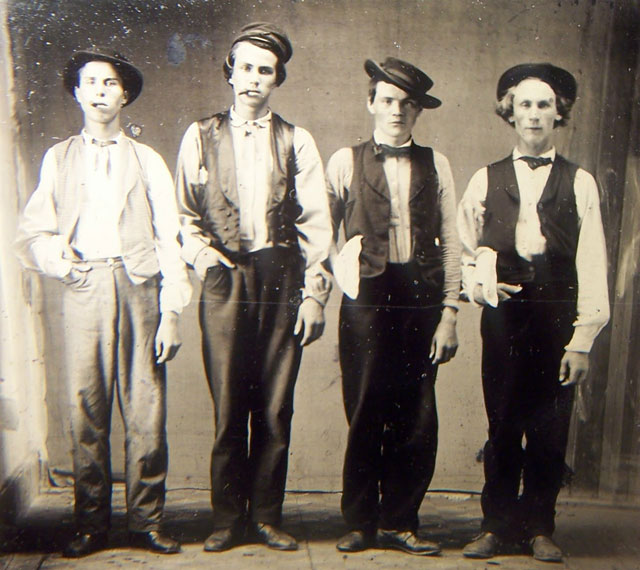
Wild west (anti)heroes in a rare (and maybe not real) group photo

by Cory Doctorow
Kara Jean

Doc Holliday seems like a babe


This may be a photo of Billy the Kid, Doc Holliday, Jesse James, and Charlie Bowdre, taken in Las Vegas (NM) in 1879:

"There is that story that these two met in Las Vegas at the Old Adobe Hotel on July 26, 1879, and during a card game Jesse asked Billy to join his gang..........Henry Hoyt and Migeul Otero say so in their books, and that they witnessed it..............But Jesse James did stay at the Old Adobe Hotel from July 26 through July 29 in the summer of 1879, according to an announcement in the Las Vegas Optic printed weeks later. The owner of the Old Adobe Hotel, W. Scott Moore, was from Clay County, Missouri, Jesse's home turf, and was a childhood friend of his. Hoyt recalled Jesse's missing finger and his alias, Mr. Howard. And Jesse was on the run, so New Mexico is possible."

Billy the Kid and Jesse James (via Kottke)

    
09 May 21:54

Photo


09 May 15:09

Photo


09 May 14:16

Amazing treehouses

by Rob Beschizza
Kara Jean

Let me sit in each of them.

Leslie Horn collects some of the most ingenious, Myst-tastic treehouses on the planet. [Gizmodo]


09 May 14:10

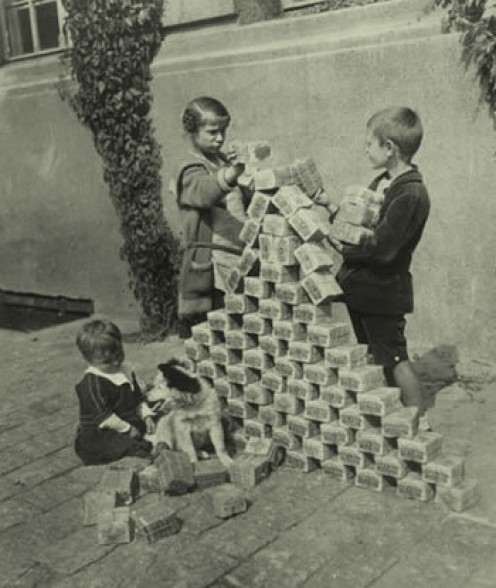
German children use bundled inflationary money as blocks, 1923

by Cory Doctorow


Here's a little visual aid for any inflation hawks out there who're looking for just the right graphic to stick in a powerpoint decrying stimulus packages or extolling gold's virtue: a group of Weimar-era kids using bundles of devalued Deutsche marks Reichsmarks as building blocks.

German children using marks as building blocks, when Germany tried to pay its war debts by printing money, causing hyper-inflation. 1923. (via Dark Roasted Blend)


09 May 14:06

Ultraconserved words? Really??

by Sally Thomason
Kara Jean

A bit of a takedown of that claim of having found evidence of a proto-Eurasian language.

On the web site of the Proceedings of the National Academy of Sciences, in the "Early Edition" section, is an article by Mark Pagel, Quentin D. Atkinson, Andreea S. Calude, and Andrew Meade: "Ultraconserved words point to deep language ancestry across Eurasia". The authors claim that a set of 23 especially frequent words can be used to establish genetic relationships of languages that go way, way back — too far back for successful application of the standard historical linguistics methodology for establishing language families, the Comparative Method.  The idea is that, once you've determined that these 23 words are super-stable (because they're used so often), you don't need systematic sound/meaning correspondences at all; finding resemblances among these words across several language families is enough to prove that the languages are related, descended with modification from a single parent language (a.k.a. proto-language).

This is the latest of many attempts to get around the unfortunate fact that systematic sound/meaning correspondences in related languages decay so much over time that even if the words survive, they are unrecognizable as cognates (sets of words descended from the same word in the parent language).   This means that word sets that have similar meanings and also sound similar after 15,000 years are unlikely to share those similar sounds as the result of inheritance from a common ancestor; if they were really such ancient cognates, they would almost surely not look much alike at all. (See "Scrabble tips for time travelers", 2/26/2009, for a discussion of some earlier work.)

I'm not qualified to judge Pagel et al.'s statistics, although I remain skeptical of their basic claim that words that haven't been replaced often in a handful of language families with vastly different time depths can be predicted to be super-stable in all language families. But there are problems with their premises in this article, in which their goal is to compare words from seven different language families and to show that, according to their statistics, all seven should be grouped together into a single super-family. I think they have a serious garbage in, garbage out problem.

Pagel et al. used their statistical method to compare reconstructed words for the seven language families they identify: Altaic, Chukchi-Kamchatkan, Dravidian, Eskimo, Indo-European, Kartvelian, and Uralic. One problem is that Eskimo is not a language family; it's part of the Eskimo-Aleut language family, and any effort to find deeper genetic relationships for Eskimo that doesn't take Aleut data into account is not likely to be useful.

A more serious problem is that Altaic is at best highly controversial as a proposed language family. The hypothesized Altaic family comprises three well-established families — Turkic, Mongolian, and Tungus — plus Korean and Japanese. It's a very old idea, but efforts to provide convincing evidence that all these languages belong in a single Altaic family have failed to convince most specialists. A prominent recent exchange appeared in the journal Diachronica (2004, 2005), starting with Stefan Georg's devastating review of Sergei Starostin et al., Etymological dictionary of the Altaic languages, and continuing with Starostin's reply and Georg's reply to the reply. In his reply, Starostin commented plaintively that he had hoped `that the publication of more than 2000…Altaic etymologies would put an end' to the dispute about whether an Altaic language family exists. To this Georg responds, though not in these words, that 2000+ unconvincing etymologies do not add up to any convincing etymologies at all.

In his review, Georg criticizes Starostin et al. for erroneous reconstructions of words in the individual language families and for a very loose standard of semantic "matching". The latter may be the most common criticism of word comparisons in efforts to establish very distant linguistic relationships; the other major criticism is a very loose standard of phonetic "matching". Given enough semantic and phonetic latitude, it's possible to amass a large number of "matching" sets of words for any set of two or more randomly selected languages. (If you don't believe me, try it: take bilingual dictionaries and search for similar-looking words that have vague semantic connections. It's an easy exercise.)

So I went to the website from which Pagel et al. got their data, the Languages of the World Etymological Database, and checked their 23 words in the Altaic database, which is presumably derived from Starostin et al.'s three-volume etymological dictionary. Only two of the 23 words have a single "Proto-Altaic" etymon each in the database, `what' and `spit (verb)'. All the others (except perhaps `I', `we', and `ye', which I couldn't find due to problems with the search function) have 2-7 "Proto-Altaic" forms each, and at least nine of the words have five or six each. How did Pagel et al. decide which "Proto-Altaic" word to compare to their other six reconstructed proto-languages? They apparently examined all of the possible words for each translation, e.g. five "Proto-Altaic" words for `that', four for `hear', 5 for `flow', 4 for `hand', and so forth; they then chose just one proto-word for each meaning, namely, the one `that the LWED proposed as cognate between language families', and used that one for their statistical analyses. This is a puzzling procedure, for two reasons. First, the Altaic database (and the Indo-European database too, and perhaps others as well) often lists more than one proto-word as cognate with words in some of the other six proposed language families. Pagel et al. do not say how they decided which set of putative cognates to select. Second, while acknowledging that linguists often `propose more than one proto-word for a given meaning', they observe that these proposals `can reflect synonyms in the proto-language or, more likely, uncertainty as to which of the words used among a language family's extant languages are most likely to be cognate to the ancestral word.' But if they believe (erroneously!) that synonyms are unlikely in proto-languages, and that apparent synonyms probably reflect linguists' uncertainty, how can they be confident that any selection from one of several options for a given meaning for the proto-language is the genuine one and only word for that meaning in the proto-language? What does this indeterminacy do to their claim that words for certain meanings are super-stable, unlikely to be replaced over thousands of years? And doesn't it introduce an element of circularity into their statistical calculations when they choose the set of proto-words to be compared according to its putative match with other language families and not according to an independent criterion?

There are other serious problems too. Unlike Altaic, most of the other families in the LWED databases are genuine language families. But if the "Proto-Altaic" reconstructions are representative of the quality of the reconstructions for the established families, it would be rash to rely on them. This is in spite of the fact that some of the reconstruction databases (e.g. Indo-European and Dravidian) are based on standard etymological dictionaries. The "Altaic" database contains variables in numerous reconstructions — usually V for an unspecified vowel, but also optional and alternate consonants — that make phonetic "matching" even easier (and therefore less reliable). This is a feature of many reconstructions carried out by people engaging in long-range comparison of languages, including efforts to establish a Nostratic super-family. In at least some of the individual LWED databases, the reconstructions based on standard sources have been `revised and significantly modified' (quoting George Starostin, Dravidian database) by others, and those others are believers not only in Altaic but in the super-family Nostratic. Reconstructions carried out by true believers in Nostratic are all too likely to be influenced by knowledge of words with vaguely similar meanings and/or forms in other proposed Nostratic languages — namely, in the LWED databases, the seven families compared by Pagel et al.

I also checked Pagel et al.'s supposedly super-stable words in the LWED's Indo-European (IE) database. One notable fact is that, of these 23 words, English retains only 6 or 7, assuming that the LWED's database is accurate — a fact that might be expected to limit Pagel et al.'s confidence in the reliability of their 23 words as an indicator of genetic relatedness. The count for English depends in part on whether the IE database has accurate reconstructions — `spit' in particular is dubious, because this IE database disagrees with the Oxford English dictionary (OED) here and the sounds don't match well enough to be convincing. I haven't checked all of the relevant LWED etymologies, but it looks there's a reasonable Proto-Indo-European etymology for the English words give, man, mother, fire, flow, and worm, in their current meanings.

The IE database has a sizable number of eyebrow-raising etymologies; like the database for "Altaic", it does not inspire confidence, although there is of course no question about the relatedness of the IE languages. There are many variables in the reconstructions, and many the forms themselves often bear little resemblance to mainstream Indo-Europeanists' reconstructions. The semantic looseness is often extreme. For instance, the database glosses a reconstructed form *(a)den@gh- (where @ = schwa) as `to reach, to seize, to have time'. Among the proposed descendants of this form are a Tocharian B form meaning `rise, raise oneself up', an "Old Indian" (Sanskrit?!) form meaning `reach, strike', an "Old Greek" (Ancient Greek?!) form meaning `with the teeth, biting together', and an Old Irish form meaning `repress, oppress, suppress, crush, put down'. This is typical of the semantic latitude. Formally, too, there are problems. The proposed "Old Indian" descendant of this proto-word is given as daghnoti, possibly on the assumption that the nasal of the reconstructed root metathesized with the gh; but the nasal of the Sanskrit form is a present tense suffix, not part of the root at all. So Sanskrit (by whatever name) doesn't match the database's proto-word phonetically.

If the reconstructions used by Pagel et al. for their statistical analyses are not reliable in either form or meaning, then the statistical results of comparing these reconstructions cannot provide any evidence for distant relationships among the seven groups they compare. If the selection procedure for choosing among several candidate proto-words to use for the statistical analysis is flawed, then there may be problems with the statistics as well. But even if there are no statistical flaws, the Pagel et al. paper is yet another sad example of major scientific publications accepting and publishing articles on historical linguistics without bothering to ask any competent historical linguists to review the papers in advance.

There is a larger moral here too. Early in their paper, Pagel et al. report, correctly, that after 5,000-9,000 years, `most words are thought to suffer from too much semantic and phonetic erosion to allow secure identification of true cognates', in particular (though they don't emphasize this point) because of the decay and loss of `the sound and meaning correspondences…which are thought to indicate that they derive from common ancestral words.' The authors intend their statistical method to provide evidence for relatedness of languages that are beyond the reach of the Comparative Method. Like other long-rangers with dreams of discovering bigger and bigger family groupings — maybe even the ur-human language, what the late Joseph Greenberg called Proto-Sapiens — Pagel et al. believe that abandoning the one method that is known (not just "thought") to be reliable can achieve the goal. But you still can't make a silk purse out of a sow's ear.
09 May 02:18

Photo


08 May 17:12

Photo


08 May 13:42

The Owl and the Runner Duck: Best Pals Take a Nap

by Andrew Bleiman

Duck awake

Friendship comes in many forms, and at times can be forged with the most unlikely of companions. This is often true in the animal world, and was proven this week at Kirkleatham Owl Center in Redcar, North East England. Meet ''Chop-suey'' the baby White-crested Runner Duck and ''Larch'' a tiny baby Long-eared Owl. A very odd couple, but the best of pals! 

The two three-week-old babies met at the center, and are now inseparable. Initially there were  a dozen duck eggs in the Center's incubator, but only one hatched, producing little Chop-suey. Although the chick was content with human company, he was not happy being left alone. Larch the Owl had been by himself there so staff put the two together and they instantly snuggled up and fell asleep!

Duck cu

Duck both asleep

Duck nap
Photo Credit: Kirkleatham Owl Center

They won't be able stay together for much longer due to their differing needs as they develop," said a spokesperson at the Center, "but while they are still very small we are more than happy for them to enjoy their time together."

Long Eared Owls are a very secretive species, but being hand reared Larch is confident around people, especially with best friend Chop-suey at his side. It is hoped that both will take part in the center's flying displays, although probably not together. Larch will be a fast flyer, while ''Chop Suey'' being a runner Duck is more of a ground bird.

Watch as these two settle in for a snooze on the video below:

08 May 03:01

radicalmtn:

07 May 15:10

Beardsley Zoo Welcomes Two New Kids

by Andrew Bleiman
Kara Jean

I want a goat. I want one. Or several.

Goat 1

On April 22nd, after a five month gestation, Connecticut's Beardsley Zoo's female Nigerian Dwarf Goat Cupcake gave birth to two female kids. The birth came less than two months shy of their father Rodney's first birthday in June. The zoo is reporting that the young, who have yet to be named, are healthy and happy as they explore the zoo's goat yard. "Mom and kids are doing quite well and are a favorite with visitors already," said zoo director Gregg Dancho. "Cupcake is very protective of them and likes to hide them in the exhibit, so visitors may have to look hard to see them," he continued.

Goat 2

Goat 3

Goat 4
Photo credits: Shannon Calvert taken at Beardsley Zoo

The offspring will continue to nurse from their mother for the next few months, though they will begin to nibble on their adult diet of hay and grains in the next week or so. Visitors to the zoo will be excited to hear that the zoo's goat yard is expecting another special delivery; Cupcake's sister Peaches is expecting kids as well.

Nigerian Dwarf Goat's are miniature dairy goats that grow to be around 75 pounds and less than two feet tall. They posses a range of coat colors including black, brown and white, and can have various patterns of these colors. Young males are fully fertile at just seven weeks of age, while females are able to be bred at eight months.

Related articles
07 May 14:41

Photo


07 May 14:34

Photo

Kara Jean

Get a life you ganja gremlin!


07 May 13:51

Ancient Eurasiatic ‘superfamily’ found at root of European and Asian languages

by Ian Sample, The Guardian
Kara Jean

via Nora

Languages spoken by billions of people across Europe and Asia are descended from an ancient tongue uttered in southern Europe at the end of the last ice age, according to research.

The claim, by scientists in Britain, points to a common origin for vocabularies as varied as English and Urdu, Japanese and Itelmen, a language spoken along the north-eastern edge of Russia.

The ancestral language, spoken at least 15,000 years ago, gave rise to seven more that formed an ancient Eurasiatic “superfamily”, the researchers say. These in turn split into languages now spoken all over Eurasia, from Portugal to Siberia.

“Everybody in Eurasia can trace their linguistic ancestry back to a group, or groups, of people living around 15,000 years ago, probably in southern Europe, as the ice sheets were retreating,” said Mark Pagel, an evolutionary biologist at Reading University.

Linguists have long debated the idea of an ancient Eurasiatic superfamily of languages. The idea is controversial because many words evolve too rapidly to preserve their ancestry. Most words have a 50% chance of being replaced by an unrelated term every 2,000-4,000 years.

But some words last much longer. In a previous study, Pagel’s team showed that certain words – among them frequently used pronouns, numbers and adverbs – survived for tens of thousands of years before other words replaced them.

For their latest study, Pagel used a computer model to predict words that changed so rarely that they should sound the same in the different Eurasiatic languages. They then checked their list against a database of early words reconstructed by linguists. “Sure enough,” said Pagel, “the words we predicted would be similar, were similar.”

Writing in Proceedings of the National Academy of Sciences, the authors list 23 words found in at least four of the proposed Eurasiatic languages. Most of the words are frequently used ones, such as the pronouns for “I” and “we”, and the nouns, “man” and “mother”. But the survival of other terms was more baffling. The verb “to spit”, and the nouns “bark” and “worm” all had lengthy histories.

“Bark was really important to early people,” said Pagel. “They used it as insulation, to start fires, and they made fibres from it. But I couldn’t say I expected “to spit” to be there. I have no idea why. I have to throw my hands up.”

Only a handful of verbs appear on the list, but Pagel points out “to give”, which appeared in similar form in five of the Eurasiatic languages. “This is what marks out human society, this hyper-co-operation that we do,” he said.

From their findings, the scientists drew up a family tree of the seven languages. All emerged from a common tongue around 15,000 years ago, and split off into separate languages over the next 5,000 years.

“The very fact that we can identify these words that retain traces of their deep ancestry tells us something fundamental about our language faculties. It tells us we have this ability to transmit highly complicated and precise information from mouth to ear over tens of thousands of years,” said Pagel.

guardian.co.uk © Guardian News and Media 2013

– –
[Caveman via Shutterstock]

07 May 11:45

lolzpicx: Just searching for a place I’ll fit in.


lolzpicx: Just searching for a place I’ll fit in.

07 May 11:45

goldenclitoris:

06 May 19:09

popularsizes:

Kara Jean

gimme this bedspread

06 May 13:36

Photo


06 May 02:42

Whaling/Wailing/Waling on

by Mark Liberman
Kara Jean

"Whaleing a gentleman is but a vulgar revenge."

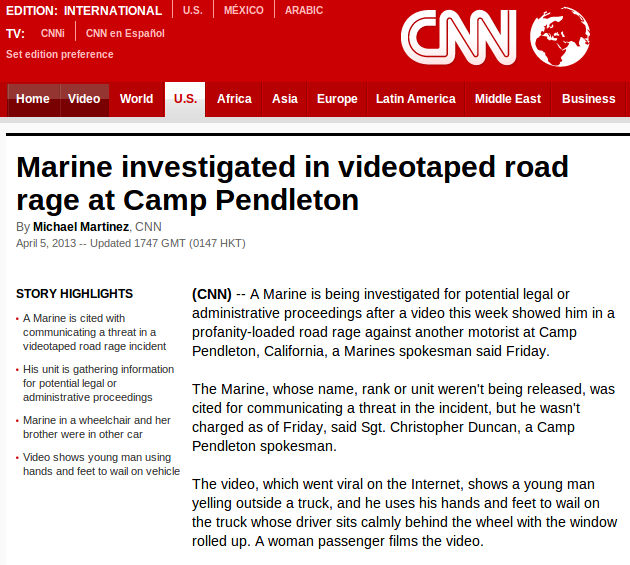
Michael Martinez, "Marine investigated in videotaped road rage at Camp Pendleton", CNN 4/5/2013:

The Marine, whose name, rank or unit weren't being released, was cited for communicating a threat in the incident, but he wasn't charged as of Friday, said Sgt. Christopher Duncan, a Camp Pendleton spokesman.

The video, which went viral on the Internet, shows a young man yelling outside a truck, and he uses his hands and feet to wail on the truck whose driver sits calmly behind the wheel with the window rolled up. A woman passenger films the video.

The cited video is here, though 6,235 views seems short of "viral" status .


The OED has whale, v.2 Now U.S. colloq. "To beat, flog, thrash". The etymology is given as

Of obscure origin. Commonly regarded as a spelling of wale v.1, but there are difficulties of form, chronology, and meaning. Perhaps originally = to thrash with a whalebone whip

The citations are

1790   F. Grose Provinc. Gloss. (ed. 2) ,   Whale, to beat with a horsewhip or pliant stick.
1801   G. Hanger Life II. 162   Whaleing a gentleman is but a vulgar revenge.
1884   ‘M. Twain’ Adventures Huckleberry Finn iii. 30   He used to always whale me when he was sober and could get his hands on me.

For most people, a pugilistic interpretation of wail "grieve aloud", in the spirit of the musical usage "To perform in an especially vigorous and exciting way", probably makes more sense than anything having to do with cetaceans.  So I wasn't surprised by the eggcorn, for which there's plenty of precedent — COCA has 4 instances of "whale on" vs. 16 instances of the same idiom spelled with "wail" (6 "wailing on", 4 "wail on", 3 "wailed on", 3 "wails on"); and examples of "wail away at" were entered into the Eggcorn Database by Arnold Zwicky in 2005.

[And COCA also has two cases where the idiom is spelled "wale", both in the form "waling on".]

But I don't recall having seen this expression used in formal writing before, in whatever spelling. If CNN counts as formal writing. And not that I object or anything.

06 May 00:36

Photo


05 May 22:54

Photo


05 May 22:53

Photo


05 May 22:53

Photo


05 May 21:26

I secretly think reality exists so we can speculate about it

by but does it float
Tree series by Myou Ho Lee Title: Slavoj Žižek More trees on BDiF Folkert
05 May 16:36

Photo


05 May 06:40

In Japan, a new hairdo idea: "Ripe Tomato"

by Xeni Jardin
Kara Jean

Ah Amemura, "America Village," where nothing is even remotely American.

Brian Ashcraft at Kotaku blogs about a neat idea for a hair style from a stylist in Japan. It's called "Ripe Tomato" ("kanjuku tomato" or 完熟トマト), and was created by "Hiro" at a salon in Osaka called "Trick Store", in the trendy Amemura district. Read: You'll Never Forget Japan's Tomato Hairdo.


04 May 06:16

Baboons raise pet dogs

by Rob Beschizza

David Mizejewski writes:

The video below shows some fascinatingly odd animal behavior that I've never heard of before: baboons stealing stray puppies from their mothers and raising them as part of their troop. This kind of interspecies interaction where one species raises another species specifically for companionship and protection--in other words, keeping pets--is behavior that is typically attributed only to humans. To see it happening with baboons and dogs is nothing short of amazing.


04 May 05:47

How can you hide from what never goes away?

by but does it float
Kara Jean

Let me live in a crazy tower.

Paintings by Minoru Nomata Title: Heraclitus Heraclitus translated by Guy Davenport via Invisible Stories Previously: The Architect of Ruins Will 50 Watts
03 May 21:06

Photo


03 May 18:22

Sneak Peek: Infant Squirrel Monkey Gets Bottle-Fed at Warsaw Zoo

by Andrew Bleiman

Squirrel monkey 1

An orphaned Common Squirrel Monkey is in very good hands at Warsaw Zoo. The infant was born at the zoo on March 28th and is now being bottle fed and raised by dedicated caretakers. The tiny monkey is male who weighed just 167 grams at birth. He is healthy and doing well.  

Squirrel monkey 3

882924_563105870396038_338400625_o

921576_565819436791348_819970592_o

Squirrel monkeyy
Photo credits: Warsaw Zoo

Common Squirrel Monkeys are found abundantly throughout the rain-forests of South America. Very agile and playful, they are highly social animals that live in hierarchical groups. Males and females live in separate social groups. The females tend stay based around certain feeding and resting sites, while males travel more widely. During the mating season, the dominant male will mate with many or all the mature females that his group encounters.

Learn more after the fold! 

Females give birth to a single baby after a gestation period of 150-170 days. The females help each other to care for young. At four to ten weeks old, the young begin to explore their surroundings and engage in play that will help them to develop important skills, such as foraging for insects and fruits. Infants are born with prehensile tails, but lose this trait as they mature. The young monkeys become independant at about ten months of age.

Related articles Just Say 'Mo': Oregon Zoo's Baby River Otter Gets A Name Bear Fight! Meerkat Kits Arrive at Warsaw Zoo Prickly Porcupette a Surprise for Woodland Park Zoo