Artist Cy Kuckenbaker digitally reorganized the traffic in this video by color.
(via http://stellar.io/interesting)
Tags: Cy Kuckenbaker traffic videoArtist Cy Kuckenbaker digitally reorganized the traffic in this video by color.
(via http://stellar.io/interesting)
Tags: Cy Kuckenbaker traffic videoWorking for CBS and later on his own in the 40s and 50s, sound engineer Charley Douglass perfected the laugh track technique, which was then called sweetening. His secret weapon was the laff box, a machine that you could use like a typewriter to produce the type and sequence of laughter you needed for a particular situation. Here's how the machine worked:
The one-of-a-kind device -- affectionately known in the industry as the "laff box" -- was tightly secured with padlocks, stood more than two feet tall, and operated like an organ. Only immediate members of the family knew what the inside actually looked like (at one time, the "laff box" was called "the most sought after but well-concealed box in the world"). Since more than one member of the Douglass family was involved in the editing process, it was natural for one member to react differently to a joke than another. Charley himself was the most conservative of all, so producers would put in bids for other editors who were more liberal in their choice of laughter. Douglass used a keyboard to select the style, gender and age of the laugh as well as a foot pedal to time the length of the reaction. Inside the machine was a wide array of recorded chuckles, yocks, and belly laughs; exactly 320 laughs on 32 tape loops, 10 to a loop. Each loop contained 10 individual audience laughs spliced end-to-end, whirling around simultaneously waiting to be cued up. Since the tapes were looped, laughs were played in the same order repeatedly. Sound engineers would watch sitcoms and knew exactly which recurrent guffaws were next, even if they were viewing an episode for the first time. Frequently, Douglass would combine different laughs, either long or short in length. Attentive viewers could spot when he decided to mix chuckles together to give the effect of a more diverse audience.
I found out about the laff box from Kevin Slavin & Kenyatta Cheese's talk about how, with the Internet, the audience now has an audience.
Tags: audio Charley Douglass Kenyatta Cheese Kevin Slavin TV videoIn a video analogue of Alvin Lucier's I Am Sitting in a Room, this YouTube video is uploaded and then downloaded 1000 consecutive times until the image becomes all artifacts.
(via digg)
Tags: Alvin Lucier remix video"Hoping to cultivate a better understanding of where the food on our plates comes from, Tomm Velthuis designed a toy farm highlighting the unsustainable reality of the meat industry.
The wooden set, called Playing Food, comes complete with 200 pigs, the enormous amounts of food required to fatten them up, the trees that must be cleared for feed crops, and the acid rain caused by the pigs’ manure. It’s factory farming packaged as an ‘innocent’ childhood toy."
See more pictures at Tomm's blog. The farm is on display at mEATing-kill your darlings, an art event about our relationship with meat and animals in Tilburg, the Netherlands. See also: Can I see your Meat License?
Jess*sigh* I just love Scandinavia.
Katie Baker notes that a prominent member of the pickup artist community has written a book about why Denmark is a bad place for pickup gurus to find women. Turns out that the Nordic country's "excellent social welfare services" also function as an effective douchebag repellant.
Tags: Denmark Katie BakerFans of the travel writer will be disappointed that "pussy literally goes into hibernation" in this "mostly pacifist nanny state," where the social programs rank among the best in the world. Roosh's initial admiration for those resources is almost charming, if you're able to momentarily forget that this is a man who considers devirginizing teenagers a sport.
"A Danish person has no idea what it feels like to not have medical care or free access to university education," an awed Roosh reports. "They have no fear of becoming homeless or permanently jobless. The government's soothing hand will catch everyone as they fall. To an American like myself, brainwashed to believe that you need to earn things like basic health care or education by working your ass off, it was quite a shock."
Shock turns into disbelief and then rage when Roosh is rejected by heaps of "the most unfeminine and androgynous robotic women" he's ever met. "Not a feminine drop of blood courses through their veins," Roosh rants. He concludes that the typical fetching Nordic lady doesn't need a man "because the government will take care of her and her cats, whether she is successful at dating or not."
He's not wrong. Several of Denmark's social services are intended to reduce gender inequality by supporting women, a sort of state feminism that he can't accept.

Impostor Syndrome is feeling like you’re not worthy of whatever success you’ve had. You feel that you’ll be “found out” at any second.
Students don’t just feel this. Everyone encounters this at some points. But why? Why do we feel like this? Dr. Valerie Young says that, “The thing about ‘impostors’ is they have unsustainably high standards for everything they do. The thinking here is, If I don’t know everything, then I know nothing. If it’s not absolutely perfect, it’s woefully deficient. If I’m not operating at the top of my game 24/7, then I’m incompetent.”
Cyclone Life has some tips on how to break out of the cycle.
Jessyes yes yes yes yes
Download this as a one-page .pdf.
credits:
music: “utopia (instrumental)” by yacht used under a creative commons attribution noncommercial sharealike license.
font: blackout by league of moveable type used under a creative commons attribution sharealike license.
The Sweethome tested a bunch of locks, consulted with bike thieves, and sifted through other reviews and chose the best bike lock for your bike.
Tags: cyclingThe consensus among those in the know was that a u-lock is best for virtually everyone, offering the highest ratio of security to portability. Unconventional devices like folding locks are intriguing, but so far none offer the security of a good u-lock. Chains sometimes offer a slight bump in security, but they often weigh twice as much and still relent to power tools. Let masochists wear belts of hardened steel; all our experts said a good u-lock is the sensible solution.
But before we talked specific lock models, they also insisted we slow down. Most people don't know how to use their locks, they said. Most people buy big, heavy expensive u-locks and then don't secure their bike's frame, or don't lock to an immobile object, or worse. Videos like this and this and this drive the point home.
Both the professional and petty thieves we talked to suggested that if a cyclist couldn't take his bike inside, he should lock his bike in a different spot each day, making it harder to case out. And they encouraged people to ride cheaper bikes. After all, the resale value of a bike -- and its expensive components -- is what makes the thing worth stealing.
Kevin Delaney, the head of Wayland High School's history department, gave his 11th grade students an interesting challenge: find out everything you can about the person who owned a dusty briefcase full of papers that Delaney had found in the storage room. The man, Martin Joyce, turned out to have a life that spanned many significant events in history and his story provided the students with a personal lens into history.
Inside were the assorted papers -- letters, military records, photos -- left behind by a man named Martin W. Joyce, a long-since deceased West Roxbury resident who began his military career as an infantryman in World War I and ended it as commanding officer of the liberated Dachau concentration camp. Delaney could have contacted a university or a librarian and handed the trove of primary sources over to a researcher skilled in sorting through this kind of thing. Instead, he applied for a grant, and asked an archivist to come teach his students how to handle fragile historical materials. Then, for the next two years, he and his 11th grade American history students read through the documents, organized and uploaded them to the web, and wrote the biography of a man whom history nearly forgot, but who nonetheless witnessed a great deal of it.
"Joyce became the thread that went through our general studies," Delaney says. "When we were studying World War I, we did the traditional World War I lessons and readings. And then stopped the clocks and thought, 'What's going on with Joyce in this period?'"
As the class repeatedly asked and answered that question, they slowly uncovered the life of a man who not only oversaw the liberated Dachau but also found himself a participant in an uncommon number of consequential events throughout Massachusetts and U.S. history. In a way Delaney couldn't have imagined when he first popped open the suitcase that day, Joyce would turn out to be something akin to Boston's own Forrest Gump -- a perfect set of eyes through which to visit America's past.
Fantastic, what a great story. My favorite tidbit is that after all the wars and stuff, he and his wife were on the Andrea Doria when it was struck by the Stockholm and sunk. Part of the students' project was building a web site pertaining to Joyce's life and includes scans of all the papers they discovered...it's well worth looking through. (via @SlateVault)
Tags: Andrea Doria Kevin Delaney Martin Joyce war World War I World War IIPowers of Ten is now a Foursquare venue. Go there, lay down on the grass, and upload a photo of yourself in the Powers of Ten pose.
Lie on the ground on a sunny day with one hand draped across your torso to recreate the starting point of the film Powers Of Ten by Charles and Ray Eames.
Chicagoans and visitors to Chicagoland, let's make this a thing. (via ★interesting-links)
Tags: Foursquare Powers of Ten videoA couple of weeks ago, a slowed-down version of Dolly Parton's classic ballad "Jolene" went viral. A lot of people who heard it loved it, a few people didn't, but everyone seemed to agree that it was like listening to either an entirely new song or the same song again for the first time.
One of the things that's eerie about this is that if you listen closely, everything is just a little bit out of tune. There's conflicting information about exactly how much the track has been slowed. Some people have said that it's simulating a 45 RPM record played at 33 1/3, which is certainly the most common way people who lived with record players heard popular songs at slower speeds. But that would actually be quite a bit slower and lower than this.
The other figure I've seen (forgive me for not citing everything, I'm typing as fast as I can) is "Jolene" has been slowed by 17 percent, which sounds about right and would explain why all the notes seem just a little bit sharp. Here's the formula for slowing or speeding up a recording to shift the pitch but generally stay in tune:
(2 ^ (semitones change/12) - 1) *100 = Percent Change
So -- as one does when procrastinating from remunerative work -- I made an Excel spreadsheet.
If you want to drop two semitones, you shift the speed down by 12.2462 percent; drop three, you shift by 18.9207 percent, which significantly changes the track. To imitate a 45 RPM record played at 33 1/3, that's about 25.926, but very few records still sound like something a person actually made at this speed. All of these slowdowns are interesting, even the ones that don't work.
You can do all of them in the free/open-source audio processing app Audacity; it's very fast and very easy. (If you want to get freaky, you can also use Audacity to change pitch without changing tempo, or vice versa, or to start out slow and go fast, and all manner of lesser and greater perversity.)
But after messing with Audacity for longer than was strictly necessary, I can tell you that some songs and transformations work out better than others, and they tend to be those that share a lot of the same characteristics as Jolene:
And so, here are some of the results:
I described this Prince track as sounding like the slowest, sultriest, funkiest Sylvester song you've ever heard.
Mazzy Star surprised me. I always thought Hope Sandoval's vocals were gorgeous but a little warbly, which gave them character, but that's almost entirely a production effect. When you slow it down, you can really hear how clean and sustained her notes are.
My Bloody Valentine is the best example of that fractal quality. You can slow it down almost indefinitely and it still sounds like My Bloody Valentine. At this rate, though, it really just turns Bilinda Butcher's vocals into Kevin Shields'.
There's more at my Soundcloud page, including The Breeders' "Cannonball," "House of Jealous Lovers," Hot Chip's "Over and Over," Grizzly Bear's "Two Weeks" (which I actually sped up), and more. (Finally, if slowing a track down and posting it online somehow breaks copyright, let me know and I'll take them down.)
Update: Andy Baio tips me to a second remix of "Jolene" that slows down the track, but corrects the pitch. Sounds great.
Update 2: Here's Michael Jackson's "P.Y.T." slowed from 127 BPM to 110 BPM, leaving the pitch as-is.
Tags: Audacity Dolly Parton Jolene Mazzy Star Michael Jackson music My Bloody Valentine Prince timeJessMaybe actually my favorite thing written about the March for Jobs & Freedom.
Today is the fiftieth anniversary of the March on Washington for Jobs and Freedom. The full title is important because the right words are important.
@Soledad_OBrien Everyone forgets that the "March on Washington" was the "March for Jobs and Freedom."
— Tim Carmody (@tcarmody) August 23, 2013
It's important because the Great March itself was a compromise, an evolution of the movement A. Philip Randolph of the Brotherhood of Sleeping Car Porters had forged decades before during the Roosevelt and Truman administrations to force the government to desegregate the army and provide more economic opportunities to black Americans. Each time the March was about to happen, the government made concessions and it would be called off.
Randolph was 74 when the March finally materialized in 1963, with him as its titular head, the only figure with the credibility to unify northern labor leaders and southern pastors, radical enough for the relative radicals (the radical radicals saw the March as a sideshow or were actively asked not to get involved) and institutional enough for the wary moderates. (Bayard Rustin was Randolph's lieutenant, and did the bulk of the work organizing the March. Rustin was gay, had been a Communist, and couldn't be its public face.)
Special trains leaving from Penn Station to bring marchers to DC. Officials say it's the largest early-morning crowd since end of WW2.
— Today in 1963 (@todayin1963) August 28, 2013
Everything that happened there, from the arrival of more than 100,000 people through all the speeches, all of the songs, all the signs painted, all the 80,000 cheese sandwiches made, distributed, and eaten, and every one of those moments, happened in one day. Television stations were able to carry the event live. No one but Rustin could have pulled it off.
John Lewis was 23 years old and the March's youngest speaker. He is the only one of that day's speakers who is still alive. He had recently been made head of the Student Nonviolent Coordinating Committee, or SNCC, a new independent civil rights organization that had proven itself integrating lunch counters in Nashville, on the Freedom Rides with CORE protesting segregated busing and bus stations throughout the south, and working with the NAACP and Southern Christian Leadership Conference (SCLC) in Albany, Georgia.
If you're serious about the civil rights movement, you have to learn a lot of organizations' names and abbreviated titles. You have to learn that the leaders of these organizations rarely agreed with each other, and within each organization there was an equal amount of discipline and dissent. They were organized because they had to be. They were disciplined because they had to be. They were allied because they had to be. It was all fragile. At any moment, it could all fall apart.
Lewis had been part of both series of Freedom Rides and had been badly beaten during the second in Montgomery when the state highway patrol abandoned the riders to a white mob at the city station. He was 21 years old. His friend Jim Zwerg was also 21, and went out the door of the bus first, and was nearly beaten to death, partly because he was white. Jim Zwerg is still alive. It's amazing any of these people are still alive.
August 28, 1955, Emmett Till is murdered.
— Melissa Harris-Perry (@MHarrisPerry) August 28, 2013
Lewis was originally going to give a much more provocative speech at the March, singling out the supposedly liberal Kennedy administration for its lukewarm (a less polite word would be half-assed) support of civil rights, and arguing that the civil rights bill proposed by the Kennedy administration was "too little and too late." Each of the March's major figures, including Rustin and Dr. King, urged Lewis to moderate his speech. They had a testy but evolving relationship with the Kennedys that they didn't want to aggravate or jeopardize. It was only A. Philip Randolph who swayed Lewis.
Lewis was 51 years younger than Randolph. Lewis later said of Randolph that "if he had been born in another period, maybe of another color, he probably would have been President." Randolph had been an actor as a young man, and his voice has that deep, archaic, clear-toned, echoing-from-infinity quality that you imagine is the voice of history itself, the voice you imagine reading the Gettysburg Address and Declaration of Independence.
Lewis and the other young leaders of SNCC were quite rightly in awe of him.
He was 75, and here we were, you know, one-third his age and, you know, he was asking us to do this for him. He said, "I waited all my life for this opportunity, please don't ruin it." And we felt that for him, we had to make some concession. [Courtland Cox]
The day's speeches were already underway. This all happened in one day. Lewis was sixth on the program. So Cox and Lewis and James went to the Lincoln Memorial -- no bullshit, they went and sat together at the foot of the Lincoln fucking Memorial -- and rewrote Lewis' speech. It's still pretty fierce.
To those who have said, "Be patient and wait," we must say that "patience" is a dirty and nasty word. We cannot be patient, we do not want to be free gradually. We want our freedom, and we want it now. We cannot depend on any political party, for both the Democrats and the Republicans have betrayed the basic principles of the Declaration of Independence...
The revolution is a serious one. Mr. Kennedy is trying to take the revolution out of the streets and put it into the courts. Listen, Mr. Kennedy. Listen, Mr. Congressman. Listen, fellow citizens. The black masses are on the march for jobs and freedom, and we must say to the politicians that there won't be a "cooling-off" period...
We must say, "Wake up, America. Wake up! For we cannot stop, and we will not be patient."
I was amazed recently to discover that Reverend Doctor Joseph E. Lowery, one of the co-founders of SCLC, is still alive at 91. He has three videos of interviews up at "His Dream, Our Stories," a site devoted to the March. Lowery was a pastor in Mobile and helped lead the bus boycott in Montgomery, Alabama -- which, people forget, went on for over a year after Rosa Parks' arrest. Lowery later, along with John Lewis, Hosea Williams and others, led the Selma to Montgomery march in 1965, ten years after Emmett Till's murder and the Montgomery bus boycott, two years after the March on Washington, and a year after the Civil Rights Act, where the marchers were attacked by state and local police for trying to protest for the right to vote. In 2008, Lowery gave the benediction for Barack Obama's first Inauguration.
The March all happened in one day; the Movement happened over years and years and years.
Parks was 42 when the Montgomery bus boycott began (and 50 at the time of the March, where she was honored along with Little Rock's Daisy Bates, SNCC's Diane Nash Bevel, Cambridge, Maryland's Gloria Richardson, and Mrs. Herbert Lee in a speech by Myrlie Evers-Williams, then listed as Mrs. Medgar Evers). Lowery was 34. King was 26, not much older than Lewis was when he was called to speak and to lead SNCC. Randolph would live to be 90 years old, just a little younger than Lowery is now.
We've lost so much. We've forgotten so much. We've asked so few to stand in for so many. We're doing it still.
Copyright lawyer Josh Schiller wrote an op-ed in the Washington Post, "Why you won't see or hear the 'I have a dream' speech," examining how the King estate's vigorous defense of his speech's copyright has prevented its popular reproduction.
One place you can both see and hear King's speech is on PBS's Eyes on the Prize website. Eyes on the Prize is a landmark documentary on the entire modern civil rights movement, from Emmett Till's murder through the 1980s, when it first appeared, and its producers know more than a thing or two about the thorniest issues of copyright. Its rebroadcast and distribution were held up for years while rights for music and photographs and videos were cleared. I'm pretty sure they've done their work and paid the right licensing fees to get King's speech on the website.
Watch Dr King's speech. It's not the entire thing, and it's a crummy little QuickTime video. But it includes A. Philip Randolph's introduction, footage of the marchers arriving, and footage of President Kennedy meeting with the March's leaders, along with Walter Cronkite's contemporary commentary.
Remember this is history, which means we are still within it, even when those for whom it has been living memory leave us. Remember that it is the March on Washington for Jobs and Freedom. Remember how fragile it all was. Remember A. Philip Randolph and Bayard Rustin, Joseph E. Lowery and Jim Swerd.
Remember Martin Luther King, Jr., that thickly-built, still-young man, rooting his feet in our history and turning himself into a column of pure energy, like a beacon through time and space, a light so bright we can't look at him directly, but have to turn away and look only at his half-remembered shape still impressed on us when we close our eyes.
Remember that fifty years after the Emancipation Proclamation, A. Philip Randolph was organizing the Shakespearean Society in Harlem. Fifty years after that, he was meeting a President who now owed him more than he probably ever knew. Fifty years is a long time and yet not so very long. If so much can be done in just one day, how much more could we do, now that we know we have another fifty years?
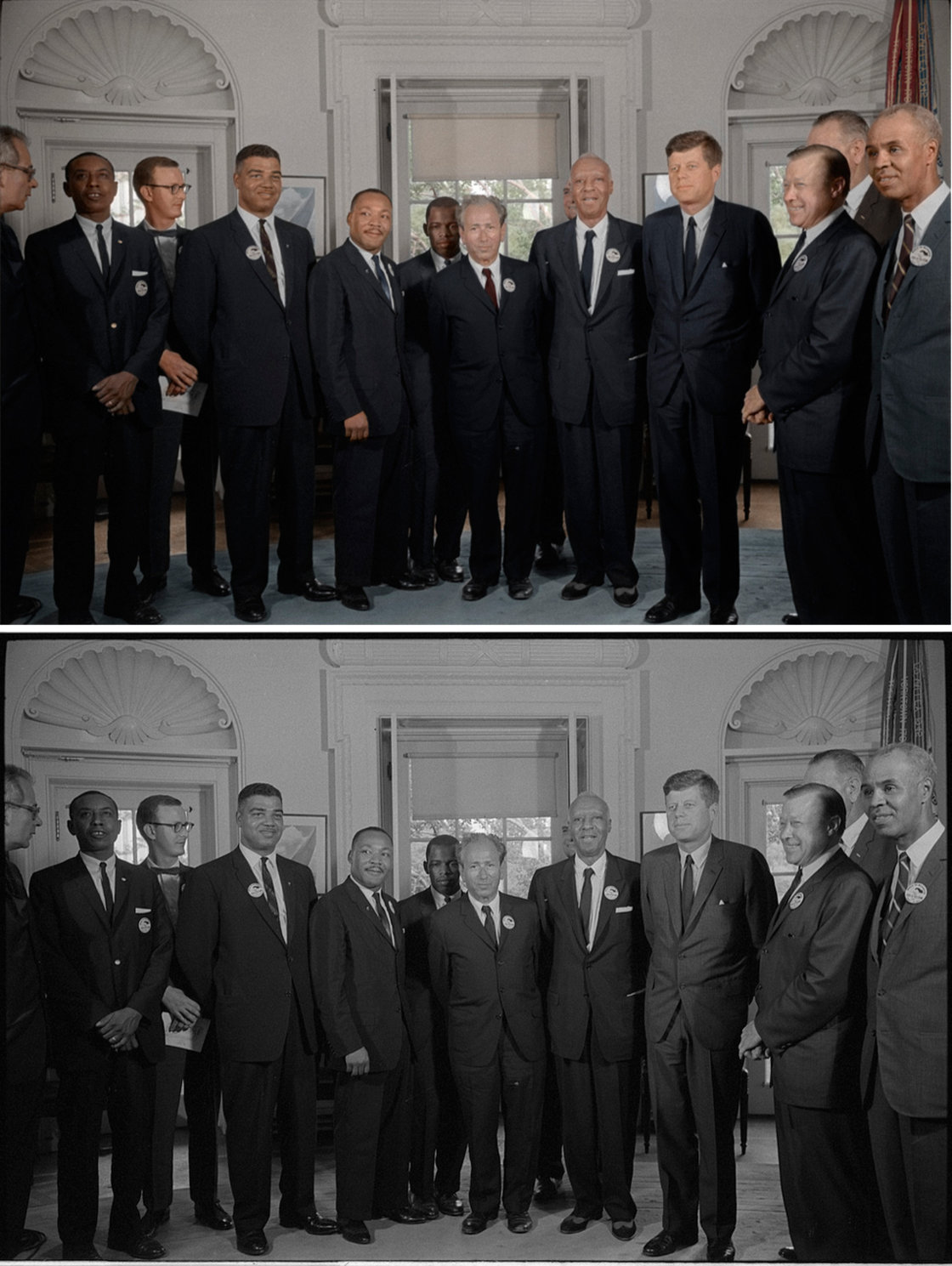 Image colorized by Mads Madsen for NPR.
JessPete wrote a whole research paper basically about this as an artistic practice, which was pretty great.
Maria Bustillos' "Curses! The birth of the bleep and modern American censorship" has a blacked-out subhed. Mouse over the black virtual ink and you see "Shit, piss, fuck, cunt, cocksucker, motherfucker, and tits," George Carlin's original list of Seven Dirty Words that can't be said on radio or television.
How'd we get here? Supposedly it was because of a nursery rhyme vaguely referencing contraception read live on a Newark radio station by actress Olga Petrova: "There was an old woman who lived in a shoe, She had so many children because she didn't know what to do." The rhyme wasn't censored, but engineers later built a switch to turn on music in case anyone recording went blue.
In the US, the government owns the airwaves and regulates their content, and bases its criteria for obscenity in part on past court cases regulating print.
In order to be considered obscenity, the material in question must pass a three-pronged test: first, it has to "appeal to the prurient interest," or be be liable to turn the average person on sexually; secondly, it must describe sexual conduct "in a patently offensive way;" and finally, "the material taken as a whole, must lack serious literary, artistic, political or scientific value." The last is how both Ulysses and Lolita slide out of being considered "obscene."
But in addition to obscenity, the FCC also has rules governing "indecency" and "profanity"; all three are technically distinct in the same way that a moron is different from an imbecile, which in turn is different from an idiot. And most of the censorship action happens within TV or radio networks' standards and practices departments anyways.
Once the bleep is introduced, however, it takes on its own meaning. It's a kind of zero-sign that artists can use deliberately for effect.
The writers of Arrested Development are masters of this comic technique, repeatedly pushing the envelope. They snuck the word "fucking" past prime time television censors by putting half the word at the beginning of the show, and half at the end.But it was with the aid of censor bleeping that Arrested Development reached the summit of its satiric genius. The show's creator, Mitch Hurwitz, told Neda Ulaby of NPR, "We realized, you know, it's more fun to not know exactly what it is that we're saying ... It becomes kind of a puzzle for people. And I think it's about, you know, letting your imagination do the work."
The full essay tracks the legal and cultural history of the bleep from its high-analog origins up to its culmination/obsolescence in the digital dump track. Now if a producer really wants to keep you from hearing something that might make someone uncomfortable, they just cut it right out of the audio, and you'd never know it was there.
Disclosure: I worked at The Verge and discussed this feature when it was in development. Also, freelance writer Maria Bustillos is awesome.
JessThe real story here is obviously actually the tote bags.

Each of these shirts offered for sale by Litographs contains the entire text of your favorite public domain book.
You may have seen these designs featured back when they were just available as posters. But what good is a poster when you have to bring someone inside your house to show them how literary you are? Now you can wear it right on your sleeve.
For those worried about allover tshirt printing, they use dye sublimation which embeds the ink in the fibers so it's not heavy paint sitting across the entirety of the shirt waiting to crack and peel. It's a smooth, long lasting process that leaves it feeling like you're wearing a regular, blank tshirt.
And with Litographs' contributions to the International Book Bank for each sale, you can look and feel good while supporting literacy.
The shirt featured above (and below, zoomed in) is the Hamlet shirt.

(via @jenny8lee)
JessNightmare folder, if anyone is listening.
JessIt's about time!
A federal judge ruled this morning that NYC's controversial stop-and-frisk practice violated the rights of "tens of thousands" of New Yorkers.
In a decision issued on Monday, the judge, Shira A. Scheindlin, ruled that police officers have for years been systematically stopping innocent people in the street without any objective reason to suspect them of wrongdoing. Officers often frisked these people, usually young minority men, for weapons or searched their pockets for contraband, like drugs, before letting them go, according to the 195-page decision.
These stop-and-frisk episodes, which soared in number over the last decade as crime continued to decline, demonstrated a widespread disregard for the Fourth Amendment, which protects against unreasonable searches and seizures by the government, according to the ruling. It also found violations with the 14th Amendment.
To fix the constitutional violations, Judge Scheindlin of Federal District Court in Manhattan said she intended to designate an outside lawyer, Peter L. Zimroth, to monitor the Police Department's compliance with the Constitution.
This is good news. Treating every young black male in the city like a criminal is not a policing strategy and it's embarrassing it has gone on this long. This kind of thing, along with the recent NSA revelations and other issues, make me wonder if "innocent until proven guilty" is still something the US citizenry and its law enforcement agencies still believe in. (via @beep)
Tags: legal Michael Bloomberg NYC racism
A frog using a leaf as an umbrella in a rain storm. Shot by Penkdix Palme.
Tags: Penkdix Palme photographyJessFuller White is an awesome cat name.
Did they even keep pets in Medieval times? Of course they did, we've all seen Game of Thrones (what). Anyway, yes, and not only were dogs and cats domesticated in the Middle Ages, they were even given names! So crazy. Dogs had names like Bo, Nameles, and Hemmerli (Little Hammer). Cats had Tibert and Gyb.
Tags: MedievalOther names for cats included Mite, who prowled around Beaulieu Abbey in the 13th century, and Belaud, a grey cat belonging to Joachim du Bellay in the 16th century. Isabella d'Este also owned a cat named Martino. Old Irish legal texts refer to several individual cats and names them: Meone (little meow); Cruibne (little paws); Breone (little flame, perhaps an orange cat), and Glas nenta (nettle grey). An Irish poem from the ninth century describes how a monk owned a cat named Pangur Bán, which meant 'fuller white'.
A study by researchers in Sweden indicates that the heartbeats of singers in a choir quickly synchronize.
Using pulse monitors attached to the singers' ears, the researchers measured the changes in the choir members' heart rates as they navigated the intricate harmonies of a Swedish hymn. When the choir began to sing, their heart rates slowed down.
"When you sing the phrases, it is a form of guided breathing," says musicologist Bjorn Vickhoff of the Sahlgrenska Academy who led the project. "You exhale on the phrases and breathe in between the phrases. When you exhale, the heart slows down."
But what really struck him was that it took almost no time at all for the singers' heart rates to become synchronized. The readout from the pulse monitors starts as a jumble of jagged lines, but quickly becomes a series of uniform peaks. The heart rates fall into a shared rhythm guided by the song's tempo.
(via @stevenstrogatz)
Tags: music scienceKaren Cheng learned to dance in a year. Here's a video of her progress, from just a few days in to her final number:
Here's my secret: I practiced everywhere. At bus stops. In line at the grocery store. At work -- Using the mouse with my right hand and practicing drills with my left hand. You don't have to train hardcore for years to become a dancer. But you must be willing to practice and you better be hungry.
This isn't a story about dancing, though. It's about having a dream and not knowing how to get there -- but starting anyway. Maybe you're a musician dreaming of writing an original song. You're an entrepreneur dying to start your first venture. You're an athlete but you just haven't left the chair yet.
The interesting thing is, Cheng basically did the same thing in her professional life as well.
I decided to become a designer, but I had no design skills. I thought about going back to school for design, but the time and money commitment was too big a risk for a career choice I wasn't totally sure of.
So I taught myself -- everyday I would do my day job in record time and rush home to learn design. Super talented people go to RISD for 4 years and learn design properly. I hacked together my piecemeal design education in 6 months -- there was no way I was ready to become a designer. But I was so ready to leave Microsoft. So I started the job search and got rejected a few times. Then I got the job at Exec.
The first few weeks were rough. Everyday I sat in front of my computer trying my damnedest and thinking it wasn't good enough. But everyday I got a little bit better.
(via hacker news)
Tags: dance how to Karen Cheng video workingFlavorwire has collected 50 notable works of video art that are available to watch online for free, mostly on YouTube and Vimeo. Here's a piece from Chris Burden where he has a friend shoot him in the arm with a .22 rifle.
Other artists represented are Christian Marclay, Cory Arcangel, Marina Abramovic, and Andy Warhol.
Tags: art Chris Burden lists videoJessMy goal for the present is the present.

If you slow down the Seinfeld theme by 1200%, it sounds like the soundtrack to a bad 80s sci-fi movie.
You may also enjoy Justin Bieber at 800% slower.
Tags: audio Justin Bieber remix Seinfeld videoJessIf you're coming to ALA, hit me up and come visit the RWL!
This post was originally published May 2013.
Today we are so pleased to welcome Amanda Meeks to the Library as Incubator Project. Amanda is the outreach coordinator for the Read/Write Library, located in Chicago, Illinois. A big thank you to Amanda for providing us with a fantastic overview of this community resource. Enjoy! ~ Laura
by Amanda Meeks

Photo by Christina Rago.
This year, as you plan your busy schedule for the annual ALA conference in Chicago, be sure to squeeze in a visit to the Read/Write Library, located on Chicago’s west side. The Read/Write Library was formerly known as the Chicago Underground Library; the non-profit organization officially changed the name in 2011 in order to reflect their mission more accurately.
According to their website–and as evidenced by the democratic collection policy and ever-growing collection of non-circulating materials–the library aims to be an all-inclusive, open archive of Chicago-specific media, produced by and for the community. They provide a welcoming space for individuals, organizations and ideas to come together to foster creative connections and collaboration.
Founder, Nell Taylor, is a Chicago native who felt a strong disconnect with her city’s culture and decided that a library would be the perfect lens through which to examine Chicago’s local history and community connections. Since 2006, the collection has grown from two boxes of materials in Nell’s apartment to over 2000 items including art journals, zines, broadsides, art books, newspapers, and even cookbooks from Chicago churches. The library collection did not have a permanent home for several years and often operated via pop-up libraries at other organizations around Chicago.
A significant portion of the collection was damaged during the 2011 blizzard when the windows of the church where the collection was housed broke and allowed snow to drift inside. After enduring that loss, the library took up permanent residence in the beautiful Humboldt Park neighborhood. The library is entirely staffed by dedicated volunteers and librarians from around the city, many of whom are also artists, students, and folks interested in figuring out how they fit into the web of media-makers in Chicago.

Photo from the Read/Write Library’s Facebook page: https://www.facebook.com/read.write.library.chicago?fref=ts

Photo by Christina Rago.
Read/Write offers a great deal of creatively driven programming and welcomes other organizations to utilize the space, such as the Letter Writers Alliance (LWA): An international organization dedicated to preserving letter writing as an art form. LWA was started in Chicago and holds occasional letter writing socials at the library. Other free and low-cost events include panel discussions on the creative process, theatrical interpretations of work found in the collection, crafting (known as the monthly Crafterday), puppet shows, and many more.
One truly unique program the library hosts is the Self Preservation Series, a monthly workshop which focuses on preserving anything from paper to moving image to, eventually, vegetables from community gardens. Essentially, this series teaches community members of all ages how to preserve what is of value in their lives, be it creative works, personal histories, or food.

Photo by Christina Rago.
A visit to the library is a must, whether for an open, community event or simply to browse for inspiration within the collection. The space is open to the public three days a week: Friday, Saturday, and Sunday. The collection is also available through the online catalog, where you may search by subject, format, series title, publisher, keywords, and contributors. However, I recommend trying out the “obscurity meter” and the “location” browsing methods in the catalog for an added level of serendipity.
Amanda Meeks is a recent graduate of Emporia State University’s SLIM program in Portland, OR and the Read/Write Library’s outreach coordinator. For more information about the library, events, and volunteering please email her at outreach@readwritelibrary.org.
The New Yorker introduces their Strongbox, a way to anonymously send files to editors at the magazine.
Strongbox is a simple thing in its conception: in one sense, it's just an extension of the mailing address we printed in small type on the inside cover of the first issue of the magazine, in 1925, later joined by a phone number (in 1928-it was BRyant 6300) and e-mail address (in 1998). Readers and sources have long sent documents to the magazine and its reporters, from letters of complaint to classified papers. (Joshua Rothman has written about that history and the magazine's record of investigative journalism.) But, over the years, it's also become easier to trace the senders, even when they don't want to be found. Strongbox addresses that; as it's set up, even we won't be able to figure out where files sent to us come from. If anyone asks us, we won't be able to tell them.
Strongbox is based on DeadDrop, an open source app built by Aaron Swartz.
Tags: Aaron Swartz New Yorker StrongboxJessThis is exactly how I feel about my winter. Totally wasted opportunity to be at home all the time.

JessGood. I hate the gym AND running!
According to science, you can achieve the results of a long run and a visit to weight room by doing "12 exercises deploying only body weight, a chair and a wall." And the whole thing only takes seven minutes.
"There's very good evidence" that high-intensity interval training provides "many of the fitness benefits of prolonged endurance training but in much less time," says Chris Jordan, the director of exercise physiology at the Human Performance Institute in Orlando, Fla., and co-author of the new article.