Interesting, tho not sure how surprising it is. I wonder if it will get Samsung et al to slim down their bloatware tho, which would be an incentive to maybe go back?
Who do you think is most likely to switch to value-for-money phones like the Pixel 3 and OnePlus 6T? Former iPhone users balking at iOS or top-tier pricing? No -- it's prior Samsung owners, according to a study. Counterpoint Research estimated tha...
Enlarge / A Dutch Air Force F-16 had a close encounter with its own cannon shells in January. (credit: Getty Images)
The Netherlands’ Defense Safety Inspection Agency (Inspectie Veiligheid Defensie) is investigating an incident during a January military exercise in which a Dutch Air Force F-16 was damaged by live fire from a 20-millimeter cannon—its own 20-millimeter cannon. At least one round fired from the aircraft’s M61A1 Vulcan Gatling gun struck the aircraft as it fired at targets on the Dutch military’s Vliehors range on the island of Vlieland, according to a report from the Netherlands’ NOS news service.
Two F-16s were conducting firing exercises on January 21. It appears that the damaged aircraft actually caught up with the 20mm rounds it fired as it pulled out of its firing run. At least one of them struck the side of the F-16’s fuselage, and parts of a round were ingested by the aircraft’s engine. The F-16’s pilot managed to land the aircraft safely at Leeuwarden Air Base.
The incident reflects why guns on a high-performance jet are perhaps a less than ideal weapon. The Vulcan is capable of firing over 6,000 shots per minute, but its magazine carries only 511 rounds—just enough for five seconds of fury. The rounds have a muzzle velocity of 3,450 feet per second (1050 meters per second). That is speed boosted initially by the aircraft itself, but atmospheric drag slows the shells down eventually. And if a pilot accelerates and maneuvers in the wrong way after firing the cannon, the aircraft could be unexpectedly reunited with its recently departed rounds.
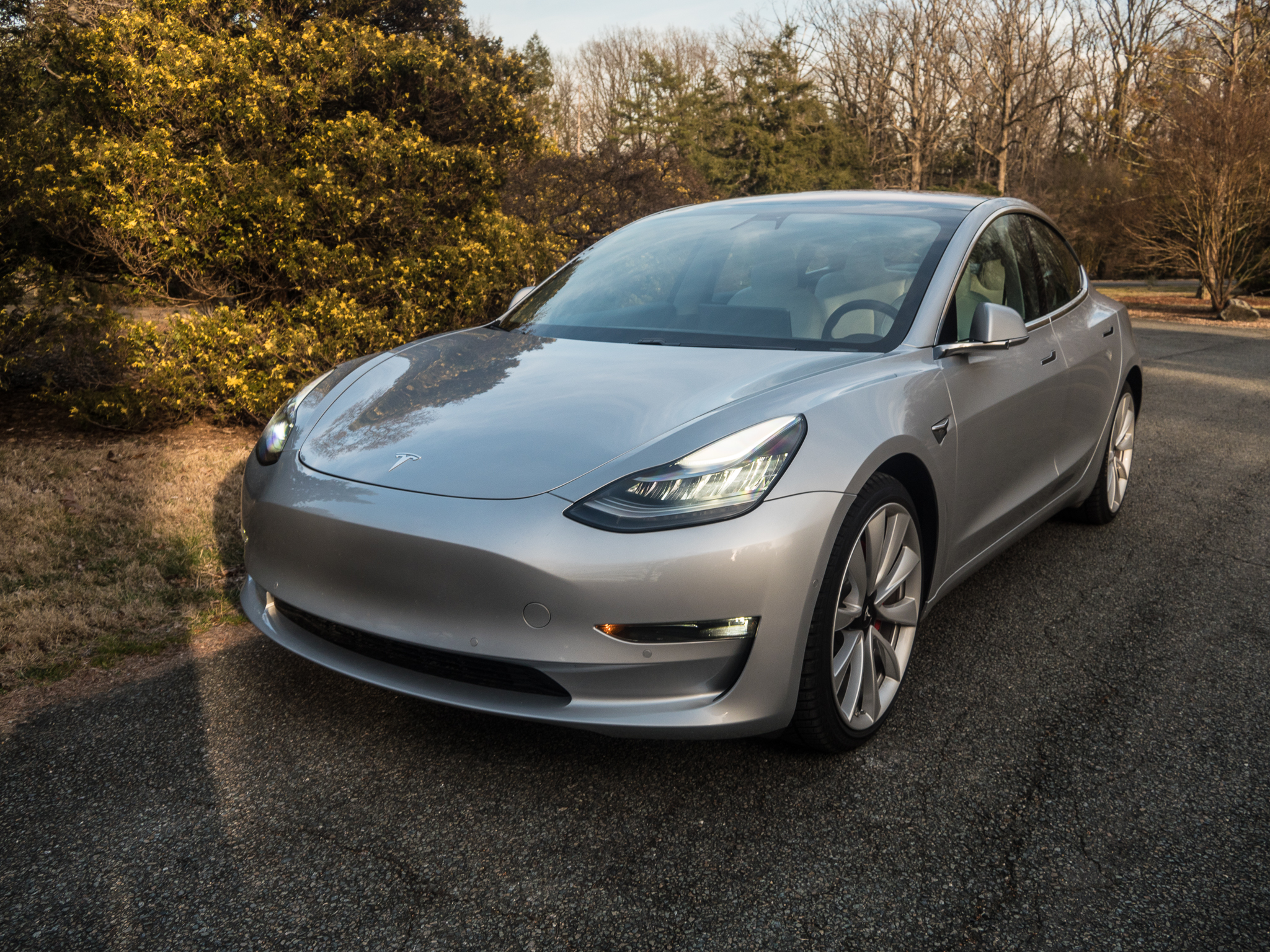
Over 58 percent of passenger cars sold in Norway in March were zero-emission vehicles, according to Norway's Road Traffic Information Office (OFV). That's a new record for the small Scandinavian country that has long led the world in adoption of zero-emission vehicles.
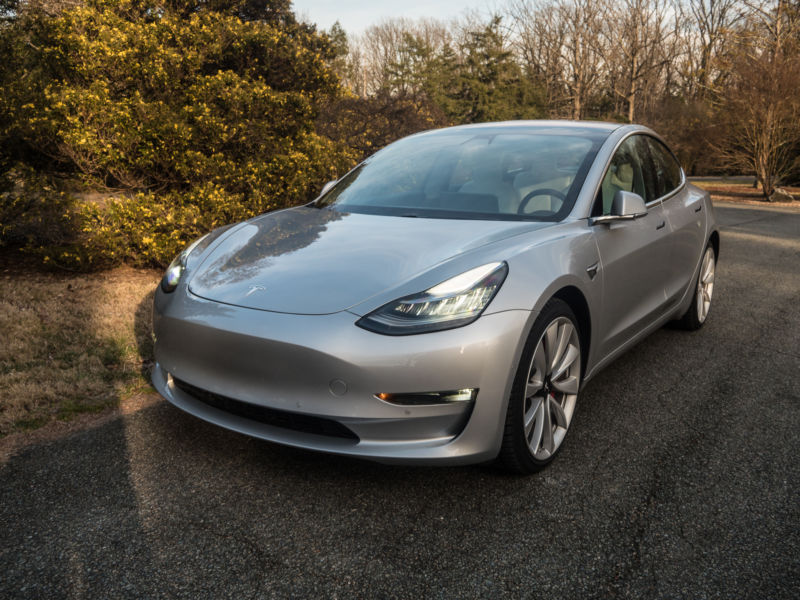
The strong sales reflected pent-up demand for Tesla's new Model 3, which only became available in large volumes in late February. The Model 3 accounted for 5,315 of the 18,375 vehicles sold in Norway in March, with the Model S and Model X selling another 500 vehicles combined.
"In 2018, Norway’s fully electric car sales rose to a record 31.2 percent market share from 20.8 percent in 2017, far ahead of any other nation," Reuters reports.
SAN FRANCISCO—In a shocking discovery certain to complicate the legacy of a national icon, the estate of Walt Disney announced Friday it had discovered a cache of anti-American cartoons the pioneering animator intended to release if the Axis Powers had triumphed in World War II.
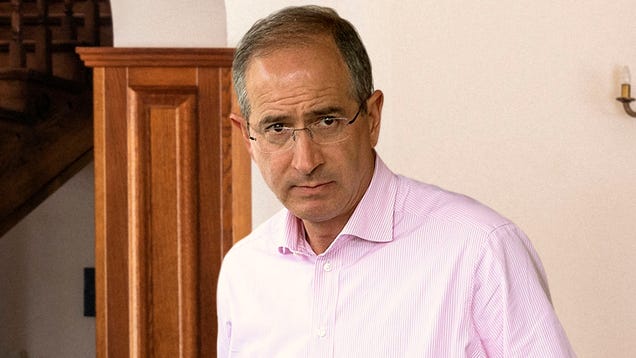
PHILADELPHIA—Saying he is always too embarrassed to get into the specifics of what he actually does for a living, Comcast CEO Brian Roberts confided to reporters Tuesday that whenever he is asked about his job, he just says he does digital media stuff. “It’s honestly pretty boring, so I usually tell people I work at a…
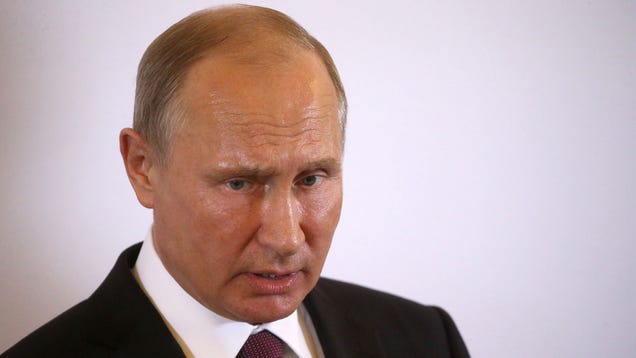
MOSCOW—Saying that he had been “totally blindsided” by the revelations from the recently released findings of the Mueller investigation, a shocked Vladimir Putin reportedly came to the realization Tuesday that he didn’t conspire with Donald Trump’s 2016 presidential campaign after all. “What the hell? I worked so hard…
WASHINGTON—Vowing to fight tooth and nail against what he called “an insidious smear campaign,” Rep. Devin Nunes (R-CA) announced Wednesday he was considering filing a defamation lawsuit against his official Twitter account for ruining his reputation. “The figure behind @DevinNunes has disparaged my good name in what…
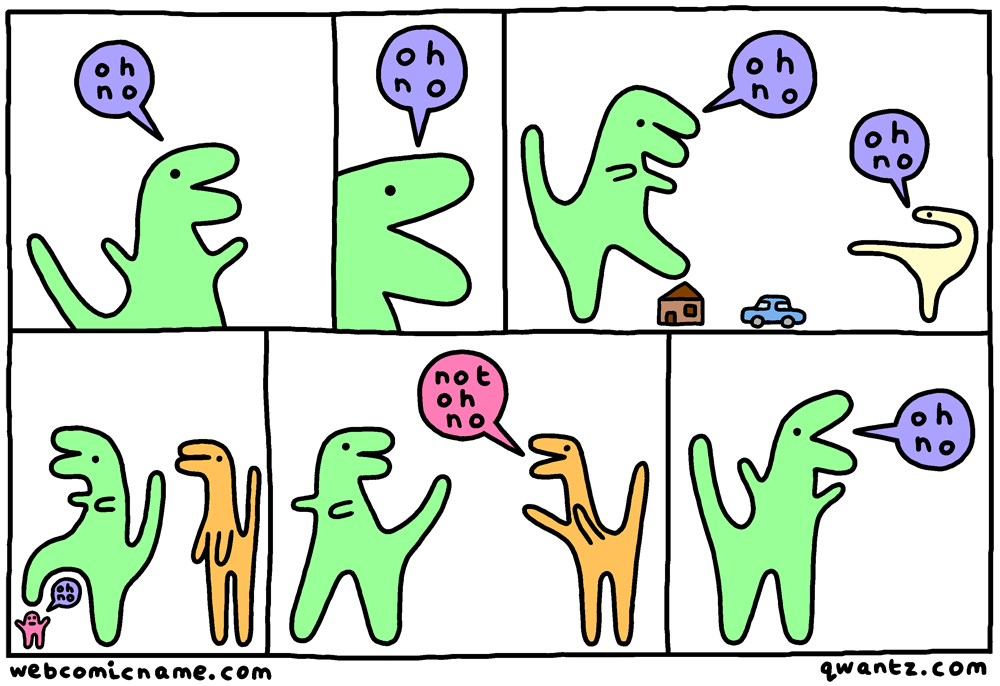
March 20th, 2019: I've had some minor hand surgery this week, so to, uh, celebrate (?) that and give my hand a break: here is a guest comic!! It is by the incredible Alex Norris of Webcomic Name and I hope you will like it. I will give you three guesses as to what two-word phrase Alex said when I contacted them and told them my hand was out of commission.
TUSCALOOSA, AL—Confirming decades of speculation concerning the potentially disruptive effects of runaway literacy, scientists at the University Of Alabama published a study Tuesday establishing a definite and potentially dangerous link between the practice of book learnin’ and increased back talk. “According to our…
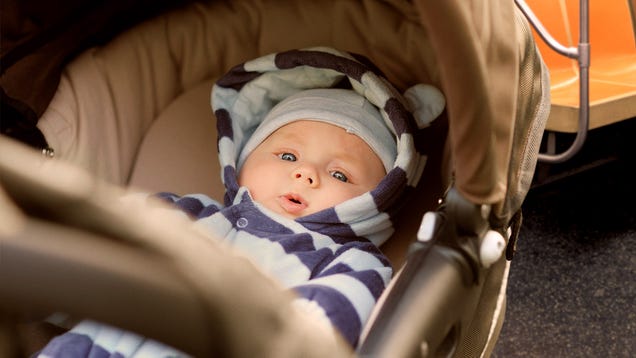
NEW YORK—Wishing he could just curl up under his blanket and die, infant Liam Henderson reportedly felt foolish Thursday after realizing a stranger he had responded to on the subway was actually waving at the toddler sitting one seat over. “Oh my God, I was smiling and babbling at him the whole time—I’m such an…
DALLAS—Bringing spectators to their feet with a stunning display of showmanship, Dallas Mavericks power forward Dirk Nowitzki shattered the glass of a backboard Wednesday night with his powerful soprano singing voice. “It was mind blowing—I didn’t think he could still get that high at his age,” said Mavericks teammate…
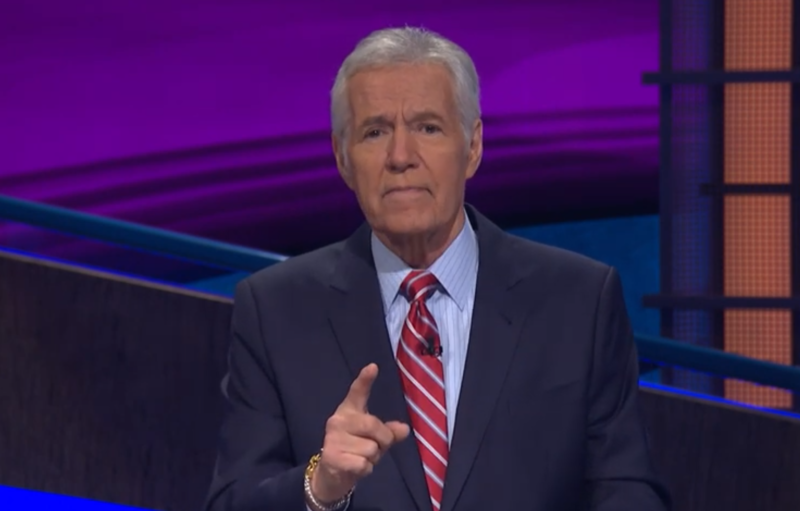
Enlarge / Alex Trebek speaks directly to Jeopardy! fans about his health on Wednesday, March 6. (credit: Jeopardy!)
Alex Trebek, the host of TV's Jeopardy! for 35 years, took to YouTube on Wednesday to announce bad news about his health. The 78-year-old has been diagnosed with stage-four pancreatic cancer.
"I have some news to share with you, and it's keeping with my longtime policy of being open and transparent with our Jeopardy! fanbase," Trebek said in the video statement (embedded below). "I also wanted to prevent you from reading or hearing some overblown or inaccurate reports regarding my health. Therefore, I wanted to be the one to pass along this information."
His statement, unsurprisingly, sets medical context for his news, including his statement that his diagnosis is "just like 50,000 other people in the United States each year." He also expresses his desire and confidence to take the cancer diagnosis head-on, telling viewers that he "plans to beat the low survival rate statistics for this disease."
Enlarge / Anthem may look gorgeous. But what's that worth when it makes your console hard-lock to the point of fully powering down? (credit: EA / BioWare)
After a weekend full of reports about Anthem woes on PS4, people who purchased the game on that console got a sliver of "good" news on Monday: you can probably get a no-questions-asked refund for your purchase if you ask Sony for it.
The story begins with a scary "full" system crash mid-game, which doesn't just hard-lock the game or dump users into an error message and system menu. Instead, the crash completely powers down PS4 consoles, as if the power cord had been yanked out. That means a tap of the controller's "PS" button won't power the console back on. Once users press the system's power button, the PS4 reboots in a black, 480p-resolution screen to check for possible issues with corrupted memory. After that disk check, the console's menus remind users not to power down their systems in such an unsafe way.
But, again, that's the fault of the game Anthem as of its Thursday, February 28 patch on PS4. Multiple threads on the game's r/AnthemTheGame Reddit community have sprung up with userscomplaining of the same issue, and they've pointed to games journalists and critics like Giant Bomb's Brad Shoemaker reporting the same crash. (Ars Technica does not have a copy of the game on PS4 to test.)
Enlarge / The most detailed images of Ultima Thule, obtained just minutes before the spacecraft's closest approach at 12:33am EST on Jan. 1. (credit: NASA/Johns Hopkins Applied Physics Laboratory/SWRI)
Twenty-six minutes after the clock struck midnight on New Year's Eve in Times Square, the long-range camera aboard the New Horizons spacecraft was hard at work. The probe was just six minutes from its closest approach to Ultima Thule, an object formally named 2014 MU69, which resides in the Kuiper Belt around the outer Solar System.
One, two, three—the images ticked through, each with an exposure time of just 0.025 seconds. Four, five, six—and now the spacecraft was less than 7,000km away from its target. Seven, eight, nine—these pictures had to be perfect, because New Horizons was passing Ultima Thule at a speed of more than 50,000km/hour.
Only recently were investigators able to download all of these images and cobble together a composite image of the contact binary. With a resolution of 33 meters per pixel, this is probably as good of a view as we're going to get of Ultima Thule. And it still looks something like a snowman, peanut, pancake, or combination thereof.
YouTube is trying to dissuade creators from posting videos about the Momo Challenge (a viral self-harm hoax allegedly targeted towards kids) by stopping ads from running against such content. It told The Verge videos related to Momo violate advertise...
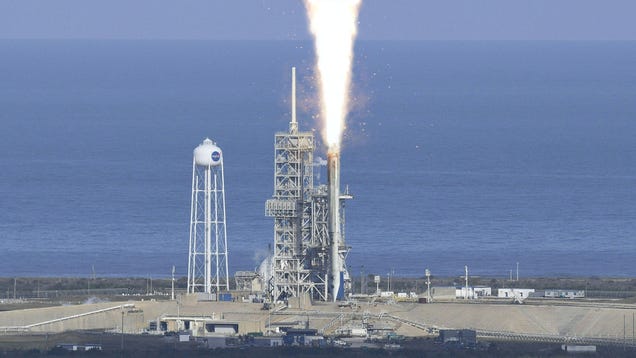
HOUSTON—Rushing into a press conference mere minutes after lift-off, NASA officials frantically announced a mission to the Earth’s core Friday after accidentally launching a Atlas V rocket upside down. “Today, I’m excited to announce that we’ve successfully launched—let’s see. Well, I guess we’ll just call this the…
Amazon renewed its quirky superhero series The Tick for a second season all the way back in January last year, and we finally know when you can expect the next batch of episodes on Prime Video. Along with the April 5th release date, Amazon released a...
HANOI, VIETNAM—Tearing up as he described the courage he would have had no choice but to summon had he not been born into a life of luxury, President Trump reportedly took time Tuesday before the North Korea summit in Hanoi to travel south and lay a wreath at the spot where he would have died in the Vietnam War if he…
I like the looks of this over the Samsung... but $2600?!? I'll wait for version 2.
Good morning! If you like your phones foldable, ready for 5G or just plain brand new, then we've got quite the Morning After for you. Over the weekend, we saw Huawei's attempt at a foldable phone, as well as a 5G phone from LG that's coming to major...
TIL California has its own Newark, and it sounds a lot like NJ's: "The remaining employees were told they would be moving to the Theranos laboratory facility, across the bay in Newark, California. Employees who were still at Theranos at the time describe Newark as “crummy” and a “shithole.”"
Photographed by Jenny Hueston for The New Yorker.
Elizabeth Holmes appeared to know exactly what she needed to do. It was September 2017, and the situation was dire. Theranos, the blood-testing company that she had dreamed up more than a decade ago, during her freshman year at Stanford, was imploding before her very eyes. John Carreyrou, an investigative reporter at The Wall Street Journal, had spent nearly two years detailing the start-up’s various misdeeds—questioning the veracity of its lab results and the legitimacy of its core product, the Edison, a small, consumer blood-testing device that supposedly used a drop of blood to perform hundreds of medical tests. Carreyrou had even revealed that Theranos relied on third-party devices to administer its own tests. Theranos, which had raised nearly $1 billion in funding for a valuation estimated at around $9 billion, now appeared less a medical-sciences company than a house of cards.
Owing largely to Carreyrou’s reporting, the fallout had been colossal, unprecedented. Theranos was under investigation by the Securities and Exchange Commission, the Department of Justice, and the Federal Bureau of Investigation. It had been sued by investors. Walgreens, its largest partner, terminated the relationship and shut down 40 testing sites. Forbes, which once estimated Holmes’s wealth at $4.5 billion, wrote it down to zero. The young founder, who was once compared to Steve Jobs, had recently been dubbed a “millennial Madoff” by the New York Post. According to two former executives at the company, Theranos had as many as nine different law firms on retainer, including the formidable Boies Schiller Flexner, to handle the mess—what appeared to be the end of a long, labored, highly visible, and heinous corporate death march.
iTunes user? Just tap here to listen to Inside the Hive at your convenience. And don’t forget to subscribe.
But Holmes had other ideas. Despite the chaos, she believed that Theranos could still be saved, and she had an unconventional plan for redemption. That September, according to the two former executives, Holmes asked her security detail and one of her drivers to escort her to the airport in her designated black Cadillac Escalade. She flew first class across the country and was subsequently chauffeured to a dog breeder who supplied her with a 9-week-old Siberian husky. The puppy had long white paws, and a grey and black body. Holmes had already picked out a name: Balto.
For Holmes, the dog represented the journey that lay ahead for Theranos. As she explained to colleagues at the company’s headquarters, in Palo Alto, he was named after the world-famous sled dog who, in 1925, led a team of huskies on a dangerous, 600-mile trek from Nenana, Alaska, to remote Nome, Alaska, bearing an antitoxin that was used to fight a diphtheria outbreak. There is even a statue of Balto in New York’s Central Park, Holmes told one former employee. The metaphorical connection was obvious. In Holmes’s telling, Balto’s perseverance mirrored her own. His voyage with the life-changing drug was not so different from her ambition.
In Silicon Valley, founders and C.E.O.s often embrace a signature idiosyncrasy as a personal branding device. Steve Jobs wore the same black turtleneck every day and tended to only park in handicap spots. Mark Zuckerberg went through a phase during which he would only eat the meat of animals he had personally killed. Shigeru Miyamoto, the Nintendo video-game legend, is so obsessed with estimating the size of things that he carries around a tape measure. It can get even weirder. Peter Thiel has expressed an interest in the restorative properties of blood transfusions from young people. Jack Dorsey drinks a strange lemon-water concoction every morning, and goes on 10-day silent retreats while wearing designer clothing and an Apple Watch. Holmes, too, had seemingly cherry-picked from her elders. She wore a black turtleneck, drank strange green juices, traveled with armed guards, and spoke in a near baritone. In an industry full of oddballs, Holmes—a blonde WASP from the D.C. area—seemed hell-bent on cultivating a reputation as an iconoclastic weirdo. Having Balto seemed to help fortify the image.
Immediately after returning to California, Holmes decided that Balto would hardly leave her side on the quest to save Theranos. Each day, Holmes would wake up with Balto at the nearly empty Los Altos mansion that she was renting about six miles from her company’s headquarters. (Theranos covered the house’s rent.) Soon after, one of her two drivers, sometimes her two security personnel, and even sometimes one of her two assistants, would pick them up, and set off for work. And for the rest of the day, Balto would stroll through the labs with his owner. Holmes brushed it off when the scientists protested that the dog hair could contaminate samples. But there was another problem with Balto, too. He wasn’t potty-trained. Accustomed to the undomesticated life, Balto frequently urinated and defecated at will throughout Theranos headquarters. While Holmes held board meetings, Balto could be found in the corner of the room relieving himself while a frenzied assistant was left to clean up the mess.
Around this same time, Holmes says that she discovered that Balto—like most huskies—had a tiny trace of wolf origin. Henceforth, she decided that Balto wasn’t really a dog, but rather a wolf. In meetings, at cafés, whenever anyone stopped to pet the pup and ask his breed, Holmes soberly replied, “He’s a wolf.”
Former Theranos COO Ramesh Balwani leaves federal court in San Jose, January 14, 2019.
Holmes and her attorney arrive at the San Jose federal court, January 14, 2019.
Silicon Valley can often feel like a lawless place, and for good reason. Many of the people who run the largest technology companies on earth don’t often suffer the consequences of their actions. Despite their unequivocal role in upending our democracy, Zuckerberg and Sheryl Sandberg still run Facebook. Dorsey is still the C.E.O. of Twitter, even though he has not been forthright about the number of bots on the service, and has done almost nothing to stop the spread of hate speech on his platform. The C.E.O. of Tesla, Elon Musk, has been charged with securities fraud, and yet he’s still running the company. (Musk later agreed with the S.E.C. that he would step down as chairman and pay a $20 million fine.)
Holmes is that rare exception in which consequences occur. And the public, perhaps fed up with the behavior of other tech giants (and Wall Street bankers before them), has been captivated by her downfall. Three years after Carreyrou began his investigation, Holmes has again become a figure of extraordinary pop-culture fascination—a distinct rarity for a businessperson. Her story is the subject of the HBO documentary, The Inventor, and ABC News’s podcast series, The Dropout.Bad Blood, Carreyrou’s book, has sold half a million copies and is being developed for Hollywood by Adam McKay.Jennifer Lawrence is set to play Holmes. (Disclosure: I was a consulting producer on the HBO project, which was partly based on an article I wrote about Theranos nearly three years ago.)
The fascination with Holmes often fixates on her extraordinary rise—her ability to convince Stanford scientists to believe her idea despite a lack of formal training; her aptitude for getting wisemen (Henry Kissinger, James Mattis, George Schultz) to sit on her board; and her skill for obtaining early funding from eminences such as Rupert Murdoch, the Walton family, and others. But the final days of Theranos were equally chilling. After all, Holmes wasn’t just an inexperienced scientist; she was also a wild-spending fiduciary.
Holmes had always enjoyed a certain lifestyle. From the early days of the company, she had insisted on flying in a private jet. As the company’s legal problems mounted, its costs skyrocketed, but Holmes had a hard time weaning herself off certain luxuries. She still had her own personal security detail, drivers, personal assistants, and a personal publicist who was on retainer for $25,000 a month, according to one of the former executives. Theranos had an indemnity agreement with Holmes and Sunny Balwani, the company’s C.O.O., with whom she had been romantically involved. (They are no longer dating.) Theranos paid all their legal bills, which totaled millions of dollars a month, according to both executives.
By late 2017, however, Holmes had begun to slightly rein in the spending. She agreed to give up her private-jet travel (not a good look) and instead downgraded to first class on commercial airlines. But given that she was flying all over the world trying to obtain more funding for Theranos, she was spending tens of thousands of dollars a month on travel. Theranos was also still paying for her mansion in Los Altos, and her team of personal assistants and drivers, who would become regular dog walkers for Balto.
But there were few places she had wasted so much money as the design and monthly cost of the company’s main headquarters, which employees simply referred to as “1701,” for its street address along Page Mill Road in Palo Alto. 1701, according to two former executives, cost $1 million a month to rent. Holmes had also spent $100,000 on a single conference table. Elsewhere in the building, Holmes had asked for another circular conference room that the former employees said “looked like the war room from Dr. Strangelove,” replete with curved glass windows, and screens that would come out of the ceiling so everyone in the room could see a presentation without having to turn their heads.
But by the end of 2017, it became clear that it was financially untenable to stay in 1701, largely owing to Theranos’s legal expenditures. The remaining employees were told they would be moving to the Theranos laboratory facility, across the bay in Newark, California. Employees who were still at Theranos at the time describe Newark as “crummy” and a “shithole.” The building was formerly home to a solar-panel maker, and it had a huge floor space. Employees were set up on the second floor, where people would sit four to a table in the open-floor plan. Holmes took the corner office with Balto.
The move may have been a last-gasp attempt to save the company, but morale at Theranos was already at an all-time low. The S.E.C. and other government agencies had started to subpoena current and former workers. Remaining employees started to resign or were let go, almost on a daily basis, it seemed. As two former employees told me, you could go to Antonio’s Nut House, the famous Palo Alto bar, any night of the week and there would reliably be a goodbye gathering for at least one Theranos employee.
Yet through all of this, former employees of the company have told me, Holmes had a bizarre way of acting like nothing was wrong. Even more peculiarly, she appeared happy. “The company is falling apart, there are countless indictments piling up, employees are leaving in droves, and Elizabeth is just weirdly chipper,” a former senior executive told me. One former board member also noted that Holmes would come to board meetings “chirpy” and acting as if everything was “great.” She would walk up to people in the office who could have just testified in front of the S.E.C., or been questioned by lawyers at the F.D.A., and she would give them a hug and ask how they were doing. She was so confident that the company would be fine, executives who worked with her said, that she enrolled Balto in a search-and-rescue program. Holmes spent weekends training him to find people in an emergency. Unfortunately, huskies are not bred for rescue; they are long-distance runners, and Balto failed out.
For years, Holmes had relished in the ritual of giving speeches to the employees. When Balwani worked at Theranos, the speeches ended with chants. Some were positive, and some were more famously negative, such as when employees in lab coats would chant “fuck you” to a competitor or journalist. But such rhetoric was usually followed by excited cheers and roars. One day in late December 2017, Holmes showed up at the Newark building and held an all-hands meeting. She appeared excited beyond restraint. Brimming with enthusiasm, she told her employees that Fortress Investment Group, one of the world’s largest private investment companies, had agreed to offer a $100 million loan that would allow the company to survive.
But Holmes didn’t appear to receive the response that she craved from her colleagues. One executive who was there told me the room was silent. After an uncomfortable beat, Holmes said, “Does anyone have any questions?” Again, nothing. Just a bristling silence. By this point, “The morale had been completely drained out of the company,” the employee explained. Months later, Holmes was charged with 11 criminal felony counts, including wire fraud and conspiracy. Theranos was essentially gutted by the spring of 2018. It shuttered in September 2018, one year after Holmes adopted Balto. Fortress got ownership of all of Theranos’s patents. The $900 million she had raised was up in smoke.
Holmes at the lab in Palo Alto, 2015.
Since Theranos’s collapse, observers have wondered how Holmes kept the company going for so long—how she was able to convince those scientists, investors, and colleagues that her quixotic idea for a portable, revolutionary blood-testing technology could somehow come to fruition. Recently, I posed a similar question to a former Theranos board member: how did the board of directors, composed of such accomplished people, not stop her. This person admitted that board members asked tough questions but were fed contrived answers. (Notably, the board was stacked with dignitaries, not scientists.) After the Journal broke the news that the company was being investigated, the board suggested that Holmes take the Theranos blood test and compare it with results from two other competing labs and one university lab, this person said. If all the results were the same, Theranos could prove to regulators and the media, so went the logic, that their blood-testing products worked perfectly. If the tests showed that Theranos’s results were off, the board suggested that Holmes could direct the company’s considerable raised capital toward fixing the problem.
Holmes agreed to the trial but then withheld the results, the former board member told me. When the board asked about the findings, Holmes seemed to offer a series of obfuscations. Sometimes she would say she was waiting on results; at other times, she said there had been problems with the tests. Eventually, this got heated. At one meeting, according to the former board member, a Theranos employee presented financials that indicated that a Theranos lab in Arizona had not generated the revenues that Holmes had communicated to her directors. This was one of the few times where board members criticized their C.E.O., this person said. One board member was visibly irate; it appeared that Holmes had been deceptive. Soon after, Holmes shook up the board.
Holmes will almost certainly face consequences, but it may take a while. Justice Department officials, according to a filing from January 2019, are combing through between 16 and 17 million pages of documents. And there could be more charges filed against Holmes and Balwani, and even other people close to them. Assistant U.S. Attorney John C. Bostic said in court recently that the “story is bigger than what’s captured in the [original] indictment.” And that it “doesn’t capture all the criminal conduct” that the investigation has uncovered so far. Holmes faces up to 20 years in prison.
Holmes and Balwani have stated that the charges are baseless. Theranos represented a business failure, according to one line of exculpatory logic, but it was not created to rip off investors or mislead consumers—it wasn’t actual fraud. Also, according to another argument, neither of them actually made any money from Theranos. But their lifestyles were partly funded by the company. Holmes’s travel, security details, and publicists were all paid for by Theranos. Meals, clothing, and other social activities were almost always expensed. As one of the former employees said to me, “Someone had to be paying for all those Birkin bags.” This employee said that Holmes’s expenses were somewhat of a joke at the company. “The company paid for everything,” they said. “She would submit her miles if she drove the six miles to her house in Los Altos.” The employee said that the only time Holmes evidenced defeat during Theranos’s collapse was when the company cut her off financially, after the criminal charges were filed. “She lost her cool. She had a fit,” they said. “She had to give up the house in Los Altos.”
When I asked the former executive close to Holmes if she has come to regret what happened, the response surprised me. “Elizabeth sees herself as the victim,” this person said. “She blames John Carreyrou, she blames David Boies, and she blames Heather King.” Boies, the star lawyer, had sat on Theranos’s board, and represented the company during the Carreyrou crisis. King, Theranos’s general counsel for 15 months, overlapped with this period. (King now works at Boies’s firm.) Holmes, according to the former employees, blames the lawyers for giving her bad advice, and their inability to contain the bad press stemming from Carreyrou’s reporting. According to this person, Holmes thinks that she could have somehow convinced a Pulitzer Prize–winning reporter into believing that Theranos was going to change the world despite the fact that its core technology didn’t work. “She often confuses the message for the messenger,” the former employee told me.
When I asked Carreyrou what he thought about this theory, he told me: “I just reported the facts. If there had been nothing to my reporting, federal prosecutors wouldn’t have brought criminal fraud charges and those charges wouldn’t be supported by 17 million pages of evidence.” (Boies and King declined to comment, citing bar obligations. Neither Holmes nor her counsel responded to requests for comment.)
In his book, Carreyrou muses about an oft-raised question regarding Holmes. Was she just a young person who got in over her head? Or, more dramatically, is something more serious afoot. Is she a sociopath? “I’ll leave it to the psychologists to decide whether Holmes fits the clinical profile,” he writes, “but there’s no question that her moral compass was badly askew.” Former employees raise this question with frequency. One pointed to a formative experience: Holmes’s father, Christian, was an executive at Enron, and the family’s finances were affected by its collapse. Did Holmes, scarred by this experience, vow to revive the family’s fortunes at all cost? Was she a hustler or a con artist, or merely a staggering Mr. Ripley? “One of Elizabeth’s superpowers is she never looks back,” this person said.
Holmes is currently living in San Francisco in a luxury apartment. She’s engaged to a younger hospitality heir, who also works in tech. She wears his M.I.T. signet ring on a necklace and the couple regularly post stories on Instagram professing their love for each other. She reliably looks “chirpy” and “chipper.” She’s also abandoned the black-turtleneck look and now dresses in athleisure, the regrettable attire of our age. Notably, she is far from a hermit. She tells former colleagues, according to the two executives, that she is greeted by well-wishers on the street who are rooting for her resurrection. It’s a stark contrast to many of her old colleagues. Former Theranos employees I have spoken to have relayed horror stories about their inability to find work after leaving the company, now with a permanent stain on their résumé.
Holmes, for her part, still doesn’t seem to think the work of Theranos is finished. Like her dog’s famed namesake, she still wants people to know that Theranos was going to save the world. But in order to do so, she needs to share her side of the story. She has recently held more meetings with filmmakers to try to collaborate on a documentary about her “real” story. And Holmes desperately wants to write a book. In Holmes’s eyes, according to former employees, this is only the beginning of yet another redemption story—possibly one that is too good to be true. As for Balto, Holmes still tells people he’s a wolf.
 Who do you think is most likely to switch to value-for-money phones like the Pixel 3 and OnePlus 6T? Former iPhone users balking at iOS or top-tier pricing? No -- it's prior Samsung owners, according to a study. Counterpoint Research estimated tha...
























 YouTube is trying to dissuade creators from posting videos about the Momo Challenge (a viral self-harm hoax allegedly targeted towards kids) by stopping ads from running against such content. It told The Verge videos related to Momo violate advertise...
 Amazon renewed its quirky superhero series The Tick for a second season all the way back in January last year, and we finally know when you can expect the next batch of episodes on Prime Video. Along with the April 5th release date, Amazon released a...

 Good morning! If you like your phones foldable, ready for 5G or just plain brand new, then we've got quite the Morning After for you. Over the weekend, we saw Huawei's attempt at a foldable phone, as well as a 5G phone from LG that's coming to major...