HARTFORD, CT—In an effort to remain financially solvent by keeping payroll expenditures in check, executives at the Banford Group announced Tuesday they would have to start hiring more female employees.
Vani Hari, AKA the Food Babe, has amassed a loyal following in her Food Babe Army. The recent subject of profiles and interviews in the New York Times, the New York Post and New York Magazine, Hari implores her soldiers to petition food companies to change their formulas. She's also written a bestselling book telling you that you can change your life in 21 days by "breaking free of the hidden toxins in your life." She and her army are out to change the world.
She's also utterly full of shit.
I am an analytical chemist with a background in forensics and toxicology. Before working full-time as a science writer and public speaker, I worked as a chemistry professor, a toxicology chemist, and in research analyzing pesticides for safety. I now run my own blog, Science Babe, dedicated to debunking pseudoscience that tends to proliferate in the blogosphere. Reading Hari's site, it's rare to come across a single scientific fact. Between her egregious abuse of the word "toxin" anytime there's a chemical she can't pronounce and asserting that everyone who disagrees with her is a paid shill, it's hard to pinpoint her biggest sin.
Hari's superhero origin story is that she came down with appendicitis and didn't accept the explanation that appendicitis just happens sometimes. So she quit her job as a consultant, attended Google University and transformed herself into an uncredentialed expert in everything she admittedly can't pronounce. Slap the catchy moniker "Food Babe" on top, throw in a couple of trend stories and some appearances on the Dr. Oz show, and we have the new organic media darling.
But reader beware. Here are some reasons why she's the worst assault on science on the internet.
Natural, Organic, GMO-Free Fear
Hari's campaign last year against the Starbucks Pumpkin Spice Latte drove me to launch my site (don't fuck with a Bostonian's Pumpkin-Spice Anything). She alleged that the PSL has a "toxic" dose of sugar and two (TWO!!) doses of caramel color level IV in carcinogen class 2b.
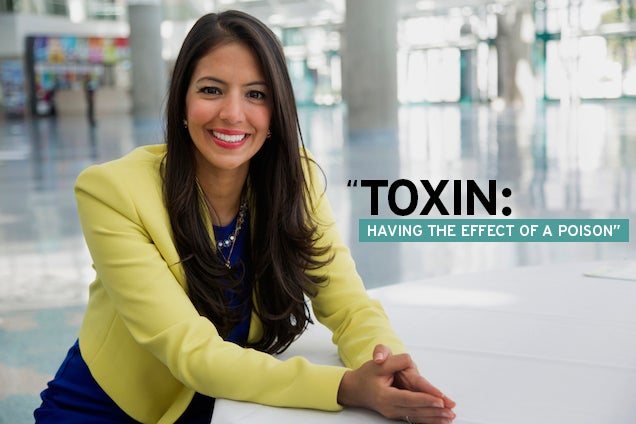
The word "toxic" has a meaning, and that is "having the effect of a poison." Anything can be poisonous depending on the dose. Enough water can even be poisonous in the right quantity (and can cause a condition called hyponatremia).
It's a goddamn stretch to say that sugar has deleterious effects, other than making your Lululemons stretch a little farther if you don't "namaste" your cheeks off. However, I implore you to look at the Safety Data Sheet for sugar. The average adult would need to ingest about fifty PSLs in one sitting to get a lethal dose of sugar. By that point, you would already have hyponatremia from an overdose of water in the lattes.
And almost enough caffeine for me.
And what about that "carcinogenic" caramel color? Well, it turns out that it's not the only thing in your PSL that's in carcinogen class 2b.
Coffee is class 2b because of the acrylamide accumulated during the roasting process. Coffee, before Starbucks turns it into a milkshake, is pretty healthy for you. Class 2b means that all possible carcinogenic effects haven't been ruled out (because we haven't tested drinking it while tightrope walking across the Grand Canyon and simultaneously attempting to eat fire… yet), but that it hasn't been shown to cause a single case of cancer.
This is a blatant attempt at getting you to look to her for answers by making you unnecessarily afraid. The goal of Hari's campaign was to… well, we're still not sure. Remove the caramel color? Smear Starbucks? After that campaign failed, she launched a failed attempt to get them to use only organic milk, which would have made their lattes far more expensive and no healthier.
Hari uses this tricky technique again and again. If I told you that a chemical that's used as a disinfectant, used in industrial laboratory for hydrolysis reactions, and can create a nasty chemical burn is also a common ingredient in salad dressing, would you panic? Be suspicious that the industries were poisoning your children? Think it might cause cancer? Sign a petition to have it removed?
What if I told you I was talking about vinegar, otherwise known as acetic acid?
This is Hari's business. She takes innocuous ingredients and makes you afraid of them by pulling them out of context (Michelle Francl, in a review of Hari's book for Slate, expertly demonstrates the shallowness of this gimmick). This is how Hari demonized the harmless yet hard-to-pronounce azodicarbonamide, or as she deemed it, the "yoga mat chemical," which is yes, found in yoga mats and also in bread, specifically Subway sandwich bread, a discovery Hari bombastically trumpeted on her website. However, as the science-minded among us understand, a substance can be used for more than one thing perfectly safely, and it doesn't mean that your bread is made of a yoga mat if it happens to contain azodicarbonamide, which is FDA-approved as a dough-softening agent. It simply means your bread is composed of chemicals, much like everything else you eat.
Hari's rule? "If a third grader can't pronounce it, don't eat it."
My rule? Don't base your diet on the pronunciation skills of an eight-year-old.
A Force to Disagree With
In a recent blog post, Hari accused several of her detractors of having nefarious ties to sinister organizations. These evildoers included Dr. Joe Schwarcz, the director for Science and Society at McGill University, Dr. Steve Novella, a Yale-educated neurologist and contributor to the Skeptics Guide to the Universe podcast, and Dr. Kevin Folta, the horticultural chair at the University of Florida. Why? Because these highly credentialed scientists had the nerve to use facts against Hari. Dr. Schwarcz speaks out regularly about her tactics. Dr. Novella debunked some wild claims of hers about the science of microwaves. And Dr. Folta said "she found that a popular social media site was more powerful than science itself, more powerful than reason, more powerful than actually knowing what you're talking about."
But could any of these scientists' criticisms possibly have merit? Not to Hari. She has flung these accusations at Dr. Folta multiple times. He's responded on his personal blog and has released his email correspondence to prove that he has no financial connections to hide. And yet, Hari has not recanted.
Moreover, the tireless crusader for transparency doesn't want you to pay attention to the bullshit behind the curtain. And it's not just when scientists point it out in the news–it's when anybody questions her on her Facebook page.
There's a group on Facebook called "Banned By Food Babe" that boasts nearly 6,000 members. Reasons for being banned include "I asked for her qualifications" and "I pointed out that water was a chemical." Some members of the page were former fans of hers who were banned when they asked questions of clarification. Any dissent couldn't possibly have merit within the ranks of the Food Babe Army.
And when Hari's been questioned about silencing critics by news outlets? She consistently says that she won't be silenced by people who are haters and shills, racist or sexist.
If she thinks she's being attacked for being a woman, she's missed that she's not the only "babe" in this discussion.
If her arguments had merit, she could engage in a battle of wits with her detractors instead of making insidious accusations. It's not about Hari, the woman who gets home at the end of the day, maybe gives her dog an (organic) treat and watches some crappy TV show. It's about Food Babe LLC, the business organization that spreads terribly inaccurate science.
It's about statements like this:
"The enzymes released from kale go in to your liver and trigger cancer fighting chemicals that literally dissolve unhealthy cells throughout your body."
One of her outspoken critics, Kavin Senapathy, is a writer at Grounded Parents and a contributor at the Genetic Literacy Project. Senapathy has said that the Food Babe "exploits the scientific ignorance of her followers." With a background in genomics, Senapathy is a science writer and likewise an Indian American woman, but I'm sure it's a much more comforting narrative in the Food Babe Army to say that we're all just sexists and racists.
Is It Made With Real Girl Scouts?
How many companies or products do you think it would make sense to crusade against in the course of a career? One? Three? A dozen?
Hari has declared, to date, more than 610 products and companies to be unsafe over the course of four years.
And is there even a shred of truth to this? Not in the least. Hari claims going organic will save you from pesticides, but organic farming uses pesticides too. Some of them are far more toxic than conventional pesticides. (Remember, the dose makes the poison. Neither apple would have enough pesticide by the time it reaches market to be harmful.)
Maybe Hari's crusades would be OK if she had the facts to back them up. But she doesn't, and worse, when she's wrong, she tries to make her errors disappear.
Recently, a writer from the New York Times contacted me to ask for some background on Hari. I was happy to oblige. She was looking for the articles for which Hari had been widely criticized and that were conspicuously absent from her Facebook page. Hari had told the writer that she couldn't recall those articles.
Luckily, the internet never forgets.
If you want proof that Hari doesn't research anything before she puts it online, look no further than this article on airplanes, which she deleted from her site. She claimed that pilots control the air in an airplane, so you should sit near the front to breathe better air. She wrote that passengers are sometimes sprayed with pesticides before flights, and that airplane air is pumped full of nitrogen.
Please recall high school science, in which you hopefully learned that the atmosphere is 78% nitrogen. Also, if anyone has personally been sprayed with pesticides before a flight, please email me, I would love to talk to you about it (not really).
The other piece of writing that she unsuccessfully attempted to cleanse from the bowels of the internet claimed that microwaves are like small nuclear reactors, and they make water crystalize the same way it does when you say "Hitler" or "Satan" to it, because water has ears and a grasp of early twentieth-century European dictators.
Feel Better—Detox and Definitely Don't Vaccinate!
Food Babe has written that, in order to deal with the flu, you should take vitamins, get sunshine, and "encounter the flu naturally." In other words, her advice is to get the flu, an infection that kills an average of 31,000 people annually.
A PSA: Please remember that when you vaccinate, you help protect the people around you who cannot vaccinate. You protect people who are immunocompromised, who are going through cancer treatments, and who are on immunosupressants. If you catch the flu, you become a disease vector and can easily infect more people.
"I won't eat any of these ingredients or even put them on my body," Hari wrote of the components that make up the flu vaccine. "However, the mainstream medical community, government agencies and pharmaceutical companies suggest that I directly inject these ingredients into my bloodstream? And I need do it every year until I die? Are you freaking kidding me?"
Nope! Not kidding. The flu is serious. To scare people into not taking every measure they can against a deadly disease mortifies me. Hari has denied that she's anti-vax, but all the reasons she has for avoiding the flu vaccine are ones anti-vaxxers hold near and dear to their hearts for letting their children suffer. Toxins. Aluminum. Mercury. The usual suspects.
But hey, the next time you're down with a bug, follow Hari's lead and detox your way out of it. Who doesn't want to lose a few pounds, feel better, and have more energy? Hari will help, for only $9/per bottle from her sponsor, Suja.
In Hari's non-defense, they're "only" $6 per bottle from Suja's website.
But wait, didn't she say that the Pumpkin Spice Lattes had a toxic dose of sugar at fifty grams in a grande? So why does she endorse Suja when it has forty-two grams of sugar and even comes with a warning on its website that it's not suitable for diabetics?
It's probably because detox is complete bullshit.
In order to buy into the premise that you need detoxing, you first have to be "toxed." The common enemies they claim that juice can clean out of your system are heavy metals and pesticides. The bullshit? Those don't cause allergies, acne, weight gain, or whatever symptom she's using to scare you into buying overpriced juice this week. Heavy metal toxicity has specific symptoms, and actual pesticide poisoning is really scary.
Neither can be fixed by fruit juice. Not even organic fruit juice.
You're constantly "detoxing" just by living. Your kidneys and liver take care of cleaning out unnecessary things in the body fairly efficiently on their own. Proof? The toilet paper industry.
Go Ahead, Lie About Your Food Allergies
We've already established that Hari has a fickle relationship with the truth. How about the definition of the word "allergy"? That seems basic enough. An allergy is an immune system overreaction. Life-threatening food allergies are serious.
And this one is very serious.
Hari claimed that she's allergic to refined sugar in a blog entry in which she also wrote about about all the desserts she's eaten. But only refined sugar, because apparently short-chain carbohydrates are only evil if they're not from one of her approved sponsored sugar sources. So, I guess she can just eat these now that her acupuncturist diagnosed and treated her for this alleged sugar allergy.
"Go as far as telling the server you are allergic to butter and dairy, soy and corn," she writes. "Butter really isn't bad for you if it is organic and you use it in moderation – but restaurants can go crazy with it, adding several hundred extra calories you can live without."
This is a problem.
I have celiac disease, and there are people with genuine life-threatening allergies. When people like me go into a restaurant, we're at the whim of a waiter who may have just served twenty fussy assholes from the Food Babe Army who think that gluten causes your spleen to turn radioactive, or whatever lie she's using to sell organic kale dipped in yak's butter this week. So when I tell a server that I can't do gluten, that waiter might roll their eyes at me because of people like Vani Hari.
Well, people like Hari and her Food Babe Army. Changing the world, one lie at a time.
Yvette d'Entremont holds bachelor's degrees in theatre and chemistry along with a master's degree in forensic science. With a background working as an analytical chemist, she currently runs Science Babe full time. Her site has become a reliable mix of debunking pseudoscience with humor and science. She lives in southern California with her dog, Buddy. Follow her at fb.com/sciencebabe and scibabe.com.
Today, I brought my girlfriend home to meet my dad. He was wearing a shirt with a photo of our dog on it, and my dog was wearing a shirt with a photo of my dad on it. Great first impressions. FML
This seems so obvious that I can't believe it hasn't been done before.
The problem with renewable energy isn't getting it—it's having it around when we need it.
Renewables are abundant, but they tend to make themselves available at inconvenient times—the wind often blows strongest at night, when the lights are off—and in out-of-the-way places, like sunlight in the desert. In order to get more from renewables, we need a better storage solution than even the most advanced batteries, which aren’t likely to store anywhere near what we need or what renewables produce.
So far, the main large-scale storage option is even more inconvenient than the renewables themselves.
Pumped hydro storage is an ingenious, 100-year-old solution that uses no fancy science, only physics and engineering: falling water turns turbines to run a generator that produces electricity. All you need to do is pump water to the top when you have excess energy, and then, when you're running low, let it fall down again.
The big hitch in this scheme is that you generally have to build a dam to make it work—and building dams means making lakes, and making lakes means covering lots of stuff with water. For someone trying to create a viable grid-scale energy storage solution, the chance of finding a suitable valley that's available for flooding is basically pretty much zero. "It's incredibly difficult to permit the civil works that are necessary for large-scale hydro," said James Kelly, CEO of California-based Advanced Rail Energy Storage (ARES).
Rather, ARES and a Canadian start-up called Hydrostor have developed large-scale systems based on the simple physics of pumped hydro storage (i.e. gravity), but without all the extra lakes.
Instead of trying to build new pumped hydro facilities, the founders of ARES—William Peitzke, Matt Brown and John Robinson—asked themselves, "How can we do pumped storage hydro-electric, but without any water?" The answer they found was basically the opposite of water: rocks. Or more specifically, rocks on trains.
“We realized the solution was right in front of us,” said Kelly. “The railroad industry had developed an incredibly efficient way to move mass.” One ARES engineer determined that the coefficient friction of steel wheels on railroad track is lower than the coefficient friction of ice skates on ice.
The ARES system uses excess energy from the grid to pull 140-ton railcars up hills (total train weight: 1,350 tons). When the grid needs that power back, they simply let gravity take the weighted cars back down. Regenerative braking—similar to what you find in a Toyota Prius, or in Japanese subways—captures the energy the trains produce along the way
ARES built a test facility in California to prove the concept, and now they’re in the final stages of building a 50 megawatt facility in Nevada, which will come online in 2016. For comparison, this facility alone will add more energy storage than was built across the entire US in 2013 (44.2 megawatts), according to a recent recent report by US Energy Storage Monitor. The same report suggests that 220 megawatts will be deployed in 2015, twice the capacity of the previous two years combined. ARES is part of a rapidly growing sector—and it’s not the only one.
Hydrostor is a Toronto-based startup that also expects to play a big role in grid-scale energy storage. Rather than pumping water to a higher altitude and letting it fall down again, they decided to pump air underwater instead.
The company compresses the air into giant balloons—the kind used to lift sunken ships and downed planes—located several kilometers offshore and deep below the surface. Each plant is also scalable by depth: the deeper the balloons are, the greater the water pressure, and the more efficient their output. If the company doubles their depth, they can get the same amount of energy from half the number of balloons.
That’s a bigger cost-saving than it seems, because those balloons are really big: 9 metres high by 5 metres in diameter. The upward lift on one balloon is 100 tons, so for Hydrostor, the greatest expense is installing structures with enough ballast to hold the bags down.
The underwater real-estate market isn't exactly competitive, which makes Hydrostor's installations well-suited for islands and waterfront cities without a lot of extra space for big power facilities. Like ARES, they built a test facility to show it works, and now they’re preparing to start construction on their first project in Aruba, with six more in the works.
Both ARES and Hydrostor pride themselves on offering off-the-shelf mechanical solutions. Apart from their patented computer technology, both companies buy all their parts out of catalogues, and so they scale up or down very easily. They each could make a 5mw or 1,000mw facility, as needed, and they don’t need to plug up any rivers to do it.
"With the renewables that we can harvest cost-effectively, the potential is enormous," says Kelly. "The problem will not be supply." The problem, rather, is storing all that surplus energy. For ARES, that means having access to a few good rocks. For Hydrostor, some airbags will do the trick. Either way, it beats making lakes.
The college student named Jacob says his birthmark has taught him to be less judgmental of others.
A 25-year-old New York-based college student is transforming a birthmark that covers a majority of his arm into a map of an imaginary world with just a pen.
Jacob told BuzzFeed News he has been doodling on his hand for as long as he can remember, but began seeing his birthmark as a map in high school. He said to draw the full map takes an hour and a half or more.
I've partied in their office a couple times. They throw good parties!
Daniel Espinal delivers mattresses on his bicycle. In fact, the first time he delivered a Casper mattress on his Bullitt cargo bike, he had to ride over the Brooklyn Bridge. “It was awesome,” he says, smiling. “There was a lot of wind and the bike was tilting.”
Today, it’s about 20 degrees, a temperature Espinal insists is warm. He’s in his early twenties and covered up in long sleeves, jeans, and a hat that looks like he’s wriggled a condom on his head. Only his happy face is visible. He uses bungee cords to secure the bed to the front of his ride before hopping the bike over a slab of ice on the curb and taking off.
Espinal isn’t about to ride for 20 minutes with a fully expanded mattress strapped to the front of his bike. The bed he’s delivering has been smashed down until it fits in a box about as big as a golden retriever — this is one of the things the “Warby Parker of mattresses” is known for, along with the $14.95 million it has raised from investors like Ashton Kutcher, Nas, and designer Steven Alan. (The rest of the U.S. and Canada have to settle for stodgy old UPS delivery.) Hefting the 68-pound box, the bike bobbles as Espinal turns onto the quiet street leading into the apartment complex. A woman passing by sees the box and says, “He’s not delivering pizza.”
Rebecca Gentsch, 25, her roommate Misha Mayeur, 24, and a fluffy cat named Abella are waiting for Espinal in their apartment. It’s Gentsch’s new bed. She loathed the Ikea mattress she bought about a year ago, but hadn’t gotten around to going to a store to shop for a new one. “I was being lazy about it,” she says. So, instead, she ordered a queen-size Casper online after seeing ads for it on the L train.
Rebecca Gentsch, 25, her roommate Misha Mayeur, 24
Photograph by Andrew Spear for Buzzfeed News
After Espinal wheels it on a dolly through the living room and into Gentsch’s bedroom, Gentsch and Mayeur cut open the roughly 3-foot-tall box and shimmy out the tightly plastic-wrapped bed. Gentsch slices through the covering and the bundle starts expanding quickly. The women yell and gasp, hopping around the edges warily as if they’re not sure how big the bed’s going to get. It’s like they’re little kids observing one of those foam sponge figurines grow in water. After about a minute, the mattress looks like just another regular bed.
Casper encourages buyers to take videos of themselves unboxing their mattresses, a practice pulled from the YouTube mega-trend in which consumers film themselves opening everything from Disney toys to Chanel handbags. Gentsch and Mayeur pass, but the strategy seems to be working: One such video has over 118,000 views, and photos of white-and-blue Casper boxes dot Instagram. In March, 17-year-old Kylie Jenner, who has 19.4 million Instagram followers, posted a picture of her Casper box in the empty living room of her new $2.7 million mansion.
Casper is one of a wave of companies seeking to make us covet what previously have been mundane, inconspicuous household items, and lend a folksy transparency to notoriously opaque industries. After all, few people know what you sleep on, even if you have a bumping social life. “It’s a challenge for us. Mattresses aren’t about external signaling, it’s different than eyeglasses or sheets,” says Philip Krim, Casper’s co-founder and CEO. “We deliver a mattress on a cargo bike in New York. That just doesn’t make sense. But you're spending your hard-earned money, it should be delightful."
The rashofsock-subscriptioncompanies and razorbladeclubs — and now Casper and its ever-growing field of competitors — won’t just prevent headaches, their shiny sales pitches suggest. They will "surprise and delight" you. Call it making the mundane fun — fundane. This is the philosophy espoused by the teachings of life guru of the moment Marie Kondo in her best-selling The Life-Changing Magic of Tidying-Up: Whittle your home down to only the items that spark joy; throw out the rest.
It’s no longer enough for an object to be functional; it has to make you giggle, or at least smirk — at which point, these brands and their investors hope, you'll tweet about the experience. Or Vine it. Or post your new purchase to Instagram — all of which gives an odd intimacy to things that used to be chores. Can businesses built around the idea of intimacy do what it takes to break into the mainstream and still be your friends?
Photograph by Andrew Spear for Buzzfeed News
Casper is one of at least six fledgling bed-in-a-box brands seeking to disrupt Big Sleep; there are Keetsa, Leesa, Saatva, Tuft & Needle, and Yogabed. (Casper and Yogabed seem to have missed the memo about using a double vowel in the company name.) Their websites are cool and sleek, with white backgrounds, pictures of a happy, diverse group of twentysomethings (often lounging on mattresses), and the promise that they alone are reimagining the slumber experience.
Four of the mattress startups have nearly identical business plans: mail-order, single-model mattresses at a budget price. The goal is simple, brainless consumption you can feel good about. (It’s easy! It’s fun!) You can’t lose sleep mulling over whether you’d prefer tightly coiled springs, layers of foam, or gel-infused massaging beads because there’s only one kind of bed for sale. In the case of Casper: The actual mattress is a 7-inch layer of base foam, topped with a 1.5-inch layer of memory foam and a 1.5-inch layer of cooling latex foam, at $500 for a twin and up to $950 for a California king.
“It's a threatening message,” says David Perry, an editor at Furniture Today who has covered the mattress industry for 20 years. “They're saying, ‘It's so confusing to buy a mattress that we're going to take all of the confusion’ ... It's good old David versus Goliath. These guys are the David of mattresses.”
Scott Galloway, a clinical professor of marketing at NYU’s Stern School of Business, calls this one-product plan “sniper retail.” “They’re taking one product and going after it with a laser focus,” he says. “And they're much more skilled. Traditional companies might be going after the same thing, but they're using swords. The startups are trying to achieve the scale and efficiency of a value-based retailer, like Wal-Mart, but at the same time give you the individual attention you’d get from a specialty retailer, like Duxiana. So you feel like you’re getting Williams-Sonoma at a Costco price. That’s a powerful combination.”
The big companies think that the idea of mattresses being one-size-fits-all is preposterous — and not going to catch on; one told Perry that it was the same as a winemaker saying he had one bottle everyone would adore. “While everyone desires simplicity, we have also learned through experience over time that comfort is unique and subjective to all individuals,” Serta emailed in a statement. “It’s important to offer a variety of mattress constructions and comfort levels, from firm to plush, so that consumers can find a mattress that is going to work for them.” Galloway predicts that in five years, only one or two of the mattress startups will be successful — but it’s early still.
Photograph by Andrew Spear for Buzzfeed News
A decade ago, my then-roommate and I bought our first mattresses in New York at the Sleepy’s that’s down the street from where the Casper headquarters is now. We lay fully clothed on a bunch of beds in front of a guy in a suit before bargaining for two mattresses at $300 each. I felt pretty good about the whole thing — until they were delivered. We lived in a six-floor walk-up, and the delivery guys stopped at the third floor and demanded $20 more per mattress for each successive floor. My roommate called me at work, panicked; neither of us had $60 to blow. “Can you just stand there with the beds until I come home from work?” I said. It was around noon. We ended up paying.
I haven’t been mattress shopping since.
I am not alone. According to Perry, most people go mattress shopping only once every eight to ten years. This makes the mattress industry relatively small compared with other consumer goods; it’s valued at around $14 billion. “People are spending more on coffee,” he says. “Only 10% of the population is buying a bed each year.”
Americans haven’t always slept on mattresses that cost as much as a month’s rent. Mattresses were fairly standard until the 1950s, when Simmons introduced bigger, more plush versions — it was the first company to sell a queen and king size, in coil-spring versions. Materials and types of beds ballooned from there, from extra-firm to pillow-top — and never forget the 1970s love affair with the waterbed. In 1991 Tempur-Pedic introduced a bed made from memory foam, the technology that makes most of the bed-in-a-box startups possible.
The mattress world is dominated by huge chains. The margins on beds are high: Depending on whom you speak to, the markup on mattresses is anywhere from four to twelve times what it costs to make them (unsurprisingly, disruptors like Casper frequently point to the higher figure). According to Bloomberg Business, last year the three largest public companies in the mattress business — Tempur-Sealy, Select Comfort, and Mattress Firm — collectively saw sales rise by 21% to $5.4 billion. Profit at the three companies also went up by 11% to $276 million. Sleepy’s is a private company that doesn’t disclose sales, but it boasts over 1,000 retail stores nationwide. “The irony of being down the street from Sleepy’s wasn’t lost on us,” Krim says.
Right now, the number of beds the startups are selling is small in comparison to the big guys. Americans buy 35 million beds a year. Perry says that if one of the mattress startups siphons off even a minimal amount of mattress shoppers, it could be a very good business: “If they became a $100 million company, that would be a huge success.”
Casper says it made $20 million in revenue between April 2014 and February of this year, including an impressive $1 million in its first 28 days. But if you break that down, assuming it comes solely from the sales of Caspers and that each bed was bought for an average of $800, that’s only about 25,000 beds. (The company has yet to release official figures for how many beds it's sold.)
I decided to return to the Sleepy’s near the Casper headquarters I’d last been in a decade ago. It was pretty much the same as I’d left it. There was a sales guy in the corner eating a late lunch with a paper towel tucked into his collar like a bib, and another named Louis who told me they were having a 50%-off sale. “The discount bonanza is the biggest of the year,” he said.
Much like the used car dealerships they’re often compared to, mattress stores are always having a sale. Both Louis and I knew this. We moved on. I tried out a few beds, going, as directed by Louis, from firm to soft ones. Confusion is baked into the business model for many mattress retailers: The bed makers rename identical products for each store to make it impossible to comparison shop. When you can’t find the same model at Sleepy’s that you can at Macy’s, how can you possibly figure out which is the better deal? Most likely the answer is you can’t — and you just buy the last one you flop on after you’re completely exhausted.
I asked about foam beds, and Louis led me to a Tempur-Pedic but told me they never go on sale. “They don’t have to,” he said. I liked the bed, so he said, “Maybe I can get them to throw in free pillows.” After a brief call to someone at Tempur-Pedic named Hector, the price was down $600, from $3,100 to $2,500. Sleepy’s salespeople work on commission — which is typical in the furniture industry. I said I’d think about it and asked for Louis’ business card. “We don’t have business cards,” he said, acknowledging that he was never going to see me again. “No one ever comes back.” He called Tempur-Pedic again. “Hector, she’s not going to take the deal,” he said. Sleepy’s declined to comment for this story, saying it doesn’t talk about competitors.
Casper CEO and co-founder Philip Krim at the Casper's headquarters in New York City, on March 6, 2015.
Photograph by Andrew Spear for Buzzfeed News
The Casper headquarters feels more like an apartment on the first night after you move in than an office space. Pretty much the only items there are Macs, a large leather couch, a coffee table — and lots of naked beds piled in the corners. Newsweek and the Harvard Business Review sit on the coffee table. Appropriately, the kitchen is stocked with breakfast food, including seven flavors of Pop-Tarts. Lindsay Kaplan, Casper’s vice president of communications, even has a dog named Bagel. “It’s a coincidence,” she says. (Another woman on staff has a dog named Donut, and a third has one named Blitz, which Kaplan has been trying to persuade the owner to change to Blintz to fit the breakfast theme.) Everyone on the 45-person staff has presumably rolled in from a night’s sleep on a Casper — a free mattress is an employee perk.
Andrew Spear for Buzzfeed
During a morning staff meeting before Valentine’s Day, Kaplan describes an upcoming promotion centered around the holiday. “We want to make it clear that Casper is a bed that loves you back,” she says. “We’re asking people to tweet us their dream Valentine’s Day, and we’ll try to help. So we’ll be sending stuff like movie tickets or Seamless gift certificates. Some people might even get a poem from their Casper.”
She riffs: “‘Roses are red / Casper is gray / Come back to bed / I want you to stay.’ I just made that up.”
Kaplan goes on with more ways it's building the brand. “Everyone knows Neil is going to be one of Elle.com’s most eligible bachelors in America,” she says. Neil Parikh, a co-founder and the COO, who’s sitting nearby in a yellow sweater, grins. (The pickup line he chose to share in the piece: “Have you tried a Casper mattress for a hundred nights yet?”)
“And we’re continuing with ‘Casper in the wild,’” she says of an Instagram campaign where the Casper is shown as a mattress about town. “We’re going to have the mattress holding a coffee that says Casper with a ‘K.'” She pauses before explaining, "You know, because Starbucks always spells your name wrong.”
All of this — the social media campaigns, the poetry, the pimping of the co-founders — is how Casper is positioning itself as not an old-school mattress brand. It’s a point all of the mattress startups are trying to make, but Casper might be the most committed to it. Over Labor Day weekend, the company staged a promotion to deliver via Uber in New York City. The brand describes the bed’s look as “MacBook meets mattress.”
That formula seems to be working, at least so far. For the first month, the company struggled to meet demand and customers had to wait weeks for their mattresses. Casper sent them air beds from Amazon so they’d have something to sleep on in the meantime.
Though most sales are made online, the brand has two showrooms designed to make customers feel like they’re at a house party rather than a retail store. The newest is in a midcentury modern home in Los Angeles, with floor-to-ceiling glass windows overlooking the Hollywood Hills. The New York showroom, a one-bedroom apartment on Bond Street, looks like a moneyed bachelor pad, with a minimalist leather chair, stacks of books, including five copies of Dune, and a pinball machine in the corner.
Casper's New York City showroom in the NoHo neighborhood of New York City.
"You got: Ragnar You’re a badass warrior who may even be descended from the gods themselves. Just like Ragnar Lothbrok, you’re a strong leader, and people naturally trust you to do what’s right. At times you feel restless and just want to move on to the next adventure, but with a little help from your allies, your campaigns always end in glory."
A new study has found that the amount of time parents spend with kids between ages 3 and 11 has less correlation with how they turn out than the quality of their time spent together, so it’s important that parents aren’t too stressed, anxious,...
“Oh Lordy, I don’t know if we can loan that object or not, it is exceptionally rare! High maintenance, too.” — Dan Hagedorn, curator and director of collections of The Museum of Flight in Seattle, Washington.
That was my first exchange with my friend Dan Hagedorn when I approached him about borrowing Wonder Woman’s invisible plane from The Museum of Flight. The Museum of Flight had acquired the plane with help from Lieutenant Diana Prince in April 2013. Since then, our curator Bob van der Linden wanted very much to display the plane at the Museum in Washington, DC.
“There’s nothing that would make my daughter happier than to bring Wonder Woman’s invisible plane back to Washington, DC, if only for a very short time,” he said.
Bob has worked very hard to secure a space for the jet by moving not only the Spirit of St. Louis but also SpaceShipOne to make room in the Boeing Milestones of Flight Hall. Our next step was to work with Ted Huetter, public relations and promotions manager at The Museum of Flight. Ted helped us secure the loan by referring us to the paperwork The Museum of Flight had used when they last loaned the plane to Science City at Union Station, Kansas City. With his help, and the help of many at the National Air and Space Museum, we were able to arrange to bring this artifact back to the Washington, DC area.
Museum staff hang the invisible plane and transform it into its jet formation. Photo courtesy: Marty Kelsey
The trick for the National Air and Space Museum was to display the plane in its jet formation. The plane has only been displayed publically in the propeller configuration. The new design was made possible by the plane’s shape shifting properties. Although The Museum of Flight staff was concerned about this formation change, they worked with our conservation staff so that the shift was safe and temporary. Once the shift took place the jet underwent a total review by our conservation department and appears to be in remarkable shape.
The plane was originally housed in an undisclosed location near Washington, DC from about 1941 to the early 1970s. In 1975, the plane was moved to another location in Southern California where it stayed until 1979. After 1979, the jet went missing. It was through the careful work of The Museum of Flight staff and former Army nurse Lieutenant Diana Prince that the plane was finally discovered on a quiet estate in Potomac, Maryland in 2012. After the discovery, The Museum of Flight moved the plane to Seattle where it went on display in April of 2013.
The jet is well ahead of its time. It used stealth technologies in the 1950s long before the Lockheed YF-12A and the SR-71 Blackbird were introduced. The engines on this plane allowed Wonder Woman to travel through space. Keep in mind that NASA’s North American X-15 took the United States to the edge of space in the 1960s, but it was Amazonian technology that had Wonder Woman traveling into deep space in the 1950s.
Wonder Woman’s invisible aircraft on display, next to the Bell X-1, in its jet formation at the National Air and Space Museum. On loan from The Museum of Flight. Photo courtesy: Marty Kelsey
Other features on this jet include shape shifting, telepathic abilities, and multi-dimensional transport. Although the jet was invisible the passengers were not, and they often appeared to float on the clouds. It should be mentioned that even though Wonder Woman can fly under her own powers, the plane has come in handy when needed to transport Etta Candy and the Holliday Girls as well as Steve Trevor and others.
The National Air and Space Museum is proud to be able to present Wonder Woman’s Invisible Plane for the first time publicly in the Washington DC area. Many thanks to the staff at The Museum of Flight and The Friends of the Princess Diana of Themyscira Society for making this once-in-a-lifetime loan possible.
Beth Wilson is a museum specialist in the Education Division of the National Air and Space Museum.
WASHINGTON—Indicating a major shift in public opinion from just a generation ago, a poll conducted by Gallup this week found that 74 percent of Americans would be comfortable blaming a female president for the problems facing the nation.
This comment from the person who was there makes me happy: "Justin Bieber didn’t seem as giggly as they showed on the broadcast. Actually it kind of looked like he was sad and uncomfortable for much of the roast."
Long story really short: It was fun!
First of all, the roast was huge. Look how blurry the stage is from my seat — that's because the place was so big and I was far back.
When I arrived at my table there were bottles of wine, apparently from a vineyard called Roast of Justin Bieber. I'm assuming it's somewhere in Napa Valley.
There were also snacks on the table including this deviled egg. (Get it? 'Cause he once egged a house and also might be related to the devil?)
Today, a really drunk couple staggered into the store I work at. One of them yelled at me, "Hey you! Kid! Tell us where the booze is at!" This would have been funny if these people weren't my parents. FML
Photographer Calder Wilson added an explosive new method to his long exposure "light paintings" earlier this year when he was struck by a brilliant notion: Strap some leftover New Year's fireworks to the back of a UAV, light them up and then lift off...
YOUR OFFICE—Suddenly reappearing at your workplace after two visits late last week, sources confirmed Tuesday that a totally unknown guy is once again strolling around your part of the office for some reason.
Hong Kong is surprisingly mountainous, and the best place to catch the sunrise is in South Lantau, with a hike up Lantau Peak. Top tip: stay in the Ngong Ping Youth Hostel the night before to shorten your hiking time to a fairly vigourous two hours.
There are queues around the block for the breakfast at Australia Dairy Company. This no-frills, east-meets-west diner is known for its Hong Kong breakfast foods, namely macaroni and ham soup and scrambled egg sandwiches.
Hong Kong's wet markets are where locals go to shop for the day's groceries. The best time to visit is in the morning, when people flock to get the best stuff for dinner. There are wet markets in just about every district in Hong Kong, but the outdoor Graham Street Market in Central is the oldest and most atmospheric.
It's literally an urban jungle on Bowen Road, a flat four-kilometre path that takes you from the Mid-Levels to Happy Valley. It's popular with joggers, strollers and dog-walkers alike thanks to its shady trees, breathtaking views of Hong Kong island and smattering of historical landmarks along the way.
Once I googled him I recognized him from one of the few daily show episodes I've seen recently, the one where they welcomed him to their staff. Pretty funny guy.
With Dwayne "The Rock" Johnson as the host, Saturday Night Live imagined what a live action remake of Bambi would look like from the director of Furious 7.
The remake stars your favorite Furious actors including The Rock as Bambi, Vin Diesel (Taran Killam) as Thumper, Tyrese Gibson (Jay Pharoah) as Flower, and Michelle Rodriguez (Cecily Strong) as Faline.
Also, if you are bored and want to laugh, listen to all of the musicals this guy has put out, starting with this one. I also liked the Running Man/Hunger Games one.
By popular demand: Arnold Schwarzenegger laments his inability to kill in the aria "To Kill Someone Again" from Terminator 2: The Opera. Legolambs is the wor...







 Photographer Calder Wilson added an explosive new method to his long exposure "light paintings" earlier this year when he was struck by a brilliant notion: Strap some leftover New Year's fireworks to the back of a UAV, light them up and then lift off...