
Calm morning by La Mo
Vista is a name of a restaurant in a Song Saa Island in Cambodia where I'm spending 3 nights for my holiday and photography.
La Mo: Photos · Blog
Lindsaycdavisoni'm sure my dad would agree with this.

Wallace Stevens was one of America's greatest poets. The author of "The Emperor of Ice-Cream" and "The Idea of Order at Key West" was awarded the Pulitzer Prize for Poetry in 1955 and offered a prestigious faculty position at Harvard University. Stevens turned it down. He didn't want to give up his position as Vice President of the Hartford Accident and Indemnity Company.
This lyrically inclined insurance executive was far from alone in occupying the intersect of business and poetry. Dana Gioia, a poet, Stanford Business School grad, and former General Foods executive, notes that T.S. Eliot spent a decade at Lloyd's Bank of London; and many other poets including James Dickey, A.R. Ammons, and Edmund Clarence Stedman navigated stints in business.
I've written in the past about how business leaders should be readers, but even those of us prone to read avidly often restrict ourselves to contemporary nonfiction or novels. By doing so, we overlook a genre that could be valuable to our personal and professional development: poetry. Here's why we shouldn't.
For one, poetry teaches us to wrestle with and simplify complexity. Harman Industries founder Sidney Harman once told The New York Times, "I used to tell my senior staff to get me poets as managers. Poets are our original systems thinkers. They look at our most complex environments and they reduce the complexity to something they begin to understand." Emily Dickinson, for example, masterfully simplified complex topics with poems like "Because I could not stop for Death," and many poets are similarly adept. Business leaders live in multifaceted, dynamic environments. Their challenge is to take that chaos and make it meaningful and understandable. Reading and writing poetry can exercise that capacity, improving one's ability to better conceptualize the world and communicate it — through presentations or writing — to others.
Poetry can also help users develop a more acute sense of empathy. In the poem "Celestial Music," for example, Louise Glück explores her feelings on heaven and mortality by seeing the issue through the eyes of a friend, and many poets focus intensely on understanding the people around them. In January of 2006, the Poetry Foundation released a landmark study, "Poetry in America," outlining trends in reading poetry and characteristics of poetry readers. The number one thematic benefit poetry users cited was "understanding" — of the world, the self, and others. They were even found to be more sociable than their non-poetry-using counterparts. And bevies of new research show that reading fiction and poetry more broadly develops empathy. Raymond Mar, for example, has conducted studies showing fiction reading is essential to developing empathy in young children (PDF) and empathy and theory of mind in adults (PDF). The program in Medical Humanities & Arts (PDF) even included poetry in their curriculum as a way of enhancing empathy and compassion in doctors, and the intense empathy developed by so many poets is a skill essential to those who occupy executive suites and regularly need to understand the feelings and motivations of board members, colleagues, customers, suppliers, community members, and employees.
Reading and writing poetry also develops creativity. In an interview with Knowledge@Wharton, the aforementioned Dana Gioia says, "As [I rose] in business ... I felt I had an enormous advantage over my colleagues because I had a background in imagination, in language and in literature." Noting that the Greek root for poetry means "maker," Dana emphasizes that senior executives need not just quantitative skills but "qualitative and creative" skills and "creative judgment," and feels reading and writing poetry is a route to developing those capabilities. Indeed, poetry may be an even better tool for developing creativity than conventional fiction. Clare Morgan, in her book What Poetry Brings to Business, cites a study showing that poems caused readers to generate nearly twice as many alternative meanings as "stories," and poetry readers further developed greater "self-monitoring" strategies that enhanced the efficacy of their thinking processes. These creative capabilities can help executives keep their organizations entrepreneurial, draw imaginative solutions, and navigate disruptive environments where data alone are insufficient to make progress.
Finally, poetry can teach us to infuse life with beauty and meaning. A challenge in modern management can be to keep ourselves and our colleagues invested with wonder and purpose. As Simon Sinek and others have documented, the best companies and people never lose a sense of why they do what they do. Neither do poets. In her Nobel lecture "The Poet and the World," Wislawa Szymborska writes:
The world — whatever we might think when terrified by its vastness and our own impotence ... is astonishing ...Granted, in daily speech, where we don't stop to consider every word, we all use phrases like "the ordinary world," "ordinary life," "the ordinary course of events" ... But in the language of poetry, where every word is weighed, nothing is usual or normal. Not a single stone and not a single cloud above it. Not a single day and not a single night after it. And above all, not a single existence, not anyone's existence in this world.
What if we professionals cultivated a similar outlook? We might find our colleagues more hopeful and purposeful and our work revitalized with more surprise, meaning, and beauty.
Poetry isn't a one-size-fits-all solution to every business problem. There are plenty of business leaders who've never read poetry and have been wholly successful. But to those open to it, reading and writing poetry can be a valuable component of leadership development.
Lindsaycdavisonisn't something like this the reason we have labor laws in the us? ugh
Yesterday, more than 100 people died in a garment-factory fire in Dhaka, Bangladesh. The cause, according to the Wall Street Journal, wasn't immediately clear. But this is just the latest of many garment-factory blazes that have killed hundreds of workers not only in Bangladesh, but also in Thailand, China, Pakistan, the United States, and many other locations over the past 100-plus years.
If you didn't know better, the remarkable similarity of these fires might lead you to believe that this was the work of a serial arsonist.
The arsonist's mode of operation is to first lure hundreds of young immigrant women and men into a multistory building by offering them $1 a day to sew clothing. Next, he locks the doors and maybe even puts bars on the windows (to prevent the workers from taking breaks and stealing machinery or fabric). He fails to install fire escapes, sprinklers, or extinguishers. Finally, he waits. He waits for a spark from the machinery, or a short in the wiring, or a carelessly tossed cigarette. Sooner or later, the fire starts, and with the exits blocked, these naïve workers suddenly find that their lives mean even less than $1.
Over the next days and weeks, many individuals and entities will be accused: the factory owners, the managers, the local authorities. And while each of these parties is certainly partially responsible, the repetitive nature of the fires suggests that there's an underlying cause. The pressures to find cheaper and cheaper sources of capital (including human) and to extract more and more value from these resources assures that this story will be repeated next year or the year after.
In the past, societies have sometimes condoned burning people, as a punishment for their crimes or as a way to purge impurities from the community. But it is hard to imagine any society that would explicitly condone these deaths by fire — human beings burned to give us cheaper clothing.
Raw capitalism becomes brutal and wild when it escapes the taming confines that have been constructed by developed governments. Multinationals that seek to gain cost advantages by doing their business in less-developed markets should expect to find this more potent and deadly form of capitalism there. And these corporations should be included in the list of entities that are complicit in the deaths.
The decision to do business in less-developed markets comes with a responsibility to keep your business in check and to prevent abusive, life-threatening practices. For example,
Preventing abusive practices is a process, not an event. This must become part of your ongoing investment. It involves establishing standards with clear expectations, providing education and training so that the partner or supplier comprehends why the standards are important, helping the supplier or partner develop the capabilities it needs so that it can comply with the rules, and verifying compliance through frequent visits and audits.
It has been decades since a garment factory fire has claimed lives in the highly regulated markets of the developed world. Businesses already know how to prevent this tragedy — they just have to be willing to make the investment.
Lindsaycdavisonhi tamara!! so glad to have this back. LOVE the bangs :)

gettin’ bangs :) @beepaglia
Lindsaycdavisonadorbs


Dump this guy. He doesn’t have a motorcycle or a drinking problem. Actually, maybe he has a sauvignon blanc drinking problem which is basically just called being caucasian.
LindsaycdavisonI love them.
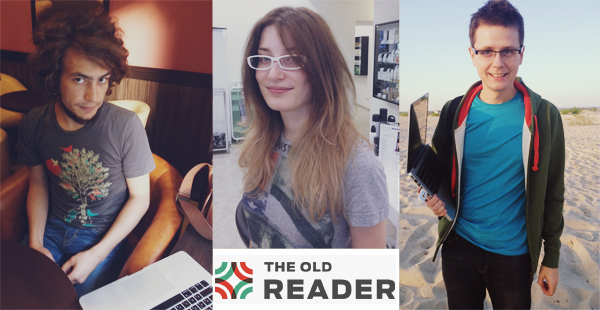
This is amazing. Incredible. Outstanding. And absolutely unexpected. We reached our personal milestone this morning. In early June Dmitry made a bet that he would start making an iOS app once The Old Reader hits 5000 registrations, and the team gladly accepted this challenge. We have not expected this to happen until early 2013 but in these last five days ~1900 new users registered. These are mostly some awesome people from Brazil who have found us and spread the word in Twitter with astonishing passion and lots of sincerity.
We are sorry for some technical issues you might have experienced recently; importing your feeds should work much better now and we are trying various things to make it work perfectly. And thank you all for your patience, words can’t describe how important and touching it was to receive reassuring replies like “Ok, I can wait :)”.
So, 5000.
What does this mean for us?
The Old Reader is not even half-finished. We have lots of different tasks to do and the list is growing on a daily basis. All Dmitry talks about these days is different optimizations, while Anton silently opens terminal and starts typing, while Elena is trying to land us a sponsorship or a partnership. And, of course, we are looking forward to bookmarklet, mass-editing, sorting, and lots of other features you requested.
What does it mean for you?
The Old Reader is not even half-finished. But some day it will be.
What does it mean for all of us?
As we promised earlier, along with other tasks we are going to start working on an iOS app. Yes, it’s a big deal for us.
Last month was not the best for our team in terms of our project: one of us changed jobs, some of us changed countries and all three of us are now unable to spend evenings and weekends coding, tweaking, fixing, writing emails, resolving issues, and generally having the best experience that friends can have: creating something together. But we will continue doing everything we can to bring The Old Reader to the new level.
We thank all our users for your interest, kind words, critique, suggestions, patience, and new challenges you give us. And thanks to our old and new friends for using The Old Reader to read, curate, and share the best content ever. Keep on going and we will keep on working.
P.S. We knew that Elena can cry while reading emails and replies in Twitter, we witnessed her doing that multiple times during last few days, but apparently she is also able to write a post and cry at the same time. Hardcore multitasking.
Lindsaycdavison@andreadrager who is a teen :)

The existence of apps like Versagram is evidence that Facebook's $1 billion acquisition of Instagram was money well spent, even if the latter had just 13 employees when it was purchased in April. The photo-sharing site, not Facebook, increasingly looks like the place where the next generation of social networkers wants to talk.
What it is: Versagram is an iOS app that lets users post what are essentially status updates inside of Instagram. Popular among teens, Versagram lets users choose from a variety of background "themes," including pictures of a sky filled with balloons and a spherical head of dandelion seeds, and either insert their own text or choose from a library of celebrity quotes from the likes of Adele and Effie Trinket of "The Hunger Games." (They can also post to Apple's iMessage.)
User base: Versagram's creator, Ian Broyles, estimates that the app has been downloaded 3 million times since he shipped it to the App Store in February and that it's currently being downloaded between 6,000 and 10,000 times a day. From what he can tell, the majority of users are under 16 and plenty are under 13 (the official cut-off for Instagram and other social-media sites).