Shared posts

25 Apr 07:07

Forget the Strategy PowerPoint

by John P. Kotter

I have for decades watched CEOs and other executives try to explain a corporate strategy to a small group of senior managers or to a much larger group of staff. For the most part, it has not been a pretty sight. In the case of senior managers, I usually hear 3 or 4 different interpretations of what the boss said, or disagreements about what they thought he or she said. In either case, no alignment at the top. In the case of a larger group of staff, often many people look on blankly during the presentation. They may appreciate a CEO’s willingness to share crucial plans. But because they don’t have the context or experience, they can’t even begin to understand what is being thrown at them in a thick PowerPoint deck. And what they do see certainly doesn’t make them want to get up in the morning and come to work.

I have watched CEOs have better success communicating a good vision. It is much shorter, easier to see (literally), at best emotionally compelling. It is the place that a strategy is trying to drive the enterprise. But better success communicating the vision only goes so far. To truly help an enterprise succeed, this needs to be tightly connected to the actual strategy, and often is not. Worse, the vision can come out sounding as if it has no real content, or antiseptic or foggy.

My colleagues and I have found an alternative that is easier to communicate, more effectively aligns people, and generates and sustains energy better and for longer. We call it “The Big Opportunity” and I devote an entire chapter to it in my new book Accelerate. We have been using this in all our field work with different kinds of companies and organizations.  I have been impressed with the power of this simple, clear concept.

Briefly, here is the idea: a Big Opportunity articulates in language that is analytically accurate and emotionally compelling an opportunity that will move an organization forward in a substantial way. It is that exciting possibility which, if you can capitalize on it, will place you into a prosperous, winning future. It is related to vision and strategy in a very straightforward way: a strategy shows you what you need to get to a vision; a vision shows you what you will be doing if you get to, and are able to capitalize on, a big opportunity.

The Big Opportunity Graphic

A written statement of a Big Opportunity can be a very useful tool. It is short, like a vision statement, and unlike a strategy description which is often much longer. “Short” usually means about half a page long. The crisp clarity of it is one of its advantages. Another is its tone. Both strategies and visions can sound like: OK, this is what top management has decided and now you will go do it. Effective Big Opportunity statements direct attention to an inspiring rainbow outside; they don’t feel like a finger pointing out what the managerial and employee children should be doing inside the organization.

Big Opportunity statements, as we have used them, have real rational content (like any good strategy) and are emotionally compelling (like any good vision). Here are the basic characteristics of an effective Big Opportunity statement:

Short. Written on less than a page, often just a quarter of a page. Short length makes it easier to share with others and to create a sense of urgency among large groups of people.

Rational. It makes sense in light of real happenings inside and outside an organization. A good statement concisely addresses issues of what, why, why us, why now, and why bother.

Compelling. It is not all head. There is heart in it. And it speaks to the emotions of all relevant audiences — not just to select people and groups, excluding others.

Positive. Because it is about an opportunity, it has a positive tone. It is less like a statement about a “burning platform,” which seeks to scare us out of our complacency, and more like a statement of a “burning desire.”

Authentic. It feels real. It is not just “good messaging” to motivate the troops. The senior leadership team that puts it together, or at least signs off on it, must genuinely believe in it and feel excited about it.

Clear. You can create a statement that is short, rational, emotionally compelling… but still unclear. A great statement makes people rush off in the same direction — not different directions.

Aligned. The statement is aligned with any important existing statements of strategy in the group or organization. Or at the least, it is aware of any non-alignment and the stresses and strains that will create, so leaders are prepared for it.

In our experience, we have found that that you can get 75% of a large employee population to understand, believe in, and be energized by a good Big Opportunity statement in a way that just doesn’t happen with a larger description of a business strategy or a vision. In an increasingly fast-moving world, this achievement can can be hugely helpful in dealing with rapid-fire strategic challenges.

24 Apr 08:58

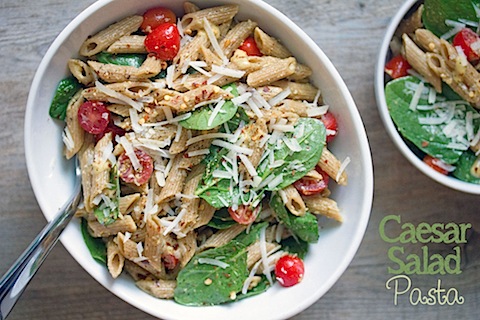
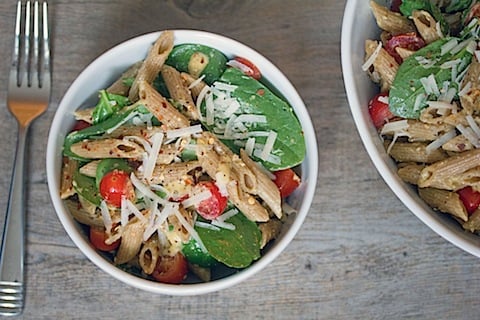
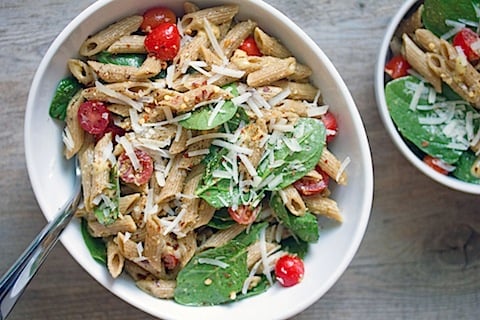
Caesar Salad Pasta

by Sues
Lindsaycdavison

I'm a fan of salad pasta...gets over my salad aversion

Caesar Salad Pasta.jpg

I suddenly realized I’ve posted about a million desserts on the blog in a row. And I got nervous that you are all sitting at home thinking “Dang, does that girl do anything but eat frosting and butter?” The answer is that yes, I do a few things that don’t involve eating frosting and butter. But not many. And most of those involve candy melts, anyway. Oops.

But today I posted an actual dinner recipe over at Parade Magazine’s website. It involves pasta and Caesar salad dressing, so clearly I’m easing into things over here.

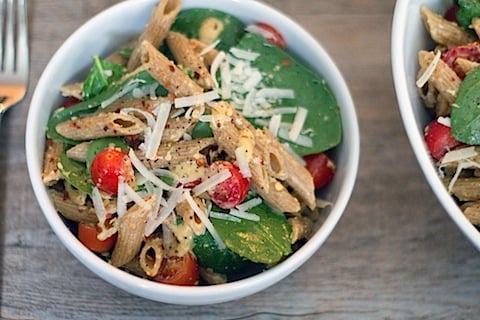
Caesar Salad Pasta 2.jpg

But it also has a healthy dose of spinach and tomatoes, so I’ll give myself some credit for that. And maybe a pat on the back. Annnd maybe a milkshake, too. Shush.

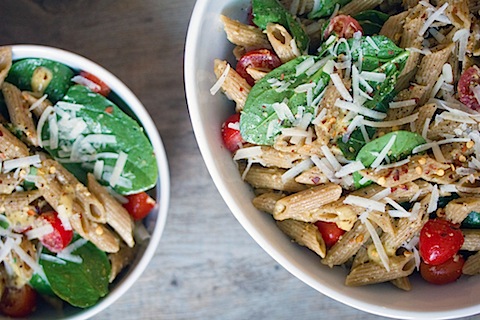
Caesar Salad Pasta 12.jpg

Don’t you hate it when you’re out to eat and they ask if you want the Caesar salad or the garden salad? Because obviously you want the Caesar salad. The Caesar salad is basically lettuce with rich creamy dressing, topped with fried bread and cheese. You’re crazy if you don’t want it. But you also just ordered a heavy pasta/pizza/insert super high-calorie dish here. And you know you should get a garden salad with lots of veggies and a low-fat vinaigrette. Ugh.

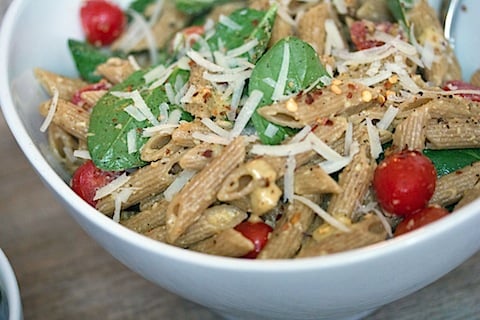
Caesar Salad Pasta 8.jpg

Please do not ask me to make this decision.

Caesar Salad Pasta 7.jpg

I’m not really sure the point of that rant because basically what I did here was take a Caesar salad and combine it with pasta. But again, there are vegetables. You know, like a garden salad. Kind of. Sort of. Maybe? Please just go with me.

Caesar Salad Pasta 9.jpg

The point is, I made dinner.

If you want to combine the best ever salad with pasta, too, check out my recipe for Caesar Salad Pasta over at Parade Magazine!

Will it be a Caesar salad or garden salad for you?

[Sues]

24 Apr 08:36

Design Icon: Sony Walkman

by Maxwell Tielman

designsponge_walkman1_libbyvanderploeg

Design: Sony Walkman

Date: 1979

Designer: Nobutoshi Kihara (1926-2011)

Country of Origin: Japan

Background: Although contemporary people might associate Apple’s iPod with the revolution of portable music, one need look over twenty years earlier for its true origins: The Sony Walkman. Portable music had been available for some time prior to the Walkman’s release, but never in such a distilled, easy-to-use, minimally-designed package—something that literally put music in the palm of your hand. With nary a superfluous design element in sight, the Walkman was a beautiful amalgam of form and function. Barely larger than the cassette tapes it held, the original Walkman featured a precise layout and elegant lines—a surprisingly high-end look for a mass-market product. (Check out this fabulous deep-look at the Walkman on the Minimally Minimal blog.)

Illustration by Libby VanderPloeg.


24 Apr 08:30

5 Inspirational Sheet Backsplashes — The Kitchn

by Jennifer Hunter
23 Apr 18:00

Wild Garlic (or Ramps) Pasta

by David

Ramp/Wild Garlic pasta

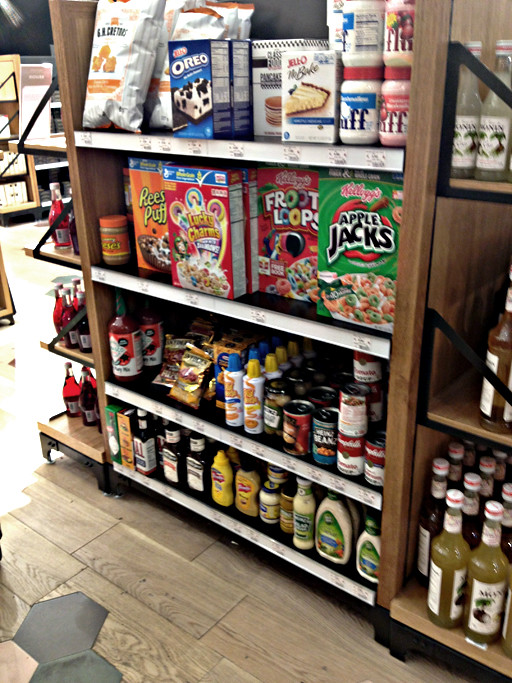
I’ve become weary – and wary – of the American aisles in European supermarkets. And have come to the conclusion that people think we all eat badly because we live on bottled salad dressings, orange cheese in squirt bottles, and strawberry Fluff, which is something I’ve never seen in America. And I like Fluff just fine. (Just the plain, though. The red scares me. However truth be told, I’ve been known to succumb to the magic of Lucky Charms, a long time ago.) But when that’s the sole image representing American food, it’s sad to me, because we’ve had a wonderful renaissance in the last few decades of marvelous farmers’ markets sprouting up everywhere, even in the middle of the most urban city in the world, New York.

Ramp/Wild Garlic pasta

Of course, no one is exporting fresh American goat cheese to France, farm eggs, small-batch jams, or artisan honeys, since they have those things in abundance here. (And the French have their share of goofy foods, too, including unusual flavors of tinned ravioli, but they don’t seem to make it across the Atlantic.)

Ramp/Wild Garlic pasta

In Switzerland recently, while touring with my group, I noticed at the sweet little auberge near Lausanne where we had dinner the final night, that the blackboard propping the door open said the plat du jour was fondue with bear’s garlic (ail des ours). Although lunch that day was cheese beignets, and dinner the night before was fondue at Café Grütli, and we’d had a cheese-tasting that afternoon at a cheese-ripening cave, for some reason, I was hungry for yet another hit of melted cheese. Happily, the owner was kind enough to bring me, and my group, a small pot for a taste. And let me tell you, if we weren’t facing another full-on dinner of Swiss food, I would have scraped that entire pot clean.

Ramp/Wild Garlic pasta

Continue Reading Wild Garlic (or Ramps) Pasta...

23 Apr 14:57

The Design Flaw That Almost Wiped Out an NYC Skyscraper

by nickdivers
23 Apr 14:52

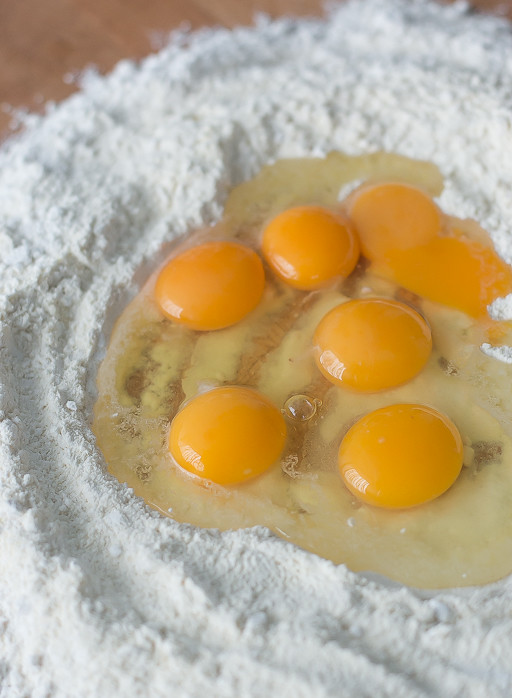
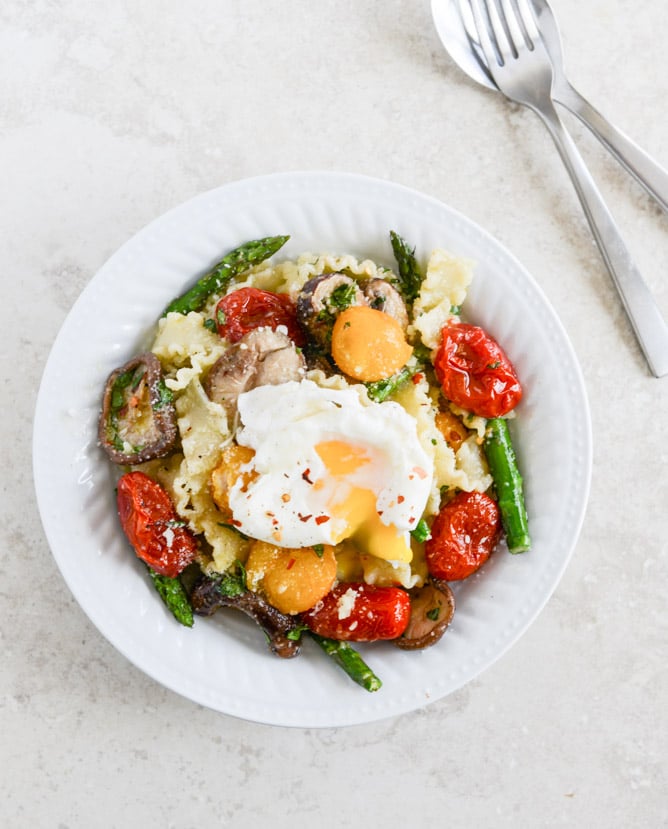
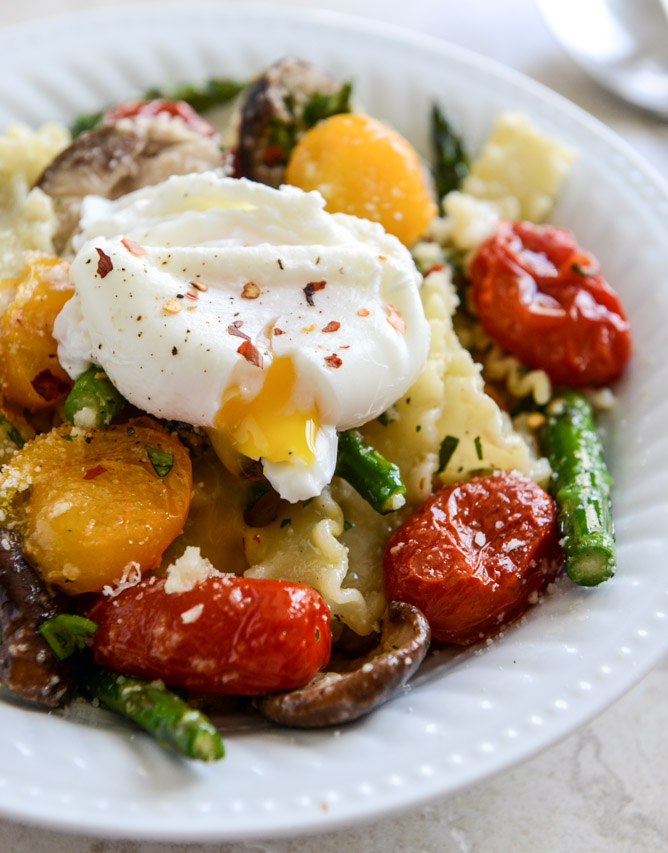
Springtime Pasta with Blistered Tomatoes and Eggs.

by Jessica
Lindsaycdavison

weirdly, runny egg yolks are one of the things i miss most. Brunch just isn't the same :(

Here’s what to do if you’re currently pounding reese’s peanut butter eggs.

Springtime Pasta with Blistered Tomatoes and Eggs I howsweeteats.com

Or cadbury crème eggs.

Or dove coconut filled eggs.

Or fruity jelly beans. (If you like spiced beans I don’t know how we’re friends.)

Or massive Sarris’ truffle eggs.

I could go on and on. But here’s what to do. Grab a big skillet and throw all the junk that’s in your fridge inside of it. You can even add the (faux peanut butter) eggs if you want.

Personally I’d like to eat those adorable pastel foil wrapped chocolate eggs for every meal today, but I also would prefer to not hate life. You get it.

Springtime Pasta with Blistered Tomatoes and Eggs I howsweeteats.com

Okay, so it’s been spring for like a month already and even though I was pushing for spring about two months before that, I finally feel like NOW it’s time. It’s spring, it’s spring!

Heck it’s practically summer.

Okay no I’ll stop. I want to punch me in the face too. No rush summer.

I mean, I did officially change my computer wallpaper to something rather beachy so it’s clearly a new season. And my hand has been hovering over the AC (I start to lose it at 72 degrees outdoors) but I haven’t pulled the trigger. Yet.

Springtime Pasta with Blistered Tomatoes and Eggs I howsweeteats.com

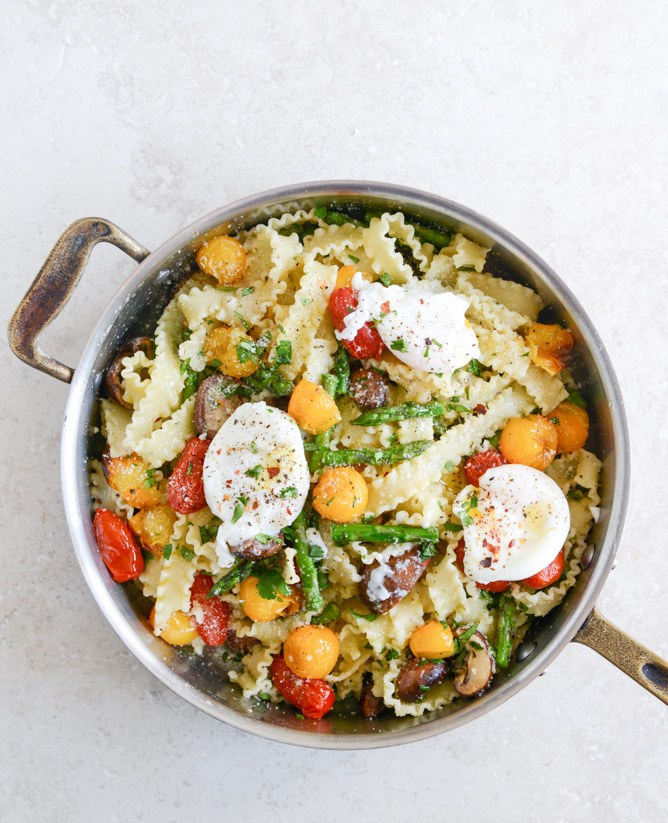
This mess is full of my current favorite things: mushrooms, asparagus, almost-popped tomatoes and… of course… eggs. Lots and lots of eggs.

I will never quit the eggs.

And the cheese, obviously.

I get it. I overdo the eggs. But I could truly put them on anything and be thrilled with life. No hating it.

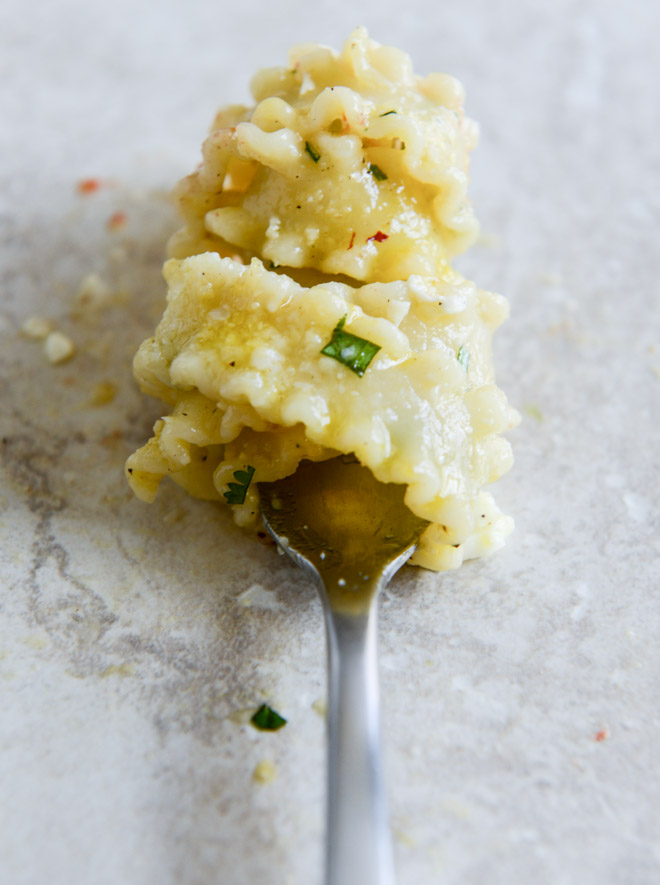
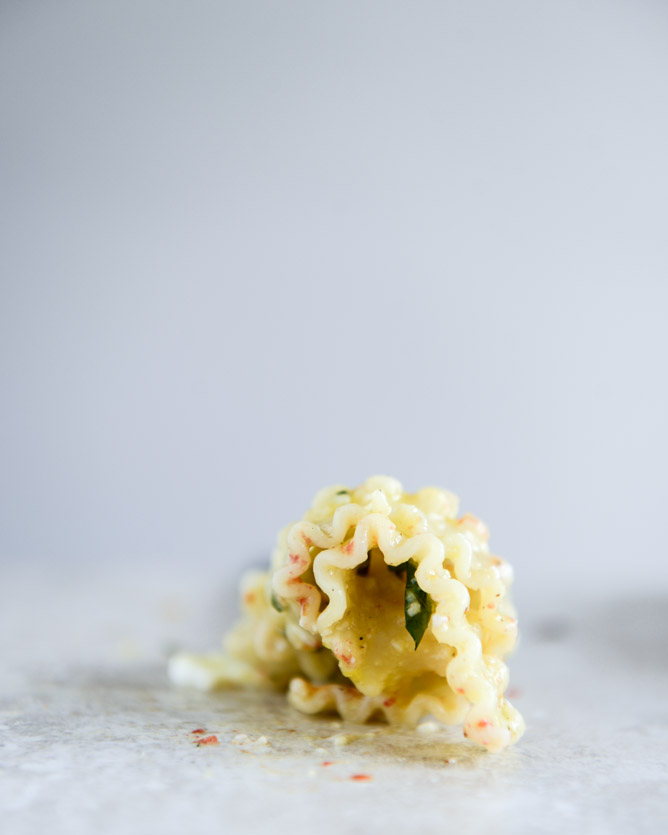
One of the reasons I’m so nutty over this dish is because the runny eggs mix into the pasta and create a delicious rich coating on the noodles. If you’re feeling frisky you could even just add a farm fresh yolk right down in the center of the whole shebang instead of a poached egg. But I was afraid of freaking people out.

People being my husband. Who would think that he’d hate such a thing while really actually loving it but refusing to try it out of fear. You know. The norm.

So we have: pretty little tomatoes that are shoved in the oven until they almost burst, but don’t. Garlic sautéed mushrooms and crisp asaparagus and noodles swirled in olive oil, fresh herbs and freshly grated cheese. And topped off with the softest poached eggs peppered with crushed red pepper.

I need nothing else. Forever and ever.

Springtime Pasta with Blistered Tomatoes and Eggs I howsweeteats.com

Spring Pasta with Blistered Tomatoes and Eggs

Yield: serves 4 appropriately, 2 obnoxiously

Total Time: 45 minutes

Ingredients:

1 pint grape tomatoes
2 teaspoons olive oil
1/4 teaspoon salt
1/4 teaspoon pepper

1/2 pound mafalda pasta (or another wide noodle-like pasta)
2 tablespoons olive oil
2 tablespoons unsalted butter
12 ounce shiitake mushrooms
4 garlic cloves, minced
1/2 pound asparagus spears, stems removed and cut into thirds
1/3 cup freshly grated parmesan cheese
1 tablespoon chopped fresh basil
1 tablespoon chopped fresh parsley
1/2 tablespoon chopped fresh thyme
1/2 teaspoon salt
1/2 teaspoon pepper
4 eggs, fried or poached
a sprinkle of crushed red pepper

Directions:

Preheat the oven to 425 degrees F. Add the tomatoes to a baking sheet and drizzle with olive oil, salt and pepper, tossing to coat. Roast for 15 to 20 minutes, or until the tomatoes are just about to burst. Remove from the oven.

While the tomatoes are roasting, bring the water to a boil and prepare the pasta.

Heat a large skillet over medium heat and add olive oil and butter. Add the mushrooms and stir. Cook, stirring occasionally, until the mushrooms are soft and juicy, about 6 to 8 minutes. Add in the garlic and asparagus, stirring to coat. Cook until the asparagus are green and vibrant, about 5 minutes. Stir in the pasta, tomatoes, parmesan, fresh herbs, salt and pepper. Toss well to coat and stir. Taste and season additionally if desired. If the pasta seems a little dry, a few drizzles of olive oil and stir.

Serve topped with a poached egg and a sprinkle of crushed red pepper.

Springtime Pasta with Blistered Tomatoes and Eggs I howsweeteats.com

see, now you can have a snickers egg.


© How Sweet It Is

23 Apr 12:06

Recovery in Euro Zone Gathers Pace

by By DAVID JOLLY
Business activity in the 18 nations that use the common currency expanded in April at its fastest rate in nearly three years, according to a private sector survey.


23 Apr 10:59

A Beginner's Guide to Spanish Wine

by Stacey Gibson

From Drinks

20140302spanishwinetop.jpg

Essential info on Spanish wine regions and grapes. [Photograph: Nicole Lerner]

When I asked my mother recently what kind of Spanish wine she enjoyed, she enthusiastically exclaimed, "sangria!" Of course, Spain has much more to offer in wine than just that tasty pitcher drink. You can find so many great values in Spanish wine—delicious (and cheap!) bottles for any night of the week. But you will also be rewarded if you decide to spend a little more and explore the classic wines of Spain. If you mostly drink wines from the New World—say, South America, California, or Australia&mdsah;lush Spanish wines are a great introduction to the Old World.

Facing a new section of your local wine store can be daunting. Today, we'll help you get to know some major Spanish wine regions and grapes so you can confidently choose a few bottles to try.

What You'll See On the Bottle

20140302riojabottles.jpg

[Photograph: Imamon on Flickr]

One of the things that makes Spanish wine special is that many Spanish wineries age the wine for you, in oak barrels and in the bottle. This means you get a chance to taste cellared wines that have aged to the point of tasting their best without investing in storage space at home. When you look at a Spanish wine and see the terms Joven, Crianza, Reserva, or Gran Reserva, they're telling you about how long the aging was: those Gran Reservas have been cellared the longest, and a bottle with 'Joven' on the label didn't spend nearly as much time resting at the winery.

Because Spain is part of the European Union, the wine labeling system is pretty similar to those of France and Italy. The category you will most often see at your local shop is Denominación de Origen (DO), which is the equivalent of an Appellation d'Origine Contrôlée (AOC) in France. Each individual DO (for example, Ribera del Duero or Rías Baixas) has its own rules for the wines, such as which grapes can be planted. If for some reason you can't find the DO on the bottle, the "logo" of the DO should be on a sticker on the back or on the capsule over the cork.

The top of the Spanish wine quality pyramid is Denominación de Origen Calificada (it has several abbreviations because of regional dialects: DOCa, DOC or DOQ). There are only two DOCs: Rioja and Priorat. Spain also has a unique category, called DO Pago, which is for single estates.

When you're looking at bottles of Spanish wine, you'll often see the primary grape front and center on the label, or otherwise, on the back. One thing you will notice is that because of regional language differences, sometimes grapes or areas may look just a little different. Garnacha in Catalonia, for example, will appear as Garnatxa.

Weather Shapes the Wine

vineyard in spain

[Photograph: Randi Hausken on Flickr]

Since Spain is a peninsula, the climate varies widely from region to region. Most of central Spain sizzles under the summer sun and gets very cold in the winter. In the northwestern part, called Galicia, the cool ocean breezes and many rivers lead to the moniker "Green Spain." In the south, the brutal, arid land and howling winds can prove too much for most grapes. The Mediterranean to the west contributes warm temperatures and cooling breezes, while the Pyrenees on the border with France block rain clouds from making their way to the north central area.

Ready to start drinking?

Cava

20140302cavabottles.jpg

[Photograph: Robyn Lee]

Cava is the famous sparkling wine of Spain. You'll mostly find Cava production in Catalonia in the northeast by Barcelona. Cava goes through the traditional method of secondary fermentation in the bottle to get its bubbles—like Champagne in France and Franciacorta in Italy. Cava can be white or rosé and is usually a blend of Xarel-lo, Macabéo, and Parellada grapes, but a few other varieties are also allowed in the blend. Because of extended aging with the spent yeast, most Cavas have a richness that complements crisp appley flavors. Cavas are usually dry, but like with Champagne, the amount of sugar from the dosage will be indicated on the label with such terms as Brut or Semi-Seco. If you're looking for not-too-pricey sparkling wine for a special occasion (or a weeknight dinner), Cava can be a great choice.

Spanish White Wines

Fresh and Salty

20140302txakoli.jpg

Txakoli has a bit of light fizz. [Photograph: Jon Oropeza]

On the Northern coast of Spain near San Sebastian is Basque country. This is where you will find Txakoli (pronounced CHALK-oh-lee), a citrusy wine with low alcohol and some spritz made from the Hondarribi Zuri grape. Ameztoi and Txomin Etxaniz are two producers that are easy to find, but many more have been imported into the US recently and you should be able to find this perfect sunny afternoon sipper wherever you live. The area makes a tiny bit of red wine from the Hondarribi Beltza grape, which also allows them to make rosé. Txakoli rosé is truly one of the great joys in life. It is fun and fresh and tastes like salted watermelon.

On the western coast, north of Portugal, lies Rías Baixas. The star of this area is Albariño, with Loureira and Treixadura being the backup dancers. True to its coastal nature, you can find a briny, ocean touch to this wine, which also has hints of white flowers and stone fruit. Take a hint from the locals and enjoy a glass with seafood. A big bowl of steamed mussels, perhaps?

Rich and Textured

The tiny region of Valdeorras, just a few hours inland from Rías Baixas, makes several styles of wine. Start with the white wines, based on the Godello grape. Godello combines lemon and cantaloupe flavors with a crisp minerality. These wines have enough body to carry you through a meal from a braised octopus appetizer to roasted halibut.

Southeast of Valdeorras is Rueda, which sits on the Duero River in the Castilla y León region. A small amount of red wine is made, but the true gems are white wines made from Verdejo. If the wine is mostly Verdejo, it will say 'Rueda Verdejo' on the bottle. Otherwise, it likely has a significant portion of Viura and Sauvignon Blanc blended with it. The wines are wonderfully aromatic, reminiscent of meyer lemon and almond.

While also planted around Galicia and in Catalonia for use in Cava (under the name Macabéo), Viura is famously known as the white grape of Rioja. It can be bottled on its own or blended with other grapes, such as Garnacha Blanca or even Chardonnay. Lopez de Heredia, one of the greatest wineries in Spain, makes an aged Viura called 'Viña Gravonia' that really is in a class by itself. They cellar it in American oak barrels for years and then it doesn't hit shelves until nearly a decade after the grapes were picked. It is tannic, full-bodied and has an amazingly complex aroma of bruised apple, curry, and coconut. Not all white Rioja is made this way, though. Many that you will find, especially if they are young, will be fresh but still full-bodied, with waxy apple and pear flavors.

Spanish Red Wines

20140302mugacellars.jpg

The cellars at Muga in Rioja. [Photograph: Bodegas Muga]

If you've started exploring Spanish wine, you've likely had a bottle or two of Tempranillo. Tempranillo is the most planted red grape in Spain, and it appears under a few names, including Tinto Fino, Tinto de Toro, Cencibel, Ull de Llebre, and Tinto del Pais. The two most famous regions for Tempranillo are Rioja and Ribera del Duero.

Rioja

Rioja is in north-central Spain on the Ebro River. Wines of Rioja are a great blend of ripe fruit and earthy flavors—they have one foot in the New World and one foot in the Old World. In Rioja, Tempranillo grapes can be blended with Mazuelo, Graciano, Garnacha, and Maturana Tinta. The law also leaves a little room for winemakers to add non-traditional grapes like Cabernet Sauvignon in small proportions. Classic examples will combine ripe plum and dried prune flavors with hints of leather and sweet-and-sour sauce.

Rioja went above and beyond Spanish laws and added some time to their minimum aging requirements. And often, winemakers allow the wines to age for years beyond what is required by Rioja. For red wines, Crianzas are aged at least 2 years total (including 1 year in oak barrels.) Reserva wines are aged at least 3 years total, including 1 year in barrels. Gran Reservas spend at least 2 years in barrels and then three more years in bottles before they're sold.

You might hear people calling wines from Rioja either 'traditional' or 'modern' in style. What does this mean? 'Traditional' wines of Rioja are aged in American oak barrels, which impart hints of coconut and dill to the wine. 'Modern' winemakers tend to use French oak barrels, which add a little vanilla and baking spice flavor. While some winemakers are squarely in one camp or another, many use methods that are somewhere in between. You might find some wines that have been aged in a mixture of American or French oak barrels or even in barrels that are themselves made of both types of oak.

Want to try some great Rioja? Producers to seek out include Muga, Lopez de Heredia, and CVNE.

Ribera del Duero

Ribera del Duero is the other Spanish wine region known for top-quality Tempranillo, and here, the wines are usually entirely Tempranillo, rather than a blend. Like Rioja, most wine labels from Ribera del Duero will let you know how long the wine has been aged by using the terms Crianza, Reserva, and Gran Reserva on the labels. The winemaker's use of oak has a major influence on the finished wine here, too. While you'll see mostly American oak in traditional Rioja bottlings, winemakers in Ribera del Duero often opt for more French oak, so you're more likely to taste vanilla, cinnamon, and clove. Overall, Ribera del Duero is more opulent and polished than the rustic, earthy Rioja. I think of Ribera del Duero as my shiny black pumps and Rioja is best-fitting pair of soft leather loafers.

Tempranillo isn't just limited to Rioja and Ribera del Duero, though. It's grown across the country, and regions such as La Mancha and Valdepeñas offer affordable versions that are lightly oaked and ready to drink right away.

Priorat

20140302priorat.jpg

Steep vineyards in Priorat [Photograph: Agricultura Generalitat de Catalunya]

Wines from Priorat are intense and muscular. If you love sun-kissed, full bodied California wines but are looking for an earthier touch, this is a great region to explore. Many of the vineyards in Priorat are so steep they necessitate building terraces—it's like making the hill into a large staircase with rows of vines on each step. Priorat's unique slate soil—called llicorella—looks like broken chalkboard strewn around the hillside. This rough terrain requires vines to dig deep in the earth in search of water and nutrients.

Most of Priorat's red wines are made from a blend of Garnacha and Cariñena with Cabernet Sauvignon, Syrah, and others. Alvaro Palacios was a pioneer in this region and while prices of Priorat in general have skyrocketed over the years, his "Camins del Priorat" bottling is still one of the best values around.

If you're curious about wines like this, but can't swing the price tag, try seeking out wines from Montsant, a region that is like a horseshoe around Priorat. The wines are full-bodied with intense red and black fruit, dried tobacco, and earth.

More Red Wine Values in Spain

If you want to try Spanish wine on a budget, it's worth getting friendly with a few more grapes beyond Tempranillo.

I've already mentioned Garnacha a few times—it appears as part of the blend in Priorat and in Rioja. Known as Grenache in France, this is the third most planted grape in Spain. Garnacha thrives in warm climates, especially in the north-central part of Spain. It is often used to make rosé, but can also make wonderfully ripe, cherry-fruited weeknight wines, such as Borsao's 'Tres Picos' from Campo de Borja.

Monastrell, the Spanish name for Southern France's Mourvèdre, can be found across southern Spain. It needs a lot of sunshine to ripen; it definitely finds that warmth on the sunny Mediterranean coast near Valencia. Often the wines will be full-bodied with aromas of ripe, juicy red fruit, pepper, and meat.

The grape Mencía makes medium- to full-bodied wines with hints of blackberry, anise, and a distinct herbal aroma that often reminds me of Cabernet Franc. While the grape is grown throughout Galicia and northwestern Spain, Bierzo is a good region to seek out.

Sherry

20140302sherryandolives.jpg

Sherry and olives are delicious together. [Photograph: Krista on Flickr]

The first time I ever stuck my nose in a glass of sherry was in a wine class. All the students popped their heads up and looked around. Was there something wrong with it? We had never smelled anything like that stuff. The weird wine in the glass was Fino Sherry...and not only was it not flawed, but it was totally delicious. Sherry captures you with its intense aromatics and electrifying acidity.

Most sherry is a fortified wine that goes through a solera, a system of blending where wines from different years are mixed into each other over time. In some sherry barrels, a layer of yeast called flor will form over the top of the wine, protecting it from oxygen while imparting a distinct flavor. The freshest styles are Fino and Manzanilla (that second one is a Fino sherry made in the town of Sanlúcar de Barrameda.) If these styles are exposed to oxygen later on in their aging, combining the taste of flor with nutty, oxidative characteristics, they become the Amontillado and Palo Cortado styles. Oloroso sherry is made without flor to protect the wine from oxygen. This gives the wine rich walnut and toffee notes. (Want to read more about sherry? We have a whole guide here.)

Dry sherries can be such a surprisingly perfect pairing for food. A glass of Manzanilla with almonds and boquerones is classic and delicious. A bottle of Palo Cortado with a crispy-skinned roast chicken will blow you away.

Time for dessert? Sweet styles of sherry, such as Pedro Ximénez and Pale Cream sherries, can be a rich, syrupy delight. They go perfectly with ice cream or chocolate cake, or served as a sweet counterpoint to a cheese plate.

23 Apr 09:03

What Makes the Best Infographics So Convincing

by Andrea Ovans

A great infographic is an instant revelation. It can compress time and space. (Good gosh – Usain Bolt is that much faster than all the other 100-meter gold medalists who’ve ever competed?) It can illuminate patterns in massive amounts of data. (Sure, we’re spending much more on health care and education than our grandparents did. But look how much less on housing.) It can make the abstract convincingly concrete. (Which player was ESPN’s SportsCenter most discussed during the 2012 football season? Tim Tebow — and by a colossal margin. Seriously?)

BAInfographics_ESPN

These intriguing revelations come from a short trip around The Best American Infographics, 2013. Spend serious time poring over graphs, pie charts, bar charts, flow charts, timelines, interactive diagrams, maps, cut-away diagrams, and narrative illustrations, as Gareth Cook did to compile the collection, and you’ll come away with more than your share of these mind-bending moments – and a wide-ranging view of what infographics can do. A Pulitzer Prize–winning journalist, Cook is a regular contributor to NewYorker.com and Scientific American Mind.

The most compelling infographics, he says, mine relationships among overlooked variables to tell you something unexpected and get you thinking. (Who knew it takes an annual income of $908,000 to break into the top 1% in Stamford, Connecticut, but only $609,000 in New York City — and just $558,000 in pricey San Francisco?) The least effective confuse you (the food pyramid), overwhelm you with data (nutrition labels), or are just plain boring. I recently asked Cook to share his thoughts about what makes an infographic particularly persuasive.

What’s special about the way infographics make their case?

Infographics have an emotional power because they can show you an idea — or a relationship, or how something works — very quickly. People respond to that. A persuasive infographic surprises the viewer. It moves them in some way and makes them want to keep looking at it or show it to other people.

Did you see commonalities in the ones you found most convincing?

First, I’d say, they all have a clear focus. The designer has gone in and removed all the extraneous details so you see just what you need to understand the message behind it. And yet the best ones also have a kind of openness – the person who’s done it is transparent about what data they’re using. That can be tricky because you need to give people a sense of all the data that’s out there, and enough context, without overwhelming them. In the best cases, viewers feel that they are the ones stepping in and making the connection because they can see the bigger pattern naturally emerging from what you’re showing them.

Can you give me an example?

Take a look at the first infographic of the collection. It’s very simple. It starts with a question: “Which Birth Dates Are Most Common?” And what we see is a chart that shows every day of the year in various shades of a single color. The darker the color, the more babies were born on that day in the U.S.

BAInfographics_BirthDates

It’s effective because you can see all the data for the entire year, and yet the actual relationship emerges very strongly. You immediately see the dark band running through July, August, September, and into October. It’s very clear that more people are being born then.

Once you’ve seen the main relationship, you can look at other things, as well, which is very satisfying. You can see, for example, on July 4th and 5th there’s a sudden drop-off in people being born, presumably because it’s around the holidays — you can see the same thing around the Christmas holidays. But then if you look over at February 14th there’s a dark island where a lot of babies are being born. So you can see the main relationship, but then you can also do some exploring.

That’s an important part of its persuasiveness: You want to show someone something, but you also want to give them a sense that they’re free to move around and find their own relationships. When they do, they’ll have confidence that you really are giving them the whole story.

In his introduction to the book, David Bryne talks about the power of infographics to let us see the invisible. He’s thinking mainly of cutaway diagrams, as an explanatory tool, but I imagine that can be an effective tool of persuasion as well.

Sometimes people don’t believe you because they can’t relate to your argument or they can’t understand it. Infographics can make an abstract subject concrete – let viewers put their hands around it. One of the 10 interactive infographics in the book does this especially well. It shows carbon emissions in New York City in real time, representing each ton of carbon dioxide as a giant blue sphere.

In 2010, as we’re told in the introduction, New York City added the equivalent of 54 million metric tons of carbon dioxide to the atmosphere. That’s two tons every second. As you watch, the giant spheres emerge from the ground and start to float upward, two every second. You can see how much they build up over time. By the end of a day, the pile has reached the top of the Empire State Building. It’s amazing; you get a visceral sense for how much pollution that is.

Can you give me an example of an infographic that’s good at boiling down a mass of big data?

One is the Better Food Label, which Mark Bittman and a team of designers at the New York Times came up with. Look at the food label on your breakfast cereal in the morning and you see this overwhelming amount of data – vitamin A, vitamin C, calcium, all these percentages, two columns, with and without milk. It’s hard to make sense of it all. Imagine someone at the grocery store trying to decide between two products: Which is going to be better for me and my family? It’s just too hard to get the answer.

So they came up with a chart designed to address just a few basic questions that someone might want to know when trying to decide how good this food is. How healthy is it nutritionally? How free is it from possible contaminants? How safely was it produced, environmentally? And when you look at their label, you can take in all of that information in two or three seconds. (Click to see a larger version of the image below.)

BAInfographics_FoodLabels

This is something infographics are naturally designed to do – give you the gist of a really big data set. I think this is one of the reasons why we’re seeing infographics used in so many different realms right now.

I know you’re talking to a number of business groups while working on next year’s collection of infographics. What are some of the ways forward-thinking businesses are beginning to use them?

Certainly, businesspeople are working with designers to develop infographics that present ideas. But more broadly, they working with them to help solve problems. People adept at creating visual solutions bring a different basic set of questions to bear. In considering a data set, they may say “Oh, we can look at this unusual variable and see how that changes over time.” Or they may come up with a new way to explain something to a customer who just can’t seem to understand your current pitch.

I was not at all anticipating this when I set out to do this collection, but I’ve definitely heard from readers who use this as a source book. When they have a problem they flip through it and may notice something that gives them an idea they wouldn’t have thought of before.

Many of the infographics in this collection are pretty funny. If you are in the serious business of trying to persuade people of something, do you see a role for humor?

I think it’s often the case that when people are designing something to persuade, they forget the importance of whimsy. Humor opens people up and makes them more willing to hear messages they might not otherwise reject out of hand. When you’re working really hard on designing something or making something clear, it’s very easy to lose that sense of fun yourself, and the work shows it. You want your audience to sense that at a certain level you are enjoying this. A lot of the pieces in this collection just make me smile.

BAInfographics_IsLifeGood

Persuading with Data
An HBR Insight Center
23 Apr 08:20

Nazi Artifact Auction Cancelled

by Marilyn Z Tomlins
Lindsaycdavison

I don't really consider this morally reprehensible...i think it's history. No?


The Nazi Hermann Göring, who died 68 years ago, was in the news again this week. The reason: a Paris auction of 40 Nazi artifacts which included Göring’s passport. The auction, which had been scheduled to be held on April 26, has been called off due to pressure from several Jewish and anti-racism groups as well as France’s Minister of Culture, Aurelie Filippetti. She described the auction as ’morally reprehensible’ and on her instigation the body which oversees all auctions held on French territory (C.V.V – Conseil des Ventes Volontaires) strongly advised the auction house – Vermont de Pas – not to go ahead with selling the objects.

Said Laudine de Pas, co-owner of the Vermont de Pas Auction House: “It was not our goal to stir a scandal. We were pitching this as part of the responsibility to remember – but in no way to shock or create a polemic.” Also among the items were a wooden chest decorated with Swastikas which had been given to Adolf Hitler as a birthday gift, a mat decorated with the Nazi eagle and bearing Hitler’s initials, and a 17th century manuscript which had been a gift to Göring in 1935. Ms de Pas also spoke of the ‘political pressure’ which had been put on them and of how they had received several ‘insulting’ phone calls and e-mails. A spokesperson for CRIF (Conseil Repréresentative des Institutions Juives de France) the French affiliate of the World Jewish Congress spoke of how the sale of such Nazi artifacts harmed ‘the memory of the victims of Nazi barbarity’ and that the trading in such things gave them an ‘unhealthy symbolic value that resembles cynicism and a form of moral indecency’.

Ms de Pas was auctioning the objects on behalf of who: who was the seller? Ah-ha! The sellers have not been named. Ms de Pas only said that they were the possessions of four people, some of them being former French soldiers or their relatives. How did the soldiers get hold of them? Again – Ah-ha! They had looted Hitler’s Bavarian Alps retreat – the Berghof – when the French Army reached it in May 1945, WW2 having ended and Hitler having shot himself to death.

>more

23 Apr 04:18

How Do I Avoid Being A Micromanager?

by Art Markman and Lolly Daskal

You need to make sure things get accomplished but you don't want to be the boss that everyone hates--the dreaded micromanager. Leadership coach Lolly Daskal and Psychologist Art Markman offer their advice in how to balance this tricky situation.

The micromanager might be one of the most common "bad boss" stereotypes, but it's a tricky situation when you are on the other side.

Read Full Story


23 Apr 03:38

The Top 10 Most Innovative Sustainable Buildings Of 2014

by Adele Peters

From a net-zero energy historic courthouse in Colorado to a homeless center in Oregon filled with green space, these days, the best sustainable architecture goes far beyond a few rooftop solar panels.

By next year, as much as 48% of new non-residential building construction will be green, according to estimates. Sustainable architecture is no longer rare, and that's something that's happened fairly quickly--from 2005 to 2012, the number of new green building designs jumped up 39%.

Read Full Story


23 Apr 02:42

Beyond Curry: Anglo-Indian Coconut Clam Stew

by Denise D'silva Sankhe

20140414-indian-clam-stew-primary.jpg

[Photograph: Prasanna Sankhe]

In India, clams have many names—five, the last time I counted—and come in varying shapes, sizes, and colors. I've always found that compared to other fish and shellfish, clams are rather mild in flavor, with a gentle sweetness, light bitterness, and just a touch of oceany aroma. They're a great way to get into seafood stews and curries if you aren't quite ready to take the plunge into fish; this stew, made with chilies, ginger, turmeric, tomatoes, and coconut, is a particularly good way to enjoy them.

Depending on where you get your clams, the most time-consuming part of this dish can be cleaning them. Since they're filter feeders, they tend to come with a lot of grit. Some fishmongers will purge their clams before selling them, getting rid of most of the sandy dirt trapped inside. The easiest way I've discovered to get rid of it at home is to boil them covered by about 2 inches of water, shuck them, and then rinse the meat off in the liquid. Once you've cleaned and shucked them all, take the liquid off the heat so that the sand settles to the bottom. You can then pour off the flavorful liquid from the top and reduce it as necessary.

With its mild seasoning, this dish is really more Anglo-Indian in nature, but that doesn't make it any less delicious. You can use white bread to soak up all its broth, or serve it with fluffy white rice. Whatever you do, just don't let that precious liquid go to waste!

Get the Recipe!
23 Apr 02:39

Ellen DeGeneres to Host Furniture Design Show — Design News

by Tara Bellucci
Pin it button

Ellen DeGeneres is taking her hosting skills to HGTV. The comedian and daytime talk staple will host Ellen's Design Challenge, a Project Runway-style competition where six designers compete in furniture projects. The show will air next year.

READ MORE »

23 Apr 02:37

Rooftop Season Is Here

by Girls Guide to Paris
Lindsaycdavison

weirdly - I sort of miss a 'season' for rooftops. since it's warm all the time, I never think of going to a roof top. But i should! all the time!

Le Perchoir opened its doors last summer, filling a gap in the Paris bar and restaurant scene: a place on an open rooftop where guests could enjoy an amazing view of the city. The enviable location of this bar offers a 360-degree view of the City of Light. Le Perchoir is divided into two parts: a restaurant on the sixth floor, which serves special gastronomic menus designed seasonally by the chef; and a casual bar on the top floor.

It is recommended to reserve at the restaurant well in advance, especially in spring and summer. Access to the bar is easier from the restaurant; if you only intend to go to the bar, plan to be there as early as 5:30 p.m., because by 6:30 p.m. you may not be allowed to go up until 10 p.m. As the days get warmer, you can’t miss this spot.

>more

23 Apr 02:32

Note to self: Don’t release 1.5MM balloons at once unless...

by bestrooftalkever-george
Lindsaycdavison

it's cool though

22 Apr 19:08

The Food Lab: Maximize Flavor by Ultra-Smashing Your Burger

by J. Kenji López-Alt
Lindsaycdavison

andrew can we try to recreate the shake shack burger soon please please please???

It's time for another round of The Food Lab. Got a suggestion for an upcoming topic? Email Kenji here, and he'll do his best to answer your queries in a future post. Become a fan of The Food Lab on Facebook or follow it on Twitter for play-by-plays on future kitchen tests and recipe experiments.

20140330-ultra-smashed-cheeseburger-food-lab-primary.jpg

An ultra-smashed cheeseburger from Harlem Shake that packs in the flavor. [Photographs: J. Kenji Lopez-Alt]

By now we all know that the old piece of burger wisdom, "never press on your burger!," is either patently false or, at the very least, wildly inaccurate. Heck, there's an entire successful burger chain devoted to using the technique. While a more traditional griddled burger might be cooked with the goals of a loose, tender texture in mind, a smashed burger goes for one thing only: maximum crust.

See, by placing a ball of meat on a hot, un-oiled griddle and smashing it down firmly into a flat, thin disk, you greatly increase the contact points between the meat and the griddle, which in turn increases the Maillard reaction. That's the series of chemical reactions that creates the rich brown crust that makes our steaks and burgers taste so freaking good. Maximum crust = maximum flavor = maximum craving.

I've already discussed the basic ins and outs of smashed burgers in the past, but after writing that article, I found myself wondering, what if I were to take this to the extreme? Is there a way I can pack even more flavor into a burger?

Spoiler alert: the answer is a big fat (or should I say short smashed?) yes.

Size Matters

I'm going to let you in on a little secret: I'm a writer by accident and a cook by design. In fact, for many years, while I was still living in Boston, I had the goal of returning to the world of restaurant kitchens by opening up my own burger joint. I even went as far as to get a partner, do market research, write up a business plan (truly the most mind-numbing experience of my life), check out spaces, design a menu and logo, and get asked in no uncertain terms* by a number of potential investors you want that much money in this economy?!

*insofar as it is possible to ask with no uncertainty, that is.

Needless to say, that burger joint never came to fruition and it's probably all for the best—I can't imagine a better way to live life than to get paid to do what you love doing, all while still having weekends and holidays to be with friends and family (that's something you don't get with a restaurant life). But still, that little voice in my head was still there. What if you'd done it?

20130521-harlem-shake-opening-13.jpg

I finally got the chance to live out that dream—and answer the ultra-smashed burger questions—about a year ago when some friends of mine who live in the neighborhood told me they were opening up a new burger joint down the block. Struggling to come up with a clear menu concept, they asked if I'd help them out. You mean I get to live out my dream of opening up a burger joint and help out my neighborhood, all with no actual financial responsibility? I thought to myself. Count me in!**

**For the record, in order to avoid any conflict of interest with my work here, I have no continuing financial stake in the restaurant, and my consulting and training payments were directly donated to local charities.

20130521-harlem-shake-opening-03.jpg

It's not that the up-and-coming area of Harlem around Lenox and 125th Street was completely lacking in burgers—both Red Rooster and Chez Lucienne serve great ones—but what it was missing was a strong competitor in the fast-casual department. A burger that uses high quality ingredients, but is aimed at quicker dining with less fuss. A burger that's a reasonable enough size that you can eat one for lunch without feeling weighed down the rest of the day, all without compromising on flavor. Thus Harlem Shake was born.***

***And before you even ask, it was named before that song!

The question is, with so many competitors in that space, how do you differentiate yourself? Can you really do something different with a burger that's not just a novelty?

From the get-go, I knew that smashing would be part of it. The technique is not anything particularly new, but credit goes to the Shake Shack for perfecting it by incorporating the use of a low-emissivity Miraclean griddle, and a stiff scraper for picking up more crust than had ever been possible before. It's a fantastic technique for a fast-casual burger joint because it not only produces great flavor, but it also cuts burger cooking time down significantly, meaning less waiting for the customer after they place an order.

The idea with the Harlem Shake burger was to take it one step further. Rather than a single 4-ounce patty, what would happen if we split that beef in half, producing two 2-ounce patties and effectively doubling the amount of crust?

It took several months of finagling—finding the right tools for the job, hitting the right heat level, tasting various burger blends, nailing down a repeatable procedure—but in the end it was a success. A smashing success, you might say.

Here's how it's done at the restaurant.

Step 1: Place the Patties

20130717-harlem-shake-06.jpg

You start by placing two 2-ounce patties on the surface of a hot (and I mean hot) griddle. These are relatively high-fat patties (around 25%), made from a combination of short rib, brisket, and sirloin from Pat LaFrieda.

Step 2: Smash the Patties

20130717-harlem-shake-07.jpg

We tried a whole host of instruments for smashing our patties before settling on a standard plastering trowel, which is essentially a steel plate attached to a wooden handle. It gives you good leverage, which is important—remember, we're smashing petite 2-ounce patties down to a size that's wide enough to fit on a standard burger bun.

One of the real keys here is to use an un-greased surface. You want the meat to stick, so as to maximize contact points for browning.

Step 3: Season

20130717-harlem-shake-12.jpg

Next up, the patties get seasoned with salt and pepper. When you've got great beef, it's the only additional flavoring it needs. Think of it as a suit and tie for your patties.

Step 4: Scrape the Patties

20130717-harlem-shake-17.jpg

After just about 30 seconds, the burgers are ready to scrape. One of the great things about the Miraclean griddle is that it heats almost completely through conduction. That is, you have to come into direct contact with it to feel its heat—you can hold your hand inches away from its surface and not feel a thing. This means that while your crust is developing, the upper portions of the patty don't cook as fast as they would on a standard griddle.

To scrape up the browned bits in the burgers, we use a heavy-duty scraper with a 4-inch razor blade, pressing down on it firmly and working around the patty to make sure every last bit of flavor is lifted from that griddle.

Step 5: Flip and Cheese

20130717-harlem-shake-18.jpg

After flipping the burger, a slice of american (or cheddar) cheese is added to one of the patties and the second patty is placed directly on top. This way, the cheese gets heated from both sides simultaneously and rapidly melts, helping the patties stay together on their trip to the sandwich.

Step 6: Stack and Go

20130717-harlem-shake-20.jpg

Here's the thing with ultra-smashed burgers. As with all decisions you make in life, this one comes with a tradeoff. You're never gonna achieve the trued medium-rare center that you can get with a bigger, fatter burger. The patties are simply too thin. This means yes, your burgers come out a little bit dryer, but there are ways to minimize that effect.

For one thing, the patties are cooked almost 100% unilaterally. That is, they spend most of their time with one side down, developing that massive crust. Once you flip them, you've got to work as quickly as possible—that second side should cook for no more than a few seconds.

That center layer of cheese is also of vital importance, providing fat and moisture to each bite.

20130521-harlem-shake-opening-07.jpg

From start to finish—from the time the meat gets laid down to the time the burger hits the window—the process takes less than a minute.

The basic cheeseburger at Harlem Shake comes on a Martin's potato roll toasted in butter, along with some homemade pickled cucumbers and onions, and a squirt of a salty-sweet special sauce made with plenty of black pepper.

That's not to say you can't get other things on your burger like, oh, this Jerk Fry Burger. (Pardon a brief moment or two of shameless plugging):

20130717-harlem-shake-48.jpg

Pickles, onions, tomato, shredded lettuce, smoked jerk mayonnaise, and french fries (cooked in real beef tallow!) tossed in jerk seasoning piled on top of the patty. There are a few other topping options on the menu (like a pickled cherry pepper-bacon relish and a version piled with fried pork rinds), along with homemade veggie or turkey versions of every burger, natural casing hot dogs (bacon-wrapped and deep-fried, if you'd like), a real patty melt, a couple fried chicken sandwiches, some salads, and of course shakes.****

****And yes, that's a Big Red you see there. Part of my stipulations for helping out were to have a fridge stocked with all my favorite sodas: Big Red, Cheerwine, Vernor's Ginger Ale, Foxon Park Birch Beer, Boylan's Grape Soda, Ting, and Mexican Coke, to name a few.

Bringing it Home

So that's how you can do it in a restaurant space. What about at home?

20140330-ultra-smashed-cheeseburger-food-lab-12.jpg

The process really isn't that different; you just need a slightly different set of tools. Like the restaurant version, it starts with good beef. You can grind your own, or just buy fresh-ground beef from a good butcher or supermarket. The key is making sure it contains enough fat to get the whole thing sizzling without having to grease your pan. Fresh-ground chuck will do, and use a scale if you want to be precise (and why wouldn't you want to be?).

Unlike with regular burgers, you actually want to work this meat a little bit and help it bind together. Some gentle massaging, followed by packing it into 2-ounce balls. is all it takes.

20140330-ultra-smashed-cheeseburger-food-lab-02.jpg

For cooking, I use either a stainless steel or cast iron pan, with my preference leaning towards the former. A wide, straight-sided sauté pan or slope-sided skillet does the trick and cuts down a bit on the inevitable fat spatters. You want to preheat the pan over high heat for several minutes—600 to 700°F is what you're going for here. Whatever you do, stay away from non-stick. Not only will it prevent proper crust development, but it's also unsafe to heat non-stick surfaces to temperatures above 450°F or so—the coating vaporizes.

20140330-ultra-smashed-cheeseburger-food-lab-04.jpg

To smash the burgers, I use my favorite Due Buoi wide spatula, using a second spatula to apply pressure to the top.

20140330-ultra-smashed-cheeseburger-food-lab-05.jpg

Just as they do at the restaurant, the burgers should take under a minute to develop a good crust, which means that even before it hits the pan, you should have a buttered-and-toasted bun, complete with toppings, ready to go. And, of course, that slice of cheese.

20140330-ultra-smashed-cheeseburger-food-lab-06.jpg

Scraping the patties can be done with the same stiff spatula, but a sharp bench scraper does the job even better, provided you're not afraid of the pan. Don't be. I'm pretty sure hot fat can sense fear. Some heavy duty protective gloves can help.

20140330-ultra-smashed-cheeseburger-food-lab-07.jpg

As soon as the patties are flipped, and I mean as soon as they're flipped, add cheese to one patty and stack the other on top. I'd recommend either using a store-bought American cheese (see our taste test here), or homemade melty cheese slices. You need a good melter to help bind the patties together.

20140330-ultra-smashed-cheeseburger-food-lab-08.jpg

And onto the prepared bun they go. You can mix it up with the toppings, but try and keep it simple. This is a burger that's all about the beef. I like sliced onions, dill pickles, some shredded lettuce to help catch any dripping juice (and there will be dripping juice), and a mayo-based condiment (in this case, it's some basic homemade mayonnaise).

20140330-ultra-smashed-cheeseburger-food-lab-09.jpg

And there you've got it. It's a burger that packs in a crazy amount of flavor in a single, manageable, 4-ounce package. The textural contrasts you get from just the patty and cheese alone are mind-blowingly good. Juicy meat, gooey cheese, and crisp, lacy crust are just about everything I want in a burger. A burger that cooks in under a minute, no less.

About the author: J. Kenji Lopez-Alt is the Chief Creative Officer of Serious Eats where he likes to explore the science of home cooking in his weekly column The Food Lab. You can follow him at @thefoodlab on Twitter, or at The Food Lab on Facebook.

Get the Recipe!
22 Apr 18:45

Wise Words by William Morris

by Maxwell Tielman

Design*Sponge | Quote by William Morris


22 Apr 18:22

5 Lesser-Known Bourbons You Should Be Drinking

by Robert Moss
Lindsaycdavison

@bourbon people

From Drinks

20140402lesserknownbourbon.jpg

They might not be as well known as Pappy Van Winkle, but these 5 bourbons deserve a spot in your liquor cabinet. [Photographs: Robert Donovan]

These days, bourbon drinkers have a lot of choices in front of them. The big distillers have brought out a steady parade of small batches, single barrels, and special reserves, and they've been joined by a new wave of craft distillers and blenders who are creating premium whiskey on a smaller scale. Trying to separate the worthy juice from the over-marketed impostors can be daunting.

I'm one of the founding members of the Charleston Brown Water Society, which aims to help whiskey lovers navigate this ever-expanding landscape of options. We gather regularly to share good whiskey, especially rare or lesser-known releases, and we host tasting events with distillers and blenders to hear how they make their products and learn more about the history of great American spirits. Our members include bartenders and cooks from many of the top restaurants and bars in Charleston, South Carolina, along with food writers, liquor sellers, and whiskey aficionados from all walks of life.

I asked a few of the Society's members to recommend some bourbons that may not be quite as well known as Pappy Van Winkle but very much deserve a spot in your liquor cabinet.

20140302medleybourbon.jpg

Dan Latimer, the general manager of Husk Restaurant, is a big fan of the Medley Brothers' Old Medley 12. "It drinks older than it actually is," Latimer says. "In a blind tasting I would pick it to be 15 to 18 years old. It has a unique nutty quality about it, like pecans, that really complements the vanilla and caramel." Old Medley can easily stand side by side against the best higher-end bourbons, Latimer adds, and it offers a lot of bang for the buck. "At $50 retail it's one of the best values on the market."

20140402taylorbourbon.jpg

E.H. Taylor, Jr. Single Barrel is a 100 proof bottled-in-bond whiskey, which is appropriate since it was named in honor of Colonel Edmund Haynes Taylor, Jr., who helped lead the fight for pure whiskey that culminated in the Bottled-in-Bond Act of 1897. It's not just the historical connection but the flavor, too, that makes it a favorite for Greg "Bear" Barrow, a Charleston historian and tour guide. "It finishes a lot like Scotch, in my opinion," Barrow says. "The smoke flavor is rare for a bourbon and shows its true depth in taste."

20140302balcones.jpg

Craig Nelson, the owner of Proof Bar, looks westward to Texas and Balcones Distilling, where head distiller Chip Tate is turning out a line of whiskeys with distinctive Texas twists. Nelson particularly likes the Balcones Brimstone, which is made with blue corn that's smoked over Texas scrub oak. "It starts off with a heavy smoke scent," Nelson says, "But after a few sips, as your palate adjusts, the sweet and spice notes shine through."

Since they're aged in uncharred oak barrels, the Balcones products can't be designated bourbons, but they can still take a respected place on a bourbon lover's shelf. "They're kind of a nice hybrid for a Scotch or bourbon drinker," Nelson adds, "Wonderful campfire flavors, with a sweet corn and pepper finish."

20140402jefferson.jpg

R.H. Weaver, the head barman at Husk Restaurant, recommends Jefferson Reserve, a combination of four bourbons of different ages created by Master Blender Trey Zoeller. "I really like Trey and what he's doing. I like that he says up front, 'I purchase it. I blend it. And I make it my own way.' That's respectable." The Reserve is a bold blend with rich caramel and toffee flavor and hints of cinnamon and orange. But when you get right down to it, Weaver likes it for one simple reason: "Because it's good."

20140302noahsmill.jpg

Duncan Morgan, who works alongside Weaver behind the bar at Husk, guides patrons toward Noah's Mill, a barrel-strength bourbon from Willett Distillery. "It's a fine small batch bourbon and under $50 a bottle," he says. "The proof is 114.3, and it works in perfect harmony with the well-oaked, spicy sweetness of the whiskey." As for how to drink this bourbon, Morgan advises enjoying it neat. "I wouldn't use it in a cocktail because its flavor is too good to mask. Don't let the proof scare you away, because it's an easy sipper."

About the Author: Robert F. Moss is the senior food and drinks writer and restaurant reviewer for the Charleston City Paper and the author of Barbecue: The History of an American Institution and Going Lardcore: Adventures in New Southern Dining. You can find him on Twitter @mossr.

22 Apr 18:02

Airbnb Valued at $10 Billion

Lindsaycdavison

how do people feel about this valuation?

A group led by private-equity firm TPG finalized an agreement to invest $450 million in Airbnb, valuing the home-rental site at $10 billion.
21 Apr 18:34

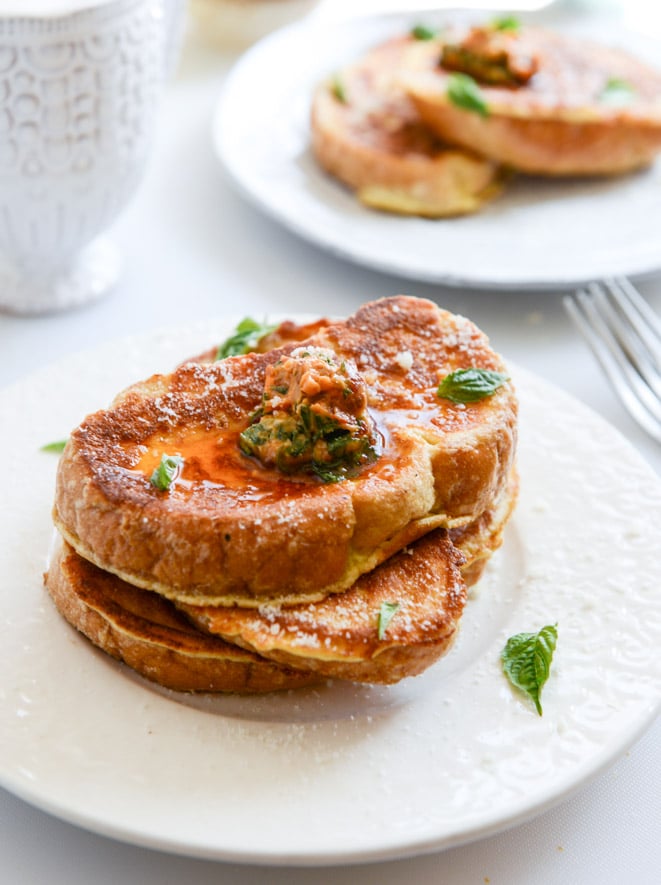
Savory Romano Crusted French Toast with Cherry Tomato Basil Butter.

by Jessica
Lindsaycdavison

I've never had savory french toast and I don't know how I feel about it...

I want to go where rivers of butter flow.

Savory Romano Crusted French Toast with Cherry Tomato Basil Butter I howsweeteats.com

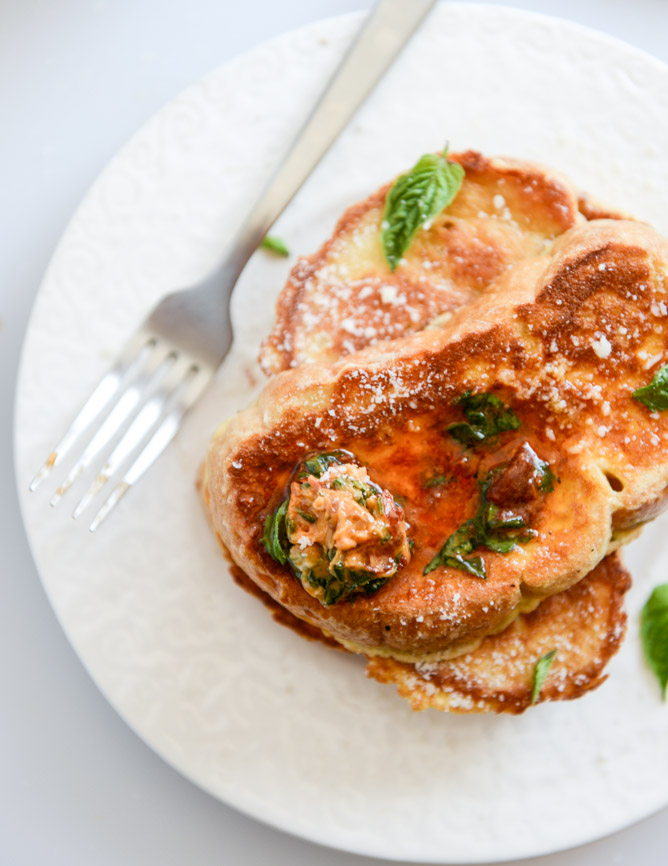
Like right smack dab in the middle of this French toast!

I mean… the butter. Please look at it.

It’s just…

so

melty.

Things are old and things are new right now. Old thing? Eddie is deep in a Cruel Intentions marathon (I think it’s one of his favorite movies of all time) and all I can think of while it’s on is OMG PACEY.

Savory Romano Crusted French Toast with Cherry Tomato Basil Butter I howsweeteats.com

New thing? I continue to be gravitating towards savory foods over sweets. I first talked about this probably six months ago or so but it’s still a thing: either I’m old and boring and more responsible these days or my taste buds are changing.

I’m going with the latter even though I’m definitely old and boring.

After discovering savory French toast on the kitchn, I was ridiculously hooked. I needed something other than just toast and cheese though… so enter a savory compound butter. I know I know. I’ve been all about them recently. And it’s not even prime fresh herb season yet so I predict that things will get even worse. Just a warning.

Savory Romano Crusted French Toast with Cherry Tomato Basil Butter I howsweeteats.com

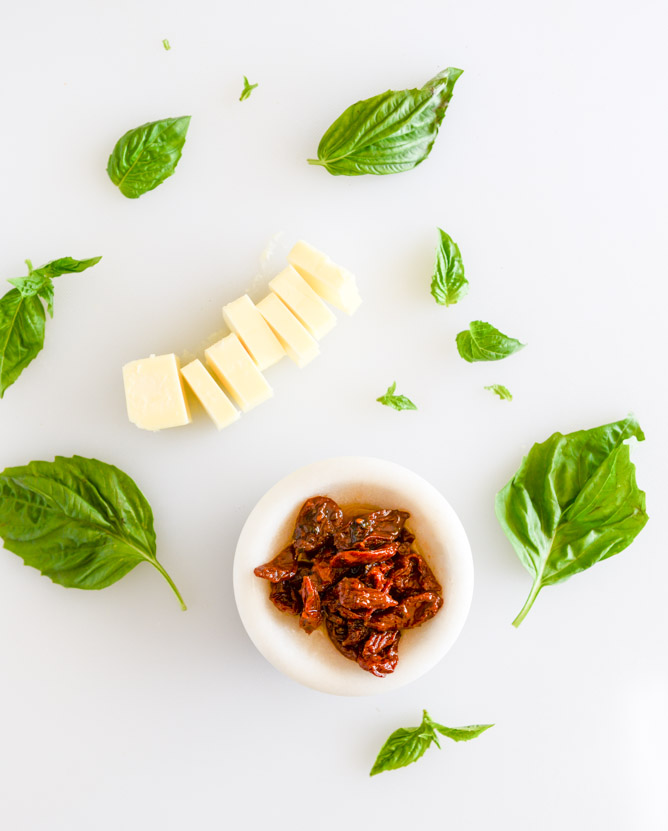
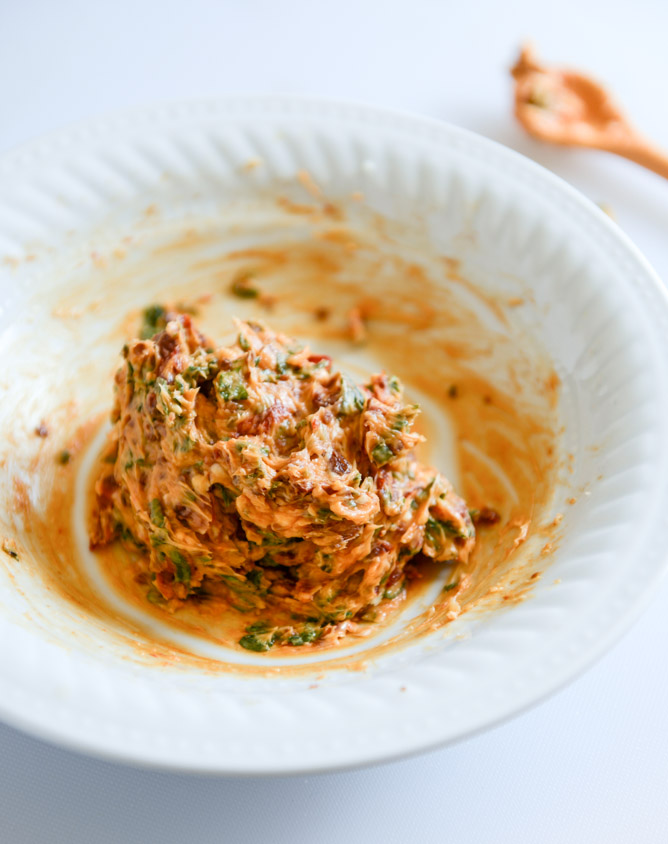
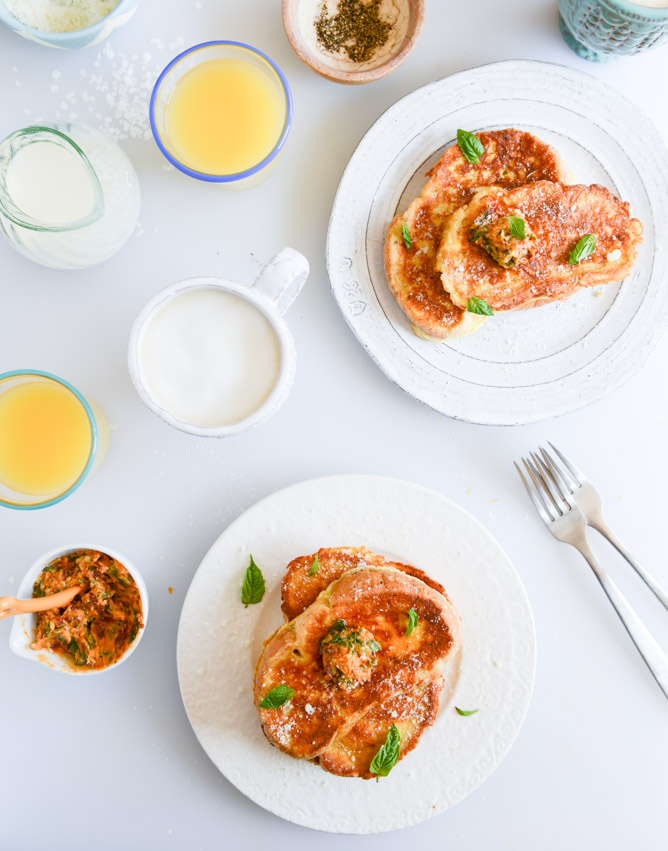
The batter for this French toast is chock full of freshly grated romano cheese and then fried in butter like the regular stuff. Covered with some extra softened cherry tomato basil butter – I used these delicious sun dried cherry tomatoes again along with fresh basil – that melts into the hot toast creating a little flavor river. It’s flowing!

I don’t even know what to do with myself. Can’t deal.

Savory Romano Crusted French Toast with Cherry Tomato Basil Butter I howsweeteats.com

This is the final recipe from my spring brunch video with DeLallo and quote possibly my favorite. It’s just… different than what I’m used to. Obviously, I still love sweet versions of French toast but as long as you serve something else sweet at the table for usual sweet teethed freaks like me, you’re good to go. I need a little of both at every meal. I recently made some caramel pork and ummm we need to discuss. Soon.

As the year goes on, I’m going to be doing a bunch more of these videos with DeLallo and making all sorts of delicious recipes and stuff. In the meantime, please live on this fraaaanch toast with me so you can discover the beauty of it. Emotions never tasted so good.

Savory Romano Crusted French Toast with Cherry Tomato Basil Butter I howsweeteats.com

Savory Romano Crusted French Toast with Cherry Tomato Basil Butter

Yield: serves about 4

Total Time: 35 minutes

Ingredients:

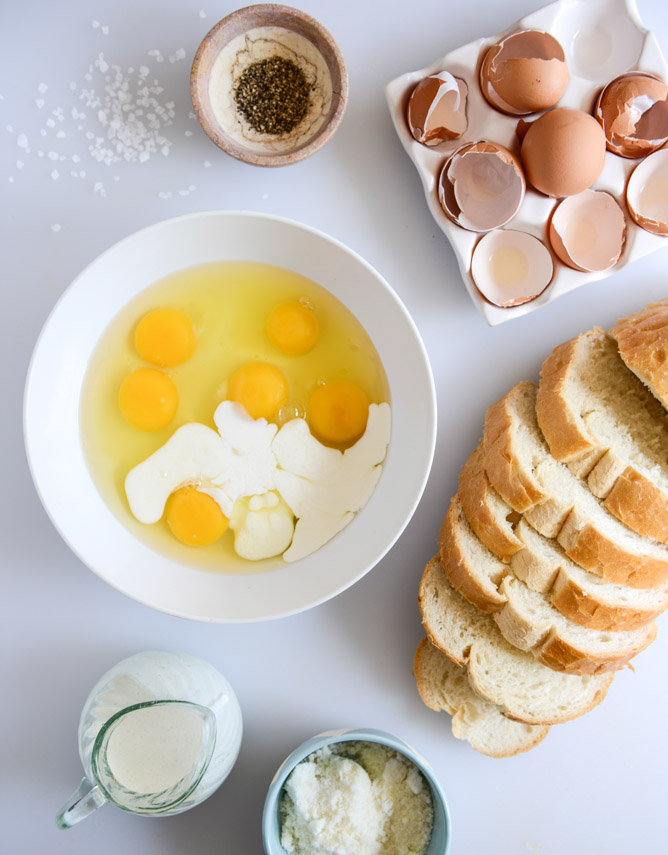
4 large eggs
1/2 cup half and half
1/2 cup finely grated romano cheese, plus more for topping
1/4 teaspoon salt
1/4 teaspoon black pepper
1 loaf italian bread, cut into 8 thick slices
3 tablespoons unsalted butter
a few basil leaves for garnish

cherry tomato basil butter
5 tablespoons unsalted butter
1/4 cup sundried cherry tomatoes, chopped
3 tablespoons chopped fresh basil
1/8 teaspoon garlic salt

Directions:

In a large bowl, combine the eggs, half + half, cheese, salt and pepper. Whisk well until combined. Heat a large skillet over medium head and add 1 1/2 tablespoons butter. Dip each bread slice in the egg mixture and flip to coat. Add the french toast to the skillet and fry on both sides until golden. Repeat with the remaining bread and butter. Serve immediately with the tomato basil butter for topping, a sprinkling of romano and a few basil leaves.

cherry tomato basil butter
Mix all ingredients together until combined. You can serve softened or place in the fridge to firm up.

Savory Romano Crusted French Toast with Cherry Tomato Basil Butter I howsweeteats.com

Don’t you want to cannonball into that?!


© How Sweet It Is

21 Apr 17:01

New York’s Dancing Traffic Cop

by Scout

Last week, I was walking by 57th & 2nd Avenue when I noticed a bunch of people filming a traffic officer with their phones. At first, I was confused – then I started watching, and it all made sense.

There are several dancing traffic officers in the city, but I believe this is Mentoria Hutchinson, who the NY Times profiled last year. Now 62, she’s been a traffic cop since 1980 (!!). Why dance? “You ever seen anyone dance and be mad?…It’s the best way to keep yourself happy!”

-SCOUT

21 Apr 17:00

An Old Bridge in Italy to be Converted into Condos — Design News

by Tara Bellucci
Lindsaycdavison

super cool!

Pin it button

In Italy's Calabria, an old bridge and its aqueducts are getting a modern makeover. The government held a competition to best reuse the structure, and the winning design is an "inverted skyscraper." From the road, you'll descend between the hills to retail and residences.

READ MORE »

21 Apr 15:52

Can You Guess What This Tile Is Made From? The Answer Will Surprise You

by Stephanie Strickland
Lindsaycdavison

any guesses? I already clicked through

Recycled CRT glass tile
Pin it button

This tile is beautiful and destined for someone's gorgeous new kitchen or bathroom, but it began life as something very, very different. Can you guess?

READ MORE »

21 Apr 14:31

friday finds

by Katie Rose
Lindsaycdavison

i seriously like the name khaleesi...too bad we're having a boy. Andrew, how do you feel about kale? http://www.bonappetit.com/entertaining-style/trends-news/article/baby-food-names lol


Happy Friday! I'm joyfully writing from home today, as my office is closed for Good Friday. Al's parents, Deacon & Retta, arrived last night and we have a fun weekend planned both to celebrate Easter and to celebrate Deacon's retirement! Today - some shopping. Tomorrow  - the botanical gardens. And you can bet that our sweet pup is getting spoiled rotten. 

Wishing you a beautiful weekend and Happy Easter!

/////

Finds I'm loving from the web this week...

This priest gave a bride and groom quite the surprise. He's really good!

Stats on people naming their kids after food. Kale, Apple, etc. I see no mention of Mayo though...


Loved this ABCs of the workplace. And that pie chart of feelings at meetings is hilarious.

FOMO from Coachella? Don't worry - here's a list of upcoming NYC concerts (I think kids these days call them 'shows').

Speaking of Coachella, can someone please explain to me why the majority of people there look like they got dressed in the dark? The Fug Girls agree. "How to do Coachella at home, in three steps: Take a bedsheet, Poke arm holes through it. Wear."

Need more iron? A few clues that you might. (And ask a doctor first)

Plans for Pier A, the new event/eating/shopping space in Battery Park.

Leaving you with the video that's all over the web right now. And it brings tears to my eyes each time I watch it. So incredibly true.


/////

Have a fantastic weekend!
xo,
K

P.S. You may have missed:  the perfect cake for your Easter menu, Shopbop sale

{image of our brekky this morning}
21 Apr 14:21

Photo

by nickdivers


21 Apr 14:18

Could TV Characters Really Afford Their Rents? — Design News

by Tara Bellucci
Lindsaycdavison

I was thinking HIMYM maybe could...but maybe I dont' know how much architects make.

Pin it button

Some suspension of disbelief is required when watching sitcoms, including whether or not the characters could afford their homes. Real estate blog Movoto used real data to estimate which were spending 30% or under on their rent or mortgage.

READ MORE »

21 Apr 14:12

A Stylish Family Friendly Australian Home — Professional Project

by Adrienne Breaux
Lindsaycdavison

i like the rug.

Pin it button

Project by: Anna Williams
Location: Townsville, Queensland, Australia

We love examples of homes that can mix a stylish look for grown-ups that still have room for kids to be comfortable and happy. The designer Anna Williams provided inspiring before and after photos plus a list of some of the resources used to create this look!

READ MORE »

21 Apr 12:04

Brave New World: Boston Pizza's Pizza Cake

by Kate Andersen

From Slice

20140418-pizza-cake.jpg

[Photograph: Brand Eating/Boston Pizza]

Before you go rushing off—either to be sick or snatch one of these suckers up—you should know that this meaty mutant layer cake isn't actually available yet...but it might be in a few months (albeit in Canada only). According to Brand Eating, chain restaurant Boston Pizza is asking its customers to vote on what they want to see on their summer menus, and I'm awed to admit (in the truest sense of the word) that the Pizza Cake is winning. By a lot. Maybe this is less surprising when you consider the other options: things like tiny pie-shaped mints, a pizza-shaped beard napkin, and a gas-powered pizza cutter.

I'm kind of scared to ask, but...would you try it?

About the author: Kate Andersen is a Contributing Editor for Slice.