Shared posts

28 Oct 15:51

The president’s power to deploy troops domestically: an explainer

by Kelsey Dallas

Updated on Oct. 28 at 9:16 p.m.

Since June, President Donald Trump has ordered several National Guard deployments within the United States, often against the wishes of the Democratic governors of the states where troops are being sent. The resulting legal battles have put a spotlight on the president’s authority to federalize troops and use them domestically. How far, exactly, does this power extend? 

Here’s an overview of the legal backing behind Trump’s recent deployment orders.

Where has Trump sent the National Guard?

In the past five months, Trump has sent or attempted to send National Guard troops to five cities led by Democrats: Los Angeles; Washington, D.C.; Portland, Oregon; Chicago; and Memphis, Tennessee. To justify the deployments, the president has pointed to the crime rates in those cities and the need to protect federal officials involved in immigration enforcement. For example, Trump’s Aug. 11 memorandum on mobilizing the District of Columbia National Guard said the city is “under siege from violent crime,” and that “[i]t is a point of national disgrace that Washington, D.C., has a violent crime rate that is higher than some of the most dangerous places in the world.”

Trump’s deployment orders have led to multiple legal battles. In L.A., Portland, and Chicago, the disputes primarily center on the president’s authority to federalize National Guard troops – which are traditionally under state control – and send them to U.S. cities, even after governors declined the president’s request to order such deployments. In Memphis, the conflict is between the Tennessee officials who support the deployment and those who do not, with members of the latter group challenging Gov. Bill Lee’s decision to carry out Trump’s deployment plans. In D.C., Trump has direct command over the city’s National Guard, so the key question in a lawsuit brought by the D.C. attorney general is not whether the president can deploy any troops there, but under what circumstances Trump can bring in troops from other states to supplement the local force.

What authority has Trump invoked?

The Constitution does not grant the president the authority to call military troops into domestic federal service. Article I, § 8 instead gives this power to Congress, which is tasked with “calling forth the Militia to execute the Laws of the Union, suppress Insurrections and repel Invasions.” Once Congress has issued the call, the president has the authority to command the troops under Article 2

Just four years after the Constitution was ratified, Congress enacted the Militia Act of 1792, which gave the president the power to independently call troops into federal service to quell a foreign invasion or domestic insurrection or to stop the obstruction of the laws of the United States. This act allowed President George Washington to call up and lead state militia forces during the Whiskey Rebellion of 1794, and it is a precursor to the laws at issue in the ongoing legal battles over Trump’s deployment plans.

In a June 7 memorandum, Trump cited one such statute when he laid out his case for his authority to deploy the National Guard to U.S. cities. In that memo, he pointed to 10 U.S.C. § 12406, originally passed in 1903, which allows the president to “call into Federal service members and units of the National Guard of any State in such numbers as he considers necessary” to stop an “invasion by a foreign nation,” combat a “rebellion or danger of a rebellion” within the U.S., or “execute the laws of the United States” with regular forces. 

In considering the challenges to the deployments in Los Angeles, Portland, and Chicago, federal judges have considered whether conditions in these cities met one of the latter two criteria – that is, whether they constituted a rebellion or something near a rebellion and whether officials were able to uphold U.S. laws without National Guard troops present. The Trump administration has pointed to protests, including violent confrontations with federal immigration officials, to justify the president’s invocation of Section 12406, while challengers have either said that the administration is using past conflict to justify new deployments or is generally overstating the size and violence of current protests.

The Chicago deployment is on hold since a U.S. district judge there held that it wasn’t “called for” because the situation on the ground didn’t meet either of those thresholds (though there is little case law on what constitutes such a threshold), and the U.S. Court of Appeals for the 7th Circuit agreed with that assessment. 

In Los Angeles and Portland, district judges issued similar orders blocking deployment after determining that protests did not rise to the level of a rebellion and that local law enforcement officials currently were capable of enforcing the law, but the U.S. Court of Appeals for the 9th Circuit paused both orders. It concluded that courts must be highly deferential to the president’s determination that the federalization and deployment of National Guard troops was or is necessary to “execute the laws of the United States.” On Tuesday, the 9th Circuit announced that it will rehear the government’s appeal of the order blocking the Portland deployment en banc (a larger panel) and that deployment would remain on hold at least until then. 

Even as it has worked to convince judges that Trump’s use of Section 12406 was justified, the Justice Department has argued that such justification isn’t necessary. “As a threshold matter, this Court long ago held that ‘the authority to decide whether [an] exigency has arisen[]’ justifying the federalization of the militia ‘belongs exclusively to the President,’ whose judgment is ‘conclusive,’” contended U.S. Solicitor General D. John Sauer in his request for the Supreme Court to clear the way for the Chicago deployment, citing an 1827 case called Martin v. Mott.

What is Martin v. Mott?

The 1827 case stemmed from President James Madison’s decision to call up the New York militia during the War of 1812. When Jacob Mott failed to report for duty and then faced consequences for that decision, he challenged Madison’s order, claiming that the president didn’t have the authority to bring the New York militia into service in the first place.

As Sauer noted, the court stated in Martin v. Mott that a president’s decision to call up a state militia can’t be questioned. Specifically, the court wrote that “[w]e are all of opinion that the authority to decide whether the exigency has arisen belongs exclusively to the President, and that his decision is conclusive upon all other persons.” But not all courts agree with Sauer’s application of that ruling to today’s deployment debates. 

For example, in its decision allowing the order blocking the Chicago deployment to remain in place, the 7th Circuit stated that the 1827 ruling “must be understood in its context,” which tells us that the Supreme Court wanted to prevent members of the militia from challenging a president’s deployment decisions, especially when the country was under threat from “the most powerful empire on earth,” not to prevent judicial review. According to the 7th Circuit, “The Court in Martin expressed incredulity at the prospect that every officer under the President’s command could make his own determination whether an imminent threat of invasion existed and could refuse to obey the President’s orders. … Here, by contrast, the question is whether courts, not subordinate militiamen, may review the President’s determination.”

What is the Posse Comitatus Act?

The disputes over recent deployments also have involved the Posse Comitatus Act, an 1878 law outlining what activities members of the U.S. military can undertake in U.S. cities when they’re under the president’s control. In other words, Section 12406 and similar statutes outline the circumstances under which domestic deployments can happen, while the Posse Comitatus Act places limits on what the troops can do once they’re deployed.

The Posse Comitatus Act addressed a concern that was present even among the Founders – that is, that the federal government would interfere with local law enforcement by sending federal troops to take over – but specifically responded to “abuses resulting from the extensive use of the army in civil law enforcement during the Civil War and the Reconstruction,” according to one scholar

The act came to the forefront of the dispute over the L.A. deployment when a U.S. district judge in California held in early September that the Trump administration had violated it by using federalized National Guard troops to execute domestic law. “The evidence at trial established that Defendants systematically used armed soldiers (whose identity was often obscured by protective armor) and military vehicles to set up protective perimeters and traffic blockades, engage in crowd control, and otherwise demonstrate a military presence in and around Los Angeles,” Senior U.S. District Judge Charles Breyer wrote. That decision, which would have limited what National Guard troops could do in L.A., was put on hold with an administrative stay by the 9th Circuit, which currently is considering whether to continue blocking a different order from Breyer regarding Trump’s invocation of Section 12406 that would have barred Trump’s use of California National Guard troops in L.A. altogether.

What is the Insurrection Act?

Looming over the current deployment disputes is the possibility of Trump invoking the Insurrection Act. Like Section 12406, this law gives the president the power to federalize and deploy National Guard troops to “enforce the laws of the United States.” Unlike that other statute, it also authorizes the president to deploy members of the regular armed forces domestically, and deployments under the Insurrection Act are not subject to the limitations outlined in the Posse Comitatus Act.

Those aren’t the only difference between the two statutes. The Insurrection Act allows for deployment under a broader range of circumstances – by, for example, enabling the president to federalize troops when laws are “impracticable to enforce,” rather than only when they can’t be executed. 

It also explicitly defers to the president’s judgment of whether conditions on the ground fit one of those circumstances. Specifically, it states that “[w]henever the President considers that unlawful obstructions … or rebellion against the authority of the United States make it impracticable to enforce the laws of the United States in any State by the ordinary course of judicial proceedings, he may call into Federal service such of the militia of any State, and use such of the armed forces, as he considers necessary to enforce those laws or to suppress the rebellion.”

Those differences help explain why legal experts have described the Insurrection Act as far more favorable to presidential authority. “It is based on highly permissive standards for action and provides neither a role for Congress nor a basis for serious judicial review,” wrote Bob Bauer and Jack Goldsmith in an Oct. 18 column calling on Congress to reform the act.

The Insurrection Act has been used 30 times since the country’s founding era by presidents from both parties. Presidents Dwight D. Eisenhower, John F. Kennedy, and Lyndon B. Johnson used it to send federal troops to the South to enforce desegregation orders. The Insurrection Act was last used by President George H.W. Bush in May 1992 to respond to riots in L.A.

What has Trump said about the Insurrection Act?

In recent interviews about his National Guard deployments, Trump has floated the idea of using the Insurrection Act if his efforts to use other statutes fail. 

“I’m allowed, as, you know, as president. Like 50% of the presidents have used the Insurrection Act, they can use that, and everybody agrees you’re allowed to use that,” he said on Oct. 19 when speaking with reporters about the possibility of deploying troops to San Francisco. “We’re trying to do it in a nicer manner. But we can always use the Insurrection Act if we want.” 

What will happen next?

The Supreme Court’s ruling on the Trump administration’s planned deployment in Chicago is expected at any time. Although the justices’ orders on the interim docket rarely include much explanation, that decision may clarify how the court views Martin v. Mott and how much deference it believes justices should give to the president when assessing whether Section 12406 has been properly invoked. 

The post The president’s power to deploy troops domestically: an explainer appeared first on SCOTUSblog.


01 Oct 17:23

Do state limits on malpractice actions apply in federal court?

by Ronald Mann

Berk v. Choy, to be argued on Oct. 6, surely will be the Supreme Court case of the year for medical professionals. At issue in the case is the extent to which a set of common state statutes designed to stem medical malpractice litigation apply in federal court. If they don’t apply in federal court, victims who have a way to get into federal court will have a much easier time pursuing litigation against doctors than those who cannot.

The case involves Delaware’s “affidavit of merit” statute, something that dozens of states have passed in recent years. Although the details vary, the key concept is that for a medical malpractice action to proceed, the case either has to involve medical negligence that is pretty obvious – the doctor left a foreign object in the patient’s body, the doctor operated on the wrong person, the doctor operated on the wrong organ – or the plaintiff has to file with the complaint an affidavit from a medical professional attesting to the negligence of the doctor who is being sued. Because those affidavits are somewhat hard to come by – how many doctors want to help someone sue another doctor for malpractice? – they pose a serious obstacle to the pursuit of many medical malpractice claims.

The case before the Supreme Court arose from a claim by Harold Berk that a doctor (Wilson Choy) and the hospital where he was treated (Beebe Medical Center) were negligent in treating an ankle and foot injury that Berk sustained at a house he owns in Delaware. If he had filed suit in a Delaware state court, the court would have dismissed the action immediately, because he does not have an affidavit from a doctor stating that Choy and Beebe were negligent. Because Berk is a resident of Florida, however, the parties are diverse – that is, from two different states – and federal law therefore gives him the option to bring his case in federal court rather than state court.

The first question for the federal court in deciding whether to apply the affidavit of merit statute is if it should follow federal procedures for civil cases or instead should follow the more onerous procedures that would apply in a Delaware state court. Typically, federal courts answer those questions under the “Erie” doctrine, referring to a famous 1938 case in which the Supreme Court held that federal courts should follow the substantive law that states create to govern conduct within their borders but should follow the procedural rules that Congress and the Supreme Court create to govern cases in federal courts.

In this case, the lower courts dismissed Berk’s case on the theory that the affidavit of merit statute is “substantive” for purposes of the Erie doctrine. Because many other courts have refused to apply those statutes in federal court, it seemed like a likely case for Supreme Court attention – and so we have oral arguments on the question next week.

Berk argues that federal courts shouldn’t apply affidavit of merit statutes because they “answer the same question” as the applicable federal rules. From his perspective, the federal rules (principally Rules 8 and 9 of the Federal Rules of Civil Procedure) define all of the requirements for getting a case heard in federal court. Those rules require only a short statement of the basis of the complaint and say nothing about anything like an affidavit of merit. Other rules discuss the circumstances that might require “verification” of a complaint or disclosure of expert testimony, but the requirements of the Delaware statute are quite different from what those rules contemplate.

Choy and Beebe, by contrast, make two main points, one textual and one more atmospheric. The textual point provides an argument that nothing in the Delaware statute directly conflicts with the federal rules. It centers on the statement in Rule 11 that there can be no requirement of an affidavit or other verification “[u]nless a rule or statute specifically states otherwise.” Because the Delaware statute in this case does specifically state otherwise, there is no conflict with the federal rules in applying the statute.

More generally, Choy and Beebe portray the statutory requirements as falling outside of anything that the federal rules discuss. The affidavit requirement is not, they say, a pleading, but simply an additional requirement that Delaware (and many other states) impose in these kinds of cases. There are many reasons why federal courts dismiss cases that do not appear in the rules themselves, and the Delaware statute provides just one more.

The more atmospheric point is the real-world purpose of these statutes, which is to provide a major substantive limitation on the ease with which medical malpractice claims can be brought. As Choy and Beebe explain (joined by filings from the American Medical Association and the large group of states that have these statutes), the costs of malpractice litigation are a substantial share of health care costs in the United States, and those costs do not to any major degree go to benefit those who were injured by negligent medical practice.

For my part, not surprisingly, I am impressed by an amicus (“friend of the court”) brief from a prestigious group of professors who study civil procedure. They work through the details of all that would be required to implement the affidavit of merit statutes in federal court and argue that the intrusion into routine federal judicial administration would be chaotic. For them, the basic problem is that Delaware (and the other states) was unwilling to change the substantive rules for malpractice actions, so they instead have changed the procedural rules. The choice to go with procedure, the professors say, means that the changes should not apply in federal court.

I expect a lively argument. The bench has expertise in civil procedure (Justice Elena Kagan, a former professor), lengthy experience as a trial judge (Justices Sonia Sotomayor and Ketanji Brown Jackson), and a broad sensitivity to the problematic costs of this kind of litigation. I will be surprised if several of the justices are not sympathetic to the desire of the states to quell this kind of litigation, but whether most of the justices will share that concern is less clear.

The post Do state limits on malpractice actions apply in federal court? appeared first on SCOTUSblog.

10 Jul 15:57

A Long Weekend Reveals What Pennsylvanians Really Think About the Issues

by Steve Ulrich

What would the voters of Pennsylvania really think about the issues if they discussed them in depth in a civil and evidence-based environment for a long weekend?

That could never happen, you say? The folks who run “America in One Room” beg to differ.

On June 5-9 in Philadelphia, an experiment was sponsored by Helena, a global problem solving organization working with the Deliberative Democracy Lab at Stanford University, and Public Opinion Strategies. One hundred seventy-five Pennsylvanians were recruited from around the Commonwealth to participate in discussions about issues facing the state and the nation. Another 502 were assigned to a control group but did not deliberate.

Voter opinion measured in surveys before and after the deliberations reveal dramatic shifts from partisan extremes toward middle ground on elections and voting rights, immigration and visas, foreign policy and the state of our democracy, and other major topics. The result is a truer measure of the “will of the people” than typical polls rooted in deep understanding of proposals and discourse with opposing views, rather than living within our echo chambers.

In a process called “Deliberative Polling,” here is what Pennsylvanians had to say about what is happening in the neighborhood, their state, and their country.

Attitudes Toward Democracy

How satisfied or dissatisfied are you with the way democracy is working in the U.S.”

  • At the start: 75% were dissatisfied. After deliberation: 54% were dissatisfied. (-21)
  • GOP: 57% -> 41% (-16). Dems: 91% -> 66% (-25). Indies: 79% -> 56% (-23)
  • The very act of considering our difficult choices together lessened the current widespread discontent and created a bit more optimism about democratic possibilities.

Education

“Pennsylvania should implement tuition caps for public colleges and universities.”

  • At the start: 81% support. After deliberation: 77% support (-4)
  • GOP: 71% -> 77% (+6). Dems: 76% -> 86% (+10). Indies: 76% -> 70% (-6)

“Pennsylvania should make tuition free for public colleges and universities.

  • At the start: 60% support. After deliberation: 46% support (-14)
  • GOP: 50% -> 46% (-4). Dems: 73% -> 61% (-12). Indies: 36% -> 32% (-4)
  • Participants discussed the budgetary effects on the universities and the fact that many lower income students already get financial aid.

“Pennsylvania should amend its constitution to directly fund each child’s education at the school they choose.”

  • At the start: 34% support. After deliberation: 40% support (+6)
  • GOP: 33% -> 42% (+9). Dems: 30% -> 36% (+6). Indies: 60% -> 49% (-11)

Democratic Processes

“Pennsylvania should impose term limits on state legislators, where, after a certain number of terms, legislators may never run again or hold office.”

  • At the start: 78.1% support. After deliberations. 77.6% support (-0.5)
  • GOP: 80% -> 78% (-2). Dems: 78% -> 82% (+4). Indies: 69% -> 47% (-22)
  • The sample weighed whether term limits would reduce incumbency advantages against whether they would reduce voter choice. In the end they seemed to want new representatives through term limits.

“After an 18-year term, federal judges should not be eligible for reappointment.”

  • At the start: 72% support. After deliberations: 75% support (+3)
  • GOP: 75% -> 76% (-1). Dems 70% -> 77% (+7), Indies 53% -> 55% (+2)
  • Predictable appointment cycles would allow for fresh perspectives. While there was some concern for the transition, there seemed to be little support for our current system of lifetime appointments.

“The Supreme Court should have the same binding code of ethics that other federal judges have.”

  • At the start: 82% support. After deliberations: 86% support. (+4)
  • GOP: 76.7% -> 77.5% (+0.8). Dems: 87% -> 94% (+7). Indies: 87% -> 82% (-5)

“Making sure everyone who wants to vote can do so.”

  • At the start: 83% support. After deliberations: 96% support (+13)
  • GOP: 71% -> 93% (+22); Dems: 95% -> 97% (+2). Indies. 83% -> 100% (+17)

“Pennsylvania should allow for in-person voting at least 11 days before an election.”

  • At the start: 61% support. After deliberations: 71% support (+10).
  • GOP: 43% -> 57% (+14). Dems: 80% -> 86% (+6). Indies. 49% -> 65% (+16)

“Require all voters to provide a government-issued photo ID, obtained with proof of citizenship, when voting.”

  • At the start: 68% support. After deliberations: 90% support. (+22)
  • GOP: 88% -> 90% (+2). Dems: 48% -> 57% (+9). Indies: 77% -> 70% (-7)
  • Even after weighing the issue of whether such measures would impede participation from the poor, the sample embraced the benefits in public confidence about voting security.

“Pennsylvania should use nonpartisan primaries, so that all voters are able to choose the top two candidates who would face each other in the general election.”

  • At the start: 67% support. After deliberations: 61% (-6).
  • GOP: 60% -> 56% (-4). Dems: 73% -> 63% (-10). Indies: 73% -> 82% (+9)

Immigration

“Increase the number of visas for low skilled workers.”

  • At the start: 25% support. After deliberations: 50% (+25)
  • GOP: 9% -> 29% (+20). Dems: 41% -> 69% (+28). Indies: 21% -> 53% (+34)
  • Participants considered the issue of worker shortages in construction, agriculture and hospitality against arguments that there could be a strain on resources needed for US citizens.

“Implement state level protections for Deferred Action for Childhood Arrivals program (DACA)”

  • At the start: 45% support. After deliberations: 56% support (+11)
  • GOP: 18% -> 38% (+20). Dems: 73% -> 74% (+1). Indies: 35% -> 39% (+4)

Public Service

“Pennsylvania should provide significant incentives to young people to participate in one year of state-level public service.”

  • At the start: 74% support. After deliberations: 79% (+5)
  • GOP: 73% -> 75% (+2). Dems: 76% -> 81% (+5). Indies: 69% -> 90% (+21)
  • Participants weighed the benefits of bringing people together to address public needs versus the cost and administrative burden.

Health Care

“Pennsylvania should offer tax credits to healthcare providers or facilities that expand services in underserved rural areas.”

  • At the start: 84% support. After deliberations: 88% support (+4)
  • GOP: 81% -> 87% (+6). Dems: 88% -> 88% (0). Indies: 77% -> 90% (+13)
  • Participants weighed access to health care and addressing rural health disparities against arguments about costs and the effectiveness of tax credits.

“Pennsylvania should incentivize healthcare professionals to work in underserved areas through loan forgiveness programs.”

  • At the start: 83% support. After deliberations: 94% support (+11)
  • GOP: 72% -> 94% (+22). Dems: 93% -> 100% (+7). Indies: 81% -> 90% (+9)
  • Participants weighed the merits of attracting health care professionals to areas where they were truly needed versus the cost and questions about the effectiveness of such incentives.

“Pennsylvania should require able-bodied Medicaid recipients to work 20 hours per week or participate in job training to maintain benefits.”

  • At the start: 58% support. After deliberations: 59% support. (+1)
  • GOP: 73.1% -> 72.6% (-0.5). Dems: 43% -> 49% (+6). Indies: 70% -> 47% (-23)
  • Participants weighed arguments about encouraging self-sufficiency and upward mobility through work against arguments about administrative complexity and burdensome reporting requirements that could unintentionally disqualify some recipients.

One of the most telling numbers that was revealed was in the increase in mutual respect that came from the deliberations.

When asked about “the people who disagree strongly with you,” there was an increase from 72% to 91% in those responding “I respect their point of view though it is different than mine.” There was a 15-point jump (30-45%) in agreement with the statement, “They have good reasons; there are just better ones on the other side,” while an additional eight percent (81-89) agreed that they “would be willing to compromise to find a solution we can both support.”

“A weekend of deliberation transformed these voters, said James Fishkin, director of the Deliberative Democracy Lab at Stanford. “They moved closer together on many of the most divisive issues. They emerged with greater mutual respect and a sense that their opinions were worth listening to. Their conclusions offer a roadmap to what matters to voters when they have a chance to really think about our common problems.”

Pennsylvania policymakers including Gov. Josh Shapiro, House Speaker Joanna McClinton (D-Delaware/Philadelphia), and state Sen. Joe Picozzi (R-Philadelphia) participated in the event, with McClinton committing to taking the results related to voting reform proposals with her as she continues conversations in the state capital.

28 Jun 18:15

Laser Danger

To combat the threat, many airlines are installing wing-mounted spray bottles.
12 Aug 14:53

Chicago Advocates are Demanding a People-Friendly Lake Shore Drive

by John Greenfield
This post is sponsored by The Bike Lane.

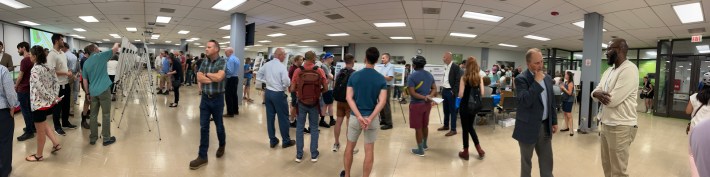
At the Save Our Lakefront Rally, hundreds of people called on the Illinois and Chicago transportation departments to halt plans to rebuild North DuSable Lake Shore Drive as a car-choked eight-lane barrier to Chicago’s lovely shoreline. The demonstration took place outside the IDOT and CDOT open house on the recommendations from their Redefine the Drive study, at Truman College, 1445 W. Wilson Avenue, next to the Wilson Red Line station.

The crowd at the rally. Photo: John Greenfield

At one point in the gathering, Rony Islam from Chicago, Bike Grid Now! said of the gathering, “This feels like a Jane Jacobs moment.” He was accurately comparing the movement to the legendary NYC urbanist and activist’s successful campaign against notorious city planner Robert Moses’ destructive Lower Manhattan Expressway scheme.

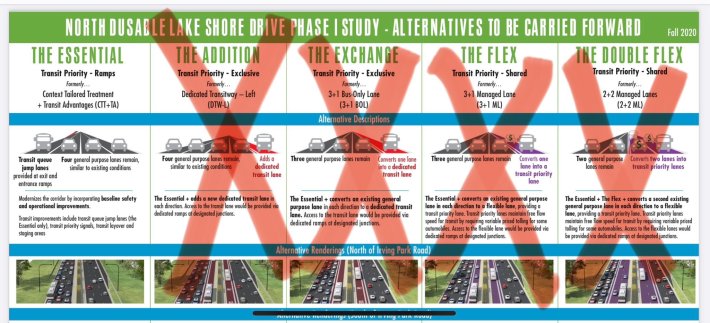
Image: IDOT, Michelle Stenzel

If you’re unfamiliar with the backlash to IDOT and CDOT’s proposal, you can get up to speed here. But, in a nutshell, sustainable transportation and environmental advocates have joined forces with dozens of Chicago and Illinois lawmakers to fight the decision to keep all eight lanes available to traffic jam-creating drivers. They want to see two of those lanes reserved for fast, reliable transit service.

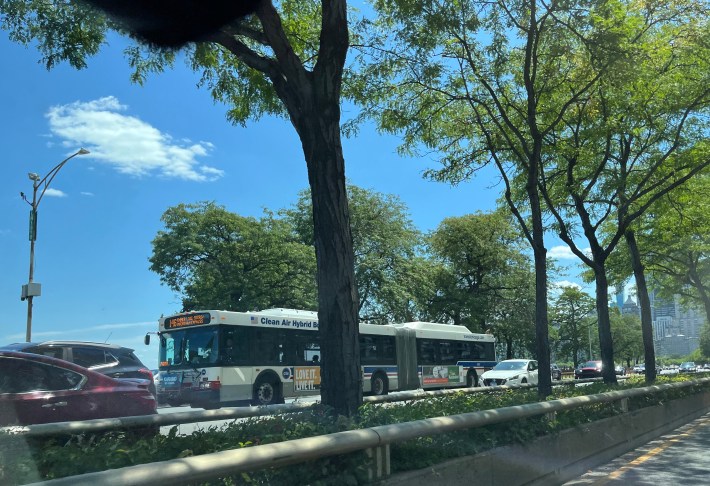
CTA bus riders stuck in a traffic jam created by car drivers on North DLSD this week. Photo by a reader.

Preferably the highway would be converted to a more people-friendly surface boulevard that would make it easier to walk, roll, bike, and take buses to the beach.

Rendering of an alternative layout for DuSable Drive from the Better Streets Chicago website.
Rendering of an alternative layout for DuSable Drive from the Better Streets Chicago website.

Here’s a list of the rally sponsors:

  • Active Transportation Alliance 
  • Better Streets Chicago
  • Chicago, Bike Grid Now! 
  • Commuters Take Action 
  • Edgewater Environmental Coalition
  • Sierra Club Chicago
  • Urban Environmentalists Illinois

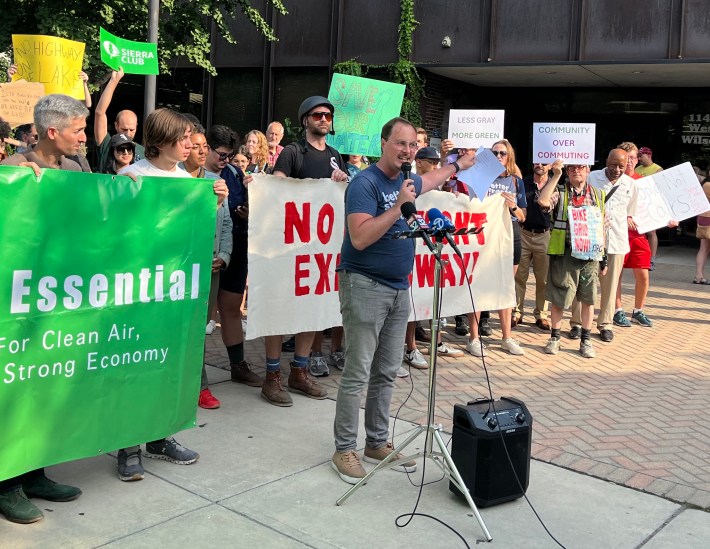
At the start of the demo, the massive throng chanted, “No more highway! Save our lakefront!” Better Streets executive director Kyle Lucas emceed the event and kicked off the speeches. “We are out here tonight demanding change on our lakefront,” he told the crowd. “I am so proud to be here today with… community organizers, to be here today with with advocacy organizations, and to be here today with elected officials, all who are standing here united in a demand that we don’t want a highway on our lakefront. We want a different future than what IDOT and CDOT are presenting to us.” The audience erupted with cheers.

Kyle Lucas. Photo: John Greenfield

“For a decade, the Illinois Department of Transportation has been telling us that we can’t have transit improvements on the lakefront… that we have to have an expressway, something that is forbidden by the municipal code,” Lucas said. “That ain’t right!” The crowd shouted back the phrase.

Ald. Maria Hadden. Photo: John Greenfield

Next up was Ald. Maria Hadden (50th) of Rogers Park, Chicago’s northermost lakefront ward and chair of the City Council’s Committee on Environmental Protection and Energy. “This is a once in a lifetime opportunity for the City of Chicago and the State of Illinois to create, and literally rebuild and reimagine a different future for our lakefront,” she said. “We know that we need to see active transportation prioritized.”

“We appreciate the decade of work that IDOT, that CDOT, that folks have done, but we don’t see that reflected in their plans that are put forth the future that we know we can have for Chicago,” Ald. Hadden added. She noted that the final NDLSD design with no dedicated bus lanes is called “The Essential.” But she said that back when her neighboring colleague Ald. Andre Vasquez (40th), worked selling cell phone contracts, the cheapest, most basic plan had the same name, “The Essential”. “It’s not good enough,” she said.

Ald. LaSpata. Photo: John Greenfield

She was followed by Ald. Daniel La Spata (1st) from the Near Northwest Side, chair of the Committee on Pedestrian and Traffic Safety. “[The committee] informs this work for me,” he said. “I love my feet, I love my bike, I love the bus and so does my daughter. And, at times, you gotta drive too.” But he added that the current plan for the NDLSD, which has already seen multiple fatal car crashes this year, will make it even more dangerous for drivers.

Ald. La Spata noted that IDOT is planning to get rid of the road’s S-curve at Oak Street, and remove its Chicago Avenue stoplights. “But when you smooth out the curve, when you take away traffic signals, you don’t just reduce delays, you increase speeds,” he said. “Increasing speeds leads to more fatalities. This is common sense.” Attendees clapped in affirmation.

IDOT’s proposal to straighten the Oak Street Curve.

“We can do better,” Ald. La Spata concluded. “We can have our cake and eat it too. We can have more green space and bus-only lanes. We can can have safer streets and a boulevard feel. We do all of it. But that’s only if in this moment we have the courage to demand better.”

Ald. Bennett Lawson

After that was Ald. Bennett Lawson (44th), from the waterside Lakeview community, who talked about “granular” neighborhood issues that he said aren’t being addressed in the Redefine the Drive plan. “The Belmont/Sheridan intersection is one of the most dangerous on the entire North Side, and there are no changes to it under this plan. The Aldine on-ramp is functionally a Belmont alternative that will not change in this plan. I need to make my streets safer, and make it safer for folks to access their park.” He said his ward would actually be losing green space as part of the proposal.

The streets Ald. Lawson discussed: Image: Google Maps

Next the crowd chanted “Buses, bikes, trains are great, no expressway on the lake!” and “Save our lakefront, stop the highway!”

W. Robert Schultz III. Photo: John Greenfield

The following speaker was Active Transportation Alliance Campaign Organizer W. Robert Schultz III, also a leader of the Transportation Equity Network and a longtime sustainable transportation advocate. “The first principal in Chicago should be ‘People are more important that cars,” he said. The audience cheered. He noted that years ago DLSD was rebuilt on the South Side as a limited-access highway, with little or no input from local residents. Attendees booed. “Now the South Lakefront is practically inaccessible, except for an occasional fancy bridge. And drivers ignore the posted speed limit to drive at whatever speed they believe is reasonable… Do we want to make the same mistake on the North Lakefront?”

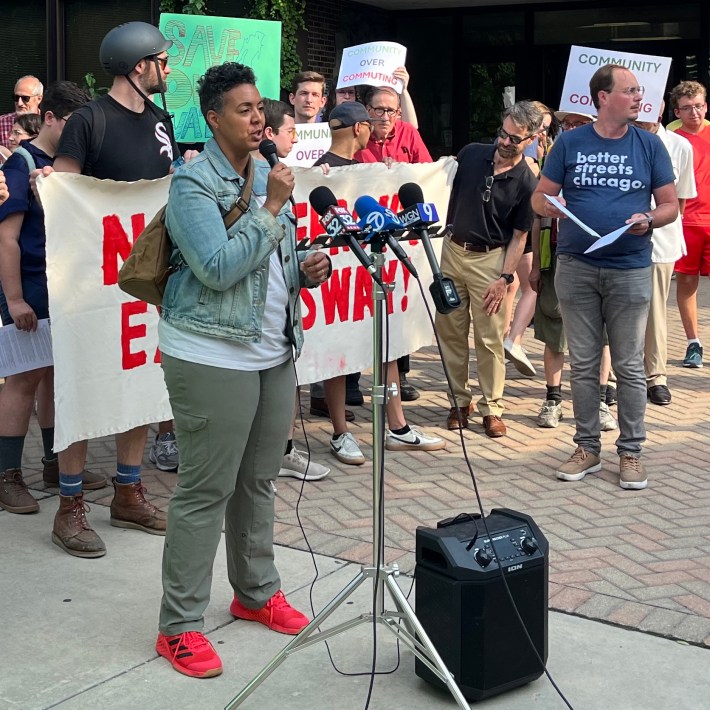
Chicago, Bike Grid Now! member Rony Islam spoke next, arguing that “CDOT and IDOT are in [the open house] manufacturing consent.” He said the department’s engineering and modeling practices reflect 20th Century transportation concepts, and are out of touch with modern reality.

Sen. Mike Simmons. Photo: John Greenfield

After him was State Sen. Mike Simmons (7th), who represents several Chicago neighborhoods not far from Truman College. He discussed how important biking, transit and the shoreline were for him as a youth growing up in a working-class family on the North Side and exploring the region. “We love the the lake because it’s such a precious asset,” he said.

Much of Sen. Simmons’ speech addressed the issue of traffic violence, including the need for safer surface streets, and well as a lakefront road that doesn’t enable speeding by 80 mph, as is currently the case on NDLSD. He noted that in June 2022 unsafe conditions on nearby Leland Avenue forced the family of Lily Shambrook, 3, to lay her to rest after a bike crash. “I’m going to be fighting like hell to make sure the vision [of safe streets] is heard,” Simmons concluded. “Let’s get this right for the next 100 years in Chicago.”

Other speakers included State Sen Robert Peters (13th), Ald. Leni Manaa-Hoppenworth (48th), Sativa Volbrecht from the Sierra Club of Illinois, Access Living Senior Policy Analyst Lauren Saltzman, Urban Environmentalists Illinois co-lead Jack Warren and Ald. Andre Vasquez (40th).

The very long line to get into the open house. Photo: John Greenfield

“We’re going to go to every corner of the city let people know this is happening,” Better Streets’ Kyle Lucas declared at the end of the speeches. “Go inside and make your voice heard.” As you can see from these photos from the open house after the rally, the rally attendees did just that.

Inside the open house. Photo: John Greenfied

Streetsblog Chicago will provide an Illinois Department of Transportation staffer’s perspective on the rally and the complaints about the design in the near future. But I can tell you now that one IDOT employee said they were impressed by the huge turnout.

So was Michael Burton, the cofounder of the weekly Chicago Critical Mass bike rides and co-organizer of the Campaign for a Free and Clear Lakefront, who attnded Thursday’s rally. Back in the early 2000s, the latter group announced an only-half-joking mission to “Depave [DuSable] Lake Shore Drive.” How does he feel now that the idea of making our city’s lakefront less car-oriented is picking up speed?

Burton, left poses at Chicago’s Bike to Work Rally in the early 2000s with then-Mayor Richard M. Daley, Alderman Walter Burnett (27th, still in office and currently serving as Vice Mayor), and Revolution Brewing founder Josh Deth, after giving Mayor Daley a “Depave Lake Shore Drive” t-shirt. Photo: Provided

“It’s very exciting,” Burton replied. “When we were doing it, it was based more out of the Critical Mass rides, and it was more theater, and sort of provocative. And it seems like those ideas have come to fruition through community organizing. And it’s exciting to see a big coaliltion coming together for reclaiming the most valuable land in our city, for the people instead of cars.”

Watch videos of all the speeches, posted by the Active Transportation Alliance, here.

Click here to check out the IDOT/CDOT open house materials.

donate button

Did you appreciate this post? Please consider making a tax-deductible donation, to help keep Streetsblog Chicago’s sustainable transportation news and advocacy articles paywall-free.

The post Save Our Lakefront Rally draws huge crowd to Redefine the Drive open house, demanding a people-friendly DLSD layout appeared first on Streetsblog Chicago.

06 Aug 00:36

Supreme Court rejects Missouri’s request to block Trump’s New York gag order, sentencing

by Amy Howe
Supreme Court rejects Missouri’s request to block Trump’s New York gag order, sentencing

Share

The Supreme Court on Monday turned down a plea from Missouri to block New York from imposing a gag order and sentencing former President Donald Trump in his criminal proceedings there until after the 2024 elections.

After a six-week trial, Trump was convicted in May in a New York state court on 34 counts of falsifying business records. Prosecutors contended that Trump sought to hide a $130,000 payment to adult film star Stormy Daniels during the 2016 election, made in exchange for her silence about an alleged sexual encounter with Trump in 2006. (Trump has denied any sexual relationship with Daniels.)

Trump’s sentencing was originally scheduled for July 11, but it has been postponed at least until September in the wake of the Supreme Court’s July 1 decision holding that former presidents have broad immunity from prosecution for their official acts.

In a brief unsigned order without any explanation, the justices rejected a long-shot bid by Missouri Attorney General Andrew Bailey to file a lawsuit against New York directly in the Supreme Court. Bailey told the justices that he wanted to ensure that voters in Missouri and elsewhere could hear from Trump and that Trump could “freely travel and campaign” without the gag order.

Bailey criticized Manhattan District Attorney Alvin Bragg for having brought “transparently weak charges for the transparent purpose of trying to impose political damage against Trump and trying to restrain his ability to campaign in advance of an election forecasted by the polls to be very close.”

New York Attorney General Letitia James countered that Missouri has not outlined the kind of tangible harm to its state interests that it needs to bring this lawsuit. Instead, James contended, “Missouri is clearly and impermissibly seeking to further the individual interests of former President Trump.”

Missouri has also not shown, James continued, that New York is causing it any harm. Missouri’s complaint seeks to block orders obtained by Bragg, the Manhattan DA, in a state trial court. “Allowing Missouri to file this suit for such relief against New York would permit an extraordinary and dangerous end-run around former President Trump’s ongoing state court proceedings and the statutory limitations on this Court’s jurisdiction to review state court decisions.”

Moreover, James added, after the May verdict against Trump, Judge Juan Merchan lifted most of the order limiting Trump’s out-of-court statements, including the bar on attacking witnesses and jurors.

Justices Clarence Thomas and Samuel Alito indicated that they would have allowed Missouri to file its complaint against New York.

This article was originally published at Howe on the Court

The post Supreme Court rejects Missouri’s request to block Trump’s New York gag order, sentencing appeared first on SCOTUSblog.

27 Apr 19:02

My adult kids found themselves in nature. Will my youngest lose herself in her phone?

by Tracy Ross
Three photos: (left) rafters floating in a brown river surrounded by arid mountains; (middle) a young girl in a red-and-white striped dress and red headband holds a teddy bar and smiles. She stands on a rocky path surrounded by bright green grass and evergreens; (right) a raft floats in a calm body of water bordered by a large rocky mountain with evergreen trees.
Hollis Edmondson, age 7. | Paige Vickers/Vox; photos courtesy of Tracy Ross

My 12-year-old daughter will inherit a warmer world — and, I fear, a lonelier one.

When my son Hatcher and I started our hike down Idaho’s Middle Fork of the Salmon River during the fall of 2023, we feared what we might see.

We were backpacking through our favorite place, the Frank Church–River of No Return Wilderness. It’s almost 2.4 million acres of central Idaho that shelters wolves, black bears, river otters, and lynx; the Salmon River threads through it for 200 breathtaking miles.

One of America’s longest free-flowing rivers, the Salmon is so fierce that in spots it cuts a chasm deeper than the Grand Canyon. And even though its tributary, the Middle Fork, is stacked with whitewater rapids that can flip your boat and suck you under, most drop into forgiving pools that let you recover.

The main fork of the Salmon stretches across hundreds of miles and two time zones, existing as a dividing line between Mountain Time and Pacific. This means that for as long as you are on it, you are between time. Anthropologists call zones like this “ambiguous.”

To the Irish, they are “thin places.” To my husband, Shawn, and me, anywhere on the Salmon has always been the best place to raise our children.

Salmon Time gave Scout, our oldest child, a reverence for wilderness and taught him that he can survive anywhere with the right skills and the right friends. He has since become an accomplished adventurer, outdoor writer, and justice seeker, a defender of wild places.

top left: a little boy with long brown hair and bangs smiles in front of reddish rock formations; bottom left: a boy with curly brown hair and a girl with long blond hair smile, posing arm-in-arm while wearing life-jackets. Behind them is a body of water; top right: a figure standing on a rock formation raises a walking stick in the air, posing above the valley below; bottom right: two young boys wearing baseball caps and life-jackets stand next to an inflatable raft floating in a river. Courtesy of Tracy Ross
Growing up throughout the years: Scout Edmondson as a boy (top left); Hatcher Edmondson pictured with a classmate in South America (bottom left); Hatcher posing on a high point above the Middle Fork River in the Frank Church–River of No Return Wilderness (top right); Scout (left) and Hatcher (right) on the San Juan River when they were preteens (bottom right).

It gave Hatcher a taste of independence he’d never known, introduced him to kayaking, and started him on a journey that would make him one of the youngest licensed guides working multiday trips on this wild river.

But this place, where both of my sons gained such reverence for the natural world, would also soon confront them with the environmental toll that the climate crisis exacts. During Hatcher’s first year of guiding, in 2021, fires torched 87,000 acres along the upper Middle Fork corridor. No one was hurt, but several groups, including a few of Hatcher’s, had to row through smoke and past flames raging just off the river banks.

The next summer, torrential rains released tons of mud laden with rocks, boulders, bushes, and hundreds of Douglas fir and lodgepole pine trees into the river. I imagine it sounding like a freight train crashing through the wilderness.

That’s one of the reasons Hatcher and I were here: to witness how fire had altered the river we consider a kind of home away from home.

But here’s the other reason: I was working through some serious anxiety over the state of the world and my children’s places in it.

Scout will be 23 this spring, Hatcher is 21, and their little sister, Hollis, a member of Generation Alpha, is 12. If you lay their births out on a timeline of climate-change acceleration, you will understand why I lie awake at night worrying about their futures.

The dividing line between my low(er) anxiety and high is the year Hollis was born: 2011. That’s the year the World Meteorological Service says we entered the “decade of [global warming] acceleration.” The “acceleration” was caused by an unprecedented rise in greenhouse gas emissions that fueled record land and ocean temperature increases and turbocharged a dramatic acceleration in ice melt and sea-level rise from 2011 to 2020 and beyond.

And, indeed, it does feel as though we’ve entered a new chapter of the climate crisis. Where I live, chronic overuse of water resources coupled with a 20-year, climate-change-spurred drought has sucked more than 10 trillion gallons out of the Colorado River Basin, threatening supply to more than 40 million people. This February, the Atlantic Ocean was warmer than it had ever been, causing whales to move north following plankton in search of cooler temps and foreshadowing another devastating hurricane season this summer.

Over the same span of time, I’ve also witnessed the way technology’s grip on our children has tightened. The average 12-year-old spends 5.3 hours a day staring into their cellphone, according to Sapien Labs, a nonprofit organization that runs an ongoing survey into global mental health. Kids’ eyes are even elongating to “adapt” to their addiction. And “technology overload” is creating symptoms in kids that look a lot like ADHD, according to the National Alliance on Mental Illness.

I see the signs in Hollis: She doesn’t want to go outside anymore. She barely looks up from her screen.

Like most parents I know, I want to grab Hollis’s phone and throw it in the nearest toilet. But she’d immediately start begging me for a new one because her “entire life” is on it.

When I think back to Scout’s and Hatcher’s childhoods, only a decade before Hollis’s, they seem like a relative Eden. Climate change still seemed a distant and abstract threat, and they didn’t have cellphones. Lucky kids, they grew up believing in Arctic sea ice and that play dates only occurred in person. And I believe the time they spent outside, in nature, gave them some skills to help them find their way in a more complicated world.

Three photos. Left: aboard a floating raft, a woman in a blue baseball cap and reflective sunglasses smiles, posing for a photo with a toddler wearing a top-big baseball bat and sticking her tongue out. Middle: bare trees, burnt in a fire, flank a small sandy path that cuts through tall grass. Right: Rafts pulled up to a rocky shoreline flanked by tall evergreens. Courtesy of Tracy Ross
Tracy Ross, pictured with her daughter, Hollis, when she was 7. A trail pierces through the remnants of a burn in the Frank. Rafts edge up to the shoreline of the Middle Fork during the same trip that Hollis found herself alone on the raft.

Hollis is coming of age during an age of disaster.

The childhood I want to give her, one immersed in nature, is changing, becoming more dangerous. All the while, the lure of her cellphone threatens to disconnect her even more.

As her mother, I want to help her navigate this new world, but I’m not entirely sure how. I hoped days hiking along the Middle Fork with Hatcher might help me sort it out.

Our home, in the woods outside of Boulder, Colorado, lies within the Roosevelt National Forest. At any given time, moose, deer, bobcats, mountain lions, black bears, and coyotes walk through our property. Sometimes they do more than walk. The moose trap us indoors while they lick salt off our truck and the bears know how to open car doors, especially when there’s a week-old burrito heel, wadded up in tinfoil, inside.

And because the early aughts were still the dial-up age for the average consumer, 5G hadn’t been invented, and Elon Musk hadn’t littered the night sky with his snaking chain of satellites, the boys had zero access (yes, literally) to that sort of technology. So when they cried boredom inside, we shooed them outside.

Out on our forested property with a seasonal stream running through it, they hunted Bigfoot and convinced themselves that they saw him in every shaded space between the lodgepole pine trees. They built entire worlds out of rocks and dirt — Trolls Town and Bombs Berg, over which “Scout was a dwarf guy armed with pine cones for bombs,” says Hatcher, and where both boys could disappear for hours — with The Lord of The Rings looping in their imaginations. Their outside play imbued them with the skills we believed they needed to become well-adjusted adults.

Scout and Hatcher sometimes moaned about going out when they wanted to stay in and play their Nintendos and later Xbox (we let them have those; we weren’t monsters!). Yet they loved the camaraderie of doing outdoor adventures with like-minded families, of non-school-approved vacations, and of snacks with no end.

But rafting was a different story altogether, a different level of nature immersion and freedom. On a multiday raft trip on a river that limits crowds by requiring a permit, all the parents needed to do was row, set up camps, know how to negotiate the rapids, and keep the kids in life jackets, sun-screened, hydrated, fed, and safe from falling overboard, poison ivy, scorpions, and snakes.

Seven people, wearing white helmets and orange life-vests, paddle atop a blue inflatable raft, sprayed by churning water. Courtesy of Tracy Ross
Hatcher Edmondson guides a tour group in 2022 along the Middle Fork River.

The Salmon’s waters were emerald green and primordial, coursing over Volkswagen Beetle-size boulders. We were awestruck by the evidence of the Indigenous Sheepeater people, a Shoshone band, that could be found in depressions on the river banks where they camped. The bright red salmon swimming toward their ancestral homes to spawn were cool as hell and spooky.

We all felt held and nurtured by things you could only find out there, in that wilderness. Those trips imprinted Scout and Hatcher with some of the most important lessons they would ever learn, including self-reliance, respect for nature, and the value of a tight-knit community. And the power of rivers.

As Scout and Hatcher grew from children to teens, Hollis grew up, too, eventually into the 7-year-old singing along to Frozen playing on my iPad as we drove across Idaho for a family trip to the Middle Fork.

Like millions of caregivers, we weren’t immune to the lull of sleek devices, sometimes letting our iPhones babysit our children.

We did it even though we knew it was a terrible way to rear them. We did it even as CEOs of the most powerful tech companies were starting to admit they’d never let their own children have a cellphone. And we did it knowing the lithium batteries that power cellphones — and the phones themselves — are a major contributor to climate change through the mining of the raw materials they’re made of, the energy it takes to build and distribute them, and our habit of tossing millions of them each year for new ones, our dopamine levels spiking with the transaction.

But during the first week of July in 2019, I was so excited to finally introduce Hollis to the river. I couldn’t wait to be unreachable for six days, to hold her tight on the boat while Shawn rowed us through rapids, to swim with her in the deep, clear eddies, and to trace constellations in the stars from our sleeping bags laid next to the Salmon.

But as humans are sometimes like to do, we made a mistake. Our desire to raft the Middle Fork with our daughter eclipsed our instinct that it was too dangerous to bring her.

A series of misjudgments led us into a situation where Hollis was alone, on our boat, headed for a treacherous rapid. We’d slowed to pull our boat to the shoreline, before a blind corner. Approaching the shore, Shawn and I jumped out, leaving Hollis alone, and tried to pull the raft in with a bowline, a rope rigged to the boat.

But it was too heavy, and the raft — and Hollis — headed for the bend and, somewhere below it, the rapid.

As I stood on the shore screaming and Shawn tried to pull himself back into the boat, a kayaker in our group saw what was happening, paddled over, climbed on, and saved Hollis. When I finally reached her, she scrambled into my lap crying and said, “I thought I was never going to see Scout again. I thought I would never see Boone” — that’s our Chesapeake Bay Retriever — “again.”

Throughout the rest of the trip, we stuck together. I piggybacked her a mile to a storied hot spring. We made s’mores, spread our sleeping bags next to the river, counted shooting stars, wished on them, and slept cozied up together. But when the trip was over and we were driving away, she stared at the Salmon out of our truck window, squeezed my hand so hard it left tiny fingernail marks, and said she never wanted to see the Middle Fork again.

We went home and in six months, Covid was upon us. Before it arrived, we could coax Hollis outside to ride bikes, play in our stream, or do campouts in our woods: no screens. When it hit, I could still get her to gear up, go outside, and ski laps on the hill across from our house. At first, I was the mom I’d always wanted to be: baking homemade whoopie pies while she licked the bowl, lazing in bed reading her The Wind in the Willows, cheering her on as we skipped down our deserted road.

But as the weeks wore on, I wore out, and the pull of our screens was stronger than ever.

I know I’m no different from millions of other parents who’ve been plugging in their kids while they worked or cleaned or “took a break.”

It’s no wonder, then, that by 2019 more than half of American children owned a cellphone by age 11 and a third of TikTok users were 14 or younger. I remember loosening my parental controls on social media during Covid because I wanted Hollis to “stay connected” to her friends during the forced absence. I saw how quickly that lifeline became a reason for her to stay on her iPad longer and longer each day, as warnings about the dangers of letting kids access social media increased.

There’s still much we don’t understand about the long-term effects, and some recent studies have cast doubt that media use behavior is altering our kids’ cognition, underlying neurological function, or neurobiological processes. We need more data.

Three pictures. From left to right: a toddler in a yellow life-jacket sits on a raft beside a woman wearing a life-jacket and sunhat, a young girl wears large pink visor glasses and holds a silver juice pouch, a young girl wearing sunglasses and a sunhat sits crosslegged atop a kayak bow with a paddle balanced across her lap, floating on calm, green water. Courtesy of the Ross and Edmondson family
Hollis, over the years, embracing the outdoors — away from any WiFi connection.

But I can confirm changes I saw in Hollis’s happiness and self-confidence when, as a grade-schooler, she got into a conflict with a former friend. Hollis said her friend began controlling her, laying on guilt — usually through text and social media messages — whenever she didn’t do what the friend demanded.

Hollis is a “normal” kid — pleasant, kind, fun to be around. But between fourth grade through sixth, I started hearing from other parents that their daughters said she was crying in the school bathroom. She stopped confiding in me, for fear of letting details slip, because I would tell the friend’s mom and the friend would retaliate. After asking her to “be brave” in a situation that was clearly wearing her down, Shawn and I decided to take her out of school.

What followed was a disastrous second half of self-guided sixth grade — guess where — on screens. But even when she tried to start a new life as a seventh grader at a new school, Hollis still faced pressure from the same friend group on her social media. We pulled her out again.

Watching a bright, goofy, formerly confident kid dissolve into one wracked with anxiety upset me. But the thing that saddens me about Hollis’s phone now is how it turns her into Gollum to Sauron’s ring. Even when I can get her outside — which I still can, if we go skiing — she’s so distracted by the rectangle in her hand or pinging constantly in her jacket pocket, she can’t notice the beauty around her.

Here, you’re supposed to say: “Parent. You’re in charge. Do something.”

Give me a minute.

Back on the Middle Fork, Hatcher and I saw no one. It was just us and the Frank. Normally that would be perfect, but under the circumstances, it was ominous.

On our first night, we huddled in our tents and listened to thunder that sounded like moaning aliens as a storm blew in.

On day two, we entered a section of trail where all of the trees had been torched to blackened husks, evidence of the fires that had recently ripped through.

“It’s Mordor,” I said to Hatcher.

“Is it?” he asked.

“Look around,” I answered.

“But there’s fireweed,” he said, pointing to one of the beautiful, purple-flowered plants. “That’s hope.”

Later that evening, we found our second camp, along the river. As we sat on the bank watching the current, a slick, brown creature swam past us.

“Look, Hatch! An otter!” I yelled. “My favorite!”

“Oh my god!” he shouted. “It’s huge!”

We continued marveling over our luck. It was only when the “otter” slapped its big, flat tail on the water that we realized it was really a beaver. But it didn’t matter. We were in our favorite place. And apparently the beaver wanted to hang out. It swam upstream past us, and then floated back down toward us. “An otter would never do that!” Hatcher said, and we laughed.

Two photos. Left: a woman wearing overalls, a baseball cap, and sunglasses, wades in a shallow creek holding a net. Right: a young man wearing a baseball cap and sunglasses extends a hand toward a flowing, rocky river below him. Courtesy of Tracy Ross
Tracy Ross catches a fish in her home state, Colorado (left). Hatcher during their 2023 trip on the Middle Fork River (right).

During rare stretches when he and I were talked out, I thought about ways nature had helped Hatcher when he was in trouble. As a young teen, he was lured by the escape of marijuana. One evening during his first year of high school, I found a significant amount of it in his jacket and admitted to myself that if I didn’t step in and do something to help him, I’d be partially to blame if he continued down a bad path.

That year, I helped him apply for a Youth Conservation Corps job in Denali National Park in Alaska. I figured plunging him into a 6-million-acre wilderness could only help — and I believe it did. That summer kicked off a new trajectory that would eventually set him up for his guide job in Idaho.

But now, back in the Frank together, we were getting close to the damage we’d come to see on the Salmon. We made camp at the toe of one of the biggest rock slides I’d ever seen. It was at a small unnamed creek and had stripped the drainage it ran through down to bedrock. Tons of loose dirt and rocks spread across the river bar and into the river.

But that didn’t prepare us for what we’d see next.

The inundation of tons of mud, boulders, bushes, flowers, and dozens of trees from a landslide in the aftermath of the Boundary Creek Fire had completely dammed parts of the Middle Fork. As in, you could walk on the bottom. As in, there was no water.

Miles farther downstream, we were stunned by more damage.

Debris at a rapid called Hell’s Half Mile had blocked the river to the point that a large, unstirring lake now sat above it. When we saw the lake, we knew two of our favorite things had been forever altered by fires. There was the Middle Fork itself, and then the salmon that swam there. A lake shouldn’t sit in a free-flowing river, and salmon can’t live for very long in water that sluggish. Because they are a vital part of the food chain, when salmon die in large numbers, a cascade of other deaths follows.

We stayed at the narrowing of the river and the lake above it for a long time. And then, with heavy hearts, we started hiking back the way we’d come.

Post-wildfire, the Salmon River and the forest kept on doing their thing: adapting. Wildfires have recently gotten bigger, hotter, and more out of control in a forest of desperately dry trees, other flora, and soils. Only a month or so before my trip with Hatcher, another 26,000 acres burned on the Main Salmon, in what the incident report called “the perfectly wrong alignment of fuels, terrain and weather” and the 90-mile-per-hour wind “blowing from all directions.”

It was terrifying to imagine. Yet I still had hope.

Our path back to the trailhead took us along the most beautiful spot on the Middle Fork, where Civilian Conservation Corps workers in the 1930s and ’40s carved a trail out of rock. At one spot, it’s big enough that a not-too-tall person can lie down on their stomach and stare into the river.

I did that when we got there, and I saw the Middle Fork as it had always been to me: cool, refreshing, and free-flowing, with fish lingering along the shaded banks.

It was a perfect autumn day, with the sun shining, the temperature cool, and the mineral smell of the river rising around me. Everything felt right.

I wished Hollis was with us. I imagined her wanting to find an eddy, take off her shoes, and slip her toes into the water.

When Hatcher had been at his worst in high school, we tried everything to keep him from succumbing to the lure of drugs by transporting him to a new place — Denali, and later South America — with no technology, no cellphone. We didn’t think about it, we just did it, and he healed and started thriving.

In the years since, I’ve thought a lot about why that is. Why Shawn and I kept being drawn back to the Frank Church–River of No Return Wilderness with our kids. Why we were drawn to nature in the first place. And why we think it’s important for our children to connect with the outdoor world, too.

Left: Underneath a blue sky dotted with white clouds, tall evergreens grow from the mountainside and a greenish river flows. Right: a young girl wearing striped pajamas steps into shallow river water by the shore, leaning on an inflatable raft. Courtesy of Tracy Ross
The Middle Fork flows away from a valley in the Frank Church–River of No Return Wilderness. Hollis, wearing a matching PJ set and a protective floatation device, with her feet in the river.

For our family, nature has been a fix, an antidote; the Frank, a vital and healing part of our story.

But there’s something deeper to that, which extends beyond my own family, beyond a far-away wilderness in Idaho. In 35 states, nature has been recognized as an effective therapeutic approach to integrative health care in the US. Time spent outside is being prescribed for many conditions, including anxiety and depression. I think of the times I’ve spent in green space, even in the middle of a bustling city, and the way the fresh air slowed my thoughts and relaxed my tightly coiled mind.

In our increasingly technological society, more aspects of our lives are becoming digitized — separating us from the literal dirt of the Earth.

In a world where cellphones reign, time in nature grounds us.

Hollis is 12. She’s preoccupied with makeup tutorials and candy salad recipes on YouTube and TikTok. I want to let her be 12. And so we haven’t yet talked about the ways the climate crisis will impact her future. I can’t bring myself to bring it up. Even though I know someday soon we’ll have to have that talk. Scientists predict that by 2060, 10 extreme heat waves will hit Colorado each year (compared to just one on average between 1970 and 2000). Wildfires, too, will be substantially worse, as additional warming further increases fuel dryness and enhances fire ignition and spread. It isn’t a stretch to imagine our personal Eden gone.

When I went back to the Frank with Hatcher last year, I was afraid that, destroyed by fire, it could no longer be a place for our family. But by returning with him under less-than-ideal circumstances, investigating our favorite place with curiosity, and letting ourselves laugh and sing as well as tear up, our bond grew stronger.

As we navigate the climate crisis, you reach for what matters most to you, what your soul understands. For my family, I’ve chosen to confront the state of the world as it is, not try to change it or run away from it, but to get close. The world will continue to adapt. Climate change is an existential human problem. If I want to give Hollis half of what I’ve been able to give Scout and Hatcher, despite the wilderness most certainly continuing to burn, I need to bring her back.

The nature I show 12-year-old Hollis may be more hostile than the world my sons grew up in, but I still believe in its power to provide a respite. That’s why I’m planning a trip back to the Salmon River this summer.

There’s a sweet spot, usually, in early summer after the spring runoff has subsided, before the fires start to ramp up. It’s a place on the Main Salmon, with big pools, sandy beaches, emerald green water, and more forgiving rapids. A place out of time, without technology, where a kid can learn to be a kid again.

30 Mar 21:10

Saturday Morning Breakfast Cereal - Dying

by Zach Weinersmith


Click here to go see the bonus panel!

Hovertext:
Who is kind - he that kicketh a man in the balls for no reason, or he that doeth not?


Today's News:
22 Feb 18:13

“Cognitive Resistance” and Law Student Underperformance

by Academic Support
We all probably have experience with students resisting learning. My earliest encounter with this occurred in my first year of teaching when two police officers were enrolled in my evening division legal writing class. The spring assignment just so happened...
24 Jan 17:08

Weight Stigma – Shifting the Narrative of Blame

by Karena Yan

By Divya Gopisetty

Rather than stigmatizing others for not fitting our definitions of health, we should be emphasizing personal success and challenging our notions of beauty​

In a 1950’s study on cultural reactions to physical traits, children were shown images of other children and asked to rank them in order of who they “liked best.” The study participants included children from varying races, socioeconomic backgrounds, and geographical locations. 

The images they were shown included a child with obesity, one in a wheelchair, one with crutches and a leg brace, one with a missing hand, one with a facial disfigurement, and one with no handicaps who was at a “normal” weight. Researchers found that, in the image preference rankings, the photo of the child with obesity consistently ranked last. 

These findings show us that fat-phobia isn’t new – our societal obsession with weight hasn’t changed for many decades. The media portray people who are fat as lazy, and the weight loss and dieting industry markets thinness as a sign of beauty and discipline. These judgments and assumptions are so pervasive that they even shape how physical spaces are designed – from the cramped spaces on airplanes and restaurants to the inaccessibility of doctors’ waiting rooms, our society refuses to accommodate fat. Instead, it is shaming people by making them feel unwelcome and burdensome.

Fat shaming assumes that being fat is an individual’s fault because they lack self-control and motivation. However, there are a myriad of factors that affect overweight and obesity, including genetics, stress, and environment. For example, the absence of walking paths, unsafe neighborhoods, food deserts, and food swamps significantly diminish the nutrition and exercise options for communities. Obesity does not happen because an individual is ignorant and unaware of how to manage their weight. It is a result of the complex – and often harmful – systems in which we live.

What about health? The fear-driven assumptions of the health risks associated with obesity exacerbate the stigma toward an already stigmatized group. While living with overweight or obesity can put individuals at risk for certain conditions, people who are not fat also develop these conditions, and people who are fat might also not develop these conditions. Moreover, research shows that weight stigma triggers both physiological and behavioral changes linked to increased weight gain and poorer metabolic health. Individuals who experience weight stigma have demonstrated higher levels of cortisol, the hormone released during periods of stress. In turn, cortisol is an obesogenic hormone, meaning its presence increases levels of obesity. Weight stigma is also associated with exercise avoidance, negative effects on mental health, and even mortality, thus creating a feedback loop of more weight gain and self-blame. 

As such, we must consider a more holistic view of health. Achieving success also means developing self-love, and we need to recognize that different people have different goals. For some, their goal might be eating more vegetables. For others, it might be going on a walk three times a week. And indeed, for some, it might be losing weight. Most important, we should not be shaming individuals if they are not our preconceived image of beauty and health. There are many ways of defining and achieving success, and as we work toward reducing the incidence of obesity, we all must promote compassion and respect.

Date Published
This is the featured article for this issue of diaTribe 0

Read more on:

Section name Advocacy and Policy
Hide image on article page 1
03 Sep 11:29

Reducing legal-writing clutter with (cleaned up)

by Wayne

Have you heard of (cleaned up)—the daring new explanatory parenthetical?

Suppose you’re writing a piece of legal analysis and you need to quote a case that’s quoting another case. And suppose you choose to omit some words and alter the original a bit. Under Bluebook rules, you’d cite the case you’re quoting as well as the underlying source, and you’d show every alteration and omission. Those are the rules. So you might end up with something like this:

The Court has previously observed that “[t]he failure to affirmatively establish the fact sought does not ‘prevent the cross-examination from having . . . probative value in regard to the witness’s credibility.’” Henry v. State, 343 S.W.3d 282, 288 (Tex. Crim. App. 2018) (quoting Cawdery v. State, 583 S.W.2d 705, 710 (Tex. Crim. App. 1979)).

But what if you could delete the brackets, the ellipses, and the quotation within a quotation? What if you could omit the underlying source and the parenthetical it’s embedded in? Would that be okay, as long as you told the reader you “cleaned up” what would otherwise be a messy quotation? If you did, it might look like this:

The Court has previously observed that “the failure to affirmatively establish the fact sought does not prevent the cross-examination from having probative value in regard to the witness’s credibility.” Henry v. State, 343 S.W.3d 282, 288 (Tex. Crim. App. 2018) (cleaned up).

That cleaner, neater version was the goal of attorney Jack Metzler when he invented the “cleaned up” explanatory parenthetical in 2017. Metzler has also written a law-review article about (cleaned up). The idea was to make quotations easier to read and to reduce words and bibliographic clutter. So this original—

Above all, “[c]ourts presume that the Legislature ‘ “understands and correctly appreciates the needs of its own people, that its laws are directed to problems made manifest by experience, and that its discriminations are based upon adequate grounds.” ’ ” Enron Corp. v. Spring Indep. Sch. Dist., 922 S.W.2d 931, 934 (Tex. 1996) (quoting Smith v. Davis, 426 S.W.2d 827, 831 (Tex. 1968) (quoting Texas Nat’l Guard Armory Bd. v. McCraw, 126 S.W.2d 627, 634 (Tex. 1939))).

would look like this—

Above all, “courts presume that the Legislature understands and correctly appreciates the needs of its own people, that its laws are directed to problems manifest by experience, and that its discriminations are based on adequate grounds.” Enron Corp. v. Spring Indep. Sch. Dist., 922 S.W.2d 931, 934 (Tex. 1996) (cleaned up).

Metzler’s idea was a hit. Lawyers and judges have started using (cleaned up), and it has appeared in dozens of appellate briefs and judicial opinions in Texas, as well as in other state courts and federal courts. Metzler’s rules for (cleaned up) appeared in the Journal of Appellate Practice and Process, and they’re quoted in full at the bottom of this post. But here’s a quick summary: Using (cleaned up) means that in quoting, the author—

  • has removed extraneous, non-substantive material such as brackets, quotation marks, ellipses, footnote numbers, and internal citations,
  • has changed capitalization without indicating the changes, and
  • has made changes that enhance readability while otherwise faithfully reproducing the quoted text.

Bottom line: using (cleaned up) makes quoting and citing easier and aids reading, too.

But beware. When you use (cleaned up), your credibility is on the line. You’re saying, “I haven’t altered this quotation unethically, and I haven’t done anything dishonest or underhanded.” If you use (cleaned up) to change the quotation in ways that misrepresent the original text, your credibility is gone.

Of course, that’s true of anything you cite or quote: if you’ve exaggerated, fudged, or lied, someone—judge, staff attorney, clerk, opposing counsel—will find you out. So consider (cleaned up) and join me in hoping the next edition of the Bluebook takes note.

Get Wayne Schiess’s books:

Legal Writing Nerd: Be One
Plain Legal Writing: Do It

_____

Proposed Bluebook Rule 5.4: Cleaning up Quotations:

(a) Cleaning up. When language quoted from a court decision contains material quoted from an earlier decision, the quotation may, for readability, be stripped of internal quotation marks, brackets, ellipses, internal citations, and footnote reference numbers; the original sources of quotations within the quotation need not be cited parenthetically; and capitalization may be changed without brackets. Indicate these changes parenthetically with (cleaned up). Other than the changes specified, the text of the quotation after it has been cleaned up should match the text used in the opinion cited. If the quotation is altered further, indicate the changes or omissions according to Rules 5.2 and 5.3.

(b) Cleaning up intermediary case citations. In addition to the alterations described in Rule 5.4(a), when a quoted passage quotes a second case quoting a third case, the citation to the middle case may be omitted to show that the first court quoted the third. To indicate this change, retain the quotation marks around the material quoted from the third case and any alterations that were made to the quotation, and insert (cleaned up) before the “quoting” parenthetical citation to the third case. Indicate any alterations that were made to language quoted from the third case according to Rules 5.2 and 5.3.

Jack Metzler, Cleaning Up Quotations, 18 J. App. Prac. & Process 143, 154-55 (2017).

13 Aug 14:54

Tandem’s Control-IQ Hybrid Closed Loop Algorithm Submitted to FDA

by Jimmy McDermott

By Ruiyan Wang and Divya Gopisetty

Control-IQ Hybrid Closed Loop on track to launch in the US by the end of 2019 for those ages 14 and older; first system with automatic correction boluses and no fingersticks CGM (Dexcom G6)

Tandem has submitted the algorithm for Control-IQ — an automated insulin delivery (AID) system — to the FDA. Control-IQ combines the the t:slim X2 insulin pump, the Dexcom G6 CGM, and an algorithm built into the pump that adjusts basal insulin delivery and gives automatic correction boluses. If the FDA approves this, a US launch is expected at the end of 2019 for people ages 14 years and older. Because correctly dosing insulin is challenging, the automated features of Control-IQ are very appealing – the changes are designed to decrease the burden for people with diabetes and to improve blood sugar management. This system has been shown to reduce hypoglycemia (low blood sugar), increase time-in-range (70-180 mg/dl), and lower A1C.

Tandem confirmed that Control-IQ will be offered as a free software update for: (i) in-warranty t:slim X2 pump users in the US; and (ii) those who purchase a Tandem pump in the US any time before December 31, 2020. The download will be offered through the Tandem Device Updater, which individuals access online from the convenience of their homes. Like the upgrade to add Basal-IQ, users will be able to access meaningful new innovation without needing a new pump – a big win!

Control-IQ is designed to increase time-in-range (70-180 mg/dl) throughout the day and night. It will be the first hybrid closed loop system to: 

  • Give automated boluses to correct for high blood sugars. In addition to adjusting basal rates to keep blood sugar in range, Control-IQ will give automated boluses up to once per hour during the day. If a user forgets to bolus, Control-IQ will “automate” and give approximately 60% of a full correction bolus with a target of 110 mg/dl. Users will still need to bolus insulin before mealtime.

  • Not require fingersticks from users for CGM calibration. Because Control-IQ is compatible with the Dexcom G6 CGM, no fingerstick calibrations are necessary.

This FDA submission follows the impressive results of the pivotal study of Control-IQ. Users on the system spent 2.6 more hours per day in-range (70-180 mg/dl) and lowered their A1C by 0.3% more than the group with the same pump and CGM without automation. Remarkably, all 168 participants completed the study. Control-IQ users spent 92% of the full six months with closed loop active. Control-IQ also achieved near-perfect scores on a technology acceptance questionnaire: ease of use was 4.7/5, usefulness was 4.6/5, trust was 4.5/5, and desire to continue using was an impressive 4.8/5 – an encouraging sign of the system’s simplicity (no modes to juggle), the no fingersticks G6, and limited alarms.

An additional pediatric study is recruiting to test the Control-IQ system to extend the age range down to six years. Tandem aims to get FDA approval for 6-13 years before next summer. 

Control-IQ Algorithm Details

The Control-IQ hybrid closed loop algorithm aims is to keep users between 70-180 mg/dl as much as possible using a combination of automated basal insulin delivery and automated correction boluses. These decisions are based on readings from the Dexcom G6 CGM, which inform the algorithm’s decisions every five minutes. The algorithm includes the following components:

  • Automated Basal Rate Adjustment during the day (including after meals): the system targets a range of 112.5-160 mg/dl.

  • Automated Basal Rate Adjustment at night: the algorithm becomes more aggressive and tries to arrive at 112.5-120 mg/dl by morning.

  • Automated Bolus Corrections: these automated corrections can occur up to once an hour during the day, are triggered if the CGM is predicted to go over 180 mg/dl, and are calculated to give approximately 60% of a correction bolus with a target of 110 mg/dl. These boluses occur on top of the basal rate modulations described above. Users are still expected to meal bolus, but this feature should help reduce high blood sugars more quickly when a meal bolus is forgotten.

  • Exercise Mode: there is a button that the user can push if they wish that changes the target range to be closer to 140-160 mg/dl.

The algorithm requires all the normal pump settings: basal profile, insulin:carb ratio, insulin sensitivity factor; as we understand it, all those settings influence the system’s aggressiveness.

Date Published
This is the featured article for this issue of diaTribe 0

Read more on:

Diabetes Classification Type Type 1
Section name new now next
Hide image on article page 1
10 Jul 12:52

Why are you assessing?

by ★ Owner

Summer is a great time to reflect on and possibly rethink your assessment practices. I’m a big believer in form following function, so I think the first question to reflect on should be, “Why are we doing this?” You can then reflect on how well your assessment practices achieve those purposes.


In Chapter 6 of my book Assessing Student Learning I present three purposes of assessment. Its fundamental purpose is, of course, giving students the best possible education. Assessment accomplishes this by giving faculty and staff feedback on what is and isn’t working and insight into changes that might help students learn and succeed even more effectively.


The second purpose of assessment is what I call stewardship. All colleges run on other people’s money, including tuition and fees paid by students and their families, government funds paid by taxpayers, and scholarships paid by donors. All these people deserve assurance that your college will be a wise steward of their resources, spending those resources prudently, effectively, and judiciously. Stewardship includes using good-quality evidence of student learning to help inform decisions on how those resources are spent, including how everyone spends their time. Does service learning really help develop students’ commitment to a life of service? Does the gen ed curriculum really help improve students’ critical thinking skills? Does the math requirement really help students analyze data? And are the improvements big enough to warrant the time and effort faculty and staff put into developing and delivering these learning experiences?


The third purpose of assessment is accountability: assuring your stakeholders of the effectiveness of your college, program, service, or initiative. Stakeholders include current and prospective students and their families, employers, government policy makers, alumni, taxpayers, governing board members…and, yes, accreditors. Accountability includes sharing both successes and steps being taken to make appropriate, evidence-based improvements.


So your answers to “Why are we doing this?” will probably be variations on the following themes, all of which require good-quality assessment evidence:

  • We want to understand what is and isn’t working and what changes might help students learn and succeed even more effectively.
  • We want to understand if what we’re doing has the desired impact on student learning and success and whether the impact is enough to justify the time and resources we’re investing.
  • Our stakeholders deserve to see our successes in helping students learn and succeed and what we’re doing to improve student learning and success.
15 Jan 11:16

Students are supposed to read The Scarlet Letter, not wear it

by Andre Perry

At the start of the 2018-19 school year, every student at Mingus Union High School in Cottonwood, Ariz. was issued a color-coded ID badge.* In the past, red badges denoted a student’s rank as an underclassman. Juniors and seniors wore gray badges. Beyond distinguishing between older and younger students, color coding provided a sense of progression, rank and seniority. However, last year the school decided to take a different direction in categorizing students. Mingus Union forced academically underperforming students to carry a red badge — a virtual scarlet letter — to set them apart from the rest of their peers.

The shaming of her daughter didn’t sit well with the mom of one such upperclassman, Jordan Pickett. She had missed a lot of school due to a medical ailment and her grades suffered as a result. “It didn’t seem right,” Pickett’s mother told the Today show. 

It isn’t right. Mingus Union reinforced an aspect of American culture that has educators believing they can teach students by punishing and shaming them. Shaming is the worst method of teaching, because it manipulates kids’ fear of alienation and stigma. It involves giving up on teaching students, and leaves them with only those lessons that can be learned from adult-sanctioned ridicule and mockery. Shaming students is the bullying that schools regularly endorse.

The use of negative reinforcement by marking and branding is more common in schools than you would think. Most of us know the archetypal image of a boy who has been punished, seated in a stool in a corner, wearing a cone hat with the word dunce on it or emblazoned with the letter “D.” That boy was made an example of, as the symbol of what not to be. Teachers shamed students with the dunce cap, which was used as late as the 1950s. Decades after the cap was phased out, everyone still knows what that image represents, showing just how entrenched the instinct to shame is in school.

Related: Bold, progressive ideas aren’t unrealistic

External shame, also referred to as stigma awareness, involves the fear of criticism and social rejection,” wrote Krystine I. Batcho in a Psychology Today article last year. Educators often leverage the fear of rejection and isolation to motivate students to change. Batcho explains that the fear of rejection is strong enough to lead to isolation, which is a powerful agent of behavioral control. Teachers know as much as anyone that social connectedness is essential to adolescents. Shaming is a manipulation of that importance in Mingus Union in an effort to improve students’ grades.

Shaming actually works very well, but it runs the great risk of alienating students, moving the problem underground, and away from the supports a student needs to thrive.

In the book “Hacking Classroom Culture,” authors Angela Stockman and Ellen Feig Gray show how ubiquitous shaming is. Feig Gray recounted how one of her teachers in high school history class shamed students in an attempt to garner greater involvement from the classroom. In front of the entire class, her teacher said, “Robert, we haven’t heard from you at all this semester. I think I’ll replace you with a potted plant!” In a practice that seemingly inverted the shaming principle, teacher Roni Dean-Burren reflected in a blog post how her practice of giving students extra credit for bringing school supplies ended up shaming others whose families couldn’t afford them. “I realized I’d made a grave mistake,” Dean-Burren wrote. “These students didn’t have supplies because they couldn’t afford them. And because they or their families couldn’t afford them, I’d caused their grade to suffer.”

As a former board member of a charter school in New Orleans, I witnessed students wearing “Not Yet” signs — meaning, they had not yet met expectations — taped on their backs for not following the school’s behavioral policy. I also saw one of those students being made to walk up and down stairs for going against the mandated flow of foot-traffic. Shaming is often paired with harsh disciplinary policy and corporal punishment. None of these are positive means for lifting students up academically or behaviorally.

Educators who incorporate shame in their practice should be ashamed of themselves. Shaming actually works very well, but it runs the great risk of alienating students, moving the problem underground, and away from the supports a student needs to thrive. Students can become so ashamed that they become silent and removed. Bad academic habits can fester and behavioral issues worsen in the absence of authentic teaching. Shaming something away isn’t teaching.  Authentic teaching establishes relationships that empower students with the values and norms we want students to demonstrate outside of school. Shaming isn’t empowering. We should call shaming what it really is: bullying.

Pickett’s mother, Jennifer Lansman, told the Phoenix News Times that other students sneer at the red badges, saying that the kids who wear them “must be stupid, or they’re failures.”

Related: Charter school leaders should talk more about racism

What Mingus Union did was also remove the layer of privacy attached to grades. When most kids do badly on a test, no one knows but them, their teacher, and their parents. That allows a badly performing student to deal with the work of improving their grade, not pile on the stress of having classmates know about it. It’s no business of the other students what a classmate’s grades are.

Shaming is the worst method of teaching, because it manipulates kids’ fear of alienation and stigma.

The shaming policy may even have put Mingus Union afoul of the Family Educational Rights and Privacy Act, commonly known as FERPA, and the Americans with Disabilities Act, both of which prohibit the release of personal information to the public. If students with disabilities score lower because of their disability, the red badge could have been seen as discriminating against them. The school may also have been in violation of the federal law by being “deliberately indifferent to discrimination (A.K.A. the school doesn’t care if its biased),” according the American Civil Liberties Union, which believes Mingus Union violated the ADA on both grounds. No wonder, then, that the ACLU got involved.

“The public display of student education records through the creation of ‘scarlet badges’ exemplifies the type of student privacy violation that spurred the passage of FERPA and must immediately cease,” wrote Kathleen Brody, legal director for the ACLU of Arizona, in a letter to the Mingus Union High School District superintendent on December 28. Last week, Mingus Union reversed its policy, saying in a statement that “all students will now have the same color student ID’s, which is red for the school’s colors,” according to reporting by KAFF News.

Lawyers shouldn’t be the ones to teach teachers that a culture of shaming is holding back their students. And Mingus Union is not alone in abdicating responsibility for actually teaching students; the concept takes many forms in many educational institutions, and we need to eradicate it wherever it exists. If there anything that needs to be singled out, it’s schools that bully students.

*Clarification: This story has been updated throughout to reflect that Mingus Union reversed its policy last week.

This story was produced by The Hechinger Report, a nonprofit, independent news organization focused on inequality and innovation in education. Sign up for Hechinger’s newsletter.

The post Students are supposed to read The Scarlet Letter, not wear it appeared first on The Hechinger Report.

13 Sep 17:27

How to Help Someone Discover Work That Excites Them

by Amy Jen Su
sept17-13-56533197

Much has been written on a leader’s role in motivating, engaging, and bringing out the best in others. Yet research suggests there is still much more that could be done. Frequently cited is the 2014 Deloitte study that found that “up to 87% of America’s workforce is not able to contribute to their full potential because they don’t have passion for their work.” This passion gap is important because “passionate workers are committed to continually achieving higher levels of performance.” Robert Kaplan, author of What You’re Really Meant to Do, states that “numerous studies of highly effective people point to a strong correlation between believing in the mission, enjoying the job, and performing at a high level.” If passion plays an important role in the potential and high performance of others, how does a leader develop others toward their passions?

Adopt a servant leader’s mindset. In the face of heavy workloads, it’s easy to have every interaction with your direct reports turn into a rushed conversation focused on getting stuff done or fixing problems. Developing others toward their passions requires a mindset shift. While many authors have written about the concept of servant leadership, one of the best definitions still comes from Robert Greenleaf, who originally coined the phrase in an essay published back in 1970. In it, Greenleaf writes, “The servant-leader is servant first…it begins with that natural feeling that one wants to serve. The best test, which is difficult to administer, is: Do those served grow as persons? Do they, while being served, become healthier, wiser, freer, more autonomous, more likely themselves to become servants?”

Help to unlock and discover people’s passions. You can help to explore what drives passion on the job for your employees by giving them a chance to pause and reflect. Choose natural points in the workflow to ask questions such as:

  • In advance of new experiences: What are you excited about for this upcoming project or initiative? What are ways you hope to develop, learn, or grow with this experience?
  • After key milestones: What’s something you felt great about or were especially proud of on that team or project? What was especially rewarding, meaningful, or inspiring coming out of that project, initiative, or event?
  • At annual performance reviews: What did you most enjoy working on this past year and why? What are the types of things you’d like to get more experience in next year?
  • In career development conversations: What is your career aspiration over the next three to five years? How do you see this role helping you get there? What inspires you now?

Prioritize work at the intersection of passion and contribution. With greater information in hand, you can help to better identify that sweet spot where your employee’s passion and contribution to your team or organization overlap. In January 2017 I wrote an HBR article about prioritizing those activities where passion and contribution intersect. While the article focused on how to prioritize your own work, you can apply the same framework to helping your direct reports prioritize theirs. This ensures that passion is included in the equation.

You and Your Team Series

Making Work More Meaningful

  • You’re Never Done Finding Purpose at Work
    • Dan Pontefract
    The Research We’ve Ignored About Happiness at Work
    • André Spicer and Carl Cederström
    What to Do When Your Heart Isn’t in Your Work Anymore
    • Andy Molinsky

    Be careful of assuming that throwing more opportunities or stretch assignments at your employee is the key to unlocking passion. At some point, this can lead to what Michael E. Kibler calls a “brownout” — a term used to describe part of the life cycle of a star. As Kibler says, these people “seem to be performing fine: putting in massive hours in meetings and calls across time zones, grinding out work while leading or contributing to global teams, and saying all the right things in meetings. However, these executives are often operating in a silent state of continual overwhelm, and the predictable consequence is disengagement.”

    Know when it’s time to help someone move on. Practically, you aren’t always going to have work or opportunities that hit the “passion contribution” zone for your employees. The key is to recognize when a role has run its course. Don’t become the boss who keeps others “in a box” or gets locked into a view of someone from the past. Not allowing a protégé to move on or spread their wings can create a passion drain.

    One of the things that most struck me in Sydney Finkelstein’s 2016 HBR article “Secrets of the Superbosses,” which was based on his review of thousands of articles and books as well as more than 200 interviews, was how superbosses “accept churn.” They recognize that “smart, creative, flexible people tend to have fast-paced careers. Even after someone moves out of their organization, superbosses continue to offer advice, personal introductions, and membership into their networks.”

    Helping others to develop toward their passions can be a rewarding part of being a leader. By adopting a servant leader’s mindset, helping others to explore, prioritizing for passion contribution, and supporting others’ careers beyond their current role, you will not have only increased engagement but also be more likely to build long-lasting relationships.

30 Mar 17:21

Teams Solve Problems Faster When They’re More Cognitively Diverse

by Alison Reynolds
mar17-30-158318431

Looking at the executive teams we work with as consultants and those we teach in the classroom, increased diversity of gender, ethnicity, and age is apparent. Over recent decades the rightful endeavor to achieve a more representative workforce has had an impact. Of course, there is a ways to go, but progress has been made.

Throughout this period, we have run a strategic execution exercise with executive groups focused on managing new, uncertain, and complex situations. The exercise requires the group to formulate and execute a strategy to achieve a specified outcome, against the clock.

Received wisdom is that the more diverse the teams in terms of age, ethnicity, and gender, the more creative and productive they are likely to be. But having run the execution exercise around the world more than 100 times over the last 12 years, we have found no correlation between this type of diversity and performance. With an average group size of 16, comprising senior executives, MBA students, general managers, scientists, teachers, and teenagers, our observations have been consistent. Some groups have fared exceptionally well and others incredibly badly, irrespective of diversity in gender, ethnicity, and age.

Since there is so much focus on the importance of diversity in problem solving, we were intrigued by these results. If not diversity, what accounted for such variability in performance? We wanted to understand what led some groups to succeed and others to crash and burn. This led us to consider differences that go beyond gender, ethnicity, or age. We began to look more closely at cognitive diversity.

Cognitive diversity has been defined as differences in perspective or information processing styles. It is not predicted by factors such as gender, ethnicity, or age. Here we are interested in a specific aspect of cognitive diversity: how individuals think about and engage with new, uncertain, and complex situations.

The AEM cube, a tool developed by Peter Robertson, a psychiatrist and business consultant, assesses differences in the way people approach change. It measures:

  • Knowledge processing: the extent to which individuals prefer to consolidate and deploy existing knowledge, or prefer to generate new knowledge, when facing new situations
  • Perspective: the extent to which individuals prefer to deploy their own expertise, or prefer to orchestrate the ideas and expertise of others, when facing new situations

Having run the strategic execution exercise over 100 times and observed such big differences in the performance of teams, we decided to use the AEM cube to measure the level of cognitive diversity in groups undertaking the exercise. Our analysis across six teams who recently undertook the exercise shows a significant correlation between high cognitive diversity and high performance, as shown in the table below:

W170320_REYNOLDS_HIGHERCOGNITIVE


The three teams that completed the challenge in a good time (teams A, B, and C) all had diversity of both knowledge processes and perspective, as indicated by a larger standard deviation. The three that took longer or failed to complete (D, E, and F) all had less diversity, as indicated by a lower standard deviation.

Intuitively, this makes sense. Tackling new challenges requires a balance between applying what we know and discovering what we don’t know that might be useful. It also requires individual application of specialized expertise and the ability to step back and look at the bigger picture.

A high degree of cognitive diversity could generate accelerated learning and performance in the face of new, uncertain, and complex situations, as in the case of the execution problem we set for our executives. Based on these indicative findings, we are continuing our research with a larger sample.

These cognitive preferences are established when we are young. They are independent of our education, our culture, and other social conditioning. Two things about cognitive diversity make it particularly easy to overlook.

Cognitive diversity is less visible.

First, it is less visible than, for example, ethnic and gender diversity.

Someone being from a different culture or of a different generation gives no clue as to how that person might process information, engage with, or respond to change. We cannot easily detect cognitive diversity from the outside. It cannot be predicted or easily orchestrated. The very fact that it is an internal difference requires us to work hard to surface it and harness the benefits.

We worked with a startup biotechnology company. When its R&D team members tried our strategy execution task, they performed terribly. The team, mixed in terms of gender, age, and ethnicity, was homogeneous in how it preferred to engage with and think about change. These were PhD scientists who had been attracted to biotech to explore their specialties. But, with little cognitive diversity, they had no versatility in how to approach the task. They never finished.

On another occasion, we worked with a group of IT consultants on the same exercise. If we had not called a halt, we would have had to cancel dinner. All activity ceased, as each individual tried to work out a solution in their own head.

Conversely, we have observed siblings of the same sex, generation, and schooling, typically considered a low-diversity group, demonstrate a high degree of cognitive diversity and solve the task at speed. Recently, two teams of European middle-aged men went head-to-head on the challenge. One failed to complete it; the other succeeded. The difference? The successful team had much higher cognitive diversity.

There are cultural barriers to cognitive diversity.

The second factor that contributes to cognitive diversity being overlooked is that we create cultural barriers that restrict the degree of cognitive diversity, even when we don’t mean to.

There is a familiar saying: “We recruit in our own image.” This bias doesn’t end with demographic distinctions like race or gender, or with the recruiting process, for that matter. Colleagues gravitate toward the people who think and express themselves in a similar way. As a result, organizations often end up with like-minded teams. When this happens, as in the case of our biotech R&D team, we have what psychologists call functional bias — and low cognitive diversity.

Functional bias is a problem for teams facing new uncertain and complex situations because, with little cognitive diversity, the team will have limited ability to see things differently, engage in different ways (e.g., experiment versus analyzing), or create new options. Similarly, when organizations initiate change programs, they often seek out and identify advocates or change agents to support activities. Those selected often have a similar approach to change. This lack of cognitive diversity has two impacts. First, it reduces the opportunity to strengthen the proposition with input from people who think differently. Second, it fails to represent the cognitive diversity of the employee population, reducing the impact of the initiatives.

To overcome these challenges, make sure your recruitment processes identify difference and recruit for cognitive diversity. And when you face a new, uncertain, complex situation, and everyone agrees on what to do, find someone who disagrees and cherish them.

If you look for it, cognitive diversity is all around — but people like to fit in, so they are cautious about sticking their necks out. When we have a strong, homogenous culture (e.g., an engineering culture, an operational culture, or a relational culture), we stifle the natural cognitive diversity in groups through the pressure to conform. We may not even be aware that it is happening. The chart on the left below shows, according to the AEM cube, the self-assessed cognitive diversity of a group of 32 managers from an organization executing a new strategy. The chart on the right shows how the same managers were perceived by their direct reports. A lot less diverse!

W170320_REYNOLDS_COGNITIVEDIVERSITY


If cognitive diversity is what we need to succeed in dealing with new, uncertain, and complex situations, we need to encourage people to reveal and deploy their different modes of thinking. We need to make it safe to try things multiple ways. This means leaders will have to get much better at building their team’s sense of psychological safety.

There is much talk of authentic leadership, i.e., being yourself. Perhaps it is even more important that leaders focus on enabling others to be themselves.

30 Mar 11:23

New Learning Outcomes Database -- A Searchable Clearinghouse of Law School Learning Outcomes

by Jerry Organ
The Holloran Center for Ethical Leadership in the Professions at the University of St. Thomas School of Law (Minnesota) is pleased to announce the availability of a new, searchable, web-based clearinghouse of information regarding law school learning outcomes – the...
16 Jan 15:51

Take Note: What Pennsylvania can learn from Ontario's education model

Keystone Crossroads' education reporter Kevin McCorry recently visited Ontario to see what Pennsylvania could learn from our neighbors to the north. WPSU's Eleanor Klibanoff spoke with him about that project.

29 Oct 12:43

4 Ways Leaders Fritter Their Power Away

by Ron Carucci
oct15-29-90401821

“The last thing I want is to be perceived as a power-monger.” That was what one high-ranking executive recently told me, and the sentiment among top leaders is common. The executive who embezzles money, curries favor with bribes, or gets caught in sordid affairs makes headlines and is justly derided. But our 10-year longitudinal study revealed that the paralyzed executive is just as dangerous, and likely more common.

We conducted more than 2,700 interviews with more than 100 newly transitioned executives, and while the data warned against the allure of using power for self-interest, we saw the greater challenge of power wasn’t exploiting it, but abdicating it.

In an effort to create egalitarianism, to make direct reports feel valued and included, and to avoid risks associated with making tough calls, these leaders struggled to exercise power. 57% found decisions more complicated and risky than they expected, while 61% said people wanted more of their time than they could give, yet felt guilty saying no because they didn’t want to appear inaccessible. Frozen in a need to please or be liked, or in fearful avoidance of catastrophic error, these leaders effectively felt powerless: an astounding 60% of our participants struggled with the fact that people ascribed more power to them than they actually believed they had. Nearly half our respondents indicated believing the power accompanying their jobs was insufficient to execute the objectives with which they were charged.

At some point, probably every executive has lamented, “How is it I have all these resources, and I still can’t make anything happen?” We frequently hear this from new executives. And yet such leaders are often guilty of abdicating the power that they do have. Of the many abdications of power we isolated, we identified four particularly recurring and destructive ones:

Paralysis is one of the most widespread forms of abdication, and can have crippling effects on an organization.   One executive bore the nickname “the waffle” because of his inability to stick to a decision. He was frequently susceptible to the “last one in” phenomenon – the last person in his office swayed him toward their views.   Regardless of the data or support he amassed, he never declared a final choice, leaving behind confusion about whether a decision had been made. The team quickly learned this lack of clarity worked to their advantage. Absent any evidence a decision had been finalized, they could interpret meeting outcomes consistent with their views. The risk was minimal because they could always claim it’s what they understood “his” decision to be.

Over-inclusion also inhibited leaders’ decisiveness. Fearful leaders delude themselves thinking the way to disperse risk is by getting lots of people involved. While including those who must live with a decision’s consequences is important, over-including people at the expense of action isn’t consensus-building, it’s hiding. Many respondents pointed with exasperation to this challenge among executive ranks. One complained, “The number of people who expect to have a say in decisions is ridiculous. I spend more time building false consensus rather than increasing quality of the decision. I thought I would have more authority than I do.” Newly appointed executives must have thick skin to withstand the inevitable hostility that comes with unpopular decisions. Avoiding it doesn’t disperse risk, it heightens it.

Accommodation is pandering to the agendas of others at the expense of a greater good. Yes, people feel deep ownership when they have greater control over the direction of their projects — but that kind of empowerment should never come at the expense of a broader organizational agenda. Senior leaders can shape that strategic direction while still leaving plenty of room for others to make choices that translate the vision into action. Doling out “yeses” to resource requests for individuals’ agendas “so they feel ownership” is not empowerment, it’s abandonment. Narrowing priorities and focus to strengthen execution is one of an executive’s greatest unifying contributions. When the need to say “yes” overpowers the courage to say “no,” it fragments organizations, and results in the final form of abdication.

Tolerating poor performance is the final major pattern we noticed, and unfortunately, in organizations where people are confused by too many competing priorities and grappling with poorly allocated resources, there’s a lot of poor performance to observe. Once people conclude the plan can’t be taken seriously because the priorities change by the day, their commitment to drive the strategy is diluted, and results falter. To avoid exposing their own hypocrisy, the executive who set the mayhem in motion can’t call the question on the performance free-fall, so must tolerate it. Paradoxically, doling out too many yeses serves to exterminate the very ownership an executive sought to strengthen and leads the splintered organization into the performance pitfall they so desperately believed they were avoiding.

Power is an essential asset of executive roles. It is the currency that ensures a leader’s legacy. It can right organizational injustices, nurture promising talent, and drive great achievements. It requires careful stewardship, yes, but the way to make good things happen is by embracing your influence, not fearing it.

21 Sep 10:18

Mother who spent night in Wal-Mart with children sentenced to 2-5 years in prison

by The Associated Press
Police in East Lampeter Township say DeFreitas spent hours in the store with three young children, filling three carts with items and stuffing more into two purses.
16 Dec 16:28

Even Samantha Power, one of the world's most powerful women, deals with sexism at work

by Amanda Taub

Samantha Power is many things: Current U.S. Ambassador to the United Nations. Former Harvard professor. Pulitzer prize winner. And, as a particularly galling incident involving a French ambassador makes clear, reported in this week's profile by The New Yorker's Evan Osnos, she is also someone who, despite all of those impressive accomplishments, is still expected to take time out of her busy schedule to bow to outdated gender norms.

Here is what happened, according to Osnos' story: Gérard Araud, the current French Ambassador to the US and at the time French ambassador to the UN, sent Power a text one day while they were on the Security Council that read, "On behalf of the French delegation, I want to tell you, you are very beautiful." The source for this story is Araud himself.

That's right: Araud, in his capacity as diplomatic representative of France, not only sent an obnoxious text to the US Ambassador to the United Nations, while they were in the Security Council, but later bragged about it to the New Yorker, saying that "As a Frenchman, I'm not condemned to be politically correct."

Araud also told Osnos that he'd expected Power to be an "NGO girl" before he met her, but was pleasantly surprised by her ability when they worked together — a remark that's a contender for the back-handed compliment hall of fame.

That incident is telling about the degree to which international diplomacy remains a boys club, even if some women reach its highest levels.

But Power's response to Araud is more telling still: she played the role that he demanded, sending a reply text that said "This is one of the nicest SMSs I have ever received." Her strategy, apparently, was effective: Osnos reports that Araud became "one of Power's closest collaborators."

I'm not criticizing Power's decision to send that response — it worked, and she had a job to do. But it is frustrating to consider that the US ambassador to the UN — the representative of the world's most powerful country to the world's most important institution — was put in a position of having to simper about compliments to her appearance in order to not jeopardize a working relationship with a US ally.

Compliments can be lovely, but receiving that sort of remark from a professional colleague who isn't a friend places women in a deeply annoying position: either respond positively and risk being seen as unprofessional and flirtatious, or respond negatively and risk being seen as rude. I'd wager that that's a tradeoff that every working woman in America has had to make — albeit probably not in response to the French Ambassador.

Likewise, Power seemed to be careful not to appear too ambitious when speaking to Osnos. She took pains to paint her career as the result of impulse and emotion, rather than ambition and dedication. "My career is not well thought out," she told him. "Every choice has been instinctive and, quite literally, impulsive in many ways."

That description is totally at odds with the actual facts of Power's career: this is a woman who, after writing a paper about genocide in her second year of law school, sent it to Marty Peretz, then the editor of the New Republic, and to Anthony Lewis, then a columnist for the New York Times. And who then parlayed that very paper into a book, the book into a Pulitzer Prize, the Pulitzer into a Harvard professorship, and then her role at Harvard into positions in Barack Obama's first presidential campaign and then his administration. (Some instincts! Some impulses!)

But unfortunately it's not at odds with the truth that ambitious women are often seen as demanding, unpleasant, or unreasonable. That is a tightrope that our society expects all successful women to walk, but it's still frustrating to be reminded that there is no position senior enough to escape the contradictions of being a successful woman in America. Be high-achieving, but not ambitious. Be attractive, but don't appear to prioritize your appearance over other things. Sit at the table with powerful men, and if they don't know how to handle that, gracefully overlook their misbehavior.

We have progressed far enough to appoint a woman as ambassador to the UN, but not so far that she won't have to navigate those oppressive gender expectations once she gets there.

I have met Samantha Power, and am familiar with her work. I can say firsthand that her looks are the least remarkable thing about her. And I don't always agree with her, but her ambition is inspiring, and her accomplishments are impressive. I wish we lived in a society that let her own that without judgment. Apparently we don't.

26 Sep 22:59

A Place to Find Statistics

by Legal Skills Prof
StatisticBrain.com offers a wealth of statistics. For example, ff you’re looking for statistics on education, here are your choices: Average Cost of College Tuition Bar Exam Statistics Bible Statistics Child Rate by Mothers Education College Endowment Rankings College Enrollment Statistics...
17 Jul 16:35

New Textbook Facilitates Experiential Learning Course for Business Negotiations

by Daniel D. Bradlow
Daniel D. Bradlow We are happy to introduce our newly published textbook, Negotiating Business Transactions: An Extended Simulations Course. The textbook accompanies our transactional law and...

[This is a content summary only. Click through to visit the complete article, or go to http://online.iaals.du.edu]
16 Jul 22:55

Masters Degrees for NonLawyers

by Legalskillsblog
An increasing number of law schools are offering short courses of studies for nonlawyers. From the National Law Journal: Emory is among nearly 30 law schools that have or soon will offer a master's degree for nonlawyers, up from just...
16 Jul 21:03

The Impact of Digital Tools on Student Writing and How Writing is Taught in Schools

by Lrwprofs
This afternoon, I'm digging into this survey about technology and writing from the Pew Research Center's Internet and American Life Project. The survey asked about 2,500 middle and high school teachers about how digital technologies have affected student writing. From...
16 Jul 00:55

teaching time management, too

by Lrwprofs
Christine Bartholomew, at SUNY-Buffalo, has written a very helpful article onTime: An Empirical Analysis of Law Student Time Management Deficiencies. She acknowledges LRW professors' role on the front line of teaching time managment and provides information and ideas that every...
15 Jul 22:17

Career Satisfaction: Money & Prestige Aren’t the Keys

by Legalskillsblog
From the A.B. A. Journal blog: Money and prestige aren’t key to career satisfaction, according to findings from a multiyear survey of University of Michigan law grads. Instead, work satisfaction is more closely related to the law grads’ perceptions of...
10 Jul 22:28

Ten Lessons to Teach About Writing

by Legalskillsblog
Justin Reich teaches high school, college, and graduate students. He says that he teaches all three groups the same lessons about writing: The sentence 1. Omit needless words. 2. Use action verbs in the active voice. 3. Express complex ideas...
09 Jul 12:35

The Checklist Manifesto: A Book that Altered How I View the World

by Josh Douglas

Perhaps I am late to the party, as it came out in 2009, but I recently finished reading The Checklist Manifesto, by Atul Gawande, and it changed how I view the world.  Gawande is a surgeon, but he wrote this book for a general audience to probe how checklists can help to eradicate simple errors in the increasingly complicated things that we do.

As Gawande recounts, we live in a world of tremendously complex knowledge, yet we still make many harmful mistakes.  Surgeries cause infections.  Planes (unfortunately, as this past weekend's news reminded us) crash.  Investors make poor decisions.  How can we fix these problems?

The idea is quite simple:  use a checklist.  Well-constructed checklists, when employed at pause points in a complex process, help to ensure that we do not allow our huge array of knowledge to cloud the routine but essential steps we must perform in a given procedure.  Buildings do not generally collapse because engineers use checklists at each step in the building process.  Implementing a simple checklist in the operating room significantly reduces infections. Charles "Sully" Sullenberger used a checklist to successfully land his damaged plane in the Hudson River.  (It is not clear whether the Asiana Airlines pilots in this past weekend's crash used a checklist once they realized they were in danger.)

Yet we still do not use checklists on a routine basis in lots of things that we do.  

Indeed, at a instinctual level checklists are often anathema to many people.  Surgeons generally reject checklists because they believe they are the "experts" and know how to run their operating rooms.  I experienced a knee-jerk anti-checklist mentality myself without even realizing it:  The day after finishing the book I was on the telephone with an after-hours nurse hotline to ask a simple question about an allergy medicine, and I became very frustrated when the nurse kept asking me seemingly-unrelated questions about my symptoms.  She continued to probe me on an array of irrelevant matters that, I thought, had nothing to do with my issue.  Only after I hung up did I realize -- she was using a checklist!  Sure, I might actually have a simple question regarding a medicine, but someone else calling with that same issue could be experiencing a more serious health issue that required immediate attention.  Using a checklist could allow the nurse to catch the emergency situations.

Almost every endeavor we undertake could benefit from a checklist.  Law is no exception. Litigators could use checklists in a deposition or when questioning a witness on the stand.  Commercial lawyers can employ checklists at different stages of the dealmaking process.  Brief writers might look to a checklist to ensure they include all of the necessary elements in their written submissions.  We often tell law students to create checklists for their exams to make sure they are hitting all of the issues.  But although there are obvious benefits, checklists are generally underused.

This is certainly true in my own field of election law.  This all leads to one of my current research projects, an article tentatively titled "A Checklist Manifesto for Election Day."  My initial research shows that states and counties provide poll workers with long, detailed training materials but no easy-to-use checklist to which they can refer on Election Day.  Yet, as the continued flurry of post-election litigation demonstrates, we make election mistakes in every election.  Perhaps a checklist can help.

It is rare that a book I read for pleasure turns not only into a research agenda but also changes the way I view so many aspects of what we do as a society.  Faithful readers (hi Mom!), are there other books that have had same affect on you?  Do you use checklists?

05 Jul 17:42

Bar Passage and Accreditation

by Deborah J. Merritt

The Standards Review Committee of the ABA’s Section of Legal Education has been considering a change to the accreditation standard governing graduates’ success on the bar examination. The heart of the current standard requires schools to demonstrate that 75% of graduates who attempt the bar exam eventually pass that exam. New Standard 315 would require schools to show that 80% of their graduates (of those who take the bar) pass the exam by “the end of the second calendar year following their graduation.”

I support the new standard, and I urge other academics to do the same. The rule doesn’t penalize schools for graduates who decide to use their legal education for purposes other than practicing law; the 80% rate applies only to graduates who take the bar exam. The rule then gives those graduates more than two years to pass the exam. Because the rule measures time by calendar year, May graduates would have five opportunities to pass the bar before their failure would count against accreditation. As a consumer protection provision, this is a very lax rule. A school that can’t meet this standard is not serving its students well: It is either admitting students with too little chance of passing the bar or doing a poor job of teaching the students that it admits.

The proposal takes on added force given the plunge in law school applications. As schools attempt to maintain class sizes and revenue, there is a significant danger that they will admit students with little chance of passing the bar exam. Charging those students three years of professional-school tuition, when they have little chance of joining the profession, harms the students, the taxpayers who support their loans, and the economy as a whole. Accreditation standards properly restrain schools from overlooking costs like those.

Critics of the proposal rightly point out that a tougher standard may discourage schools from admitting minority students, who pass the bar at lower rates than white students. This is a serious concern: Our profession is still far too white. On the other hand, we won’t help diversity by setting minority students up to fail. Students who borrow heavily to attend law school, but then repeatedly fail the bar exam, suffer devastating financial and psychological blows.

How can we maintain access for minority students while protecting all students from schools with low bar-passage rates? I discuss three ideas below.

The $30,000 Exception

When I first thought about this problem, I considered suggesting a “$30,000″ exception to proposed Standard 315. Under this exception, a school could exclude from the accreditation measure any student who failed the bar exam but paid less than $10,000 per year ($30,000 total) in law school tuition and fees.

An exception like this would encourage schools to give real opportunities to minority students whose credentials suggest a risk of bar failure. Those opportunities would consist of a reasonably priced chance to attend law school, achieve success, and qualify for the bar. Law schools can’t claim good karma for admitting at-risk students who pay high tuition for the opportunity to prove themselves. That opportunity benefits law schools as much, or more, than the at-risk students. If law schools want to support diversification of our profession–and we should–then we should be willing to invest our own dollars in that goal.

A $30,000 exception would allow schools to make a genuine commitment to diversity, without worrying about an accreditation penalty. The at-risk students would also benefit by attending school at a more reasonable cost. Even if those students failed the bar, they could more easily pay off their modest loans with JD Advantage work. A $30,000 exception could be a win-win for both at-risk students and schools that honestly want to create professional access.

I hesitate to make this proposal, however, because I’m not sure how many schools genuinely care about minority access–rather than about preserving their own profitability. A $30,000 exception could be an invitation to admit a large number of at-risk students and then invest very little in those students. Especially with declining applicant pools, schools might conclude that thirty students paying $10,000 apiece is better than thirty empty seats. Since those students would not count against a school’s accreditation, no matter how many of them failed the bar exam, schools might not invest the educational resources needed to assist at-risk students.

If schools do care about minority access, then a $30,000 exception to proposed Standard 315 might give us just the leeway we need to admit and nurture at-risk students. If schools care more about their profitability, then an exception like that would be an invitation to take advantage of at-risk students. Which spirit motivates law schools today? That’s a question for schools to reflect upon.

Adjust Bar Passing Scores

One of the shameful secrets of our profession is that we raised bar-exam passing scores during the last three decades, just as a significant number of minority students were graduating from law school. More than a dozen states raised the score required to pass their bar exam during the 1990′s. Other states took that path in more recent years: New York raised its passing score in 2005; Montana has increased the score for this month’s exam takers; and Illinois has announced an increase that will take effect in July 2015.

These increases mean that it’s harder to pass the bar exam today than it was ten, twenty, or thirty years ago. In most states, grading techniques assure that scores signal the same level of competence over time. This happens, first, because the National Conference of Bar Examiners (NCBE), “equates” the scores on the Multistate Bar Exam (MBE) from year to year. That technique, which I explain further in this paper, assures that MBE scores reflect the same level of performance each year. An equated score of 134 on the February 2013 MBE reflects the same performance as a score of 134 did in 1985.

Most states, meanwhile, grade their essay questions in a way that similarly guards against shifting standards. These states scale essay scores to the MBE scores achieved by examinees during the same test administration. This means that the MBE (which is equated over time) sets the distribution of scores available for the essay portion of the exam. If the July 2013 examinees in Ohio average higher MBE scores than the 2012 test-takers, the bar examiners will allot them correspondingly higher essay scores. Conversely, if the 2013 examinees score poorly on the MBE (compared to earlier testing groups in Ohio), they will receive lower essay scores as well. You can read more about this process in the same paper cited above.

These two techniques mean that scores neither inflate nor deflate over time; the measuring stick within each state remains constant. A score of 264 on the July 2013 Illinois bar exam will represent the same level of proficiency as a score of 264 did in 2003 or 1993.

When a state raises its passing score, therefore, it literally sets a higher hurdle for new applicants. Beginning in 2015, Illinois will no longer admit test-takers who score 264 on the exam; instead it will require applicants to score 272–eight points more than applicants have had to score for at least the last twenty years.

Why should that be? Why do today’s racially diverse applicants have to achieve higher scores than the largely white applicants of the 1970s? Law practice may be harder today than it was in the 1970s, but the bar exam doesn’t test the aspects of practice that have become more difficult. The bar exam doesn’t measure applicants on their mastery of the latest statutes, their ability to interact with clients and lawyers from many cultures, or their adeptness with new technologies. The bar exam tests basic doctrinal principles and legal analysis. Why is the minimum level of proficiency on those skills higher today than it was thirty or forty years ago?

If we want to diversify the profession, we have to stop raising the bar as the applicant pool diversifies. I do not believe that states acted with racial animus when increasing their passing scores; instead, the moves seem more broadly protectionist, occurring during times of recession in the legal market and as the number of law school graduates has increased. Those motives, however, deserve no credit. The bottom line is that today’s graduates have to meet a higher standard than leaders of the profession (those of us in our fifties and sixties) had to satisfy when we took the bar.

Some states have pointed to the low quality of bar exam essays when voting to raise their passing score. As I have explained elsewhere, these concerns are usually misplaced. Committees convened to review a state’s passing score often harbor unrealistic expectations about how well any lawyer–even a seasoned one–can read, analyze, and write about a new problem in 30 minutes. Bad statistical techniques have also tainted these attempts to recalibrate minimum passing scores.

Let’s roll back passing scores to where they stood in the 1970s. Taking that step would diversify the profession by allowing today’s diverse graduates to qualify for practice on the same terms as their less-diverse elders. Preserving accreditation of schools that produce a significant percentage of bar failures, in contrast, will do little to promote diversity.

Work Harder to Support Students’ Success

Teaching matters. During my time in legal education, I have seen professors improve skills and test scores among students who initially struggled with law school exams or bar preparation. These professors, notably, usually were not tenure-track faculty who taught Socratic classes or research seminars. More often, they were non-tenure-track instructors who were willing to break the law school box, to embrace teaching methods that work in other fields, to give their students more feedback, and to learn from their own mistakes. If one teaching method didn’t work, they would try another one.

If we want to improve minority access to the legal profession, then more of us should be willing to commit time to innovative teaching. Tenure-track faculty are quick to defend their traditional teaching methods, but slow to pursue rigorous tests of those methods. How do we know that the case method or Socratic questioning are the best ways to educate students? Usually we “know” this because (a) it worked for us, (b) it feels rigorous and engaging when we stand at the front of the classroom, (c) we’ve produced plenty of good lawyers over the last hundred years, and (d) we don’t know what else to do anyway. But if our methods leave one in five graduates unable to pass the bar (the threshold set by proposed Standard 315), then maybe there’s something wrong with those methods. Maybe we should change our methods rather than demand weak accreditation standards?

Some faculty will object that we shouldn’t have to “teach to the bar exam,” that schools must focus on skills and knowledge that the bar doesn’t test. Three years, however, is a long time. We should be able to prepare students effectively to pass the bar exam, as well as build a foundation in other essential skills and knowledge. The sad truth is that these “other” subjects and skills are more fun to teach, so we focus on them rather than on solid bar preparation.

It is disingenuous for law schools to disdain rigorous bar preparation, because the bar exam’s very existence supports our tuition. Students do not pay premium tuition for law school because we teach more content than our colleagues who teach graduate courses in history, classics, mathematics, chemistry, or dozens of other subjects. Nor do we give more feedback than those professors, supervise more research among our graduate students, or conduct more research of our own. Students pay more for a law school education than for graduate training in most other fields because they need our diploma to sit for the bar exam. As long as lawyers limit entry to the profession, and as long as law schools serve as the initial gatekeeper, we will be able to charge premium prices for our classes. How can we eschew bar preparation when the bar stimulates our enrollments and revenue?

If we want to diversify the legal profession, then we should commit to better teaching and more rigorous bar preparation. We shouldn’t simply give schools a pass if more than a fifth of their graduates repeatedly fail the bar. If the educational deficit is too great to overcome in three years, then we should devote our energy to good pipeline programs.

Tough Standards

Some accreditation standards create unnecessary costs; they benefit faculty, librarians, or other educational insiders at the expense of students. Comments submitted to the ABA Task Force on the Future of Legal Education properly question many of those standards. The Standards Review Committee likewise has questioned onerous standards of that type.

Proposed Standard 315, however, is tough in a different way. That standard holds schools accountable in order to protect students, lenders, and the public. Private law schools today charge an average of $120,000 for a JD. At those prices, schools should be able to assure that at least 80% of graduates who choose to take the bar exam will pass that exam within two calendar years. If schools can’t meet that standard, then they shouldn’t bear the mark of ABA accreditation.