Russian Sledges
Shared posts
Sharing a Sherry Treasured in Spain
Russian Sledgescontradictory, delicious
a-nightingale-in-a-golden-cage: I found this in...

a-nightingale-in-a-golden-cage:
I found this in Landquart/Switzerland and was quite excited!
It’s a TARDIS street! :D
corinnesullivan02: best USB drive ever
Russian Sledgesdoes not contain engagement ring

more authentic


Follow @drewtoothpaste on Twitter or join the TFD Facebook Page.
(NEW!) Drew's blog is The Worst Things For Sale.
one weird old tip


Follow @drewtoothpaste on Twitter or join the TFD Facebook Page.
(NEW!) Drew's blog is The Worst Things For Sale.
How ISPs Collude To Offer Poor Service


Read more of this story at Slashdot.

Masonic Dial Watch, Face Features Freemason Symbols (1950s)

The Freemasons have serious style, as evidenced by this gorgeous 1950s Masonic dial watch designed by Girard-Perregaux. The Grand Lodge of British Columbia and Yukon website has lots of images of cool Masonic watches.
via b0lt, WeWasteTime
Connecticut town drive will collect and destroy violent video games

A town in Connecticut is holding a drive to collect and destroy violent games, music, and movies in the wake of the school shooting in Newtown. On January 12th, a community group in Southington will host a "Violent Video Games Return Program," where despite the name, it asks people to turn any types of violent media. In return, Polygon reports that they'll get a $25 gift certificate from the local Chamber of Commerce, and the media itself will be "destroyed and placed in the town dumpster for appropriate permanent disposal," probably by incineration. Given how quickly used games lose value (and the even cheaper cost of CDs and DVDs if the same gift certificates are handed out for everything), that's a surprisingly good incentive.
The...
Sazerac Cocktail Cake
Last week was Andrew Rausch‘s birthday, and my friend Katie and I set about coming up with an irresistible cake that would be appropriately celebratory. No time for funfetti or any of that nonsense–it was time to get serious.
Now, in my house, it’s become tradition to celebrate birthdays with what we’ve affectionately deemed a “shot cake,” which means any old cake with shot glasses on top with a bit of high proof liquor floated on top of something more palatable which are lit and extinguished in lieu of candles.
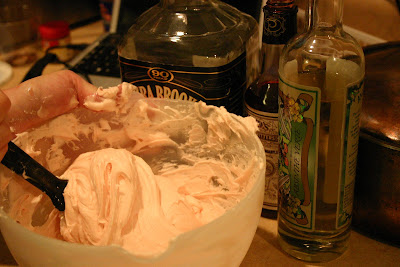
Then it hit us: why not use the shot cake as inspiration and create a cake that ITSELF was a cocktail? Indeed, there was no reason not to try, and the Sazerac cake was born. The goal in the cake was to create a dessert that would be close to the spirit of a Sazerac cocktail without simply being a cake soaked in liquor.
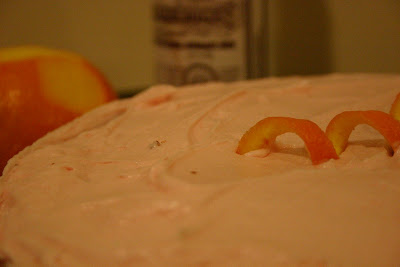
The resulting cake is evocative of a Sazerac, but is still unmistakably a dessert. (Personally, I think it could stand a bit more absinthe and Peychaud’s to make the flavors more pronounced, even.) If you’re looking for a twist on the usual type of dessert, give it a try — or try cakifiying another classic cocktail and get back to me — I’d love to try a Negroni cake.
Cake ingredients:
- 1 1/2 cups sugar
- 1 1/4 cups unsalted butter, warmed up to room temperature
- 2 tablespoons grated orange zest
- 1 teaspoon salt
- 5 large eggs
- 2/3 cup rye (or bourbon)
- 1/2 oz Peychaud’s bitters
- 1 tablespoon absinthe
- 2 1/2 cups all-purpose flour
- 1 extra orange, for twisting + garnish
Icing ingredients:
- 1/2 cup vegetable shortening
- 1/2 cup unsalted butter
- 4 cups confectioner’s sugar
- 1/2 oz Peychaud’s bitters
- 1/4 cup rye (or bourbon)
Preheat your oven to 350 degrees, and butter two shallow 9″ cake pans.
Beat the sugar, butter, and orange zest with an electric mixer (or just a lot of stirring) until it’s smooth. Add eggs one at a time, mixing continuously so the mixture keeps a creamy texture throughout. Still mixing, beat in the rye, bitters, and absinthe. Add in the flour slowly and continue to mix until the batter is battery-seeming enough, then distribute it intwo the two cake pans. Put them in the oven and bake for 45 minutes.
In another bowl — the frosting bowl — mix the butter and shortening, then add in the booze and bitters while continuing to mix. Add the confectioners’ sugar while mixing until the frosting is frosting-y enough. Place the bowl in the fridge while the cake bakes.
After the cake is done, let it cool in the pans for about half an hour at room temperature. Remove one of the cake halves (the less attractive one, preferably), and place it on the bottom. Top it with frosting, then stack the second half on top and frost it as well.
Garnish with an orange twist and serve. Optional: make a shot-glass sized Sazerac on top. Instead of rinsing with absinthe, float it on top and ignite it in place of candles. It’s birthday time!
Wigs and weaves
 It’s easiest to write reviews when there are soaring triumphs and miserable failures. This is true in any field. One need only look back at the review of Birgit Nilsson‘s legendary debut as Isolde in 1959 or Pete Wells‘ much more recent takedown of Guy Fieri‘s “restaurant” in Times Square.
However, if a critic conistently gets too caught up in hyperbole (critical or laudatory), he quickly loses credibility. It’s those damned middling reviews that really exemplify one’s voice as a ”critic.” Those are not that fun to read, and not that fun to write. But you’ll have to bear with me because the Met’s premiere of Donizetti’s Maria Stuarda inspired just such a review.
The opera “crackles with romance,” or so David McVicar tells us. I’m inclined to agree, and so is history. The plot centers around a fictitious meeting between Elizabeth I and Mary Stuart. The libretto is based on a Schiller play that also concocted a love triangle between Mary, Elizabeth and the Earl of Leicester. Rehearsals for the premiere resulted in the singers cast as the two queens breaking into a brawl after the confrontation scene in which Mary spews out the infamous “vil bastarda” (vile bastard) insult.
The world premiere was canceled in Naples after the dress rehearsal, since King apparently wasn’t down with hearing a monarch (of whom his wife was a descendent) called a whore on stage. The piece was revamped but also banned at La Scala, and except for a few scattered performances in the 1860s, was largely ignored for almost a century afterward. It popped up again during the bel canto revival with the help of brilliant sopranos such as Leyla Gencer, Montserrat Caballé and Beverly Sills who couldn’t resist delving into Donizetti’s rich score and the iconic exploits of the martyred Mary Stuart.
Unsurprisingly, the most famous bit of the score is that notorious, censored, verbal smackdown outside of Fotheringhay castle. Stuarda is a diva show through and through. Indeed, yours truly held on tightly to her weave, just in case Elizabeth or Mary got out of hand, reached up and snatched it off my head all the way in the family circle.
First things first: credit where credit is due. Top marks go to David McVicar, John MacFarlane and Jennifer Tipton for fashioning such a beautiful Tudor England . The sets are spacious and unobtrusive. The singers had plenty of space to move about and the emphasis was on human drama and not the spectacle of monarchal Europe. MacFarlane’s elegant constructions are much like those in Charles Edwards’ Trovatore in that there are no awkward lulls in the drama because the sets simply ascend to the rafters to reveal/transform into other sets when their use has expired.
 His costumes were absolutely stunning. They were hyperrealistic, ornate and beautiful. The lighting was effective throughout, particularly in Maria’s execution scene. What a masterful use of chiaroscuro Tipton employed with the chorus emerging from the bright doorway upstage and silhouette of the executioner looming above the staircase up which Maria must march to be beheaded!
The direction shrewdly focused on the interaction between the characters. Apparently McVicar is not a fan of an unnecessarily cluttered stage. In Act I when the court is awaiting Elizabeth the hustle and bustle was very efficient symmetrical. He must have told choreographer Leah Hausman something to that affect, because even the backflipping court jesters mirrored each other in the opening scene.
And the musical elements are also on a high level. Maurizio Benini did the finest conducting we’ve heard from him at the Met so far, bringing out out some lovely, buoyant playing from the Met orchestra. The orchestra was right with the singers, who seemed committed to the stylem complete with lovely decrescendos on the half cadences followed by portamenti that skillfully linked phrases together and deftly adding to the flow of the music.
Donald Palumbo‘s chorus is proving to be one of the best in the world singing with superb balance and sonority during Mary’s prayer at the end of the opera. Top vocal honors go to the compulsively listenable Matthew Polenzani. It’s nice to see that he is finally getting the recognition he deserves this season with two HD performances. His ringing tenor voice and exquisitely colored phrasing (particularly when he is imploring Elizabeth to have mercy on the Maria) were the high point of the evening. He may well be the best lyric tenor on the Met’s roster.
So much good stuff in this show, right? What the fuck is my beef?
The ladies. They simply missed the mark. Given the vocal and histrionic attributes of these two singers, I found myself wondering what the show would have been like if each had been cast in the other’s role.
Elza van den Heever made an inconsistent Met debut as Elizabeth, more crotchety old lady than fierce rival. Her voice was quite present, but there were were quite a few smeared runs and a handful of curdled top notes. I wanted a little more firmness in the middle voice than she had at her disposal. Still, the phrasing was quite nice and she held her own in her duets with Leicester and Maria. I’d like to see her in another perhaps more gracious role.
Maria Zifchak, Joshua Hopkins and especially Matthew Rose provided sturdy vocalism if little personality to the evening, but that’s beside the point. This is Maria’s show. And unfortunately, the largest disappointment of the evening was the spunky Kansan underdog-cum-diva du jour herself, Miss Joyce DiDonato.
Don’t get me wrong, there was nothing scandalous in the least about her performance. The voice is mostly resonant and true. She has a masterful technique and a command of the style. But she did not convince me that her urgent mezzo was an ideal fit for the part. The pianissimo top tones bordered on straight tone. To my taste this effect can be effective in Baroque repertoire, but in bel canto in quickly becomes grating.
Conversely, her forte singing occasionally found vibrato widening into a bleat. When she had been going full blast in dramatic declamations, and this was followed by a sustained top tone (as in her cabaletta “Nella pace”) the voice thinned out noticeably.
Vocal shortcomings can, however, be overcome by artistic commitment, but that is where DiDonato really disappointed me. It is admirable that she mentioned in her interview with the New York Times that she does not feel the need to compete with ghosts, but the ghosts were out in full force in my mind’s eye last night. So maybe she doesn’t have the diamond bright top tones and stratospheric coloratura of Sutherland or the ethereal pianissimos of Caballé, does she she have the fire of Leyla Gencer? Well, no.
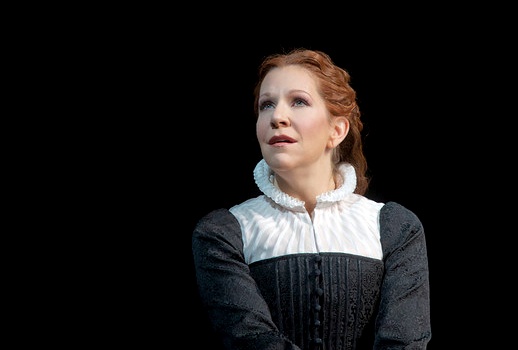 DiDonato was definitely committed throughout the entire evening, but the part needs bolder choices than she was making. She didn’t channel her inner bitch well enough to be appropriately hair raising when she curses Elizabeth. Worse yet, she did not suffer convincingly, and thus I didn’t suffer with her. I saw a caricature of anguish and pathos, nothing more. She had no X-factor. Her performance, while perfectly competent, left me ice-cold.
The evening was most infuriating because there was no one to be mad at. It’s so much fun to curse Jonathan Friend for his wretched casting or Peter Gelb for letting him turn the Met into a a pantomime-beauty-pageant-museum for warhorse operas. To the contrary this was exactly what we would hope the Met would be doing; taking a lesser known masterpiece and putting it before a larger audience via movie theatre broadcast in a high quality production with top level artists.
On this particular night all of the elements (beautiful production, clever direction, fabulous conductor and top notch singers) were in place for a great evening yet the performance just didn’t manage to catch fire. I wanted magic complete with shiny high D’s, glittering pianissimos held for an obscenely long time, soul wrenching phrasing, or other such glorious vocal excesses. I wanted fire and blood. I wanted to be hauled out on a stretcher in a state of post-traumatic operatic delirium, but alas, it was not to be. All I got was singers going through the motions.
Stuarda needs that wild sparkle of genius in order to transcend the work from wig-snatching bitch fight to gripping theatre and the ladies just didn’t deliver the goods.
Photos: Ken Howard.
A List Apart: Articles: Designing Contracts for the XXI Century
"Go f– yourself."
- House Speaker John Boehner to Senator Harry Reid, as fiscal cliff negotiations came to a close.
Republicans Blame Boehner For Failure On Sandy Relief
Russian Sledges“It’s a Boehner betrayal.”

New York Republicans and Democrats are publicly furious with Speaker John Boehner for abruptly cancelling an expected vote late Tuesday night on a relief package for victims of superstorm Sandy.
The Senate recently passed an aid package for Sandy victims worth $60 billion, a price tag that made many House Republicans nervous. So they decided to divide it up into two parts: $27 billion and $33 billion. The first part was vetted by appropriators for wasteful spending but the second wasn't. And most of the latter chunk would not have been spent in the first year, anyway. So one school of thought was to vote separately on both and let the chips fall where they may.
The likely upshot was that the House would immediately authorize $27 billion for victims and give themselves time to determine, in the next Congress, how much of the rest was necessary. A two-track vote was expected after the bill to avert the fiscal cliff. But it never happened. Why was it pulled?
Wednesday morning on the House floor, New York Republican Reps. Peter King and Michael Grimm blamed Boehner for what they described as a betrayal.
"It was entirely the speaker's decision," said a GOP leadership aide, who doesn't work in Boehner's office. "As to why we're not voting on it now? That's a question I can't answer."
A Boehner aide told TPM on Wednesday that the speaker intends to prioritize the Sandy relief package when the new Congress convenes Thursday, and has shared that with members of the New York and New Jersey delegation.
"The speaker will make the supplemental his first priority in the new Congress," the aide said.
At a press conference in New York, Sen. Chuck Schumer (D-NY) told reporters Wednesday that he's "distraught" and "angry" over the House's failure to hold a vote, blaming it on a House GOP "leadership squabble." He said Majority Leader Eric Cantor (R-VA) has been "truly helpful" in piecing together the package and blamed Boehner.
"Cantor has been very much for us, but Speaker Boehner ... pulled the rug out from under us," Schumer said. "It's a Boehner betrayal."
A Cantor aide affirmed that the majority leader has been pushing for the package.
"Majority Leader Cantor is committed to ensuring the urgent needs of New York and New Jersey residents are met, and he has been working tirelessly toward that goal," the aide told TPM.
King called the lack of a vote "disgraceful," saying Boehner "refused to tell us why" the vote didn't happen or provide "any indication or warning whatsoever."
"People in my party, they wonder why they're becoming a minority party," King said on CNN. "Anyone from New York or New Jersey who contributes one penny to the Republican congressional campaign committee should have their head examined."
The consequence of the move is that lawmakers must start all over on the relief package once the 113th Congress convenes Thursday.
Why Zipcar's "Greedy VCs" Weren't Quick Enough
Avis is paying a 50 percent premium to buy up Zipcar. That’s good news for the car-sharing service, right?
Absolutely not, says managment guru Tom Peters. Via Twitter, he announced his disappointment:
Aargh. Hate hate hate to see Zipcar swallowed by Avis!! Greedy VCs looking for quick payback, I presume???
– Tom Peters (@tom_peters) January 2, 2013
After getting some pushback from start-up folk like First Round Capital’s Chris Fralic, kbs+’s Darren Herman and angel investor Jerry Neumann, Peters concedes that maybe this wasn’t the case here, and that he doesn’t really know or care much about Zipcar the company, but he really thinks most VCs suck.
So let’s stipulate that some VCs are fantastic human beings and others are not. But let’s also point out that Zipcar’s three primary VC backers — Benchmark, Greylock and AOL co-founder Steve Case’s Revolution investment group — seem to have been Zipcar believers, not Zipcar flippers.
Zipcar went public in April 2011, when it priced at $18 a share and popped to $26. At the end of 2011, Benchmark still had 66 percent of its original stake, and Greylock and Case hadn’t sold a share (click charts to enlarge).


Neither Benchmark nor Greylock seem to have sold anything since then, while Case ended up betting $8 million more on Zipcar in August 2012.
Case’s summer investment now looks pretty good, since he was buying stock on the open market for an average of $7.80 a share, and Avis is going pay him $12.25. But Case, Greylock and Benchmark still missed many other chances to sell off their Zipcar stakes at much higher prices.
In November 2011 — more than half a year after the Zipcar IPO, when most lockups traditionally expire — Zipcar was trading at $20. If its VCs were looking for a quick payback, that would have been the best time to bail out.

Avis Zips Up Zipcar For A Cool $500 Million
Russian Sledgesstarting to freak out
 While New York city eagerly awaits the arrival of our bike share program (soon, they swear) something interesting has just happened in the more established world of car shares. Car rental company Avis just bought the industry leader, Zipcar. Assuming the $500 million deal is approved, the merger should be complete in the Spring. [ more › ]


Ex-Boyfriend Says Subway Shoving Suspect Has Long Hated Muslims
Russian Sledgescontinues to freak me out
 The suspect accused of shoving a man onto the subway tracks in Queens last week has been admitted to the psychiatric jail ward for women at Elmhurst Hospital. Erika Menendez, 31, told police she fatally shoved 46-year-old Sunando Sen into the path of a 7 train because she hates "Hindus and Muslims ever since 2001 when they put down the twin towers I’ve been beating them up.” A former boyfriend told the Daily News that Menendez has long hated Muslims: "She would say, ‘I can't stand being around these people,’" John Goelz said. "I kept telling her you can't blame every person you see." [ more › ]
A Jew in the Northwest
Russian Sledgesaw;dr
On leaving New York for Portland.
William Deresiewicz | The American Scholar | Dec 2012 [Full Story]Imprint Magazine: 50 Years of Chicago “L”...

Imprint Magazine: 50 Years of Chicago “L” Graphics
Say goodbye to a productive day and go and have a look through this stunning collection of Chicago “L” maps, posters, timetables and more from around 1910 through to the 1960s. Some amazing pieces, including some promotional posters that rival the best work the London Underground ever produced.
Source: via Twitter user @erik_griswold
Bus-ted... Public Buses Quietly Adding Microphones to Record Passenger Conversations
Transit authorities in cities across the country are quietly installing microphone-enabled surveillance systems on public buses that would give them the ability to record and store private conversations, according to documents obtained by a news outlet.
 The systems are being installed in San Francisco, Baltimore, and other cities with funding from the Department of Homeland Security in some cases, according to the Daily, which obtained copies of contracts, procurement requests, specs and other documents.
 The use of the equipment raises serious questions about eavesdropping without a warrant, particularly since recordings of passengers could be obtained and used by law enforcement agencies.
 It also raises questions about security, since the IP audio-video systems can be accessed remotely via a built-in web server (.pdf), and can be combined with GPS data to track the movement of buses and passengers throughout the city. (more)
A Sampling of Sugars from Asia
[Visit Alcademics.com for the full post.]
City Quilts, Cosmopolitan Quilted Maps of Cities

City Quilts by Brooklyn-based Haptic Lab are a line of cosmopolitan quilts featuring map grids of major cities.
via bookofjoe
Doctor Who: Missing in Action
Long-term fans may well remember this short documentary, which aired with repeats of Planet of the Daleks back in 1993, Doctor Who‘s 30th anniversary year.
Narrated by Nicholas Courtney, the video below explains the state of play (as it was then) concerning the missing episodes from the series’ early years, mainly from the Second Doctor’s era (1966-1969) and featuring music producer/fan Ian Levine.
(Warning: microcosm of old-school fandom in evidence!)
Available only on YouTube and highly unlikely to appear on a DVD (due to the way in which fans are portrayed), this short film nevertheless presents a nice historical perspective to the quest for missing episodes and the state of fandom in 1993…
What Is the ‘Detroit Leaning’ Referred to in the Pretenders’ ‘Brass in Pocket’?

Less than a minute into the music video for the Pretenders’ “Brass in Pocket” — one of the first clips ever aired on MTV — we see teddy-boy-coifed bassist Pete Farndon maneuvering a pink whale of an automobile toward the diner where singer Chrissie Hynde is waitressing. All three male ... More »
Unearthly Sculpture Shows Three Women Floating in Midair



Elisabet Stienstra's The Virgins of Apeldoorn, a sculpture placed on display in the Netherlands in 2001, appears to show three women levitating:
Their hair and the cloth of their dress hangs below them as though they are sleeping on an invisible bed in midair. The intriguing figurative pieces are each presented in an almost cyclical composition. One cannot tell if these are three separate girls or perhaps the same one at different periods of time, tossing and turning in bed.
There are several interpretations of the fascinating piece. One could look at the trio of youthful female figures as a frozen emblem of innocence, while others can dispute its exploitation. After all, the draping skirt exposes each of the girls, giving audiences the uncomfortable opportunity to look underneath. Whether the young woman is lying on her back, face down, or on her right side, she is met with an uncompromising position, dependent on the spectator's view angle.
Link | Artist's Website (NSFW)


The Bierpinsel
Built in 1976 by architect couple Ursula and Ralph Schuler in the Steglitz neighborhood of South Berlin, the Bierpinsel (aka The Beer Brush) is an iconic example of the german Brutalism craze.
Originally designed to resemble a tree, the science fiction-like structure rises vertiginously to 47m from the ground, offering a panoramic view of the city.
The story of its accommodation is long, and filled with bankruptcy and financial dramas. Ordinarily equipped with a restaurant and a night club, the building closed many times and became a monument to Berlin's sweet and sour urban decay until some recent somewhat onerous restorations.
Reopened in 2010 under the name “Turmkunst,” the tower was decorated by famous street artists like Honest and Sozyone Gonzales, giving it a fresh pop-art makeover.
The Old Ship Saloon
In 1849, at the height of the Gold Rush, stormy seas drove the ship Arkansas aground on Alcatraz Island, and the wreckage was towed to shore along the city’s notorious Barbary Coast. In 1851, the ship started its second life as a bar.
A gangplank led to the entrance cut from the side of the ship, with a sign reading “Gud, bad and indif’rent spirits solds here! At 25 cents each.”
Between 1849-1852, a huge number of ships were wrecked or abandoned in the San Francisco Bay as ship after ship arrived following the announcement of the discovery of gold in the Sacramento foothills. In 1850, over 500 ships were recorded as being at anchor in the formerly sleepy bay, some undoubtedly slowly rotting in place after their crews had headed to the gold fields.
Like the nearby Niantic and other Gold Rush shipwrecks and abandoned vessels, the Arkansas quickly became part of the shoreside infrastructure.
By 1855 the ship was landlocked by infilling at the bay (at least partially with rubble and ballast stones of other ships), and by 1859 all traces of the above-ground portion of the ship were removed. With the exception of the bad old days of prohibition, it’s been in the business of serving drinks for a century and a half. The current owner took over the property in 1992, and although today it may be tough to spot the bar’s shipwreck origins, they do serve a very nice version of Pisco Punch - the city’s Gold Rush drink of choice.
