Courage, Anxiety and Despair Watching the Battle (detail)
James Sant
19th Century
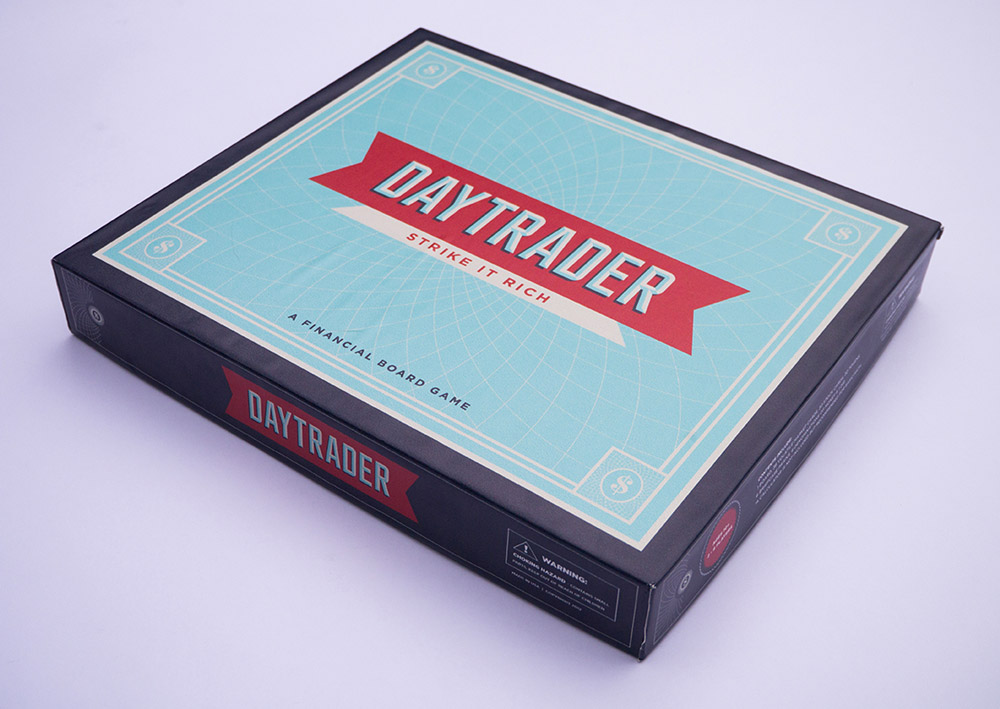
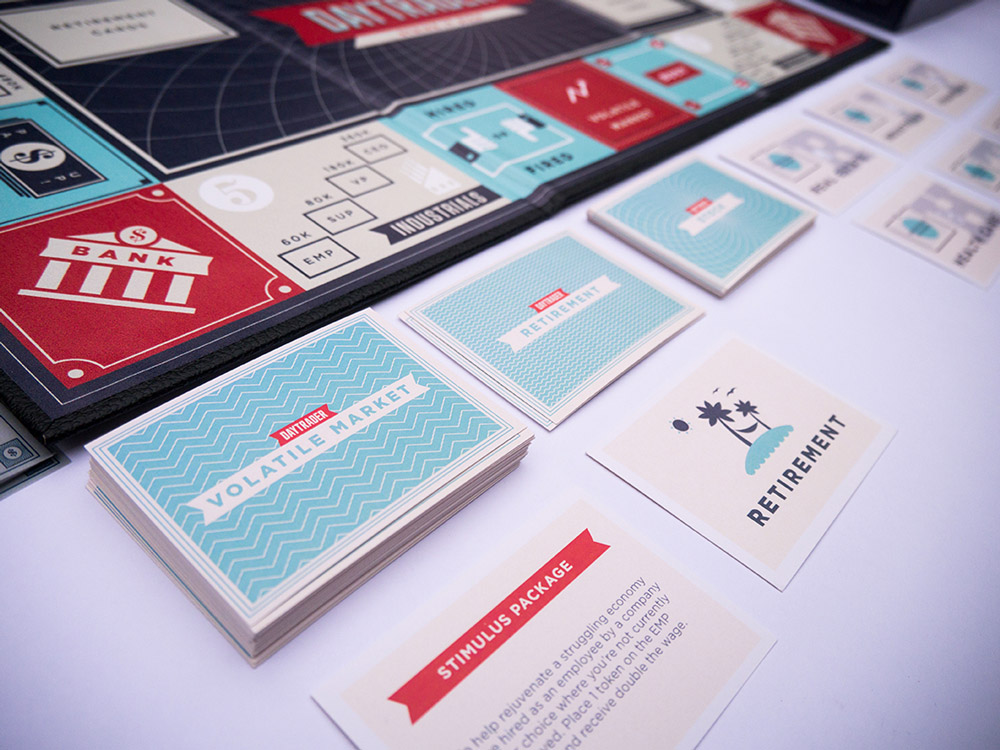
Designed by Italic | Country: United States
“Daytrader is a really funny and educational game created by Samir Lyons. It’s a financial board game that brings you the thrills and chills of investing in the stock market but without real risk. It’s simple, educational and fun.
Italic was enlisted to give Daytrader a unique and playful look & feel. The design draws inspiration from classic American business signage and simple currency-like illustrations as a tribute to the golden age of finance and Wall Street. The Americana feel to the game adds a warm, approachable simplicity to the chaotic and complex world of economic affairs. Daytrader is designed so a wide range of people can enjoy the experience of playing, from families around the dinning room table, to finance gurus, students, board game geeks and beyond.”



The first model of the NES wasn’t all that great; just ask any one of the millions of six-year-olds who independently discovered blowing on a cartridge made it work. The second NES hardware revision, the top loader, was better but only had RF video output. These are the only two pieces of hardware that can play every single NES game, and even with years of hacking NES-on-a-chip devices, there’s still much to be desired.
[low_budget] over on the AtariAge forum decided he’d had enough of these hardware compromises and decided to build the first new NES hardware revision in 20 years. It’s got all the best features from both of its predecessors and a few new features not seen on any existing NES. There’s support for composite and RGB video generators, new and better amplifiers for the audio, no lockout chip, and a top loading cartridge slot to prevent bent pins on the 72 pin connector.
While [low_budget]‘s prototype works, it only does so by salvaging the CPU and PPU from a working NES. There’s still much work to be done on the prototype, but even if we’ll have to destroy our beloved NES, we’d love to get our hands on one of these improved consoles.


 |
| Georgia O'Keeffe lemons show up with surprising frequency |


Russian Sledgesomg boys
Differences, that is. On “Need to Know” this week, Jay and I talk with Christina Hoff Sommers about her important New York Times piece “The Boys at the Back.” We examine the alarming data about boys lagging behind girls in school at every level, from kindergarten through grad school. The gals are taking the more challenging courses, garnering 60 percent of college degrees, and are about to outstrip men in the number of Ph.D.s earned.
Sommers offers other alarming statistics as well. We venture into forbidden areas — like innate differences between the sexes (it’s called “essentialism” don’t you know), the benefits of single-sex schooling for some kids, and the feminization of American classrooms over the past several decades. These trends, along with pervasive fatherlessness, have yielded a genuine boy crisis.
Keep reading this post . . .
 After some Reddit/4chan MRA babies tried to make #INeedMasculismBecause happen on Twitter today (co-opting the popular feminist meme, because EYEROLL), it blew up in their faces bigtime. The hashtag was gleefully hijacked by the normal, thinking humans of Twitter, who are currently churning out hundreds of tweets lampooning Men's Rights talking points. I had to scroll down for years to find one sincere #INeedMasculismBecause tweet from an MRA. (And when you do find them, they read like parody anyway.) It's pretty awesome. More »
Russian Sledgesgiant pain in the ass, fyi


 |
 |


Diane Meyer distorts sections of personal photos resulting in compositions that comment on memory. In her own words: “This series is based on photographs taken at various points in my life and arranged by location. Sections of the images have been obscured through a layer of embroidered pixels sewn directly into the photograph. The embroidery deteriorates sections of the original photograph forming a new pixelated layer of the original scene. The project refers to the failures of photography in preserving experience and personal history as well as the means by which photographs become nostalgic objects that obscure objective understandings of the past.” (via)


Russian Sledgesjesus christ
Russian Sledgesa heated exchange? on AUTOCAT?
Aside from paying very little attention to visual design and not caring about the impact of horrible typography, the big problem with library catalogs is that they are not designed to help people accomplish library tasks. Instead, they’re designed to expose catalog records. Correct me if I’m wrong, but this is totally backward—prioritizing the collection, not people, results in a user-hostile interaction design and a poor user experience. Imagine the reverse: a tool that prioritizes helping people accomplish their tasks, whereby bibliographic data exists quietly in the background and is exposed only when useful.
Russian Sledges'Lowering standards is counter-productive - the idea that “it’s hard to hire women engineers therefore we won’t hold them to such a high standard” is noxious. It reinforces the impression that women aren’t good at engineering which is obviously a downwards spiral.'
no shit
Etsy recognized that their engineering team was not as gender diverse as they wanted it to be, even after recognizing the issue and attempting to fix it. Here's how they made some real progress.
Tags: Etsy Kellan Elliott-McCreaKellan Elliott-McCrea (@kellan), a former architect at Flickr and co-author of the OAuth spec, is now the CTO at Etsy, the world's most vibrant handmade marketplace. During his tenure, he's played a critical role in the company's restructuring of its engineering organization; now, Etsy hires for diversity, particularly gender diversity. After witnessing first-hand how challenging it can be to attract women engineers, Kellan shares lessons in building a process and culture to attract female engineers. All the good stuff below belongs to him.
Etsy's decision to pursue women engineers is indicative of a broader change: making diversity a core value. But even after a number of concerted efforts to bring more women talent onboard, the company achieved almost no progress; in fact, one year, they actually saw a thirty-five percent decline in gender diversity even when this was a priority.
Russian Sledgesupdate: "Traffic will be banned from roads statewide as of 4 p.m."


The work of Matthew Picton is something more than a map, even something more than a model city. He meticulously builds cities from paper. Each buildings wall is built from a strip of paper leaving its interior empty. In a way his three dimensional maps get at the personality of a city. Speaking about cartography Picton says,
“There is some intrinsic quality to cartography that goes beyond the scientific document – a beauty of form and detail, a record of past times and places, something that lives as a world in which imagination can flow; places to re-visit, places to re-imagine, a world to re-make itself in the imagination.” [via]
Several of his pieces depict cities before and after a natural disaster or war. The charred strips of paper mark burnt or crumbled buildings. Pockets of burnt paper seem more like injuries than a cold record of a past fact.


Russian Sledgesvelvet goldmine?