
Russian Sledges
Shared posts
01 May 02:45
Katy Perry accusée de blasphème contre Allah dans son dernier clip
Un Britannique a lancé une pétition contre le clip « Dark Horse » de la chanteuse américaine, dans lequel elle réduit en cendres un homme portant un pendentif au nom d'Allah.


28 Feb 23:40


mhc-asc: Hand knits in the Archives! These wool stockings were...
Hand knits in the Archives! These wool stockings were knit by Fidelia Fiske, Class of 1842, from wool spun by Mount Holyoke founder Mary Lyon. The wool is incredibly fine — almost like sewing thread — and those long double pointed needles look like quite a challenge to work with. But certainly nothing was impossible for this knitter who went on to found a school based on the Mount Holyoke model in Persia (present-day Iran) in 1843.
Great photos! Anybody else have interesting clothing in their collections? One thing this calls to mind here at Houghton is our collection of costumes worn by contortionists.
27 Feb 12:53

questionableadvice: ~ Road Book of Boston and Vicinity for...
Russian Sledgesvia firehose
attn tweed ride participants
~ Road Book of Boston and Vicinity for Bicyclers, Riders and Drivers, Charles A. Underwood, ed., 1893
"It is not advisable to wear a bustle."
Tertiarymatt and -1 others like this
27 Feb 12:53


houghtonlib: Milton, John, 1608-1674. Paradise lost : a...
by villeashell
Russian Sledgesvia firehose via otters: "PARKER
GET ME PHOTOS OF SATAN"
Milton, John, 1608-1674. Paradise lost : a poem written in ten books, 1667.
Houghton Library, Harvard University
Tertiarymatt and -1 others like this
27 Feb 12:50
adokal: Ottoman pilot Ahmet Ali Effendi, 1916, world’s first...
Russian Sledgesvia firehose

Tertiarymatt, firehose likes this
27 Feb 12:47

Nonchalance In Corduroy. David Bowie.
Russian Sledgesvia multitask suicide
Nonchalance In Corduroy.
David Bowie.
Tertiarymatt and -1 others like this
27 Feb 12:40
Under the Spell of Yoga
by William Dalrymple
Russian Sledges'So it was that seventeenth-century Allahabad/Prayag became the confluence not just of two holy rivers but of several traditions of sacred art in a way that today might be considered implausible to anyone who takes at face value the idea of a clash of civilizations: a Hindu artist painting the first-ever systematic set of illustrations of yogic asana positions, while working for a Muslim patron, and borrowing for the yogis the features of Jesus Christ.'
William Dalrymple
Yoga: The Art of Transformation
an exhibition at the Freer and Sackler Galleries, Washington, D.C., October 19, 2013–January 26, 2014; the Asian Art Museum, San Francisco, February 22–May 18, 2014; and the Cleveland Museum of Art, June 22–September 7, 2014
The Khecarīvidyā of Ādinātha: A Critical Edition and Annotated Translation of an Early Text of Haṭhayoga
by James Mallinson
Sinister Yogis
by David Gordon White
Warrior Ascetics and Indian Empires
by William R. Pinch


Yoga: The Art of Transformation
an exhibition at the Freer and Sackler Galleries, Washington, D.C., October 19, 2013–January 26, 2014; the Asian Art Museum, San Francisco, February 22–May 18, 2014; and the Cleveland Museum of Art, June 22–September 7, 2014
The Khecarīvidyā of Ādinātha: A Critical Edition and Annotated Translation of an Early Text of Haṭhayoga
by James Mallinson
Sinister Yogis
by David Gordon White
Warrior Ascetics and Indian Empires
by William R. Pinch
By the sixteenth century, yoga and the secret bodies of knowledge that were associated with it had become part of the science of government in Indo-Islamic courts. The interest was as much practical as mystical: many sultans were convinced that extraordinary powers could be accessed through the practices of yogis.
27 Feb 12:38
Beneath the Stars
by Jeanine Basinger
Russian Sledges<3 barbara stanwyck forever
also, I hadn't realized ava gardner was that foul-mouthed
Jeanine Basinger
Ava Gardner: The Secret Conversations
by Peter Evans and Ava Gardner
A Life of Barbara Stanwyck: Steel-True, 1907–1940
by Victoria Wilson


Ava Gardner: The Secret Conversations
by Peter Evans and Ava Gardner
A Life of Barbara Stanwyck: Steel-True, 1907–1940
by Victoria Wilson
In 1949, Metro-Goldwyn-Mayer, the studio that boasted “more stars than there are in the heavens,” released one of its typical productions. Based on a soap-opera-ish novel by Marcia Davenport, East Side, West Side put MGM’s assets on show: Cyd Charisse (in a non-dancing role), Nancy Davis (soon to be Mrs. Ronald Reagan), James Mason (at his most suave), and Gale Sondergaard and Van Heflin (both Oscar winners). The headliners ...
27 Feb 12:36
The Latest Scheme for the Parthenon
by Mary Beard
Russian Sledgesapparently it's about human sacrifice now (or not)
Mary Beard
The Parthenon Enigma
by Joan Breton Connelly


The Parthenon Enigma
by Joan Breton Connelly
There is one basic rule about the “Elgin Marble Controversy”: it is not straightforward (if it were, it would have been solved decades ago). There are bad arguments and woeful oversimplifications on both sides, and the whole question raises some of the biggest dilemmas of heritage and cultural property. It pits the desirable notion of the Universal Museum against the desirable aim of seeing a coherent ensemble of sculpture (whether or not united by the Erechtheus theme) put together again.
firehose likes this
27 Feb 11:40
Cantonese Proverbs in One Picture | 廣府話小研究Cantonese Resources
by overbey
Russian Sledgesvia overbey
劏白鶴 [tōng baahk hohk/hók] (to slaughter a white crane)
to vomit, to throw up
firehose likes this
27 Feb 03:05
Track Premiere "Be Free" a new song by King Dude & Chelsea Wolfe

The hypothetical Venn Diagram of Chelsea Wolfe and T.J. Cowgill would have a dense gravitational pull towards the center; for the past several years, both artists have worked with charred, neo-folk instrumentation, a gothic warble, and at times the spirit of an old country jukebox. “Be Free” is the pair’s new collaborative 7” from the Not Just Religous Music label—helmed by the Gira-reminiscent Cowgill, aka King Dude—and again proves their voices to be complementary. It’s a cold, sad, fiercely-strummed march, booming open and closed like Wolfe’s staggering Pain Is Beauty LP. “Don’t you dare take my hand if you want to be free,” Wolfe and Cowgill sing to one another, articulating the sentiment in various iterations. It’s a timeless negotiation between desire and emotional freedom and the necessity of not looking back, and also one of the most direct pieces of songwriting either artist has casted out.
27 Feb 02:12


Russian Circles and Chelsea Wolfe photographed live by Hillel...
Russian Sledgesoh shit, chelsea wolfe is on the new russian circles album
Russian Circles and Chelsea Wolfe photographed live by Hillel Zavala in Bologna, Italy on October 14, 2013 at their sold out Locomotiv Club show part of their European co-headline tour together. See full photo set HERE.
SEE ALL RUSSIAN CIRCLES TOUR DETAILS HERE
27 Feb 01:46
File:Peirce quincuncial projection SW 20W tiles.JPG - Wikipedia, the free encyclopedia
Russian Sledgesvia firehose ("wallpaper")

 Wikipedia - Recent changes [en].

firehose likes this
27 Feb 01:40




Welcome to Googletown
by Sean Hollister
Russian Sledgesvia firehose
contains: owl
Some days it feels like Google is taking over the world. For the residents of Mountain View, California, that feeling is personal. Two weeks ago, Google signed a deal for its very own airport just east of the Googleplex, complete with a blimp hangar large enough to house the Hindenburg. But building a better blimp probably isn't the reason that Google is leasing the historic Moffett Federal Airfield from the US government. At the same time the search giant is building robots and self-driving cars, Google is on a hometown real-estate binge — and Moffett Field could be the missing piece Google needs to reshape the city in its own image.
In 1999 Google moved into its first Mountain View office at 2400 Bayshore Parkway, with fewer than 50 employees to its name. Fifteen years later, it's the city's biggest employer. Though Microsoft, Symantec, Intuit, and LinkedIn each have a major presence in Mountain View, all are dwarfed by Google: in 2013, Google employed 9.7 percent of the city's entire workforce and owned 10.7 percent of all taxable property. In other words, Google represented one-tenth of Mountain View as of last year.
And it’s only getting bigger.
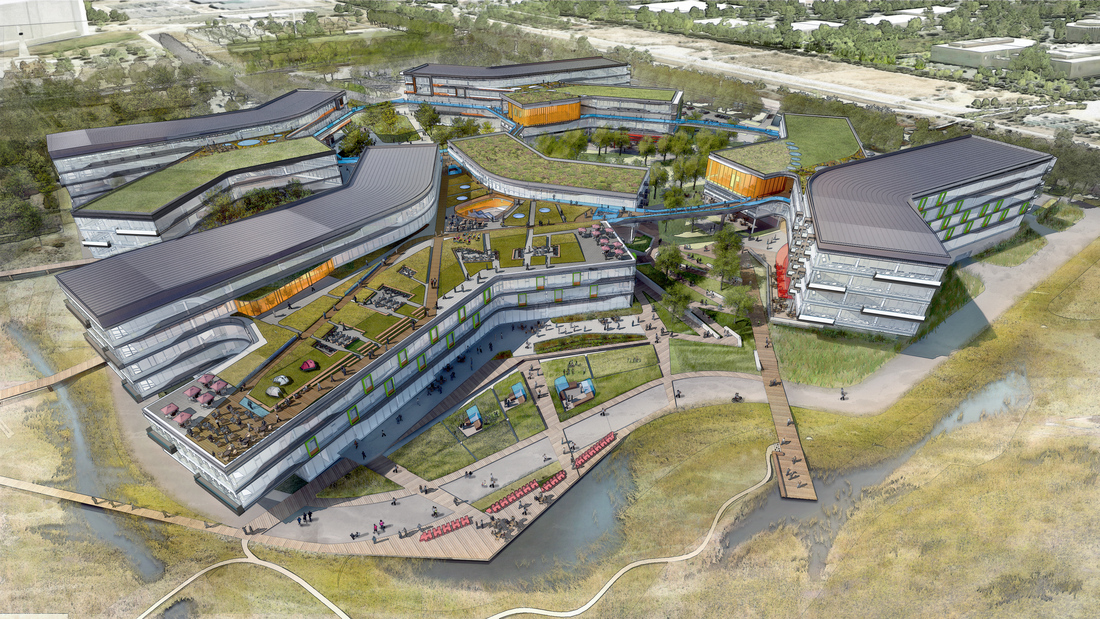
Google's proposed 1.2 million square foot Bay View campus. (NBBJ)
Not a cash cow
That growth might not be so bad if Google had more to offer than higher property values. City council member Mike Kasperzak is generally proud to call Google a neighbor, but he points out that the company’s presence isn’t the economic windfall you might think. There's no sales tax on Google's search or ad businesses, and no sales tax on the free meals that Google dishes out to employees. "I don’t want them to leave, but they aren’t the cash cow that everyone thinks they are," says Kasperzak.
Meanwhile Google is creating a tremendous amount of traffic. Google now owns or leases practically every office building north of Highway 101, an area known as North Bayshore. The importance of the islandlike geography can't be understated: Highway 101 is the primary thoroughfare that connects Mountain View to the rest of the San Francisco Bay Area, and it completely separates the North Bayshore employees from their houses and apartments. By design there’s little to no housing in North Bayshore, and all traffic in or out of Google has to go across or through Highway 101. As Google grows that traffic is becoming unbearable. "It's a parking lot," says city council member Jac Siegel. "I live on a side street, and there are times I can’t even get out of my driveway to get onto the side street; that's how bad it's gotten."
Google's central hub is cut off from the world
Yet Google has shown no signs of slowing its growth. As of June 2013 Google employed 11,332 workers in Mountain View, but it told the city council that it hopes to add 3.7 million square feet of new development under the city's latest zoning plan — enough to eventually double its workers to 24,000 by a conservative estimate. And that’s without counting any other purchases or leases Google might make in the area. To Google's credit, only 52 percent of its employees drove alone to work in 2012 — one-third opted for company buses — but even 52 percent of 24,000 is daunting when some of Mountain View's roads are already overflowing.
Google declined interview requests for this story, but provided the following statement: "Google and more than 3,000 Google employees call Mountain View home, and to date we’ve added no new development. No matter what happens in the future, we’re committed to being good neighbors for the community and the natural environment. In fact, our shuttle program takes 5,000 cars off the road each day, and thousands more Google employees ride bikes to work."
In 2007, after Google's first shopping spree resulted in the company snapping up roughly one-quarter of local office space, some residents were already becoming concerned. "I worry about us becoming a one-company town," a local told the Silicon Valley Business Journal that year, even as a city council member praised Google for revitalizing the area. In 2009 a Google transportation planner eerily predicted the gridlock that Mountain View might face in five to ten years if growth continued unchecked.
Best viewed fullscreen
Butting heads
Those worries didn't fall on deaf ears. According to Daniel DeBolt, a journalist who's been covering the story for nearly a decade, the Mountain View City Council has repeatedly challenged Google's ambitions. They've opposed Google proposals to build housing, to erect a hotel, and more recently to start any new construction whatsoever in the North Bayshore area. Transportation is one of the council’s concerns, but the environment also ranks high on the agenda: some are worried about impact to the native burrowing owl and other species in North Bayshore’s wildlife refuge.
"Having our employees right next to each other... is critical to our success."
Presently, the city council is leaning towards allowing Google to replace existing offices in the center of North Bayshore or near the freeway with taller, denser ones in exchange for reducing the size of offices near wildlife habitats at the edge of the area. On the transportation front, the city's planning to improve pedestrian and bicycle pathways, and to entrust a nonprofit Transportation Management Association (TMA) including Google, Samsung, and Intuit to coordinate a shared shuttle service in the area. The city's "precise plan" is due at the end of the year.
But Google doesn't appear willing to risk its potential growth on Mountain View’s leadership. At a January 22nd, 2013 meeting, Google's VP of real estate David Radcliffe gave the city council something of an ultimatum. "We can either grow up, taking the buildings we have now and making them bigger and denser, or we can sprawl out in a continued march through neighboring business parks and communities," he said, explaining that Google preferred the former. "Having our employees right next to each other, shoulder to shoulder, is critical to our success."
If that was indeed a threat, Google has been carrying it out in the year since. The company has bought or leased a total of nearly 2 million square feet since that meeting, including giant parcels west, south, and east of the company's traditional North Bayshore haunts. "2013 was a jaw-dropping year in terms of their appetite," says Silicon Valley Business Journal reporter Nathan Donato-Weinstein, whose careful record of local real-estate transactions helped inform this story.
And then there's Moffett Field to consider.
Moffett Field
Federal jurisdiction
Google's lease of the 1,000-acre Moffett Federal Airfield is mystifying at first. According to Deborah Feng, associate director of NASA's Ames Research Center, Google can't do whatever it wants with the land. The company will not only need to renovate the historic hangars but also run the actual airport whenever the California Air National Guard or other government entities need to use it. "What they do in the hangars is their own business as long as it's not illegal," says Feng, adding that Google can use Moffett's sizable airspace too. However, an FAA representative tells us that the company still won't be able to do anything special with that airspace — like testing drones — without explicit approval. Feng says that to her knowledge Google will use the hangars as R&D facilities of some sort, but that the company is limited to a relatively small 90,000 square feet of developable space outside the hangar walls.
Moffett Field begins to make more sense, though, when you consider that it could be part of Google's master plan. In 2008 Google leased 42 acres from NASA at the northwestern corner of Moffett Field as well as nine acres at the east end of Charleston Road, and it soon proposed building futuristic new campuses to rival the Googleplex at both locations. Then it proposed a bridge over the creek separating its huge North Bayshore holdings from the Moffett Field area. If you add the Palo Alto tract that Google bought this year and another proposed bridge between that Palo Alto property and Mountain View, Google could soon have a practically unbroken line of property bridging Palo Alto, Mountain View, and Sunnyvale. With a clear corridor connecting those three areas like one that Google has proposed, the company could reduce its dependence on Highway 101. And if it could house employees on federal property, those people could work, eat at Google cafes, and go home again without ever leaving Google’s island.
Work, eat, and sleep on Google property
Though the city of Mountain View has shot down housing in North Bayshore time and again, it doesn’t have any jurisdiction on the federal land, and it just so happens that parts of that land are already zoned to house as many as 5,000 residents. When Google first announced it was leasing NASA’s "Bay View" parcel in 2008, it wrote that housing would be part of the plan. Now, we’re hearing Google may also sublease nearly 2,000 planned housing units from University Associates, a struggling educational venture which has been trying to build a new Silicon Valley college campus on nearby NASA land.

A bridge too far
There’s just one problem: Mountain View won't let Google build a bridge to Moffett Field.
"We literally just about threw them out on their ear," says council member Jac Siegel. "It’s totally off the table." In a controversial move, the city council trashed the idea due to environmental concerns — without letting Google actually conduct an environmental impact report to gauge the reality of those fears. In his defense, Siegel says that the results of such studies inevitably wind up favoring the company who pays the bills. "If they don’t come up with the right answers, they don’t get hired again," he relates, saying that he’s personally seen it happen in the past. "I don’t feel that we could get a clean shake."
Backed into a corner
But if Google expands at Moffett Field without such a bridge, it could lead to more transportation woes. By buying up millions of square feet of real estate in and around Mountain View and developing millions more on federal land, Google is effectively forcing the city to choose between its conservation-friendly status quo and catering to Google’s growth. There’s not much Mountain View can do. "We have a council that believes in the free market," says council member Kasperzak. "We’re not going to tell a company that it can’t buy any more land."
Kasperzak believes that Google will do the right thing about the gridlock he fears if allowed to. "We can create a better environmental transition by just letting these companies build, but if you fight them at every turn... you'll never get what you want," he says. "The companies know they've got to keep their employees happy, and employees are increasingly less happy. They’re motivated to try and figure something out."
But Siegel worries that Google’s growth will destroy the character of the town. "The turnover in these apartments is 50 percent a year," says Siegel, addressing the common argument that the city should build more rentals in response to demand. "That means every other person who lives there won’t be there next year. That’s building a strong community, now isn’t it!" he gibes.
After eight years on the beat, Daniel DeBolt also fears that his community is disappearing. He recently interviewed Nilda Santiago, one of the city’s human relations commissioners up until a few weeks ago.
"She’s the kind of person who goes out of their way to help people who aren’t getting help from anyone else, and she’s being forced out of the city due to rent increases," DeBolt tells us. As much as he tries to remain objective in his reporting, he says he believes it’s "just not okay to not take a position" on the issues Mountain View faces, and his position is that Google is tearing the community apart. "The community … is being replaced by people who spend most of their day on the Google campus, no longer contributing to civic life," he says. But at this point DeBolt believes that something has got to give.
More likely than not, Google will get its way before long. At the end of this year, terms expire on three of the city council’s conservative majority members, including Siegel, and even he believes the Moffett bridge will resurface once "the right council members" are in charge. While there’s a possibility that the local population will elect more conservationists, it seems likely that between the new elections and the increased pressure to solve transportation and housing, Mountain View will begin to give Google what it wants.
"What I fear mostly is that Mountain View becomes Googleville," says Siegel. "It’s a town controlled by Google, most of their employees live here, and it just becomes like a old factory town on the East Coast where they control anything and everything they want."
"I’ve been around for a while. I remember when Lockheed had 35,000 people. I remember when SGI had 39 buildings out in North Bayshore," Siegel warns. I’m not saying Google’s going anywhere, but if you look at history, it could change. Somebody in India or China or Pakistan could develop new technology that would be cheaper or better … and then there’d be a blight here. You don’t build a city for the current trends, you build it for the long term."
"I don’t want to build a city where the current residents don’t want to live anymore."
Lead image and design by Dylan C. Lathrop
27 Feb 01:39
Another One Bites the Dust
by Josh Marshall
Russian Sledges"But U.S. District Judge Orlando Garcia issued a stay along with the ruling, so the ban remains in place for the time being."
Tertiarymatt likes this
27 Feb 01:38
As Putin Orders Drills in Crimea, Protesters’ Clash Shows Region’s Divide
by By STEVEN LEE MYERS and RICK GLADSTONE
The new government in Kiev is faced with the challenge of calming separatism at home while placating President Vladimir V. Putin, who sees Ukraine as a vital part of his strategy to rebuild Russian influence.


|
27 Feb 01:38
Great American Bites: 'Julia Child's Taqueria' draws swarms to Santa Barbara
by russiansledges
Russian Sledgesoverbey, you are obligated to eat the fuck out of this when you are in santa barbara
If you have to wait in a long line to eat at La Super-Rica Taqueria – and you usually do –blame Julia Child. The late culinary star, who split her time between Santa Barbara and Cambridge, Mass., once said on Good Morning America how much she liked this taco stand. Since then, the casual remark has taken on legendary proportions, even spawning a New Yorker article headlined "Julia Child's Taqueria." While she may not have expected to be taken so seriously for decades, the bottom line is that the woman knew her food and was right about this otherwise unremarkable looking corner taco stand.
27 Feb 01:38
Conservative Texan Dan Patrick Accidentally Endorses Gay Marriage in a Twitter Typo, Fans of Irony Everywhere Cackle Delightfully
Russian Sledgesvia ereed
Greendinos, billtron and one other like this
27 Feb 01:18


Is Cyborg joining Batman Vs. Superman? Is Capaldi leaving Doctor Who?
by Katharine Trendacosta
Russian Sledges'The Mirror's claiming that Peter Capaldi's run as the Doctor will only last one season, similar to Christopher Eccleston's. It goes further to say that he was selected as a "transitional" Doctor, paving the way for a "radical" new direction. Whether that direction is for a non-white or non-male Doctor and/or the end of Moffat's run in charge of the show, no one's quite sure.'
via firehose
dude wtf

It's all crazy rumors all the time. Batman Vs. Superman may be adding another Justice League member, while Peter Capaldi's Doctor may have an expiration date already. Josh McDermitt talks what's next for Eugene, Abraham, and Rosita. Plus, the first look at Agents of SHIELD's newest agent. Spoilers now!
|
|
26 Feb 21:11


School Lunch On Layaway?
by Andrew Sullivan
A Salt Lake City school got national attention last month for refusing to give meals to students with outstanding lunch bills, following similar decisions in Texas and New Jersey. Patricia Montague of the School Nutrition Association calls the rise of lunch debt “a broad and growing national problem”:
School meal programs are self-sustaining and financially independent of a school district’s education budget. However, federal regulations prohibit school meal programs from carrying debt from unpaid meal charges from one school year to the next. So when parents don’t pay the balance, and meal programs are unable to cover the costs, school districts are forced to pick up the tab. As a result, many school meal programs have been forced to institute controversial charge policies governing whether, and what, their school cafeterias will serve to students who are unable to pay for a meal.
Research indicates that an increasing number of children arrive in the cafeteria unable to pay for their meals. A 2012 SNA survey of school meal program directors found that 53 percent of school districts were experiencing an increase in unpaid meal charges. Of those facing the increase, 56 percent anticipated that the accumulated debt from those charges would be greater at the end of the school year compared with that of the previous school year. Thirty-three percent anticipated a significant increase in debt. Some meal programs acquire thousands, even hundreds of thousands, of dollars in debt from unpaid meal charges. New York City’s public schools reportedly incurred $42 million in unpaid meal debt between 2004 and 2011.
26 Feb 20:50
Pointing Fingers: Women, Sin, Crime, and Guilt
by villeashell
Russian Sledgesvia otters
"Comtesse de Valois de La Motte, Jeanne de Saint-Rémy. Memoirs of the Countess de Valois de La Motte: Containing a Compleat Justification of Her Conduct, and an Explanation of the Intrigues and Artifices Used Against Her by Her Enemies, Relative to the Diamond Necklace. London: 1789.
Download the book as a pdf. "
tl;dr: Rose of Versailles is more historical than you thought
like, almost all of it
Pointing Fingers: Women, Sin, Crime, and Guilt:
Online version of an exhibition mounted in the Rare Book Room, Bryn Mawr College Library, in Fall, 2006.
firehose likes this
26 Feb 19:33
submitted by Crowsby
[link] [13 comments]
TIL that the alternate reality Portland also has a supernaturally-themed donut shop.
Russian Sledgesvia firehose
shhhh maine is real
Portland, Maine is home to Holy Donuts.
- We have voodoo, they have holiness.
- Ours are made from scraps and offal, theirs are made from top-tier ingredients. And also potatoes.
- We have the bacon maple bar. They have bacon & cheddar donuts.
- They have a reputation for being friendly and patient with their customers. We...not so much.
Based on these facts, one can only surmise that we are the goatee-wearing Dark Zone villains. It's a bummer, but at least we get the alternate-reality Uhura.

[link] [13 comments]
26 Feb 19:29

Even Fellow Republicans Are ‘Bullying’ Jan Brewer Into Vetoing Arizona’s Anti-Gay Bill
by Margaret Hartmann
Last week, Arizona's state legislature passed SB 1062, a bill that would allow business owners to refuse service to gay and lesbian customers due to their religious beliefs. Governor Jan Brewer has until Saturday to decide whether she'll allow the measure to become a law, and is said to be leaning toward vetoing it – mainly because she's being "bullied by the homosexual lobby in Arizona and elsewhere," as Rush Limbaugh explained on Tuesday. Businesses like Apple, American Airlines Group, and the NFL – which plans to hold the next Super Bowl in University of Phoenix Stadium – are urging Brewer to kill the bill. More surprisingly, it seems the "homosexual lobby" also includes Republican Arizona Senators John McCain and Jeff Flake, Mitt Romney, Newt Gingrich, and three Republican state senators who now say their votes in favor of the bill were a "mistake."
Republicans aren't turning against the bill solely because it's discriminatory. They're concerned it will lead to boycotts and bad press for the state. After tweeting his opposition over the weekend, Flake told reporters on Tuesday, "I don't think it's needed, and ... it would be devastating economically to the state." McCain echoed that sentiment on CNN, saying, "This is going to hurt the state of Arizona’s economy and, frankly, our image, so I hope the governor of Arizona will veto this and we move on." Romney and Gingrich also sided with those who want to "advance the gay agenda," as Limbaugh put it.
Politico reports that most Republicans at the national level just want the issue to go away. If Brewer allows the legislation to become a law, opponents could try to overturn it by putting a referendum on the November ballot, giving Democrats fodder for the midterms. Republican consultant Steve Schmidt, who was the senior strategist on McCain's 2008 campaign, told Politico, "It makes the party of Lincoln and Reagan look small, closed and intolerant and exacerbates our political differences with every single demographic group in America that is growing."
Read more posts by Margaret Hartmann
Filed Under: arizona ,jan brewer ,vetoes ,politics ,early and often
26 Feb 16:50
Out-Cumberbatch Benedict Cumberbatch with your own Cumberbatchian name
by Abraham
Russian Sledgesvia firehose ("oblig.")
Want your own ultra-English moniker so you too can be as awesome as Benedict Cumberbatch? Look no further than the Benedict Cumberbatch Name Generator…
Here are some samples…


Now go get your own. Being without a high-class appellation as magnificent as Mr. Cumberbatch’s is the only thing that’s holding you back in life.
firehose likes this
26 Feb 16:22

Thanks to the good folks over at Pitchfork, you can now stream...
Russian Sledgesvia toasterfire
Thanks to the good folks over at Pitchfork, you can now stream the ENTIRE soundtrack to Wes Anderson’s upcoming film, The Grand Budapest Hotel, right here.
"Anderson co-produced the soundtrack with longtime music supervisor Randall Poster. It features original music by composer Alexandre Desplat (who worked with Anderson on Moonrise Kingdom and Fantastic Mr. Fox) as well as Russian folk songs and performances by the Osipov State Russian Folk Orchestra."
26 Feb 14:42
Because of all the attention of this morning’s library post, I thought it’d only be fair...
Russian SledgesBecause of all the attention of this morning’s library post, I thought it’d only be fair to post the NYPL’s response. I’m quoting four points that they’ve asked me to clarify:
*The man says “I work at this Library.” Ends up, he doesn’t “work” for the library in the sense of being an employee. He is probably doing his work at the library (millions do each year!). We fear the confusion might make people think he is offering his opinion as an employee.
*The vast majority of research books will remain on the site (in far superior storage conditions)
*None of the public spaces he and others enjoy will change, and we’ll be returning a circulating collection to this main library (it had one for its first 70 years).
*This plan will be greatly expanding access to the library. The renovation will allow all New Yorkers–scholars, students, educators, immigrants, job-seekers– to take advantage of this beautiful building and its world-class collections.
Obviously the issue is more complex than soundbites from either side, so feel free to educate yourself further and form your own opinion:
http://lmgtfy.com/?q=NYPL+renovation+debate
Because of all the attention of this morning’s library post, I thought it’d only be fair...
Tertiarymatt, firehose likes this
26 Feb 13:05
The Other Connecticut, the Other America was first posted on February 21, 2014 at 6:00 am.
©2013 "Pacific Standard". Use of this feed is for personal non-commercial use only. If you are not reading this article in your feed reader, then the site is guilty of copyright infringement. Please contact me at njackson@psmag.com
The Other Connecticut, the Other America
by John-Manuel Andriote
Russian Sledges'I returned to Norwich in 2007 precisely because, having lived in major cities for decades, I did look beyond the disgrace that is Norwich’s downtown and saw an opportunity to contribute to my hometown’s renaissance by opening a unique, well-marketed coffeehouse in the “new” downtown, exactly the kind of magnet business that can entice people back into an old neighborhood.'
oh, dear.
tw: complaining about indians stealing your land
Just over a hundred miles northeast of Manhattan, the Connecticut River cleaves New England’s southernmost state, named for it, in two—literally, economically, and politically. The contrasts between the two southern corners of Connecticut could not be more stark. In fact, they are more like different worlds than two parts of the same whole.
West of the river, close to the New York line, Hollywood stars, hedge fund billionaires, and the cream of corporate America retreat to their designer-decorated manses amid the leafy hills and coastal inlets of Fairfield County, Connecticut’s Gold Coast. East of the river, in “the other” Connecticut, Revolutionary War heroes and Indian chiefs are celebrated, ruins of long-silent mills blight the riverways, and colonial-era farmhouses stand as reminders of the area’s long agricultural history.
In Greenwich, the southwesternmost town in Fairfield County, closest to New York, the median home price is $1,221,400, according to the Zillow Home Value Index. Connecticut has the most multi-million-dollar homes in the northeast, second in the nation only to California, and most of them are in Fairfield County.
In Norwich, the largest municipality in Southeastern Connecticut—where members of my family have lived since my great-grandparents emigrated from Greece around 1920—your $1,221,400 would buy eight-and-a-half homes given the median price of $143,500.
“Gambling is not Connecticut. We have people who are qualified to perform much higher skill jobs than serving drinks in short skirts or serving as security guards in a casino.”
Despite the much lower cost of living in Southeastern Connecticut compared to the tony western suburbs—Zillow’s Rent Index says the median rent in Greenwich is $5,529; in Norwich it’s $1,228—residents complain bitterly about what they consider their high cost of living.
Of course, it’s all relative. Relative to Greenwich’s per capita income of $88,519, Norwich’s $25,512 can only be stretched so far. The city’s recent high unemployment rate—7.3 percent compared to Greenwich’s 4.3 percent—isn’t only due to the still-struggling economy, but reflects the over-supply of low-skill workers and state policies that seem meant to keep the region isolated.
In Greenwich, you can leave your imported automobile in the park-and-ride lot, and for a $10.75 one-way peak fare ($76 a week for commuters) a Metro-North express train whisks you to Grand Central Station in less than 40 minutes from any of the town’s four stops. In Norwich, many residents don’t even own a car. Their only real alternative is the bus. A one-hour Southeast Area Transit (SEAT) bus ride trundles you 15 miles to New London, connecting to the only Amtrak station and ferry services in New London County’s entire 772 square miles. SEAT fares range from $1.50 to $2.50, though SEAT’s website doesn’t define the zones. The paucity of public transportation that effectively isolates the eastern region from the well-linked western half isn’t the only striking difference between the two Connecticuts.
Consider this: While Greenwich had four registered sex offenders living among its 62,256 residents as of January 2014, Norwich had 84 dispersed among its own, smaller population of 40,502. The Democrat-controlled state government—which finds homes for registered sex offenders after they serve their prison sentence—apparently believes NIMBY-ism is a perfectly acceptable policy. Why else would it burden a city only two-thirds the size of, and far poorer than, Greenwich with 21 times the number of offenders?
JOHN AND MARY FARNAN, my maternal grandfather and grandmother, shivered from the winter chill on Thursday, January 21, 1954. After 18 months of construction, they were attending the launch of Nautilus, the world’s first nuclear-powered submarine. President Dwight D. Eisenhower’s wife, Mamie, broke the traditional bottle of champagne across the sub’s bow as the 319-foot-long, 3,400-ton vessel slid into the Thames River.
My grandfather helped build Nautilus for the Electric Boat Company, the huge submarine company based in Groton, where the Thames meets Long Island Sound on Southeastern Connecticut’s coast. For more than a hundred years, Electric Boat—now General Dynamics Electric Boat; still ”E.B.” to locals—has been the leading builder of submarines for the U.S. Navy, and is still the largest employer in the region. Today “The Boat” employs some 11,000 men and women. Just before the break-up of the Soviet Union in 1991, it had a workforce of 25,000 and a backlog of 17 subs.
For generations, E.B. employed more than one member of many area families. A pipefitter or welder with a high-school education or less could own a modest house and support a family—including, as in my grandfather’s case, a stay-at-home wife.
When the Vietnam War ended in 1975, and again after the Soviet collapse, defense cutbacks took a terrible economic toll on Southeastern Connecticut as tens of thousands of working men and women were laid off. But even as the region’s economy contracted in agony, a newly resurrected Mashantucket Pequot tribe in Ledyard—once known as North Groton—succeeded in spinning white guilt; lawyerly shrewdness; and large, well-aimed political contributions into a fortune that King Croesus himself would envy. Unfortunately for Southeastern Connecticut, the tribe’s fortune grew in proportion to the toll its money-making enterprise exacted on one of the most rural areas in America.
Richard “Skip” Hayward was the grandson of the last remaining woman of uncertain Pequot provenance on the small reservation in Ledyard. He could more clearly trace his ancestry back to the Mayflower Haywards than to actual Pequots, who had been effectively obliterated as a tribe by the region’s English colonists as far back as 1637.
Hayward, a hard-drinking former E.B. pipefitter who couldn’t make a clam shack profitable even in maritime Mystic, succeeded wildly in making his family extremely rich by way of the tribe he was able to form from extended family members. In Hitting the Jackpot: The Inside Story of the Richest Indian Tribe in History, former Washington Post business reporter Brett D. Fromson says, “This is a tribe where most members, by ancestry, are at least 63/64ths something other than Pequot.”
Reconstituted by one family practically from thin air after existing for hundreds of years only in history books, the tribe was able to win federal recognition and state approval for what became the largest casino in the world, literally rising up out of the rocky forests and swamps of little Ledyard.

By the time Foxwoods Resort Casino opened in 1992, Connecticut’s defense industry had eliminated more than 150,000 jobs. E.B. planned to hand out pink slips to another 15,000 because of cutbacks in the sub-building program. The financial losses to the area’s families as thousands of breadwinners lost their jobs were Foxwoods’ gain.
Kim Isaac Eisler notes in Revenge of the Pequots: How a Small Native American Tribe Created the World’s Most Profitable Casino that 30,000 people at one point applied for the 2,300 jobs available at Foxwoods for dealers, food service personnel, and hotel maids–workers who had made far better union wages building subs.
Unlike Atlantic City’s casinos, Foxwoods didn’t have to pay union wages. Neither did Mohegan Sun, a second Indian-owned casino, hotel, and entertainment complex that opened in 1996 only 10 miles away. The Mohegans and Mashantuckets were each considered a “sovereign nation,” and therefore exempt from the National Labor Relations Act, which gives workers the right to collective bargaining.
Before Foxwoods opened, Eisler says then-Governor Lowell Weicker, formerly a Republican U.S. Senator but by then an Independent and a staunch opponent of casino gambling, called it the state’s “single biggest threat,” a “near-sighted solution with damaging long-term consequences for the state’s quality of life.”
Fromson quotes the governor as saying: “Gambling is not Connecticut. We have people who are qualified to perform much higher skill jobs than serving drinks in short skirts or serving as security guards in a casino.” But that was before the Pequots’ big political contributions began rolling in.
Federal records show that by 1994, the Mashantucket Pequots were the largest contributors of soft money to the Democratic Party. To hedge their bets, they also made significant contributions to the Republican National Committee. Skip Hayward was on personal terms with President Bill Clinton. He even got to sleep in the Lincoln Bedroom, like other major donors.
By 1998, Foxwoods was annually hauling in $1 billion with $152 million in net income for a tribe that had swelled to 600 members. Most of the tribe’s members were uneducated and lacked skills. Many had relocated from America’s urban slums after finding out about the money to be made from their dubious Pequot ancestry—and were paid hundreds of thousands of dollars a year from casino revenues simply for being there. As Associated Press reporter Bill Dermody put it in a 1994 article about the tribe and its casino after their first two years, “Pequots have been popping up all over to claim their share.”
BMWs, Mercedes, and shiny new SUVs rolled along the country roads of Southeastern Connecticut as newly minted, nouveau riche Pequots flashed their bling at area residents who mostly had far, far less. But along with the money being sloshed around came big problems—for tribal members as well as longtime locals.
Car accidents, drug arrests, and DUIs shot up. By 2000, more than 200 tribal members had been arrested—an extraordinarily high percentage of the entire tribe. Fromson says that child neglect, child abuse, and child sexual abuse “were rife in the tribe.” Personal bankruptcies quadrupled in New London County as the area’s working-class residents took their chances and squandered their hard-earned dollars on the rigged games at the casino, joking about “helping to pay the Indians’ mortgage.”
The Pequots’ disdainful treatment toward Southeastern Connecticut residents was evident as early as 1993, when Skip Hayward decided the tribe was entitled to expand its 2,200-acre reservation by annexing many thousands of adjacent acres.
He expected his big political contributions meant the federal government would simply allow the tribe to buy up and remove vast tracts of land from the tax rolls of the already-struggling towns surrounding the casino. This would have amounted to the tiny tribe taking more than 12 percent of Ledyard, five percent of Preston, and 15 percent of North Stonington. That there were about 700 privately owned houses and farms on the land didn’t phase them.
In a breathtaking display of bought-and-paid-for politicians, then-U.S. Senator Christopher Dodd and Second District Congressman Sam Gejdenson—both Democrats—assured the Pequots they wouldn’t oppose their effort to annex the thousands upon thousands of acres of land. Gejdenson went so far as to dismiss local residents, his constituents—who were understandably up in arms—as “settlers.”
Neither politician mentioned the tens of thousands of dollars each had accepted in campaign contributions from the Pequots. Senator Dodd was certainly happy about the minor-league baseball stadium they promised to build in Norwich and name after his father, former U.S. Senator Thomas J. Dodd.
It wasn’t until 2002, nine years after stirring up a hornet’s nest of ill will, that the Pequots notified the Bureau of Indian Affairs they were withdrawing their request to annex the neighboring lands.
Long before then, Foxwoods and Mohegan Sun had become two of the largest employers in Southeastern Connecticut, and in the entire state. Today, Foxwoods employs about 8,000 local people, and Mohegan Sun employs another 8,400—mostly in low-paying jobs. Steady declines in their revenues the last few years have forced reductions in their workforces, which at their peak numbered more than 10,000 each.
Under the terms of a 1993 compact with the Mashantucket Pequots and, later, the Mohegans, Connecticut guarantees the Indian-owned casinos a monopoly on gambling in the state. In exchange, and in lieu of paying taxes, the casinos pay the state 25 percent of their net slot revenues. The original compact guaranteed the state $100 million or 25 percent of the gross slot revenues, whichever was greatest.
Declining revenues during recent years have chipped away at the casinos’ payments to the state. In November 2013, for example, Mohegan Sun visitors pumped $627.55 million into the casino’s nearly 5,500 slot machines. The Sun’s “win,” or revenue, of $49.3 million marked a drop of $680,817 from its November 2012 revenue of $49.98 million. Of this, the casino gave $12.33 million to the state, a 1.4 percent decrease from the previous November. The drop in revenues meant the state would get a $296 million cut from the two casinos for 2013—quite a plunge from the peak of $430 million it collected in 2007, just as the recession was beginning.
In its first 20 years, the Pequot-Mohegan Fund has larded Connecticut’s coffers with well over $6 billion. The state originally promised to pass along those funds to its 169 cities and towns, based on a complex formula that considers “numerous factors including, but not limited to, the value of state-owned property, private college and general hospitals, population, equalized net grand list, and per capita income,” as the Connecticut Office of Policy and Management describes it.

But over the years, the state has reneged on the promise and simply kept most of the money in its general fund. In 1994, a year after the Fund was created, 85 percent of slot funds went to cities and towns. In 2013, only $61,779,907—20 percent—of the $296 million paid to the state was divided among municipalities. Of that amount, less than $6 million total—two percent of the funds generated for the state from within their towns—went to the casinos’ five host communities.
As if to underscore their disregard for “the other” Connecticut, politicians in Hartford from the western half of the state have been more than happy to redistribute the Indians’ money to the general fund and to their own constituencies. Because compensation from the Fund is based on population, the bigger cities west of the Connecticut River—Bridgeport, New Haven, Waterbury—naturally get more money. Meanwhile the casinos’ host towns bear the costs of providing municipal services for millions of Foxwoods and Mohegan Sun visitors and thousands of employees and their families, a great many of them non-English-speakers recruited in Asia and Latin America.
State law requires schools to provide teachers who speak students’ native languages. In Norwich, more than 30 different languages are spoken at home by the city’s students. It’s exceedingly expensive to pay for all these linguistically qualified teachers. Then there are the costs of the police and social services required to mop up after the crime and poverty that have increased exponentially in the casinos’ shadows.
Imagine the panic that ensued in the region when Governor Dannel P. Malloy in 2011 proposed a “Plan B” budget that included eliminating municipal payments to Connecticut towns out of the Pequot-Mohegan Fund. That year the five host communities stood to receive a grand total of $5.7 million. Under the plan, Ledyard would have lost the $984,357 from the fund it expected to fold into its $18.87 million budget; Preston anticipated that $1.17 million would vanish; Norwich would kiss goodbye to $1.9 million; Montville, home of Mohegan Sun, would lose $800,000 to $1 million; and North Stonington, which would have had 15 percent of its land taken off the tax rolls if the Pequots had gotten their way, would have to make due without the $888,708 it expected for the year.
North Stonington First Selectman Nicholas H. Mullane told The Day newspaper: “We use that money for added cost for the highway, an extra state trooper; it’s spread throughout everything. That’s a big number, that’s huge. We’d have to cut everything to make up for it.”
As it weighs the prospect of allowing casinos, next-door Massachusetts is looking at the experience of Southeastern Connecticut as a cautionary tale. Instead of the state taking a cut of the proceeds and redistributing what it chooses back to the host communities, as in Connecticut, the Massachusetts Gaming Commission is giving affected towns as much leverage as possible. The towns will be able to negotiate directly with the casinos for appropriate compensation to cover the costs they incur because of the casinos’ presence.
Just before Milford, Massachusetts, voters rejected a plan by Foxwoods to construct a $1 billion, 980,000-square-foot casino there, Norwich City Manager Alan Bergren met with an anti-gaming coalition from Massachusetts to describe what Eastern Connecticut has experienced and offer advice for the potential host communities in that state. “It will change the dynamics of how you operate and deliver services,” he said. “I think they need to be vigilant about understanding whatever is built, it will have an impact on their communities, and that they need to be treated fairly and get appropriate compensation for that.”
Unfortunately, the former “back roads” of Southeastern Connecticut, now traversed by literally millions of visitors each year driving into the area from neighboring casino-free states, aren’t the only thing that has been worn down in the two decades since the casinos have been in operation.
In the place of a city that had once pulsed with the energy of its dozens of mills, whose natural harbor teemed with ships and trains moving Norwich-made goods to a world in which it was vitally engaged, I found a city that had turned in upon itself.
“COMING SOON!” SHOUTS THE inch-high headline. “Announcing a special hardcover book from The Bulletin,” says the advertisement that follows. “Quiet Corner Memories: A Pictorial History.”
The Bulletin is Norwich’s daily newspaper that, in one guise or another, has published since 1791. Like most newspapers, it has shrunken dramatically in size, scope, and staff. Even more painful to witness, its very purpose as a newspaper has been diluted from keeping readers abreast of local, national, and global news, and holding elected officials accountable.
Today, The Bulletin provides its mostly older readership with a steady drip of nostalgia with articles, columns, and a growing library of books that look back at “how great we used to be” rather than looking ahead to what we could become.
Even the paper’s one-year-old Norwich magazine reflects a city stuck in a time warp and a newspaper happy to profit by keeping it there. The January issue’s cover story was about Thermos, the company that makes insulated food and beverage containers. For decades, Thermos was Norwich’s largest employer, and by all accounts generous to its 2,000 employees. My father worked there for a while in the early 1970s. But Thermos closed the Norwich factory in 1988.
The old Thermos factory was converted into loft-style apartments, one of only a few repurposed industrial buildings in the city. The banks of the Thames, Shetucket, and Yantic rivers that converge at Norwich’s harbor on the edge of the downtown, are pocked with dozens of long-abandoned mill buildings slowly collapsing upon themselves. What would be prime riverfront property in a thriving city is now brownfields of old chemical spills and blight. Norwich, like nearly every town in Eastern Connecticut, and the rest of New England, still bears the jagged scars of America’s Industrial Revolution. Laced as the region is with rivers that powered corn, grist, and saw mills in the 1700s, and cotton, textile, and paper mills in the 1800s and 1900s, the vacant mills crumble, perhaps in silent shame, for their leading role in transforming the nature of work itself as American citizens, once free agents managing themselves in home-based spinning and weaving operations, became, simply, “labor.”
The magazine’s December cover was about once-bustling, long-blighted downtown Norwich—the setting for a 2011 zombie movie because its many vacant, boarded-up buildings offered a ready-made apocalyptic setting. “When you look beyond the vacancies and sometimes rough street scene,” wrote Zachary Lamothe in the article, “downtown provides the perfect backdrop for work and play.”
I returned to Norwich in 2007 precisely because, having lived in major cities for decades, I did look beyond the disgrace that is Norwich’s downtown and saw an opportunity to contribute to my hometown’s renaissance by opening a unique, well-marketed coffeehouse in the “new” downtown, exactly the kind of magnet business that can entice people back into an old neighborhood.
But no sooner did I return than the Great Recession hit Norwich, and Southeastern Connecticut hard—their latest blow. Unemployment reached 9.8 percent in the Norwich-New London area in January 2011, according to the Bureau of Labor Statistics. Instead of investors for a business that bankers predicted could quickly grow into a regional chain, I found risk-aversion. Instead of a renaissance, I found retrenchment.
I found a city once known as “the shopping center of Eastern Connecticut,” where the specialty shops once lining downtown’s streets and the low-cost but appealing department stores favored by working people like my own family—W.T. Grant, Barkers, Zayre—have all been replaced by a Walmart, T.J. Maxx, and a Goodwill. Even the nearly vacant shopping mall where I worked as a teen during its heyday in the ’70s, was finally sold to a Massachusetts developer, given a face lift, and occupied by low-budget stores like Big Lots and Dollar Tree.
United Community Family Services, Norwich’s largest social service agency, bought an entire shopping plaza to better serve its thousands of poor clients. Its administrative offices occupy the beautiful 18th-century homestead of Samuel Huntington, a signer of the Declaration of Independence—a building economic development-minded local history buffs argue should be a museum dedicated to Huntington and America’s other “Forgotten Founders.”

Unfortunately, social services—rather than historic tourism that would capitalize on Norwich’s rich stock of colonial and Victorian-era buildings and sites important to America’s past—are Norwich’s only growth industry as the city continues to warehouse the state’s poor.
In the place of a city that had once pulsed with the energy and prosperity of its dozens of mills, whose natural harbor teemed with ships and trains moving Norwich-made textiles and other manufactured products to a world in which it was vitally engaged, I found a city that had turned in upon itself. Once engaged, even Norwich’s leaders now talk about “the outside world” with defiance edged in fear.
In this Norwich, elected officials freely spend millions of taxpayer dollars to “protect” falling-down old buildings and plots of land from “outsiders.” They borrow and spend millions more to tear down other buildings to “get ready” for the developers who praise Norwich’s “potential”—but never want to spend their own money on its rehabilitation.
Paralyzing nostalgia, incompetent leadership, and negligent state policy have proved a lethal combination in Norwich—as I regularly pointed out in my nearly three years as a weekly columnist for The Bulletin that ended last October.
Case in point: in his January 2013 “state of the city” speech, then-Mayor Peter Nystrom called Norwich’s brand-new, taxpayer-funded $22 million Intermodal Transportation Center a “fitting architectural addition to our downtown.” What else could he say? Even city council members were already joking about the “white elephant.”
At the June 2, 2012, dedication, Nystrom said to the 200 in attendance, “This is the future we are embracing, our revolutionary vision.” For his part, Governor Malloy said: “I’m happy we’re here today, some 17 years after the idea of this building came about, but it shouldn’t have taken so long. We’ve got to be able to turn projects around in 16 months, not 16 years. Linking people to their jobs, to their future, and moving them about the state is what it’s all about.”
Two years after its opening, the ITC is nothing more than another vision of sugarplums dancing in city officials’ heads. Despite its grand name, the Intermodal Transportation Center provides only one mode of transportation: the SEAT buses that swing through to pick up and drop off passengers at the inconvenient location. It’s not even a proper bus terminal. Even the center’s three-level, 162-car parking garage is usually empty. Robert Mills, president of the privately run Norwich Community Development Corporation—the city’s de facto economic development department—said it would be “decades” before the ITC was an actual transportation center in the sense that most people understand the term. By then, of course, millions more dollars will be required for renovations.
It seemed clear to those of us who didn’t make money off the deal that the state had once again thrown a bone to Southeastern Connecticut, knowing it had no further plans to fund the transportation infrastructure that would make the ITC more than a local joke.
After all, 2012 marked 40 years since the state simply suspended construction on Route 11, the expressway first planned in 1953 to provide a major connector linking Route 2 and Routes 95 and 395, the two major interstates in Eastern Connecticut. Nicknamed “Route 5 1/2” because of its half-completed condition, plans to finish the road surface regularly, are discussed and “fast-tracked,” and then set aside once again as the cost of completion escalates—now estimated at more than $1 billion. Meanwhile, the state is pushing, full-steam ahead, on the new $569 million express bus line between New Britain and Hartford. While the line is expected to serve 3,720 riders during peak hours, Route 11 would serve an estimated 18,700 and provide what area residents and businesses agree would be an important catalyst to the region’s economic development.
The 2013 Connecticut Transportation Survey ranked transportation as the state’s third-most important economic issue behind economic development and education. When even business leaders complain about the region’s inadequate transportation, the half-finished expressway and empty Norwich Intermodal Transportation Center stand as fitting symbols of the state’s empty promises and reverse-Robin Hood attitude toward Eastern Connecticut. And they make it all the sadder, and stranger, to hear Bob Mills’ waxing rhapsodies about the high-tech, biopharm, and green industries he believed were panting at Norwich’s portals for the opportunity to locate there.
Mills had announced in 2011 that 70 percent of Norwich’s new $3.2 million Downtown Redevelopment Fund would be set aside for such businesses. Norwich voters approved the fund in 2010 to encourage owners to bring their empty buildings up to code and support new businesses willing to locate in downtown. Bob Santy, CEO of the Connecticut Research Center, Inc., publicly set Mills straight. “The bioscience center is Pfizer,” he said of the world’s largest pharmaceutical manufacturer. “That’s in Groton, not in Norwich.” Before Norwich can become competitive in attracting businesses, Santy said the city must first focus on creating an attractive place to live and work and offering an employable local workforce.
If it has any chance at a better future, Norwich first needs leadership that can make costly decisions based on facts, not wishful thinking.
In his January 2012 state of the city speech, for example, Mayor Nystrom gamely announced that $100 million had been privately invested in Norwich the previous year. A UPS truck driver by day, Nystrom hadn’t brought home much bacon from Hartford in his 18 years as Norwich’s former state representative. In fact, his entire mayoral campaign platform had been simply that he grew up in and “loves” Norwich.
Those of us in the audience familiar with Norwich’s desperate economy were skeptical, since even the sale of the then-nearly vacant shopping mall and of the small marina at the harbor—the city’s two largest economic development projects the previous year—didn’t add up to $20 million.
When pressed, the mayor explained that he and the city planner had decided between them that homeowners had spent $100 million on “household improvements.” This in a city where one in 10 homes is vacant; 30.6 percent of households make less than $35,000 per year; 28.3 percent of households receive Social Security benefits; and one in five residents receives public assistance, food stamps, or both.
With this lack of accountability, it’s probably not surprising that the voting populace of Norwich has largely given up on exercising their most fundamental right as American citizens. Of Norwich’s 19,796 registered voters, a mere 4,573—23 percent—voted in the November 2013 mayoral and City Council election. The new mayor, former alderwoman and social worker Deb Hinchey, was elected by a total of 2,203 votes—just 11 percent of registered voters.
It’s unclear whether apathetic voters are a symptom or the cause of Norwich’s problems. And those problems are legion.
“Norwich, the largest municipality in the region, is coping with a number of problems,” according to a 2009 report prepared for then-Governor Jodi Rell by Spectrum Gaming Group. “It is located within eight miles of both casinos. DUI arrests have more than doubled since [Foxwoods opened in] 1992. Montville and Ledyard have also experienced significant increases. Roughly 20 percent of the motorists in Montville, Ledyard, and North Stonington acknowledged to police that their last drink was at a casino.”
The report also noted a four-fold increase in embezzlements, as well as “fraud, bank robberies, and thefts” committed to feed gambling habits—many of them by people with no previous criminal records.
In 2013, the state’s chief medical examiner reported nine heroin overdose-related deaths in Norwich—exactly the same number as in Bridgeport, the state’s largest city with 146,425 residents.
Norwich has no community or youth center. Young people complain regularly about “nothing to do.” Even the hundred-year-old downtown Southeastern Connecticut YMCA went bankrupt in 2009.
SchoolDigger.com ranks the Norwich School District at 154 out of 164 statewide. Despite the city’s spending more than $17,596 for each of its fewer than 4,000 students—and even though the schools gobble up 60 percent of the city’s $116,306,191 total budget—conversations with local real estate agents invariably include their mention of families with school children that will not consider Norwich because of its poorly performing schools.
This is what things look like close to the bottom in “the other” Connecticut—and in many parts of America. “Out of sight, out of mind” aptly describes state officials’ attitude toward Southeastern Connecticut and its troubled towns.
A beautiful region of coastline, farm land, rolling hills, and deep American history, “the other” Connecticut is treated like the state’s dumping ground—or cash cow that keeps on giving while subsisting on scraps. Yet even here, amid hardship and misery, human kindness abounds, and people with little to spare themselves are incredibly generous to others even worse off.
This past Christmas, for example, about 5,000 Eastern Connecticut children were able to wake up to find that Santa Claus didn’t pass by their house just because their families are poor. Sponsored by The Bulletin, the Tommy Toy Fund has been distributing toys to needy families since 1974, when a little girl wrote to the newspaper concerned that her little brother Tommy would have no presents because their parents had no money.
Every year since, hundreds of volunteers throughout the region organize toy collections and fundraising events in the weeks leading up to the holiday. There is a gala, road races, police departments filling cruisers with toys, and volunteer firemen and women holding up their boots at busy intersections for passing motorists to drop in cash and change.
This little corner of America shaped this country in ways big and small. It shaped my own resilience and understanding of what it means to be an American, this haunting, troubled place “that other” Connecticut prefers not to think about.
The Other Connecticut, the Other America was first posted on February 21, 2014 at 6:00 am.
©2013 "Pacific Standard". Use of this feed is for personal non-commercial use only. If you are not reading this article in your feed reader, then the site is guilty of copyright infringement. Please contact me at njackson@psmag.com
26 Feb 03:33
The Dartmouth - Author of online post identified as member of Class of 2017
by hodad
 hodad
hodadFreshman-on-freshman sexual assault. My students knew both the victim and the assailant.
“She might be reluctant,” read a Jan. 10 post on Bored at Baker, outlining the steps one should take to rape a female member of the Class of 2017, who requested anonymity based on the personal nature of these online attacks. “Just tell her to relax.” The student targeted in the post, which identified her name and residential cluster, was in the library when she read it. Later that day, while in class, she broke down.
“It just really hit me,” she said. “I started crying and needed to leave.” After emailing her dean, Natalie Hoyt, Safety and Security escorted her from class to the dean’s office, at which point the post was reported to Safety and Security and to Hanover Police.
For the next three nights, the student slept in a secret room reserved by the housing office for emergencies. She changed residence halls shortly thereafter.
The author of the Jan. 10 Bored at Baker post, a male member of the Class of 2017, is no longer on campus. He will return to appear before the Committee of Standards for violating the Standards of Conduct.
The female member of the Class of 2017 targeted in the post alleges that the post’s author sexually assaulted her last fall, but that she chose not to report the assault to either Hanover Police or Safety and Security.
Assistant dean and director of case management Kristi Clemens said that the female student came to the administration with the Bored at Baker post but had not filed a sexual assault report.
The College identified the author of the post last week with assistance from the female student, Clemens said in an email. Upon confirming his identity, Safety and Security investigators retrieved the male student. Once the post’s author’s identity was confirmed, the College issued a no-contact order.
Acting chief of the Hanover Police Frank Moran said they opened a case on Jan. 10, the day the post was published online. He said that because Hanover Police does not have a Dartmouth email address and thus cannot log in to Bored at Baker, all information must come from sources with access to the website. When a Bored at Baker post is reported to the police, they launch an investigation to determine if the law has been violated.
“From what I’ve seen of the content, it is clearly disgusting and morally irresponsible, but I’m not convinced that we have a crime that we would be able to prosecute,” Moran said.
New Hampshire defense attorney Andrew Winters said it is unlikely that the post’s author would be arrested and charged with a crime.
“It’s obviously very hateful and vile, but I think that it’s highly doubtful it would be sustainable as a criminal case,” he said. “It’s not a specific enough threat against the person.”
The post, however, may qualify as criminal defamation, which is a class B misdemeanor punishable by a fine under New Hampshire law, Winters said.
Moran, who was unaware that the post’s author had been identified when interviewed on Tuesday afternoon, said that one consideration during the investigation was the improbability of identifying the poster given the department’s resources. Due to Bored at Baker’s design, it is nearly impossible to identify website users, even with assistance from its administrator.
After an individual threatened in a Bored at Baker post to bomb last year’s commencement ceremony, Hanover Police contacted the FBI, which identified the source of post, Moran said. In this case, however, Hanover Police did not contact the FBI.
“We can only go to the FBI for what we consider the most heinous of crimes and the most serious of threats to the community,” he said.
Moran said that the police may reevaluate the case since learning that the post’s author has been identified,
Upon hearing the initial news that the police would not prosecute the author of the post, the target of the post decided to bring the post to public attention on Feb. 4. She posted a screen shot and a description of her experience in the Class of 2017 Facebook page.
“I can’t do this alone,” she said of her decision to post in the Facebook group. “We can’t have a culture where it’s okay to harass me and call me names like that. I thought I should address this to my classmates, so I did.”
After the Hanover Police department chose not to pursue the case, the College launched its own investigation into the post. The female student said she was unaware at the time of her Facebook post that the College would commence its own judiciary process.
When a criminal investigation is underway, the College yields to Hanover Police’s authority and does not start its judicial proceedings, Clemens said.
“That’s the lag time that I think people are asking questions about,” she said.
The post’s author is currently subject to the College’s judicial process. Under the typical judicial process, Safety and Security compiles a report for the Office of Judicial Affairs, which determines if the Dartmouth Standards of Conduct have been violated.
Clemens said that as a private college, Dartmouth’s policies sometimes hold students to a standard higher than that of the law.
The target of the post said she first spoke with her assigned dean, Hoyt, in November about being harassed on Bored at Baker. She was also seeing a therapist at Dick’s House.
“I passed the person going to class one day, and it made me tear up because I felt like he was responsible,” she said. “What if this person gets angry at me and tries to come after me?”
She alleged that the assault occurred following a residence hall party that took place during the first six weeks of fall term. At that time, the Greek First-Year Safety and Risk Reduction policy, which barred members of the Class of 2017 from entering Greek events where alcohol was served, was still in effect. She said she chose not to report the assault.
The name-calling on Bored at Baker began in November, she said, with anonymous online posters identifying her by name and labeling her “Choates whore,” as well as commenting on her intelligence. There are currently 21 posts on the website from between November and Jan. 10 that use the phrase. All posts referencing her name or initials have been deleted.
“I talked to the dean’s office because I was really depressed about it and upset and mortified that someone would be saying those hurtful things, and they told me there was nothing they could do,” she said. “I had to stay at Dick’s House because of how I was feeling.”
While the target of the post did not file an official report with the College in the fall when the harassment began, she said the response from administrators she spoke with seemed to indicate a lack of options.
The target of the post said she contacted her alleged assaulter in November via email, asking him if he had written comments about her online, and he responded saying she should contact the administration if she felt she was being harassed. The posts continued.
The female member of the Class of 2017 said the Jan. 10 post stood out from the others. The post advocated providing the target with alcohol and assaulting her.
The student body has reacted passionately to the Bored at Baker post. Panhellenic Council, along with the presidents of each of the eight sororities that it represents, and the Interfraternity Council sent campus-wide emails condemning the post.
“As women on campus, we are only as protected and safe as the least safe member on campus,” Panhellenic Council president Eliana Piper said.
The incident also inspired a gathering on the Green Monday night, where student leaders addressed hundreds of students, then sang the alma mater.
“I feel like a lot of people have been really supportive, and that shows how Dartmouth really is,” the target of the post said.
She also said that she is pleased with the administration’s response.
“They’re doing everything they can, and I feel like I have so much support there,” she said. “I just wish that it had happened sooner.”
The Department of Safety and Security could not be reached for comment by press time.
Hoyt, citing a desire to respect the students’ privacy, declined to comment.
26 Feb 02:26

There is a Book Featuring Metal Dudes Posing with Their Kitty Cats
by Vince Neilstein
Russian Sledgesvia multitask suicide
#tal
And you will buy it.
The post There is a Book Featuring Metal Dudes Posing with Their Kitty Cats appeared first on MetalSucks.
firehose and -1 others like this
26 Feb 02:21
The 100 Most Overused Metal Band Name Words
by Invisible Oranges Editor
Russian Sledgesvia multitask suicide
1. Death – 1,184 entries
2. Black – 1,157 entries
3. Dark – 1,094 entries
4. Blood – 924 entries
5. Dead – 741 entries
6. Hell – 704 entries
7. War – 731 entries
8. Necro – 632 entries
9. Soul – 538 entries
10. Night – 520 entries
11. Fall – 503 entries
12. Hate – 470 entries
13. God – 455 entries
14. Evil – 449 entries
15. Kill – 415 entries
16. Fire – 392 entries
17. Storm – 389 entries
18. Rain – 388 entries
19. Lord – 385 entries
20. Head – 383 entries
21. Metal – 359 entries
22. Human – 347 entries
23. Light – 345 entries
24. Moon – 329 entries
25. Winter – 322 entries
26. Shadow – 304 entries
27. Demon – 300 entries
28. Satan – 298 entries
29. Pain – 297 entries
30. Eternal – 285 entries
31. Dream – 284 entries
32. Burn – 273 entries
33. Witch – 271 entries
34. Chaos – 266 entries
35. Flesh – 265 entries
36. Cult – 264 entries
37. Goat – 261 entries
38. Rage – 259 entries
39. Terror – 252 entries
40. Force – 249 entries
41. Fear – 249 entries
42. Throne – 245 entries
43.Wolf – 241 entries
44. Stone – 240 entries
45. Christ – 236 entries
46. Steel – 232 entries
47. Rot – 231 entries
48. Funeral – 230 entries
49. Torment – 222 entries
50. Ritual – 216 entries
51. Cross – 214 entries
52. Gate – 213 entries
53. Frost – 208 entries
54. Gore – 202 entries
55. Doom – 199 entries
56. Corpse – 198 entries
57. Beyond – 194 entries
58. Crypt – 189 entries
59. Infernal – 189 entries
60. Wind – 189 entries
61. Brain – 185 entries
62. Lost – 178 entries
63. Grim – 175 entries
64. Ash – 175 entries
65. Iron – 169 entries
66. Face – 167 entries
67. Raven – 166 entries
68. Spirit – 165 entries
69. Morbid – 164 entries
70. Forest – 155 entries
71. Sick – 154 entries
72. Cold – 147 entries
73. Skull – 147 entries
74. Anger – 147 entries
75. Fuck – 146 entries
76. Fallen – 145 entries
77. Grind – 144 entries
78. Devil – 140 entries
79. Ruin – 140 entries
80. Thrash – 137 entries
81. Suffer – 135 entries
82. Murder – 133 entries
83. Divine – 133 entries
84. Slaughter – 133 entries
85. Brutal – 132 entries
86. Child – 126 entries
87. Nocturnal – 124 entries
88. Sorrow – 124 entries
89. Psycho – 123 entries
90. Torture – 122 entries
91. Torment – 222 entries
92. Wrath – 121 entries
93. Serpent – 119 entries
94. Agony – 118 entries
95. Slave – 116 entries
96. Heaven – 113 entries
97. Circle – 112 entries
98. Grace – 111 entries
99. Noise – 111 entries
100a. Ancient – 108 entries
100b. Dragon – 108 entries
100c. Hand – 108 entries
According to Metal Archives
This is a content summary only. Click on the story to read the whole thing at InvisibleOranges.com


This is a content summary only. Click on the story to read the whole thing at InvisibleOranges.com