Shared posts

13 Nov 23:19

Yet another post on Abu Qatada.

by septicisle
Well, who could have predicted thatAbu Qatada winning his latest appeal against deportation to Jordan?  This has never happened before!  Oh, except it hasTwice, in fact.  And when even a keyboard monkey like me with no real legal knowledge whatsoever could pick holes in Theresa May's trumping of how this time Qatada really was as good as on a plane, it suggests both she and her predecessors have been receiving incredibly bad advice for quite some time.

The judgment by the Special Immigration Appeals Commission (PDF) is essentially a rehash of the ECHR's decision earlier in the year, that Qatada doesn't personally face the prospect of mistreatment or torture, but he does face the prospect of a trial where the main evidence against him is confessions from men who almost certainly were tortured.  Regardless of the change to the Jordanian constitution to explicitly prohibit the use of evidence obtained via torture, Mr Justice Mitting and his team reached the conclusion that, based on expert evidence from Jordanians who gave written and in person testimony, the statements that incriminate Qatada may well be used against him, and that the burden of proof is likely to fall on the witnesses to prove they were tortured, rather than for the prosecution to prove that they weren't.  As the torture happened over a decade ago and the Jordanian courts previously rejected the notion that torture took place, the likelihood of them being able to do so, even in front of three civilian court judges, is dubious in the extreme.  Barring a further change to the Jordanian code of criminal procedure or a definitive ruling from one of two courts on the ambiguities in the code, Qatada is staying here.

Unless that is May manages to convince the Court of Appeal that SIAC is being unreasonable in its demands of the Jordanians, something that seems highly unlikely considering SIAC has come to effectively the same conclusion as the ECHR did.  In the meantime, ol' bird nest face is free for 8 hours a day, if your definition of free is being tagged, followed by security officers the moment you step out of your front door and being denied access to pretty much everything that makes life pleasurable.

If all this seems a bit much for someone whose motivations have often seemed opaque, then SIAC also obtained new information on the nature of the evidence against Qatada.  To say some of it is thin is an understatement: all that links Qatada to the "Reform and Challenge" case is that one of the defendants says he suggested the targets and then congratulated him afterwards; in addition, three of the defendants had copies of a book by Qatada.

The evidence against him for the Millennium plot isn't much thicker: Qatada gave one of the defendants money, although not ostensibly towards the plot, gifting him 800 Jordanian dinars with which he bought a computer, while the defendant admitted discussing the "issue of jihad" with Qatada, although not specifically about any plot.  Another defendant claimed Qatada had given a further $5,000 to the same man, while the money he had been promised to marry the first defendant's sister never arrived.  Otherwise, the evidence again amounts to possession of books by Qatada, and the discovery of messages between the two men.  SIAC additionally comments on this that "[T]he record of the evidence produced at the trial does not clearly support the prosecutor’s case", although it's presumed that in the case file there will be statements from investigators that will.

All is likely to depend on whether the Jordanians are prepared to move further, or whether a case comes before either court that irons out the disagreement between the experts consulted by the commission.  SIAC accepted that the Jordanians had moved significantly from their initial position, and also noted their awareness of how this was a potential opportunity for them to show they were capable of trying a man notorious internationally with scrupulous fairness.  If SIAC was making its decision on that basis alone, as indeed had the ECHR, Qatada would be long gone.

In a different world, this entire case might be seen as showing the best of the British state.  Despite the contempt often shown towards the Human Rights Act and the ECHR by politicians from both main parties, successive governments have abided by the decisions made in line with it, refusing to countenance ignoring the rule of law in this specific case, and have gone so far as to push Jordan towards making genuine judicial reforms.  Pushing any authoritarian state in the direction of respecting basic human rights is something to be proud of, regardless of the circumstances.

Unfortunately, we're stuck with this world, and it's one where judges are traduced by tabloid newspapers for doing their job.  By all means criticise the judiciary if they get basic decisions wrong, or apply the wrong tests when they sentence someone, but not when they've delivered a judgment as in-depth and cogently argued as Mitting has.  

The real responsibility for this 7-year-long slog lies with the last government.  The decision to simply get rid of Qatada rather than attempt to prosecute him has never been explained adequately: we don't know whether there simply isn't enough evidence against him, whether the evidence is mainly phone intercepts, whether his involvement with MI5 goes too deep, whether it was made impossible by the rendering of Bisher al-Rawi who reported on Qatada to MI5, or whether deportation was felt to be the easiest option.  Where this government has failed has been to fall into the same trap as the previous one, of boasting to the media that the deportation is all but done and dusted, only to find it still hasn't got its legal arguments in order.

One suspects that Qatada will eventually get sent to Jordan, if only down to how successive governments have backed themselves into a corner.  Should further changes to the Jordanian law not be forthcoming, then Qatada's bail restrictions will have to be either loosened or dropped entirely.  The only other option is to impose a TPIM, and they can only last for two years.  Even at this late stage there's still time for a potential prosecution to be looked at, however embarrassing that might be either for the previous government or the security services.  It can't be any worse than the prospect of someone built up to be Osama bin Laden's right-hand man in Europe mooching free around London.
13 Nov 23:17

Norman Lamb writes: A landmark for the NHS – and a line in the sand for mental health

by Norman Lamb MP

The first mandate between the Government and the NHS Commissioning Board was published today, setting out the priorities for the health service over the next two years. It reaffirms our commitment to a comprehensive and universal NHS, available to all based on need rather than on your ability to pay. Its overriding aim is to make the NHS work better for patients.

The Mandate was drawn up following widespread consultation over the summer. Key goals contained within it include:

  • Improving standards of care, especially for the elderly
  • Better diagnosis, treatment and care for people with dementia
  • Better care for women during pregnancy, childbirth and the postnatal period
  • Making it easier for patients to give feedback
  • Making it easier to access GP services – booking appointments and ordering repeat prescriptions, and accessing your own health records – online
  • Preventing premature deaths from the biggest killers
  • Putting mental health on an equal footing with physical health

There is lots to be pleased about within the Mandate: its focus on outcomes rather than processes, on quality of care as well as quality of treatment, and on the patient’s experience rather than the institution’s convenience.

However, one aspect that we can be particularly proud of is the attention that is paid to mental health. Rather than being treated as a separate minority concern, awareness and consideration of mental health is written right through the Mandate.

At Liberal Democrat Conference in September we had a very good debate about what more could and should be done to improve matters for people suffering from mental health problems in this country. ‘Parity of esteem’ (placing mental health care on a par with physical health care) is now written in to the Mandate and ensuring more open access to the IAPT programme (Improving Access to Psychological Therapies), highlighted at Conference, is one of the ways in which this will be measured.

Ed Miliband seems only recently to have woken up to this issue – perhaps because he can see that the Coalition is determined to make genuine progress on this. The last Labour government consistently treated mental health as a second class service: introducing an 18-week waiting time target for physical health but not for mental health and specifically excluding mental health service users from the right to choose where, and by whom, you are treated. The absurd but inevitable result was a health service in which the bias towards physical health has been institutionalised, despite all the evidence demonstrating the fundamental importance of mental health.

Today’s publication of the Mandate marks a line in the sand. I have talked before, both on these pages and elsewhere about moving from rhetoric to reality. The Mandate does this. It is a statement of intent, of our commitment to improving mental health care in this country. It also, crucially, clearly sets out how the Commissioning Board will be held to account for delivering on that commitment.

* Norman Lamb MP is Liberal Democrat Minister of State at the Department of Health

13 Nov 20:09

Top Ten Amazing Higgs Boson Facts!

by Sean Carroll

To celebrate the publication of The Particle at the End of the Universe, here’s a cheat sheet for you: mind-bending facts about the Higgs boson you can use to impress friends and prospective romantic entanglements.

1. It’s not the “God particle.” Sure, people call it the God particle, because that’s the name Leon Lederman attached to it in a book of the same name. Marketing genius, but wildly inaccurate. (Aren’t they all God’s little particles?) As Lederman and his co-author Dick Teresi explain in the first chapter of their book, “the publisher wouldn’t let us call it the Goddamn Particle, though that might be a more appropriate title, given its villainous nature and the expense it is causing.”

2. Nobel prizes are coming. But we don’t know to whom. The idea behind the Higgs boson arose in a number of papers in 1963 and 1964. One by Philip Anderson, one by Francois Englert and Robert Brout (now deceased), two by Peter Higgs, and one by Gerald Guralnik, Richard Hagen, and Tom Kibble. By tradition, the Nobel in Physics is given to three people or fewer in any one year, so there are hard choices to be made. (Read Chapter 11!) The experimental discovery is certainly Nobel-worthy as well, but that involves something like 7,000 people spread over two experimental collaborations, so it’s even more difficult. It’s possible someone associated with the actual construction of the Large Hadron Collider could win the prize. Or someone could convince the Nobel committee to ditch the antiquated three-person rule, and that person could be awarded the Peace Prize.

3. We’ve probably discovered the Higgs, but we’re not completely sure. We’ve discovered something — there’s a new particle, no doubt about that. But like any new discovery, it takes time (and in this case, more data) to be absolutely sure you understand what you’ve found. A major task over the next few years will be to pin down the properties of the new particle, and test whether it really is the Higgs that was predicted almost five decades ago. It’s better if it’s not, of course; that means there’s new and exciting physics to be learned. So far it looks like it is the Higgs boson, so it’s okay to talk as if that’s what we’ve discovered, at least until contrary evidence comes in.

4. The Large Hadron Collider is outrageously impressive. The LHC, the machine in Geneva, Switzerland, that discovered the Higgs, is the most complicated machine ever built. (Chapter 5.) It’s a ring of magnets and experimental detectors, buried 100 meters underground, 27 kilometers in circumference. It takes protons, 100 trillion at a time, and accelerates them to 99.999999% the speed of light, then smashes them together over 100 million times per second. The beam pipe through which the protons travel is evacuated so that its density is lower than you would experience standing on the Moon, and the surrounding superconducting magnets are cooled to a temperature lower than that of intergalactic space. The total kinetic energy of the protons moving around the ring is comparable to that of a speeding freight train. To pick one of countless astonishing numbers out of a hat, if you laid all the electrical cable in the LHC end-to-end it would stretch for about 275,000 kilometers, enough to wrap the Earth almost seven times.

5. The LHC was never going to destroy the world. Remember that bit of scaremongering? People were worried that the LHC would create a black hole that would swallow the Earth, and we would all die. (It was never quite explained why the physicists who built the machine would be willing to sacrifice their own lives so readily.) This was silly, mostly because there’s nothing going on inside the LHC that doesn’t happen out there in space all the time. There was a real setback on September 19, 2008, when a magnet kind of exploded, but nobody was hurt. The current casualty list from the LHC mostly consists of people’s favorite theories of new physics, which are continually being constrained as new data comes in.

6. The Higgs boson isn’t really all that important. The boson is just some particle. What’s important is something called the Higgs mechanism. What really gets people excited is the Higgs field, from which the particle arises. Modern physics — in particular, quantum field theory — tells us that all particles are just vibrations in one field or another. The photon is a vibration in the electromagnetic field, the electron is a vibration in the electron field, and so on. (That’s why all electrons have the same mass and charge — they’re just different vibrations in the same underlying field that fills the universe.) It’s the Higgs field, lurking out there in empty space, that makes the universe interesting. Finding the boson is exciting because it means the field is really there. This is why it’s hard to explain the importance of the Higgs in just a few words — you first have to explain field theory!

7. The Higgs mechanism makes the universe interesting. If it weren’t for the Higgs field (or something else that would do the same trick), the elementary particles of nature like electrons and quarks would all be massless. The laws of physics tell us that the size of an atom depends on the mass of the electrons that are attached to it — the lighter the electrons are, the bigger the atom would be. Massless electrons imply atoms as big as the universe — in other words, not atoms at all, really. So without the Higgs, there wouldn’t be atoms, there wouldn’t be chemistry, there wouldn’t be life as we know it. It’s a pretty big deal.

8. Your own mass doesn’t come from the Higgs. We were careful in the previous point to attribute the mass of “elementary” particles to the Higgs mechanism. But most of the mass in your body comes from protons and neutrons, which are not elementary particles at all. They are collections of quarks held together by gluons. Most of their mass comes from the interaction energies of those quarks and gluons, and would be essentially unchanged if the Higgs weren’t there at all. So without the Higgs, we could still have massive protons and neutrons, although their properties would be very different.

9. There will be no jet packs. People sometimes think that since the Higgs has something to do with “mass,” it’s somehow connected to gravity, and that by learning to control it we might be able to turn gravity on and off. Sadly not true. As above, most of your mass doesn’t come from the Higgs field at all. But even putting that aside, there’s no realistic prospect of “controlling the Higgs field.” Think of it this way: it costs energy to change the value of the Higgs field in any region of space, and energy implies mass (through Einstein’s famous E = mc2). If you were to take a region of space the size of a golf ball and turn the Higgs field off inside of it, you would end up with an amount of mass larger than that of the Earth, and create a black hole in the process. Not a feasible plan. We haven’t been looking for the Higgs because of the promise of future technological applications — it’s because we want to understand how the world works.

10. The easy part is over. The discovery of the Higgs completes the Standard Model; the laws of physics underlying everyday life are completely understood. That’s pretty impressive; it’s a project that we, as a species, have been working on for at least 2,500 years, since Democritus first suggested atoms back in ancient Greece. This leaves plenty of physics that we don’t yet understand, from dark matter to the origin of the universe, not to mention complicated problems like turbulence and neuroscience and politics. Indeed, we’re hoping that studying the Higgs might provide new clues about dark matter and other puzzles. But we do now understand the basic building blocks of the world we immediately see around us. It’s a triumph for human beings; the future history of physics will be divided into the pre-Higgs era and the post-Higgs era. Here’s to the new era!

13 Nov 19:46

Why I like playing the bass

by mike

Here’s a clip of an English bass player, Johnny Copland, playing a short section of classic bass line from the Aretha Franklin song Until you come back to me. The original bass part was played by Chuck Rainey, a famous studio musician who’s played on thousands of songs.


Until You come Back to Me (That’s all I want to do)


You probably never noticed the bass line before. Who knows what the bass does anyway?1 But it’s pretty amazing. Mr Copland has kindly provided a transcription.

The bass line grooves; it propels the song along and adds to the feel of the tune. It helps keeps a “mellow” tune from sounding static and bland. It’s worth looking at what it’s doing and why it works.

Every chord has a “root” note, the note that gives it its name. It’s usually the lowest note in the chord. A chord has to have at least two other notes, and can have many more, but the bass players’s first order of business is the root note. And you usually want to hit the root note on the first beat of every measure (ROOT 2, 3, 4) . The second most common note to play would be the 5th note of the chord (if the root was a “C”, the fifth would be five notes away, a “G”). You’ve heard the root/five pattern a million times. It’s the opening of Steely Dan’s Rikki don’t lose that number; it’s the oom-pa of an oompa marching band. For Mary Poppins fans, it’s “do-so” in the sequence “do re mi fa so la ti do.”  It’s a “strong” harmonic interval and sounds nice: the two notes don’t clash at all. For any bass player, the root and the five are the two basics. You can play other notes, as we’ll see, but most of the time if the root and the five are there everybody in the band feels happy.

Here’s a really basic, mundane bass line played behind that same song, just using a standard root/5–5 pattern as in the steely dan song.  Dull, no?

aretha plain

Compare it to what Rainey plays, which is more like this:

raineybass.mp3

Rainey’s line is rhythmically and harmonically much more interesting and much more effective. He’s very aware of the beat, and that’s the second part of a bass player’s job: bridging the harmonic content and the rhythm. Rainey plays a lot of notes, but what makes it work is the very specific notes he doesn’t play.

In this kind of R+B based music, the sound of the snare drum is very important. If you compare this tune to, say, this kind of beat, known as a “shuffle” beat:

shuffle1.mp3

On that kind of groove, a bass player typically plays one note for each beat, the notes of the chord that would be played, and plays right over the snare drum.

You can see that Aretha’s song depends on a different beat, and especially on a distinct snare drum hit on the two and the four of every measure. The snare drum is very prominent on this recording and it has a lot of reverb on it, which helps give it both “snap” and a relaxed, slightly behind the beat feel. In this kind of music, the snare hits are usually on the two and the four of every measure (one TWO three FOUR). Aretha sings “no you don’t call any (snare) more (snare)” “I sit (snare) and wait (snare)”

In this kind of music, the bass player wants to get out of the way of the snare drum, to leave a hole where that snare drum can really pop out. Watch it again and see how Rainey’s bass line plays around the snare, leaving it open so it rings out clearly. If you can read the music, you can see very clearly where the “rests” are–right where the snare drum is playing.

The line highlights the snare hits by anticipating them, then leaving that space open. As is so often the case with music, what’s not  played is as important as what’s played. And what’s really great about Rainey’s bass is how it combines urgent and relaxed, how it builds tension towards those snare notes and then leaves them open.

He’s also “locked in” to what the kick drum, the bass drum is doing, which is 1 hit on the first beat, and multiple hits on the third beat. Sort of like this:

thump (snare) thump thump thump (snare)thump thump (snare). The bass player needs to be keyed nto that as well, so Rainey often starts each measure with a single note held longer, then a rest, te multiple notes, then a rest.

Rainey does a bunch of other cool stuff. In measure 9. where Aretha is singing “I want to tell you baby” Rainey play a low “E,” lets it ring, and then plays way up the neck, where bass players rarely get paid to play, to add the two notes that make up an E minor 7. And the song has a “half diminished” chord in it, with a root note in F#. That chord has a “flatted” fifth, a C instead of a C# sharp. It’s a “tense” chord that calls for resolution, and Rainey, recognizing that the song is building to a climax at that point, comes up with a really clever fast bass lick that plays all the most important notes of a F#minor 7 flat five. It’s a hard lick, and the timing is really complex and really effective.

Rainey also plays a lot of F#s, which is interesting. F# is the sixth note of an A major seven, and the seventh note of a G major seven, the fifth note of a B7 and the third note of a D major. The song is built around those four chords mostly, and Rainey takes care to play a note all the chords have in common. So even when he’s hopping around a lot, the bass line feels harmonically solid and rooted.

This is why I like playing bass–this kind of example. The bass line is highly sophisticated, but grooves hard and feels relaxed and “natural.” It’s funky and clever, earthy and smart. You can’t ask for more


  1. If you are a kid learning to play today this is what you use–a youtube clip of the body of some guy you’ve never met playing some famous bass/guitar/keyboard/drum part. Clips like this must be second only to videos of pets and babies on youtube.
13 Nov 16:13

Beware Small Positive Studies

by Neuroskeptic
A Letter in the prestigious American Journal of Psychiatry offers a skeptical response to a paper published there recently.
The original article claimed amazing benefits of a safe and cheap brain stimulation technique in treating schizophrenia. But Dutch letter-writers Sommer et al aren't convinced.

It's a short piece and worth quoting:
We read with interest the article by Brunelin et al. in the July issue, which described the application of transcranial direct-current stimulation (tDCS) in the treatment of both auditory hallucinations and negative symptoms simultaneously... An effect size of 1.58 was reported for refractory hallucinations, which is remarkably large when compared with the effect sizes of antipsychotic medication (0.4–0.6).

Clinical trials involving nonconvulsive brain stimulation in schizophrenia were first introduced in 1999. Initial effect sizes were very large while samples were small. Some years later, large negative studies were published. To date, 17 placebo controlled transcranial magnetic stimulation (TMS) studies on hallucinations have been published. The mean weighted effect size is now around 0.3. Yet, the negative correlation between effect size and year of publication suggests that over time, the mean effect size may become smaller.

When selective serotonin reuptake inhibitors (SSRIs) were introduced for depression, effect sizes greater than 1.0 were reported, which created their legacy as a wonder drug. Over the course of 20 years, the mean effect size of SSRIs decreased to around 0.3. A similar trend was demonstrated for cognitive-behavioral therapy.
 
This trend likely results from publication bias. A remarkably high effect size suggests the discovery of a new wonder treatment. Studies with such findings are therefore easily published in high-impact journals. In contrast, studies of similar sample size with marginally or nonsignificant findings are less likely to be accepted for publication. Usually, after some years, negative studies with large sample sizes become available. This is when meta-analyses start to detect a decrease in efficacy.

In this view, the Brunelin et al. study is exemplary of an initial placebo-controlled study applying a new technique: it included a small sample, found remarkably large effects, and is published in a high-impact journal.
 
We sincerely hope that tDCS is the exception to the rule— as a cheap, safe, and highly effective method to treat both refractory hallucinations and negative symptoms is most welcome. However, given the previous observations for other new treatments, it is realistic to expect that 10 years from now the mean weighted effect size of tDCS will be around 0.3.
Sommer et al are talking about the famous 'decline effect', in which the size of an effect mysteriously shrinks the more people study it, which I've written about before.

I suspect the authors are right in this case; playing science devil's advocate though, it's unfair and unscientific to assume that a new treatment that looks promising will eventually turn out to be mediocre, just because that's happened to other treatments before.

After all, some things look awesome because they are - penicillin, for example, was heralded as a new wonder drug... and it was.

I very much doubt that tDCS is the new penicillin. But I do think that this kind of speculation is ultimately not very useful. Rather than bemoaning the errors of the past and wondering whether they'll be repeated, we should reform science to make sure they don't.

ResearchBlogging.orgSommer IE, Aleman A, Slotema CM, and Schutter DJ (2012). Transcranial stimulation for psychosis: the relationship between effect size and published findings. The American Journal of Psychiatry, 169 (11) PMID: 23128925
13 Nov 15:29

Copyright Industry Madness Takes Six Years To Catch Up With The Worst Satire Of It - Falkvinge on Infopolicy

by andrewhickeywriter
13 Nov 15:29

Why Don’t You Take More Care? | Life on the Spectrum

by andrewhickeywriter
13 Nov 15:29

An Indiana State Prison lets murderers adopt cats in their cells. ~ OMG Facts Information

by andrewhickeywriter
13 Nov 15:29

Flip All The Pronouns – blarg?

by andrewhickeywriter
13 Nov 15:18

Fairy Wren Passwords

by schneier

Mother fairy wrens teach their chicks passwords while they're still in their eggs to tell them from cuckoo impostors:

She kept 15 nests under constant audio surveillance, and discovered that fairy-wrens call to their unhatched chicks, using a two-second trill with 19 separate elements to it. They call once every four minutes while sitting on their eggs, starting on the 9th day of incubation and carrying on for a week until the eggs hatch.

When Colombelli-Negrel recorded the chicks after they hatched, she heard that their begging call included a single unique note lifted from mum's incubation call. This note varies a lot between different fairy-wren broods. It's their version of a surname, a signature of identity that unites a family. The females even teach these calls to their partners, by using them in their own begging calls when the males return to the nest with food.

These signature calls aren't innate. The chicks' calls more precisely matched those of their mother if she sang more frequently while she was incubating. And when Colombelli-Negrel swapped some eggs between different clutches, she found that the chicks made signature calls that matches those of their foster parents rather than those of their biological ones. It's something they learn while still in their eggs.

It's worth noting that this is primarily of use to the chicks' parents, so they know not to expend time and energy on the impostor cuckoo chick. Cuckoo chicks, as part of their evolutionary adaptation, kick the real chicks out of the nest, so they're lost in any case. It's the fact that the signal allows the parents to identify impostors and start a new brood that's of evolutionary advantage.

Additional articles.

13 Nov 15:17

Free Online Cryptography Course

by schneier

Dan Boneh of Stanford University is offering a free online cryptography course. The course runs for six weeks, and has five to seven hours of coursework per week. It just started last week.

ETA 11/14: A second part of the course will be starting on 21 January 2013.

13 Nov 14:34

Buddhism and Me: The Five Precepts

1. Introduction
2. The Three Refuges
3. The Four Noble Truths
The Eightfold Path:
4. Right Understanding
5. Right Intent
6. Right Speech
7. Right Livelihood
8. Right Effort
9. Right Mindfulness
10. Right Concentration


So this was a long time coming, right?

Honestly, the reason that I took so long before completing this series was because I’m still caught up in my reaction to one specific precept, and the way I perceive social reactions to it. It’s one thing to decide to live one’s life a certain way, it’s another to work out the reasoning and justify it when people ask.

Especially when you make a choice for more or less moral reasons. I defy anyone to hear the words “I don’t do [x]  for moral reasons” without examining their own choices for doing [x]. Which more often than not leads to a conversation that’s not helpful for any one involved.

But that reason to not talk about the five precepts comes from aversion.

The Five Precepts

(All translated into English)

  1. I undertake the precept to refrain from destroying living creatures.
  2. I undertake the precept to refrain from taking that which is not given.
  3. I undertake the precept to refrain from sexual misconduct.
  4. I undertake the precept to refrain from incorrect speech.
  5. I undertake the precept to refrain from intoxicating drinks and drugs which lead to carelessness.

These are rules (well, guidelines) for lay people – monastic life takes things a little stricter, but in a lay life that seeks to be free from suffering involves commitment to these five abstentions.

Taking of Life

Show me a religion that doesn’t include an instruction to its followers that killing should be limited, and I’ll give you a funny look and tell you you’re looking too hard. Buddhism extends that instruction wider than human life. Part of this is because of the reincarnation mythology that suggests the chicken you eat for dinner might be your spouse from a previous life. More relevant to me is the cultivation of compassion. If I carelessly step on an ant, or set a glue trap, or eat a pig, I am contributing to a world that doesn’t respect these creatures as living beings, and more importantly, I am training my heart to think of these lives as worthless. So I abstain from killing more than absolutely necessary, and when it is necessary (I live in Brooklyn, and am used to cohabiting with pest species) I try to do so with as much respect as I can.

I have been a lacto-ovo vegetarian since I was thirteen. I understand further ethical implications of farmed dairy products and eggs, but I do not think I could personally live a healthy life without those factoring in my diet. And that’s important: the precepts are not about self-deprivation but about balance. Many people cannot live a healthy life without eating meat, and were that the case for me I would change my diet.

Stealing

More complicated that just ‘not stealing,’ but easily summed up in those words. By committing myself to not taking that which is not freely given, I devote myself to the counterpoint: not to hoard and to keep for myself what someone else genuinely needs.

If I am committed to the second precept, I am committed to generosity; to the best of my ability give my time and my resources to those who need it. Again, without harming or overspending myself, this means charitable donations, but it also means giving sympathy, compassion, and time when I have it to give.

Sexual Misconduct

Consent. Consent. Consent. Consent.

Yes, it’s more complicated than that, but I happen to believe I can’t say consent enough times.

For me, the third precept is about never using sex in a way that can cause suffering – and there are a lot of ways sex can be used to cause suffering. The emphasis can be placed on keeping sexual activity to within a safe, committed relationship. Many people may tell you this requires monogamy, but while for me it does, I know that for many healthy, skillful relationships it does not.

What it really means for me is to never take sexual contact where not freely given, to be open and communicative and to love and respect my sexual partners, as I do everyone, but particularly in this situation.

Harmful Speech

So important it has its own precept as well as being a specific part of the eightfold path. I undertake to tell only the truth, to speak at the right time and with benevolent intentions.

This actually includes white lies – there is no room in Buddhism for the idea that telling a lie is ever the right way to go. Buddhism is a path of knowledge and the truth. Even the smallest of lies has unskillful consequences. Sometimes there may still be more good than harm coming from speaking a lie – I’m sure you can come up with an example – but the lie itself still has negative consequences, and this is why we try to limit them.

Intoxicants

This is the hardest one to defend in the society I live: I am asked about my choice not to drink much more often than my relatively mundane choice not to eat meat. And because I am always self conscious about admitting to being a Buddhist white woman, I usually say “because I’m a dick when I’m drunk.”

It’s true, I am.

One of my absolute favorite parables involves the monk who was told that he must choose to break one of the precepts. Reasoning that the fifth precept would harm only himself and until the alcohol wore off, he chose that one. The next morning, he discovered that while drunk he had broken all the other four.

To maintain a skillful lifestyle, I refrain from intoxicants that hinder my self control, from harmful substances that damage my health, and from toxic environments and activities that harden my heart.

Five Precepts Links

Access to Insight

Urban Dharma

Alan Khoo

The Big View


This post can also be found at Thagomizer.net. Feel free to join in the conversation wherever you feel most comfortable.

13 Nov 12:49

Vile, sexist and sad

by noreply@blogger.com (Simon Titley)
Giles Coren wrote a review of the new James Bond film Skyfall for the Times. But the Times wouldn’t publish it, probably because Coren refused to join the crowd and heap praise on the film.

So he borrowed his wife’s recipe blog and published it there instead.
13 Nov 01:28

Welcome to Liberator's blog

by Jonathan
Many readers of this blog will be familiar with Liberator, the magazine where Lord Bonkers' Diary appears.

Now the magazine has its own blog. You can find it at Liberator's blog.

I may post there myself from time to time - and Lord Bonkers thinks it would be a Terribly Good Idea if he did too.
13 Nov 00:08

Some Quick and Final Post-Election Notes to Some But Not All White Men

by John Scalzi

Specifically, to the white men who have spent the last week freaking out about the fact that Obama won a second term without the majority of white men voting for him.

1. First off, relax. A rainbow coalition of gays, women and minorities is not coming to your door to take your guns or your freedom. As difficult as it may be to believe, when anyone else votes, they’re usually actually not ever thinking about how their vote is going to have an impact on you, the white man. Consequently, in the aftermath of the election, they’re generally still not thinking about you. You’re just not that interesting or important to them.

2. Second, stop believing that the problem was that Romney didn’t sell the message. He sold it just fine. So did Paul Ryan. So did the GOP candidates you favor. So did hundreds of millions of dollars worth of ads funded by SuperPACs. The problem isn’t the selling of the message. The problem is the message. Everyone else got the message. They just said “thanks, no,” to it. Stop being the guy who thinks the message will work by restating it again in a slightly different, often louder, way. That says “You’re stupid enough not to notice I’m selling the same message.” This is not a good way to convince people.

3. If you’re going to “go Galt,” now really is an excellent time to do it. Please, go Galt! We want you to go Galt. It’s probably best for everyone if you do go Galt. I feel compelled to warn you, however, that as you don’t actually live in an Ayn Rand novel, your self-deportation to the Galt’s Gulch of your choice will not, in fact, collapse society into a wailing socialist pancake of misery. What will happen is that someone else in our nation of 300-some-odd million will slot into your position, albeit with probably less strident personal politics, and things will go on more or less as they did before. This is something Ayn Rand got wrong.

4. Speaking of Ayn Rand, I realize that many of you are still using her terminology and trying to blame Mitt Romney’s defeat on a coalition of “takers,” or, like Bill O’Reilly, really believe that tens of millions of your fellow citizens voted for “things” and “stuff.” I understand it makes you feel better to say “takers” rather than, say, “people who believe that the overall benefits of a pluralistic society should be less obviously tilted to the tiny minority at the very top of the income pyramid,” but be aware that a) not everyone (and by “not everyone” I mean “almost no one but you”) sees the two as synonymous, b) you’re not helping yourself by continuing to assert that they are. This is another thing Ayn Rand got wrong.

5. In fact, as a general note going forward: Ayn Rand? Got it wrong. On pretty much everything relating to humans. Yes, I know. It was hard for me to believe it too, for fifteen minutes when I was teenager. But I struggled through! And so can you.

6. While you’re at it, consider widening your diet of political thought and reportage beyond the holy trinity of Fox News, Rush Limbaugh and the Drudge Report, and their various lesser cognates. They stopped modeling reality and started just saying what they think should happen and called it “reality.” Political scientists call this “epistemic closure” but I call it “NYAH NYAH NYAH I CAN’T HEAR YOU AND DON’T WANT TO KNOW.” I’m not saying don’t listen to them; you’re going to do that anyway. But you might double check the things they say against a source that doesn’t make its money, as I’ve noted before, terrifying aging white people.

7. Finally, relax yet again. There are still tens of millions of you. Your political concerns are not going to go away. You still have a seat at the table. The politicians you favor are still going to win lots of elections, especially at mid-terms. Heck, your favorite politicians still have the House of Representatives! That’s half a branch of government right there. You’re going to be just fine. You’re just going to have to get used to the idea that you won’t always get your way. Which makes you like everyone else. I know, that’s not what you’ve been led to expect. But it is fair.

Update, 11/13: Liberals and or Obama supporters! I have notes for you too.


13 Nov 00:04

The Speccy

by Jimmy Maher

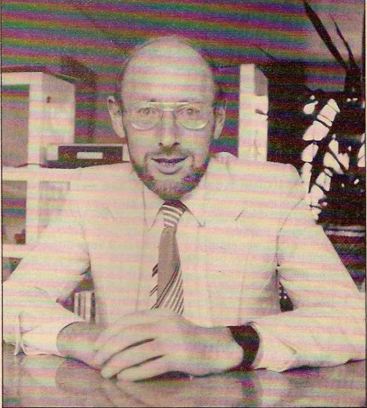
To put it mildly, Clive Sinclair was not pleased by the BBC’s decision to make the Acorn Proton the standard bearer of British computing. He had some legitimate complaints to levy. The process of selecting the machine, for one thing, could under no interpretation be considered fair and above-board. The BBC had simply handed the contract to the government-controlled Newbury, then when that fell through slipped it to Acorn as the most viable remaining manufacturer that was not run by Sinclair; his company and others never had a chance. The price of the Acorn machine also seemed at odds with the BBC’s original intentions for the program. The £400 BBC Micro Model B (the really practical and desirable model) was simply too expensive to become the fixture in everyday British homes that the BBC had imagined. And then there was the question of whether a government agency had any right or business to interfere with the workings of private industry in the first place. (Admittedly, this was a question that Sinclair, like so many businessmen, tended to answer differently depending on whether he was the one directly benefiting from the government’s largesse.)

In addition to practical complaints, however, Sinclair was personally wounded by the BBC’s choice. They had chosen Chris Curry, the erstwhile junior partner he had mentored, over him; anointed Curry’s company the Great Hope for British computing rather than his own. In response, he lashed out. His interviews from the period — and he did plenty of them — read like the reactions of a jealous lover, strewn with invective toward the BBC peppered with occasional expressions of dismay that they didn’t pick him. From the August 1981 Your Computer:

“When you have a company like ours, which is easily dominating the whole of Europe in personal computers, we believe we have done a very important job in popularizing computers. It is a real disappointment to have your own national broadcasting corporation completely ignore you.”

“What the BBC is doing, it is doing badly and it is damaging the whole progress of computers in this country. We have put a new version of BASIC into our machines. It has been highly praised in the UK and abroad, because of its editing facilities. We developed into it features such as single-keyword entry. None of that is in the BBC version.”

On the perceived slight of not being consulted in the government’s planning for IT Year ’82:

“The government has it so wrong. Frankly, they are so bad at it, it would be better if they left it alone. Fine, they should be doing things for the computer market, but this recent Department of Industry scheme is so peculiar. We were not even talked to.”

But Sinclair reserved his most strident scorn for the rival whom he perceived to have gone behind his back to make the deal with the BBC. All pretense of civility fell away from his relationship with Curry, whom the BBC “for some strange reasons allowed to stick [their] logo on his machines” which would otherwise not have a chance in the marketplace. No shrinking violets themselves, Curry and his partner Hermann Hauser responded in kind with shots at Sinclair’s “duct-tape” brand of engineering that made his machines an impossibility for a serious organization like the BBC. Even Paul Kriwaczek, the producer of The Computer Programme, got in on the act to defend the BBC’s choice, calling Sinclair’s machines “throwaway” products. It was quite a petty display all around, if also a very entertaining one.

Sinclair largely won this public-relations war. The British computer industry was full of other, smaller companies feeling equally spurned by the BBC deal, equally convinced that their own latest designs could have fit the bill much better than anything Acorn had to offer. Sharing a common enemy with Sinclair made them, at least in this sphere, his friend. With virtually the entire industry standing on one side and just Acorn and the BBC on the other, it was easy to conclude that the BBC Micro must be the bad idea and/or botched execution they said it was. On Sinclair’s side most of all, though, was his popular image as the benevolent “Uncle Clive,” largely the creation of his advertising agency, Primary Contact.

Sinclair certainly looked the part of the slightly eccentric but ultimately cuddly boffin, and Primary Contact played the image up for everything they were worth. As Ian Adamson and Richard Kennedy wrote in Sinclair and the “Sunrise” Technology, even long before the controversy over the BBC Micro, “Sinclair was marketed as the maverick doyen of hi-tech, the lone entrepreneur with the vision to take on the Americans and the Japanese. The implication was that by supporting Sinclair the consumer was advancing the cause of British innovation in the face of the brute strength of foreign marketing might.” Now the entrenched bureaucrats of the BBC could be added to the forces he defied. The Clive Sinclair of the popular imagination spent his time puttering away in a basement laboratory somewhere before emerging with designs that were both simpler and better than the competition thanks to his grounded British know-how. He then, unmaterialistic boffin that he was, sold them for a ridiculously low price and just blinked bemusedly when praised for it. Spreading the joy of computing and helping his country were their own rewards. His anger at the BBC was the righteous anger of the honest, practical man confounded by sycophants and politicians.

The reality was very different. Sinclair certainly had electrical know-how, but he was no computer engineer. His machines were designed by others to his specifications, which always began and ended with the price he intended to sell them for and the profit margin he needed to preserve even at that price. Except for these absolutes, all else — including not only features but fundamental quality controls — was negotiable. Characteristically, Sinclair got most involved with the actual engineering of his “creations” when hunting down which component parts he could source for the cheapest prices. Personally, he was domineering, uninterested in the opinions of others and possessed of a deadly combination of overweening arrogance and a deeply buried insecurity that occasionally flashed to the surface when his decisions were questioned. His contempt extended to his customers, whom he regarded as sheep waiting for the Man of Genius (i.e., him) to tell them what they wanted. Surprisingly, Sinclair didn’t even believe that that would necessarily be computers in the long term. He had come into this field largely to finance the quixotic further development of two absurd products he had been dreaming about for years: a miniature, portable television and an electric car. Computers were just a means to that end, a way to capitalize on a passing fancy of the fickle everyman.

Of course, as French philosophers have taught us, the perceptions engendered by mass media are often as real in practical terms as anything else. The British computer industry needed a company hell-bent on selling its machines so cheaply that almost anyone could afford one, even if that meant cutting some corners. And the British public needed an Uncle Clive persona to put a friendly, comfortably British face on all of this disruptive new technology and tell them they had nothing to fear from it. Sinclair was such a terrible businessman that this ride couldn’t possibly last very long. But it would be fun while it did; whatever else you can say about Clive Sinclair, he’s never been boring.

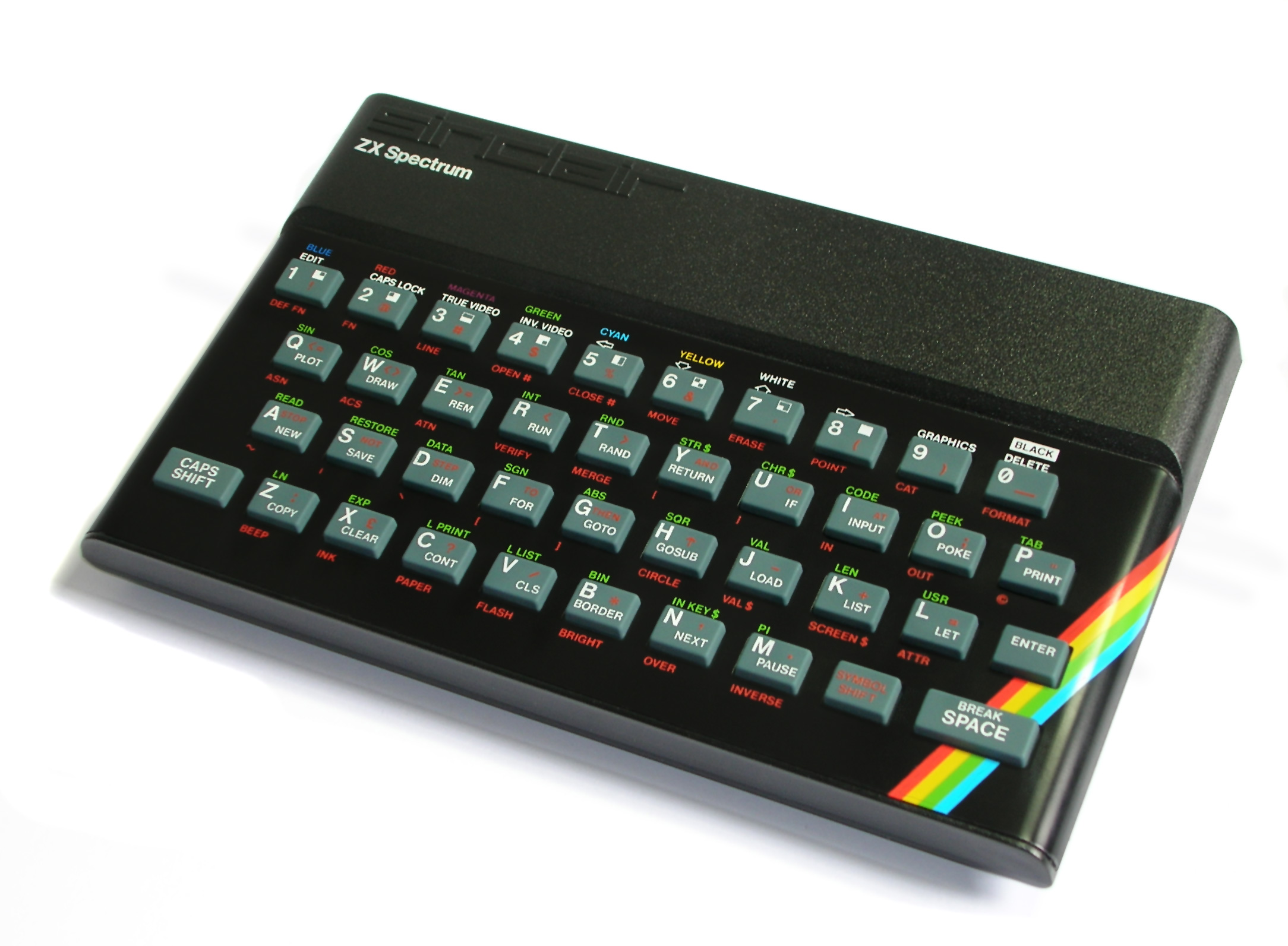
When not sniping at the BBC in the press, Sinclair spent late 1981 and early 1982 pushing hard on his own new computer that would show them how wrong they had been to choose Acorn over him. The successor to the ZX80 and ZX81, it would borrow much of its internal and external engineering from those earlier machines, remaining a tiny thing that looked more like a desk calculator than a computer. The big change, from which it derived its name — the ZX Spectrum — was the addition of color and graphics capabilities. It would deliver these in a package costing just £125 for 16 K or, in another coup, £175 for a full 48 K, well under half the price of the 32 K BBC Micro Model B.

In many ways the Spectrum was a typical Sinclair product, the result of brutal cost-cutting. The keys were made of squishy rubber, which further added to the calculator-like impression and were only marginally more comfortable than the membrane keyboards of the ZX80 and ZX81. Many choices seemed a product of the echo chamber inside Sinclair, owing little to any sort of practical real-world considerations. When designing the ZX80, the company had developed something they called “one-touch” BASIC programming, which matched each BASIC command word to a key on the keyboard. The idea was that the user need only type a single key for each command instead of the whole word, thus cutting back on typos and limiting the interacting she had to do with the ZX80′s atrocious keyboard. As they added more commands to their BASIC with each successive model, however, the idea became increasingly ridiculous. By the time the Spectrum emerged the user had to memorize arcane sequences for many commands that required holding down multiple shift and control keys and some octopus-like finger dexterity. The sequences were both more difficult to remember and more difficult to enter than just typing in the words would have been; some commands actually required as many or more key strokes than there were letters in the word. How this absurd system could have made it out the door is a mystery — or perhaps a tribute to the dominance of Clive Sinclair, who had decided that “one-key” entry was a key to his company’s success and wasn’t interested in hearing otherwise.

In other ways, though, the Spectrum was a Sinclair like no others. Sinclair wasn’t exactly a company one might have expected to deliver cutting-edge aesthetics, but they shocked here. The machine’s externals, by industrial designer Rick Dickinson, have been enshrined — and for good reason — as a design classic. The svelte ebony case with its flash of color stands out from all of the other computers models of its era, with their chunky, lumpy frames and acres of bland beige plastic.

In practical terms, the Spectrum finally answered a question that had been uncomfortably nagging at the backs of the minds of many people ever since this computer thing got rolling in the press. Everyone understood that computers were the wave of the future and all that. But, if you weren’t running a shop and needing to keep inventory or something, what could you really do with one? Sure, a small minority might spend hours every night tinkering with the vagaries of BASIC, but that was of little practical value and destined to remain a niche interest at best. For everyone else, most notably children and teenagers, the Spectrum finally provided a better answer: you could play games. Its graphics hardware could display fifteen colors at a resolution 256 X 192, with the very significant restriction that each 8 X 8 block of the screen could use only two of them. Still, combined with the 48 K of memory that allowed a decent scope for complexity in game designs, it was good enough. Its tiny size even meant that you could stuff it into a trench-coat pocket to cart to your mate’s house after school. For all of the caveats and limitations that came with it, the Spectrum was the right machine at the right time at the right price to launch computer games into the mainstream in Britain.

In retrospect one of the most bemusing things about the feud between Sinclair and Acorn is that, as Curry and Hauser at least remarked in their more lucid moments, the BBC Micro and Sinclair Spectrum were barely competitors at all. Sinclair largely created a new, home-computer market in Britain, just as Commodore did with the VIC-20 in the United States. (The VIC-20 was also sold in Britain, but didn’t have quite the same impact.) The BBC Micro, meanwhile, put Acorn in a position similar to that of Apple in the U.S., making more expensive, better supported machines for a more “professional” (or, at least, well-heeled) consumer.

The Spectrum was officially launched on April 23, 1982, but it’s pretty safe to say that no consumer received a machine before June. Sinclair, who often trumpeted in interviews that he “never made the same mistake twice,” was nevertheless “utterly astonished” by the demand for the new machine, as he had been for each model that preceded it. The company’s practice of advertising that consumers who ordered directly from them would receive their computers within 28 days prompted much ire as waiting periods stretched to three months and beyond. This in turn prompted a sternly worded warning from the Advertising Standards Authority, a ritual that played out with every Sinclair product launch. It was 1983 before Sinclair cleared its backlog, at which time the company started the whole shortage over again when they reduced prices by more than 25%. In the end none of the angst mattered that much. Where else, Sinclair asked, were customers going to find a 48 K micro with 15-color graphics capabilities for his prices? Most people would wait, he figured — and he was right.

So, IT Year was a success beyond architect Kenneth Baker’s wildest dreams. At its end there were three times as many computers in British homes as there had been at its beginning. One could certainly argue how much of this explosion was really due to the government’s efforts; one suspects that Clive Sinclair would have some strong opinions on that subject. But, however we apportion the credit, things would never be the same; computing in Britain went mainstream with the IT Year and, crucially, the Spectrum. A generation of British children went to school to learn about computers and BASIC and many other subjects on the sturdy BBC Micros. The same kids came home to hang out with friends and play games in front of their “Speccys.” Can you guess which machine is more fondly remembered by Britons today? The poor BBC doesn’t have a chance.

The Spectrum also spawned a huge games industry to feed this eager market. Speccy programmers came to love the machine, as much because of as in spite of its limitations. With its crazy BASIC entry system and dry error messages like “Nonsense in BASIC,” the Speccy felt like theirs — quirky, slightly off-kilter, and somehow distinctly British in its sensibility. Many of the games they produced had a sensibility to match, very different from that of their American cousins. It’s mostly the innovative action games like Manic Miner and Jet Set Willy that are remembered today, but the Speccy also had adventures. Oh, boy, did it have adventures — thousands of them. We’ll look at one of the earliest and most important of them next time.


Comments
12 Nov 23:54

MANY HAPPY RETURNS competition!

by Jac

Edited on 30th November to add:

Many Happy Returns is out now: http://www.bigfinish.com/news/v/many-happy-returns-out-now

Invest in ME have been busy creating hope, and now Big Finish have gift-wrapped little bits and put them in our Christmas stockings. Thank you so much to everyone who has worked on, bought, or otherwise supported this project. You’re great.


MANY HAPPY RETURNS competition! Win Doctor Who and Merlin goodies! Woooooooo!

With the release of Many Happy Returns by Big Finish Productions to celebrate the twentieth anniversary of Bernice Summerfield’s first appearance in Doctor Who, I’m hoping that people will want to learn more about Invest in ME, the charity for which it’s raising much-needed funds. Please take a look at the charity’s website here: http://investinme.org/

In fact, I’m so keen for you to look at the website that if you can prove you’ve had a look there might be something in it for you – on top of the satisfaction of knowing you have the inside scoop on possibly the most misunderstood disease of our era, of course.

Have a readthrough and see if you can find answers to the questions at the end of this blog. Then email your answers to mhrcomp@gmail.com and I’ll choose a winner – completely at random from all correct entries received – on 5th December, which happens to be my own 19th anniversary of becoming ill. See below for what you could win.

From Doctor Who Magazine #453

If you haven’t pre-purchased/downloaded (depending on when you’re reading this) Many Happy Returns, you can do so here: http://www.bigfinish.com/releases/v/many-happy-returns-775. The utterly wonderful Scott Handcock and Gary Russell were in charge, and it features performances from Big Finish favourites Lisa Bowerman, Stephen Fewell, Sophie Aldred, Sylvester McCoy and Nick Briggs alongside many others, and written contributions from top writers including Paul Cornell (Doctor Who and so much more – http://www.paulcornell.com/), Steve Cole (Astrosaurs, Cows in Action etc. – http://www.stevecolebooks.co.uk/) and Justin Richards (Invisible Detective, Time Runners etc. – http://www.justinrichardswriter.com/). Everyone – actors, writers, director, studio, artists, production – gave their time, energy and creativity completely free of charge, and as this is a download (no CD mastering fees etc.) every single penny of the £10 purchase price goes to Invest in ME. At the time of writing, the Let’s Do it for ME! initiative has raised £67K of the £100K needed for the first research project. Every purchase, therefore, really does make a significant difference – your £10 could be the one that gets us to our goal; it could be the one that changes my life, and the lives of so many thousands more who are suffering with this horrendous condition.

Buying Many Happy Returns or just becoming ME aware is brilliant, but if you would like to contribute further please visit www.ldifme.org where you can find out about calendars, Christmas cards, an audio play (http://www.barnabyeatonjones.com/apps/webstore/) and many more things sold in aid of the charity, or donate at http://www.justgiving.com/teams/ldifme.

Here’s the competition-y bit:

  1. What does the abbreviation ME stand for?

a)      Missing Energy

b)      Multiple Elephants

c)       Myalgic Encephalomyelitis

2. It’s suspected that which famous figure from history suffered from ME?

a)      Florence Nightingale

b)      Emperor Claudius

c)       Napoleon

3. The World Health Organisation classifies ME as:

a)      A neurological disease

b)      An imaginary illness

c)       Just feeling a bit tired

4. It is estimated that what percentage of the 250,000 ME sufferers in the UK are severely affected? (House- or bed-bound)?

a)      5%

b)      25%

c)       12%

Hint: http://investinme.org/InfoCentre%20background.htm might be helpful.

Prizes of stuff by me (yes, it seems rather egotistical but they’re things I handily have copies of right here in the very room where I’m writing this and here’s a picture to prove it): Doctor Who: Magic of the Angels (a 2012 Quick Read) and Merlin: the Complete Guide (no longer exactly ‘complete’ as it’s mainly related to Season One, but it does have some nice stuff about spells in it). Oh, and I’ll add in Doctor Who: Love and War (audio adaptation of Virgin New Adventure; not pictured cos I haven’t actually got a copy yet).

(I’m happy to sign any of these if requested, as long as you realise that if you then throw any of them away I will be able to track you down and look hurt at you.)

(I use brackets too much. Sorry, I just really like brackets.)

Email your answers to mhrcomp@gmail.com by 5th December 2012. I’m sorry that for reasons of postage costs I can only post to a UK address. Please note that this email address is for competition entries only. Any queries, get in touch with me via Twitter @GirlFromBlupo, although please be aware that as my health fluctuates I may not be able to answer immediately. If you want to know more about ME, Invest in ME or the Let’s Do It for ME! initiative, please visit the websites listed above.


12 Nov 18:21

Barry Letts in the Underworld

by Lawrence
A wholly genuine, absurdly non-Photoshopped photo of someone exploring the Cave of Crystals, Mexico.

Nice to know that sometimes, nature can do CSO that's even more unconvincing than "Planet of the Spiders".

Now look at the photo accompanying the National Geographic article: http://ngm.nationalgeographic.com/2008/11/crystal-giants/shea-text. And try to work out why nothing in modern SF looks quite so improbably alien, when this is just 300 yards under the planet you're on.

12 Nov 16:35

The Independent View: Hope yet for parity esteem for mental health issues

by The Voice

Mihir Magudia is Head of Strategy & Public Affairs for St Andrew’s Healthcare, the UK’s largest mental health charity that provides more services to the NHS than any other charity. On his blog, Spotlight, he praises Norman Lamb for signalling “parity of esteem” between mental health and physical health treatment at a recent conference:

…Norman Lamb went further than his predecessors. After rightly pointing out that people with mental health problems suffer from an institutional disadvantage in the health system (mentioning how they have been ignored by the reforms on waiting times, choice and payment by results) he went on to call for something very specific.

A statutory entitlement for people with mental health services to access services on exactly the same terms as people with physical health problems.

Now on first glance, this might seem obvious, but for anyone familiar with mental health services, this would be a huge step forward:

From people in prison or living homeless on the streets to people suffering from mild depression and anxiety, there are huge problems in accessing services and huge delays which worsen people’s mental health conditions.

Norman Lamb’s suggestion, if implemented, would revolutionise services for people with mental health problems and ought to betaken up as government policy. It’s a shame that it’s not (yet), but I understand from early indications about the forthcoming NHS Mandate, that there will be hardly a page where mental health does not feature and there is an emphasis on access to genuine choice for patients and service users.

I don’t know when or if we’ll get to genuine equality between mental and physical health, but the speech I heard today makes me far more hopeful that that day will actually come.

12 Nov 15:43

When it comes to DRM, Amazon is a bottom feeding hell beast.

When it comes to DRM, Amazon is a bottom feeding hell beast.
12 Nov 13:25

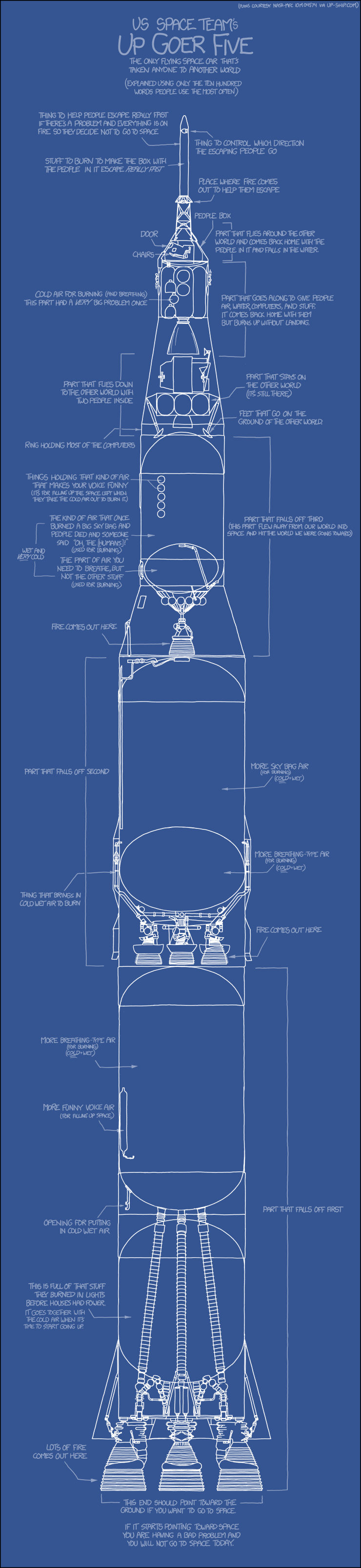
Up Goer Five

Another thing that is a bad problem is if you're flying toward space and the parts start to fall off your space car in the wrong order. If that happens, it means you won't go to space today, or maybe ever.
12 Nov 13:08

It’s no Excuse

by Leigh Forbes

excuse noun /iks-kūz’/*

1. A plea offered in extenuation or explanation, in order to avoid punishment.
2. Pardon or forgiveness.
3. Indulgence.

ORIGIN: Latin excusare, from ex from, and causa, a cause or accusation.

Excuses are emotionally charged things, in search of absolution. They are what we offer when we’re trying to “get away with” not doing something we know we should have done. They carry a negative quality; I am at fault (e.g. I’m late for a meeting with a friend) and I regret it. As such, excuses are usually preceded by an apology, e.g.: “I’m sorry I’m late, but the traffic was terrible.” If I offer an excuse, it’s because I want you to say whatever I’ve done wrong doesn’t matter, so I don’t have to feel bad about it (because otherwise I will).

reason noun /rē’z(ǝ)n/*

1. Ground, support or justification of an act or belief.
2. An underlying explanatory principle.
3. Conformity to what is fairly to be expected or called for.

Origin: French rasion, from Latin ratio, onis, from reri, ratus to think.

A reason is a statement of fact, which carries no emotional charge; I am still late, but I am not seeking my friend’s forgiveness (even if I start with the socially essential apology): “I’m sorry I’m late; there was an accident and the traffic was terrible.” As it’s clear there’s nothing I could have justifiably been expected to do to avoid being late, the issue is not one for which forgiveness is appropriate, my friend will probably say, “Don’t apologise; it’s not your fault.” It’s a good reason.

This situation is completely different from: “I was late because I didn’t leave enough time to get through the rush hour jams,” in which case my friend (however open-minded she might be) would be justified in feeling annoyed, and think (even if she doesn’t say), “that’s no excuse; you know the traffic’s always bad at this time of day.” This is an bad excuse.

Of these two forms of explanation – the excuse (unjustifiable) and the reason (justifiable) – one is seen as good, the other bad. One requires forgiveness and the other does not. How any particular explanation is received depends on the wronged party’s own life experience and generosity of spirit.

So, when I hear someone saying “he [or she] is just using Asperger’s syndrome as an excuse for not doing it…” my hackles rise. (Sure, the aspie might be milking it to his/her own advantage; but aspies, by definition, are not inclined to manipulative behaviour.) In most cases, it’s likely that the other person simply has no concept of life on the spectrum. Particularly if the aspie “appears normal,” his/her autism is seen as an excuse, an unjustifiable reason, for being unable to do whatever “it” is.

Conversely, more visible disabilities (and the issues involved) are easier for others to comprehend. You have to be pretty sheltered (or cruel) to accuse a partially sighted man of using his blindness as “an excuse”. You’d never blame a deaf man for needing subtitles, or the paralysed for being unable to walk. These disabilities are imaginable: if I close my eyes, or stick my fingers in my ears, I can get some idea of what it is like to be blind or deaf. I don’t need an analogy to explain paraplegia. I can imagine the fundamental issues, and even with my limited “empathy”, I can see any of these disabilities would have a severe effect on my life.

But you can’t temporarily rewire your brain and pretend to be autistic.

Living with autism is hard enough without being made to feel I must justify everything I can or can’t do. Or apologise for it. So it’s important to keep educating others, to gently explain that – whatever their own experiences of life – I can no more “pull myself together” than a blind man can see. Asperger’s syndrome is not an excuse for the way we behave; it’s a reason.


I recommend The Man Who Mistook his Wife for a Hat, by Oliver Sacks, as a fascinating voyage into the world of neurological disabilities – conditions that are virtually impossible for the rest of us to imagine.

*Taken from The Chambers Dictionary, 12th Edition, 2011. I have omitted definitions irrelevant to this post.

11 Nov 23:53

THE MONKEES - AS WE GO ALONG

by Derek See
Somewhere around 1980, a TV show went back into syndication that made an indelible impact on who I am. Mom had already given me her 45's from the '60's so my music education and fanaticism  had already begun. These fellas o TV that hung out having fun playing music together, chasing cute girls, wearing cool clothes, and driving a boss car truly cemented who I wanted to be. Today we get to see hero Michael Nesmith perform these songs live with The Monkees; stoked doesn't even BEGIN to describe it!
Of course I've taken lots of flack over the years from people who can't get over the fact that the group was manufactured and that they didn't play on their hits. So what? For one thing, EVERY group is manufactured- whether it's picking friends or picking people that fit the mold and vision, everything is based on some sort of manufacturing when a band is assembled. As for the studio musicians playing on the tracks- practically from the beginning The Beach Boys tracks were played by studio musicians. It just doesn't matter; fact is, three of these guys WERE legit musicians before the group was assembled, and the late Davy Jones was such a good sport he learned how to play rudimentary bass for their '60's concerts. When I first saw them in the '80's he played some very respectable guitar as well. But truly all that matters are the songs (which are loved by so many), and in the case of the Monkees, the brilliant visual images of the TV show and their freaky film Head, from which this track is drawn from.
Micky Dolenz is a very, very fine singer- gifted with one hell of a range and lots of power, he puts it to its greatest use on this stellar track. The cherry on top is lead guitar provided by (then) Buffalo Springfield member Neil Young. This 45 is a single-only mono mix as well.

from 1968...
THE MONKEES - AS WE GO ALONG
11 Nov 17:01

Cowardice on public transport

by James Graham

NaBloPoMo November 2012Travelling home from central London on a train yesterday, a bunch of eight of drunken louts got on our carriage and proceeded to spend the rest of the journey loudly singing racist and misogynist football chants (I say football, but in doing so will possibly now get loud complaints about how it has nothing to do with the culture that pervades football; it is and you know it). And aside from a tweet and the odd grimace, I did nothing.

I spent the rest of the journey home fantasising about how I should have stood up in the midst of their 5th rendition of “I’d rather be a Paki than a Yid”, announcing that I was a Jew and that they ought to be ashamed of themselves, but the fact is I didn’t (I’m not actually Jewish by the way, but I figured I could pull that off more easily than claiming to be from Pakistan). Nor did I do anything when a bunch of kids started abusing my bus driver earlier in the day for threatening to kick one of their friends off for not having the fare on his Oyster card (he actually gave in to them but still got heaped with abuse). Nor did I stick up for the passenger on my bus on Friday who told off a girl for putting her feet on the seat and got verbally assaulted by the girl and her two adult friends (possibly parents) for the rest of the journey.

I like to think I’m not a moral coward, but I’ve not exactly availed myself well recently. The worst I would have got from taking a stand in the bus incidents is a bit of abuse. In the case of the train incident, I’d have risked a physical beating but statistically speaking that probably wouldn’t have happened – and if it did, even then it would arguably have been worth it. At least that way there’d now be facing criminal charges.

Standing up to antisocial behaviour might not get you very far in the short term, but it probably doesn’t take very much to get these people to think twice in future. In the case of the girl and the group of boys, you could see the fear in their eyes – their displays of bravado were because they were terrified not because they were especially angry.

We’re probably just a few harsh words away from making our journeys on public transport a significantly better experience, and yet most of us do nothing. I sort of understand the psychological reasons for that, but ultimately I don’t really find that to be much of an excuse.

Ho hum. At least I don’t have to feel good about it. That’s at least something. Maybe next time.

11 Nov 16:59

Why I haven’t worn a poppy this year

by James Graham

NaBloPoMo November 2012I’ve always been a supporter of Remembrance Sunday and have never held much truck with this white poppy nonsense that has always seemed more like a pose than a genuinely ethical position. This is because, for me at least, the day has always represented a reflection on the awfulness of war and the sacrifice that everyone pays – be they soldier, conscientious objector or civilian – when it sweeps across the world. It’s a act of solidarity, and walking around with a white poppy has always seemed, intentional or not, like flicking a v-sign at anyone who wishes to participate in a collective national experience. But I didn’t wear a poppy this year (although I did stand for the two minute silence despite not thinking I would).

There are two main reasons for this. The first is my shock and disgust last month at learning that Sir John Kiszely, the then President of the Royal British Legion, had been caught on camera offering to lobby government ministers at “boring” remembrance events on behalf of one of his prospective clients as a lobbyist (in this case a fake company pretending to be attempting to sell the UK government military drone aircraft). He swiftly resigned and no one at any stage suggested that the Royal British Legion in any way condoned his actions, but what does it say about the organisation that such a man was free to rise to their most senior and prominent position? Either way, I don’t think this scandal received anything like the level of attention that it deserved.

The second is this discussion about marking the centenary of the First World War, which appears to be big on history, looking backwards and even producing a kind of theme park version of the war, complete with poppy fields and token football matches, all of which looks suspiciously like a celebration. After 2012, I’ve truly had enough of all this bread and circus business and am weary of the prospect of turning such an important occasion into yet another backslapping jamboree.

As we approach the centenary, the key question we need to ask is what the purpose of remembrance is once the generation that made that sacrifice are all dead? This is universally true in the case of the first world war and increasingly so in the case of the second. Walking through Kings Cross station yesterday, I was struck at how they’d got Barbara Windsor to be the “voice” of the poppy appeal – she was 8 at the end of WW2, and far more associated with the swinging sixties. However well intentioned, having someone like that simply lacks the resonance of, say, Thora Hird.

Over the course of my life, the TV coverage of Remembrance Sunday has shifted from pictures of a dwindling parade of war veterans to pictures of a bunch of politicians doing their best to look solemn. We seem to be sleepwalking on with an annual ceremony which no longer has the same meaning, and yet there is no attempt to take a comprehensive look at how we might make it matter for a new generation. What has happened instead is that an event that was supposed to mark a dreadful, world changing war, and which could conceivably be expanded to commemorate its depressing sequel 20 years later, has come to be used to mark the low and steady hum of military conflicts which the UK as periodically get itself embroiled in in the 65 years since.

We talk about “sacrifice” but that word has acquired a different meaning over the years. 90 years ago, people were talking about the self-sacrifice of a few for the benefit of the many. But the sacrifice that is being made now looks suspiciously more like a more Old Testament style sacrifice: a blood letting to appease the Gods and maintain the status quo.

The 20th century World Wars weren’t about fighting for the status quo, regardless of the hopes of those in power at the time. Their great cost lead to a social revolution, and rightly so. Are we really that comfortable about investing its legacy into the hands of a few politicians and professional tinpot generals (I originally wrote “professional soldier” but none of the people I’m referring to have seen the front line in decades)? What was meant to be a communal event has been privatised by stealth.

Remembrance Sunday’s meditation of the dreadfulness of war has been replaced by a focus on its inevitability and relentlessness. I find that a troubling shift and an effective takeover by an industry and professional class with an interest in its continuance.

Would I be endorsing all this if I wore a poppy? No, but it’s enough to make me want to abstain for at least one year. I only hope that over the next couple of years we can, as a nation, get our heads together and subvert David Cameron’s Theme Park Centenary with something more sombre – perhaps the cancellation of the Trident replacement? That, at least, would mean something.

11 Nov 12:46

Why Jeb Bush will win the 2016 Presidential election

by Nick

Because history repeats itself, except for all the times it doesn’t.

Barack Obama’s re-election this week meant that three successive US Presidents (Bill Clinton, George W Bush and Obama) had all been elected to two terms in office. The only other time this has happened in American politics was 200 years ago, with the Presidencies of Thomas Jefferson, James Madison and James Monroe.

The interesting thing about this is that in both of these sequences, the President who served immediately beforehand was a holder of the office for a single term (John Adams and George HW Bush), who’d previously been Vice-President for two terms (for George Washington and Ronald Reagan). In the Jefferson-Madison-Monroe sequence, the next President was a son of that former President who served for a single term: John Quincy Adams.

As perfect symmetry can’t be achieved unless someone finds a way for George W Bush to run again for the Presidency, the burden of history falls on the other politically-active son of George W Bush, former Florida Governor Jeb Bush. To keep up with history, he should win a bitterly disputed election that ends up decided by the Congress, after the ruling party has split several ways. The winner of the popular vote and the most electoral votes (Andrew Jackson in 1824) will then swear revenge, get elected for two terms immediately afterwards and make radical changes to the way the political system of the country works.

Of course, the parallels break down when you look too closely, not least in how James Monroe’s period as President was known as ‘the era of good feelings’ with so little domestic strife that he was re-elected without serious opposition to his second term. When the historians write about this period of US history, I somehow doubt ‘good feelings’ will be used much. However, Jeb Bush is being mentioned as a potential Republican candidate next time round, so maybe history is preparing for the tragedy or the farce.

11 Nov 11:58

Orca

by Mark Liberman

Byron York, "What Sank McCain", NRO 11/5/2008:

In January, a few days before the South Carolina Democratic primary, I went to a Barack Obama rally in Columbia with a Republican friend who had never before seen Obama in action. This friend’s reaction: “Oh, s**t.” The super-enthusiastic crowd was about 3,000 strong — no big deal compared to the audiences Obama would later draw in the general election, but several times what John McCain was attracting in South Carolina at the time. My friend said the scene reminded him of the old clip from Jaws, in which the small-town sheriff, seeing how big the shark really is, says, “We’re gonna need a bigger boat.”

The line was actually "You're gonna need a bigger boat", at least in the movie:

The movie Jaws features Orca the fishing boat, so named because orcas (= "killer whales") are natural predators of sharks:

The Romney campaign featured ORCA the get-out-the-vote program (John Ekdahl, "The Unmitigated Disaster Known As Project ORCA", Ace of Spades 10/8/2012):

What is Project Orca? Well, this is what they told us:

Project ORCA is a massive undertaking – the Republican Party’s newest, unprecedented and most technologically advanced plan to win the 2012 presidential election.

Pretty much everything in that sentence is false. The "massive undertaking" is true, however. It would take a lot of planning, training and coordination to be done successfully (oh, we'll get to that in a second). This wasn't really the GOP's effort, it was Team Romney's. And perhaps "unprecedented" would fit if we're discussing failure.

The entire purpose of this project was to digitize the decades-old practice of strike lists. The old way was to sit with your paper and mark off people that have voted and every hour or so, someone from the campaign would come get your list and take it back to local headquarters. Then, they'd begin contacting people that hadn't voted yet and encourage them to head to the polls. It's worked for years.

It would be a little weird, in my opinion, to name a GOTV program after a boat used to hunt a fictional monster shark. Clearly the shark would be Obama, or perhaps Obama's appeal — but in that metaphor, where are the Romney voters? Sitting at home waiting for the beaches to re-open? [Update: It seems that name was actually chosen because orcas kill and eat narwhals, and a Democratic voter-targeting project was named Narwhal; but the metaphorical emphasis remains on predation rather than on mobilization.]

And apparently Project Orca was a big step down from the traditional pencil-and-paper approach — Ekdahl's post presents an elaborate saga of mismanagement and disfunction, which ends this way:

So, the end result was that 30,000+ of the most active and fired-up volunteers were wandering around confused and frustrated when they could have been doing anything else to help. Like driving people to the polls, phone-banking, walking door-to-door, etc. We lost by fairly small margins in Florida, Virginia, Ohio and Colorado. If this had worked could it have closed the gap? I sure hope not for my sanity's sake.

The bitter irony of this entire endeavor was that a supposedly small government candidate gutted the local structure of GOTV efforts in favor of a centralized, faceless organization in a far off place (in this case, their Boston headquarters).

Most of the problems that Ekdahl describes were more managerial than technical:

People had been kicked from poll watching for having no certificate. Others never received their pdf packets. Some were sent the wrong packets from a different area. Some received their packet, but their usernames and passwords didn't work.

But there were some technical (or at least design) problems as well:

Now a note about the technology itself. For starters, this was billed as an "app" when it was actually a mobile-optimized website (or "web app"). For days I saw people on Twitter saying they couldn't find the app on the Android Market or iTunes and couldn't download it. Well, that's because it didn't exist. It was a website. This created a ton of confusion. Not to mention that they didn't even "turn it on" until 6AM in the morning, so people couldn't properly familiarize themselves with how it worked on their personal phone beforehand.

Next, and this part I find mind-boggingly absurd, the web address was located at "https://www.whateveritwas.com/orca". Notice the "s" after http. This denotes it's a secure connection, something that's used for e-commerce and web-based email. So far, so good. The problem is that they didn't auto-forward the regular "http" to "https" and as a result, many people got a blank page and thought the system was down. Setting up forwarding is the simplest thing in the world and only takes seconds, but they failed to do it.

Anyhow, ORCA the GOTV program seems to have suffered the same metaphorical fate as Orca the shark-hunting boat (except that the program's problems were self-inflicted):

There's been some push-back from the Romney campaign to the effect that Orca wasn't a complete failure, and anyhow didn't matter to the election one way or the other. Thus Natalie Jennings, "Romney digital director: Orca wasn't a loss", 11/9/2012:

The digital director for the Romney campaign responded to criticism in the blogosphere  of the campaign’s Election-Day “Orca” vote monitoring platform, saying the program had issues but for the most part performed its mission.

Zac Moffatt said that data about 14.2 million voters was recorded through Orca, including 5,397 instances of polling-place irregularities, and that data came back from 91 percent of counties being monitored.

Volunteers have started complaining online about lack of instructions, non-functional usernames and an overall system crash.

“I understand the frustrations over interruptions with so many people engaged,” Moffatt said. “But I have real numbers.”

Real numbers of dollars in new personal wealth, according to Ben Howe, "Campaign Sources: The Romney Campaign was a Consultant Con Job", Red State 11/9/2012:

So what caused the breakdown and why didn’t it get fixed in time? Well according to sources who worked closely with the program, the blame is at the feet of consultants. […]

They say that the truth is the consultants essentially used the Romney campaign as a money making scheme, forcing employees to spin false data as truth in order to paint a rosy picture of a successful campaign as a form of job security.

Zac Moffatt, Digital Director for the Romney campaign, was specifically named as having “built a nest egg for himself and co-founder of Targeted Victory, Mike Beach,” and that they “didn’t get social” media and ignored objections from other consultants and staffers in the campaign.

So maybe, in the end, the difference between we and you mattered, because the line really should have been "Let us sell you a bigger boat".

A detailed pre-election take on Project Orca: Amanda Terkel, "Mitt Romney Campaign Plans Massive, State-Of-The-Art Poll Monitoring Effort", HuffPo 11/1/2012.

As for the source of Project Narwhal's name, Sasha Issenberg wrote ("Obama’s White Whale", Slate 2/15/2012) that

In a campaign that has grown obsessed with code-naming its initiatives, the integration project is known as Narwhal, after the tusked Arctic whale whose image (via a decal) adorns a wall adjacent to the campaign’s engineering department, as first reported by Newsweek. Narwhal remains a work-in-progress. Campaign spokesman Ben LaBolt refused to discuss the project, and the actual origins of their project’s code name are obscure, but at Obama’s headquarters the joke has become that reference to a mammal often called “the unicorn of the sea” has come to accurately describe an elusive quarry.

As Issenberg explains, Narwhal was not an election-day GOTV program, but an attempt "to link once completely separate repositories of information so that every fact gathered about a voter is available to every arm of the campaign". Why the Romney campaign's Project Orca was conceived as a way to kill and eat the Obama campaign's data-integration effort is a different metaphorical mystery.

For a pre-election discussion of the campaign's differing approaches to software development, see Hamish McKenzie, "In the Red Corner, Zac Moffatt Leads Romney’s Digital Drive to Topple Obama", Pando Daily 9/26/2012:

At the Democratic National Convention in Charlotte, tech people I talked to approvingly described Obama’s digital team as a “startup within a startup.” Rather than outsource the building of various tools to other companies, it has developed everything in-house.

When I put that claim to Moffatt, however, he protests that the opposite is true. The Obama campaign, he asserts, is more like government. “They’ve pulled everything together and determined that they can do everything best,” he says. “We actually function like a startup. We are finding the best minds and best companies, but if something doesn’t work it’s easy for us to iterate and pivot into a new direction.” By relying on in-house tools, you can very quickly get lumped with cumbersome legacy items that becomes costly over time. “For me, it looks much more like central planning than it does anything else.”

Additional Orca post-mortems: Sean Gallagher, "Inside Team Romney's whale of an IT meltdown: Orca, the Romney campaign's 'killer' app, skips beta and pays the price", Ars Technica 11/9/2012; Robert X. Cringely, "Unleashed! Project Orca, the campaign killer whale: Big data fails big time for the Romney camp as its smartphone app crashes spectacularly, right on schedule for Election Day", InfoWorld 11/9/2012; Adi Robertson, "Killer fail: how Romney's broken Orca app cost him thousands of votes", The Verge 11/9/2012; Michael Kranish, "ORCA, Mitt Romney’s high-tech get-out-the-vote program, crashed on Election Day", Boston Globe 11/9/2012; Rosslyn Smith, "Conservatives harpooned by Orca", American Thinker 11/11/2012; Michael Falcone, "Romney Campaign Acknowledges High-Tech Election Day Monitoring System ‘Had Its Challenges’", ABC News 11/10/2012; Maggie Haberman & Alexander Burns, "Mitt Romney’s ORCA program couldn't stay afloat", Politico 11/9/2012.

Catherine Ann Fitzpatrick tried to figure out who got the Orca development contract ("Was Al Gore's Dev In Charge of Romney's Aps?", and follows the digital breadcrumbs to what she thinks is the answer:

Ekdahl didn't say — but I found it. The organization is called Targeted Victory, and they have Romney logos flashing on their site now.

Look at Our Team -- typical bloated over-staffed organization top heavy with marketers and underpaid drones — and then see how many devs there are.

Just two. Apparently under the direction — in between them and Moffat — of a senior project manager whose credentials include working for United Nations Women, The Getty Institute, UNESCO, Ecuadorian Ministry of Tourism and the Quito Tourism Bureau.

So…All of this complicated, national, critical system rested on the slender shoulders of two dudes 20-something or 30-something at best — with maybe their project manager also bringing them the pizza and yelling at them?

I was afraid to click, because I knew what I would find.

Sure enough, what I found were two guys who looked like very likely Obama voters.

Commenters on the Ars Technica article quote unsourced rumors that development was outsourced to India via Accenture. I'm skeptical of both theories, and look forward to learning who really did the project.

Update — Still no clarity on who built Orca — but for the other side's story, see Alexis Madrigal, "When the Nerds Go Marching In", The Atlantic 11/16/2012.

11 Nov 02:12

For every natural number N, there's a Cantor Crank C(n)

by MarkCC

More crankery? of course! What kind? What else? Cantor crankery!

It's amazing that so many people are so obsessed with Cantor. Cantor just gets under peoples' skin, because it feels wrong. How can there be more than one infinity? How can it possibly make sense?

As usual in math, it all comes down to the axioms. In most math, we're working from a form of set theory - and the result of the axioms of set theory are quite clear: the way that we define numbers, the way that we define sizes, this is the way it is.

Today's crackpot doesn't understand this. But interestingly, the focus of his problem with Cantor isn't the diagonalization. He thinks Cantor went wrong way before that: Cantor showed that the set of even natural numbers and the set of all natural numbers are the same size!

Unfortunately, his original piece is written in Portuguese, and I don't speak Portuguese, so I'm going from a translation, here.

The Brazilian philosopher Olavo de Carvalho has written a philosophical “refutation” of Cantor’s theorem in his book “O Jardim das Aflições” (“The Garden of Afflictions”). Since the book has only been published in Portuguese, I’m translating the main points here. The enunciation of his thesis is:

Georg Cantor believed to have been able to refute Euclid’s fifth common notion (that the whole is greater than its parts). To achieve this, he uses the argument that the set of even numbers can be arranged in biunivocal correspondence with the set of integers, so that both sets would have the same number of elements and, thus, the part would be equal to the whole.

And his main arguments are:

It is true that if we represent the integers each by a different sign (or figure), we will have a (infinite) set of signs; and if, in that set, we wish to highlight with special signs, the numbers that represent evens, then we will have a “second” set that will be part of the first; and, being infinite, both sets will have the same number of elements, confirming Cantor’s argument. But he is confusing numbers with their mere signs, making an unjustifiable abstraction of mathematical properties that define and differentiate the numbers from each other.

The series of even numbers is composed of evens only because it is counted in twos, i.e., skipping one unit every two numbers; if that series were not counted this way, the numbers would not be considered even. It is hopeless here to appeal to the artifice of saying that Cantor is just referring to the “set” and not to the “ordered series”; for the set of even numbers would not be comprised of evens if its elements could not be ordered in twos in an increasing series that progresses by increments of 2, never of 1; and no number would be considered even if it could be freely swapped in the series of integeres.

He makes two arguments, but they both ultimately come down to: "Cantor contradicts Euclid, and his argument just can't possibly make sense, so it must be wrong".

The problem here is: Euclid, in "The Elements", wrote severaldifferent collections of axioms as a part of his axioms. One of them was the following five rules:

  1. Things which are equal to the same thing are also equal to one another.
  2. If equals be added to equals, the wholes are equal.
  3. If equals be subtracted from equals, the remainders are equal.
  4. Things which coincide with one another are equal to one another.
  5. The whole is greater that the part.

The problem that our subject has is that Euclid's axiom isn't an axiom of mathematics. Euclid proposed it, but it doesn't work in number theory as we formulate it. When we do math, the axioms that we start with do not include this axiom of Euclid.

In fact, Euclid's axioms aren't what modern math considers axioms at all. These aren't really primitive ground statements. Most of them are statements that are provable from the actual axioms of math. For example, the second and third axioms are provable using the axioms of Peano arithmetic. The fourth one doesn't appear to be a statement about numbers at all; it's a statement about geometry. And in modern terms, the fifth one is either a statement about geometry, or a statement about measure theory.

The first argument is based on some strange notion of signs distinct from numbers. I can't help but wonder if this is an error in translation, because the argument is so ridiculously shallow. Basically, it concedes that Cantor is right if we're considering the representations of numbers, but then goes on to draw a distinction between representations ("signs") and the numbers themselves, and argues that for the numbers, the argument doesn't work. That's the beginning of an interesting argument: numbers and the representations of numbers are different things. It's definitely possible to make profound mistakes by confusing the two. You can prove things about representations of numbers that aren't true about the numbers themselves. Only he doesn't actually bother to make an argument beyond simply asserting that Cantor's proof only works for the representations.

That's particularly silly because Cantor's proof that the even naturals and the naturals have the same cardinality doesn't talk about representation at all. It shows that there's a 1 to 1 mapping between the even naturals and the naturals. Period. No "signs", no representations.

The second argument is, if anything, even worse. It's almost the rhetorical equivalent of sticking his fingers in his ears and shouting "la la la la la". Basically - he says that when you're producing the set of even naturals, you're skipping things. And if you're skipping things, those things can't possible be in the set that doesn't include the skipped things. And if there are things that got skipped and left out, well that means that it's ridiculous to say that the set that included the left out stuff is the same size as the set that omitted the left out stuff, because, well, stuff got left out!!!.

Here's the point. Math isn't about intuition. The properties of infinitely large sets don't make intuitive sense. That doesn't mean that they're wrong. Things in math are about formal reasoning: starting with a valid inference system and a set of axioms, and then using the inference to reason. If we look at set theory, we use the axioms of ZFC. And using the axioms of ZFC, we define the size (or, technically, the cardinality) of sets. Using that definition, two sets have the same cardinality if and only if there is a one-to-one mapping between the elements of the two sets. If there is, then they're the same size. Period. End of discussion. That's what the math says.

Cantor showed, quite simply, that there is such a mapping:

\{ (i \rightarrow i\times 2) | i \in N \}

There it is. It exists. It's simple. It works, by the axioms of Peano arithmetic and the axiom of comprehension from ZFC. It doesn't matter whether it fits your notion of "the whole is greater than the part". The entire proof is that set comprehension. It exists. Therefore the two sets have the same size.

Share

10 Nov 14:09

Debunking Two Nate Silver Myths

by MarkCC

I followed our election pretty closely. My favorite source of information was Nate Silver. He's a smart guy, and I love the analysis that he does. He's using solid math in a good way to produce excellent results. But in the aftermath of the election, I've seen a lot of bad information going around about him, his methods, and his result.

First: I keep seeing proclamations that "Nate Silver proves that big data works".

Rubbish.

There is nothing big data about Nate's methods. He's using straightforward Bayesian methods to combine data, and the number of data points is remarkably small.

Big data is one of the popular jargon keywords that people use to appear smart. But it does actually mean something. Big data is using massive quantities of information to find patterns: using a million data points isn't really big data. Big data means terabytes of information, and billions of datapoints.

When I was at Google, I did log analysis. We ran thousands of machines every day on billions of log records (I can't say the exact number, but it was in excess of 10 billion records per day) to extract information. It took a data center with 10,000 CPUs running full-blast for 12 hours a day to process a single days data. Using that data, we could extract some obvious things - like how many queries per day for each of the languages that Google supports. We could also extract some very non-obvious things that weren't explicitly in the data, but that were inferrable from the data - like probable network topologies of the global internet, based on communication latencies. That's big data.

For another example, look at this image produced by some of my coworkers. At foursquare, we about five million points of checkin data every day, and we've got a total of more than 2 1/2 billion data points. By looking at average checkin densities, and then comparing that to checkin densities after the hurricane, we can map out precisely where in the city there was electricity, and where there wasn't. We couldn't do that by watching one person, or a hundred people. But by looking at the patterns in millions and millions of records, we can. That is big data.

This doesn't take away from Nate's accomplishment in any way. He used data in an impressive and elegant way. The fact is, he didn't need big data to do this. Elections are determined by aggregate behavior, and you just don't need big data to predict them. The data that Nate used was small enough that a person could do the analysis of it with paper and pencil. It would be a huge amount of work to do by hand, but it's just nowhere close to the scale of what we call big data. And trying to do big data would have made it vastly more complicated without improving the result.

Second: there are a bunch of things like this.

The point that many people seem to be missing is that Silver was not simply predicting who would win in each state. He was publishing the odds that one or the other candidate would win in each statewide race. That's an important difference. It's precisely this data, which Silver presented so clearly and blogged about so eloquently, that makes it easy to check on how well he actually did. Unfortunately, these very numbers also suggest that his model most likely blew it by paradoxically underestimating the odds of President Obama's reelection while at the same time correctly predicting the outcomes of 82 of 83 contests (50 state presidential tallies and 32 of 33 Senate races).

Look at it this way, if a meteorologist says there a 90% chance of rain where you live and it doesn't rain, the forecast wasn't necessarily wrong, because 10% of the time it shouldn't rain - otherwise the odds would be something other than a 90% chance of rain. One way a meteorologist could be wrong, however, is by using a predictive model that consistently gives the incorrect probabilities of rain. Only by looking a the odds the meteorologist gave and comparing them to actual data could you tell in hindsight if there was something fishy with the prediction.

Bzzt. Sorry, wrong.

There are two main ways of interpreting probability data: frequentist, and Bayesian.

In a frequentist interpretation, saying that an outcome of an event has a probability X% of occuring, you're saying that if you were to run an infinite series of repetitions of the event, then on average,
the outcome would occur in X out of every 100 events.

The Bayesian interpretation doesn't talk about repetition or observation. What it says is: for any specific event, it will have one outcome. There is no repetition. But given the current state of information available to me, I can have a certain amount of certainty about whether or not the event will occur. Saying that I assign probability P% to an event doesn't mean that I expect my prediction to fail (100-P)% of the time. It just means that given the current state of my knowledge, I expect a particular outcome, and the information I know gives me that degree of certainty.

Bayesian statistics and probability is all about state of knowledge. The fundamental, defining theorem of Bayesian statistics is Bayes theorem, which tells you, given your current state of knowledge and a new piece of information, how to update your knowledge based on what the new information tells you. Getting more information doesn't change anything about whether or not the event will occur: it will occur, and it will have either one outcome or the other. But new information can allow you to improve your prediction and your certainty of that prediction's correctness.

The author that I quoted above is being a frequentist. In another section of his articple, he's more specific:

...The result is P= 0.199, which means there's a 19.9% chance that it rained every day that week. In other words, there's an 80.1% chance it didn't rain on at least one day of the week. If it did in fact rain everyday, you could say it was the result of a little bit of luck. After all, 19.9% isn't that small a chance of something happening.

That's frequentist intepretation of the probability - which makes sense, since as a physicist, the author is mainly working with repeated experiments - which is a great place for frequentist interpretation. But looking at the same data, a Bayesian would say: "I have an 19.9% certainty that it will rain today". Then they'd go look outside, see the clouds, and say "Ok, so it looks like rain - that means that I need to update my prediction. Now I'm 32% certain that it will rain". Note that nothing about the weather has changed: it's not true that before looking at the clouds, 80.1 percent of the time it wouldn't rain, and after looking, that changed. The actual fact of whether or not it will rain on that specific day didn't
change.

Another way of looking at this is to say that a frequentist believes that a given outcome has an intrinstic probability of occurring, and that our attempts to analyze it just bring us closer to the true probability; whereas a Bayesian says that there is no such thing as an intrinsic probability, because every event is different. All that changes is our ability to make predictions with confidence.

One last metaphor, and I'll stop. Think about playing craps, where you're rolling two six sided dice.
For a particular die, a frequentist would say "A fair die has a 1 in 6 chance of coming up with a 1". A
Bayesian would say "If I don't know anything else, then my best guess is that I can be 16% certain that a 1
will result from a roll." The result is the same - but the reasoning is different. And because of the difference in reasoning, you can produce different predictions.

Nate Silver's predictions of the election are a beautiful example of Bayesian reasoning. He watched daily polls, and each time a new poll came out, he took the information from that poll, weighted it according to the historical reliability of that poll in that situation, and then used that to update his certainty. So based on his data, Nate was 90% certain that his prediction was correct.

Share

10 Nov 02:12

A planned moon mission, I sure hope so

by Tobias Buckell

Nasa is rumored to announce a new manned moon mission at some point very soon.

It’s been floating around space blogs for a while, but getting a firm data could be interesting.

Exploration of Earth-moon L2 could get started as early as 2021 with the first manned flight of SLS and Orion, which NASA calls Exploration Mission 2. (Exploration Mission 1 is the initial, unmanned test launch of SLS, slated for late 2017.) “I’m not privy to the specifics of this, but one could conceive of the second SLS mission being the start of activity in cislunar space, rather than just being a lunar orbit mission,” Logsdon said.

I still think 2021, 9 years from now, sounds like forever away. 2019, even if still a while, makes it feel more around the corner. Still in the same decade. For optics, I would push hard for that.