Shared posts

10 Nov 00:35

John Constantine: Hellblazer. You only live twice.

by James Graham

John ConstantineNaBloPoMo November 2012The decision by DC comics to cancel its imprint Vertigo’s longest running title Hellblazer and replace it with a new comic featuring its main character John Constantine in a new in-continuity title may not seem like that much of a big deal to outsiders. For the comics’ fans however, this represents the end of an era and an uncertain future. Explaining why however, may get a bit confusing – for which I apologise in advance. Welcome to the mad, bad world of corporate comics.

John Constantine and Hellblazer were originally part of official DC continuity. Constantine was first created by Alan Moore as a supporting cast member of the horror comic Swamp Thing. A British occult investigator-cum-conman, Constantine acted as the Swamp Thing’s guide to the occult as he lead (and mislead) him through a series of adventures.

The Swamp Thing’s odyssey was itself part of a larger story which engulfed the whole of the DC Comics line. Constantine would use the Swamp Thing to perform a crucial war in a magical secret war taking place concurrently with the Crisis of Infinite Earths in 1986. The Crisis was DC’s rather futile and counterproductive attempt to clean up its continuity, replacing an infinite multiverse with a single universe in which all its characters interacted with each other.

Despite this integral role Constantine and the Swamp Thing played in the creation of this new world, within five years they would spin out of it to form a continuity of their own in 1993. This was ostensibly for commercial reasons. Both Swamp Thing and Hellblazer, together with a number of other titles (all of which, at the time, were written by Brits), were enough of a critical and commercial success to lead DC to publish a new imprint Vertigo. All the initial titles published by Vertigo moved from the DC universe to their own separate continuity. Initially, all these titles were tied together, even having their own crossover event at one stage.

Vertigo wobbled significantly during its initial period however, with most of its titles struggling to find an audience. Hellblazer was the only of Vertigo’s launch titles to survive for more than three years (admittedly, in the case of the hugely successful Sandman, this was due to the author choosing to end the series rather than anything else). The idea of a “Vertigoverse” fell quickly out of favour, and Hellblazer spent the remainder of its run existing in (mostly) splendid isolation.

So far, so – reasonably – straightforward. Things got a little more complicated in 2011 however with the reappearance of both Swamp Thing and John Constantine in DC continuity – despite Hellblazer remaining in publication. Of course, this was not technically the same continuity as the one the two characters left in 1993, with the universe having been rebooted in both 2005 and 2008 (and also 1991, but that’s another story). Indeed, the continuity they returned to was not even a universe any more, but a multiverse, with it having by then been established that there were now 52 separate worlds.

Both these characters kicked their heels around in the official continuity for a few months until DC decided to reboot their titles once again, this time calling it the New 52 (because there are to be 52 ongoing monthly titles in publication at any one time, not because there are 52 worlds). In this reboot, Swamp Thing has once again been given his own title (alongside fellow Vertigo alumnus Animal Man), while Constantine joined a title called the Justice League Dark (sort of an occult version of the Justice League America). It is this character who is about to get his own solo series.

You might ask “isn’t the new Constantine just the same character as the old Hellblazer character?” No is the answer, because while DC continuity has followed the standard superhero convention of having its characters age only very slowly, if at all (New 52 continuity has actually seen all the main characters get younger), since Hellblazer moved to Vertigo, that John Constantine has aged in real time. That John Constantine is an ageing ex-punk about to turn 60. The New 52 John Constantine is a still a jack the lad in his early 30s who can probably only just remember Britpop. Constantine’s slow march to docility is a main theme in the latter Hellblazer stories; in the New 52 Constantine is probably younger than most of his readers.

So what do I make of all this? I’m in two minds. I think there is an argument that after 300 issues and 25 years Hellblazer has run its course. It has slipped into repeating itself on numerous occasions now. Furthermore, while ageing a character over several decades is interesting and something we rarely see in comics, Constantine differs from Judge Dredd (who has aged in real time over 35 years) in two fundamental respects. Firstly, the comic has had a number of typically very good but different writers, each of whom have brought with them their own ideas, themes and supporting cast. While John Constantine’s own personality has been fairly consistent, pretty much everything else has been thrown up in the air every few years.

Connected to that is the fact that nothing really changes in Constantine’s world. They hit the big reset button every few years. While one of the overarching themes of the series is that actions have consequences, you don’t see Constantine really deal with the consequences of his actions 20-30 years ago, which might as well be ancient history as far as the title is concerned, because everything has to get wrapped up in 2-5 year story arcs. In that respect the title’s continuity has been a real straitjacket. Contrast that with Dredd where John Wagner regularly revisits a storyline from decades in the past, and can irrecoverably change the world as a consequence.

So in principle, I have nothing against giving John Constantine a reboot, any more than I have for any other character. Whether this is the right reboot however is another matter; without wanting to get into the topic of the New 52 more generally, the John Constantine we’ve seen in Justice League Dark thus far has been fairly fun but unremarkable. He lacks the weight and groundedness that his past incarnation had in abundance.

It’s also interesting to note that this switch comes at a time when there are rumours of a Justice League Dark film directed by Guillermo Del Toro. Constantine has of course been in a film before, in a film which cast Keanu Reeves as a black haired resident of Los Angeles (as opposed to a blond Londoner). It shouldn’t have worked, and was certainly not a critical or commercial success, but I have to admit to enjoying it for reasons that go beyond my Tilda Swinton obsession.

My guess is that DC have decided that if the film does come off, they want to present the world with a single, simplified vision of the character, rather than two versions at different ages and with wildly divergent back stories. Of course this is dumb: they aren’t about to stop publishing the collected editions of Hellblazer, so anyone visiting a book shop will still be confronted by two versions. But it is how the corporate mindset works.

So this is a bit sad, but does point to the character getting wider recognition; and if that means more people reading Hellblazer at its best then that’s something. I just hope it doesn’t mean we’ll never get to revisit the old John Constantine again or that it will prevent other, potentially fascinating interpretations of the character.

10 Nov 00:19

Frequentists vs. Bayesians

'Detector! What would the Bayesian statistician say if I asked him whether the--' [roll] 'I AM A NEUTRINO DETECTOR, NOT A LABYRINTH GUARD. SERIOUSLY, DID YOUR BRAIN FALL OUT?' [roll] '... yes.'
09 Nov 16:24

++ SHOCK! HORROR! LIB DEM MP CAUGHT UP IN NEW EXPENSES ROW!

by Stephen Tall
Andrew Hickey

Deborah Linton? You should be ashamed, Debi ;)

I’m deeply grateful to the Manchester Evening News and its reporter Deborah Linton for exposing Manchester MP John Leech’s shameless attempts to exploit the taxpayer by…

(brace yourselves for the shock)…

… offering coffee to staff working at his constituency office and members of the public visiting him.

With unbelievable extravagance, Mr Leech has splashed out on two £34.99 coffee makers from Aldi for his Didsbury office. As if that weren’t shameless enough, he also bought coffee beans to actually put into the actual coffee makers!

Then to top it all, he allows his staff and constituents to consume the coffee, even allowing them to add milk — milk which is, in a very real sense, squeezed from the udders of the hard-working, decent-minded silent majority in this country.

Yes, you read that right: the scoundrel is actually letting people — there’s no other way of putting this — DRINK OUR TAXES. The total bill that you and I are having to foot for such profligacy is £176.55.

So outrageous is this behaviour, it’s even prompted the reticent Taxpayers’ Alliance to speak out, rightly noting “MPs’ expenses are to cover the costs of their role not to keep them supplied with caffeine all year round.” Thank goodness they’re sticking up for what’s right and what matters to the British people.

I am scandalised.

I demand immediately that John Leech refer himself to the Parliamentary Standards Commissioner.

And I further demand that Nick Clegg launch at least two independent public inquiries: one into the management of the coffee-making process in Didsbury; and a wider over-arching inquiry into the culture of beverages that seems to have percolated into his Didbsury office.

I for one won’t rest until we have got to the bottom of these dregs.

And I am at a total loss to understand the reaction of the readers of the Manchester Evening News, who — instead of the OUTRAGE we all must feel when confronted by MPs living the high life — have instead chosen to stick up for Mr Leech. Comments such as:

Is this really what the MEN classes as “news” these days? What a sorry state of affairs.

I would hardly call this unreasonable, 2 coffee machines from Aldi, seems reasonable to me!

and

For goodness sake MEN.

He’s gone and got a couple of cheap coffee machines and some coffee to go in them, to keep his staff and visitors happy. And his employers (us) have paid for it. Not in the least bit unreasonable. Which option would you have preferred – paying for it out of his own pocket or no drinks for staff and visitors?

I would suggest that very few people do the former, and if the latter came to pass the MEN would be the first writing a story about parched staff and visitors denied fluids by a cruel MP.

Would this story have anything to do with the fact that Mr Leech is a Lib Dem MP in a Lib Dem/Lab marginal and the MEN is owned by Trinity Mirror, the most unthinkingly pro-Labour media group in the UK?

Such comments only go to show out of touch the public is with popular opinion. Thank goodness for journalists!

* Stephen Tall is Co-Editor of Liberal Democrat Voice, a Research Associate for the liberal think-tank CentreForum, and also writes at his own site, The Collected Stephen Tall.

09 Nov 16:23

When You're Visited By A Copy Of Yourself, Stay Calm : Krulwich Wonders... : NPR

by andrewhickeywriter
09 Nov 12:37

Butterflies - Rachael Dunlop's blog: Stuck at Stage Three

by andrewhickeywriter
09 Nov 12:37

Rany on the Royals: The GOP And Me.

by andrewhickeywriter
"I’ll admit: I had never considered the threat of secular, atheist, radical Islamists before. But then, that’s why Newt Gingrich was running for president and I wasn’t. He sees things the rest of us don’t."
09 Nov 12:35

Why the white evangelical religious right can no longer presume to claim moral superiority

by Fred Clark

The religious right is frightened and angry after Tuesday’s election.

That’s not really news, since the religious right was frightened and angry before Tuesday’s election. Frightened and angry is pretty much what the religious right is like every day.

But this quasi-religious political movement is back on its heels now. After decades of lucrative success that transformed America’s politics and deformed American evangelicalism, the religious right was confronted Tuesday with evidence that its strategy is no longer working. The problem is not just that they lost in this election — that the president they demonized was convincingly re-elected, the legislative candidates they championed were resoundingly sent packing, and the ballot initiatives they rallied behind all went against them.

That happens with elections sometimes. Sometimes you win, sometimes you lose. That, by itself, doesn’t necessarily mean that something fundamental is no longer operative.

The problem for the religious right is not that they lost, but how they lost and why they lost.

The religious right lost because they are no longer perceived as having the moral high ground. For decades, the religious right has been pre-occupied with two issues above all else: abortion and homosexuality. And on both of those issues, they have wielded power and influence by claiming the moral high ground — claiming to represent the godly, “biblical” truth of right and wrong. Anyone who disagreed with them on these issues was portrayed as less moral, less godly, less good.

That claim — that framing of these issues as right vs. wrong, good vs. evil, biblical vs. unbiblical, moral vs. immoral — was asserted and accepted for most of the religious right’s 30-year run.

But not any more. That claim is still being asserted, but it is no longer being accepted.

Part of what happened on Tuesday was that millions of people rejected that claim on moral grounds. This was not just a political or pragmatic disagreement that preserved their essential claim of godly morality. It was a powerful counter-claim — the claim that the religious right is advocating immoral, unjust and cruelly unfair policies on both of its hallmark issues. Knee-jerk opposition to legal abortion and to gay rights weren’t just rejected as bad policy, but as bad morals — as being on the wrong side of right vs. wrong, good vs. evil, biblical vs. unbiblical, moral vs. immoral.

When Franklin Graham took out full-page newspaper ads declaring that “there are profound moral issues at stake” in this election, voters agreed with that much of his argument. Voters thought Graham was right that this argument about “the biblical definition of marriage between a man and a woman” is a “profound moral issue,” but they believed that Graham himself was profoundly wrong — that his opposition to marriage equality put him on the wrong side of a moral issue.

Voters in Maryland, Maine, Minnesota and Washington all rejected Graham’s opposition to marriage equality, not because it was too lofty a moral claim, or too sectarian in its “biblical” concerns, but because it was immoral, oppressive, unfair, unjust, unethical, unkind and unrighteous.

This makes for a new and fundamentally different argument. For decades, the religious right has been arguing that their purchase on the moral high ground ought to result in their political triumph. The political opposition to that used to be a form of “yes, but …” — yes, these political preachers are correct about morality and immorality, but other factors need to be considered, or other complications have to be accounted for, etc.

Opposition to the religious right’s agenda on Tuesday did not take the form of this “yes, but …” argument. It was simply, “No.”

It was not a disagreement about the political implications of the preachers’ righteous moral claims, but a denial of those claims, of their righteousness and of their morality. No, these political preachers are incorrect about morality and immorality. No, pretending that some “biblical definition of marriage” is a pretext for denying people their rights or delegitimizing their families is not good or decent or right. No, legal coercion compelling rape victims to bear the offspring of their attackers is not good or decent or right.

And that cuts to the core of the matter. That isn’t just a single defeat in a single election, but a fundamental rejection of the entire basis for why anyone, anywhere should ever listen to the religious right.

The religious right can no longer simply assert and assume that it has the moral high ground. If it wants to make that claim, it will have to argue for it, will have to explain why its absolute opposition to legal abortion and to civil rights for LGBT people is right or true or good.

I think of the religious right, broadly speaking, as divided between two groups: True believers and hucksters. They true believers have become unaccustomed to having to explain why they believe what they believe. The hucksters — disingenuous, bad-faith actors in it for the money, the power and the perks — have never been interested in or capable of explaining that.

But that explanation is now required. It will no longer suffice for the religious right simply to assert that everybody knows that marriage equality is immoral, because everybody does not know that. Many of us claim to know the opposite, in fact — we are saying that opposition to marriage equality is immoral. If the religious right wants to convince us otherwise, it will have to do just that — convince us, providing arguments, data, reason and reasons.

It won’t do for the religious right simply to continue wielding the word “biblical” like a club. President Obama quoted the Bible in declaring his support for marriage equality. Vikings punter Chris Kluwe cites the Bible more often and more specifically than any of his religious-right opponents bother to do.

The ground has shifted. The religious right has backed losing candidates before and has occasionally lost ballot initiatives too. But this loss wasn’t due to other issues — the economy, a war — eclipsing the significance of their “values” issues. This loss wasn’t due to any evasive “yes, but …” arguments from the other side.

The other side met them toe-to-toe: You want to argue about abortion on moral grounds? Great, let’s do that. We say your opposition to legal abortion is immoral, and here’s why. You want to argue about the morality of same-sex marriage? Fine. We say your opposition to marriage equality is immoral, and here’s why.

The religious right wasn’t prepared for that response. You could see that throughout the election, as they continued to rely on attack-lines that had served them so well in the past. They repeatedly characterized President Obama as the “most pro-choice president of all time,” expecting him to cringe and deny the suggestion. Instead, he embraced it — running ads saying the same thing and insisting that it was true because defending women’s right to make their own choices is the right thing to do. They attacked Obama for his association with women like Sandra Fluke, as though they were somehow self-evidently immoral. Obama embraced them, figuratively and literally, insisting that doing so was the right thing to do. The religious right spent years accusing Obama of secretly favoring same-sex marriage and he responded by openly and forcefully supporting same-sex marriage, declaring that it was the right thing to do.

The religious right didn’t just lose an election or a ballot initiative, it lost an argument. It lost the argument because it wasn’t used to having to make an argument — wasn’t accustomed to encountering a forceful argument coming back at it from the other side.

The other side won the argument, and in so doing, it seized the moral high ground.

The full meaning of this still hasn’t sunk in for many of the leaders on the religious right. They can’t imagine that anyone may have begun to doubt the legitimacy of their long-presumed moral superiority.

What is going on with the American people?” Pat Robertson asked, utterly perplexed.

“Race and ethnicity overrode values,” said Matt Staver of Liberty Counsel (still unable to see how his bigoted assumptions about the immorality of those people taint the reception of every other moral claim he makes).

The Liar Tony Perkins is in full “Turn those machines back on!” mode, unable to do anything more than just keep repeating the same failed assertions. The marriage equality votes in Maine, Maryland, Minnesota and Washington, he said, were “a significant moment for the radical Left, which was helped to victory by the most pro-gay president in American history.”

Perkins is still operating under the assumption that calling someone “pro-gay” implies a moral deficiency on that person’s part. Most people don’t agree. We’ve been having quite a national conversation on this subject for the past several decades and most of us have come around to regarding a title like “the most pro-gay President in American history” as a badge of honor — as high praise for this president’s morality, values, principles and commitment to justice.

Robertson, Staver and Perkins are all hucksters. What about the true believers? Southern Baptist Archbishop Al Mohler is someone I think of as a true believer on the religious right, and he’s one of the few figures in the movement who seems to realize that their presumption of moral superiority is no longer widely accepted.

As election returns came in Tuesday night, Mohler tweeted: “There is no evidence in voting patterns that President Obama’s evolution’ on same-sex marriage cost him anything. Another revealing truth.”

Mohler also referred to the marriage equality votes as a sign “we are witnessing a fundamental moral realignment of the country.” Unlike Perkins and Robertson, he seems to grasp what he’s seeing and hearing — that Americans aren’t just failing to embrace his denunciation of LGBT families as immoral, but Americans are actually denouncing him as immoral for opposing such families.

David Sessions finds a few other voices from the anti-gay, anti-abortion religious right who also seem to be “Smelling the Coffee.”

“We must face the reality that we may be on the losing side of the culture war,” Southern Baptist pollster Ed Stetzer writes.

This loss did not occur in Tuesday’s election — the election was simply a powerful demonstration that the loss is occurring. Much, much more to say about this, so we’ll return to this topic in future posts.

09 Nov 12:25

How to Avoid Accidentally Offending Somebody

by Scott Meyer

Thanks again to all of you who have been using my Amazon Affiliate links (USUKCanada)!

09 Nov 12:15

Noirvember: They Shoot Horses, Don’t They?

“I’m not lecturing,” I said, “but you ought to change your attitude.  On the level.  It affects everybody you come in contact with.  Take me, for example:  before I met you I didn’t see how I could miss succeeding.  I never even thought of failing.  And now — “

“Who taught you that speech?” she asked.  ”You never thought that up by yourself.”

Gloria Beatty is dead from the first moment we see her.

Quite literally:  the very first scene in Horace McCoy’s rigid, impossibly bleak 1935 novel They Shoot Horses, Don’t They?* is its narrator recalling how he put a pistol to the side of her head and blew her brains out, and how she smiled as he did it.  But she’s gone even before he pulls the trigger; she’s already dead and buried in her mind from the moment they first meet, and is just waiting for someone to make that vision a reality.  There are a number of fairly substantive differences between McCoy’s book and the better-known but inferior 1969 film adaptation by Sydney Pollack, but this is the first and the most important:  Pollack keeps us guessing as to Gloria’s fate until the end.  It doesn’t come as a surprise, exactly, but Pollack plays around with the framing device to save the reveal until the film’s climax.  In the novel, however, we know Gloria is a dead woman from the first page of the book.  We know who killed her, why he did it, and what’s going to happen to him because of it; and it’s this knowledge that makes the novel of They Shoot Horses, Don’t They? a true noir work of art.

One of the fundamental elements of noir, one of the key ingredients that separate it from other types of similar crime dramas such as the hardboiled detective genre and the thriller, is the pervasive sense of doom.  True noir is populated with lowlifes and failures who, more often than not, are at least aware of, if not always resigned to, their inevitable fate.  A well-done noir should play out like a Greek tragedy, both in its artfulness and in its inevitability.  To this end, most noir novels and films offer pretty prescriptive gender roles:  it’s the man who is the doom-struck victim of circumstance, while the woman is the femme fatale who uses her sexuality and drive to lure him to that inescapable fate.  They Shoot Horses is a terrifying reversal of that order.

Gloria Peatty is no Sherry Peatty, no Cora Smith, no Phyllis Dietrichson:  her only ambition is to die.  Life has crushed and broken her in ways that are spelled out quite frankly for a novel written at the height of the Depression — a nifty proof of how the disreputable nature of pulp fiction allowed it a freedom denied to more respectable literature.  Her immediate family was wiped out by the influenza epidemic; the uncle who cared for her also used her for sex, only the first of many times she was raped.  She got no education and learned no skills, and had no money to elevate her out of a poverty only worsened by the ruined economy.  A suicide attempt further wrecked her already tenuous health.  By the time she drifted to Hollywood in search of some kind of success, she already looked ragged for her age.  She drifts randomly into the orbit of a weak-willed, dopey wanna-be named Robert Syverten, and they enter a marathon dance competition, lacking anything better to do.

She is not beautiful.  Robert doesn’t seem to be attracted to her at all — he thinks she’s rather plain and has little chance of becoming a film star or even an extra.  But he is an innocent, ignorant drifter himself, and lacks any kind of power against his own fate, so he is the perfect candidate to become haplessly stuck in her morass of negativity.  In the film, Gloria is sad, rebellious, a manic-depressive misfit, portrayed by Jane Fonda more in sorrow than in anger, but in the book, she is furious, elemental, enraged at the world that has ruined her.  The relationship between moping, helpless Robert and acid-spitting Gloria resembles no other film couple so much as it does that of Al and Vera in the equally stripped-down Detour:  Robert, like Al, just treads water with an aggrieved look on his face until he’s almost drowned, while Gloria, like Vera, is a violent, contemptuous force of nature — only all her hatred is directed inward.

As the dance contest drags on and on, and as the contestants — whose stench, exhaustion and pain McCoy’s tight prose makes you feel on every page — become more and more exhausted and hopeless, the focus stays squarely on Gloria.  Another key difference between book and film is that the movie makes the marathon operators out to be much bigger crooks than they are in the book; while this gives Gig Young (who would later carry out a real-world murder-suicide that would be right at home in a noir novel) a chance to deliver a memorably oily performance, it opens up the narrative into a larger, ’70s-style ‘comment’ about the manipulation of little people by the forces of society.  McCoy’s story is much smaller, and all the more effective for it:  it is far more bloody (murder is ever-present amongst the dancers, whether they know it or not), the ending is less ambiguous, and by keeping its attention squarely on Gloria’s spiraling desperation and Robert’s utter inability to apprehend it, it makes every element of the existential conflict more vivid, right up until the inexorable end.

This is why, to my reading, They Shoot Horses, Don’t They? is often mistakenly affiliated in terms of influence.  Because of timing and setting, it’s frequently compared with the works of Nathanael West, who also wrote of the grimy, unspectacular corners of Hollywood glamor and the failures and human catastrophes that occurred there.  But had it been written only a while later, it would have fit right in with the novels of Jim Thompson, the epic poet of despair and doom.  The flashbacks of Robert Syverten strongly resemble the interior monologues of Lou Ford in The Killer Inside Me, with homicidal malice replaced by fatal indifference and misunderstanding; and the flecks of blood decorating the exterior edges of the central narrative are early warnings of the grotesque details of Thompson’s books.

As sure-handed as McCoy is with his characters (Gloria’s malignant hatred of another contestant for presuming to bring a baby into a spoiled and hopeless world, and her memorable explosion at the hypocrisy of a pair of moralizing church ladies, are two of the most effective scenes in pulp fiction), he is also careful with its structure.  Pollack had his screenwriters invent new characters and expand the history of others, to engage the moviegoing audience.  It’s a good move (the book was originally optioned by Charlie Chaplin, and it’s terrifying to contemplate what he would have done with it), but the book has no time for such fripperies.  It moves along at the pace of the rallies the contestants are forced to compete in, almost brutally fast and punishing.   The few flaws in the prose are scabbed over by this fatal velocity.

The history of the book itself is intriguing, as well:  McCoy, who did odd jobs to support his writing career, was a bouncer at a Dallas nightclub where he saw a dance marathon of the kind he depicts in the book, and became obsessed with the notion.  He finally turned it into a novel — one where he worked closely with the designers to create its typographically ambitious framing device — after numerous false starts as a short story, a stage play, and even a musical with the unfortunate title Marathon Dancers.    He died long before the movie was made, so we’ll never know what he would have thought of it.  But the film, while worthwhile and probably the best of Pollack’s career, suffers simply because it replaces squalor with spectacle at the wrong moments, desanguinates the book, and gives us a little too much time to breathe, while the novel simply grabs and twists until the twitching stops.

Like noir itself, the reputation of They Shoot Horses, Don’t They? is largely attributable to French critics, who embraced its dark vision of weak people trapped by their own failures while Americans largely ignored it.  Reading it in all its hissing violence and sex might shock those who have only seen the film.  It plays to McCoy’s strengths of characterization and efficiency, but has a few hidden charms in its clever use of imagery (Robert links the pounding of the Pacific waves beneath the dance hall, located above the waters on a pier, to his own heartbeat, and his only regret after being sentenced to die for murdering Gloria is that he’ll never see the beach again).  But mostly, it surprises because of its clockwork movement and its audacious tinkering with the traditional roles of a noir novel.  It’s probably too much of a stretch to call it a feminist novel, but the way it keeps a wide-open eye on Gloria all through the story not only anticipates the likes of Blood and Guts in High School, but provides a perspective on the psychological ordeals of a noir protagonist that is usually only extended to men.  The great irony of Robert’s closing line is that he’s the one who has acted instinctually, mechanically, like a beast in a box, while hostile, shattered Gloria may have been a walking corpse, but it was the shell of a human, not an animal.

*:  I’m sure I’m missing some incredibly obvious ones, but this is the only novel I can think of where the title is also the last line of the book.  Although I’d have loved it if Faulkner had been able to release one called Women, Shit.

Mirrored from LEONARD PIERCE DOT COM.

09 Nov 12:02

Henry G Manson assesses the implications for Labour of Clegg staying until 2015

by Mike Smithson

Henry G Manson on the implications for Labour of Clegg staying until the general election. www7.politicalbetting.com/?p=53584 twitter.com/MSmithsonPB/st…

— Mike Smithson (@MSmithsonPB) November 9, 2012

Any LAB-LD deal is dependent on Clegg going

During this week’s Prime Minister’s Question Time Nick Clegg ruled himself as a future candidate for European Commissioner. The Lib Dem leader’s pro-European credentials were strong. He previously worked for Leon Brittan while he was a Commissioner and as an MEP for the East Midlands for five years. The increasing Euroscepticism of the Conservative Party would have made it impossible for David Cameron to nominate Nick Clegg in this role.

Now the Deputy Prime Minister has ruled out a departure to Brussels it appears he intends to stay as his party’s leader until at least 2015. This has implications for the Labour Party.

Labour has directed a lot of political fire at Nick Clegg since 2010. Many had thought there was a prospect the leader would have faced an internal challenge by now. Instead his most plausible challenger has had to resign over allegations of perverting the course of justice.

    Half-way into the parliament there were hopes for at least one parliamentary defection to Labour. Nothing. His continued survival is a sign of Opposition impotence.

Secondly Labour cannot entertain forming a coalition as long as the Liberal Democrats are led by Nick Clegg. Even if Ed Miliband was minded to, his parliamentary party would not allow it. This limits possible overtures and instead will mean covert without being able to publicly engage it’s harder to create any semblance of a ‘big tent’ opposition parties often aspire to achieve.

The third effect of Clegg lasting to 2015 relates to his public standing and the electoral price it will bring. A Clegg-led Liberal Democrats will likely continue to struggle in the polls. Any credit from economic upturn will surely go to George Osborne rather than a a man with no department. Putting more distance between Liberal Democrats and the Conservatives has yet to bear fruit. Corby could be a massacre for the Lib Dems. More importantly a weak performance at the general election could mean many Conservative gains in the south west of England. A reasonable amount of tactical voting from Labour supporters is crucial to Lib Dems in seats where the reds are third, yet this will drastically diminish without a leadership change. Clegg’s survival is therefore good news for the Conservative Party.

Finally Clegg remaining leader will have a direct impact on televised leadership debates in 2015. We’ve just seen in the USA how Romney’s impressive first performance changed the dynamic for several weeks, albeit not the eventual result. While Ed Miliband will be able to claim it is impossible to ever trust anything Nick Clegg says, it will mean that both Coalition leaders will be able to easily ‘gang up’ on the Opposition leader in a way that someone like Vince Cable would have been less keen to indulge in. It’s not going to be straight forward for the Labour Leader to be seen as ‘the winner’ on these occasiions.

There will of course be some positives for the Labour Party, particularly around capitalising on the resentment of young graduates with considerable tuition debts. (If Labour learns one thing from the Obama election it should be how to register and mobilise young people to vote.) However more Labour people need to accept that Nick Clegg is very likely to remain until 2015. It’s not something they were banking on and not something they will enjoy.

Henry G Manson

For the latest polling and political betting news

Follow @MSmithsonPB

09 Nov 11:56

The $10 billion voter

by Scott

Update (Nov. 8): Slate’s pundit scoreboard.

Update (Nov. 6): In crucial election news, a Florida woman wearing an MIT T-shirt was barred from voting, because the election supervisor thought her shirt was advertising Mitt Romney.

At the time of writing, Nate Silver is giving Obama an 86.3% chance.  I accept his estimate, while vividly remembering various admittedly-cruder forecasts the night of November 5, 2000, which gave Gore an 80% chance.  (Of course, those forecasts need not have been “wrong”; an event with 20% probability really does happen 20% of the time.)  For me, the main uncertainties concern turnout and the effects of various voter-suppression tactics.

In the meantime, I wanted to call the attention of any American citizens reading this blog to the wonderful Election FAQ of Peter Norvig, director of research at Google and a person well-known for being right about pretty much everything.  The following passage in particular is worth quoting.

Is it rational to vote?

Yes. Voting for president is one of the most cost-effective actions any patriotic American can take.

Let me explain what the question means. For your vote to have an effect on the outcome of the election, you would have to live in a decisive state, meaning a state that would give one candidate or the other the required 270th electoral vote. More importantly, your vote would have to break an exact tie in your state (or, more likely, shift the way that the lawyers and judges will sort out how to count and recount the votes). With 100 million voters nationwide, what are the chances of that? If the chance is so small, why bother voting at all?

Historically, most voters either didn’t worry about this problem, or figured they would vote despite the fact that they weren’t likely to change the outcome, or vote because they want to register the degree of support for their candidate (even a vote that is not decisive is a vote that helps establish whether or not the winner has a “mandate”). But then the 2000 Florida election changed all that, with its slim 537 vote (0.009%) margin.

What is the probability that there will be a decisive state with a very close vote total, where a single vote could make a difference? Statistician Andrew Gelman of Columbia University says about one in 10 million.

That’s a small chance, but what is the value of getting to break the tie? We can estimate the total monetary value by noting that President George W. Bush presided over a $3 trillion war and at least a $1 trillion economic melt-down. Senator Sheldon Whitehouse (D-RI) estimated the cost of the Bush presidency at $7.7 trillion. Let’s compromise and call it $6 trillion, and assume that the other candidate would have been revenue neutral, so the net difference of the presidential choice is $6 trillion.

The value of not voting is that you save, say, an hour of your time. If you’re an average American wage-earner, that’s about $20. In contrast, the value of voting is the probability that your vote will decide the election (1 in 10 million if you live in a swing state) times the cost difference (potentially $6 trillion). That means the expected value of your vote (in that election) was $600,000. What else have you ever done in your life with an expected value of $600,000 per hour? Not even Warren Buffett makes that much. (One caveat: you need to be certain that your contribution is positive, not negative. If you vote for a candidate who makes things worse, then you have a negative expected value. So do your homework before voting. If you haven’t already done that, then you’ll need to add maybe 100 hours to the cost of voting, and the expected value goes down to $6,000 per hour.)

I’d like to embellish Norvig’s analysis with one further thought experiment.  While I favor a higher figure, for argument’s sake let’s accept Norvig’s estimate that the cost George W. Bush inflicted on the country was something like $6 trillion.  Now, imagine that a delegation of concerned citizens from 2012 were able to go back in time to November 5, 2000, round up 538 lazy Gore supporters in Florida who otherwise would have stayed home, and bribe them to go to the polls.  Set aside the illegality of the time-travelers’ action: they’re already violating the laws of space, time, and causality, which are well-known to be considerably more reliable than Florida state election law!  Set aside all the other interventions that also would’ve swayed the 2000 election outcome, and the 20/20 nature of hindsight, and the insanity of Florida’s recount process.  Instead, let’s simply ask: how much should each of those 538 lazy Floridian Gore supporters have been paid, in order for the delegation from the future to have gotten its money’s worth?

The answer is a mind-boggling ~$10 billion per voter.  Think about that: just for peeling their backsides off the couch, heading to the local library or school gymnasium, and punching a few chads (all the way through, hopefully), each of those 538 voters would have instantly received the sort of wealth normally associated with Saudi princes or founders of Google or Facebook.  And the country and the world would have benefited from that bargain.

No, this isn’t really a decisive argument for anything (I’ll leave it to the commenters to point out the many possible objections).  All it is, is an image worth keeping in mind the next time someone knowingly explains to you why voting is a waste of time.

08 Nov 20:29

The accusative of panic

by Geoffrey K. Pullum

On the Muskegon Opinion page at m live in Michigan, Paula Holmes-Greeley posed a Question of the Day: After this election, what will pull our country together. Among the clowns who answered the call for comments (people saying that we should start an impeachment movement, or that all the Republicans should jump into the sea), Harry Masters posted this comment:

What will pull the country together?

The question should be "What/Whom has so divided our country?"

My question is different: What or who is responsible for teaching Americans grammar so badly that when commenting online, i.e. communicating publicly rather than conversing, they will change who to whom just as a shot in the dark, to cover themselves against the vague fear that who might be incorrect? What or who is the source of the nervous cluelessness that leads to this sort of panic-attack accusative?

My Brown University colleague Polly Jacobson asked me whether I thought it might just be that Harry Masters might be a speaker of one of the (non-standard) dialects that likes accusatives in noun phrase coordinations even as subjects, so they say My brother and me are gonna fix it, or Sharon and him don't get along no more. I don't think so. In those dialects you don't get whom at all. Harry Masters writes standard English; in fact he is using formal style. Even within a sentence of only 11 words, I can show you evidence of that: so as a modifier before a verb is unusually formal. In conversation you wouldn't say He has so divided our country, you'd say He's divided our country so much, or He's divided our country such a lot, or (with so modifying a predicative adjective rather than a verb) He's been so divisive for our country.

No, Harry is writing formal standard English; but, unsure of the rule for inflecting the human interrogative pronoun but sure that there was one, he resorted to the accusative of panic.

Added later: Language Log reader Orin K. Hargraves tells me that he saw a similar case in the Boulder Weekly just yesterday. Someone wrote in to complain about an article that confused gambit with gamut, and began thus:

"Just noticing that whomever wrote the admittedly significant piece in your Oct. 18 [issue] ("Killer's 'awareness space' may lead to clues," cover story) about this heinous crime needs to better understand the meanings of certain words and to use them appropriately…

In that instance coordination is not involved: the grammatically indefensible whomever is the subject of the main clause and is immediately followed by a tensed verb. It's the accusative of panic again.

08 Nov 16:36

Archbishop Welby: Just don't mention the rock badgers

by The Heresiarch
As Archbishop of Canterbury, Justin Welby will be called upon to preside with due solemnity over grand national events. This was one of the bits of the job that Rowan Williams did unambiguously well: coming from the Catholic side of the Anglican equation, he had an instinctive understanding of the more ceremonious aspects of religion. Welby by contrast seems to have an Evangelical's natural suspicion of ecclesiastical mummery. Indeed there are signs he struggles to take it seriously.

Speaking in Liverpool Cathedral in October last year, shortly before he left the deanery for the more exalted role of Bishop of Durham, he raised an eyebrow at the "very strange" investiture ceremony, which involved "judges in tights and wigs, and much proclamation, and a great deal of prorection." It was, he said, "like Gilbert and Sullivan". He went on to refer to clerics like himself as "strange men dressed in ornate curtain material"; although on this occasion he resembled nothing so much as "a middle aged, balding man looking like a tour guide.

He clearly has a sense of the ridiculous, though being quite so up-front about the absurdity of ecclesiatical garb surely runs the risk of letting daylight in on magic. Here he was on Maundy Thursday:

Oh, the trouble is I quite like all this episcopal bling. As long as I don’t see photos of myself of course. Then I see my ears stick out, and in a mitre, lacking Bishop's Michael’s stature, I slightly resemble a self‐propelled tulip. Only slightly. I hope.


There was an unfortunate incident in February last year when the then Dean of Liverpool corpsed during evensong. The Old Testament lesson, which it was his turn to read, was taken from Leviticus. It was a long passage enumerating various non-kosher animals,

And then suddenly something happened which I warmly advise you against. As I read, I could see in my mind's eye what this looked like to the casual visitors who were wandering in and out of the cathedral and stopping to observe the service, even in some cases to take part. Many of them were clearly foreigners, and they came into this extraordinary building and found a middle aged man reading about not eating rock badgers, various types of owl and reptile, and not even eating camels. And a statement that God really didn't like any of that. Moreover, this same middle aged man is wearing what to the initiated looked like a dressing gown and nightie, the wrong way with the nightie over the dressing gown. As I thought about it the absurdity struck me more and more forcefully and as I got to the three types of owl or vulture that you are not meant to eat, I began to laugh and was incapable of stopping myself. I could hear the choir stalls rattling as the men and and boys of the choir themselves collapsed in helpless laughter. Eventually I had to stop the lesson before it got to its end, gasp out "God doesn't like you eating any of these things," and stagger back to my seat.

So, if you want to knock the next Archbishop of Canterbury off his stride at some important moment (not that you would, of course), you know what to do. Just sidle up to him and whisper "rock badger" in his ear.

There's a good chance that Archbishop Welby will preside over the next coronation, a ceremony more ridiculously Ruritanian than anything he has yet had to face. Should be fun.

© 2013 Heresy Corner, all rights reserved.
08 Nov 16:06

This is Radio Flash by pirate satellite

by missheenan

So in the 80s my sister had a radio station, “Radio Flash”. The studio was based under her desk. It was soundproofed using a single duvet and weighed down with my aforementioned Olivetti typewriter, about the dimensions and weight of a massive laptop with a breezeblock glued on to it . The studio equipment was an ancient tape recorder of my mother’s. Her research was lifted from my used copies of Smash Hits, which I still bought on the off chance it might be funny (it could still be at that point, but increasingly less so) or have less than 20 pages of Stock Aitken and Waterman acts in it. It was 1989 and my sister was a huge Jason Donovan and New Kids on the Block fan. I was into eyeliner and anything that jangled so I looked on her with derision from my gothic little bed cave on the other side of our vast and by now, shared, bedroom. Her side, all Rainbow Brite pop trash in comparison to my pre-Raphaelite posters and incense.

I brooded on my bed one day, probably reading Baudelaire or Keats or something and my sister beavered away in her ‘studio’ – the soundproofing so good that I couldn’t quite hear what was going on, but out of the blue, she must have pulled the duvet out from under the typewriter and the typewriter landed on her head. She ran from the room down the corridor to the other end of our flat (quite some way away, screaming for Mum) I looked over at the ‘studio’ realised that the tape had been recording…whipped the tape out of the deck, transferred it to my super flashy twin desk (with hi-speed dubbing, ah the 80s) and taped off the last minute of K’s recording and returned the tape to her tape recorder before anyone knew what had happened. (My lack of concern for my sister’s welfare amuses me to this day) I had been making a kick ass compilation tape at the time so this got recorded straight after the previous song…in this case it appears after the closing strings and piano tinkling of Purple Rain – it’s pretty much the only thing that can follow a Prince epic.

I returned the tape to K 10 years ago and she managed to lose it “somehow” (if any of her friends still has what I think is a blue and white Sony tape please return it to her, thank you) However, the content of the tape is indelibly marked in my consciousness.

Here follows the transcript…10 year old KH is reading an interview with Jordan Knight. She does the accents.

KH (as Smash Hits journalist)     So Jordan, what did you used to do before you     became famous and rich and gooooood-looooking?!
KH (as Jordan)                                I used to work in insurance and it was so BORING, I mean, we used to get these envelopes and they were sticky, we used to see (Kate yawns and, I assume, stretches) we used to see…
Typewriter:                                        (Falling) THUNK KA-DUNK THUNK THUNK THUNK
                                                            (Beat)
KH                                                      Waaaaaahhhhhhh-aaahhhhhhh-ahhhhhhh-aaaaahhhhhhh. Ohhhhh godddddddddddddddddddd.

I took it in to school and got everyone to listen to my sister’s howls of agony. I think my sister still hates me for this (amongst many other things) but then she used to cry and pretend I’d hit her if I wouldn’t lend her something, so I think we’re even.


08 Nov 15:27

The Voracity of Hope

So, here we are.

After years of ambiguity over the direction Barack Obama was taking as president, after months of nausea at the repulsive tactics his Republican opponents and the inexplicable support for Mitt Romney (the most worthless presidential candidate of my lifetime), after weeks of stress headaches whenever there was chatter about poll numbers or election results, I finally woke up this morning to a world in which our incumbent Democratic chief executive had won a second term, and rather handily at that.

Of course, I enjoyed a honeymoon phase of about six hours, laughing myself into stomach cramps at the busted predictions and shameless recriminations coming from the usual right-wing blowhards.  I watched Karl Rove discover the limits of his omnipotence on FOX News; I watched the poltroon behind Unskewed Polls flopping like a landed trout when his numbers proved as wraithlike as Paul Ryan’s potential for leadership; I watched the whole Internet suddenly discover what the rest of us have known for over twenty years:  that Donald Trump is a braying, shit-footed jackass and that no good whatsoever can come from associating with him in any way.  All these things I watched with delight and amusement, but eventually, even the blood-black giggles of political schadenfreude must give way to a recognition of new realities.

Now, I’m not gonna lie:  after all my hard-left trash talk, after all my resentment of the Democratic mainstreamers who called me a shitbird for even considering the idea that Barack Obama didn’t deserve my vote, after all my cynicism of the bought-out game that is American presidential politics, when the time came, I stepped into that booth and cast my vote for the incumbent.  (I voted Green for the Bexar County Railroad Commissioner, but it turns out that move didn’t pay off.)  I voted early, though, which left me a whole four days of further self-recrimination and doubt over whether or not Obama, who I believed was going to win the race albeit by a slimmer margin than he actually pulled off, was going to be worth re-electing.  During that four whole days of social-media boilerplate about how he’s better than the alternative (which would be truly helpful if I were a salt-crusted idiot, or if I didn’t think having only two choices wasn’t part of the goddamn problem in the first place), I got to torture myself thinking about drones, and Guantánamo, and targeted killings, and state-sponsored assassinations, and the USA-PATRIOT Act and all manner of affiliated security-state monstrosities, and the pointless water-treading in Afghanistan, and the continued disgrace of the drug war, and the president’s standoffish attitude towards labor unions and globalization and the environment, and my severe ambivalence about the bailouts, and his letting the GOP roll over him time and again, and the compromised sell-out that is Obamacare, and the kid gloves with which corporate criminals are treated, and all the other items on the litany of complaints held by those of us who wish the President really was the raving socialist the right likes to pretend he is.

It’s no secret that I’m a fan of Obama’s rhetoric.  He can sell a speech and no mistake, and every time he opens his mouth, he rekindles in me the muted spark that made me believe, an eternity ago in 2004, that he might turn out to be the progressive liberal the country so desperately needs instead of the compromising technocrat we’re stuck with.  But it wasn’t Obama’s victory speech, strong though it was, that made the fading memory of hope come flooding back like a tea-soaked madeleine.  True, there are a lot of things to be thankful for with an Obama win, entirely aside from the fact that it means we didn’t elect that empty cardboard shell of a plutocrat that was running against him.  First and foremost, of course, is the thing every candidate ought to blow a very loud horn about but are usually too chickenshit to do so:  the fact that another four years with a Democrat in charge will keep the recidivist caveman element in the Supreme Court in check.  Obamacare, as half-assed as it is, is also a victory; it’s better than nothing, and nothing is what we would have gotten if Romney had won.  With an Obama victory, it’ll get a chance to actually go into effect, making it exponentially harder for a future GOP president to repeal it; no country on Earth with any form of socialized medicine will give it up voluntarily.  And, of course, there’s the possibility, however slight, that a lame duck Obama will finally uncompress his spine and start really pushing for the agenda he was too compromised to fight for the first time around.

But the hope of President Obama, born again hard, isn’t the one that’s had me full of good adrenaline today.  I’ve learned a lot of hard lessons in my life as a lefty, and one of them is that FDR is dead and he ain’t coming back.  It’s almost always a fool’s game to place your faith in a leader except as a symbol; the power has to come from where it has always come from:  the people.  It is only through union and solidarity that we can hope to advance a real progressive agenda; it doesn’t take a majority, either — just enough people to make so much noise that it can’t be ignored.  And it was from the people, whose attitudes and demographics are changing in a way that’s crippling to the movement conservatives, that I got this unexpected dose of hope.

For one thing, three states approved gay marriage — and not by judicial appeal, a perfectly acceptable method of advancing civil rights, but one which conservatives will always smear with the tar of illegitimacy, but by popular vote.  I’ve always thought it would take a Supreme Court decision to finally break the back of the forces of homophobia, but a generation growing in number and strength doesn’t seem to give a shit who marries who, and knows too many gay people to accept their demonization.  Even in Maryland, the spectre of black churchmen was largely a non-factor in the decision to ratify gay marriage.  For another, marijuana was legalized in as many states.  This is somewhat more problematic; while a Supreme Court decision would, I believe, ultimately find bars to gay marriage unconstitutional, there will always be a divide between the states and the feds over drug policy that may never be breached.  But the ballot initiatives proved, at least, that there is a growing sense that our war against drugs is futile, unfair, and unreasonably destructive of life and liberty.

California, too, engaged in a bit of clear-headedness about the absurdity and cruelty of the security state, softening up the unconscionable “three strikes” law and hopefully preparing it for a death blow.  The forces of old and evil received what might have been their strongest rebuke when it came to the fate of ugly, mean men who have appointed themselves the definers and defenders of rape:  Todd Akin, Richard Mourdock, Roger Rivard, Joe Walsh, Tom Smith, John Koster, and Paul Ryan himself — all of whom raised eyebrows with intemperate 18th-century comments about who owns a woman’s body — were unceremoniously dumped from the body politic like flecks of dead skin.  It’s probably a bit much to hope that this is our Scopes Monkey Trial moment — the modern equivalent of that sledgehammer blow in 1925 that sent religious fundamentalists skulking home to the backwoods, forsaking politics as hopelessly godless and corrupt, not to return for a good three decades.  But it’s a good start, and it’s one that came from the bottom up.  It wasn’t part of either party’s campaign platform, but it bubbled up powered by pure popular outrage until the left made hay out of it and the right was forced to answer to it — and their answers, of course, were uniformly wrong.  Even Puerto Rico laid its money on America’s golden era not being quite over yet, and have, after a century, asked to join a more perfect union.

Beyond all this, too, beyond the specifics of ballot initiatives and binding resolutions, there are demographic trends that let a little progressive light shine through the gloom.  Everyone knows what’s happening, but this time, it’s the right — less worried about seeming racist and more willing to spell it out, albeit in ugly terms, that’s speaking frankly about it:  the era of white majority is beginning to fade.  LBJ’s observation that you can get the dumbest cracker to vote your way by telling him he’s better than the smartest Negro is close to being a mathematically unviable proposition.  And the GOP’s ‘outreach’ to blacks, Hispanics, Arabs, and other fast-growing minority groups has been a total disaster, largely because they’ve spent 40 years nakedly begging for the approval of America’s most dyed-in-the-wool racists and xenophobes.  That means there’s a giant voting bloc that, if they aren’t entirely inspired to vote Democrat, have no reason on God’s brown Earth to vote Republican.  Right-wing predictions that the Republican “war on women” would backfire as a liberal fabrication blew up in their faces when it turned out that women don’t like to be told what to do and not do with their private parts any more than men do.  And while there’s a rump of noisy right-wing ideologues amongst the booming youth, they seem to be exemplified by the likes of hapless provocateur James O’Keefe, and are vastly outnumbered by the live-and-let-live generation that’s voting (D) in large numbers.

None of this is to say that things are peaches and cream in America.  Most of these rays of sunshine have little to do with economic issues, and for people like me, the labor struggle is the only struggle.  (This may change with shifting demographics as well, though; with black and Hispanic populations on the rise and more politically engaged, there will be millions of new voters who are quite used to working-class struggle and likely to express that in their party affiliation.)  Almost nothing has changed in the House or Senate (although it’s immensely satisfying to see Elizabeth Warren in Ted Kennedy’s old seat), and Republicans, as dispirited as they are today, will surely roadblock any progressive legislation Obama proposes, even assuming that he finds the gumption to do so.  But those are wars being fought in the sky, and here on the ground, even as the post mortems for the failure of the Occupy movement are cooling on pundits’ windowsills, we’re actually seeing some progressive populism that would have been unthinkable in the last dozen or so years.  It doesn’t take a nation of millions to roll the New Feudalism back:  it just takes a few hundred thousand here and there, organized, unified, and always acting together.  Brothers, sisters:  let nothing divide us.  There is one thing I can say about hope:  when it gets what it wants, it always wants more.  We got another term in office for our man:  now let’s get more.

Mirrored from LEONARD PIERCE DOT COM.

07 Nov 18:05

The Schadenfreude Pie I Make This Week Will Be Dedicated to Right-Wing Pundits

by John Scalzi

Particularly the ones who shat all sorts of bricks in the direction of FiveThirtyEight’s Nate Silver. Nate Silver, who applied statistical modeling to the polls to see how likely it was that either Obama or Romney would win the White House, consistently had Obama as the most likely to win — in fact, he never not had Obama as the favorite for re-election. Silver’s not the only stat nerd to say this (for example, my personal favorite electoral stat nerd, Princeton’s Sam Wang, did the same thing and was even more confident of the probability of Obama’s re-election), but he’s the stat nerd whose blog is hosted by the New York Times. So as election day approached and Silver’s site continued to show confidence in the probability of an Obama victory, the right-wing pundits decided to use him as their generic piñata for everything they hated about the polls not conforming to their own hopes. Some folks even decided to “unskew” the polls to make them more palatable.

Then along came election day and the actual electoral map conformed to Nate Silver’s probability map (almost) exactly. We have to wait for Florida to officially drop into the Obama tally, but once it does, Silver’s probability map is gold. He called it true, as did Wang. This will, of course, be the cue for the right-wing pundits whose own predictions — “based on their experience” rather than rigorous statistical analysis — were wildly off base, to complain that it’s the media who skewed the results to meet its own predictions, nevermind that the pundits themselves are part of the media they are griping about, because it’s different for them, you see.

It’s not just reality that has a well-known liberal bias, guys. Now it’s math, too.

If there’s one thing that I would fervently hope for the right wing of this country in the aftermath of this election, it’s that it finally stops viewing the world from the warm, safe confines of its own ass. Or if that can’t be managed — and why should it be? There’s money to be made inside the warm, safe confines of the right wing’s own ass — that everyone else truly and definitively recognizes that much of the right-wing punditry of the country simply does not have the ability to accurately model the world as it actually is, as opposed to how they want it to be.

I understand no one likes having to face reality, when reality doesn’t give you what you want. But in the case of Silver, Wang, et al, modeling reality didn’t mean “Making guesses based on what I want to happen,” or (in the case of the now hilariously named unskewedpolls.com) “starting from a political point of view and then fiddling with things to get the desired result.” It meant “using a transparent system of statistical analysis and accurately reporting what it tells us on the probability front while simultaneously pointing out where errors can and do occur.” Strangely enough, it makes a difference.

In point of fact, neither math nor reality have a liberal bias. However, it might be accurate to say that liberals may be more comfortable with both math and reality. Or at least, they were in this election cycle.


07 Nov 17:11

Comics In Which T-Rex Gets A Ride Home By Me, Ryan

archive - contact - sexy exciting merchandise - cute - search - about
← previous November 7th, 2012 next

November 7th, 2012: You know what's out today? The first collection of the Adventure Time comics I wrote!! If you haven't been able to make it down to your local comic shop (where this volume and the past issues are available) you can also order it from Amazon and have it delivered RIGHT TO YOUR DOOR. This book has the complete first story arc from the comics, plus some special bonus features too, like the sketches I did for Water Princess! I cannot draw at all so they are PRETTY ADORABLE / INCOMPETENT.

– Ryan

07 Nov 09:46

Math

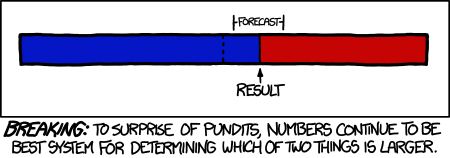
As of this writing, the only thing that's 'razor-thin' or 'too close to call' is the gap between the consensus poll forecast and the result.
07 Nov 09:22

There will always be a valley, always mountains we must scale

1. Roller skating.
2. Women in comic books.
3. Living in America.
4. Social media.
5. What you miss most from home.

Two of my favorite things. Women. Comics.

Two ways women can be “in comics”: as characters, and as creators.

Two things about female characters: firstly, that the comic medium is frequently flawed in its depiction of women. Secondly, that female characters in comics are nevertheless so often interesting, amazing characters compared to stories in other media, that I fell into reading comics just because of the female characters. So women in comics are particularly important to me, perhaps more so that in other media, which is particularly unfair.

Anyway, I don’t particularly want to talk about the flaws and problems with my particular fandoms today, let’s celebrate some awesome women in comics. I’ve been talking for years about Dinah Lance, Barbara Gordon and Renee Montoya, so I think I’ll focus on characters I discovered more recently.

Five Awesome Characters in Comics and Manga

Tara F. Chace (Queen and Country by Greg Rucka, Oni Press)

I realize Tara’s middle name is Felicity, but for people who have read these books, her full name is generally “Tara Fucking Chace,” because she is frankly the most bad ass super competent character in fiction as far as I’m concerned.

Queen and Country is an espionage series that ran from 2001 to 2007, set in MI6. Not in the slightest bit James Bondy, Q&C is as much about the political machinations and personal agendas of the British Secret Service than it is about the job, but the job is still there, taking its toll on the people who do it.

And Tara is really good at her job. The experience of reading Q&C is generally one of repeating over and over again, “damn, she’s good.”

Endo Kanna (20th Century Boys by Naoki Urasawa, English translation by Viz Media)

Becca handed this manga to me a few months ago and I devoured the whole series. And everyone is brilliant in it, but Kanna quickly earned a place in my heart.

(read right to left!)

Kanna is the niece of Endo Kenji, the convenience store clerk who discovers his childhood stories of saving the world are being acted out and turned against the world in terrifying ways, but finds himself unable to stop it. Growing up in an Orwellian Japan, Kanna is inspired by her uncle’s leadership to become a rebel herself, and discovers that, while her spoon bending ability seems useless, she has incredible powers of CHARISMA and LEADERSHIP.

Kanna is a hot headed, determined, young woman who longs to live up to her uncle’s legacy, so it’s obvious why I like her. She fumbles about her feelings, struggles with her relationship to her extended family, and powers her way through the series with an unstoppable momentum. That’s pretty much all I say say without serious spoilers, but in a series full of great characters, Kanna is the greatest.

Princess Adrienne (Princeless by Jeremy Whitley and M. Goodwin, Action Lab Entertainment)

I’ve said it a couple of times, but I’ll say it here: Princeless is easily the best comic for girls I’ve seen in recent years – and by “for girls” I mean the target audience is obviously female children, and I would (and have) happily hand the book to girls under the age of twelve.

Adrienne is a snarky, headstrong princess who, according to a tradition that she thinks is stupid, is locked in a tower by her parents, guarded by a dragon for would-be suitors to slay for her hand. She sulks there for about a page, before she finds a sword under her bed, teams up with the dragon, and flies off to save her sisters.

I shouldn’t need to say more, so I won’t.

Carol Danvers (Captain Marvel, by Kelly Sue Deconnick, Marvel)

Alright, I admit it. I may be picking up more and more Marvel books these days. Blame DC’s stupid New52 and the editorial wankery around it. Anyway, Carol Danvers has had a place in my heart without me reading a single issue of hers, when I saw this video on The Escapist about her treatment in The Avengers and how Chris Claremont worked on it. So when I saw she was taking on the mantle of Captain Marvel, in a book written by a writer I already loved from her work on Supergirl, I knew I had to pick it up.

And I wasn’t mistaken.

Miria (Claymore by Norihiro Yagi, English translation from Viz Media)

Oh Claymore, Claymore, Claymore, manga of my heart. The conceit of the series is girls who have been surgically implanted with the  flesh of demons called yoma, granting them superhuman strength and speed. Feared by normal people, Claymores are sent out by a mysterious Organization to fight the yoma that plague the world. But because this is a 20+ volume manga, everything is not as simple as girls fight monsters. The Organization is shadowy and secretive and has ulterior motives, and Miria, the cleverest (and also fastest) Claymore, is out to find out what. Without hurting a single one of her sisters.

Because Miria is the best.

And because I’m celebrating women, and couldn’t narrow it down to 5:

Ten Awesome Female creators of Comics and Manga

G. Willow Wilson (writer: Cairo)

Hiromu Arakawa (writer and artist: Fullmetal Alchemist)

Kelly Sue Deconnick (writer: Captain Marvel)

Nicola Scott (artist: Birds of Prey; Secret Six)

Gail Simone (writer: Birds of Prey; Secret Six)

Amy Reeder (artist: Batwoman)

Jen Van Meter (writer: HawkeyeBlack Lightning: Year One)

Marjane Satrapi (writer and artist: Persepolis)

Amanda Conner (artist: Power Girl)

K.B. Spangler (writer and artist: A Girl and her Fed)

This post can also be found at Thagomizer.net. Feel free to join in the conversation wherever you feel most comfortable.

07 Nov 01:36

Why I’m worried about ‘Election Day Communion’

by Fred Clark

“I sit on a man’s back choking him and making him carry me, and yet assure myself and others that I am sorry for him and wish to lighten his load by all means possible … except by getting off his back.” — Leo Tolstoy

Election Day Communion is a fine idea. Unity in Christ. Remembering what’s truly most important. Excellent.

I like this idea very much — in theory. In practice, I’m not so sure.

Here’s the introduction from Election Day Communion’s website:

On November 6, 2012, Election Day, we will exercise our right to choose.

Some of us will choose to vote for Barack Obama.
Some of us will choose to vote for Mitt Romney.
Some of us will choose to vote for another candidate.
Some of us will choose not to vote.

During the day of November 6, 2012, we will make different choices for different reasons, hoping for different results.

But that evening while our nation turns its attention to the outcome of the presidential election, let’s again choose differently. But this time, let’s do it together.

How is this to work in, say, Minnesota, Maine, Maryland or Washington?

What I mean is, we’re talking about communion here — the Lord’s Supper, breaking bread together in Christ’s name. And that communion ought to include everyone, just as the ECD folks insist it should. Political differences shouldn’t keep us from Christian fellowship.

So far so good. Except that in Minnesota, Maine, Maryland and Washington, this election is also determining the civil rights of LGBT people.

So Joe Christian shows up this evening for Election Day Communion in, say, Havre de Grace, Md., and takes his seat in the pew. To his right is a family, two women and their children, whose civil right for legal recognition of their marriage is on the ballot this Election Day. And sitting to Joe’s left, at the other end of the pew is another family, a husband and wife who just voted against the civil rights of the first couple.

This isn’t a matter of simple social awkwardness or wounded feelings. This has to do with justice and with injustice.

Given that, it seems to me that Joe can break bread in fellowship with one family or the other, but not with both. To join in communion with the family to his left would be to overlook the actual harm that family has just done and is doing to the family to his right. It does not seem right or proper for Joe to disregard that harm and dismiss it as inconsequential. It is not right to pretend that this does not really matter to real people.

Nor would it seem right for the families there in the pew with Joe to participate together in this ritual of unity. Even to ask that family to the right to do so seems to me to compound the harm that has been done to them.

And here, I think, we’re back in the ugly arena of compulsory forgiveness. We’re back in the realm of saying, “You really need to forgive your brother in Christ for standing on your neck” as though the Christian under the boot, and not the one wearing it, was the problem.

We discussed this earlier this year — see: “Mercy for the downpresser man is not the first step. Or the second, or third” and “Trying to get down to the heart of the matter.” The conclusion of that latter post, I think, sums up what’s behind my reservations about Election Day Communion:

If you are to grant me forgiveness, then, it can only happen if I come to you in powerlessness — if I accept that my request for forgiveness grants you all the power in the equation. Pharaoh can only be forgiven when he bows down before the former slave he has wronged.

This reversal, this correction, of the imbalance of power is why forgiveness can bring healing to both parties in the transaction. It’s like the leveling sung of by Mary or preached by John the Baptist. It brings down the powerful from their thrones and lifts up the lowly; it fills every valley and makes low every mountain and hill. The powerful are brought low and the powerless are lifted up. The powerless are empowered.

The counterfeit of coerced or compulsory forgiveness cannot do this. There can be no leveling if the powerless are required or demanded or expected to surrender their forgiveness before the powerful are brought low. Any talk of forgiveness for one who has misused or exploited power over others that does not grant power — all the power — to those others becomes, itself, a second misuse and exploitation of power. It’s a sham and a scam that has nothing to do with real forgiveness at all.

Again, I appreciate the idea of Election Day Communion, but it risks trivializing the enormous stakes today for many millions of people by treating all political disagreements as little more than angry looks exchanged between neighbors with different yard signs. We need to confess those sorts of sins to one another as well in the days that follow an election — “I’m sorry I called you names,” “Forgive me for losing my temper,” etc.

But if that’s the main post-election problem in your congregation, then your first prayer shouldn’t be one of confession or communion. It should be a prayer of thanksgiving for the enormous privilege of being wealthy and healthy and “normal” enough that you didn’t have far more at stake.

06 Nov 21:26

A Pennsylvania Surprise?

by David Brin
My last official campaign entry "Election 2012: What's the fundamental issue?" is still posted below. But it seems I must do one more.

You see... I'm worried about Pennsylvania.  Mitt Romney just campaigned there and many in the press wondered why? Why take time from crucial swing states like Florida, Virginia, Ohio and Colorado, to campaign in a state President Obama has apparently sewn up? There's a chilling hypothesis, related to my recent posting about potential fraud with e-voting machines.  (NEW: see how easy it is to hack the voting machines!)
So, in that context, why might Mitt go to Pennsylvania? To give fig leaf cover for a Big Surprise?
Consider. The real potential for fraud lies in states that use electronic voting machines without accompanying paper ballots that can be audited. These are mostly red states where stuff like this -- and gerrymandering -- is apparently just fine. Expect Mitt's popular vote tally to be boosted even higher than plausible in those states, in order to give him a plurality sheen.  Those states won't shift the Electoral College...
...but Virginia and Pennsylvania are two swing states that also have no-audit electronic voting! Moreover, they have people in the right places. Carol Aichele is Secretary of State in Pennsylvania, and also a member of the Republican State Committee. Janet Vestal Kelly, Secretary of Virginia, is a veteran partisan operative. And all the voting machine manufacturers have deep connections to right wing politics.
If there's a Pennsylvania surprise, remember you heard it here first.  Expect Supreme Court Madness! Ah, but if it happens, here are some things Ms. Aichele and Ms. Kelly may not expect --

-- for good billionaires to come out with huge whistle blower rewards. For some henchmen to die then, in mysterious plane and car crashes. Whereupon one will blab and the rest go to prison.
Aw heck... expect that I'm being paranoid and it'll all work out and we'll prove wise and good and live up to the investment that our ancestors devoted to us.
Be sure to vote. . . ...a collaborative contrarian product of David Brin, Enlightenment Civilization, obstinate human nature... and http://davidbrin.blogspot.com/ (site feed URL: http://davidbrin.blogspot.com/atom.xml)
06 Nov 16:18

Super-Endorsements 2012:

by Caleb
06 Nov 15:17

Links I found interesting for 06-11-2012

06 Nov 14:04

The Distinctiveness of Left-Libertarianism

by Gary Chartier

[Editors Note: This essay is part of BHL's Symposium on Left-Libertarianism. Click on the link to see the other essays.]

Left-libertarianism in the relevant sense is a position that is simultaneously leftist and libertarian. It features leftist commitments to:

  • engaging in class analysis and class struggle;
  • opposing corporate privilege;
  • undermining structural poverty
  • embracing shared responsibility for challenging economic vulnerability;
  • affirming wealth redistribution;
  • supporting grass-roots empowerment;
  • humanizing worklife;
  • protecting civil liberties;
  • opposing the drug war;
  • supporting the rights of sex workers;
  • challenging police violence;
  • promoting environmental well-being and animal welfare;
  • fostering children’s liberation;
  • rejecting racism, sexism, heterosexism, nativism, and national chauvinism; and
  • resisting war, imperialism and colonialism.

Simultaneously, it features libertarian commitments to:

A Leftist Position

 A leftist position is marked, I suggest, by concern with subordination, exclusion, deprivation, and war. Left-libertarians whole-heartedly embrace these leftist concerns. But left-libertarians may differ from other leftists insofar as they:

  • affirm the independent value of robust protections for just possessory claims—as, among other things, an expression of and a means of implementing the leftist opposition to subordination and leftist support for widely shared prosperity, but also as constraints on the means used to pursue some leftist goals;
  • make different predictions about establishing a genuinely freed market (rejecting the view that such a market would be a corporate playground);
  • offer different explanations of the origins and persistence of objectionable social phenomena (so that, for instance, state-secured privileges for elites, rather than market dynamics, account for persistent poverty and workplace subordination); and
  • urge different remedies for these phenomena (characteristically, a combination of remedying state-perpetrated and state-tolerated injustice, and fostering voluntary, solidaristic action).

Left-libertarians share with other leftists the awareness that there are predictable winners and losers in society and that being sorted into the two camps isn’t primarily a matter of luck or skill. But left-libertarians emphasize that it’s not a consequence of market exchange, either: it’s a reflection of state-committed, state-threatened, and state-tolerated aggression. As long as there’s a state apparatus in place, the wealthy can capture it, using it to gain power and more wealth, while the politically powerful can use it to acquire wealth and more power. The ruling class—made up of wealthy people empowered by the state, together with high-level state functionaries—is defined by its relationship with the state, its essential enabler. Opposing this class thus means opposing the state.

Left-libertarians share with other leftists the recognition that big businesses enjoy substantial privileges that benefit them while harming the public. But they stress that the proper response to corporate privilege is to eliminate subsidies, bailouts, cartelizing regulations, and other state-driven features of the legal, political, and economic environments that prop up corporate power rather than retaining the privileges while increasing state regulatory involvement in the economy—which can be expected to create new opportunities for elite manipulation, leave corporate power intact, stifle upstart alternatives to corporate behemoths, and impoverish the public.

Left-libertarians share with other leftists both outrage at structural poverty and the recognition that the wealthy and well connected help to shape the rules of the economic and political game in ways that preserve their wealth and influence while making and keeping others poor. But left-libertarians emphasize that poverty isn’t created or perpetuated by the freed market, but rather by large-scale theft and by the privileges and constraints—from licensing requirements to intellectual property rules to land-use controls to building codes—that prevent people from using their skills and assets effectively or dramatically raise the cost of doing so. Eliminating structural poverty means eliminating state-secured privilege and reversing state-sanctioned theft.

Left-libertarians share with other leftists both compassionate concern with economic vulnerability and the recognition that vulnerable people can’t be left to fend for themselves, that shared responsibility for meeting their needs is morally and practically essential. But they stress that mutual aid arrangements have dealt successfully with economic vulnerability. They also emphasize that such arrangements could be expected to be more successful absent taxation (people can and will spend their own money on poverty relief, but they’re likely to do so much more efficiently and intelligently than state officials deploying tax revenues), poverty-producing state regulations, and limitations on choice in areas like medical care.

Left-libertarians share with other leftists the conviction that the redistribution of wealth can be appropriate or even required. But they deny that redistribution may reasonably be undertaken to bring about a particular pattern of wealth distribution, that it may be effected through aggressive interference with people’s justly acquired possessions, or that it is properly the work of the state. Rather, they suggest, redistribution ought to be effected by the legal system (as it restores to people resources unjustly taken from them or their predecessors in interest, as it makes assets stolen by the state or acquired unjustly by its cronies available for homesteading, and as it denies validity to state-secured privileges that preserve the economic positions of the well-connected while keeping others poor), through solidaristic mutual aid, and through the tendency of a market liberated from privilege to “eat the rich.”

Left-libertarians share with many other leftists—New Leftists and Greens, say—the conviction that decision-making should be decentralized, that people should be able to participate to the maximum feasible degree in shaping decisions that affect their lives. But they maintain that this means that, against a backdrop of secure pre-political rights, all association should be consensual. Top-down, forcible decision-making is likely to be marred by the fallibility of decision-makers and their tendency to pursue self-interested goals at the public’s expense. Small-scale political units are more humanizing than large-scale ones; but decentralization must finally be decentralization to the level of the particular person.

Left-libertarians share with other leftists the realization that hierarchical workplaces are disempowering and stultifying, and that supporting workplace hierarchies is thus often morally objectionable. But they stress that hierarchical workplaces are more likely given state action. Hierarchies limit the ability of workers to use their knowledge and skills to respond flexibly and efficiently to production and distribution challenges and to meet customer needs. The inefficiencies of hierarchies would make them less common aspects of worklife, and increase the odds that people would be able to choose alternatives offering more freedom and dignity (self-employment or work in partnerships or cooperatives), in the absence of privileges that lowered the costs of maintaining hierarchies and raised the costs of opting out of them (as by making self-employment more costly, and so more risky). State action also redirects wealth to those interested in seeing that they and people like them rule the workplace; and the state’s union regulations limit the ways unions can challenge workplace hierarchies.

Left-libertarians share with other leftists a commitment to civil liberties. But they stress that the state is a predictable foe of these liberties and that the most effective way to safeguard them is to protect people’s control over their bodies and justly acquired possessions.

Left-libertarians share with other leftists a conviction that the drug war is destructive, racist, and absurdly expensive. But they emphasize that the best protection against prohibitionist campaigns of all sorts is to respect people’s control over their bodies and justly acquired possessions, and that aggression-based limits on all disfavored but voluntary exchanges should be disallowed.

Left-libertarians share with other leftists a concern for the well-being of sex workers. But they note that state actors engage in violence against sex workers and that state policies, including criminalization and regulation, create or intensify the risks associated with sex work.

Left-libertarians share with other leftists a passionate opposition to police violence and corruption. But they emphasize that this is not simply a reflection of poor oversight or the presence in police agencies of “a few bad apples” but instead a reflection of the structural positions of such agencies as guarantors of state power and of the lack of accountability created both by the existence of substantial de facto differences in standards for the use of force by police officers and others and by the monopolistic status of police agencies.

Left-libertarians share with other leftists persistent concerns with environmental quality and animal welfare. But they stress that environmental harms can be prevented and remedied without state involvement, as long as robust legal protections for bodies and justly acquired possessions are in place; that state action is not required to protect non-human animals from abuse; and that state actions and policies are often directly responsible for protecting polluters, promoting environmental harms, and injuring non-human animals.

Left-libertarians share with other leftists a commitment to the well-being of children. But left-libertarians underscore the importance of respecting children’s rights to control their own bodies and possessions—rejecting both attempts to treat children as their parents’ property and paternalistic state action that interferes unreasonably with children’s freedom—and emphasize the degree to which the state is not the protector of children but is responsible in multiple ways for significant threats to their freedom and well-being, notably through compulsory schooling.

Left-libertarians share with other leftists the awareness that racism, sexism, heterosexism, nativism, and national chauvinism are morally repugnant. But they emphasize the crucial role of the state in creating, perpetuating, and capitalizing on these forms of unfairness while stressing that eliminating the props the state provides for prejudice-driven conduct can play a vital role in combating discrimination. Suspicious of the state and respectful of just possessory claims, they stress non-aggressive solidaristic action as the appropriate means of dealing with persistent discrimination. They promote marriage equality while seeking the departure of the state from the marriage business. And, while joining other leftists in opposing xenophobia, they stress that all borders should be razed to enable untrammeled migration.

Left-libertarians share with other leftists a passionate opposition to war and empire and a concern for the victims of both, including native peoples across the globe. But they emphasize the links between warfare, imperialism, and colonialism and the state’s continuing infringements on civil and economic liberties—not to mention ruling-class mischief. Interference with people’s peaceful conduct within the state’s borders is objectionable for many of the same reasons as war beyond the state’s borders. As a form of enslavement, conscription is unjust. The freedom to trade tends to reduce the probability of war. And warfare is a likely consequence of the operation of the state, which seeks predictably to expand its influence by force. Leftist opposition to war should be seen as entailing opposition to the state per se.

A Libertarian Position

A libertarian position is marked, I suggest, by support for equality of authority; for robust protections for just possessory claims; and for peaceful, voluntary cooperation, including cooperation in and through exchange. Left-libertarians share these commitments. But left-libertarians may differ from other libertarians insofar as they:

  • make different predictions about the likely effects of liberating people and eliminating the institutionalized aggression that prevents them from cooperating peacefully and voluntarily (stressing the contingency of hierarchical workplaces, for instance);
  • call attention to particular generally accepted consequences of building a free society (say, by emphasizing not only freedom but also solidarity, diversity, and poverty relief as among the outcomes of eliminating state-secured privilege);
  • tell different historical or social-scientific stories about the causes and dynamics of social phenomena (so that the extant distribution of wealth is seen as a product of state action rather than individual virtue); and
  • treat certain kinds of social phenomena (arbitrary discrimination, for instance) as morally objectionable and argue for non-aggressive but concerted responses to these phenomena.

Left-libertarians share with other libertarians a commitment to equality of authority—to the view that there is no natural right to rule and that non-consensual authority is presumptively illegitimate. This egalitarianism naturally issues in a commitment to anarchism, since state authority is non-consensual. But left-libertarians emphasize that the commitment to moral equality that underlies belief in equality of authority should entail the rejection of subordination and exclusion on the basis of nationality, gender, race, sexual orientation, workplace status, or other irrelevant characteristics. While left-libertarians agree with other libertarians that people’s decisions to avoid associating with others because of such characteristics shouldn’t be interfered with aggressively, left-libertarians emphasize that such decisions can often still be subjected to moral critique and should be opposed using non-aggressive means.

Left-libertarians share with other libertarians a commitment to robust protections for just possessory claims to physical objects. But they reject “intellectual property” and emphasize that possessory protections shouldn’t cover objects acquired with the decisive aid of the state, or otherwise through the use of violence, or to those clearly abandoned. They make clear that there are just limits to the things people can do to protect their possessions (becoming a trespasser doesn’t automatically make one liable to violence). They note that whether claims to land should be held by individuals or groups can only be determined in light of the economics of particular situations and the ways particular claims are established. And they stress that, while just possessory claims should be respected, it’s quite possible to oppose aggressive interference with someone’s use of her possessions in a given way while challenging that use non-aggressively.

Left-libertarians share with other libertarians a commitment to a model of social life rooted in peaceful, voluntary cooperation. But they differ with other libertarians in emphasizing that, while force may justly be used only in response to aggression, peaceful, voluntary cooperation is a moral ideal with implications that go beyond simple non-aggression. Left-libertarians urge that associations of all kinds be structured in ways that affirm the freedom, dignity, and individuality of all participants, and thus allow participants the option not only of exit but also of voice—of influencing the associations’ trajectories and exercising as much individual discretion within them as possible.

While rejecting capitalism, left-libertarians share with other libertarians an enthusiastic recognition of the value of markets. They stress that both parties to a voluntary exchange participate because they prefer it and believe it will benefit them; that prices provide excellent guides for producers and distributors (far better than anything a central planner could offer); and that people should internalize the costs as well as the benefits of their choices. But they emphasize that background injustice can distort markets and constrain traders’ options. They also note that commercial exchange does not exhaust the sphere of peaceful, voluntary cooperation and that people can and should cooperate in multiple ways—playful, solidaristic, compassionate—that need not be organized along commercial lines.

A Transformed Vision

Left-libertarianism embraces and transforms leftist and libertarian ideals.

Many leftists and libertarians already share some commitments: opposition to war, empire, and corporate privilege; support for civil liberties and grass-roots empowerment. However, many leftists and libertarians also embrace, and often share, various mistaken assumptions.

Left-libertarians challenge these assumptions while embracing the commitments leftists and libertarians share. They seek to demonstrate that it’s reasonable both to oppose structural poverty and to favor freed markets, to seek both workplace dignity and robust protections for just possessory claims, to embrace freedom of association while opposing arbitrary discrimination, to foster both peace and economic liberty, to link rejection of war and imperialism with support for peaceful, voluntary cooperation at all levels.

By endorsing leftist and libertarian concerns and challenging assumptions that make it difficult for leftists to embrace libertarianism and for libertarians to become leftists, left-libertarianism offers a provocative vision of an appealing politics and a world marked by greater freedom and fairness.

Thanks to my colleagues in the Alliance of the Libertarian Left/Center for a Stateless Society/Molinari Society, to Anthony Gregory, and to David Gordon, among others, for reviewing earlier versions of this essay. It is markedly better in virtue of the feedback I have received, though I, of course, remain responsible for its flaws.


06 Nov 11:27

Out of Love | The Slow Bullet

by andrewhickeywriter
06 Nov 11:27

BBC News - Britain's recession: Harsh but fair?

by andrewhickeywriter
06 Nov 10:09

Orycon are liars

by Neurodivergent K
...or else they're so incompetent they can't find their asses with 2 hands & a map.

-->
For those of you playing along at home, Orycon told Dora that they would be cancelling the no Autistics involved autism panel.

What happened instead? According to someone who was actually there, the following events:

-The door of the panel still references autism. The people who elected to go against con staff instructions (if I am being charitable) or who were asked by con staff to ignore the cancellation (if I am not) are Joyce Ward-Reynolds, her son (who she offered up as a token), and G David Nordley.

-A friend of mine walks in wearing a neurodiversity shirt. Joyce-Ward Reynolds starts squirming & looking very uncomfortable and apologizes for using person first language. A note here: this is kind of like totalling someone's car & apologizing for scratching the paint.

-When asked why the panel was cancelled, Ms. Ward-Reynolds said it was “because there were some in the autistic community who were concerned about the panel not having any autistic people on it and when I offered to bring my son they said that wasn't good enough.”

-When my friend's NT friend went to registration to complain that the schedule still said “Autism Spectrum”, registration said it was a mistake. Not “Oh, they shouldn't be there”, but “it's a mistake, now I'mma go back to picking my fingernails”.

-Halfway through the hour, some guy (friend did not see who) opened the door, looked in, and said “Oh right, this room does not exist.” Ms. Ward-Reynolds laughed and said “Yeah, this panel never happened.”

-Therefore, official bullshit is that the panel was cancelled & this woman was using a vacant room to have an informal discussion, becoming the first person in the history of ever to use space rented by a con to do something she was explicitly told not to do by the con without the con noticing.

Now, I have been involved with organizing con like things before. And I am telling you one thing, nothing happens that con staff doesn't know about. And I am telling you another thing: if there is something that got cancelled because of controversy, con staff is especially watching the participants in that-if they care, of course.

If your goal is to do whatever you were going to do anyway, you happen to not notice that someone is in the space you paid for, doing what you said you wouldn't do. If your goal is to actually respect the people who raised the issue, you make DAMN sure that the cancelled event stays cancelled.

The dishonesty shown from Orycon is really disgusting. We made overtures, we made efforts, and contrary to what people who are used to having their asses kissed believe, we were all polite. Every one of us. Orycon didn't dislike our “tone”-there was nothing there to object to. They disliked being called on their oppressive bullshit.

Orycon told Dora that they learned, that they appreciated being told where they went wrong, that they wanted to make it right. Taking advantage of people wanting to work with you is not making it right. It will get back to us. We see your bullshit and raise you a “you did bad things and should feel bad”, Orycon. It is bad enough to go right ahead and do exactly what you are going to do anyway, but to lie about it? No. That multiplies the offensiveness exponentially-it WILL get back to us, and we WILL be pissed off.

Orycon staff & panelists have been disrespectful, dismissive, & dowright ableist from beginning to end. It's good to know that a couple of neurotypicals feel that their wish to share what they learned on Teh Googles is more important than what actually autistic people think about it, and it's fantastic to know that Orycon gives no shits.

The people who had the power to stop this did not.

So, let's recap the steps Orycon took in fucking up spectacularly (sorry, I'm sorry moderating my language and tone for y'all, it clearly does nothing good):

First, they scheduled this panel in the first place, clearly with little to no research on the subject in the first place.

Secondly, they condesplained at me when I inquired, and indicated that it was totes cool because you don't have to be gay to be for gay rights (they had no answer as to whether or not a panel of straight people talking about the apparent increase in homosexuality would be even a little acceptable-spoiler alert, y'all, it'd be fucking terrible don't do that).

Thirdly, when they met with another Autistic activist they told her they were completely ignorant & would be putting up an apology & cancelling the panel. That's not actually the bad part. The bad part is that they, here, were lying.

Fourthly, the apology they put up is a sack of crap. It is not an apology. They were told that the first thing they needed to do in their apology was acknowledge that they fucked up. If they have done this, I have yet to see it, but it sure as shit isn't in their nonpology-which is nothing but excusing themselves & pleading ignorance as though that's a get out of jail free card.

Fifthly, they still held the panel. If people are joking about the room not existing, it is damn well staff sanctioned, even if not officially. When Orycon allowed it to happen-and they knew, not only that, but my friend's NT friend's inquiry should have been a pretty big hint to check on it if they were serious about cancelling it-they spat in all of our faces. This is basic stuff here, guys.

If Orycon is serious about wanting to work with autistics, they're going to need to do a hell of a lot better than this. Apparently the chair is telling other people they're oh so sorry, that they feel like a failure of a human being, that they didn't know, that they didn't mean for this to happen, but I don't believe them.

If they were actually sorry but ignorant, they'd be doing some serious naming & shaming, because this isn't acceptable behavior, no matter how oh-so-important the NT panelists fancy themselves. IF they were actually sorry but ignorant, there should be a much longer, much better apology up on the website. If they are actually sorry at all, they owe an awful lot of people personal apologies in addition to owing the Autistic community some pretty significant groveling.
Joyce Ward-Reynolds, I don't know what makes you think you are above honoring promises made by a con that is paying you, but nothing does. You directly contributed to a world that devalues your son-not for being a furry, but for being autistic. Good job. Are you proud of yourself? I know, all that googling and maybe even reading a book was oh so hard, and you are oh so important, you couldn't possibly listen to someone who wasn't you, because you are an expert.

And no, throwing your son on the panel wasn't good enough, because this isn't his thing. He's a member of the furry fandom, good for him. He is not an autistic activist. This is not an area that he wants to talk about. Offering him up as a token was disrespectful to every autistic person who actually had things to say on the subject-and many of us have well researched opinions on the subject, by which I mean “we read scientific papers and we made comments on the DSMV criteria”. It was disrespectful to him as well. You may have him convinced that I'm a meaniepants, but at least I have enough respect for him to know that using him as a get-out-of-trouble shield is disgusting & dehumanizing. So I'll take being a meaniepants every time.

G David Nordley, what makes YOU so damn important that you don't have to honor the people you are talking about or the convention's promise? Seriously, I want to know.

This is the panel that is oh so autism sophisticated (their words) that they don't see it necessary to talk to autistic people. These are the folks who are so hell-bent on having their say they will put their reputation and that of Orycon on the line, damn what the people they're talking about have to say about it. That's how important they are (and people say autistics are self centered!). I'm reminded of a line from one of the parents in the ableist emails-something about how their son would be a shitty panelist unless you wanted to hear him talk about what he wants to talk about. Who went and did exactly that-talked about whatever they wanted to talk about without regards for other people? Oh it was these non autistic panelist. 'Scuse me, my irony meter exploded.

I'm waiting to see how you'll unfuck this up, Orycon. I know that this year's chair is telling other people that they feel like a failure of a human being, but is failing spectacularly to act towards being less of a failure-generally stopping failing is a good way to get past that feeling. I also know they're saying that nothing could be worse than what's going around on Tumblr (challenge accepted, btw). Things do get back to me.

Orycon has a lot of fixing to do before I will consider giving them my money, I will not be attending any cons where either Ms Ward-Reynolds or Mr Nordley are speaking, and I have a pretty steady crew of friends who are right on board this plan with me.

If it was your plan to deceive us all along, it is high time you put on your big kid undies and admitted it. If it really was panelists casting Forget on you & going rogue, convince me.
06 Nov 10:02

Classic rock for Fundamentalists, 1: Meat Loaf

by Mike Taylor
06 Nov 01:20

Labour's return to the right.

Labour's return to the right.
06 Nov 00:36

The living wage is fine as far as it goes, but the Lib Dems can be bolder

by Nick Thornsby

There we have it. Miliband’s big idea: the living wage. Only it is not Miliband’s idea. And more to the point it is not a very big idea. In fact, it seems to me extraordinarily unambitious.

We presently have a system in which somebody earning the national minimum wage – which for most is not sufficient to live in any comfort even before tax – and working full time pays income tax at 20% on about a third of their salary, national insurance, VAT on the goods they buy, fuel duty and road tax on the car that gets them to their minimum-wage job, council tax, air passenger duty on their budget holiday, and more.

Yet because the minimum wage in insufficient, and such a vast proportion of it is paid in taxation, the government then gives back to majority of these low-paid workers the same amount, or more, than they paid in tax through working tax credits, child tax credits, council tax benefit and housing benefit.

Who, if they were designing a wage, tax and benefits system from scratch, would come up with such a convoluted, inefficient system? (Well, probably Gordon Brown.)

On its own, the living wage would have a marginal impact in inserting a bit of sense into the system. But it is essentially just a small increase in the minimum wage, which is good but not sufficient.

A better starting point would be to abolish direct taxes on a minimum wage salary, as the Lib Dems want to do (and have already started).

Even then, though, there will be a large number of people whose net income is not enough to live on. Reducing some of the indirect taxes mentioned above would therefore help a little more.

A significant proportion of the funding for these changes can come from the reductions in tax credits and benefits paid to those now keeping more of the money they earn. And different taxes can be levied on wealthier individuals to cancel out the positive effect of reducing indirect taxes.

Still then there will likely be more to do. And this is where a higher minimum wage can be considered. But while the minimum wage so far seems only to have had a relatively small impact on unemployment, a significant increase – without other changes – clearly would make hiring people less attractive.

That is why – and this is crucial – the further savings made in the benefits and tax credits system should be hypothecated to reduce taxes on business, starting with the abolition of employer national insurance contributions. This would, to a large extent, mitigate the effects on employment of a significant increase in the minimum wage.

There is a way to make work pay and leave behind Gordon Brown’s labyrinthine tax and benefits system. Indeed, the Lib Dems have made significant steps to doing so already. But we must be bolder, because we know for sure that neither Labour nor the Tories will be.

* Nick Thornsby is Thursday Editor of Liberal Democrat Voice and blogs here.