Shared posts

18 Jan 19:31

Coalition tax rates are far more progressive than under Labour

by Mark Thompson
They say a picture is worth a thousand words.

Well:


This is the difference in income tax that people are paying in the current tax year versus what they paid under the last year of Labour government. When let's not forget they had had 13 years to align the tax rates in any way they wished with a large majority in parliament.

We can see that someone earning £10,000 is paying almost 30% less tax now whilst those earning the highest amounts (£500,000+) are paying well over 20% more. Oh, and that line above seems to me to be the dictionary definition of "progressive". It goes up progressively.

Worth remembering this next time Labour are banging on about how unfair the coalition is being to the poorest people.


Hattip to Len Gates and Carl Minns for the original data.

18 Jan 17:04

Robert Frost mug

by Michael Leddy

[Only $15.95. Good grief.]

Robert Frost’s “The Road Not Taken” has the distinction of being celebrated by large numbers of people who have no idea what it’s saying. Why does an elementary school have its students sign and sing the Village People’s “Y.M.C.A.” at a spring concert? Cluelessness. Why do people want Frost’s poem on a mug or poster or plaque? See answer to previous question.

Reading “The Road Not Taken” with even modest attention reveals the poem to be more complicated and compelling than any platitude about going one’s own way and never looking back:
Two roads diverged in a yellow wood,
And sorry I could not travel both
And be one traveler, long I stood
And looked down one as far as I could
To where it bent in the undergrowth;

Then took the other, as just as fair,
And having perhaps the better claim,
Because it was grassy and wanted wear;
Though as for that the passing there
Had worn them really about the same,

And both that morning equally lay
In leaves no step had trodden black.
Oh, I kept the first for another day!
Yet knowing how way leads on to way,
I doubted if I should ever come back.

I shall be telling this with a sigh
Somewhere ages and ages hence:
Two roads diverged in a wood, and I —
I took the one less traveled by,
And that has made all the difference.
Beginning with its title, the poem is about nothing but looking back: its speaker even begins to rehearse his story once again in the final stanza before breaking off to offer the evidence-defying declaration that he “took the one less traveled by.” Look back at what he’s told us: the two roads looked equally appealing; one looked grassier than the other; they looked equally worn; that morning they were both covered in leaves than no one had walked on. Where there is no difference, there is no basis for a meaningful choice. And the difference a choice makes cannot be gauged when one has no idea of where an alternative may have led. If “way leads on to way,” the two roads might even meet again in the future: and who would know?

What the poem shows us is a traveler who would have preferred not to have to choose, who retells his story (like the Ancient Mariner), who travels to an unknown end (“somewhere ages and ages hence”), and who is determined to impose meaning on one moment of experience. If the speaker will be retelling his story with a “sigh,” it’s far from clear that the difference he claims for his choice — if there was a choice, if there is a difference — is for the better. But in Frost’s universe, any meaning is better than none. Or as another Frost poem puts it:
Better to go down dignified
With boughten friendship at your side
Than none at all. Provide, provide!
And speaking of things boughten, you can also buy the poem’s first stanza as a poster ending with a semicolon. Good grief.

[Elaine and I heard “Y.M.C.A.” sung by elementary-school kids some years ago. Not wanting to embarrass anyone, we kept our mouths shut.]
You’re reading a post from Michael Leddy’s blog Orange Crate Art. This work is licensed under a Creative Commons 3.0 License.
18 Jan 13:19

Identifying Anachronisms in ‘Lincoln’ & ‘Mad Men’

by David Malki !


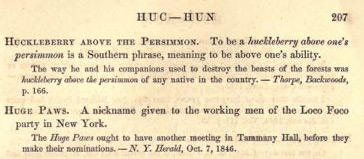
Image: The Dictionary of Americanisms

I enjoyed two articles in The Atlantic by historian Benjamin Schmidt: one looking at the movie Lincoln, and the other at episodes of Mad Men, in which he used computers to compare the language used in each by characters to a corpus of actual published works from the same era, with the goal of flagging any modern terminology or phraseology that snuck into supposedly period-accurate works. (For example, “snuck” is a word he cites as becoming common decades too late to be accurate to Lincoln’s time.)

From the Lincoln article:

It turns out Kushner didn’t reach for that OED as much as he could have. Mary Todd complains about Thaddeus Stevens’s “prosecutorial” interest in her accounts, but the word wasn’t used at all until 1934, and not widely until Watergate. As others have noted, everyone said “sneaked,” not “snuck,” until the 20th century, and the “barrage” of artillery Edwin Stanton plans for Wilmington only entered English around 1900. And the “bipartisanship” at the heart of the movie’s narrative? The dictionary says the term only entered the language in 1909, although I’ve found a few occurrences from the 1890s.

And Mad Men:

What seems to be the most ubiquitous mistake in Mad Men is so frequent as to be invisible: the phrase “I need to.” Modern scripts set in 1960s, including Mad Men, use it constantly: it’s about as frequent as everyday words like “good,” “between,” or “most.” But to say “I need to” so much is a surprisingly modern practice: books, television shows, and movies from the 1960s use it at least ten times less often, and many never use it all. Sixties dialogue written back then used “ought to” far more often than modern imitators do.

I love this type of stuff. In Dispatches from Wondermark Manor I of course tried to affect a quasi-Victorian style of writing, but completely absurdly and with a deliberate disregard for accuracy…and yet, when I went back to assemble the complete edition, revisiting texts that in some cases I’d written years earlier, I absolutely made changes based on my improved understanding of Victorian language. Stuff just stood out to me as wrong.

I remember replacing tsunami with cyclone and zeppelin (as a generic term for airship) with dirigible. I also snuck, er, sneaked in some particularly juicy turns of phrase that I’d come across in period literature that charmed me with how different they sounded from something written today.

But I rather love the mishmash, as well — obviously someone striving for period accuracy would do well to try to use the language of the day in the manner in which it was actually used, but there’s something charming to me about adopting the trappings of a different era but putting a little bit of a modern voice into it. It becomes new; it’s something we couldn’t have gotten from the real era. It’s science fiction: traveling back to the world of Kennedy or LBJ or Queen Victoria or Abraham Lincoln, getting to put on those clothes and talk about those issues, but bringing a little 2013 with you in a way that they never would have done. It’s inventive.

Oh no you guys this was an accident but I — I think I just invented steampunk

18 Jan 13:18

#903; The Faucet, Reinvented

by David Malki !
18 Jan 13:17

#906; In which a Choice is forced

by David Malki !

the entire band poses for pictures with the recently deceased ringworm farmer. the experience inspires their next concept album

18 Jan 13:08

Debi Watches Arrow (sydht!) 1.10: Burned

So I have a job on Thursday afternoons, now. Which means my time to watch and recap Arrow is sort of limited, on account of me not being the kind of blogger who will sacrifice sleep or anything else for the blog. So today I’m trying a new format. Instead of painstakingly describing each scene as it happens, I’m going to focus on each of the subplots. It didn’t actually work in terms of getting this up before work, but oh well.

The good thing is that the show’s comfortably formulaic enough that I can do this. This episode for instance, has the following traditional threads:

  1. Villain of the Week
  2. Ollie’s gots Issues (with bonus appearance by the Island of Low Saturation)
  3. Laurel and Tommy Need Their Own Show
  4. The Grown Up Plot (featuring Thea!)

Highlight of this week: Joanna gets plot! Of course, what actually happens is Joanna gets enough characterization to provide motive to her white best friend and the wbf’s white hero buddy. And at the end of the episode is disappointing. And it generally speaks to the show’s problems with its female characters of color that it’s an improvement that someone other than the wbf acknowledges her existence. Yeah.

Secondary highlight of the week: Diggle gets his shirt off.

Theme of the Week: traumatic experiences and recovery.

But on to the recap:

Villain of the Week

110a

The episode opens on a team of firefighters fighting a blaze at a factory. One man in particular is trying to clear the upper level when he calls over another man in uniform (“Hey you!”) to help him. The unidentified firefighter ‘helps’ his colleague by spraying him with an accelerant and calmly watching him burn. (It’s kind of hard to tell in the lighting, but worth mentioning that the man we see screaming and pinwheeling around on fire is a black man. The man watching him die is a white man. I’M JUST SAYING.)

Instantly, anyone familiar with comics knows who this villain is.

Note to Non-Comics Readers: Garfield Lynns, aka Firefly, is a Gotham villain most commonly seen in the Rogue’s Gallery of Batgirl. His in-universe first appearance (though not his in-comics first appearance, if that makes sense) was in Batgirl: Year One, in which he came up against Batgirl I, Barbara Gordon. The book also featured Babs’ later girlfriend partner Black Canary.

At the CNRI offices, Joanna and Laurel are talking about what an awesome lawyer Joanna is, when they are interrupted by Quentin, and the fire chief, both wearing bad-news faces. The man burned to death in the opening was Joanna’s brother, Danny. Joanna also gets a last name: de la Vega. And some fine acting, I have to say.

110c

Later, Joanna drops around to Laurel’s apartment with the simple opener “I need your help.” She’s convinced that Danny was murdered, rather than dying in the line of duty. Laurel is reluctant to believe her, based on Laurel’s own experiences of trying again and again to find a reason for why the boat may have gone down and killed her sister.

(Or course, we know this was sabotage, and I’m sure it was well covered-up, but they kind of made Laurel look less than super-competent, here.)

However, Joanna has actual evidence. From the coroner’s office she has a report that Danny’s turnout coat was doused in turpentine, a substance that wasn’t being used at the factory. The coroner also said (don’t know how he knows this, but w/e) that the fire didn’t exceed 250°F, but the coat’s supposed to withstand temps of up to 500, so Danny burned to death at a temperature higher than the fire he was supposed to die in.

At this point, Laurel takes over, for reasons uncertain. She does some digging – which presumably Joanna could also do – and a week ago, a firefighter Leo Barnes died under the same really-hot turpentine-doused circumstances. Armed with this information, she confronts her father, who explains that the fire department has their own detective unit and don’t answer to the police.

Given that I’d think ‘doused in turpentine’ where turpentine wasn’t supposed to be present would be a reason to follow up any death, I wonder whether this is supposed to be a Grand Conspiracy on the part of the FD. Most likely sloppy writing, but still.

They are interrupted by a random forensics dude dropping Ollie’s phone on Quentin’s desk. After six weeks of analysis, they’ve found nothing, not even the manufacturer. Laurel asks about it, and Quentin confesses about it being an Arrow-phone, then changes the subject. When he runs off to do more work, Laurel steals the phone and uses it to phone Maninnahood.

He turns up at her apartment that evening (by cutting the power, which really?) and uses a voice changer to be passive aggressive about those mean things she said to her father about him being a killer.

(Newsflash, Ollie: YOU KILLED PEOPLE. Geez.)

She gives him the file by saying that if Danny was murdered, they “have to bring the killer to justice.” And despite my best efforts I start getting Canary!feels. Suddenly I have this idea in my head that Laurel needs to solve all this on her own, and go and bring down Firefly on her own. Spoiler alert: she doesn’t, But that would have been nice. Just insert Laurel into Maninnahood’s role in this plot and have Joanna do Laurel’s stuff.

Ollie relates this to Diggle, who promises to reach out to his contacts in the fire investigations department. He comes up with a ’72 Ford Pickup eyewitnesses reported at the scene of the fire where Danny died. And when Stagg Chemical (Presumably run by the same Stagg Industries that pulled out of funding CNRI in an earlier episode) started burning, Diggle hacked into the security cameras – as you do when you’re a bodyguard who still needs Felicity Snoak to Bing search for you. (Though not this episode thankfully.) And what did he see? The same pickup. So he gets Ollie to go over there in Hood.


110g

By the time Maninnahood gets there, Firefly has already thrown his victim over the railing of a walkway into the blaze, in the process losing a glove. Hood and Firefly fight on the walkway, a process that involves a lot of Ollie getting the snot kicked out of him. He falls to the ground, and Firefly continues to put the boot in, just like Merlyn (see Ollie’s Gots Issues). For no apparent reason, he leaves Ollie lying there and steps back. With a closeup of a horribly burned right hand, with a tattoo of a firefly (told ya), Firefly draws a… wait for it… an actual smoke bomb, and uses it to escape.

110h

Ollie phones Laurel to tell her about the pick up and the tattoo. Also some new information that all the men in Engine Company 15 had firefly tattoos. I don’t know how he knows this. He tells Laurel to do with this information what she would do before she met him.

(Me: NO! Dress in fishnets and go after him! That’s what he means!)

Laurel – with Ollie in tow – asks the Fire Chief about “The Fireflies,” a group of 15 firemen from an old, now shut down station house, all of which went to different companies. Four of them are now dead: three in the last six weeks, making Danny the second, I guess. The fourth is Garfield Lynns (told ya) , who “died” two years ago in an apparently famous “Nodell Tower tragedy.”

For the benefit of the man who was on an island at the time, they explain that the Nodell Tower was a poorly built tower which collapsed when a gasline blew, taking with it 34 civilians and 6 firemen, including Mr. Lynns. As soon  as she’s shed Ollie, Laurel phones the Hood, and  the comedy opportunity is completely wasted. She asks him what she’s supposed to do now, and Ollie disappoints by saying it’s his turn.

NNCR: I’m choosing to believe that this is a shout out to Mart Nodell, the creator of Green Lantern, the second of which is Ollie’s comics BFF. (Was, pre-boot.)

With an alibi for all surviving men in the Firefly unit, Ollie looks up Garfield Lynns and the Nodell Tower incident. Some of the bodies – implicitly including Lynns but he doesn’t make it explicit – were too badly burned for identification.

The Weekly Party Scene is relevant to the Tommy/Laurel plot and is taking place in teh club above the ArrowCave. At it, Ollie sweeps Laurel over to the Fire Chief to ask him about the Nodell Fire, and the absense of Lynns’ body. It’s inappropriate for the situation and the chief calls him on it. But still, he admits that it was a fire and a half. The fire was like “some monster out of a science fiction movie,” and I’m sad it probably wasn’t a comic book villain. He radioed his men to get out, but Lynns stayed, refusing to come out while he fought but without the backup that the chief wouldn’t send in.

At that moment they are interrupted by the arrival of a man in a fire fighting outfit. Lynns apparently got bored of  waiting for fires and has crashed the party. He wades into the building and starts throwing  fire bombs, setting the party alight. Taking his helmet off, he reveals a scarred face, which I’m not screen capping because I don’t know how I feel about FACIAL SCARS MAKE VILLAINS. Or rather, I do, and I don’t like it. Diggle and Tommy evacuate the building, leaving the Fire Chief, Ollie and Laurel facing down Lynns, Ollie shielding Laurel bodily. Lynns tells them to run and they do, leaving the chief to be sprayed down by turpentine. Laurel runs to Tommy, Ollie disappears into the Arrow Cave, where he Hoods up.

Lynns explains his backstory – pulled out as a John Doe, burned and feeling horribly betrayed by his boss, swearing revenge.

NNCR: Comics!Firefly is a complete pyrophile. He just likes to watch people burn. This version is thematic for the episode, but I like comics!Firefly.

After his monologue, he reaches into a pocket and pulls out a Zippo, which he throws at the chief. Fortunately, Maninnahood has just arrives and SHOOTS THE ZIPPO OUT OF THE AIR.

It’s awesome archery, admit it. It’s even shown on screen – the zippo being hit by the arrow, I mean. I didn’t cap it because I suck at capping.

Ollie holds Lynns at arrow point, and Lynns – ah, I’ll mention this in the Issues section. At the end of it, Lynns commits suicide by burning. Not five minutes after he explained how much being burned alive freaking hurts.

The next time we see Joanna, she’s packing a box to take a hiatus to spend time with her Mom. So I guess that’s another character who’s already off screen too much, who we’re never going to see in a while. Basically, she’s been put on a bus.

Stupid show and their stupid wasting of a character. I hope Annie Ilonzeh is off to brilliant things.

Ollie’s Gots Issues

110b

Aware that the last few episodes have been light on the manflesh eyecandy, Ollie makes his first entrance with an extended topless montage of him working out in the Arrowcave. This includes that thing with the bar and the jumping pull-ups that I can watch all night. All the while he’s flashing back to having the snot beaten out of him by John Barrowmerlyn last week. He ends the sequence by shooting at a tennis ball in the air and missing, just to let us know he’s off his game.

Diggle interrupts PT time to check on Ollie, and Ollie ignores the “how are you?” opener to talk about Walter. Diggle’s been following up with a bunch of leads and Walter is indeed missing. “Either he doesn’t want to be found,” says Ollie, “or someone doesn’t want him to be found. Diggle is apparently shit-hot connected. I don’t know where this came from.

Walter has been missing for six weeks, with no contact from putative kidnappers. It seems he’s probably dead. More on this in “the grown ups plot,” because Diggle is more interested in his job as Ollie’s caretaker. He wants to know when Ollie’s going to get back on to The List. Ollie says his family needs him right now. Diggle continues to poke gently at Ollie during the episode, suggesting that putting on the hood might be good for the city, and good for Ollie.

This is a total 180 on Diggle’s position from earlier episodes, and it bothers me. I wish he had some consistency, and wasn’t just there to worry about his own white best friend. Or maybe Diggle’s now just loving the whole idea of Hood-erizing. In which case, Diggle should put it on himself. #showsIwouldratherbewatching.

When Diggle sends Ollie to the Stagg Chemical blaze in costume, Ollie takes the opportunity to sulk about it. After having his ass handed to him in hand-to-hand with Firefly, he spends more times sulking alone with his bow.

110e


Ollie and Diggle get more subtexty as the show goes on, with Ollie choosing to remark on the large and sexy biceps on topless Diggle. Sorry about the face in this cap, by the way. It wasn’t what I was trying to capture. Anyway, when Diggle is suggesting that Ollie might not be up to 100%, he attempts to prove it by throwing a punch at his face. They fight, Ollie wins by throwing Diggle against a desk.

“What did that prove?”

“This is one sturdy desk.”

See? Subtext.

Anyway, Diggle finally tells Ollie that he needs to deal with some stuff – not Walter going missing, but the thing of having had his ass handed to him by John Barrowmerlyn (The Other Archer). Diggle says he knows what it’s like to “stare death in the face and be the one who blinks,” but Ollie, offended that the show might actually mention some sort of backstory for Diggs, tells him he’s WRONG. It’s not that he’s never been close to death, it’s that he’s never been afraid of dying, because on the island he had nothing to lose. But now he has family and Laurel and Tommy, and he doesn’t want to leave them alone. Does Diggle suggest that Ollie do what Diggs has been saying he should do since the beginning and hang out with his family more? Hell no, Diggle loves the Hood stuff. (Diggs should do the Hood stuff)

No, sorry, what Diggs actually says is that staring death in the face with something to live for is better than not having that. It’s standard awesome hero stuff and I love Diggle’s words, I just wish I had more Diggle action.

Shooting Lynns’ Zippo out of the air was the second time Ollie fired a bow this episode, and the only successful shot. It’s symbolic, see? When facing Lynns down, the firebug says “I’m not afraid to die.” Ollie counters with “No, you’re afraid to live.” I SEE WHAT YOU DID THERE.

Ollie also asks Lynns to let him (Ollie) get him (Lynns) help. And we’re reminded that Ollie’s never seen a therapist, sigh.  After the fire, the ArrowCave is untouched, and I guess no one involved in the rebuilding will even look in the basement – actually the warehouse looks fine from outside too. In the last scene, Ollie has a smile on his face, and no shirt on his back. He thanks Diggle, “you know what for,” and picks up his List, announcing his intention to go hunting.

Basically, the whole Ollie-Issues side of the plot is about getting back on the horse after a fall. I kind of wish they’d  drawn it out longer so Laurel and Diggle could have a ride, (not like that, but damn,) but eh. This is the all-Ollie-all-the-time show, not the other-people-get-development show.

Early in the episode, Ollie is watching TV and an anchor lady quotes figures that show that violent crimes in the forms of assaults, muggings and murder all dropped significantly in the four months ManinnaHood was active, but he’s been missing for 6 weeks. I really like this touch – artificial as it is, it seems that Maninnahood really was making a difference.

During his bizarre and focused murder spree. Sssssssssssh.

(Walter Steele goes missing and Maninnahood stops vigilanting. NO ONE JUMPS TO THE OBVIOUS  CONCLUSION and I am sad.)

At the end, the same anchor lady is talking about how he probably saved a bunch of lives in the club fire. For the first time publicly, she uses the term “hero.” I guess he’s stopped killing people – it was a character arc I predicted, but I think it could have been better handled. Now to see if he’s going to consistently not murder people for a while.

Then we can bake him “not a murderer (anymore)” cookies!

On the Island of Low Saturation, after Deathstroke and Fyers ambushed Yao Fei, Ollie ran into the woods. There, he huddles wet and alone, and defies the rain to make a small fire, which serves only to attract the attention of one of Fyers’ black clad mercenary types. Grasping a knife in his hand (which he may have picked up from the mercenaries earlier, may have been Yao Fei’s, watch how I don’t care), Ollie hides behind a tree and then jumps out at the mercenary. They fight, badly, and end up rolling down a hill, dropping Ollie into a river. Mercenary lands on a boulder, back first, which kills him. Ollie takes the opportunity to steal the guy’s mercenary clothes, including a bulletproof vest, in the pockets of which he finds keys and A MAP. Presumably of the island. It’s also labelled in Russian.  DUN DUN DUN.

110k

The Grown Ups’ Plot

Featuring Thea! (Because 33% of the grown ups on this show are missing, and another 33% are John Not-appearing-in-this-episode)

110f

Moira is spending a lot of time in her room looking at photos and being sad. Ollie pokes his head in to invite her to eat Big Belly takeout and watch movies with him and Thea, but she turns it down. Downstairs, Thea says “I’ve seen this movie before.” Not the DVD, but with Mom – I mention this because I think that’s some nice dialogue.

Spending time at home, then ceasing to go out is how Moira deals with loss. Thea saw it with Robert and Ollie, and now she’s seeing it with Walter. The first time, it was Walter who got her out of it, by showing up “British and stern-like,” and informed his friend they were going out for lunch.

Even when he’s not on screen, Walter persists in being the best character on the show.

Thea suggests Walter’s maybe left them to have an affair, and she does it desperately, hoping against hope she hasn’t lost another father figure, and I just want to hug her forever.

Later, Ned Foster, the COO of Queen Consolidated drops over to Queen Manor to point out that having two CEOs disappear in five years might make bad press, and would Moira consider chairing her own company? She turns him down, citing the need to be at home with her family.

Ollie tells her that he and Thea are fine, but this sounds like something everyone needs her to do. So Moira snaps.

“Maybe I don’t care what everyone needs.”

And she storms out, leaving Ollie to reassure Thea weakly that she’s going to be okay. Which, yeah. It’s okay, Moira, to go through some shit when your second husband in five years goes missing. (It’s not okay to put your daughter through this shit a second time, though.)

110i


Thea tracks Moira down to her room and announces a mother-daughter outing to get Moira out of the house. Moira turns her down and tells her not to presume to know what Moira is going through. Because GOSH it’s hard when you had your husband kidnapped. Thea, not knowing this is all Moira’s fault, points out that she’s going through it too. She gives a speech about not getting to worry about Walter because she’s too busy looking after her grown mother. And I get EVEN MORE Canary feelings.

NNCR: Eh, you probably don’t need to know why I get Canary feelings about a teenage daughter looking after her stubborn, mourning mother.

After Ollie’s club burns to the ground (“It was under construction before. Now it’s more under construction.”) Moira surprises her kids by wearing a natty skirt suit and announcing that she’s off to do Walter’s job. Because Thea convinced her, and Thea is awesome. Moira promises her kids that Walter will be back, and she’ll know, I guess. Ollie’s cheerful and oblivious to what Thea considers to be a pretty quick change of heart. But that’s Ollie.

In summary: Thea is fantastic, but I miss Walter.

Laurel and Tommy Need Their Own Show

110d

Laurel returns to her apartment the day of hearing the news about Danny to find Tommy, who obviously has a key and permission to come and go, because his presence is unsurprising a comforting. What he doesn’t have is a drawer, and apparently they’ve been talking about this. Rightly, Tommy suggests they put the issue aside while dealing with the issue of having a best friend in mourning. Laurel just doesn’t think they’re there yet.

Tommy is working as manager of the Arrow Club,* unlike his best friend and putative owner of the club. Ollie just lets him get on with it. It is Tommy who suggests throwing a fundraiser for the fire department, and Ollie is more than a little surprised. “What happened to Tommy Merlyn?” he asks.

“That guy needed a swift kick up his ass.”

*Not its real name

Laurel finds Joanna throwing herself into her work, and suggests it isn’t healthy. Sure, that’s exactly what Joanna herself did after Sara’s death, but that wasn’t healthy either. Quentin interrupts them to confront Laurel about the phone; about how stealing evidence is bad and wrong, but also about how he disapproves of her choice in masked vigilante boyfriends who murder people. He demands the phone back, but Laurel lies and says she’s already returned it to Maninnahood. Laurel asks Quentin if he would have followed a lead that might have given him closure on Sara’s death. He says no: Not if it involved lying to the people closest to him.

When Laurel runs into Oliver at the fire station, he is checking on the guest list for the gala, and she is apparently clearing out Danny’s locker for Joanna, but actually she’s advancing the plot (see above). Ollie uses the opportunity to ask about the Tommy-Laurel drawer discussion, and she explains why she is being protective about her drawers.

“I’m an all or nothing type of girl. First it’s a drawer, then it’s a closet, half my rent, half my life. Am I really ready to do that with Tommy?” (“You could take things slow.”) “I don’t take things slow, remember? I close my eyes and I jump, just like you. I think that’s why we spooked each other. Our feelings, our fears, they control us. It’s not the other way round.”

NNCR: YES. THIS. THIS IS DINAH. THIS IS BASICALLY HER. ALL THE CANARY FEELS.

Anyway, by the time the gala rolls around, they’ve apparently settled and are good on “drawer-gate.” presumably because Tommy respects Laurel’s boundaries and that was such a non-issue it was adorable, I swear.  Later, they end up together in a burning building and it remains cute.

110j

Afterwards, Quentin finds Laurel to apologize for yelling her about Hood. After he saved the fire chief’s life, it was probably a good thing she brought him in. He calls her out on still having the phone and he takes it off her. Then he turns his back, plays with the phone for five seconds and turns back to her. This is totally not suspicious at all, nope. Giving it back to her, he spins a tale about the Hood saving her life, and she might as well have the Arrowphone for emergencies.

But NO. For it turns out Quentin actually had the same Some Forensics Guy from the department do some tech magic. When Quentin fiddles with the phone, he hid a transmitter in the speaker, and the next time Laurel phones the Hood, they’ll be able to monitor the call. GASP. And after you gave the speech about lying to your people, Quentin, for shame. Even Some Forensics Guy thinks it’s cold. I don’t care about Some Forensics Guy, so whatever.


Um. This post didn’t turn out any shorter, did it? I’ll have to work on that. But… thoughts on the new format? It may work out for me, but I have no idea how it works when read.

This post can also be found at Thagomizer.net. Feel free to join in the conversation wherever you feel most comfortable.

18 Jan 12:52

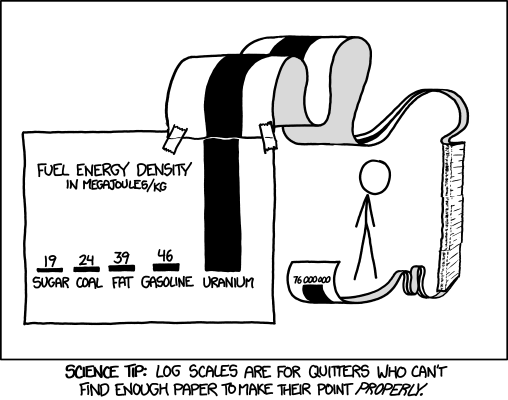
Log Scale

Knuth Paper-Stack Notation: Write down the number on pages. Stack them. If the stack is too tall to fit in the room, write down the number of pages it would take to write down the number. THAT number won't fit in the room? Repeat. When a stack fits, write the number of iterations on a card. Pin it to the stack.
18 Jan 12:50

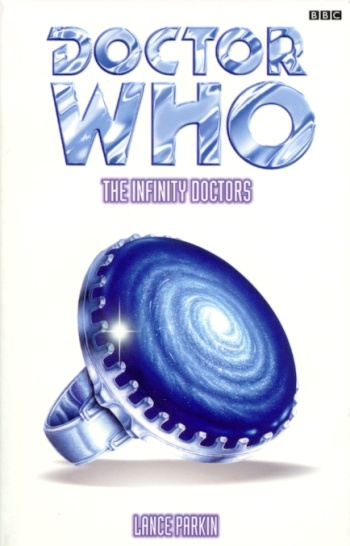
You Were Expecting Someone Else 16 (The Infinity Doctors)

by noreply@blogger.com (Philip Sandifer)

The Infinity Doctors, BBC Books’ 35th Anniversary book, presents the adventures of an unspecified version of the Doctor having adventures on Gallifrey, seemingly, but not necessarily prior to An Unearthly Child. The result, unsurprisingly, is wholly incommensurable with continuity. Cheekily, and typical of Parkin, he builds this out of an excessive loyalty to continuity. Parkin has noted that he built The Infinity Doctors by taking all of the Gallifrey stories at once and taking them seriously in such a way as to generate a tangled mess that makes internal sense but contradicts virtually everything outside of it. So if you try to place The Infinity Doctors as a prequel leading up to the series you run into the problem of Susan’s tangible absence. Repeated reference is made to Lungbarrow even though it provides an alternate theory of the Doctor’s departure from Gallifrey. The villain is nicked from The Three Doctors and another character from The Arc of Infinity, but both stories are nearly impossible to reconcile with the Time Lords’ relationship with Omega here. And so on and so forth. It’s all true, therefore none of it is.

As with Iris Wildthyme, the most interesting question is where the brakes get slammed on in this process. Parkin, after all, is not going to just casually destabilize the entire narrative of Doctor Who. The Infinity Doctors is carefully related to everything that’s going on around it even as it rebels and blows up all of the normal structures. The main clue, unsurprisingly, comes at the end, as the Doctor ponders the adventure here and comes to the conclusion that Gallifrey is unable to change and thus broken, and that he’s therefore going to have to go have adventures in time and space instead. So there we have it: the defining aspect of Doctor Who and what keeps it coherent is its mutability: the fact that it is subject to change.

In a purely factual sense, at least, this is more or less true. Doctor Who is still on the air in 2013 in a large part because Innes Lloyd took the decision in 1966 to recast the lead actor, thus allowing the show more or less completely free rein to change with the times. And while I might be the sort of person to quibble that this is perhaps somewhat flatter than a broad philosophical commitment to pleasure and fun in as many configurations as can be found, it seems unfair to complain merely that Parkin doesn’t have as thoroughly philosophic and theoretical a foundation as Paul Magrs.

Anyway, there’s a more interesting point to be made in all of this, which is that Parkin also constrains the extent of change. This takes place both on a pragmatic level - however much The Infinity Doctors may embrace change, it doesn’t throw anything from the past away. But more telling is its conclusion, in which the mind duel between the Doctor and Omega is resolved in part when the Doctor says that the power to rewrite anything renders it meaningless. Which is to say that Parkin is careful about what he means by change. He does not suggest that Doctor Who thrives through continually throwing out the past and inventing something new. He distinguishes between change and wholesale rewriting and reconceptualization. No, change is an incremental process based not only on what the thing changing becomes but on what it was at the start.

On a broad level, Parkin ties this to the arc of history. The problem the Time Lords have is that they are unable to change in a historical sense - their society has no sense of progress. So there’s a significant bit of parsing to be done here, distinguishing between a sort of mad flux of change and inventiveness and good old material social progress. The present, and more to the point the future, are of interest and given meaning only inasmuch as they extend from the past. Hence the sequence in which the Sontaran/Rutan war is resolved by locking General Sontar and the Rutan Host on the Doctor’s TARDIS for a good long while with a state of temporal grace in effect such that the two of them progressively work through trying to kill each other, independently seeking a solution, and finally cooperation and peace, effectively collapsing centuries or millennia of social development into one event.

But The Infinity Doctors takes seriously the prospect of change beyond mere linear development. It does not, after all, advance Doctor Who on to the Ninth Doctor. Instead it creates an alternate Doctor Who. This is significant - it’s a change not based on incremental historical development but on an act of creation. This too is something posited within the book itself - the Doctor defeats Omega with a non-existent anti-singularity, engaging in a raw act of creation. This creation is, of course, still influenced by the past; it’s still a form of change and progress. But it’s not linear development. It’s something else: a different form of history.

There are, of course, obvious parallels to be drawn to the act of writing and creation. Most of the Omega/Doctor duel doubles neatly as this. When the Doctor warns Omega that nothing has any meaning if you’re all powerful, he uses the example of creating and uncreating Skaro at will. So that’s a bit of an obvious swipe. But there are larger concerns as well, of course: the conventions of genre, for instance. Parkin notes in an interview that “I tried to tell something radical and ended up with the High Council plotting against the Doctor and ancient evil and ‘by Rassilon’s fingers’ and all that.” Which is to say that even in excess of what Parkin attempted, the conventions of the genre and form of “Gallifrey stories” weighed on him.

It’s not accurate to call this a shift or a development in Doctor Who. Rather, and fittingly for the argument being made, it is a reconceptualization of something that was always there. Doctor Who’s relationship with history and progress has never been one of social realism. This has at times been a frustration, as the series exists side-by-side with social reality and as a result interacts awkwardly with it in places. But the way Doctor Who engages history and progress is via the act of writing and creation. This is, of course, the most blatantly obvious thing imaginable to say about a work of fiction. But Parkin is entertainingly unwilling to simply let the fact lie there obvious and unstated, instead migrating the logic of how one usefully engages history and progress via fiction from a writerly concern to one within the narrative.

Which brings us to the question of what the book is doing in the broad sense. Of the books of the BBC era, The Infinity Doctors is perhaps the one that sticks out the most oddly in hindsight. Its entire basic mandate is to be the big movie version of Doctor Who. This was, in the 1990s, a chronic concern. Everyone was well aware of what the TV Movie had spared us, but with the failure of the TV Movie the newfound status quo was that if Doctor Who came back it was going to be as a BBC Worldwide produced movie, and Doctor Who Magazine dutifully repeated whatever the most recent flavor of rumor about the movie was. Doctor Who’s return to television was arguably delayed by a solid half-decade as initial meetings with Russell T Davies came to naught due to BBC Worldwide’s complaint that a new series might scupper their movie plans. So in 1998, for the thirty-fifth anniversary, all evidence was that if Doctor Who came back it was going to be a big Hollywood version, which was, inevitably, assumed to be a reboot of some sort.

Obviously, in 2013, this is something of a faded concern. Not an entirely faded one, as the frankly bizarre slow burn spat between David Yates and Steven Moffat on the subject of a Doctor Who movie demonstrates, but one that doesn’t way on day-to-day life particularly. At this point even if there is a movie the future of the television series seems secure for the foreseeable, which means that the prospect of a movie that overwrites television continuity isn’t really a risk. And let’s be clear, that is the big thing that people don’t like about the idea of rebooting Doctor Who. It’s not that the idea of a movie that doesn’t tie into TV continuity bothers them - after all, nobody loses sleep over Peter Cushing. It’s the idea of Doctor Who’s primary form denying its history. Which is understandable, as there’s no earthly reason why it should have to. As long as you start from the perspective of someone into whose world the Doctor drops and end with them falling out of the world there’s no reason you can’t start Doctor Who with the Eighth, Ninth, or Fiftieth Doctor.

Even within that, though, there’s a concern, which is that a movie would involve Doctor Who being run by people who didn’t “get” it. What getting it entailed is, of course, terribly contested, since there are plenty of us who would, for instance, say that Ian Levine doesn’t get Doctor Who. Nevertheless, there’s a sense, right or wrong, that before you get to be in charge of Doctor Who you have to earn your stripes, so to speak. So what we get here, from Parkin, is a demonstration of what a total reboot could look like if built out of an encyclopedic knowledge of the series - you know, by the guy who wrote A History of the Universe. And it’s interesting enough, and it works, but there’s something lost to it simply because its concerns are oddly foreign to the present day. The question of how you’d do a total reboot of Doctor Who seems wholly academic.

Worse, and if we’re being honest Parkin already identified the problem here, Gallifrey is boring. He couldn’t really escape that, ultimately ending up with the same broken structure of Gallifrey that he was reacting against. A thorough explanation of Gallifrey ends up being less than the sum of its parts. There are great ideas here, but they don’t have great implications. Which is what Gallifrey has always been - a cool and compelling image that has no usable depth, and that becomes less compelling the more clearly you show it. More broadly, this entire novel serves to prove a point that is, in hindsight, not as interesting as it seemed in 1998. Yes, he’s figured out how to do a reboot of Doctor Who, but that’s a kind of hollow prize in hindsight. Because all he’s done is reconfigured the mythology of an essentially unchanged show. Contrary to the prevailing wisdom of the 1990s, and for that matter of the 1980s, the Doctor’s relationship with Gallifrey is not the most interesting thing about the show. It’s just about the least interesting part of it, in fact.

Look, there’s no way to get around saying this, so let’s just bite the bullet: Parkin gets it wrong here. It’s vividly clear in hindsight that one of the best ideas Russell T Davies had in rebooting the series was nuking Gallifrey because it solved for once and for all the tension between having the Doctor be dwarfed by the magnitude of the Time Lords and having him be the narrative center of his universe. The Doctor is the last of the Time Lords. Perfect. Now he gets to be bigger and more important than all of them while simultaneously allowing them to be mythic and larger than life. Parkin’s strategy here, going back and finding a way to make Gallifrey work, turns out to have been the wrong one. Wiping Gallifrey out and leaving it to the imagination works so much better.

All of which is to say that despite seeming impressive, there’s something oddly insubstantial to The Infinity Doctors. It solves the wrong problems, and its solutions seem less weighty than they act. It’s a book that seemed very important at the time, and not just because it was proclaimed to be the 35th Anniversary book, but that in practice mostly reveals just how far off the reservation the BBC Books line had wandered. A brilliant solution to a problem that doesn’t exist is, in the end, not compelling.
17 Jan 21:17

One-Day Doctor Who Fandom Challenge: Favourite Season Countdown

by Alex Wilcock
To start their celebrations of Doctor Who’s fiftieth anniversary year, Jennie and Caron have embarked on a thirty-day “Fandom Challenge”, daily choosing their favourite and least favourite aspects of the series. I’ve not. Aside from my inability to get my finger out (and Richard and my both being rather ill at the moment), I don’t really like answering ‘least favourites’… So, to make up for that, here are my top ten favourite seasons (if you want me to answer another question from the meme, suggest it and I’ll think about it). And this isn’t a countdown of my favourite Doctors… Not least because Matt Smith, Patrick Troughton and Colin Baker might all be nipping at the heels of my favourite, and none of them get a look in. While the Doctors may have a quite a bit to do with it, this is much more about the stories, with of course quite a bit about me, too (my top two will be predictable as ever). And although it was reading about Jennie’s favourite season and Caron’s favourite season that inspired me to think about this, I completely disagree with both of them. Hurrah!


10: Season Seven – Exiled to Earth (1970)

Possibly Doctor Who’s most consistently strong season, where I could stick every single story in front of you and say, ‘There, that’s really good, that is.’ The Doctor has suffered the egregious fate of being exiled to Earth as Jon Pertwee, and ends up semi-working for the United Nations Intelligence Taskforce. This means we get the awesome Brigadier Lethbridge-Stewart (Nicholas Courtney), at pretty much his most awesome and, to start with, very much the lead, and Dr Elizabeth Shaw (Caroline John), the companion so brilliant and capable that she could only last one year. On the downside, it can be rather too consistent: in theory, it’s virtually all on Earth in the same period (the 1980s, probably. What? What?). I say ‘in theory’, because perhaps surprisingly, what you might think of as the UNIT paradigm of day-after-tomorrow Earth (probably being invaded) lasts precisely one story before they start undermining it. Still, with the Doctor all mouth and no TARDIS and with not much sense of playfulness, there’s something vital missing. Still, if you like your Who with a bit of a Quatermass flavour and a strong moral centre yet also lots of shooting, this is a bold, terrific relaunch for the series.

Great stories: Doctor Who and the Silurians, Spearhead From Space, The Ambassadors – SPROING! – of Death


9: Season Twenty-Nine / Season 2007 / Series Three – You Are Not Alone (2007)

One of the two Twenty-First Century seasons that really stand out so far, this captivates me with a powerful through-theme about what it means to be human, running alongside the Doctor’s story as ‘last of the Time Lords’. In both themes, after a fun but less focused season in between, this is from lead writer Russell T Davies’ natural, more reflective, more pessimistic successor to 2005’s return. From the mirroring of the last of Boekind and the last of the Daleks, then the last of humanity, to the ‘A Deal With God’ mirroring of the Doctor’s watch against the Master’s, the themes are carefully intertwined. This season’s favourite horror trope is more thematically consistent again, too: where Season 2005 was all walking dead but 2006 packed in a wide variety of horror / fairy-tale tropes, this time there’s a strongly vampiric feel, with repeated transformation and consumption of humans – starting with the Empress of the Racnoss, who feasts on us, transforms Donna and has a history much like that of the Great Vampires and the Yssgaroth, and carrying on through the plasmavore, the Carrionites, the various Dalek-human hybrids, Professor Lazarus transforming to give himself more life then sucking the life from his victims, the crew sucking the life out of a sun and possessed by it in vengeful turn, the Family wanting to consume the Doctor’s long life, the Weeping Angels leeching life and time from their victims, the cannibal Futurekind and the “Toclafane” prolonging their lives but losing their humanity, to ultimately – and most disturbingly – the Buffy vampires-as-demons-entering-a-human-body-and-giving-it-superpowers-while-overwhelming-the-personality idea inherent in the way that both John Smith and Professor Yana meet their ends… With the bonus of David Tennant finding his feet as the Doctor in suffering (and possibly through Freema Agyeman’s Martha Jones giving him a kick in the arse).

Great stories: Human Nature / The Family of Blood, Utopia / The Sound of Drums / Last of the Time Lords, Gridlock


8: Season Thirteen – Body Horror (1975-6)

Tom Baker’s second season as the Doctor, and his second in one year – and what a year! – sees more horror, but of a very different kind to Season Twelve. The Doctor himself is at his most grim and brooding; Elisabeth Sladen’s Sarah Jane Smith really comes into her own; and where the previous season had strong underlying themes emphasised by its own largely monochrome colour palette, here it’s as if the colour leads the stories – but what colour! The most visually startling of any Twentieth Century season, it explodes into rich, visceral, organic colours for stories which are, appropriately, the series’ most consistently horrific, with a recurring motif of body horror and possession and scientists changing from the previous season’s fascists to dangerous meddlers who disturb something horrible. Science was the sterile future; now it awakens the dark past and the all-too-fertile body. This time, there are very few references to Doctor Who, but an awful lot to famous horror stories: Frankenstein, the Wolf Man / Jekyll and Hyde, Mummies, Triffids, zombie android body-snatching pod-people… Plus starting with the Zygons, the series’ best one-off monsters between the Quarks and the Reapers. While in theory the season returns surprisingly often to UNIT, paradoxically it’s only to emphasise how far away the series has moved, and the defining stories are the ones with the fabulous historical setting, dark god and glorious score, the stunning alien world and nightmarish sci-fi burial alive, and the series’ own myths and black humour that herald what’s to come. This season establishes what feels like the most settled old Who pattern – five four-episode stories followed by a big six-parter that takes what’s gone before to its natural conclusion – but its vivid, thrilling tone has its own weaknesses: everything tends to get blown up at the end, there are very few women, and there’s little playfulness to leaven the mood. For all those reasons, it’s a terrific though flawed season, and perhaps the very best ever to show to small boys.

Great stories: Pyramids of Mars, The Brain of Morbius, Planet of Evil


7: Season Twenty-Six – New Games (1989)

Doctor Who’s last TV season of the Twentieth Century draws elements from many earlier ones – echoes of the very first story in its earthly child, of Season Seven’s almost entirely Earthbound setting and a world destroyed in the finale, of early Tom’s horror stories – but has an assured, mature confidence of its own. And though the BBC brought Doctor Who on screen to an abrupt pause, Season Twenty-Six looks forward, too, inspiring one of the greatest eras of Doctor Who, though sadly most of the New Adventures weren’t on the telly. That’s a fitting legacy for one of the most intelligent, innovative and impressive years in the history of the series. Sylvester McCoy had already become a darker Doctor; here, he and lead writer Andrew Cartmel add more subtle shades, with a more complex character and morality than the judgemental destroyer of the previous year. This gives his companion Ace (Sophie Aldred) more focus, with female empowerment another running theme (as the current DWM explores), and she brings the recognisable world in whatever strange setting she finds herself. There’s still often a dark feel, with a hint of magic – every story has something unearthly and unexplained, and each of them is packed with ideas and, looking forward to post-2005 Doctor Who, passion too.

Great stories: The Curse of Fenric, Ghost Light, Survival


6: Season Sixteen – The Key To Time (1978-9)

If Season Twenty-Six has a hint of magic, this marvellous season revels in it, the series at its most fairy-tale, fluffy and fun. Tom Baker’s enjoying himself as the Doctor, Mary Tamm’s Romana is icily fabulous, and this is easily the best season for K9 (John Leeson), all now collected together in a DVD box set for the show’s first serious ‘story arc’. Which, despite impending doom for the entire Universe, is rarely serious at all. The sheer entertainment of the actors and the style is massively boosted by some of the best writers ever to work on the Doctor, who include Douglas Adams, Robert Holmes and David Fisher (the most underrated, but who for my money gets the best balance of character and wit here, and is rather grown-up about sex). A compelling Doctor and companion having masses of fun, witty scripts, love, magic, a story arc, vivid women characters and even filming in Wales… It could almost be the series in the Twenty-First Century, if you stepped up the pace and budget and added all the old enemies. While the sparkly magical themes of quests, citadels and evil queens appear very cohesive on the surface, the battles between or rejection of gods underneath keep pointing in different directions – perhaps because producer and writers had different ideas about all-powerful superiors. And the stories themselves feature the Doctor sent on a mission from God, at which point he gets involved in a small-time scam and ignores the ‘important people’; the Daily Mail’s worst nightmare – young people today who are gay hoodies; a fabulous killer lesbian and sausage sandwiches; a summer holiday running around the countryside, playing at swordfighting with a moustache-twirling villain; more buttocks and tentacles on show than Torchwood; a skull on a stick, and the most Doctorish possible answer to absolute power…

Great stories: The Androids of Tara, The Ribos Operation, The Pirate Planet


5: Season Eighteen – Decay and Change (1980-1)

Tom Baker’s final season is something wonderful and strange, not the dry science it’s often dismissed as but a much older sort of story underneath: I may be the only person who loves both this and Season Sixteen to bits equally, and sees that amid their very different tones, both are making, in their own way, sci-fi fairy tales (just as Mr Moffat says he’s making today, and just as distinct from each other as they are from his). The ultimate in Who ‘concept albums’ from lead writer Christopher H Bidmead, this is one of those seasons that work best when you watch all the way through. Events cast shadows before them, and with Season Eighteen the long shadow of Tom’s departure, no wonder it’s so often hymned as “Change and Decay”. But it’s really the other way round – just as it’s wrong to see regeneration as a funeral, in a season of Decay and Change, every story features things set in their ways before collapsing, then ends in rebirth, whether people, societies or ultimately our heroes. By the season’s end, everything has changed, but with an irresistible sense of hope. Sombre yet still wittily quotable, beautiful but scary again, with gorgeous music and every penny seeming well-spent on great design thanks to new producer John Nathan-Turner, five stories out of seven brilliant and only one a bit saggy, I’d call it a triumph were it not for the sober tone. It makes for two striking bookends, as well: though all of Tom’s seasons have an unusual degree of thematic unity, this one closes his reign more coherently than any other since his first; and, the first season broadcast in the ’80s, it’s way ahead of any other season of the decade until the final one.

Great stories: The Keeper of Traken, Logopolis, Full Circle (Warriors’ Gate, The Leisure Hive)…


4: Season One – Wanderers in the Fourth Dimension (1963-4)

Several brilliant people invent the best idea ever invented in the history of the world and Verity Lambert and David Whitaker put it on TV with the impossibly brilliant William Hartnell as the Doctor to take us on adventures in time and space. And it’s not just a cracking concept, but a cracking start, nailed from the very beginning with perhaps the greatest single piece of television ever made, and the pieces rapidly come together with that theme, with the TARDIS, then with the Daleks and their world. The sound and visual design is inspired, and unlike anything else: weird and disorientating; dark and atmospheric; busy and terrifying; gleaming white and mind-expanding. The stories find their way into shaping the Doctor and the series in a diverse but strangely discrete assortment – for the only time, strictly split into either Earth and history or sci-fi and otherworldly – that set an amazing standard with five of the first six adventures simply superb. The great line-up of companions, especially teacher and goddess Barbara Wright (Jacqueline Hill), do as much as the Daleks to prompt the Doctor into becoming the hero. And everyone involved creates what, fifty years later, is still an astonishing launch for a series that’s still being carried forward today on the ever-expanding edge of that first explosion of imagination.

Great stories: The Aztecs, An Unearthly Child, The Daleks


3: Season Twenty-Seven / Season 2005 / Series One – The Trip of a Lifetime (2005)

At last, Doctor Who was back on television, and more fantastic than I’d dared to hope. This is still the most coherent of the Twenty-First Century series so far, just beating 2007, with its strong running story of Christopher Eccleston’s war survivor and Billie Piper’s shop assistant journeying together and bringing out the best in each other. Yet though the key themes are of the Doctor’s journey from suicidal survivor guilt to new life and love and Rose’s from shopworker just going with the flow to deciding the fate of all time and space, with underneath it all the looming and receding shadows of the Bad Wolf and the Time War, there are two other underlying ideas with very different tones to them. On the one hand, keeping all the stories within our solar system, from human history to the end of the Earth, makes the series not just down-to-earth but about the wonder of humanity… On the other, there’s a recurring motif of the walking dead. The Autons are plastic zombies; the Doctor and Cassandra, last survivors who ought to be dead; the Gelth zombies; aliens walking round inside dead humans; the Dalek is another last survivor who should be dead; zombies staff the Satellite 5 control room; Pete, dead but walking; gas-masked zombies; Blon Fel-Fotch Passameer-Day Slitheen as Margaret Blaine, another sole survivor, again walking around in a dead person; and a Dalek army made entirely from the dead. A bright and optimistic series, then, but – as Russell T Davies said – steeped in death. The first three episodes together (or simply that trailer) are just about a perfect introduction to Doctor Who, and it’s notable how many seasons since have started off with the same present-past-future template all covered within three weeks – and it’s not just those: there’s not a single weak story in all ten. While the music and visual design (barring the TARDIS) is no longer alien and bizarre, it still looks different to anything else on TV: matching the thematic consistency, this season simply glows, beautifully. Oh, and it’s all eerily (and, given Russell’s love of it, surely deliberately) reminiscent of Season Twelve, too, in both the structure and content of the stories…

Great stories: Father’s Day, Boom Town, Rose


2: Season Twelve – New Birth and Cold Science (1975)

This was the first Doctor Who season I ever saw, and I’ve always loved it. Yet if anything I’ve only grown to appreciate it more over the years. Striking out in a bold new direction, in come Tom Baker as the Doctor, Robert Holmes as lead writer, Philip Hinchcliffe as producer and the greatest titles ever. Here are companions intelligent, capable Sarah Jane Smith (Elisabeth Sladen) and adorable, pretty Harry Sullivan (Ian Marter). And it’s one of the most thematically unified seasons in the show’s history, on top of obvious links to get you from one story to the next. On screen, it’s the cold, monochromatic style that hits you – the vibrant new Doctor in red and a swirl of scarf often the only dab of colour – but the design theme reflects the scripted themes of fascistic elites placing survival at all costs over what makes us human, a mixture of sterility and rebirth. These cold abusers of science include: the nuclear blackmailers out to ‘reform’ society on scientific lines; the chosen survivors set to resettle a world; the alien mechanically testing humanity to destruction; thrilling new villain Davros devising the ultimate form of scientific ‘progress’ overwhelming individual feeling and decision; and the battle between humanity and its half-machine ‘descendants’ (though the last story falls to bits on delivery, hey, not even everything Holmes and Hinchcliffe touched could turn to gold). With other recurring motifs such as compelling speeches, disturbing torture, and even great big phallic missiles, this is an amazingly coherent season. I was coming up to three and a half when I started watching this, and I’ve got no idea what my life would have been like if I hadn’t. Tom Baker’s first three seasons are written through me like a stick of rock, and the Doctor, Harry and Sarah Jane seem as natural a team as I could imagine. I love this period. It scared me as a kid, inspired me growing up, and I still find new ideas in it today. What more does a television series need?

Great stories: Genesis of the Daleks, The Ark In Space, Robot


1: Season Fourteen – Dark Religion (1976-7)

Tom Baker, Philip Hinchcliffe and Robert Holmes – and Doctor Who – reach their height in a season with a sense of history that both builds on and goes way past what’s gone before, in style and substance, theme and design. Motifs of survival, vengeance and possession continue; colour palettes of sterile monochrome and visceral colour give way to darkness; rebirth and scaring small boys evolve into growing up; and science as fascism and science as dangerous meddling give way to science as sheer intelligence, for good or evil, pitting rationalism against dogma. You can still see them borrowing from horror, but there’s also much invention and experimentation, with a greater variety of settings and styles than in any season since the ’60s now the Doctor’s at last fully a wanderer again. Most of this season features rich, dark design aiding literate scripts in building believable societies, with the Doctor a Renaissance man in a dark Universe of ancient secrets and fallen glories, the stories often taking place at the fringes of or as codas to great events. The horror is both more full-blooded than before and leavened by vivid characters, much black humour, more satisfying conclusions than just a big bang and the Doctor finally coming out of a year-long sulk. I was five for this season, and during it Doctor Who was making my mind pop with ideas and inspiring me to start reading: I think it was Isaac Asimov who said the stories you loved the best are those you come to when you’re fourteen. Well, I wasn’t, but Doctor Who was, and made me feel like it (and did an Asimovian murder mystery here into the bargain).

The season’s key themes are laid out in The Masque of Mandragora like a manifesto. Enlightenment-set, it puts the importance of intellect and making up your own mind centre stage, pitching it against intrigue and dogma – so from here, the season unfolds into three main underlying ideas. The mind is this year’s battlefield, whether championing intelligence and rationalism or delving into the darker themes of mental domination and madness, with not just the human mind at stake but computer, robot, pig and even electronic group minds. That’s complemented by the running theme of growing up, from Marco trying to outgrow both superstition and his uncle, to the Doctor returning home before finding himself another world’s absentee dad (then saddled with heretic ‘granddaughter’ Leela). And on a personal note, I had a very religious upbringing, so I felt this was speaking my language: it’s impossible to miss the religious elements throughout the season, usually in opposition to intelligence and individuality (imagine!). Everyone’s in a cowl, even the TARDIS looks like a chapel, and if you split the season into two halves (as they did, on first broadcast; how modern), both have the same structure: a Catholicism-inspired society where an evil god sets religion against science and it’s the Doctor’s fault, taking the role of Adam or Prometheus; then the Doctor faces a self-styled scientific messiah; then a masked, post-death villain from another time mixes technology with religious trappings. This has been my favourite season since it first aired, and I’ve got more out of it as I’ve got older, as good as Doctor Who ever gets – so far… And to complete this Fandom Challenge, watch a fan-made Season Fourteen trailer here.

Great stories: All of them. Obviously. But in particular, three that stand out as among the best the series has ever produced: the Art Deco character study in psychological horror and extraordinary worldbuilding; Doctor Who in the inner city, with gangs, guns, stabbings, drugs and prostitution – which, ridiculously, turns out to be one of the most quotable and sheerly enjoyable works of television ever made; and the greatest Doctor Who story ever told, not least because it tells so many stories and fires off so many ideas in so much style – so that, to take just one thing about it, after Part One you’d pin it as ‘just’ a brilliant comedy horror driven by satirical dialogue, but it then overturns expectations into first nightmarish surrealism and then an action epic where hardly a word is uttered. Isn’t that the very definition of Doctor Who, that nobody should know what’s coming next?

And if you don’t know the stories that were coming last, they were, of course, this time in ascending order, The Robots of Death, The Talons of Weng-Chiang and – if you watch only one from this page – The Deadly Assassin.

17 Jan 18:35

Cllr Simon Wheale: Labour making the wrong choices for Manchester.

by John Leech MP
By releasing the council budget to the Manchester Evening News, and putting their spin on it before anyone could possibly read the facts, Labour’s Town Hall bosses have shown where their priorities lie. Playing politics rather than doing the right … Continue reading →
17 Jan 16:58

A game every Lib Dem should play...

by noreply@blogger.com (Richard Morris)


There's a cracking (if stomach churningly violent) new drama on C4 called Utopia.  It's basically about how quickly individuals can be traced and found by a mysterious, dark organisation operating on the edge of society. No, not the Tories...

Anyway, now C4 have produced a website where you can feed in some questions about your on line habits and lifestyle, and they'll tell you just how easy you would be to track down...

My time was 17 hours and 35 minutes. this puts me at the 'sitting duck' end of the spectrum..

Have fun...and be slightly afraid....
17 Jan 15:16

Who are the Lib Dem welfare rebels?

by andrewhickeywriter
17 Jan 15:16

munificent/vigil · GitHub

by andrewhickeywriter
17 Jan 15:16

Factcheck: How does the Coalition score on food poverty and living standards? | Full Fact

by andrewhickeywriter
17 Jan 15:16

An eyewitness to President Lincoln's assassination appeared on television in 1956

by andrewhickeywriter
17 Jan 13:43

The Things I Like Best

by Site Owner

All rhyme with 'ooh'
Doctor Who
Scooby Doo
I'm sorry I haven't a Clue
Fu-Manchu
Cthulhu
...and you.
17 Jan 01:59

Lib Dem wriggling on Europe comes back to bite Clegg on the bum

by Jonathan Calder
Yesterday Nick Clegg took part in a notably scratchy interview on the Radio's Today programme. In part this was due to that programme's philosophy that its own presenters are far more interesting and important than those they interview. Justin Webb once looked as though he might be an exception to this, but he now fits in very well.

Another example of the programme's failings, incidentally, was its coverage of this morning's helicopter crash. It took half an hour for it to be mentioned, and the show ended with John Humphrys informing us that the helicopter was still dangling from the crane. It was like watching a carthorse trying to do dressage.
But much of the blame for that unsatisfactory interview has to go to the Liberal Democrats themselves. Because our record on Europe and referendums was very difficult for Nick to defend.
Let me quote from an article I wrote in Liberal Democrat News - a rare example of my writing for that paper "because I had something to say, not because I had a deadline to meet":
The Liberal Democrats voted for a referendum on Maastricht. We called for one on the Lisbon treaty until we had the chance to vote for it in the Commons in February 2008. Then we walked out, demanding an in-or-out referendum instead. That has been our policy ever since, until we had a chance to vote for an in-or-out referendum on Monday, whereupon we voted against it. 
It may be possible to find a thread of principle running through this history – at the last general election we called for an in-or-out referendum only when "a British government signs up for fundamental change in the relationship between the UK and the EU" – but I have a simpler idea. Let’s stop calling for referendums on Europe altogether ... 
For years the main parties have engaged in something close to a conspiracy. The issue of Europe has been taken out of general elections, with the promise that it will be decided through a referendum. Those referendums never take place. The result has been an infantilisation of debate on Europe, as politicians are allowed to take up self-indulgent, extreme positions they know they will never have to defend to the electorate. 
This process has been bad for us Liberal Democrats, encouraging the idea that all we need do to prosper is not offend anybody and deliver lots and lots of leaflets. And it has been bad for democracy as a whole. Why should voters feel enthusiastic about Westminster when their representatives avoid talking about one of the most important issues facing the country?
I ended by saying that the way to thwart the Tory right  is not to shunt Europe off to referendum campaigns that never happen but to return the issue to the centre of our general election campaigns.

This is still what I believe today, and we cannot complain if our wriggling in an attempt to avoid talking about Europe appears less than impressive to journalists and voters.

Incidentally, the Tory enthusiasm for a referendum on Europe is yet another example of the modern Conservative Party's divorce from its own philosophy.

British Conservatives used to insist on the inherent superiority of our constitution on other models. Now they are happy to junk it because of their obsession with the European Union.
17 Jan 00:32

Who watches the watchmen, who edits the editors - some ironies.

by rkaveney@gmail.com
Now I have listened to the Radio 4 Media show it's clear that several important points that I made were edited out. Thankfully the stuff about #transdocfail made it through. What was cut?

At one point I suggested that, while some of the tweets aimed at Suzanne Moore were undoubtedly indefensibly unpleasant, freedom of speech applies to Twitter trolls as much as to Julie Burchill - though the difference is that, if people choose to, they can report abuse to the Lords of Twitter and offending tweets may be taken down. As was Julie's piece, when people protested.

I responded to the 'at least there is a discussion point' on its second or third appearance with the remark - and I said I first made it forty years ago which indicates just how unoriginal Burchill's piece was - that no-one would say that republication of the Protocols of the Elders of Zion made it easier to talk about anti-semitism.

When I suggested that someone at the Observer had thought, o Julie will stir things up, and commissioned that piece for that reason, and no other, the presenter said I couldn't know that was the case, to which I replied 'the race is not always to the swift nor the battle to the strong, but that's the way to bet.'

I did explain part of why 'Brazilian transexual' was unfortunate and mentioned I had contacted Suzanne Moore to explain why to her - again, that was cut.

More if I remember more - but there are points where I sound nervous because they cut me in mid-word, something they did not do to the verbose Young.

Oh, and I was asked to comment on whether I thought people should be sacked. I said that an internal process was going on at the Observer and it would be contrary to natural justice to discuss that while it was going on.

Freedom of speech is a great idea - I don't think I got it.
16 Jan 21:30

“Paperless NHS” puts the vulnerable at risk

by Zoe O'Connell

In the wake of the #TransDocFail hashtag, it has become clear that bad or abusive healthcare at the hands of medical professionals is still as common as it has been historically. Many trans folk have a simple fix for this: don’t tell random medical professionals your full history. This is tougher for trans men but in the case of trans women, “I take HRT and have no uterus or ovaries” tells them everything they need to know. The why simply does not matter one bit in the vast majority of interactions.

But the NHS wants your data, ostensibly because it increases patient safety, and Jeremy Hunt has agreed. Yet again, this is an example of how something that might give a benefit for the majority being wholly unsuitable in both principle and practice for already-marginalised groups. And it is not just medical professionals who will have access to the data: those involved in social care will also gain access.

I doubt that the trans community is the only group affected. One person has already expressed concern that those with mental health issues may also face discrimination. In just the same way as a well-meaning but clueless doctor can assume any complaint must be related to transition, obviously physical conditions often get mistaken for symptoms of mental health conditions in patients who have such a diagnosis.

Not being completely stupid (Hey, stop sniggering at the back) Hunt has promised a opt-out for those that don’t want to be on the new system, just as you can opt-out of the current NHS “Spine” summary database: “You absolutely have to have a process in place for people who don’t want that [data sharing] to happen“.

But opting-out of the spine is tricky, and if you’re obviously opted out of a database that everyone else is on it raises questions.

16 Jan 21:30

From E.S.L. to A/S/L

ON THE INTERNET 

To Do and Say

  • TO THINK:  ”I have not been completely inundated with self-validation about _____.”
  • TO SAY:  ”Am I the only person in the world who thinks _____?”


  • TO THINK:  ”I am irrationally excited by the overly familiar.”
  • TO SAY:  ”Squeeee


  • TO THINK:  ”I do not know the facts.”
  • TO SAY:  ”I’m sorry, but those are just the facts.”


  • TO THINK:  ”I have insufficient information to have an informed opinion about _____.”
  • TO SAY:  ”The problem is that you’re focused on _____, when the real problem is _____”


  • TO THINK:  ”My job and/or home life is extremely unfulfilling.”
  • TO SAY:  ”This altered photograph of Gene Wilder as Willie Wonka should make my feelings on this matter clear.”


TO DO:  A woman has asked to be treated with a modicum of respect.  Explain why she is a dirty whore.

  • TO THINK:  ”It is really a matter of public health.”
  • TO SAY:  ”You are fat.”


  • TO THINK:  ”I cannot be bothered to articulate my thoughts on this issue, because I am playing Angry Birds.”
  • TO SAY:  ”Meh.”


  • TO THINK:  ”I am having an affair with your sister.”
  • TO SAY:  ”I think it’s sad that you can’t learn to trust other people.”


  • TO THINK:  ”I am desperately insecure.”
  • TO SAY:  ”I have just checked in as the new Mayor of _____.”


  • TO THINK:  ”Everyone is wrong but me.”
  • TO SAY:  ”There are extremists on both sides of this issue.”


TO DO:  Justify your own constant appropriation of other peoples’ work while scolding someone about creator’s rights.

  • TO THINK:  ”I cannot comfortably conceive of a person whose tastes are at variance with my own.”
  • TO SAY:  ”If you don’t like _____, I don’t think we can be friends.”


  • TO THINK:  ”I take offense at everything.”
  • TO SAY:  ”I take offense at that.”


  • TO THINK:  ”I am a dolt.”
  • TO SAY:  ”tl;dr”


  • TO THINK:  ”I find my own neuroses endlessly fascinating.”
  • TO SAY:  ”I guess I just don’t conform to your mainstream standards.”


  • TO THINK:  ”I am a huge asshole.”
  • TO SAY:  ”I am the moderator of a Men’s Rights forum.”


TO DO:  Oh, no, it’s raining!  Tell your friends in other parts of the country how they have no idea what bad weather is really like.

  • TO THINK:  ”I have no idea what is happening, what is happening, make things stop happening”
  • TO SAY:  ”Reply:  All”


  • TO THINK:  ”I think of other people primarily as marketing tools for my personal obsessions.”
  • TO SAY:  ”Please RT”


  • TO THINK:  ”I have just read the Wikipedia entry about _____.”
  • TO SAY:  ”Obviously, you don’t know anything about _____.”


  • TO THINK:  ”I did not write this.”
  • TO SAY:  ”This is problematic.”


  • TO THINK:  ”I am a hypocrite.”
  • TO SAY:  ”I am on the internet.”


TO DO:  Explain someone else’s joke to them.

Mirrored from LEONARD PIERCE DOT COM.

16 Jan 17:00

Depression and Geeks

by MarkCC

Since this weekend, when the news of Aaron Swartz's suicide, there's been a lot of discussion of the goverments ridiculous pursuit of him, and of the fact that he suffered from depression. I can't contribute anything new about his prosecution. It was despicable, ridiculous, and sadly, all too typical of how our government works.

But on the topic of depression, I want to chime in. A good friend of mine wrote a post on his own blog about depression in the tech/geek community., which I feel like I have to respond to.

Benjy, who wrote the post, is a great guy who I have a lot of respect for. I don't intend this to be an attack on him. But I've seen a lot of similar comments, and I think that they're built on a very serious mistake.

Benjy argues that the mathematical/scientific/logical mindset of a geek (my word, not his) makes us more prone to depression:

Someone whose toolkit for dealing with the world consists of logic and reason, ideals and abstractions, may have particularly weak defenses against this trickster disease.

You realize that it’s lying to you, that there are treatments, that that things aren’t objectively as bad as they feel. But you know, on some level deeper than logic, that there is no point, no hope and no future. And to encounter, maybe for the first time, the hard limits of rationality, to realize that there’s a part of your mind that can override the logical world view that is the core of your identity, may leave you feeling particularly helpless and hopeless.

You can’t rationalize depression away, a fact that people who’ve never suffered from it find hard to comprehend. But if someone you care about is struggling with it, and it’s likely that someone is, you can help them find a new way to access their mind.

Tell them that you care about them and appreciate them and are glad to have them in your life. Show them that you enjoy being around them and that you love them. And above all, spend time with them. Give them glimpses of an alternate future, one in which they are secure, happy and loved, tear away the lies that depression needs in order to survive, and in that sunlight it will wither.

Most of what Benjy wrote, I agree with completely. The problem that I have with it is that I think that parts of it are built on the assumption that our conscious reasoning is a part of the cause of depression. If geeks are more prone to suffering from depression because the way that our minds work, that means that the way that we make decisions and interpret the world is a part of why we suffer from this disease. The implication that too many people will draw from that is that we just need to decide to make different decisions, and the disease will go away. But it won't - because depression isn't a choice.

The thing that you always need to remember about depression - and which Benjy mentions - is that depression is not something which you can reason with. Depression isn't a feeling. It's not a way of thinking, or a way of viewing the world. It's not something that you can choose not to suffer from. It's a part of how your brain works.

The thing that anyone who suffers from depression needs to know is that it's a disease, and that it's treatable. It doesn't matter if your friends are nice to you. It doesn't matter if you know that they love you. That kind of thinking - that kind of reasoning about depression - is part of the fundamental trap of depression.

Depression is a disease of the brain, and it affects your mind - it affects your self in a terrible way. No amount of support from your friends and family, no amount of positive reinforcement can change that. Believing that emotional support can help a depressed person is part of the problem, because it's tied to the all-too-common stigma of mental illness: that you're only suffering because you're too weak or too helpless to get over it.

You don't just get over a mental illness like depression, any more than you get over diabetes. As a friend or loved one of a person with diabetes, being kind, showing your love for them doesn't help unless you get them to get treatment.

I'm speakaing from experience. I've been there. I spent years being miserable. It nearly wrecked my marriage. My wife was as supportive and loving as anyone could dream of. But I couldn't see it. I couldn't see anything.

The experience of depression in different for different people. But for me, it was like the world had gone flat. I wasn't sad - I was just dead inside. Nothing could have any impact on me. It's a hard thing to explain, but looking back, it's like the world had gone two-dimensional and black-and-white. Eventually, I was reading something in some magazine about depression, and it talked about that flat feeling, and I realized that maybe, maybe that was what was wrong with me.

When I started taking antidepressants, it was almost frightening, because it changed the world so much. ANtidepressants didn't make me happy. In fact, for a while, they made me very sad, because I was realizing how awful I'd been treating my wife and daughter. But they made me feel things again. A few weeks after I started taking them, I realized that I was noticing colors. I hadn't done that for years. It wasn't that I couldn't see colors when I was depressed, but they didn't mean anything.

Antidepressants aren't a panacaea. They don't work for everyone. But there are treatments that can help. The way to defeat depression is to do something that changes the way the brain is functioning. For some people, the exercise of therapy can do that. For others, it's medication. For still others, exercise. The key is to get to someone who understands the disease, and who can help you find what will work for your brain.

My point here is that when we're talking about depression, we need to realize that most of the time, no one is at fault. People don't suffer from depression because they did something wrong, or because they're weak, or because they're flawed. People don't suffer from depression because their friends and family are inadequate. Depression is a disease - a treatable, chronic disease. It needs to be recognized, and it needs to be treated.

In my case, my depression wasn't caused by my wife and daughter. It wasn't their fault, and it wasn't my fault. No amount of support, love, and appreciation could have helped, because the nature of my depression meant that I couldn't see those things. The only thing that anyone could have done for me is recognized that I was suffering from depression, and pushed me to get treatment sooner.

If someone you know is suffering from depression, then they need help. But the help they need isn't any amount of love or appreciation. It isn't instilling any kind of hope, because depression kills hope in your brain. The thing that you can do to help is to help them get the treatment that they need.

Share

16 Jan 16:28

Comic for January 16, 2013

16 Jan 16:18

What the Hell is Wrong With You People?

Originally published at Sarah Brown's Blog. You can comment here or there.

Last week thousands of transgender people, sick and tired of suffering systemic and chronic abuse at the hands of an institutionally transphobic medical profession, decided we were going to tell the world about it.

Or at least the bit of it that reads Twitter.

It was relatively successful. Lots of people looked at the stories of routine and pointless abuse, abuse for its own sake, and were shocked.

So what did our intrepid press do? Did they decide to run daring exposés of this systemic abuse? Bring justice to a minority denied it for decades? Campaign to stop further abuse from happening?

No, they didn’t do any of these things. Noticing that it looked like a bit of a laugh, and the the doctors were getting away with it, they apparently decided to join in themselves.

So far we have the Guardian, Observer, Telegraph and today the Independent joining in (apparently we should be able to take a joke as our “shoulders are broad enough”). Interesting to note that this is mostly the broadsheets too. I await the contributions of the Times and Financial Times with interest. What will it be? A hilarious witty take on how trans women have deep voices, and are ugly, and how we have hairy arms, and smell and are stupid?

A development I’ve also seen this morning is the Dawkins Brigade joining in. Not just the ones who think rape is funny, but some of the ones who are horrified at the ones who think rape is funny, because while rape is definitely Not Funny, apparently trans people are. They can agree on that: laugh at the trans people, they’re funny. Ha ha!

Apparently this is about “freedom of speech”. When a newspaper editor publishes something randomly abusing trans people and then thinks better of it, and withdraws the article, this is an attack on Freedom of Speech and it is Censorship, and because trans people had the nerve to complain about being abused in the national press, it is Our Fault and we are The Censors, and Julie Bindel was right all along about a trans cabal.

The irony of telling a minority to shut up in a forum where we’re mostly being ignored anyway so that the majority can call us bedwetters in a national newspaper without worrying if their editor is going to pull the piece is apparently lost on “freedom of speech” campaigners.

I think, reflecting on this, I have one point to make: Freedom of speech is many things, but what it is not is the right to a column in the national press, free from editorial constraint, where you get to abuse “the little people”, and have a baying mob telling those same “little people” to keep quiet while our betters tell us how rank we are. In caricaturing it thus, you cheapen it.

Meanwhile, trans people are increasingly wondering what the hell is happening us and curling up into balls and feeling like begging for the abuse to stop. I know I am.

Please stop it. Please just stop. Stop.

Please?

16 Jan 02:18

Cross Purposes

by Andrew Rilstone
Can a place of work or a school have a dress code?
Yes.
Ought a place of work or school to have a dress code? Dunno. Depends on how extreme the code is and how good a reason for it there is. Asking people to wear hard hats on building sites, fair enough. Asking people to wear clowns hats in the office, not so much. Okay to ask men to wear a tie. Not okay to ban them from wearing trousers. Unless company in question was Jock McHamish's Kilt Emporium. Or the Perfectly Normal Transvestite Shop. Or, come to that, the Raunchy Nude Butler company. It's complicated.

Are you saying that dress codes aren't unreasonable in themselves, but a particular dress code might be unreasonable for some people under some circumstance?
It's complicated.
Is this a human rights issue? We have to come up with a vocabulary and framework for talking about these things, and human rights seems to be the one we've decided. If they'd asked me, we'd have reserved "human rights" for the big stuff like torture and war crimes, but they didn't. When t.c Tony Blair talked about access to the internet being a human right, I started to think that "human rights" had become one of those phrases that used to have a meaning but now just indicate mild approval from the speaker, like "stakeholder", "zero tolerance", and "British".
Might this ever be a human rights issue? If a prison or school or branch of Tescos had a policy of enforced nudity, then that would be a breach of someone's human rights, as well as an interesting premise for a porno movie. We should be careful of making assumptions about how different people from different backgrounds feel about modesty. If your culture tells you to wear a turban, what does it feel like to be caught with no turban? Is it more like "How incredibly embarrassing! I've come to work without putting a tie on"? Or is it more like "OMG my knickers have fallen down in public and everyone can see my arse!"? It's only a couple of generations since a woman walking down the high street without a hat would have caused a genuine scandal, after all.
If a place of work or a school has a dress code, should there be exceptions to it for people with strong religious convictions? It depends on the importance of the original dress code and the importance of the religious conviction. I don't think that I should be exempted from wearing protective clothing at work because I happen to have decided that I feel like wearing my "Smile, Jesus loves you" tee shirt today. If a company has made a rule about wearing badges, then I am not sure that it makes any difference if the badge in question is a skull and cross bones or an icthus. 
What are these strange "badges" of which you speak? I believe that they are what foreigners would call "buttons". You may have become confused about the differences between "trousers" and "pants" several pages ago.
Is the law prohibiting Christians from displaying signs of their faith a breach of their human rights? I don't know. But it seems pretty intolerant and mean spirited to me.
Is there, in fact, a law prohibiting Christians from displaying signs of their faith? No. Of course not. Don't be silly. Just walk down your street and count how many cars have Christian fishes on them, and, for that matter, how many cars have those nasty little Darwin fishes on them.
Do some companies have a dress code which forbids the wearing of jewellery at work? Apparently so.
Are people who want to wear crosses, stars of david or rosaries at work automatically exempted from the "no jewellery" rule? Apparently not.
Have you ever seen anyone wearing a rosary at work? No. Of course not. Don't be silly. 
Should there be an exception? It depends on the importance of the rule and the importance of the jewellery. If you are working on a production line and jewellery is dangerous, then there should probably not be an exception. If you are putting books on shelves in a library and it's a very small and discrete cross, then there probably should be. If wearing a small cross is a compulsory element of your sect, then almost definitely. 
Wouldn't that mean that Motorhead fans and members of the Liberal Democrats would suddenly decide that wearing small badges was a compulsory part of their faith? Almost certainly. If you say that "literary merit" is a defence against a charge of indecency or obscenity then every publisher in the country is going to claim that his top shelf magazine is a work of serious literature.
Are there, in fact, any Christian sects for whom wearing a cross at all times is compulsory? No. Of course not. Don't be silly. 
So how did "the human rights court is deciding if companies should be legally obliged to waive their dress codes for Christians who want to wear jewellery to work" become "the human rights court is deciding if Christians should be banned from wearing crosses in public"?  See under "Eric Pickles", above. 
Why does he think its such a big deal? It isn't quite clear. He doesn't think that people should be allowed to wear crosses because everybody should have the same freedom as everybody else and subject to that as much freedom as possible; he thinks that people should wear crosses because Faith is a good thing and we want more of it. It doesn't matter too much in what. But he has a purely instrumental view of this Faith stuff.  He doesn't think Faith is a good in itself; he thinks it's a good because "it provides a clear moral compass and a call to action that benefits society as a whole", whatever that means.
So he really cares about "society as a whole" and sees Faith as a means to an end? That's what I meant by "instrumental", yes. 
So, in fact, he worships "society" rather than God? Yes Socrates; that is indeed the case.
Is that roughly what you would expect a member of discredited right wing government to do in a country where the dominant folk religion has always been a sort of Christian tinged secular pelegianism? Oh, Socrates, you are so much cleverer than us!
Would the world be a happier place if I refrained from reading the Daily Telegraph even when someone has left a copy of it on my table? Very probably.
What's the difference between analogy and allegory? Analogy is when strawberries being you out in spots. Allegory invented the internet.
15 Jan 21:54

Opinion: The Burchill controversy – a mixed blessing for the trans community

by Zoe OConnell

I have followed recent mainstream media events unfolding around the transgender community with a mixture of excitement, anxiety and sadness.

Excitement, because it is rare that trans issues get coverage that isn’t designed to portray us as perpetrators of some hideous evil. Even though the stories started with biased coverage in the Guardian about a doctor under investigation by the General Medical Council, it turned into something more positive when the #TransDocFail hashtag lead to LibDem Councillor Sarah Brown discussing the issue on BBC Radio. Even the continuation of bad reporting had a silver lining, when Julie Burchill’s transphobic screed in The Observer lead to widespread condemnation from the internet at large and calls for her to be sacked.

Trans people have put up with biased reporting and name-calling for years, even suffering from the ignominy of having transphobic writers nominated for awards by LGB campaigning groups. The difference here is that, oblivious to the turning of the tide when it comes to hate speech, Julie Burchill and the editors of The Observer finally crossed a line that mainstream opinion could not ignore.

Anxiety, because I worry what will happen to stories like this when the mainstream press gets hold of them. Besides the usual errors, such as erasure of trans men and use of “transsexuals” as a noun rather than an adjective, coverage has been on the whole pretty positive. Except for one point: The anti-trans lobby has been allowed to rewrite history in portraying a “baying mob” that hounded Suzanne Moore off Twitter, which was the catalyst for Julie Burchill’s piece. In reality, although someone picked her up for her “Brazilian transsexuals” comment online, that sort of behaviour is so common that, against the background of lady-boy jokes on BBC TV, that it would not even warrant a footnote in the annals of trans history. It was her subsequent abusive response to polite criticism from non-trans people on Twitter including the phrase “lopping bits off your body” that angered people.

If there was a mob on Twitter, then the leader was Suzanne Moore who reacted to valid criticism with abuse before flouncing off the site for a couple of days. But despite some disgusting language from Julie Burchill, her version of the “facts” has been accepted almost unquestioningly by many, because it appeared in a national newspaper.

And sadness because the reaction of some has been to complain that people expressed an opinion against hate speech, accusing those who dare speak out against oppression of being “identity politics obsessed lefties”.

Of course, my challenge to this on Twitter (after the piece was publicised on Twitter) was characterised as “intimidating” the proving the point, despite the acknowledgement that I was being polite. I do wonder about the mental processes of anyone involved in politics who thinks a polite exchange is intimidating. Have they ever been in a council meeting?

The crux of this argument seems to be that if anyone dares mention trans issues at all, they will be mercilessly attacked. The trouble is not that a non-trans person mentioning trans issues will cause outrage, as I do not see any such response to excellent posts by Caron Lindsay and Jennie Rigg. The issue comes when you assume a position of privilege but act from a position of ignorance.

Oppressed groups have recently found a voice via the Internet, and sites such as Twitter have recently boosted this even further. Journalists such as Julie Burchill (and others before her, such as Suzanne Moore, David Batty and Julie Bindel) have had a voice via the pages of The Guardian and The Observer that enables them to reach a million people. A voice that, according to the Leveson report, “fails to treat members of the transgender and intersex communities with sufficient dignity and respect” and “continues to refer to the transgender community in derogatory terms, holding transgender people up for ridicule“.

Complaining that these people are being silenced when they have such a loud voice that has gone hitherto unchallenged is simple oppression of those who have never had that voice.

If there is an issue with the kind of pieces these people have been writing for years expressed on Twitter, then consider that the Internet is revealing decades-old inequalities and injustices, not creating them.

* Zoe O'Connell is a member of the LGBT+ Liberal Democrats executive and author of the Complicity blog.

15 Jan 21:52

Trying to be a good trans* ally: round up of developments on Burchillgate and related issues

Something that has really warmed the cockles of my flinty old heart the last couple of days has been the number of people - of all genders, cis and trans*, from most sides of the political divides - who have come together to say "hang on a minute, THAT'S not on" to the way trans* people are being treated by the media. Slightly less gratifying is the way that this all seems to be centred on the media and how everyone on all sides is being mean to the media, and not on the actual people who are suffering - and if you need any proof of trans* people's suffering, check out the #transdocfail hashtag on twitter, also covered in the Grauniad and by Zoe; or maybe look into forced divorce - but that's par for the course. What has happened is that people are suddenly starting to pay attention to trans* folk and listen to their voices. This can only be a good thing in my view.

Obviously many of the articles over the last few days concentrate on Burchillgate. The ones that I am going to link to below constitute an interesting cross section for those who are feeling a bit lost as to what is going on.
  1. Everything You always wanted to know about trans* issues but were afraid to ask by Jennie Kermode in The New Statesman
    The New Statesman is doing a trans* issues week this week. Presumably this was arranged long before the weekend's events, but it's good timing from them. The piece I link to above is a very good place to start if you're totally clueless on trans issues.

  2. On feminism, transphobia and free speech by Laurie Penny.
    Laurie argues that feminism and the trans* rights movement should be fighting for the same objectives: To learn that the world is not divided into ‘normal’ people and ‘freaks’ with you on the safe side is uncomfortable. To admit that gender identity, like sexual orientation, exists on a spectrum, and not as a binary, is to challenge every social stereotype about men and women and their roles in society. Good. Those stereotypes need to be challenged. That’s why the trans movement is so important for feminism today.

  3. The Burchill controversy: a mixed blessing for the trans community by Zoe O'Connell.
    Regular readers might have noticed that I link to articles by Zoe a lot. This is because she is awesome. Read the very balanced and well-sourced article linked if you have any doubts on that. She has a way of summing things up that just slots nicely into my brain patterns. I'm not going to pull out a quote because I really think you should read the whole thing.

  4. Julie Burchill, transphobia, and hostility towards the victims of oppression by Dean Burnett in the Grauniad.
    Dean is a neuroscientist, and in this piece theorises that the Just World Hypothesis might have something to do with the irrational way many people who are supposedly advocates for social justice are behaving on this issue. He also says that given... the Guardian's perceived poor track record in this area, I felt it was necessary to have at least one piece published under the Guardian banner that presented transphobia as illogical and irrational, which it definitely is.

  5. What the hell is wrong with you people by Sarah Brown.
    Sarah is another of those people who I link to a lot because I think she's awesome. In this piece she comprehensively dismantles the idea that oppressed people and their supporters pointing out to bigots that they are being bigoted is an attack on free speech. This is something I struggle to understand myself. Surely if a person is free to speak then other people are equally free to respond? Isn't that what free speech means? I don't want to support the kind of free speech that's only free for the powerful and the rest of us have to shut up... The comments on this piece are also well worth reading.

  6. Savile: Denialism and the "grooming the nation" delusion by Martin Robbins in The New Statesman
    Lest we think this is all high-falutin' academic discourse, Martin points out the very real dangers that all women, cis and trans, face in our rape apologist culture. I would argue that this also applies in different ways to racial minorities, genderqueer folks that don't fall under the banner of "women" for whatever reason, and basically anyone who does not conform to our society's rigid standards of "normality". Nobody should be enslaved by conformity, policed by loudmouths on the street, and that's why I am a Lib Dem, right there.
Hopefully those articles have given you a flavour of why I feel so strongly about this, even though it nominally doesn't affect me as a cis woman. Firstly, even though I'm cis, there are people I love who are not. Secondly, I don't want to see ANYBODY oppressed by the powerful because of who they are. People don't fit into neat little boxes of worthy and unworthy just because they fit into demographic groups of one sort or another. We are all individuals, and some of us have more struggles than others, but those of us who are struggling less should be helping those who are struggling more, not demonising them.

So if you're poor, I'm on your side. If you're black, I'm on your side. If you're disabled, I'm on your side. And if you're trans? Damn right I am on your side. Because at the end of the day, we all need to work on this, TOGETHER.

comment count unavailable comments
15 Jan 20:40

Midwinter Night’s Dreams #17

by Rick

Pen and Ink, 1994

15 Jan 20:40

A Midwinter Night’s Dreams #20

by Rick

Pen and ink, 1994

15 Jan 20:36

Bad science reporting again: the Eskimos are back

by Geoffrey K. Pullum

You just can't keep a bad idea down. And you just can't lift the level of bad science journalism up. David Robson of New Scientist, in a piece published in that pop science rag a couple of weeks ago (issue of 22/29 December 2012, p. 72; behind a pay wall) and now also published in the Washington Post, reports on a book chapter by Igor Krupnik and Ludger Müller-Wille about anthropologist Franz Boas's travels in the early 20th century with a Canadian Inuit band whose language he learned. Robson says of Boas:

Mentioning his observations in the introduction to his 1911 book "Handbook of American Indian Languages," he ignited the claim that Eskimos have dozens, or even hundreds, of words for snow. Although the idea continues to capture public imagination, most linguists considered it an urban legend, born of sloppy scholarship and journalistic exaggeration. Some have even gone as far as to name it the Great Eskimo Vocabulary Hoax. The latest evidence, however, suggests that Boas was right all along.

Not a single statement in this passage is correct.

  • Boas never "ignited" the familiar claim. That came many decades later, after a major role had been played by popular works (among them an article by Benjamin Lee Whorf and a book by Edward T. Hall called The Silent Language). Boas made no quantitative claims at all; he just noted that languages didn't necessarily draw the lines between the lexemes in semantic fields in the same places as other languages: Canadian Inuit separates falling snowflakes (for which the qana- root is used) from snow lying on the ground (for which the api- root is used), just as English separates water running along (as in river) from water standing still (as in lake), and so on. He was stressing that this arbitrariness of lexical denotation boundaries was something the two languages had in common, not that Inuit was quantitatively unusual.

  • It is not true that "most linguists considered it an urban legend": many taught it in their introductory classes throughout the 1960s and 1970s and on into the 1980s, and I am sure there are some who still do. Quite a few have never paid attention to the story and have no view on it (linguists are much less interested in "X has many words for Y" stories than the general public seems to be). Some are expert Eskimologists and have very nuanced (and divergent) evidence-based views on the issue. Many may have thought the supposed factoid was a bit of a cliché (I certainly did even when I was an undergraduate). But it was not a linguist who first noted that there was a kind of urban legend here. That point was first made in 1982 when anthropologist Laura Martin gave a paper to the American Anthropological Association on the topic. Anthropologists squealed, and referees hated her, but by 1986 she had managed, with difficulty, to get a short research report (not a full article) published in American Anthropologist. Yet still virtually no linguists knew of that paper until years later.

  • It is not true that "some have even gone as far as to name it the Great Eskimo Vocabulary Hoax." Just one person named it thus: I did. The phrase was the title of a 1989 humorous essay (later included in a 1991 book with the same title), an essay in which I tried to publicize Laura Martin's work. I mocked the credulous parroting and arbitrary numerical invention that one finds in newspapers and magazines, and critiqued the practice of repeating traveler's tales about exotic peoples without having any evidence. Forgive my pique, but I'm a bit annoyed to see Robson attributing my only contribution, the cutesy name, to folklore. It was not a current phrase that linguists in general were using; it was a title I invented, and I'm getting a bit tired of people picking up the phrase without citing me. (There was another such incident not long ago; I'll tell you about it later.) Robson didn't mention Laura Martin either, and that's even worse, since her paper was scholarly and serious, and opened up the topic.

  • Finally, the new evidence from Krupnik and colleagues (and it is not really new, just re-examined lexicography in a book chapter from 2010) does not suggest for the first time that Boas was right all along. Nobody ever doubted that Boas was right in what he said: his anodyne factual observations held no trace of the usual story — the notion that there are scores or hundreds of different snow types that only Eskimos can distinguish because only they have the different names that are needed. Boas cited four snow-connected roots, and made (in 1911) no claim that there were others, or that four was a lot. What Krupnik and Müller-Wille do is to clarify (very usefully) Boas's role as a student of Canadian Inuit and to catalogue some snow and ice vocabulary and allege (somewhat unfairly) that linguists like me were wrong all along to cast aspersions on the myth-repeaters. (I will comment on the Krupnik team's results another day.)

It was never in doubt that there were several distinct Eskimoan lexemes denoting snow phenomena: Boas had given four (Robson also cites just four, though they are different ones), and there are certainly some others. But one has to be rather careful if counting distinct snow terms is the game. What is a snow term? Some Eskimoan dialects use a derived word (kavisik) meaning "snow with a herring-scale pattern on it caused by re-freezing of rain pockmarks on fallen snow," but the root (not found in the Fortescue/Jacobson/Kaplan Comparative Eskimo Dictionary) appears to mean "herring." So we need criteria for deciding whether that would be counted as a snow word or a herring word — not an insignificant matter, especially with a language that has such productive word formation that you can construct arbitrarily many derived words for snow or herring or coffee or anything else. Similar cautions hold for many other items. Illuksaq in Greenlandic has been cited as a word meaning "snow suitable for building an igloo", but in fact illu- means "house" and -ksaq means "stuff for the construction of", so illuksaq means "house-building material". It is not a snow word at all. In a similar way, I have seen a word for soft snow cited, but it appeared to be based on the root meaning "soft", and a word for early autumnal snow apparently based on the root for "fall", and so on. I'm just not sure how many of these should count as snow terms.

No one will pay attention to such details now. New Scientist and the Washington Post have announced that Boas claimed there were fifty snow lexemes and that new research has now confirmed this; so everyone will believe that, since they wanted to believe it anyway, and they will keep on repeating the same drivel about things-people-have-multiple-words-for that they have so often repeated in the past. A depressing prospect, but it seems inevitable.

My article, which Robson clearly never looked at, was not aimed at establishing a negative quantitative claim about Eskimoan lexical resources. It did add some documentation of the absurd numerical exaggerations that were current by the end of the 1980s, but it was primarily satirical. It mocked people who pick arbitrary numbers out of the air and use the factoid about the alleged hundreds of snow lexemes to make themselves sound clever without having a shred of evidence to support what they said about these languages of which they know nothing. Robson has simply made it easier for people to go on doing that.

15 Jan 16:01

Boy: Now that's what I call an official spokesman

by noreply@blogger.com (Richard Morris)
I don't know who this was* but hats off: if you're going to make a statement, make it like this...

In response to "Why isn't Nick Clegg attending the Privy Council?...' The Telegraph reports the following:


“I can’t believe we are having this ------- conversation again,” an aide to the DPM emoted in a tirade worthy of Malcolm Tucker in the television series The Thick of It. “The ------ fact is he can’t ------- be everywhere, but I know you are going to go off and write that the DPM has ------- snubbed the Queen once a ------- gain.”

Blimey

* but I can guess