| archive - contact - sexy exciting merchandise - cute - search - about | |||
| dinosaur comics returns monday! in the meantime, here's an a softer world kickstarter! :o
|
|||
| ← previous | August 15th, 2013 | next | |
|
August 15th, 2013: Hey there is an A Softer World Kickstarter! You should get in on this A Softer World Kickstarter! One year ago today: let's play the floor is lava! on alternating tiles! in an 8x8 grid! look if you don't like my rules you don't have to come over anymore – Ryan 
| |||
Andrew Hickey
Shared posts
18 Aug 11:31
hello humans are you worried that one day bad things might happen because hah hah honestly me too


15 Aug 19:54
The NSA is Commandeering the Internet
by schneier
It turns out that the NSA's domestic and world-wide surveillance apparatus is even more extensive than we thought. Bluntly: The government has commandeered the Internet. Most of the largest Internet companies provide information to the NSA, betraying their users. Some, as we've learned, fight and lose. Others cooperate, either out of patriotism or because they believe it's easier that way.
I have one message to the executives of those companies: fight.
Do you remember those old spy movies, when the higher ups in government decide that the mission is more important than the spy's life? It's going to be the same way with you. You might think that your friendly relationship with the government means that they're going to protect you, but they won't. The NSA doesn't care about you or your customers, and will burn you the moment it's convenient to do so.
We're already starting to see that. Google, Yahoo, Microsoft and others are pleading with the government to allow them to explain details of what information they provided in response to National Security Letters and other government demands. They've lost the trust of their customers, and explaining what they do -- and don't do -- is how to get it back. The government has refused; they don't care.
It will be the same with you. There are lots more high-tech companies who have cooperated with the government. Most of those company names are somewhere in the thousands of documents that Edward Snowden took with him, and sooner or later they'll be released to the public. The NSA probably told you that your cooperation would forever remain secret, but they're sloppy. They'll put your company name on presentations delivered to thousands of people: government employees, contractors, probably even foreign nationals. If Snowden doesn't have a copy, the next whistleblower will.
This is why you have to fight. When it becomes public that the NSA has been hoovering up all of your users' communications and personal files, what's going to save you in the eyes of those users is whether or not you fought. Fighting will cost you money in the short term, but capitulating will cost you more in the long term.
Already companies are taking their data and communications out of the US.
The extreme case of fighting is shutting down entirely. The secure e-mail service Lavabit did that last week, abruptly. Ladar Levison, that site's owner, wrote on his homepage: "I have been forced to make a difficult decision: to become complicit in crimes against the American people or walk away from nearly ten years of hard work by shutting down Lavabit. After significant soul searching, I have decided to suspend operations. I wish that I could legally share with you the events that led to my decision."
The same day, Silent Circle followed suit, shutting down their e-mail service in advance of any government strong-arm tactics: "We see the writing the wall, and we have decided that it is best for us to shut down Silent Mail now. We have not received subpoenas, warrants, security letters, or anything else by any government, and this is why we are acting now." I realize that this is extreme. Both of those companies can do it because they're small. Google or Facebook couldn't possibly shut themselves off rather than cooperate with the government. They're too large; they're public. They have to do what's economically rational, not what's moral.
But they can fight. You, an executive in one of those companies, can fight. You'll probably lose, but you need to take the stand. And you might win. It's time we called the government's actions what they really are: commandeering. Commandeering is a practice we're used to in wartime, where commercial ships are taken for military use, or production lines are converted to military production. But now it's happening in peacetime. Vast swaths of the Internet are being commandeered to support this surveillance state.
If this is happening to your company, do what you can to isolate the actions. Do you have employees with security clearances who can't tell you what they're doing? Cut off all automatic lines of communication with them, and make sure that only specific, required, authorized acts are being taken on behalf of government. Only then can you look your customers and the public in the face and say that you don't know what is going on -- that your company has been commandeered.
Journalism professor Jeff Jarvis recently wrote in the Guardian: "Technology companies: now is the moment when you must answer for us, your users, whether you are collaborators in the US government's efforts to 'collect it all -- our every move on the internet -- or whether you, too, are victims of its overreach."
So while I'm sure it's cool to have a secret White House meeting with President Obama -- I'm talking to you, Google, Apple, AT&T, and whoever else was in the room -- resist. Attend the meeting, but fight the secrecy. Whose side are you on?
The NSA isn't going to remain above the law forever. Already public opinion is changing, against the government and their corporate collaborators. If you want to keep your users' trust, demonstrate that you were on their side.
This essay originally appeared on TheAtlantic.com.
Slashdot thread. And a good interview with Lavabit's founder.
Tadeu, Netreaper80 and 3 others like this
15 Aug 19:40
 You can use the idea of “youth culture,” or your vague understanding of that idea, to sell most anything. Witness this 1969 advertisement: “Get high on honey.” And witness the advertisement to the left, in which Stevie Staple-Freak helps the next president. If Stevie weren’t grooving on presidential candidates, his long hair, plaid bells, and two-tone shoes would be sufficient to mark him as a cool guy. He could have gone to high school with Greg Brady.
I wrote youth culture, not counter-culture : Stevie is working within the system, defeating a “radical anarchist” and bringing order from chaos with his Swingline Tot stapler. And yet he’s a freak. And the narrative line here is itself freaky, loopy, wobbly, comix-like. In what television studio do past presidents become future presidents? In what time-frame do Washington and Lincoln debate? And in what material world can one staple the blades of a fan to a hat? It feels like a bad trip to me — not that I would really know.
This ad appeared in the October 1972 Boys’s Life. Click (the ad, not the magazine) for a larger view. And here, if you like, is a Swingline Tot looking just like the one in the ad.
The artist responsible for these illustrations has since moved in other directions. You can read about Nicholas Zann at his website.
Related reading
All stapler posts (Pinboard)
You’re reading a post from Michael Leddy’s blog Orange Crate Art. Your reader may not display this post as its writer intended.
This work is licensed under a Creative Commons 3.0 License.
Stevie Staple-Freak
by Michael Leddy
 You can use the idea of “youth culture,” or your vague understanding of that idea, to sell most anything. Witness this 1969 advertisement: “Get high on honey.” And witness the advertisement to the left, in which Stevie Staple-Freak helps the next president. If Stevie weren’t grooving on presidential candidates, his long hair, plaid bells, and two-tone shoes would be sufficient to mark him as a cool guy. He could have gone to high school with Greg Brady.
I wrote youth culture, not counter-culture : Stevie is working within the system, defeating a “radical anarchist” and bringing order from chaos with his Swingline Tot stapler. And yet he’s a freak. And the narrative line here is itself freaky, loopy, wobbly, comix-like. In what television studio do past presidents become future presidents? In what time-frame do Washington and Lincoln debate? And in what material world can one staple the blades of a fan to a hat? It feels like a bad trip to me — not that I would really know.
This ad appeared in the October 1972 Boys’s Life. Click (the ad, not the magazine) for a larger view. And here, if you like, is a Swingline Tot looking just like the one in the ad.
The artist responsible for these illustrations has since moved in other directions. You can read about Nicholas Zann at his website.
Related reading
All stapler posts (Pinboard)
You’re reading a post from Michael Leddy’s blog Orange Crate Art. Your reader may not display this post as its writer intended.
This work is licensed under a Creative Commons 3.0 License.
15 Aug 19:39

At the Bipartisan Policy Center, is cash the real divide?
by Lydia DePillis
So bipartisan! Democrat Henry Cisneros and Republicans Mel Martinez and Kit Bond. (Bipartisan Policy Center Facebook page)
The word “bipartisan” carries a special weight in Washington. If something’s bipartisan, it’s presumed to be fair and balanced. Just get an approximately equal number of Democrats and Republicans together to agree on something, and it should inoculate you against attacks from either side.
But what if the sheen of bipartisanship masks a deeper, more important bias? That the real divide in Washington is between those who can afford to pay for manufactured reports and white papers, and those who can’t or don’t want to?
That’s the central allegation facing the Bipartisan Policy Center, a nonprofit founded in 2007 by former Senate majority leaders Howard Baker, Tom Daschle, Bob Dole and George Mitchell. As the self-proclaimed “only Washington, DC-based think tank that actively promotes bipartisanship,” it says it “drives principled solutions through rigorous analysis, reasoned negotiation and respectful dialogue.”
Over the past month, the center faced attacks for perhaps being not nearly so principled as it claims. The Nation magazine dinged the center for its role in shepherding a plan for major U.S. retailers to improve conditions at Bangladeshi garment factories, when it had received funding from Walmart and several of its affiliated scholars had worked or lobbied for some of the other companies involved. Investigative journalist Ken Silverstein, in a piece for Harvard’s Safra Center for Ethics, outlined how the BPC takes money from oil and gas interests while promoting expanded drilling in a report overseen by a lobbyist who’d done work for ExxonMobil.
This week, the BPC is the subject of a scathing report from Ralph Nader’s consumer advocacy group, Public Citizen. The authors charge that, soon after receiving funding from the American Banking Association and Citigroup, the center convened a project on financial regulatory reform stacked with industry advocates meant to examine what could be improved in the Dodd-Frank Wall Street Reform and Consumer Protection Act as implementation got underway.
Public Citizen’s worries were bolstered by the resignation of John Coffee, a Columbia University law professor who was among the few on the task force who was not affiliated with industry.
“The Task Force has been bipartisan in terms of political parties,” Coffee says. “But it was not bipartisan in terms of the critical division in Washington: The financial services party and the reform party.” Coffee had been satisfied with a previous BPC project on capital markets, which had been staffed purely with academics. This one, not so much. He was assigned to a working group with Annette Nazareth, a former Securities and Exchange Commission member who now works on financial issues for the mega-law firm Davis Polk. They couldn’t agree on what to do about money market mutual funds, and Coffee quit.
“I just felt that whether they were Democrat or Republican, the people I was dealing with were professionally engaged in serving the financial services industry,” he says. “All they wanted to discuss was further deregulation, and I thought it was a waste of my time. There were Democrats, former SEC commissioners. But if you are a partner with Davis Polk, which is the firm most involved in lobbying on these issues, you’re really not neutral or objective.”
Another academic on the 15-person panel, James Cox of Duke University School of Law, also expressed some dissatisfaction with the process in a statement to Public Citizen. While not speaking in detail on the record, he said that awyers these days have a hard time contradicting their clients’ interests — such as those of the financial institutions that the lawyers on the panel represent.
“Increasingly, the legal profession’s becoming more client-oriented, and less public- oriented,” Cox said. “It’s ceased being a profession, and it’s become a business.” And a more competitive business, at that, which makes it even harder for a lawyer to stay independent of what the people they work for want. “There’s no longer any client loyalty to the firm, so it’s a volatile situation,” he says.
But a third academic participant, former University of Rochester president Thomas Jackson, said he had no problem with the process. The white paper his working group put out in May on how to resolve failed banks, which the Public Citizen report didn’t mention, doesn’t take sides in either direction, he says. “Essentially what the report did was endorse the direction in which the FDIC was going,” he says. Like Coffee, Jackson was also paired with a Davis Polk partner, but he didn’t think the lawyer’s view dominated the outcome. “I never got a sense that my academic ideas about what you needed to do with this were being resisted on the grounds that ‘my clients would go into an uproar about this.’”
Jason Grumet, the BPC’s president, vehemently defends the group’s process. The financial reform initiative was underwritten by a California-based foundation, he says; the ABA and Citigroup provide less than two percent of its funding. The center took care to make sure each working group had at least one Democrat and one Republican.
“We very actively embrace interested parties across the spectrum. We don’t believe here is such a thing as purity or objectivity,” Grumet says. “The hubris to suggest that their narrow viewpoint is more valuable, pure and instructive than a broader group, we think, is what’s wrong with Washington.”
But BPC didn’t cross the whole spectrum when recruiting for the panel. It avoided people who thought Dodd-Frank was perfect as-is — or who couldn’t be seen publicly criticizing it — and those who wanted to see it totally repealed. While declining to name those who didn’t join the panel, Grumet referred to them as the “tribal warriors for the different orthodoxies.”
“There was an implicit expectation that there was a polarized and unproductive debate going on, between those who were arguing for repeal, and those who were saying this massive piece of legislation is perfect,” Grumet says. “The folks who said they weren’t willing to move past the position of perfection or repeal didn’t join up.”
But are valuable voices lost when the more strident ones are ruled unfit to participate? Simon Johnson, an economist who espouses greater intervention in the banking industry, wondered why people like former FDIC chair Sheila Bair or former TARP administrator Neil Barofsky weren’t on the panel. In a critical New York Times blog post titled “The Dark Side of Bipartisanship,” Johnson wrote that the composition of the group suggested that its final positions would favor weakening reforms that already didn’t go far enough.
And as for industry participation, Grumet says it’s both unavoidable and essential, since most high-level government people also have taken turns in the private sector and have the experience to know what works and what doesn’t. “How one would suggest that they could have a meaningful interaction on these issues without corporate engagement is befuddling,” Grumet says. “The question is, do we have a process that inoculates our policy work from the special interests of our funders?”
Public Citizen says that it’s impossible to separate policy work from the people who pay the bills. But lots of think tanks receive corporate contributions, or at least help from institutions that have discrete policy interests. Bart Naylor, who wrote the report, says that’s fine as long as you’re up front about it.
“Public Citizen gets money, and I bet if we attacked the people who are our funders, they might be less than thrilled,” he says. “But we say we’re progressive, and Cato is up front that they’re anti-government. But ‘bipartisan’ says, hey, we have an open mind.”
Grumet acknowledges that the banks who donated to the center probably hope to see that something favorable to their point of view comes out of it.
“This idea that there is such a thing as disinterested money, the notion that anybody’s going to write a $100,000 check to an organization because they don’t care about the issues that are being worked on, is kind of fantastic,” Grumet says. That’s why they try to get a diversity of funding sources, and prominently identify where everybody is coming from, in hopes that the collision of interests will result in a solution that makes some sense to everyone.
“I think that what we find is a little silly about these critiques is that there’s this effort to delegitimize the question by suggesting that undisclosed connection,” he says. “We proudly wear our different interests on our sleeve.”
15 Aug 13:18
 Tuesday
Meadowcroft finds a youth, dishevelled and wet through, sleeping in his potting shed and hales him before me for judgment.
“Please don’t send me back,” sobs the accused, “I have escaped from the Liberal Youth Activate weekend. I thought it would be fun, but all we got was endless canvassing drill and lectures on the perils of self-abuse.”
I give him a hot bath, square meal, suit of clothes and ten bob for the train, but am left troubled. “What has happened to the Spirit of Liberalism, which was first brought to these shores by Joseph of Arimathea?” I ask.
Meadowcroft puts on his thoughtful face.
“You say Westminster is befangled with knights?”
“That’s right,” I return.
“And the Spirit of Liberalism is missing?”
“Indubitably.
“Then send them aquesting for it!”
“Meadowcroft, you are a genius.”
Lord Bonkers was Liberal MP for Rutland South-West 1906-10.
Earlier this week in Lord Bonkers' Diary
Lord Bonkers' Diary: Escape from Liberal Youth
by Jonathan Calder
Meadowcroft finds a youth, dishevelled and wet through, sleeping in his potting shed and hales him before me for judgment.
“Please don’t send me back,” sobs the accused, “I have escaped from the Liberal Youth Activate weekend. I thought it would be fun, but all we got was endless canvassing drill and lectures on the perils of self-abuse.”
I give him a hot bath, square meal, suit of clothes and ten bob for the train, but am left troubled. “What has happened to the Spirit of Liberalism, which was first brought to these shores by Joseph of Arimathea?” I ask.
Meadowcroft puts on his thoughtful face.
“You say Westminster is befangled with knights?”
“That’s right,” I return.
“And the Spirit of Liberalism is missing?”
“Indubitably.
“Then send them aquesting for it!”
“Meadowcroft, you are a genius.”
Lord Bonkers was Liberal MP for Rutland South-West 1906-10.
15 Aug 11:26
Joan Edwards' intentions
by The Heresiarch
The now notorious will of the late Miss Joan Edwards of Bristol can scarcely be described as a masterpiece of clear drafting. It directed that the proceeds of her estate be given to "whichever government is in office at the time of my death for the government in their absolute discretion to use as they think fit." This could, on the face of it, mean several things, but it does not unambiguously or uncomplicatedly mean any of them. If she had intended the money simply to go into state coffers, why use such a complicated formulation? If she intended it to be used for the party political purposes of the governing party (or parties), this could easily have been specified. She might have been hoping that wise ministers would designate a particular charity or public purpose to receive the money in her memory: but again, this would not be difficult to spell out.
The executors, who are also the solicitors who helped Miss Edwards draw up this will, state that they received clarification from her about her true purposes and that she confirmed that she intended the money to go to the political party of government itself. This seems fairly eccentric, but it is not completely implausible; perhaps she trusted in the good sense of the British people to decide for her which set of politicians was worthy of her cash. If that was indeed the case - and good professional practice would of course require that this be noted down in writing - then the panicked decision by the Coalition partners to give the money to the Treasury (where it will make no discernible difference to the national debt) frustrates her intentions.
Whatever view one takes of the drafting, there's clearly a difference between "the government" and "whichever government is in office at the time of my death". The former may be said to be synonymous with the state: "I give my money to the government" means effectively the same thing as "I give my money to the Exchequer". But Miss Edwards' formulation takes implicit account of the political situation. Goverments change: "whichever government is in office on the day of my death" most naturally means "whichever bunch of politicians happen to have their feets under ministerial desks when I pop my clogs."
Imagine Miss Edwards had died on the eve of an election. In that case, the govenment in power at the time of her death would not be the same as the government in power when her will was executed and the estate distributed. In that case, on a strict view, the money could not be given to anyone, since "the government in office at the date of my death" no longer existed. Had she died in 2009 and the estate only finally wound up now (such delays are not unusual) the money could scarcely have gone to the Coalition, a government that was not "in office" at the requisite time. Perhaps it would have gone to the Labour party. But the Labour party led by Ed Miliband is not the same as the Labour government led by Gordon Brown, though it shares many of the same members.
Morally, the Conservatives and the Lib Dems would have had every right to keep the money, given the solicitors' insistence that Miss Edwards intended to make a political donation, however awkward the wording. In the first instance it is for the executors to interpret the will; only if it is contested does ithe meaning of a will become a matter for the courts. The solicitors are in a better position to know her intentions than the Daily Mail, which complained that "grasping politicians" had misappropriated the money, or than Polly Toynbee, who imagines (quite without evidence) that she "left her money to the people of the country" and that the two governing parties took "a chance to seize the money for themselves, carving it up between narrow party political interests." Politically, however, this soon became impossible, because the Mail decided that it knew Miss Edwards had meant better than her solicitors did. So the money has been sunk into general Treasury funds, where it will scarcely be noticed: the national debt grows every day by several times more than the £520,000 Miss Edwards left. What a waste. If the parties had to give up the money, it would have been better for David Cameron and Nick Clegg both to nominate a cause or purpose to receive their share of the money. That might just have been what Miss Edwards wanted all along.
© 2013 Heresy Corner, all rights reserved.
The executors, who are also the solicitors who helped Miss Edwards draw up this will, state that they received clarification from her about her true purposes and that she confirmed that she intended the money to go to the political party of government itself. This seems fairly eccentric, but it is not completely implausible; perhaps she trusted in the good sense of the British people to decide for her which set of politicians was worthy of her cash. If that was indeed the case - and good professional practice would of course require that this be noted down in writing - then the panicked decision by the Coalition partners to give the money to the Treasury (where it will make no discernible difference to the national debt) frustrates her intentions.
Whatever view one takes of the drafting, there's clearly a difference between "the government" and "whichever government is in office at the time of my death". The former may be said to be synonymous with the state: "I give my money to the government" means effectively the same thing as "I give my money to the Exchequer". But Miss Edwards' formulation takes implicit account of the political situation. Goverments change: "whichever government is in office on the day of my death" most naturally means "whichever bunch of politicians happen to have their feets under ministerial desks when I pop my clogs."
Imagine Miss Edwards had died on the eve of an election. In that case, the govenment in power at the time of her death would not be the same as the government in power when her will was executed and the estate distributed. In that case, on a strict view, the money could not be given to anyone, since "the government in office at the date of my death" no longer existed. Had she died in 2009 and the estate only finally wound up now (such delays are not unusual) the money could scarcely have gone to the Coalition, a government that was not "in office" at the requisite time. Perhaps it would have gone to the Labour party. But the Labour party led by Ed Miliband is not the same as the Labour government led by Gordon Brown, though it shares many of the same members.
Morally, the Conservatives and the Lib Dems would have had every right to keep the money, given the solicitors' insistence that Miss Edwards intended to make a political donation, however awkward the wording. In the first instance it is for the executors to interpret the will; only if it is contested does ithe meaning of a will become a matter for the courts. The solicitors are in a better position to know her intentions than the Daily Mail, which complained that "grasping politicians" had misappropriated the money, or than Polly Toynbee, who imagines (quite without evidence) that she "left her money to the people of the country" and that the two governing parties took "a chance to seize the money for themselves, carving it up between narrow party political interests." Politically, however, this soon became impossible, because the Mail decided that it knew Miss Edwards had meant better than her solicitors did. So the money has been sunk into general Treasury funds, where it will scarcely be noticed: the national debt grows every day by several times more than the £520,000 Miss Edwards left. What a waste. If the parties had to give up the money, it would have been better for David Cameron and Nick Clegg both to nominate a cause or purpose to receive their share of the money. That might just have been what Miss Edwards wanted all along.
© 2013 Heresy Corner, all rights reserved.
15 Aug 11:23
David Watts came from Rutland
by Jonathan Calder
If you watch the episodes of Top of the Pops from 1978 that BBC4 is showing, your enjoyment can only be enhanced by following Top of the Pops Fax on Twitter. He tweets relevant facts and trivia about the musicians while the show is on each week.
There was a terrific fact this week - it easily wins my Trivial Fact of the Day Award. And it is that David Watts from the Kinks' song was a real person and came from Rutland.
Really this should not have been such a surprise to me. Andrew Hickey reported it when reviewing the LP Something Else by the Kinks:
I remember watching this show with her when it was first broadcast in 1978. With all the authority of someone who had just got his A level results and was off to university, I explained that the Jam were a "new wave" band.
My mum watched them for a little while and said: "I see, it's a cross between punk and the mods." How cool was that?
There was a terrific fact this week - it easily wins my Trivial Fact of the Day Award. And it is that David Watts from the Kinks' song was a real person and came from Rutland.
Really this should not have been such a surprise to me. Andrew Hickey reported it when reviewing the LP Something Else by the Kinks:
While it’s ostensibly about a schoolboy, David Watts was in fact a real person — a concert promoter in Rutland, who had once tried to buy Dave Davies from his brother for his own sexual uses.
Once one knows that, lines like “And all the girls in the neighbourhood/Try to go out with David Watts/They try their best but can’t succeed” and “He is so gay and fancy-free” become not so much a gay subtext as outright gay text.And having watched the Jam's version of David Watts on this evening's Top of the Pops gives me a chance to pay tribute to my mum, who has not been very well of late.
I remember watching this show with her when it was first broadcast in 1978. With all the authority of someone who had just got his A level results and was off to university, I explained that the Jam were a "new wave" band.
My mum watched them for a little while and said: "I see, it's a cross between punk and the mods." How cool was that?
15 Aug 11:22
 The new Liberator is with subscribers, so it is time to spend another week with Rutland's most celebrated fictional peer.
Monday
“Is it true,” one of my companions asks over the Smithson & Greaves Northern Bitter, “that there are as many knights among Liberal Democrat MPs as there are women?”
“I am afraid so,” I reply. “Their spurs and lances keep striking sparks from the stone and the Serjeant-at-Arms says they are a fire hazard.”
There are those who regard women as the weaker sex and hold that they have no place in the rough and tumble of Westminster: I suspect they have never met the barmaid at the Bonkers’ Arms. For myself, I believe we should have more women in the Commons, though I have suggested to Jenny Willott and Tessa Munt that it would be more picturesque if they more those pointy hats with the veils as an interim measure.
As to this practice of giving every unlucky or incompetent former minister a knighthood… isn’t that what life peerages are for?
Lord Bonkers was Liberal MP for Rutland South-West 1906-10.
Lord Bonkers' Diary: Too many knights
by Jonathan Calder
Monday
“Is it true,” one of my companions asks over the Smithson & Greaves Northern Bitter, “that there are as many knights among Liberal Democrat MPs as there are women?”
“I am afraid so,” I reply. “Their spurs and lances keep striking sparks from the stone and the Serjeant-at-Arms says they are a fire hazard.”
There are those who regard women as the weaker sex and hold that they have no place in the rough and tumble of Westminster: I suspect they have never met the barmaid at the Bonkers’ Arms. For myself, I believe we should have more women in the Commons, though I have suggested to Jenny Willott and Tessa Munt that it would be more picturesque if they more those pointy hats with the veils as an interim measure.
As to this practice of giving every unlucky or incompetent former minister a knighthood… isn’t that what life peerages are for?
Lord Bonkers was Liberal MP for Rutland South-West 1906-10.
14 Aug 23:37
#957; In which a Train is taken (Part 2)
by David Malki !

firehose and -1 others like this
14 Aug 23:07

[Please focus your attention on the lower-left corner.]
For some time now I have been hoping to espy “some rocks,” the mystical triad that appears again and again in Ernie Bushmiller’s Nancy. Scott McCloud explains:
This past Sunday, Elaine suggested that we go out in search of some rocks. More than that, really: she was determined to find me some rocks. So I drove, and she surveyed. We passed many an individual rock. We passed many groups of four or more rocks, some of those groups in remarkable disarray. We passed the School, where Children strove / At Recess — in the Ring. We passed the Fields of Gazing Grain. We drove to the outskirts of the outskirts of town, to streets and roads that we found years ago by bicycle. And we found some rocks.

[Some rocks.]
When we drove back into town, Elaine spotted another group, in a parking lot of all places. One U-turn and they were ours.

[Some more rocks.]
Bushmiller’s rocks are rounded and clumped, snow-white on a snow-white lawn. These rocks would never have passed muster in a Nancy strip. But they’re more than I ever expected to find.
Thank you, Elaine.
*
4:03 p.m.: And here at last is the triad that was just down the street, right under our noses all along, as neat a bunch of rocks as you’d ever want to see:

[Still more rocks.]
And here is the instigator of the quest:

[Elaine Fine, wearing a hat and surrounded by vines.]
Other posts, other rocks
Zippy : Zippy : Zippy : Zippy : Zippy : Lassie and Zippy : Conversational rocks
[Nancy panel found via Nancy Panels. Zippy cartoonist Bill Griffith often pays homage to Bushmiller’s rocks.]
You’re reading a post from Michael Leddy’s blog Orange Crate Art. Your reader may not display this post as its writer intended.
This work is licensed under a Creative Commons 3.0 License.
Some rocks
by Michael Leddy

[Please focus your attention on the lower-left corner.]
For some time now I have been hoping to espy “some rocks,” the mystical triad that appears again and again in Ernie Bushmiller’s Nancy. Scott McCloud explains:
Ernie Bushmiller didn’t draw A tree, A house, A car. Oh, no. Ernie Bushmiller drew THE tree, THE house, THE car. Much has been made of the “three rocks.” Art Spiegelman explains how a drawing of three rocks in a background scene was Ernie’s way of showing us there were some rocks in the background. It was always three. Why? Because two rocks wouldn’t be “some rocks.” Two rocks would be a pair of rocks. And four rocks was unacceptable because four rocks would indicate “some rocks” but it would be one rock more than was necessary to convey the idea of “some rocks.”Got it?
This past Sunday, Elaine suggested that we go out in search of some rocks. More than that, really: she was determined to find me some rocks. So I drove, and she surveyed. We passed many an individual rock. We passed many groups of four or more rocks, some of those groups in remarkable disarray. We passed the School, where Children strove / At Recess — in the Ring. We passed the Fields of Gazing Grain. We drove to the outskirts of the outskirts of town, to streets and roads that we found years ago by bicycle. And we found some rocks.

[Some rocks.]
When we drove back into town, Elaine spotted another group, in a parking lot of all places. One U-turn and they were ours.

[Some more rocks.]
Bushmiller’s rocks are rounded and clumped, snow-white on a snow-white lawn. These rocks would never have passed muster in a Nancy strip. But they’re more than I ever expected to find.
Thank you, Elaine.
*
4:03 p.m.: And here at last is the triad that was just down the street, right under our noses all along, as neat a bunch of rocks as you’d ever want to see:

[Still more rocks.]
And here is the instigator of the quest:

[Elaine Fine, wearing a hat and surrounded by vines.]
Other posts, other rocks
Zippy : Zippy : Zippy : Zippy : Zippy : Lassie and Zippy : Conversational rocks
[Nancy panel found via Nancy Panels. Zippy cartoonist Bill Griffith often pays homage to Bushmiller’s rocks.]
You’re reading a post from Michael Leddy’s blog Orange Crate Art. Your reader may not display this post as its writer intended.
This work is licensed under a Creative Commons 3.0 License.
14 Aug 21:54
First guarantee minority rights. Elections come later.
by Fred Clark
We Americans believe in democracy so we tend to celebrate whenever anyone holds an election. That’s a mistake.
Democracy doesn’t just mean voting, and thus elections should not come first. First come legal safeguards for minorities — a commitment to a constitution that guarantees basic human rights for all that cannot be taken away regardless of who wins any given election.
 Lots of Americans don’t understand that. That’s why we see this wave of voter suppression legislation. If you think democracy means nothing more than winning elections — the tyranny of the 50.01 percent — then such efforts to strip minorities of their rights makes a perverse kind of sense. If elections are the most important thing, then as soon as Party A wins an election, it would make sense for them to “democratically” pass a law prohibiting members of Party B from voting in future elections and thereby guaranteeing the perpetual reign of Party A.
But that’s not democracy, because in democracy, elections are never the most important thing. Elections are, in fact, meaningless without a prior guarantee of the rights of minorities — rights that cannot ever be contingent on who wins the next election.
The worst current American example of this confusion comes from the attempt by certain bishops and CEOS and Manhattan-Declaring clowns to redefine “religious liberty” as the right of the powerful to impose their sectarian beliefs on the powerless. If the majority of a community belongs to a particular sect, they say, then that majority should have the right to establish that sect as an official, privileged and public religion for the entire community. If the owner of a company holds religious beliefs, they say, then that owner should have the right to enforce those religious beliefs on all of his employees — even to the extent of determining what those employees may or may not spend their earnings on.
This perversion of religious liberty is profoundly anti-democratic. It is anti-democratic in precisely the same way as that hypothetical law above prohibiting anyone from voting for Party B. It reduces democracy to mere elections and then imagines that the result of those elections trumps any prior claim to basic rights for the losers of that vote. The tyranny of the 50.01 percent, the tyranny of the winners of an election, is still tyranny, not democracy.
For a glimpse of the inevitable consequences of this perversion of religious liberty and of this reduction of democracy, just take a look at what’s now unfolding in Egypt. The now-deposed Muslim Brotherhood administration represented a majority of Egyptian voters, but it interpreted that majority as a mandate to impose its sectarian beliefs on the whole of Egyptian society. The minority of Egyptians lost the election and so, according to the winners, they also lost the right to determine their own conscience.
This led, inevitably, to violence. Without a guarantee of religious freedom for minorities — for the losers of elections, for dissenters and outsiders of every kind — there will always be violence. Without such a guarantee, the stakes are simply too high for anyone to accept a losing outcome in “election.”
Americans enjoy this guarantee, and so some Americans look at the sectarian violence in places like Egypt or Iraq and imagine that it is somehow only a feature of Muslim culture. Nonsense. It’s a feature of the universal human desire for the universal human right of freedom of conscience. As an American, I will (for the most part) retain my religious freedom regardless of the outcome of any given election. But what if losing an election meant that I would also have to adopt the religion of the winners? What if it meant I would have to start paying a church tax? Have to re-baptize myself or my children? What if it meant I would be required to renounce what I believe and to proclaim my allegiance to that which I do not believe?
I would take to the streets. So would you. So would anyone. The stakes of freedom of conscience are too high for anyone to allow them to be decided at the polls.
That is why government cannot be sectarian. If the sectarian identity of the government — and therefore of the governed — can be changed in the next election, then no one has freedom of conscience, only the possibility of privilege of conscience contingent on whether one’s own beliefs correspond with those of the majority.
Again, the stakes are too high there to leave such vital matters of freedom and identity to a simple majority ballot. Religious liberty and freedom of conscience have to be taken off the table — have to be guaranteed as essential, non-negotiable, non-surrenderable rights for all, regardless of which faction wins the next election.
The dim American “thinkers” proposing a redefinition of religious liberty are, right now, feeding the violence in Egypt. The second-rate academics offering third-rate arguments against secular government here are seeing those arguments cited and echoed by the proponents of sectarian government all over the world.
Congratulations, idiots. I know you thought you were being clever when you decided to argue that “secular” was, itself, a sect — a religion of non-sectarianism. You pulled this little semantic knot so tight that you figured others might mistake it for a meaningful thought. But, predictably, it turns out that your arguments in favor of sectarian government, while largely unconvincing, still have consequences. Bloody, lethal consequences.
It’s long been annoying to me, personally, to have to avoid the word “secular” so as not to contribute to the confusion you folks have sown around that word. It was a good word, a necessary and useful word. It was a meaningful word — it meant something and did not mean other things. But thanks to your pretending for so long that it doesn’t mean what it means, I’ve had to move away from that word — substituting “non-sectarian” just to underscore how empty, ridiculous and self-refuting your claim of a “religion of secularism” is.
But my annoyance over having to retreat from a useful and necessary word pales in comparison to the more tangible, violent consequences of your deliberate confusion as it’s playing out right now in places like Egypt.
You’ve spent years attacking tolerance because, you said, smirking, it’s supposedly hypocritical for not tolerating intolerance. And you’ve spent years attacking secular governance because, you said, with that same sophomoric smirk, that it was just a way of establishing the sect of non-sectarianism. And you’ve congratulated yourselves all the while for producing an argument so semantically nonsensical that it is impossible to sensibly refute.
And what I want to know is how do you like your bluyeeyed boy, Mr. Death?
14 Aug 15:10
Opinion: Paxman, politics and pogonophobia
by Andy Boddington

Oh what a fuss about a beard!
The media has gone mad over Jeremy Paxman’s beard, egged on a ‘Twitter storm’ last night. Even the BBC has got in on the act, declaring its presenter’s beard to be ‘notorious’.
What is it about beards that generate such interest, dislike, even fear? (This fear, the media tell us with glee, is properly called pogonophobia.)
Distrust of beards is nothing new. I grew mine the moment I escaped from sixth form. As an archaeologist, being hirsute was pretty much obligatory for men in those days. But when I led a dig for a county council, the head of personnel laughed out loud at the ‘odd habit’ of us diggers growing facial hair.
Some years later I mentioned this to Michael (now Lord) Bichard, who had just finished twenty bearded years in local government. He confessed that he’d similarly been regarded as odd, even revolutionary, simply for growing hair on his chin amid the clean shaven world of local government.
For some people, the very sight of a beard defines personality. Take conservative Bill Cash for example. In a rage against wind turbines planned near his home, he wrote scathingly about “the bearded… wind developer.” But then, so very few Tory MPs have beards. Bill himself is shaved to egg-like perfection. Of the 256 male Tory MPs, just four have beards, though Keith Simpson exhibits a very fine moustache.
The Lib Dems don’t fare much better. Having shaken off our image of being a “beard and sandals” brigade in the last few years, its 50 male MPs can only come up with a miserable three beards. Even Paxman has observed that our “beard quotient seems to be down.”
Labour on the other hand almost excels in hairiness. Maybe it’s the cold of the north that has encouraged them to grow 20 beards (and a lone moustache) between their 169 male MPs. It’s good to know that Labour is getting something right, if only 12% of the time.
The Paxman beard has created a typical silly season flurry of press interest. Ben Fogle told the Daily Mail that TV executives threatened to sack him if he grew a beard. Evening Standard owner Evgeny Lebedev advises Paxman that he “must carry his beard through to the end.” Quite right too. Beards are for life, not just for summer holidays as Paxman’s is rumoured to be.
We as a party must do more to promote beards. We should outlaw discrimination against people that wear them. We must also expand our energy efficiency policies. Imagine how much electricity is wasted every day in pursuit of a collective clean chin for the nation. A tax break for beard wearers anyone? If we had such, a nation of five o’clock shadows would be abolished in just a few days. Nick Clegg would be able stand up at next month’s conference and announce with pride that we have abolished chin stubble at a stroke.
So how about it Nick? Fancy growing a beard in time for Glasgow?
* Andy Boddington is a Lib Dem living in Ludlow, Shropshire. He is Friday Editor for Lib Dem Voice.
14 Aug 12:39
++ Lib Dems to give party’s share of Miss Joan Edwards’ bequest to government (UPDATED)
by Stephen Tall
Here’s the breaking news…
BREAKING: Lib Dem source tells me the party WILL be giving Joan Edwards' money to the Government. Formal announcement very soon!
— Michael Savage (@michaelsavage) August 14, 2013
The decision was inevitable, given the furore triggered by the Daily Mail’s story this morning. However, let’s be clear. The implication of the Mail’s story — that the Lib Dems tried somehow to swindle a spinster out of her legacy — is wrong, pure and simple.
It suits the cynical anti-politics zeitgeist, but the decision was that of Miss Edwards’ executors, her solicitors. The Lib Dems did not take part in any discussions about the proceeds of the estate until it was decided by her executors that the party was a named beneficiary.
The most important thing in all this is that the wishes of Miss Edwards are honoured. As for what her actual intentions were, I don’t know. The wording of her will is ambiguous (you can read it here) as the legal blogger David Allen Green notes in his tweet here:
Am certainly not a wills lawyer, but the "whichever…is in office" suggests parties, else it is a tautology.
— Jack of Kent (@JackofKent) August 14, 2013
It would certainly seems odd to leave a bequest to which ever party (or parties) happen to be in power. But, then, why not use clear wording such “to the government for the benefit of the nation”?
Key lesson here: make sure your will is unambiguous if you don’t want your intentions to be subject to the second-guessing of strangers you’ve never met years later. There’s some useful advice courtesy of the Citizens Advice Bureau here.
Update: Joan Edwards’ solicitors statement: she wanted money to go to governing party
According to documents lodged with the Bristol District Probate Registry, the executors were James Davis and Peter Wood of Bristol-based law firm Davis Wood Solicitors and the will drafted in 2001.
The firm insisted the solicitor responsible had “specifically checked” with Ms Edwards about the “unusual nature of her proposed bequest” when it was first made.
“It was confirmed by Miss Edwards at the time of her instructions that her estate was to be left to whichever political party formed the Government at the date of her death,” it said.
* Stephen Tall is Co-Editor of Liberal Democrat Voice, a Research Associate for the liberal think-tank CentreForum, and also writes at his own site, The Collected Stephen Tall.
14 Aug 11:17
Quantum Mechanics Explained
by Sean Carroll
Yesterday was Erwin Schrödinger’s birthday, as those of you who actually visit the Google home page would have noticed.
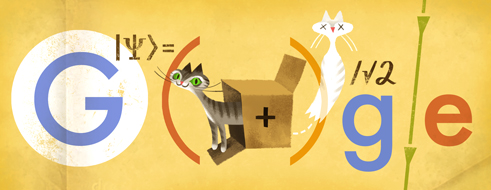
This auspicious event nudged me (a day late, admittedly) to do something I’ve been contemplating for a while now — explain the basic ideas of quantum mechanics the best way I know how, at an accessible level (no equations) but without any frustrating length limitations. Sure, you can do pretty well in just five words, but sometimes you need to be a little more expansive.
Fortunately, very little work was required, since I’ve already done it! This is what happens when you write popular books on physics. Depending on the subject, one of the early chapters is guaranteed to be an overview of either quantum mechanics or general relativity. When I wrote From Eternity to Here, I fooled everybody with an unprecedented step: I put my intro to QM late in the book, in Chapter 11. (The intro to GR was, admittedly, Chapter 5.)
I tried hard in that chapter to do justice to the important ideas of quantum mechanics — superpositions, entanglement, measurement, decoherence, probabilities — without getting bogged down in technical details. I glossed over the fact that amplitudes are complex numbers, although I certainly emphasized that they can be negative as well as positive. It laid some groundwork for the rest of the book, but that chapter itself didn’t really talk about (or rely on previous discussion of) entropy, cosmology, or the arrow of time.
So I’ve simply made it into its own web page, here freely available to all:
It’s about 13,000 words — there’s a lot to explain. But now I have somewhere to point to if someone wants to know the basics.
Of course, physicists famously don’t quite agree about what quantum mechanics actually says. Naturally, I’m giving the version I think is right. At the end I try to distinguish what everyone agrees on from what is still conjectural, but this is certainly not the place to go for an overview of all the different interpretations. It’s just the particular view of one cheerful psi-ontologist.

Sambinns92 likes this
14 Aug 11:10
Waiting for kingship.
by septicisle
Here's a question that doesn't seem to have an answer: just how long does it take someone to prepare to become king? Depending on whether you measure it from when Mumsie became Queenie, or from when little Prince Charlie was born, the one and only Duchy Original has either been waiting in vain for 61 or 64 years. Despite being the longest serving heir apparent in British history though (® Wikipedia), it seems he still isn't quite ready to take on the reins, at least if we're to believe successive governments. Both the coalition and the last Labour government vetoed the release of 27 letters written by Charles to ministers over a seven-month period, although it was left to Dominic Grieve to explain this was necessary as to prevent anyone falling under the misapprehension that Chaz wasn't politically neutral when expressing his "most deeply held personal views and beliefs", when all he was merely doing was "preparing for kingship".
This latest defence of our glorious Prince of Wales comes after the Mail discovered that since 2010, Charles has had just the 36 meetings with ministers (or 53, if you count the ones with juniors as well). That this is almost certainly more than some of those ministers have had with the prime minister is clearly nothing to be concerned about; no, according to Tim Loughton, one of those lucky enough to have dunked biscuits with his royal highness, it's a "grotesque caricature" to portray these meetings as lobbying sessions. Rather, ol' big ears is a concerned citizen who just so happens to have the influence to get personal sessions with senior politicians, and he's "well briefed and knowledgeable", the engagements even "hugely beneficial". Again, these meetings also help him to prepare for his "future role as king".
Indeed, Clarence House presents these cosy arrangements as being the "Prince's right", even his "duty", to bring his "unique perspective" and "reflect the many issues people raise with him personally". If we were being cynical, which we're obviously not, then we might suggest at this point that discussions that consist precisely of Charles regaling ministers with all the jobs people he's met do might be a bit dull. Clearly though, Charles is nothing if not a sponge, soaking up the concerns of ordinary people only to then drench the minister unlucky enough to have picked the short straw this month.
The first question then leads to a second. If Chaz's preparing for kingship only ends once he's crowned, then just how did Brenda herself get ready to become queen? Did she start preparing to become queen only once she was heir presumptive, was it from birth, or was it from when she took on public duties during WWII? Did this involve bringing her "unique perspective" on how the war could be brought to an end sooner, or did she perhaps confine her views to the nationalisations of the Labour government after 1945? Was there a meeting between Ernest Bevin and Liz on what should be done about India, maybe, or have a chat with Nye Bevan about the establishment of the NHS and the possible inclusion of homoeopathy?
Whichever it was, Lilibet prepared for her queenship for only a fraction of the time Charles has been doing so, and most tend to agree that on the whole, she's been fairly good at it. Isn't it then perhaps time that the heir stopped preparing and maybe started, err, acting like an actual monarch? Or is that too terrible a prospect for all concerned to consider?
This latest defence of our glorious Prince of Wales comes after the Mail discovered that since 2010, Charles has had just the 36 meetings with ministers (or 53, if you count the ones with juniors as well). That this is almost certainly more than some of those ministers have had with the prime minister is clearly nothing to be concerned about; no, according to Tim Loughton, one of those lucky enough to have dunked biscuits with his royal highness, it's a "grotesque caricature" to portray these meetings as lobbying sessions. Rather, ol' big ears is a concerned citizen who just so happens to have the influence to get personal sessions with senior politicians, and he's "well briefed and knowledgeable", the engagements even "hugely beneficial". Again, these meetings also help him to prepare for his "future role as king".
Indeed, Clarence House presents these cosy arrangements as being the "Prince's right", even his "duty", to bring his "unique perspective" and "reflect the many issues people raise with him personally". If we were being cynical, which we're obviously not, then we might suggest at this point that discussions that consist precisely of Charles regaling ministers with all the jobs people he's met do might be a bit dull. Clearly though, Charles is nothing if not a sponge, soaking up the concerns of ordinary people only to then drench the minister unlucky enough to have picked the short straw this month.
The first question then leads to a second. If Chaz's preparing for kingship only ends once he's crowned, then just how did Brenda herself get ready to become queen? Did she start preparing to become queen only once she was heir presumptive, was it from birth, or was it from when she took on public duties during WWII? Did this involve bringing her "unique perspective" on how the war could be brought to an end sooner, or did she perhaps confine her views to the nationalisations of the Labour government after 1945? Was there a meeting between Ernest Bevin and Liz on what should be done about India, maybe, or have a chat with Nye Bevan about the establishment of the NHS and the possible inclusion of homoeopathy?
Whichever it was, Lilibet prepared for her queenship for only a fraction of the time Charles has been doing so, and most tend to agree that on the whole, she's been fairly good at it. Isn't it then perhaps time that the heir stopped preparing and maybe started, err, acting like an actual monarch? Or is that too terrible a prospect for all concerned to consider?
14 Aug 11:09
Why I should be Editor in Chief of DC: 10. Showcases
[Introduction | Supers | Bats | Wonders & Lanterns | Solo Heroes | Justice | The Grey Area | Magic | No Tights, No Capes | Out of Time]
This last batch are a space for team-ups, out-of-continuity storytelling and showcases for characters who don’t have their own title, and for creators who are less well known than others. Storylines can be as short as half an issue, or long enough to fill a trade, but most are standalone stories, with the intention of being possible to jump on at any issue, or with any arc.
48. THE BRAVE AND THE BOLD is a book for team-ups that involve a Bat character (usually Batman) teaming up with any other character from the whole universe. Stories can be any length, and the creative team varies from story to story, with some new creators and some established creators. While it is closer to comics continuity to the show of the same name, and there is no fixed age group, it is considered an ALL AGES title.
49. WORLDS’ FINEST is keeping that damn apostrophe ’cause I love it. A collection of stories involving at least one character each from two of the Trinity families: Bats (Batman, Batwoman, Nightwing, Red Robin, Robin, Black Bat, Spoiler, Oracle, Huntress); Supers (Superman, Lois Lane, Supergirl, Conner Levitt, Power Girl); and Wonders (Wonder Woman, Wonder Girl, Donna Troy). These stories are fast and loose with continuity. Sometimes they are consistent with the rest of the universe, sometimes they are involved in Super or Bat crossovers, and sometimes they are a complete Elseworld. In general, this book is considered to be completely Elseworld unless it fails to contradict other books. After the first Trinity storyline, Peej, Huntress and Donna hang out in this title when they’re not appearing in Justice books.
50. DC COMICS SHOWCASE is actually Andrew’s idea: A bimonthly book (alternate with Adventure Comics, offset fortnightly with Action and TEC), double sized featuring one standalone story by big name writers and creators of any DC- or creator-owned property they wish. (And gee, I hope it’s possible for DC to publish a story and keeping it creator owned. Otherwise original stories also permitted), and one story on a DC big name character by first time creators or creators not currently under contract. I’d like to see this second story operating under a submission system, but that might not be possible.
51. SECRET FILES AND ORIGINS is a repository for “Year One” stories, each of varying length, one to six issues, and including any character active in the universe. Ideally the current creative teams on varying books would produce stories about the characters they’re currently writing, and the book would double serve as a showcase for that particular run. Other creators and characters not currently appearing in books are also hoped to appear.
And finally:
52. WEDNESDAY COMICS is not like the oversized title from before: it is a weekly comic of around ten pages in length, retailing at a dollar fifty, and containing an anthology of single to three page installments of stories that and completely out of continuity but have a much more cartoony, four color feel. Like DC Nation Shorts but in comic form, this book contains pages from Dustin Nguyen’s Lil Gotham, a print version of Lauren Faust’s Super Best Friends Forever, a Tiny Titans storyline, as well as until previously not-for-profit fanworks such as a single page of Yale Stewart’s JL8, and of course Batman and Sons. I think of it as an All Ages version of Showcase, being a place for light hearted takes on DC properties where everything is sweetness and light and nothing hurts. Ever.
Aaaaaaaaaand that’s my Fifty-Two! Stay tuned for the conclusion, in which I talk about my first crossover event.
This post can also be found at Thagomizer.net. Feel free to join in the conversation wherever you feel most comfortable.
14 Aug 11:08

Recessions used to make people live longer. Not anymore.
by Ezra Klein

(Flickr user Cavin/CC license)
It’s one of the weirdest findings in economics: Recessions — horrible as they are — lead to longer life expectancy. Between 1972 and 1991, a 1 percentage point increase in the unemployment rate cut total mortality by 0.5 percent — mainly because there were fewer traffic accidents and fewer heart attacks. If you don’t have a stressful job, you are less likely to keel over because of it, or to crash while navigating rush-hour traffic driving back from it.
But that might be changing. A new working paper by the University of Virginia’s Christopher Ruhm finds that the odd relationship between recessions and mortality has disappeared in recent years.
The reason is interesting: Recessions still reduce deaths due to heart attacks and traffic accidents. But they increase deaths due to cancer and “accidental poisoning.” The cancer finding, Ruhm writes, likely reflects “the increasing importance of financial resources used to purchase sophisticated (and expensive) treatments that have become available in recent years,” while the accidental poisoning finding “reflects the unintended consequences of illicit or prescribed use of opioids used to treat mental health problems, which become more prevalent during economic downturns.”
There’s been little change in deaths from falls, drowning or fires.
14 Aug 10:56
How to Give Advice
by Scott Meyer

In today's Asking the Wrong Guy, Rick explains the difference between a Clyde and a Rube! It's not to be missed.
As always, thanks for using my Amazon Affiliate links (US, UK, Canada).
14 Aug 10:51
Daily Mail accuses “grasping politicians of pocketing spinster’s £500,000 legacy”. Let’s have some facts first, please.
by Stephen Tall
 This morning’s Mail Online has a shocking headline: Grasping politicians pocket spinster’s £500,000 legacy she bequeathed to government to spend ‘as they may think fit’. The newspaper’s front page also splashes on the story (right).
This follows the story we reported here yesterday of Miss Joan Edwards, who had apparently bequeathed £520k to the two Coalition partners as the current governing parties. This was divided 80:20 between them, with the Lib Dems getting almost £100k.
The Mail disputes that interpretation, asserting instead that she intended to leave the money as a bequest to the nation. They say the will’s wording was not (as claimed in newspaper reports yesterday) for the money to be passed “to whoever was the party of government of the day” but that it should be passed to “whichever Government is in office at the date of my death”. On that basis, the paper accuses the Conservatives and Lib Dems of deception bordering on fraud.
My Twitter timeline today suggests two things. First, everyone believes the Daily Mail when it suits them. Secondly, that there are a surprising number of people who think they’re experts on legacy bequests.
I’ve handled a few in my time in my fund-raising day-job. What normally happens is this: you receive a letter from the executors of the estate informing you that your organisation is a beneficiary under the terms of the will. This seems to be what happened here, according to the Mail’s own report: ‘A Tory source briefed: ‘This money was donated out of the blue.’’
The power for deciding what happens rests with the executors, the persons legally charged with dealing with the estate. In this case, the executors are solicitors, so they should know the law (possibly better than the Mail’s reporters).
The key line in the Mail article is this one: ‘Somewhere along the line, somebody decided what she meant by this was for her hard-earned cash to fund the Conservatives’ and Lib Dems’ campaigns to win the next election.’ They do not report anything which suggests that decision was taken by the Tories or Lib Dems: indeed, legally it simply couldn’t have been.
I haven’t seen the full wording of the will, and the Mail only quotes an excerpt. The paper claims to have a copy, but as it hasn’t been fully settled yet (and therefore the executors haven’t yet filed it) that seems unlikely.
It may well be that the will’s wording has been mis-interpreted. None of us knows. Depending on any ambiguity in the will’s wording it may be impossible for us to know.
But if there is fault (and I stress the word ‘if’) it’s most likely to lie either/both with the solicitor who drafted a will which didn’t reflect their client’s true intentions, and/or with the executors who didn’t interpret them accurately. What I suggest is highly unlikely is that the Mail’s implication that the Tories and Lib Dems swindled the estate is in any way accurate.
A Lib Dem official I’ve been in touch with this morning who dealt with the bequest said: “I followed our legal advice and established they had talked to the Treasury solicitors about whether it was government bequest before I entered into the discussion about a split with the Tories.”
There may well be questions to be asked in this case. But the Mail’s cheap accusation of “grasping politicians” is very unlikely to be anywhere near the truth in this case.
Update 2: the Lib Dems have announced they will hand over the party’s share of the bequest to the Treasury. See my story here. However, let’s be clear: the implication of the Mail’s story — that the Lib Dems tried to swindle a spinster out of her legacy — is wrong, pure and simple.
Update: Lib Dem pensions minister Steve Webb was asked about the case this morning:
.@stevewebb1 on donation row: "If will says money should go to Treasury, of course should go there – the lady’s wishes are paramount" #bbc
— PoliticsHome (@politicshome) August 14, 2013
* Stephen Tall is Co-Editor of Liberal Democrat Voice, a Research Associate for the liberal think-tank CentreForum, and also writes at his own site, The Collected Stephen Tall.
13 Aug 18:29

Four ways to understand the latest Obamacare delay
by Ezra Klein
There’s a rule in Obamacare that limits out-of-pocket costs — including deductibles and co-payments — to $6,350 for individuals and $12,700 for families. Sounds simple enough.

Wonkblog will not delay the use of this photo until 2015. (Jessica Rinaldi/Reuters)
But when the Obama administration went to implement the rule, it found it wasn’t going to be that easy. Some insurers and employers lack the capacity to keep track of an individual’s out-of-pocket health costs. They often use different companies to administer medical benefits and pharmaceutical benefits — and those companies’ computer systems don’t speak to each other. Implementing the rule would require upgrading those systems — and that takes time.
So as the eagle-eyed Robert Pear noticed, the Obama administration quietly delayed the rule for certain insurers and employers until 2015 (official details here). The delay was actually announced in February, but as Pear writes, it was “in a maze of legal and bureaucratic language that went largely unnoticed.”
That means it’s time, once again, to play Obamacare Rashomon! Does this mean:
1) “The Obamacare ‘train wreck‘ continues,” with another “vivid demonstration of governing incompetence.”
2) The Obama administration is correctly showing flexibility in the rollout of a vast and complex law. No legislation fully survives first contact with reality, and they’re doing the right thing by listening to employers and insurers who say this small provision would be too burdensome to implement in 2014.
3) The Obama administration is favoring the interests of politically powerful employers and insurers over the interests of consumers and, in particular, the chronically ill, who would be likeliest to spend past these out-of-pocket limits.
4) Almost nothing. This is a small provision that effects relatively few people that’s only being delayed in certain cases — and even then, it’s only being delayed for a single year. Chill out.
My sympathies, as you might expect, lie with some mixture of 2, 3, and 4. What would make Obamacare into a train wreck is if the Obama administration insisted on implementing technically difficult provisions that they don’t have the capacity to implement. These kinds of delays cut the number of possible problems the law will face in its first year.
But that’s not to say these delays are good news. What we don’t know is what happens in 2015. Do these provisions get delayed again? Changed by Congress? Or with the law up-and-running, does the Obama administration begin focusing on the nettlesome provisions they put on the shelf for 2014? Unlike the employer mandate, which I’d prefer to see repealed or completely overhauled, the out-of-pocket limits are important for protecting people who actually get sick — which is, in the end, the point of this whole thing.
13 Aug 16:29


#956; In which a Train is taken (Part 1)
by David Malki !

There will be new comics every day this week.
firehose, Scott Akerman likes this
13 Aug 15:47
Lessons of Coalition (15): what do the Lib Dems need to learn from the first 3 years?
by The Voice
 LibDemVoice is running a daily feature, ‘Lessons of Coalition’, to assess the major do’s and don’ts learned from our experience of the first 3 years in government. Reader contributions are welcome, either as comments or posts. The word limit is no more than 450 words, and please focus on just one lesson you think the party needs to learn. Simply email your submission to voice@libdemvoice.org. Today Richard Flowers shares his thoughts.
The Economy (it’s too soon to say)
Three years into a five-year fixed Parliament, with the economy showing tremulous signs of growth, and we’re all very keen to pass judgement: “austerity has failed” or “the medicine is working”.
The rolling 24-hour news cycle, newspaper deadlines, and election timetables demand instant analysis. People need to try to understand the chaotic world and events that surround them so Parties, commentators and analysts must continue to supply answers.
But don’t confuse that with the truth. Most people may accept the news cycle agenda, but it’s totally useless for measuring real economic changes or even political ones.
The problems of our economy, from “bonus culture” in the banks to failure to invest in housing, are problems of “short-termism”, and even three years is very short term when looking at the macro-economy.
We should be asking ourselves: “What are the Liberal Democrats trying to achieve in the long-term?”
I would suggest that our ongoing aims ought to include (but not be limited to):
(1) A sustainable (green) economy, that is in a position to reduce the impact of both booms and busts.
(2) A political system that responds more fairly to what people want.
(3) A state that maximises opportunity and minimises intrusion.
It’s very easy to say now with hindsight that we see that the Labour Government was incredibly profligate, running a deficit during the biggest boom in history, but it’s important to remember that very few voices (honourable mention to Vince Cable) were saying that at the time. People couldn’t see it not because they were stupid or selfish or deliberately obdurate, but because it’s very difficult to make good judgements when you are so close to the data.
The Coalition is keen to claim credit for the economy while Labour wants to pile on the accusations of failure. Signs of growth, lower inflation, low interest rates and no big spike in unemployment versus the biggest fall in living standards in the developed world and the economy still not back to pre-2008 levels.
The sad truth, however, is that almost nothing that the Chancellor (any Chancellor) can do will have any effect within the lifetime of even a five-year Parliament.
The changes to government spending are simply not big enough nor fast enough to have any major short-term impact. Cumulatively, sure, they represent a marked change of direction, but not a quick one. The Coalition neither caused nor cured the recession.
The true test of the Coalition’s stewardship of the economy will be in the next five to 10 years, and will be determined not just by whether growth continues and strengthens or remains faltering, but also whether the Treasury is able to balance the books in proper Keynesian fashion, by running surpluses as the economy recovers, or returns to the Gordon-omics of borrow and spend, and whether the reduction in income inequality is sustained – something, I suspect, will require a continued Liberal Democrat presence in the Treasury to ensure.
Previously Published:
Mark Valladares: Better party communications responding to the realities of governing
Gareth Epps: Government: What’s Occurrin?
Nick Thornsby: Making a success of coalition government as a concept
Caron Lindsay: That old “walk a mile in each others’ shoes” thing works
Louise Shaw: One member, one vote for all party elections
Mark Pack: The invisible ministers should up their game, or be sacked
Robin McGhee: We should organise ministers better
Rob Parsons: Understand the mechanics of government
Richard Morris: Make the red lines deeper and wider
Bill le Breton: The Open Coalition and Its Enemies
Patrick Murray: Make sure our policies are reflected in our manifesto
David Allen: If It Won’t Work, Walk
Joe Otten: Government is hard
13 Aug 13:52
Flipping the script on Russia’s anti-gay persecution
by Fred Clark
“In everything,” the Golden Rule says, “do to others as you would have them do to you.” Simple in theory, but often very challenging in practice.
The easiest way to check ourselves — to evaluate how well we’re living up to this — is to flip the script. What if I were you and you were me? What if we were them and they were us?
This is something we should be doing all the time. “In everything,” Jesus said.
It’s what Thers does in a recent post discussing the upcoming Winter Olympics in Russia:
The International Olympic Committee cannot guarantee the safety from state persecution of any athletes or spectators — gay, or even just perceived as gay.
So.
Would there be any question whatsoever of the United States of America participating in an Olympic Games hosted by a country that refused to guarantee the safety of Christian athletes or spectators, or that had passed laws against Christians similar to those Russia has imposed against homosexuals?
I think Thers may be overestimating American Christians’ capacity for solidarity with Christians in other countries, but it’s still an excellent point.
If Russia declared open season against Christians the way it has done against LGBT people, then American Christians would be calling for the Winter Games to be relocated to Canada. If one of our best figure skaters was a flamboyant Christian and he faced the threat of imprisonment just for showing up at the Olympics — a very real threat now facing Johnny Weir — there would be loud demands for guarantees of his safety and for repeal of the laws that made his very existence a crime.
 That is how American Christians would respond if Russia were persecuting Christians the way it is now persecuting LGBT people. But that is not how American Christians are responding to the persecution of LGBT people.
American Christians fail the test. We’re breaking the Golden Rule — disregarding the whole of “the law and the prophets.” We are failing to love our neighbors as we love ourselves.
But it’s actually much worse than that.
American Christians are not simply failing to speak up against Russia’s persecution as they would if such a thing were happening to their own tribe. American Christians are praising Russia’s persecution.
• ”The Russian government is right,” said Bryan Fischer of the American Family Association. “Heterosexuality is God’s design. Policies that encourage young people to think this are good ideas.”
• ”I applaud the Russians for taking a stand,” said Bill Owens of the National Organization for Marriage.
• “The Catholic Family and Human Rights Institute said it ‘admires’ Russia’s latest anti-gay moves; Peter LaBarbera of Americans for Truth About Homosexuality lauded Russia for rejecting ‘America’s reckless and decadent promotion of gender confusion’; and the Illinois-based World Congress of Families has scheduled its 2014 conference for the Kremlin.”
• “Russia could become a model pro-family society,” said anti-gay evangelist Scott Lively.
So it’s not just that these American Christians are failing to stand up for others as they would have others stand up for themselves. These American Christians are also cheering for the persecution of Russian gays.
But it’s even worse than that.
This cheering isn’t from the sidelines — these American Christians are contributing to and participating in this persecution. Bryan Fischer’s remarks above were made during his interview with Vladimir Putin’s state-owned “Voice of Russia.” Russian officials are citing American Christians in order to validate the alleged morality of this persecution.
But it’s still worse than that.
Because while cheering for and participating in the persecution of LGBT people in Russia, these same American Christians are loudly complaining that they are themselves the victims of persecution.
And yet that’s still not the worst of it. It gets worse than that.
These American Christians promoting the persecution of LGBT people in Russia are loudly complaining that they are themselves being persecuted — and they blame LGBT people for this imaginary persecution.
That’s not just failing to live up to the Golden Rule. That’s not just breaking the Golden Rule. That’s crushing the Golden Rule beneath your shoe, setting fire to the crumbled remains of it, then pissing on the ashes.
13 Aug 09:50
Why I should be Editor in Chief of DC: 9. Out of Time
[Introduction | Supers | Bats | Wonders & Lanterns | Solo Heroes | Justice | The Grey Area | Magic | No Tights, No Capes]
So far, most of these books are occurring concurrently and more or less in continuity, with allowances for writer freedom and keeping crossovers to a manageable number. The following books do not take place in the same timeframe, and as such may or may not actually take place in the same universe. The futures glimpsed here might not be different points in the same future, and the pasts might not truly be the past of the existing world. But they might, that is up to the writers, and more importantly, to the readers. No continuity is set in stone.
43. DEMON KNIGHTS are Vandal Savage, Jason Blood, Madame Xanadu, Shining Knight, the Amazon Exoristos, the Horsewoman and Al Jabr, having adventures across medieval Europe. It’s very violent, and there’s magic and dinosaurs and swords and science. And Vandal Savage shouts a lot. Paul Cornell is back as writer on this pure fantasy romp.
44. JONAH HEX is an old school Western comic, with gunfights and… um. More gunfights? IT’S A WESTERN. WESTERN THINGS HAPPEN.
45. KAMANDI is a human boy living in a world after an apocalyptic disaster that killed all humans and left only animals – talking, anthropomorphic animals – living on the earth. It is a four color Kirby-esque romp with a protagonist whose motivation is getting angry when animals disrespect him. It makes no sense, and it’s not meant to. There are talking animals. Obviously, a YOUNG READERS title. But only for young readers whose parents don’t mind them reading a lot of pulp violence.
46. THE LEGION OF SUPERHEROES are active in the 31st century, fighting crime IN SPACE. And I have never read a Legion book and I have no strong opinions about it. This is also a YOUNG READERS title, aimed at 12-14 year olds.
47. TIME MASTERS follows the adventures of the Linear Men, led by Rip Hunter. It is a time traveling adventure through the entire history of the DCU, popping up in the pasts and the futures of these particular titles, but also having jaunts into the adult lives of modern teen heroes, or the All Star Squadron of the second world war. Or the early days of the Justice League. Or having adventures with Sherlock Holmes or Percy Blakeney.
This title is both in continuity and out of continuity. It’s a Time Travel book: it has to be flexible in terms of what is and what isn’t ‘real.’ Futures change from adventure to adventure, and so do pasts. One day they might be fighting alongside D’Artagnon and his musketeer friends, the next they might be chummy with the imaginative Alexandre Dumas. This book both tells the definitive history of the DCU and is completely out of canon. ADVENTURES.
I realize that these are generally a bit samey in feel: ADVENTURE TIME ROMPS. But these should cover various genres: High Fantasy, Western, “Boy’s Own Adventure,” Space Adventuring, and time travel.
Next: Showcases!
This post can also be found at Thagomizer.net. Feel free to join in the conversation wherever you feel most comfortable.
13 Aug 09:50
Friendly Fire
by LP
PFC Miller, Spec/9 Taylor and Cpl. Laredo: This one was no big deal. I don’t even know why this is being brought up against me. It was the designated duty of Spec/9 Taylor to inspect the Apache for engine flaws and mechanical problems and the like, not the designated duty of me. It is my opinion that if you want to try me under the Uniform Code for accidentally dropping a wrench into the main rotor circuit, then okay, I am guilty, and I’m sorry I can’t be perfect like all the people on the tribunal. But I am pretty sure there is no rule against wrench-dropping, nor neither is there any such rule against not mentioning the wrench-dropping, especially as if you were going to mention it later and you didn’t even know the thing was going to take off so soon because that’s not your squadron anyway. If you ask me and I know nobody did because they’re all too busy listenening to Mrs. Laredo’s sob story like it’s my fault she had six kids, it should be Taylor who is on trial on the charge of not doing his job and if you think about it he’s kind of lucky he burned up in the fire because I would court-martial him if I was you guys, instead of me.
Pvts. Montague, Molesky & Duncan: Oh, this one I’m completely guilty of. Guilty of doing my job is what I mean. As a ground spotter it is my job to report the movement of other ground forces. That is what it says in my service manual. If you read the service manual, and not the book on witch hunts or whatever you guys are reading, you guys sir I mean, then you would know: yes! It is the job of PFC Dunn to report to the fighters if there are troops moving in the vicinity. And yes! It is the job of PFC Dunn to report to the fighters how many and in what direction they are moving. But no! It is not the job of PFC Dunn to report to the fighters if they are our boys or not. And no! It is not the job of PFC Dunn to ask how come the pilots didn’t ask me if they were our boys or not. I read part of their so-called testimony and they said they just ‘assumed’ that the troop movements I was reporting was of the Talibans. Well hey guess what flyboys? Guess what happens when you assume? Yes. You make an A-S-S out ouf U and PFC Dunn. Now, okay, I know it’s not your all’s jurisdiction to prosecute the Air Force pilots. But can we just admit that they are the ones who should be on trial in this situation? I am what is called a patty in this matter.
Lts. Untermeyer and Kahane, Capt. Feller & SSgt. Velasquez: All right, first off the bat, I do not know what the word ‘fragging’ means. I’m sorry but I didn’t go to college like some people and that is why I am just a regular grunt in this man’s army instead of some high and mighty military prosecutor. So if you’re just throwing this word around to impress people I’m sorry but you don’t impress me, on account of how I don’t know what it means. Second of all off the bat, since you already have Cpl. Rashid in custody for actually launching that rocket into the officer’s mess, which to me seems like the real crime here, I don’t know what the point is of charging me for abetting is. I admit that I gave him my rocket launcher and told him where the officer’s mess is — for which, okay, I am sorry that I was trained to help out my fellow soldier in need and also I am sorry that I can’t read minds or see the future, forgive me — but he was the bad guy in this situation. He was the one who did the crime and to drag me into it when I really had nothing to do with the actual killing, just seems like you’re being petty. I’m sorry but that really is my opinion.
Pvts. Helton, Gopaswandi & Tariq and Lt. Elster: Before I address this specifically, I want to say that, all right, seventeen people starts to look kind of like you’re doing it on purpose. (By you here I mean me, because for some reason I am the one being charged with all of these so-called incidents.) But, listen, if you drop a plate, you are just as likely to drop another plate, and that’s statistics. Like flipping a coin. The one thing doesn’t have anything to do with the other thing and it’s just a series of unconnected things. I read this somewhere. It’s math. So, okay, yes, seventeen people in five different things, or incidents, or whatever you want to call them, yes that looks bad. But it is still just five unexplained coincidences, and once I explain them, then it’s just five coincidences and that’s not anything a guy needs to go to jail over. And saying how one guy accounts for over 25% of the fatalities in the entire Coalition military over whatever period of time does not make it any less coincidentical. All right. Now as to the facts: I hate to break this to you but I joined the US Army. Not the British Army. And I am sorry to say this because it is not very PC but those guys look a lot like Talibans. Whose fault is it that I was not told upon enlistment that there was such a thing as a Pakistani, and some of them were in the British Army (which I am not a member of), and they are not the enemy? All I know is that they were armed and in our zone of control. Maybe we should not have picked so-called allies who have totally different uniforms than us, did anyone think of that in the rush to make a scapegoat of PFC Dunn?
Pvt. Collins, Cpl. Reid and Sgt. Gunderson: Okay, you know how they said the Talibans were going to dress up like US soldiers? I totally thought this was one of those deals.
13 Aug 09:41
‘Night Vale’ needs to sound more like Art Bell
by Fred Clark
So I finally got around to checking out the “Welcome to Night Vale” podcast:
Welcome to Night Vale is a twice-monthly podcast in the style of community updates for the small desert town of Night Vale, featuring local weather, news, announcements from the Sheriff’s Secret Police, mysterious lights in the night sky, dark hooded figures with unknowable powers, and cultural events.
Turn on your radio and hide.
I read the transcripts from the first two episodes at this Tumblr fan site and I was won over by the delicious, delirious storytelling. Here’s the very first bit:
Hello listeners. To start things off I’ve been asked to read this brief notice: the city council announces the opening of a new dog park at the corner of Earl and Summerset near the Ralph’s. They would like to remind everyone that dogs are not allowed in the dog park. People are not allowed in the dog park. It is possible you will see hooded figures in the dog park. Do not approach them. Do not approach the dog park. The fence is electrified and highly dangerous. Try not to look at the dog park, and especially do not look for any period of time at the hooded figures. …
That got me hooked. Writers Joseph Fink and Jeffrey Cranor have painted a surreal universe with aptly chosen odd-ball details, suggestive hints, gonzo riffs and deadpan understatement. It’s creepy and funny and quotable and very well done overall.
So then I listened to the podcast.
 Ugh. No. This is not at all what I had been reading. The conceit of the show is that you’re listening to a community radio station serving the isolated and very strange desert town of Night Vale. Read transcripts of the show and that is exactly the voice you will encounter. It’s the idiosyncratic voice of a strangely serene, reassuringly incurious and matter-of-fact community radio host. But the podcast itself does not allow you to encounter that voice.
You won’t hear that voice in the podcast. What you’ll hear, instead, is a book on tape, read by the narrator of a book on tape using his very best books-on-tape narrator’s voice. That’s not the voice of a community radio host. It’s the voice of someone who has apparently never heard a community radio host. This voice has nothing to do with the premise of the show.
Reading transcripts of the show, I heard the voice of this small-town radio host and it drew me into the story. Listening to books-on-tape-narrator guy reading those same words took away that voice and pushed me out of the story.
The storytelling of Night Vale is really good, but the form needs to complement the content. It should be a radio play, not a book on tape. And it should be a radio play that sounds like a radio broadcast. Somebody like Roy Blount Jr. or Tom Bodett should be reading this stuff. Maybe Tim Russell. Heck, Glenn Beck would be pretty good. Or Don Imus. Joe Frank probably sounds too much like Joe Frank, but George Noory or Art Bell would be terrific. Maybe all they really need is someone who can do a good Jean Shepherd imitation.
But not books-on-tape-narrator guy.
It’s still quite fun, and I still recommend it, even despite BOTNG. But I don’t think I’ll be listening to more episodes of the podcast. I’ll keep reading the transcripts, though, and I’m really looking forward to the inevitable book. On paper, not audio.
13 Aug 08:43
Doctor Who: 1985
by 0tralala
Episode 630: Vengeance on Varos, part two
First broadcast: 5.20 pm, Saturday 26 January 1985
<< back to 1984
I used to be terrified of Doctor Who - or at least some of it. As I've said already, it was always (or always seemed) a serious, adult show full of things I didn't understand and content unsuitable for an impressionable small boy.
In 1982, after Kinda - and the Mara lurking in Tegan's dreams - I had nightmares. The following year, there were more, the result of the Mara returning in Snakedance and David Collings' chilling performance in Mawdryn Undead.
I didn't tell anyone: I feared if my parents knew they wouldn't let me watch the programme. And it wasn't that every story led to nightmares. Monsters, generally, didn't scare me - I've never been very squeamish. The death of Adric or the Black Guardian's control of Turlough were thrilling but not scary.
When I got through Season 21 (in 1984) without a sleepless night, I thought I'd achieved something, that I was growing up and out of nightmares. So it was a bit of a shock when the following year Vengeance on Varos utterly terrified me.
The whole story is deliciously horrid. Sil is a brilliantly grotesque creation, giggling as he orders yet more outlandish tortures. And yet the thing that really got in my head is the briefest moment.
Peri and Areta are subjected to an experimental process to amuse the viewing public. As Quillam is all too eager to explain:
But it wasn't the process that turned Peri into a bird that bothered me so much as the Doctor coming to her rescue. We see her change back to her human self and the Doctor rushes over:
It was only when the story came out on video in 1993 that I saw it again and realised the moment that so terrified me, that I'd kept in my head for years, didn't really happen. Peri doesn't say "I can fly", only that she had thought that she could. She's fine, if confused and exhausted. There is no permanent damage.
I'd taken something in the story and spun it out into something of my own, as if just to scare myself further. The nightmares were a creative act. Once I realised that, I could see it was also true of the other stories that scared me. I'd invented new stories for the Mara, appearing in places I knew in real life such as my school and the fields where we walked our dog. With Mawdryn Undead, there's a brief time when Nyssa and Tegan think Mawdryn might be a regenerated Doctor and I fixed on the idea he had regenerated, in pain, on his own - something that's barely suggested in the episode.
I'm fascinated by how people respond to and take ownership of Doctor Who - telling their own stories, making films and documentaries, dressing up, or looking for work in the industry. David Tennant became an actor because of his love for Doctor Who. Though my favourite version of this is that Dr Marek Kukula pursued an academic career in astrophysics because he wanted to be Leela.
Oh, and that thing of Peri being transformed but the Doctor not noticing? In 2002 I used that as the basis for my first ever professionally published bit of fiction, a Doctor Who short story called "The Switching".
Next episode: 1986
First broadcast: 5.20 pm, Saturday 26 January 1985
<< back to 1984
 |
| The Doctor rescues Peri - doesn't he? Vengeance on Varos, part two |
In 1982, after Kinda - and the Mara lurking in Tegan's dreams - I had nightmares. The following year, there were more, the result of the Mara returning in Snakedance and David Collings' chilling performance in Mawdryn Undead.
I didn't tell anyone: I feared if my parents knew they wouldn't let me watch the programme. And it wasn't that every story led to nightmares. Monsters, generally, didn't scare me - I've never been very squeamish. The death of Adric or the Black Guardian's control of Turlough were thrilling but not scary.
When I got through Season 21 (in 1984) without a sleepless night, I thought I'd achieved something, that I was growing up and out of nightmares. So it was a bit of a shock when the following year Vengeance on Varos utterly terrified me.
The whole story is deliciously horrid. Sil is a brilliantly grotesque creation, giggling as he orders yet more outlandish tortures. And yet the thing that really got in my head is the briefest moment.
Peri and Areta are subjected to an experimental process to amuse the viewing public. As Quillam is all too eager to explain:
QUILLAM:It's the word "unworthy" that really got me: as if transforming was the victim's fault. If you're not good enough, the machine finds your secret fears and then uses them to change what you look like.
The nuclear bombardment beams release all the power latent in the recipient's mind. If the changelings see themselves as unworthy, they can become serpentine or reptilian. [Peri], for instance, must wish to fly away from trouble as would a bird.
But it wasn't the process that turned Peri into a bird that bothered me so much as the Doctor coming to her rescue. We see her change back to her human self and the Doctor rushes over:
DOCTOR:There's a hint that she's not back to normal, that for all it looks as if the process has been reversed, inside her head she's still a bird. That's what terrified me and led to nightmares - because the Doctor's too busy trying to escape to notice.
I am the Doctor and you are Peri. Perpugilliam Brown.
PERI:
Peri.
DOCTOR:
It's a question of re-imprinting their identities, of establishing again who they are.
JONDAR:
Wake up, Areta. Come on!
DOCTOR:
Can you walk, Peri? Come on, try.
PERI:
I thought I could fly.
It was only when the story came out on video in 1993 that I saw it again and realised the moment that so terrified me, that I'd kept in my head for years, didn't really happen. Peri doesn't say "I can fly", only that she had thought that she could. She's fine, if confused and exhausted. There is no permanent damage.
I'd taken something in the story and spun it out into something of my own, as if just to scare myself further. The nightmares were a creative act. Once I realised that, I could see it was also true of the other stories that scared me. I'd invented new stories for the Mara, appearing in places I knew in real life such as my school and the fields where we walked our dog. With Mawdryn Undead, there's a brief time when Nyssa and Tegan think Mawdryn might be a regenerated Doctor and I fixed on the idea he had regenerated, in pain, on his own - something that's barely suggested in the episode.
I'm fascinated by how people respond to and take ownership of Doctor Who - telling their own stories, making films and documentaries, dressing up, or looking for work in the industry. David Tennant became an actor because of his love for Doctor Who. Though my favourite version of this is that Dr Marek Kukula pursued an academic career in astrophysics because he wanted to be Leela.
Oh, and that thing of Peri being transformed but the Doctor not noticing? In 2002 I used that as the basis for my first ever professionally published bit of fiction, a Doctor Who short story called "The Switching".
Next episode: 1986