Shared posts

13 Jan 19:46

Anatomy of a drummer.

by brian
Despite the interview with John Ware, the tribute to Tommy Ardolino and now this, I promise, this blog is not morphing into a drumming blog. After all, do you see the words "paradiddle", "deep shell" or "stick size" being thrown around? No. And you won't.
The piece below is drum-centric, but hopefully entertaining to the general audience. Or at least to you, my faithful, music-loving reader. I just wanted to put myself in the picture for this one. You may enjoy the ride. 


In November of 1984, a couple weeks before my 12th birthday, I was digging around a large closet in the family room of the house I grew up in North Andover, MA. The sizable space was filled with miscellanea: photo albums, my mom's old paintings, portable files containing bills and documents, a ton of paperbacks from the 50's-60's, a book about sex from the early 60's (which, though I was initially psyched to find, was about as convoluted and unsexy as a law book), and, at the bottom of one pile, a thin, glossy book that looked like this:
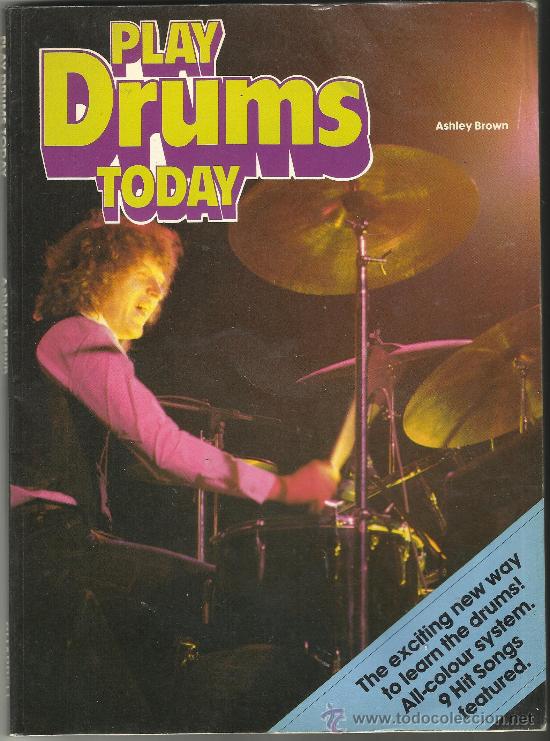


 There was a $1.99 price tag on it from Sav-On or Thrifty (from our Orange County, CA days), which showed that my parents bought it for me when I FIRST expressed interest in drumming--when I was 6 and just wanted to hit things.

64 pages and lots of pictures. And an alternative method to learning what to hit, when. Instead of notes on a staff, it was like colored dots and x's or something, if I remember correctly (I don't have the book anymore).
I had no idea who the guy on the cover was (I think he's from Golden Earring). There were also a lot of other drummers inside that I didn't recognize, but whose names I remembered for future reference (Max Roach, Elvin Jones, Baby Dodds, Billy Cobham...). There were photos of Ginger Baker and Ringo Starr which I later cut out and put on my wall. 

I read the History section, the explanation of the notation, and then...a photo that probably set my sexual maturity back a few years, because suddenly, I cared not about the naked ladies in the weird sex book, or about baseball any more. What I saw was a full page photo, taken from maybe 8 feet high, looking down on a red sparkle 4 piece drum kit, brand new milky white skins, with high hat, crash and ride cymbals. And..YOU COULD SEE THE PEDALS! It felt nearly pornographic. I could imagine my feet pressing down on those pedals. I could imagine the different sounds the kit would make as I hit those pristine heads and shiny, thin, gold cymbals. Oh my god. This was a match made in heaven. I'd never lusted after anything so much before. Ok, MAYBE that 30 inch Easton aluminum bat 2 years prior, but I was so over that.

I decided I wanted to start playing the drums. NOW. My parents said "Woah there, Mr. Baseball, where'd this all come from? We don't think it's a very wise thing to get you something so loud and heavy and space-consuming if it's just a whim.  Maybe next year".

Grr. This is what sucks about December birthdays. You get all your gifts in one month. When you're a kid, the rest of the year seems SO long, and, you're pretty much a different person with different interests by the next birthday/holiday season. Sucks for the kid. Great for the parents. So, they knew if I STILL wanted drums by the following December, that a) I was really committed and b) they (as well as my sister and the two cats) were damned to have a 14 year old practicing drums in the house.

So, no drums for my 12th birthday.

But what did I get? I got a Doors tape from my sister. This one. It was exciting. I listened to it 9,758 times.


Although I was listening to a lot of radio and watching a lot of V66 at that time, it meant a lot to have my own tape. I had a favorite band. In the following months, I got into more bands, but for a while, it was all Jimbo all the time.

Since I was so horny to become a drummer,  here's what I did:
I cut out pieces of cardboard to the exact sizes the book said the drums were (minus the bass drum). Then I placed the 14", 12" and 16" cardboard discs on my bed, positioned my feet on imaginary pedals, sat facing the mirror, and played along endlessly to tapes and to the radio.
Why the mirror? I knew that half the battle was to look cool.
For sticks, I had a pair that my mom had sympathetically swiped from the school she worked at.

I also was constantly tapping on my knees, tabletops, and air drumming--all habits that continue to this day, and completely unconsciously. It's just that there's never NOT a song running through my head, and it's my job to keep the godddamn beat!

The following year, yes....I got my first kit. It was from Sears catalog, and was complete shite. Kick, rack, snare, and one tiny, useless cymbal attached to the kick. No hi hat or ride.

Thank god for sites like WishbookWeb.com. I found the page from which I assembled my first kit. 1985 Sears Wishbook.

I asked for, and received:

M: the "small scale drumset" for $99.99
G: the hi hat stand, with cymbals included! $29.99
H: 16 inch cymbal: $19.99
and
J: steel boom stand for $29.99

(I know, if I got the Synsonics and the timbales, I could have started my own Prince tribute band). 


 As you might have guessed, from those low, low prices, the cymbals sounded like tin pie plates. The drums sounded like comical sound effects and were barely tunable. But it wasn't from the toy section, and fulfilled its function.

Much like how there's no way to really expect how your first kiss will feel, no matter how much you read, hear or watch, there was no way to know the feeling of that first bounce of the stick against the drum. The feeling of going from the snare to the tom for my first fill. Or from the hi hat to the ride. Or the sound of my first 4/4 beat as I steadied my eager limbs like a baby lamb taking its first uncoordinated steps.

My parents were pleasantly surprised that I already knew many of the basics.

(Though I also realized that I played weird--left handed, right footed. This was a hang up for a while and made me wonder if I could be taken seriously--but I eventually noted other drummers who do the same "open handed" style. In fact many years later, a close friend and excellent excellent drummer, Dave Hower--Winterpills, Spanish For Hitchhiking-- is one of them.)

I said "No Way!" to lessons. I'd been taking lessons from the greats, up in my room for the last year. By spring, I was jamming with the one good guitar player in 7th grade (Pete Turpin). Our tastes weren't necessarily the same, but we were the only people we knew who could do something like play rock and roll together.  I used to have a cassette of that first jam. Fuck, I wish I still did.
It was like seeing my life laid out in front of me. Playing music with another person was the most fun I could ever imagine a human having.

A few months later, I convinced my dad that I needed better cymbals. I got some Camber IIs (a crash/ride and a hi hat), which were sort of the best cheap cymbals. Did the trick.

The following year, I upgraded to a Dixon set. A white 4 piece. A floor tom! Woo! That was the kit I played my first ever gig on (one song. more about that later). It was better than the Sears, but still bottom of the line. And I was getting very, very serious. I can't remember what we did with it. Probably the classifieds.

Next came a 5 piece Ludwig Rocker kit in 1987 (my main kit until 2001 and still being played at weekly practices at Rub Wrongways Headquarters) and then a 1966 Rogers 4 piece the following year (the snare of which is my favorite possession and has been on a dozen albums). That Rogers was languishing in the corner of the Daddy's Junkie Music in Salem, NH, having been marked down to (get this) $250.00. This was before the vintage craze. I had to have it.
Anyway....this isn't a gear blog. It's about the people and parts who, added all up, formed my drumming style and aesthetics.

                             THE MAKINGS OF MY DRUMMING DNA

My first drumming hero, when I didn't really know what went on behind a drum set, was Peter Criss from KISS. Mostly, it was the sound of his snare on the Love Gun album. I still love it. It just sounds DANGEROUS. Like the sound you hear in your ears when you get hit in the face with a basketball.

KISS--Shock Me


As I became aware of my burgeoning drum lust, I'd get my kicks watching, of all things, Name That Tune. It was on at 3 or 4pm. Fun post-school viewing.  Tommy Oliver was the leader of the band in 1984-85, but I can't seem to track down who the drummer was.
Who ever you were, nameless guy, I loved seeing you in silhouette, and admired all the different beats and styles you'd play in such a short period of time. Thanks, man.

Name That Tune--1985


Something else that got my blood pumping in my first drumming days was watching The Buddy Holly Story (which was one of the first ever things I taped off TV when we got our first VCR. The very first thing? Elvis '68 Comeback Special)--in particular the live segments, because the band are actually playing live. And it was a modern day interpretation of a 50's rock and roll band giving it their all on stage, and thus came across as a garage/punk band. Loud, simple, energetic.

Don Stroud, who played "Jesse" (based on Jerry Alison) learned drums for the part. I think I get off on his playing the same way I really dig Micky Dolenz's playing, once The Monkees became a recording/touring band. There are fundamental fuck ups, but the "holy crap this is fun!" spirit is there. (For a good example of a fundamental mistake, check out Don's entrance into the first song. He sorta panics and hits the cymbal in a way and at a place that a trained drummer never would). 

Scene From The Buddy Holly Story--1978


At this time, my sister was firmly in her U2/Talking Heads etc phase. So I was exposed to a lot of the alternative rock of the time, both when I hung out in her room, or when we'd watch Hot Hit Video with Bill Smith, or V66. One of the things I did to demonstrate that her schooling me in music was paying off, was to play that beat that seemed to be going through (at least) three of the most popular alt rock songs of the day. It's an important beat to know. It came to me easily. The 16th notes on the hi-hat, the syncopated snare/kick pattern..some say if you play that beat alone at midnight on a full moon, you will conjure Molly Ringwald. Or was it Judd Nelson?

The Beat of 1984-5: How Soon is Now (the Smiths), Don't You Forget About Me (Simple Minds),
Pride (U2)


Around when I got my first Doors tape, the Doors live/rarities album Alive She Cried was released. The single from it was a version of Van Morrison's "Gloria", recorded at a soundcheck in 1969. The song was all over WBCN, and the video was all over V66. I particularly loved the slow down/speed up dynamic (sexual, yes, but to me, not yet) as well as John Densmore's energetic fills in the chorus. I also loved the shot in the video of Densmore going nuts on his cymbals. His drums look so tiny in comparison. From then I always preferred to sit up high, hitting down on the drums. Showing them who's boss. I hated the idea of big shells, deep toms, 7 foot high cymbals, parts you could barely reach, etc. I wanted to be the dominant one.
Oh, another thing I greatly admired was Densmore's jazz-ish syncopated roll at in the last minute, while Morrison sings "keep the whole thing going...". Because it was put in a rock context (much like Densmore's use of bossa nova beat on "Break On Thru") I digested it easily. If it was in the pure jazz context, I'd have been intimidated and thought it too difficult. 

Gloria--The Doors


V66 was great because, not only did they show things like "How Soon is Now" and The Cure's "In Between Days", but they also gave props to the classics. That Doors video was just one of several they'd show. They also would show this next video. Creedence Clearwater Revival, live in 1969-70, doing Born on the Bayou. I loved this. Why? Much of it was due to Doug "Cosmo" Clifford bashing the living daylights out of the biggest ride cymbal I'd ever seen (I think his hi hats are oversized too).
I bought CCR The Concert on cassette and practiced along to it a bunch. One of my favorite moments in all rock drumming is the thing he does around 3:40 on the clip below. Watching it, you can't really tell. But on the Concert record, it's just one of those things that taught me how to keep things, uh, "chooglin" while the band is just riding on one chord, feeding back. I'm sure I quoted that moment a few times.

Born on the Bayou--CCR


And so, of course, it was only a matter of time until I got into the Beatles. The first Beatles tape I owned was a compilation called "Rock and Roll Music Vol 1".


It taught me a whole host of rock and roll basics, as done by the Liverpudlians. I'd work up quite a sweat just keeping up with one side of those amphetamine-aided raves. This track always got me pumped. Plus, I marveled at Ringo's sorta straight, sorta shuffle (see: Tom Ardolino) beat. 

Long Tall Sally--The Beatles


This next song was like a manual of cool rock fills.
At my first ever gig, playing a cheesy Van Halen (Hagar) ballad, I refused to play Alex Van Halen's bombastic lead in fill, and played the "Lovely Rita" fill instead. Ha ha. That should get me into heaven, right?

Sgt Pepper Reprise--The Beatles


Another thing Professor Starkey taught me was the 6/8 blues beat (although so did John Densmore on the "Little Red Rooster"on Alive She Cried). 

Oh Darling-The Beatles


Then came the inevitable. I rented The Kids Are Alright from the video store. What did I get from Keith Moon? Well, it's hard to really say, it's so ingrained. But I think: 1) don't make it look like you're trying too hard 2) flick your wrists and wave your arms so people can't always tell what you're doing 3) Don't play the DRUM KIT like AN instrument, play THE DRUMS AND CYMBALS like you are controlling the entire PERCUSSION SECTION of an orchestra 4) Don't live so fast that you're already past your peak at 26 years old.
I also had no idea what "French Blues" or "Black Beauties" were, so I thought that if Keith could get around the kit that fast, I should too! He looks so young and innocent...no way he's on drugs! So I'd practice doing that kind of stuff...perhaps aided by a can of Coke and a couple Chips Ahoy. Gateways if there ever were...

Can't Explain--The Who


What follows is perhaps the most exciting piece of rock and roll ever caught on film. I'd watch this just before leaving for a show back in high school. When I got into punk etc, I always retained the thought, "this is 10x more punk than (fill in the blank)". Plus, it was punk dressed in paisley, so that's double cool. Punk in hippie clothes. Keep them guessing.

The Who--My Generation (Monterey Pop Festival 1967)


Though I eventually became annoyed by Mitch Mitchell's playing (it's one thing to be super busy if your guitarist is Pete Townshend, but it's another thing when it's Jimi Hendrix), I loved to drum along to, and get all jazzed by this version of "Killing Floor". This was the first song the JHE ever played in the US. Mitch's constant chatter during Hendrix's two solos is totally great and endearing here, and he always played amazingly on the JHE records...but I always tired easily listening to long jams on live albums because Mitch just could never stop freaking the fuck out and stomping all over Jimi, with no real interplay between the two. Like two fighting cats.

Killing Floor--The Jimi Hendrix Experience


Then there's Micky Dolenz!
I know what you're thinking. How do you go from learning from expert drummers to a guy who had been playing for a year and sounds like it? Not sure. It's kind of like when you realize you totally root for that number 8 hitter who, after 130 games, is batting 228 with 1 HR and 22 RBI. Or when people say The Shags are the best band ever. Rooting for the underdog.
Perfection is lame. And is a myth.
I love the audacity of Micky Dolenz bashing away simplistically, but with major cojones, high on adulation and chemicals, occasionally attempting a heroic fill, and driving the wobbly, clunky Monkee machine while 20,000 girls scream. Well, check this out. I have many times used that dorky fill that he plays before the outro chorus.


When I first saw HEAD, in 8th or 9th grade, it was really the only way I could see young Dolenz in action (as opposed to miming on the The Monkees series). Again, I was rooting for him and his ambitious drum part. It's a bit sloppy, but I can see what he's getting at and it's very cool. When I convinced my high school band to do this song, I played this part, but unslopped it a tiny bit. Dolenz deserves much credit, and it sucks that he gave up drumming for 20 years shortly after this.

Circle Sky (live 1968)--The Monkees


Normally, double bass drums annoy me. I feel they aren't needed, and I always say "why not aim to be like John Bonham, and do two feet worth with one foot?"
However, despite the double kick, I really like Ginger Baker's feel. It's completely unique. I even started putting my toms at a totally straight angle like him because I liked how it looked.
He is Mr. Triplet (think of the fills during "Sunshine of Your Love") and I took a lot of that from him. Also, he had a very nice dance beat. And, don't forget, that tribal thing on the toms, hitting on all four beats. I could never really listen to "Toad" very much, but I appropriated one of his common licks for whenever I'm forced to do any sort of solo. I can't really describe it. In any case, this song, which is just a blues, is made most interesting by Ginger's style (and Clapton's falsetto--and perm).

Strange Brew--Cream (1967)


Oh, Charlie! In my mid 20's, my favorite drummer became Charlie Watts. I knew I wasn't going to die young, and I came to grips with the fact that I'm much too much of a lightweight and too cautious to ever be a Keith Moon type. So, I looked at Charlie--sharp suit, small drum kit, sophisticated, looks great, not trying to prove a damn thing. All about preservation. But if he wants to suddenly get into hard drugs for a couple years when he's 45 years old, let him. If he wants to punch "his singer" in the jaw out of the blue, that's good too. Then, quietly, go back to being a horse farmer, married for 47 years.
But as far as my teenage drumming goes...
Charlie immediately made me believe that metronomes and click tracks are a symptom of a scared society. Like getting boob jobs. Scared to be the imperfect beings that we all are. Taking the easy way out, and selling your soul. The Rolling Stones are (to many) the greatest rock band ever (at least their first 10 years). They say a band is only as good as their drummer. Thus, Charlie Watts, who has no fancy fills in his repertoire, no "how does he do that?" tricks, and who so often comes in a fraction early or late with a fill, and who hits the rim of the snare every once in a while, is the greatest drummer ever. So why would someone NOT want to play like Charlie? I have no clue.
I'll tell you this right now--I've never wanted to be Neil Peart, Stuart Copeland or Alex Van Halen. It's just who I am.
So listen here. Charlie comes in a fraction late, brings the dynamics up and down at seemingly odd times, and does nothing special--except be Charlie Watts...and thus, plays a part that I memorized note for note when I was 15.

Rolling Stones-Jumpin' Jack Flash (live 1969)


(another song that greatly influenced me--say in a few Figments songs--was the Get Your Ya Ya's Out version of "Sympathy for the Devil")

Here's more Charlie, from 1968. Rock drumming was stretching out and Charlie's contribution to it was priceless. Although he didn't play the famous grooves and fills in "You Can't Always Get What You Want" (producer Jimmy Miller did), in many ways I prefer his drumming on this song. The formula is the same. Heroic fills and double time at the end. I love his drumming on this song ("Salt of the Earth"), "Stray Cat Blues" and "Jigsaw Puzzle". All from Beggar's Banquet, and all part of my DNA.

Rolling Stones--Salt of the Earth


The Grateful Dead. I've never been much of a Mickey Hart guy, but Bill Kreutzmann, when he was the only drummer (in 1965-67 and 1971-74) kicked very much ass. What did I take from him? Something that I've tried to explain to my students:
That, if you picture the beat of a song like a ruler (or like a digital recording interface), know that every beat and division of that beat means something different depending on when and where you accent that beat. It's what jazz drumming is all about, but it took me a long time to realize that, because I've always thought of jazz drumming as a foreign language I may not ever have time to learn. But this concept works in rock/pop as well.
For example, it's standard and unremarkable to hit the kick and crash cymbal on the "one" beat. BUT, it's a whole different plate of pasta if you hit the SNARE and crash on the "AND one" (the quarter note just before the one). THAT gets people's attention, and acts as a pinch in the bum, or a slap in the face. Some love that stuff, some find it too jarring. I love it.
If your band mates allow you the freedom, as long as you don't stray from the overall meter of the song, you are free to stress or accent any division of that beat. But only if it's adding something. Kreutzmann, when too coked up (see: 1974 European tour) could turn his brilliance into a major CALM THE FUCK DOWN AND KEEP THE DAMN BEAT situation.

But also, if you listen to the first Dead album from 1967, Kreutzmann was a hell of a conventional pop drummer. In early high school, my friend and I used to LOVE his fill in the middle of "Cold Rain and Snow". We thought that that kind of "quick, snappy fill" drumming and Lou Reed's "fast, rubber wrist" style of rhythm guitar in the Velvet Underground could be a winning combination.

I suppose the Wedding Present had that. Don't worry. I'm getting to them.

Anyway, hear how Kreutzmann divides up the beat in this song--half time, real time; AND does those quick wristed fills.
They are the drumming equivalent of interjecting 3 quick words between someone's monologue, instead of trying to interrupt.

One More Saturday Night--The Grateful Dead


One more Dead thing. I never had a prog rock period. I don't really like songs that change time signatures every 3 measures, just to show..I don't know what. I don't like listening to it, or playing it.
But if a song is in an odd time, and sticks with that time, well, then I like it because you get into a very odd trance. By 9th grade, I loved practicing along to this song by the Dead. It's called "The Eleven" because...guess how many beats per measure?  I would play to the version on Live/Dead. But this will suffice. The song doesn't shift into 11/4 until about 2 min in.
SIDENOTE: playing along to other Dead songs got me comfortable playing in other odd times, such as 7/4 and 10/8. 

The Eleven--The Grateful Dead 1968)


I already gave my pros and cons of Mitch Mitchell spiel, right? This is how I came to that opinion. Listening to Hendrix play a 7 minute solo, with a steady rhythm section. Not a couple of insecure British dudes trying to upstage Hendrix, but a couple of Jimi's soul brothers, who knew that if they just held it down tight, Jimi could just stand and deliver. To me, it makes it so much more fun and less distracting to listen to a long guitar solo. As far as the drumming, it taught me the effectiveness of not competing, but supporting**.

**The extreme version of this would be Mo Tucker of the Velvet Underground playing an unwavering, unsyncopated, straight beat for 12 minutes in the middle of a long Velvets jam like "What Goes On" on Live 1969 or "Follow the Leader" from The Quine Tapes.
I can't do that because I have this male ego to deal with. As well as ADD that makes me get bored very easily.

I also took away some of that excellent Buddy Miles kick/snare syncopation. Love it.

Jimi Hendrix/Band of Gypsies--Hear My Train a Comin' (1970)

SORRY, ALL TRACES OF THIS SONG HAVE VANISHED FROM THE INTERNET. YOU'LL HAVE TO BELIEVE ME OR DOWNLOAD IT SOMEWHERE. THE HENDRIX ESTATE IS VERY PROTECTIVE.


John Bonham. Fucking monster. He started out in Zeppelin when he was 19. Thus, there are some youthful errors that have always pissed me off. Like "DON'T PLAY FULL TILT OVER JIMMY PAGE'S ACOUSTIC SOLO IN 'YOUR TIME IS GONNA COME' OR 'THANK YOU'. THANK YOU!"
But by Zep 3, he was the man.
I was once asked "Moon or Bonham"?
Bonham any day.
Why? He was heavy AND funky AND tasteful AND completely understood Jimmy Page and John Paul Jones' weird rhythmic curve balls. And played a single bass drum kit, with only one rack tom and two floor toms (yeah, yeah, and a gong and a kettle drum. But, whatever). He could do more with one kick than most double kick players. And yes, I stole a lot from him too. If a song I'm playing is heavy, I know that there's a Bonham trick or two I can use.

Whole Lotta Love (live 1973)--Led Zeppelin


Away from the heaviness and back into the canyons of LA. This song (the finale on Forever Changes) influenced me so much both in my drumming and songwriting. It's a perfect song, the drumming is perfect and...I don't know. It left a huge stamp on my over all feel. Can't really put my finger on it. Two distinct feels here. Playing to this sort of prepares one for playing along to any theatrical type song.

You Set the Scene--Love


This next one's all about visual style.
It wasn't until 10th grade that I got into the Beach Boys. In early 11th grade I rented The Beach Boys, an American Band. Though I mostly just watched the 1966-71 bits, I did take note of the early Dennis Wilson. He ROCKED OUT, and looked fucking cool doing it! Even in those horrible shirts! I was already aware that I couldn't assimilate Keith Moon's craziness, but I saw the girls screaming at Dennis, and thought "there's my new role model". The other thing was, I was still self conscious about my "incorrect" open-handed style, and Dennis W was the first drummer I saw who looked awesome doing it. 

Dance, Dance, Dance--The Beach Boys


I was beginning to leave behind the bearded, stoned, 7 minute jam music that had taken me to this point, and was shifting towards punk/new wave/alternative, and tuning in on Sundays to hear "Boston Rocks" on WFNX and "Boston Emissions" on WBCN. After all, I wanted that to be my future--not to be in a classic rock cover band. At the same time, I was also pointing out to my friends that much of the 60's music they scoffed at actually contained an energy that can only be described as punk (I know I already said that about The Who).
I used to play along to The Live Kinks--which was difficult with all the screams. But the songs are all taken at a much speedier pace, and this final medley is just manic. At this point I started shifting away from wanting to "jam and relate and interact and have a musical conversation" with my band, to acting my fucking age! I was 17, had a lot of pent up energy and just wanted to explode. Like these guys.

Medley: Milk Cow Blues/Batman/Tired of Waiting--The Kinks (live 1967)


Ahh...and then...I was lent Buzzcocks' Singles Going Steady. Wow! Every song is a winner (except "Orgasm Addict" embarrassed me). The songs are all pop gems, the playing is sloppy but tight (the drummer wavers like Charlie Watts, but plays great parts) and boom. I had myself a favorite non-classic rock band. I practiced along to this and set my inner metronome up a few BPMs.

Buzzcocks--Love You More


Buzzcocks--Ever Fallen in Love


I was already into XTC by this time, but found nothing to gain, drumming wise, from Oranges and Lemons or Skylarking. They seemed too "adult" and I didn't want to go there. Sophistication is not what I got in this game for.
But I did love the early stuff, and Terry Chambers, while playing some complex parts, seemed human. And of course, remains a huge influence. Go Terry!!!!
Senses Working Overtime is an excellent song to expand one's pop drumming vocabulary. There are four distinct feels, and a heroic fill that helps to bring in the irresistible chorus. My drumming benefited so much from getting (way) into XTC.


 XTC--Senses Working Overtime


Drums and Wires is a goldmine of fascinating beats and feels and fills.
"Making Plans For Nigel" was my first conscious exposure to one interesting drum pattern occupying a whole song--sort of a human imitating a machine. But I'll get to that below, with Joy Division, who also did that masterfully, and of course, Gang of Four.
But "Helicopter"--keeping that disco beat, but with closed hi hat-- was fun to do. But then comes the chorus. What Terry does while Andy is singing "..just like a helicopter...copter" was pretty challenging to learn. The beat doesn't waver or alter, but the crash accent happens in a place that doesn't come naturally. And this opened the door to a new bag of tricks for me. The "sitting on a tack" accent. Snare and crash hit simultaneously on an offbeat. It makes the listener jump like they sat on a tack. Early XTC was ALL about that. It's a shot of adrenalin. Thank so much, Andy and Terry for opening my ears to all that.


XTC--Helicopter


And thank you Topper! Playing along to London Calling was like using the ska/punk tricks I learned from XTC, but in a more relaxed, less self conscious way. Whereas early XTC took pains to be MODERN!, The Clash had no qualms about occasionally sounding like the classic rockers they supposedly hated (but didn't really hate). I fucking love Topper's drumming.

The Clash--Lost in the Supermarket


Getting back into the robotic, as interpreted by a human. Stephen Morris was an extremely creative drummer, although, something tells me that their producer, Martin Hannett, had a lot to do with his drum parts. I say this because if one listens to a live or Peel Sessions version of say, "Love Will Tear Us Apart", or "Transmission", Morris is playing like a Keith Moon wanna-be. Over the top fills coming out of his arse. Not exactly robotic or cold and dark. But on record, there is a lot to be learned from Joy Division. Patterns, man. Patterns. Economy. Say a lot with a little.

 Joy Division--Transmission


Patterns vs Fills. 

As I listened to more and more punk and new wave, I noticed that a new school had developed, especially in England (though DEVO did this a lot too). Basically, human imitating the machines that were invented to imitate humans. These days, with digitized everything, we're used to reverse progress leading to progress after all. Progress is inevitable, so even when we're consciously going backward, we're going forward. It's just that if you're a Republican, what you call "going back to a simpler time" equals "going forward into the abyss".
Anyway.. the next three songs are examples of throwing all the classic rock and roll rules out the window.
No fills, no dynamics. These are men playing inventive, effective and distinctive mechanical sounding patters on acoustic drum sets. All three of these songs were very influential to me.

Joy Division--Colony


Gang of Four--Natural's Not In It


XTC--Rocket from a Bottle


1990: The Manchester thing. That beat. You had to do it. I was happy to do it, because it made people dance and as a drummer, that's my job. I play, they dance, they watch me, I watch them.
You can't argue with the Stone Roses' eponymous debut. Ok the lyrics are sometimes dumb, but the music is top notch. Well written, arranged and played. I loved playing along to this song because the first half has the 1-2-3and4and thing that's always fun. Then it shifts into an all out jam--with a couple of scripted parts. Very, very fun. And I felt like it was a very promising blend of cutting edge and classic. That's where, I suppose, I'm most comfortable.

The Stone Roses-I Am the Resurrection


So...now I was getting to the end of 11th grade, and had a band that was playing original pop (and hip covers) and were looking to maybe get some attention from the Boston music scene. The band we (or some of us) loved the most was a power pop trio, 2 parts Who, one part Beatles....ladies and gentlemen, The Cavedogs!

I wanted us to BE The Cavedogs--difficult, since we had 6 people in the band. But, I was so happy that their drummer, Mark Rivers, brought a total Keith Moon vibe to a modern pop band. The problem was, though, as witnessed by Nirvana and Dave Grohl's Ringo-meets-Bonham style, record buyers wanted a more predictable, less creative type of drumming. Thus, the Seattle power trio's earnest and humorless 1992 major label debut exploded,  and the Boston one's more snarky, witty one sank after a few weeks on the college charts. That's when history changed. You had to not sound well-read, or make people wonder what chords you were playing or where you picked up that crrrazzzy beat. Nirvana were great, but their lack of subtlty ended up attracting a lot of the people (jocks, metal heads) they got into punk rock to avoid. Jocks and metalheads, on the other hand, would never give a band like The Cavedogs a second look.

I still dig The Cavedogs, and Mark Rivers has had a nice career in showbiz.

The Cavedogs--Tayter Country


I was hearing more and more of my classic rock roots in much of the so called "cutting edge" music of the time. Jane's Addiction's "Mountain Song" reminded me of Hendrix's "In From the Storm" (just the riff). Still, I loved Jane's Addiction, saw them three times, and my band covered "Summertime Rolls" and "Mountain Song". What I picked up from Stephen Perkins' part on this song is that crash-snare-crash-crash on the 3 sixteenth notes leading up to the 1.
Um, huh? I think I described that as best I can. It happens after Perry sings "and I say" and before he says "cash in!".
Anyway, it's a valuable trick for heavy tunes. You can vary it any way you want too, once you have it down and know when to do it.

Jane's Addiction--Mountain Song


Yesss...Daydream Nation. First time I heard this album, I put on headphones and was sent into another world. But what I got most from Steve Shelly's drumming was that I shouldn't shy away from Keith Moon hyper fills. He did them plenty. Lots in this song. I also felt like there was a place after all for spacey jams that, to me, evoked the best Grateful Dead--the 1968-74 noise stuff. Tribal and spacy at once. That whole acid thing. Seeing SY at the Orpheum in 1990 is still one of the best shows I've seen. Redd Kross opened. 

Sonic Youth--Teenage Riot


Back to the punk/new wave/ska influence. Though it was a gradual process, and it wasn't until a few years later that I found a good band in which to use his influence, I've always loved Pete Thomas. Talk about someone who is great because of no click track! SO many early EC songs speed up by the end. But, Pete Thomas has a very distinct style. I can't describe it any other way but "snappy". He hits hard, nothing rings or sustains very long, and he's on top of every beat. He also utilizes that "turning the beat around" thing to great effect. I love the guy. He's tall and lanky and plays that way. For me, Topper Headon, Terry Chambers and Pete Thomas are the punk/ska/new wave Big Three. They gave me a HUGE fondness for the snare hit/crash hit on the 4 AND. That "wake up!" thing.
The one thing that prevented me from absorbing too much Stewart Copeland (who could easily fit among this group) was simply the size of his drum kit. I'm too pragmatic for all those bells and whistles. Oh, and, uh, lazy.


Elvis Costello and the Attractions--Radio Radio


We're getting to where I stopped being influenced by other drummers and felt like I now had the tools to throw it all in a pot, jump in and let the big mess become my style. But there were still two or three more things I picked up...we're now in senior year of high school.

You can''t listen to the Wedding Present and not take note of the drumming. The guy (for a good while anyway) is named Simon Smith (oh, boy. How many horrible jokes has he heard with that name?). In the age of big deliberate dumb fills, Simon brought back the quick wrist-ed fills of Eddie Hoh and Hal Blaine. The drumming on Seamonsters is a big part of why I love that album so much. Hard to choose between these two songs, so I won't make myself.


The Wedding Present--Corduroy


The Wedding Present--Dalliance


And finally...though he was made to look a bit foolish in the Death to the Pixies documentary, David Lovering found a way to play to Charles Thompson's odd phrasings and feels. To me it's always sounded like a Rush fan playing punk rock. That may in fact be the case. Anyway, I was a couple years late coming to this album. In the summer of 1991, it did not leave my car tape deck. I still associate it with extreme heatwaves, which we definitely had that summer. It was the soundtrack to my sendoff to college, in Amherst, MA, where I hoped to take all these influences in my kitbag, and become known as a guy people wanted to play with. It's 21 years later, and I suppose I achieved that to some degree. I mean, I'm far from famous, but having drummed with as many artists and on as many albums as I have is not a bad record. Thanks to all of the drummers on this list. You are all swirling through my unconscious every time I sit behind a kit.

The Pixies--Oh My Golly!


To wrap it all up,  here's an admittedly vain-as-all-fuck series of You Tube clips I uploaded, with small samples of some of the stuff I've drummed on in the last 15 or so years.


14 Nov 12:04

Homework. How do I?

by Alyssa
This is reprinted from Yes, That Too because it fits. The title is different.

Trigger Warning: Uh. I got triggered while writing it but am not sure what warning to give. School stuff, generally related to teachers mistaking the results of executive dysfunction for other problems and acting on that mistake?

NO REALLY. I KNOW THAT WARNING IS NONSPECIFIC, BUT PAY ATTENTION TO IT. I'D GIVE YOU A BETTER ONE IF I COULD READ MY OWN POST WITHOUT GETTING TRIGGERED AGAIN. I CAN'T.

I read the shoes post. If you don't know what post that is, you should probably go read it now. No, really. Go read it. Now.
The whole thing is important. But what I'm thinking about right now is mostly the executive functioning stuff. Because that's a problem I have too. 
She even told my mother that she wouldn't let me read at my level until I had nice handwriting.
That's one thing I was never told, though I did get banned from handwriting my math homework twice. I was told that I couldn't get math classes that were appropriate to my level because I needed to learn to get organized. It doesn't work like that. Keeping me out of work that I can do doesn't make aspects of my disability go away. It just doesn't. Never did, never will. I'm not going to magically gain the ability to do daily homework because I'm suddenly in an easier class, or fewer classes, or whatever else.
I had no trouble whatsoever grasping the academic content. It was not a challenge. Getting the work done was because the attitude was still "if you're so d*mn smart just do it, god, what are you stupid or something?"
I've been there. I've been there so much it's not even funny. No one said it in exactly those words, but I've been there. Usually I was lazy, which isn't true, bad at time management, which is kind of true but doesn't get at the root of the problem, or doing too much, which has sometimes been true but also wasn't the problem. The problem wasn't that I had too many other things I was trying to do. If that were the problem, I could have done my homework fine in sixth grade, when literally all I had other than school was Hebrew school for two hours three times a week. I still had problems. I got caught with homework for other classes under my desk fairly regularly in sixth grade. In seventh grade and later, I was just better at hiding it. I think eighth grade is the last time I got properly caught (I'm not counting the times that it was knitting or chainmail done openly and the teacher didn't like it, because that's not executive dysfunction. That's can't sit still well/coping mechanism for auditory processing stuff.) My record for most homework assignments completed between getting on the bus to school and the end of the day? Seven. All five "core" classes- math, science, social studies, English, Chinese, plus drama and an after school extra math class I was in because my school wouldn't put me in my level of math class until I got organized and that's a thing I'm not capable of doing myself. (No, they did not offer any help with doing so or methods I could use. Because if I'm so smart, I should be able to figure it out. Or something.) For reference, my classmate in that after school math class? She spent about six hours per week on that homework, aka basically the length of the school day, during which I went to seven classes and did six other assignments. I was fast. It wasn't always good, but it was done. Usually.
Teachers kept up with the "if you're so d*mn smart why are you so d*mn stupid?" and I stopped taking classes that were academically even a bit of a challenge-no one would help me get set up to do the work, so fine, I can pull a great GPA in classes that I can do actually in class.
My coping strategy was a bit different. My GPA was good but not great. I took classes that I could get done during school hours/on the bus to and from sports, with the exception of the occasional paper that would be done between 2am and the start of school on the due date. I'd go to sleep around 8pm as usual, then get up however early I estimated I needed to and hope for the best. My final exam story for English in 9th grade? Written between 12am and 7am on the due date. My research paper for high school? Written between 12am and 7am on the rough draft due date, not edited beyond the in-class edits we did between then and the final due date. Shorter papers were typically between 4am and 6am on the due date, and I've lost track of how many times I did that.

Now, for the problem. How do you get people to understand what the actual problem (executive dysfunction, I mean) is? I'm not sure. I've never managed it before. Never. In middle school, they didn't understand and so they wouldn't let me get into the classes I belonged in (for math, that would be ~2 grade levels ahead, everything else was to be in Honors/AP which didn't exist in middle school so that part's OK.) Well, except 8th grade when they had a pre/post test and I got higher on the pre-test end than most kids got on the post-test end, so the teacher ran around talking to people and got me an independent study. Which, um, hello? If I can't get my homework done, what makes you think an independent study is a good idea? It was better than properly being in the math class, since I was actually allowed to work on my other stuff during class time and could sometimes even do it, but it still wasn't what I needed. I need outside support of "you are working on this thing during this time" and I need stuff to be weekly at least. Not daily. Daily is a set up for failure.
In high school, they didn't understand the real issue, but there was a procedure for testing out of math classes and the independent study for 8th grade made it clear to everyone that I should be looking at that procedure. Also, Honors Pre-calculus didn't check the homework. AP Calculus BC only checked it three times all year, always with warning. I finished two of those three, and none of the others. I think I finished my Pre-calculus homework once? Maybe?
In college, you generally just need to pass the class, and no one gives daily homework, which is basically the bane of my existence. Unless I can get it done in the approximately hour before it's due? Not getting finished. Which is a problem. Bigger projects, longer term projects, I can usually get started sooner by enough to finish them. The week mark is about when I start being able to start stuff with enough extra time to actually finish it, even if it takes longer than an hour to do. I'm still working straight through that final hour, though. I really wish there was an accommodation for executive dysfunction, because goodness, do I ever need it.

Of course, in middle school, in high school? I generally didn't have the words I needed. Executive dysfunction? Sure, I know what that is now. I didn't then. And even if I did have the words? Well, for any teachers in the audience: would you have believed the twelve year old who was telling you that being in easier/fewer classes wasn't going to cure their executive functioning issues? Honestly? Would you? Or would you think they had no clue what they were talking about/they were making excuses/whatever other reason that kids, even ones who actually do know what's up, don't need to be listened to when they're difficult or complicated?

That's what I thought.
02 Nov 11:58

Politics: Labour proposals to define E-Cigarettes as medicine is a shameful attack on the health of the poorest in society.

by Iain Donaldson

A new and welcome phenomenon of the last couple of years has been the shift that many smokers have made from cigarettes to E-Cigarettes, a cleaner and healthier alternative.  Literally thousands of Manchester residents have taken to this healthier and cheaper option, which will in time save lives.

That is why it came as a massive shock when the Labour Party in the European Parliament proposed that E-Cigarettes should  be declared to be a medicine, which means they would have to be tested and regulated, pushing the cost of production through the roof.

North West Liberal Democrat MP, Chris Davies, has been leading the assault on Labour’s policy, and he recently told me that when he was out canvassing in Manchester one Saturday a local GP told him that “I recommend e-cigs to my patients when they come to me about smoking problems.”  he went on to tell Chris that “Cigarettes are full of nasty things but nicotine is the least of them.”

Chris briefed me about his battle in the Environment & Public Health Committee of the European Parliament before the summer recess where he lost a vote to try and prevent Labour classifying and restricting them as medicinal products by 2-1.  Fortunately Chris’s campaign is gaining ground as more and more MEPs seem to be coming to the view that they could really help smokers switch to something less harmful.

Together with one of our Belgian Liberal colleagues Chris has been working to fashion an amendment that can address concerns (product safety, advertising to under 18s, etc) and secure cross-party support when the Committee vote in plenary on 8 October.

Chris has now had an email from the leader of the largest delegation of MEPs, the German CDU/CSU (Angela Merkel’s people) saying that they will be backing the Liberal Democrat amendment.  The ground is moving in the European Parliament in favour of the stand that Chris is taking, and E-Cigarette users in the North West can be thankful that they have one of the most experienced EU Legislators, Chris Davies MEP, on their side.


31 Oct 08:41

Porn-Education (1976-1979)

by About me
More rare screenshots this week.

In 1976 the Scarfolk Board of Education was faced with a problem: Children weren't educated enough to be able to learn anything, thus benefit from education.

Teenagers had lost all interest in schooling and spent their time indulging themselves in popular teenybopper pop groups such as The Wittgenstein Rollers and Arnold & the Schoenbergs.

To counter this apathy, the Board of Education decided to take advantage of the recent relaxing of film censorship and the rise of sexploitation.

From September 1976 they delivered the school curriculum via a series of feature-length pornographic films. In particular they wanted to enliven maths and English topics and to "put some lead back in the pencil" of pedagogy, as the minister for education, Tom Stiph, put it.

School attendance rose by 42% in less than six months, as did the birth rate.

Below are three of the long-lost maths and English, so-called 'Porn-Ed' films, as certified by the BBFC (British Board of Film Censorship).

Other films included:
"Debbie Does Differential Geometry" (1976)
"Lady Pythagoras' Love Triangle" (1977)
"HomoPhone Sex Operators" (1977)
"Vital Statistics and Alge-bra Overflows" (1977)
"Homonympho Grown-up Groans" (1978)
"Homonympho 2: Whole Holes Meet Man Meat" (1979)


To enlarge/zoom right-click and 'open in new page/tab'
09 Oct 15:50

Jimmy Carter, Jesus and "the Matthew effect"

by Mark Goodacre
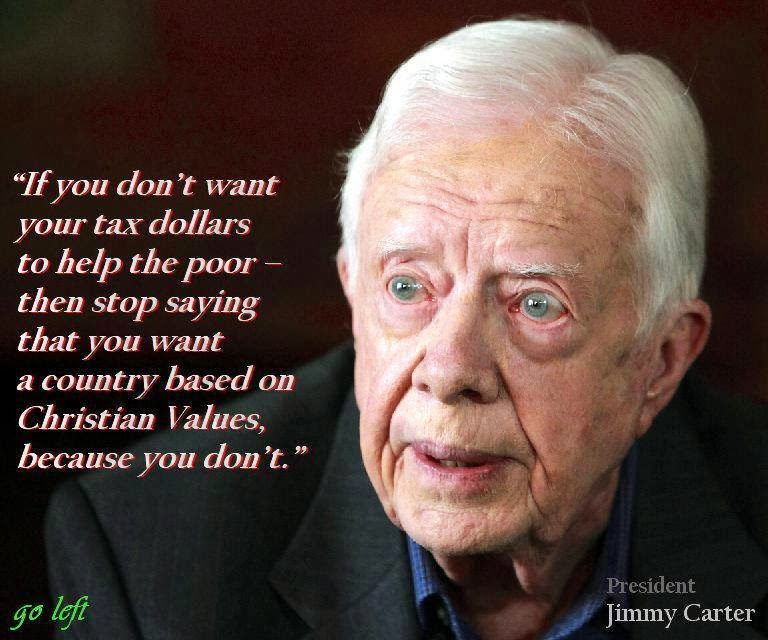
I have discussed the Matthew effect here before whereby a a piece of research, an idea, a quotation, a story gets associated with a more famous, more prominent person.  There's a famous example of it in our field, the misattribution of a saying to Schweitzer (about looking into the well and seeing our own reflection) that was actually said by George Tyrrell.

There was another example of it circulating on the internet not long ago, where a saying was misattributed to the Dalai Lama.  Today I saw another great example of the Matthew effect in a quotation attributed to Jimmy Carter (right).  The quotation is actually extracted from an interview with John Fugelsang.  Here is the quotation in context:
Who would Jesus vote for in this election? 
I don’t know. I don’t think he would vote for either of the two major party candidates. I think Jesus would be third party all the way, if he did vote. I bring up the fact that Jesus never lived in a democracy quite a bit, because when you hear people say, “Jesus said to help the poor, but he didn’t say the government should do it!” I always respond, “Yes, but Jesus didn’t have democracy.” If you want your tax dollars to help people over here instead of blowing them up over there, then vote that way. And if you don’t want your tax dollars to help the poor, to help the sick, to avoid violence, to take better care of those in prison, to help the needy, fine. Don’t vote that way. But don’t ever say you want a government based on Christian values, because you don’t.
I actually prefer the original quotation from Fugelsang in which one may hear an allusion to Matt. 25.31-46 (Sheep and the Goats).  Also, the term "government" makes better sense here than "country".  In order for the briefer, pseudo-Carter version to work, ". . . But don't ever say" has to be adjusted to "then stop saying", but otherwise the saying is clearly the same.

There's a nice analogy here for Christian origins scholarship in another way too.  It is sometimes said that simpler, briefer, terser sayings are likely to be more primitive than longer sayings, and this works as a common criterion in historical Jesus research, especially as it is practised by the Jesus Seminar and John Dominic Crossan.  However here, as also in early Christianity, the briefer, terser version can be later than and dependent on the earlier, more detailed version (see further Thomas and the Gospels, 145-50).
06 Oct 17:45

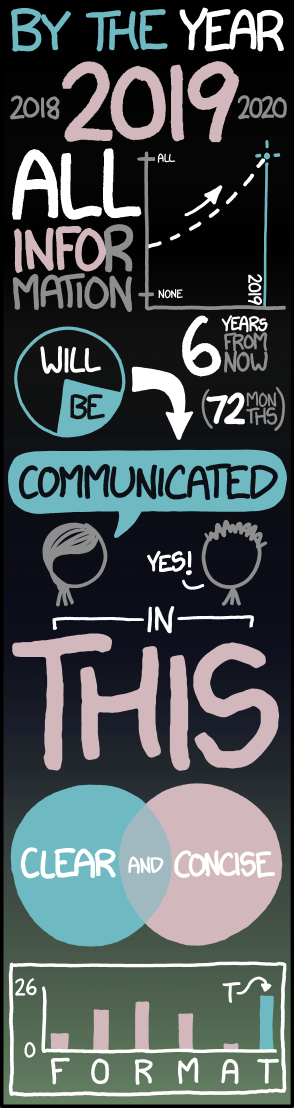
Tall Infographics

'Big Data' doesn't just mean increasing the font size.
06 Oct 17:45

If you don't use your words you won't be indistinguishable.

by Neurodivergent K
"What's wrong with saying 'use your words'? My son's ABA therapists told me to!"

Yes, and your son's ABA therapists jobs are dependent on the promise of indistinguishability, their entire professional life revolves around creating a performance of typicality, not with helping Autistic people actually be healthy happy Autistic people. The whole indistinguishability series is all about that. Today, let's talk about "use your words". This will be a trip through all the levels on which that phrase is not awesome, semi stream of consciousness style.

So, what is wrong with "use your words"? Let's think for a moment. When do you say that? Do you say it when you have no idea what I am communicating? No you do not. Not generally. Those of you who give a shit establish if it's urgent, life threatening or something, first. But you know I'm not dying? You have a pretty good idea what I'm saying? "Use your words!"

This is you holding my needs and wants hostage to my ability to communicate your way. Once you're reasonably sure I am not actively being mauled by a bear? You've decided it isn't important enough to me if I don't communicate it how you want.

This is an extremely dangerous assumption to make, and completely backwards. If something is urgent and important, words are hard. Your brain may go to words first. Mine does not. Not even a little. "Use your hands & sounds" is a better way to get useful communication from me when something is urgent and important. What my body does? Far more reliable than what my mouth says.

The less impact and importance my speech has, the more reliable it is, especially in a real-time communication situation. That part of my brain shuts down when what I say has immediate consequences of any significance.

"Use your words" assumes the exact opposite of this. It assumes my words mean more under duress. They do not. You are going to get whatever words fall out of my mouth in an order that may or may not make any sense or relate at all to what I am trying to convey. It might even be the opposite of what I mean.

Making that assumption comes from a dangerous place. When you demand that I "use my words", the underlying attitude is that I can but am choosing not to. That I am intentionally doing something to make my life more difficult. No, I am fucking not flapping, semi-signing, making non-word sounds, crying, starting and stopping words just to piss you off. Allistics act like we're just trying to make their lives difficult or add annoyance to their day. So they tell us to use our words, like it's just that simple.

But if we could, we would be. Let's walk in some Autistic shoes. Is flailing and sound making efficient? No. No it is not. It causes me far more actual problems than it could possibly ever cause you. "Use your words" says that I am choosing the non-awesome results of being unable to speak in that moment. It's really presumptuous, actually, for you to make that assumption. It's very allistic-centering.

"Use your words" holds my needs hostage to performance of typicality and says I do not deserve to have my needs met if I cannot make that performance work. That is what you are saying when you tell me to use my words.

And you don't even really want my words. My words come in atypical syntax (which apparently is charming when I'm not trying to communicate something that you don't want to hear) and I do, in fact, say "fuck" a lot. Especially under duress. That is not the word you want when you condescendingly tell me to use my words. You want your sentence construction. You want "polite" and "respectful" and the genuine words I have access to are not perceived as either-not the words I can use in a stress situation.

The result of this and of a childhood of "use your words" isn't less swearing or more standard syntax. It is a library of scripts. My grocery store small-talk script is unlikely to be useful--and has actively sabotaged medical care when the nurse triggered the "I'm-fine-thanks-how-are-you?" sing song. Having to fall back on scripts rather than use my natural means severely inhibits communication--my message is falsely constrained to the socially appropriate things I can echo under stress.

They may not all sound like echoes. If a script is caught as a script, it is "meaningless echolalia" and not communication, unless of course it fits the least irritating narrative for the allistics involved (see: the nurses who decided I was fine when they triggered the grocery store script. I had cysts hemorrhaging on my ovaries at the time. Plural cysts. This wasn't life threatening but it causes scarring and incredible pain).

"Use your words" is silencing. "Use your words" is a tool used to silence those of us who cannot-not will not, can not, express ourselves on your terms all the time. "Use your words" is yet another thing that promotes a facade of normalcy at the expense of our very real needs and desires. "Use your words" is yet another thing that demands performance, or else. "Use your words" is emblematic of the idea that only typical people have a right to have needs or wants. It is a Lovaas-esque "the child has no right to behave bizarrely" tactic that pretends we are nothing but our superficial behavior, and that we can choose to change that if there is a strong enough reinforcer.

"Use your words" is oppressive ableist bullshit. These are my words: Touch your fucking nose.
06 Oct 16:24

Day 4657: If Theresa May Was A Terrorist – a Thought Experiment

by Millennium Dome
Tuesday:


This week Theresa May accused Cap’n Clegg of Hating Britain* for putting the Human Rights of terrorists and criminals above ordinary people.

That’s because Ms May does not understand that Human Rights are not to protect terrorists, they are to protect people who get called “terrorists”.

So, as an experiment, let us imagine that Theresa May is a terrorist.

It’s not that hard to imagine… she’s the head of an organisation that preaches messages of hate to frighten people, snatches people off planes for intimidation, targets certain people in the streets and, of course, occasionally shoots innocent people dead.

Er, okay, this is just a thought experiment, isn’t it?

Anyway, since Ms May doesn’t believe “terrorists” deserve Human Rights, then let’s see how well she does without them, shall we?

Let’s call her a “terrorist”.

Shouldn’t we have to prove that?

Well, a Fair Trial is one of her Human Rights, so I guess not.

So we’ll lock her up.

Oh, no we can’t do that because Liberty is one of her Human Rights… oh hang on.

But shouldn’t she be allowed to hire a lawyer at least?

Well, we’ll just seize all her money. No protection of Property without your Human Rights you see.

But we can’t just do that because of what she thinks… can we?

As it happens Freedom of Thought is another of those pesky Human Rights.

Isn’t she allowed to protest?

Aaaaactually, guess what, Free Speech is one of her Human Rights, so that’s gagged her too.

You can’t actually gag her though, that’s cruel and unusual!

But, since you mention it, Protection from Torture and Degrading Treatment is, guess what, a Human Right.

If you carry on like this you’ll end up killing her!

Funnily enough, I was just coming to that…


So Ms May, if you want to abolish the Human Rights Act, which rights don’t you want? It’s not hard; there’s only ten of them:

1. the Right to Life
2. the Right to Protection from Torture and Degrading Treatment
3. the Right to Protection from Slavery
4. the Right to Liberty and Freedom
5. the Right to a Fair Trial and No punishment without Law
6. the Right to respect for Private Life, including the right to Marry
7. the Right to Freedom of Thought, Religion and Belief
8. the Right to Free Speech and Free Assembly and Protest
9. the Right to Freedom from Discrimination
10. the Right to Protection of your Property


*Or was that was the Daily Heil.

Featured on Liberal Democrat Voice
06 Oct 16:24

Day 4658: Is Mr Cameron Laying A Trap for the Liberal Democrats?

by Millennium Dome
Wednesday:

Firstly, congratulations to the Daily Heil for granting Mr Milipede free publicity to totally overshadow the guff our pie-faced Prime Monster came out with at the climax to the Conservatories conference.

But to be honest, David Cameron – Mr Balloon – was probably grateful for anything overshadowing the uninspiring, reheated, frankly tired Thatcherite rhetoric he was coming out with. He looks like he’s decided the next election is a lost cause and he’s gone back to shoring up the base against UKIP

I mean “Land of Hope is Tory”? Are you really going to say that, Prime Minister? Really?

It’s like a line out of “House of Cards” (BBC version): Do you remember the bit where Urquhart (and we the audience) look on and mock at Conservatory conference as an Apprentice-line of Leadership wannabes troop onto the platform to deliver what they think will be the rhetoric to stir the troops to their cause. Like the Britain’s Got Talent without… no, actually, like Britain’s Got Talent. “It’s the right way… the right… way!”. Sad.

The whole conference has been conducted under a banner of “For Hardfaced Badwords”… sorry that should read “For Hardworking Families”.

(I remember the meeting with Cap’n Clegg where we were among Lib Dem members who had words with him about adopting that language – and to be fair, even then his idea of “family” was a broad and inclusive one, not the nasty narrow Conservatory prescription, but he accepted that it could trap him in the same frame and he’s worked hard to avoid it since. Liberal Democrats really can do better than this. Er.)

And there was Master Gideon, pumping up the housing market to the refrain of “I’m Forever Blowing Bubbles”, saying it was time to end the “something for nothing” culture. I look forward to his announcement that Inheritance Tax will be going up to 100%.

But it’s all such a long, looooong way from “Hug a Huskie” or “Let the Sunshine In”, isn’t it.

And of course we have to oppose this monstrous idea that people under twenty-five need to be “motivated” into jobs that don’t exist with the threat of homelessness and starvation.

But here’s the “trap” – can we really pledge to block that without reminding every young person in the country of the last pledge that we made?

Is Mr Balloon’s gambit that as soon as Cap’n Clegg raises this horrible policy, he will fling the tuition fees debacle back in his face and say: “well, you can’t trust the Lib Dems can you”?

In fact the policy is so obviously absurd that it almost look like it’s there as a pre-prepared sacrificial lamb for the next round of Coalition negotiations. We are going to have to make it very clear that dropping that policy is a prerequisite for walking in the door, or we’re going to be in the position of trading away something that’s actually important just to kill it.

In fact I’m wondering whether we don’t need one or two policies in the “you’ve got to be kidding” category ourselves – free moon trips for teenagers, perhaps, and fish-fingers and custard on demand for all Eleventh Doctor fans – before we get serious about abolishing ATOS.

Mind you, at this rate it will be Mr Milipede we’ll be negotiating with anyway. And the message for Mr Balloon? Shut Your Trap.

Featured on Liberal Democrat Voice
05 Oct 22:07

Fuck the Daily Mail?

by stavvers

HEY GUESS WHAT EVERYONE, THE DAILY MAIL ARE BEING MEAN ABOUT A DEAD WHITE GUY.

WE SHOULD, LIKE, SET THEM ON FIRE OR SOMETHING.

Forget about the woman they hounded to death. Or the relentless racism, the vicious homophobia, the rampant misogyny, the perpetual incitement to violence against anyone marginalised.

Now they’re being mean about a dead white guy, that’s just a step too far.

Yes. You may say you were pissed about all of those things, too, and that this is the last straw. I get that. I really, really get that.

But here’s the thing. Most of the evils of the Mail are not actually this particular newspaper. The Mail, for the most part, is a dark mirror which reflects disgusting attitudes which pervade society. It phrases them a little more bluntly than many are comfortable with, perhaps, but it is just an amplification of prejudices which already exist. The Mail didn’t invent xenophobia, it merely turned up the volume.

It is only really for white dudes that the Daily Mail is creating any kind of novel hate. For most of us, it’s just repeating the same hate we hear every day, in a louder voice.

It’s not the Mail that’s the problem. It’s fucking kyriarchy. And unfortunately, that’s too hard for a lot of people to attack. And so we have a moan about the Mail–god knows I’m as guilty of this as anyone else–rather than the social conditions which produce the bile that they spout.

It is the death of these conditions, the death of bigotry, the death of kicking down that needs to happen, not the death of a particular newspaper. The world around us is far uglier than a Daily Mail editorial if you allow yourself to see it.


05 Oct 22:01

Wave the White Flag

by LP

As I write this, America is creaking under the third day of a shutdown of the federal government, forced by as low a group of petulant time-serving cretins as ever bore the title of elected official.  It’s a dark time for anyone who believes in the high-school-civics conception of good government; most polls are showing that the current Congress ranks somewhere between Stalin and food poisoning in terms of popularity, and were votes of confidence available to us as they are in other democracies, the entire 113th would likely be replaced by a nice set of flatware by Halloween.  The majority of Americans are only vaguely aware of what their elected officials do to begin with, and now, they’re convinced that the answer is nothing, and at great expense.  No one is fooled by grandstanding senators who say “Oh, we didn’t mean to shut that service down”, and the distinct possibility that John Boehner will fiddle as New Orleans drowns (again) is enough to put even the least cynical voters in a killing mood.

While a handful of delusional partisans (and, of course, the six-sides-of-the-same-coin media) are still insisting this was brought about by intransigence on both sides, even most staunch Republicans — including hack propagandist Newt Gingrich, who authored the last government shutdown — think this is a pretty shitty deal, and is likely to jeopardize the G.O.P.’s election chances in the immediate future.  But, given the glee with which many of the Tea Party die-hards are pursuing this dead end strategy, one has to wonder:  do they even care about being elected?  Ever since the “Republican Revolution” (speaking of Newt Gingrich), the bewilderingly effective extremist wing of the party, the so-called radical right, don’t seem to care about electability.  The presidency, to them, seems to be a promotional bauble that’s not worth the candle, something only a truly compromised leader would seek out in the first place; they don’t even want to dominate the party, since their small minority seems enough to cow the mainstream into submission.  As the Democrats move further to the right, so, too, does the Right move further to the right, until the space once occupied by left liberals is as empty and desolate as a South Side playground, and the G.O.P. stakes out territory that would once have terrified the Reagan Republicans.

Indeed, as ably covered by the Baffler Boys back when Clinton was in flower and as a friend reminded me recently, these people don’t act like elected government representatives at all.  Their virulent hatred of the entire concept of government, their hostility towards the public sector, their fear and mistrust of the executive branch marks them as something more like, well, a bunch of anarchists.  This is hard for me to hear; after all, anarchism as an idea, if not as a practice, is still near and dear to my heart, and my progression from the teenage Communist I once was to the crotchety old Democratic Socialist that I am now was marked by an extended spell as a proud waver of the black flag and the circle-A.  I walked the talk and sported the tats, and I even ran with a black bloc crew when that was a dangerous rather than quaint thing to do.  A number of anarchist thinkers were crucial to my political development, and I still think of a stateless society as an ideal, albeit one that is impractical on anything approaching a large scale.  So how am I supposed to feel about my freak flag being flown by a bunch of self-made capitalist cut-throats, creatures farther to the right than I ever was to the left, who are having more success tearing the system down from within than I ever dreamed of doing from without?

The answer lies, as all answers do, in the problem of definition.  The whole idea of right-anarchism has been a problematic one from the beginning.  Libertarianism, while it skirts around the edges of anti-statist doctrine in theory, has always in practice been a conservative, even reactionary, creed.  As has been repeatedly pointed out, you cannot want what the state wants and not want the state, and what we have seen from the Libertarian right, from its communes and communities to its criminal organizations, has always been more or less supportive of existing power structures — just a little bit greedier, a little bit more sunk in vice, and a little less willing to contribute to the societies that make it possible.  The robber barons of the Gilded Age were just as scornful of Big Gummint as any latter-day web billionaire or Reason contributor, but it was not that brand of anarchism that society feared; it was the bomb-wielding, working-class, foreign-tongued madmen of the left, huddled in their black masses in sinful Chicago.

So, too, are the prophets of destruction in the radical right.  If there is such a thing as right-wing anarchism — and I am not convinced that there is, for in some form or another, all right-anarchists seem comfortable with the accumulation of power as long as it is not sanctified by the state, and to me, Webster’s notwithstanding, anarchism must necessarily be against authority as much as it is against government — it is not embodied in this tawdry gang of wreckers and vandals.  When Marx spoke of the withering away of the state, he didn’t mean the complete disappearance of authority, but rather its transformation into an instrument of the will of the working class; this idea would be anathema to the rich men’s tools who fancy themselves saviors of the common man from government oppression.  Despite how it might look, they aren’t even pure Darwinists, favoring society as a state of nature where only the strong survive and the weak are culled away.  They might picture themselves a Conans, wielding a pitiless sword and crushing the unworthy, but they are just normal, fat, soft, American businessmen who would shit purple if a real state of lawlessness dawned and they found themselves facing down the wrong end of a looter’s shotgun.  No one is as quick to call out the law or the Army when capital is invaded than bosses and their toadies.

No, these are no anarchists, these men and women busting up the halls of power like school kids trashing their lockers on the last day of school.  They lack even the juvenile commitment and self-awareness of some rowdy man-teen reading Bakunin for the first time.  The flag they fly is not red or black, but white — not the white flag of surrender, but the white flag of the royalist, the monarchist, the conservative, the reactionary, of the White Terror that would butcher thousands rather than see the germ of social responsibility infect the body of authority.  And even that gives them too much credit, for they lack even that level of political sophistication.  They have no special problem with statism, with the imbalance of power, with authority and social control; their issue is not the whip, but who’s holding on to the reins.  In their every action, from sulking about a perfectly legitimate law they were unable to block to their one-sidedly forcing a national embarrassment and then, like an abusive husband, demanding why their victims made them do it, they manifest no theory or design, only id, spite, and greed.

Even more so than the Bonnot Gang, they are a group of self-enriching criminals, greedy, egotistical, and deeply incompetent, hiding behind a child’s notion of ideology.  If they can play at anarchism, then I can flirt with authority:  for them, let us have the labor camp, the guillotine, the gibbet. Fuck ‘em!

05 Oct 21:54

Frankenfood

by LP

“Victor, you didn’t invite Adam over again, darling?”

“Of course I did. Why wouldn’t I?”

“Honestly, darling, he’s just awful. We’re getting a reputation. No one will come to our dinner parties if you keep asking him over.”

“But whatever is the matter? He’s well-read, a fine speaker, mannered, very polite.”

“He’s polite until someone lights a cigar after their meal. Then he’s throwing people into the koi pond.”

“I don’t understand why you don’t like him.”

“Darling, he’s hideous.”

“What do you mean?”

“I mean, he’s…well, he’s disfigured.”

“Oh, I wouldn’t say he’s disfigured.”

“Whatever are you saying, Victor? Of course he is. Just look at him. He has bolts in his neck.”

“No, no, obviously he is disfigured. I just wouldn’t say it. It’s rude. At any rate, he’s no worse than some of your friends.”

“Victor! What a thing to say!”

“Well, it’s true.”

“Like who?”

“Oh, for example, that horrid Rebecca von Friesendorf.”

“What’s wrong with Rebecca?”

“She wears too much perfume. And she’s a terrible bore. And once she spilled tea on our linen tablecloth and tried to hide it by angling a spoon, just so.”

“I suppose she may not present one with the most scintillating after-dinner conversation…”

“Ah, ha! You see?”

“…but then again, she isn’t assembled out of the corpses of vagabonds.”

“We don’t know that for sure.”

“Victor. Please.”

“You don’t understand, darling. I know he can be a chore, but…well, the fact is, I feel a certain responsibility to him. I can’t just bustle him out of my life. When I was young, I made him.”

“Darling, when I was two, I made a mess in my pants, but you don’t see me inviting it to dinner.”

“What do you want me to do?”

“Simply disinvite him!”

“I can’t. I haven’t the heart.”

“Can’t you think of some excuse?”

“Hmmmm…what are we having for main course?”

“Cornish hen.”

“That’s it?”

“Well, it’s a full course, but…”

“Is there electricity on the menu”

“The market was fresh out.”

“Well, then. That’s his favorite. I suppose he won’t be too keen to come now.”

“You’re a darling, Victor.”

05 Oct 21:34

Today’s Political Comment

by evanier

Ted Cruz appears to be concerned that he hasn’t managed to piss off every single person in America who isn’t a Tea Party looney.  The latest…

"The House of Representatives has repeatedly compromised already," said Cruz, who already who spoke against funding the law on the Senate floor for 21 hours earlier this month. "The House began — it is the view of every Republican in this body, and indeed every Republican in the House, that Obamacare should be entirely and completely repealed. Nonetheless, the House started with a compromise of saying not repealing Obamacare but simply that it should be defunded."

It’s statements like this that make me wish we had an actual Democrat in Congress besides Bernie Sanders (who isn’t even a Democrat) to veer as far left as many Republicans veer right. The Dems oughta send Sanders out to demand that Obamacare be "repealed and replaced" with Single Payer, then have all the putative Democrats in both Houses endorse this for a few days. Then they can drop it, agree to be satisfied with the Affordable Care Act "as is," and say, "Okay, we compromised!"

And by the way, I don’t for a minute believe every Republican in the house thinks that it would be a good thing for America if Obamacare was completely repealed. Most of them might well think that it would be a good thing for the Republican party.

03 Oct 21:10

Book Preview: They Might Be Giants' Flood

by noreply@blogger.com (Philip Sandifer)

Today we've got the intro to They Might Be Giants' Flood, the book I wrote with the brilliant S. Alexander Reed for Bloomsbury Academic's 33 1/3 series. The book is out November 14th, and is available for pre-order at Amazon and Amazon UK

I'll surely write about the book again closer to release, so I don't want to do too much beyond just put the intro here and let it speak for itself. I will say that even if you're not a huge They Might Be Giants fan, I think the book probably has plenty of cool stuff for you. It's not just about They Might Be Giants, but about a particular historical moment. It's not just a book about music, but about how 1990 was a turning point for geek culture, and about the nature of what geek culture is, in a way that goes beyond the conventional nerdy references. Indeed, one thing the book is very much about is how "geek" went from meaning twenty-sided dice and fluency in Klingon to meaning something much broader and more inclusive. I think most people who like my stuff will like it too.

But I will add a personal note. In the current publishing climate, the saying is that anything that sells a thousand copies is doing well. The TARDIS Eruditorum books do that. Handily. Unfortunately, they do it through channels that don't show up when publishers do searches on authors' past sales.

One of the explicitly stated reasons I didn't get a traditional press contract for the Wonder Woman book (out towards the end of October, I believe) is exactly this - my sales figures look way smaller than they actually are. And by way smaller, I mean that when traditional publishers check my sales, I have sold two books. Ever.

All of which is an overly long way of saying that this book is kind of a big deal for me. If it does well then when I shop future projects to traditional publishers I look a lot more credible. It opens doors. So if you're interested, please consider putting in a pre-order. Impressive pre-orders make the publisher put more time into supporting the book. The publisher supporting the book boosts sales. Strong pre-orders are, in current publishing, a huge deal.

But more broadly, and with the knowledge that my readers have been incredibly generous to me this year, and that I have a lot of material coming out in a short period of time, I just want to pause and say thank you to everyone who supports my work, however you support it, and whichever bits of it you support. It means a lot knowing that I do work that people enjoy enough to support. More than a few days have been genuinely brightened just by knowing you lot exist. Thank you. 

OK. This is getting maudlin. Let's talk about 90s geek rock.

PROLOGUE: THEME FROM FLOOD


Two Floods (There’s a Picture Opposite Me of My Primitive Ancestry)


A photograph of the Ohio River’s 1937 deluge emblazons the cover of They Might Be Giants’ 1990 album Flood. Both Floods poured into a million American homes, but while the former killed 385 people, the latter managed to kill absolutely no one. Flood is, after all, not a ferocious record. Where rock fans might want John Flansburgh’s guitar to roar, they get a pinched meow instead. There are no awesome drum solos or trancelike beats, just a sterile, tinny rhythm machine. Flansburgh and his accordionist bandmate John Linnell sing in voices so nasal that a rock critic once asked them if they sounded like Olive Oyl on purpose. This is not music for cool people.


But there’s actually something more interesting happening on Floodthan rocking out. Despite the sleeve photo, the flood that the album uncorks doesn’t refer to a past event, but instead we might hear it as a creative practice. And not to put too fine a point on it, the band’s “flooding” on this album can tell us a lot about an important shift around 1990 that gave a new social, technological, and ultimately economic legitimacy to what we might call geek culture.


The authors of this book first heard Flood as middle schoolers at an academic summer camp. The program’s name was CTY—Center for Talented Youth—but to our classmates during the regular school year, it was usually just called nerd camp. In our public schools, it was a statement of fact that we were nerds; there was no use denying it. CTY by its nature attracted a lot of people like us from the outskirts of various social groups, and its own culture is heavily impacted by the fact that for large swaths of its student population, those three summer weeks are the first time that they have been in a like-minded social environment. Campers’ parents sent them for the academics, but more than coursework, every kid there treasured that sense of belonging, and as such, the weekly dances served as major centerpieces of the larger experience. Each Friday, Flood’s iconic single “Birdhouse In Your Soul” marked a peak of giddy, electrified togetherness for 400 teenagers. For a few minutes, being a nerd wasn’t about isolation.


If the media’s portrait of They Might Be Giants is to be believed, this experience was no fluke. Billboard magazine declares them “nerd-rock heroes,” Pitchfork media champions them as “geek-rock kings,” and England’s New Musical Express dubs them a “nerdhouse cabaret act.”  The words geek and nerd—setting aside any arguable differences between them—are cavalierly tossed around in writeups of the band without much definition or qualification, which suggests there’s an unwritten assumption that readers not only understand the terms, but that they also understand why such labels might be applied to They Might Be Giants’ music, fairly or otherwise. The implication is that whatever it is that makes someone a geek, you’ll find it in on Flood.


Flood, then, helps us to understand a certain identity, a way of being. It’s especially interesting to scope out the album’s supposed geekdom in the context of its time, because 1990 was a transformative moment for that pocket of culture. For the band’s own part, the Johns Linnell and Flansburgh grew up in the 1960s and ‘70s, a time when the meanings of nerd and geek first came to specify bookish social outcasts, limited in both physical strength and traditional attractiveness. To their generation, geekdom offered little more than ostracism, and so accordingly the band is defensive about the label: Linnell explains, “As far as the ‘nerd’ or ‘geek’ thing goes, I think that’s a way of describing unusual things when you’re uncomfortable with them.”


But part of Flood’s importance in 1990 comes precisely from its dearness to that culture—most of whom were a half-generation younger than the two Johns—who reclaimed the smear of geek and shaped it into a viable social identity. To some, it even became something worth aspiring to. After all, when Flood came out on January 5 of that year, Stephen Hawking’s A Brief History of Time ranked as a top-ten New York Times bestseller, Garry Kasparov had secured genuine rockstar status just a few weeks earlier when he defeated the Deep Thought chess supercomputer, and Bill Gates was the richest thirtysomething on the planet.


For geek to turn from an insult into a source of individual and collective empowerment meant that it needed to connote more than booksmarts, Star Trek fandom, or an enthusiasm for Dungeons and Dragons. Indeed, Flooddoesn’t offer much in the way of traditionally geeky iconography. It’s true that after Flood, the band was declared “Musical Ambassadors to International Space Year” (as endorsed by the United Nations in 1992), and they released the children’s record Here Comes Science in 2009, but these achievements serve less to market the band to geeks than to reaffirm a longstanding public identity. Instead, Flood encapsulates in 43 minutes and 14 seconds a moment when geekdom demanded recognition not as a set of interests, but as a way of thinking. It’s not reasonable to claim that the record on its own turned the tides of outcast identity, but Floodnonetheless helps us to understand how and when such a shift could happen. The appeal of They Might Be Giants doesn’t come from what they write songs about, but instead from how they write songs. What other explanation is there for fans’ dizzy adoration of “Minimum Wage”—a song containing nothing more than John Flansburgh’s triumphant belting of the title, a crack of a whip, and forty-five seconds of retro lounge sauntering?


Overflow (That’s All I Can Think of, but I’m Sure There’s Something Else)


This is where the notion of the flood comes in. In the music of They Might Be Giants, flooding is an artistic overflow; it is a supply of creative resources that so overwhelms the demands of creation that songwriting ceases to be about clearly expressing a single idea, and turns into a playground of excess ideas.


John Flansburgh explained to the New York Times in 1987, “Most people just don’t bring everything they’ve got to what they do. We don’t feel we have to strip things away and make the songs more simple for people to understand what we’re about… it’s a cornucopia, a myriad.”


The notion of sheer quantity arises time and again in the band’s output. In the 1990 promotional video for Flood, the two Johns make their case clear:


Linnell: Some records that come out today only have ten songs, or less.


Flansburgh: This makes us angry.


Linnell: But instead of cursing the darkness, John and I have decided to do something about it. We’ve put out a record with nineteen songs on it.


Flansburgh: And that’s why our record is better.


Behind this joke lurks a telling possibility. If nonsense, variability, and excess are the hallmarks of “cornucopia,” then the songwriting practices of clarity, focus, and restraint are the stuff of famine—certainly boring, and quite possibly stupid.


As we’ll explore, even as the album’s nineteen songs overflow by virtue of their number, the songs themselves are little floods. With no stylistic foreshadowing, the heavy metal guitar solo of “Your Racist Friend” suddenly drowns beneath a calypso trumpet interlude. In the chorus of “Someone Keeps Moving My Chair,” the vocal rhythm is every bit as non-sequitur as the lyric. The knowledge of musical genre on parade throughout Flood might seem outright boastful if its specifics weren’t so desperately uncool by 1990 standards—Edwardian musical theatre in “Theme from Flood,” rockabilly in “Lucky Ball and Chain,” contradance in “We Want a Rock,” and sea chantey in “Women and Men.” Humbly armed with a cheap Alesis SR-16 drum machine, the two Johns actually exhibit little interest in showing off; conspicuous virtuosity is additive within a rock song, whereas They Might Be Giants’ music is, as Flansburgh says, the result of not stripping things away. One gets the sense that the music is really just that effortlessly overrun.


What’s going on here is playfulness. Flood embodies the idea that creativity is an open-ended result of asking “what if,” and not the single-minded pursuit of a pre-imagined ideal. The band’s music rejoices in a continual sense of play, altering and subverting the expected order of things, whether imagining the world from the perspective of a canary-shaped nightlight or inventing bizarre fictional fads involving prosthetic foreheads. The point isn’t whether “Particle Man” is a metaphor for the struggle between science and religion (as many fans suppose it is), but instead that “Particle Man” is both unwriteable and incomprehensible under the assumptions of order and of one-to-one lyrical meaning that a lot of performers and audiences bring to their musical experience. Because They Might Be Giants’ music is (almost) never in service of a joke, the silliness of songs like “Particle Man” is exploratory, not goal-driven. Musical, lyrical, and visual ideas then exist for their own sake.


The word flood shares a root with affluence, and it’s easy to see that there’s an economics of mental resources at work here, both on the part of the band in playing haphazardly with ideas (rather than investing them carefully) and on the part of audiences in relating to this particular sort of mental excess. Enjoying Flood’s brand of playfulness affirms a listener’s sense of her own intelligence, imbues fandom with a secret language shared between artist and audience, and celebrates weirdness for its own sake. See why this might be appealing to an auditorium of allegedly gifted teens at nerd camp?


All of this has further implications in terms of cultural criticism. Geek culture occupies an unusual social space. On the one hand it is defined by the enormous privilege implicit in having access to computers, wide swaths of literature and media, and education. Unspoken in an aesthetic of playfulness is the economic security necessary to “play” in the first place (it’s fitting that private college campuses have been a lynchpin of the band’s tours since the beginning). On the other hand, geekdom is often marked by a sense of social isolation and even by bullying.


This mix of privilege and outsider status is, in many ways, also mirrored by the band itself, particularly during its time at Elektra Records, starting with Flood. They Might Be Giants were in many ways an odd choice for so large a record company, and Flood is an exceedingly strange animal. On the one hand it is self-consciously designed in its production and song sequencing to be a breakthrough major label debut. On the other, it is nearly self-evident that the two Johns were destined never to become mainstream stars. This tension is audible throughout the album, and it speaks to the oddness of 1990’s musical moment, when the reversal of social tides loomed large enough in culture (and sounded clearly enough in the band’s music) that somebody figured—rightly, as it turned out—a million people wanted to hear this.


What follows, then, is an exploration of the thicket of historical and cultural contexts that Flood encompasses. This means tracing the musical and cultural origins of They Might Be Giants inasmuch as they help us to understand why and how this record matters. It also means looking at the people who have embraced this album and investigating how in 1990 it was so poised to interact with their own particular ways of being. In the pages that follow, we’ll see the collisions of childhood, technology, and subculture, their unintended effects rippling well beyond the domain of music. 

03 Oct 18:39

Cockblocked by redistribution: a pick-up artist fails in Denmark.

Cockblocked by redistribution: a pick-up artist fails in Denmark.
03 Oct 16:12

So what is Paul Dacre playing at?

by The Heresiarch
This week's Private Eye has an interesting (should you care about such things) item about the future of legendary Mail editor-in-chief Paul Dacre.  It reports that Dacre's incentive package was amended in 2010 from a five-yearly bonus to one in which he was to be paid "an additional £500,000 for each full year that he continutes working until he is 65".  We also learn that "his contract was also amended last year from a rolling one to 'the residual term until his 65th birthday on 14th November 2013'."

A big hint there that Dacre is being eased out.  The 65th birthday looks like an excuse, or a face-saving formula.  There's no reason why he shouldn't continue as editor after then, should he wish to and should his employers want him to stay on.  On the other hand, were he really ready to quit, why would he want to cling on until a symbolic retirement age? 

Assuming this account is accurate (and the evidence for the Eye's story seems quite clear), it provides some context, at least, to Dacre's kamikaze-like behaviour in recent days.  It's not clear whether or not he personally decided to run the now-notorious article about Ralph Miliband, which might otherwise have passed without much fuss, under the headline "The Man Who Hated Britain". But there's little doubt that it was he who responded to the criticism from Ed Miliband with a trenchant refusal to apologise, indeed a determination to repeat and underscore the allegations about the Labour leader's Marxist father.  And the Mail's attempt to link the story with its campaign against press regulation certainly has Dacre's fingerprints all over it.  So what is he playing at?

It could well be a case of the devil coming in great fury because he knows his time is short.  Nothing to lose, now, after all.  Better to go down all guns blazing in a fight to the death with Ed Miliband than to just slink off to his retirement home.  His departure, even if postponed until November, will (at least in his own eyes) take on the lineaments of a martyrdom.  Perhaps he believes that he can bring Miliband, or the whole regulatory process, down with him.  Or perhaps it's simply his last hurrah for the Blackshirts.  Either way, he will be enjoying his final battle.

There's a risk here, of course, which is that Dacre's behaviour will hasten the dawn of Leveson-style regulation, by increasing Miliband's determination to accept nothing less (feelings of outraged filial piety now joining his longstanding desire to muzzle newspapers like the Mail).  Already, pro-regulation campaigners scent blood: the fury with which the Mail is now being pursued is somewhat opportunistic, however genuine the anger behind it.  They will not be appeased by securing Dacre's scalp (as it will inevitably appear); the removal of their most rabid opponent will be no more than a first step.

As Roy Greenslade has it:

In truth, the whole affair has blown up in Dacre's face because of his intransigence. The Mail editor has become the centre of a story that has legs.

In the process, he has achieved the reverse of his intentions. A dignified Ed Miliband has emerged with an enhanced image. As for press regulation, he has made it infinitely more difficult for the matter to be resolved in favour of the system he favours.

But perhaps Dacre doesn't really care, and this last campaign is part of a scorched-earth policy.  There's said to be little love lost between Dacre and the man often touted as his successor, Mail on Sunday editor Geordie Greig.  Greig himself today issued an abject apology for one of his reporters gatecrashing a memorial service for Ed Miliband's uncle.  He was insistent that he had nothing to do with it (but then who did dispatch the reporter without his permission?  One of Dacre's minions?).   The subtext to Greig's grovelling is presumably to signal that the Mail under his control will be softer, gentler affair, a labrador puppy to Dacre's pitbull; and no doubt there's also a hint of panic that the scandal might cost him his long dreamed-of prize. 

Ed Miliband, meanwhile, has gone over Dacre's head to the present Lord Rothermere, demanding a thorough enquiry into the ethics of the Mail.  Such an enquiry could only satisfy by presenting the Labour leader with Dacre's head on a platter.  But if Dacre is leaving anyway, the sacrifice can only be a symbolic one.  Unless, of course, it gives Rothermere a most convenient opportunity to remake the Mail's image by loading all of its sins onto a scapegoat, who will then be cast out into the wilderness with only a vast pension to sustain him.  Or unless Dacre has raised the stakes so high that his departure now would look too much like a victory for the supposed enemies of a free press.  In which case the plans for his retirement might have to be revisited, and Rothermere (and the whole country) might be stuck with him for logner than originally expected.  Who knows?

UPDATE: The Press Gazette is reporting that Dacre is staying on for another twelve months at least, having agreed a new contract. It's not clear when he negotiated this. In any case, it puts paid to any "scorched earth" theory, but I doubt the timing is entirely coincidental. Perhaps his new lease of professional life has gone to his head.


© 2013 Heresy Corner, all rights reserved.
03 Oct 12:35

Why The ACA Matters to Me

by John Scalzi

Over on her site, author Kameron Hurley tells the story of how she almost died because she didn’t have enough money to manage her adult-onset Type 1 diabetes. It wasn’t that she wasn’t working — First she worked for a company through which she had (crappy) insurance, and later she was hustling as hard as she could as a freelance writer. It was because the way insurance has been handled in the US made it very difficult for her to get insured, stay insured and to afford to be insured — and the alternative to being insured here in the US  is so much worse that it simply beggars description.

Thing is: Kameron’s story? Not unusual for writers in the US. I don’t have enough fingers and toes on my body to count off the writers in my own personal sphere who are hardworking, who are hustling as much as they can with their work, who had the medical boom dropped on them by life and were screwed because they didn’t have health insurance, or couldn’t get health insurance was even remotely within their financial means. I can’t tell you the number of writers I know who personally have gone begging online or to family and friends to cover a catastrophic medical issue. Not to mention musicians, artists, actors, and any other sort of creative people.

Or anyone else, for that matter, who doesn’t live in the magical bubble of work that carries benefits. I was at the store the other week, listening to the woman in front of me in the checkout line cough like her lungs were trying to escape through her throat, and heard her friend admonish her for not going to the doctor. And the coughing lady gave her a look, and it was a look I knew really well from days of old, the one that said, and just how am I going to afford that, do you think?

In my professional life, I’ve been fortunate. I’ve always had good health insurance, either through my employer or through my wife’s, and the one brief time I paid full freight for our health insurance, I was able to afford it (although I had to incorporate, hire my wife and then attach myself and our child as dependents on her policy, because it was massively cheaper that way — which also points out the stupidity of how health insurance is done in the US). I’m also aware how fortunate I have been for someone in my field; I am one of the few self-employed writers I know who doesn’t have a health insurance tale of woe.

I’m also aware how many of how many people I know — not just writers but people in general, among friends and family — who have no margin of error when it comes to their health. If they get sick, their most rational option is take some Tylenol and hope it goes away. Because they can hardly afford to go to the doctor and even if they do, what is the doctor going to do? Give them a prescription for something they really can’t afford, or send them along to a specialist they also can’t afford, or tell them they have some problem or issue they can’t afford to fix. Out comes the Tylenol. Out comes the look the woman in the checkout line gave her friend.

Now, here comes the Affordable Care Act, and its various marketplaces for insurance. God knows it’s not the perfect system — it’s really not — but for the first time in my adult memory it means that people can find an insurance plan with decent coverage, including the basic preventative care that can address so many problems early and much more cheaply than if people wait until they find themselves in an emergency room, for a price scaled to their income and their ability to pay. It means all the people whose previous rational options for health care consisted of being sick because it was cheaper than getting well have a better option, both for themselves and for the rest of us (you didn’t think those ER visits came for free, do you? Oh, we pay for them, my friends).

And of course some people oppose it. They give all sorts of financial and economic reasons, which don’t hold up to scrutiny, particularly over the long term, as the benefits of a healthier population and throttling of expanding costs come into play. In the end, a lot of the opposition stems from the fact that the United States still has a thick layer of angry Calvinism to it, the sort that suggests that if you are poor, or sick, that you did something to deserve it and that you should just have to deal with it because after all it is your fault. Well, I’m looking real hard to see how Kameron Hurley deserved to get adult-onset Type 1 diabetes. I’m coming up with a blank. They only thing she can be blamed for — and to be clear, blame is hardly the accurate word for it — is handling her illness in the way that the circumstances of her life dictated, first with her (bad) insurance and then later with none. Yes, sometimes people do foolish things, and get sick or hurt. But lots of people don’t do foolish things, and get sick or hurt anyway. In the real world, this angry Calvinism is nonsense (and even people who do foolish things should have affordable health care).

I know too many people — too many people who work hard — for whom the ACA is a lifechanger, a way for them to finally be able to not have to choose between health care for themselves and their families and all the other bills they have to pay. When I see the Congresspeople who shut down the government as a way to stop the ACA, among all the other problems I have with them is the fact that I see a group of people who are, essentially, looking at people I know and care about and saying to them, just fucking die, already.

I’m not inclined to look kindly on the people wishing my friends and family dead. I’m going to remember the ones who did. I am also going to remember the ones who instead chose to help them.


03 Oct 10:22

Opinion: I need the Liberal Democrats to stand up for me when Conservative ministers denigrate me

by Matt

I want to share with you how I feel when Conservative government ministers talk about welfare claimants in disparaging terms. I hope that I can bring a bit of understanding about the problems people like me face.

Before I begin, I should give a trigger warning for rape, self harm and sexual abuse. The details are upsetting but I feel you need to know the whole story.

I was raped and abused as a child every single week for 12 years. On numerous occasions I would wake to find myself being raped and suffocated by my abuser, who was later imprisoned for 8 years. It has left me with a severe, permanent mentally disabling disorder.

I have tried o try and make a life for myself, I have worked and been quite successful at times, but my mental health disorders have always come back with increasing severity.

At 21, I started to use drugs as a way of escaping the reality of abuse that I had suffered. My career began to suffer until I had a nervous breakdown and could no longer work.

I managed to get off the drugs  but I was  living as a total recluse. I felt judged by my community.

I ended up moving to Australia to be with my boyfriend. I hoped that a new life where nobody knew me would help me escape the past, but it wasn’t that easy. We both returned to the UK.

I was unable to work because of the Depression and my annual medical  for my Incapacity Benefit was a nightmare. Every year I had to go through the humiliation of explaining my situation to a complete stranger. I was often found fit for work and would have to then tell my story to a Tribunal which always restored my benefits.

Within 4 years, I had recovered enough to go to college. Sadly, a serious brought my ambitions to an end. This time it was worse than ever, with horrific nightmares and flashbacks of the abuse. I attempted suicide several times.

I also developed a debilitating and incurable physical condition which was exacerbated by my self harming.

The annual humiliating ritual of claiming benefits restarted.

Finally in 2009, I was offered therapy. I was given 15 sessions of Cognitive Behavioural Therapy but that was all the NHS could offer me.

I had no choice but to privately fund my weekly therapy sessions, which I’ve been doing since then. These therapy sessions keep me going. Without it, I doubt I’d still be alive. The £40 weekly cost is a huge drain on my income but luckily my Disability Living Allowance helps me pay for it.

Even with the therapy, the effects of my illnesses are distressing, debilitating and life-limiting. Every day is a struggle.

I only leave home to go to medical appointments or to visit family and even then only if my partner is there to support me. I cannot be left alone because I get very fearful and end up in a complete panic or suicidal thoughts take over.

My disabilities cost us a fortune, from added heating costs, grocery delivery, car costs and therapy.

I will not be offered more NHS treatment  unless I threaten to kill myself again or I threaten someone else. The NHS refuses to fund the treatment recommended for me and I can’t afford to meet the weekly £220 cost of paying for it privately.

When I was reassessed for Employment and Support Allowance, I had to fight yet again to be put into the support Group. Initially I was told I would have to attend work focused interviews despite the abundance of medical evidence given to Atos. I had to go through the ordeal of another appeal and yet again I was forced to humiliate myself and expose myself by revealing my traumatic past.

I’ll have to go through it all again in January 2014 when my ESA comes up for renewal and when I am re-assessed for Personal Independence Payments, the successor to DLA.

The assessment asks me whether I can pick up a pen, reach with hands over my head, use a washing machine, answer a telephone and take a simple message, can I use one finger to reach out and push a button. It has no relevance to my daily struggles.

I am petrified by these changes to welfare and the deeper segregation that it is causing in society. I feel penalised and ostracized for being unwell, like I’m a burden on the state

The awful language that is used by Conservative ministers to promote these policies makes people increasingly resentful to anyone who is on welfare.

I am hurt that I am living in a country where the government of the day seems to be fuelling that hostility.

I feel pretty worthless as it is, I don’t really need to make me feel worse than I already do. I’d like to hear the voices of Liberal Democrats call the Conservatives out when they denigrate me. Is that too much to ask?


* Matt is a reader of Liberal Democrat Voice who, because of the intensely personal details included in this post is not using his full name.

03 Oct 09:40

Gordon Brown on Paul Dacre: "Great personal warmth and kindness"

by Jonathan Calder
In view of Labour's outrage (which I share) at the Daily Mail's attack on Ralph Miliband, let me remind you of what Gordon Brown said about him.

This is taken from Nick Davies' excellent Flat Earth News:
Politicians works hard socially as well as politically to make the Mail their friend. Gordon Brown caught the tone in a videoed message for Paul Dacre's tenth anniversary as editor:
"Paul Dacre has devised and delivered one of the great newspaper success stories. He also shows great personal warmth and kindness as well as great journalistic skill."
03 Oct 07:39

“The Last Chance Saloon”: Spectre of the Gun

by noreply@blogger.com (Josh Marsfelder)
"Zoinks! It's...It's It again! Let's git!"

Star Trek is not in a healthy position.

Let's get this over with right from the start. This is a dead show walking, and the average quality it hits over the next year backs this up completely. Under no condition did NBC want a fourth season of Star Trek, and the network went out of its way to hurry the show's inevitable demise along, slashing the budget while increasing the actors' salaries and shunting it into the Friday Night Death Slot, the final straw that lead almost the entire original creative team to stage a mass exodus in protest. Furthermore, those who did stay on were driven away by NBC's constant micromanaging and burdening them with D.C. Fontana's replacement as story editor, one Arthur Singer, who by all accounts knew absolutely nothing about what Star Trek was and how it worked, and nor did he care.

Traditionally, the blame for the malaise of the 1968-9 season was laid at the feet of incoming producer and showrunner Fred Frieberger, who is typically seen as a network lackey and responsible for “ruining” Star Trek. However, the reality was likely far more complex then being the fault of one person: Although Leonard Nimoy and Gene Roddenberry are quick to finger Frieberger, in their memoirs of their time on the show, both Nichelle Nichols and William Shatner go out of their way to defend him, saying he did the best he could with a show that had become at that point unmanageable. For the rest of his life, Frieberger was hounded by fans and critics alike eager to blame him for “killing” the Original Series, even going so far as to say his tenure as showrunner of and association with Star Trek was the single worst experience of his life, counting the time he spent in a German prisoner-of-war camp. Thankfully, one of the more laudable phenomena of recent Star Trek fandom is a comprehensive movement to redeem Frieberger. It's just a shame they couldn't have done that for other people involved in the franchise's early years as well.

And really, this does seem to make a lot more sense then to posit Frieberger was some Evil Network Demon come to destroy the fans' beloved utopia. Frieberger was an extremely professional and experienced television producer, with credits on shows like The Six-Million Dollar Man, Bonanza, The Wild Wild West, Have Gun, Will Travel, Rawhide, and The Dukes of Hazzard among many, many others. It seems, erm, illogical to argue he was an incompetent hack on Star Trek and Star Trek alone. It's far more reasonable (and fits with the rest of what we know about this point of the show's history) the presume this was a situation that was entirely out of Frieberger's control.

Furthermore, Herb Solow and Bob Justman, perhaps predictably, don't even need to think about laying all the blame at the feet of Gene Roddenberry in Inside Star Trek, whom they continually take to task for abandoning the show and leaving it leaderless (while continuing to draw an executive producer's salary from an already desperate budget, no less). And look, while I'm usually quick to side with Solow and Justman in regards to pretty much everything and in spite of my deep loathing of Roddenberry, I can't entirely fault him for jumping ship here, nor can I fault D.C. Fontana, Gene Coon and John Meredyth Lucas for stepping back from day-to-day operations. Like the O.K. Corral in the episode I promise I'm going to actually talk about soon, this looks like a situation that it was far more advisable to escape from if possible, as those who stay to fight end up locked in a deathtrap.

(I will, however, absolutely fault Roddenberry for continuing to turn a salary from the show he not only walked away from but which was hurting for money as it was. This is the veritable definition of scummy.)

But although it is imperative to keep in mind that this year is going out in the context of all of this, I largely want to leave aside the Agony and Ecstasy of Season Three narrative for a time, as I'm saving a more detailed examination of precisely what went wrong for Star Trek creatively this year for a few episodes from now, especially as the show hasn't exactly been a beacon of quality up to now as it is. And anyway, “Spectre of the Gun” has enough going on in its own right, being on the whole one of the more interesting episodes we're going to get this year. Almost inescapably, however, the very things that make it interesting are inexorably bound up with the behind-the-scenes turmoil: This is a story about Star Trek being shackled and sentenced to death. Naturally, it's a Gene Coon script, although this marks the debut of his pseudonym Lee Cronin, which he uses on all of his third season contributions. I'm not entirely sure why Coon felt compelled to protest “Spectre of the Gun”: It's not one of his best offerings (there are pacing issues and a bunch of dialog is straight-up repeated, though I'm inclined to blame that on Arthur Singer), but I'm not sure what about it caused him to be embarrassed enough to refuse credit for it (honestly were I Coon I would have taken my name off of “Space Seed” and “A Taste of Armageddon” instead). Indeed, the true irony is this is still one of the most self-aware and imaginative stories the show ever did.

“Spectre of the Gun” concerns Kirk, Spock, McCoy, Scotty and Chekov becoming trapped in a recreation of the gunfight at the O.K. Corral. Mistaken for one of the two warring factions of Tombstone, Arizona, the landing party have to find a way to escape before they get caught up in an outbreak of very real violence. Readers who are versed in the history of Doctor Who will most likely have just perked up, as this premise is intriguingly similar to a 1966 Innes Lloyd/William Hartnell serial entitled “The Gunfighters”. Now, I've tried hard to keep Doctor Who out of the discussion up to now as there's a point much further in the future where it's in my opinion far more appropriate to bring it up, but in this case it really is unavoidable as “Spectre of the Gun” is literally the exact same story, down to one of the characters (The Doctor in “The Gunfighters” and Kirk here) trying to convince a Tombstone citizen they're not who they appear to be by getting them to feel the fabric of their clothes in hopes they'll realise it's not of that time and place. Now, I can't accept that Gene Coon would stoop to straight-up plagiarizing a Doctor Who script, if for no other reason there's simply no way he would ever have had the chance to see Doctor Who: That show wouldn't premier in the United States until the 1970s, and as far as I know Coon wasn't in the habit of popping off to the UK on a regular basis. But the similarities really are uncanny, and it's endlessly fascinating to compare and contrast how the two shows handled the same brief.

The first difference is who our characters get mistaken for. In “The Gunfighters”, the TARDIS crew falls in with the Earp brothers because people think The Doctor is Doc Holliday (which is, admittedly, hilariously perfect). In “Spectre of the Gun”, however, the landing party is explicitly assigned the roles of the outlaw Clanton gang who are ultimately killed at the O.K. Corral shootout, perhaps because they're being punished for trespassing in Melkotian territory. But what I find really interesting here is that the Clantons are not only outlaws, but the script is clearly treating them as the protagonists as well. While in “The Gunfighters” there was a lot of anxiety about unnecessary violence and the threat of these armed and dangerous men making a bad situation worse, in “Spectre of the Gun”, every character who isn't an Earp is deeply sympathetic to and supportive of the Clantons and, crucially, when history is suddenly changed and Chekov's character, Billy Claiborne, is gunned down, the Sheriff is completely in favour of Ike ClantonXKirk's right to vengeance.

Identifying Kirk, Spock, McCoy and Chekov (and by extension the rest of the Enterprise crew) as heroic outlaws is incredibly revealing: Not only does it help to drive home and make clear a lot of Gene Coon's signature motifs, but it tells us something about what the general attitude on the Paramount studios set was in late 1968. On the one hand, this is obvious as the whole recreation of Tombstone is part of an overly elabourate death sentence on the part of the Melkotians, so naturally the crew would be cast as outlaws. But let's stop and unpack this for a minute: Why, exactly, are the Enterprise crew on death row? And why did the Melkotians go to such laughably convoluted extremes to punish them? Well, the Melkotians' entire argument comes down to the fact the Enterprise ignored their warning buoy, which doesn't make any sense because Kirk made it very clear on several occasions their only intention was to make peaceful contact. Even under the most cartoonishly exaggerated of authoritarian Judge Dredd-style universes, this shouldn't be a death penalty offense. Kirk and Spock make some comments about how they're under strict orders to make contact with the Melkotians at all costs, which also makes them look like idiots: The last time we had a story like that was “A Taste of Armageddon”, and that was at least in part about how disconnected and incompetent bureaucrats were and how stupid it was to blindly follow orders at all costs.

But this is not the approach “Spectre of the Gun” takes. This is the first episode of Star Trek made in a post-Bjo Trimble, post-”Save Star Trek!” world. While perhaps not textually overt yet, there is now the beginning of a general sense that the point of Star Trek really is to “Seek Out New Life And New Civilizations” and not to enforce space law or solve everybody else's problems. We saw the seeds of this in “Return to Tomorrow” and this episode is the next step: Star Trek is now trying to justify its existence by virtue of its sense of exploration and idealism rather than its moral superiority. In other words then, the Melkotians are trying to punish Star Trek for being Star Trek because they don't understand it (recall they repeal their sentence and allow a diplomatic conference after Kirk proves to them he's not a killer). The real-world overtones of this theme are quite obvious. But this motif goes even deeper: The point of “The Gunfighters” was in many ways the idea that Doctor Who is incredibly ill-suited to being a western. Not only does The Doctor look laughably out-of-place in Tombstone, on the level of the actual production, the guest cast are absolutely terrible at doing US accents and acting like characters in a cowboy flick. This has been cited as evidence that Doctor Who is special amongst genre shows in that it can throw off the more pulpish and action-oriented aspects of science fiction to become something unique unto itself. But this is what “Spectre of the Gun” does too.

The original Star Trek is frequently (and inaccurately) described as “A Wagon Train to the Stars” in an often-misattributed quote. Despite this flatly not being the original intent of the show (Gene Roddenberry's own bafflingly idiotic ramblings about John Wayne in latter years perhaps notwithstanding) there does still remain this tendency to think Star Trek is some kind of Space Western and ought to operate by the logic of Hollywood cowboy flicks. “Spectre of the Gun” is Gene Coon's response to that claim, where having Star Trek trapped into becoming a western is a literal death sentence (note how the Melkotians' Tombstone is “unfinished” and consists mostly of facades and assorted props, just like the stage set for a cowboy movie or play might be. The characters even point this out). In a sense, the crew are forced into playing roles they're not suited to-The entire story is about them trying to re-write the O.K. Corral myth so it ends nonviolently, after all. But while “The Gunfighters” played its premise as a kind of goofy genre romp comedy (complete with an intentionally irritating “theme song” that plays throughout the whole serial) “Spectre of the Gun” treats its gravely seriously, down to teasing the death of a major character as a consequence of Star Trek being forced to not be Star Trek (it's telling Chekov is the character most obviously eager to take up, and disappear into, his role).

What's genius about the trick Coon pulls here is that it ties so beautifully into the recursive artifice and performativity Star Trek inherited from people like him and William Shatner (recall not only did Coon write “A Piece of the Action” but “The Conscience of the King” was the first proper script of his tenure as showrunner). Just like his last script, Star Trek is shown to crash-land into a story it really doesn't belong in, but while there Kirk could slip in and out of the two genres and ultimately deform Star Trek for the better, here he's forcibly shoehorned into a role he's not supposed to play, and things go badly wrong. Although Kirk may still be a literary outlaw (and it's perfect that in the last two Gene Coon scripts Kirk has gone from mob boss to leader of an Old West gang of bandits and gamblers), this role requires him to be a murderer, and that's something his personal moral code won't permit. So, he does what he's best at: Rebels against the narrative structure and reshapes it from within. So, when Spock deduces that the entire recreation is (of course) one big artifice, Kirk holds a mind-meld orgy to get the landing party to aggressively reject the reality of their situation, thus making them immune to the Earps' bullets and allowing them to wrestle Star Trek back from the hands of the people who don't know what it's true potential is and want to make it a show about space cowboys.

I can't think of a better way to open up Star Trek's notoriously problematic, doomed-from-the-start third season, which makes it all the more astounding this wasn't made the season premier. Gene Coon makes one last grand attempt to define what Star Trek should be about, even in a time where it's becoming clear his vision of the show is no longer the network-mandated and approved one. It's not altogether surprising Coon only has three stories left after this. But the true tragedy here is that we know Coon and his friends will ultimately win: Star Trek gets to come back over and over again, and it's entirely thanks to the efforts of people like him, D.C. Fontana, Paul Schneider, William Shatner and John Meredyth Lucas. While the production circa 1968 may now be indifferent to their efforts and eager to move beyond them, we certainly won't be.
02 Oct 08:45

Some tweets about the word gender

by rkaveney@gmail.com
I have no particular interest in replying to any of the anti-trans self-called 'radical' feminists. However, one of them came, in spite of their perpetual whittering about respecting boundaries, into my time-line on twitter this morning in order to harangue me and so I was provoked into replying, briefly.

Elizabeth Hungerford, co=author of a submission to the UN asking for the exclusion of gender identity from protection, said this

Exactly, #nosubstance! @RozKaveney has lots of words but refuses to address that naturalizing GENDER HURTS WOMEN. #gendercrit4life


I was irritated and so replied as follows

No substance? One of the many words I have is gender, a word with many meanings and nuances all of which we inhabit.
Radical Feminism tries to impose a single meaning on a fluid word and impoverish language and life, and endanger women.
However, transexuality has very little to do with any meaning of gender save people's sense of embodiment in physical sex.
Being trans is not about social role or choice of partner or occupation or collaboration with kyriarchy in its patriarchal mode
Trans rights are about the human right to feel at ease in one's own skin. And you would deny that for a theoretical position.
You and your allies are bullies and liars.You are also like other bigots, losing an argument we no longer need to have with you
It's weird to wake up and find people who go on about boundaries trespassing all over my timeline.
TERFs chose long ago to refuse debate on equal terms. You do not have the right to unpaid access to my time. Go away.

That's an elegant enough formulation of my position that I think I should post it here as well and on Facebook. She won't be able to complain about evasion any longer. She and her friends will doubtless invade here and on FB to yell at me.

I repeat, they are not welcome there.
01 Oct 09:51

Votes @ 16: If these are our experts...

by noreply@blogger.com (Lee Griffin)
... then boy are we screwed!

This article featuring a few 'democratic experts' lays out some responses to the positive words Ed Miliband has had towards the Votes @ 16 campaign. It makes for pretty sad reading from some of these talking heads, and I just wanted to pull out a few quotes here and respond to them.

First, young people are not generally passionate about their right to vote. Less than half of 18-24 year olds voted at the last three general elections. These figures are hardly surprising given that around 4 in 10 are not even registered.

So will giving people the vote at 16 encourage or discourage higher registration to vote, given that such registration would/could take place as part of the educational system?

Second, there is little evidence of widespread public support for votes at 16.

This guy has a weird concept of democracy, seemingly believing everything has to be about majorities rather than about actions being "right" or "justifiable". If the public supported, widely, the execution of all blue eyes people, would this expert be happy with that to occur?

Third, Britain is not out of line with international norms. The qualifying age to vote is 18 in all but a few democracies.

*has flashbacks to the AV referendum campaigns, where somehow what the rest of the world does should dictate what we do*

Britain was once a world leader, and yet our democratic "experts" seem to advocate waiting until enough of the rest of the world has done something before we join the party? Again... if the rest of the world removed the right for women to vote, would this expert suggest it is reasonable to consider this for the UK?

If we make the highly questionable assumptions that a clear majority of 16-17 year olds would register to vote, cast a ballot and support a single political party, the numbers involved would still be too small to make a difference anywhere other than in the most marginal constituencies.

This is a 'democratic' 'expert' saying "look, guys, your vote isn't going to matter anyway...why bother any attempt to improve enfranchisement"?

It’s difficult to understand politicians who think that 16 year olds are not to be trusted with fireworks but the vote is just fine.

Different guy this time, using the opposite argument of "Why give people the vote, it won't make a difference" above, instead making an analogy that suggests the single vote from one 16 year old will be as catastrophic as misuse of a firework! As one of the other experts says above...

while [15/16yos] have adultlike abilities to think and reach rational judgments, adolescents’ capacities are more susceptible to being confounded by the real-world contexts in which they make decisions. When they must either make decisions quickly or under pressure, or when they are highly emotional or stressed, adolescents’ performance suffers. Elections, however, are a decision-making domain in which adolescents’ cognitive-processing abilities would almost certainly remain uncompromised. Elections unfold over a period of time, giving voters the opportunity to deliberate and evaluate options without undue pressure. Many sources of information are readily available, which serve as scaffolding or heuristics to help voters evaluate their choices. And voting itself is done anonymously and in private, which diminishes the concern that adolescents’ choices will be unduly pressured or influenced by their peers or others.

So unlike the situation of setting off a firework, something that is dealt with in a short space of time, with peers around...voting in an election doesn't face those same risks. Mainly through lack of gunpowder.

and finally...

Whatever else it is, it’s not popular, even amongst 16 and 17 year olds.

What we are saying here, as with most of the statements above, is that what people want only matters if they're in a majority; we're saying democracy must revolve around the many and not the few. I don't want to go all Godwin on y'all, but this is the kind of thinking that lets people go "Well, tbh, I think gassing Jews is something the state can legitimately progress with"

What is my view?

If people want to vote, let them. As many an 'expert' has said above, it's not like it's going to make a massive difference to the country. What it might do is make a difference to that 20% or so of young people that wish they could have had their say at 16 instead of at 23 for the first time. While the assault on the under 25's continues we may well have to ask ourselves if the lack of represented voices in that age bracket due to the entry point of joining the franchise goes some way to explain how we can so easily let businesses and governments exploit the young.

It's not ridiculous to trust young people to vote because it is not ridiculous to trust daily mail readers to vote, or those that may be suffering from dementia to vote, or those that are racist to vote. We have millions upon millions of people that make their decisions of who to vote for on such small criteria, sometimes as small as "My family has always voted X" or, conversely "My family would never vote for X".

It seems strange to say that what happens at 18 is we accept people as adults, and therefore will ignore their lack of understanding, their lack of care and lack of research in to the choices they're making, while at less than 18 we will scrutinise them for such traits and penalise even those that could show that they can think critically and maturely about subjects such as who to vote for at an election.

One of these people in the article says:

A substantial change in the culture of politics is required before lowering the voting age is considered.

...and he's right to a degree, except that the extension of votes to 16 doesn't threaten such a culture change. If anything it provides an opportunity, directly and accessibly through our education systems to tell students directly on an election year that...you know what...here is a process that people in a civilised society can choose to go through, and this is how to think critically about the choices you make.

All of these excuses about public opinion, about youth desire to vote, about the practices of other countries... all smoke and mirrors, pathetic and weak arguments that fail to answer the main question about votes @ 16...

"What is lost, as a nation, if we give 16 year olds the vote?"

Answers on a postcard.
01 Oct 09:27

The Junior Whip: Lines 53 to 55

by Jonathan Calder
My 10th Whipped column for Ad Lib magazine.

Regular readers will know how that I have long coveted the Chief Whip’s job. Sitting there telling other people how to vote? I I would be good at that.

At least I thought so. After Glasgow I am not so sure…

******

The Chief Whip had been ringing and texting a certain Liberal Democrat MP without success. “Get him in the hall for lines 53 to 55,” he snarled. “I don’t care how you do it, just get him in there.”

So I rushed around the conference centre until I spotted a familiar face.

“It’s lines 53 to 55,” I panted. “You’ve got to go into the hall now and vote for them. Or maybe it’s against them. Or maybe someone wants a separate vote. Anyway, you’ve got to get in there and vote.”

“I’d like to, son, but I’m a bit busy being the catering manager at the moment.”
Then I really did see the MP.

“Lines 53 to 55? I’m meant to be speaking at two fringe meetings now as it is. One’s on human rights in the Southern Sahara and I’ve no idea what the other one’s about. But if you do them for me, I’ll go in and vote.”

******

“…and I can’t be in two places at one time,” I finished triumphantly.

“Nonsense,” said the Chief Whip, “I do it all the time. Go back out and get him to vote.”

******

On reflection it didn’t turn out so badly. I am now a member of the all-party group on Human Rights in the Southern Sahara and, though I have no idea what the second meeting was about, my speech went down well. Keep saying “fairer economy” and “stronger society” (or something like that) and you will go a long way in this party.

Better still, the catering manager voted the right way on lines 53 to 55.
30 Sep 21:28

Setting light to a bunch of £50s

by noreply@blogger.com (Mark Smulian)
I’ve long wondered who writes the weekly briefings to Liberal Democrat members from party chief executive Tim Gordon.

It’s unlikely he writes them himself, given that the mixture of policy detail and spin is not what one would expect from someone in an organisational role.

Whoever wrote last week’s briefing must have been stumped for a way to put a positive spin on the Public Accounts Committee’s savaging of the rural broadband programme. You can see its report here.

Amongst other cock-ups, it noted that DCMS had handed BT a publicly-subsidised monopoly; that the programme had ended up with BT committing £356m rather than the £563m expected, while local authorities must commit £730m against the £494m they were expected to pay; and that confidentiality clauses prevent councils comparing BT prices.

Labour’s Margaret Hodge might be the public face of this committee, but it has a clear coalition majority.

The Liberal Democrat members’ briefing said without elaboration that the PAC’s findings “are at odds with the findings of the National Audit Office. They found that the approach reduced the cost of the programme for taxpayers”.

Whoever wrote that was no doubt confident that few would bother to seek out whatever the NAO had said.

Happily, Liberator can help. This is what the NAO’s head Amyas Morse said: “The rural broadband project is moving forward late and without the benefit of strong competition to protect public value. For this we will have to rely on the Department’s active use of the controls it has negotiated and strong supervision by Ofcom.” The NAO report continued at some length in similar unflattering vein.

Two things flow from this. The first is that there is no point in trying desperately to spin away a balls-up when it can’t be spun away. How much better, not least for the reputation of politics, to admit it.

The second is that political activists of all kinds should keep an eye on PAC and NAO reports. They sound boring, but I have to look at many professionally and one becomes almost punch drunk with the tales of waste and mismanagement laid out there, in particular on defence procurement and government IT projects. The team behind Universal Credit recently chucking away £34m on a failed IT scheme was a classic example.

The horror stories are so relentless that one should be very wary of any politician of any party who claims they will pay for something by “cutting waste”. To judge from these reports, those responsible for large sections of Whitehall cannot even recognise wasted money, let alone control it, and in negotiations often have rings run round them by private sector suppliers.
30 Sep 10:13

Private Eye can Arkell v. Pressdram over #TalkNotTech

by JHSB

Featured on Liberal Democrat VoicePrivate Eye has lamely tried to imply that Lib Dem policy supports paedophilia by linking Conference’s decision to refer back motion F17, to the investigation into Sir Cyril Smith. The piece on P5 of Eye 1349 begins:

Last Sunday, as the Lib Dem conference voted against toughening up controls to protect children from online pornography, little thought was given to the party’s own record on protecting childhood innocence

This is pretty sloppy reporting from Private Eye, an organ which generally does a good and diligent job. F17 was not voted down, it was referred back for further discussion. It was referred back because it did little to protect children from online pornography and had some major side-effects and drawbacks. I am writing the following response to the Eye‘s editor:

Dear Sir,

You recently claimed that the Lib Dem conference had voted against toughening up controls to protect children from online pornography. This is untrue. The policy motion was not voted down; it was referred back for redrafting as it was not fit for purpose. The motion presented to conference introduced the kind of web filtering and snooping the Eye has opposed on many occasions, would do little to protect children, and would deny them access to educational resources.

The Lib Dems who spoke in the debate, including many technology experts and young people, made a clear case for educating children about healthy relationships and good sex education to protect them against the unrealistic expectations set by pornography far better than web censorship can. This became Lib Dem policy in a later conference motion.

Not only was your reporting factually inaccurate, the attempt to conflate this conference debate with paedophilia was cheap and crass. Please return to your usual high standard so I can encourage you to keep up the good work.

As one of the people who campaigned for a reference back on F17, including sacrificing my Friday night to designing flyers for Liberal Youth and LGBT+ Lib Dems to distribute, and organising an all-member mailing for Plus to vote to refer the motion back, I am particularly annoyed by this sloppy reporting and shameful attempt to correlate genuine concern for childrens’ welfare with child abuse. Teaching our children about healthy relationships, rather than pretending we can solve this problem with web filtering, will protect them from abusers.

We do need to continue the #TalkNotTech conversation; it’s something I’ve been thinking about particularly since this F17 debate, and I suspect we may want to pursue a wide-ranging liberal policy on relationships, respect and consent which I’m nominally naming “Destroy the Heteronormative Patriarchy”.

There are many people interested in getting this right, from the anti-F17 agitators James Shaddock and Alisdair Calder McGregor, through excellent speakers including Jezz Palmer and Sophie Bridger, super-blogger Caron Lindsay and many, many others. LGBT+ Lib Dems and Liberal Youth are interested, and I’m hoping this is something Lib Dem Women will want to contribute to as well. Hopefully by Spring Conference 2014 we’ll have a motion we can put to the Conference floor which is truly radical, concentrating on the root causes of sexism, homophobia, biphobia, transphobia, rape culture etc. without being too unwieldy to ever implement.

In the meantime, get writing to Lord Gnome!

UPDATE: Sadly, the Eye‘s response leaves a lot to be desired:

Thank you for your letter, however we stand by the fact that conference did actually vote against motion F17 (and rightly so). A “reference back” is a rejection of the motion, even if, as mentioned elsewhere in coverage of the vote, it’s a polite lib dem way of doing so. Nick Clegg even acknowledged as much in his joke about the Syria vote.

It’s a shame you choose to nit-pick over conference semantics rather than acknowledging that the party’s handling of the Cyril Smith situation and failure to apologise to his victims.

The Eye‘s assertion ignores party procedure, the terms of the reference back, and the speeches given by members in the debate, which clearly demonstrate that the party is very keen on finding a good way to protect children from any potential harm from exposure to porn – and indeed the fact that the party voted for more comprehensive sex and relationship advice for children later in the very same Conference. The motion as presented did not protect children from harm and may have caused worse harm in other ways.

The Cyril Smith “situation” is indeed very serious and worrying. It deserves better treatment from the Eye than being juxtaposed with tawdry and baseless assertions that the party is opposed to the protection of children. Better education for our children about the risks they face, and healthy and appropriate relationships, will help protect them from abuse from adults, whether or not they’re Liberal MPs.


30 Sep 10:12

The Liberal Democrats and the FDP

by Jonathan Calder
I have been thinking for a while that the Liberal Democrats are becoming like the FDP in Germany: centrist, technocratic, without ideology.

This may not be entirely fair on either party, but the collapse of the FDP vote in the recent German election did give me, like any other Lib Dems, pause for thought.

Generally, those who are most in favour of our party becoming more like the FDP were quickest to assure us that this collapse had no lessons for us.

In a post on Lib Dem Voice (" Nicht Schadenfreude, sondern Selbstverteidigung") Gareth Epps was more concerned at the parallels - and did at least display an impressive grasp of the language.

Now I have come across a post on the British Politics and Policy at LSE blog by Akash Paunand Robyn Munro in which they look at how smaller parties - the Lib Dems and the FDP - fare in coalition.

Based on their research, they come up with six conclusions:
  • smaller parties can only distance themselves from larger coalition partners to a limited extent;
  • smaller parties need to be able to demonstrate their distinct contribution to government to avoid what the former leader of the Irish Green Party called “the narrative of the lost moral compass”;
  • small parties’ success rests greatly upon the performance and profile of the party leader;
  • parties associated with the premature coalition breakdowns are rarely rewarded by voters;
  • smaller parties have a limited influence over whether they remain in government or not.
This last point is an important one, given the emphasis that Nick Clegg has put upon our becoming "a party of government".

It is a point I have made myself, and Raun and Munro go on to flesh it out:
A party may end up in coalition even after a poor election result (as did Democrats 66 in 2003) or may return to opposition even after performing relatively well (as for the German Greens in 2005 or the Scottish Liberal Democrats in 2007).
Raun and Munro suggest the moral is that the Lib Dems should make the most of the rest of this parliament, and seek to achieve as much as possible before 2015.

I would also suggest that we conclude that becoming a party of government is not the result of our achieving some higher political plane but largely the result of an electoral fluke. We should therefore do all we can to maintain a distinct appeal to the electorate and an informed and active membership.
30 Sep 09:54

Sensor Scan: The Transformed Man

by noreply@blogger.com (Josh Marsfelder)

William Shatner is one of those personalities who is so ubiquitous that their reputation precedes and obfuscates their actual contributions to art and pop culture. Shatner is so famous as Captain Kirk and the the king of unironic and self-evidently ridiculous camp that his iconic public persona dwarfs and overshadows his entire creative body of work. One of the reasons why I focus so heavily on Shatner in my overview of this period of Star Trek history (if not the primary one) is that his status as an omnipresent and immediately recognisable part of pop culture has ironically made it difficult to discern any reasonable erudition about the kind of actor he is, the style of performance he delivers and what the positionality he draws it all from really is. That's not to say Leonard Nimoy, James Doohan, DeForest Kelley, George Takei, Nichelle Nichols and Walter Koenig aren't equally as iconic and memorable in their roles, they are, but everyone knows they're brilliant and, more to the point, everyone largely knows why they're brilliant. That's not really the case with with William Shatner.

All of which is to say that in 1968 William Shatner released an album of spoken-word poetry.

This is, it should probably go without saying, manifestly not the sort of thing anybody expected of William Shatner at the time, two thirds of the way through the original run of Star Trek. It is also probably fairly safe to say it is still not the sort of thing people expect of William Shatner today, because despite his subsequent musical performances becoming part of his camp reputation, the sort of bemused detachment this part of his oeuvre attracts from would-be fans and critics is rather telling. But the existence of The Transformed Man is in fact a very revealing look at not only the approach to Soda Pop Art in the late-1960s but also Shatner's own worldview and how his presence helped re-shape what Star Trek came to represent. So with that said, what the heck even *is* The Transformed Man?

It may actually be beneficial to begin with an overview of what The Transformed Man *isn't*, as this is the source of the overwhelming majority of confusion and bafflement this record attracts. In this regard it's worth comparing it, if for no other reason then the comparison is unavoidable, with Leonard Nimoy's musical catalog. In 1967, just as Star Trek was starting to gain a significant following, Dot Records released an album called Mr. Spock's Songs from Space, which was pretty much exactly what it sounds like: A collection of fluffy novelty songs Nimoy recorded in full-on Spock-the-logician mode to abjectly hilarious results. Literally the only reason this album exists is because Spock was the show's breakout character, and in the 1960s releasing an album of novelty music to tie in to a popular TV show was just sort of the thing you did, no matter how nonsensical it might sound if you think too hard about it (see also “Snoopy's Christmas” by The Royal Guardians). However, the album was popular enough it spawned a follow-up release in 1968 entitled The Two Sides of Leonard Nimoy, which added the twist of having one side be the in-character Spock one and the other side being dedicated to Nimoy singing as himself. This album also featured the mythically bonkers “The Ballad of Bilbo Baggins”, which has gone on to become Internet Famous.

The thing about both of Nimoy's releases however is that, like all novelty music, it's abundantly clear none of this is meant to be taken remotely seriously. This is Nimoy goofing around and clearly having a fantastic time running with the self-evidently ridiculous (and amazing) idea of Spock singing songs to children (in fact, next time a Trekker approaches you to complain about something or other betraying the sanctity of these characters, just remind them Spock once recorded an album full of songs with names like “Music To Watch Space Girls By” and “A Visit To A Sad Planet” and that it's 100% canonical). Go watch “The Ballad of Bilbo Baggins” again and it very obviously looks like the sort of thing you'd see on a variety show targeted towards children to get them excited about literature-There are even direct references to slogan buttons and Carnaby Street fashion. This is largely because that's exactly what it was.

This is not, however, what The Transformed Man is. Shatner's release had the spectacular ill fortune to come out around the same time as Nimoy's, and while Star Trek was more popular and visible than it had ever been before to boot. It would have been impossible to not compare the two and mentally associate them with each other, when in truth the two records couldn't have been more different. The first clue should be in the artwork and liner notes: Nimoy's albums unabashedly cashed in on the popularity of Spock and Star Trek and latched onto the delightfully lunatic concept of Mr. Spock recording a novelty album. However, Shatner barely references Star Trek at all, except to say he met his collaborators in between filming blocks. There's a solitary picture of Shatner in costume as Kirk and while he is credited as “William Shatner: Captain Kirk of Star Trek”, I presume for marketing purposes, this had the side-effect of fundamentally altering people's expectations. As a result, fans picking this up expecting a cheerfully tongue-in-cheek comedy record about Captain Kirk singing space songs instead got a somber and profound meditation on the nature of performativity and the meaning of life. Suffice to say, this made Shatner look cataclysmically self-indulgent.

But if we cast aside all preconceptions of The Transformed Man being a celebrity novelty cash-in, which it's not, and try to take it at face value, it starts to become clearer what Shatner may have been aiming for here. At its most basic, The Transformed Man comes out of the spoken word poetry most famously associated with the Beat Generation movement of the 1950s. Spoken word is fundamentally focused on the dynamics of language, especially the tone and sound of words, often combined with an emphasis on nonverbal gestures. The genre has its origins, as much avant-garde art in North America does, with black culture, in particular modernist Jazz, blues and the poetry of the Harlem Renaissance. This is an environment that will also provide some of the inspiration for the early Mod scene and many art rock acts of the 1960s, 1970s and 1980s, thus linking the Mods with the Beats and the literary underground. Spoken word performance then, at least this kind of spoken word performance, is thus an extremely countercultural form of creative expression, such that if you come up with a list of spoken word performers, it will also double as a roughly comprehensive introduction to some of the most significant artists, thinkers and social justice activists of the past half-century (Sojourner Truth, Booker T. Washington, William S. Burroughs and Laurie Anderson, just to name a few).

What William Shatner realised, and indeed what he was uniquely poised to realise, was that there is an intrinsic connection between something like spoken word poetry, theatre and music. Namely, that they are all explicitly, and in fact almost uniquely, performative. In the liner notes, Shatner talks about how as a child visiting the theatre he was always fascinated by orchestral music and how it complimented the performance, and how he's always wanted to do a project that explores the interconnection between the two art forms. The Transformed Man, he goes on to say, is the product of a chance meeting with producer Dan Ralke after working with his son Cliff on Star Trek where they would talk about Shakespeare, music and poetry on breaks, and that he knew he needed to make an album after being exposed to the wonderful poetry of Frank Davenport. Seeing this album released, he claims, is the realisation of that dream he's had since boyhood. Shatner may be pulling our leg here, but then again he actually does seem like the kind of person who would talk about poetry on his lunch break. What he does on The Transformed Man then is use his perspective as a thespian to explore this interlinking performativity.

The way Shatner accomplishes this is by taking a mixture of poetry and classic Shakespeare scenes and pairing them up with spoken-word renditions of famous contemporary pop songs. This basic approach is usually a source of derision, but I have nothing against reinterpreting pop songs in different genres. What Shatner is saying is that pop music, poetry and Shakespearean prose are all equally creative outlets for people to explore human experience, which is something I really can't find fault with. After all what is Vaka Rangi but a long-winded experiment in treating pop culture like any other form of “serious” art? And anyway, you can't help but smile to hear Shatner breathlessly introduce each track like an old-fashioned stage manager, quite literally “setting the stage” for the audience at the beginning of a play. He's clearly having an absolute blast.

And furthermore, the structure works great. The album opener, for example, “King Henry the Fifth; Elegy for the Brave” takes the bombast and zeal of King Henry rousing his troops to action and sets it up against a somber poem about soldiers lying dead and dying on a battlefield after a conflict. The glory of the battle is shown to have little meaning in the hereafter, as the bodies of the deceased are unable to know of the effect their efforts had on the ordinary people at home, or of the comings and goings of nature's cycle, indifferent as it is to human ambition. Similarly, “Hamlet; It Was A Very Good Year” and “Romeo and Juliet; How Insensitive (Insensatez)” look at anguish and nihilism in opposition to rose-tinted nostalgia and obsessive young love contrasted with the clumsy, confused coldness of a relationship coming to a close, respectively. Crucially though, Shatner is saying that all of these conflicting emotions are things everyone experiences throughout life, and that expressing them is itself a kind of staged artifice.

The pinnacle of this theme would appear to be “Theme From Cyrano; Mr. Tambourine Man”, which seems like Shatner's exploration of the creative process, and how creators struggle between appealing to to the demands of fandom and doing what they personally find intellectually rewarding and stimulating. It's possible to read this track as a bit of autobiographical embellishment on Shanter's part, especially knowing what was going on with Star Trek at the time (or indeed what we know the Star Trek phenomenon is going to eventually become), but I think there's something altogether more subtle going on here. Never once on The Transformed Man does Shatner ever indicate he's doing anything different than what he normally does, that is, play a role. The creator of “Theme From Cyrano; Mr. Tambourine Man” isn't meant to be a crass stand-in for Shatner himself any more than he's the lover in “Romeo and Juliet; How Insensitive (Insensatez)”, the soldiers in “King Henry the Fifth; Elegy for the Brave”, or Captain Kirk in Star Trek, for that matter (And anyway, Shatner plays the creator as frenzied and standoffishly huffy, so if he is talking about himself he's being *extremely* self-deprecating about it). These are all different *characters* Shatner is playing, and while they may come out of his positionality as all art by definition has to, he's frankly too good a writer and a performer to do something like that.

But one of The Transformed Man's many hidden virtues is its ability to slowly and methodically build tension all the while lulling the audience into a false sense of security with fake climaxes. The real stunner comes on side two, which features only one track (the title one) as Shatner and his producers very wisely recognised it stands on its own. This track, a recitation of a poem of the same name, tells the story of a person who gives up a day job and house in the city to seek wisdom and inner peace in the wilderness. The speaker begins a lengthy meditation amongst and communion with the land, the sky and the wild creatures before eventually experiencing something that can very easily be described as ego death: A complete dispossession of the Self leading to an understanding of their place within and connection to a cosmic consciousness. Interestingly though, the last line of the poem mentions “touching God”, which would imply a pop Christian reading, despite the rest of the poem describing a very pagan version of enlightenment. The lynchpin, however, is, as always, William Shatner.

Although the words are not his, I'm going to speculate a bit and hazard a guess this is a kind of experience not altogether unfamiliar to Shatner. See, despite becoming known mainly for being part of a ubiquitous and iconic piece of United States pop culture and being seen primarily as a US actor, William Shatner is, of course, actually Canadian and was born and raised in Quebec. Canada has the largest, most unbroken stretch of wilderness in the world: The Boreal Forest, and Quebec, one of the nation's oldest and most storied provinces, is situated right where the forest's great expanse truly begins to open up. I don't think it's unreasonable to presume this might have left an impact on him. Furthermore, as a performer, and in particular thanks to his unique style of performance, Shatner is very, very good at conveying and drawing attention to artifice, and that's the entire point of The Transformed Man, both the album and the poem: Shatner's overall message here is that our conception of reality, all the way up to the way we can attain enlightenment, is subjective. Furthermore, enlightenment, wisdom and inner peace are deeply personal and ethereal things, and in the end it's ultimately impossible to convey them to others in a way that is 100% loyal. So, if Shatner's rendition of “The Transformed Man” feels hammy and stilted, well, that's the point: It's a metaphor unto itself, and the almost audible twinkle in Shatner's eye lets us all know it's a grand, cosmic joke that he's in on as much as we are.

What's even more marvelous is that “The Transformed Man” comes directly after “Spleen; Lucy In The Sky With Diamonds”, where the contrast is despair and hopelessness pitted against the euphoria of describing a transcendental experience (and the ultimate futility of trying to get someone who didn't experience it firsthand to understand it the same way you do). While “Lucy In The Sky With Diamonds” may not actually be about LSD, it was definitely the poster song for altered states of consciousness for a very long time, and certainly would have been seen as such in 1968. The easy thing to do here would be to draw parallels between the two songs and declare Shatner is endorsing the 1960s counterculture and the possibility enlightenment can be found by allying with them. However, I'm going to go one better.

While the youth culture themes are there, I think it's even more rewarding to put Shatner amongst a larger group of colleagues. See, reading William Shatner as someone who is first and foremost invested in the performativity and artifice of human interaction puts him square in the tradition of Avital Ronell, who is herself operating in the tradition of Giles Delueze, Goethe, George Bataille, Jacques Lacan, Jacques Derrida, Søren Kierkegaard, Edmund Husserl and Walter Benjamin. Ronell regularly likens writing, and really all creativity, to drug tripping. Writers, like junkies, let go of the sense of Self and independent will and let themselves be taken over by an outside force. Writers and creators, if we can allows ourselves to momentarily use those words despite their patriarchal connotations, take dictation from an ethereal spirit and become “writing beings”, in the language of Kafka. The text exists only inasmuch as it is a dead signifier of some long-forgotten intangible mental and physical confluence. In the language of William Shatner and Avital Ronell, we're all putting on some stilted and awkward show in an attempt to pay our dues to writing. We transform ourselves every day in an attempt to grasp and understand truths that will transform us spiritually.

In case it wasn't abundantly clear after all that, I consider The Transformed Man to be something of a masterpiece. It's not Shatner's absolute best effort (there are in fact moments where it feels like Shatner is trying a bit too hard-His histrionics at the end of “Theme From Cyrano; Mr. Tambourine Man” tread dangerously close to “Omega Glory” territory), but it's an absolutely staggering debut album and piece of work once you figure out what it's trying to tell you. See, the big secret about William Shatner is that, in truth, something like this record is a far better showcase for his style of acting then something like Star Trek, and it's in an environment like this where he's finally and truly allowed to shine. The end result of all this is that we finally have a handle on what William Shatner really is and the perspective he brings to the table: Shatner certainly isn't a musician, but he's not an actor either.

No, William Shatner is a performance artist. And his subject is the performativity of our lives.
30 Sep 09:37

Sensor Scan Bonus: Mysteries Five and 1968

by noreply@blogger.com (Josh Marsfelder)
Before I began Vaka Rangi, I was toying with the idea of doing projects of similar size and scope for other pop culture phenomena. I posted most of these "pilots" to this blog's sister site Soda Pop Art, if anyone's interested in some of the things I write about outside of Star Trek. One of the projects I've considered doing off and on for the past three or four years is a comprehensive critical history of the Scooby-Doo franchise, which, in my opinion, is one of the most frequently misread things in pop culture. And, when I was planning the between-season material for the gap between the end of the Original Series and the beginning of the Animated Series, there was one show from 1969 I knew was an absolute no-brainer for me to cover.

Unfortunately, I'd already written about it.

So yes, Scooby-Doo, Where Are You! is getting a Sensor Scan post sometime after "Turnabout Intruder". But as it's part of a larger project I'd still like to write someday and as its sociopolitical and ethical roots really date back to 1968, the production history of the show has its own post, which you can read below.

This essay then, as well as the planned one on the show-as-aired, is a revised, remixed, expanded and otherwise tweaked version of a piece I already posted to Soda Pop Art about a year ago. Because of that, I'm not comfortable making this an "official" Monday/Wednesday/Friday post (even though it's certainly long enough to be one) and you're free to skip ahead and go read up on Scooby-Doo over there if you like. Or if you'd prefer to wait to see the strangled way I try to connect this all back to Star Trek, you can certainly do that as well.


Mysteries Five

The year was 1968.

Hanna-Barbera, long having proven itself one of the major pillars of the children's television animation genre they helped create, was under fire from Parental Rights and moral guardian activist groups who were complaining that their Saturday Morning Cartoon market, at the time dominated by sci-fi action serial inspired offerings such as Space Ghost and Jonny Quest, were too violent and scary for children and demanding their programming be changed to reflect more “suitable” content and topics. Despite being Exhibit A, Hanna-Barbera were far from the only studio targeted by this campaign, and one of the earliest, and most influential, responses was Filmation's The Archie Show, which reconceptualized the Riverdale high kids from the popular evergreen comics as a teen pop band and centered around themes of teenage relationship and parent drama.

With the complaints by parental watchdogs echoing in their ears, Hanna-Barbera set to work trying to come up with a show that would both please the activists and serve as a tentpole series for their upcoming season. While all this was going on, Fred Silverman, then head of CBS' children's television department, contacted producers Joe Ruby and Ken Spears with an idea he had for a new show that combined elements from I Love A Mystery and Armchair Detectives, two popular radio serials from decades past. The twist would be this new show would star characters overtly meant to represent contemporary youth, perhaps modeled off of The Archie Show or the sitcom The Many Loves of Dobie Gillis.

This is frankly already not off to a terribly promising start. Anyone with a passing interest in the aesthetic value of fiction, especially children's television, knows that no good ever comes from making a fuss that things are “too scary” for kids or demanding anything be “toned down”, especially when so many of these arguments are built around the presupposition that children are televisually illiterate and naive to the point of being unable to distinguish fiction from reality, as indeed these were. It doesn't help that the arguments of the activists are patently ludicrous at face value, as anyone who actually *watched* Space Ghost or Jonny Quest can attest to. Those shows were about as frightening as one would expect a mid-60s Hanna-Barbera cartoon to be.

This is all, however, sadly, mostly business as usual for US children's animation. More concerning is Silverman's apparently sincere belief that the The Archie Show (based as it was on notoriously static and, at the time, conservative-leaning comics) or The Many Loves of Dobie Gillis was a legitimate and even-handed representation of late-1960s youth. For those unfamiliar with the latter series, it was a CBS sitcom that ran from 1959-1963 and chronicled the misadventures of the titular teenage lead Dobie Gillis. Most of the plots of the series' episodes related Dobie's frequent, and just as frequently failed, attempts to attain money, popularity and the admiration of women. The show's biggest problem was Dobie's best friend Maynard G. Krebbs, the first character overtly coded as a representation of the Beat Culture on United States television and who would perhaps be more of a historical milestone were he not an appallingly crass, inaccurate and offensive stereotype created solely for the purpose of derision. Maynard's defining character trait was sloppiness and his adamant aversion to any kind of work, often played up for comedic effect. It's about as ugly and transparent an attempt at bullying and marginalization as exists, and is almost singlehandedly responsible for the rise of the “beatnik” stereotype Jack Kerouac went to his grave vehemently protesting.

There were two other main characters worth mentioning. One was Thalia Menninger, an enterprising young lady Dobie was always hopelessly infatuated with. Thalia was cold, calculating and cynically manipulative and often abused Dobie's trust in and admiration for her in order to use him in her many and varied get-rich-quick schemes. So, perhaps not the most favorable portrayal of femininity then. Finally there was Zelda Gilroy, a brilliant academic and star athlete who was as smitten with Dobie as he was with Thalia, but who always spurned her advances because she wasn't as conventionally attractive as Thalia. In terms of reaching out to the blossoming contemporaneous youth counterculture and giving them a charitable reading and fair podium, The Many Loves of Dobie Gillis was pretty much, well naught-for-naught. Turning to it for inspiration for a youth-centric show in the much more turbulent years of 1968-1969 then, would seem to be not heading for trouble so much as careening headfirst towards it in a blind rage, an altered state of consciousness and with a broken accelerator pedal. Surely there's no hope of this ending in anything other than immediate and catastrophic failure; there's no way, with these guidelines, the show is destined to be anything other then a spectacular affront to quality and taste.

Then Ruby and Spears promptly ignored all of that and came up with Mysteries Five.

It's at this point I have to be careful with how I proceed in my analysis. Mysteries Five exists to me as two separate, though connected, television artefacts and neither of them is a physically extant cartoon show. The first is the Mysteries Five I can try and piece together from old concept art and written accounts left behind by the people directly involved in its creation. The second is the Mysteries Five whose potential the former show hints at; the show I desperately wish I could have seen and can only dream about. As I'm playing the role of an amateur animation historian here, it's my job to do my best to describe the first show as best I can, but I'm not going to lie and pretend the second show isn't the one with the most tantalizing material for critique or the one I'm really the most interested in. With that on the table, let's see what we can do to square away what Mysteries Five actually was, or at least could have been.

With Mysteries Five, Ruby and Spears seemed to take the most basic of their dicta and distilled them into the most cohesive form they could manage. Our young heroes were a teenage rock band, the titular Mysteries Five, who would travel around from gig to gig in their groovy van The Mystery Machine. Along the way, they would have the uncanny knack of stumbling into a new baffling mystery every week, hence their band's name. Alongside solving mysteries, the gang would also be challenged by drama with relationships, elders and so on. Each episode would feature a mixture of all these interlinking plots, with the mystery as the omnipresent background. Eventually, however, most of the non-mystery aspects of the show were thrown out by Ruby and Spears, who felt it might make the show a bit too unfocused.

Ruby and Spears also gave the band a dog, at this point named Too Much, because they knew Fred Silverman liked dogs (in network television it's always wise to play to your boss's ego). Ruby and Spears were initially undecided as to whether or not Too Much would be better off as a large, cowardly and silly dog or a small, feisty and humourously pugnacious one (a small piece of trivia it might be worth holding on to) before finally settling on the former and giving him the position of bongo drummer in the band. Ruby and Spears always wanted Too Much to be a Great Dane, but first settled on a sheepdog because they felt it would attract confusion with the comic strip Marmaduke, before Silverman assured them this wasn't anything to worry about and changed him back.

Following some early refinements, the initial cast of five was reduced down to four well-defined leads, in addition to the dog Too Much: Kelly, Linda, W.W. (who was to be Linda's brother) and Geoff. After some further planning sessions, they were renamed Daphne, Velma, Shaggy and Fred, respectively (in network television it's always wise to play to your boss's ego). At this stage, these characters are essentially the same ones we're familiar with from the later Scooby-Doo, Where Are You! save for one or two key differences. Because of this I'm going to reserve going into too much detail about exactly who these characters are and what they represent until I tackle the actual televised show (Teaser: Despite being frequently compared to them, our new gang are about as far away from the Riverdale kids and Dobie Gillis as is actually conceivable of being). Also because what's really the most interesting aspect of Mysteries Five is what its underlying structure and philosophy seem to have been saying.

Mysteries Five was fundamentally created as a comedy/horror genre fusion piece, trending towards the horror. A quick glance at some of the concept art, aged, faded and scanned in maddeningly low resolution as they may be, reveals something positively stunning. This was no blockbuster Universal-style monster mash or cheesy 1950s B-movie pastiche: Mysteries Five was borrowing its horror iconography from the very roots of the genre-the German Expressionist masterpieces of the celebrated and long-departed Weimar cinema. The history of German Expressionism and the meaning behind its distinctive and incalculably influential look is inexorably bound up with the environment into which it was born: In brief, German Expressionism was a reaction to the devastation The Great War wrought across Europe and the ensuing runaway societal breakdown that it left in its wake. This was particularly gruesomely noticeable in Germany, the country deemed wholly responsible for the war by a world sociopolitical order left shell-shocked by the scale of the meltdown it had just lived through, bringing it face-to-face with the limitations of Modernism for the first time and desperate for someone, anyone, to hold accountable.

Though certainly not blameless during the war, the resulting effect on German culture and morale was frankly horrific and it's a hard person indeed who'd wish it on any people: In the lead-up to the Treaty of Versailles approximately 700,000 German citizens died of hunger partly as a result of a draconian military blockade that surrounded the country. Thousands more died in the revolutions that sprung up from both sides when protestors were shot dead in the streets even as the new Weimar republic struggled to maintain some semblance of legitimacy. Interwar Germany was defined by systemic and catastrophic social collapse the likes of which it's hard for a contemporary viewer to actually conceive of, let alone get a hold on. In a bizarre mirror image of the bloodshed surrounding it, Berlin became a cosmopolitan centre and served as a meeting ground for artists, poets, philosophers and radical thinkers of all sorts, the blend of music from the jazz clubs and the gunfire in the streets providing an unnervingly constant background. For many of these intellectuals, this nightmarish juxtaposition symbolized that the world had ceased to make sense, instead revealing itself as a warped, grotesque truism where abject horror was everyday reality. But at the same time there was an overwhelming sense of revolutionary solidarity and hope, and their art reflects this bizarre, paradoxical, dreamlike world.

Films of the German Expressionism school had an extremely unique look, utilising light and shadow to create stark visual contrast, everyday objects warped and distorted almost beyond the point of recognition and unorthodox set design techniques to make utterly singular cinematic worlds that turned familiar settings into threateningly alien and unearthly landscapes that instilled a constant sense of foreboding. Nosferatu, for example, adapts Bram Stoker's Dracula in a way that would be unfamiliar to those only acquainted with the Bela Lugosi film; overtly playing up the concept of the vampire as a diseased undead neither of one world or the other in a permanent state of decay. The best, most vivid example of German Expressionism's link to the everyday life of Weimar Berlin in my view is The Cabinet of Dr. Caligari, taking place in a haunting dreamscape comprised of unnatural shadow that refuses to return to normalcy even after the protagonist awakes and it's revealed to be a dream (because, of course, the grotesque dream *is* normality) and that concerns a silent killer who stalks the night. The fact this genre was now being invoked to form the aesthetic backbone of a Saturday Morning Cartoon Show in 1968-9 aimed at the youth is...telling, to put it mildly. While it's best to save precisely why until next time, some background about the state of youth culture in 1968 is perhaps in order.

Although arguably beginning with the dual assassinations of Martin Luther King, Jr. and Robert Kennedy on April 4 and June 5, 1968, the shockwaves of collapse reverberated most strongly later that year in Chicago, where brutal riots sprung from attempts to do psychedelic street theatre at the Democratic National Convention. Mayor Richard Daley proceeded to order the Chicago police force to use whatever means necessary to clamp down on the rapidly deteriorating situation after already issuing a “shoot-to-kill” order on Martin Luther King, Jr. As a result of the ensuing bloodbath, which Daley was able to pin on the protestors despite it being entirely his fault and that of the riot squad, the tide of public opinion was swayed irrevocably away from youth groups leading centrist Vice President Hubert Humphrey (seen by the young left as too close to then-President Lyndon Johnson, whose actions during the Vietnam War made him an enemy of the progressives) to easily secure the Democratic ticket over antiwar favourite Eugene McCarthy and, eventually, to lose spectacularly in the general election to Richard Nixon due in no small part to the young left bailing out of mainstream politics entirely in the aftermath of 1968, retreating in equal parts to third party candidates and cold bitterness.

Behind the scenes the climate was even more dire: All throughout his campaign Nixon, it has since been revealed, was working clandestinely with the Saigon government to sabotage peace talks initiated by the Johnson administration in an effort to use the worsening state of the Vietnam War as political leverage. The information was relayed to Christian Science Monitor reporter Beverly Deepe in October, 1968 by her contacts in South Vietnam. Although the story was heavily edited, then buried by Deepe's editors, it eventually reached as far as Johnson himself who threatened to go public with the story before it was decided by his aides that it would be too destabilizing on the morale of the country to publish it and that it was now too late to make a difference in the outcome of the election anyway. Consortium News' Robert Parry outlines the full timeline of events here. While it may not have been a matter of public knowledge at the time, Nixon's unabashed acts of treason fit into the general zeitgeist of 1968 chillingly well.

The truly astonishing thing about Mysteries Five is that all of these wildly disparate and gravely serious themes ultimately wound up influencing the finished product. That Ruby and Spears honestly thought they could write all of this into their new show aimed at seven-to-ten year olds and actually get away with it is a frankly stupefying amount of confidence and courage matched only by the even more unreal fact they almost did. Fred Silverman loved the show, as did Bill Hanna and Joe Barbera themselves. After a last minute name-change to Who's Scared? at Silverman's request, the completed concept art was submitted to the CBS higher-ups for approval...and that's when it all fell apart. Ruby's and Spears' unbelievable good luck finally ran out when the CBS executives leveled at their show that most damning of accusations: “It's too scary for the kids”. Here is where the fateful choices were made: Without an anchor programme for the upcoming season and desperately needing Who's Scared? to pass, Silverman, Ruby and Spears frantically went back to the drawing board to see what could safely be placed on the chopping block.

When the show reached it's final form it had been veritably gutted: Gone was the rock band motif (leaving the continued existence of The Mystery Machine a tremendous plot hole) and more distressingly, with it went the show's basic tone. While Mysteries FiveXWho's Scared? was created from the beginning to be a comedy horror piece, the horror and drama aspects were apparently always intended as the primary ones (although to be fair expecting any Hanna-Barbera show to be a work of weighty pathos is a bit far-fetched). Now, the show's major focus was to be the comedy stylings of Shaggy and Too Much, (now renamed Scooby-Doo after Frank Sinatra's scat at the end of “Strangers in the Night”, a change that, if I'm honest, I can't really contest) with Velma as a third wheel, and this was to become the central thrust of every episode. This change was made partially because Fred Silverman, as expected, was absolutely in love with the dog, but mostly to divert the CBS censors' eyes away from the Expressionistic nightmare world the show took as its setting. Additionally, at some point during development Velma and Shaggy stopped being siblings, which opens up a whole special can of worms all unto itself. Ruby, Spears and Silverman resubmitted the retooled show, dubbed Scooby-Doo, Where Are You!, where it was accepted without incident.

This, at last, is the original sin of Scooby-Doo. While the unforgettable visual style miraculously remained intact (which, to be fair, was always probably going to be the most important thing about Mysteries Five) and catapults Scooby-Doo, Where Are You! to classic status almost by its merits alone, it's been irreparably defanged. We have an ending that is, unfortunately coded with an awkward brand of poetic justice: The show born with the spirit to rebel against hegemonic anti-intellectualism from within is shot down by the very forces it carried the promise of overturning. Even though we'll never know exactly what Mysteries Five would have been and whether or not my conclusions have any sort of merit, the troubling fact remains that no matter how good Scooby-Doo, Where Are You! and its successors get, there will always be uncertainty hanging over the franchise as to what it could have really achieved had it been allowed to live up to its full potential. Given the achingly tantalizing clues we get in the various seasons of television to come, it's a maddening truism to come to terms with indeed.

A little-known fact about The Cabinet of Dr. Caligari is that the original ending would have revealed the titular doctor, after having been revealed as the source of the murders, to be in truth a raving inconsolable lunatic who is literally an escaped inmate running the asylum. The ending was changed, at the behest of the studio, to make the protagonist the mental patient and the obvious toothy commentary about the state of authority and social structure in interwar Europe was lost. How fitting then that The Cabinet of Dr. Caligari is the work of German Expressionism that the visual aesthetic of Scooby-Doo, Where Are You! seems the most inspired by.

However...

Mysteries Five may be dead and gone, but that's not to say the simulacrum now wearing its visage doesn't bear some traces of its predecessor’s squandered potential. Scooby-Doo, Where Are You! is a show born out of aesthetic death and given life by forces of hegemony. It draws its visual style from the unnatural foreboding of German Expressionism, a genre created in response to a shattered continent trying to come to grips with the aftermath of a bloody, devastating war and widespread social collapse. And, perhaps most intriguing of all, it stars four avatars of 1960s youth culture...
30 Sep 09:23

Majority Rules, Minority Drools

by evanier

If I understand it correctly — and on any given topic, there’s always a good chance I don’t — the problem presently before Congress is caused by a thing called the Hastert Rule. It’s named for Dennis Hastert, a Republican who was the Speaker of the House from 1999 to 2007. He formalized a practice that had been informally used before him, sometimes by Democrats. Basically, the way it works is that since the majority party can more-or-less control which bills are voted upon, no bill gets the floor for a vote unless a majority of the majority party is for it. This is to prevent bills from passing that would pass if put up to an open vote.

An example. There are 435 members of Congress. To pass, a bill needs 218 votes.

Let’s say there’s a bill to outlaw the making and selling of cole slaw…and by the way, don’t you think it’s about time? Or no, better still, let’s say there’s a bill to outlaw the strangling of puppy dogs. Those are more or less equal in my mind but we’ll go with the puppy dogs. Let’s further say that there are 234 Republicans in the House and 201 Democrats…which was what we seem to have at the present time.

Let us say that 134 Republicans are in favor of puppy-strangling and 100 are opposed to it. Please understand that these are just hypothetical numbers based on no polling…kind of like the stuff most politicians put in their speeches. In truth, the number of Republicans who support puppy-strangling is probably much, much higher and don’t call me and argue the point, Roger. I’m kidding. Let us say all 201 Democrats are opposed to puppy-strangulation and yes, I know that’s giving at least a couple of them the benefit of the doubt.

If Congress worked the way I was taught in Fifth Grade, it would be simple: 301 Congressfolks are for the bill. 134 are opposed to it. The bill carries overwhelmingly. That’s how Democracy works.

But it doesn’t work that way since the Hastert Rule became a way the majority can render the minority impotent. Since the bill does not have the support of the majority of his party, the current Speaker, Mr. Boehner on whose shoulders the dread government shutdown now seems to rest, would not allow the bill to come to a vote.

Does anyone besides me think that’s not what the Founding Fathers had in mind? That 134 should prevail over 301?

The numbers are not absolute but it looks like the funding bill that keeps the doors open on the United States of America without crippling Obamacare does have the support of the majority of Congresspeople. It just doesn’t have the support of the majority of the majority party.

The Hastert Rule is not going to be abolished for this. It probably will not be abolished ever because whoever’s in the majority is not going to want to give it up and the party in the minority can’t do it. But it oughta be outlawed. A majority of Democrats and Republicans who agree with one another should trump a majority of whichever party happens to have the most seats at the moment.

27 Sep 09:18

The Value of Negative Reviews

by John Scalzi

Over at Metafilter they’re talking about this New Yorker article, in which book critic Lee Siegel explains why he doesn’t want to write negative book reviews anymore (here’s the MF thread). I posted my thoughts on the matter there, but it’s worth posting them here too. Here’s what I said.

I was a professional critic of film and music for a number of years and I didn’t shy away from giving negative reviews when I felt negative about the work. But it’s worth noting that when I was doing that work, I wasn’t given the option of what work to review; particularly with film, my job was to review every film that came into town. With music, what I reviewed was mostly assigned, not chosen.

These days people are interested in knowing my reviews of books (particularly in science fiction and fantasy). By and large with books I publicly offer only positive reviews. Reasons for that: One, I am on my own remit in what I choose to read and am under no obligation to make reviews, so I’m allowed to review only what I want, when I want; two, at this particular moment in time, if I were to be offering negative reviews of SF/F I would be mostly be punching downward. To the extent I want to trade in my notability in the field, I would prefer to use it to build up, not tear down. And again, that’s my choice to make.

With that said, I don’t think it’s beneficial to have all published criticism be positive. I think criticism should (generally) be honest and explanatory — if the critic finds something to be bad (or poorly made) then an examination of that is useful, even if it initially hurts the author’s feelings. One of my favorite reviews I’ve gotten as an author was from Russell Letson in Locus, when in the reviewing of Old Man’s War he noted that he kept throwing the book against the wall in irritation… and then picking it back up again right after to keep on reading. The review was not positive, but it was honest and it was fair, in the sense that Letson explained why he felt what he did. It was good criticism, if not positive criticism.

As an author I generally prefer to get positive reviews (welcome to the human ego), but I’m not lying when I say I would rather get a thoughtful negative review than a thoughtless positive one. It’s easy to say “oh, I liked that.” It’s harder to say, “I did not like it, and here are all the reasons why.” Whether I agree with the reasoning (or whether my feelings are hurt, or even whether the review might damage my commercial prospects) is immaterial — the criticism isn’t for me specifically. It’s for readers (in the case of reviews, which ask the commercial question of whether the work is worth the money) or for observers of the field ( in the case of literary criticism, which asks whether the work has existential value).

So while I understand Lee Siegel’s reasoning for not offering negative reviews, and indeed follow it for myself in the field in which I work, I hope not everyone agrees with him. There is value in negative reviews. Sometimes critics need to plant their flag and say “this is simply bad. And here’s why.”