“Assignment: Earth” aired on March 29, 1968. Martin Luther King, Jr. was assassinated on April 4. Synchromysticism is the study of “happenings” and reoccurring patterns and synchronicity in human behaviour and world events, and the end of April is regarded in synchromystic circles as a “red zone” with a high concentration of violent activity. Sixty-nine days after King's death, Robert F. Kennedy was also assassinated. June 5, the date of Kennedy's death, also has synchromystic connections, being the date of the Six-Day War between Israel and its neighbouring countries. June is a major month on the whole with Midsummer (around the 24th) being a particularly important date. The flying saucer era began on June 24, 1947 when pilot Kenneth Arnold reported seeing unidentified flying objects flying in formation at supersonic speed over Mount Rainier in Washington. The date has also marked several occasions when mysterious objects fell from the sky.Looking back on the pilot of any long-running television series can be a strange experience. The reoccurring motifs we're accustomed to aren't there, or are at least present in forms different to the ones we're accustomed to. A pilot is by definition a first draft, and the one for
Assignment: Earth is no different in this regard. What's especially strange about this pilot though (simply and uninspiringly titled “Assignment: Earth”, though I suppose it gets the point across), at least for someone used to what the show eventually becomes, is that it opens up not with Supervisor 194 Gary Seven in his swanky apartment, but with an oddly-shaped spaceship in orbit around Earth. The ship's captain, played by Canadian Royal Shakespearean actor William Shatner, exposits that he and his crew come from the far future and have travelled back in time to 1968 for historical research. Gary then transports aboard the ship, looks around in confusion and we cut to the intro credits...of an entirely different show.
Knowing a little background about how United States TV worked in the late-1960s would probably be beneficial. Back then it was customary for new pilots to be not-so-subtly disguised as regular episodes in currently-airing shows, so that the new show could piggyback off of the existing one, hopefully inheriting its audience. This still happens on occasion today, but not with the same kind of regularity as it used to. In this case,
Assignment: Earth actually began life as a spin-off of an earlier, lesser-known series of Gene Roddenberry's called
Star Trek, which followed the adventures of Captain Kirk (Shatner's character) and the crew of the USS
Enterprise, which patrolled and explored the galaxy in the far future as part of an interstellar conglomerate called the United Federation of Planets.
Star Trek was indebted to the Pulp and Golden Age science fiction genres of the 1950s and early 1960s, in much the same way as
Assignment: Earth was to the “spy-fi” fad of the late-1960s and 1970s, at least at first.
Part of the reason
Star Trek isn't as well remembered as its successor is today is that it never scored particularly good ratings, partially due to the fact that it largely wasn't any good, and it ultimately burnt itself out after two seasons. But let's bear in mind we all know
Assignment: Earth was no great shakes in its earliest days either, and there's every reason to believe
Star Trek might have been just as successful had it been given the chance. Certainly from what we can see in this episode alone it looks like it had promise-Shatner is likeable, and Leonard Nimoy and James Doohan deliver equally memorable turns as science officer Spock and chief engineer Scott, respectively. Nevertheless, this would explain why it ran a backdoor pilot as its series finale.
In this regard we need to talk about the episode itself a bit. Aside from the framing device of having the
Enterprise crew from
Star Trek intervene and slow the plot up a bit, the story here is largely the same as the one we're familiar with from the premier episode a year later: Gary is sent to Earth to tamper with the launch of a nuclear warhead and scare the major powers into abandoning the Cold War arms race and the concept of balance of power. The biggest difference is Roberta: While she's still Gary's fabulously Carnaby Street liaison and assistant, here she's the former secretary of the deceased agents, and depicted as a flighty, easily perplexed scatterbrain. While erratic loopiness is something of a character trait of Roberta's at this point in the show's history, it does help to approach
Assignment: Earth from the perspective of the future, where we know she'll eventually transform into a stronger, more interesting character. Here though her confusion causes more than a fair share of major problems for the rest of the characters, and this combined with the dominating, controlling “You're not allowed to leave, you've seen too much” attitude Gary has toward her for the majority of the episode makes her scenes borderline unwatchable.
The one saving grace about Roberta in the pilot is that she's played with impeccable earnestness by Teri Garr, who at least sells every bit of her ditziness and endeavours to make her charming. Garr would go on to have marquee roles in movies like
Tootsie and
Close Encounters of the Third Kind, and shadows of her future performances are visible here. She would have made an excellent Roberta, and it's a shame she didn't return for the series. Not that Garr can really be blamed, though: She was treated absolutely horribly on the set by Roddenberry, who kept ordering the hemline on her skirt raised over and over again to the point it actually ruined the look of the costume. Yet another reminder of how much of a problem Roddenberry's influence was early on in
Assignment: Earth, and how much of a godsend for the series' future prospects it was that he was eventually replaced as showrunner. While not as huge of an issue as Roberta, Gary has problems of his own that touch on probably the fundamental issue this series is going to have to address: As a perfect human from space who comes down to Earth to teach us all how to think and behave, there's an undeniably patriarchal streak to Gary, especially as Roberta, the show's representative of youth culture, is depicted here as someone who has good intentions but is very hapless, needing the guiding hand of the much older man to help her along. This is...distasteful, to put it mildly.
On March 29, 1968, A.D., a Federation Temporal Agent code-named Gary Seven clandestinely transported down to that period's Earth, setting up a base for undercover operations in the region known at the time as New York City. His first mission was to secretly sabotage the launch of a rocket-mounted orbital nuclear weapons platform, the last-minute destruction of which would frighten the major world powers into abandoning the Cold War arms race they were engaged in. This is an example of a situation where direct intervention in the local time-stream was in fact not only called for, but required. Had the United States and the Soviet Union continued their policy of mutually assured destruction, this would have risked preventing our timeline from coming to pass. In certain such cases, an effect comes into play known as the
predestination paradox: In short, this means that the events transpiring must, in fact, transpire in order to uphold the sanctity and integrity of the timeline. The events of March 29 and Gary Seven's actions are one such example of this phenomenon. Modern timeships are equipped with specialized temporal scanners that allow their crews to easily determine if they are working with such a situation.
There are many myths and urban legends surrounding this particular temporal event. The most prominent of these is the rumour that a third party was at play, or perhaps even another Federation timeship (in some versions of this myth, the timeship is none other than the USS
Enterprise NCC-1701 under the command of James T. Kirk. The practical absurdity of such a claim, given both Kirk and the
Enterprise date from a point in history centuries before the Federation had mastered temporal mechanics, should be self-evident). The truth is that there was no such intervention, from Kirk or anyone else: Gary Seven caused the rocket to malfunction, just as he was meant to. The
Enterprise was in fact involved in this event as per popular speculation, being in the same time-space on an unrelated mission of historical research. Seven's motives were naturally unclear to Kirk and his crew, and it was a critical lapse of judgment on Seven's part to not share such crucial information with them, and his actions put his mission in grave jeopardy, could very well have destabilized the timeline, or worse, resulted in a Temporal Civil War.
Our “successors” don't want us to know that not everyone living tacitly under Federation jurisdiction shares its cultural assumptions, nor keeps in lock-step with its talking points or received history. There is a long tradition of Starfleet timeships that have gone rogue. Jim Kirk knew that
his future was in danger. That's why he interfered with Gary Seven's plans. The textbooks may *say* that this was some “predestination paradox” or that “everything happened the way it was supposed to”, but then they would, wouldn't they? History is written by the people who have the power and the agency to write it.
“Assignment: Earth” isn't a
Star Trek episode. It's a backdoor pilot for a TV series Gene Roddenberry hoped to launch for the fall 1968 season. The original script, dating to late 1966, was a standalone story Roddenberry retooled to include a
Star Trek framing device so he could sell his new show as a spin-off. As a result, the
Enterprise crew is barely in this episode, and when they do get involved they mostly screw up the *real* heroes' plans and get themselves uselessly captured due to their incompetence. The basic cynicism of the brief aside, this is quite telling: To be blunt, you don't do an episode like this if you expect the parent show to live a long and healthy life. No, when this was being filmed all signs still pointed to
Star Trek being canceled at the end of its second season, and Roddenberry did what any Hollywood businessman would have done: Gear up to put the old show to rest and get the new show sold as quickly as possible.
And the episode as aired does reflect this: If “Bread and Circuses” last week was the end of the
Star Trek story, “Assignment: Earth” is the bonus episode we get that lets us know what's coming next. More than anything else in the Original Series, this belies the truth about Gene Roddenberry's attitude towards Star Trek: It was never some grand, utopian vision for the future that was deeply personal and meaningful to him. No,
Star Trek was a show an LA scriptwriter pitched to a network, and when it looked like it was about to run its course he tried to pitch another, because that's what you do when you have that sort of job. What's most revealing honestly is the fact Roddenberry was planning
Assignment: Earth as early as 1966: That should say everything about how much confidence anyone had in
Star Trek ever seeing any manner of success.
What's equally as telling is that
Assignment: Earth was an even bigger disaster than
Star Trek, and it's entirely due to Gene Roddenberry's overbearing incompetence. First of all, Roddenberry was selling a pilot for a potential show that wasn't going to have any of its cast carry over (again). Robert Lansing, who plays Gary Seven, made it very clear he was unwilling to commit to a television series, and Teri Garr, who played Roberta Lincoln, was so horribly treated by Roddenberry she walked off the set and refuses to speak about him or Star Trek to this day (apparently he kept raising the hemline of her skirt to make it more revealing, which even managed to piss off William Ware Theiss). Even if Lansing and Garr hadn't been driven away though, there are a number of fundamental problems with this concept that would have made
Assignment: Earth extremely problematic. Gary Seven himself is concerning on a number of levels: What's important to note about him at first is that he seems loosely based on accounts of “contactees”. This phenomenon dates (at least in the modern UFO era) to at least the 1940s, and involves people who claim to have had contact with benevolent extraterrestrial beings. These beings are reportedly concerned about the future of Earth and humanity, and offer to help us solve our problems by, among other things, ending nuclear testing, ending warfare outright or using their contacts on Earth to spread their message of peace and solidarity.
This would at least make
Assignment: Earth come across as comparatively current (although it'll be another decade or so before anything of Roddenberry's comes close to seriously engaging with UFOlogy and Forteana), although an even better point of comparison might be the 1951 movie
The Day the Earth Stood Still, where a highly advanced alien comes down to Earth to try and get humanity to end all warfare and conflict, by force if he has to. Curiously, both the contactee phenomenon and the basic themes of “Assignment: Earth” and
The Day the Earth Stood Still seem more in tune with the 1970s Glam-style concept of the Starman who beams down to enlighten us all, at least superficially. What's different about Gary Seven is his modus operandi and general tactics are also drawn from spy-fi, a fusion of science fiction and spy fiction-Seven has to conduct all his operations undercover.
The main problem is that this is still pretty patriarchal: Once again, we have an enlightened male authority figure teaching us the proper way to behave and do things, and this is especially egregious in “Assignment: Earth” as Gary Seven is paired off with Roberta Lincoln, a character who straightforwardly proves Gene Roddenberry knew as much about youth culture as he did women, that is to say, absolutely nothing. Roberta could have been a cool character, a Mod action superheroine who shows us the idealized future Gary Seven wants can only come about by embracing women and the youth. Instead, Garr gets to stand around slack-jawed as magic future aliens beam in and out of her office, lock her up, physically restrain her and just generally dismiss her as she's clearly too stupid to understand what's going on or to help out in any meaningful way. Garr does make Roberta charming and likeable (actually, “Assignment: Earth” is on the whole more then decently entertaining to watch, even if it's nowhere near as good as I remember it being), but, predictably, she's hideously wasted on the part.
When paired with Gary Seven, this becomes abundantly obvious: Roddenberry clearly only thinks the youth have their hearts in the right place and are too naive, flighty and scattered to actually bring about any real change. What they need, according to him, is an older, wiser, male authority figure to show them how things really work. Also, Roberta is supposed to be twenty. Gary Seven looks middle-aged. This makes the pseudo-romantic relationship the show clearly is setting them up to have (crucially, Isis gets jealous, because the only two modes a woman can have are nagging and jealousy, even if they're shapeshifting cat aliens. Seriously, Roddenberry can even screw up shapeshifting cat aliens) beyond creepy. Compare this to
Raumpatrouille Orion, where the headquarters of the Rapid Space Fleet is in the Starlight Casino, a Mod bar, and everyone has Mod-inspired hairstyles and uniforms. There, the Mods were depicted as literally being from the future, even if we'll ultimately need to move beyond them someday to get at real, material social progress (which was, in 1966, not only a fair comment but a damn prescient one). Meanwhile here, in 1968, almost 15 years into the Mod movement, and Gene Roddenberry can't help but write his Mod lady as an excruciating stereotype.
But really, there's only one way I could close out the second season of
Star Trek, and the show's original intended run. While we are, in fact, coming back next year thanks to one of the most unprecedented acts in United States pop culture history, the story of
Star Trek and its original creative team is over now. It's fitting then the “finale” last week was co-written by Gene Roddenberry and Gene Coon, as this is their last real opportunity to make a firm declaration about what
Star Trek is about. If “Assignment: Earth” was largely Roddenberry, “Bread and Circuses” was largely Coon (well...up to the end). Coon was also the person really responsible for the unbelievable Hail-Mary pass that was the run from “The Immunity Syndrome” to “The Ultimate Computer”, the first real time we had an unfiltered look at the beating heart of Star Trek. The heart that Gene Coon gave it. While we'll be seeing them both more next year, along with D.C. Fontana and John Meredyth Lucas (and Roddenberry of course sticks around until 1991) it's not quite the same after this.
So let's briefly take a moment to think back on the achievements of Gene Coon, D.C. Fontana, Dave Gerrold and John Meredyth Lucas. These are the people who took a ropey, ill-conceived retrograde bit of sci-fi and, within the space of a year and a half, made it into a legend. We know they did even now, in 1968: No sooner does this episode go out than the unthinkable happens, and the people make it clear just how much the show
Star Trek became meant to them.
“Assignment: Earth” involves Gary Seven attempting to sabotage a nuclear warhead loaded into a Saturn V rocket. On April 4, 1968, NASA did indeed launch a Saturn V rocket, except it was carrying the Apollo 6 test craft. Just as depicted in the episode, the rocket did in fact suffer a malfunction and go off course. Star Trek fans are quick to claim this is evidence of the truthfulness of “Assignment: Earth” as Kirk and Spock say the details of the malfunction were never fully made public.
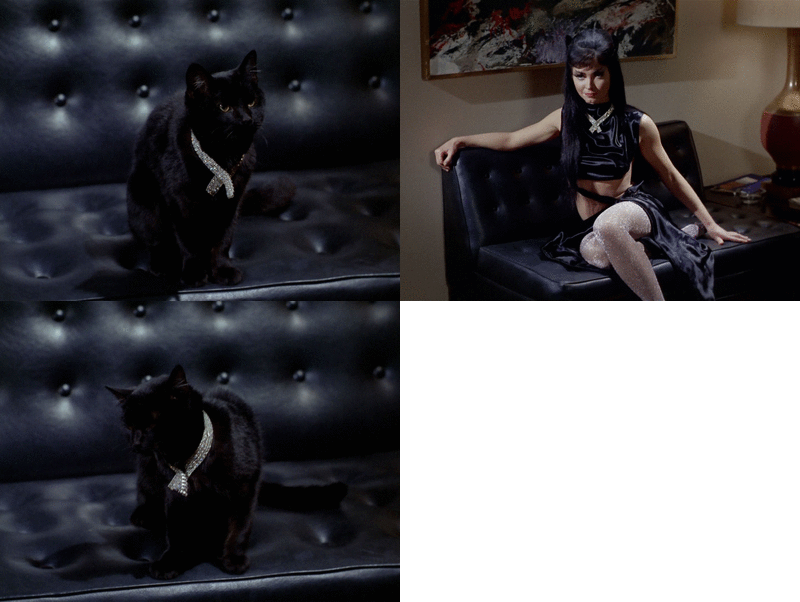 |
| Isis generously decided to provide the nominal cat picture every website must have by law. I expect this to become my most popular post. |