Shared posts

24 Apr 19:32

How Nanoexplosives Could Help Solve One of the Biggest Mysteries of Astrophysics

Particles of dark matter should trigger nanoexplosions in certain materials, an idea that could lead to an entirely new generation of detectors, say physicists.


One of the great mysteries of modern astrophysics is the nature of dark matter. This is the mysterious stuff that astrophysicists say must exist to provide the gravitational forces necessary to hold galaxies together.

24 Apr 19:23

Juno is the egg Izumo receptor and is essential for mammalian fertilization

by Enrica Bianchi
Nosimpler

This is big.

Juno is the egg Izumo receptor and is essential for mammalian fertilization

Nature 508, 7497 (2014). doi:10.1038/nature13203

Authors: Enrica Bianchi, Brendan Doe, David Goulding & Gavin J. Wright

Fertilization occurs when sperm and egg recognize each other and fuse to form a new, genetically distinct organism. The molecular basis of sperm–egg recognition is unknown, but is likely to require interactions between receptor proteins displayed on their surface. Izumo1 is an essential sperm cell-surface

24 Apr 18:19

Reconstructing Nonlinear Biochemical Networks

by Igor
Nosimpler

"Since a cellular signalling system is in fact indivisible, this reductionistic approach may have an impact on the accuracy of the inference results." YAY


Inferring Cell-Scale Signalling Networks via Compressive Sensing by Lei Nie, Xian Yang, Ian Adcock, Zhiwei Xu, Yike Guo
Signalling network inference is a central problem in system biology. Previous studies investigate this problem by independently inferring local signalling networks and then linking them together via crosstalk. Since a cellular signalling system is in fact indivisible, this reductionistic approach may have an impact on the accuracy of the inference results. Preferably, a cell-scale signalling network should be inferred as a whole. However, the holistic approach suffers from three practical issues: scalability, measurement and overfitting. Here we make this approach feasible based on two key observations: 1) variations of concentrations are sparse due to separations of timescales; 2) several species can be measured together using cross-reactivity. We propose a method, CCELL, for cell-scale signalling network inference from time series generated by immunoprecipitation using Bayesian compressive sensing. A set of benchmark networks with varying numbers of time-variant species is used to demonstrate the effectiveness of our method. Instead of exhaustively measuring all individual species, high accuracy is achieved from relatively few measurements.

In this paper, we present a distributed algorithm for the reconstruction of large-scale nonlinear networks. In particular, we focus on the identification from time-series data of the nonlinear functional forms and associated parameters of large-scale nonlinear networks. Recently, a nonlinear network reconstruction problem was formulated as a nonconvex optimisation problem based on the combination of a marginal likelihood maximisation procedure with sparsity inducing priors. Using a convex-concave procedure (CCCP), an iterative reweighted lasso algorithm was derived to solve the initial nonconvex optimisation problem. By exploiting the structure of the objective function of this reweighted lasso algorithm, a distributed algorithm can be designed. To this end, we apply the alternating direction method of multipliers (ADMM) to decompose the original problem into several subproblems. To illustrate the effectiveness of the proposed methods, we use our approach to identify a network of interconnected Kuramoto oscillators with different network sizes (500~100,000 nodes).
22 Apr 12:37

Four Great Myths of the McCarthy Era

by Jesse Walker

Joseph McCarthy (artist's rendition).Sixty years ago today, the ABC and DuMont television networks began their live broadcasts of the Army-McCarthy hearings, a two-month Senate soap opera that marked the final stage of the Wisconsin Republican Joseph McCarthy's period of power. The hearings are most famous today for what happened when the senator tried to make hay of the fact that Army attorney Joseph Welch's law firm employed a man who had once been a member of an organization with links to the Communist Party. The guilt-by-loose-chain-of-association charge was a showcase for McCarthy's sleazy style, allowing Welch to let loose a line that is constantly quoted to this day: "Have you no sense of decency, sir, at long last? Have you left no sense of decency?"

The hearings would go on for another week, and McCarthy would remain in office until his death three years later. But it was that exchange—which wrapped up with McCarthy blustering, Welch cutting him off, and the gallery bursting into applause—that effectively ended the senator's career.

Today McCarthy has come to symbolize the entire postwar Red Scare, allowing the hearings to serve as a tidy end to a tidy story about a demagogue who attained outsized influence and then was cut down to size. But the crusade against Communist subversion that marked the late 1940s and the '50s began before McCarthy seized the issue; and if his downfall was a sign that those fears were fading, it did not bring them to an end. The biggest myth of the McCarthy era is that it was a McCarthy era, rather than an episode in which McCarthy was merely one of the most noisy and irresponsible figures.

World communism (artist's rendition).There are other myths of the period too. The great radical myth of the Red Scare is that it was nothing but a scare—that the Americans accused of being Russian agents were virtually all innocent. (It's hard to maintain that position now that the Venona files have been released and some of the left's biggest causes célèbres have come crumbling down—at this point even Julius Rosenberg's children have acknowledged that he was a spy—but some folks still hold onto the dream.) The great conservative myth of the period, meanwhile, is that the espionage justified the witch-hunts. People like Ann Coulter and M. Stanton Evans have taken to declaring that McCarthy was right without acknowledging that the bulk of his accusations were false, and that this was true of many other red-hunters too. And then there's the great liberal myth of the period: the idea that the libs of the day managed to plot a course between the Soviet apologists and the paranoid hysterics, striking a delicate balance between protecting the country's liberties and protecting its security. In fact, the Red Scare, like the Cold War itself, had liberal fingerprints all over it.

Some of those fingerprints were left before the Red Scare actually began, as Democrats eager to ferret out fascist subversives in the '30s and early '40s lent their support to tools that would later be turned against the left. The Smith Act, which made it illegal to advocate the overthrow of the U.S. government, was a potent weapon during the Red Scare. But it was passed with liberal backing in 1940 and then used against alleged fascists, most infamously in the great sedition trial of 1944. Similarly, when Congress rechartered the House Committee on Un-American Activities in 1938, many liberals voted with the ayes because they wanted to investigate the right.

TAKE THE RED PI—whoops, wrong movie.When the Cold War got underway and the threat of communism replaced the threat of fascism, liberals often found themselves in the red-hunters' crosshairs. But liberals also went on the hunt themselves. "It was the Truman administration," Richard Freeland notes in The Truman Doctrine & the Origins of McCarthyism, "that developed the association of dissent with disloyalty and communism, which became a central element of McCarthyism. It was the Truman administration that adopted the peacetime loyalty program, which provided a model for state and local governments and a wide variety of private institutions. It was the Truman administration, in the criteria for loyalty used in its loyalty program, that legitimized the concept of guilt by association." To his credit, Truman vetoed the McCarran Act of 1950, which went well beyond chasing spies to limit Communists' civil liberties. (Congress overrode the veto and the bill became law anyway, though the courts eventually struck down many of its provisions.) But the Democrats who broke with Truman and voted for the measure included both Lyndon Johnson and John F. Kennedy. Speaking of Kennedy: His brother Bobby, later a liberal heartthrob, was a counsel for the McCarthy committee, and McCarthy was godfather to Bobby's first child.

It may be tempting to put all the madness of the early Cold War on the shoulders of one Wisconsin senator, and then to cheer as Joseph Welch ritually exorcises him on the floor of the Senate and the TV screens of America. The truth, alas, is much messier and uglier than that. When it comes to the Red Scare, there's plenty of shame to go around.

22 Apr 00:56

The Airwaves Belong to the (Properly Licensed) People! Boston Radio Station Raided, Shut Down

by Brian Doherty

Reason contributor Garrett Quinn reports out of Boston on how the federal government keeps the fraying edges of civilization together: by raiding and shutting down a nice thing that made lots of people happy, Boston radio station Touch 106 FM:

An underground Boston radio station considered by some as the voice of Boston's African-American community while operating in Dorchester for last eight years was raided by federal agents on Thursday.

Touch 106.1 FM was shutdown after a raid by U.S. Marshals this morning, according to the station's owner and operator, former mayoral candidate Charles Clemons.

A defensive Clemons told reporters today that the station was shut down for operating without a license, something the station has been doing for years.

"We are unlicensed. It's point blank. We are unlicensed," said Clemons.

The station is a low power station with a range that does not extend very far beyond Dorchester, Mattapan, and Roxbury. Agents, according to Clemons, took anything related to transmitting from the Touch 106.1 FM studios....

Universal Hub is reporting that Clemons was fined $17,000 by the FCC for operating without a license in 2008.

Reason's Jesse Walker wrote a history of scrappy rebellious radio, Rebels on the Air. Hat tip: Jeff Patterson.

18 Apr 14:33

Gabriel Garcia Marquez (1927-2014)

by Minnesotastan

[from 2014] I just heard that Gabriel Garcia Marquez died today.  In his memory I would like to cite (part of) the most remarkable sentence I've ever read.   It was 25 years ago that I first read Love in the Time of Cholera, and a year or two later One Hundred Years of Solitude and The Autumn of the Patriarch.  The first two are in my view the better books, but Autumn of the Patriarch [fulltext at the link] has one truly awesome sentence.  It begins like this, at the start of the final chapter of the book...
THERE he was, then, as if it had been he even though it might not be, lying on the banquet table in the ballroom with the feminine splendor of a dead pope amidst the flowers in which he would not have recognized himself in the display ceremony of his first death, more fearsome dead than alive, the velvet glove stuffed with cotton on a chest armored with false medals of imaginary victories in chocolate wars invented by his persistent adulators, the thunderous full-dress uniform and the patent leather boots and the single gold spur that we found in the building and the ten sad pips of general of the universe to which he was promoted at the final moment to give him a rank higher than that of death, so immediate and visible in his new posthumous identity that for the first time it was possible to believe in his real existence without any doubt whatsoever, although in reality no one looked less like him, no one was so much the opposite of him as that showcase corpse which was still cooking in the middle of the night on the slow fire of the tiny space of the little room where he was laid out with candles while in the cabinet room next door we were discussing the final bulletin with the news that no one dared believe word by word when we were awakened by the noise of the trucks loaded with troops in battle gear whose stealthy patrols had been occupying public buildings since before dawn, they took up prone positions under the arcades of the main commercial street, they hid in doorways, I saw them setting up tripod machine guns on the roofs of the viceregal district when I opened the balcony of my house at dawn looking for a place to put the bouquet of wet carnations I had just cut in the courtyard, beneath the balcony I saw a patrol of soldiers under the command of a lieutenant going from door to door ordering people to close the doors of the few shops that were beginning to open on the commercial street, today is a national holiday they shouted, orders from higher up, I threw them a carnation from the balcony and I asked what was going on with so many soldiers and so much noise of weapons everywhere and the officer caught the carnation in midair and replied to me just imagine girl we don't know ourselves either, the dead man must have come back to life, he said, dying with laughter, because nobody dared think such an earthshaking event could have happened, rather, on the contrary, we thought that after so many years of negligence he had picked up the reins of his authority again and was more alive than ever, once more dragging his great feet of an illusory monarch through the house of power where the globes of light had gone on again...  [and ends thus]... he had arrived without surprise at the ignominious fiction of commanding without power, of being exalted without glory and of being obeyed without authority when he became convinced in the trail of yellow leaves of his autumn that he had never been master of all his power, that he was condemned not to know life except in reverse, condemned to decipher the seams and straighten the threads of the woof and the warp of the tapestry of illusions of reality without suspecting even too late that the only livable life was one of show, the one we saw from this side which wasn't his general sir, this poor people's side with the trail of yellow leaves of our uncountable years of misfortune and our ungraspable instants of happiness, where love was contaminated by the seeds of death but was all love general sir, where you yourself were only an uncertain vision of pitiful eyes through the dusty peepholes of the window of a train, only the tremor of some taciturn lips, the fugitive wave of a velvet glove on the no man's hand of an old man with no destiny with our never knowing who he was, or what he was like, or even if he was only a figment of the imagination, a comic tyrant who never knew where the reverse side was and where the right of this life which we loved with an insatiable passion that you never dared even to imagine out of the fear of knowing what we knew only too well that it was arduous and ephemeral but there wasn't any other, general, because we knew who we were while he was left never knowing it forever with the soft whistle of his rupture of a dead old man cut off at the roots by the slash of death, flying through the dark sound of the last frozen leaves of his autumn toward the homeland of shadows of the truth of oblivion, clinging to his fear of the rotting cloth of death's hooded cassock and alien to the clamor of the frantic crowds who took to the streets singing hymns of joy at the jubilant news of his death and alien forevermore to the music of liberation and the rockets of jubilation and the bells of glory that announced to the world the good news that the uncountable time of eternity had come to an end.
What is remarkable is not the content per se, but the fact that I used the ellilpsis in the center of the citation to pass over 53 pages of text - all of it one single sentence.  I once estimated that the sentence comprises about 17,500 words.  One might consider this creation to be a whimsy or a conceit by someone just playing with words, but in my view it is a sort of prose poem by a superbly skilled writer who loves the craft of language.  If you'd like to give it a try, go to this link.

Addendum (2020):


It would be presumptuous of me to offer a review/critique of a novel that is a modern classic, written by a Nobel Laureate in literature, but after giving it a final good-bye reread, I wanted to jot down some notes about it.

Although I'm filing this post in my recommended books category, I have to admit that this is not a book that everyone will enjoy.   To be honest, not much happens in the novel.  A young man falls in love with a young woman who tentatively agrees to marry him ("Very well, I will marry you if you promise not to make me eat eggplant"), but they are separated by circumstances including her marriage, and he waits for her ("... convinced in the solitude of his soul that he had loved in silence for a much longer time than anyone else in this world ever had...") until her husband's death.  "Florentino Ariza never had another opportunity to see or talk to Fermina Daza alone in the many chance encounters of their very long lives until fifty-one years and nine months and four days later, when he repeated his vow of eternal fidelity and everlasting love on her first night as a widow." In the devotion of her mourning she rejects him, so he continues to wait, as their lives go from the late nineteenth century to the first decades of the twentieth.

As he follows the two protagonists separately, Marquez uses their lives as a platform for discussing the passage of time ("... contemplating with regret the banana plants in the mire of the patio, the stripped mango, the flying ants that came after the rain, the ephemeral splendor of another afternoon that would never return") and the process of aging:
    "... only then did he realize that his life was passing.  He was shaken by a visceral shudder that left his mind blank, and he had to drop the garden tools and lean against the cemetery wall so that the first blow of old age would not knock him down." 
    "She had barely turned the corner into maturity, free at last of illusions, when she began to detect the disillusionment of never having been what she had dreamed of being when she was young..." 
    "... they marked the passage of his life, for he experienced the cruelty of time not so much in his own flesh as in the imperceptible changes he discerned in Fermina Daza each time he saw her."
And finally a reunion:
"By the time she had emptied the teapot and he the coffeepot, they had both attempted and then broken off several topics of conversation, not so much because they were really interested in them but in order to avoid others that neither dared to broach."

"It was the first time in half a century that they had been so close and had enough time to look at each other with some serenity, and they had seen each other for what they were: two old people, ambushed by death, who had nothing in common except the memory of an ephemeral past that was no longer theirs but belonged to two young people who had vanished and who could have been their grandchildren."

"Then he reached out with two icy fingers in the darkness, felt for the other hand in the darkness, and found it waiting for him.  Both were lucid enough to realize, at the same fleeting instant, that the hands made of old bones were not the hands they had imagined before touching.  In the next moment, however, they were."
Herewith various excerpts, curiosities, and interesting words:

"On Friday, June 8, 1708, at four o'clock in the afternoon, the galleon San Jose set sail for Cadiz with a cargo of precious stones and metals valued at five hundred billion pesos in the currency of the day; it was sunk by an English squadron at the entrance to the port, and two long centuries later it had not yet been salvaged."  I love treasure stories, and the wealth carried by the Spanish galleons was fabulous; I was in awe watching reports of the recoveries from the Atocha.  Apparently the San Jose was located by staff from Woods Hole in 2015, and recovery and conservation efforts are currently underway.

"He was a fine parrot, lighter than he seemed, with a yellow head and a black tongue, the only way to distinguish him from mangrove parrots who did not learn to speak even with turpentine suppositories."  ???

"They brought in live chickens from Cienaga de Oro, famous all along the coast not only for their size and flavor but because in colonial times they had scratched for food in alluvial deposits and little nuggets of pure gold were found in their gizzards."  ??true - or an old wives' tale?

The death of Dr. Urbino: "But he released [the parrot] immediately because the ladder slipped from under his feet and for an instant he was suspended in air and then he realized that he had died without Communion, without time to repent of anything or to say goodbye to anyone, at seven minutes after four on Pentecost Sunday."

"The use of the mullein plant to put the fish to sleep had been prohibited by law since colonial times, but it continued to be a common practice among the fishermen of the Caribbean until it was replaced by dynamite."  No time to look this up - anybody know?

"... the black doll that was sent to her without any letter... it had been bought in Martinique, according to the original tag, and it was dressed in an exquisite gown... it seemed so charming to Fermina Daza that she overcame her scruples and laid it on her pillow during the day and grew accustomed to sleeping with it at night.  After a time, however, she discovered when she awoke from an exhausting dream that the doll was growing: the original exquisite dress she had arrived in was up above her thighs, and her shoes had burst from the pressure of her feet.  Fermina Daza had heard of African spells, but none as frightening as this.."  ??? constructed with dehydrated material that swells with time/humidity, or ?? new larger dolls being surreptitiously switched in place??

"She learned to smoke backward, with the lit end in her mouth, the way men smoked at night during the wars so that the glow of their cigarettes would not betray them."  I've heard of this before, during wartime.  I wonder if this technique also enhances nicotine absorption by preventing external loss.

"... he allowed himself to be swayed by his conviction that human beings are not born once and for all on the day their mothers give birth to them, but that life obliges them over and over again to give birth to themselves."

"She had written versions of the deportment and civics texts in hendecasyllabic couplets, like those used for spelling..."  From the Latin, having eleven syllables.

"... the sibylline fragrance of gardenias on hot nights..."  Literally 'having the characteristics of an oracle' but perhaps metaphorically 'mysterious.'

"... Florentino Ariza learned what he had already experienced many times without realizing it: that one can be in love with several people at the same time, feel the same sorrow with each, and not betray any of them."

Re her husband's death: "Once he had told her something that she could not imagine: that amputees suffer pains, cramps, itches, in the leg that is no longer there.  That is how she felt without him, feeling his presence where he no longer was."

"... at last he put on his chamois mustache cover and lay down without removing his trousers and shirt..."  ??why useful?

Next year perhaps I can add some notes about One Hundred Years of Solitude.
18 Apr 04:05

The Problem of Now

by Sabine Hossenfelder
[Image Source]

Einstein’s greatest blunder wasn’t the cosmological constant, and neither was it his conviction that god doesn’t throw dice. No, his greatest blunder was to speak to a philosopher named Carnap about the Now, with a capital.

“The problem of Now”, Carnap wrote in 1963, “worried Einstein seriously. He explained that the experience of the Now means something special for men, something different from the past and the future, but that this important difference does not and cannot occur within physics”

I call it Einstein’s greatest blunder because, unlike the cosmological constant and indeterminism, philosophers, and some physicists too, are still confused about this alleged “Problem of Now”.

The problem is often presented like this. Most of us experience a present moment, which is a special moment in time, unlike the past and unlike the future. If you write down the equations governing the motion of some particle through space, then this particle is described, mathematically, by a function. In the simplest case this is a curve in space-time, meaning the function is a map from the real numbers to a four-dimensional manifold. The particle changes its location with time. But regardless of whether you use an external definition of time (some coordinate system) or an internal definition (such as the length of the curve), every single instant on that curve is just some point in space-time. Which one, then, is “now”?

You could argue rightfully that as long as there’s just one particle moving on a straight line, nothing is happening, and so it’s not very surprising that no notion of change appears in the mathematical description. If the particle would scatter on some other particle, or take a sudden turn, then these instances can be identified as events in space-time. Alas, that still doesn’t tell you whether they happen to the particle “now” or at some other time.

Now what?

The cause for this problem is often assigned to the timeless-ness of mathematics itself. Mathematics deals in its core with truth values and the very point of using math to describe nature is that these truths do not change. Lee Smolin has written a whole book about the problem with the timeless math, you can read my review here.

It may or may not be that mathematics is able to describe all of our reality, but to solve the problem of now, excuse the heresy, you do not need to abandon a mathematical description of physical law. All you have to do is realize that the human experience of now is subjective. It can perfectly well be described by math, it’s just that humans are not elementary particles.

The decisive ability that allows us to experience the present moment as being unlike other moments is that we have a memory. We have a memory of events in the past, an imperfect one, and we do not have memory of events in the future. Memory is not in and by itself tied to consciousness, it is tied to the increase of entropy, or the arrow of time if you wish. Many materials show memory; every system with a path dependence like eg hysteresis does. If you get a perm the molecule chains in your hair remember the bonds, not your brain.

Memory has nothing to do with consciousness in particular which is good because it makes it much easier to find the flaw in the argument leading to the problem of now.

If we want to describe systems with memory we need at the very least two time parameters: t to parameterize the location of the particle and τ to parameterize the strength of memory of other times depending on its present location. This means there is a function f(t,τ) that encodes how strong is the memory of time τ at moment t. You need, in other words, at the very least a two-point function, a plain particle trajectory will not do.

That we experience a “now” means that the strength of memory peaks when both time parameters are identical, ie t-τ = 0. That we do not have any memory of the future means that the function vanishes when τ > t. For the past it must decay somehow, but the details don’t matter. This construction is already sufficient to explain why we have the subjective experience of the present moment being special. And it wasn’t that difficult, was it?

The origin of the problem is not in the mathematics, but in the failure to distinguish subjective experience of physical existence from objective truth. Einstein spoke about “the experience of the Now [that] means something special for men”. Yes, it means something special for men. This does not mean however, and does not necessitate, that there is a present moment which is objectively special in the mathematical description. In the above construction all moments are special in the same way, but in every moment that very moment is perceived as special. This is perfectly compatible with both our experience and the block universe of general relativity. So Einstein should not have worried.

I have a more detailed explanation of this argument – including a cartoon! – in a post from 2008. I was reminded of this now because Mermin had a comment in the recent issue of Nature magazine about the problem of now.

In his piece, Mermin elaborates on qbism, a subjective interpretation of quantum mechanics. I was destined to dislike this just because it’s a waste of time and paper to write about non-existent problems. Amazingly however, Mermin uses the subjectiveness of qbism to arrive at the right conclusion, namely that the problem of the now does not exist because our experiences are by its very nature subjective. However, he fails to point out that you don’t need to buy into fancy interpretations of quantum mechanics for this. All you have to do is watch your hair recall sulphur bonds.

The summary, please forgive me, is that Einstein was wrong and Mermin is right, but for the wrong reaons. It is possible to describe the human experience of the present moment with the “timeless” mathematics that we presently use for physical laws, it isn’t even difficult and you don’t have to give up the standard interpretation of quantum mechanics for this. There is no problem of Now and there is no problem with Tegmark’s mathematical universe either.

And Lee Smolin, well, he is neither wrong nor right, he just has a shaky motivation for his cosmological philosophy. It is correct, as he argues, that mathematics doesn’t objectively describe a present moment. However, it’s a non sequitur that the current approach to physics has reached its limits because this timeless math doesn’t constitute a conflict with our experience. observation.

Most people get a general feeling of uneasiness when they first realize that the block universe implies all the past and all the future is equally real as the present moment, that even though we experience the present moment as special, it is only subjectively so. But if you can combat your uneasiness for long enough, you might come to see the beauty in eternal mathematical truths that transcend the passage of time. We always have been, and always will be, children of the universe.
17 Apr 18:53

Synopsis: Bird Flocks Shatter on Impact

Nosimpler

what

Simulations show that flocks hitting a wall disintegrate like brittle solids rather than splash like fluid drops.

Published Tue Apr 15, 2014
16 Apr 23:55

No Perisaccadic Mislocalization with Abruptly Cancelled Saccades

by Atsma, J., Maij, F., Corneil, B. D., Medendorp, W. P.
Nosimpler

Not 100% sure of the implications, but seems interesting.

Every saccadic eye movement that we make changes the image of the world on our retina. Yet, despite these retinal shifts, we still perceive our visual world to be stable. Efference copy from the oculomotor system to the visual system has been suggested to contribute to this stable percept, enabling the brain to anticipate the retinal image shifts by remapping the neural image. A psychophysical phenomenon that has been linked to this predictive remapping is the mislocalization of a stimulus flashed around the time of a saccade. If this mislocalization is initiated by saccade preparation, one should also observe localization errors when a saccade is planned, but abruptly aborted just before its execution. We tested this hypothesis in human subjects using a novel paradigm that combines a flash localization task with a countermanding component that occasionally requires saccade cancellation. Surprisingly, we found no trace of mislocalization, even for saccades cancelled close to the point of no return. This strongly suggests that the actual execution of the saccade is a prerequisite for the typical localization errors, which rejects various models and constrains neural substrates. We conclude that perisaccadic mislocalization is not a direct consequence of saccade preparation, but arises after saccade execution when the flash location is constructed from memory.

15 Apr 21:41

Edward Snowden’s NSA Leaks Lead to Pulitzer Prize; Pension Crisis Also Noticed

by Scott Shackford

We won't hold our breath for a White House responseThe Pulitzer Prize has rendered its vote on what it thinks of Edward Snowden’s revelation of the National Security Agency’s (NSA) domestic surveillance techniques today by giving a gold medal in public service to The Guardian US and The Washington Post for breaking the stories. The Pulitzer committee credits the Post for helping "the public understand how the disclosures fit into the larger framework of national security," while The Guardian is recognized for "helping through aggressive reporting to spark a debate about the relationship between the government and the public over issues of security and privacy."

Snowden has already put out a statement:

"Today's decision is a vindication for everyone who believes that the public has a role in government. We owe it to the efforts of the brave reporters and their colleagues who kept working in the face of extraordinary intimidation, including the forced destruction of journalistic materials, the inappropriate use of terrorism laws, and so many other means of pressure to get them to stop what the world now recognizes was work of vital public importance."

Rosie Gray of BuzzFeed tracked down NSA hard-core surveillance-defender and Snowden-hater Rep. Pete King (R-IRA). He told her "Anybody who got a Pulitzer in the past should give it back. The Pulitzer Prize doesn’t mean anything now."

The NSA responded by hacking the Twitter feed of US Airways and distracting the world by putting up a picture of a naked woman with a model plane in her nethers. I am kidding about the hacking, but the tweet actually happened and quickly became all everybody was talking about online. It’s still not as horrifying as last year, when the Boston Marathon bombing happened right as the winners were being announced. (The Boston Globe got a Pulitzer for breaking news for their coverage.)

Getting much less attention, partly because of the Snowden debate but also because the subject just gets less attention, The Oregonian’s editorial board won a Pulitzer Prize in the category of editorial writing for its coverage of the state’s pension crisis. The Pulitzer Prize committee praised "its lucid editorials that explain the urgent but complex issue of rising pension costs, notably engaging readers and driving home the link between necessary solutions and their impact on everyday lives." The Oregonian ’s package of editorials can be read here.

The full list of Pulitzer winners can be found here.

There’s also some interesting topics tackled by the runners-up. The NSA coverage beat out a report by Newsday of concealed police abuse and misconduct by the Long Island police. And The Oregonian beat out editorials at the Des Moines Register challenging Iowa’s restrictive licensing laws.

11 Apr 15:03

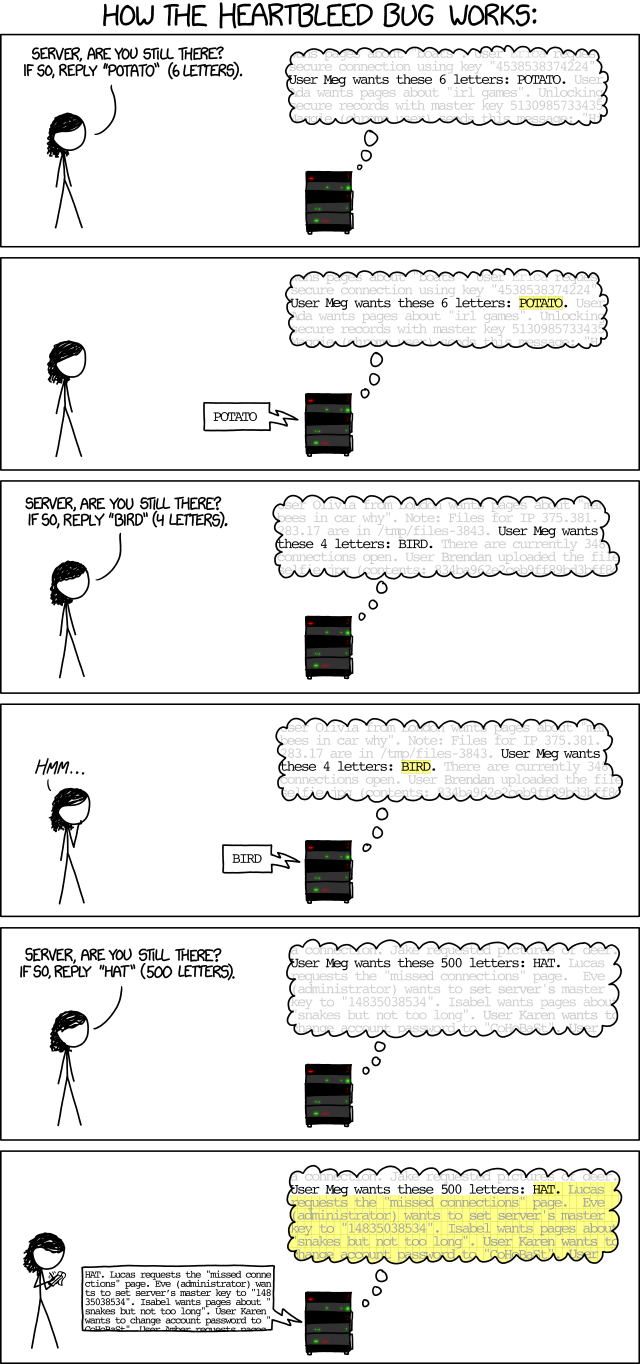
Heartbleed Explanation

Are you still there, server? It's me, Margaret.
11 Apr 03:01

Compressive Direct Measurement of the Quantum Wave Function. (arXiv:1404.2680v3 [quant-ph] UPDATED)

by Mohammad Mirhosseini, Omar S. Magaña-Loaiza, Seyed Mohammad Hashemi Rafsanjani, Robert W. Boyd

The direct measurement of a complex wavefunction has been recently realized by using weak-values. In this paper, we introduce a method that exploits sparsity for compressive measurement of the transverse spatial wavefunction of photons. The procedure involves a weak measurement in random projection operators in the spatial domain followed by a post-selection in the momentum basis. Using this method, we experimentally measure a 192-dimensional state with a fidelity of $90\%$ using only $25$ percent of the total required measurements. Furthermore, we demonstrate measurement of a 19200 dimensional state; a task that would require an unfeasibly large acquiring time with the conventional direct measurement technique.

08 Apr 02:55

The Modular Flow on the Space of Lattices

by willerton
MathML-enabled post (click for more details).

Guest post by Bruce Bartlett

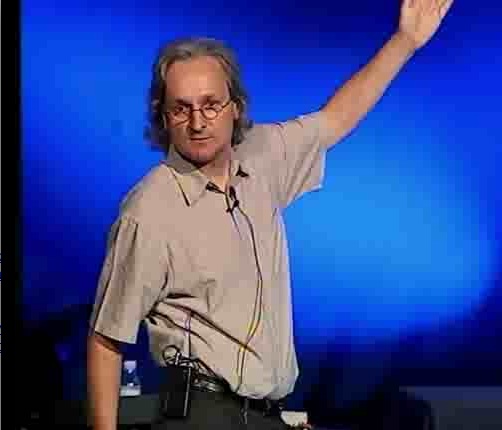
The following is the greatest math talk I’ve ever watched!

  • Etienne Ghys (with pictures and videos by Jos Leys), Knots and Dynamics, ICM Madrid 2006. [See below the fold for some links.]

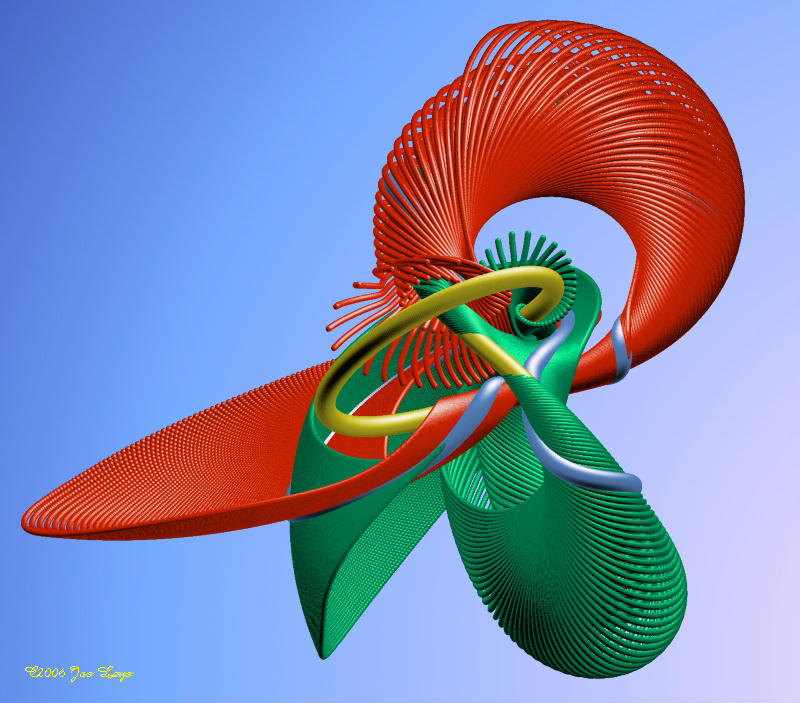
Etienne GhysA modular knot

I wasn’t actually at the ICM; I watched the online version a few years ago, and the story has haunted me ever since. Simon and I have been playing around with some of this stuff, so let me share some of my enthusiasm for it!

The story I want to tell here is how, via modular flow of lattices in the plane, certain matrices in SL(2,ℤ)\SL(2,\mathbb{Z}) give rise to knots in the 3-sphere less a trefoil knot. Despite possibly sounding quite scary, this can be easily explained in an elementary yet elegant fashion.

MathML-enabled post (click for more details).

As promised above, here are some links related to Ghys’ ICM talk.

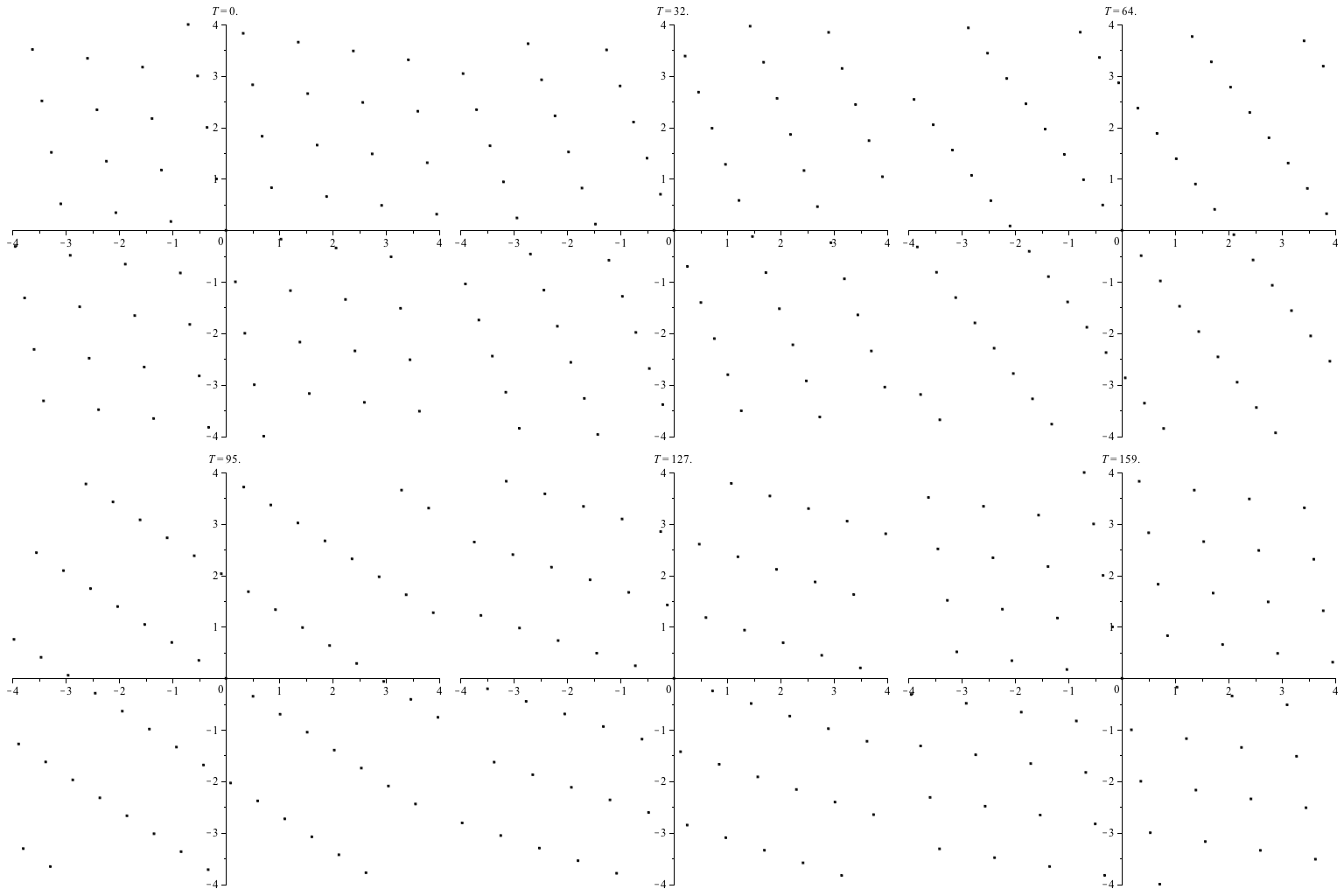
I’m going to focus on the last third of the talk — the modular flow on the space of lattices. That’s what produced the beautiful picture above (credit for this and other similar pics below goes to Jos Leys; the animation is Simon’s.)

Lattices in the plane

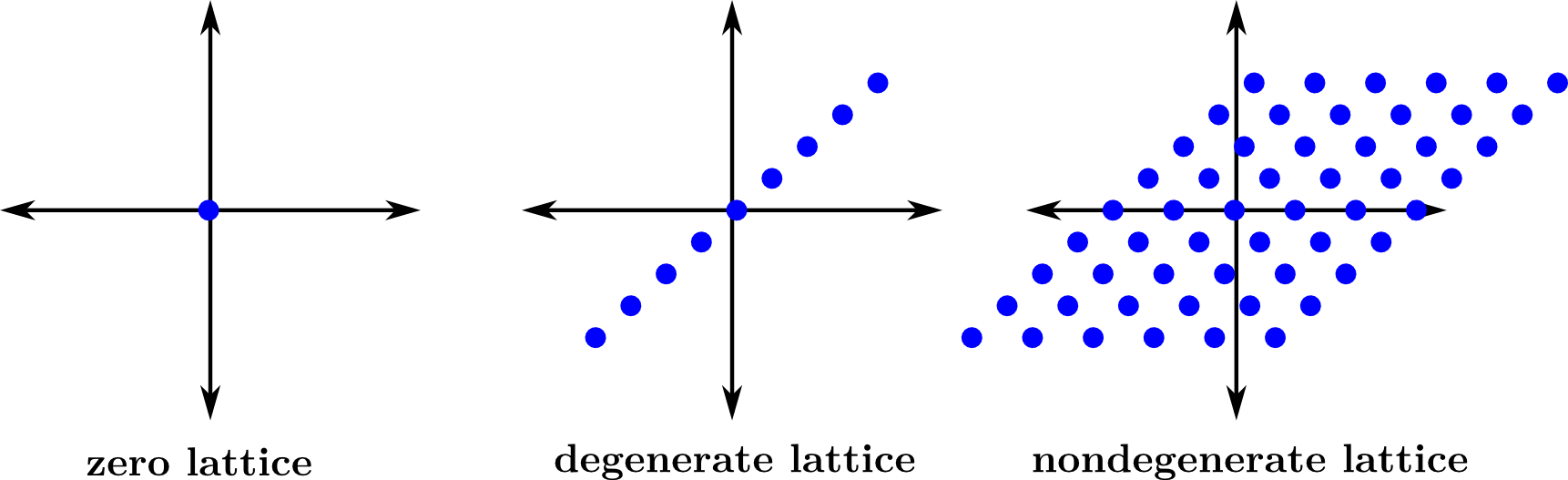
For us, a lattice is a discrete subgroup of ℂ\mathbb{C}. There are three types: the zero lattice, the degenerate lattices, and the nondegenerate lattices:

Lattices

Given a lattice LL and an integer n≥4n \geq 4 we can calculate a number — the Eisenstein series of the lattice: Gn(L)=∑ω∈L,ω≠01ωn. G_{n}(L) = \sum _{\omega \in L, \omega \neq 0} \frac{1}{\omega ^{n}}. We need n≥3n \geq 3 for this sum to converge. For, roughly speaking, we can rearrange it as a sum over rr of the lattice points on the boundary of a square of radius rr. The number of lattice points on this boundary scales with rr, so we end up computing something like ∑r≥0rrn\sum _{r \geq 0} \frac{r}{r^{n}} and so we need n≥3n \geq 3 to make the sum converge.

Note that Gn(L)G_{n}(L) = 0 for nn odd since every term ω\omega is cancelled by the opposite term −ω-\omega . So, the first two nontrivial Eisenstein series are G4G_{4} and G6G_{6}. We can use them to put `Eisenstein coordinates’ on the space of lattices.

Theorem: The map {lattices}→ℂ2L↦(G4(L),G6(L)) \begin{aligned} \{ \text{lattices} \} &\rightarrow \mathbb{C}^{2} \\ L & \mapsto (G_{4} (L), \, G_{6}(L)) \end{aligned} is a bijection.

The nicest proof is in Serre’s A Course in Arithmetic, p. 89. It is a beautiful application of the Cauchy residue theorem, using the fact that G4G_{4} and G6G_{6} define modular forms on the upper half plane HH. (Usually, number theorists set up their lattices so that they have basis vectors 11 and τ\tau where τ∈H\tau \in H. But I want to avoid this ‘upper half plane’ picture as far as possible, since it breaks symmetry and mystifies the geometry. The whole point of the Ghys picture is that not breaking the symmetry reveals a beautiful hidden geometry! Of course, sometimes you need the ‘upper half plane’ picture, like in the proof of the above result.)

Lemma: The degenerate lattices are the ones satisfying 20G43−49G62=020 G_{4}^{3} - 49G_{6}^{2} = 0.

Let’s prove one direction of this lemma — that the degenerate lattices do indeed satisfy this equation. To see this, we need to perform a computation. Let’s calculate G4G_{4} and G6G_{6} of the lattice ℤ⊂ℂ\mathbb{Z} \subset \mathbb{C}. Well, G4(ℤ)=∑n≠01n4=2ζ(4)=2π490 G_{4}(\mathbb{Z}) = \sum _{n \neq 0} \frac{1}{n^{4}} = 2 \zeta (4) = 2 \frac{\pi ^{4}}{90} where we have cheated and looked up the answer on Wikipedia! Similarly, G6(ℤ)=2π6945G_{6}(\mathbb{Z}) = 2 \frac{\pi ^{6}}{945}.

So we see that 20G4(ℤ)3−49G6(ℤ)2=020 G_{4}(\mathbb{Z})^{3} - 49 G_{6}(\mathbb{Z})^{2} = 0. Now, every degenerate lattice is of the form tℤt \mathbb{Z} where t∈ℂt \in \mathbb{C}. Also, if we transform the lattice via L↦tLL \mapsto t L, then G4↦t−4G4G_{4} \mapsto t^{-4} G_{4} and G6↦t−6G6G_{6} \mapsto t^{-6} G_{6}. So the equation remains true for all the degenerate lattices, and we are done.

Corollary: The space of nondegenerate lattices in the plane of unit area is homeomorphic to the complement of the trefoil in S3S^{3}.

The point is that given a lattice LL of unit area, we can scale it L↦λLL \mapsto \lambda L, λ∈ℝ+\lambda \in \mathbb{R}^{+} until (G4(L),G6(L))(G_{4}(L), G_{6}(L)) lies on the 3-sphere S3={(z,w):|z|2+|w|2=1}⊂ℂ2S^{3} = \{ (z,w) : |z|^{2} + |w|^{2} = 1\} \subset \mathbb{C}^{2}. And the equation 20z3−49w2=020 z^{3} - 49 w^{2} = 0 intersected with S3S^{3} cuts out a trefoil knot… because it is “something cubed plus something squared equals zero”. And the lemma above says that the nondegenerate lattices are precisely the ones which do not satisfy this equation, i.e. they represent the complement of this trefoil.

Since we have not divided out by rotations, but only by scaling, we have arrived at a 3-dimensional picture which is very different to the 2-dimensional moduli space (upper half-plane divided by SL(2,ℤ)\SL(2,\mathbb{Z})) picture familiar to a number theorist.

The modular flow

There is an intriguing flow on the space of lattices of unit area, called the modular flow. Think of LL as sitting in ℝ2\mathbb{R}^{2}, and then act on ℝ2\mathbb{R}^{2} via the transformation (et00e−t), \left ( \begin{array}{cc} e^{t} & 0 \\ 0 & e^{-t} \end{array} \right ), dragging the lattice LL along for the ride. (This isn’t just some formula we pulled out the blue — geometrically this is the ‘geodesic flow on the unit tangent bundle of the modular orbifold’.)

We are looking for periodic orbits of this flow.

“Impossible!” you say. “The points of the lattice go off to infinity!” Indeed they do… but disregard the individual points. The lattice itself can ‘click’ back into its original position:

animation

How are we to find such periodic orbits? Start with an integer matrix A=(abcd)∈SL(2,ℤ) A = \left ( \begin{array}{cc} a & b \\ c & d \end{array}\right ) \in \SL(2, \mathbb{Z}) and assume AA is hyperbolic, which simply means |a+d|≥2|a + d| \geq 2. Under these conditions, we can diagonalize AA over the reals, so we can find a real matrix PP such that PAP−1=±(et00e−t) P A P^{-1} = \pm \left ( \begin{array}{cc} e^{t} & 0 \\ 0 & e^{-t} \end{array} \right ) for some t∈ℝt \in \mathbb{R}. Now set L≔P(ℤ2)L \coloneqq P(\mathbb{Z}^{2}). We claim that LL is a periodic orbit of period tt. Indeed: Lt=(et00e−t)P(ℤ2)=±PA(ℤ2)=±P(ℤ2)=L. \begin{aligned} L_{t} &= \left ( \begin{array}{cc} e^{t} & 0 \\ 0 & e^{-t} \end{array} \right ) P (\mathbb{Z}^{2}) \\ &= \pm PA (\mathbb{Z}^{2}) \\ &= \pm P (\mathbb{Z}^{2}) \\ &= L. \end{aligned} We have just proved one direction of the following.

Theorem: The periodic orbits of the modular flow are in bijection with the conjugacy classes of hyperbolic elements in SL(2,ℤ)\SL(2, \mathbb{Z}).

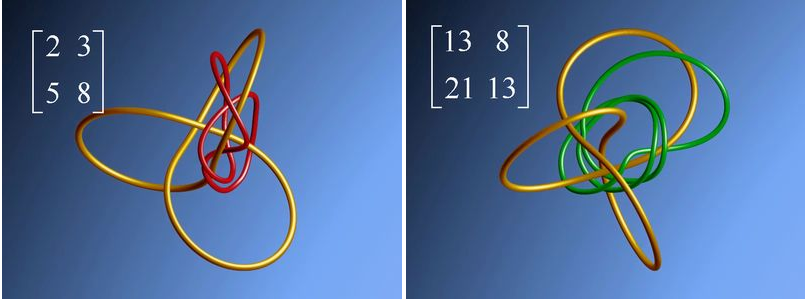
These periodic orbits produce fascinating knots in the complement of the trefoil! In fact, they link with the trefoil (the locus of degenerate lattices) in fascinating ways. Here are two examples, starting with different matrices A∈SL(2,ℤ)A \in \SL(2, \mathbb{Z}).

animation

The trefoil is the fixed orange curve, while the periodic orbits are the red and green curves respectively.

Ghys proved the following two remarkable facts about these modular knots.

  • The linking number of a modular knot with the trefoil of degenerate lattices equals the Rademacher function of the corresponding matrix in SL(2,ℤ)\SL(2, \mathbb{Z}) (the change in phase of the Dedekind eta function).
  • The knots occuring in the modular flow are the same as those occuring in the Lorenz equations!

Who would have thought that lattices in the plane could tell the weather!!

I must say I have thought about many aspects of these closed geodesics, but it had never crossed my mind to ask which knots are produced. – Peter Sarnak

MathML-enabled post (click for more details).MathML-enabled post (click for more details).
07 Apr 18:25

Will the social sciences ever become hard sciences?

by Sabine Hossenfelder
Nosimpler

See Point 3. It seems like the argument is incomplete, but I am lazy and waking up still.

The term “hard science” as opposed to “soft science” has no clear definition. But roughly speaking, the less the predictive power and the smaller the statistical significance, the softer the science. Physics, without doubt, is the hard core of the sciences, followed by the other natural sciences and the life sciences. The higher the complexity of the systems a research area is dealing with, the softer it tends to be. The social sciences are at the soft end of the spectrum.

To me the very purpose of research is making science increasingly harder. If you don’t want to improve on predictive power, what’s the point of science to begin with? The social sciences are soft mainly because data that quantifies the behavior of social, political, and economic systems is hard to come by: it’s huge amounts, difficult to obtain and even more difficult to handle. Historically, these research areas therefore worked with narratives relating plausible causal relations. Needless to say, as computing power skyrockets, increasingly larger data sets can be handled. So the social sciences are finally on the track to become useful. Or so you’d think if you’re a physicist.

But interestingly, there is a large opposition to this trend of hardening the social sciences, and this opposition is particularly pronounced towards physicists who take their knowledge to work on data about social systems. You can see this opposition in the comment section to every popular science article on the topic. “Social engineering!” they will yell accusingly.

It isn’t so surprising that social scientists themselves are unhappy because the boat of inadequate skills is sinking in the data sea and physics envy won’t keep it afloat. More interesting than the paddling social scientists is the public opposition to the idea that the behavior of social systems can be modeled, understood, and predicted. This opposition is an echo of the desperate belief in free will that ignores all evidence to the contrary. The desperation in both cases is based on unfounded fears, but unfortunately it results in a forward defense.

And so the world is full with people who argue that they must have free will because they believe they have free will, the ultimate confirmation bias. And when it comes to social systems they’ll snort at the physicists “People are not elementary particles”. That worries me, worries me more than their clinging to the belief in free will, because the only way we can solve the problems that mankind faces today – the global problems in highly connected and multi-layered political, social, economic and ecological networks – is to better understand and learn how to improve the systems that govern our lives.

That people are not elementary particles is not a particularly deep insight, but it collects several valid points of criticism:

  1. People are too difficult. You can’t predict them.

    Humans are made of a many elementary particles and even though you don’t have to know the exact motion of every single one of these particles, a person still has an awful lot of degrees of freedom and needs to be described by a lot of parameters. That’s a complicated way of saying people can do more things than electrons, and it isn’t always clear exactly why they do what they do.

    That is correct of course, but this objection fails to take into account that not all possible courses of action are always relevant. If it was true that people have too many possible ways to act to gather any useful knowledge about their behavior our world would be entirely dysfunctional. Our societies work only because people are to a large degree predictable.

    If you go shopping you expect certain behaviors of other people. You expect them to be dressed, you expect them to walk forwards, you expect them to read labels and put things into a cart. There, I’ve made a prediction about human behavior! Yawn, you say, I could have told you that. Sure you could, because making predictions about other people’s behavior is pretty much what we do all day. Modeling social systems is just a scientific version of this.

    This objection that people are just too complicated is also weak because, as a matter of fact, humans can and have been modeled with quite simple systems. This is particularly effective in situations when intuitive reaction trumps conscious deliberation. Existing examples are traffic flows or the density of crowds when they have to pass through narrow passages.

    So, yes, people are difficult and they can do strange things, more things than any model can presently capture. But modeling a system is always an oversimplification. The only way to find out whether that simplification works is to actually test it with data.

  2. People have free will. You cannot predict what they will do.

    To begin with it is highly questionable that people have free will. But leaving this aside for a moment, this objection confuses the predictability of individual behavior with the statistical trend of large numbers of people. Maybe you don’t feel like going to work tomorrow, but most people will go. Maybe you like to take walks in the pouring rain, but most people don’t. The existence of free will is in no conflict with discovering correlations between certain types of behavior or preferences in groups. It’s the same difference that doesn’t allow you to tell when your children will speak the first word or make the first step, but that almost certainly by the age of three they’ll have mastered it.

  3. People can understand the models and this knowledge makes predictions useless.

    This objection always stuns me. If that was true, why then isn’t obesity cured by telling people it will remain a problem? Why are the highways still clogged at 5pm if I predict they will be clogged? Why will people drink more beer if it’s free even though they know it’s free to make them drink more? Because the fact that a prediction exists in most cases doesn’t constitute any good reason to change behavior. I can predict that you will almost certainly still be alive when you finish reading this blogpost because I know this prediction is exceedingly unlikely to make you want to prove it wrong.

    Yes, there are cases when people’s knowledge of a prediction changes their behavior – self-fulfilling prophecies are the best-known examples of this. But this is the exception rather than the rule. In an earlier blogpost, I referred to this as societal fixed points. These are configurations in which the backreaction of the model into the system does not change the prediction. The simplest example is a model whose predictions few people know or care about.

  4. Effects don’t scale and don’t transfer.

    This objection is the most subtle one. It posits that the social sciences aren’t really sciences until you can do and reproduce the outcome of “experiments”, which may be designed or naturally occurring. The typical social experiment that lends itself to analysis will be in relatively small and well-controlled communities (say, testing the implementation of a new policy). But then you have to extrapolate from this how the results will be in larger and potentially very different communities. Increasing the size of the system might bring in entirely new effects that you didn’t even know of (doesn’t scale), and there are a lot of cultural variables that your experimental outcome might have depended on that you didn’t know of and thus cannot adjust for (doesn’t transfer). As a consequence, repeating the experiment elsewhere will not reproduce the outcome.

    Indeed, this is likely to happen and I think it is the major challenge in this type of research. For complex relations it will take a long time to identify the relevant environmental parameters and to learn how to account for their variation. The more parameters there are and the more relevant they are, the less the predictive value of a model will be. If there are too many parameters that have to be accounted for it basically means doing experiments is the only thing we can ever do. It seems plausible to me, even likely, that there are types of social behavior that fall into this category, and that will leave us with questions that we just cannot answer.

    However, whether or not a certain trend can or cannot be modeled we will only know by trying. We know that there are cases where it can be done. Geoffry West’s city theory I find a beautiful example where quite simple laws can be found in the midst of all these cultural and contextual differences.
In summary.

The social sciences will never be as “hard” as the natural sciences because there is much more variation among people than among particles and among cities than among molecules. But the social sciences have become harder already and there is no reason why this trend shouldn’t continue. I certainly hope it will continue because we need this knowledge to collectively solve the problems we have collectively created.
07 Apr 18:08

The Poetic Torture-House of Language by Slavoj Žižek

Annotations:
  • The military dictatorship in Argentina from 1976 to 1983 brought about a grammatical peculiarity, a new passive use of active verbs: when thousands of Leftist political activists and intellectuals disappeared and were never seen again, tortured and killed by the military 
who denied any knowledge about their fate, they were referred to as “disappeared,” where the verb was not used in the simple sense that they disappeared, but in an active transitive sense: they “were disappeared” (by the military secret services). In the Stalinist regime, a similar irregular inflection affected the verb “to step down”: when it was publicly announced that a high nomenklatura member stepped down from his post (for health reasons, as a rule), and everyone knew it was really because he lost in the struggle between different cliques within the nomenklatura, people said he “was stepped down.” Again, an act normally attributed to the affected person (he stepped down, he disappeared) is reinterpreted as the result of the nontransparent activity of another agent (secret police disappeared him, the majority in the nomenklatura stepped him down).
  • This is also why, in order to get the truth to speak, it is not enough to suspend the subject’s active intervention and let language itself speak — as Elfriede Jelinek put it with extraordinary clarity: “Language should be tortured to tell the truth.” It should be twisted, 
denaturalized, extended, condensed, cut, and reunited, made to work against itself.
03 Apr 18:30

Viewpoint: A Step Towards a Seismic Cloak

A large-scale experiment shows that a periodic array of boreholes embedded in the soil can deflect the energy of an incoming seismic wave.

Published Mon Mar 31, 2014
03 Apr 17:35

Crowdsourced Amateurs Outperform CIA at Predicting World Events

by Zenon Evans

Elaine Rich is a pharmacist in her 60s. She and a team of 3,000 other amateur forecasters in the Good Judgment Project (GJP) use Google to keep current on the news. The Central Intelligence Agency (CIA) employs over 20,000 professionals, operates with an annual budget north of $14 billion, and has access to oodles of classified information.

Which of these groups is better at predicting world affairs?

When it comes to “everything from Venezuelan gas subsidies to North Korean politics,” reports National Public Radio (NPR), amateurs outperform the pros. Rich, in particular, has “been put on a special team with other superforecasters whose predictions are reportedly 30 percent better than intelligence officers.” NPR explains how this is possible:

"Everyone has been surprised by these outcomes," said Philip Tetlock, one of the three psychologists who came up with the idea for the Good Judgment Project. The other two are Barbara Mellers and Don Moore....

But also, if you take a large crowd of different people with access to different information and pool their predictions, you will be in much better shape than if you rely on a single very smart person, or even a small group of very smart people....

"There's a lot of noise, a lot of statistical random variation," Tetlock said. "But it's random variation around a signal, a true signal, and when you add all of the random variation on each side of the true signal together, you get closer to the true signal."

The GJP has been operating for about three years. Tetlock's team provides people like Rich with some basic training in probability estimation, and then they're good to go.

This network of folk forecasters isn't likely to supplant the CIA, but it is looking to make changes in the way the intelligence community operates. The GJP blogged this week that “for many geopolitical forecasting questions, we see promise in a human-machine hybrid approach that combines the best strengths of human judgments and statistical models.”

03 Apr 05:22

Other People's Pathologies - Ta-Nehisi Coates - The Atlantic

03 Apr 05:21

Boundaries and Subtleties: the Mysterious Power of Naming in Human Cognition

by Yohan John

by Yohan J. John

6a019b010d0685970b01a3fcdcf313970b-320wi
“Little does my lady dream / Rumpelstiltskin is my name!" Rumplestiltskin, by Anne Anderson. Image from Wikimedia Commons

Of all the strange and wonderful fairy tales I encountered as a child, Rumpelstiltskin always struck me as the most peculiar. The story revolves around a girl who must spin straw into gold or face death at the hands of the king. A dwarf appears out of nowhere, and spins the straw into gold — for a price. On the first night he takes a necklace, and on the second a ring. On the third night the girl has nothing left to pay him with, and so the dwarf makes her promise to give him her firstborn child. The king's greed is sated after three days of gold-spinning, and he marries the girl. In due time the new queen gives birth to a child, and sure enough, the dwarf returns to receive his pounds of flesh. But the queen refuses, and tries to offer him some of her newly acquired riches instead. The dwarf agrees to give up his claim on the child, but only if the queen can guess his name within three days. Her guesses on the first two days fail. But then one of her spies returns with a strange tale. He came across a little cottage in the woods, in from of which he saw a dwarf prancing around a fire, singing a song that ended "Little does my lady dream / Rumpelstiltskin is my name!" On the third day the queen initially pretends not to know the dwarf's name. Finally she says, "Could your name be Rumpelstiltskin?" At this the dwarf flies into a rage, and stomps his foot on the ground so hard that a chasm opens up in the ground, swallowing the dwarf, who was never seen again.

As a child I found the dwarf's plunge into the subterranean void the most eerie element in the story, but in recent years I've been pondering another, perhaps deeper mystery. Why did Rumpelstiltskin's name have so much power?

Fairy tales notwithstanding, by the time I got to college I had come to think that names were mere conventions that had no intrinsic meaning or value. For all practical purposes, surely one label was as good as any other? Dismissing a debate on what to call something as "mere semantics" seemed to be an act of hard-nosed skepticism and realism.

But as I came to discover, naming involves much more than simply assigning a label to something that has already been identified. The act of naming is one of the central mysteries of human cognition — it is the visible tip of an iceberg whose depth below the surface of conscious thought we have only just begun to plumb. I cannot claim to have solved this mystery, but I'd like to present what I have cobbled together so far: a handful of puzzle pieces which I hope will entice the reader to join in the investigation. (Perhaps more puzzle pieces will turn up in future columns.) I've divided up the essay into four parts. Here's the plan:

  1. We'll introduce two key motifs — the named and the nameless — with a little help from the Tao Te Ching.
  2. We'll examine a research problem that crops up in cognitive psychology, neuroscience and artificial intelligence, and link it with more Taoist motifs.
  3. We'll look at how naming might give us power over animals, other people, and even mathematical objects.
  4. We'll explore the power of names in computer science, which will facilitate some wild cosmic speculation.

1. The name that can be named

My change of attitude towards naming started with a book on Chinese philosophy that I found in a second-hand book store. I discovered to my initial bafflement that most ancient Chinese philosophical schools had a theory of "names and actualities". In Confucianism the correspondence between names and things took on special ethical importance — ranks, duties and functions needed to be clearly delineated in order for society to be harmonious. I initially put this sort of thing down to the inscrutableness of ancient modes of thought — the same ancient alienness that caused people to impute divinity and power into the names of their deities. Perhaps this just came down to a confusion about words and the things they refer to? Surely it is the things — the objects, forces, people, and processes — that are important, and not what we choose to call them?

But not all ancient thinkers thought names and things were the same. Lao Tzu, the founder of Taoism, seemed to go against the Confucian ideal, and denied the equation of names with actualities. The very first chapter of Lao Tzu's Tao Te Ching sets the stage for a more ambivalent attitude towards names.

The Tao that can be expressed Is not the Tao of the Absolute.
The name that can be named
Is not the name of the Absolute.
The nameless originated Heaven and Earth.
The named is the Mother of All Things.

One way to read this is to say that the Tao, or the way of nature, goes beyond our expressive capabilities. Whatever we can name, delineate, and define is not enough to encapsulate the way nature works, or the way we should work with nature. This is the usual mystical interpretation. Taoist metaphysics has at least two parallels — one from the West, and one from India. Apophatic theology developed in Europe, and centers on the belief that because God is ineffable, no positive attributes can be assigned to Him. One can only list all the things that God is not. This often amounts to listing everything that one can think of, and then asserting God is not any of them. A similar approach is taken in the Jnana Yoga and Advaita Vedanta schools of Hindu thought. The supreme reality, Brahman, is "neti neti", or "not this, not this". It is the essence of "suchness" for which no other definition applies.

If unnameable forces are so powerful, why then does Lao Tzu bestow upon the named the honor of being the "Mother of All Things"? Why give naming any credit at all? Perhaps there is a clue in the saying "the namer of names is the father of things" (a maxim whose origins I am unable to trace). The mystery of names seems to lead us to the mystery of creation.

2. Manifest boundaries

The act of naming requires at least two components: the name, and the thing to be named. So in order to understand the process of naming, we have to think about things. The "namer of names" needs raw material for his task. So what are things? How do we decide that a thing is a thing? The question seems so absurd that I suspect most people never think of it. Perhaps more people have pondered the following question: before you are introduced to the name of an emotion, have you really experienced it?  When I was a child I didn't really know what "ennui" meant, so maybe I never truly experienced it. But once I was given the definition, I could discern the outlines of this emotion in my own life. How does this sort of thing happen?

This is where the cognitive and neural sciences come in. Unlike philosophers, cognitive scientists, neural network modelers and artificial intelligence researchers are trying to emulate human cognition, rather than just come up with verbal theories about it. Complex emotions are among the most difficult topics for scientists to address. (Plus, for the time being robots that display signs of ennui are not high on our priority list.) We have a hard enough time grappling with things! For researchers trying to imitate human intelligence, the nature of objects is a matter of practical concern. Brains and artificial systems are not directly presented with objects — what we receive are patterns of energy: photons on our retinas and vibrations on our ear drums. Artificial intelligence researchers learned the hard way that getting separate objects to "pop out" of these undifferentiated sensory fields is an unexpectedly complex ability that most humans take for granted. Objects aren't completely "out there" in the world — they're also products of our minds and brains, and therefore of our cultures. So naming an object can be a creative act. (Also, deciding which naming system to adopt can be a political act.) Philosophers have often acknowledged the subjective and creative aspects of naming, but the sheer mechanistic complexity of naming is best appreciated through the attempts to get machines to do what humans find trivially simple.

When presented with a rich visual scene — like a cluttered desk, for instance — how can we pick out separate things: coins, keys, wallet, pen, phone? This is a problem that humans are extraordinarily good at. The process is called visual object segmentation, and it is thought to be a key first step in pattern recognition. Even after decades of research, most advanced algorithms cannot perform object segmentation better than little children. The artificial approaches are improving and will soon overtake humans, partly as a result of taking inspiration from the human brain. Still, the way in which Google and Facebook's artificial neural networks pick out the faces in our photographs is only a loose approximation of how we seem to do it. There exists the distinct possibility that we will come up with devices that imitate human intelligence without shedding light on how natural, biological intelligence works. Only time will tell, but in the meantime the scientists and engineers will keep probing, coding, and tinkering. Perhaps they'll need to engage with the philosophers and their verbal theories.

Many artificial object segmentation systems start by trying to discover the boundaries in an image. You can use these boundaries — lines, contours, edges, discontinuities of lighting and texture — to discover the outlines of objects present in the image. This itself is a challenging task for machines. The trick is to find the important boundaries, because there are many contours that don't mark the outlines of things. Neural networks and other techniques such as Bayesian modeling often require considerable training in order to approach the performance that comes naturally to a toddler. The result of this training is a form of expectation. These models learn to sort images into different categories, and then use the categorization system as a guide for what to expect in a new image. In the case of neural networks, this expectation takes the form of connection weights between artificial neurons. In a Bayesian model, the expectation takes the form of probability distributions called priors, which help the model determine how likely it is for a particular object to be found given other information present in the image. If the image has been categorized as an photograph taken in a forest, the probability that the model picks out the outlines of trees should be much higher than the probability that it picks out the shape of a sofa. The model, like a human, should expect to see trees in the image, not sofas. For both humans and machines, prior expectations seem necessary in order to perceive useful boundaries. Without these prior expectations, the sensory world might appear poorly defined — like an impressionistic painting in continuously varying shades of grey, lacking distinct nameable objects.

Characterizing pattern recognition in terms of boundaries and expectation evokes these lines from chapter 1 of the Tao Te Ching, which immediately follow the lines I quoted earlier:

Thus, without expectation,

One will always perceive the subtlety;

And, with expectation,

One will always perceive the boundary.

With the Tao Te Ching, every translation captures subtly different shades of meaning. Consider this version of the four lines I just quoted:

Ever desireless,

One can see the mystery.

Ever desiring,

One can see the manifestations.

Subtlety and mystery are easy to link. A mystery, after all, is the absence of a clear dividing line between truth and falsehood, an absence that renders everything subtle, shadowy and indistinct. How about desire and expectation? A desire for food, for instance, is closely linked to the expectation that the reassuring outlines of edible objects will soon appear, perhaps with a little effort. When someone sitting at a restaurant table says they expect prompt service, you can be pretty sure they desire the rapid manifestation of a waiter.

More problematic for me initially was the link between "boundary" and manifestation". The connection became apparent only after I was exposed to visual object recognition research. If you are unable to see boundaries in the world, you will be unable to perceive objects. In a very real sense boundaries are required for things to become manifest to you.

What do expectation and desire have to do with objects? The typical mystical approach is to downplay them in order to gain a heightened awareness of subtlety and mystery. But I like to think that that Lao Tzu was telling us that the two ways of seeing both have their roles to play. He probably didn't know about expectation values in Bayesian decision theory, but he may have intuited that when you look at the world with desire, or with the expectation of getting something from it, you tend to assess your perceptions in starkly delineated terms: good and bad, useful and useless, dangerous and safe, edible and poisonous. A starving person is not usually interested in subtleties. Acknowledging the importance of both desire and desirelessness is consistent with the dialectical style that characterizes Taoism, a philosophy that often emphasizes the interplay of opposing forces: yin and yang. Lao Tzu ends the chapter like this:

The source of these two is identical,

Yet their names are different.

Together they are called profound.

Profound and mysterious, the gateway to the Collective Subtlety.

Floating in a sensory world without boundaries, lacking expectation or desire, nothing would ever become manifest. Being set adrift in a grey sea of subtlety sounds rather depressing. In fact depression has been described as a "flaw in love", a disease that attacks the very basis of desire and other strong motivations. Antonio Damasio, in his book Descartes' Error, documents neurological disorders that lead to reductions in emotional expression. The surprising result of such disorders is that they sometimes render the patient incapable of making decisions. Such patients' cognitive abilities seem untouched — they can solve problems when asked to do so. But when asked to make decisions for themselves, they cannot pick one alternative over any other. All the alternatives seem equally good — shades of grey everywhere, and no way to draw a line between them. There is some preliminary neuroscientific data that suggest that some clinically depressed people have a weakened ability to tell apart different patterns. In other words, their "desireless" condition is correlated with an inability to draw boundaries between perceptual objects, memories, and situations. [1]

There is no doubt that the act of naming requires that objects and patterns become manifest to us. In order for things to become manifest, their boundaries must be delineated. But the mystery of naming seems to go deeper. Where does the power of names come from?

3. Naming and Taming the Infinite

When your dog has learned its name, you can exercise a small but useful amount of control over its behavior. When you call it by name, it comes. Perhaps it has been trained to expect a treat when its name is called. Most cats on the other hand are unable or unwilling to react strongly to their own names. Evolutionary biologists inform us that dogs may have been the first animals to be domesticated — perhaps 12000 years ago. Perhaps names were crucial to the transformation from wild wolves into tame dogs.   Cats may have joined the party much later, around 5000 years ago. Maybe we haven't fully domesticated them yet! Or maybe to gain power over something by naming it requires a degree of consent on the part of the named.

The behavioral control we wield over (some!) named animals even shows up in when we use a human's name. If you hear your name being spoken you will most likely direct your attention to the source of the sound. In conversation with someone, judiciously slipping in their name can cause them to lower their guard. Salespeople, confidence tricksters and politicians routinely use this to their advantage. Dale Carnegie, in his legendary self-help book How to Win Friends and Influence People, tells us to "Remember that a person's name is to that person the sweetest and most important sound in any language." Perhaps the act of naming allowed humans to domesticate each other, completing our transition from wild apes to cultured individuals.

Stories like Rumpelstiltskin might be cultural relics from a time when language was new and strange, and just beginning to reveal its powers. The belief in the power of names may have roots in the prehistoric infancy of our species, but it lives on in many of the world's religions. Perhaps the sacred place given to particular names reflects an appreciation of the civilizing, domesticating role of naming itself. In the Hindu Namakarana ceremony, a child is given two names: one ordinary name, and one secret name that is derived from astrology and known only to the father. The Hebrew scriptures seem to link God's creative power with the act of naming. In Genesis, "God said, ‘Let there be Light', and there was light." The Jewish people came to believe that the name of God — the Tetragrammaton - was too holy to be uttered. Some Christians inverted this belief, and held that the name of God, or of Jesus, was so holy that it ought to be uttered repeatedly. A particular version of this belief, known as name-worshiping, emerged in Tsarist Russia, and persists to this day despite condemnation from the Russian Orthodox Church. The name-worshipers believe that "The name of God is God Himself and can produce miracles." In a twist that brings us closer to the idea that names have power, this strange, heretical belief system may have had an impact on the world of pure mathematics.

Mathematics, it should be pointed out, is distinct from science in that it deals with what appear to be pure forms of thought — entities that seem to have no necessary connection with the natural world, other than the fact that they are produced by human minds. For this reason mathematics departments may be the last bastions of platonism — the belief that there exist objects that are neither material nor mental, but are in essence abstract. Only a subset of mathematics is of relevance to science (though one never knows which arcane branch with prove useful in the future). Mathematicians are often given to wonder about the ontological status of the concepts and patterns they work with. What are mathematical "objects"? Do mathematical objects exist? Are the names of mathematical objects important? The celebrated 20th Century Russian-French mathematician Alexander Grothendieck was said to have "a flair for choosing striking evocative names for new concepts; indeed, he saw the act of naming mathematical objects as an integral part of their discovery, as a way to grasp them even before they have been entirely understood.'' [2]

In the late 1800s Georg Cantor initiated a seminal phase in the discussion of whether mathematical objects are "real" through his study of infinity. Cantor might as well be called the Father of Infinity; though he didn't invent the word, he created a set of concepts that he assigned the name "infinity" to, forever changing how mathematicians think about it. Before Cantor, most mathematicians followed Aristotle's approach, holding that infinity was a potentiality rather than an actuality. Cantor broke with this tradition by asserting that infinity was real, not a potentiality, and that there were several different sorts of infinity, each with rigorously provable properties. To cut a long and complex story short, Cantor created a formal system called set theory, which was used to study collections of mathematical objects, such as numbers. He used set theory to show that there were different sorts of infinite sets. So the set of all natural numbers (1,2,3,4, and so on) was infinite yet countable, and the set of real numbers — the collection of all points on a real line — was infinite but uncountable. He then showed in very convincing ways that the set of points on the real line was in a sense "bigger" than the set of natural numbers, despite the fact that both sets are infinite. He also showed that the rational numbers, the numbers that can each be written as a ratio of two integers, were also countable. So the uncountable real numbers vastly outnumber the countable rational numbers. The real numbers that aren't rational are called, unsurprisingly, irrational numbers, and a tiny handful of them do have names, such as the square root of two, pi, and Euler's number e.  As if the notion of two sort of infinity were not mind-boggling enough, Cantor went on to reveal an infinite number of such infinite sets, each "bigger" than the last.

By naming the properties of new, unheard-of objects, Cantor seemed to be drawing them out of the shadows and into the light of day, where they were forced to obey the rules of pen-and-paper mathematics. The ontological question is this: did Cantor create these dizzying infinities, or simply bestow names on mathematical objects that already existed in some sense? Does something need to exist before you can name it? Or can a concept arise at the very moment it is named? Influential French mathematicians followed Cantor into this strange domain where naming and creation resemble each other, but according to one version of the story, they lost their nerve, and climbed down from the vertiginous precipice of infinity. Perhaps that was the safe thing to do, because some people think Cantor's attempt to tame infinity drove him to depression and madness.

A handful of Russian mathematicians lead by Dmitri Egorov and Nikolai Luzin had no such failure of nerve. Egorov and Luzin were both name-worshipers. They believed that "if they named God, they assured his existence, and similarly they thought that by naming the new sets they could make them real. God could not be defined, but he could be named." The concepts that Egorov and Luzin picked up in Paris were hard to visualize, but they could be named, as Cantor had demonstrated. Luzin's personal papers contain a suggestive account of his attitude to definitions:

Each definition is a piece of secret ripped from Nature by the human spirit. I insist on this: any complicated thing, being illumined by definitions, being laid out in them, being broken up into pieces, will be separated into pieces completely transparent even to a child, excluding foggy and dark parts that our intuition whispers to us while acting; only by separating into logical pieces can we move further, towards new successes due to definition.

This belief may have contributed to Egorov and Luzin's role in starting up the influential ‘Moscow School of Mathematics'.  A modern Taoist might say that in desiring to understand Nature, Luzin and his colleagues perceived new mathematical manifestations. But Luzin may also have been aware that this came at a price: perhaps the "foggy and dark parts that our intuition whispers to us" are the subtle mysteries that can only be seen without expectation. [2]

4. The Algorithm helps those who help themselves

There is another modern domain that makes use of "name magic", and it may be the most unexpected of all. Where do you suppose the following quote comes from?

One of the things that every sorcerer will tell you is if you have the name of a spirit you have power over it.

It's not from a medieval grimoire or a fantasy novel. It's from an MIT lecture on computer science from 1986 (and no, it is not a Dungeons & Dragons reference either). As the textbook that accompanied this course explains,

A computational process is indeed much like a sorcerer's idea of a spirit. It cannot be seen or touched. It is not composed of matter at all. However, it is very real. It can perform intellectual work. It can answer questions. It can affect the world by disbursing money at a bank or by controlling a robot arm in a factory. The programs we use to conjure processes are like a sorcerer's spells.

Despite the fact that computers programs can only work their magic in the decidedly material world of electronic circuits, there is a sense in which computer programs are like mathematical objects — they seem to reside in a platonic realm of pure forms. After all, a program can move from device to device, but it is still the same program. But why do names crop up in computer science? What is the source of their power? Another line might give us a clue. "To call up a demon, you must learn its name".  (This time it is from a novel: William Gibson's Neuromancer.)

In computer science, a "daemon" is a program running as a background process that quietly performs system "chores". It was named after Maxwell's demon, a creature from a physics thought experiment who works tirelessly to sort molecules into two piles. Maxwell's demon can trace its roots to the demons of Greek mythology — nature spirits who were believed to be constantly working behind the scenes. So we can draw a genealogical line from the mythical demons of the past to the real daemons operating on your computer or smartphone. The program daemons are working behind the scenes without your explicit permission, so to gain control of them, you need to know what they're called.

In recent years, some physicists have speculated that the whole universe could be a simulation — a labyrinthine algorithm running on some vast alien supercomputer. One can never tell how seriously physicists take concepts like this. But some claim that there are ways to establish this experimentally, implausible as this sounds [3]. If this idea takes hold, perhaps history will come full circle, and we will discover our commonality with ancient seers and medieval alchemists, invoking the hidden daemons that keep the Universal Algorithm running smoothly. Like cosmic hackers, some of us might seek to learn the names of these code-spirits in order to gain power over them. The tendency to see our minds and our genetic material as computational codes might turn the daemon quest inwards as well.

Every generation features people who think that they have arrived at a comprehensive rational understanding of how the Universe works. They think they already know the names of all the daemons that keep the Universal Algorithm from crashing. Perhaps these new daemons, instead of being called Abraxas or Gorgon or Pantalaimon (or Rumpelstiltskin?), have names like "Higgs Boson" or "Quark" or "Superstring" or "Selfish Gene". Let's call the set of all known concepts the "nameable concepts". Are the nameable concepts all there is to the universe? An analogy with mathematics is in order. The nameable numbers are infinite, but like the rational numbers, they are countably infinite. We can say the same about the nameable concepts. We can always list them one by one, as entries in a limitless encyclopedia like Wikipedia. But just as there are unnameable numbers, there could be unnameable concepts — a far larger infinite set whose elements we may never fully list, or count, or compute, or even point to. [4]

When we take our nameable concepts too seriously and forget about the possibility that there are things we haven't named, we are confusing the map with the territory. We mistake the finger pointing at the moon with the moon itself, and we forget that there might be other heavenly bodies out there — some that astronomers might one day discern, and some that are so far away that their light will never reach us. But even this analogy doesn't capture the possibilities outside the reach of our named concepts — things that we can only talk about negatively, apophatically. Perhaps there are things out there that are not galaxies, not stars, not planets, not dark matter, not living, not dead…

Maybe the story of Rumpelstiltskin, in its cryptic way, is trying to tell us two intertwined tales. On the one hand it is telling us that unnamed powers lurk in the shadows: capricious spirits that can both help and harm us. Like stories themselves, these powers may be infinite. Perhaps our rational concepts can never fully account for them. But on the other hand, it seems to be telling us that when malevolent or irrational forces manifest themselves, we can — if we're lucky — name them and tame them.

But maybe I'm wrong about this. After all,

The Tao that can be expressed

Is not the Tao of the Absolute.

The name that can be named

Is not the name of the Absolute.


_____

Notes & References

[1] A recent study indicated that people suffering from depression has a weakened pattern separation ability — compared to healthy people, the boundaries between their memories were more blurred. This may have something to do with the loss of the ability to produce new neurons in the hippocampus, as Siddhartha Mukherjee explains is his masterful New York Times article, "Post-Prozac Nation: The Science and History of Treating Depression".

[2] The mathematical section of the article was inspired by the paper "The Power of Names" by Loren Graham which appeared in the journal Theology and Science. The quotes in this section also come from this paper. Graham and co-author Jean-Michel Kantor expand on the theme of name-worshiping and mathematics in their book Naming Infinity: A True Story of Religious Mysticism and Mathematical Creativity.

[3] See, for example, recent news items in the New York Times ("Is the Universe a Simulation?") and Discover Magazine ( "Do We Live in the Matrix?").

[4] In the arcane psychoanalytic theories of Jacques Lacan  — which I confess I have only encountered via Slavoj Žižek and Wikipedia — experience is divided into three orders: the Imaginary, the Symbolic and the Real. I don't know whether Lacan or Žižek studied higher mathematics, but the concept of the Real might have something in common with the concept of real numbers, or perhaps with Georg Cantor's concept of the Absolute Infinite, which he equated with God. The real numbers are uncountably infinite, and therefore always "exceed" the rational numbers. As Cantor demonstrated using his surprisingly intuitive and nontechnical diagonal argument, the rational just can't keep pace with the real. As far as I can discern, the psychoanalytic Real involves the unnameable, unanticipated aspects of experience that break through our cozy certainties, exposing the inadequacy of our named concepts. Perhaps the Real is the experience — sometimes exciting, sometimes traumatic — of discovering that Nature always has a trick up her sleeve. Perhaps the Real is where black swans come from. The Real eludes our attempts to draw neat boundaries to pick out perceptual and conceptual objects, forever lurking unmanifest in the "foggy and dark parts" of the universe, and of the mind.


24 Mar 19:08

This review of Max Tegmark’s book also occurs infinitely often in the decimal expansion of π

by Scott

Two months ago, commenter rrtucci asked me what I thought about Max Tegmark and his “Mathematical Universe Hypothesis”: the idea, which Tegmark defends in his recent book Our Mathematical Universe, that physical and mathematical existence are the same thing, and that what we call “the physical world” is simply one more mathematical structure, alongside the dodecahedron and so forth.  I replied as follows:

…I find Max a fascinating person, a wonderful conference organizer, someone who’s always been extremely nice to me personally, and an absolute master at finding common ground with his intellectual opponents—I’m trying to learn from him, and hope someday to become 10-122 as good.  I can also say that, like various other commentators (e.g., Peter Woit), I personally find the “Mathematical Universe Hypothesis” to be devoid of content.

After Peter Woit found that comment and highlighted it on his own blog, my comments section was graced by none other than Tegmark himself, who wrote:

Thanks Scott for your all to [sic] kind words!  I very much look forward to hearing what you think about what I actually say in the book once you’ve had a chance to read it!  I’m happy to give you a hardcopy (which can double as door-stop) – just let me know.

With this reply, Max illustrated perfectly why I’ve been trying to learn from him, and how far I fall short.  Where I would’ve said “yo dumbass, why don’t you read my book before spouting off?,” Tegmark gracefully, diplomatically shamed me into reading his book.

So, now that I’ve done so, what do I think?  Briefly, I think it’s a superb piece of popular science writing—stuffed to the gills with thought-provoking arguments, entertaining anecdotes, and fascinating facts.  I think everyone interested in math, science, or philosophy should buy the book and read it.  And I still think the MUH is basically devoid of content, as it stands.

Let me start with what makes the book so good.  First and foremost, the personal touch.  Tegmark deftly conveys the excitement of being involved in the analysis of the cosmic microwave background fluctuations—of actually getting detailed numerical data about the origin of the universe.  (The book came out just a few months before last week’s bombshell announcement of B-modes in the CMB data; presumably the next edition will have an update about that.)  And Tegmark doesn’t just give you arguments for the Many-Worlds Interpretation of quantum mechanics; he tells you how he came to believe it.  He writes of being a beginning PhD student at Berkeley, living at International House (and dating an Australian exchange student who he met his first day at IHouse), who became obsessed with solving the quantum measurement problem, and who therefore headed to the physics library, where he was awestruck by reading the original Many-Worlds articles of Hugh Everett and Bryce deWitt.  As it happens, every single part of the last sentence also describes me (!!!)—except that the Australian exchange student who I met my first day at IHouse lost interest in me when she decided that I was too nerdy.  And also, I eventually decided that the MWI left me pretty much as confused about the measurement problem as before, whereas Tegmark remains a wholehearted Many-Worlder.

The other thing I loved about Tegmark’s book was its almost comical concreteness.  He doesn’t just metaphorically write about “knobs” for adjusting the constants of physics: he shows you a picture of a box with the knobs on it.  He also shows a “letter” that lists not only his street address, zip code, town, state, and country, but also his planet, Hubble volume, post-inflationary bubble, quantum branch, and mathematical structure.  Probably my favorite figure was the one labeled “What Dark Matter Looks Like / What Dark Energy Looks Like,” which showed two blank boxes.

Sometimes Tegmark seems to subtly subvert the conventions of popular-science writing.  For example, in the first chapter, he includes a table that categorizes each of the book’s remaining chapters as “Mainstream,” “Controversial,” or “Extremely Controversial.”  And whenever you’re reading the text and cringing at a crucial factual point that was left out, chances are good you’ll find a footnote at the bottom of the page explaining that point.  I hope both of these conventions become de rigueur for all future pop-science books, but I’m not counting on it.

The book has what Tegmark himself describes as a “Dr. Jekyll / Mr. Hyde” structure, with the first (“Dr. Jekyll”) half of the book relaying more-or-less accepted discoveries in physics and cosmology, and the second (“Mr. Hyde”) half focusing on Tegmark’s own Mathematical Universe Hypothesis (MUH).  Let’s accept that both halves are enjoyable reads, and that the first half contains lots of wonderful science.  Is there anything worth saying about the truth or falsehood of the MUH?

In my view, the MUH gestures toward two points that are both correct and important—neither of them new, but both well worth repeating in a pop-science book.  The first is that the laws of physics aren’t “suggestions,” which the particles can obey when they feel like it but ignore when Uri Geller picks up a spoon.  In that respect, they’re completely unlike human laws, and the fact that we use the same word for both is unfortunate.  Nor are the laws merely observed correlations, as in “scientists find link between yogurt and weight loss.”  The links of fundamental physics are ironclad: the world “obeys” them in much the same sense that a computer obeys its code, or the positive integers obey the rules of arithmetic.  Of course we don’t yet know the complete program describing the state evolution of the universe, but everything learned since Galileo leads one to expect that such a program exists.  (According to quantum mechanics, the program describing our observed reality is a probabilistic one, but for me, that fact by itself does nothing to change its lawlike character.  After all, if you know the initial state, Hamiltonian, and measurement basis, then quantum mechanics gives you a perfect algorithm to calculate the probabilities.)

The second true and important nugget in the MUH is that the laws are “mathematical.”  By itself, I’d say that’s a vacuous statement, since anything that can be described at all can be described mathematically.  (As a degenerate case, a “mathematical description of reality” could simply be a gargantuan string of bits, listing everything that will ever happen at every point in spacetime.)  The nontrivial part is that, at least if we ignore boundary conditions and the details of our local environment (which maybe we shouldn’t!), the laws of nature are expressible as simple, elegant math—and moreover, the same structures (complex numbers, group representations, Riemannian manifolds…) that mathematicians find important for internal reasons, again and again turn out to play a crucial role in physics.  It didn’t have to be that way, but it is.

Putting the two points together, it seems fair to say that the physical world is “isomorphic to” a mathematical structure—and moreover, a structure whose time evolution obeys simple, elegant laws.   All of this I find unobjectionable: if you believe it, it doesn’t make you a Tegmarkian; it makes you ready for freshman science class.

But Tegmark goes further.  He doesn’t say that the universe is “isomorphic” to a mathematical structure; he says that it is that structure, that its physical and mathematical existence are the same thing.  Furthermore, he says that every mathematical structure “exists” in the same sense that “ours” does; we simply find ourselves in one of the structures capable of intelligent life (which shouldn’t surprise us).  Thus, for Tegmark, the answer to Stephen Hawking’s famous question—”What is it that breathes fire into the equations and gives them a universe to describe?”—is that every consistent set of equations has fire breathed into it.  Or rather, every mathematical structure of at most countable cardinality whose relations are definable by some computer program.  (Tegmark allows that structures that aren’t computably definable, like the set of real numbers, might not have fire breathed into them.)

Anyway, the ensemble of all (computable?) mathematical structures, constituting the totality of existence, is what Tegmark calls the “Level IV multiverse.”  In his nomenclature, our universe consists of anything from which we can receive signals; anything that exists but that we can’t receive signals from is part of a “multiverse” rather than our universe.  The “Level I multiverse” is just the entirety of our spacetime, including faraway regions from which we can never receive a signal due to the dark energy.  The Level II multiverse consists of the infinitely many other “bubbles” (i.e., “local Big Bangs”), with different values of the constants of physics, that would, in eternal inflation cosmologies, have generically formed out of the same inflating substance that gave rise to our Big Bang.  The Level III multiverse is Everett’s many worlds.  Thus, for Tegmark, the Level IV multiverse is a sort of natural culmination of earlier multiverse theorizing.  (Some people might call it a reductio ad absurdum, but Tegmark is nothing if not a bullet-swallower.)

Now, why should you believe in any of these multiverses?  Or better: what does it buy you to believe in them?

As Tegmark correctly points out, none of the multiverses are “theories,” but they might be implications of theories that we have other good reasons to accept.  In particular, it seems crazy to believe that the Big Bang created space only up to the furthest point from which light can reach the earth, and no further.  So, do you believe that space extends further than our cosmological horizon?  Then boom! you believe in the Level I multiverse, according to Tegmark’s definition of it.

Likewise, do you believe there was a period of inflation in the first ~10-32 seconds after the Big Bang?  Inflation has made several confirmed predictions (e.g., about the “fractal” nature of the CMB perturbations), and if last week’s announcement of B-modes in the CMB is independently verified, that will pretty much clinch the case for inflation.  But Alan Guth, Andrei Linde, and others have argued that, if you accept inflation, then it seems hard to prevent patches of the inflating substance from continuing to inflate forever, and thereby giving rise to infinitely many “other” Big Bangs.  Furthermore, if you accept string theory, then the six extra dimensions should generically curl up differently in each of those Big Bangs, giving rise to different apparent values of the constants of physics.  So then boom! with those assumptions, you’re sold on the Level II multiverse as well.  Finally, of course, there are people (like David Deutsch, Eliezer Yudkowsky, and Tegmark himself) who think that quantum mechanics forces you to accept the Level III multiverse of Everett.  Better yet, Tegmark claims that these multiverses are “falsifiable.”  For example, if inflation turns out to be wrong, then the Level II multiverse is dead, while if quantum mechanics is wrong, then the Level III one is dead.

Admittedly, the Level IV multiverse is a tougher sell, even by the standards of the last two paragraphs.  If you believe physical existence to be the same thing as mathematical existence, what puzzles does that help to explain?  What novel predictions does it make?  Forging fearlessly ahead, Tegmark argues that the MUH helps to “explain” why our universe has so many mathematical regularities in the first place.  And it “predicts” that more mathematical regularities will be discovered, and that everything discovered by science will be mathematically describable.  But what about the existence of other mathematical universes?  If, Tegmark says (on page 354), our qualitative laws of physics turn out to allow a narrow range of numerical constants that permit life, whereas other possible qualitative laws have no range of numerical constants that permit life, then that would be evidence for the existence of a mathematical multiverse.  For if our qualitative laws were the only ones into which fire had been breathed, then why would they just so happen to have a narrow but nonempty range of life-permitting constants?

I suppose I’m not alone in finding this totally unpersuasive.  When most scientists say they want “predictions,” they have in mind something meatier than “predict the universe will continue to be describable by mathematics.”  (How would we know if we found something that wasn’t mathematically describable?  Could we even describe such a thing with English words, in order to write papers about it?)  They also have in mind something meatier than “predict that the laws of physics will be compatible with the existence of intelligent observers, but if you changed them a little, then they’d stop being compatible.”  (The first part of that prediction is solid enough, but the second part might depend entirely on what we mean by a “little change” or even an “intelligent observer.”)

What’s worse is that Tegmark’s rules appear to let him have it both ways.  To whatever extent the laws of physics turn out to be “as simple and elegant as anyone could hope for,” Tegmark can say: “you see?  that’s evidence for the mathematical character of our universe, and hence for the MUH!”  But to whatever extent the laws turn out not to be so elegant, to be weird or arbitrary, he can say: “see?  that’s evidence that our laws were selected more-or-less randomly among all possible laws compatible with the existence of intelligent life—just as the MUH predicted!”

Still, maybe the MUH could be sharpened to the point where it did make definite predictions?  As Tegmark acknowledges, the central difficulty with doing so is that no one has any idea what measure to use over the space of mathematical objects (or even computably-describable objects).  This becomes clear if we ask a simple question like: what fraction of the mathematical multiverse consists of worlds that contain nothing but a single three-dimensional cube?

We could try to answer such a question using the universal prior: that is, we could make a list of all self-delimiting computer programs, then count the total weight of programs that generate a single cube and then halt, where each n-bit program gets assigned 1/2n weight.  Sure, the resulting fraction would be uncomputable, but at least we’d have defined it.  Except wait … which programming language should we use?  (The constant factors could actually matter here!)  Worse yet, what exactly counts as a “cube”?  Does it have to have faces, or are vertices and edges enough?  How should we interpret the string of 1′s and 0′s output by the program, in order to know whether it describes a cube or not?  (Also, how do we decide whether two programs describe the “same” cube?  And if they do, does that mean they’re describing the same universe, or two different universes that happen to be identical?)

These problems are simply more-dramatic versions of the “standard” measure problem in inflationary cosmology, which asks how to make statistical predictions in a multiverse where everything that can happen will happen, and will happen an infinite number of times.  The measure problem is sometimes discussed as if it were a technical issue: something to acknowledge but then set to the side, in the hope that someone will eventually come along with some clever counting rule that solves it.  To my mind, however, the problem goes deeper: it’s a sign that, although we might have started out in physics, we’ve now stumbled into metaphysics.

Some cosmologists would strongly protest that view.  Most of them would agree with me that Tegmark’s Level IV multiverse is metaphysics, but they’d insist that the Level I, Level II, and perhaps Level III multiverses were perfectly within the scope of scientific inquiry: they either exist or don’t exist, and the fact that we get confused about the measure problem is our issue, not nature’s.

My response can be summed up in a question: why not ride this slippery slope all the way to the bottom?  Thinkers like Nick Bostrom and Robin Hanson have pointed out that, in the far future, we might expect that computer-simulated worlds (as in The Matrix) will vastly outnumber the “real” world.  So then, why shouldn’t we predict that we’re much more likely to live in a computer simulation than we are in one of the “original” worlds doing the simulating?  And as a logical next step, why shouldn’t we do physics by trying to calculate a probability measure over different kinds of simulated worlds: for example, those run by benevolent simulators versus evil ones?  (For our world, my own money’s on “evil.”)

But why stop there?  As Tegmark points out, what does it matter if a computer simulation is actually run or not?  Indeed, why shouldn’t you say something like the following: assuming that π is a normal number, your entire life history must be encoded infinitely many times in π’s decimal expansion.  Therefore, you’re infinitely more likely to be one of your infinitely many doppelgängers “living in the digits of π” than you are to be the “real” you, of whom there’s only one!  (Of course, you might also be living in the digits of e or √2, possibilities that also merit reflection.)

At this point, of course, you’re all the way at the bottom of the slope, in Mathematical Universe Land, where Tegmark is eagerly waiting for you.  But you still have no idea how to calculate a measure over mathematical objects: for example, how to say whether you’re more likely to be living in the first 1010^120 digits of π, or the first 1010^120 digits of e.  And as a consequence, you still don’t know how to use the MUH to constrain your expectations for what you’re going to see next.

Now, notice that these different ways down the slippery slope all have a common structure:

  1. We borrow an idea from science that’s real and important and profound: for example, the possible infinite size and duration of our universe, or inflationary cosmology, or the linearity of quantum mechanics, or the likelihood of π being a normal number, or the possibility of computer-simulated universes.
  2. We then run with that idea until we smack right into a measure problem, and lose the ability to make useful predictions.

Many people want to frame the multiverse debates as “science versus pseudoscience,” or “science versus science fiction,” or (as I did before) “physics versus metaphysics.”  But actually, I don’t think any of those dichotomies get to the nub of the matter.  All of the multiverses I’ve mentioned—certainly the inflationary and Everett multiverses, but even the computer-simuverse and the π-verse—have their origins in legitimate scientific questions and in genuinely-great achievements of science.  However, they then extrapolate those achievements in a direction that hasn’t yet led to anything impressive.  Or at least, not to anything that we couldn’t have gotten without the ontological commitments that led to the multiverse and its measure problem.

What is it, in general, that makes a scientific theory impressive?  I’d say that the answer is simple: connecting elegant math to actual facts of experience.

When Einstein said, the perihelion of Mercury precesses at 43 seconds of arc per century because gravity is the curvature of spacetime—that was impressive.

When Dirac said, you should see a positron because this equation in quantum field theory is a quadratic with both positive and negative solutions (and then the positron was found)—that was impressive.

When Darwin said, there must be equal numbers of males and females in all these different animal species because any other ratio would fail to be an equilibrium—that was impressive.

When people say that multiverse theorizing “isn’t science,” I think what they mean is that it’s failed, so far, to be impressive science in the above sense.  It hasn’t yet produced any satisfying clicks of understanding, much less dramatically-confirmed predictions.  Yes, Steven Weinberg kind-of, sort-of used “multiverse” reasoning to predict—correctly—that the cosmological constant should be nonzero.  But as far as I can tell, he could just as well have dispensed with the “multiverse” part, and said: “I see no physical reason why the cosmological constant should be zero, rather than having some small nonzero value still consistent with the formation of stars and galaxies.”

At this, many multiverse proponents would protest: “look, Einstein, Dirac, and Darwin is setting a pretty high bar!  Those guys were smart but also lucky, and it’s unrealistic to expect that scientists will always be so lucky.  For many aspects of the world, there might not be an elegant theoretical explanation—or any explanation at all better than, ‘well, if it were much different, then we probably wouldn’t be here talking about it.’  So, are you saying we should ignore where the evidence leads us, just because of some a-priori prejudice in favor of mathematical elegance?”

In a sense, yes, I am saying that.  Here’s an analogy: suppose an aspiring filmmaker said, “I want my films to capture the reality of human experience, not some Hollywood myth.  So, in most of my movies nothing much will happen at all.  If something does happen—say, a major character dies—it won’t be after some interesting, character-forming struggle, but meaninglessly, in a way totally unrelated to the rest of the film.  Like maybe they get hit by a bus.  Then some other random stuff will happen, and then the movie will end.”

Such a filmmaker, I’d say, would have a perfect plan for creating boring, arthouse movies that nobody wants to watch.  Dramatic, character-forming struggles against the odds might not be the norm of human experience, but they are the central ingredient of entertaining cinema—so if you want to create an entertaining movie, then you have to postselect on those parts of human experience that do involve dramatic struggles.  In the same way, I claim that elegant mathematical explanations for observed facts are the central ingredient of great science.  Not everything in the universe might have such an explanation, but if one wants to create great science, one has to postselect on the things that do.

(Note that there’s an irony here: the same unsatisfyingness, the same lack of explanatory oomph, that make something a “lousy movie” to those with a scientific mindset, can easily make it a great movie to those without such a mindset.  The hunger for nontrivial mathematical explanations is a hunger one has to acquire!)

Some readers might argue: “but weren’t quantum mechanics, chaos theory, and Gödel’s theorem scientifically important precisely because they said that certain phenomena—the exact timing of a radioactive decay, next month’s weather, the bits of Chaitin’s Ω—were unpredictable and unexplainable in fundamental ways?”  To me, these are the exceptions that prove the rule.  Quantum mechanics, chaos, and Gödel’s theorem were great science not because they declared certain facts unexplainable, but because they explained why those facts (and not other facts) had no explanations of certain kinds.  Even more to the point, they gave definite rules to help figure out what would and wouldn’t be explainable in their respective domains: is this state an eigenstate of the operator you’re measuring?  is the Lyapunov exponent positive?  is there a proof of independence from PA or ZFC?

So, what would be the analogue of the above for the multiverse?  Is there any Level II or IV multiverse hypothesis that says: sure, the mass of electron might be a cosmic accident, with at best an anthropic explanation, but the mass of the Higgs boson is almost certainly not such an accident?  Or that the sum or difference of the two masses is not an accident?  (And no, it doesn’t count to affirm as “non-accidental” things that we already have non-anthropic explanations for.)  If such a hypothesis exists, tell me in the comments!  As far as I know, all Level II and IV multiverse hypotheses are still at the stage where basically anything that isn’t already explained might vary across universes and be anthropically selected.  And that, to my mind, makes them very different in character from quantum mechanics, chaos, or Gödel’s theorem.

In summary, here’s what I feel is a reasonable position to take right now, regarding all four of Tegmark’s multiverse levels (not to mention the computer-simuverse, which I humbly propose as Level 3.5):

Yes, these multiverses are a perfectly fine thing to speculate about: sure they’re unobservable, but so are plenty of other entities that science has forced us to accept.  There are even natural reasons, within physics and cosmology, that could lead a person to speculate about each of these multiverse levels.  So if you want to speculate, knock yourself out!  If, however, you want me to accept the results as more than speculation—if you want me to put them on the bookshelf next to Darwin and Einstein—then you’ll need to do more than argue that other stuff I already believe logically entails a multiverse (which I’ve never been sure about), or point to facts that are currently unexplained as evidence that we need a multiverse to explain their unexplainability, or claim as triumphs for your hypothesis things that don’t really need the hypothesis at all, or describe implausible hypothetical scenarios that could confirm or falsify the hypothesis.  Rather, you’ll need to use your multiverse hypothesis—and your proposed solution to the resulting measure problem—to do something new that impresses me.

20 Mar 16:18

Diamonds are not forever

by Minnesotastan

A thread at Reddit addressed the question "If diamonds are made of just carbon, is it possible to get a diamond to catch fire?"

The embedded video answers the question by showing a diamond being burned (heated white-hot, then dropped in liquid oxygen).

Practical significance, for those without liquid oxygen at home and diamonds to burn?
If your house burns down with the family jewels inside, you can collect the pools of melted gold, but the diamonds will be gone in a puff of CO2. Cheaper, more attractive stones, such as cubic zirconia and synthetic ruby and sapphire, are made of refractory metal oxides that easily withstand the same heat. So it's actually mall trinkets, not diamonds, that are forever.
19 Mar 17:12

How Racist Is Your State's War on Weed? Compare!

by Elizabeth Nolan Brown

A new interactive website from the American Civil Liberties Union (ACLU) highlights how many lives are derailed and billions of dollars wasted fighting a racially biased war on drugs in America.

The site, called The Uncovery, offers state-by-state statistics on U.S. marijuana arrests, emphasizing racial disparities and the cost of enforcing drug laws. 

The stats are based on data from the ACLU's "War on Marijuana" report. For the U.S. overall, someone is arrested for marijuana every 0.01 hours and this person is 3.73 times more likely to be black than white. The site notes that the U.S. spent more than $3.6 billion enforcing marijuana laws in 2010 and that 88 percent of marijuana arrests are for possession (in New York and Texas, that figure is 97 percent). The Uncovery also breaks down marijuana arrest and spending stats by state. Let's take a look. 

The 10 states spending the most on marijuana law enforcement: 

1. New York: $678,450,560
2. California: $490,966,080
3. Texas: $251,648,800
4. Florida: $228,635,840
5. Illinois: $221,431,776
6. New Jersey: $127,342,512
7. Georgia: $121,898,152
8. Ohio: $120,148,064
9. Maryland: $106,702,784
10. Pennsylvania: $100,748,528

Staggering, no? And the disparities in black-to-white arrest ratios are equally horrifying. 

The 10 worst states for racially biased marijuana arrests: 

In ___, a black person is ___ times more likely to be arrested than a white person for having marijuana. 

1. Iowa - 8.33
2. D.C. - 8.05
3. Minnesota - 7.81
4. Illinois - 7.56
5. Wisconsin - 5.98
6. Kentucky - 5.95
7. Pennsylvania - 5.19
8. South Dakota - 4.78
9. Nebraska - 4.65
10. New York - 4.52 

States with the smallest racial disparities in marijuana arrests were Hawaii (where blacks were only 0.99 times as likely as whites to be arrested for marijuana), Alaska (1.6 times more likely), New Mexico (1.86), Oregon (2.08), and Maine (2.13). All five of these states have very small African American populations overall. 

19 Mar 16:01

Black, Latino Firefighters in New York City Settle Long-Running Suit over Racial Discrimination

by mail@democracynow.org (Democracy Now!)
Black_fdny

Some 1,500 Black and Latino applicants to the Fire Department of New York have settled a long-running lawsuit with the city and the Justice Department over racially discriminatory hiring practices at the nation’s largest fire department. The agreement grants almost $100 million in back pay to those impacted. When the case was filed in 2007, the Fire Department was 90 percent white, even though African Americans and Latinos totaled half the city’s population. Under the new agreement, the Fire Department will be required to change its recruiting policies in order to increase diversity and make the department more representative of the city’s population. We discuss the settlement with two guests: Paul Washington, past president of the black firefighters’ group, the Vulcan Society of Black Firefighters, and captain of Engine 234 in Crown Heights, Brooklyn; and Richard Levy, the case’s lead attorney.

16 Mar 20:34

"I want gay people to be able to protect their marijuana plants with guns."

by Nick Gillespie
Nosimpler

What a slogan.

Tim Moen is a Canadian who is apparently the first federal Libertarian Party candidate to run for Parliament from the Fort McMurray-Athabasca area in Alberta.

Here he is talking to the site of Fort McMurray Today:

“To me, that meme [above] is the message of classical liberalism and the philosophy of liberty"...

“People should be allowed to marry whoever they want, put what they want into their bodies as long as no one is hurt, and protect themselves and their property.”...

“I was initially skeptical that political action could make any positive change in the world, but I was convinced by a number of people that I would be best at spreading the message of liberty across the region and Canada.”...

“I do believe if property rights for people and especially First Nations were enforced, there would be a slower, more sustainable and responsible pace of development."...

“The only say I should have, as a government representative, is with helping resolve disputes.”...

“Gun control is not about protection, so much as it is about control. We’ve seen what happens in countries that allow these liberties to be eroded and it’s not pretty.”

The platform of Canada's LP is summarized thusly:

The party believes in a commitment to free trade. It also supports the elimination of income tax and the GST [goods and services tax, a form of sales tax or VAT], opting instead for a system of fees.

It also supports the elimination of all subsidies, social and corporate welfare programs and gun control laws.

More here.

Read more at Moen's site and Facebook page.

Hat tip: The Twitter feed of Isidro by way of Victoriano Urbano by way of Frances Martel.

16 Mar 17:35

Optogenetic perturbations reveal the dynamics of an oculomotor integrator.

by Gonçalves PJ, Arrenberg AB, Hablitzel B, Baier H, Machens CK
Related Articles

Optogenetic perturbations reveal the dynamics of an oculomotor integrator.

Front Neural Circuits. 2014;8:10

Authors: Gonçalves PJ, Arrenberg AB, Hablitzel B, Baier H, Machens CK

Abstract
Many neural systems can store short-term information in persistently firing neurons. Such persistent activity is believed to be maintained by recurrent feedback among neurons. This hypothesis has been fleshed out in detail for the oculomotor integrator (OI) for which the so-called "line attractor" network model can explain a large set of observations. Here we show that there is a plethora of such models, distinguished by the relative strength of recurrent excitation and inhibition. In each model, the firing rates of the neurons relax toward the persistent activity states. The dynamics of relaxation can be quite different, however, and depend on the levels of recurrent excitation and inhibition. To identify the correct model, we directly measure these relaxation dynamics by performing optogenetic perturbations in the OI of zebrafish expressing halorhodopsin or channelrhodopsin. We show that instantaneous, inhibitory stimulations of the OI lead to persistent, centripetal eye position changes ipsilateral to the stimulation. Excitatory stimulations similarly cause centripetal eye position changes, yet only contralateral to the stimulation. These results show that the dynamics of the OI are organized around a central attractor state-the null position of the eyes-which stabilizes the system against random perturbations. Our results pose new constraints on the circuit connectivity of the system and provide new insights into the mechanisms underlying persistent activity.

PMID: 24616666 [PubMed - in process]

16 Mar 16:45

Train tracks on a torus

by Jesse Johnson

A little over a year ago, I started writing a series of posts on train tracks and normal loops, then got distracted by other things. In the mean time, I wrote a paper with Yoav Moriah involving train tracks and curve complex distances, which gave me a whole new perspective on what train tracks really mean, more in line with much of Masur and Minsky’s work [1]. So, I want to resuscitate the series of posts on train tracks, but in a slightly different direction than where I was headed before. I’ll start by looking at a very simple case: train tracks on a torus. If you need a review of what train tracks are (the mathematical object, not the literal ones), you can reread my earlier post.

We can form a train track on a torus by taking two essential loops in the torus that intersect once, then smoothing the intersection, as in the Figure below. (I’m drawing the torus as a square with opposite sides identified.) There are two possible ways to smooth the intersection, and for now we’ll just arbitrarily pick one. (Later on, we’ll come back to look at the difference between the two smoothings.) The resutling graph isn’t a train track, bit we can turn it into a train track by taking a regular neighborhood of it, then giving the neighborhood a foliation by intervals perpendicular to the original graph. The original graph (shown in the middle of the Figure) is called a train track diagram.

torustrain

The question I want to explore in this post is: What loops in the torus are carried by this train track? The answer will be in terms of the slopes of the carried loops. Recall that the universal cover of the torus is the plane. In every isotopy class of essential loops, there is a representative that lifts to a straight line in the universal cover. In fact, there’s an infinite family of such loops that lift to different lines in the plane, but all these lines have the same slope. This slope is what we call the slope of the (isotopy class of the) loop in the torus. In the Figure above, the blue loop has slope 0 and the red loop has slope 1/0 or \infty. Note that both of these loops are carried by the train track. (Or, more precisely, they’re isotopic to loops that are carried by the train track.)

In general, we can calculate the absolute value of the slope of a loop by dividing the number of times it intersects the horizontal boundary of the square by the number of times it intersects the vertical boundary. (You can check that this formula holds for the red and blue loops.) For any slope other than 0 and \infty, we can figure out the sign as follows: If an arc has one endpoint on the left side of the square and the other endpoint on the top then the loop has positive slope. If an arc has one endpoint on the left and its other endpoint on the bottom then the loop has negative slope. (It’s not too hard to check that a loop that intersects the sides of the square minimally can’t have both types of arcs.)

There are many other loops in the torus, in addition to the red and blue loops above, that are carried by this particular train track. Examples with slopes 1, 2 and \frac{1}{2}, respectively, are shown in red in the Figure below.

ttslopes

All these loops have positive slopes, and in fact, you can see that no arc from the left side of the square to the bottom of the square can be carried by this train track. So this means that this train track can only carry positive slopes.

On the other hand, we can put in as many copies of either the vertical or the horizontal arc as we want. We can also put in as many arcs as we want from the left side to the top side, and the same number from the bottom to the right side. By choosing the number of such arcs carefully, we can get the intersections between the resulting loops and the sides of the squares to be whatever we want. (If the number of intersections with the top is greater than the number with the bottom, we’ll only use vertical arcs. Otherwise, we’ll only use horizontal arcs.) So, every loop with positive slope will be carried by this train track.

To make it clear, let me summarize what we’ve learned: The train track that we constructed carries all the loops with positive slopes, as well as the loops with slope 0 and \infty. Going back to the beginning of the post, note that if we had chosen to smooth the intersection between the original two loops in the opposite way, the resulting train track would have carried all the negative slope loops, as well as 0 and \infty. So, we can think of a train track as a way to separate the loops in a surface into two different classes: the loops that are carried and the loops that aren’t.

One way that this gets really interesting is when consider what these two classes look like in the curve complex for the surface. This approach is one of the main tools used in Masur and Minsky’s work on the curve complex [1], particularly their proof that curve complexes of surfaces are Gromov \delta-hyperbolic.

Recall that the curve complex for a surface S is the simplicial complex whose vertices represent isotopy classes of essential, simple closed curves in S and whose faces span sets of isotopy classes with pairwise-disjoint representatives. The curve complex for a torus is pretty boring: Any two disjoint essential loops in a torus are parallel (and thus isotopic) to each other, so there are no edges in this curve complex- It’s just an infinite collection of discrete vertices.

So instead, one generally works with the Farey graph for the torus. Much like the curve complex, the vertices of the Farey graph represent isotopy classes of essential loops in the torus. In particular, each vertex represents a rational number (a slope) including \infty, and in fact we can arrange the vertices in order by slope along a circle. Since there are no pairs of disjoint loops, we connect any two vertices representing loops that intersect in a single point.

FareyGraphSimilarly, we include in the Farey graph all the triangles bounded by loops of three edges. I’ll leave it as an exercise for the reader to check that for every pair of loops in the torus that intersect in exactly one point, there are exactly two other loops such that each of these loops intersects each of the original two loops in a single point. (The two new loops will intersect each other in two points.) So, in other words, each edge in the Farey graph is in the boundary of exactly two triangles. This tells us that the triangles form a surface. In fact, the surface that they form is the disk bounded by the circle along which we placed the vertices in the previous paragraph.

Six of these triangles are shown in the figure on the right, with the slopes corresponding to their vertices indicated as fractions. For each edge in the Farey graph, we can calculate the third vertex representing one of the adjacent triangles as follows: The numerator of the new slope is the sum of the numerators of the original two, and the denominator is the sum of their denominators. Similarly, to get the vertex defining the other triangle, we subtract the numerators and denominators. (To see why this works, you can think about the normal loops and Haken sums that I mentioned in another post from a while back.)

Notice that the triangles in this picture are different sizes, and in fact they get smaller as the numerators and denominators get bigger. But in reality, the edges of the Farey graph should all be the same length. So, you should think about this circle like the boundary of the hyperbolic plane, and the triangles as being ideal triangles. This isn’t exactly right either, since the edges in the Farey graph have finite length, unlike the edges of ideal triangles. But the Farey graph will have the same symmetry group as a tesselation of the hyperbolic plane by ideal triangles.

The Farey graph is closer in structure to a tree. In fact, we can construct a tree by putting a vertex at the center of each triangle and connecting two vertices whenever the corresponding triangles share an edge. The Farey graph will be quasi-isometric to this tree (though if you don’t know what quasi-isometric means, don’t worry about it.) In the same way that each edge in a tree cuts the tree into two separate trees, each edge in the Farey graph cuts the Farey graph (which is really a cell complex) into two disconnected sets of triangles.

Now, lets go back to the train track from the beginning of this post. Recall that the set of loops carried by the train track consisted of all loops with positive slopes, as well as the loops with slopes 0 and \infty. These loops make up the right half-circle of the Farey graph. In particular, the subcomplex of the Farey graph spanned by the loops carried by this train track is exactly one of the two components that we get if we cut along the edge spanned by 0 and \infty.

Note that when we constructed this train track, we started with any two loops in the torus that intersect in one point, or equivalently, any edge in the Farey graph. We then had a choice of two different ways to smooth the vertex where they intersect into a pair of switches in the train track. If we had made the other choice with our original two loops, we would have gotten a train track that carried all negative slopes, i.e. the other component defined by the edge between 0 and \infty. By symmetry, if we had started with a different pair of loops, the two possible train tracks that we could construct from them would similarly define the two different components that we get by cutting the Farey graph along this new edge. (Note that one can also show that every “reasonable” train track in the torus can be constructed from two loops in this way.)

The point of all this is that the different train tracks on the torus can be thought of as defining all the different ways of cutting the Farey graph along single edges. Train tracks in higher genus surfaces play a very similar role, though it’s more complicated because the curve complexes of these surfaces are much less tree-like (though they’re still delta hyperbolic, which is close.) In particular, you can’t separate these complexes by removing a single edge, or indeed any finite collection of simplices. But train tracks still define subsets of loops that are very nice with respect to the curve complex structure.

The reason this turns out to be useful is that it is often possible to prove things about the types of loops that are carried by a given train track, which can then be translated into the language of the curve complex. This is one of the main techniques in Masur and Minsky’s papers on the curve complex [1], and on disk sets of handlebodies [2]. It also proved very useful in my work with Yoav Moriah [3] and his earlier work with Martin Lustig [4]. But a discussion along those lines will have to wait for a future post.


16 Mar 16:41

"The Irritating Gentleman" (1874)

by Minnesotastan
"Berthold Woltze was a German painter who was born in 1829. Several works by the artist have been sold at auction, including 'The Irritating Gentleman' sold at Dorotheum '19th Century Paintings' in 2011 for $43,737. The artist died in 1896."
I love the detail in this painting - the leather strap for adjusting the window, perhaps a small tear on the young lady's cheek.  And especially her gaze at the viewer, as though appealing for assistance.
 

Via Eva's Blog and Large Size Paintings.
16 Mar 16:31

The NSA Can Learn All Your Secrets From Your Phone Metadata |...


The NSA Can Learn All Your Secrets From Your Phone Metadata | Co.Exist | ideas impact

According to the official narrative, monitoring metadata is no big deal. But two Stanford University researchers wanted to see how “sensitive” metadata actually was. So they enlisted hundreds of volunteers to install an app called “MetaPhone” on their Androids to pick up that metadata over several months. What they found shocked them. “The degree of sensitivity among contacts took us aback,” co-authors Jonathan Mayer and Patrick Mutchler wrote on Web Policy, Mayer’s blog. “Participants had calls with Alcoholics Anonymous, gun stores, NARAL Pro-Choice, labor unions, divorce lawyers, sexually transmitted disease clinics, a Canadian import pharmacy, strip clubs, and much more.” The point is, they found, it’s actually really easy to identify names and infer very intimate details about a person’s life just from phone metadata. And things got a lot creepier, and potentially devastating, when researchers posted samples of what these metadata-informed stories could tell. Take, for example, Participant E:
Participant E had a long, early morning call with her sister. Two days later, she placed a series of calls to the local Planned Parenthood location. She placed brief additional calls two weeks later, and made a final call a month after.
11 Mar 22:14

When You Assume

You know what happens when you assert--you make an ass out of the emergency response team.
11 Mar 22:11

Sensory–motor transformations for speech occur bilaterally

by Gregory B. Cogan

Sensory–motor transformations for speech occur bilaterally

Nature 507, 7490 (2014). doi:10.1038/nature12935

Authors: Gregory B. Cogan, Thomas Thesen, Chad Carlson, Werner Doyle, Orrin Devinsky & Bijan Pesaran

Historically, the study of speech processing has emphasized a strong link between auditory perceptual input and motor production output. A kind of ‘parity’ is essential, as both perception- and production-based representations must form a unified interface to facilitate access to higher-order language processes such as syntax and semantics, believed to be computed in the dominant, typically left hemisphere. Although various theories have been proposed to unite perception and production, the underlying neural mechanisms are unclear. Early models of speech and language processing proposed that perceptual processing occurred in the left posterior superior temporal gyrus (Wernicke’s area) and motor production processes occurred in the left inferior frontal gyrus (Broca’s area). Sensory activity was proposed to link to production activity through connecting fibre tracts, forming the left lateralized speech sensory–motor system. Although recent evidence indicates that speech perception occurs bilaterally, prevailing models maintain that the speech sensory–motor system is left lateralized and facilitates the transformation from sensory-based auditory representations to motor-based production representations. However, evidence for the lateralized computation of sensory–motor speech transformations is indirect and primarily comes from stroke patients that have speech repetition deficits (conduction aphasia) and studies using covert speech and haemodynamic functional imaging. Whether the speech sensory–motor system is lateralized, like higher-order language processes, or bilateral, like speech perception, is controversial. Here we use direct neural recordings in subjects performing sensory–motor tasks involving overt speech production to show that sensory–motor transformations occur bilaterally. We demonstrate that electrodes over bilateral inferior frontal, inferior parietal, superior temporal, premotor and somatosensory cortices exhibit robust sensory–motor neural responses during both perception and production in an overt word-repetition task. Using a non-word transformation task, we show that bilateral sensory–motor responses can perform transformations between speech-perception- and speech-production-based representations. These results establish a bilateral sublexical speech sensory–motor system.