Shared posts

24 May 16:33

Functionally connected brain regions in the network activated during capsaicin inhalation

by Michael J. Farrell, Saskia Koch, Ayaka Ando, Leonie J. Cole, Gary F. Egan, Stuart B. Mazzone
Nosimpler

People get paid to do this.

Abstract

Coughing and the urge-to-cough are important mechanisms that protect the patency of the airways, and are coordinated by the brain. Inhaling a noxious substance leads to a widely distributed network of responses in the brain that are likely to reflect multiple functional processes requisite for perceiving, appraising, and behaviorally responding to airway challenge. The broader brain network responding to airway challenge likely contains subnetworks that are involved in the component functions required for coordinated protective behaviors. Functional connectivity analyses were used to determine whether brain responses to airway challenge could be differentiated regionally during inhalation of the tussive substance capsaicin. Seed regions were defined according to outcomes of previous activation studies that identified regional brain responses consistent with cough suppression, stimulus intensity coding, and perception of urge-to-cough. The subnetworks during continuous inhalation of capsaicin recapitulated the distributed regions previously implicated in discrete functional components of airway challenge. The outcomes of this study highlight the central representation of airways defence as a distributed network. Hum Brain Mapp 35:5341–5355, 2014. © 2014 Wiley Periodicals, Inc.

22 May 21:20

A Tutorial on Time-Evolving Dynamical Bayesian Inference. (arXiv:1305.0041v3 [physics.data-an] UPDATED)

by Tomislav Stankovski, Andrea Duggento, Peter V. E. McClintock, Aneta Stefanovska
Nosimpler

This might be Bayesian stuff I can actually get behind.

In view of the current availability and variety of measured data, there is an increasing demand for powerful signal processing tools that can cope successfully with the associated problems that often arise when data are being analysed. In practice many of the data-generating systems are not only time-variable, but also influenced by neighbouring systems and subject to random fluctuations (noise) from their environments. To encompass problems of this kind, we present a tutorial about the dynamical Bayesian inference of time-evolving coupled systems in the presence of noise. It includes the necessary theoretical description and the algorithms for its implementation. For general programming purposes, a pseudocode description is also given. Examples based on coupled phase and limit-cycle oscillators illustrate the salient features of phase dynamics inference. State domain inference is illustrated with an example of coupled chaotic oscillators. The applicability of the latter example to secure communications based on the modulation of coupling functions is outlined. MatLab codes for implementation of the method, as well as for the explicit examples, accompany the tutorial.

22 May 01:15

Jury Power Gets a Courtroom Nod in Possible Boost for Nullification

by J.D. Tuccille

JuryEarlier this month, the authority of the jury received a welcome nod from the Fifth Circuit Court of Appeals. In a case in which the defendant confessed in the courtroom to all of the charges against him, the court ruled that a directed "guilty" verdict was out of line, since the jury still had the right to make its own decision by its own criteria, no matter what the judge thought. For fans of jury nullification, here's a new endorsement of the power of a jury to bring a "not guilty" verdict for reasons of its own.

In the case of United State of America v. Juan Agudin Salazar, Judge Jerry E. Smith wrote:

Juan Salazar was charged with multiple drug and gun violations. At trial, the government presented overwhelming evidence of  guilt; against the advice of counsel, Salazar decided to testify and confessed to all of the crimes charged.  At the trial’s conclusion, believing no factual issue remained for the jury, the district court  instructed the jury "to go back and find the Defendant guilty." Because the Sixth Amendment safeguards even an obviously guilty defendant’s right to have a jury decide guilt or innocence, we vacate the conviction and remand.

Smith went on to point out that Salazar may have confessed, but he hadn't changed his plea. That left the ultimate decision of "guilty" or "not guilty" in the hands of the jury. Under the Sixth Amendment, he wrote, "a defendant's confession merely amounts to more, albeit compelling, evidence against him. But no amount of compelling evidence can override the right to have a jury determine his guilt."

The Fully Informed Jury Association suggests this case "has in effect re-affirmed the right of jury nullification, in which jurors may conscientiously deliver a Not Guilty verdict even in the face of overwhelming evidence that the law has technically been broken."

That's probably not what Judge Smith and his colleagues had in mind. But accidental victories can still be chalked up in the "win" column.

21 May 14:44

Oscillations: Synchrony shows mice the way

by Leonie Welberg
Nosimpler

Not sure if I have access to BU's library anymore, but this could be an interesting review...

Nature Reviews Neuroscience 15, 347 (2014). doi:10.1038/nrn3756

Author: Leonie Welberg

Synchronized, high-frequency gamma oscillations contribute to successful decision making in a working-memory task in mice and may, therefore, reflect content in working memory entering the animal's 'awareness'.

19 May 16:36

Nobody Could Have Predicted

by noreply@blogger.com (Atrios)
For awhile the big trend was international campuses, seen as a way to have a money spigot aimed at the home institution, or at least aimed at certain people in those institutions. Not everybody thought it was a good idea, of course.
Facing criticism for venturing into a country where dissent is not tolerated and labor can resemble indentured servitude, N.Y.U. in 2009 issued a “statement of labor values” that it said would guarantee fair treatment of workers. But interviews by The New York Times with dozens of workers who built N.Y.U.’s recently completed campus found that conditions on the project were often starkly different from the ideal.

Virtually every one said he had to pay recruitment fees of up to a year’s wages to get his job and had never been reimbursed. N.Y.U.’s list of labor values said that contractors are supposed to pay back all such fees. Most of the men described having to work 11 or 12 hours a day, six or seven days a week, just to earn close to what they had originally been promised, despite a provision in the labor statement that overtime should be voluntary.
17 May 18:11

Dan Piponi (sigfpe): Types, and two approaches to problem solving

by noreply@blogger.com (Dan Piponi)

Introduction

There are two broad approaches to problem solving that I see frequently in mathematics and computing. One is attacking a problem via subproblems, and another is attacking a problem via quotient problems. The former is well known though I’ll give some examples to make things clear. The latter can be harder to recognise but there is one example that just about everyone has known since infancy.


Subproblems

Consider sorting algorithms. A large class of sorting algorithms, including quicksort, break a sequence of values into two pieces. The two pieces are smaller so they are easier to sort. We sort those pieces and then combine them, using some kind of merge operation, to give an ordered version of the original sequence. Breaking things down into subproblems is ubiquitous and is useful far outside of mathematics and computing: in cooking, in finding our path from A to B, in learning the contents of a book. So I don’t need to say much more here.


Quotient problems

The term quotient is a technical term from mathematics. But I want to use the term loosely to mean something like this: a quotient problem is what a problem looks like if you wear a certain kind of filter over your eyes. The filter hides some aspect of the problem that simplifies it. You solve the simplified problem and then take off the filter. You now ‘lift’ the solution of the simplified problem to a solution to the full problem. The catch is that your filter needs to match your problem so I’ll start by giving an example where the filter doesn’t work.


Suppose we want to add a list of integers, say: 123, 423, 934, 114. We can try simplifying this problem by wearing a filter that makes numbers fuzzy so we can’t distinguish numbers that differ by less than 10. When we wear this filter 123 looks like 120, 423 looks like 420, 934 looks like 930 and 114 looks like 110. So we can try adding 120+420+930+110. This is a simplified problem and in fact this is a common technique to get approximate answers via mental arithmetic. We get 1580. We might hope that when wearing our filters, 1580 looks like the correct answer. But it doesn’t. The correct answer is 1594. This filter doesn’t respect addition in the sense that if a looks like a’ and b looks like b’ it doesn’t follow that a+b looks like a’+b’.


To solve a problem via quotient problems we usually need to find a filter that does respect the original problem. So let’s wear a different filter that allows us just to see the last digit of a number. Our original problem now looks like summing the list 3, 3, 4, 4. We get 4. This is the correct last digit. If we now try a filter that allows us to see just the last two digits we see that summing 23, 23, 34, 14 does in fact give the correct last two digits. This is why the standard elementary school algorithms for addition and multiplication work through the digits from right to left: at each stage we’re solving a quotient problem but the filter only respects the original problem if it allows us to see the digits to the right of some point, not digits to the left. This filter does respect addition in the sense that if a looks like a’ and b looks like b’ then a+b looks like a’+b’.


Another example of the quotient approach is to look at the knight’s tour problem in the case where two opposite corners have been removed from the chessboard. A knight’s tour is a sequence of knight’s moves that visit each square on a board exactly once. If we remove opposite corners of the chessboard, there is no knight’s tour of the remaining 62 squares. How can we prove this? If you don’t see the trick you can get get caught up in all kinds of complicated reasoning. So now put on a filter that removes your ability to see the spatial relationships between the squares so you can only see the colours of the squares. This respects the original problem in the sense that a knight’s move goes from a black square to a white square, or from a white square to a black square. The filter doesn’t stop us seeing this. But now it’s easier to see that there are two more squares of one colour than the other and so no knight’s tour is possible. We didn’t need to be able to see the spatial relationships at all.


(Note that this is the same trick as we use for arithmetic, though it’s not immediately obvious. If we think of the spatial position of a square as being given by a pair of integers (x, y), then the colour is given by x+y modulo 2. In other words, by the last digit of x+y written in binary. So it’s just the see-only-digits-on-the-right filter at work again.)


Wearing filters while programming

So now think about developing some code in a dynamic language like Python. Suppose we execute the line:


a = 1


The Python interpreter doesn’t just store the integer 1 somewhere in memory. It also stores a tag indicating that the data is to be interpreted as an integer. When you come to execute the line:


b = a+1


it will first examine the tag in a indicating its type, in this case int, and use that to determine what the type for b should be.


Now suppose we wear a filter that allows us to see the tag indicating the type of some data, but not the data itself. Can we still reason about what our program does?


In many cases we can. For example we can, in principle, deduce the type of


a+b*(c+1)/(2+d)


if we know the types of a, b, c, d. (As I’ve said once before, it’s hard to make any reliable statement about a bit of Python code so let's suppose that a, b, c and d are all either of type int or type float.) We can read and understand quite a bit of Python code wearing this filter. But it’s easy to go wrong. For example consider


if a>1 then:
return 1.0
else:
return 1


The type of the result depends on the value of the variable a. So if we’re wearing the filter that hides the data, then we can’t predict what this snippet of code does. When we run it, it might return an int sometimes and a float other times, and we won’t be able to see what made the difference.


In a statically typed language you can predict the type of an expression knowing the type of its parts. This means you can reason reliably about code while wearing the hide-the-value filter. This means that almost any programming problem can be split into two parts: a quotient problem where you forget about the values, and then problem of lifting a solution to the quotient problem to a solution to the full problem. Or to put that in more conventional language: designing your data and function types, and then implementing the code that fits those types.


I chose to make the contrast between dynamic and static languages just to make the ideas clear but actually you can happily use similar reasoning for both types of language. Compilers for statically typed languages, give you a lot of assistance if you choose to solve your programming problems this way.


A good example of this at work is given in Haskell. If you're writing a compiler, say, you might want to represent a piece of code as an abstract syntax tree, and implement algorithms that recurse through the tree. In Haskell the type system is strong enough that once you’ve defined the tree type the form of the recursion algorithms is often more or less given. In fact, it can be tricky to implement tree recursion incorrectly and have the code compile without errors. Solving the quotient problem of getting the types right gets you much of the way towards solving the full problem.


And that’s my main point: types aren’t simply a restriction mechanism to help you avoid making mistakes. Instead they are a way to reduce some complex programming problems to simpler ones. But the simpler problem isn’t a subproblem, it’s a quotient problem.

Dependent types

Dependently typed languages give you even more flexibility with what filters you wear. They allow you to mix up values and types. For example both C++ and Agda (to pick an unlikely pair) allow you to wear filters that hide the values of elements in your arrays while allowing you to see the length of your arrays. This makes it easier to concentrate on some aspects of your problem while completely ignoring others.


Notes

I wrote the first draft of this a couple of years ago but never published it. I was motivated to post by a discussion kicked off by Voevodsky on the TYPES mailing list http://lists.seas.upenn.edu/pipermail/types-list/2014/001745.html


This article isn’t a piece of rigorous mathematics and I’m using mathematical terms as analogies.


The notion of a subproblem isn’t completely distinct from a quotient problem. Some problems are both, and in fact some problems can be solved by transforming them so they become both.

More generally, looking at computer programs through different filters is one approach to abstract interpretation http://en.wikipedia.org/wiki/Abstract_interpretation. The intuition section there (http://en.wikipedia.org/wiki/Abstract_interpretation#Intuition) has much in common with what I’m saying.
17 May 18:09

Assistant Police Chief Says "Too Many Sacrifices" to Allow Flag Defacing In His Pennsylvania Community

by Ed Krayewski
Nosimpler

Haha remember the first Elk House Halloween party?

trigger warningThe U.S. Code makes desecration of an American flag a crime punishable by up to one year in jail. Most states have their own additional laws. In Pennsylvania it is apparently illegal to "disrespect" the U.S. flag or to use it for publicity or commercial purposes. (No one tell all the businesses in Philly, and elsewhere I'm sure, that use American flags to advertise!)

Joshua Brubacker, of Alleghany Township, found out about laws protecting the American flag last week after spray painting his and flying it upside down in protest, he says, of the sale of Wounded Knee. Via WPXI:

"I was offended by it when I first saw it. I had an individual stop here at the station, a female, who was in the military and she was very offended by it." said Allegheny Township police Assistant Chief L.J. Berg.

Berg said he took the flag down and charged Joshua Brubaker with desecration and insults to the American flag….

"People have made too many sacrifices to protect the flag and to have this happen in my community, I'm not happy with that," Berg said.

Brubaker said he wishes those who were offended would have come to him so he could have explained his position. He is facing misdemeanor charges, but hopes police will reconsider. 

Brubaker also claims he never meant to offend someone which begs the question of what he did intend with displaying a defaced, upside down flag? Protest isn't all that effective if it doesn't upset somebody—it's kind of the point. Brubaker might find more success appealing to his First Amendment rights rather than playing along with (or buying into, as the case may be) the ridiculous notion that in America offensiveness is something the police should, uh, police, or that the right not to be offended is why Americans make sacrifices for their country.

h/t Anthony B.

14 May 23:07

The Problem of Military Robot Ethics

by Peter Suderman
Nosimpler

I would make an exception to my military funding ban for this.

I’m not entirely sure what it would mean for a robot to have morals, but the U.S. military is about to spend $7.5 million to try to find out. As J.D. Tuccille noted earlier today, the Office of Naval Research has awarded grants to artificial intelligence (A.I.) researchers at multiple universities to “explore how to build a sense of right and wrong and moral consequence into autonomous robotic systems,” reports Defense One.

The science-fiction-friendly problems with creating moral robots get ponderous pretty fast, especially when the military is involved: What sorts of ethical judgments should a robot make? How to prioritize between two competing moral claims when conflict inevitably arises? Do we define moral and ethical judgments as somehow outside the realm of logic—and if so, how does a machine built on logical operations make those sorts of considerations? I could go on.

You could perhaps head off a lot of potential problems by installing behavioral restrictions along the lines of Isaac Asimov’s Three Laws of Robotics, which state that robots can’t harm people or even allow harm through inaction, must obey people unless it could cause someone harm, and must protect themselves, except when that conflicts with the other two laws. But in a military context, where robots would at least be aiding with a war effort, even if only in a secondary capacity, those sorts of no-harm-to-humans rules would probably prove unworkable.

That’s especially true if the military ends up pursuing autonomous fighting machines, what most people would probably refer to as killer robots. As the Defense One story notes, the military currently prohibits fully autonomous machines from using lethal force, and even semi-autonomous drones or others are not allowed to select and engage targets without prior authorization from a human. But one U.N. human rights official warned last year that it’s likely that governments will eventually begin creating fully autonomous lethal machines. Killer robots! Coming soon to a government near you.

Obviously Asimov’s Three Laws wouldn’t work on a machine designed to kill. Would any moral or ethical system? It seems plausible that you could build in rules that work basically like the safety functions of many machines today, in which the specific conditions result in safety behaviors or shut down orders. But it’s hard to imagine, say, an attack drone with an ethical system that allows it to make decisions about right and wrong in a battlefield context.

What would that even look like? Programming problems aside, the moral calculus involved in waing war is too murky and too widely disputed to install in a machine. You can’t even get people to come to any sort of agreement on the morality of using drones for targeted killing today, when they are almost entirely human controlled. An artificial intelligence designed to do the same thing would just muddy the moral waters even further.

Indeed, it’s hard to imagine even a non-lethal military robot with a meaningful moral mental system, especially if we’re pushing into the realm of artificial intelligence. War always presents ethical problems, and no software system is likely to resolve them. If we end up building true A.I. robots, then, we’ll probably just have to let them decide for themselves. 

14 May 04:21

Circenses without panem isn't sufficient

by Minnesotastan

An article at AlterNet notes that if you don't appease the public with both bread and circuses*, social unrest may develop.
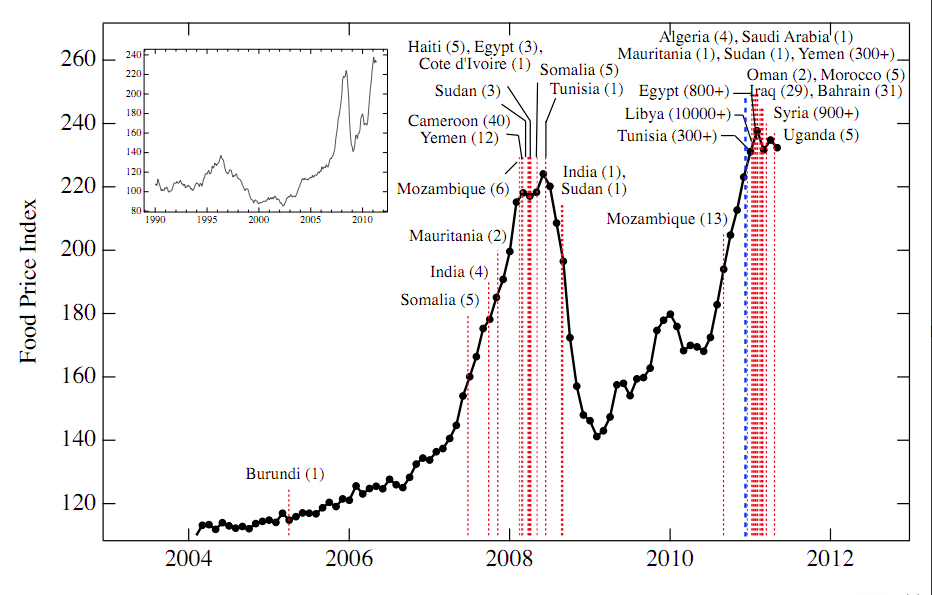
From 2008 to 2014, insurrectionist activity has sequentially erupted across the globe, from Tunisia and Egypt to Syria and Yemen; from Greece, Spain, Turkey and Brazil to Thailand, Bosnia, Venezuela and the Ukraine...

...beneath what we’ve come to perceive as isolated and distinct events is a shared but neglected root cause of environmental crisis. What most people don’t realize is that outbreaks of social unrest are preceded, usually, by a single pattern — an unholy trinity of drought, low crop yield and soaring food prices.

So what do the Arab Spring, Syrian civil war, Occupy Gezi, and the recent conflicts in the Ukraine, Venezuela, Bosnia and Thailand all have in common? Expensive food… and not much of it.
Details at the link.

* "This phrase originates from Rome in Satire X of the Roman satirist and poet Juvenal (circa A.D. 100). In context, the Latin metaphor panem et circenses (bread and circuses) identifies the only remaining cares of a new Roman populace which cares not for its historical birthright of political involvement. Here Juvenal displays his contempt for the declining heroism of his contemporary Romans. Roman politicians devised a plan in 140 B.C. to win the votes of these new citizens: giving out cheap food and entertainment, "bread and circuses", would be the most effective way to rise to power."
14 May 04:12

How multiplicity determines entropy [Physics]

by Hanel, R., Thurner, S., Gell-Mann, M.
The maximum entropy principle (MEP) is a method for obtaining the most likely distribution functions of observables from statistical systems by maximizing entropy under constraints. The MEP has found hundreds of applications in ergodic and Markovian systems in statistical mechanics, information theory, and statistics. For several decades there has been...
14 May 00:43

One-bit compressive sensing with norm estimation

by Igor
Laurent Jacques mentioned it on on his twitter feed but I think it is bigger than even what he says (more on that at the end of this entry):
Norm can be recovered! "One-bit compressive sensing with norm estimation" by K. Knudson, R. Saab, R. Ward http://t.co/bNnIVnE7jM #1bitcs
— Laurent Jacques (@jacquesdurden) May 3, 2014


Compressive sensing typically involves the recovery of a sparse signal x from linear measurements ai.x, but recent research has demonstrated that recovery is also possible when the observed measurements are quantized to sign(ai.x)∈{±1}. Since such measurements give no information on the norm of x, recovery methods geared towards such 1-bit compressive sensing measurements typically assume that ∥x∥2=1. We show that if one allows more generally for quantized affine measurements of the form sign(ai.x+bi), and if such measurements are random, an appropriate choice of the affine shifts bi allows norm recovery to be easily incorporated into existing methods for 1-bit compressive sensing. Alternatively, if one is interested in norm estimation alone, we show that the fraction of measurements quantized to +1 (versus −1) can be used to estimate ∥x∥2 through a single evaluation of the inverse Gaussian error function, providing a computationally efficient method for norm estimation from 1-bit compressive measurements. Finally, all of our recovery guarantees are universal over sparse vectors, in the sense that with high probability, one set of measurements will successfully estimate all sparse vectors simultaneously.


Like Laurent says, it is a big deal for the 1bit compressive sensing and quantization crowd but I want to take this further. 1-bit compressive sensing is first and foremost a nonlinear encoding of measurements of a special kind, in fact it very much parallels the first layer of neural networks except that it doesn't use a sigmoid and does not use an affine function. The paper lifts that problem by adding an afine constant and thereby shows that more of the signal can be recovered than initially thought. In short, it provides a natural connection between the whole theoretical framework of compressive sensing and the vibrant and exciting development in neural networks, see the recent:
In other words, some theoretical justification is coming to the neural network community and by the same token, this might provide a way to design those in a more efficient manner. Woohoo !


Join the CompressiveSensing subreddit or the Google+ Community and post there !
Liked this entry ? subscribe to Nuit Blanche's feed, there's more where that came from. You can also subscribe to Nuit Blanche by Email, explore the Big Picture in Compressive Sensing or the Matrix Factorization Jungle and join the conversations on compressive sensing, advanced matrix factorization and calibration issues on Linkedin.
13 May 13:50

Quiver Grassmannians can be anything

by lievenlb
Nosimpler

Yohan, to answer your question from Facebook about a month ago, the Grassmannian is a manifold in which subspaces are viewed as points. This all relates to the amplituhedron that got so much attention in theoretical physics last year (through the so-called positive Grassmannian), as well as various other hedra (associahedra, permutahedra, etc.). It's kinda funny to see quantum mechanics, abstract mathematics, and cognitive science (Tononi's notion of qualia spaces) essentially converge on objects that are basically gussied up versions of Platonic solids.

A standard Grassmannian $Gr(m,V)$ is the manifold having as its points all possible $m$-dimensional subspaces of a given vectorspace $V$. As an example, $Gr(1,V)$ is the set of lines through the origin in $V$ and therefore is the projective space $\mathbb{P}(V)$. Grassmannians are among the nicest projective varieties, they are smooth and allow a cell decomposition.

A quiver $Q$ is just an oriented graph. Here’s an example

Q~:~\xymatrix{\bullet & \bullet \ar[l]_a \ar@/^2ex/[r]^{b} \ar@/_2ex/[r]_{c} & \bullet}

A representation $V$ of a quiver assigns a vector-space to each vertex and a linear map between these vertex-spaces to every arrow. As an example, a representation $V$ of the quiver $Q$ consists of a triple of vector-spaces $(V_1,V_2,V_3)$ together with linear maps $f_a~:~V_2 \rightarrow V_1$ and $f_b,f_c~:~V_2 \rightarrow V_3$.

A sub-representation $W \subset V$ consists of subspaces of the vertex-spaces of $V$ and linear maps between them compatible with the maps of $V$. The dimension-vector of $W$ is the vector with components the dimensions of the vertex-spaces of $W$.

This means in the example that we require $f_a(W_2) \subset W_1$ and $f_b(W_2)$ and $f_c(W_2)$ to be subspaces of $W_3$. If the dimension of $W_i$ is $m_i$ then $m=(m_1,m_2,m_3)$ is the dimension vector of $W$.

The quiver-analogon of the Grassmannian $Gr(m,V)$ is the Quiver Grassmannian $QGr(m,V)$ where $V$ is a quiver-representation and $QGr(m,V)$ is the collection of all possible sub-representations $W \subset V$ with fixed dimension-vector $m$. One might expect these quiver Grassmannians to be rather nice projective varieties.

However, last week Markus Reineke posted a 2-page note on the arXiv proving that every projective variety is a quiver Grassmannian.

Let’s illustrate the argument by finding a quiver Grassmannian $QGr(m,V)$ isomorphic to the elliptic curve in $\mathbb{P}^2$ with homogeneous equation $Y^2Z=X^3+Z^3$.

Consider the Veronese embedding $\mathbb{P}^2 \hookrightarrow \mathbb{P}^9$ obtained by sending a point $(x:y:z)$ to the point

\[ (x^3:x^2y:x^2z:xy^2:xyz:xz^2:y^3:y^2z:yz^2:z^3) \]

The upshot being that the elliptic curve is now realized as the intersection of the image of $\mathbb{P}^2$ with the hyper-plane $\mathbb{V}(X_0-X_7+X_9)$ in the standard projective coordinates $(x_0:x_1:\cdots:x_9)$ for $\mathbb{P}^9$.

To describe the equations of the image of $\mathbb{P}^2$ in $\mathbb{P}^9$ consider the $6 \times 3$ matrix with the rows corresponding to $(x^2,xy,xz,y^2,yz,z^2)$ and the columns to $(x,y,z)$ and the entries being the multiplications, that is

$$\begin{bmatrix} x^3 & x^2y & x^2z \\ x^2y & xy^2 & xyz \\ x^2z & xyz & xz^2 \\ xy^2 & y^3 & y^2z \\ xyz & y^2z & yz^2 \\ xz^2 & yz^2 & z^3 \end{bmatrix} = \begin{bmatrix} x_0 & x_1 & x_2 \\ x_1 & x_3 & x_4 \\ x_2 & x_4 & x_5 \\ x_3 & x_6 & x_7 \\ x_4 & x_7 & x_8 \\ x_5 & x_8 & x_9 \end{bmatrix}$$

But then, a point $(x_0:x_1: \cdots : x_9)$ belongs to the image of $\mathbb{P}^2$ if (and only if) the matrix on the right-hand side has rank $1$ (that is, all its $2 \times 2$ minors vanish). Next, consider the quiver


\xymatrix{\bullet & & \bullet \ar[ll]^h \ar@/^2ex/[rr]^x \ar[rr]^y \ar@/_2ex/[rr]^z & & \bullet}

and consider the representation $V=(V_1,V_2,V_3)$ with vertex-spaces $V_1=\mathbb{C}$, $V_2 = \mathbb{C}^{10}$ and $V_2 = \mathbb{C}^6$. The linear maps $x,y$ and $z$ correspond to the columns of the matrix above, that is

$$(x_0,x_1,x_2,x_3,x_4,x_5,x_6,x_7,x_8,x_9) \begin{cases} \rightarrow^x~(x_0,x_1,x_2,x_3,x_4,x_5) \\ \rightarrow^y~(x_1,x_3,x_4,x_6,x_7,x_8) \\ \rightarrow^z~(x_2,x_4,x_5,x_7,x_8,x_9) \end{cases}$$

The linear map $h~:~\mathbb{C}^{10} \rightarrow \mathbb{C}$ encodes the equation of the hyper-plane, that is $h=x_0-x_7+x_9$.

Now consider the quiver Grassmannian $QGr(m,V)$ for the dimension vector $m=(0,1,1)$. A base-vector $p=(x_0,\cdots,x_9)$ of $W_2 = \mathbb{C}p$ of a subrepresentation $W=(0,W_2,W_3) \subset V$ must be such that $h(x)=0$, that is, $p$ determines a point of the hyper-plane.

Likewise the vectors $x(p),y(p)$ and $z(p)$ must all lie in the one-dimensional space $W_3 = \mathbb{C}$, that is, the right-hand side matrix above must have rank one and hence $p$ is a point in the image of $\mathbb{P}^2$ under the Veronese.

That is, $Gr(m,V)$ is isomorphic to the intersection of this image with the hyper-plane and hence is isomorphic to the elliptic curve.

The general case is similar as one can view any projective subvariety $X \hookrightarrow \mathbb{P}^n$ as isomorphic to the intersection of the image of a specific $d$-uple Veronese embedding $\mathbb{P}^n \hookrightarrow \mathbb{P}^N$ with a number of hyper-planes in $\mathbb{P}^N$.

13 May 13:24

Compressive Sensing and Short Term Memory / Visual Nonclassical Receptive Field Effects

by Igor


This is fantastic: Here are papers trying to link Short Term Memory with either the RIP or the Donoho-Tanner phase transition so that we have actual limits on what constitute a good neural assembly. You probably recall Chris Rozell is one the lead behind one of the rapid solver construction (see Faster Than a Blink of an Eye. ) Being fast is one thing, but we also want to see how that approach translates into system size and so forth (a little bit like what the GWAS folks are trying to do with the sample size of the genome using compressive sensing ( see Application of compressed sensing to genome wide association studies and genomic selection, Predicting the Future: The Upcoming Stephanie Events). Anyway, here is Chris just sent me :
:

Hi Igor-
I know you've had a long-standing interest in the intersection of neuroscience with sparsity (and possibly compressed sensing). I wanted to draw your attention to some recent papers at this intersection. 
First, you may find our recent paper in PLoS Computational Biology interesting: M. Zhu and C.J. Rozell. Visual nonclassical receptive field effects emerge from sparse coding in a dynamical system. PLoS Computational Biology, 9(8):e1003191, August 2013.
http://www.ploscompbiol.org/article/info:doi/10.1371/journal.pcbi.1003191

While the classic Olshausen & Field (1996) paper showed that sparse coding can account for classical receptive fields shapes in primary visual cortex (V1), that paper didn't say anything about whether sparse coding can actually explain response properties observed in V1 neurons. In fact, classical receptive fields are not very good predictors of V1 neural responses to natural scenes (especially single-trial responses). The paper above performs simulated electrophysiology experiments to demonstrate that a wide variety of observed nonlinear/nonclassical response properties (single cell and population) are emergent behaviors of a sparse coding model implemented in a dynamical system. These results show that the sparse coding hypothesis, when coupled with a biophysically plausible implementation, can provide a unified high-level functional interpretation to many response properties that have generally been viewed through distinct mechanistic or phenomenological models. 

Second, it's possible you saw a preprint version of this, but you may be interested in our recent paper that just appeared in Neural Computation: A.S. Charles, H.L. Yap, and C.J. Rozell. Short term memory capacity in networks via the restricted isometry property. Neural Computation, 26(6):1198-1235, June 2014. http://arxiv.org/abs/1307.7970 

An interesting open question is how brains can store sequence memories for lengths of time on the order of seconds, which is probably too short to be due to plasticity (changes in synaptic connections between cells). The conjecture is that this type of memory must be due to transient activity in recurrently connected networks. In addition to questions about biological memory, this question has also come up as part in trying to understand why reservoir computing strategies (i.e., untrained, randomly connected artificial neural networks such as Echo State Networks and Liquid State Machines) work so well in some situations. The conventional wisdom is that signal structure could be used by the network to dramatically increase memory capacity, but this was not supported by formal analysis. In the paper above, we use a compressed sensing style analysis to show conclusively that memory capacities for randomly connected networks can be much higher than what was previously known when the signal has sparse structure than can be exploited. From a technical perspective, this paper establishes RIP for a very structured random matrix that corresponds to the propagation of a signal through a networked system. 
regards,
chris rozell
Thanks Chris, this is outstanding. I will come back to this later.

Very relevant set of links:


Join the CompressiveSensing subreddit or the Google+ Community and post there !
Liked this entry ? subscribe to Nuit Blanche's feed, there's more where that came from. You can also subscribe to Nuit Blanche by Email, explore the Big Picture in Compressive Sensing or the Matrix Factorization Jungle and join the conversations on compressive sensing, advanced matrix factorization and calibration issues on Linkedin.
13 May 04:44

How Black People See White Culture - YouTube

09 May 18:24

"She flung her anus high up in the air..."

by Minnesotastan
A passage from the book Matisse on the Loose, as translated by an optical character reader:
"When she spotted me, she flung her anus high in the air and kept them up until she reached me. 'Matisse. Oh boy!' she said. She grabbed my anus and positioned my body in the direction of the east gallery and we started walking."
It's all explained Sarah Wendell, editor of Smart Bitches, Trashy Books:
"So if the text is old, and it says 'arms', the OCR [optical character recognition] scanner will see it as 'anus.' OMG," Wendell tweeted. (She was referring to optical character recognition, the process by which printed texts can be scanned and converted into ebooks.)
Via The Guardian and Melville House, where there are additional examples of the error.
07 May 16:47

"No copula, no problem"

by Minnesotastan
This is a followup to yesterday's post about crash blossoms, in the comments to which an anonymous reader clued me in to the term "zero copula":
Zero copula is a linguistic phenomenon whereby the subject is joined to the predicate without overt marking of this relationship (like the copula 'to be' in English)... used most frequently in rhetoric and casual speech...

Standard English exhibits a very limited form of the zero copula, common in statements like "The higher, the better"; "The more, the merrier"...

Zero copula also appears in casual questions and statements like "You from out of town?"; "Enough already!" where the verb (and more) may be omitted due to syncope. Apart from syncope, the zero copula is probably not used productively in standard English.

The zero copula is far more productive in Caribbean creoles and African American Vernacular English, some varieties of which regularly omit the copula. For instance, "You crazy!", "Where you at?" and "Who she?" As in Russian, this is the case only in the present tense. In past-tense sentences, the copula must be specified...

The zero copula is also present, in a slightly different and more regular form, in the headlines of English newspapers, where short words and articles are generally omitted to conserve space. For example, a headline would more likely say "Gulf coast in ruins" than "Gulf coast is in ruins"... 
The Wikipedia page goes on to discuss zero copula in languages other than English (note zero copula is standard in American Sign Language).
07 May 00:56

Pro Wrestling: Vladimir Putin vs. Edward Snowden

by Zenon Evans

Professional wrestling, with its monstrous egos, blowhard rhetoric, and bad solutions (use the chair!), is kind of like politics except that it's got better acting. And, you can actually use wrestling as a sort of barometer for the average person's views, instead of the government's, on hot-button issues. This past Sunday World Wrestling Entertainment (WWE) showed us how Americans perceive Russian President Vladimir Putin and whistle-blower Edward Snowden.

At a pay-per-view event in New Jersey, C.J. "Lana The Ravishing Russian" Perry riled up fans for a fight featuring Miroslav "Alexander Rusev" Barnyashev, by dedicating his performance to Putin. Perry announced in her best fake accent:

I am proud to be Russian. I am proud to come from a country with the most dominant and powerful president in the world, Vladimir Putin. He makes fools out of every one of you. You are merely pawns in his game of global dominance.

The jumbotron displayed Putin's mug. The crowd started booing and chanting U-S-A so loudly, you could feel the Cold War rekindling. The negative response to Putin was expected, since the WWE knows its marketing. It is, after all, a billion dollar business with 15 million weekly viewers. Unlike other sports that occasionally stumble into American's ongoing debates on race or drugs or sexuality, pro wrestling's scripted game explicitly relies on popular culture outside the sport and the ability to reflect them in a way the audience wants.

Still, the fact that the WWE is reviving nationalistic gimmicks not seen since Hulk Hogan spat on the Soviet flag, Rocky clocked Drago, and the Wolverines valiantly battled the Red Army, shows just how bad the perception of America's foreign relations have gotten lately. And it's not because there's a threat to American lives any more real than pro wrestling itself. Rather, it boils down to the fact that the Obama and Putin administrations have dropped the ball on two decades worth of relationship repairing the U.S. and Russia did after the Cold War ended.

But, that's not even where The Ravishing Russian's speech ended. Her final blow was supposed to be that Putin "welcomes with open arms the patriot Edward Snowden" in his quest for power.

The Washington Free Beacon, whose editors have collectively stated their dislike for Snowden and Russia, saw the match and reported "audible ire from the audience" for Snowden. You can judge for yourself, but that's not what I heard. The response from the crowd sounded conspicuously muted to me. The fans were worked up into a lather by the Putin bit but the Snowden insult, which was supposed to be the final straw, just fell flat.

It fell flat in the same way big government advocates and apologists like President Obama, Sen. John McCain (R-Ariz.), and Rep. Mike Rogers (R-Mich.) do every time they try to unambiguously paint Snowden as a traitor who deserves time in prison for drawing attention to the massive surveillance state that continues to violate virtually every American's privacy.

Wrestling and politics both rely on framing issues as dualities: red versus blue, face versus heel, with us or against us. But neither of these groups can elicit outrage about Snowden, because his personal legacy is too mixed. In a recent YouGov poll that asked if Snowden did "the right thing" by exposing government surveillance, an almost equal number of people said yes as said no, and slightly more said they weren't sure.

And, far less ambiguous are the feelings for government snoops that Snowden awakened in the public. Exposing the National Security Administration (NSA) immediately and dramatically shifted Americans' concerns from terrorism to civil liberty violations as one poll shows. Another survey demonstrates that a record number of Americans see big government as the greatest threat to the future of America. Reason-Rupe poll data indicates that only 18 percent of Americans trust the NSA with their personal information and that many people think the agency is violating their privacy.

The WWE is savvy. It pays attention to how fans feel and responds quickly and accordingly. The Russophobia will continue as long as the international political showboating does, but I bet they'll stop lumping Snowden in the bad guy camp after this goof. Public servants who value their own popularity should take note.

06 May 19:22

Nobody Has Any Money For Retirement

by noreply@blogger.com (Atrios)
Something's gotta change.
The median size of a 401(k) is $24,400 as of March 31, with people older than 55 having $65,300, according to Fidelity Investments. Those funds can disappear quickly in retirement, and the early withdrawals indicate that the coming retirement crisis could be even more acute than expected.

04 May 22:50

Would you help this man get out of prison? - updated

by Minnesotastan

This petition is at Change.org:
Cornealious "Mike" Anderson is 36 years old, a married father of four, youth football coach, volunteer, homeowner and small business owner in St. Louis, Missouri.  In 1999, he was arrested and later convicted of participating in a robbery of a Burger King manager.  He was sentenced to 13 years in prison.  He was released on bail while his appeals were pending, and after he lost his appeals, the State of Missouri simply forgot about him.  They never told him to report to prison to serve his sentence.

When he was arrested, he was 22 years old, had no children, was not married, and did not own a home or a business.

From 1999 to 2013, he lived a law-abiding life, paid taxes, and worked to build a career as a carpenter. He never became a  fugitive, tried to change his identity, or flee from justice.  He had no further trouble with the law.  He stayed right in St. Louis.  He got married, had 4 children, built his own home in Missouri, and started several successful small businesses, including a contracting business.  He volunteered at his church and coached his son's youth football team.

In July, 2013, the State of Missouri suddenly realized, 13 years later, that Mike Anderson had never served the sentence, and that he was out on bail this entire time.  They raided his house with a SWAT team, and ripped him from his home without warning, hauled him off to prison, and told him he now had to serve 13 years in prison.

If he is required to serve the sentence, he will be 50 years old when he is released.  His kids will have grown up without a father, his wife will have had to raise 4 children alone, and they will lose their home and business - everything he had worked so hard to attain in the last 13 years of leading a normal life.

The victim of the robbery believes that Mike Anderson should not be forced to now serve a 13-year sentence, and believes the State of Missouri dropped the ball.  He has said that he believes it would serve no purpose in now incarcerating this man.
The full story, with extensive details, is at Riverfront Times.

I first heard the story as a podcast on This American Life.  It takes about 15 minutes, and I think is well worth a listen before you pass judgment.

I've signed the petition, as have 35,000 others.

Update:  He has been released.
Judge Terry Lynn Brown lauded Anderson's "exemplary" behavior during his 13 years of freedom before the arrest. "You've been a good father. You've been a good husband. You've been a good taxpaying citizen of the state of Missouri. "That leads me to believe that you are a good man and a changed man."

Anderson walked out of the courtroom with his wife and 3-year-old daughter on one arm and his mom on the other. Before being driven away to a freedom celebration at an undisclosed spot, Anderson told reporters he was "very happy. My faith has always been in God. I'm just so thankful. Thank God for everything."

The best place to follow the conclusion of the story is at the Riverfront Times (which was a favorite read of mine when I lived in St. Louis).

The podcast is still worth a listen; it's quite a story.
04 May 22:48

This is a living creature

by Minnesotastan

I find this photo to be endlessly fascinating.  The creature is a single-cell organism (Nassula).

And it has all that is needed for life.  What is it that converts this combination of membranes and complex molecules into a "living" organism capable of eating and reproducing.  It staggers my mind to think about it.

Photo credit: Mr. Riccardo Taiariol, La Spezia, Italy, using differential interference contrast at 25x, from an Olympus Bioscapes gallery.
04 May 22:27

Low dimensional topology of information

by dmoskovich

Is information geometric, or is it fundamentally topological?

Information theory is a big, amorphous, multidisciplinary field which brings together mathematics, engineering, and computer science. It studies information, which typically manifests itself mathematically via various flavours of entropy. Another side of information theory is algorithmic information theory, which centers around notions of complexity. The mathematics of information theory tends to be analytic. Differential geometry plays a major role. Fisher information treats information as a geometric quantity, studying it by studying the curvature of a statistical manifold. The subfield of information theory centred around this worldview is known as information geometry.

But Avishy Carmi and I believe that information geometry is fundamentally topological. Geometrization shows us that the essential geometry of a closed 3-manifold is captured by its topology; analogously we believe that fundamental aspects of information geometry ought to be captured topologically. Not by the topology of the statistical manifold, perhaps, but rather by the topology of tangle machines, which is quite similar to the topology of tangles or of virtual tangles.

We have recently uploaded two preprints to ArXiv in which we define tangle machines and some of their topological invariants:

Tangle machines I: Concept
Tangle machines II: Invariants

I’ve posted about an earlier phase of this work HERE and HERE.

Our terminology is classical computer-science inspired- the term “tangle machine” imitates “Turing machine”, our connected components are “processes”, our strands are “registers”, and our crossings are “interactions”. Tangle machines are envisioned as a diagrammatic calculus for information theory, in a big amorphous multidisciplinary sense, which capture an underlying topological nature to information manipulation and transfer.

In what sense is information topological?

Information manipulation should fundamentally be causal, by which I mean that one unit of information y causes another unit of information x to change (we’ll call it’s updated state x\triangleright y). By how much? That depends on your method of measurement. In what direction? That depends on your chosen (perhaps arbitrary) system of coordinates. But the plain fact of causation, that y causes x to change to x\triangleright y, doesn’t depend on any of that. I’d like to draw such an interaction as a crossing:

An interaction

Note: Statistics gives us the tools to detect such causal interactions inside real-world data, in which one piece of information triggers a transition between two pieces of information. This means we can actually detect tangle machines inside e.g. Google Trends search data! As a single-interaction example, given graphs of number of searches and nothing else, we can detect with statistical significance that iPhone 5 caused Samsung to update from S2 to S3. Some graphics for another detection example are given below.

interaction detected

Our information is in the form of colours on strands (i.e. in registers). For example, each strand might be coloured by a real number representing the entropy of a `typical sequence’ of zeros and ones. I’m imagining `information’ sitting as colours on each of the strands, with each crossing representing an information fusion or its converse.

Note also that information plays a dual role e.g. in the classical paradigms of computing, such as a universal Turing machine. On the one hand, information is something that is manipulated by a computer, such as the input or the output of a computation. Such information is called a patient. On the other hand, the computer programme that does the manipulation is itself information. Information in this capacity is called an agent. A computer programme can modify another computer programme, so that an agent in one context may be a patient in another context. A labeled digraph (such are the classical diagrammatic languages for such things) does not capture this dual nature of information. But a strand in a tangle diagram may be an overstrand mediating between an input understrand and an output understrand in one crossing, and it may be an understrand itself in another crossing.

We claim that interactions, i.e. crossings, satisfy the Reidemeister relations, and that these represent fundamental properties of information fusion. Indeed, Reidemeister 1 tells us that information cannot generate new information from itself and so, for example, that the entropy of a closed system cannot drop, and in fact can’t increase either, without outside intervention. This seems to contradict the second law of thermodynamics, but thanks to e.g. the Poincaré recurrence theorem I think it’s actually fine.

Reidemeister 2 is what information theorists call `causal invertibility’, telling us that we can recover the input x from the output x\triangleright y and the agent y, and that updating and then discounting by y- adding information and then taking it away- brings us back to where we started as though we had done nothing.

And Reidemeister 3, which comes from distributivity, tells us that if we find a common cause z for an interaction in which y causes x to change to x\triangleright y, then that doesn’t change our causal relationships: y\triangleright z still causes x\triangleright z to change to (x\triangleright y)\triangleright z. In information theory, this is equivalent to no double counting. If we update x\triangleright z by y\triangleright z then we obtain (x\triangleright y)\triangleright z, so z is counted towards the result `just once’.

One fun spinoff of this approach is that several classical information theoretical algorithms, such as Kalman filtering and covariance intersection, can be developed using Reidemeister move invariance for suitable choices of what we mean precisely when we say `information’. We can imagine a little Kalman filter fusing and discounting estimators, or a little covariance intersection, sitting at each crossing.

So what does this all give us? We now have a coordinate free `topological’ language with which to discuss fusion and discounting of information. Moreover, we can describe the same network in many different ways, which differ by finite sequences of Reidemeister moves. Different equivalent tangle machines may have different local performance- to fuse and then to discount may consume time and resources, although topologically we’ve done nothing. So tangle machines become a formalism for choosing between different ways to realize `the same’ network of information manipulation.

These ideas become quite concrete in the quantum physical context of adiabatic quantum computation (this is our Section 5.2). Here, the colours represent Hamiltonians, and the interaction is of the form x\triangleright y\stackrel{\textup{\tiny def}}{=} (1-s)x+sy, where s\in [0,1). As we move s from 0 to 1 (this is the computation), x\triangleright y evolves from x to y. Concatenate many such interactions, and the machine describes a controlled evolution (quantum annealing) of an initial groundstate of a Hamiltonian towards a final state, where we are forcing the Hamiltonian to pass through each state described by a groundstate of a Hamiltonian which overcrosses its strand. The effect may be to speed up adiabatic quantum computations! Farhi et.al. have a recent preprint in which they discuss such speedups by `inserting intermediate Hamiltonians’, and it seems to be known that you can speed up classical quantum algorithms such as the Grover algorithm in this way. Essentially, the idea is that the speed of the computation is inversely proportional to the minimum distance between the lowest two eigenvalues of the Hamiltonian along the evolution path. The `straight line annealing’ of `classical adiabatic quantum computing’ is like walking in a straight line between two points on hilly ground- you might have to climb over hills and down gullies, and, despite being a straight line, it may be a strenuous path. I wouldn’t necessarily want to hike between two peaks of a high mountains by going in a straight line! Tangle machines give a diagrammatic language to describe the process of choosing the traverse.

From another perspective, information manipulation might be just another word for computation. The word `computation’ is a charged word, which, like `information’, doesn’t have clear mathematical meaning. One way to ascribe the word `computation’ mathematical meaning would be to define computation as the operation of a Turing machine. Can a tangle machine simulate a Turing machine?

Let’s define the computation of a tangle machine to be `input colours into a set of registers S_{\text{in}}, and read off colours from another set of registers S_{\text{out}}‘. Assume that the colours of S_{\text{in}} uniquely determine the colours of S_{\text{out}}.

This notion of computation, unlike many others, makes no mention of the notion of `time’.

Let’s choose our set of colours to be 0, \frac{1}{2}, and 1, represented as red, green, and blue correspondingly. A colour acts trivially on itself, but switches any colour other than itself- this is a Fox 3-colouring.

We first simulate a NOT gate, exchanging 1 and 0. The arrow on the left is the input, and on the right is the output. The strand without the arrow is fixed at \frac{1}{2}, and is neither input nor output, but is merely part of the gate.

NOT gate

We next simulate a multiplexer, which copies a register labeled 0 of 1. This gate has one input and two outputs.

Multiplexer

To simulate an AND gate, we need one more piece (and its inverse). This is a trivalent vertex which accepts two colours as input, and outputs their minimum. This sends (0,0), (0,1), and (1,0), to zero, and it sends (1,1) to one.

AND gate

And that’s it! With an AND gate, a NOT gate, and a multiplexer, we can compute any recursively computable function, and tangle machines (in this new extended sense, which I haven’t properly defined) are Turing complete.

I haven’t explicitly written down the Reidemeister moves that such a machine satisfies in this blog post.

Tangle machines can further simulate a Turing machine, tape and all, and can further simulate neural networks. If we allow the overcrossing colour to also be updated, so our colour set is not a quandle but is instead a biquandle, we can also simulate machine learning.

Besides our approach, there are other quite different approaches which relate low dimensional topology with the theory of computation (although I don’t know other works relating low dimensional topology with information theory). One approach is to view the tangle itself as a unit of data, and to compute by applying rewrite rules. This approach originates with Kauffman, who is I think the father of applying low dimensional topology to computing. It is tremendously exciting, with possible applications in internet architecture and in biology. A recent preprint by Kauffman and Buliga outlines one such idea. Marius Buliga has a very nice research blog in which he explains his research programme. There is also another approach of Kauffman in which colours evolve along a braid. I think that this concept of computation is similar in spirit to ours (with knots instead of with tangle machines), in that his crossings are also performing computations. Meredith and Snyder have an approach in which they encode knot diagrams using Milner’s π calculus, with a view to using process calculi formalisms to find and compute knot invariants. In this approach also, crossings play the role of switches. Then there are the category theory approaches, outlined nicely in Baez and Stay’s survey.

Thanks to Lou Kauffman and to Marius Buliga, for useful feedback regarding tangle machines and computation.

As today there is information geometry, Avishy and I strongly believe that there will be information topology. The low dimensional topology of information.


01 May 14:56

'Classically Cannabis': Colorado Symphony Orchestra Goes to Pot

by Elizabeth Nolan Brown

Classical concerts just don't stir the kids like they used to. But the Colorado Symphony Orchestra has an idea it's hoping might help change that. This May, the symphony is introducing "Classically Cannabis: The High Note Series," a round of weed-friendly summer fundraising concerts. 

"It's an interesting way to connect ourselves to new audiences and new potential financial support," said Jerry Kern, Colorado Symphony CEO, in an NBC News clip (below).  

The concerts—each with a different theme—will take place in May, July, and August at a downtown Denver venue called the Space Gallery.

Edible Events Co., "Colorado’s premier producer of cannabis-friendly events," is curating, with all proceeds going to the Colorado Symphony. "I'd like to kind of start redefining what a cannabis user looks like," said Jane West, owner of Edible Events. 

Along with some sweet classical jams, the $75 ticket price will get concertgoers complimentary booze and food truck grub. But all shows are "BYOC"—bring your own cannabis.

The symphony is also hosting a series of "Beethoven and Brews" concerts, which wil have slightly cheaper tickets and take place in local breweries.

01 May 05:05

Perspective: Synthetic biology revives antibiotics

by Gerard Wright

Perspective: Synthetic biology revives antibiotics

Nature. doi:10.1038/509S13a

Author: Gerard Wright

Re-engineering natural products provides a new route to drug discovery, says Gerard Wright.

29 Apr 20:42

TGA: Grassmann Averages for Scalable Robust PCA - implementation -

by Igor
So it looks like we have a fast implementation of the Robust PCA

Grassmann Averages for Scalable Robust PCA by Søren Hauberg, Aasa Feragen, Michael J. Black

As the collection of large datasets becomes increasingly automated, the occurrence of outliers will increase“big data” implies “big outliers”. While principal component analysis (PCA) is often used to reduce the size of data, and scalable solutions exist, it is well-known that outliers can arbitrarily corrupt the results. Unfortunately, state- of-the-art approaches for robust PCA do not scale beyond small-to-medium medium sized datasets. To address this, we introduce the Grassmann Average (GA), which expresses dimensionality reduction as an average of the subspaces spanned by the data. Because averages can be efficiently computed, we immediately gain scalability. GA is inherently more robust than PCA, but we show that they coincide for Gaussian data. We exploit that averages can be made robust to formulate the Robust Grassmann Average (RGA) as a form of robust PCA. Robustness can be with respect to vectors (subspaces) or elements of vectors; we focus on the latter and use a trimmed average. The resulting Trimmed Grassmann Average (TGA) is particularly appropriate for computer vision because it is robust to pixel outliers. The algorithm has low computational complexity and minimal memory requirements, making it scalable to “big noisy data.” We demonstrate TGA for background modeling, video restoration, and shadow removal. We show scalability by performing robust PCA on the entire Star Wars IV movie.


from the text:

To further emphasize the scalability of TGA, we compute the 20 leading components of the entire Star Wars IV movie. This consist of 179,415 frames with a resolution of 352153. Computing these 20 components (see [15]) took 8.5 hours on an Intel Xeon E5-2650 with 128 GB memory.
my emphasis on the underlined word.

The project page is here and the attendant code is here. It will be added to the Advanced Matrix Factorization Jungle page shortly.


Join the CompressiveSensing subreddit or the Google+ Community and post there !
Liked this entry ? subscribe to Nuit Blanche's feed, there's more where that came from. You can also subscribe to Nuit Blanche by Email, explore the Big Picture in Compressive Sensing or the Matrix Factorization Jungle and join the conversations on compressive sensing, advanced matrix factorization and calibration issues on Linkedin.
29 Apr 20:10

(100 x 100)-dimensional entangled quantum system [Physics]

by Krenn, M., Huber, M., Fickler, R., Lapkiewicz, R., Ramelow, S., Zeilinger, A.
Entangled quantum systems have properties that have fundamentally overthrown the classical worldview. Increasing the complexity of entangled states by expanding their dimensionality allows the implementation of novel fundamental tests of nature, and moreover also enables genuinely new protocols for quantum information processing. Here we present the creation of a (100...
28 Apr 00:01

New Scientist Article

by leinster
MathML-enabled post (click for more details).

I’ve got a full-page opinion piece in this week’s New Scientist, on why mathematicians should refuse to cooperate with agencies of mass surveillance. If you’re in the US, UK or Australia, it’s the print edition that came out yesterday.

Thumbnail of New Scientist article

MathML-enabled post (click for more details).

The substance is much the same as my piece for the London Mathematical Society Newsletter, but it’s longer, and it’s adapted for a US readership too.

I don’t currently have much to add to the article or what I wrote about mathematicians and the secret services previously. But I do have some observations to make about the process of writing for New Scientist.

This was my first time writing for a magazine. The article received substantial edits from at least three editors; you can compare it with the version I originally submitted. I have mixed feelings about this process.

On the one hand, it’s great to have the input of experienced magazine journalists, and I can definitely see ways that they improved what I wrote. On the other hand — and despite the editors I dealt with being reasonable, helpful, and pleasant — I found the process pretty frustrating. I think that’s because of where the control lies.

What doesn’t happen is that you submit your piece, the editors read it and give you their critiques, and then you amend your article accordingly. What does happen is that you submit something, the editors change it how they like, and if you don’t like any of their changes, you have to argue for why it should be changed back. This process may be iterated several times, perhaps with different editors with different opinions. Rationally, I know that the article goes out not only under my name but also under the magazine’s, but by the end of the process, I did have the depressing feeling that the article wasn’t entirely mine.

(Small example: there were three words that I disliked and repeatedly removed from the editor’s edits: “moral”, “snoop” and “spook”. The editors I dealt with directly respected my wish to avoid them, after I’d made the case. But in the online version, the headline and the standfirst — which I neither wrote nor saw before publication — managed to use two out of those three words.)

Anyway, it was a new experience.

Comments are open. As ever, if you’re leaving comments on the political aspects, please keep them focused on the relationship between mathematicians and the secret services.


Update   Here’s a list of the various press articles that followed on from my original article:

MathML-enabled post (click for more details).MathML-enabled post (click for more details).
27 Apr 23:58

inkhorn

Merriam-Webster's Word of the Day for April 27, 2014 is:

inkhorn • \INK-horn\  • adjective
: ostentatiously learned : pedantic

Examples:
Richard's use of inkhorn terminology in his paper didn't impress his professor, whereas simple language demonstrating a clear understanding of the material would have done the trick.

"It was not until the 18th century that dictionary-makers began to include everyday words and weed out the weighty-sounding inkhorn terms." — From an article by Faye Carney in The Times Educational Supplement, September 23, 2005

Did you know?
Picture an ancient scribe, pen in hand, a small ink bottle made from an animal's horn strapped to his belt, ready to record the great events of history. In 14th-century England, such ink bottles were dubbed (not surprisingly) "inkhorns." During the Renaissance, learned writers often borrowed words from Latin and Greek, eschewing vulgar English alternatives. But in the 16th century, some scholars argued for the use of native terms over Latinate forms, and a lively intellectual debate over the merits of each began. Those who favored English branded what they considered ostentatious Latinisms "inkhorn terms" after the bottles carried by scholars, and since then we have used "inkhorn" as an adjective for Latinate or pretentious language.

26 Apr 17:19

The Poors Definitely Can't Have Nice Things

by noreply@blogger.com (Atrios)
It isn't the full story, but part of the acceptance of "only poor people get busted for drugs" is based on the idea that the poors don't deserve any "fun" at all. Obviously given addiction issues drug use is a bit more complicated than "fun," but people who have no problem shelling out $50 for a bottle of wine are horrified to see the poors with a six pack of cheap beer. Likewise, upper middle class people who for one reason or another rely on drugs, legal or not, think the poor, with their slightly more acute struggles, must have purity of essence.
25 Apr 17:27

Friday A/V Club: The Legend of Action Park

by Jesse Walker
Nosimpler

Watch this with someone you love.

I hate to imagine that form.Action Park was a legendarily unsafe amusement park in New Jersey, the sort of place that Blue Teamers imagine a libertarian society would be like. (There is a parallel universe, I'm sure, where Action Park occupies the place held by Somalia on our plane's compendium of comment-thread clichés.) "Action Park was less a water park and more a complete insult to the evolutionary concept of self-preservation," Matthew Callan wrote in a fun Freezerbox piece some years back. "And yet, despite all the danger, we kids kept going back, tempting fate like Russian-roulette-players."

You should read Callan's whole essay, with its detailed descriptions of the park's fate-tempting rides. Here's a sample:

The very first ride you saw when you entered Action Park involved a sled and a ramp of metal rollers. You slid down on your sled across the metal rollers, reaching speeds of roughly 300 miles an hour, and skipped thirty feet across the surface of a very shallow pool. The metal-roller ramps had no guardrails on them, so there was always a possibility that you would veer off to the side and fall very quickly into two feet of water. And since there were four metal-roller ramps emptying into this pool in tandem, snarls of sled collisions were constantly occurring, making it look like the Cross Bronx Expressway on a Friday night.

The Colorado River Ride was a water slide involving huge inner tubes that could fit seven people. It tried to approximate a mountain rapid, with lots of bumps and obstacles and so forth. But the most dangerous part of it was the fact that the borders that kept the tubes on the course were criminally short. And just off to the side of the Colorado River Ride was a steep tree-and-pricker-bush-lined hill. It was the perfect demonstration of the Action Park philosophy: Put seven people in a large inner tube, push them down a wet slide, and let the laws of physics handle the rest. People would gather around to watch folks scream their way down, cheering and hoping that a tube would hop the barrier and go careening down the side of the hill. When a large family would come close to flying away, the whole crowd would gasp and then sigh in disappointment, like the audience at the Indy 500 when the Tide car just narrowly misses hitting the Pepsi car and exploding in a beautiful orange ball of flame.

And then there was this thing:

A picture is worth a thousand depositions.

They called it the Cannonball Loop. "It was never open," Barry Petchesky recalls in Deadspin. "You wondered if it had ever been open." Turns out it had indeed been open, though apparently not for very long. Petchesky has located some footage of the slide in action, part of an alternately eerie and funny compilation of Action Park commercials and home movies:

If you want to watch people riding the slide, you can skip ahead to 8:17. But there's much more to see here, from the children-as-sewage-discharge footage at 5:12 to the breakdancing demonstration at 3:13. (The latter is recommended for hardcore '80s nostalgists only.) And at the very end of the video, there's the most frightening ad slogan I've ever heard: "where you and the rides become one."

Bonus link: "Anarchy, State, and Amusement Park."

(For past editions of the Friday A/V Club, go here.)

24 Apr 20:08

Why Two Artists Installed a Spy Lamp at McDonald's

by Elizabeth Nolan Brown

"Yeah right. Don't you know Loretta's an Aquarius?"

That's one snippet of conversation secretly recorded at an unspecified New York City McDonald's and broadcast on Twitter via @conversnitch, a project "bridging the gap between online and IRL" in the most terrifying way possible. It sharply highlights how easily we could all be surveilled without the slightest knowledge of it.

The conversations are being picked up by a device attached to an unassuming McDonald's table lamp by artists Brian House and Kyle McDonald. This "conversnitch" device cost under $100 to make and can plug into any ordinary light fixture. 

Using a microphone, a Raspberry Pi mini-computer, and the locale's own Wi-fi, conversnitch streams recordings to Amazon's Mechanical Turk, an online temp worker marketplace. Mechanical Turk freelancers then transcribe and tweet out bits and pieces of the digitally eavesdropped conversations. 

This has been going on for nearly seven months. 

"Conversations are fleeting in person, they last briefly and then disappear," McDonald, an adjunct professor at the New York University, told British magazine Dazed and Confused.

"It's exactly the opposite of everything the internet is. With everyone keeping more personal records every day, and various governments and corporations doing similarly, how much longer do we have until the idea of a fleeting moment, much less a private one, is a complete impossibility?"


As the video below shows, conversnitch is small and undetectable enough to be installed in restaurants, in libraries, on street corners, or just about anywhere. The code's available for free here. "Here were Brian and I trying to make something kind of scary, something that makes you wonder if someone’s watching you all the time," McDonald said in an interview with Wired. "And then Snowden says, 'They are.'"