
Shared posts
10 Jul 16:22


Meep Meep Watch
by Andrew Sullivan

I’m sure my Republican readers will wince at that headline – or mock it. The news narrative of the summer is the floundering of the president in any number of ginned-up stories: he “lost” the Middle East (as if that’s a bad thing); he’s created a crisis in illegal immigration (even though the bulk of the blame goes to a Bush-era law); he’s responsible for total gridlock (as if Ted Cruz did not exist); he’s been snookered by Putin; he’s been humiliated by Netanyahu; he’s the “worst president since World War II”, and on and on.
But let’s revisit last fall when Obama was in his first second term swoon. At that point, with the implosion of healthcare.gov, the very survival of the ACA, his signature domestic achievement, was in serious doubt. In the wake of Obama’s sudden bait-and-switch in Syria, when he threatened a strike and then accepted a Putin-brokered deal with Assad on WMDs, his foreign policy skills were about to get systematically downgraded by the American public. The economy was still sluggish, with no guarantee of a robust revival. Here’s Gallup’s picture of the president’s stark reversal of polling fortune, almost rectified before Iraq exploded a month or so ago:

In April of last year, his approval ratings were exactly the inverse of what they are today. And with every passing day in his second term, his ability to leverage his power attenuates.
But let’s return to last year’s crises. Less than a year after the ACA was regarded as near-dead, the implementation has exceeded most expectations. Today’s Commonwealth Fund report tallies the results:
The uninsured rate for people ages 19 to 64 declined from 20 percent in the July-to-September 2013 period to 15 percent in the April-to-June 2014 period. An estimated 9.5 million fewer adults were uninsured. Young men and women drove a large part of the decline: the uninsured rate for 19-to-34-year-olds declined from 28 percent to 18 percent, with an estimated 5.7 million fewer young adults uninsured. By June, 60 percent of adults with new coverage through the marketplaces or Medicaid reported they had visited a doctor or hospital or filled a prescription; of these, 62 percent said they could not have accessed or afforded this care previously.
And the rate of increase in per capita healthcare costs has moderated substantially since the Bush administration. Perspective is everything, of course, and politically, the ACA is still (on balance) a loser, especially among the older, whiter Medicare recipients who are over-represented in mid-term elections. But still: isn’t this by the measure of last fall a pretty stunning comeback? And the purist “repeal!” chorus has dimmed to a faint version of replace or fix.
So turn your gaze to Syria, where the entire foreign policy establishment moaned in concert at Obama’s fecklessness last September. We were all told that it was unbelievably naive to think that Assad would ever fully cooperate and relinquish his stockpile of WMDs as a reward for not getting bombed. It was a pipe-dream to think Putin was serious about being constructive as well. Well: a couple weeks back, the last shipment of WMDs was removed from the country, with very limited use in the intervening period, and is now undergoing destruction. I don’t know of any similar achievement in non-proliferation since Libya’s renunciation of WMDs under Bush. No, we didn’t resolve the sectarian civil war in Syria/Iraq, but we did remove by far the biggest threat to the West and to the world in the middle of it. Why is that not regarded as an epic triumph of American diplomacy, backed by the threat of force?
Now look at the economy where Obama has been stymied by the GOP for a very long time – both federally and in the states where local government austerity put an unprecedented drag on the recovery. Well: again, we have an unemployment rate back to where it was before the Great Recession hit. If the momentum continues, we could have an unemployment rate below 6 percent before too long. It’s taken for ever – but the hit was deep and the debt overhang large. And speaking of debt, we also have this data to chew on:

No, there hasn’t been any progress in reducing our long-term debt or our unfunded liabilities in entitlements. But when the GOP refuses to countenance any new revenues, I can’t blame the president. And to have reduced a budget deficit from 10 percent of GDP to just over 2 percent in the wake of a massive recession is something a Republican president would be bragging incessantly about.
There’s still a lot in play. The critical negotiations with Iran remain as tricky as ever – but that we have a chance of controlling Iran’s nuclear program without war is already a remarkable fact. Again: a function of skilled, relentless diplomacy backed by serious sanctions. The menace of Putin has not gone away – even though a very good case can be made that in that head-to-head, Putin is now licking his wounds a little, after Ukraine has signed that trade deal with the EU, and Ukraine’s military is regrouping. Immigration reform is in limbo. But I’d argue that on the wider political plain, Obama has been winning the strategic war with the GOP. The last twelve months have been an unmitigated disaster for Republican outreach to Hispanics; the Republicans have hurt themselves with many more women on the question of contraception, than they have helped themselves with orthodox Christians; the Palin impeachment chorus is poison to the middle of the country; and the Democrats have a clear and female front-runner against a divided and small-bore GOP bench in 2016. If Clinton were to win, it would be as decisive a strategic advance as when George H W Bush cemented Reagan’s legacy.
I’m applying the criteria that Obama has applied to himself. Is his long game bearing fruit? So far, it seems to me, the question answers itself.
(Photo: U.S. President Barack Obama departs the White House July 8, 2014 in Washington, DC. Obama was scheduled to travel to Denver, Colorado. By Win McNamee/Getty Images.)
10 Jul 05:41




best-seen-in-snow: coconutjob: whoever did this is a...
by plug
NOOOOOOOOOOOOOOOOOOOOOOOOO YALL FUCKED UP

10 Jul 05:28
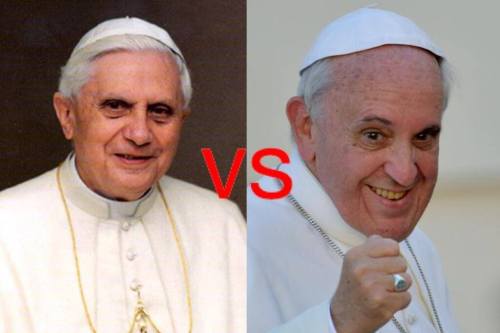
World Cup 2014 finals: where’s your god now?
World Cup 2014 finals: where’s your god now?
Fastolfi likes this






09 Jul 18:20

Photo
Steve Dyercan we as a group agree to share all GERvsBRA related memes we find thanks in advance

09 Jul 05:23
dulect: when someone is playing their music too loud
by lion
Steve Dyeri've shared this before but it's just THE JUICIEST
when someone is playing their music too loud

08 Jul 18:00


The View From Your Window Contest: Winner #212
by Andrew Sullivan
Steve DyerShit. Forgot to submit. We still aren't on the board.

A stumped veteran player writes:
Zambia. I mean why not. You people are insane.
A happier reader:
I have no clue where this is, but I just wanted to say that I love the photo. One of my favorite VFYW photos ever. Thanks for posting. Can’t wait to learn where it was taken.
Another hazards a guess:
The Greenbrier in White Sulphur Springs, WV. This is merely a hunch based upon the details of the balustrade along the roof line and the green ridges in the distance. Never having been there, I am unsure of where in the building the window is located.
A more confident reader:
This is a view from the state capitol in Helena, Montana. No doubt about it!
Another confident reader:
Has to be Yavin 4:

That isn’t the view we’re looking for. But that Star Wars base and the White House actually were the most popular incorrect guesses this week. Another nails the right country:
Happy Fourth of July!!!
Another:
I doubt if you will get a single wrong answer this week, so you will have to start off directly with the right answers.
A bunch of right answers:
The only private residence designated a world heritage site.
Until Frank Lloyd Wright came along, this building was the purest expression of intelligence in architecture in North America.
We hold this house to be self-evident. Life, liberty, and the pursuit of fancy rotunda.
Home of my most favorite dead president evah!
Let’s just let OpenHeatMap get to the point:

One of those readers who correctly answered Charlottesville, Virginia:
I’ve never been to Monticello, but (noting the date of this particular contest) it was the first thing I googled, and – WHAMMO! – there was the window! Well, eight of them. Figuring out which one was the window in question wasn’t that difficult. I’d be very surprised if this VFYW doesn’t receive the most correct answers ever, based solely on the fact that I was able to figure it out, and normally I stink at this. Truly, truly stink.
Indeed, a whopping 587 entries came in this week, the vast majority of them correct, rivaling only VFYW #14 from Brookline as the most popular contest. One entry came from “My Piggy Bank, Hawthorn Woods, IL”:
Apparently, the interior is much more expansive than I ever would have imagined!

Another smiles:
THIS IS MY FAVORITE VFYW CONTEST EVER! I mean it was obvious that the window was from Monticello, so I had the location within five seconds of going to the contest page. But who knew that Google streetview had actually had someone walk all over the property so that we could explore the whole area from afar?! I didn’t, until today. Thanks for pointing me towards a virtual tour that I am really enjoying this morning and will continue to enjoy for at least an hour more.
How one reader came to guess the correct window:
When I saw this week’s window, the circular shape and the neoclassical details of the balustrade in the foreground reminded me right away of a window I knew high atop a building across the street from the Basilica in downtown Baltimore, near where I went to college. The story I’d always heard was that the window belonged to the apartment of the “father of American architecture,” Benjamin Latrobe, who’d designed the apartment and the window to give him a good vantage for supervising construction of the cathedral. I kind of recalled that Latrobe and Jefferson were pals, and given yesterday’s holiday all signs pointed right to Monticello.
A bit of Google-mapping and image searching later and I found the Dome Room and sorted out from the position of the balustrade and the walkway below which of its eight windows the view was taken from. The Dome Room is fantastically cool, with green floors and Mars yellow walls which you can see a little bit of in the photo. And of course all those windows.


Another features some history:
Pictures make it appear to be a beautiful room, but apparently it had limited use in Jefferson’s time. According to Monticello’s website:
During Jefferson’s lifetime, the only documented use of the dome room appears to have been as a grandson’s bedroom. Access to the room was reached after climbing steep, narrow stairs and following a low hallway along the third floor. There would seem to be a limit to the practicality of such a chamber, but certainly no argument against the aesthetic beauty of the space. Washington socialite Margaret Bayard Smith wrote, following her visit to the house in 1809, that “it is a nobel and beautiful apartment furnished and being in the attic story is not used, which I thought a great pity, as it might be made the most beautiful room in the house.”
An expert weighs in:
I attended the University of Virginia for six years, and acquired a Ph.D in the history of American architecture there, so I’ve been in the Dome Room many times. It’s a pity that Jefferson’s most inventive room turned out to be nearly useless to him. He had planned on making the room his library, but the weight of his thousands of books were too much for the structure of the house. Had he put all his books there, they would have come crashing down into the Salon below. So this glorious room because a storeroom and sometimes playroom for Jefferson’s many grandchildren. The library-in-a-dome idea had to wait until he designed the Rotunda at the University about 1819.
Another relays some speculation:
Historians aren’t 100% sure of what the room was built for, but one theory is shared in the comments on Monticello’s website:
Cinder Stanton, Monticello’s Senior Research Historian, suggests that Jefferson might have used this room as his panopticon, where with the aid of his telescope, he could keep an eye on everything, including his slaves. With Jeremy Bentham’s 18th Century book “Panopticon” in his collection and two former slaves noting his use of the telescope, it is a sinister yet plausible interpretation.
Personally, I link to think that Jefferson simply wanted a room to admire such a lovely view.
Another needs to hide his column:
Funny, I spent a couple years doing fine architectural woodwork in Virginia, and although I have never been to Monticello, I knew it in an instant: the restraint, the reason, the measuredness of it all. I could stare at that window all day without ever wanting to look through it. Thanks for posting it on a Saturday, because for me at least, this kind of architectural porn is not safe for work.
The best aerial view we got this week:

But this reader is no fan of Jefferson:
In the view you posted, you can see a bit of the pediments’ sloping roof, as well as one of the walkways, below. Lovely view of the countryside. Too bad it was a concentration camp (i.e., slave plantation.)
My father’s grandparents supported the renovation of Monticello in 1923, and we have two plates from the inaugural dinner (Thomas Jefferson Foundation.) I loved to look at them as a child. They are inscribed with a beautiful cadence: “All my wishes end, where I hope my days will end, at Monticello.” As I got older, and realized that not only was Monticello built on the backs of slaves, but a good deal of my ancestors’ money and social prominence as well (Maryland, Eastern Shore), I’m glad all we have left of that lucre are two stupid plates.
Another has a more balanced view:
I knew in an instant that this was Thomas Jefferson’s mansion, Monticello. When I was taken there on a family trip at age 8 it made a huge impression on me. At that time I was astonished by his genius as an inventor (such as his “polygraph” machine designed to make copies of his letters – it was two goose-quill pens latched together). Later I was astonished by the breadth of his thinking, and read scores of biographies. After that I became equally astonished at his inability to deal with the unspeakable depravity of slave owning. It’s all worth contemplating when examining how this nation is so often at cross-purposes.
GIF of the day:

For many, the view brought a flood of memories:
Many happy childhood vacations were spend riding around the US to historical sites where my father would bring to life the stories and high ideals of this America adventure. To him, I owe a debt whose payment is rendered as civic responsibility, social conviction, and a well-seasoned sense of Wonder. I was never allowed to visit the upper-floored room where this window reigns, but the picture portrays the view exactly as mustered in my vivid imagination.
Here’s to Life, Liberty, and the Pursuit of Happiness.
And here’s to clever readers:
Gah! Another one that EVERYONE will get. At first glance I thought it would be really hard. Not much to go on in the photo. But then I realized it was the Fourth of July weekend and that we were probably looking out from a historical building related to the American Revolution, perhaps one of the Founding Father’s homes. Monticello was literally the first one I searched, but even if I hadn’t, how many different famous Founding Father homes are there? I can only think of Mount Vernon and Peace Field off the top of my head. But there are probably no more than five at most?
My only hope of winning is that most people will guess the wrong window. I first thought it was one of the front-facing windows, but a careful examination of the roof railing indicates that it’s the one facing the right side of the building.
![nickel[1]](https://sullydish.files.wordpress.com/2014/07/nickel1.png)
Chini chimes in:
Looking at this one on my phone during the Argentina match I was sure it would be hard. Flat forestland, no other buildings, a real nightmare. But it only took a few minutes after the match ended to discover that it was, in fact, as easy as views get. You just had to ask yourself “What view would they pick for the Fourth of July?”
Many contestants had the same question:

On that note:
What happens when 500 people get the right answer?
Another contestant has a suggestion along those lines:
Click to view slideshow.I expect that so many people will get the correct window, the win will come down to extreme precision. Based on how very deeply the window is recessed into the wall and the position of the distant horizon viewed through the window, one can determine how high the camera was off the floor:
Or it might just have been an employee who stood on the only chair in the room (just visible in photo #8) when nobody was around … or some anonymous pituitary case.
An inspired entry, but we’re still giving the prize to the player with the most previous guesses but no wins, especially if they’ve guessed difficult contests in the past. So this long-suffering veteran gets the prize this week:
I hope my many previous guesses will be enough to win the tiebreaker this time. We are looking out from the south-facing window on the top floor of Thomas Jefferson’s Monticello in Charlottesville, Virginia.

From the view’s submitter:
I think it’s either going to be super-hard or super-easy: you guys are either sadists or chumps!
This shot was taken facing south, overlooking the garden and slave quarters, in the dome room at the top of Monticello. (I’ve attached a photo of the Western facade, showing the window.) The dome is not generally open to the public: it’s part of a “Behind The Scenes” tour that must be reserved in advance, with only a limited number of slots available.
Jefferson called this vista his “sea view,” and the Piedmont countryside rolling off to the horizon certainly evokes a large body of water – which just might beguile anyone who doesn’t know where the shot was taken!


07 Jul 17:12


The View From Your Window Contest
by Andrew Sullivan
Steve DyerARE YOU FUCKING KIDDING ME
You have until noon on Tuesday to guess it. City and/or state first, then country. Please put the location in the subject heading, along with any description within the email. If no one guesses the exact location, proximity counts. Be sure to email entries to contest@andrewsullivan.com. Winner gets a free The View From Your Window book or two free gift subscriptions to the Dish. Have at it.
07 Jul 16:31
rotatingfloor: dokuroou: Twitter / SASSA1002:...
Steve DyerNAHHHHH


07 Jul 16:18
The Uber Bomb Detonates in New York
by John Herrman
Steve Dyeryes to this sass
by John Herrman
 Have you been in a New York cab recently? Sometimes prompted but more often not, drivers will want to talk to you about Uber. If you're in a yellow cab or a livery car, you will hear about Uber the virus, Uber the interloper, Uber the merciless invader; if you're in an Uber cab, or an Uber-adjacent green taxi, you'll hear about Uber the inevitable, Uber the strange, Uber the great (for now). It's been a boom time for untethered drivers—a magical stretch during which they could take advantage of high fares, high demand, and low barriers to entry all at once. It was acknowledged, rarely explicitly, that the arrangement felt strange and temporary—the product of an imbalance, not a new status quo.
This has been imagined in the press as a battle between unregulated drivers and their super-regulated counterparts. But that's not it at all! This was, and is, and will be until Uber's billion dollars either runs out or multiplies itself, Uber against the world. Look what they did today:
We just dropped uberX fares by 20%, making it cheaper than a New York City taxi. From Brooklyn to the Bronx, and everywhere in between, uberX is now the most affordable ride in the city.
Haha, first of all, "the most affordable ride in the city" that is in a car, driven by another human, for your individual transportation, maybe. Uber's style is too consistent for its announcement post to be called tonedeaf; it's a company that wears its fuck-you, get-mine philosophy on its sleeve. Its price examples have riders going from Williamsburg to the East Village, from Grand Central to the Financial District, from Nolita—Nolita!—to Lincoln Center. From your LOFT to FASHION WEEK, from the TRADING DESK to THE TRAIN TO YOUR LARGE DISTANT HOME, from your STEEL RESIDENTIAL ARCOLOGY to your TASTING MENU, Uber will save you two dollars.

Here are some people who will be happy about this: Uber riders. Here are some people who will be upset about this: Anyone who drives a car professionally in New York, by far America's most cab-dense city. When Uber has dropped prices like this elsewhere, it has temporarily made up the difference for drivers. Not here! The volume is too high, the cost too great. What are all the new Uber drivers, with their freshly depreciated new Uber-financed rides, supposed to do now that their per-ride take has just been slashed by a fifth? That the conditions that lured them to this odd new company have changed? They mustn't complain, else their Uber star rating fall by a star and they get purged from the system. So they'll just keep driving, and we'll keep riding, until one day we find ourselves standing on the street corner with our arms up, phones dead, hailing ghosts.
9 CommentsThe post The Uber Bomb Detonates in New York appeared first on The Awl.
07 Jul 15:07

Chat Wars
by n+1 magazine
Steve Dyeralright, i'll mark as unread for the next 3 weeks
by David Auerbach
Image: Adam Ferris. Detail from CA1. 2013.
This article appears in Issue 19: Real Estate, available now. Subscribe to read it in print.
In the summer of 1998 I graduated from college and went to work as a programmer at Microsoft in Redmond, Washington. I was put on the group that was building MSN Messenger Service, Microsoft’s instant messaging app. The terrible name came from Marketing, which had become something of a joke for always picking the clunkiest and least imaginative product names. Buddy List? C U C Me? MSN Messenger? No, MSN Messenger Service. I’ll call it Messenger for short.
At the time the big players in instant messaging were AOL Instant Messenger (AIM), Yahoo, and ICQ. AIM had tens of millions of users; AOL had become the country’s biggest dial-up provider in the mid-’90s by blitzing everyone’s mailboxes with CD-ROMs, and all AOL users instantly became AIM users. Yahoo and ICQ each had millions of users. Those were big numbers for the 1990s.
It was a large project: on the desktop program (“client”), we had to create a sleek user interface to let people see their buddies when they came online, allow them to change the color of the font in a cool way, and so on. That is, we had to create a program that would do everything the other chat programs could, then add a few wrinkles of our own. The server-side team had to notify users about the comings and goings of other users, so that if your buddy Gordon logged on, the server would tell your client that he was there (we, on the client side, had to take the notification and display it to the user properly). The server side also had to integrate our functionality with Hotmail, which had tens of millions of users and which Microsoft had acquired in 1997.It was imperative that every Hotmail user be able to log on to Messenger with a Hotmail address and password as seamlessly as possible. This was not simple.
The initial team consisted of about ten people, though it gradually expanded to several times that size. On the client side we’d meet to discuss what needed to be done, what kinds of features we wanted, what we could do and couldn’t do. Then we’d go and do it. I was 20 years old, the youngest person on the team, and very green. I was given little chunks of the project to work on at first, then bigger ones. I worked on the instant messaging windows: the “type your message here” window and the “transcript” window above it. I added better font control and helped make the client work with non-Latin character sets like Chinese/ Japanese/Korean, Indic, Hebrew/Arabic (right-to-left, a particular pain). I managed when the windows would pop up, how they could be moved around, and how scrolling worked in them (scroll bars were very buggy in Windows!). Handling shutdown was a pain, making sure the windows closed down neatly and all the program’s resources were cleaned up properly without the program crashing.
After we finished the user part of the program, we had some down- time while waiting for the server team to finish the Hotmail integration. We fixed every bug we could find, and then I added another little feature just for fun. One of the problems Microsoft foresaw was getting new users to join Messenger when so many people already used the other chat programs. The trouble was that the programs, then as now, didn’t talk to one another; AOL didn’t talk to Yahoo, which didn’t talk to ICQ, and none of them, of course, would talk to Messenger. AOL had the largest user base, so we discussed the possibility of adding code to allow Messenger to log in to two servers simultaneously, Microsoft’s and AOL’s, so that you could see your Messenger and AIM buddies on a single list and talk to AIM buddies via Messenger. We called it “interop.”
This wasn’t elegant, but it wasn’t that complicated, either. A program talks to a server using a well-defined protocol, which is a set of coded instructions sent to and from the server. HTTP (hypertext transfer protocol), used to request and transmit web pages, is one of the most common protocols in existence. It is built on top of TCP/IP (transmission control protocol/internet protocol), the underlying protocol of the internet itself. Internet companies run servers that speak these and other protocols. Some protocols, like HTTP and TCP/IP, are public, documented, and spoken by everyone, but some are private/ proprietary and undocumented. AIM’s protocol, known as OSCAR (for Open System for CommunicAtion in Realtime), was in the latter group. I didn’t have the “key” to decode it. But what I could do was sign up for an AIM account and then watch the communications between the AIM client and the server using a network monitor, a development tool used to track network communications in and out of a computer. That way I could see the protocol that AIM was using. A sample message looked like this, with the hexadecimal representation of the binary on the left and the ASCII character translation of the binary on the right:
2A 02 EE FA 00 B0 00 0E 00 06 00 00 9B 7D BD 28 *............}.(
33 41 35 36 35 43 38 37 00 03 00 03 00 28 0D 52 3A565C87.....(.R
45 41 4C 52 65 67 72 65 73 73 6F 72 00 00 00 03 EALRegressor....
00 01 00 02 00 10 00 0F 00 04 00 00 00 18 00 03 ................
00 04 3E 4C BE 8C 00 01 00 00 00 05 00 68 00 02 ..>L.........h..
00 08 75 73 2D 61 73 63 69 69 00 03 00 02 65 6E ..us-ascii....en
00 01 00 48 69 2E 2E 20 41 6E 79 62 6F 64 79 3F ...Hi.. Anybody?
I didn’t understand what it meant, but I could see when it was surrounding one of my text messages. “Hi... Anybody?” I would write into my AIM chat box and press return, and then on my network trace I would see my “Hi... Anybody?” Some of the protocol was always changing, but some was always the same. Our client took the surrounding boilerplate and packaged up text messages in it, then sent it to the AOL servers. Did AOL notice that there were some odd messages heading their way from Redmond? Probably not. They had a hundred million users, and after all I was using their own protocol. I didn’t even send that many messages. My program manager and I thought this little stunt would be deemed too dubious by management and taken out of the product before it shipped. But management liked the feature. On July 22, 1999, Microsoft entered the chat markets with MSN Messenger Service. Our AOL “interop” was in it.
As people downloaded the client to try it out, they thought it was cool: everything worked, it had more font functions than AOL, it was seamless with Hotmail (which a lot of people had), and, look at this, you could use two services with one program and still talk to your AOL chat buddies! Our lark was paying off.
Of course no one had warned AOL, and they weren’t happy. They pretty quickly started blocking Messenger from connecting to their servers; they’d disconnect the user and pop up an instant message saying, “Use an authorized AOL client at this link: [web URL].” But AOL could only block Messenger if they could figure out that the user was using Messenger and not AIM. As long as Messenger sent exactly the same protocol messages to the AOL servers, AOL wouldn’t be able to detect that Messenger was an impostor. So I took the AIM client and checked for differences in what it was sending, then changed our client to mimic it once again. They’d switch it up again; they knew their client, and they knew what it was coded to do and what obscure messages it would respond to in what ways. Every day it’d be something new. At one point they threw in a new protocol wrinkle but cleverly excepted users logging on from Microsoft headquarters, so that while all other Messenger users were getting an error message, we were sitting at Microsoft and not getting it. After an hour or two of scratching our heads, we figured it out.
Microsoft and AOL were both, obviously, giant companies, and soon the press got hold of the story. On July 24, the New York Times put it on the front page: “In Cyberspace, Rivals Skirmish Over Messaging.” It was like reading about a boxing match that you yourself were in. AOL kept blocking us, wrote the paper of record. “But Microsoft refused to roll over. Late Friday, the software giant said it had revised its MSN Messenger program to circumvent America Online’s roadblock. Within hours, America Online answered that challenge with a new block.”
I framed the article. My name wasn’t in it, but it didn’t matter. That was me!
+ + +This was, as I say, 1999. Just two decades after launching MS-DOS, its first operating system, Microsoft was one of the biggest companies in the world. We had 30,000 employees worldwide, about 10,000 of them in Redmond. The campus was about the same size as Yale.
What was Microsoft’s secret? They were, and are, essentially a software company. While hobbyists in the 1970s were trying to figure out how to build a computer small enough to fit in your home, Bill Gates and his partner Paul Allen were figuring out how to write software for when the hobbyists finally figured it out. In 1980, they partnered with IBM to make an operating system, MS-DOS (for Microsoft Disk Operating System), for the first mass-manufactured personal computer. A few years later they partnered with Apple to give early Apple PC users functioning programs, including Microsoft Word. Gates and Allen’s insight was simply that PCs were going to be a big deal, and people would want software for the new machines.
By licensing Microsoft to provide the operating system for PCs, IBM essentially handed them a license to print money. The margins on software were far greater than on hardware, because the physical manufacturing process was negligible—producing disks was cheap and trivial next to microprocessors and peripherals. And since Microsoft was the only company producing the operating system needed to run, ultimately, all software on PCs in the 1980s, it had a lock on guaranteed sales of the ballooning PC industry. IBM wasn’t the only hardware maker in town—far from it—but Microsoft was the only MS-DOS maker.
Microsoft’s rise did not go unnoticed or uncontested. In 1984, Apple debuted the Macintosh. After the Lisa, which came out the year before and cost $10,000, the Mac was the first PC to use an operating system with a graphical user interface (GUI), building on research done at Xerox PARC and elsewhere. The company bought ad time during the Super Bowl to trumpet this revolution in computing, and in truth they weren’t exaggerating. Until the Macintosh, everything had been text; now you could see a visual representation of the inside of the computer— a “metaphorical desktop,” as it was called. When I saw it at age 7, I found it dazzling, but at the time computers weren’t quite powerful enough to make the GUI necessary. I used PCs myself back then and was perfectly fine with typing at the MS-DOS command prompt. But toward the end of the ’80s, home computers became fast enough to make multitasking (running more than one program simultaneously) increasingly valuable, and it was clear that GUIs promised far more user-friendliness than text command lines.
Microsoft thought so too, and in 1985 they released the first iteration of Windows (with, importantly, some elements licensed from Apple). It was basically a clickable list version of the files on the computer, resembling today’s Windows Explorer, plus some other “windows” displaying executable files (a calculator, for example). It was an improvement over the MS-DOS command prompt, but a far cry from the different folders displayed so elegantly on the Macintosh. In 1987, Microsoft released Windows 2.0. This was still clunky, but already better, with overlapping windows and some other useful functions. Apple could see which way things were headed, and in 1988 they sued Microsoft for copyright infringement.
The suit failed. Windows was similar to the Mac operating system, but hardly identical. The appeals court wrote, “Almost all the similarities spring either from the license [for the initial Windows] or from basic ideas and their obvious expression. . . . Illicit copying could occur only if the works as a whole are virtually identical.”
The initial decision came down in 1992 and was affirmed on appeal in 1994. It was a serious blow to Apple during its Steve Jobs–less slump. Hampered by poor management, overpriced computers, and a protectionist attitude toward the Macintosh brand, maintaining that only Apple could make Macintosh hardware, the company saw its market share decline throughout the decade, eventually prompting the return of the exiled Jobs and setting the stage for Apple’s resurgence. Windows, of course, conquered the world, never attaining the elegance or unification of Mac OS, but working well enough that the Macintosh premium was more than most wanted to pay. In Windows 95, the first post-lawsuit release of the operating system, Microsoft went ahead and incorporated Apple’s famous trash can, impishly refashioned as a “recycle bin.” For a good long while, Windows could not be stopped.
Gates and Allen were skilled coders, but the history of software is littered with people just as smart or smarter who did not end up as billionaires. Their strength was on the business side. For years they remained a small company, but you didn’t need to be big to make soft- ware back then. The programs were simple, and they were all that was available, so you could charge a premium for them. The amount of person-hours that goes into a $50 piece of software today dwarfs that of a $50 item of software thirty years ago. In 1983, a word processor so primitive it advised users to put little stickers on their keyboards so they'd know which functions correlated to which keys retailed for $289. For this price it offered a tiny fraction of what most freeware can do today. It was a different world.
In this world, Microsoft stood out. They worked fast, they were aggressive, and they were very cagey. Their strength was never in innovation per se, but in appropriation, improvement, and integration. One slogan that you would hear at the company was that Microsoft made “best-in-class” products. A less charitable way to put this would be to say that upon entering a market, Microsoft would make a product that was better enough than the best out there, and then take over the market. So the quality of Microsoft’s offerings closely tracked the quality of existing offerings.
Lotus’s spreadsheet software 1-2-3 was a good product in the 1980s and early 1990s; consequently Microsoft Excel, which debuted in 1985, became the standout of Microsoft’s nascent Office suite. Word processors like WordPerfect and WordStar were less formidable; as a result, Microsoft Word was considerably less stellar than Excel. And in the absence of any dominant email programs, Microsoft Outlook was buggy and slow, and remained that way well into the early 2000s. Microsoft was far too efficient to waste time improving a project beyond what was needed to defeat their competitors. In the late ’90s I got a chance to tour the legendary Massachusetts computer company Digital Equipment Corporation (DEC, later bought by Compaq), and the difference in culture was remarkable. There were people at DEC who had been working on threading (the manner in which operating systems manage concurrent sets of linear processor instructions) for twenty years. Half the people had PhDs in their areas of specialty. Corners were never cut to release something earlier.
Ah, I thought. This is why Microsoft won.
Microsoft certainly tried to innovate with new products from time to time. Clippy, the little paper clip that popped up occasionally in Microsoft Word, was an innovation. Microsoft Bob, a yellow dog in dark glasses who showed up in Windows 95 to see if you needed help, was an innovation. Cairo, the “revolutionary” new operating system from the 1990s, would have been an innovation had it ever shipped. But as a whole the company was more comfortable entering existing markets and besting competitors. And in the absence of a clear target, planning could become fuzzy and tentative. You see this in the reticence to engage wholeheartedly with the internet in the 1990s: no one was making gobs of money yet, so who was Microsoft to follow? It wasn’t as if Microsoft (and everyone else) didn’t see that there was money to be made; Microsoft just wasn’t about to create the mechanism to do so on its own.[1]
By 1999, Microsoft was poised between financial security and an obscure future. The Windows and Office behemoths ensured the company’s dominance of the desktop operating system and business applications markets for as long as the PC remained a going concern. Even when the US v. Microsoft antitrust trial was at its peak, in 1999–2000, it was hard to see how a feasible antitrust remedy could actually address the problems. Sure enough, the plan to split Microsoft into two monopolies, one for Windows and one for Office, wouldn’t have helped a bit, even if it made it past the appellate court that overturned the initial judge’s ruling and attacked him for trashing Microsoft to the press. The whole case ended up a bizarre and political sideshow, which I’m not sure had more than a negligible impact on the state of the tech industry— other than ensuring that future tech companies kept a far larger battery of lawyers and lobbyists close by.
One interesting thing did emerge (at least for me, as an employee of the company) in the antitrust discovery process: I learned that before I arrived, a war over the future took place at the highest levels of Microsoft, between the “doves” and the “hawks.” The “doves” wanted to embrace other internet companies, like Netscape (which had the best early browser) and even AOL to an extent, and share power with them; the “hawks” wanted to clamp down and try to make Microsoft the provider of internet services. The real bone of contention was Windows: here was the most profitable thing in the history of computers. But a truly aggressive internet strategy would have meant thinking about a world without Windows. This was too difficult. “I don’t want to be remembered as the guy who destroyed one of the most amazing businesses in history,” one senior executive wrote of Windows during this argument. In the end the hawks won and most of the doves left Microsoft. Then the hawks lost.
+ + +To understand what happened next in the Messenger war it may be helpful to have some sense of how computers and computer programs work.
Computers are best seen as a series of abstraction layers, one on top of the other. Each layer is more complicated than the next down, and assembles the previous layer’s pieces into more complex, high-level structures. At the bottom you have the hardware itself: the central processing unit (CPU). The CPU consists of more than a billion transistors arranged to execute a particular “assembly” code that is native to that CPU. Assembly is the lowest layer of coding, where you are telling the CPU exactly what to do. And what you can tell it to do is often pretty limited: store this number here, retrieve this number from there, add or subtract these two numbers, and branch to different bits of code depending on some condition or other. In different contexts, these operations can take on different meanings, such as printing text onto a screen or sending something across a network, but the overall level of structure is very primitive. Analyzing and manipulating data is extremely tedious in Assembler.
In the early days of PCs, many programmers did code directly in Assembler. Programs were small enough and performance was critical enough that one needed to micromanage everything at that level. But as computers got larger and more complex, it became unfeasible to code in assembly. And needing to learn a different assembly language for every computer (Apple II, Macintosh, PC) was horrendously inefficient. Better to use a higher-level, CPU-independent language. All the languages you read about today, from C++ to Java to Ruby to Perl, are higher-level languages. They have far more instructional “primitives” that allow you to designate pieces of code as “functions” and abstract over them through “interfaces.” A program called a compiler then takes the code written in these languages and translates it into the assembly code for a particular specified processor, so you can have C++ code that compiles for the PC, or for Linux, or for the Macintosh.
Here’s some assembly for a “Hello world!” program (one that just displays “Hello world!” and exits) in MS-DOS PC assembly, which I’ve borrowed from Wikipedia:
.model small
.stack 100h.data
msg db 'Hello world!$'.code
start:
mov ah, 09h ; Display the message
lea dx, msg
int 21h
mov ax, 4C00h ; Terminate the executable
int 21hend start
And here it is in C:
int main() {
printf(“Hello world!\n”);
return 0
}
Having a compiler turn the C into assembly, as you might expect, saves a programmer a vast amount of time. It also allows for far greater levels of code reuse, since you can parameterize functions to take different inputs and handle them accordingly. But you lose some control with a higher-level language. Assembly lets you know exactly where every bit of information is going. As you go up the great chain of languages, you lose more and more control over the management of the guts of the computer, which is taken over by compilers, interpreters, and virtual machines. These programs are exceedingly good at managing things automatically, and they don’t make mistakes (unlike humans), but they have their limits. They do not know the overall intent of a program. If you pile on too many abstraction layers, performance can suffer. The downfall of Microsoft’s Vista operating system, which needed to be restarted almost from scratch in order to ship three years late, came because it was written in a new language of Microsoft’s own design, called C#, that did not offer sufficient micromanagement to make Vista run quickly enough. Like Java, C# was considerably higher level than C db ‘Hello world!$’ or C++, and the code responsible for taking care of the lower-level nastiness just couldn’t perform optimally. So they scrapped the C# code and started over in C++. Lesson learned.
A “language” like C++, Java, or Python consists of a certain number of commands, not more than a few hundred, and a certain number of numerical and logical operators, like + and && (for logical AND). Many languages offer the same basic functionality sets; where they differ is in the methods they provide for structuring programs, as well as the amount of abstraction they provide from the underlying computer fundamentals.
So what was Messenger? It was about a hundred thousand lines of code, in C++, implementing everything from pop-up notifications when a buddy logged in, to uninstallation code to remove the program if people hated it, to code to allow you to save IM windows as text files for later, to code to talk to the Messenger servers (and, for a while, the AOL servers). In its early years, it was a small, efficient, lean little program.
I no longer have access to the Messenger code, which remains the private intellectual property of Microsoft. So instead, here is a piece of the open-source C code for the chat program Pidgin. This function, update_typing_icon, is called when the program needs to update the “typing indicator” that tells you whether your buddy is currently typing a message or not.
static voidupdate_typing_icon(PidginConversation *gtkconv){PurpleConvIm *im = NULL;PurpleConversation *conv = gtkconv->active_conv;char *message = NULL;if (purple_conversation_get_type(conv) PURPLE_CONV_TYPE_IM)im = PURPLE_CONV_IM(conv);if (im NULL)return;if (purple_conv_im_get_typing_state(im) PURPLE_NOT_TYPING) {update_typing_message(gtkconv, NULL);return;}if (purple_conv_im_get_typing_state(im) PURPLE_TYPING) {message = g_strdup_printf(_(“\n%s is typing…”),purple_conversation_get_title(conv));} else {assert(purple_conv_im_get_typing_state(im_ ==PURPLE_
TYPED);message = g_strdup_printf(_(“\n%s has stopped typing”),
purple_conversation_get_title(conv));}update_typing_message(gtkconv, message);g_free(message);}
The function takes a parameter called gtkconv that contains information about the chat session (PidginConversation) being updated. The italicized portion of the code is the most important. It calls a function called purple_conv_im_get_typing_state, passing it to the chat session in question. That function then returns one of three possible values: PURPLE_NOT_TYPING, PURPLE_TYPING, or PURPLE_TYPED. A user interface function, update_typing_message, is then called to change what message is displayed on the screen. In the case of PUR- PLE_TYPING, a message with “[Buddy name] is typing” is shown. If PURPLE_TYPED, meaning that text has been entered but your buddy hasn’t typed anything for a bit, “[Buddy name] has stopped typing” is shown. And if no text has been entered and the buddy isn’t typing (PURPLE_NOT_TYPING), then no message is shown at all.
Most of the other functions that this function calls are also part of the Pidgin program, separated into modular chunks so that each can be isolated, tested, and perhaps reused. One exception is the g_strdup_ printf function, which creates the string containing the message to be displayed. g_strdup_printf is part of the open-source GNOME user interface library; because what it does is sufficiently generic, it was considered helpful to include in a popular package of generic user interface code.
All this C code is compiled into assembly by a C compiler, which can then run natively on the processor for which the compiler was designed.
+ + +The messenger war was a rush. Coming in each morning to see whether the client still worked with AOL was thrilling. I’d look through reams of protocol messages to figure out what had changed, fix the client, and try to get an update out the same day. I felt that I was in an Olympic showdown with some unnamed developers over at AOL. I had no idea who my adversaries were, but I had been challenged and I wanted to win.
AOL tried different tactics. At one point they seemed to be identifying the Microsoft client because it wasn’t downloading a huge chunk of advertising that the AOL client downloaded. So I changed our client to download it all (and then throw it away). They put in mysterious messages that didn’t seem to affect their client but broke ours because we weren’t expecting them. One day, I came in to see this embedded in a message from the AOL server: “HI. –MARK.” It was a little communication from engineer to engineer, underneath the corporate, media, and PR worlds that were arguing over us. I felt some solidarity with him even though we were on opposing sides.
AOL was putting out absurd propaganda about how Microsoft was behaving like an evil hacker by asking for your AOL password. This wasn’t true, but we weren’t allowed to respond except through our PR department. My team was completely sealed off from the outside world—except for our code, of course.
And then AOL stopped blocking us. It was strange to encounter sudden silence, and while I wanted to believe we’d won, AOL had been too loud and obstreperous to give up without a word.
Maybe a week after the blocks had stopped, I came in to work to find that Messenger had been blocked again, but this time it was different. The AOL server was sending a huge chunk of new gobbledygook that I could not understand. It looked approximately like this:
:
00000040 2A 02 77 9C 01 28 00 01 ........*.w..(..
00000050 00 13 00 00 80 0E A6 1B 00 FF 00 0B 01 18 83 C4 ................
00000060 10 4F 8D 94 24 E4 FE FF FF 8B EC 03 AA F8 00 00 .O..$...........
00000070 00 90 90 90 90 8B 82 F0 00 00 00 8B 00 89 82 4E ...............N
00000080 00 00 00 8B 4D 04 03 8A F4 00 00 00 8D 82 42 00 ....M.........B.
00000090 00 00 89 45 10 B8 10 00 00 00 89 45 0C C9 FF E1 ...E.......E....
000000A0 00 01 00 20 00 00 00 00 00 00 00 04 00 00 00 00 ................
000000B0 00 00 00 00 00 00 00 00 00 00 00 00 00 00 00 00 ................
000000C0 00 00 00 00 00 00 00 00 00 00 00 00 00 00 00 00 ................
000000D0 00 00 00 00 00 00 00 00 00 00 00 00 00 00 00 00 ................
000000E0 00 00 00 00 00 00 00 00 00 00 00 00 00 00 00 00 ................
000000F0 00 00 00 00 00 00 00 00 00 00 00 00 00 00 00 00 ................
00000100 00 00 00 00 00 00 00 00 00 00 00 00 00 00 00 00 ................
00000110 00 00 00 00 00 00 00 00 00 00 00 00 00 00 00 00 ................
00000120 00 00 00 00 00 00 00 00 00 00 00 00 00 00 00 00 ................
00000130 00 00 00 00 00 00 00 00 00 00 00 00 00 00 00 00 ................
00000140 00 00 00 00 00 00 00 00 00 00 00 00 00 00 19 10 ................
00000150 08 11 29 EC FF FF 44 00 00 00 00 00 00 00 FF 00 ..)...D.........
00000160 00 00 08 01 00 00 00 00 00 00 90 47 40 00 F8 E9 ...........G@...
00000170 EA FE FF FF 00 00
The first couple of lines here are the standard AOL instant message protocol header, but starting with that “90 90 90 90” bit, it became incomprehensible, bearing no relation to anything the AOL servers had ever sent their client or our client. The vast expanse of double zeros in the middle was also very mysterious, since a bunch of zeros couldn’t contain much meaning.
Our client just ignored it, but the AOL client responded to this gobbledygook with a shorter version of the same gobbledygook. I didn’t know what it was. It was maddening. After staring at it for half a day, I went over to Jonathan, a brilliant server engineer on our team, and asked what he thought. He looked at it for a few minutes and said, “This is code.” As in, actual x86 assembly code. The repeated zeros were what tipped him off. (They signify an empty instruction in x86 Assembler.) The code was telling the server to ignore it. The server was saying, OK.
The pieces then came together. Normally, these protocol messages sent from the server to the client are read and understood as data, not as code. But AOL’s client had a security bug in it, called a buffer overflow. The buffer is a place in a program where you temporarily store data while running some operation, so that the data doesn’t get erased. How- ever, if the buffer doesn’t have adequate protection, very large protocol messages can flood it, overwriting the client code and arbitrarily controlling the functioning of the client program—this is why it’s called a buffer overflow, and it’s a huge security hole, since it gives the server control of the client PC. In the wrong hands, the server can choose to shut down or corrupt or do other terrible things to your computer. AOL knew about this bug in their program and now they were exploiting it! That was what all those double zeros were for—they were just filling up space in the program’s buffer until they hit the end of the AOL client’s buffer and started overwriting executable code with the remainder of the protocol message. AOL was causing the client to look up a particular address in memory and send it back to the server. This was tricky, vastly trickier than anything they’d done so far. It was also a bit outside the realm of fair play: exploiting a security hole in their own client that our client didn’t have!
+ + +If I could go back in time, I wouldn’t have given up, but I was out of my depth, and I told the team that I wasn’t sure how to get around this, at least not without a fair bit more time and resources.
Someone had the bright idea of telling the press about the buffer overflow, figuring that if people knew that AOL’s client could and in fact was executing whatever a server sent to it, AOL would be forced to patch their client and could no longer use it to determine that Messenger was an impostor.
Here I only know what happened from the outside, since this wasn’t my department. According to security expert Richard M. Smith, a certain “Phil Bucking” of “Bucking Consulting” sent him a message, alertng him to the buffer overflow in the AOL client:
Mr. Smith,
I am a developer who has been working on a revolutionary new instant messaging client that should be released later this year. Because of that, I have followed with interest the battle between AOL and Microsoft and have been trying to understand exactly what AOL is doing to block MS and how MS is getting around the blocks, etc. Up until very recently, it’s been pretty standard stuff, but now I fear AOL has gone too far. It appears that the AIM client has a buffer overflow bug. By itself this might not be the end of the world, as MS surely has had its share. But AOL is now *exploiting their own buffer overflow bug* to help in its efforts to block MS Instant Messenger.
And so on. Getting the name of MSN Messenger Service wrong was a nice touch, but the rest of it is embarrassingly inept. This developer of a revolutionary new app takes time out from his coding not to promote his app but to take sides in the Microsoft-AOL war? Really? The email also includes a trace of the buffer overflow message itself, which I still remember vividly from the hours I spent staring at it, but the recipient paid more attention to the human language than the protocol messages. And if Phil Bucking’s text wasn’t suspicious enough, he’d also sent the message (via a Yahoo account, ha ha) from one of Microsoft’s computers at a Microsoft IP address, and the IP address showed up in the email headers. In geekspeak, this is what’s called a face-palm.
Smith immediately accused Microsoft of sending the email. Microsoft fessed up. So the news story didn’t become the buffer overflow (a tough sell, probably), but Microsoft’s attempt to bad-mouth AOL under a fake identity (an easier sell). People on various security forums ascertained that the buffer overflow was real and inveighed further against AOL, but the press wasn’t paying attention. The buffer overflow persisted into several later versions of AOL’s client.
So we gave up. I licked my wounds and proceeded on to far more dreary years on MSN Messenger Service, eventually getting buried so deeply in internal company politics that I was no longer able to do anything resembling useful work. The writing was on the wall when I heard one team manager scream, “I have the worst morale scores in the company and I don’t give a shit, because they can only go up!”
Those were the years of Microsoft’s long, slow decline, which continues to this day. The number of things wrong with the company was extraordinary, but they can be summed up by the word bureaucracy. Early on at Microsoft—and even later, when we first started Messenger—you could just do things. You had a good idea, you ran it by your boss, you tried it, and if it worked, in it went. After a while, you had to run everything by a hundred people, and at some point the ball would get dropped—and you’d never hear back. There was the infamous internal review system called “stack rank” that pitted teams against one another and people within each team against one another, too. There was an incredible thirst for “headcount” within a department, so managers would lobby aggressively for independent groups to come under their control. Thus the burgeoning NetDocs, which was intended to be an internet-based document-editing suite, gobbled up a number of small groups in the late ’90s. But NetDocs got eaten by Office, which then proceeded to kill it, thus leaving the door open for Google to debut Google Docs in the mid-2000s. And on it went. Multiyear projects with hundreds of engineers died without the public ever hearing a word. It continues.
I left for Google, but not without making one last mistake. I told my boss at Microsoft I was leaving to work for our direct competitor, and he threatened to sue me. I packed up my things in a box and quit the same day, without saying goodbye to my coworkers. At least Steve Ballmer didn’t throw a chair across the room, as he did when Windows architect Mark Lucovsky told Ballmer that he was leaving for Google. Microsoft was hemorrhaging hundreds of top engineers to Google at the time, and the combination of the talent loss plus the insult to the executives’ egos made for very bad blood. Still, they didn’t sue me.
Despite my ignominious defeat at the hands of AOL’s diabolical mastermind of chat, Messenger did pretty well. We acquired tens of millions of users, millions online at any one time. At some point we put ads into the client, which made some money. I don’t think we turned a profit, but we weren’t a big group, so we weren’t costing Microsoft much either. I added emoticons to the client in 2000—it was the first American chat program to turn a colon and a close-parenthesis into an actual smiley face (I say first American because the South Koreans, who loved chat more than anyone, may have preceded us)—and people loved it. We added internet phone calls to the client, which was cool and raised a bit of revenue on international calls. After I went over to the server side, I helped redesign the server architecture with a very sharp development lead who taught me a lot, as had my original mentor on the client.
Messenger puttered along for many years in limbo. It was unusual in being unkillable (because of all its users) and unassimilable by Windows or Office (because it was part of Microsoft’s internet strategy), which led, I believe, to it never amounting to anything. Taken on its own, it was a success, but a success on which Microsoft was unable to capitalize. Attempts to integrate it with other projects either fell prey to internecine executive warfare or else collapsed into consumer indifference. Despite Microsoft’s purchase of Skype, Messenger is still going today, a little Methuselah wandering in the Microsoft product mausoleum.
Years later at a party I met one of the AOL engineers who’d worked against me. We had a huge laugh over it. He’d left AOL just as I’d left Microsoft, and I complimented him on the genius of the buffer-overrun exploit, even as I bemoaned my loss. It had been a great game, I said. He agreed.
1. Of note is the single major product success of late Microsoft: the Xbox gaming console. While the Xbox has yet to turn more than a tiny overall profit since its introduction in 2001, it has established itself as a stalwart of the gaming world. This could occur for two reasons: first, unlike anything having to do with the internet, it was completely isolated from the Windows and Office empires, and so did not run afoul of those groups; and second, there were clear, existing, profitable models to copy—Nintendo’s and Sony’s—and Microsoft was willing to lose billions of dollars in re-creating that model. For the last time, they caught up to their competitors in short order and equaled them, at the cost of turning no profit themselves.
02 Jul 16:39
Video: This Little Boy’s Grandfather Started To Cry ... And His Reaction Will Blow You Away
Steve Dyerclick through!
so inspirational
01 Jul 17:31


Mental Health Break
by Andrew Sullivan
Steve Dyeromfg
A reader flagged it:
I will be disappointed if this is not shared with other Dish-heads. It’s adorable and kinda funny and goes well with some of the other animal friendships vids of late.
Adam Victor Brandizzi likes this







26 Jun 19:35



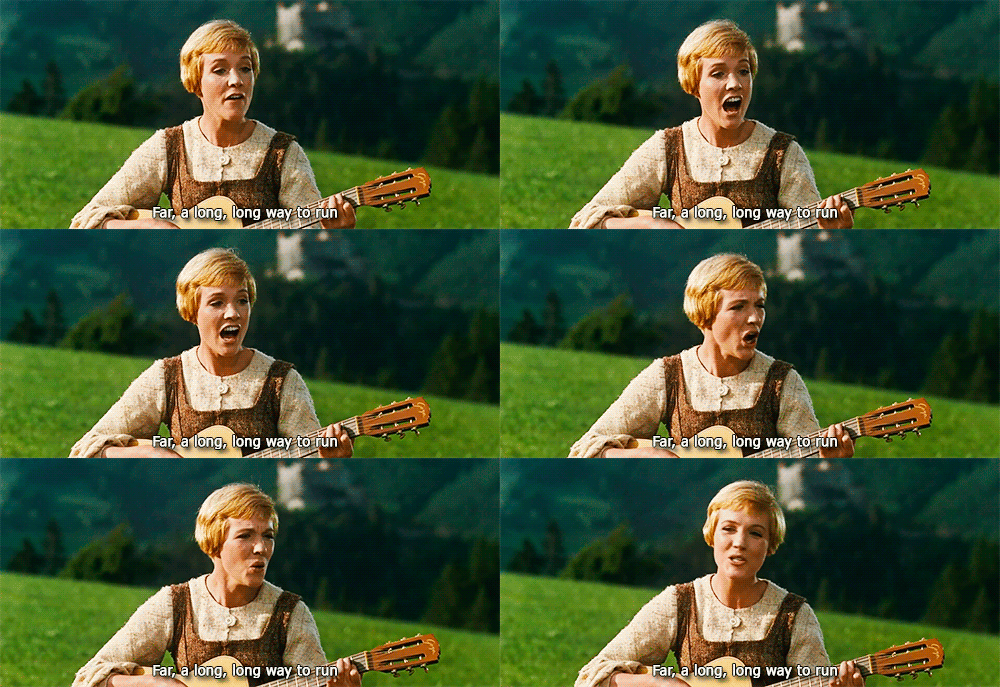


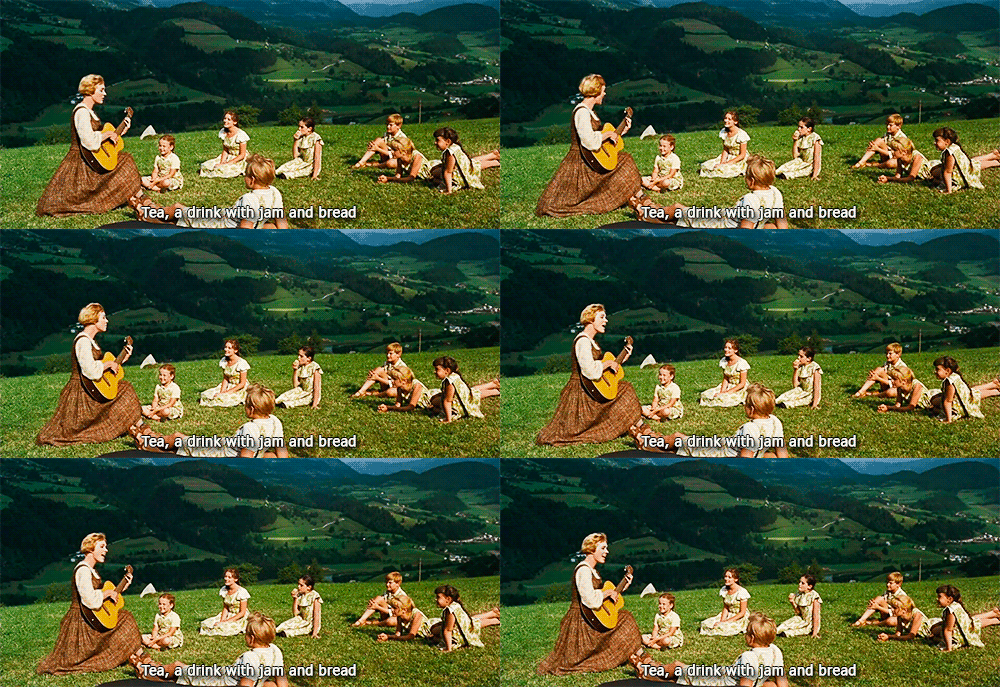
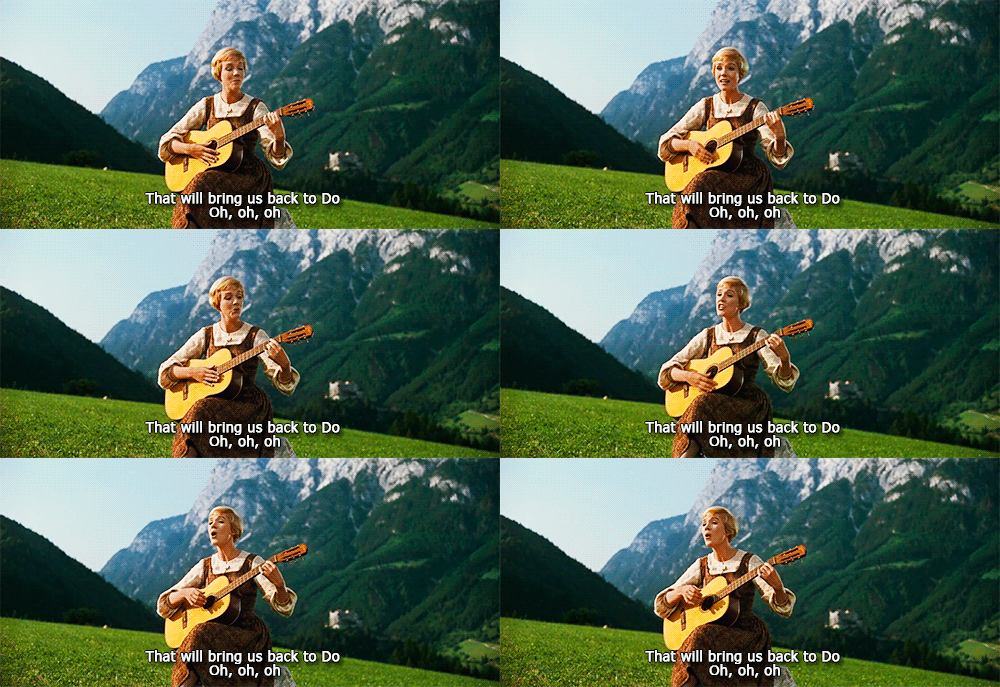
abbygubler: ohrobbybaby: The Sound of Music (1965) tumblr...
by ruinedchildhood2
The Sound of Music (1965)
tumblr fucked me up so bad i kept expecting something ridiculous to happen at the end like a still of her telling the kids to go fuck themselves smh
Anne Griffin likes this
26 Jun 18:11

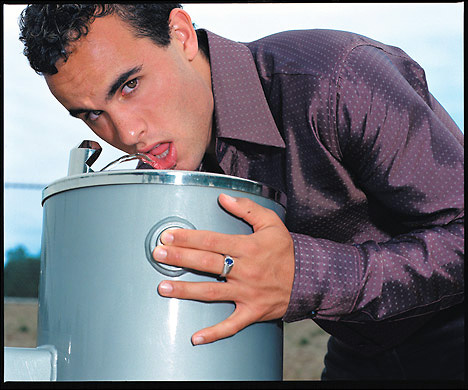



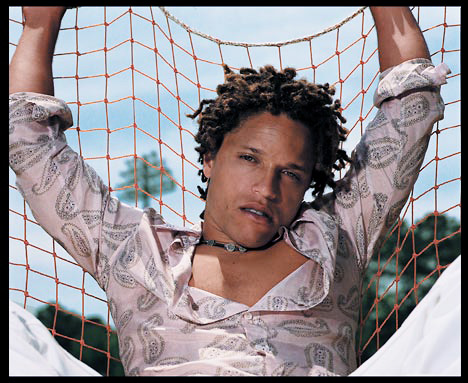
Red, White, & Blue Steel
Steve DyerSOCCER
It started with the best intentions. Of course it did. No one deliberately sets out to create images like the ones you’re about to experience. No secondary character in a high school horror movie ever goes, “You know, the drinking and sex will be nice, but what I’m really hoping to get out of this lake vacation is dismemberment.” That’s not how it works. Life just goes where it goes. You sneak off to the woods to play semi-naked hide-and-seek with Devin, maybe you get brought down by a meat-hook killer in a DIY luchador mask. Or hey, maybe you don’t. You never know. That’s what makes this whole earthly merry-go-round so exciting.
The year was 2002. American soccer, normally a global power, was going through one of its brief down periods, this one having begun in August of 1930. Across the nation, on at least three online message boards, all of which were administered by college students named Brad, hopes were soaring that a strong performance at the upcoming World Cup, to be co-hosted by Japan and South Korea, would restore the USMNT to its rightful position of glory abroad and massive celebrity at home. A little luck on the pitch, a little smart branding, the complete implosion of baseball in a years-long PED scandal, and who knows? Anything could happen.
And that was how the most amazing photo shoot in the history of U.S. soccer came blazing — literally blazing, like a Mack truck filled with dragons and pushed off the top of Mount Rushmore — into existence. It couldn’t have made more sense. Need to drum up some publicity for your sports team in advance of its big event? Of course you sign them up for a New York Times Magazine style spread photographed by Dutch photographer and ex-Armani creative director Matthias Vriens. I mean, of course you do. What are the odds that the resulting photos, published in late May under the title “The Boys of Soccer,”1 will be so tonally bewildering, such a steamy potpourri of sullenness and arch poses and billowing paisley and smothered rage, that they look like Mike Tyson’s dreams the night after he first saw The Muppet Show? What could possibly go wrong?
Nothing. Nothing could possibly go wrong. Let’s dive into history.
Photo no. 1: Kasey Keller
Actual caption: “It’s a good bet that out of 23 members on the U.S. team, Kasey Keller, 32, a goalkeeper with a flair for the spectacular, will play next month in South Korea. Cotton crewneck, $22, from Calvin Klein Underwear. At Bloomingdale’s. Macy’s. Soccer shorts and ball: Nike.”
Corrected caption: “Kasey Keller, 32, a goalkeeper with a flair for the spectacular, ignites the camera with his smoldering thighs … sorry, eyes … THIGHS … that’s EYES …”
Analysis: The spread starts on a deceptively normal note. By itself, in a different slideshow, this picture wouldn’t excite a lot of attention, even if Keller does seem to be playing fuck/marry/kill in his mind and picking you for all three. The crewneck cost $22. It’s the arsenic he’s rubbed all over his lips that’s priceless.
If he were a character in an Emily Brontë novel: “Mr. Briarfell, the mysterious proprietor of Baldcrest Abbey, was known for long silences, walking the moors at night by the light of a single candle, and shorts.”
Photo no. 2: Brian McBride
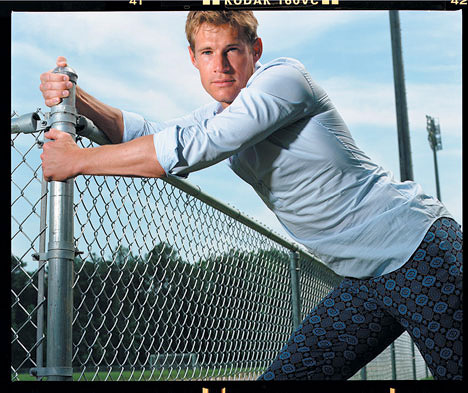
Actual caption: “On the fence but not for long, Brian McBride is a forward with an amazing aerial act. He’s in a Prada cotton shirt, $360, and pants, $390. At Barneys New York.”
Corrected caption: “Why, hello there. I was just stretchin’. Just stretchin’ out my body here on this fence. Like my outfit? It cost $750 at Barneys. It’s not so bad for stretchin’ in. It’s OK. Could be better. This chain-link fence is my main stretchin’ spot. I like the way the chain links feel on my hands. Not sure if you noticed this, but, uh, there’s a pretty funny pattern on my pants.”
Analysis: Now we’re getting somewhere. In head-to-toe Prada, and with his hips cocked like a World War I–era revolver, McBride gazes into the camera from a position that millennia of human evolution have clearly failed to prepare his body to assume. Although, in fairness to evolution, it’s not as if the untamed savanna produces a plethora of situations in which the ability to assume the torso-jink/fence-clasp posture would confer a big reproductive advantage. “I’ll just pose the mammoth to death,” says no one in the Big Book of Common Neanderthal Sayings. On the other hand, any modern pachyderm who saw this picture would presumably at least feel lightheaded.
After “Boys of Soccer” appeared, McBride was disappointed in the results. “I thought we were going to get suits,” he told the Associated Press. “All the clothes were not perfect fitting.” Maybe not, Brian. But your complaining is certainly not helpful, and it’s certainly not going to revive any passed-out elephants.2
If he were a character in an Emily Brontë novel: “The scruffy coachman leaned toward her. ‘My name is Elmforth Fleers,’ he said with a dark look. She could smell the spirits on his breath. ‘And this here’s my fence post. Aren’t you, my sweet,’ he said, stroking the fence post with the back of his hand. ‘Aren’t you, dear Gwendolyn.’”
Photo no. 3: Landon Donovan
Actual caption: “One of the youngest U.S. players is 20-year-old Landon Donovan, from Redlands, Calif., who plays forward and midfield. Donovan’s cotton Jacquard shirt, $480, and silk-wool pants, $645, by Tom Ford for Yves Saint Laurent Rive Gauche. At Yves Saint Laurent Rive Gauche boutiques.”
Corrected caption: “WHAT IS THIS THING TOUCHING MY LIPS IT’S SO COLD AND AAAAH WHY DOES IT KEEP DOING THIS NO SERIOUSLY I’M TOTALLY UNFAMILIAR WITH THE PROPERTIES OF THIS SUBSTANCE.”
Analysis: Amazingly, this is neither the worst nor the funniest photo from “Boys of Soccer” — do not adjust your set — but it’s the breakout star of the collection, the image that you’re most likely to have seen elsewhere on the Internet.3 Why has it had so much staying power when the rest of the photo shoot has virtually disappeared beneath the shifting sands of the desert in which every grain of sand is an “athletes wearing clothes”–type fashion spread?
There are a lot of ways we could answer that question. There are a lot of truths we could point to. I mean, it could be because the image captures something ineffable about the character of its subject in a way the other pictures don’t, some deep intermixture within Donovan of compliance and discomfort and feeling dutiful and trapped but also awkward about letting a photographer document the execution of what can only be described as a fantastically ineffective liquid-intake philosophy. It could be because of the look in his eyes, a mute pleading so restrained as to be almost unreadable, and how it’s accentuated by the regal mauve sheen of his shirt.
I don’t think that’s it, though. I think it’s because of the water fountain itself.
I mean, look at this little fucker. So round, so smooth. It’s got the smoke-gray glint and perfectly even flow capacity of a piece of technology that thinks it’s better than us. From its oddly large and hard-to-depress side button (see how it takes two of Landon’s fingers? And he’s a professional athlete) to its gleaming chrome upper rim, it clearly takes a perverse delight in humiliating everyone who comes to drink from its saucily angled spray nozzle. Fools, it seems to say, weaklings who need water to survive! I could have been an Apple product if I’d only gotten my shit together a little sooner in college.
But it’s got something, this water fountain. It’s got charisma. Try as you might, you can’t tear your eyes away. It’s like a great wrestling heel, or the villain in a melodrama. It knows it matters, and it knows how much. This water fountain looks at not just Landon Donovan, but all of U.S. soccer in 2002, and sees nothing but a bunch of regular dudes wearing asinine clothing in ridiculous poses. Where did it get that idea? Doesn’t matter. What matters is that this water fountain has a drive-time talk radio host on speed dial. And it calls.
This water fountain is everything American soccer has been fighting against for 50 years.
If he were a character in an Emily Brontë novel: “He threw off his black cloak and stood gloating before them, a fearsome cylinder. As the storm battered the windows, the last dying embers of the fire wove hypnotic patterns in his semi-reflective metallic outer chassis. Then he spoke, an arc of clear liquid jetting up out of his mouth-spigot. ‘You have betrayed me, Esmerelda,’ he burbled with cold menace. ‘And now I have returned.’”
Photo no. 4: DaMarcus Beasley
Actual caption: “DaMarcus Beasley, a 20 year-old midfielder from Fort Wayne, Ind., wears a Jil Sander ramie shirt, $530. At Jil Sander, San Francisco.”
Corrected caption: “‘Sup?”
Analysis: Say what you will about DaMarcus Beasley, he’s the only member of the “Boys of Soccer” retinue who looks at all comfortable with himself in this photo shoot. He’s just chilling on some grass here, not fending off paralyzing psychosexual panic derived from personal knowledge of the counter-masculine qualities often attributed to soccer players by the American public and a not-rocket-science vision of how certain cues in this photo shoot will be interpreted. He’s just like, “Hey.” You would also rest fairly easy if you knew the Jil Sander shirt they’d given you cost only $530 but your “7″ medallion was worth $400 million cold.
If he were a character in an Emily Brontë novel: “‘Oh my,’ breathed Rowena, clasping her hands together at her throat. ‘Is that … is that Mr. Pendleton Throbheart, the tenant of Makeout Springs?’”
Photo no. 5: Clint Mathis
Actual caption: “U.S. soccer’s best hope, Clint Mathis has star quality in a Tom Ford for Gucci dress shirt, $400. At select Gucci stores.”
Corrected caption: “U.S. soccer’s best hope, Clint Mathis is like ‘Durrrrrr!!!’ in a blouse he stole from either the great pirate Montbars the Exterminator or possibly Vivien Leigh.”
Analysis: We have arrived at the meat of the photo spread. There’s so much going on here it’s almost impossible to break it all down. Let’s focus on Mathis’s position vis-à-vis the pole and the angle of the shot. So … the pole is some kind of farm gate, right? Mathis is looking down over some kind of farm gate with his elbows all up like “Fuck you, hotshot, let’s do this.” So who’s he threatening here? A pony? A small pig? Wilbur? Wilbur from Charlotte’s Web? I’m just going to say it: There’s a really good chance that this is a photo of U.S. soccer star Clint Mathis on the day he woke up, style-tousled his hair, slipped into an unbuttoned short-sleeved fashion smock, and went out to the pen to beat the living shit out of one of the most beloved characters in all of children’s literature. And we’ve got the Wilbur’s-eye view.
What I want to know is: Where did Mathis’s day go after this photo was taken? Did he pick up a hockey stick and go after Eeyore? Did Mr. Toad and Mole escape OK? This is a genuinely terrifying photo. Of course, not long after this picture was taken, Mathis would wind up doing this, so it’s all relative, I guess.

If he were a character in an Emily Brontë novel: “Col. Chelminster kept a large silver pocket watch inscribed with a Latin motto and an engraving of a kitten being hanged to death, but, though his dark and perhaps even illicit past was a topic of hushed gossip among the servants of Thorncroft Mews, his guests were far too afraid of seeing his elbows escalate into their attack posture to inquire into the details.”
Photo no. 6: Pablo Mastroeni
Actual caption: “Originally from Argentina, Pablo Mastroeni plays defense but not in his Roberto Cavalli turquoise-studded shirt, $1,138, and linen pants, $350. At Roberto Cavalli boutiques.”
Corrected caption: [Speechless.]
Super-corrected caption: [Still speechless.]
Ultra-corrected caption: “Originally from the planet Fldapz, three clicks from the Frebulon system, Pable Mastroeni dons the customary garb of the Fldapzese warrior caste while impregnating a bench for some reason.”
Analysis: It’s amazing, isn’t it? Just when you think this photo shoot has peaked — that Donovan’s inert lower lip or Mathis’s oddly bendy face have set an unsurpassable standard — it finds a way to top itself, in this case by dressing a hulking, be-dreadlocked defensive midfielder in Stormtrooper underleggings and a miniaturized I Love Lucy housedress and convincing him to make unhurried love to a set of stadium bleachers. If “The Boys of Soccer” were Maradona, this would be his England game.
He looks kind of into it, I guess? But don’t judge. Everybody’s gotta do their own thing. And besides, it was a weird day and the bench was really easy to talk to.
If he were a character in an Emily Brontë novel: “I entered without knocking. The vicar was mounted upon his stool, at what a stranger — though not I, alas — should have thought a highly peculiar angle. A stranger might also have remarked upon the way that, as the vicar shifted his weight in slight increments upon the stool, small cries or moans could be heard escaping his lips. He appeared … I believe I am within the bounds of propriety to say that he appeared entirely unconscious of my presence.
“I cleared my throat. The vicar at once straightened and began to smooth his coat-front, coughing and making all manner of embarrassed throat-clearing noises. ‘Why, Mary,’ he said when he had collected himself. ‘I did not expect to see you for some hours.’
“‘Indeed,’ I answered, as coldly as I felt, ‘and how have you passed the afternoon?’
“‘Why, I have merely been reading.’ A blush darkened his cheeks.
“‘Upon that stool?’
“His blush deepened. ‘It is my most … comfortable stool, is it not?’
“‘Oh, certainly,’ said I, with all the acid I could muster. Then I raised my elbows into what I hoped was a credible fighting posture. ‘Only in that case, dear uncle,’ I whispered, ‘where is your book?’”
Photo no. 7: Cobi Jones
Actual caption: “Cobi Jones, a midfielder from Westlake Village, Calif., wears a Miu Miu dress shirt, $260. At Saks Fifth Avenue. Helmut Lang jeans, $185. At Helmut Lang, 80 Greene Street or www.helmutlang.com.”
Corrected caption: “Cobi Jones, a midfielder from Westlake Village, Calif., enacts his appointed role in the mythic cycle of creation and destruction by giving birth to the universe. Everything, $∞. At everywhere.”
Analysis: Maybe it’s not the universe. Maybe he’s just giving birth to a giant piece of paisley to join the octuplets on his shirt. Maybe he’s just pretending to give birth. I don’t know. What am I, the expert on things Cobi Jones might be giving birth to?
Here’s what I know. We are seven panels into this slideshow and I no longer understand anything about sports or gender or sex or water or basic buttoning technique. I want to lie on the grass in a $740 disco top and make hospital-anesthesia eyes at an imaginary piglet. I want to fight a drinking fountain with my elbows. I want to read 19th-century erotic fiction about task seating. I want to pose a mastodon to death. I want soccer to be like this all the time.4
If he were a character in an Emily Brontë novel: [Emily Brontë explodes.]
And that, my friends, is what I call a great photo shoot. That is what I call “The Boys of Soccer.” A photo shoot. Also: great.
The issue of The New York Times Magazine containing “The Boys of Soccer” appeared on May 26, 2002, while the team was training for the World Cup in Seoul. Reaction within the U.S. camp was immediate. Right and left, players just completely started making fun of each other. The Associated Press article I mentioned earlier (“Style strikeout: U.S. players ribbed for fashion shoot”), which was published on May 27, includes sentences like “Players thought the shoot deserved a red card” and “Fellow goalkeeper Tony Meola yelled from a few feet away: ‘You look pretty.’” Brian McBride, working hard to put a good spin on a bad situation, said, “If you can’t laugh about it, you have severe problems.” Back home in the States, it turned out that most people who saw it had almost no problems at all.
But when the tournament kicked off, a weird thing happened. The U.S. started winning. You never know! They finished second in their group behind South Korea, advancing to the Round of 16, where they beat their biggest rival, Mexico, 2-0. The two goal scorers in that match, one of the most important in the history of American soccer, were McBride and Donovan, both members of the NYT Seven. The team reached the quarterfinals, their best performance in a World Cup since Herbert Hoover was president. For a brief moment, they almost made it seem as though a combination of talent, luck, and tactics determines athletic success, instead of relentless adherence to an arbitrary code of approved cultural signifiers.
That’s impossible, obviously. And I’m not saying “The Boys of Soccer” was the secret to the U.S. team’s success. On the other hand, yes, I am absolutely saying that. So thanks, “Boys of Soccer.” Let’s do this again in 2014.
25 Jun 16:31
doctortveit: things that should be allowed to be used in essays: i shit you not you feel me no but...
by plug
things that should be allowed to be used in essays:
- i shit you not
- you feel me
- no but get this
- i’m just sayin
- let me explain you a thing
- and yeah