
Shared posts
22 Sep 14:56
patrik-star: paatticake:
Steve DyerI really recommend clicking through to experience this. A+ cuteness

21 Sep 06:34


These Horrible Guys Have Returned to Ruin Your Gay Date: VIDEO
by Kyler Geoffroy

Last year, we showed you The Disgustings, a Kickstarter-backed short film inspired by the “abundance of assholes” that comedian Jordan Firstman met when he first moved to Los Angeles. The film went on to win a bunch of well-deserved festival awards and now, thanks to a partnership with Hulu’s Difficult People (Billy Eichner anyone?), Firstman and his fellow jaded queen Drew Droege (Chloe) are back to wreak havoc on everyone else’s happiness.
In round two, Firstman and Droege critique a couple’s first date at a restaurant, ruin a workout gay date between two guys, and heckle a lesbian couple at the park. And don’t even get them started on selfies.
Watch the very funny video below and let us know what you think in the comments.
The post These Horrible Guys Have Returned to Ruin Your Gay Date: VIDEO appeared first on Towleroad.
Katherinelfunk likes this
15 Sep 18:38
Welcome to the Block Party
by Casey Johnston
Steve DyerThe Awl has been running so many good articles that keep us savvy about #content

In a 1997 segment on the short-lived tech TV show The Site, host Soledad O’Brien sits at a bar in front of a laptop computer, talking to Dev Null, a full-scale human avatar with frosted fuchsia tips and a soul patch. Motion-captured from the show’s second host backstage, he swivels from side to side, arms swinging at their joints like a marionette, jaw moving up and down as a crude stand-in for a talking animation. The clip of their discussion of recent tech news is awkwardly edited, and a huge chunk of the conversation is cut out before the avatar breaks in with a choppy laugh. “It sounds like web heaven to me, but I guess that some of the content providers weren’t so thrilled about it,” he says.
“But if you strip banner ads out of most websites… isn’t advertising really how the web is supported, financially?” O’Brien replies.
Based on the air date, July 10th, it’s possible that they were talking about the then-newly trendy practice of turning off the “auto-load images” setting in the most popular web browser at the time, Netscape Navigator. The setting had existed since version 1.0 was released in 1994, but around late 1996 and early 1997, people began to realize that they could use the setting to prevent the internet’s burgeoning population of banner ads from loading on their favorite websites. (It’s also possible that they were discussing Internet Fast Forward, an early plugin for Netscape Navigator that blocked ads, cookies, and… blinking text.) Null answers O’Brien, “Oh basically, yeah, you’re undermining the entire infrastructure of the web, sure. But at least you don’t have to see commercials.”

Gawker has one of my favorite shamelessly aggressive pop-up ads on the internet. On any piece that seems to be getting a modicum of traffic, a silent, autoplaying video loads about ten seconds after the article does (preceded by thirty or so tracking scripts). There is a tiny link to dismiss the ad in the corner; if your cursor aim is not true, and you try to click, it will open you a second tab for whatever product it’s hawking. The videos last only a few seconds, which I used to spend being angry and impatient, but now I find it’s enough time for me to reflect on what I’m paying, and what I’m getting in return, and how long these transactions are really going to last. The ad can be skipped in 5, 4, 3, (take aim) 2, 1, and the link leaps out from under my mouse as I click. Another favorite: The other day, I took a break from reading an article on this website to check out some towels. I browsed the options, assessed the prices, and decided they weren’t right for me. I went back to the article I was reading. There, on the right side of the page rail, was an ad for the towels I was just looking at, from the same store. I didn’t even have to refresh the page.
Display ads on websites have only grown more aggressive in the last two years, taking up ever-expanding amounts of space, bandwidth, and attention. Interstitials that load as a separate page—or pop-ups, which load over the content and require a click to dismiss—are more popular than ever, especially on mobile; video ads that play automatically, too often with audio, have creeped onto more and more pages, which are themselves so engorged by the number and weight of ads that they take forever to load. And, to fill ad space on their sites, most publishers use third-party networks that often place tracking cookies on each user’s device in order to sop up information that can be used to serve new, more personalized ads, or to collect information that could be aggregated, repackaged, and sold to other marketing agencies.
A few months ago, the Reuters Institute for the Study of Journalism at the University of Oxford released its Digital News Report 2015. One of the products of the current online ad environment, according to the report, is “significant consumer dissatisfaction with online advertising, expressed through the rapid take up of ad blockers.” Another, recent report from Adobe and PageFair, a service that attempts to monetize users who block ads, estimated that sixteen percent of people in the US block ads. In some pockets of the internet, the rate of adblocking has always been high—according to Adobe and PageFair, 26.5 percent of people who visit gaming websites block ads, and at a tech website I used to work at, even five years ago, the rate hovered around thirty percent—but according to the Adobe report, usage of adblocking software has grown forty-eight percent in the US over the last year.
In June, Apple announced a new class of “content-blocking extensions” for iOS 9 and OS X that would allow developers to create extensions for Safari that “block cookies, images, resources, pop-ups, and other content,” like scripts for ad networks, before they even load. While ad-blocking extensions have been around for desktop browsers for well over a decade, it was a tiny declaration of a new era in the mobile internet. The response to one early content blocker in development for iOS 9, called Crystal, has been borderline rapturous, especially since the developer, Dean Murphy, revealed benchmarks showing that it makes pages load, on average, nearly four times faster using half as much bandwidth, all while blocking third-party scripts that would compromise privacy. The verdict on how mobile ad-blocking will affect publishing and advertising has been near–unanimous: “A reckoning is coming.”

The central philosophical dispute over ad-blocking goes something like this: Publishers have no right to force readers to be exposed to certain kinds of ads or allow numerous third parties to collect their information without a prior agreement; readers have no right to read or view content that they don’t pay for in one form or another, be it with money or data. What is not in dispute is that if ad-blocking becomes ubiquitous (and there’s nearly every reason to think that it will be!) it will be devastating for publications who derive much or all of their revenue from advertising—which comprises most of the professional publications on the internet. When Murphy first posted about “an hour with Safari Content Blocker in iOS 9,” he asked, rhetorically, “Do I care more about my privacy, time, device battery life & data usage or do I care more about the content creators of sites I visit to be able to monetise effectively and ultimately keep creating content? Tough question. At the moment, I don’t know.” (With the impending release of Crystal, it seems he’s resolved that tension.) When I spoke with Chris Aljoudi, lead developer on uBlock, an extension that tells users how many third-party scripts are active on a webpage, and asked how sites should sustain themselves if all of their ads are blocked, he replied, “I’m not an expert on whether it’s a business model, I don’t think we need to know as developers of a tool like this.” Even if they don’t have solutions, “users need to be able to control what they are forced to come across,” Aljoudi said, using the example of nytimes.com, a website for which no known mandate of visitation exists.

In 2014, the total operating cost of the New York Times Company was around 1.48 billion dollars (it is on track to shrink slightly this year), roughly three hundred million dollars of which goes toward “news gathering.” The Times Company is supported by a mix of revenue streams, of which “circulation” is the largest, followed by advertising. It recently hit a milestone of one million digital subscribers—at which it has “plateaued”—in addition to its roughly six hundred and twenty-five thousand print subscribers. Even though the Times has been on a forceful subscription drive, advertising still provides roughly forty percent of its revenue, according to its most recent quarterly earnings report. Unsurprisingly, given that it now reaches a hundred million unique visitors a month, digital advertising—particularly on mobile—is a growing percentage of that mix, but overall, in the quarter, advertising revenues are down 5.5 percent percent year-over-year, while circulation revenues are up less than one percent (breaking a multi-year slide, as you can see above); the end result is a net revenue decline of 1.5 percent. In other words, even the most important and widely respected newspaper in the world is nowhere close to being healthily monetized, especially not by the small number of people who pay for it.
The math is even starker for smaller publications and individual bloggers, who rely more heavily on display advertising—and who have already been battered by shifts in the advertising market; some longtime professional bloggers, like Heather Armstrong, have given up writing their blogs full-time. The Awl’s publisher Michael Macher told me that “the percentage of the network’s revenue that is blockable by adblocking technology hovers around seventy-five to eighty-five percent.” Currently, readers use an ad blocker on around twenty-five percent of all pageviews. Nicole Cliffe, one of the founders of The Toast, said that “adblocker is brutal for us. And people always break out the ‘Subscribers model! I donate twenty bucks a year!’ thing but it doesn’t add up.”
Indeed, Marco Arment, the creator of Instapaper, which copies content from websites and more often than not strips out advertising, and The Magazine, an iPad magazine that died after its subscriber base could no longer sustain it, suggests that “it has never been easier to collect small direct payments online, cutting out the advertising middlemen and selling directly to your true customers.” (Since this article was first published, Arment, who says he “make[s] most of my living from ads,” has released an adblocker for iOS.) But it is clear that most people do not want to pay with money—according to the Reuters report, despite the rise of paywalls over the last few years, only eleven percent of respondents in the US and six percent in the UK say that they have paid for online news in any capacity; the average amount paid per month per user was ten dollars (ten pounds in the UK).
The users of ad-blocking tools often view them as a force of natural selection: It is a way of letting publishers know that they love what they are selling (their content) but not what allows that content to exist (ads and trackers). Therefore, by blocking them, the argument goes, they are encouraging the system to evolve. “If advertisers would get the hint that people will surrender their eyeballs in a REASONABLE exchange, they can get what they want,” wrote one Reddit commenter in a thread about online advertising. “Like I said I never agreed to give up these impressions nor did the other users. Ads are their source of income but it doesn’t give them the right to force it down everyone’s throat,” wrote another. “Adapt or die” is a common refrain on the internet among people who do not like its prevailing business model. The other week, New York Times tech columnist Farhad Manjoo published a column on the state of adblocking, and suggested, as many people who participate stridently in arguments about adblocking do, that it has the potential to do good:
But in the long run, there could be a hidden benefit to blocking ads for advertisers and publishers: Ad blockers could end up saving the ad industry from its worst excesses. If blocking becomes widespread, the ad industry will be pushed to produce ads that are simpler, less invasive and far more transparent about the way they’re handling our data — or risk getting blocked forever if they fail…For better ads tomorrow, block ads today.
What will these “better” ads look like? One answer is that as publications transition to becoming direct content providers for the social networks and platforms whose audiences they are currently borrowing, like Facebook, Twitter, Snapchat, Google, perhaps Apple News (or Medium??)‚ many of the ads will be the same as before—placed in front of, beside, and between content—but sold and provided by the platform, rather than the publisher. Ad-blocking, insofar as it contributes to the decimation of advertising revenues, will hasten this exodus to the platforms.  And there is no way to block the ads shown to you by Facebook or Google or Twitter in their own apps, especially not on mobile. At that inflection point, the argument about how ad-blocking protects privacy by evading trackers also becomes largely irrelevant; there’s only one website I’ve found with a single third-party tracker, and one with zero trackers, according to the browser extension Ghostery: Facebook and Google, respectively. These are two of the largest marketing and advertising companies in the world, and they have to do virtually zero work in divining personal information from their users—in most cases, it’s just handed to them. Driving publishers to Facebook will not get rid of invasive trackers; it’s only declaring allegiance to the most comprehensive one, which has bought data from brokers with hundreds of millions of consumer profiles, and whose privacy policy doesn’t prevent it from selling users’ data, as long as it is anonymized (a process widely considered insufficient for privacy protection).
The other answer is that maybe these better ads simply don’t look like ads at all. The standard for an ad impression has gone from complex (the transaction requires a user’s click) to simple (must load on the page to register) to complex again (must load and have fifty percent of the ad by area be viewable for at least one second). Rather than playing this game, the fastest-growing media companies have figured out that the real way to make money does not involve display ads or ad exchanges at all, but native ads, which are designed to look and feel like the editorial—or at least unsponsored—content that it is next to; Ev Williams, the co-founder of Blogger, Twitter, and Medium, has espoused that today, “Native ads are the only thing that can work.” Outlets like BuzzFeed, Vice, Vox Media, The Atlantic Media, Condé Nast, and many, many others run “content studios” that develop advertising and sponsored campaigns for their business partners, often circulated through social media. While an extension can block a sponsored post on BuzzFeed’s front page, it can’t block it from your Facebook News Feed when somebody shares it, where it can reach millions of users either organically or via strategic paid placement. An extension can nix pre-rolls on YouTube, but BuzzFeed also develops video ads that are unaffected by adblocking, like a full-length video dedicated to Joe Dirt-themed lifehacks.
Perhaps the most famous example of these video’s is BuzzFeed’s “Dear Kitten” series for Friskies, segments which aired during the 2015 SuperBowl. One of these videos currently stands at 23.5 million views on YouTube. And that’s on the transparent side of things: Some sponsored content is not even well-marked. Refinery29 runs sponsored pieces that aren’t marked in any particular way on its front page; a business named LiquidSocial pays platform users to promote brands with zero disclosure. Both of these things seem to violate the FTC guidelines for online content sponsorship, but the guidelines are not proactively policed.
People who block ads are right; if this stuff doesn’t interest them it’s just as well they don’t see it. But when the ad is content being shared by people on a platform, it will be increasingly laser-targeted, and it won’t be blockable. When content and advertising and user profiles hoarded and traded by marketers are all inextricable, brand affiliations will precede users virtually everywhere they go. Desktop and mobile display ads as we know them (and block them) now will fade out, in the image of Buzzfeed, because they’ll be inferior. Blocking ads will lead to “better” ads, for some parties. Publishers that can sustain their own advertising arm can circulate sponsored content through one platform after another, using their internal data to inform their targeting strategies. Other publishers, smaller ones that hand over control of their business to platforms will get better-targeted ads, thanks to even tighter integration with the most comprehensive, all-knowing trackers on the internet; both publisher and advertisers will do better business reassured by the closed nature of apps and platforms that their ads are reaching the optimal audience who cannot escape them. And we can say for certain the pages will load very, very fast. For a while, anyway.
15 Sep 15:10
The Year The Internet Ended
by Alex Balk
 I spent most of my summer working on a novel, but I turned over the first third of it to my agent at the end of last week and just received a very disappointing response. The feeling is that it is “too fantastical,” that “no one would ever believe it,” that it is “the worst kind of wish-fulfillment outside of slashfic,” and that “all books are terrible but this is especially bad because it’s so over-the-top dreamy that no one could really accept the premise.” I heartily disagree and want to show the powers that be that there is in fact an audience that is hungry for this kind of material, so I am putting a brief excerpt here in hopes that you all will find it pleasing and demand more. All you really need to know about the story, which has the working title of The Year The Internet Ended, is that it opens with our protagonist, a brilliant blogger named Alan Falk—a handsome, sensitive, tortured soul who feels everything too deeply but is irresistible to the ladies—waking up from a seven-month coma that he fell into after being electrocuted by a surge suppressor. He is released from the hospital but finds himself in an unrecognizable world where no one speaks to him or anyone else. In this scene he wanders around New York City trying to understand what has happened.
He staggered up the street acutely aware that the only sound he heard as people passed by was that of his own labored breathing. The occasional siren in the distance was even more pronounced because of the strange, oppressive silence that surrounded everything. Birds chirped and the wind rustled through the trees, but no one spoke or even made eye contact as he wandered along. It was as if they were afraid to engage with each other and his pleas for help were met, if at all, with scolding stares.
Suddenly, out of the corner of his eye, he saw a finger signalling him on. In the doorway of a nondescript apartment building a beautiful woman about his age gestured him to follow her while seemingly looking around to make sure that no one else saw. He entered the lobby and she quickly pushed him into her ground-level dwelling. She bolted the door behind him and sat him down at a small table away from the window.
“You’re Alan Falk,” she said, her voice hushed.
“How… how did you know that?”
“I used to follow you on Twitter and Facebook. In the before time. I’ve been reading you ever since you had your blog I’ve Heard There Was A Secret Chord,” she smiled.
“That all seems so long ago,” he said. “But what… what happened? Why is everything so different now? So… quiet?”
And that was how he learned about the end of the Internet, about the strange electrical signal that came from space and shut down everything on the worldwide web and beyond, even, thank God, all the idiot apps, rendering browsers useless and smartphones elaborate and expensive instruments with which to make terrible sounding phone calls and take pictures of things you had to show other people in person if you wanted them to be seen.
“At first all the governments of the world banded together with private industry in a desperate attempt to bring everything back online but every effort failed. And then, as the weeks went on, we started to realize that life was much better without the Internet. Everyone became so much less angry. We solved climate change. Restaurants started to focus on how food tastes rather than if it would show well enough to be photographed and shared. The Kardashians stopped being a thing. All the VC scumbags on Sand Hill Road had to find new scams to pull, mostly involving pharmaceuticals. It’s almost like heaven on earth.”
“It sounds like some beautiful dream,” he said. “But why is everyone so quiet?”
“Well, that’s the Vow. It came from The Moment of Great Shame, when we all realized how fucking stupid and intolerable and just generally gross we were by always having opinions and sharing them as loudly as we could as soon as they popped into our idiot heads. Once there was no Internet on which we could be gigantic fucking loud morons shouting our imbecilic, poorly informed thoughts about things all the time, we were so embarrassed by what we’d done that we all promised to stay silent in public for a year.”
“Everyone agreed to this?” he asked incredulously.
“Well, not everyone. But the men—and it was mostly men—who refused to be quiet were sent to reeducation camp in North Dakota where they were sentenced to read every thinkpiece about Jonathan Franzen, and they all died of boredom and/or rage.”
“So no one speaks in public?”
“Or writes anything either,” she beamed. “We finally realized that there was already so much that has been said even in this century alone that adding more to the pile would be like smearing a six-foot layer of shit on top of a heaping, fetid landfill. The Vow keeps anyone from expressing themselves in any way, which is good because everyone’s so fucking stupid and full of all the most dumbass possible thoughts any human could have but was ashamed enough, before the Internet, to shut the fuck up about.”
“It sounds like everything is finally amazing,” he said, after thinking about it for a couple of minutes. He could already tell how much better this world was because of the fact that he had actually spent a couple of minutes thinking about something before saying anything about it. “But if no one talks or writes, what does everyone do for fulfillment?”
“We do sex to each other, S&M bondage style!” she proclaimed, handing him a whip while stripping down to show an amazing but submissive sex body.
It gets a little graphic at this point, which I am ashamed to admit is purely for commercial purposes. But what do you think? I’m sure some of you literary types are all, “Alex, it seems incredible so far, but where is the conflict? You’ve set up an amazing utopia, what problems could there be?” Well, I have that covered! The problem is the Vow is about to expire and a bunch of stupid self-important types who feel like the world has missed out on their opinions are ready to unleash their streams of pompous windbaggery once more through the medium of the printed word, and our protagonists need to find a way to make sure everyone stays shut the fuck up. It’s full of drama, tension and subtle social commentary. There’s no way this wouldn’t be a best-seller, right? Register your support on social media or whatever and let’s make Big Publishing give me millions of dollars for this. Thank you.
Photo: Shutterstock.com
14 Sep 18:01

Which words in the English language most reliably mean their opposites?
by Tyler Cowen
Steve Dyerof interest, nerds
Is there a word in the English language that more reliably means its opposite than ‘amicable’?
Twitter responses included: “moot,” “humbled,” “nice,” “my friend,” “nonplussed,” “cordial,” “priceless,” “tolerance,” “literally,” “spry,” “sincerely,” “honest,” “pal,” “sure,” and “”Fine” particularly when given as a one word answer.”
My favorite was “spry.” Is there a word for such words? Are there other examples?
14 Sep 14:42
gifak-net: video: Baby Girl Hilariously Scares Her Dad by...
Steve DyerThis Is my child

Amanda, Laura McCaskill and 2 others like this


09 Sep 13:41
Pop economics and the rebirth of the cover song
by Tim Carmody
Steve DyerBABY IT'S COLD OUTSIDE WAS ORIGINALLY POPULAR IN THE SUMMER
Why are there so many cover versions of hit songs on Spotify, YouTube, and other streaming music services? It's not just because of searches and the artistic equivalent of SEO, but because there is an economic engine to support them:
Every time one of Scofield's songs is downloaded on iTunes, she makes around 60 cents, after paying a processing fee and, when it's a cover song, royalties to the original artist. But if one of her songs is streamed on Spotify, she'll make just a fraction of a cent. Both Scofield and Young have done the math: "You would have to play one of my songs on Spotify 150 to 400 times in order to equal what I would make from one iTunes download," Young says. Scofield agreed that to balance revenue on the platforms, she needed at least several hundred times more Spotify streams than iTunes downloads...
Spotify's microeconomy of cover artists gave rise to a cottage industry of easy-to-use online licensing services. Over the past several years, dozens of these services have emerged, like SongFile and Easy Song Licensing, an amateurish-looking website that promises it can clear a cover song for you in one to two days. Jonathan Young uses Loudr, a licensing and digital distribution startup that operates in the same way most of these companies do. For $15 per song, plus royalty fees (calculated by the number of times a song is streamed), Loudr will do the work of securing a license and putting the song up online. All Young has to do is pay and wait.
This is essentially an updated throwback to pop music in the 1940s and 1950s (and to a lesser extent the 1960s), where publishers would push hit songs on as many artists as possible to get maximum exposure/run it into the ground. It's fun to look at the recording history of a standard like "Baby, It's Cold Outside":
The following versions were recorded in 1949:Non-charting recordings were made:
- The song in its original form was released on the soundtrack for Neptune's Daughter sung by Ricardo Montalban and Esther Williams.
- The recording by Dinah Shore and Buddy Clark was recorded on March 17 and released by Columbia Records as catalog number 38463. It first reached the Billboard Best Seller chart on May 6, 1949, and lasted 19 weeks on the chart, peaking at number four.[8]
- The recording by Margaret Whiting and Johnny Mercer was recorded on March 18 and released by Capitol Records as catalog number 567. It first reached the Billboard Best Seller chart on May 6, 1949, and lasted 19 weeks on the chart, peaking at number four.[8]
- The recording by Don Cornell and Laura Leslie with the Sammy Kaye orchestra was recorded on April 12 and released by RCA Victor Records as catalog number 20-3448. It first reached the Billboard Best Seller chart on June 24, 1949, and lasted 10 weeks on the chart, peaking at number 13.[8]
- The recording by Ella Fitzgerald and Louis Jordan was recorded on April 28 and released by Decca Records as catalog number 24644. It first reached the Billboard magazine Best Seller chart on June 17, 1949 and lasted seven weeks on the chart, peaking at number 17.[8]
- A parody recording was made by Homer and Jethro with June Carter; it went to number 9 on the country charts and number 22 on the pop charts.
- By Esther Williams and Ricardo Montalban on April 7, 1949 released by MGM Records as catalog number 30197.
- By Pearl Bailey and Hot Lips Page on June 23, 1949 released by Harmony Records as catalog number 1049.
- By Louis Armstrong and Velma Middleton.
I mean, look at the cluster of dates! March 17, March 18, April 7, April 12, June 23. Some of the cover versions beat "the original" to market.
Then as now, the money isn't in the performance, especially on the record; it's in the song.
Today, the [star] artist retains more power than in the 1940s, and there's a stigma against artists who don't write their own material. But I wouldn't be surprised if at some point, we start to see more established artists get into the game of covering new (and old) hit songs, not just young artists looking for a little exposure. The economics of the thing line up the same way for everybody.
Tags: covers music
08 Sep 16:55


Sam Smith Announces He’s Belting Out the Next James Bond Theme Song
by Andy Towle
Steve DyerGREAT EXCUSE TO LISTEN TO THIS, THE BEST SONG OF ALL TIME https://www.youtube.com/watch?v=A1AMUmkj-ck

Sam Smith has recorded “Writing’s on the Wall”, the James Bond theme song for the upcoming 24th film in the franchise, Spectre (watch trailer). He’s the first British male solo artist to record the theme song for the classic film franchise since 1965.
Spectre is released in the UK on October 26 and in the US on November 6. Smith’s track drops on September 25.
The track was co-written with Jimmy Napes.
Said Spectre producers Michael G. Wilson and Barbara Broccoli: “Sam and Jimmy have written the most inspirational song for Spectre and with Sam’s extraordinary vocal performance, ‘Writing’s On The Wall’ will surely be considered one of the greatest Bond songs of all time.”
Smith added, on Twitter: “This is one of the highlights of my career. I am honoured to finally announce that I will be singing the next Bond theme song. I am so excited to be a part of this iconic British legacy and join an incredible line up of some of my biggest musical inspirations. I hope you all enjoy the song as much as I enjoyed making it.”
This is one of the highlights of my career. I am honoured to finally announce that I will be singing the next Bond theme song.
— SAM SMITH (@samsmithworld) September 8, 2015
You can pre-order 'Writing’s On The Wall' on CD or vinyl here http://t.co/7RpiBDtuUH, or on iTunes from midnight. pic.twitter.com/c9vphqANqW
— SAM SMITH (@samsmithworld) September 8, 2015
Adele sang the most recent James Bond theme song “Skyfall” and won an Academy Award, a Brit Award, a Golden Globe, and a Grammy for it. She was preceded by Jack White and Alicia Keys who sang “Another Way to Die” from Quantum of Solace, Chris Cornell who sang “You Know My Name” from Casino Royale, and Madonna, who sang “Die Another Day” from the movie of the same name.
The post Sam Smith Announces He’s Belting Out the Next James Bond Theme Song appeared first on Towleroad.
08 Sep 06:09
The Poster for 'Spectre' Is Fake, Right? It Has To Be.
by Brian Feldman
Steve DyerCherv
"Hypothetical pitch meeting" is the worst trope in the world, but how close to reality are they???
 I mean, holy shit. Look at it again.
It is the year 2015, and everything touched by a major movie studio—certainly the 24th installment in one of the medium’s most enduring franchises—is a/b/c/d/e/f-tested TO DEATH and this is the poster we get.
“Hmmm… okay here’s what we’re gonna do: let’s put James Bond on the poster. Nice, nice. White tuxedo. Very fancy. Annnnnd that’s it.”
[assistant turns to leave]
“NO WAIT. Okay, he’s a secret agent, right? Like, he’s the gun man? Can we give him a gun? Let’s do it. Give him the gun. Put a silencer on it. He’s a secret agent and they’ve always got the pew-pew-pew cylinder on the end of their tiny guns. Have him holding the gun. That way we know he means business.”
[assistant turns to leave]
“NO WAIT. Does he mean enough business? What’s another sign of meaning business. Money, obviously, but I mean the fighting business. Have him cross his arms. Yeah, he’s pointing the gun and crossing his arms. This is very good. Read that back to me?”
“James Bond, holding gun, arms crossed, white tuxedo.”
“Perfect. Print one million copies.”
[assistant turns to leave]
“Sorry, change of heart. Two million copies.”
[assistant turns to leave]
“NO WAIT. We gotta put something in the background. What’s the movie called? “Spectre”? He fights a ghost? Finally, I have been saying for years that James Bond should fight a ghost and he finally is. Put a ghost in the background. Also, ‘Spectre’ is a dumb name let’s see if we can still change it to ‘James Bond VERSUS Spooky Ghost.’ Please see yourself out, I have to yell at iTunes again.”
[assistant turns to leave]
“NO WAIT. Okay change the ghost to a skeleton? That’s much scarier than a ghost. Make it really obvious that the skeleton is smiling or laughing? Make it, like, a funny skeleton. He should be looking over his shoulder, with an expression like, ‘Who, me?’”
[assistant turns to leave]
“NO, WAIT. Put the skeleton in the fanciest top hat you can find.”
[assistant leaves]
“Finally, alone at last. Me, the smartest film executive in the world. The man who put the fancy skeleton on the secret agent poster.”

03 Sep 18:05
Making Nemo
by Jason Kottke
Steve Dyereveryone on the Nemo team got certified in scuba diving.
lots of content in the tabs today
From 2003, a 25-minute documentary (plus a few extras) on how Pixar made Finding Nemo.
How far does Pixar go to get a movie made correctly? Far. For instance, everyone on the Nemo team got certified in scuba diving. (via @drwave)
Tags: Finding Nemo movies Pixar video
03 Sep 15:57
Sarah Silverman, Patton Oswalt, Tig Notaro, and More to Guest Star in Maria Bamford’s Netflix Show
by Megh Wright
Steve Dyerooooooooo of interest
Maria Bamford is currently at work on her Mitch Hurwitz-produced Netflix show Lady Dynamite, and a bunch of guest stars have officially signed on to the project. According to Entertainment Weekly, Patton Oswalt, Sarah Silverman, Jenny Slate, Jon Cryer, Adam Pally, June Diane Raphael, Tig Notaro, and Ana Gasteyer are set to show up throughout […]
02 Sep 21:11
Kim Davis Is Defending the Sacred Sanctity of Marriage From the Gays—But Who Will Defend the Sacred Sanctity of Marriage from Kim Davis?
by Dan Savage
So when I wrote this in my post about Kim Davis earlier today...
The opinions of Kim Davis's imaginary friends matter very much when you want to get married... but not so much when Kim Davis wants to get married and divorced and married again and divorced again and married for a third time and divorced for a third time and married for a fourth time. (Mozel tov to you, Kim, and here's hoping the fourth time in the charm.) Davis's hypocrisy stinks to high holy heaven, as my mother might've said, but Davis has an answer for that: She started going back to church to honor the dying wish of her "godly mother-in-law" (her statement doesn't indicate which of her four MILs was the godly one) and that's when Jesus entered her heart and His magical mystery blood cleansed Davis of her sins—and how dare you bring up Davis's own marital history when she's just trying to do the Lord's work down there in Kentucky interfering with the rights of other couples to create their own marital histories. (And speaking of marital histories: Has anyone gone down to the courthouse to look up Kim Davis's own divorce records? Because in all fairness... if Davis was divorced for "sexual immorality" then all three of her divorces could've been "biblical," I suppose.)
...I honestly didn't expect that anyone would actually go and do it. God bless US News & World Report:
The Kentucky county clerk facing potentially stiff penalties for refusing to issue same-sex marriage licenses has been married four times, raising questions of hypocrisy and selective application of the Bible to her life. The marriages are documented in court records obtained by U.S. News, which show that Rowan County Clerk Kim Davis divorced three times, first in 1994, then 2006 and again in 2008. She gave birth to twins five months after divorcing her first husband. They were fathered by her third husband but adopted by her second. Davis worked at the clerk's office at the time of each divorce and has since remarried.
Um... wait: Kim Davis got knocked up by her third husband shortly after divorcing her first husband and somehow managed to talk her second husband into adopting the kids she had by the man who eventually become her third husband... and she's now on her fourth husband? Jesus, the Hapsburg family tree is less complicated. But, hey, it all sounds perfectly biblical... or it would if we were talking about the Book of Mormon, it was 1890s, Kim Davis was a bearded man, and if Davis hadn't divorced husbands number one, two, and three before marrying husband number four.
Gotta love this detail:
The leader of the organization providing her legal representation, Mat Staver of Liberty Counsel, says he’s not sure precisely how many husbands Davis has had, but that it's not relevant. “I know she was married more than once—I’ve heard three [times],” he says. “It’s a matter of fact that she’s been married multiple times.” Staver says “it’s not really relevant, it’s something that happened in her past” and that her conversion to Christianity about four years ago wiped her slate clean. “It’s something that’s not relevant to the issue at hand.”

So...
Kim Davis gave herself to Jesus and then Jesus sent Kim Davis a big bottle of magic Windex that allows Kim Davis to wipe her soul clean over and over again. Fornication, adultery, divorce, remarriage—all wiped clean away! And we shouldn't even be talking about Kim Davis's four marriages and three divorces because she has the magic Windex and that makes it all totally not relevant to the issue at hand—you know, those gay sinners over there.
Um, no. Sorry, Mat Staver, but Kim Davis made "biblical" and "sinful" relevant when she refused to do her job because her bible supposedly says this about same-sex couples and her bible says that about county clerks.
UPDATE: And... scene.
Roy Moore’s Foundation For Moral Law Praises Kim Davis: We Hope Millions Will Follow Her Example
02 Sep 14:21
Stripped
by Matt Siegel
Steve DyerFile under #ShudderOfRecognition

The car I’m borrowing during my visit home comes complete with tape deck and telescoping radio antennae that I broke by listening to NPR while going through the car wash. I listen to NPR constantly—not so much because of intellectual curiosity these days, but for the soothing distraction of other voices. I avoid my music because almost all of it is sad—Sharon Van Etten, Perfume Genius, Cat Power, PJ Harvey sad. Only the what-I-refer-to-as “bad bitch anthems” have the ability to momentarily snap me out of my forlornness, and I’ve overplayed Rihanna’s “Bitch Better Have My Money,” so that it no longer serves its purpose.
Driving past the STI clinic where I was tested before having bareback sex with my first love makes my sinuses throb. I am pre-cry, which is similar to pre-vomit in its emotional and physical discomfort, and in the semi-relief that comes post-purge: relieved it’s over; anxious it might happen again. He was my first real relationship: first love, first person I would do almost anything for, first one over a month long. I was his first love too, though I’m not sure what that means to him.
It should be noted that I initiated the breakup. I was being forced out of my ridiculously cheap home, and it didn’t make sense to stay in Sonoma County, engaged in the adjunct teaching struggle where I had no intentions of laying down roots. When I informed Shayne of my decision to relocate, his reaction was downright rosy: “I think it’s a good idea for you”; “I always thought you belonged in L.A. (backhanded compliment?)”; “I support you in whatever you do”; “I love you.” His cliche, preconceived notion of L.A. prevented him from even considering coming along.
The next morning at breakfast, he remained unaffected, as always. I marveled at his beauty and attempted to revel in what was left of our coupledom that I had often been flip about. Being valued romantically had enabled me to move through my days with the air of a beloved actress, with a kind of arrogance I quite enjoyed. Over an omelet, the tears began—I am not a regular crier (well, at that point I was not a regular crier)—and I hid my face behind a menu. “Aw, babe. It makes me so sad to see you cry,” he said.
A few days passed and I was noticing that Shayne seemed completely unmoved by the fact that this was ending. “I don’t see the point in wasting time dwelling in bad feelings. Don’t cry because it’s over, smile because it happened,” he said, all but quoting Dr. Seuss.
“I wish we could’ve mourned this together,” I blubbered. “I think that would’ve been most ideal for me.” That had been the plan—that he would be as distraught, if not more so, than me. That he would suggest a long-distance arrangement, which would remain in effect until it organically petered out on its own, or until I met someone new, let’s be honest. That was my plan. His plan entailed not just moving on, but moving the fuck on, and quickly.
He has a new boyfriend; I can tell they’re well suited for each other. I peeked at his boyfriend’s Facebook page (once, I’m not a masochist): He works at a farm, does yoga on the beach, takes bong hits, is tall and svelte. I saw a photo of him resting his head on my ex’s stomach. A friend commented that she “love[s] you two!” I wondered how long they had been together so that they were now a “two.” I often imagine what the two are doing on the Friday nights when I’m at home alone watching reruns of The Real Housewives of New York City on my computer, which is somehow more pathetic than watching it on the television. This particular Friday night, though, I’m on my way to a gay male strip club for the first time, and I’m not exactly sure why.
I drive and toggle between my Grindr and Scruff accounts. It’s a death wish on a few levels. I feel a certain urgency to hook up when traveling, as I have the benefit of being a new face on the grid. Not everyone is replying to my messages, so I am busy reviewing the reasons why. Number one is that they don’t like my B face. (I’m a teacher, so I’m prone to letter-grading.) Second, the profile photo I use only does a decent job of masking my femininity, which, in my experience, is a turn-off to a majority of potential suitors. I apologize to myself for the betrayal, then take comfort in the fact that it will not matter how I look at the strip club. I don’t have to feign confidence or masculinity; I can waltz in with my purse on my sad slumped shoulder and these men will act attracted to me.
It’s 10 PM and the parking lot at the strip club lot is nearly full. I park next to a pedophile van—a white Chevy G20—complete with curtains. On the way up the ramp to the club, there’s a NO FIREARMS ON PREMISES sign on the wall. A duplicate of the sign is posted front and center on the main door. I assume this has been a problem in the past. A surly-looking heavyset bearded man, who is every surly-looking heavyset bearded man, sits smoking at a receptionist’s desk. The over air-conditioned room combined with the cigarette stench reminds me of any casino. There are no double doors blocking you from the action until you pay the ten-dollar entry fee—just look to your right and there it is: the I-shaped stage with four dancers peacocking, most of the tables around the stage full of patrons. Dancers? Strippers? I don’t know exactly what to call them, but several are walking around shirtless with armbands—their piggy banks—on each bicep.
I go to the bar and order a greyhound with Ketel One. “It is real Ketel, isn’t it?” I smile, only half-serious in my snobbishness. “Promise me you’re not filling a Ketel bottle with well vodka.” The bartender laughs and assures me it’s real. He hands me a large plastic cup with the concoction. “Let’s give it up for Aspen, Tyson, Russ, and Trent!” orders an invisible Ryan Seacrest over the loudspeaker.
I’m sitting on the sidelines sipping my greyhound through a straw and taking in the room. I dread the way my clothes will smell later, but am enjoying the scene: The clientele appears diverse; no single ethnicity dominates, which is indicative, I think, of the club’s location in a major city where approximately thirty-eight percent of the population is white, fifty-four percent is black, and eight percent is classified as “other.” The dancers—no, you know what, I’m calling them strippers—are also seemingly a refreshing mix. Their bodies meet general societal standards of what is hot, but I tend to wonder about the guy with a six, seven, or eight pack—and those V muscles, the “dick muscles” that point downward toward the penis. How narcissistic do you have to be to put that much time into sculpting your body? My ex had a four, five, or six pack (I never counted) from avid cycling—a side effect of sport, that makes sense to me—but when your goal is this cheesy representation of extreme maleness, well, count me out. That said, I wouldn’t mind snapping my fingers and possessing toned arms and legs in homage to Tina Turner.
A few strippers are giving naked lap dances. It’s just bizarre to watch the dorky middle-aged man in the red button-down shirt in front of me engaging in what is essentially frottage with a naked stripper in plain sight. The room is loud, full of revelers, and here he is out in the open, in the throes of ecstasy. The stripper is nuzzling his face into his client’s neck; they are grinding into each other. The stripper pauses and holds the man’s face, looks earnestly into his eyes, and says something to him with the expression I felt come across my face the time I told my ex how glorious it was that we were best friends and lovers. They’re planning something—either a visit to the VIP lounge, or an empty promise from the dancer of an outside date.
This is a gay male strip club. Bachelorette parties are prohibited; women can only enter with a male. A woman approaches a stripper on stage, places money in his armband, then rubs her breasts against his bare dick. “This is a dick-on-dick club,” Fauxcrest shouts over the loudspeaker, “not a dick-on-tits club, ladies. Nobody wants to see that.”
One stripper currently on stage is playing with his cock in the least sexy way—like a child stretching it, cartooning it. Apparently he’s the funny one, the Lucille Ball of the bunch. He goes from penis balloon animals to pulling his cock back between his legs so that it looks like a vagina whilst giving knowing winks to audience members. I kind of want to yank him off the stage and remind him that “this isn’t the drama club” as my seventh-grade soccer coach scolded me when, in a rare moment of making contact with the ball, I was simultaneously kiki-ing with my girlfriends on the sidelines. He should be up there doing that stupid dance that male strippers do when they’re trying to dance in a sexy masculine way while wearing only underwear, socks and tennis shoes. Yeah, he should be doing that dance. Perhaps he is so confident in his looks and masculinity that even the appearance of a faux vagina won’t hurt his sales.
Another stripper on stage is quite effeminate, with a gorgeous twink face. He has one of those offensive “onion” hairdos—shaved on all sides except for a ponytail atop his head. His face is lovely, though, and he—he is a dancer. He stretches lithely against the pole; he pirouettes; when one female patron brings him cash, he drops into a split to accept the tip. He’s working. I wonder if his effeminacy impedes his earnings. I have to think it does, or perhaps I’m projecting.
One short, scrawny stripper is making rounds. He’s more my type, so I approach him. “You have a good thing going,” I tell him; Calvin’s his name. “You’re niche.” He looks at me, confused. “Do you know what I mean by ‘niche’?” I’m aware of the unintentional condescension in the question, so I say it in the least condescending way possible, like when I carefully correct my students so as not to crush them. “It’s like having something that nobody else has that you can capitalize on.” I continue, “You’re shorter and…more petite than the others. I happen to prefer your body.”
Silence.
“And I’m sure you have lots of return clients that do as well.”
Silence.
I change the subject to pricing because I want to know if it’s in the cards for me to go to the VIP Lounge and maybe even get a private dance ([singing to myself] a dance for money, do what you want me to do). One hundred and forty dollars for fifteen minutes in a private room, he tells me.
“Fifteen minutes?!” I balk. “At that rate, I better come.” I know that, for whatever reason, ejaculation is technically against the rules here. “So, does that ever happen?”
“I’m sure it does,” he says slyly.
“What about the strippers? Do they ever come?”
“I’m sure they do,” he says.
“Well,” I say, “I just can’t in good conscience spend that much money.”
He says nothing.
“I mean, that’s a lot to pay when I can have sex with hot guys for free.”
Unwilling to budge on the price, Calvin says he needs to continue making his rounds and leaves.
A dandy who appears to be in his early seventies—dressed in khakis secured by belt, a carefully tucked oxford shirt, and wearing Dominique Dunne-type eyeglasses—walks past me, arm-in-arm with a stripper, towards the VIP Lounge entrance. They seem like old friends, or an affectionate grandfather and grandson. What goes on back there that could be worth paying an additional ten dollars? Nothing intriguing is going to happen for ten dollars. Raise it to twenty-five and guarantee everyone a blowjob and I’m game.
“Give it up for Miller, Tristan, Tyler, and Brendan,” Seacrest calls out. These names.
A stripper next to me playfully sticks his tongue out at a clique of his colleagues who are all puffing on e-cigarettes. Their jobs don’t seem so bad, actually. The atmosphere here is upbeat and fun, not dark and hypersexual. The sexual seriousness that one would find in your average gay sex club is diminished because getting off is not the goal unless you’ve got one or two Benjamins to drop. This is an interactive good time with a live show and strippers flirting with you in hopes of coercing you into at least a solo dance. I’d love to come here with friends and get drunk and smoke blunts and be ballers.
A divine-faced stripper sneaks up behind me. “You’re on Grindr,” he says, glancing at my phone. “You must be horny.”
“I’m really just perusing,” I say.
“Seems like most people on there do that.”
“Oh, I fuck,” I assure him. “I usually fuck.”
He introduces himself as Vince and asks my name.
“Guess,” I say, playing the coy vixen.
“Sir Licks-A-Lot,” he replies. I pretend to think it’s funny.
“Might I interest you in a solo dance?” he asks. A solo dance consists of a naked stripper humping the patron in a variety of ways. A patron is not supposed to touch the stripper’s penis, and the patron’s genitals cannot be exposed. It takes place out in the open, costs twenty dollars, and lasts the length of a song.
“Are we talking an extended dance remix or a radio edit?” I ask. Each song is somewhere between three and five minutes, he says. Again, I repeat the sentiment that at that rate I want to come.
“I would make you wet.”
“Make me wet?” I reply. “In my vagina? I don’t think I can get wet.”
“I like missionary position,” he continues. “I’ll put you on your back.”
He’s puffing on an e-cigarette as I conjure an image of what this act would look like to the other patrons.
“What flavor is that e-cig?” I ask.
“Milk,” he says. “It tastes like milk and cereal.” He offers me a puff. It’s sweet and gross.
Vince suggests that we go to the VIP Lounge where there are fewer people. I say that I’ll go, but that I’m not agreeing to a solo dance. On our way, he tells me that ninety-five percent of the strippers are straight. “A lot of them will do movies (porn) and some clients will fly them out to places like California (escort).” I don’t buy his ninety-five percent heterosexual statistic; I suspect that for unfortunate sociological reasons, the same reasons why I feel I need that ambiguous Grindr photo, the fantasy that these men are straight is appealing to the patrons and therefore more profitable.
The VIP Lounge is less populated than the main room and has its own stage and bar. Vince plops me down on one of those black leather couches you find in young bachelors’ apartments. He’s positioned himself in between my legs wearing only underwear and is rubbing his dick on me. In the VIP Lounge, he tells me, you can get away with touching the stripper’s dick. Apparently that extra ten dollars is a dick-touching service fee.
“Let me show you how big this black dick can get,” he says, waving his junk from side to side in front of my face like a hypnotist. I’m blushing and giggling and looking in other directions hoping that he will get off of me.
“So, which one of those guys do you like the least?” I say, changing the subject to the three strippers chatting nearby.
“I like that one on the right, don’t really know the one in the middle, and I don’t like the dude on the left.”
“Is he a prick?” I ask. I’m more interested in workplace gossip than I am in being molested.
“Yeah, he’s cocky as hell and just an asshole.”
Vince pulls me even closer to him by my spread legs while I’m still trying my best to desexualize the interaction via chitchat. In my direction, I hear someone say, “What you doing there, Mandingo?” I look to my left and I see the stripper who Vince dislikes, who appears to be white, waiting for Vince’s response.
“What?” I snap, glaring and scowling. “You don’t say shit like that. Go to college.”
“What the fuck?” the stripper says to his colleagues and me. He’s pissed.
“I had your back,” I say to Vince while sitting up. “Did you see that? You shouldn’t allow him to call you that.”
“Go to college,” the stripper repeats imitating me in a fey voice. I’m reminded of what I sound like and how it hinders me with other men and it stings. In this moment especially, I long for my ex who, as hot and butch as he was, loved me as I am. I fear for my future with men.
I might have accidentally tapped into the trope of the mal-educated stripper from a small rural town who had no access to good education so that he’s led to this profession. I have no idea why telling him to go to college was my go-to. What’s more, I’m not even completely sure if it offended Vince. What if it is an accepted inside joke between the two? Perhaps I should’ve stayed out of it. Having managed to cause a mini-scene, I thank Vince and make my way to the bar.
Patrons are lined up on a row of stools receiving solo dances. A man beside me nearly falls off of his stool from the intense writhing and gyrating going on between him and the naked stripper who must be forty years his junior. I watch his stripper’s face. When he’s not facing his client, he looks positively bored and disinterested. I acknowledge that there might be a day, maybe ten or twenty or thirty years from now, where I will pay to have a young fit man with a not-so-great face wriggle on me and let me touch his penis for the duration of one song.
A stripper who introduces himself as Hollywood (there must be one Hollywood in every strip club) sidles up next to me. Perhaps the name was bestowed upon him because he slightly resembles an acne-scarred Matt Damon. I ask if he’s straight. He says he’s “recently bi” since working here and leaving the warehouse where his job entailed “shipping shit out.”
“Me and another dancer make out after work,” he says proudly.
Among many gay men, there is a perceived implicit masculinity in the bisexual man that will work to Hollywood’s advantage. The bisexual hasn’t fully crossed over yet. He is still man enough to enjoy having sex with women. I remember when my ex told me how much he liked “eating pussy.” It made me jealous and turned me on.
He’s brushing his leg against mine and doing a tip-top job seeming enthralled by me. If we were on a date, I would think he wanted to fuck me. I allow myself an irrational mini-fantasy that he will fall for me—after all, my ex did. The mini-fantasy dies as soon as Hollywood asks me to purchase a dance with him. I go into my I-don’t-have-to-pay-just-to-touch-a-dick spiel and I wonder if he believes me. Do I appear to be someone who has to pay simply to touch a penis? Please, God, no. I’m thirty-three and I have a respectable Body Mass Index.
“It’s just a dick,” I tell him. “I can touch hot dick any old time. I can touch it for free.” I had hot dick for a year and a half. It was at my disposal. I loved hot dick. Well, what I loved, who I loved, was Shayne. I no longer have hot dick or Shayne and it pains me more than any Sharon Van Etten ballad on my playlist can express.
I encourage Hollywood to go find some moneyed man so that he can get paid.
“Well, you can’t judge a book by its cover,” he says shrugging his shoulders. I suppose he means that even in my t-shirt, jean shorts, and sandals, and with my adjunct professor’s salary, I look moneyed. Perhaps I have an average-looking patrician face. That’s fine with me as long as I don’t look like someone who has to pay to touch a dick.
“Can you at least buy me a drink?” he asks.
I feel my expression switch from apathetic to annoyed. He sees this.
“…or just a shot?”
“Why?” I ask flatly.
“Well, I came over here and talked to you and you don’t want a dance,” he whines.
“I was fine here by myself. I didn’t need anyone to chat with.”
“I’m sorry to make you mad,” he says and disappears. He wasn’t entitled to a reward for interacting with me, right? I certainly don’t have to pay to chat with someone. But perhaps he has such a good hustle, one that provided me with a mini-fantasy of connection, that, in the moment, I lost sight of the fact that these men are like used car salesmen of body and intimacy. I wasted his time and time is money and, as Rihanna says, “bitch better have my money.” I suppose I did unwittingly owe him a drink.
Another stripper approaches me. His name is also Calvin, and he is also short like the other Calvin. I guess Calvin no. 1 is not so niche after all. I ask him about the gay/straight ratio of the strippers. “I’d say sixty percent are straight,” he tells me. That sounds more like it. He wants to know if I’d like a solo dance. The spiel. I sigh.
“But it’s not necessarily that you have to pay for it—it’s about the experience,” he tells me. That resonates with me.
I close my eyes as Calvin #2 is squirming on me. I’m not going to achieve horniness in front of all these people and I don’t want to see them watching me. His touch—and anyone’s touch over the past year—evokes Shayne. He would do well as a stripper here: that A face, that A body. The new boyfriend with his A- face and A body—he would also take home decent cash. Me, with my B face and B body, I wouldn’t fare so well.
“Give it up for Riley, Hunter, Baker, and Rhys!” Seacrest demands as I slink out of the club, dejected, imagining Shayne and his new love in a variety of pleasant situations. I have no messages waiting for me on Grindr or Scruff. On the way home, NPR plays in the background. All I can think to do is get in bed and watch reruns of The Real Housewives of New York City on my computer.
Photo by Vito Fun
02 Sep 13:54
Life: 8 Reasons Everyone Should Learn How To Code
Steve Dyercongrats, cherv
Let’s face it: We’d all like to have more programming knowledge. But why should you invest the time and energy into actually learning to code? Here are eight reasons that will convince you.

01 Sep 16:56
The Rise of Armchair Marketing
by John Herrman
Steve DyerThis is my favorite Take on the miley/nicki beef (LITERALLY BEEF)
 Here is something worth staring in the face:
Burger King sent McDonald’s an open letter proposing that the two fast food chains team up to create a hybrid “McWhopper” burger to celebrate Peace Day on September 21st. Burger King suggested that the “ceasefire” would take place at a single pop-up shop halfway between the corporations’ headquarters, with all proceeds going to the Peace One Day charity.
Burger King’s marketing campaign included a video, some social media posts, a special website and full-page ads in the New York Times and Chicago Tribune. In response, McDonald’s posted this on Facebook: 
The campaign took the work of “seven agencies,” including David, which helped Burger King create its “Gay Pride Whopper” campaign. (Someone who worked on that project described the process to me, shortly after the ads ran and between drinks at a party so maybe not precisely, as a difficult fight against extensive market research suggesting many of Burger King’s customers would be unhappy with the concept. A large contingent within the company agreed, but were eventually overruled by the company’s fairly new and unusually young CEO, who insisted he saw a major advertising opportunity. Anyway!)
The campaign seems to have been successful in at least one way. It garnered lots of media coverage, most of which adhered to the spirit of the campaign—jokey, but not too jokey, because there’s a charity involved—and which inherited its legitimizing verbs. “McDonald’s politely declines Burger King’s offer of world peace” is the title of the story quoted at the beginning of this post.


Major brands interact, publications produce coverage. Strange? Like basically everything, sure, if you think about it. Unusual? Not at all. It doesn’t demand much of an explanation beyond “these types of things normally do pretty well on Facebook” or “people are going to be talking about this anyway, so we should post about it.”
What publications might be missing, however, is just how people are talking about it. The top comments below the McDonald’s post are interesting. They’re not about the stunt, or even about McDonald’s or Burger King.  Some more:

And:

Most notable is the amount of scorekeeping going on: many of the highest-voted comments are criticizing not only McDonald’s as a brand but the company’s brand strategy—these actions are being received earnestly but with a full and demonstrated awareness of their execution as marketing. It’s armchair brand management, expressing interest and concern not just in the company or its products or its marketing, but in the optics of its marketing.
Denny’s joined over the weekend:


This is a brand dream—a vision of a future in which they are dramatically empowered, at least in comparison to the publications they used to depend on for coverage—and a transitional demonstration. Burger King’s placement of an ad in the New York Times led to countless articles in publications, which reached—largely through social media—a great but difficult-to-quantify number of fans, whose reactions would be influenced in part the source of the story; its simultaneous posts on Facebook, which used the Times ad as a mere prop, garnered huge and direct interaction, and ultimately set the venue for the response from McDonald’s. Which prong of this campaign do you think is going to come up in more meetings this year?
That the comments they produced are jarringly straightforward is a triumph of context, and a testament to the power of simplified, streamlined consumption that a front-to-back, top-to-bottom managed system like Facebook can provide. The irritated or confused or cynical comments we might be accustomed to seeing under a typical #brandwar story, even on Facebook, might just be attributable to messiness and noise—people reacting to coverage and aggregation and links rather than to the matter at hand, because they’re seeing something that, really, they don’t much want to see, or they’re seeing something they wanted to see delivered indirectly by an inexplicable middleman with a chip on its shoulder.
Here were have a much simpler hierarchy, and one within which publications—the ones that would have previously noted and recorded brand interactions with, at best, a slight gesture of antagonism—would just be getting in the way, and so are marginalized: Brands, which are verified, are performing on a special stage alongside celebrities and politicians, who are also verified, to an increasingly well-sorted unverified audience that is ready to cheer them on or tear them down within boundaries established by the platform on which they’re engaging. It’s Facebook’s intentional design and structure of authority expressed through human behavior, and it’s translating startlingly well.
In conclusion, congratulations to all brands, forever.
01 Sep 16:42


News in Brief: Man To Undergo Extensive Interrogation By Coworkers About Where He Got Falafel
Steve Dyerchris we really need a falafel solution
DENVER—Removing the Middle Eastern specialty from its paper carryout bag as he returned to his office desk, local insurance salesman Robert Devinshire reportedly braced himself Monday to undergo an extensive interrogation from his coworkers about where he got falafel. “Oh, God, before I even get to take one bite of this thing, I know [account managers] Ray [Gallo] and Liz [Farrell] will be over here grilling me, demanding to know the name and location of the restaurant,” said Devinshire, worried that the scent of warm, fried chickpea and tahini had already begun attracting colleagues from nearby cubicles, each of whom would soon bombard him with inquiries on whether the restaurant was new or if he grabbed a menu. “It’s only a matter of moments before they’re surrounding my desk, ordering me to tell them everything I know about how long the line was and cross-examining me about ...
firehose likes this
31 Aug 21:12
The Entire ‘SNL’ Cast From Last Season Is Returning
by Megh Wright
Steve Dyergood, it's a great fuckin cast
Not long after adding new featured player Jon Rudnitsky, Saturday Night Live has officially set its full season 41 cast. A rep from the show confirmed with us that Rudnitsky will make the only new hire this year, and all of last year’s players are returning for season 41. This will make the season 41 […]
31 Aug 14:38
Job Of The Day: Cat Circus Attendant
by Nicole Dieker

You might already have seen this, since cat news tends to travel around the internet fairly quickly, but in case you haven’t, please read the Acro-Cats’ job posting:
Has your dream always been to run away with a cat circus? Then here’s the job for you! Samantha Martin and the Acro-Cats are looking for a tour assistant to travel cross-country with a troupe of trained cats (plus a groundhog, a chicken and a few rats) as they purr-form at venues in cities across the United States.
Job duties include lifting and carrying up to 50 lbs of props, including cat carriers, as well as performing the following roles during the show:
—Front of house
—Stage manager
—Sound and light operator
—Props master
—On-stage assistant
—Volunteer coordinator (I am assuming this means “work with the people who volunteer to come on stage and be part of the cat circus experience”)
I temporarily reeled at the idea that you could do sound and lights and assist onstage at the same time, but I bet the Acro-Cats have it all worked out.
If you think this gig might be purr-fect for you (SORRY, HAD TO DO IT), please note that the pay “varies by show” but does include purr diem. (I CAN’T STOP MYSELF FROM TYPING THESE CAT PUNS.)
Also, please enjoy this video of the Acro-Cats’ Rock Cats in action:
Photo credit: zaimoku_woodpile






26 Aug 18:42
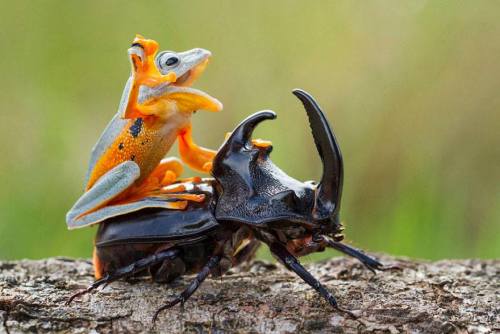
absquatulate: Dictionary.com Word of the Day
absquatulate: to flee.
Tindalostalbot likes this