Shared posts

26 Aug 17:39

Why movie CG sucks (except that it doesn't)

by Jason Kottke
Steve Dyer

loved this

Are computer generated special effects ruining movies? Freddie Wong says no; CG is so good these days that we only notice it when it's bad and in bad movies.

My biggest concern with CG is with unrealistic camera movements, e.g. like when the camera is following Spider-Man swooping all over NYC. I can't not notice it and it almost always takes me out of the experience, which is the opposite of what I want. (via @tonyszhou)

Tags: Freddie Wong   movies   video
26 Aug 15:46

Amy Schumer and Jennifer Lawrence Are Writing and Starring in a Movie Together

by Megh Wright
Say hello to the newest comedy duo: Amy Schumer and Jennifer Lawrence. According to The New York Times, Schumer and Lawrence have teamed up to write a comedy together for the big screen, which they also plan to star in. “We play sisters,” Lawrence told NYT. “We’re almost done writing. It just flowed out of […]
26 Aug 05:42

News in Brief: Oh God, Invitation To Lunch Somehow Trickled Down To Office Weirdos

Steve Dyer

The Onion has been pretty flawless with their Buffalo Wild Wings sponsored content

MEDFORD, OR—Recoiling at the sight of the two coworkers waiting for them in the lobby, employees from local company Core Analysts stated Monday that their invitation to head out and grab lunch had somehow trickled down to the office weirdos. “Crap, how did Joel [Seltz] and Matt [Heiser] hear about this?” said office manager Evan Coss, mentally recalibrating his expectations for a pleasant midday meal at Buffalo Wild Wings with friends to now include a series of labored asides in which he would make cursory attempts to engage his two bland, awkward colleagues over mozzarella sticks. “I sure as hell didn’t tell them about this—they must have heard Craig say we were meeting in the lobby at noon. Well, lunch is ruined. I wonder if I should just call it a bust, claim I have some work that needs to get out, and head back upstairs.” At ...


25 Aug 16:09

Photo

Steve Dyer

I keep on marking this as unread so I can keep rediscovering the 5 most handsome men in the world, you are welcome ladies.


25 Aug 15:32

Reminder: Tomorrow Is National Duck Out For A Drink Day

by Alex Balk
Steve Dyer

guysssssssssssss gotta do this

classicawldrinkingpostimageIt seems like just yesterday that I declared August 25th to be a national holiday where all observers took time to sneak out of their jobs and have a quick nip or two, but it turns out it was five years ago. Where did the time go? Fuck if I know. It’s 2015 now and nothing new makes sense to me, particularly this Internet we have going on these days. If I understood it any better I would set up some kind of hashtag like #nationalduckoutforadrinkday or however the hell you do it, that seems like a lot of characters, and like an Instagram thing where you could all post pictures of yourselves drinking during office hours with artfully blurred faces or whatever, but I don’t and I’m not willing to learn so instead what I will do is just remind you that tomorrow, August 25th, is National Duck Out For A Drink Day. You and your colleagues should make plans now for how you will be getting your holiday on tomorrow. A late lunch? An early exit? An “off-site meeting” around 2? The choice is yours! Have fun with it! Like and share, or whatever you kids do nowadays. But the important thing is that you celebrate. Again, the most important thing to keep in mind is this: If you go to the bar during work, it’s like they’re paying you to drink. Remember the holiday and keep it holy.

25 Aug 14:03

The cultural apocalypse that wasn’t

by Tyler Cowen
Steve Dyer

sharing cuz it's long and i'm going to read it tomorrow and it is probably of interest to Nate and Robby (since Robby made limewire)

According to the O.E.S., songwriters and music directors saw their average income rise by nearly 60 percent since 1999. The census version of the story, which includes self-­employed musicians, is less stellar: In 2012, musical groups and artists reported only 25 percent more in revenue than they did in 2002, which is basically treading water when you factor in inflation. And yet collectively, the figures seem to suggest that music, the creative field that has been most threatened by technological change, has become more profitable in the post-­Napster era — not for the music industry, of course, but for musicians themselves.

That is from Steven Johnson, the piece is excellent throughout.  And note this:

The new environment may well select for artists who are particularly adept at inventing new career paths rather than single-­mindedly focusing on their craft.

24 Aug 22:39

Blog: I Won’t Let My Kids Eat Vegetables Because I Heard Those Fuckers Are Alive

Steve Dyer

have we ganged up on vegans recently

anne is having a LAMB ROAST

suck it vegans

24 Aug 17:47

Photo


24 Aug 15:41

Photo

Steve Dyer

hannibal


22 Aug 16:05

The WhatsApp Pump-and-Dump

by John Herrman
Steve Dyer

i loooooooooooove this let's get rich

Earlier today, I got this message through WhatsApp. I don’t use WhatsApp very much. I’ve received spam there before, but not much, and nothing that looked quite like this. A few moments later I saw this in my Twitter feed:

HOT TIP pic.twitter.com/VCJtyeLV9c

— Marisa Kabas (@MarisaKabas) August 21, 2015

Oh. Oooh!!

I searched around and found lots of complaints:

First instance of @WhatsApp spam? pic.twitter.com/lBhG2eDt4I

— Michael Wang (@michaelwang20) August 21, 2015

I just got… Spam on WhatsApp. Looked like an attempt to phish or scam somehow. "This is Jack from Morgan Stanley" Adding no Jack, bihhh

— Broke Boi Bill (@TheBeatnikBill) August 21, 2015

@WhatsApp Great, my first WhatsApp spam came in today. How did this guy get my number??? #nothappy pic.twitter.com/Av6qWjYH3X

— Alexander Teusch (@alexanderteusch) August 21, 2015

A number of people on Twitter complained that this was their first-ever WhatsApp spam; others noted that the spam was fairly obviously an attempt to pump and dump a low-cap stock in a new and novel way. So let’s see:

Here’s an article about the spike on this penny stock site, which notes the stock spiked after “a massive whatsapp text message went out this morning.” Not bad at all! WHAT A MOVE!!! Etc. The company description is excellent as well:

AVRA Inc (OTCBB:AVRN) is focused on solutions in the digital currency markets, particularly in offering payment solutions to businesses worldwide. The Company’s business model is divided into four distinct categories: AvraPay: to develop a complete, turn-key and painless way for merchants to accept Bitcoin as Payment; AvraATM: to promote usage and acceptance of digital currencies through the Company’s proposed network of ATMs; AvraTourism: to provide cryptocurrency payment processing solutions for merchants such as hotels and casinos; AvraNews: to provide a news portal focusing on digital currency news.

Yes. Correct. Bitcoin penny stocks.

By the time I got my spam, the stock had already tanked. But others had received the post earlier. WhatsApp groups seem to be limited to 100 users, so maybe my group was just a little too far down the list.

@_TC_ received something similar pic.twitter.com/oyiOh5eoSn

— Michael T. Halligan (@mhalligan) August 21, 2015

Did WhatsApp inadvertently help move hundreds of thousands of shares in a penny stock scam? Unclear. But that certainly seems to have been the intent. Pump-and-dumpers practice all kinds of creative manipulations and come up with new ones all the time. A few years ago, a scammer’s best bet might have been to issue a fake press release, hoping for coverage that might produce the desired effect—to “hack” the media, more or less.

But a savvy scammer today might see a similar opportunity in the platforms that offer access to potentially much, much larger audiences. WhatsApp passed 800 million users in April. A spammer has discovered a way to access at least some of those users, reaching them with messages that are fairly obviously spam but which, unlike spam emails, are not common enough that people have completely tuned them out.

Small cracks (security or design) in platforms of unprecedented size can present major opportunities for those looking to exploit them. Just ask any publisher :)

22 Aug 02:18

ilikegirlsbro: This fucked me up


ilikegirlsbro:

This fucked me up

21 Aug 23:00

annabellehectorsworldofweird: fun with math

Steve Dyer

why did i laugh so hard

21 Aug 19:44

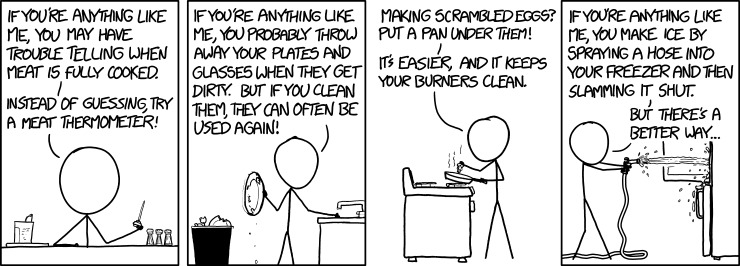
Kitchen Tips

Steve Dyer

Anne, I feel like this will make you itch in a wonderful way.

Household tip: Tired of buying so much toilet paper? Try unspooling the paper from the roll before using it. A single roll can last for multiple days that way, and it's much easier on your plumbing.
21 Aug 15:09

Iowa Looks Like Toss Up in Presidential Race; Grassley Ahead; Branstad Unpopular

21 Aug 13:33

Ten Goodass Vines

by Helen Holmes
Steve Dyer

click through, get your headphones

20 Aug 19:10

Slacklining 1000 feet in the air without safety ropes

by Jason Kottke
Steve Dyer

lol nope nope nope nope

Are your palms dry? Do you wish they were soaked with sweat right now? Then you should definitely watch Spencer Seabrooke walk on a slack line across a 210-foot gap almost 1000 feet in the air without any ropes or safety harnesses.

I mean, Jesus. (via devour)

Tags: slacklining   sports   video
20 Aug 18:59

Photo


20 Aug 15:38

The Singles Jukebox

Steve Dyer

Guys, I am chemically addicted to this song. I put up a big TLDR on fb about it, but pasting here so we can Talk. TRIGGER WARNING: POPTIMISM

All I've wanted to do for the past 2 weeks is talk about CRJ's Run Away With Me. It is the most perfect pop song I've ever heard. It is mandatory skipping, it is a four minute exclamation point, it is pondered hyperbole, it is yessence and the molten core of humanity. It's my 19-year-old closet-to-altar urgency, and the only sincere thing I have enjoyed in five years.
If you aren't an idiot, all you want to do is talk and think about this song and aspire to become this song, so I'm sharing this great post where a lot of people who are honestly so good at words are telling you what you didn't know about yourself. This one in particular gutted me like, I dunno, this [http://i.imgur.com/cD6ZQtS.png], but a rainbow and not a claw?
"Carly Rae Jepsen doesn’t write love songs; she writes about what lives before and lingers after love, what pulses beneath it, the swarming galaxies of desire which do not originate from the longed-for body any more than the rays of the sun emanate from our open eyes. I’ve never heard a song that more fully understands the element of desire which is really about the self – the way a shining someone can awaken a wish for a new self, polished and prettier, witty and strong, careening through a story big enough to earn a name the particulars of which are irrelevant, hero and sinner rendered equivalent in a schema organized around the marvelously vague dictum, take me to the feeling!"

CARLY RAE JEPSEN - RUN AWAY WITH ME
[8.70]

Before we run away, we get carried away…

Sophia Clara: This is my favorite song of the whole entire summer so far. It is huge and trembling and exuberant and I missed Carly Rae, I missed her so much. The verse builds and builds and you can’t help but smile and then the chorus is a winner, rocketing out of nowhere: BABY! TAKE ME! TO THE! FEELING! I don’t know what the feeling is but it doesn’t matter, the song is a lush spinning whirlwind. I have already been taken to the feeling. This song is absurd and confectionary and I don’t care, I don’t care. It’s like confetti thrown and spinning around in circles until you get dizzy. I’ll be your sinner in secret, she sings, but it is the kind of secret that involves absolutely no shame, sinner with a huge grin on her face, probably kissing someone up against a street-lamp. It is made of magic and, possibly, kittens. We are so lucky to have it.
[9]

Moses Kim: Like a Crayola whittled down to a fine point, Carly Rae Jepsen paints infatuation first in broad strokes, then in minute details. Desire can be either a saxophone crashing through a china shop or the lingering scent of a boy you’re trying to scrub out of your skin, “stuck on my body,” yes, but first “stuck in my head, stuck in my heart.” (There’s a measured gap between all of these phrases, like Jepsen knows only how to breathe between gushes.) A feeling can be a place for somebody to take you, just as a place can evoke a feeling: lips tower over sidewalks, light the winding path back to a time when love was as easy to pick up as the coins glimmering in the gutter. There’s the promise of the bridge, one weekend all it takes to turn a world to gold, and I can’t help but think of my 11-year-old self, how much he needed to know that the world is bigger than a closed door and the angry voices just behind it. Maybe the highest compliment I can pay “Run Away With Me” is that, for a brief moment, it takes me back to that feeling.
[9]

David Sheffieck: Subtly complicated, emotionally overwhelming, gorgeously romantic, and oh let’s not forget the massive hooks: this is pop music at its absolute finest.
[10]

Katherine St Asaph: The Rule of (My) Internet is that one’s Carly Rae Jepsen opinions are identical to one’s Carly Rae Jepsen feelings, but I shat out all my Jepsfeelings early this year in one fell gush (these feelings are poop) and now nothing is left. I am trying to be objective, and it is not working. I’m not sure why the euphoric M83 synth here does nothing while the one in “Lost Boys and Girls Club” is still the best thing I’ve ever heard; it sounds like bagpipes, which are not me, and it sharps at the end, and the result is unlistenable. The “hey!"s evoke the Lumineers, but they’re in so many pop songs anymore they may as well be sonic dust. The songwriting is still censoring for the tweens, or maybe I just got it into my memory that the lyric was "stuck in my head, stuck in my bed, stuck in my body” and prefer the post-coital bliss version. The throb is simultaneously blown to every emotional and musical height, yet it feels too restrained, unmoving. There is polish, and perfection even – the curls of lust in how Jepsen sings “run away,” the gorgeous vocals on the bridge, the little stop before the chorus – but I note them, and do not feel. The cult adoration of Jepsen has hinged, since every post-“Call Me Maybe” single, on underdog appeal; but this single got the second-most radio adds this week (after 5 Seconds of Summer’s brodown “She’s Kinda Hot”), so time may disprove that too. Perhaps I am the problem, and some essential part of me got cauterized sometime this year when I didn’t notice. But I still swoon and long to other songs, so that can’t be it, can it? Whatever it is, I wish it weren’t there.
[5]

Thomas Inskeep: I know that “Run Away with Me” has six credited writers and a trio of producers, but I’m just gonna assume this is mainly Shellback working with Jepsen, because it sounds like it. It’s akin to some of the work he did in collaboration with Max Martin on 1989, but doesn’t sound quite so clinical, so market-tested. (I love 1989, mind you.) This has echoes of ‘85 without sounding even remotely retro or out of time; for reasons I can’t quite explain it brings to mind a bit of Tears for Fears’ Songs from the Big Chair, but harnessed to throbbing popcraft that out-Moroders what Giorgio Moroder is doing these days. Jepsen’s the perfect vessel for this: she understands the limitations of her voice (no melisma nor belting here) and instead goes for the emotion of the song. She may be 29, but musically, still comes off like the ultimate teenage dream. And she’s killing it right now.
[8]

Isabel Cole: Carly Rae Jepsen doesn’t write love songs; she writes about what lives before and lingers after love, what pulses beneath it, the swarming galaxies of desire which do not originate from the longed-for body any more than the rays of the sun emanate from our open eyes. I’ve never heard a song that more fully understands the element of desire which is really about the self – the way a shining someone can awaken a wish for a new self, polished and prettier, witty and strong, careening through a story big enough to earn a name the particulars of which are irrelevant, hero and sinner rendered equivalent in a schema organized around the marvelously vague dictum, take me to the feeling! Take me to a different life; take me to a world like the movies, the bad ones shining with a gloss of money like sweat, their orchestrated wildness like the immaculate moment where her voice dovetails with that sax line, so perfect it’s almost silly, so vivid it’s almost real. Unmake my spilled-water dialogue and ugly teeth and replace them with a racing triple beat and the loomingness of yearning made as gorgeous as it is vast. Let me live in the skin you make me feel I can claim, invincible and awake, the transient beauty of sunset colors suspended just for us, turning the world to gold. You make this seem possible: the midnight drive, the seamless rebirth, the version or vision of me brave enough to follow the choreography of passion, limbs imbued with radiant sureness if you would just give me my cue. If you would just say it. Just go. Just run away with me. You make it seem easy, so why are we still here?
[10]

Maxwell Cavaseno: That bagpipe synth thing is by far either the most ingeniously or the most distressingly terrible thing I’ll hear all year, so right off the bat we’re giving Jepsen 3 points for that, ok? In an age of absurdly generic records, nothing here is distracting from the human making the songs. Carly Rae spends so much of the song making her voice sound like a choir of teens, a valkyrie’s bellow, and the happiest person in the world, all played by one Cheshire Cat grin-bearer of a weird Canadian.
[7]

Megan Harrington: Every time I listen to “Run Away With Me” I’m almost immediately greeted with vertigo brought on by mixing desire with longing. It’s crippling, such that I can’t listen to the song standing upright and when I try, Jepsen quickly levels me. Have we considered that her intent in making such an instant pop classic might be murderous?
[10]

Juana Giaimo: When you’re starting a relationship, all you want to do is to be with the one you like alone. Parties may be fun, but everyone else except you two are annoying. Leaving to a city nobody knows who you are is the perfect landscape to get to know each other better. Carly Rae Jepsen understood this so she combined the thirll of starting a relationship with the thirll of a new city: its blinding lights (and what happens when they go out); all its people around you with their own life you don’t know about; the emotion of running through streets you’ll never see again and of living a moment you’ll never live again. It’s seeing the other smile only at you for one specific instant what makes you think the craziest ideas could be good ideas, like believing this could last forever, that you could make the world better or simply running away. You and I are may be foreign to the city, but it doesn’t matter if it’s only you and I.
[9]

Luisa Lopez: Who dreamed up that sax line? It never changes and still it grows and grows, taking hold of the entire song until every note is a pressurized rendering of desire, every verse an ode to the horrible beauty of wanting. Horrible because of its longevity, the unchanging crease of an instrument that only has one voice and goes quiet for a verse only to howl again in the chorus; but beautiful for what Carly does with it, the song she builds from the upturned earth of that line. Kiss was an album about a bouquet of sensations but at the center of it was a wicked love letter to a boy who might have loved someone else. Each song muddled through the feeling in a tiptoe way, playing coy or getting ugly only to backtrack quickly and briefly bruising into moments of intense sadness for a yearning that wrecks the body but allows the heart to bloom. In E•MO•TION, there’s none of that pretense – everything is big, wounded, full of galactic joy. Opening an album with a song like this is a statement. Carly takes a moment so often embarrassing and unspoken – you make me feel like / I could be driving you all night; I’ll find your lips in the streetlight / I want to be there with you – and sends it shooting into the sky. Oh, my baby! Take me to the feeling! The ugliness is unhidden and every note is too big, too much, too endless. She sings, I’ll be your sinner in secret / when the lights go out and it’s desperate but manageable, a neatly packaged image meant to titillate him in the afternoon but then it cascades instantly into the heartbeat howl of run away with me! run away! with! me! and what a moment that is – a love song baring its face and hideous, frantic, unashamed in the revelation; a love song about wanting something so badly your heart could swing between two points of despair; a love song not about someone but something, the road from your sinner in secret to run away with me, the feeling that lives in that space. The rest of the album could have been shit – it isn’t – and it wouldn’t have mattered. This song could probably save the world. There she is, a tiny voice raised like a flag in an ocean of desire. The sax line carries her throughout, from the early rush of the first verses to the way her voice breaks on the last word.
[10]

Rebecca A. Gowns: Although “Run Away with Me” seems to have reverberations of other pop acts, it’s really more pure and clarified; this is not Carly Rae Jepsen ripping off anyone else, but rather, Carly Rae Jepsen making the song that every other pop performer wishes she could have in her repertoire. There are equal measures of sass and sweetness; balladry and rhythm; silly retro components (like that electronic sax!) tempered with a restrained backing track; the whole song rolls out elegantly, with no melodrama. Jepsen doesn’t have to push to sell this. In a pop landscape crowded with “hype,” this single stands out for its bare confidence. No pretensions, no gimmicks, no wailing belting breakdown – just a damn fine song.
[9]

Alfred Soto: The opening fanfare – treated saxophone and rumbles – could be from a Wilco tune, but as soon as the chant-or-die chorus hits it’s clear we’re in a land that has never forgotten the reign of Charli XCX. “Run Away with Me” conjures love among the skyscrapers better than Taylor Swift’s “Welcome to New York.”
[7]

Anthony Easton: There is little that is hesitant or cutesy here, just a smart, well-constructed argument in favour of Jepsen being a total pop diva. The meta has kind of fallen away, maybe due to a lack of commercial success, and the brassy, almost elegant, studio spit-shined production reigns triumphant.
[9]

Brad Shoup: The pre-chorus vocal melody and the synthsax melody are twinned: they share contours, they nudge the feeling into jagged territory. And they spawn ghosts under the hammering, horizontal chorus. Jepsen’s gift of gifts is her ability to conspire – there’s a directness in every single she’s sent out. But there’s also undercurrents: of an infatuation that could destroy, of a triumph that could be on the next floor. Basically, she’s more present than most anyone in pop.
[8]

Will Adams: Carly Rae Jepsen’s songs work so much better when I imagine them as internal monologues, everything that one would say if anxiety didn’t paralyze them the minute they walked through the door to that party they weren’t planning on going to but they just had to, because they knew that one person would be there. What separates it from the rest is that this anxiety is manifested in the music. The saxophone bleats on and on, the promise of driving someone all night, but the shiver bass and cavernous reverb reinforce those knots in your stomach. Every time I listen to “Run Away With Me,” I catch my breath, as if that someone is right there in the room, waiting for me to move.
[10]

Andy Hutchins: I docked a point because “I could be driving you all night” is clunky. This still seems harsh.
[9]

Danilo Bortoli: I’ll be forever suspicious of albums that reach the stratosphere too soon, but I suspect E•MO•TION is simply one of those pieces of art that lives up to its name and manages to stop time. And I can’t help but think that it makes all the sense in the world that “Run Away With Me” and its huge wall of sound opens the gates for Carly’s world. It’s inviting, adventurous and, above all, it’s “perfect pop” in the truest, vaguest sense of the expression: music that is bigger than the performer and the crowd and the fan, even cathartic. While I don’t think that “we can turn the world to gold” is a very radio-friendly phrase – it contains multitudes in it that demand too much from the listener – but it feels better this way. With “Run Away With Me” you get the sense that Jepsen is trying harder, feeling more and more deeply than on Kiss. Ironically, the first thing that springs to mind while listening to “Run Away With Me” is saudade, the kind of untranslatable word which defines Carly Rae’s body of work so far; “Run Away With Me” is the pop music equivalent of feeling so much that you just can’t put that into words. And the reason I keep coming back to this song is that, despite many of them being untranslatable, they are all we have left.
[10]

Edward Okulicz: If you could somehow take the verses of “I Really Like You,” the chorus of “Call Me Maybe” and the middle-eight of this, you might have the very ideal of the perfect pop song. You’d at least have a very good one – along the lines of Taylor Swift’s stunning “New Romantics” – if not for that jarring, unappetising synth-fart honk that dominates and keeps the song on the ground when Jepsen’s voice wills it to fly with all its might.
[6]

Nina Lea Oishi: Not too long ago I was looking back on diary entries I’d written when I was 14 and 15 years old. Although those entries are jam-packed with overblown preteen prose, they conjured up feelings I’d totally forgotten. The terror and thrill of the discoveries that come at that age – first kisses, first drinks, first parties, first rebellions, first high school friends. The urge to fit in, the urge to belong. The sense of standing at the edge of an undefined and exciting and terrifying new world of almost-adulthood. The belief, shaped by a fifteen-year-old’s smug and stupid confidence, that no one has ever felt this way before, that no one will ever feel this way again. I think that certain mix of terror and excitement is limited to that age range, and once we get older, more cynical, and more set in our ways, we forget it. Carly Rae Jepsen’s true genius is that she brings it all back with her sonic diary entries, from the silly flirtations of “Call Me Maybe” to the giddy confessions of “I Really Like You.” “Run Away with Me” is, gloriously, in the same vein. The beat, matched to Carly’s breathless delivery, thumps with the irrational urgency that fuels first love. The lyrics are ripped straight out of distracted-in-math-class notebook musings, but the simplicity only further infuses the track with authentic enthusiasm. When Carly begs “take me to the feeling,” she makes emotions into destinations, finally defining the mysterious place at the end of those late-night teenage joyrides. Sure, now that we’re a bit older, we have the distance to laugh at the naïve stupidity of those years long ago. But Carly remembers what we’ve forgotten – the unabashed joy, the glory, the purity of that thrill. She takes us to the feeling in a way that no other pop star can.
[9]

Josh Winters: I could run away with Carly Rae to the ends of the earth solely running off the propulsive energy of that sax cutting through the ether. Literally a beam of light in this dark, cruel world.
[10]

[Read, comment and vote on The Singles Jukebox ]
20 Aug 03:19

Photo

Steve Dyer

please be real

no one factcheck


19 Aug 14:05

Early Notes on the Ashley Madison Hack

by John Herrman
Steve Dyer

amazing

1. A data dump, which allegedly contains over 35 million email addresses, 33 million accounts with more detailed information (names and addresses), and every credit card transaction from the last seven years, is reported to have been posted online. It could be doctored or entirely fake, however: a hack was previously confirmed by the company, and early signs point to legitimacy. (Update: Brian Krebs was unsure, but now seems convinced; Ashley Madison’s official statement is ambiguous.)

2. It is not easily accessible to most internet users—it’s still in fairly raw form, in massive downloadable archives.

3. However, 4chan users, and undoubtedly others, are already combing through data and posting their discoveries. They started by searching for people with government email addresses, university email addresses, and addresses associated with major corporations. This is unfolding very quickly, already revealing the email addresses of students, teachers, public servants and municipal employees.

4. Anonymous internet posters have already discovered the email address of at least one public figure. In subsequent posts, they identify this person’s partner. This person has been confronted on Twitter; I would not be surprised if the partner is currently getting alarming emails from strangers. This happened almost instantly after the leak.

5. On 4chan, and on Twitter, users are posting plain, searchable chunks of the data. There appear to be ongoing attempts to make the data much more easily available. It seems very likely that there will be a way for curious, non-technically-inclined people to search for the names of friends, spouses, partners, or anyone else very soon.

6. We associate the cost of hacks mostly with identity theft and financial loss, from which most victims are pretty well insulated. Target assessed the cost of that hack at $148 million; outside financial institutions added another $200 million to that figure. You may know someone affected by that hack, but the resulting damages were likely mostly absorbed by their bank or credit card company. It was unsettling, yes, but it wasn’t widely ruinous.

7. This, on the other hand, is basically unprecedented? Most leaks of this size don’t implicate people in anything aside from patronizing major companies. This is new territory in terms of personal cost. The Ashley Madison hack is in some ways the first large scale real hack, in the popular, your-secrets-are-now-public sense of the word. It is plausible—likely?—that you will know someone in or affected by this dump.

8. Most of the responses and acknowledgements I’m reading now are either straight news stories or… jokes? I’m not sure anyone is really reckoning with how big this could be, yet. If the data becomes as public and available as seems likely right now, we’re talking about tens of millions of people who will be publicly confronted with choices they thought they made in private (or, in some cases, didn’t: Ashley Madison does not validate all email addresses). The result won’t just be getting caught, it will be getting caught in an incredibly visible way that could conceivably follow victims around the internet for years.

9. Such a scenario would present a number of new questions for many more internet users— questions the nature of which they’ve never really had to deal with. If the names and email addresses are available in a simple Google-like search, for example, will they search for their partners? Friends? Coworkers? Representatives? Family members? If so, why? If not, why not? Will you seek out the raw leak data after reading this post? Will news organizations, presented with user profiles associated with public figures, ask for comment? Treat each as news? Which ones? How? The last time people dealt with similar questions on a large scale was when troves of internal Sony documents, including emails, were leaked. Before that, it was when hundreds of private celebrity photos were stolen and released last year. That act was widely denounced, as were the millions of subsequent acts by the people who viewed the photos. But enough people looked at these photos to set traffic records for sites like Reddit. In any case, an incredible number of ethical questions are posed by this situation!

10. Anyway, I may be overestimating how far things will unfold, but this feels like a momentous event. Barring some sort of heroic cleanup effort on the part of the entire internet—which I guess, between Twitter moderation and aggressive lawyering, isn’t totally impossible—millions of lives may be about to change profoundly. It’s easy to kid about the fact that these people were using a site intended to help them cheat. But if understood in more abstract terms, this hack has the potential to alter anyone’s relationship with the devices and apps and services they use every day. Here were millions of people expecting the highest level of privacy that the commercial web could offer as they conducted business they likely wanted to keep between two people (even if a great number of the emails are junk, or attached to casual gawkers, the leak claims to contain nine million transaction records). This hack could be ruinous—personally, professionally, financially—for them and their families. But for everyone else, it could haunt every email, private message, text and transaction across an internet where privacy has been taken for granted. Ashley Madison, in the strange hacker economy of 2015, may have had an especially big target on its back. But it’s a powerful reminder of the impossibility of perfect privacy.

11. Welcome to the future, I guess!

19 Aug 14:02

Notes on 21st-Century Mystic Carly Rae Jepsen

by Jia Tolentino
Steve Dyer

This is a critical and crucial read in advance of Friday's release, also this http://www.nytimes.com/2015/08/02/arts/music/carly-rae-jepsen-with-a-new-album-is-definitely-changing-her-number.html

Also Anne, do you remember Alex Berdoff? Played drums for Hedwig? He works at CRJ's management company and appears to be vaguely involved with this transformation of hers.

carlyeThe first time we were anything is the last time that anything was possible. We start off life totipotent: one cell, absolute potential, ready to knit itself out towards infinity. Totipotency is a state that lasts about four days and feels as distant as some other, wilder precedents: the fish, the amphibians, the speechless hominids staring at the sun. Every Sunday night proves it: You’ll never get this back. Cells themselves can regain totipotency1, but the means by which they do so remain occult. We—that one cell turned into a degrading thirty-seven trillion—sense our lost totipotency only in the rarest of flashes, and I think, only at the very first second we feel a new kind of love.

Carly Rae Jepsen is a pop artist zeroed in on love’s totipotency: the glance, the kaleidoscope-confetti-spinning instant, the first bit of nothing that contains it all. This is audible and immediate in her voice, whose definitive quality is a childlike ardency inflected with coyness; she sings like her smile is bursting, like there are stars imploding in her eyes. Her music, strictly and deliberately generic, transcends its structure through this sonic technicolor hurry, this ecstatic sense of the possible, untethered from the way anything works.

And so Carly Rae’s music is tied up with an adolescent but ageless question: What’s more compelling—the falling or the love? Infatuation is an unrealized glimpse of future possible, and how you are as a person depends greatly on whether this vision supersedes, creates, or gets eclipsed by the actual possible. Carly Rae, anyway, is not interested in actual possible. She sidesteps the conundrum, and in a very particular way. The nameless, sparkling tension in her music comes from two parallel but opposite forces: Her substance regresses back to an impossible purity of emotional intention, while her form progresses towards an emotional climax that, necessarily imaginary, can never come. Carly Rae wants love; she wants nothing more than to want it—as in, she literally will not move past that point.

And so Carly Rae becomes somewhat of an unlikely mystic. In Decreation, the poet Anne Carson wrote about art without a personal center—a hole in the middle, left open for God. Carly Rae has resuscitated this idea, shot it through with molten sugar and planted it in genre. She’s displaced herself from the center of the pop album, a self-centered form, designating love—or E  • MO • TION, the album’s title—as her god.

Decreation’s title comes from religious philosopher Simone Weil’s idea of self-erasure. Carson quotes her: “If only I could see a landscape as it is when I am not there.” That’s the project that occupies much of E • MO • TION, its diffuse and unbearable babyish exaltation the sound of a highly pop martyrdom. The love of Carly Rae’s sonic imagination is distinctly spiritual: directed with unimaginable force at some distant object, further distinguished by having no subjectivity at all. Piece by piece, she insulates her subject matter against self-pollution, building a cathedral out of crystal and neon and smoke.

She stays, for the most part, absent, and in doing so becomes wildly present. The productive paradox of the mystic is in here: You can’t have erasure without a self to erase. When you raze your own presence, you are empowered by what goes up in place of it; the mystic becomes stronger in a degree that corresponds to self-extinguishment. The thirteenth-century mystic Marguerite Porete, eventually killed as a heretic for claiming to be able to access the divine directly, cried out in her writing to be an “annihilated soul.” Six centuries later, Weil wrote, “But when I am in any place I disturb the silence of heaven with the beating of my heart.”

Decreation draws heavily on both Porete and Weil, and for the writer, the paradox gets sharper. “Withness” was the problem, wrote Carson: “I cannot go towards God in love without bringing myself along.” The teller can’t disappear from what she is telling, and what’s more, a writer’s vocation renders this project disingenuous from the start.

For the pop star, disappearance is even less fundamentally possible, and Carly Rae—productively—is not always content to stay on the outside. It’s in the friction between her self-effacing vacancy and desperate presence that she achieves something like genius. The synth-blistered, drug-distilled, hyper-real sax howl that opens the album into “Run Away With Me” opens up into a tripleted club beat that, by the chorus, has Carly Rae pounding her fists on the walls of her cathedral she built to protect what she’s looking for. Baby, she sobs, take me to the feeling. It’s the best pop song of the year.

Carly Rae has always been in pursuit of interpersonal totipotency, the bubblegum/impossible/first kind of love. She is, really, the queen of it: Her breakout track, “Call Me Maybe,” situated pure heart-eyes potential in a single transaction that’s almost sure to go nowhere but is, at that moment—and here’s what those skipped-beat synth riffs will convince you—capable of leading to an eternity of bliss. Hey, I just met you/ and this is crazy. The text-message lyrics are fitting; infatuation is the dumbest, most colloquial thing in the world.

Because of this focus, Carly Rae is often criticized as being juvenile—isn’t she actually almost thirty, people will say, accurately—or lowest common denominator, for doing things like placing an entire hit chorus on the stairway-to-nowhere of I really, really, really, really, really, really like you. She’s also criticized for being, I guess, unsophisticated, but a few times through E • MO • TION and it’s obvious she is in control of the genre, rather than the opposite. Her music is often read as unintentionally blank when it seems to me to be obviously deliberately so, and much of the basis for all this confusion, I think, is the fact that she appears somewhat narrative-less: At a time when music criticism is both overworked (hello) and heavily reliant on intentional fallacy, pop stars are expected to provide either biographical or signatory hooks on which to hang a reading (or ideally, like Taylor Swift and Beyonce, both at the same time). Carly Rae was on Canadian Idol, released a debut album, released “Call Me Maybe,” another album, and now she’s here. Her hooks are only, and abundantly, musical. Outside that, she has her thicket of bangs, and fin.

So, though E • MO • TION should by all rights be enormous, Carly Rae seems paired with this basic confusion: Why isn’t she clearer about how we’re supposed to read her, why isn’t she bigger, why don’t we have more to work with here, people will say. Even people who love the music could wonder: How are the songs so direct and the artist so absent, the licks so obvious and the image so dissipated in smoke? The listener, I think—like the critic—wants to be the intermediary: to be pulled into the equation between the artist and what the artist seeks. But Carly Rae, like Marguerite Porete (who, again, was burned at the stake for it) seems to be after direct communion. Her willingness to be directly possessed by emotion—to regress, away from narrative, away from audience, back to that original point—reminds me of Porete’s idea of the soul stripped naked by divine presence. A soul:

to whom one can teach nothing

from whom one can take nothing away

to whom one can give nothing

and who has no will at all.

To be an original in this respect does not necessitate that Carly Rae be original in any other whatsoever. Melodically, she’s right on top of other people’s territory for much of the album. “Making the Most of the Night,” co-written by Sia, sounds like her; “Warm Blood” sounds like Lykke Li on moon rocks; “All That” perhaps should have been Jessie Ware; “LA Hallucinations” (whose first line is incredible: I remember being naked/ We were/ Two freaks just fresh to LA) has a tack-to-delectability ratio and hilariously declamatory chorus that conjures Britney Spears in “Born To Make You Happy”; the great bonus track “I Didn’t Just Come Here to Dance” sounds like what Taylor Swift’s next album will sound like if she keeps dating Calvin Harris. Vocally, Carly Rae gestures towards Ariana Grande on “Boy Problems”—whose first hook is so far up and forward in the nose that I sneezed in sympathy—and, with her roughed-up alto pulled up into little-girl coquetry, she sounds like Selena Gomez on every other song.

But “Run Away With Me” is the song that only Carly Rae could do, the song that epitomizes and matches and clarifies her artistic center. Listen to it again, right now. Robyn could get the closest—Robyn can do pure longing—but it would be more complicated: Robyn is as sad as she is buoyant, always knowing, always wrecked. Katy Perry could do it, too, but then it would be slick, anthemic, the finish line of the race rather than the gun that begins it. Taylor Swift could inhabit and electrify the sheer direct pull of the song, the big Swedish chorus. But it’s the defining feature of Taylor Swift: She is never, ever, ever going to be de-centered.

So, Carly Rae is almost everyone, and in the process she becomes no one—just not in the way that people might think. She’s not derivative but absorptive. E • MO • TION burns three decades of pop down to a few heartstrings and plays them from a home base of pure need. And in the playing, Carly Rae becomes invisible, the Casper of pop music, this album her Lazarus machine. There’s her resolution to that paradox. If only I could see a landscape as it is when I am not there. One way to do it is to be a ghost.

I feel sort of a reverse recognition when I listen to Carly Rae. I have never been good at valuing infatuation or falling helplessly to my needs, but I would like to be. Love is steady even when it’s enveloping; it’s an endpoint that’s always felt un-mysterious and immediate to me. The great, stupid, fascinating mystery is that vectored positioning—that ambient hunger, that sense of possibility, the deliberately thoughtless worship of love before it complicates or decays. Wouldn’t it be wonderful to stay there, hovering at the unreal beginning, under a spell of violent self-enchantment? Tearing your eyes out and replacing them with stars?

Gimme love, goes one of her choruses. Gimme love, gimme love, gimme love, gimme love, gimme touch/ Cause I want what I want/ Do you think I want too much? That’s Carly Rae for you. The world, as they say, is a vampire; by sheer force of wanting, Carly Rae outpaces the world. On the chorus of “LA Hallucinations,” there’s a line: There’s a little black hole in my golden cup/ So you pour and I’ll say stop. It’s a neat and perfect recompression of her genre, whose broadly painted cravings are just accessories to infatuation; it’s a sixteen-word explanation of her endlessly desiring ethos, and of endlessly desiring, you and me.

1. Well, pluripotency, but close enough.

18 Aug 21:53

Miley Cyrus, Amy Schumer, and Tracy Morgan Are the First Hosts of ‘SNL’ Season 41

by Megh Wright
Steve Dyer

TRACY

We finally have a premiere date and host lineup for season 41 of SNL, and it’s pretty great. NBC revealed on Twitter today that its 41st season will kick off on October 3rd with host Miley Cyrus, followed by Amy Schumer on October 10th and former cast member Tracy Morgan on October 17th. It will […]
17 Aug 21:37

The Problem We All Live With

by Jason Kottke
Steve Dyer

THIS IS THE BEST EPISODE IN TAL HISTORY

I am a completist and am 100% confident in this assessment, please listen to both parts ASAP!

Oh man, this episode of This American Life on desegregation and the Normandy School District (aka the Missouri district that Michael Brown attended) just totally wrecked me. Tears of sadness and rage.

Right now, all sorts of people are trying to rethink and reinvent education, to get poor minority kids performing as well as white kids. But there's one thing nobody tries anymore, despite lots of evidence that it works: desegregation. Nikole Hannah-Jones looks at a district that, not long ago, accidentally launched a desegregation program.

America likes to pride itself on its focus on the importance of education and everyone getting a crack at living the American Dream, but as this story makes clear, neither of those things are actually true. See also part two of the series and Hannah-Jones' series on segregation at ProPublica.

Tags: audio   crying at work   education   Nikole Hannah-Jones   racism   This American Life   USA
16 Aug 07:46

I guess they deserve it, huh

by Freddie
Steve Dyer

Does anyone have Freddie in their subscriptions? I feel like he is slowly agitating the whole internet in a better direction, in fits and starts and with various success. It's been an interesting and uncomfortable conversation that I've been following, with some really heated spats with The Toast ladies and some other prominent internet darlings, and I have to say I come down on his side more often than not.

Yesterday turned into yet another Twitter conflagration about how a post of mine is an uncool thing written by an uncool guy. But, you know, I was right.

The thing is, this isn’t really about David Foster Wallace, although I feel like he’s become this locus for weird shit because writer culture is an ostensibly literary culture full of people who don’t read but feel like they should read Infinite Jest and feel weird that they haven’t. (Seriously, just don’t read it, it’s fine.) It’s really about cruelty as a political tool. The thing I was reacting to was over-the-top mean. But it’s allowed to be cruel because its cruelty is directed against a target seen as deserving, the “litbro.” I don’t know what that is; I doubt anybody really does. What matters is that once sorted into that category, we’re meant to believe that there’s no amount of derision too brutal. The same goes for “neckbeards,” or “fedoras,” or “nice guys,” any number of other groups that we’ve decided are OK to treat as poorly as humanly possible. Because of progressive politics, or social justice, somehow or another. Since people enjoy being cruel in this way, the number of these bizarre categories grows and grows, though the people who devise them never seem to place themselves in any. Then you get to treat more and more people terribly. That’s what the fight was about, that concept, the concept that some people deserve limitless cruelty because politics says so. And it’s about the fact that people don’t want to give up that cruelty because they find ladling out that cruelty too much fun.

What sticks with me about the Justine Sacco situation isn’t the question of whether she deserved attack, or how much. It’s the glee people felt. If you dig around enough, you can find them, tweets where people said about that situation, “I hope this never ends.”

For myself, I think that we should fall out of love with cruelty. Not just because these groups are, by design, so shaggy and vague that they inevitably pull in people who aren’t actually sexist or racist or anything else. Instead they’re just uncool. No one would publicly argue that anyone deserves such treatment just for being uncool, of course, but that thin veneer of politics provides plausible deniability. But also because I’m actually more concern with this behavior when it’s against men who are actually sexist, actually bigoted, actually in the wrong wrong. Because even then, in the long run, the gleeful application of personal cruelty will only corrode and poison our political engagement, turn even good intentions into something sick and ugly. I don’t think it does us any good, in the long run, to be cruel, even to bad people. There are political means that by their nature occlude and undermine political ends, and even if they didn’t, those ends can’t justify intentionally inflicting emotional pain. I think cruelty is one of the master’s tools, and our embrace of it has been a terrible mistake.

Here’s how this is going to go, because it’s how this always goes.

A few of my regular readers will retweet and favorite this. A much larger number of people will make fun of it. Tweeters with names like “Stronk Fartbox” and “420 DadJeans VapeKing,” guys who work in advertising or accounting and for whom Twitter is their secret life, will screen cap parts of it, share it with a lol, and get their typical retweets and favorites. People with mean Twitpics (“That’s kind of my thing, I’m mean on Twitter, it’s like my trademark”) will be mean about it. Twitter will snark and snark and snark. A much smaller number of people will, maybe sheepishly, think that I’m right. Because they’ve noticed the cruelty, too, and it’s left them feeling sad and exhausted. And they’ll quietly agree. A small number of them, maybe 5 or 6, will email me to tell me. More will just nod along and say nothing, which is fine too. But enough people will feel this scratchy feeling on the back of their necks, like all of this endless cruelty long ago stopped fulfilling any political function at all, but became just another example of mocking people with the wrong clothes, the wrong attitude, the wrong friends. And they’ll take that feeling with them as they move forward.

Maybe, in time, that sentiment will grow, and we’ll all have had enough of cruelty.

14 Aug 20:21

News in Photos: U.S. Border Collie Rounds Up 11 Million Illegal Immigrants

Steve Dyer

how have i never heard this joke


14 Aug 14:04

Photo


13 Aug 17:35

Did You Take Personal Finance Classes in College?

by Nicole Dieker
Steve Dyer

idk what the words are even but LOOK AT ANDY'S FLOPPY HAIR

Pawnee_Community_College_4

On Monday, we looked at Financial Advice for College Students, including the Wall Street Journal‘s advice to require every student to take a behavioral finance class.

So now I’m curious: did any of you take any personal finance classes in college?

I didn’t. I just searched my alma mater Miami University’s course catalog, and they do offer a class called FIN 101: Personal Finance, with the course description:

Making informed choices related to spending, saving, borrowing, and investing continues to be the foundation of long-term financial security. This course educates students in areas such as financial planning, budgeting, federal income taxes, savings, borrowing, investing, insurance, housing, and retirement planning.

Why didn’t I take that when I went to college? (I am mentally panicking that I did in fact take FIN 101 and have no conscious memory of it. I remember Honors Linguistics and Intro to Ballet…)

However, in grad school, I took an Arts Management course that turned out to be extremely useful. Not because I ever went into arts management, but because the course taught me how to make a cash-flow budget, and I immediately applied that concept to my personal finances.

A cash-flow budget, at its simplest concept (and believe me, I used it at its simplest concept) tracks what days money will come in and what days money will go out. So I set up a spreadsheet, made a new worksheet for every month, and added a few columns for every day. Predicted income, predicted expenses, balance—and then I’d fill in those numbers with actual income and expenses as I received checks or bought groceries.

It was an invaluable tool because it helped me estimate how much money I would have in my bank account a month from now, and if I wanted to do something like, say, buy some new clothes, I could enter an estimated cost and see if any numbers down the line turned red. At that point I had such little income that I needed to know if buying something now meant not being able to pay the electric bill in 30 days.

I kept the cash flow budget up for about two years, if I recall correctly. (After that I switched to a category-based spending spreadsheet.) It helped me manage my money when I had very little of it to manage, and for that I am very grateful.

What about you? Did you take any personal finance classes? Did you learn anything in an unrelated class that you were able to apply to your finances?


This story is part of our College Month series.

12 Aug 18:58

Adult Swim Renews ‘Rick and Morty’ for a Third Season

by Megh Wright
Steve Dyer

delightful

Another season of Dan Harmon and Justin Roiland’s Rick and Morty is on the way. Adult Swim confirmed today that it’s handed a season 3 renewal to the animated series, which premiered its second season last month. “It’s an honor to see Rick and Morty join the exclusive club of shows with over nineteen episodes,” […]
12 Aug 15:49

Canadians Love Vacationing in the U.S.

by Mike Dang
Steve Dyer

This isn't normalized for total population and I want to fucking KILL MYSELF it is awful

Screen Shot 2015-08-11 at 9.36.54 PM

Canadians visit the U.S. more than Americans visit Canada. More than twice as many Americans visited Mexico in 2014 as headed north, those sunny beaches trumping the friendly nation of hockey, poutine, and Justin Bieber. Among overseas destinations, the United Kingdom and the Dominican Republic drew the most U.S. travelers, followed by France, Italy, and Germany.

Bloomberg looked at data from the Commerce Department’s National Travel and Tourism Office to discover where Americans like to go on vacation, which foreigners love visiting the U.S., and what people do when they get here (mostly shop).

My pals and I chose our summer vacation in Italy while sitting around at a dinner table one night drinking wine. Wouldn’t it be nice to rent a house in Tuscany and drink wine outside and visit a vineyard? It started out as a fantasy more than anything, but we all quickly found ourselves looking at our savings and calendar dates. But: Canada! My one visit to Canada was when I was a cool teen who flew to Vancouver with my high school for a swing dancing tour. Perhaps it’s time for another visit!

12 Aug 02:12

More Signs Your Summer Is Over

by Alex Balk
Steve Dyer

time to give up

Cherish the daylight. Sunset Tonight is at 8pm for the last time until May http://t.co/PB3oYLlEOo pic.twitter.com/5aqOZ6Y8j1

— NY1 Weather (@NY1weather) August 11, 2015


I told you people this would happen so long as the Earth continued to revolve around the sun. But did you believe me? You did not. And now winter is coming. Winter is almost here. Enjoy what light you have left, it won’t last. The days will become shorter. Your days will become shorter. All things become shorter. What’s next for you is winter. Forever.