13 Mar 08:28
by Zhiwei Jiang, Santanu Karan, Andrew G. Livingston
Abstract
Thin-film composite membranes comprising a polyamide nanofilm separating layer on a support material are state of the art for desalination by reverse osmosis. Nanofilm thickness is thought to determine the rate of water transport through the membranes; although due to the fast and relatively uncontrolled interfacial polymerization reaction employed to form these nanofilms, they are typically crumpled and the separating layer is reported to be ≈50–200 nm thick. This crumpled structure has confounded exploration of the independent effects of thickness, permeation mechanism, and the support material. Herein, smooth sub-8 nm polyamide nanofilms are fabricated at a free aqueous–organic interface, exhibiting chemical homogeneity at both aqueous and organic facing surfaces. Transfer of these ultrathin nanofilms onto porous supports provides fast water transport through the resulting nanofilm composite membranes. Manipulating the intrinsic nanofilm thickness from ≈15 down to 8 nm reveals that water permeance increases proportionally with the thickness decrease, after which it increases nonlinearly to 2.7 L m−2 h−1 bar−1 as the thickness is further reduced to ≈6 nm.

Smooth, ultrathin polyamide nanofilms with thickness from ≈6 to 15 nm fabricated at an aqueous-organic interface are used for reverse osmosis. Transfer of these nanofilms onto various support materials enables independent exploration of the impact of nanofilm thickness and support properties on composite membrane performance. Sub-8 nm nanofilms on more porous supports exhibit fast water transport and good NaCl rejection.
13 Mar 08:28
by Christine-Maria Horejs
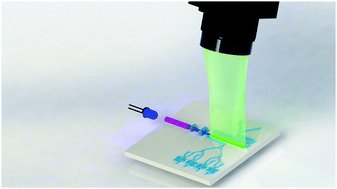
Optofluidics: You never hop alone
Optofluidics: You never hop alone, Published online: 27 February 2018; doi:10.1038/natrevmats.2018.11
Optofluidics: You never hop alone

01 Mar 05:15
by Wei Zhao, Xin Liu, Fang Yang, Kaige Wang, Jintao Bai, Rui Qiao and Guiren Wang

Analytical Chemistry
DOI: 10.1021/acs.analchem.7b02985

14 Feb 13:39
by Xiao Xia Wang, David A. Cullen, Yung-Tin Pan, Sooyeon Hwang, Maoyu Wang, Zhenxing Feng, Jingyun Wang, Mark H. Engelhard, Hanguang Zhang, Yanghua He, Yuyan Shao, Dong Su, Karren L. More, Jacob S. Spendelow, Gang Wu
Abstract
Due to the Fenton reaction, the presence of Fe and peroxide in electrodes generates free radicals causing serious degradation of the organic ionomer and the membrane. Pt-free and Fe-free cathode catalysts therefore are urgently needed for durable and inexpensive proton exchange membrane fuel cells (PEMFCs). Herein, a high-performance nitrogen-coordinated single Co atom catalyst is derived from Co-doped metal-organic frameworks (MOFs) through a one-step thermal activation. Aberration-corrected electron microscopy combined with X-ray absorption spectroscopy virtually verifies the CoN4 coordination at an atomic level in the catalysts. Through investigating effects of Co doping contents and thermal activation temperature, an atomically Co site dispersed catalyst with optimal chemical and structural properties has achieved respectable activity and stability for the oxygen reduction reaction (ORR) in challenging acidic media (e.g., half-wave potential of 0.80 V vs reversible hydrogen electrode (RHE). The performance is comparable to Fe-based catalysts and 60 mV lower than Pt/C -60 μg Pt cm−2). Fuel cell tests confirm that catalyst activity and stability can translate to high-performance cathodes in PEMFCs. The remarkably enhanced ORR performance is attributed to the presence of well-dispersed CoN4 active sites embedded in 3D porous MOF-derived carbon particles, omitting any inactive Co aggregates.

A nitrogen-coordinated single Co atom catalyst is derived from Co-doped metal–organic frameworks with accurately controlled Co contents. Atomic CoN4 sites are observed by advanced electron microscopy combined with X-ray absorption spectroscopy. Due to the high density of atomically dispersed Co sites, the catalyst achieves respectable activity and stability in acidic proton exchange membrane fuel cells.
16 Jan 03:50
by Kai Müller, Julian Helfferich, Fangli Zhao, Rupal Verma, Anemar Bruno Kanj, Velimir Meded, David Bléger, Wolfgang Wenzel, Lars Heinke
Abstract
Proton conducting nanoporous materials attract substantial attention with respect to applications in fuel cells, supercapacitors, chemical sensors, and information processing devices inspired by biological systems. Here, a crystalline, nanoporous material which offers dynamic remote-control over the proton conduction is presented. This is realized by using surface-mounted metal–organic frameworks (SURMOFs) with azobenzene side groups that can undergo light-induced reversible isomerization between the stable trans and cis states. The trans–cis photoisomerization results in the modulation of the interaction between MOF and guest molecules, 1,4-butanediol and 1,2,3-triazole; enabling the switching between the states with significantly increased (trans) and reduced (cis) conductivity. Quantum chemical calculations show that the trans-to-cis isomerization results in the formation of stronger hydrogen bridges of the guest molecules with the azo groups, causing stronger bonding of the guest molecules and, as a result, smaller proton conductivity. It is foreseen that photoswitchable proton-conducting materials may find its application in advanced, remote-controllable chemical sensors, and a variety of devices based on the conductivity of protons or other charged molecules, which can be interfaced with biological systems.

A nanoporous, crystalline material is presented where the proton-conduction of the guest molecules can be switched between high and low conductivity. This is realized by metal–organic frameworks with azobenzene side groups that undergo light-induced reversible isomerization between stable trans and cis states, resulting in the modulation of the host–guest interaction and the control of their conduction properties.
08 Jan 03:27
by Zhen Zhang, Pei Li, Xiang-Yu Kong, Ganhua Xie, Yongchao Qian, Ziqi Wang, Ye Tian, Liping Wen and Lei Jiang

Journal of the American Chemical Society
DOI: 10.1021/jacs.7b11472

XGLiu and -1 others like this
29 Dec 01:30
by Vladimir V. Egorov, Andrei D. Novakovskii and Elena A. Zdrachek

Analytical Chemistry
DOI: 10.1021/acs.analchem.7b04134

21 Dec 08:05
by Zhongbo Zhang, David H. Wang, Morton H. Litt, Loon-Seng Tan, Lei Zhu
Abstract
A new class of high-temperature dipolar polymers based on sulfonylated poly(2,6-dimethyl-1,4-phenylene oxide) (SO2-PPO) was synthesized by post-polymer functionalization. Owing to the efficient rotation of highly polar methylsulfonyl side groups below the glass transition temperature (Tg≈220 °C), the dipolar polarization of these SO2-PPOs was enhanced, and thus the dielectric constant was high. Consequently, the discharge energy density reached up to 22 J cm−3. Owing to its high Tg , the SO2-PPO25 sample also exhibited a low dielectric loss. For example, the dissipation factor (tan δ) was 0.003, and the discharge efficiency at 800 MV m−1 was 92 %. Therefore, these dipolar glass polymers are promising for high-temperature, high-energy-density, and low-loss electrical energy storage applications.

Enhanced dipolar polarization: The dipolar polarization of methylsulfonyl side groups on poly(2,6-dimethyl-1,4-phenylene oxide) (PPO) is utilized to enhance the dielectric constant of polymers while keeping the dielectric loss reasonably low. The discharge energy density of this dipolar glass polymer is greater than 20 J cm−3, which is promising for applications in electrical energy storage.
02 Dec 11:49
by K. Swathi and K. S. Narayan

Nano Letters
DOI: 10.1021/acs.nanolett.7b04359

28 Nov 11:40
by Yi Guo, Zhongqing Jiang, Wen Ying, Liping Chen, Yazhi Liu, Xiaobin Wang, Zhong-Jie Jiang, Banglin Chen, Xinsheng Peng
Abstract
Natural biomolecules have potential as proton-conducting materials, in which the hydrogen-bond networks can facilitate proton transportation. Herein, a biomolecule/metal–organic framework (MOF) approach to develop hybrid proton-conductive membranes is reported. Single-strand DNA molecules are introduced into DNA@ZIF-8 membranes through a solid-confined conversion process. The DNA-threaded ZIF-8 membrane exhibits high proton conductivity of 3.40 × 10⁻⁴ S cm−1 at 25 °C and the highest one ever reported of 0.17 S cm−1 at 75 °C, under 97% relatively humidity, attributed to the formed hydrogen-bond networks between the DNA molecules and the water molecules inside the cavities of the ZIF-8, but very low methanol permeability of 1.25 × 10⁻⁸ cm2 s−1 due to the small pore entrance of the DNA@ZIF-8 membranes. The selectivity of the DNA@ZIF-8 membrane is thus significantly higher than that of developed proton-exchange membranes for fuel cells. After assembling the DNA@ZIF-8 hybrid membrane into direct methanol fuel cells, it exhibits a power density of 9.87 mW cm−2 . This is the first MOF-based proton-conductivity membrane used for direct methanol fuel cells, providing bright promise for such hybrid membranes in this application.

A DNA-threaded DNA@ZIF-8 membrane demonstrates ultrahigh proton conductivity and low methanol permeability, holding great potential for application in direct methanol fuel cells.