This article originally appeared in Inside Higher Ed.
Shared posts
25 Jan 23:53


India's street typists: a vanishing breed
by Cory Doctorow
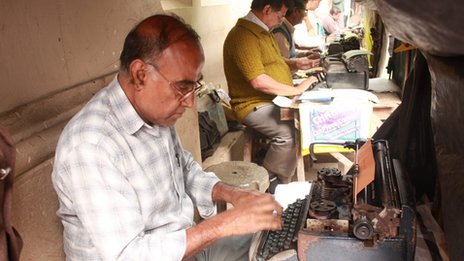
India's street typists -- skilled professionals who type documents for passersby who need formal paperwork for official purposes -- are in great financial difficulty. Their trade has been largely supplanted by computers with word-processors. Even the love-sick young men who would come to them to type out love letters have moved on. The BBC profiles the street typists of Calcutta, in a piece steeped with melancholy at a world that has moved on.
Ajay took the job because he could find no other work. He says he would not advise anyone to follow his example.
"There are only old men here now. There are no youngsters here."
"I even told my son not to join this profession as it is difficult to make a living on the streets now."
It is time for him to go home after another largely fruitless day.
As I walk away he shouts out: "Come and see me soon. I and my friends may not be here for much longer."
India's street typists heading for a final full-stop [Rahul Tandon/BBC] 
    
|
25 Jan 21:27
Denham Psycho, A British Hipster Parody of ‘American Psycho’
by EDW Lynch
British hipsters discuss the finer points of Japanese denim and Indonesian civet coffee in “Denham Psycho,” a spoof of the 2000 crime drama American Psycho. The short video includes hilarious remakes of two famous scenes from the film, the business card scene and the Huey Lewis and the News murder scene. The video was created by London creative agency Flickering Wall for clothing brand Denham.
video via Denham
via reddit, The High Definite
25 Jan 03:14


View the Passport Photos of F. Scott Fitzgerald, James Joyce, Virginia Woolf & Other Cultural Icons
by Ilia Blinderman
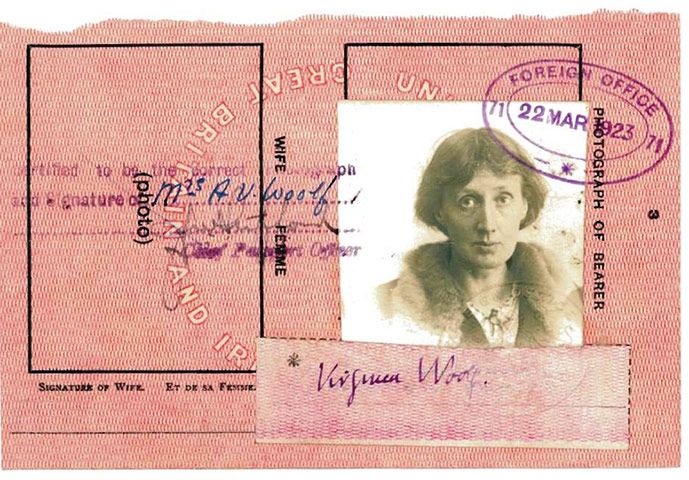
Click images to enlarge.
If you’ve had the fortune of travelling for leisure, you know that there are three types of mementoes that unfailingly elicit pangs of nostalgia. The first are photographs. The second are the running commentaries we write down in journals and blogs, documenting the various impressions, thoughts, and minutiae we experience. The third are passports. When brimming with exit stamps and tattered visas, passports are the mark of a worldly traveller: a grimy, well-worn sign to fellow hostel guests that you’re wanted company when the time comes to compare stories.
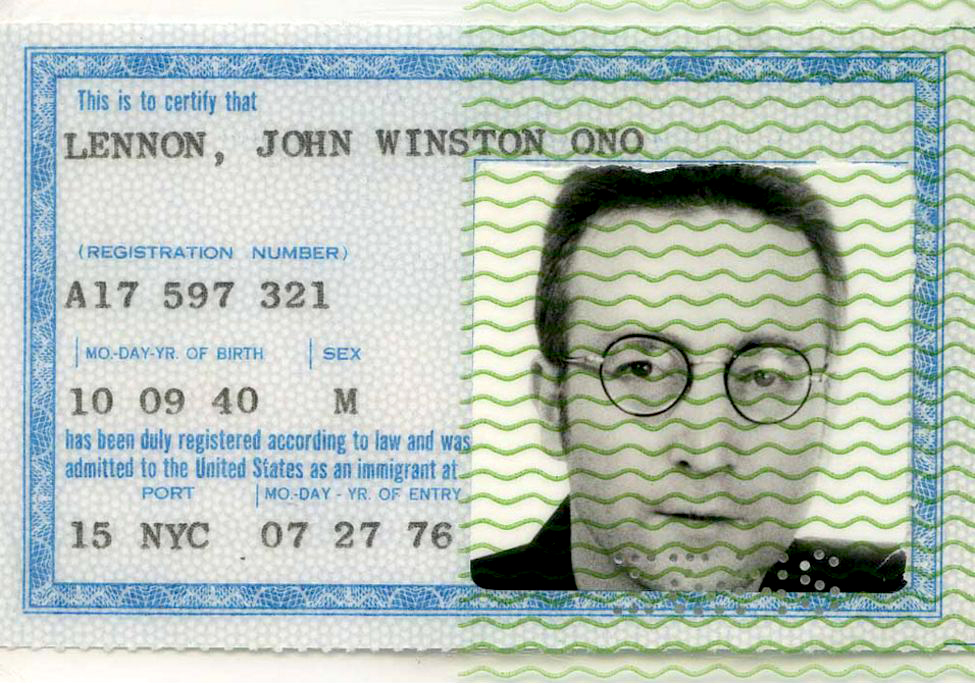
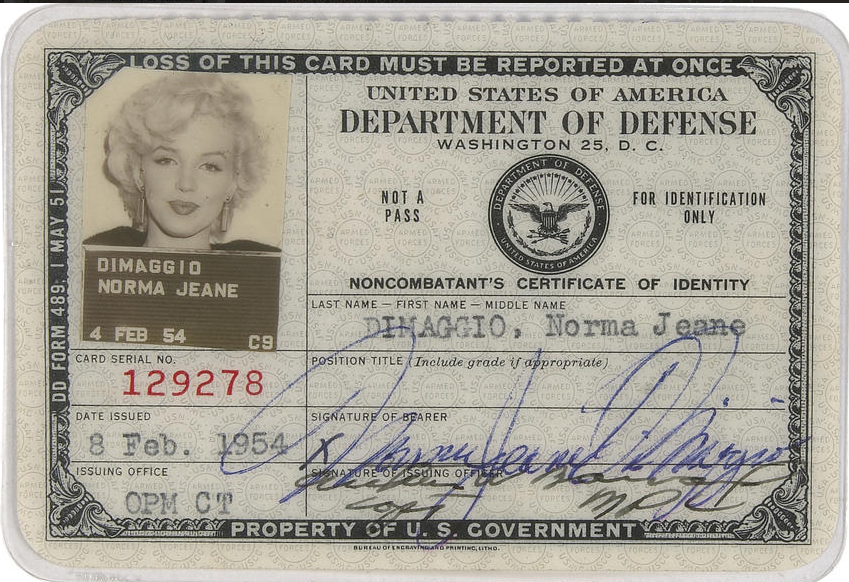
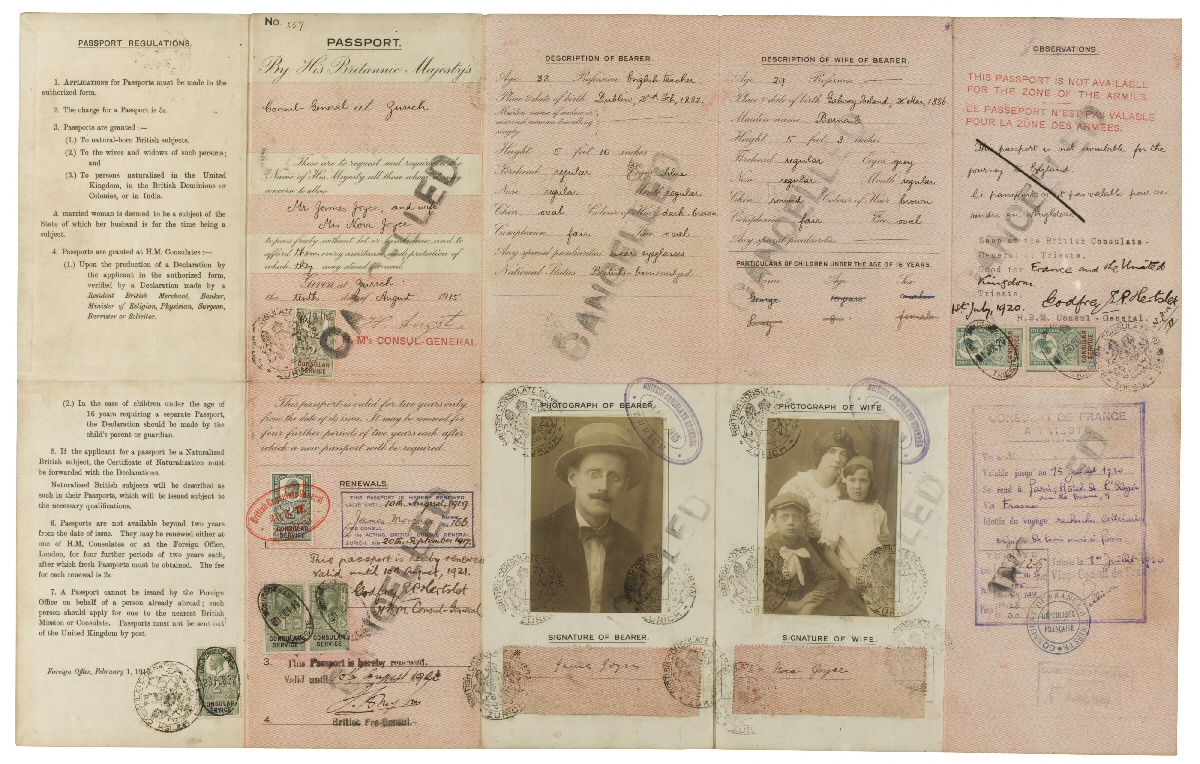
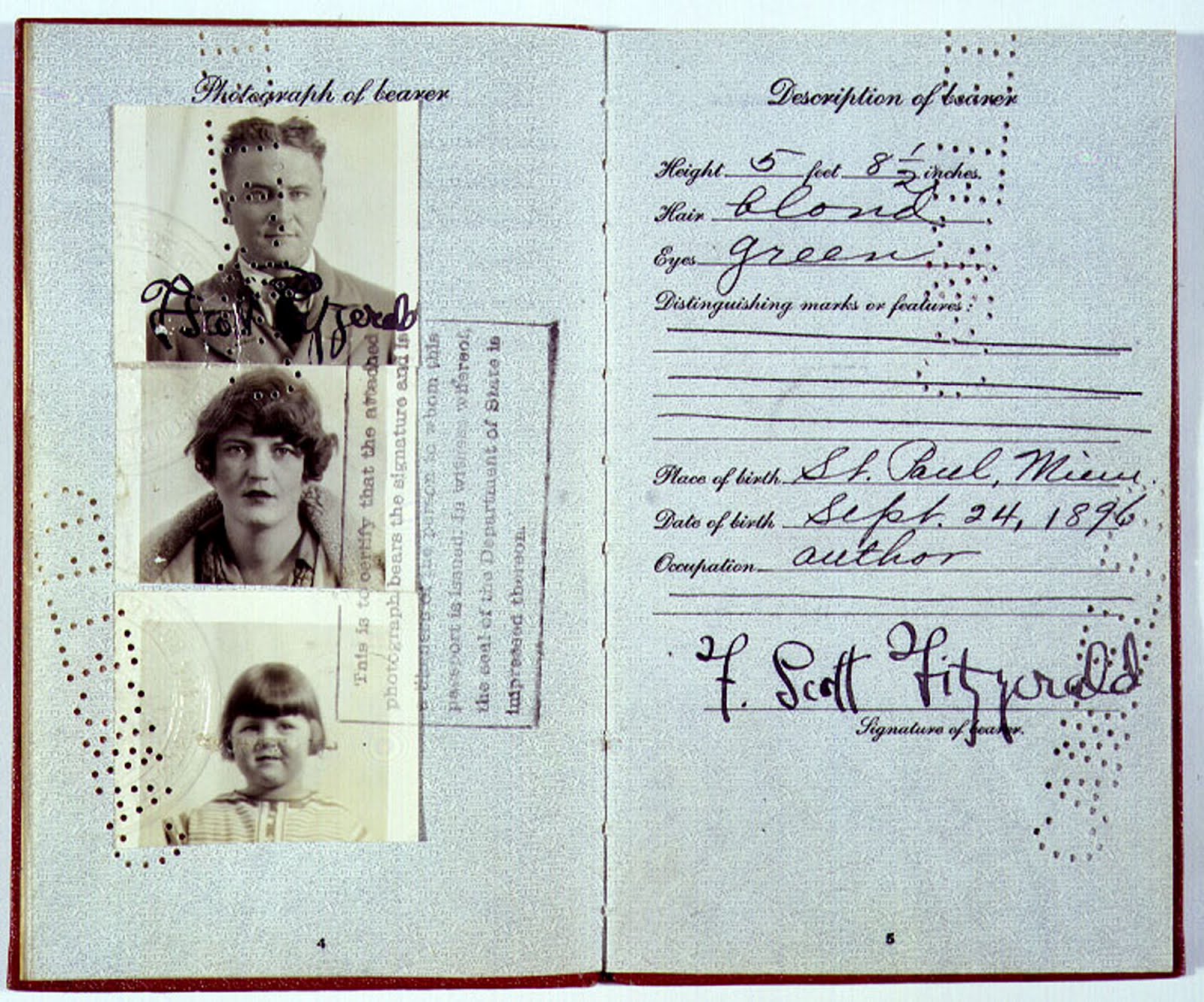
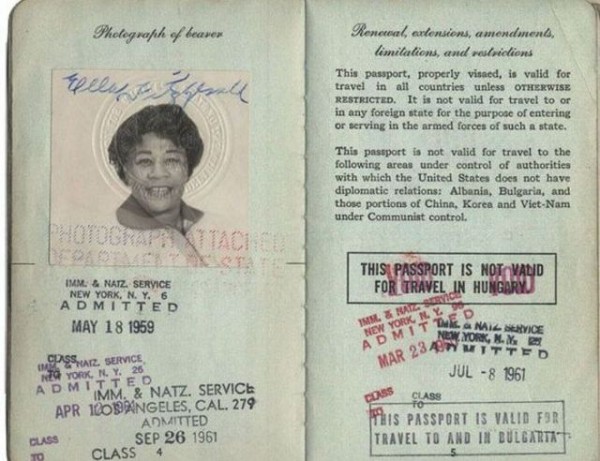
Today, we bring you several passport scans from a number of the 20th century’s best-known cultural figures. Above, you can see a travel document belonging to Virginia Woolf, who received a 1923 stamp from the Foreign Office. Below we have John Lennon’s entry card into the U.S., which the Beatle received after a battle for permanent residency that lasted for several years. Then Marilyn Monroe’s Department of Defense-issued ID card, under the name of Norma Jean DiMaggio. Further down are the passport photos of writers James Joyce and F. Scott Fitzgerald, accompanied by their respective families, who were travelling under the same documents. Lastly, we present to you the most impressively decorated passport pages of all, belonging to Ella Fitzgerald:
John Lennon
Marilyn
James Joyce and Family
The Fitzgeralds
Ella Fitzgerald
For more iconic passport photos, head to Vintage.es or The Untravelled Paths blog.
Ilia Blinderman is a Montreal-based culture and science writer. Follow him at @iliablinderman.
Related Content:
Rare Footage of Scott and Zelda Fitzgerald From the 1920s
Ella Fitzgerald Sings ‘Summertime’ by George Gershwin, Berlin 1968
James Joyce Plays the Guitar, 1915
Six Postcards From Famous Writers: Hemingway, Kafka, Kerouac & More
View the Passport Photos of F. Scott Fitzgerald, James Joyce, Virginia Woolf & Other Cultural Icons is a post from: Open Culture. You can follow Open Culture by signing up for our Daily Email. That is the most reliable and convenient option. You can also find us on Facebook, Twitter, and Google Plus.
25 Jan 03:13


Student Rickrolls Teacher By Sneaking Rick Astley Lyrics into Quantum Physics Paper
by Dan Colman
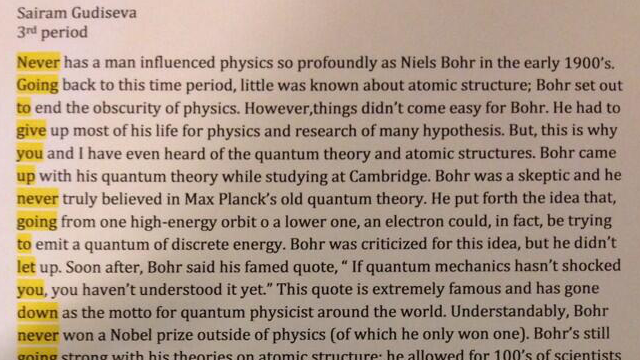
Here’s a funny little variation on “rickrolling,” a term some of our readers might not be familiar with. So let’s quickly refer you to Wikipedia:
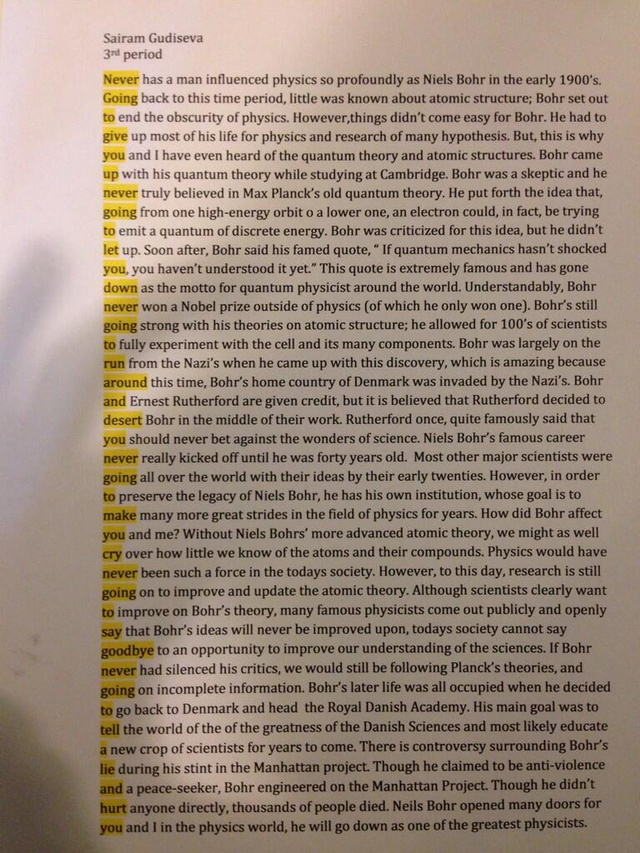
Rickrolling is an Internet meme involving the music video for the 1987 Rick Astley song “Never Gonna Give You Up”. The meme is a bait and switch; a person provides a hyperlink which is seemingly relevant to the topic at hand, but actually leads to Astley’s video. The link can be masked or obfuscated in some manner so that the user cannot determine the true destination of the link without clicking. People led to the music video are said to have been rickrolled. Rickrolling has extended beyond web links to playing the video or song disruptively in other situations, including public places, such as a live appearance of Astley himself in the 2008 Macy’s Thanksgiving Day Parade in New York. The meme helped to revive Astley’s career.
Now, in another sign that rickrolling has gone beyond the web, we have above a snapshot of a quantum physics written by Sairam Gudiseva, a student at (we believe) White Station High School in Tennessee. As the snapshot shows, Gudiseva managed to run the lyrics of “Never Gonna Give You Up” down the left margin of the page … while still keeping his ideas flowing. Well done, young man. You can see a full page of his essay here.
By the way, this is not the first time some levity has been introduced to a physic paper. You might want to refer back to our 2012 post, Physical Attraction: Marriage Proposal Comes in the Form of a Physics Paper.
Related Content:
Physics: Free Online Courses (Part of our collection of 825 Free Online Courses from Top Universities)
Marilyn Monroe Explains Relativity to Albert Einstein (in a Nicolas Roeg Movie)
The Most “Intellectual Jokes”: Our Favorite Open Culture Reader Submissions
Student Rickrolls Teacher By Sneaking Rick Astley Lyrics into Quantum Physics Paper is a post from: Open Culture. You can follow Open Culture by signing up for our Daily Email. That is the most reliable and convenient option. You can also find us on Facebook, Twitter, and Google Plus.
23 Jan 10:53

It's the year of the bush – time to rediscover all female body hair | Emer O'Toole
by Emer O'Toole
Cameron Diaz is leading a movement rejecting the shame heaped on women's privates by the removal industry. Now time for underarms and legs
On John Ruskin's wedding night, legend has it, the critic fainted on finding that – unlike the Elysian statues of his fantasies – women had body hair. Monday is the 114th anniversary of Ruskin's death. Who would've predicted that instead of laughing at Victorian prudery, many men still expect their sexual encounters to entail pudenda, pins and pits as marble smooth as those of young Ruskin's imagination?
But there's a change in the wind, a turn in the worm: oh yes, something's in the hair. Though I'm no astrologer, I think 2014 might just be the year of the bush.
In an unlikely about-face, Cameron Diaz has proclaimed that pubic hair is there for a reason, and to remove it is tantamount to saying, "I don't need my nose". This is odd, as just under a year ago she cheerfully told Graham Norton a cute story about pinning an ungroomed friend into the shower and forcibly de-fuzzing her. (I hope the poor woman's nose is still intact.)
While Diaz was making her new hairy allegiances public, clothing label American Apparel filled its New York shop windows with be-merkined mannequins in sheer undies. A spokeswoman says they're trying to spark up conversations about the kinds of femininity deemed beautiful and sexy.
To add to these media events, a UK Medix poll recently found that 50% of UK women did not groom down there at all. It must be admitted: 2014 is looking voluminously rosy for those of us who love our lady gardens.
But what's behind the last decade of wax in western culture in the first place?
Many are quick to blame porn; and porn undoubtedly has a role to play, but I know plenty of women who never need to clear their browser history, yet still denude their bottoms. (Of course, this doesn't preclude pressure from their partners.) And when you apply the age-old journalistic trick of following the money, what does the porn industry have to gain from regular real-life girlfriends looking like shiny cyber girlfriends? Not a whole lot. It's the "beauty" industry that profits, and which is driving the trend.
Before the first world war, virtually no American woman shaved her legs. By 1964, 98% of women under the age of 44 did so. Before that war, underarm hair was not a cosmetic consideration. Fashions up to that point, while often clingy and form revealing, covered up most of a woman's skin. But female fashions became ostensibly freer, and Gillette's first razor for women came out in 1915, triggering aggressive advertising campaigns on behalf of more than a dozen "beauty" companies. Female body hair was suddenly deemed unsightly.
The capitalist drive to convince us that female body hair is unnatural and unclean has been alarmingly successful. The removal industry is worth millions, and uncountable women are ashamed of and distressed by their post-pubescent hair. But the industry is greedy. It must now convince the world that female pubic hair is dirty too. It must now convince people that male body hair is equally unacceptable.
So why, if women were so easily duped in the 20th century, are they seemingly wilier now, seemingly more willing to reject the shame heaped on their hairy privates? I think one answer is that privates usually are quite private, and – give or take a few spanners – our partners tend to love us as we are, in a way that wider society does not. I think another answer is the discomfort and the invasiveness of pubic waxing. I had my first (and last) Hollywood in August as research for the book I'm writing, and I could not believe how painful it was. Or the rash and itch that set in as it grew out. It's too much. It's too far. We resent the pressure, and we resent being made to feel ashamed.
The comedian Kate Smurthwaite has a skit where she describes being in the showers after swimming, when two little girls run into the changing room, point at her fluffy bits, start giggling, and run out again. Kate, of a generation confident of the normalcy of bush, shrugs and thinks to herself, "they'll grow the same thing soon". But then she thinks about how they'll also grow leg and armpit hair. So she stops shaving.
Hollywood mania was a similar jolt for me. How could I try to claim that my pubic hair was feminine and acceptable when I was so ashamed of the hair on my legs or under my arms? I realised that I was Ruskin: unable to deal with the reality of the female body, squirmy about my own sexual maturity. So, as others are doing in this, the year of the bush, I decided it was time to stop swooning, and wake up.
theguardian.com © 2014 Guardian News and Media Limited or its affiliated companies. All rights reserved. | Use of this content is subject to our Terms & Conditions | More Feeds

19 Jan 19:28
Ziferblat, l'AntiCafé: ces nouveaux lieux où tout est gratuit, sauf le temps
by Cécile Chalancon
Le concept nous vient apparemment de Russie. Des cafés où tout est gratuit, les consommations comme la restauration et où l'on paye le temps passé dans le lieu. The Guardian consacrait en début d'année un article au premier Ziferblat ouvert à Londres. «Ziferblat signifie cadran en russe et en allemand (Zifferblatt). L'idée, c'est que les clients prennent un réveil sur l'armoire en arrivant et notent l'heure, puis le gardent avec eux, avant de littéralement pointer à la fin. Il n'y a pas de temps minimum. Les clients peuvent aussi se servir en snacks gratuits (biscuits, fruits, légumes), ou prépérer leur propre nourriture dans la cuisine; ils peuvent se faire du café à la machine professionnelle, ou se le faire faire.»
A Ziferblat, vous faites aussi la vaisselle. Ziferblat est le «bébé» d'Ivan Mitin, 29 ans, «qui a déjà ouvert 10 lieux dans sa Russie natale et un en Ukraine», indique The Independent. Le patron explique: «A Ziferblat, vous ne payez pas pour du service. Personne ne vous sert, vous vous occupez de vous. En payant pour le temps... vous participez à l'existence de ce lieu, c'est comme si nous louions cet espace ensemble.»
L'unique crainte de celui qui dit vouloir créer une ambiance «plus communautaire»? Que d'autres détournent l'idée en se mettant à faire payer le temps dans d'autres lieux comme les bibliothèques «comme dans un film dystopique». Et, cela nous avait échappé, mais le concept existe également à ... Lire la suite
A Ziferblat, vous faites aussi la vaisselle. Ziferblat est le «bébé» d'Ivan Mitin, 29 ans, «qui a déjà ouvert 10 lieux dans sa Russie natale et un en Ukraine», indique The Independent. Le patron explique: «A Ziferblat, vous ne payez pas pour du service. Personne ne vous sert, vous vous occupez de vous. En payant pour le temps... vous participez à l'existence de ce lieu, c'est comme si nous louions cet espace ensemble.»
L'unique crainte de celui qui dit vouloir créer une ambiance «plus communautaire»? Que d'autres détournent l'idée en se mettant à faire payer le temps dans d'autres lieux comme les bibliothèques «comme dans un film dystopique». Et, cela nous avait échappé, mais le concept existe également à ... Lire la suite

18 Jan 12:59


Mr Chicken: the genius who paints London's fried-chicken signs
by Cory Doctorow
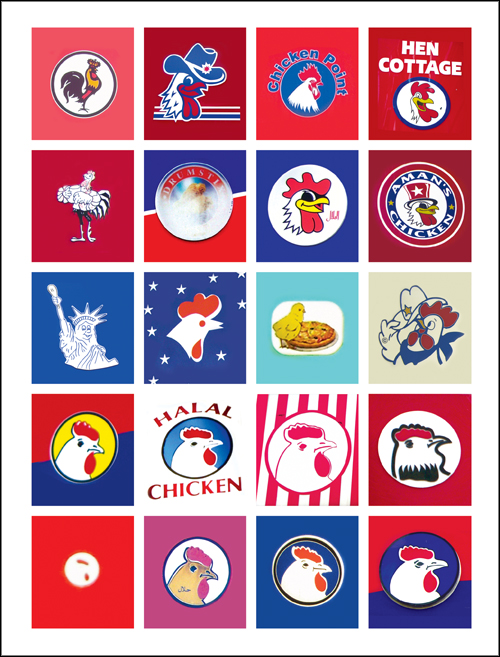
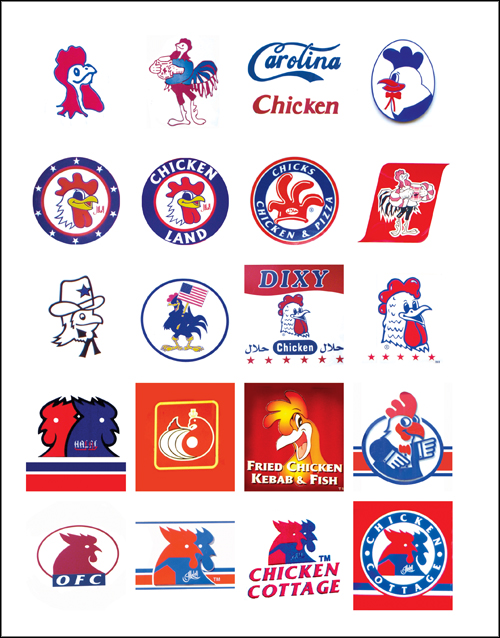
London's fried chicken restaurants are a bizarre and wonderful institution -- generally, they have American-ish names (Dixy Fried Chicken, Southern Fried Chicken, Carolina Fried Chicken) and KFC-ish logos, all carefully titrated to be just far enough from the KFC version to keep the Colonel's savage attack-lawyers at bay. I photograph these places semi-compulsively, but I never knew (until today) that all their signs were designed by a single virtuoso fried-chicken sign-painter named Morris "Mr Chicken" Cassanova, who warrants his own chapter in Siâron Hughes's 2009 book Chicken: Low Art, High Calorie. A post on Creative Review excerpts Hughes's interview with Mr Chicken:
Siâron: In London, how much of the signage would you say you’re responsible for?Morris: I would say 90% of the logos that’s been used out there now, was originally designed by ourselves. People see them and try to change them around a little bit, and you will see somewhere along the line somebody will have something looking similar to that. It’s not all about the bits and pieces that goes with it, they will automatically try to copy it.
Siâron: There’s lots of mimicking America going on isn’t there?
Morris: Yeah, yeah the majority of shop owners out there they want for some reason or other, because Kentucky Fried Chicken is an American company, they wants to give the impression that they are linked with the American fast food chain. In the past Kentucky usually have a little logo, a little slogan, “American Recipe,” people used to copy that. I mean a lot of people still try, and we say, “Oh that’s old fashioned, people not using that again.” Because they try to pull the wool over people’s eyes, you get your Dallas, it’s American, you get your California, it’s American, you get your Mississippi it’s American, and so forth and so on, and people just use those names to link with America just as well as they’re using their recipe, y’know. You hardly ever see a sign saying English Fried Chicken, or with an English name or anything like that.
Siâron: You’ve already mentioned how the menus aren’t necessarily very American anymore?
Morris: No it’s not so American anymore, because people eventually found out it doesn’t matter anymore, once the product is good and it’s selling that’s all people is interested in. In the early days when Kentucky first came over everyone was brain-washed, y’know? It’s American and it’s good, it’s gotta be good because it’s American. It’s not just chicken shops it’s pizza, too. You get people like Domino Pizza or Pizza Hut. You find other little shops they learn how to do pizza and wise up to it, once the quality of your product is good you’ve got companies like Perfect Fried Chicken, which looks different and changes their logo.
Meet Mr Chicken (Thanks, Alice!) 
|
|
18 Jan 01:20


Why the sum of all positive integers is -1/12
by Cory Doctorow
Here's a brain-meltingly cool proof of the bizarre mathematical truth that the sum of all positive integers (1 + 2 + 3 + 4 + 5....) is -1/12. This is not only provably true, it's also foundational to certain testable elements of physics. In other words: not just a logical curiosity, but also the bedrock of real-world, useful stuff.
ASTOUNDING: 1 + 2 + 3 + 4 + 5 + ... = -1/12 (via Kottke) 
|
|
Strider_short and -1 others like this
18 Jan 00:50
Awkward Moments When You’re Unemployed
by Kimber Streams
BuzzFeed draws attention to the common experiences of being unemployed in a recent video, “10 Awkward Moments When You’re Unemployed.” The video was inspired by the BuzzFeed posts “38 Signs You’ve Been Unemployed Too Long” and “The 17 Worst Moments Of Any Job Hunt.”
15 Jan 21:12
The World’s Most Photographed Places
by swissmiss

This Google-generated “heat map” showing the most photographed locations on Earth made me look.
(via Wired)

14 Jan 20:34
as Parents Age, Asian-Americans Struggle to Obey a Cultural Code
by By TANZINA VEGA
Asian-Americans are struggling to abide by a strong tradition in which they are commonly expected to care for their parents at home, but few institutions are prepared to help.
|
|
13 Jan 23:30


See The Original Alice In Wonderland Manuscript, Handwritten & Illustrated By Lewis Carroll (1864)
by Ilia Blinderman
On a summer day in 1862, a tall, stammering Oxford University mathematician named Charles Lutwidge Dodgson took a boat trip up the River Thames, accompanied by a colleague and the three young daughters of university chancellor Henry Liddell. To stave off tedium during the five-mile journey, Dodgson regaled the group with a story of a bored girl named Alice who finds adventure in the most unexpected places. By the day’s end, Liddell’s middle daughter, also named Alice, was so enthralled by this account that she implored the mathematician to write the story down. Some three years later, Dodgson would publish Alice’s Adventures in Wonderland under the nom de plume of Lewis Carroll (the pen name is an Anglicized version of “Carolus Ludovicus,” the Latinized form of Charles Ludwidge). The perennial children’s read was immediately popular, counting Oscar Wilde and Queen Victoria among its ardent fans, and has never been out of print since its initial publication in 1865.
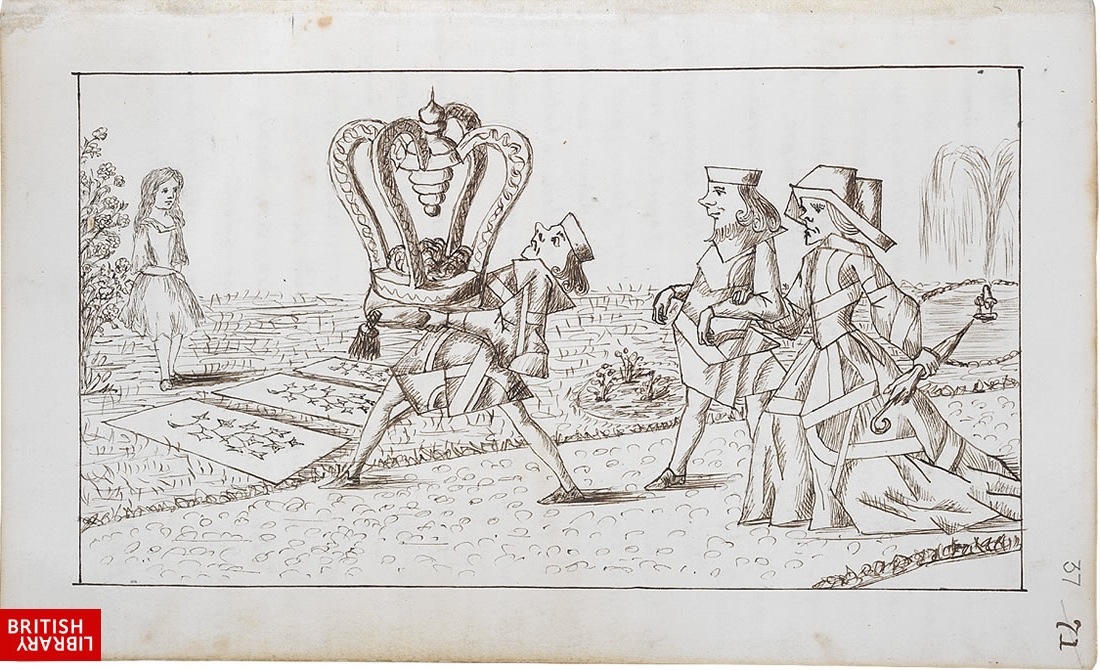
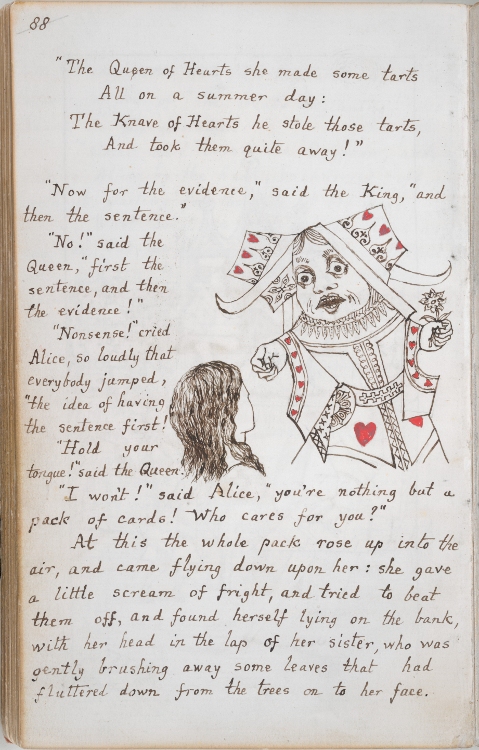
Alice’s Adventures Under Ground, the original version of the book that Carroll presented to Alice Liddell in 1864, is presently housed in the British Library, which has graciously made it freely available online. You can view it here. The handwritten volume includes 37 crisp ink illustrations, all personally drawn by Dodgson. Discerning Alice readers will notice that these illustrations differ to the iconic images (and, to my eyes, very much superior) created by famed Punch magazine political cartoonist John Tenniel.
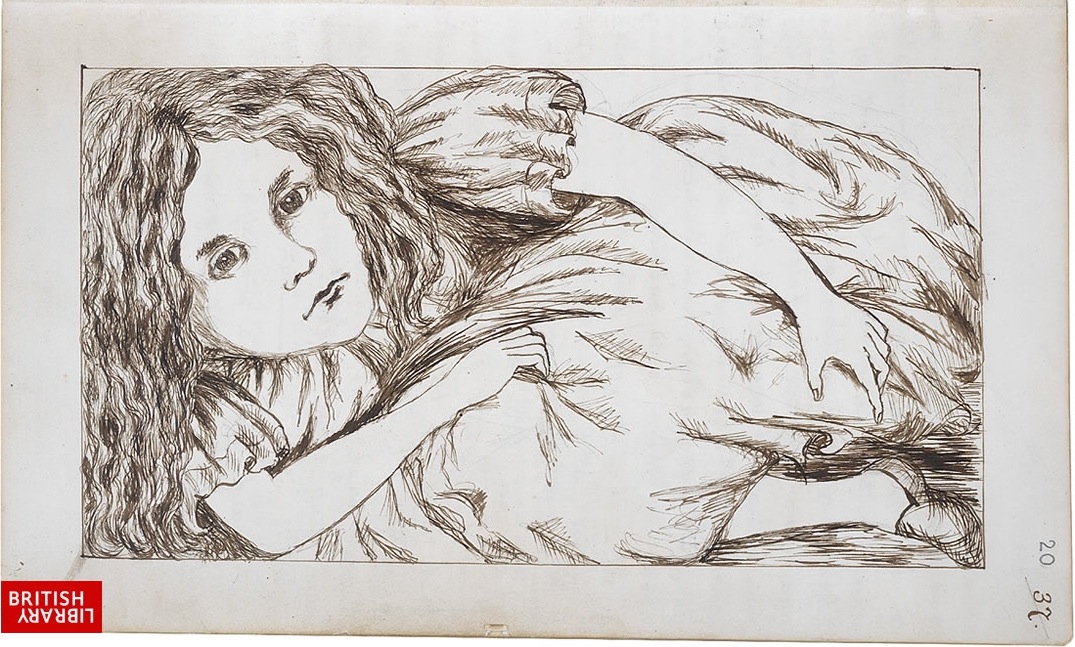
Title and illustrations aside, the original manuscript is considerably slimmer than the final version, containing roughly 12,000 fewer words.
Those wishing to revisit Alice’s adventures can do so at the British Library’s site. An audio version is also available at the Flash version of the site, here. Other versions of Alice have been catalogued in our collection of Free eBooks.
Ilia Blinderman is a Montreal-based culture and science writer. Follow him at @iliablinderman.
Related Content:
See Salvador Dali’s Illustrations for the 1969 Edition of Alice’s Adventures in Wonderland
Meryl Streep Shrooms Her Way Through Modern Alice in Wonderland
The Real Alice in Wonderland Circa 1862, and Our Favorite Culture Links on the Web
See The Original Alice In Wonderland Manuscript, Handwritten & Illustrated By Lewis Carroll (1864) is a post from: Open Culture. You can follow Open Culture by signing up for our Daily Email. That is the most reliable and convenient option. You can also find us on Facebook, Twitter, and Google Plus.
13 Jan 23:28
One Shot Makes a Single Cup of Miso Soup in One Minute at the Push of a Button
by Kimber Streams

Japanese online retailer Marukome has created One Shot, a machine that makes a single serving cup of miso soup in one minute — similar to a Keurig coffee maker, but for soup. It makes up to 75 cups, and users can choose the strength of their soup and add various mixes of dehydrated vegetables for flavor. The One Shot will go on sale at the end of January.
image via Marukome
via ITmedia, RocketNews24
13 Jan 23:24
Fast Talking Squirrel Verbally Expresses His Gratitude
by Lori Dorn
Ramon the fast-talking squirrel verbally expresses his gratitude for the walnuts that had been left out for him, while simultaneously promising to come back the next day for more.
Hello there, I am a fat little squirrel sitting on your porch. Thank you very much for giving me these delicious walnuts. I like them very much. You are a nice person. I will be sure to come back tomorrow to get some more walnuts. You are my favorite person in the neighborhood. I like you like you love you…
video by K. John Stewart
13 Jan 23:03
Quand vous vous faites un ami, il prend la place d'un autre dans votre cerveau
by Alice Bru
Vous ne pouvez avoir qu'un nombre limité d'amis proches, et quand vous vous en faites un nouveau, vous vous séparez d'un ancien, révèle une étude menée conjointement par des chercheurs des université d'Oxford et Chester en Grande-Bretagne et Aalto en Finlande, publiée sur Pnas, le site de l'Académie des Sciences américaine. Le Medical Daily explique que, pour cette expérience, 30 jeunes gens scolarisés en dernière année de lycée et sur le point d'entrer à l'université ou dans le monde du travail ont été recrutés. Les chercheurs leur ont demandé de lister leurs relations et d'évaluer le niveau d'intimité partagé avec eux sur une échelle de un à dix, dix étant la proximité maximale avec cette personne, ceci au premier jour de l'étude puis aux neuvième et dix-huitième et dernier mois de l'enquête (six participants ont quitté le programme entre-temps). En compensation, chaque participant a reçu un crédit téléphonique de 500 minutes et SMS illimités. Ces relations, explique l'étude, forment un schéma d'interactions appelé signature sociale, qui est particulièrement robuste. En analysant les données enregistrées par les téléphones et en les croisant avec les réponses aux questionnaires, comme le détaille le Cut, les chercheurs en sont venus à ces conclusions: le cerveau humain ne peut gérer qu'un nombre restreint de relations proches. Selon l'étude, une grande partie des efforts de communication de la personne étudiée sont ... Lire la suite


11 Jan 10:11
A Map of the Population Distribution of the United States Measured in Canadas
by Kimber Streams

(larger)
This map shows the population distribution of the United States as measured in units of Canadas. The entire population of Canada could fit into each outlined area on the map labeled “Canada,” which shows the higher population density in areas in the Northeast and Southern California. The original creator of the map is unknown.
firehose likes this
10 Jan 20:57
Elderly British Actors Reenact a Mind-Boggling YouTube Comment Discussion About Nelson Mandela’s Death
by EDW Lynch
British actors Grahame Edwards and Eryl Lloyd Parry reenact a mind-boggling YouTube comment discussion for the video “Nelson Mandela Is Dead – Official News” in which it becomes clear that one commenter has no idea who Nelson Mandela was. The video is the fifth “YouTube Comment Reconstruction” by UK comedy channel Dead Parrot (see our previous coverage).
firehose likes this
09 Jan 20:44
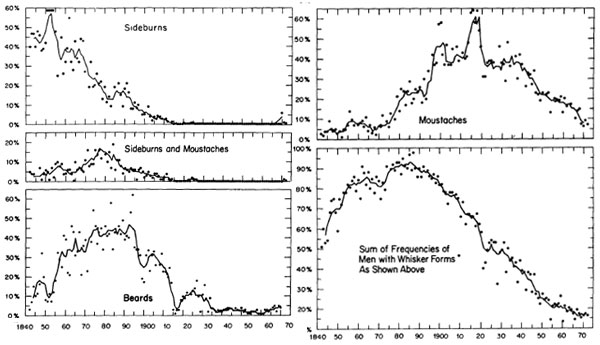 There was a time when more than half of the men had sideburns; then there was a time when they became vanishingly rare. Then the 1970s happened. [Flowing Data]


Frequency of Men with Whiskers, 1842-1872
by Rob Beschizza
There was a time when more than half of the men had sideburns; then there was a time when they became vanishingly rare. Then the 1970s happened. [Flowing Data]|
|
Vvicked and -1 others like this
09 Jan 20:43
The eyes of the starfish
by Maggie Koerth-Baker
Starfish have eyes — not just light-sensitive "eye spots", but real, honest-to-Poseidon eyes, one at the end of each of their arms. They probably see the world differently than we do (for instance, they're likely colorblind and can't see at near the level of detail), but they can see. And they know about that time you poked them with a stick. 


|
|
09 Jan 20:42



The best business card in the world
by Rob Beschizza
If The New York Times were for sale, it would have an interesting billionaire bidder: Guangbiao Chen, said to be China's most influential person, most prominent philanthropist, moral leader, earthquake rescue hero, well-known and beloved Chinese role model, most charismatic philanthropist, top low carbon emission and environmental protection advocate, and foremost environmental preservation demolition expert. [via Business Insider] 
|
|
09 Jan 20:38


Men named Dennis more likely to become dentists
by Rob Beschizza
Nominative determinism--one's name influencing oneself--is real. Alice Robb, for The New Republic, recaps research from the last decade or so.
Can we blame Ron Paul’s political ambitions on his last name? Research suggests that people choose—or are unconsciously drawn to—careers that resemble their own names. The effect is stronger for women’s first names and men’s last names; psychologists hypothesize that women are less attached to their last names because they anticipate taking their husbands’
Depending on how you pronounce it, "Beschizza" sounds like various German words and slang terms meaning things like messed up, crappy, shitty, shitfaced, etc. Workin' on it, guys.
|
|
09 Jan 20:37


The most heartbreaking thing David Attenborough has ever seen
by Maggie Koerth-Baker
Chimpanzees are omnivores and not just in the sense of eating grubs or enjoying a little meat when they can scavenge it. They kill. In fact, some troops will go hunting without any visible prey nearby — which is a pretty interesting bit of thinking and planning, in and of itself. Disturbingly, what they hunt is other primates. In this video, a group of male chimps hunt and kill some colobus monkeys, a scene that narrator Sir David Attenborough described as "most distressing/upsetting moment" in his career during a recent Reddit AMA.
|
|
08 Jan 09:26


China blocks the Guardian, censorship-tracking website says
by Jonathan Kaiman
Attempts to access the Guardian site in Beijing fail, but no clear reason for China's leadership to take issue with recent content
07 Jan 21:06


Reading creates changes in your brain — and that's a problem for neuroscience
by Maggie Koerth-Baker
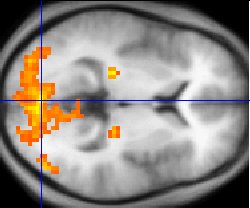
At the Brain Watch blog, Christian Jarrett explains why that "reading a novel changes your brain" study really matters. Turns out, it has big implications for neuroscience. Not because it proves reading makes you smarter or anything, but because it demonstrates flaws in a fundamental assumption of most neuroscience research — that the "resting state" of your brain represents a neutral zone that you can easily compare to what happens when you do a given activity.
|
|
07 Jan 21:02


You will be amazed by this guessing-game based on cutesy clickbait headlines!
by Cory Doctorow
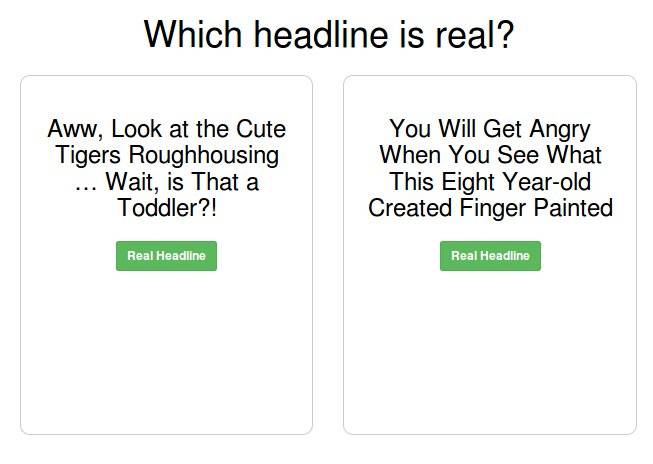
One of the signs of the apocalypse is at hand: the seal has been opened and the daemonic elder headlines are loose upon the world. Can you tell fake from real in Headlines Against Humanity? You won't believe which of these headlines are genuine! 
|
|
07 Jan 20:05
LOL My Thesis
by swissmiss
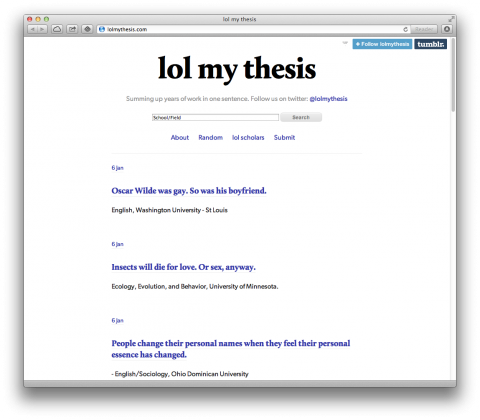
LOL my thesis sums up years of work in one sentence. Made me laugh!