Allison recently did an interview with Chief Learning Officer® about the future of learning technology. Please view the video of the interview below.
The Future of Learning Technology from Human Capital Media on Vimeo.
Allison recently did an interview with Chief Learning Officer® about the future of learning technology. Please view the video of the interview below.
The Future of Learning Technology from Human Capital Media on Vimeo.
I came across the idea of using value creation stories to assess the value of online interactions in an article by Jane Bozarth. She used a conceptual framework from Etienne Wenger, Beverly Traynor and Maarten De Laat to write the story of how her online interactions create value. Their framework thinks about value in terms of five different cycles, which Jane summarises clearly in a diagram in her article.

Value creation cycles
As Jane urges, I have read the full text of this framework, and have used their guiding questions to write a value creation story about my participation in the 702010 Forum. This is my practice run in preparation for gathering value creation stories to evaluate communities that I am helping develop in my organisation. I’ve written this post by responding directly to the guiding questions relating to each cycle of value creation. However, I would document value creation stories within my organisation by writing or recording (audio or video) a more natural narrative.

The 702010 Forum is a community of practice for learning and performance professionals applying the 702010 framework. Membership is subscription based, with some resources and webinars publicly available. A toolkit contains resources to support application of 702010, and members can participate in a range of events and an online discussion forum.
I have participated in a variety of asynchronous and synchronous activities including:
– attending webinars or viewing recordings, especially case studies by members
– delivering two case studies on webinars
– attending face-to-face events
– initiating and replying to discussions in the forum – and extending this in one case to email and phone discussions on a solution shared in the forum (more below)
– participating in a pilot of the Forum’s 702010 Practitioner Certification
– sharing and applying resources from the Toolkit with others in my organisation to assess status and develop improvements

Toolkit snapshot – showing entries I’ve ticked off as read
 Within a few months of joining the Forum I realised that while my organisation had adopted the 702010 framework a number of years ago, we had narrowly interpreted it. We were deploying blended learning where we used activities based on learning from experience (70) and others (20) within formal structured programs. However, we were not purposefully enabling people to learn as they worked or building ongoing social learning capability. From a webinar on the changing role of the learning function I saw that the skills of our capability team needed to be broadened. I gained an understanding and language to talk to key stakeholders about the opportunity to impact organisational performance more effectively if we added performance consulting, performance support, and social learning to our toolkit.
These activities and insights enabled me to have different discussions about 702010, our learning strategy, and internal Capability skills, particularly with senior managers and our Capability team. The most significant shift it enabled was an update to our Capability strategy in April 2014 to include ‘Continuous Workplace Learning’ as an element. This broadened the remit of our Capability team and created the space for us to get strategic with social learning.
We revamped our Governance Board by applying the “Toolkit for Establishing a Learning Governance Board.” Consequently we get better value out of our quarterly meetings by focussing on alignment with our business strategy.

Tonkin & Taylor Knowledge Shots webinar
A specific initiative accelerated by a case study in a Forum webinar was setting up a knowledge sharing site on SharePoint. When a senior manager gave me 1 day to prepare a prototype of a community hub on SharePoint I recalled a webinar where Tonkin & Taylor demonstrated their Knowledge Shots solution. I incorporated this into our prototype, and went on to build a variant of this for my organisation. You can see what this looks like in the guided tour of a community hub now set up on SharePoint. (Big thank you to Tammy Waite and Mark Thomas from Tonkin & Taylor, Forum members, for the support they provided by email and phone.)
As per the examples given above, application of ideas, tools and solutions from the 702010 Forum has enabled me to perform and contribute to my organisation in ways I may not otherwise have been able to.
The 702010 Forum was one of the first Learning & Development communities that I’ve participated in. During 2014 I got active on Twitter and started this blog. This helped me to create a Personal Learning Network (PLN) which encompasses many other communities (e.g. Third Place, OzLearn, PKMChat). Collectively my participation in a number of communities and interaction with my PLN has transformed and accelerated my professional development.

My first webinar delivery
One way that the Forum has supported my development has been by increasing my confidence to work out loud publicly in order to learn and improve. In December 2013 I delivered a case study in a Forum webinar. I found the reflection and learning from delivering this webinar valuable, and saw that others could benefit from me working out loud. This was a catalyst – it gave me the motivation and confidence to continue working out loud by blogging and speaking at conferences.
Realised value for my organisation is unfolding. It’s also difficult (and unnecessary) to unravel the influence of the 702010 Forum on my organisation’s performance versus that of other communities and networks I participate in. Our Capability strategy is better aligned to our overall business strategy as a result of applying ideas and tools from the 702010 Forum. We are using a broader range of Capability approaches and activities to achieve our goals. I think it will be another 6-9 months before we are clear on the outcome of these activities.
An emphatic YES to this question. It’s shifted the perspective of two very important stakeholder groups, senior managers and the Capability community, about the importance of the 70 and 20 elements of the framework and the range of approaches we can use to build Capability. We’ve reframed our Capability strategy, launched communities of practice and embraced performance consulting.
I shall close by encouraging everyone reading this to reflect on the communities and networks they are part of and consider their current level of participation. The more you participate, interact with others, apply ideas from these groups and share back what happened, the more value you create for yourself, your organisation and other community members. So, what are you waiting for? Get in there and participate.
I’d love to hear about the value that others have found in participating in communities and networks – you can leave your thoughts below or pingback to your own blog posts.


“So it is important to understand that there is no one-size-fits-all philosophy in terms of successful innovation. The one constant is that you have to be open to change and new points of view. Innovation is continuous.
Successful innovators and entrepreneurs all embrace change and the risks that they pose. In fact, innovation is the poster child of the mantra that there are no rules. Only by trying out new things, by failing, by discovering what works and what doesn’t, do you gain answers to the innovation question.” – Shaun Coffey
This is a continuation of my last post, where I said that innovation and PKM were interconnected. Innovation has been described as a combination of observing; questioning; experimenting; and networking. This correlates with Seek > Sense > Share in PKM.
Practising PKM, as a flowing series of half-baked ideas, can encourage innovation and reduce the feeling that our exposed knowledge has to be ‘executive presentation perfect’. Workplaces that enable the constant narration of work and learning in a trusted space can expose more implicit knowledge. Organizations can foster innovation by accepting that collective understanding is in a state of perpetual Beta. A culture of innovation can be created by changing daily behaviours, which the practice of PKM can do.
Innovation is not so much about having ideas as it is about connecting and nurturing ideas. When we remove artificial boundaries, we enable innovation. In complex situations, where various people are working on similar problems, it is important to know who has done what. The challenge for distributed teams and organizations is to find ways of understanding what is happening throughout the system and ensuring it is communicated within the network.
The connection between innovation and learning is evident. We can’t be innovative unless we integrate learning into our work. Here are some questions that the practice of PKM can address:
We seek new ideas from our professional social networks and then filter them through more focused conversations with our communities of practice, where we have trusted relationships. We make sense of these embryonic ideas by doing new things, either ourselves, or with our work and project teams. We later share our creations, first with our teams and perhaps later with our communities or even our networks. We use our understanding of our communities and networks to discern with whom and when to share our knowledge.
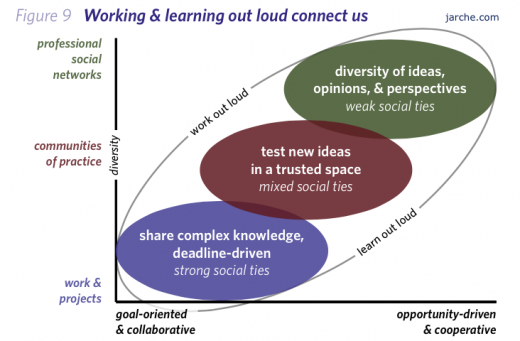
One challenge of finding new knowledge is that social networks are comprised mostly of non-core knowledge. There is often more noise than signal. However, given their diversity, social networks are where we can find innovative ideas. This is why PKM skills are so important for organizations today. Testing new knowledge is where communities of practice can be handy. Gaining competitive knowledge is the obvious return on investment for fostering internal and external communities of practice.
So here is a clear value proposition. Communities of practice act as filters of new knowledge in order to find competitive knowledge for your organization. People who understand the context of the work teams must participate in communities of practice, as only they can identify what new knowledge could be competitive. That means that those doing the work need time and support to get away from their teams and see the bigger picture.
Steven Johnson, author of Where Good Ideas Come From, observed that, “innovation prospers when ideas can serendipitously connect and recombine with other ideas” and that the “secret to organizational inspiration is to build information networks that allow hunches to persist and disperse and recombine”. The network era workplace requires both goal-oriented collaboration and opportunity-driven cooperation, because complex problems cannot be solved alone. Implicit knowledge, that which cannot be codified or put into a database, needs to flow. Social learning, developed through many conversations, enables this flow of implicit knowledge. This is not ‘nonsense chat’, as traditional management might view it, but is essential for creating stronger bonds in professional social networks. Companies have to foster richer and deeper connections which can only be built over time through meaningful conversations. Social learning in the workplace is necessary for any business.
Narration is making implicit knowledge (what one feels) more explicit (what one is doing with that knowledge). Also known as ‘working out loud’, this can be a powerful behaviour changer, as long-term bloggers can attest. Narration can take many forms. It could be a regular blog; sharing day-to-day happenings in activity streams; taking pictures and videos; or just having regular discussions. Narrating work also means taking ownership of mistakes. This requires a culture of openness: making sure that sharing is the default mode for all communications. But people inside organizations, and professional communities, are often afraid to challenge conventional wisdom, even when the data are overwhelming. The power structure exerts great pressure to conform. Only organizations that share power and encourage conflict can advance different ideas. Openness alone cannot drive change.
With 3 billion people connected by the Internet, we are entering a post-industrial network era. Effective knowledge networks are composed of unique individuals working on common challenges, together for a discrete period of time before the network shifts its focus again. We are moving from a ‘one size fits all’ attitude on work and learning to an ‘everyone is unique’ perspective. The network enables infinite combinations between unique nodes. Our interconnectedness is resulting in an increasing number of discoveries from non-traditional areas. In addition, in a networked world, where everyone is unique, there is little need for generic work processes (jobs, roles, occupations) and no need for standard curricula. Institutions, and their mindsets, will collapse. This includes process improvement.
Process improvement is a tool set, not an overarching or unifying concept for an organization. Process improvement is a means and not an end in itself. The fundamental problem with process improvement methodologies is that you get myopic. Methodologies like Six Sigma are great for speeding up assembly lines or minimizing errors, but they fail to produce new ideas.
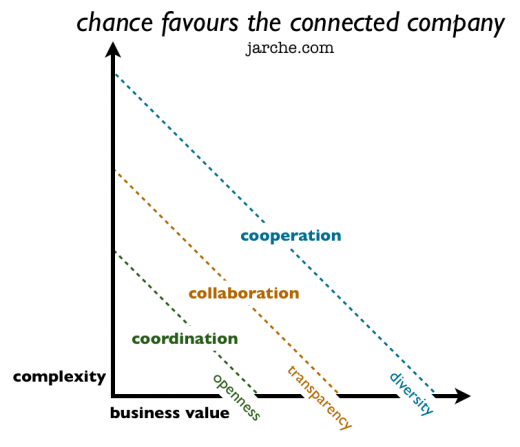
New ideas come from openness. In complex and changing markets, innovation has much higher business value than merely coordinating internal tasks or improving processes. In trusted networks, openness enables transparency, which in turn fosters a diversity of ideas. Supporting the creation of social networks can increase knowledge-sharing which can lead to more innovation, because chance favours the connected company.
Instead of asking, what have you done for the company this week, we should be asking what ideas you have had and what have you done to test them out? It might get us away from measuring and doing things that should be automated in the first place. Automation is not a bad thing if you know what to do with the extra time it provides. Organizations need more innovation catalysts. For example, Domino’s Pizza used the PKM framework to make learning a real-time activity within the flow of work, in order to develop innovation catalysts.
“Catalysts are bound to rock the boat. They are much better at being agents of change than guardians of tradition. Catalysts do well in situations that call for radical change or creative thinking. They bring innovation, but they’re also likely to create a certain amount of chaos and ambiguity. Put them into a structured environment and they might suffocate. But let them dream and they’ll thrive.” – The Starfish and the Spider
 An organization that accepts a certain amount of ambiguity can follow my suggested principles of network era ‘unmanagement’, as opposed to scientific management: It is only through innovative and contextual methods, the self-selection of the most appropriate tools and work conditions, and willing cooperation, that more productive work can be assured. The duty of being transparent in our work and sharing our knowledge rests with every person in the enterprise.

c. 1911
Innovative and contextual methods mean that standard processes do not work for exception-handling or identifying new patterns. Self-selection of tools puts workers in control of what they use, like knowledge artisans whose distinguishing characteristic is seeking and sharing information to complete tasks. Equipped with, and augmented by, technology, they cooperate through their networks to solve complex problems and test new ideas. This only works in transparent environments.
Innovation is not about smart individuals, but rather is a distributed network activity, which is why it is critical for enterprises to nourish their knowledge networks.
The Modern L&D Dept requires other skills than instructional design #C4LPT http://t.co/otoQlyZFbH
— Jane Hart (C4LPT) (@C4LPT) March 10, 2015
from Twitter http://ift.tt/NXO91C
“Are there new ways to think about our digital workplace skills that allows us to take our thinking up to a new plane, the next meta-level of thinking and working where we have much higher leverage, can manage change that is an order of magnitude or greater in volume than today, work in fundamentally better and smarter new ways — and perhaps even work a bit less — yet produce much more value?”
Dion Hinchcliffe asks What Are the Required Skills for Today’s Digital Workforce? and provides an image that addresses a good spectrum of skills for the network era.

I would like to add my perspective to each of these seven digital workplace skills.
Without learning out loud, working out loud can become mere noise (e.g. look at what I am doing!). Without taking action on ideas, working out loud is mere whimsy. But when complex work, the driver of the creative economy, gets a stream of new ideas that have been developed in trusted communities of practice, which are informed by even broader social networks, then we have the foundation for a true digital workplace.
Learning out loud in our social networks helps to seek new opinions and share our own with a diverse group of people. Outside the organization we can make new connections without permission. In addition, trusted spaces, like communities of practice, give us a place to take our half-baked ideas and test them out, with minimal risk. Meanwhile, we can sharpen these ideas and share them in our digital workplaces when we discern the time is appropriate. All of this is an art, requiring ongoing practice, and countless negotiated conversations and relationships.
PKM is a set of processes, individually constructed, to help each of us make sense of our world and work more effectively. If it is not personal, it is not PKM. Connecting people and knowledge is the focus of personal knowledge mastery. PKM builds reflection into our learning and working, helping us adapt to change and new situations. It can also help develop critical thinking skills. The discipline of PKM helps each person become a contributing node in a knowledge network. It is the foundation for social learning, which can help us develop new network era infrastructures to replace outdated institutions and markets. The PKM Seek > Sense > Share model may be simple, but it has multiple layers, such as diversifying our networks, adding value to what we find, curating for later use, and developing new skills to enhance communication: like storytelling.
I use the term ‘mastery’ instead of ‘management’ because PKM is a discipline. It takes time to master. Even if you participate in one of my workshops, you do not gain mastery. This is a difficult concept for managers who want everyone in the organization to have the required skills in ‘X’ months. Human learning does not happen this way. Mastery of a discipline is more than attending a course and taking a test. This is why I do not offer certification in PKM. It would be a useless piece of paper. Instead, recognition by one’s peers [the network] as a master, is an indicator of success.
I differentiate between collaboration and cooperation. Collaboration is working together for a common goal, often with someone in charge. Cooperation is sharing freely amongst equals. Cooperating is a way of nourishing our knowledge networks. Cooperation is not reciprocal, so that what you give does not equate to what you get. This is the nature of networks and goes against many workplace practices, such as staying focused on your job. Being cooperative, so that the entire network gets stronger, helps individuals and organizations in the long run. Cooperation is missing in most workplaces, but as many freelancers already understand, cooperation pays off in the network era.
Network leadership focuses on building better work structures. It consists of strengthening social networks, so that people can connect to do their work better. Network leaders practice and promote personal knowledge mastery, so everyone takes responsibility for sense-making and knowledge-sharing. Active experimentation is encouraged through constant learning by doing, as best practices are useless in dealing with complexity. Business results emerge from the entire network, while everyone is responsible in a transparent and open organization. Network leaders are builders. They focus on creating a more social workplace first and foremost.
Network leadership is helping the network make better decisions.
The social contract that we call employment has been changing for a while. Unions are shrinking, the self-employed are growing, and low wage service jobs are becoming our largest growth sector. What can unite us is our ability to easily connect with each other, without traditional intermediaries. Seb Paquet calls this “ridiculously easy group-forming“.
In a digital workplace, the role of management is to give workers a job worth doing, the tools to do it, recognition of a job well done, and then let them manage themselves. Working smarter means using social media tools, which are inherently designed for transparency, and doing something worthwhile. Social media are the equivalent of an industrial factory for each worker.
We can always learn from the edges of the economy and society, where creativity is usually in higher supply. Take for instance the hacker, defined as “one who enjoys the intellectual challenge of creatively overcoming or circumventing limitations”. Playfulness, cleverness, and exploration constitute essential parts of creativity as well. Like hacking, creativity requires an ongoing commitment. We cannot merely take creative time; it has to be part of our workflow. David Williamson Shaffer says that we need to make space for conversations in order to be creative.
“Creativity is a conversation – a tension – between individuals working on individual problems and the professional communities they belong to.”
Behaviour change comes through small, but consistent, changes in practice. So how do we move from responsibility, to creativity, and potentially to innovation? Play, explore, and converse. But first we need to build a space to practice. This is where management plays a key role: providing the space to ‘Do it Yourself’.
In an age when information is no longer scarce and connections are many, organizations must let all workers actively manage their knowledge networks. Systemic changes are sensed almost immediately in an interconnected world. Therefore reaction times and feedback loops have to get faster. Workers need to know who to ask for advice at the moment of need. However, this requires a certain level of trust, and we know that trusted relationships take time to nurture. The default action in emergencies is usually to turn to our friends and trusted colleagues; those people with whom we have shared experiences. Workers have to start sharing more of their work experiences now, in order to grow their trusted professional networks to deal with new and more complex situations. Practices like learning out loud can build trust.
Sharing complex knowledge in trusted networks does not happen overnight. It requires a combination of actively engaged knowledge workers, using optimal communications tools, all within a supportive organizational structure. Hierarchies, concentrated power, and control are remnants of market dominance and institutional dynamics. Networks are different, for better and worse.
“It’s all about thriving in networks that are smarter and faster than you are. It’s all about being utterly screwed if you don’t know what I’m talking about.” – Hugh MacLeod
As technology advances, so the potential for online learning flourishes
Eddie Chauncy is no stranger to traditional universities – he already holds a degree in English literature from Cambridge. But 20 years after first graduating, when he realised that a knowledge of psychology would benefit his career as a business and finance trainer, he chose to study with the Open University (OU).
“I knew the OU from when I was a kid and I used to watch the maths lessons on TV,” says Chauncy, who graduated from the OU with a psychology degree in 2012. “I’d recommended it to one of my delegates and when I got home that night, I thought: why don’t I make a life change as well? My children were coming to the end of their schooling and my son was doing A-levels, so I had to be around to support him. I also had to earn a living. So it was the only option that worked. It was a wonderful experience and really helped me move forward with the kind of training I could offer.”
Continue reading...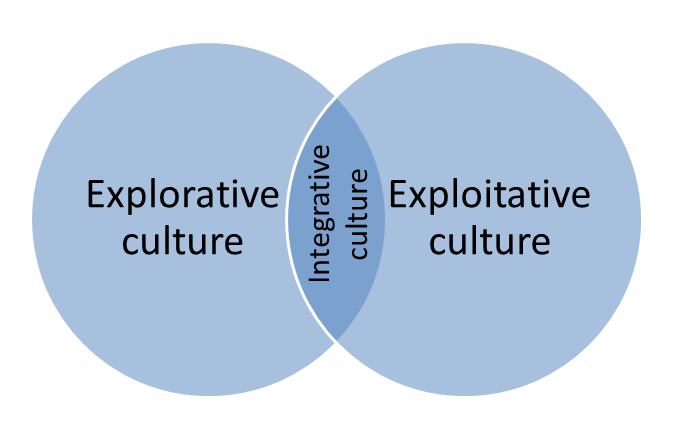
Recently, the Boston Consulting Group (BCG) has published key findings of their latest “Most Innovative Companies 2014” survey. Beside the annual ranking, headed by the top three companies Apple, Google and Samsung, some insightful outcomes with regard to organizational and cultural requirements have striked my eye. According to BCG’s research, successfully innovating companies approach innovation as a system. The system is rooted in experimentation, and, like all adaptive systems, it evolves over time as the external environment and internal needs change.
Adaptability and innovation culture
After studying innovation among 759 companies based in 17 major markets, Gerard J. Tellis, Jaideep C. Prabhu and Rajesh K. Chandy found that corporate culture was a much more important driver of radical innovation than labor, capital, government or national culture. It has further been shown that adaptability seems to be the most critical pillar of successful organization cultures. Research from Charles O’Reilly et al. has found that adaptive corporate cultures are most effective in driving financial performance. But what does adaptability really mean? O’Reilly and his colleagues define culture as a social control system that drives certain kinds of behaviors. Adaptive cultures are those that encourage:
Yet, adaptive cultures are also notable for the behaviors they choose to minimize, O’Reilly notes. There’s less emphasis on being careful, predictable, avoiding conflict, and making your numbers.
An adaptive culture, emphasizing experimentation, promotes “organizational ambidexterity“. While startups and small ventures make big bets, i.e. placing all chips on one number, established companies have to avoid losing what they have already built up. However, they have the resources to conduct experiments in order to explore new fields of businesses, concurrently with exploiting their existing business. IBM with their Emerging Business Opportunity (EBO) intitiave can be seen as a prime exaple for this approach. In 2000, they decided to include exploration experiments in their portfolio. Like actual startups, some of these initiatives failed. But there were enough of them (seven in the beginning) that in the first five years alone, the EBOs added $15.2 billion to IBM’s top line, or more than twice as much as acquisitions did. Lesson learned: a balanced portfolio of exploration and exploitation activities is essential for companies in order to thrive on the short and long term. In a more up-to-date sense, this balance also comprises collaborating with external partners, e.g. teaming up between multinational corporations and startups or small companies.
Those companies are aware that adaptability through adjustment to changing conditions requires an ability to both observe problems and then respond to them with multiple solutions. The point is not in knowing the single solution. It’s about having various of different options and solutions to turn to. There is a downside to businesses that focus heavily on standardization, optimization, and driving out variability: such organizations leave themselves vulnerable to underinvesting in experimentation and variation. Good experimentation helps firms better manage myriad sources of uncertainty when past experience can be limiting. And it is only through such experimentation, which might include structured cause-and-effect tests as well as trial-and-error experiments, that companies can unlock their true capacity for innovation. The right amount of experimentation depends not only on a company’s resources, but also on the pace of change in its industry. If the industry isn’t changing rapidly, doing a lot of experiments may be unproductive and expensive. But if no experiments are carried out at all, the company is likely to be in trouble if the industry is changing.
Given the proven relation between adpative culture and organizational survival and performance, why are so many companies struggling with establishing a culture of exploration, experimentation and variability? Two major stumbling blocks come to my mind.
Organizational stumbling blocks to innovation culture
If we stick to the definition above, a culture directs and rewards certain behaviors and traits being in compliance with organizational values. This leads to a collective mindset how things are being accomplished. Viktor Hwang has introduced the term “social contract” as set of values that governs people’s organizational life. He points out: Culture in business is primarily the conflict between two opposing social contracts. One social contract is based on values of exploitation/efficiency/predictability (metaphor: plantation). The other is based on values of exploration/variance/uncertainty (metaphor: rainforest). Both are valid per se, but are completely opposite in effect. Hwang lists some opposing rules, highlighting this “clash of social contracts”:
Companies that live only on the left side won’t pay off in the end. Companies that live only on the right side are doomed to die. Startups and small companies often tend to stick to the left side. Large organizations – whether corporations or governments – can easily get stuck on the right side. Successful companies must exist in both worlds simultaneously. That’s hard to do – in particular for the people being supposed to succeed in both “worlds”. Most people seek consistency in order to align their behavior and decisions accordingly. Ususally, corporate cultures are dominated by the right side, thus leading people to incline to conform with the corresponding values. According to Bob Sutton and Huggy Rao, for scaling and established organizations in order to operate smoothly and to develop a collective mindset, it’s crucial that people don’t get conflicting messages.
To me, this seems to be a major root cause why putting an explorative culture on top of an (existing) exploitative one – resulting in an “integrative culture” – is extremely difficult. For example, introducing a “x percent rule”, permitting workers to dedicate a portion of time to exlorative projects beside their “core business”, may be sufficient to generate ideas and develop them up to a certain stage. But in most cases this setup does not lead to well-aligned and time-efficient incubation, let alone scaling, within the organization. Succeeding in these phases is strongly tied to full-time resources and a supportive environment. Sure, there are some companies, such as W.L. Gore, proving that this kind of organizational culture can be possible, but these are obviously rare exceptions. It’s a bit like mixing a symphony orchestra with a jazz band and expecting an outstanding concert to happen.
With that said, it may be indicated to shape distinct cultures with dedicated values, requirements and people. Each side must operate as if the future of the company depended on it alone! The cultures need to be separated, but with some overlapping “touchpoints” where capabilities, ideas and knowledge are exchanged in order to avoid isolation and to benefit from each other. Examples for touchpoints can be idea management platforms, portfolio management boards, corporate strategy teams or company-wide events and communication platforms. These touchpoints are to be staffed with well-suited people, being capable of integrating both world views and dynamically setting the right priorities. How exploration and exploitation can further be integrated through so-called “integration mechanisms” has been outlined earlier.
Case in point: many energy providers and electric utilities are currently undergoing this organizational and cultural tension. While they have been operating on the basis of an entrenched, monopolistic and highly predictable business model and “production-centered mindset” for decades, they are now being forced to transform towards customer-oriented energy service providers. This requires searching for novel, customer-centered business models and tapping emerging markets through experimentation, iteration and openness. This need for innovation is driven by values and capabilities being opposed to what made the companies successful. If not organized and lead properly, such transformation processes are therefore in danger to be accompanied by disorientation, demotivation and frictional losses.
Human stumbling blocks to innovation culture
Another road block directly goes back to human nature. Our species features a couple of traits, withholding most of us from embracing activities that we intellectually know would be conducive to innovation. Some of these traits are:
How can mandatory experimentation and variance be fostered in face of these common human traits? In fact, we face another paradox here: although an explorative culture is the means of choice to tackle uncertainty on a macro-level, it is often refused since it increases uncertainty on a micro-level. Reiterating the argument above: it seems reasonable to set up dedicated, protected spaces for experimentation, variance and diversity, resourced by people being equipped with the required personal traits. This highlights the importance of proper recruitment for innovation success and sustainable organizational performance.
Organizational and cultural drivers for breakthrough innovation
The made suggestions are supported by BCG’s study outcomes. Breakthrough innovators (i.e. strong and disruptive innovators) – accounting for only 7.6% of BCG’s sample, by the way – seem to be especially effective at bringing together required management, governance and organizational design and synthesizing them for high impact.
BCG emphasizes the different innovation drivers as follows:
Management. Top management is commited to radical innovation efforts. It backs its commitment with the willingness to green-light radical-innovation projects based on nonspecific or nonfinancial expectations of success rather than projected future returns. Management uses KPIs for radical and incremental projects. It links incentives, recognition, and appraisals to an individual’s contribution to radical innovations. Three-quarters of breakthrough innovators link incentives to radical innovations.
Governance. Breakthrough innovators differentiate clearly among projects with low and high degrees of innovativeness and use different processes for radical and incremental R&D projects. Radical projects initially are permitted to have more openly defined project targets. Radical innovation processes allow for iterations and adjustments of initial plans to give individuals and teams ample room and time for experimentation. Breakthrough innovators protect radical innovation projects from strict cost-control regimes. More than 80 percent of breakthrough innovators allow projects to start with no projection of future returns.
Organization. Three-quarters of breakthrough companies use different processes and KPIs for radical innovation projects. They maintain open organization structures for radical-innovation entities that easily allow for collaboration with internal and external partners. They promote a culture of experimentation and testing that characterizes the radical innovation team.
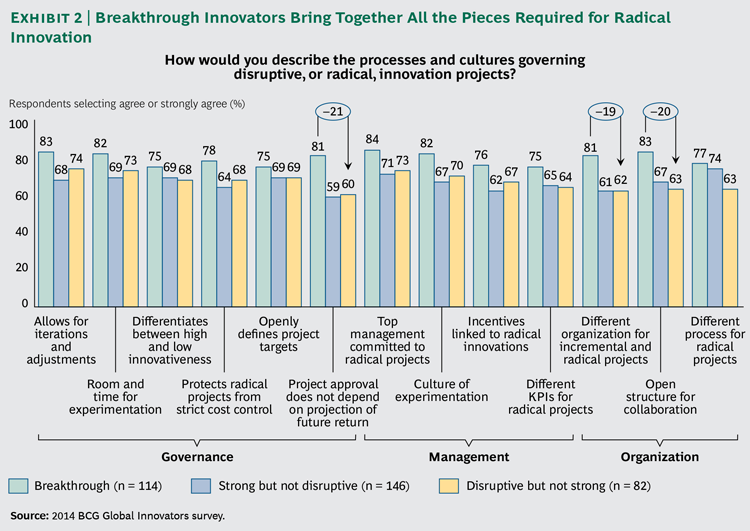
As can be seen from the figure above, it turns out that successful breakthrough innovators distinguish significantly in terms of the following – primarily organizational and cultural – characteristics:
Finally, BCG concludes:
By definition, breakthrough innovation is the introduction of new ideas that drive a different way of doing things. This requires risk taking, of course, since no one can foresee the outcome or results of such initiatives. Breakthrough innovators are willing to make decisions and choices as much on the basis of intuition and insight as on data and forecasts – they bet on people rather than manage a process.
In our experience, a dedicated environment is required to promote this kind of approach. And indeed, across all companies and industries, there is a growing trend toward a centralized approach to innovation and product development – meaning that these functions and processes are either controlled and driven by a centralized organization, or a centralized organization conducts R&D and passes the framework for new products and services to business units or regional units for development and launch. This trend is even more pronounced among strong innovators, with those pursuing a centralized approach rising from 68 percent in 2013 to 71 percent in 2014. Similarly, about 70 percent of disruptive innovators also lean toward a more centralized approach. Two-thirds of all breakthrough innovators stated that all innovation and product development is controlled and driven by a centralized organization, at least in its initial stages. More than 70 percent have a different organizational entity for managing radical innovation.
Some breakthrough innovators manage to use the entire company as a new-idea laboratory. Apple under the late Steve Jobs is perhaps the best-known example. Google’s policy of encouraging employees to spend 20 percent of their time working on their own ideas is another. The 3M Company sets the goal of earning 30 percent of its revenues from products introduced in the past five years, and the company aligns its culture and incentives accordingly. It has long allowed its employees to spend up to 15 percent of their time on projects of their choosing. But such companies are for more the exception than the rule.
Takeaway
Successful companies and their cultures are built on a common crucial pillar: adaptability. Adaptability is based on particular explorative values and behaviors, such as experimentation, iteration and variance. Moreover, it comes along with the need to deal with uncertainty and ambiguity. These requirements are basically incompatible with “daily business” and common human traits, where failure avoidance, short term orientation, habit formation and preference for predictability prevail. In order to build an organizational culture, being conducive to adaptability and innovation, the following advice can be given:
This post was published first at Integrative Innovation.

I recently came across the following story: The Japanese have always loved fresh fish. But the water close to Japan has not held many fish for decades. So to feed the Japanese population, fishing boats got bigger and went further than ever. The further the fishermen went, the longer it took to bring the fish. ...
The post The Challenges of the Agile PMO appeared first on ESI PM Blog.
Update: There is now a report by Graham McElearney from this White Rose Learning Technologists’ event (this report includes a recording of the presentation by Martin Hawksey).
I was recently invited to ALT’s White Rose Learning Technologists’ SIG to talk about Learning Analytics (LA). I first started getting interested in Learning Analytics in 2011 but I was initially reluctant to talk on the topic as I’ve recently realised how much I don’t know about this area. Another factor was my fear that learning analytics is being eroded by ‘counts’ rather than actually caring about the learner. With this in mind I decided that sharing my fears and areas I’ve struggled with would be useful for the audience. A great source of inspiration for my presentation was a talk given by Dragan Gasevic a recording of which is currently here and Dragon’s slides are on Slideshare. While Dragon focused on Learning Analytics for MOOCs transfer into other modes of learning and teaching. My own slides are available online and a recording may be available soon. Here are some of my personal notes and reflections that supplement the slides:
Amazon cares not a whit *why* people who buy german chocolate also buy cake pans as long as they get to the checkout buying both – Mike Caulfield – Short Notes on the Absence of Theory
I was fortunate to be in the bar room when ‘absence of theory’ was being discussed at MRI13. The thing that hit me hardest was the reflection that throughout my career there has been an absence of theory. Like many other learning technologists I jumped into this area from another discipline, in my case structural engineering. Consequently I started in this area with more knowledge of the plastic analysis or portal frames than educational theory. Being a curious person has taken me down numerous avenues and often along the way I’ve been lucky to work and learn with some of the best. For example I was fortunate to work with Professors David Nicol and Jim Boyle at the University of Strathclyde, Jim arguably being responsible for importing Peer Instruction to the UK. So while I have some theory I don’t have enough and whilst I have connections to some of the best people in LA my job isn’t aligned. But enough about me, without theory the danger is you have data but no actual insight to what it means.
Graphs can be a powerful way to represent relationships between data, but they are also a very abstract concept, which means that they run the danger of meaning something only to the creator of the graph … Everything looks like a graph, but almost nothing should ever be drawn as one. – Ben Fry in ‘Visualizing Data’
The consequence is ‘every chart is a lie’, a representation of data defined by it’s creator. One option here is to turn the learner into the creator. With modern web browsers it’s becoming even easier for someone to become the explorer of their own data. Dashboards, which appear to have the same appeal as Marmite, can also be personalised to give more meaning to the learner. Even with personalisation and customisation there is a danger of misinterpretation which Dragon highlighted with Corrin, L., & de Barba, P. (2014). ‘Exploring students’ interpretation of feedback delivered through learning analytics dashboards’.

The worlds of privacy and analytics intersect …not always happily – Stephen Downes
I was browsing some slide decks by Doug Clow as part of the LACEProject and he captured the sentiment nicely highlighting that there needs to be transparency when using learning analytics. He contextualised this around guidance and support rather than surveillance and control. Given the varying degrees of apathy I see around data and privacy this is a conversation always worth having. There is clear outline of ethical considerations in the Analytics for Education chapter penned by my co-authors Sheila MacNeill and Lorna Campbell:
Ethical Issues
As institutional managers, administrators and researchers are well aware, any practice involving data collection and reuse has inherent legal and ethical implications. Most institutions have clear guidelines and policies in place governing the collection and use of research data; however it is less common for institutions to have legal and ethical guidelines on the use of data gathered from internal systems (Prinsloo & Slade, 2013). As is often the case, the development of legal frameworks has not kept pace with the development of new technologies.
The Cetis Analytics Series paper on Legal, Risk and Ethical Aspects of Analytics in Higher Education (Kay, Korn, & Oppenheim, 2012) outlines a set of common principles that have universal application:
- Clarity – open definition of purpose, scope and boundaries, even if that is broad and in some respects extent open-ended.
- Comfort and care – consideration for both the interests and the feelings of the data subject and vigilance regarding exceptional cases.
- Choice and consent – informed individual opportunity to opt-out or opt-in.
- Consequence and complaint – recognition that there may be unforeseen consequences and therefore provision of mechanisms for redress. (p. 6)
In short, it is fundamental that institutions are aware of the legal and ethical implications of any activity requiring data collection before undertaking any form of data analysis activity.
At best analytics can help start a conversation. People have to be willing to take the conversation on – Roberts, G. Analytics are not relationships
My biggest fear is Learning Analytics just becomes ‘computer says no’. I’m reassured that there are many people working very hard to make sure this doesn’t happen, but in the glitz and glamor of ‘big data’, prediction algorithms and dashboards there is a danger that we start caring about the wrong thing. For me the biggest opportunity is analytics are used as feedback, helping inform the conversation.

Technology may facilitate great learning, but it’s not the end in itself. What makes great learning is simple: make it great. Understand how people learn: design the learning to match that. Work with how we learn, don’t make us learn how to use the learning. We are highly plastic and fluid in our ability to learn, but that’s no excuse to make it hard.

The best learning? Purposeful, clear, includes both knowledge frameworks and the ability to weave a story around them. Learning is about creating frames and populating them. Sometimes we populate them with external knowledge, sometimes we ‘sense make‘ what goes in them, sometimes we share our experience back to the community and help them through the same process.
But what it means to you will differ from what it means to me.

We need the right mindset around the technology: it’s about experience, curation, sharing and the co-creation of meaning.
Technology facilitates all this, but doesn’t guarantee it: the thing you need most of all? Great learning design: a rigorous methodology.
I enjoy the Learning Technologies Conference: it brings together a wealth of things. Ideas, people, gadgets and systems. Many of them are great (in all four categories). The topics reflect the trends in our industry: ‘wearable‘, ‘cloud‘, ‘neuro‘, ‘game‘, ‘social‘, ‘story‘, ‘video‘, ‘mobile‘ and so on. But the answer does not lie in the individual sessions. Nor does it lie on the exhibition floor.
The solution to the challenge of how to create great learning lies in the mindset of those of us that visit, of those of us that work in this space. Because the best technology in the world will not guarantee great learning. The best story might.
It’s about agility: prototyping, creating space for experimentation, creating opportunities to fail, to practice, rehearse and learn. And that’s just for those of us designing the learning.
No one methodology, solution, supplier or team will solve the problems, will make the learning great. But one mindset will: the mindset of curiosity. The constantly questioning approach: why are we doing it this way? What can we do better?

So much as i’ve enjoyed the conversations, the technologies, the insights and designs, the most important thing for me will be to see how it’s translated into change. How our practice evolves and, somehow, becomes more aligned to the real world. Because for too long, learning has lived in a bubble: abstract, stratified, divorced from notions of excellence in the real world. And that gap is closing as the walls between ‘formal‘ and ‘social‘ erode, as the walls of the office collapse.
Excellent is excellent, wherever we find it, and excellence is what we should strive for.

My map of Learning Technology in 2015


Some of the most productive work happens when you can harness the collective knowledge and skills of a group. When you bring the right backgrounds and experience together, suddenly the most challenging problems feel like they can be solved.
We want every meeting to be great, where things just click. Where ideas flow and work gets done. The problem is, technology hasn’t been designed for the way we want to work together.
That all changes, starting today.
Helping People Create their Best Work Together
Leveraging our core strengths in productivity from our Office and Skype divisions, we set out to create a new Windows 10 experience that would re-imagine meetings and help groups of people be more productive together. We’ve created the world’s first team device – a simple, intuitive Windows interface designed for groups, with ink and touch at its core.

A Canvas as Big as Your Imagination
When Surface Hub’s 84-inch 4k display comes alive, you’ll notice instantly that this is unlike any touch display you’ve ever experienced. We’ve designed it from the ground up to offer a large-format pen and touch experience that is unsurpassed by any other device available today. The display and touch sensor are phase locked at 120Hz – so the display refreshes every 8.33 milliseconds.
By effectively doubling the frame rate on the touch panel, and doubling the frame rate on the display, we’re cutting latency in half. What that means is there is virtually no lag – the display is literally refreshing faster than the human eye can perceive. It feels and appears as responsive as its analog counterparts – but is instantly more productive.
The hardware is also designed to completely transform meeting experiences for remote participants. Fourth Generation Intel i5 and i7 processors power the experience so apps and video are smooth and responsive. Full 1080p cameras on each side with wide field of view help ensure those joining from afar will benefit from a view of virtually the entire room. The built-in mic array leverages technology from Xbox Kinect to detect and follow voices in the room while eliminating background noise.
New Category Only Possible from Microsoft
Surface Hub is about unlocking new capabilities that will address untapped scenarios for our customers and demonstrates the flexibility of the Windows 10 platform scaling to the biggest of screens. With this new experience, Windows 10 will unlock the power of the group for our customers.
Surface Hub a fantastic illustration of the core strengths of Microsoft coming together to transform team productivity via a completely new type of device. We’re combining the power of Windows 10, Skype for Business and Office with innovative hardware from our Microsoft Devices Group.
We could not be more excited to introduce Microsoft Surface Hub, and we look forward to sharing more details in the coming months.
Thank you,
Mike Angiulo
Corporate Vice President, Microsoft Devices Group

The last 14 months saw an upgrade of every single tool in our comparison! These tools had improvements in graphics, animations, mobile compatibility, and 508-compliance, among others. With these new changes, I thought it was time to update our popular—and often controversial—authoring tools comparison.
As before, this is based solely on my opinion and experience. Not even everyone in my own company agrees with me. And we’d love to hear how your experiences might differ!
 Notable Changes
Since the last comparison about six months ago, Articulate Storyline got a bump up in the animations department. There are several times as many animations as before plus motion paths! This is enough for them to overtake Captivate. (Captivate has more animations options, but I think Storyline’s are a little easier to use.) Lectora got an improved score in graphics capability. Lectora 12 now has the ability to crop and rotate pictures as well as create gradients, drop shadows, and other effects. I like to avoid ties in this grid but can’t always. So Lectora and Captivate are now tied in this department.
If you’d like to learn more about how these tools compare to each other, click here to view our latest comparison webinar (recorded on 1/9/15).


The post Updated E-Learning Authoring Tools Comparison appeared first on E-Learning Uncovered.
I’m the Whether Man, not the Weather Man, for after all it’s more important to know whether there will be weather than what the weather will be.
– The Phantom Tollbooth
Dave Cormier has written a couple of great posts on our failure to take learner motivation seriously and the difference between improving learning and improving education. In the latter post—a response to Stephen Downes’ comment on the former post—Dave writes about the tension between improving an individual’s learning and improving our system of education, essentially positing that the reason why we as a society often fail to take learner engagement sufficiently seriously is because we become preoccupied with making the educational system accountable, a goal that we would be irresponsible not to take on but that we are also essentially doomed to fail at. (I may be putting words in his mouth on that last bit.) Dave writes,
There’s definitely something wrong if people are leaving their first degree and are not engaged in learning. We certainly need to address it. We totally want to be in the business of helping people do what they want to do. Try it. No really. Just try it. Sit down with a child and help them do what they want to do. And i don’t mean “hey this child has shown up with a random project they are totally passionate about and are asking me a question” I mean “stop them at a random time, say 8:25am, and just start helping them.” You will get blank stares. You’ll get resistance. You’ll get students who will say anything you want if it means you will go away/give them a grade. You will not enjoy this process. They will also not enjoy it.
There is something wrong. The problem is that we have built an education system with checks and balances, trying to make it accountable and progressive (in some cases), but we are building it without knowing why. We have not built an education system that encourages people to be engaged. The system is not designed to do it. It’s designed to get people to a ‘standard of knowing.’ Knowing a thing, in the sense of being able to repeat it back or demonstrate it, has no direct relationship to ‘engagement’. There are certainly some teachers that create spaces where engagement occurs, but they are swimming upstream, constantly battling the dreaded assessment and the need to cover the curriculum. The need to guarantee knowing.
He suggests that we need to redesign our education system around the goal of getting students to start caring and keep caring about learning. And his argument is interesting:
Give me a kid who’s forgotten 95% of the content they were measured in during K-12 and I will match that with almost every adult i know. Give me a kid who cares about learning… well… then i can help them do just about anything.
This is partly a workplace argument. It’s an economic value argument. It’s a public good argument. If Dave is right, then people who care about learning are going to be better at just about any job you throw at them than people who don’t. This is a critical argument in favor of public funding of a liberal arts education, personalized in the old-fashioned sense of having-to-do-with-individual-persons, that much of academia has ceded for no good reason I can think of. The sticky wicket, though, is accountability which, as Dave points out, is the main reason we have a schism between learning and education in the first place. Too bad we can’t demonstrate, statistically, that people who are passionate about learning are better workers. It’s a shame that we don’t have good data linking being excited about learning, being a high-performer in your job, and being a happy, fulfilled and economically well-off person. If we had that, we could largely resolve the tension between improving learning and improving education. We could give a compelling argument that it is in the taxpayers’ interest to build an education system whose purpose, as Dave suggests, is to increase the chances that students will start to care and continue to care about learning. It’s a tragedy that we don’t have proof of that link.
Oh, wait.
Before I get into the numbers, I think it’s important to articulate the argument in a way that makes intuitive sense even to skeptics. As Dave points out, everybody agrees with the proposition that students should love learning if that proposition is presented to them as a platitude. Where people start to waffle is when we present the proposition to them as a priority, as in, “It is more important for students to learn to develop and nurture a passion for learning than it is for them to learn any particular thing.” And in order to resolve the tension between learning and education, we need to make an even stronger proposition: “A student who develops a passion for learning about subjects that are unrelated to her eventual career will, on balance, be a better employee and more successful professional than the same student who has studied content directly related to her eventual career with relative indifference.” Do you believe this proposition? Here’s a test:
Imagine that you could go back in time and choose an undergraduate major that was exactly tailored to the job that you do today. Would you be better or worse at your job than you are now? Would you be more or less happy?
Obviously, this test won’t work for people whose undergraduate major was the perfect pre-professional major for what they are doing now, which will include most faculty. But it should work for a majority of people, including lots of folks in business and government. In my case, I was a philosophy major, which prepared me well for a career in anything except philosophy. If I could have precognitively created a major for myself in educational technology back in the late 1980s, would I be more successful today? Would I be happier? The answer to both of those questions is almost certainly “no.” In fact, there is a good chance that I would have been less successful and less happy. Why? For one thing, I didn’t care about educational technology back then. I cared about philosophy. I pursued it with a passion. This gave me three things that I still have today. First, I have the intellectual tools of a philosopher. I don’t think I would have held onto the tools of another discipline if I didn’t care about them when I was learning about them. Second, I know what it feels like to pursue work that I am passionate about. I am addicted to that feeling. I am driven to find it in every job, and I am not satisfied until I do. This makes me more selective about the jobs I look at and much, much better at the ones that I take. And finally, though it was a long and winding road, my interest in philosophy led me to my interest in instructional technology in many ways. We tend to have a rather stunted notion of what it means for a subject we study to be “related” to our work. In my philosophy classes, I spent a lot of time thinking about what it means to “know” something, what it means to “learn” something, and what it means for something to be “good.” I got to see how these words are tangled up in logic, language, and culture, and how our notions of them change over time. I learned how to write and how to think, while I was simultaneously studying the first principles of language and cognition. All of these experiences, all of this knowledge, all of these skills have been directly valuable to me in my career as a professional non-philosopher (or a standup philosopher, as Mel Brooks might call me). I wouldn’t have them if I had majored in educational technology. I would have other things, but honestly, there are no deep skills in my work that I wish I had acquired through earlier specialization. Everything that I have needed to learn, I have been able to learn on the job. As Dave wrote, “Give me a kid who cares about learning… well… then i can help them do just about anything.”
If you are one of those people who majored in exactly what you ended up doing as a career, then try reversing the thought experiment. Suppose you could go back in time and major in anything you wanted. Something that you were passionate about, but something different from what you ended up majoring in. Would it have made a difference? Would you have been more or less successful in your current career? Would you have been more or less happy than you are now? For some folks, that pre-professional major was exactly what they needed to be doing. But I bet that, for a lot of folks, it wasn’t.
If any of this resonates with you at all, then you really must read the 2014 Gallup Purdue Index Report. You’ll have to register to get it, but trust me, this one is worth it. Gallup is most widely known for their political polling, but more broadly, their business is in collecting data that links people’s attitudes and beliefs to observable behaviors and objective outcomes. How likely is a person who thinks the “country is on the wrong track” to vote for the incumbent? Or to vote at all? Does believing that your manager is incompetent correlate with an increased chance of a serious heart problem? And conversely, does “having fun” at your job correlate with a higher chance of living into your 90s? Does having a “manager that cares about me as a person” mean that I am more likely to be judged a “top performer” at work and reduce the likelihood that I will be out sick? Does having a teacher who “makes me feel excited about learning” correlate with better workplace engagement when I graduate?
Ah. There it is.
To get the full impact of Gallup’s research, you have to follow it backwards from its roots. The company does significant business in employee satisfaction surveys. As with schooling, managers know that employee engagement matters but often fail to take it seriously. But according to research cited in Gallup’s book Wellbeing: The Five Essential Elements (which I also recommend), employees who could answer “yes” to the question about whether their manager cares about them as a person, are “more likely to be top performers, produce higher quality work, are less likely to be sick, less likely to change jobs, and less likely to get injured on the job.” Also, people who love their jobs are more likely to both stay working longer and live longer. In a study George Gallup conducted in the 1950s,
…men who lived to see 95 did not retire until they were 80 years old on average. Even more remarkable, 93% of these men reported getting a great deal of satisfaction out of the work they did, and 86% reported having fun doing their job.
Conversely, a 2008 study the company found a link between employee disengagement and depression:
We measured their engagement levels and asked them if they had ever been diagnosed with depression. We excluded those who reported that they had been diagnosed with depression from our analysis. When we contacted the remaining panel members in 2009, we again asked them if they had been diagnosed with depression in the last year. It turned out that 5% of our panel members (who had no diagnosis of depression in 2008) had been newly diagnosed with depression. Further, those who were actively disengaged in their careers in 2008 were nearly twice as likely to be diagnosed with depression over the next year. While there are many factors that contribute to depression, being disengaged at work appears to be a leading indicator of a subsequent clinical diagnosis of depression.
Which is obviously bad for employer and employee alike.
In some cases, Gallup went all in with physiological studies. For example, they “recruited 168 employees and studied their engagement, heart rate, stress levels, and various emotions throughout the day,” using heart rate monitors, saliva samples, and handheld devices that surveyed employees on their activities and feelings of the moment at various points in the day.
After reviewing all of these data, it was clear that when people who are engaged in their jobs show up for work, they are having an entirely different experience than those who are disengage. [Emphasis in original.] For those who were engaged, happiness and interest throughout the day were significantly higher. Conversely, stress levels were substantially higher for those who were disengaged. Perhaps most strikingly, disengaged workers’ stress levels decreased and their happiness increased toward the end of the workday….[P]eople with low engagement…are simply waiting for the workday to end.
From here, the authors go on to talk about depression and heart attacks and all that bad stuff that happens to you when you hate that job. But there was one other striking passage at the beginning of this section:
Think back to when you were in school sitting through a class in which you had very little interest. Perhaps you eyes were fixed on the clock or you were staring blankly into space. You probably remember the anticipation of waiting for the bell to ring so you could get up from your desk and move on to whatever was next. More than two-thirds of workers around the world experience a similar feeling by the end of a typical workday.
And here’s what Dave said in his first post:
Student separate into two categories… those that care and those that don’t care.
Our job, as educators, is to convince students who don’t care to start caring, and to encourage those who currently care, to continue caring.
All kinds of pedagogy happens after this… but it doesn’t happen until this happens.
So. In this case, we’re trying to make students move from the ‘not care’ category to the ‘care’ category by threatening to not allow them to stay with their friends. Grades serve a number of ‘not care to care’ purposes in our system. Your parents may get mad, so you should care. You’ll be embarrassed in front of your friends so you should care. In none of these cases are you caring about ‘learning’ but rather caring about things you, apparently, already care about. We take the ‘caring about learning’ part as a lost cause.
The problem with threatening people is that in order for it to continue to work, you have to continue to threaten them (well… there are other problems, but this is the relevant one for this discussion). And, as has happened, students no longer care about grades, or their parents believe their low grades are the fault of the teacher, then the whole system falls apart. You can only threaten people with things they care about.
I’m not suggesting that we shouldn’t hold kids accountable, but if we’re trying to encourage people to care about their work, about their world, is it practical to have it only work when someone is threatening them? Even if you are the most cynical personal imaginable, wouldn’t you like people to be able to do things when you aren’t actually threatening them? Are we promoting a ‘creative/knowledge economy’ by doing this? Are we building democracy? Unless you are a fascist (and i really mean that, unless you want a world where a couple of people tell everyone exactly what to do) you can’t really want the world to be this way.
It turns out that Dave actually overstates the case for Fascism. Fascist bosses get bad results from employees (in addition to, you know, killing them). If you want high-performing workers, you need engaged workers. And you can’t force people to engage.
Wellbeing isn’t just about work. It looks at five different types of personal “wellbeing”—career, social, financial, physical, and community—and shows how they are related to each other, to overall wellbeing, and to performance at work and in the world. (By the way, there’s a lot of good stuff in the sections on social and community wellbeing for the connectivists and constructionists in the crowd.)
The Gallup Purdue Index Report picks up where Wellbeing leaves off. Having established some metrics that correlate both with overall personal happiness and success as well as workplace success, Gallup backs up and asks the question, “What kind of education is more likely to promote wellbeing?” They surveyed a number of college graduates in various age groups and with various measured levels of wellbeing, asking them to reflect back on their college experiences. What they didn’t find is in some ways as important as what they did find. They found no correlation between whether you went to a public or private, selective or non-selective school and whether you achieved high levels of overall wellbeing. It doesn’t matter, on average, whether you go to Harvard University or Podunk College. It doesn’t matter whether your school scored well in the U.S. News and World Report rankings. Student debt levels, on the other hand, do matter, so maybe that Harvard vs. Podunk choice matters after all. And, in a finding that will cheer my philosophy professors, it turns out that “[s]lightly more employed graduates who majored in the arts and humanities (41%) and social sciences (41%) are engaged at work than either science (38%) or business (37%) majors.”
What factors did matter? What moved the needle? Odds of thriving in all five areas of Gallup’s wellbeing index were
Again, the institution type didn’t matter (except for students who went to for-profit private colleges, only 4% of which were found to be thriving on all five measures of wellbeing). It really comes down to feeling connected to your school work and your teachers, which does not correlate well with the various traditional criteria people use for evaluating the quality of an educational institution. If you buy Gallup’s chain of argument and evidence this, in turn, suggests that being a hippy-dippy earthy-crunchy touchy-feely constructivy-connectivy commie pinko guide on the side will produce more productive workers and a more robust economy (not to mention healthier, happier human beings who get sick less and therefore keep healthcare costs lower) than being a hard-bitten Taylorite-Skinnerite practical this-is-the-real-world-kid type career coach. It turns out that pursuing your dreams is a more economically productive strategy, for you and your country, than pursuing your career. It turns out that learning a passion to learn is more important for your practical success than learning any particular facts or skills. It turns out that it is more important to know whether there will be weather than what the weather will be.
This doesn’t mean that ed tech is useless by any means, but it does mean that we have to think about what we use it for and what it can realistically accomplish. Obviously, anything that helps teachers and advisers connect with students, students connect with each other, or students connect with their passions is good. There’s also nothing inherently wrong with video lectures or adaptive learning programs as long as they are used as informational supplements once students start caring about what they learn or as tools to keep them caring about what they learn rather than substitutes for real engagement that shovel content in the name of “competency.” I’m interested in “flipping,” fad or no fad, because it emphasizes using the technology to clear the way for more direct human-to-human interactions with the students. Competencies themselves should be used more as markers of progress down a road that the student has chosen to travel rather than a set of hoops that the student must jump through (like a trained dog). Another thing that technologies can do is help students with what may be the only prerequisite to having passion to learn, which is believing that you can learn. In the places where I’ve seen adaptive learning software employed to most impressive effect, it has been in concert with outreach and support designed to help students who never learned to believe in themselves discover that they can, in fact, make progress in their education. Well-designed adaptive software lets them get help without feeling embarrassed and, perhaps more importantly, enables them to arrive at a confidence-building feeling of success and accomplishment quickly.
The core problem with our education system isn’t the technology or even the companies. It’s how we deform teaching and learning in the name of accountability in education. Corporate interests amplify this problem greatly because they sell to it, thus reinforcing it. But they are not where the problem begins. It begins when we say, “Yes, of course we want the students to love to learn, but we need to cover the material.” Or when we say, “It’s great that kids want to go to school every day, but really, how do we know that they’re learning anything?” It’s daunting to think about trying to change this deep cultural attitude. Nor does embracing Gallup’s train of evidence fully get us out of the genuine moral obligation to find some sort of real (but probably inherently deforming) measure of accountability for schools. But the most interesting and hopeful result from the Gallup research is this:
You don’t have to have every teacher make you feel excited about learning in order to have a better chance at a better life. You just need one.
Just one.
The post Harmonizing Learning and Education appeared first on e-Literate.
The five most-viewed posts here this past year provide a good synopsis of the over 150 articles I have written since January. They cover the main themes of organizations, work, and learning, that I have been discussing on this blog since 2004.
The Seek > Sense > Share framework
This article was published by UK-based Inside Learning Technologies & Skills magazine. It is an overview of personal knowledge mastery (PKM).
Key point: The mainstream application of knowledge management and learning management over the past few decades is mostly wrong; we over-managed information, knowledge, and learning, because it was easy to do so.
This is another post related to PKM, that focuses on 4 of the skills critical for success in the emerging network era workplace, as identified by the Institute for the Future.
Key point: Knowledge in a networked society is different from what many of us grew up with in the pre-Internet days.
The post-hierarchical organization
This article describes the limitations of hierarchies and asks: What does a post-hierarchical organization look like?
Key point: Organizations have to become knowledge networks.
Organizational learning in the network era
This post states that organizational learning is more than training. People in today’s workplace need ongoing, real-time, constantly-changing, collaborative, support. They can only work effectively if barriers to organizational learning are removed.
Key point: Systemic factors account for most organizational problems, and changing these has more potential for improvement than changing any individual’s performance.
This article asks: What are the functions of management in the network era?
Key point: The company no longer offers the stability it once did as innovative disruption comes from all corners. Economic value is getting redistributed to creative workers and then diffused through networks.
 CHURCH PLANS FOR CINEMA BUILDING THROWN OUT – AGAIN
“If you put lipstick on a pig it’s still a pig” – councillor
The post CHURCH PLANS FOR CINEMA BUILDING THROWN OUT – AGAIN “If you put lipstick on a pig it’s still a pig” – councillor appeared first on News from Crystal Palace - News & stories from the fresh air suburb - Crystal Palace, London SE19.
 |
| iPad image CC BY Flickr user Official GDC |


For today’s post I thought I would explore a little more deeply the themes and overlapping thinking surrounding my previous post about a Mindset of Failing. In particular I’d like to unpack this concept that learning is and always should remain in perpetual beta.
It is actually a considerable challenge to get perspective on the completeness of our work with students. I am not referring to when projects end or when we have finished that piece of artwork with them – the year long (sometimes much longer) development of learning relationships is often hard to wrap ourselves around. Since leaving the classroom I have experienced quite finite projects that have a short timeline and stuff you have to get done. I still find this refreshing.
vIn an earlier post this month I referred to the mindset we need to take towards the things we create and the way we learn. It is not just about junk modelling or computer aided design or 3D printing or physical building – a disposition towards prototyping means we:
When a piece of software is being developed it has various stages it goes through, depending on the scale of the product of course. Beta is a time for testing, as defined below:
Beta, named after the second letter of the Greek alphabet, is the software development phase following alpha. It generally begins when the software is feature complete. Software in the beta phase will generally have many more bugs in it than completed software, as well as speed/performance issues and may still cause crashes or data loss. The focus of beta testing is reducing impacts to users, often incorporating usability testing. The process of delivering a beta version to the users is called beta release and this is typically the first time that the software is available outside of the organization that developed it.
Perpetual beta is when this state is extended, sometimes indefinitely, a web service or software product remains in constant development with feedback and testing driving new feature releases. A product remains in perpetual beta.
The links here with the way we think about learning and feedback in particular are quite strong. In my post about the Mindset of Failing I pondered on the mental resilience of tennis players compared to other athletes. Losing points is regular and failing is part of the back and forth of a tennis match, very different to other sports. The post was commented on by Pam Hernandez who remarked that:
This made me think about how we traditionally provide feedback on student learning which is not unlike the analogy to football. I’m thinking American football in this case and getting an A on assignment is much like scoring a touchdown. It’s not uncommon to see teachers use sports analogies and comment “Homerun” or “Touchdown” on good work. I like the idea of rewarding effort along the way and making it okay to make mistakes along the way and be rewarded for the learning. It’s a different mindset for parents, teachers and students. (Pam Hernandez)
And it is here that we have the biggest opportunity to shift the way people are thinking about failure and failing. It is no small feat mind you. There are cultural and ethical stances people have that influence their perception of mistakes and failure in learning. We need to help the whole learning community appreciate this positive prototyping disposition. Learning in perpetual beta is all about continuous improvement with an emphasis on engineering as many opportunities for feedback as we can.
Take a look through some of these other posts from my this blog about assessment and feedback and plan to take some action:
Pic: failure is cool by Steffi Reichert
The post Learning in Perpetual Beta appeared first on The Curious Creative.
Tanja Knorr-Sobiech, Chief Corporate Community Manager for Bosch, joins us on this episode of the show to discuss enterprise 2.0 projects, and social collaboration tools.
About Tanja
As Chief Corporate Community Manager, Tanja's goal is to get the highly distributed Bosch team connected on a social collaboration platform. A natural networker, and a supporter of social technologies, Tanja kicked off Bosch's Enterprise 2.0 project in 2012 championing one of the first lighthouse communities on IT Management. 3 years later, Tanja's program has seen roaring success. She has over 20,000 communities on their platform that are helping employees to connect and collaborate better than ever before, and her IT Global Community is currently the role model for the entire organization to follow. She now serves as the primary point person for the 150 community managers working within the worldwide IT division.
Tanja is a member of BVCM e. V. (Federal Association for Community Management, Digital Communication and Social Media), and is a proud mother of a 4-year-old boy. She lives life by the motto, "Be authentic, and never give up!"
Soundbytes
You'll learn:
Resources
It takes a large amount of patience and effort to be successful with an internal collaboration roll-out. How have you gotten members of your organization on board?

Ah this flipping flip again … Since Colorado Science teachers Jonathan Bergman and Aaron Sams sparked excitement and discussions around the flipped classroom in K-12 Education, many educators have pointed out that a similar method has been practised for years
…
Do you want to really get the most out of using technology in your classroom and courses?
Or maybe you’re new or still in the early stages of adoption and want get ahead of the game by learning what NOT to do.

In most undertakings, we can all use a few pointers and learn from others’ observations about what to avoid and what to sharpen our focus on if we wish to succeed. With this in mind, I spent some time researching and compiling common causes of technology integration failures, across a spectrum of approaches. I found plenty of good insights to share, both in terms of administrative mistakes to avoid and things that teachers should keep in mind as they seek to implement various teaching approaches that are reliant on technology.
There are a lot of good lessons here. These cautionary tales of what not to do offer sage guidance in a wide variety of disciplines from the technology smorgasbord we call “ed tech”.
Failing to plan for and provide professional development is a pretty surefire way to limit the effectiveness of a technology integration effort. You probably won’t find many teachers who don’t support this assertion, and likewise, there are plenty of documented resources backing it up.
The hard-assed, “you’re all going to do this because I said so” approach is not prone to success. You are far more likely to succeed and achieve majority adoption if you gain success with a small group and have them integral to gradual on-boarding, supported by what the first article below refers to as “social proof”. The following pieces support this assertion from various perspectives:
The common thread I find when looking at challenges with Project Based Learning is understanding the difference between Projects and true PBL.
Many ideas that we encounter in life have just as much potential for harm as they do for good when not properly understood and utilized. We’ve probably all heard someone say about another that he or she “knows enough to be dangerous”. This can be said for anyone who grasps a concept only at a high level and runs off to thrust it upon others, with limited comprehension. Gamification is subject to this challenge, as are many other ed tech ideas.
In this video , Scott Nicholson explores differences between poorly implemented gamification and meaningful gamification, and the challenges of external rewards as a motivator. Relying on external rewards creates a problem because it can limit internal motivation – once the external rewards go away, the motivation level actually decreases. Unfortunately, the use of external rewards (grades, badges, etc.) are often the first (and sometimes the only) motivators that get used in a revised process that someone will declare successfully “gamified”. Nicholson notes that the grading process inherent in education is already gamified in this way, and it clearly does not ensure motivation.
Nicholson suggests taking elements from the “play” side of gaming (as opposed to the “grading/levels” side) to motivate students to get involved and find more meaning in the game, and thereby ultimately a deeper learning experience. If you are just getting started with gamification, or using it already, you would do well to explore Nicholson’s dialogue and other resources to understand gamification at a deeper level.
It’s pretty easy to take this basic concept – lesson content becomes homework, and homework becomes in-class work, and make it work poorly. Think of a math class – if students are going to sit in class and just work on math problems, it’s not going to be very engaging. As with gamification, it is important that teachers get sufficient professional development and really grow their understanding of effective flipped instruction before they start trying to use it.
Here’s a few potential obstacles and challenges in the flipped classroom that teachers should be ready to address to help ensure success:
Social Media can be a great way to facilitate Social Learning. There are plenty of great ways to use Social Media in teaching and learning, but there are also some key mistakes to avoid.
A few years back, Gartner predicted that over a 5 year span, BYOD would be become predominant within education, across all levels. Do a quick Google Search for “BYOD in schools” and you’ll find lots of policies and other content making it clear that BYOD is taking off in schools. You’ll also find some good indicators of what to avoid if you want to do it well. The bottom line is that successful BYOD isn’t a matter of just telling everyone they can bring a device, you need to plan and prepare.
These ideas can surely help you set a straighter path and avoid crashing into a wall as you turn the corner on your next ed tech adventure.
This listing just scratches the surface of some classic errors to avoid with technology integration in schools and classrooms. Do you have experiences about what NOT to do that you’re willing to share? Please do!
 This article appeared in Inside Learning Technologies & Skills Magazine, January 2015
Harold Jarche issues a challenge to L&D professionals in an environment where getting the work done is more important than learning anything new.
In the mid 1990s I became involved with my most expensive learning project. I was then serving as a Training Development Officer with the Canadian Armed Forces, working in tactical aviation (helicopters that support the Army). We had just purchased 100 helicopters. A $25 m full-motion combat simulator had been thrown in with the $1 bn budget. I was able to watch as the new simulator was installed at our training unit, as my office was next to it. As it was tested, discussions began on how best it could be used. As the ‘training guy’ I started researching best practices in flight simulation, and was able to see what our NATO allies were doing.
My work also involved research into the use of other simulators, such as cockpit procedure trainers and maintenance trainers, which were much cheaper than the one we had purchased. These lower-fidelity simulators had not been part of the original budget as it had been assumed that one comprehensive simulator would be enough. Unfortunately, a single simulator creates a bottleneck as only two pilots can be trained at any time. It also creates a potential single point of failure.
I wrote a paper on the need to develop an integrated approach to specifying what type of simulation was most suitable for any training tasks. For example, teaching start-up and shutdown sequences does not require a full-motion simulator, as those actual tasks occur while the aircraft is on the ground. They require switches, gauges, and dials that act like the real things, though. I suggested we develop a decision- support tool that looked at both physical and functional fidelity, and integrate this into the training system documentation. My recommendations were based on current practices with several other armed forces. Without such a documented process, decisions to purchase expensive simulators would continue to be made on a best-guess basis. We needed a way to clearly specify our training resource needs at the onset of a project, as millions of dollars were at stake and it was difficult to purchase any extra equipment once the main capital project had been funded.
HISTORY REPEATS ITSELF
After retiring from the military, and almost ten years after writing my internal military discussion paper, I was hired by a defence contractor to look at how training could be analysed to determine the optimal maintenance training for helicopter technicians. The focus was on specifying a maintenance simulator which could develop trouble-shooting skills. Upon asking for the available military documentation on training analysis, I found that there was still nothing that addressed simulation. There was no guidance on what type of simulator to purchase to meet training needs.
I wrote another paper on behalf of my client, explaining the need for a decision- support tool that connected simulation fidelity with both human learning and the operational tasks. The main question I tried to answer was: How do we specify the optimal level of simulation fidelity for any task? I could only suggest a general path forward, as I lacked all the data and research to go further, but it was obviously feasible to do so.
Several years later, in 2013, I met with representatives of the same contractor at a military training and simulation conference. One of the themes was how the military needed to make better uses of simulation and emulation for training. Presentations by military staff confirmed that they had no clear way to specify to industry what level of simulation was required to train personnel on a new piece of equipment. Again, millions of dollars were at stake. Not only had none of my recommendations been implemented, but my ex-client also had no record of my report. Nothing had changed. It was not just that my paper had not been used. The documentation on how to analyse tasks for training still did not include any discussion of the use of simulation. Training simulation analysis and design was continuing to be done on an ad hoc basis, usually as an afterthought to a major equipment purchase.
I learned from this series of events that training will always be a secondary player in the enterprise landscape.
WHAT OTHERS SEE
Good training analysis and design, in the larger scheme of organisational management, does not matter. Capital projects consider it a mere add-on. The training world can come up with better instructional design or new standards, but the folks who make the real decisions will continue to ignore them.
It is important for the learning and development world to understand the mindset of those making the big enterprise decisions. Training and learning are of little importance to them. However, acceptance of this fact can put the L&D profession in the right position to advance learning and development. They must be prepared to sell the idea behind anything they need to accomplish. L&D professionals have to become internal marketing specialists.
ACADEMIA AND EDUCATION
Those who read this magazine may talk about the importance of learning, but for the most part, organisations do not actively support learning. Let’s start with schools. Schools tend to focus on weaknesses instead of strengths. They also focus too much on content dissemination. Our institutions have failed to foster the love of learning, and often do not motivate students to learn for themselves – in many cases it’s the opposite. One problem is the continuing focus on subject-based curriculum. It separates education from reality. We do not live our lives in subject areas, and no workplace is subject-based, but almost all of our curricula are stuffed into subject silos. For anyone who does not enjoy school, this sets up learning as something to avoid later in life. In addition, mastery of the curriculum (content) is what the school administration assesses. Once again, this separates the school from outside reality.
Our educational models disconnect school (learning) from business (work). I remember as a young infantry officer arriving at my new unit, and being told to forget everything I had learned in training. Now I would have to learn how things really worked. This kind of attitude exists in many workplaces, attesting to how the education world is perceived.
LEARNING IS THE WORK
Our workplaces are becoming highly networked. The transmission of ideas can be instantaneous. There is no time to pause, go into the back room, and then develop something to address our learning needs. The problem will have changed by then. We need to learn as we work. In an era of exploding knowledge in all fields of science and technology, taking care of business should mean taking care of learning.
Learning has to be part of work. We have to make it everyone’s job to share what he or she learns. But in many businesses, getting work done is more important than learning anything new. Short-term thinking starts with quarterly market results and drives down to individual performance management. Learning something new hardly has a chance in the busy workplace.
Look at how corporate e-learning is usually developed. Often it’s a case of putting content online and hoping some of it sticks and translates into changed workplace behaviour. It’s easy to build a course based on defined content, as there are no messy, individual, radical learners to get in the way, only a fictional, generalised target population. My experience is that neither the public educational system, higher education, nor the corporate training business have made any great achievements in facilitating learning during the past two decades. The greatest advances have been in people learning for themselves as they connect via the Web.
We know that people learn socially. We learn through observation and modelling. Promoting learning is not the same as promoting education and training. Individual and peer-to-peer learning is a key part of workplace learning. I developed a personal knowledge mastery (PKM) framework to support this kind of learning for professional development.
I have worked with universities to include PKM as part of their curriculum, as well as companies who incorporate PKM into their leadership programmes, or make it a core component of work competence. Getting individuals to take control of their workplace learning then frees the L&D field from filling orders for training courses. Instead, they can respond to workplace needs.
REMOVING BARRIERS
Practices like PKM are only the first step. Systemic barriers to learning also have to be removed. Imagine a research intensive organisation where scientists should be sharing what they learn, and the official company policy is to share information and expertise among public and private partners. However, the company is ‘downsizing’ and layoffs are based on performance reviews. If one scientists helps a peer develop a patented product, and as a result the peer gets a better annual review, then the former may end up losing his job during the next round of layoffs.
Sharing knowledge is not a good personal strategy in this work environment. So, we see that government policies, like intellectual property regulations, can drive business practices, like financial rewards for patents, which can impede learning, and in the end we all lose. In complex systems, the solutions are never simple, but our only hope is learning how to learn better and faster – individually and as a society. If we want to promote learning we should first look at what is blocking it. L&D professionals have to think bigger than training and courses in a world where everything is connected.
Removing barriers should be the focus of the learning and development professional, not delivering content. It is time to stop being takers of orders and become better diagnosticians. Solving problems will help L&D be seen a valued part of the enterprise. L&D professionals therefore have to master their own field as well the business they support.
In addition, they have to understand that few outside L&D think what they do is important. It’s a big challenge, but learning is becoming critical to all businesses. It is up to L&D to be part of this.
Do you know what’s popular on the web right now?
If you ignore search engines, social media, and shopping, the most popular content on the web is sports (espn.com), news (cnn.com, huffingtonpost.com, foxnews.com), and porn.
If you ignore celebrities like Katy Perry, the most popular stuff on Twitter is mainstream news sites (CNN, BBC).
If you look at what’s popular among The Old Reader users, you get a much different picture.
First off, you like comics. Really, really like comics. XKCD, Dilbert, and the Oatmeal dominate the list of most popular feeds on The Old Reader.

After comics, the majority of feeds are tech blogs and tech news sites. Then comes lifestyle stuff like Lifehacker. There is also a lot of longer form content like TED Talks or in-depth magazine reporting. We also see national news sites like nytimes.com and what might be considered local news sites, like Boston.com.
Interestingly, there is very little sports in our feeds. That might be because our users are just not sports fans. Or it might be that sports is easy to consume on Twitter.
Looking at all of the data, I’m starting to think that The Old Reader is like a newspaper. Our readers are using it to compile a single source of information, news, analysis, satire, and opinion. It’s a source of information that you would have to work really hard to get just going online or using social media.
In fact, I think that the popularity of comics on our list supports my theory. It seems to me that just like in the days of the newspaper, comics are the one thing everyone can agree on.
And as a comic fan, I’d like to point out that the comics you like are not childish entertainment. These comics are satire. Satire is only useful or interesting to people who have a good handle on what’s going on and are looking for a more subtle, sophisticated take- a way to make sense of the all the other stuff they read.
On the Internet or social media, most people don’t read much beyond the headlines on mainstream news sites. But judging from our most popular feeds, The Old Reader makes it possible to consume a broader range of stuff, from comics and satire to news and analysis, to blogs and feature-length content.
Having information and being informed are not the same thing. Our users are looking to be informed. The paradox of our time is that you can have all of the information in the world available and learn less. There are more sources of information, but you need new literacy skills to decode messages in the way news and information are presented.
Most of us don’t have the time or mental energy to really analyze everything coming at us. But if you use it right, I really believe The Old Reader can help you get a better handle on a complicated world.
November saw the release of our third Learning Insights Report, which highlighted the need to add business value to organisations through learning. As part of the report release, we held a live event in London to address some of the key issues in L&D, and provide attendees with key steps to help tackle these problems.


