Shared posts

19 Nov 12:05

Why Facebook Messenger is a big deal for customer service

by Joshua Gans

[This post initially appeared on HBR.org]

For a long time, Facebook Messenger seemed to be secondary to Facebook’s core business – a product feature rather than something more. So when Facebook bought WhatsApp for an extraordinary $19 billion, it seemed like WhatsApp would end up being Facebook’s messaging platform of choice. But on April 14, Facebook announced that it was explicitly turning Messenger into a platform that allows media outlets, retailers, and anyone else to develop bots to chat with users, joining Kik, Microsoft, and others offering similar services.

After using Messenger to speak with Rogers, my internet provider in Canada, I believe the new service and others like it could have positive effects on customer service. What it also demonstrates is that small changes can have a potentially large impact, especially when a company like Facebook is behind them.

First, a provider like Rogers could implement Messenger quickly and easily. When I used the service, Facebook had just announced its service the day before. Consider, for a moment, how difficult it usually is to put in place new customer service options. For Messenger to show up as an option, so soon after launch, shows Facebook’s reach inside large organizations; in other words, it’s the secret sauce of enterprise software combined with the ubiquity of mobile devices.

Here’s my interaction with Rogers (with private bits blurred out).

As you see, the interaction was quick and to the point. I didn’t have to sit and wait for a reply because I received notifications. And, after 10 words, the agent had enough information to find out what I needed. This is stunning efficiency. This is the second big feature of Messenger. It works like Messenger. I used as I would any of my friends and that is how the interaction felt. This is a small change but, consider this, if Messenger were everywhere all of my interactions with technical support and customer service – regardless what for – would be familiar. This is a potentially large network effect.

As an aside, because of all the talk about AI, I was curious as to whether Alicia was a person. So I asked. She claimed she was human and the interaction was pleasant.

Compared to the tired and unemotional phone-based customer support I’m used to, Alica’s emoji use seemed natural and pleasant. Once again, building customer service right into familiar forms of communication allows us to act with familiarity.

This may not seem out of the ordinary to many of us. I had a simple problem that didn’t require much back and forth. But Messenger’s strengths became clear as my internet issues continued. The next time I wanted to talk to customer support, I just opened the Messenger app and continued the interaction. I didn’t speak with Alicia but the new rep saw my history and so I didn’t have to repeat what I had told Alicia. There was no ticket and no closed ticket. It felt like Rogers was “always” there for me. Once again, by having a small change towards the familiar, I am able to interact with Rogers – a large company – as I would with a person.

My internet issues have to do with some broader issues in my neighborhood. So over the last few days I have interacted with a number of Rogers agents. Each one has been able to answer my questions without a long exchange.

One good customer service experience does not make a revolution. But let’s think about what Facebook has done here.

They have seamlessly rolled out a customer service platform to a large group of customers, who previously needed to use specialized private vendors to handle customer support. It’s true that many companies also have teams that respond to inquiries via Twitter. But in my view Twitter is a shadow of Facebook in terms of user awareness. You can complain to an airline on Twitter about a flight delay but you have to go through a song and dance to see if the person at the other end can help. There’s always a sense that social media teams are just there to comfort us or prevent a public outburst. Twitter is aware of its limitations and is rolling out customer-service tools for enterprises. But I didn’t see a Twitter link on the Rogers homepage (or Kik or Skype).

Second, a messaging app is a very quick and convenient form of communication. You don’t have to sit there while someone works out how to resolve your issue. At one point, I just asked the rep to message me when there was news, and she did. If I were using email, I’d have no way of knowing if my problem was being dealt with. Messenger tells you how long it usually takes for a response (for Rogers it is within minutes, and that has been true in my experience).

Finally, the people using the Messenger service at the moment are users who like to message or at least know how to do so. This is a neat pathway to scale. Rogers can probably handle the load right now since there aren’t a lot of users. But as more people use Messenger, Rogers will have to work out ways to meet the demand. But the fact that those interactions are conveniently and efficiently passed from rep to rep is very important, and it highly likely those interactions are forming the training for artificial intelligence to handle much of this. Or at least the initial interaction.

And all of this is happening for Facebook. Suffice it to say, this has the markings of a larger communications movement as corporations become more and more socialized.

24 Oct 04:16

Learning from Korea: The Story of Korea’s Credit Guarantee Agency

by Simon Bell
Image: CC Pixabay

South Korea today has the fourth largest economy in Asia, is a member of the OECD’s “Rich Club,” and is part of the G20.  Despite sharp economic shocks emanating from the Asian financial crisis in the late 1990s, the global financial crisis in 2008, and the more recent slowdown in the Chinese economy – Korea has bounced back and continues to grow.

So it’s hard to imagine that some 70 years ago, Korea’s future looked very bleak – and akin to many of the excruciatingly difficult post-conflict environments that we face today.

To briefly summarize Korea’s post-World War II history: a 1947 report on Korea commissioned by U.S. President Truman concluded, “South Korea, [as] basically an agricultural area, does not have the overall economic resources to sustain its economy without external assistance …. Prospects for developing sizeable exports are slight ….. The establishment of a self-sustaining economy in South Korea is not feasible.” Then the Korean War compounded these problems – resulting in massive damage to both the north and the south – with destroyed infrastructure, a loss of skilled workers, a million South Koreans killed, and as much as one-quarter of the country’s population refugees. 

We have many lessons to learn from Korea – particularly as our institution, the World Bank, increasingly focuses on post-conflict and fragile environments.

Although South Korea is known for its large scale “Chaebols,” which have dominated much of its political and economic life – less well known is the considerable support that the government has provided to small and medium scale enterprises (SMEs).  As in most countries, [[tweetable]]Korean SMEs play a pivotal role in the national economy, accounting for 99% of all enterprises[[/tweetable]] (3 million SMEs), over 80% of all employees (10.8 million employees), and almost 48% of total national production.

A main policy tool for supporting Korean SMEs has been Korea’s Credit Guarantee Agency (KODIT), which is one of the largest credit guarantee schemes (CGSs) in the world – guaranteeing a portfolio of around $44 billion.

I visited Seoul in May this year to give a Key Note Address at KODIT’s 40th anniversary. The visit was timely as credit guarantee schemes are capturing increasing interest around the world as bank lending to SMEs struggles to return to pre-2007 crisis levels. By contrast, according to the OECD, [[tweetable]]Korea has experienced a healthy growth in SME lending since 2007 – boosted by the support provided by credit guarantees[[/tweetable]].  The two graphs below from the OECD’s “2015 Score Board” show the high sustained levels of SME lending in Korea – as well as the significant overall size of KODIT.

Unlike many SME support schemes that governments are now keen to push – including directed lending programs, subsidized interest rate schemes, or central bank breaks on reserve requirement holdings for commercial banks – credit guarantee schemes are considered more market friendly as they combine a subsidy element with market-based arrangements for credit allocation.  The best of [[tweetable]]these credit guarantee schemes are designed to increase overall levels of lending to SMEs[[/tweetable]], reduce their collateral requirements, and reduce the interest rate charged on such loans.

Figure 1:  Trends in Outstanding SME Loans, 2007-14
Relative to 2007, percentages (2007=0)
 

Source: OECD’s Scoreboard


Figure 2:  Government Loan Guarantees for SMEs, 2014
As a percentage of GDP
 

Source: OECD’s Scoreboard


This is but one area where Korea has excelled and demonstrated how to provide prudent, yet effective, support to a key segment of the national economy. The World Bank’s ongoing relationship with the Government of Korea and the establishment of an office in the country will help us leverage this real-world experience so Korea can share its own phenomenal economic growth story with the rest of the world and bring lessons from the real-world interventions that have made this success story possible.

24 Oct 01:12

The master class on stealthily taking over a state

by Chris Blattman

The New Yorker has a must-read-to-believe story on Fethullah Gülen, the Turkish spiritual and movement leader who, from his perch in rural Pennsylvania, has been accused of orchestrating a state takeover in Turkey, including the recent coup attempt.

Dexter Filkins starts off skeptical and then keeps uncovering layer after layer of decades-old plans to co-opt the state. The organizational mastery, if true, is amazing.

An example:

In a taped sermon from the late nineties, Gülen exhorted his followers to burrow into the state and wait for the right moment to rise up. “Create an image like you are men of law,” he told them. “This will allow you to rise to more vital, more important places.” In the meantime, he urged patience and flexibility. “Until we have the power and authority in all of Turkey’s constitutional institutions, every step is premature,” he said. But, ultimately, he promised, their work would provide “the guarantee of our Islamic future.”

Keleş told me that the chief targets of infiltration were the police and the judiciary. The schools and test-preparation centers were central to the plan. At the schools, acolytes were recruited at an impressionable age; at the centers, they were prepared for entrance examinations to the country’s bureaucracy. In many cases, “brothers” within government agencies fed answers to Gülenist candidates. Once the recruits were hired, fellow-Gülenists promoted them and furthered their careers.

In infiltrated police departments, each Gülenist officer had a code name, and each unit was overseen by an outside “imam,” regarded by the officers as a higher authority than the police chief. By the early nineties, Keleş said, he had become the movement’s “imam” in Central Anatolia, overseeing fifteen cities. By then, he estimated, forty per cent of the police in the region were followers, and about twenty per cent of the judges and prosecutors. “We controlled the hiring of the police, and the entrance exams, and we didn’t let anyone in who wasn’t a Gülenist,” he said.

…Gülen’s followers recognized that they needed greater numbers in the military. A former A.K.P. member named Emin Şirin told me that in the fall of 1999 he visited the compound in Saylorsburg, and Gülen told him that a “golden generation” of acolytes were working their way into Turkey’s institutions. If a more tolerant general was appointed to lead the military, he said, it would “bring me peace.” He mentioned General Hilmi Özkok as a desirable candidate. “I thought what I heard was insane,” Şirin recalled. But in 2002 Özkok was named chief of the Army, and the vigilance within the military relaxed. According to Jenkins, Gülen’s followers began to fill the ranks. “This created an enormous amount of unease in the officers corps,” he said.

Full story. I would be keen to hear form my Turkish academic colleagues what this story gets right and wrong. No  ideologues from any side, please.

The post The master class on stealthily taking over a state appeared first on Chris Blattman.

23 Oct 23:22

Finalists in the 2016 Comedy Wildlife Photography Awards

by Jason Kottke
13 Oct 03:24

Crash: Computer-Assisted Disaster | Tim Harford | Guardian | 11th October 2016

A computer one hundred times more accurate and one million times faster than a human will make 10,000 times as many mistakes. “This is not to say that we should call for death to the databases and algorithms. There is at least some legitimate role for computerised attempts to investigate criminal suspects, and keep traffic flowing. But the database and the algorithm, like the autopilot, should be there to support human decision-making. If we rely on computers completely, disaster awaits”
13 Oct 03:24

The Problem With P-Values | David Colquhoun | Aeon | 11th October 2016

The job of science is to establish facts as precisely as possible. But how do you distinguish between a genuine discovery and a chance event? The rule of thumb is to discard experimental results which have more than a 5% likelihood of occurring purely by chance. But that still leaves a big margin for wishful thinking. “If you observe a ‘just significant’ result, say P = 0.047 (4.7%) in a single test, the chance that you are wrong is at least 26%, and could easily be more than 80%”
24 Sep 07:21

More Virtuous Than We Think | Henry Aaron | Democracy | 22nd September 2016

Governments and laws shape the behaviour of citizens. The political and economic philosophy prevailing in the West since Adam Smith assumes that all citizens are driven primarily by self-interest; laws, policies and institutions are designed around self-interest; they will tend to produce citizens who are driven primarily by self-interest. But people can also be kind and generous. Why don’t governments do more to encourage and institutionalise kindness and generosity?
01 Sep 10:43

Terrorists Versus Chairs | Scott Alexander | Slate Star Codex | 31st August 2016

How distant does an outlying event have to be, before it can reasonably be excluded from a calculation of current risk? For example, by starting our sampling period before or after 9/11, we can produce radi%shy;cally different accounts of the incidence of death by terrorism in the United States. Giant asteroids strike Earth once every ten million years; a strike today might kill a billion people; should we therefore say that on average giant asteroids kill a hundred people per year?
25 Aug 14:43

This new climate GIF is fun until you remember it shows the end of the world

by David Roberts

In May, Brad Plumer wrote about a climate GIF created by University of Reading scientist Ed Hawkins. It had gone viral, at least in the small world of online climate change obsessives. (Hi.)

Scientists got the message: Y’all like clever gifs. So now there’s a new set of spiral GIFs, inspired by Hawkins, from scientists at the Potsdam Institute for Climate Impact Research and the Australian-German Climate & Energy College. (Hat tip to Megan Darby over at Climate Home.)

This is my favorite. It shows what remains of our carbon budget — the amount of carbon dioxide we can still dump into the atmosphere before we lock in temperatures above our purported targets:

carbon budget (spiral gifs)
Might be time to act.

Notice, as the line swings around the circle, it gains speed as the rate of carbon emissions rises and rises. And it is still rising today, despite all the world’s efforts to address it. The line is moving faster and faster.

That’s where we are — rocketing toward failure, with no sign of the precipitous deceleration necessary to restrain temperatures to safe levels. Whee!

More on the dismal math of carbon budgets here.

19 Aug 01:09

The white man in the photo of the Black Power salute at the 1968 Olympics)

by Jason Kottke

Tommie Smith and John Carlos

During the medals ceremony for the 200 meter race the 1968 Olympics, gold medalist Tommie Smith and bronze medalist John Carlos, both standing shoeless on the podium, each raised one black-gloved fist in the air during the playing of the US national anthem as a gesture in support of the fight of better treatment of African Americans in the US. It was an historic moment immortalized in photos like the one above.

The white man in the photo, silver medalist Peter Norman from Australia, could be considered a sort of symbolic visual foil against which Smith and Carlos were protesting, but in fact Norman was a willing participant in the gesture and suffered the consequences.

Norman was a white man from Australia, a country that had strict apartheid laws, almost as strict as South Africa. There was tension and protests in the streets of Australia following heavy restrictions on non-white immigration and discriminatory laws against aboriginal people, some of which consisted of forced adoptions of native children to white families.

The two Americans had asked Norman if he believed in human rights. Norman said he did. They asked him if he believed in God, and he, who had been in the Salvation Army, said he believed strongly in God. "We knew that what we were going to do was far greater than any athletic feat, and he said "I'll stand with you" -- remembers John Carlos -- "I expected to see fear in Norman's eyes, but instead we saw love."

Update: In 2011, Democracy Now! interviewed Carlos about the salute and the aftermath. He was joined by sportwriter Dave Zirin and the pair told a story about why Norman didn't want to be represented alongside Carlos and Smith with a statue on the San Jose State campus:

DAVE ZIRIN: OK, just checking. Well, they made the decision to make this amazing work of art, these statues on campus. And they were just going to have Tommie Smith and John Carlos, with a blank space where Peter Norman stood. And when John heard about that, he said, "Oh, no, no. I don't want to be a part of this. And I don't even want this statue if Peter Norman's not going to be on it." And the people at San Jose State said, "Well, Peter said he didn't want to be on it." And John said, "OK, let's go to the president's office and get him on the phone." So they called Peter Norman from the president's office at San Jose State, and sure enough, they got Peter on the phone. I believe Peter said-what did he say? "Blimey, John"? What did he say?

JOHN CARLOS: Yeah, "Blimey, John. You're calling me with these blimey questions here?" And I said to him, I said, "Pete, I have a concern, man. What's this about you don't want to have your statue there? What, are you backing away from me? Are you ashamed of us?" And he laughed, and he said, "No, John." He said-you know, the deep thing is, he said, "Man, I didn't do what you guys did." He said, "But I was there in heart and soul to support what you did. I feel it's only fair that you guys go on and have your statues built there, and I would like to have a blank spot there and have a commemorative plaque stating that I was in that spot. But anyone that comes thereafter from around the world and going to San Jose State that support the movement, what you guys had in '68, they could stand in my spot and take the picture." And I think that's the largest thing any man would ever do. And as I said, I don't think that my co-partner, my co-heart, Tommie Smith, would have done what Peter Norman done in that regards. He was just a tremendous individual.

(via @unlikelywords)

Tags: 1968 Summer Olympics   John Carlos   Olympic Games   Peter Norman   photography   racism   Tommie Smith
13 Aug 04:42

Limits are fun? Limits are fun!

by Jason Kottke

Play Anything

Play Anything is a forthcoming book by game designer and philosopher Ian Bogost. The subtitle -- The Pleasure of Limits, the Uses of Boredom, and the Secret of Games -- provides a clue as to what it's about. Here's more from the book's description:

Play is what happens when we accept these limitations, narrow our focus, and, consequently, have fun. Which is also how to live a good life. Manipulating a soccer ball into a goal is no different than treating ordinary circumstances -- like grocery shopping, lawn mowing, and making PowerPoints -- as sources for meaning and joy. We can "play anything" by filling our days with attention and discipline, devotion and love for the world as it really is, beyond our desires and fears.

Reading this little blurb, I immediately thought of two things:

1. One thing you hear from pediatricians and early childhood educators is: set limits. Children thrive on boundaries. There's a certain sort of person for whom this appeals to their authoritarian nature, which is not the intended message. Then there are those who can't abide by the thought of limiting their children in any way. But perhaps, per Bogost, the boundaries parents set for their children can be thought of as a series of games designed to keep their lives interesting and meaningful.1

2. This recent post about turning anxiety into excitement. Shifting from finding life's limitations annoying to thinking of them as playable moments seems similar. Problems become opportunities, etc.

3. Ok, three things. I once wrote a post about bagging groceries and mowing the lawn as games.

Two chores I find extremely satisfying are bagging groceries and (especially) mowing the lawn. Getting all those different types of products -- with their various shapes, sizes, weights, levels of fragility, temperatures -- quickly into the least possible number of bags...quite pleasurable. Reminds me a little of Tetris. And mowing the lawn...making all the grass the same height, surrounding the remaining uncut lawn with concentric rectangles of freshly mowed grass.

What I'm saying is, I'm looking forward to reading this book. See also Steven Johnson's forthcoming book, Wonderland: How Play Made the Modern World.

  1. I don't know about other parents, but 75% of my parental energy is taken up by thinking about what limits are appropriate for my kids. (The other 25% is meal-planning.) What do they need right now? What do they want? What can I give them? How do I balance all of those concerns? What makes it particularly difficult for me sometimes is that my instincts and my intellect are not always in agreement with what is appropriate. What is easiest for me is not always best for them. This shit keeps me up at night. :|

Tags: books   games   Ian Bogost   parenting   Play Anything   video games
02 Aug 07:29

"I've never had a goal"

by Jason Kottke

Jason Fried, founder of 37signals (which became Basecamp a few years back) writes about not having goals.

I can't remember having a goal. An actual goal.

There are things I've wanted to do, but if I didn't do them I'd be fine with that too. There are targets that would have been nice to hit, but if I didn't hit them I wouldn't look back and say I missed them.

I don't aim for things that way.

I do things, I try things, I build things, I want to make progress, I want to make things better for me, my company, my family, my neighborhood, etc. But I've never set a goal. It's just not how I approach things.

A goal is something that goes away when you hit it. Once you've reached it, it's gone. You could always set another one, but I just don't function in steps like that.

This is my exact approach, which can drive the more goal oriented people in your life a little bit nuts. Oliver Burkeman wrote about goals being potentially counter-productive in The Antidote, which is perhaps the book I've thought most about over the past year. An excerpt from the book about goals was published as a piece for Fast Company.

It turns out, however, that setting and then chasing after goals can often backfire in horrible ways. There is a good case to be made that many of us, and many of the organizations for which we work, would do better to spend less time on goalsetting, and, more generally, to focus with less intensity on planning for how we would like the future to turn out.

One illuminating example of the problem concerns the American automobile behemoth General Motors. The turn of the millennium found GM in a serious predicament, losing customers and profits to more nimble, primarily Japanese, competitors. As the Boston Globe reported, executives at GM's headquarters in Detroit came up with a goal, crystallized in a number: 29. Twenty-nine, the company announced amid much media fanfare, was the percentage of the American car market that it would recapture, reasserting its old dominance. Twenty-nine was also the number displayed upon small gold lapel pins, worn by senior figures at GM to demonstrate their commitment to the plan. At corporate gatherings, and in internal GM documents, twenty-nine was the target drummed into everyone from salespeople to engineers to public-relations officers.

Yet the plan not only failed to work-it made things worse. Obsessed with winning back market share, GM spent its dwindling finances on money-off schemes and clever advertising, trying to lure drivers into purchasing its unpopular cars, rather than investing in the more speculative and open-ended-and thus more uncertain-research that might have resulted in more innovative and more popular vehicles.

Update: Forgot to add: For the longest time, I thought I was wrong to not have goals. Setting goals is the only way of achieving things, right? When I was criticizing my goalless approach to my therapist a few years ago, he looked at me and said, "It seems like you've done pretty well for yourself so far without worrying about goals. That's just the way you are and it's working for you. You don't have to change." That was a huge realization for me and it's really helped me become more comfortable with my approach.

Tags: books   Jason Fried   Oliver Burkeman   The Antidote
29 Jul 09:52

50 best sci-fi films of the 21st century (so far)

by Jason Kottke

The Playlist lists their picks for the 50 best sci-fi films of this century. Unlike the list of 50 best animated films I posted the other day, there are many movies on this list I haven't seen or even heard of, so I'm eager to dig in. Here are picks 6-2:

6. Her
5. Mad Max: Fury Road
4. Eternal Sunshine of the Spotless Mind
3. Upstream Color
2. Under the Skin

Good choice for #1 too. I really didn't care for Under the Skin. Nice to see some love for Edge of Tomorrow, Sunshine, Donnie Darko, Primer, and Snowpiercer as well. I would also have included Cloud Atlas, which I know not a lot of other people liked but I loved, and the first Hunger Games movie.

Tags: best of   lists   movies
24 Jul 23:38

The behavioral psychology behind freemium mobile games

by Jason Kottke

In a short video, Joss Fong and Dion Lee of Vox explore how free mobile games are engineered to make money using behavioral psychology.

By collecting troves of data on how users play their games, developers have mastered the science of applied addiction. And with the rise of "freemium" games that rely on micro-transactions, they have good reason to deploy the tools of behavioral psychology to inspire purchases.

Back in 2013, Ramin Shokrizade explained The Top F2P Monetization Tricks:

To maximize the efficacy of a coercive monetization model, you must use a premium currency, ideally with the ability to purchase said currency in-app. Making the consumer exit the game to make a purchase gives the target's brain more time to figure out what you are up to, lowering your chances of a sale. If you can set up your game to allow "one button conversion", such as in many iOS games, then obviously this is ideal. The same effect is seen in real world retail stores where people buying goods with cash tend to spend less than those buying with credit cards, due to the layering effect.

Purchasing in-app premium currency also allows the use of discounting, such that premium currency can be sold for less per unit if it is purchased in bulk. Thus a user that is capable of doing basic math (handled in a different part of the brain that develops earlier) can feel the urge to "save money" by buying more. The younger the consumer, the more effective this technique is, assuming they are able to do the math. Thus you want to make the numbers on the purchase options very simple, and you can also put banners on bigger purchases telling the user how much more they will "save" on big purchases to assist very young or otherwise math-impaired customers.

Having the user see their amount of premium currency in the interface is also much less anxiety generating, compared to seeing a real money balance. If real money was used (no successful game developer does this) then the consumer would see their money going down as they play and become apprehensive. This gives the consumer more opportunities to think and will reduce revenues.

Mike Rose also discussed the psychological aspect of freemium games in Chasing the Whale: Examining the ethics of free-to-play games:

On the topic of in-app purchases, Griffiths says, "The introduction of in-game virtual goods and accessories (that people pay real money for) was a psychological masterstroke."

"It becomes more akin to gambling, as social gamers know that they are spending money as they play with little or no financial return," he continues. "The one question I am constantly asked is why people pay real money for virtual items in games like FarmVille. As someone who has studied slot machine players for over 25 years, the similarities are striking."

Griffiths argues that the real difference between pure gambling games and some free-to-play games is the fact that gambling games allow you to win your money back, adding an extra dimension that can potentially drive revenues even further.

Update: In 2009, Chris Anderson wrote a book called Free: The Future of a Radical Price in which he argued that freemium was going to be an important business model.

The online economy offers challenges to traditional businesses as well as incredible opportunities. Chris Anderson makes the compelling case that in many instances businesses can succeed best by giving away more than they charge for. Known as "Freemium," this combination of free and paid is emerging as one of the most powerful digital business models. In Free, Chris Anderson explores this radical idea for the new global economy and demonstrates how it can be harnessed for the benefit of consumers and businesses alike. In the twenty-first century, Free is more than just a promotional gimmick: It's a business strategy that is essential to a company's successful future.

Tags: Chris Anderson   Dion Lee   economics   gambling   iPhone games   Joss Fong   Mike Rose   psychology   Ramin Shokrizade   video games
24 Jul 23:37

Statistical analysis of 67 years of Lego sets

by Jason Kottke

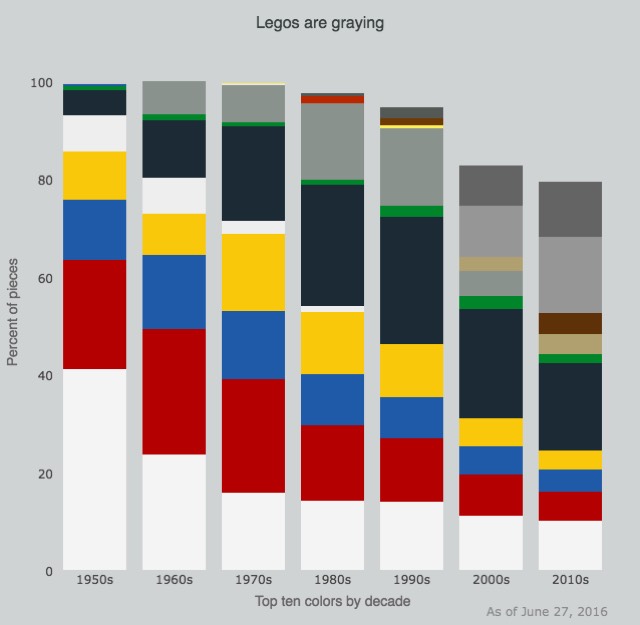
Legos Are Graying

Life-long Lego fan Joel Carron recently analyzed a data set containing the types, colors, and number of pieces in every Lego set from the past 67 years and graphed the results. The shift in colors is the most striking thing to me: Legos are graying.

Legos have gotten darker, with white giving way to black and gray. The transition from the old grays to the current bluish grays (or "bley") is a hot-button topic for many Lego fans.

If you look at the dominant color palettes for all of the tie-in sets they're doing now, it's not difficult to see where those darker colors are coming from.

Tags: Joel Carron   Legos
20 Jul 06:02

The 50 best animated films of the 21st century

by Jason Kottke

The Playlist has decided on their list of the 50 best animated films of the 21st century (so far). Here is 50-46:

50. Brave
49. The Pirates! Band of Misfits
48. Cloudy with a Chance of Meatballs
47. Tokyo Godfathers
46. Frankenweenie

And 5-2:

5. The Triplets of Belleville
4. It's Such a Beautiful Day
3. Up
2. The Incredibles

I'll give you a hint about #1: it is somehow not Wall-E, which didn't even crack the top 10. And come on, Up? The opening of that movie is damn near perfect, but the rest of it is good but not great.

Tags: best of   lists   movies
30 Jun 00:18

A look inside America's assembly line prison system

by Jason Kottke

Reporter Shane Bauer went undercover as a guard in a Louisiana private prison for four months. Mother Jones devoted their entire recent issue to the story.

In class that day, we learn about the use of force. A middle-aged black instructor I'll call Mr. Tucker comes into the classroom, his black fatigues tucked into shiny black boots. He's the head of Winn's Special Operations Response Team, or SORT, the prison's SWAT-like tactical unit. "If an inmate was to spit in your face, what would you do?" he asks. Some cadets say they would write him up. One woman, who has worked here for 13 years and is doing her annual retraining, says, "I would want to hit him. Depending on where the camera is, he might would get hit."

Mr. Tucker pauses to see if anyone else has a response. "If your personality if somebody spit on you is to knock the fuck out of him, you gonna knock the fuck out of him," he says, pacing slowly. "If a inmate hit me, I'm go' hit his ass right back. I don't care if the camera's rolling. If a inmate spit on me, he's gonna have a very bad day." Mr. Tucker says we should call for backup in any confrontation. "If a midget spit on you, guess what? You still supposed to call for backup. You don't supposed to ever get into a one-on-one encounter with anybody. Period. Whether you can take him or not. Hell, if you got a problem with a midget, call me. I'll help you. Me and you can whup the hell out of him."

He asks us what we should do if we see two inmates stabbing each other.

"I'd probably call somebody," a cadet offers.

"I'd sit there and holler 'stop,'" says a veteran guard.

Mr. Tucker points at her. "Damn right. That's it. If they don't pay attention to you, hey, there ain't nothing else you can do."

He cups his hands around his mouth. "Stop fighting," he says to some invisible prisoners. "I said, 'Stop fighting.'" His voice is nonchalant. "Y'all ain't go' to stop, huh?" He makes like he's backing out of a door and slams it shut. "Leave your ass in there!"

"Somebody's go' win. Somebody's go' lose. They both might lose, but hey, did you do your job? Hell yeah!" The classroom erupts in laughter.

Fusion has a summary of Bauer's reporting, which you really should actually read in its entirety. America's prison system is shameful; its reform is one of the biggest issues facing our nation in the future.

Tags: crime   legal   prison   Shane Bauer   USA
02 Jun 06:28

Tips and tricks for street photography

by Jason Kottke

Thomas Leuthard takes us around Salzburg and demonstrates a number of tricks you can employ to take photos on the street. Tricks sounds too gimmicky...think of these as potential approaches to being creative with a camera. Watching this made me want to start taking photos again. Before I had kids, I carried a camera pretty much everywhere.1 I still do (in the form of an iPhone 6s) but I'm not hunting for photos in the same way.

  1. And, somewhere on my hard drive, I have dozens of photos I took in Salzburg with that camera during a 2006 trip.

Tags: photography   Thomas Leuthard   video
26 May 23:43

The Courage To Act | Noah Smith | CFR / International Finance | 14th May 2016

Highly intelligent discussion of Ben Bernanke’s big book about the 2008 crisis and its aftermath. Bernanke foresaw the dangers of a banking crash better than anyone around him because he had spent a working lifetime studying the Great Depression. He bailed out the big banks to prevent a second depression. “Basically, Bernanke wants the world to understand why he did what he did, and in order to understand we have to know everything. The book succeeds” (PDF)
13 Apr 02:59

The Augmented Human Being | George Church | Edge | 30th March 2016

Fascinating throughout, on genetics, genetic engineering, de-extinction and Crispr. “Aging reversal is a much better target than prolonging longevity because it takes decades to prove that you have extended longevity; also, if you’ve done it on somebody that’s quite old, the economic consequences are dire. If you can reverse to an age where you essentially don’t use any medicine, this will be much more cost effective”
22 Dec 20:03

SantaCon, explained

by Phil Edwards

(Including its surprising roots in Danish performance art).

Christmas Eve is just around the corner, but Santa's already been out and about — in fact, there have been thousands of them.

That's the legacy of SantaCon, the mid-December event that features tens of thousands of Santas parading the streets, being jolly, and generally sullying the reputation of the North Pole. As we mop up Santa's holiday cheer, it's a good time to reflect on the event's meaning.

It turns out that SantaCon is more fascinating than just another bar crawl, as the above video shows. It's an event whose purpose is constantly changing, thanks in part to its surprising origins.

1) What is SantaCon?

Some SantaConners, spreading holiday cheer. (Getty)

SantaCon is a roving, loosely organized event where people dress like Santa Claus, elves, or other holiday figures and parade around a city in varying states of sobriety. Comparable to other adult party days, like St. Patrick's Day or Halloween, it's not organized by one particular group, though there is occasionally a dominant organization in a city (with varying degrees of cooperation with local businesses).

SantaCon New York, the largest event, defines itself as a "charitable, non-commercial, non-political, nonsensical Santa Claus convention that happens once a year for absolutely no reason." That definition, which mixes a flash mob sensibility with holiday celebration, is common to most of the SantaCons around the world (albeit with different names and local flavors).

To critics, however, Santa Con isn't just a benign holiday sleigh ride. As Jason O. Gilbert wrote in a strongly worded New York Times op-ed: "For those living in peaceful oblivion, SantaCon is an annual tradition in which revelers dress up as Kriss Kringle (or, at least, put on a Santa hat) and participate en masse in an often literal bar crawl, cramming 12 nights of Christmas boozing into a single afternoon."

2) When did SantaCon start?

For those only familiar with SantaCon through the drink specials, its origin is especially surprising: You have to go back to Denmark in the 1970s.

That's because the first SantaCon was actually a performance art protest, where Santas prioritized politics over revelry.

In a 1977 article for Mother Jones, Ellen Frank told the story (this article is a part of SantaCon's history as well — more on that later). In her article, Frank described the efforts of a Danish art collective named Solvognen, which took its name from a relic of Norse mythology.

Many members of the group lived in Christiania, a semi-autonomous "state" within the city of Copenhagen. The anarchists who lived there (these anarchists were nonviolent — think more hippie than punk) were critical of the inequality they believed existed in Danish society, and those conditions had been exacerbated by the oil crisis. That catalyzed Solvognen's famous Santa art project in 1974.

That year, about 75 Santas enacted a parable in Copenhagen. The premise? With each passing day, the troop of Santas learned a little bit more about the consumerism and greed they believed had taken over Christmas. The demonstrations were charming, funny, and occasionally violent. On the first day, they caroled with an angel; by the event's conclusion, they were attacking buildings with pickaxes and handing out free presents in a local department store.

The event (and miraculous footage of Santas being beaten and arrested) made the performance iconic. Arrests were minimal, and Danes came to venerate the performance — Julemandshæren (Santa Claus army) was later added to Denmark's Culture Canon, which commemorates key works of art in the country's history.

Solvognen performed different pieces each year — as one co-founder told Frank, "We only have one rule — never do anything twice." But while the Danish Santas didn't storm Copenhagen the next year, they did inspire SantaCon as it exists today.

3) How did Danish performance art become SantaCon?

Santarchy provides the origin story for SantaCon in America.

Gary Warne, founder of the San Francisco Suicide Club (a "secret society" that explored the city and pulled pranks), was inspired by that Mother Jones article about Solvognen. Though Warne died before his group could carry out a reenactment, a similar group called the San Francisco Cacophony Society did in 1994.

The first event involved some of the prankish antics of Solvognen, albeit with a little more improvisation. One of the Santas was "hanged" (using a noose with a harness), but the event was more about pleasant absurdity than political criticism (or binge drinking). The Santas wandered around the city, snuck into parties, and spread some holiday chaos. Though the group initially thought it would be a one-time performance, they couldn't resist the temptation to don their holiday suits again.

The second year, the event escalated and had already become rowdier. By this time, it had adopted the name "Santarchy" and, as importantly, firmly established a new incarnation of Santa: jolly agent of chaos, frequently found in mobs.

4) How did SantaCon grow from a weird San Francisco thing?

In 1996, Portland's Cacophony society hosted a SantaCon with the help of the San Francisco crew. Santa was on the move.

Santas like author Scott Beale, among others, helped train Santas around the country in the art of producing their own SantaCon events (occasionally called Santarchy, SantaCon, or Santapalooza). The event rapidly grew in various alternative scenes, and as it grew, some of the original absurd anarchy was drowned in beer.

By 2000, SantaCons were international and included events that were explicitly called pub crawls. That represented an evolution that's continued until today, when the event is primarily associated with St. Patrick's Day–style drinking.

5) Isn't SantaCon a charity thing?

Some Santas. Maybe they are just about to donate to charity?

SantaCon New York requests a cash donation, but because SantaCon is often, by definition, an unorganized event, it's not a requirement to participate.

Other SantaCons, however, might have more organized charitable attempts. In Kalamazoo, Michigan, for example, SantaCon is a more structured bar crawl, which allows organizers to raise money for charity through the SantaCon venues (though with many of these SantaCons, the full details of the financial relationships are private).

So the short answer is: It depends. But SantaCon's probably not best characterized as a charitable event.

6) Don't Santas destroy the city?

SantaCon 2015 in New York recorded five arrests. For a day of heavy drinking with thousands of fun-loving participants, that's not a particularly violent event.

However, many have come to view SantaCon as a nuisance. Outlets published the SantaCon official bar list as a list of bars to avoid, and Twitter users complaining about the drunken Santas:

Whether you think SantaCon ruins Santa, and life in general, may depend on the Santas you meet and whether you experience holiday cheer or holiday public urination.

7) So what does SantaCon really mean?

Vox's Santa-bearded reporters interviewed a few dozen SantaCon participants at the 2015 event's kickoff. Only one was familiar with the event's San Francisco origins, and none knew about the Danish group that first sent a wave of Santas into the street.

But the interviewees also declined to mention partying and hard drinking as their reason for dressing up as Santa. Most cited holiday spirit, a festive environment, and the fun of dressing up as their reason for participating. While partying is doubtless part of the allure, it's not the only appeal of the event.

SantaCon has long lost the protest art purpose of its 1974 performance, and time has depleted the anarchic spirit of its early years. Due to cultural amnesia and simply being too well-known to be absurd, SantaCon's become a mainstream event with its own unique meaning.

And even that meaning is always changing. Vox's Santas met people dressed as elves, Superman, and Jesus. One man told Vox that he'd bought a thousand candy canes to give out to SantaCon participants, and his trip to New York was part of a nationwide tour he was taking after his divorce. That's something a group of Danish anarchists probably never would have expected — but they might not have minded it, either.

But if that doesn't warm your heart, you can still watch Santas get beat up by the cops. You can see that above, or on our YouTube channel.

07 Dec 20:30

Refusing racial victimhood

by James Choi
In a grand corridor of Harvard Law School, framed professors’ photographs hang on a wall. A week ago, someone put slivers of black tape over the faces of most of the African-American professors. I am one of those whose photograph was marked. ...

Since then I have been asked repeatedly how I feel about having been targeted by what some deem to be a racial hate crime. Questioners often seem to assume that I should feel deeply alarmed and hurt. I don’t.

The identity and motives of the person or people behind the taping have not been determined. ... Some observers, bristling with certainty, insist that the message conveyed by the taping of the photographs is obvious. To me it is puzzling.

Assuming that it was a racist gesture, there is a need to calibrate carefully its significance. On a campus containing thousands of students, faculty members and staff, one should not be surprised or unglued by an instance or even a number of instances of racism. The question is whether those episodes are characteristic or outliers. ...

Activists have succeeded in shoving to the top of the higher-education policy agenda the claims, dissatisfactions and aspirations of African-American students.

Successes, however, can generate or exacerbate destructive tendencies. I worry about two in particular. One involves exaggerating the scope of the racism that the activists oppose and fear. The other involves minimizing their own strength and the victories that they and their forebears have already achieved.

I have asked dissidents to tell me with as much particularity as possible the circumstances that led them to say that they feel burdened, alienated, disrespected, oppressed. ...

While some of these complaints have a ring of validity, several are dubious. ... Racism and its kindred pathologies are already big foes; there is no sustained payoff in exaggerating their presence, thus making them more formidable than they actually are.

Disturbing, too, is a related tendency to indulge in self-diminishment by displaying an excessive vulnerability to perceived and actual slights and insults. Some activists seem to have learned that invoking the rhetoric of trauma is an effective way of hooking into the consciences of solicitous authorities. Perhaps it is useful for purposes of eliciting certain short-term gains.

In the long run, though, reformers harm themselves by nurturing an inflated sense of victimization. A colleague of mine whose portrait was taped over exhibited the right spirit when he jauntily declared that it would take far more than tape to slow him down.
--Randall Kennedy, NYT, on maintaining perspective
22 Nov 08:28

Discretion in Hiring -- by Mitchell Hoffman, Lisa B. Kahn, Danielle Li

Who should make hiring decisions? We propose an empirical test for assessing whether firms should rely on hard metrics such as job test scores or grant managers discretion in making hiring decisions. We implement our test in the context of the introduction of a valuable job test across 15 firms employing low-skill service sector workers. Our results suggest that firms can improve worker quality by limiting managerial discretion. This is because, when faced with similar applicant pools, managers who exercise more discretion (as measured by their likelihood of overruling job test recommendations) systematically end up with worse hires.
16 Nov 19:13

Did the media ignore the Beirut bombings? Or did readers?

by Max Fisher

If social media is an expression of public sentiment, then it seems significant that perhaps the most widely shared tweet on Friday's terror attacks in Paris was not about Paris at all but rather was about another terror attack, earlier that week, in Beirut:

No media has covered this, but R.I.P to all the people that lost their lives in Lebanon yesterday from Isis attacks pic.twitter.com/mZXUEcxDmR

— Jackjonestv (@jackjonestv) November 14, 2015

The photo in this tweet is not, in fact, from last week's blast in Beirut. Rather, it is from 2006, during Israel's war against Hezbollah in Lebanon. But what is most striking to me about this tweet, now shared by well over 50,000 people, is that it's wrong: The media has, in fact, covered the Beirut bombings extensively.

The New York Times covered it. The Washington Post, in addition to running an Associated Press story on it, sent reporter Hugh Naylor to cover the blasts and then write a lengthy piece on their aftermath. The Economist had a thoughtful piece reflecting on the attack's significance. CNN, which rightly or wrongly has a reputation for least-common-denominator news judgment, aired one segment after another on the Beirut bombings. Even the Daily Mail, a British tabloid most known for its gossipy royals coverage, was on the story. And on and on.

Yet these are stories that, like so many stories of previous bombings and mass acts of violence outside of the West, readers have largely ignored.

It is difficult watching this, as a journalist, not to see the irony in people scolding the media for not covering Beirut by sharing a tweet with so many factual inaccuracies — people would know that photo was wrong if only they'd read some of the media coverage they are angrily insisting doesn't exist.

"Nobody is going to read this"

Watching this debate unfold, my mind goes back to one of the first bombings I covered, in early 2010.

That April, a series of bombs ripped through Baghdad, killing 85 people. The city has not known what we might call total peace for some years, but it was a period of relative calm. The bombings, in addition to being a humanitarian disaster, also came at a tense political moment.

It was a big, scary, and important event. Writing from the US, at that point as an editor at the Atlantic, I tried as best I could to capture what made it so important. I was traveling that day, and I remember calling the web editor to discuss some revisions and urge him to position it at the top of the homepage. He readily agreed. But when I began discussing the headline and the photo with him, and I asked what he thought would best help get readers interested in the story, he laughed.

"It doesn't matter what art we put with this or if it's at the top of the homepage," he said. "Nobody is going to read this."

He was right. No matter how much we promoted the story, no matter how many times and ways we put it in front of readers, they were not interested.

I refused to believe that the editor had been right, and instead I blamed myself — my story must have been boring or poorly headlined, or the lede was too dry. Or maybe it was just that this was Baghdad, and readers had in the preceding months not come to appreciate the city's brief calm — another way I might have failed them.

I still hold out hope that it's possible to get readers interested. And I have been trying over and over in the five years since to get readers engaged with these stories. Incidents of mass violence in the world are, I believe, desperately important for readers to know. Not just so that readers can offer sympathy to the victims, but so that they may better understand what's happening in the world and thus can better and more actively participate in whatever role they have to play as voters and global citizens. But unless the victims are either children or Christian, I have never really succeeded in getting readers to care about such bombings that happen outside of the Western world.

Most recently, we tried it with the June bombing in Kuwait and the August bombing in Bangkok. We covered the series of violent attacks this summer in Turkey. On Beirut alone, I wrote about the October 2012 bombing and the December 2013 bombing, and, yes, my colleagues wrote about last week's bombing there.

It's not just me, of course: My peers throughout the media have dutifully and diligently covered such attacks for years. Local reporters and foreign correspondents out in the field have of course done far more than I have, spending days interviewing victims and painstakingly reconstructing events — despite knowing that readers were all but certain to ignore the stories. "Nobody is going to read this" is a phrase we've grown accustomed to hearing.

The gap between true narratives and true facts

I was thus a bit surprised, over the past week, to see an outpouring of reader outrage. So what's driving people to scold media outlets for not covering an event they have in fact covered extensively?

At the most basic level, I suspect this may reflect a very human tendency with which we in the media are all too familiar: People start with a narrative they feel is true, and then look for evidence to support that narrative.

In this case, people began with the narrative that the world gives lesser weight to the suffering of non-Westerners — absolutely true — and then latched onto a piece of evidence, the supposed lack of media coverage, that supported their narrative. The fact that the media has in fact covered Beirut, and that the tweet capturing this outrage contained a photo from 2006, was in many ways beside the point.

But facts do matter, and emphasizing wrong facts can lead us astray — not only because they lead us to blame the wrong villain. Jamiles Lartey, in an insightful series of tweets reflecting on all this, notices some concerning trends in a lot of this discourse that might otherwise be well-intentioned:

I'm referring to the impulse to say in effect "yes Paris was bad, but why didn't you get outraged about Beirut/Boko Haram/Garissa/etc"

— Jamiles Lartey (@JamilesLartey) November 14, 2015

This walks dangerously close to the #alllivesmatter attempts to mute real and specific black suffering and grievance.

— Jamiles Lartey (@JamilesLartey) November 14, 2015

People should be permitted to grieve, and seek redress for specific violence and suffer without being redirected or corrected.

— Jamiles Lartey (@JamilesLartey) November 14, 2015

And the self-congratulatory energy of much of this grievance and suffer redirection should be concerning.

— Jamiles Lartey (@JamilesLartey) November 14, 2015

Some commentators today honestly sound like tragedy hipsters, "Bro- I care about suffering and death that you've never even heard of"

— Jamiles Lartey (@JamilesLartey) November 14, 2015

But I am still sympathetic to the anger. The underlying point behind this criticism is not really about the media, after all. Rather, it's about a sense that the world at large has ignored Beirut's trauma and that it ignores similar traumas throughout the world if they occur in the wrong places; that it does not offer the same sympathy to victims outside of wealthy or Western countries.

This is entirely correct. People in Beirut do feel forgotten; they do feel that the world has given Paris more sympathy and more attention than it has to them. We know this in part because the New York Times, as part of its running coverage of the Beirut blasts, published an article reporting on these feelings of neglect in Beirut.

There's more than just a supposed lack of media coverage at stake here, and the world's attention manifests itself in ways beyond just the frequency or attendance of sympathy rallies. The Syrian refugee crisis, for example, is something that has hit both France and Lebanon. Yet the world's response — not just its words but its actions — has given significantly more weight to France's refugee burden than to Lebanon's.

France has received 6,700 Syrian asylum claims, and expects to receive several thousand more. In response, European and other Western leaders have convened repeated international summits to try to help France and other Western countries figure out how to deal with this. By comparison, Lebanon currently hosts 1.1 million Syrian refugees — equivalent to one-quarter of the country's population. In response, the world has given some aid but has fallen far short of the United Nations' annual funding requests. Lebanon is enduring not just a tremendous economic burden but a political burden. The world truly does care more about France, in this respect and in many others, than about Lebanon. And that has consequences.

It would be easy to blame the media for this, to say that if only media outlets covered Beirut rather than ignoring it, the world might pay attention. I have bad news: The media does cover Beirut, just as it has been covering Lebanon's refugee plight for years. That's an uncomfortable truth, because rather than giving us an easy villain, it forces us to ask what our own role might be in the world's disproportionate care and concern for one country over another.

But if that reflection leads people to express greater interest in what happens in Beirut or Abuja or Baghdad, then few will be happier than those of us in the media. We've been trying for years to break through reader apathy and disinterest. If we take some unfair criticisms but it gets people to finally pay attention, I think that is a trade-off every reporter on Earth would accept.

15 Nov 11:18

Taste for Competition and the Gender Gap Among Young Business Professionals -- by Ernesto Reuben, Paola Sapienza, Luigi Zingales

Using an incentivized measure of test for competition, this paper investigates whether this taste explains subsequent gender differences in earnings and industry choice in a sample of high-ability MBA graduates. We find that "competitive" individuals earn 9% more than their less competitive counterparts do. Moreover, gender differences in taste for competition explain around 10% of the overall gender gap. We also find that competitive individuals are more likely to work in high-paying industries nine years later, which suggests that the relation between taste for competition and earnings persists in the long run. Lastly, we find that the effect of taste for competition emerges over time when MBAs and firms interact with each other.
11 Nov 13:37

When Coming Out Means Rewriting Your Story

by Spencer Kornhaber
Image

All bands have a mythology around them, and Passion Pit’s begins with a man and a woman. It goes like this: When he was a student at Emerson College, Michael Angelakos recorded a set of songs in his dorm room and gave them to his then-girlfriend as a belated Valentine’s Day present. The sweetly romantic electro-pop made it onto the Chunk of Change EP in 2008, which then made it to listeners and festival stages worldwide.

There’s another chapter of Passion Pit’s mythology, and it’s also about a man and a (different) woman. Angelakos has talked openly about his bipolar disorder, depression, and alcoholism; he has also talked about deeply loving Kristy Mucci, the woman he married. In a 2012 Pitchfork profile, he said that she stopped him from jumping out of a window during one of his manic episodes, and some of the songs on his most recent album, Gossamer, are explicitly about her. “Just believe in me, Kristina / All these demons, I can beat them,” goes one lyric that People quoted when it covered their divorce this past August.

Passion Pit’s latest extra-musical chapter began Monday, when the 28-year-old Angelakos for the first time said publicly that he’s gay. The statement came during a conversation on Bret Easton Ellis’s podcast that began (after a lengthy monologue from Ellis about Quentin Tarantino’s recent controversies) with a discussion of Angelakos’s mental-health struggles and the media’s treatment of them. “It’s pretty amazing how often my life can be condensed into a very-easy-to-rattle-off monologue,” Angelakos said, before any mention of his sexuality.

Whenever a public figure comes out, there are few stock reactions from the Internet-commenting masses. Some people offer congratulations. Some people recoil, either with blatantly homophobic statements or the equally insidious idea that LGBT folks should keep quiet about their personal lives (even though straight celebs aren’t asked to do the same). And some people ask what took the public figure so long to come out, often with a hint of condemnation.

It’s the last question—why now­?—that Angelakos and Ellis spent the most time discussing on the podcast. Angelakos said he first felt conflicted about his sexuality around age 20, but tried to forget about it because he was in a world of “dudes in bands talking about girls.” He also talked about having no gay role models growing up, a deathly fear of AIDS, a wonderful relationship with a woman, and a profound amount of self-hatred. In other words, it’s complicated.

More than anything, though, Angelakos talked about stories: the ones he told to himself, the ones that the public told about him, and the ones that belong in both categories. “Also, there was the narrative of the Chunk of Change EP,” Angelakos said when starting to explain why he stayed in the closet. “It’s like, he made it for his girlfriend.”

Ellis broke in with a tone of helpful skepticism: “That’s the myth, that’s the origin story.”

“That’s a very true story!” Angelakos shot back.

Everything came to a climax, he said, this past spring, when his marriage was in trouble and he was getting wound up about his own press coverage. It was Mucci who encouraged him to figure out his sexuality, while also saying she didn’t hold him at fault or think he misled her. He recalled talking to her on his birthday and hearing that she was exhausted from dealing with his issues. “I needed to feel embarrassed about how I was making other people feel, because that was the only way I could understand how I was feeling,”Angelakos said. “It’s kind of like RuPaul saying, ‘If you don’t love yourself how the hell are you going to love anybody else?’ That was quite honestly what was happening.”

“It’s amazing how often my life can be condensed into a very-easy-to-rattle-off monologue,” Angelakos said.

Mucci also helped him move past his hangups with the public. “You can’t be buying all these things that people are saying about you, all these narratives,” Angelakos remembered her saying. “You have a very rich and interesting life that cannot be condensed into an article.”

His anxiety about narratives should be relatable to a lot of people who’ve had to come out. In a society where straightness is the default, being gay can feel like a disruption to one’s life story, an unwanted plot twist—when in fact what it means is that it’s dangerous to try and fit into predetermined narratives. “I was buying into these notions that I kind of was receiving very early on: This is the way you live your life,” Angelakos said when talking about his marriage.  

As for the future, Angelakos said that he is excited to make music that can be fully honest, something he hasn’t quite been able to do since the early days of the band. And he’s trying not to worry about what this revelation means for his mythology. “Publicly, I came out about [being] bipolar and everyone was, ‘Ohhh that dude is crazy.’ That’s basically overshadowed so much of my work life,” he said. “If I come out what is that going to do? How can that diminish the impact of it? But then I was like, I don’t care! I don’t care anymore. I like girls, I like boys, everyone's fantastic, but you know what? I’m gay. Finally.”


11 Nov 12:11

Why I signed a petition against transparent research in political science

by Chris Blattman

“Hey, your tenure letters are going out in a few months, so you should inject yourself into the most controversial debate of the year in the discipline,” said no one ever.

What’s the debate? It’s over DA-RT, short for Data Access and Research Transparency. And it’s opening an old split in the discipline.

For some reason, it struck me as a good idea to explain what’s going on, and take a position, in WashPo’s Monkey Cage:

Even before the recent scandal about fake data, editors from 27 political science journals signed on to a DA-RT transparency statement. It commits the journal to certain principles, such as requiring authors to “ensure that cited data are available at the time of publication through a trusted digital repository”…

For the kind of statistical, data-driven work I do, the requirements are pretty clear and (to me) make perfect sense. There need to be some exceptions and protections, but my sense is that most quantitative scholars are on board with the idea of sharing their data and code.

In the past few weeks, though, a number of my colleagues doing other kinds of work have said, “Wait a second, what does this mean for us?” Last week, six professors started an online petition asking the profession to hold off on enforcing the DA-RT principles. The basic thrust: “Can we talk about this more?” Hundreds of scholars have signed — including friends and colleagues whose work I enjoy and whose opinions I respect.

…So far, DA-RT supporters have put little meat on the bones of their principles. From where I stand, qualitative scholars look to be bearing a lot of risk. Nobody likes uncertainty, especially when your career could be on the line. I’d like to give more time for qualitative standards and norms to be debated and evolve.

In the meantime, let’s move ahead with clear standards for quantitative work. After many years of debate, it’s relatively clear how transparency and data access works for people who rely on quantitative data.

You can read the full thing to find out why I feel this way, and why I think you should too. Here is the petition.

The post Why I signed a petition against transparent research in political science appeared first on Chris Blattman.

09 Nov 13:08

A map of all the underwater cables that connect the internet

by Phil Edwards

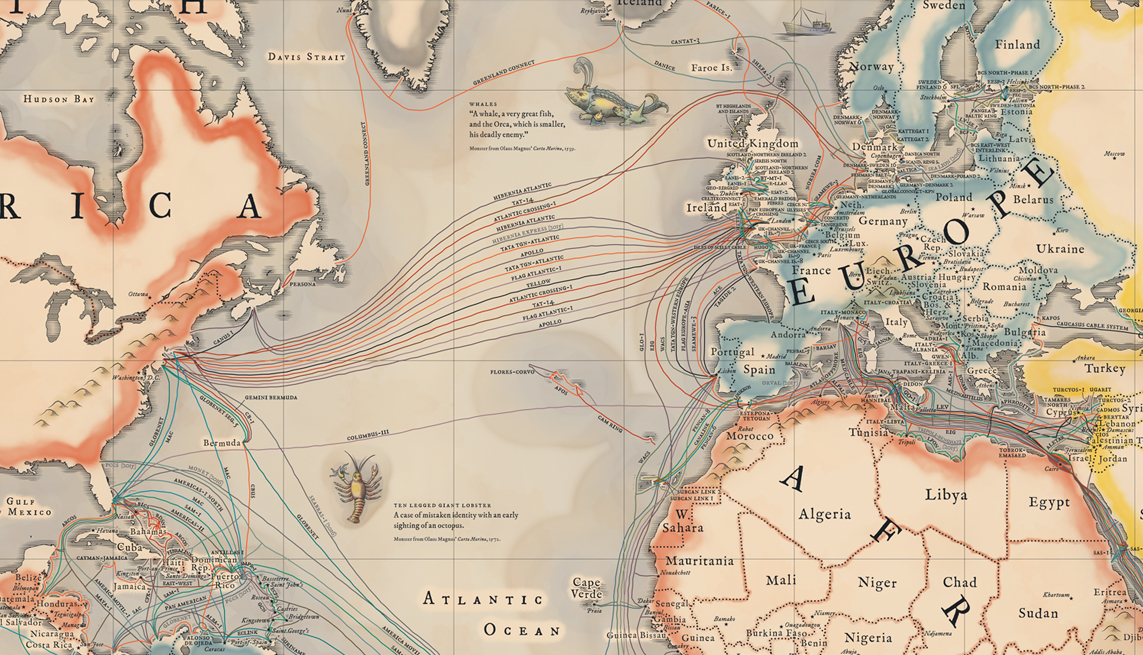
Cables lying on the seafloor bring the internet to the world. They transmit 99 percent of international data, make transoceanic communication possible in an instant, and serve as a loose proxy for the international trade that connects advanced economies.

Their importance and proliferation inspired Telegeography to make this vintage-inspired map of the cables that connect the internet. It depicts the 299 cables that are active, under construction, or will be funded by the end of this year.

In addition to seeing the cables, you'll find information about "latency" at the bottom of the map (how long it takes for information to transmit) and "lit capacity" in the corners (which shows how much traffic a system can send, usually measured in terabytes). You can browse a full zoomable version here.

The cables are so widely used, as opposed to satellite transmission, because they're so reliable and fast: with high speeds and backup routes available, they rarely fail. And that means they've become a key part of the global economy and the way the world connects.

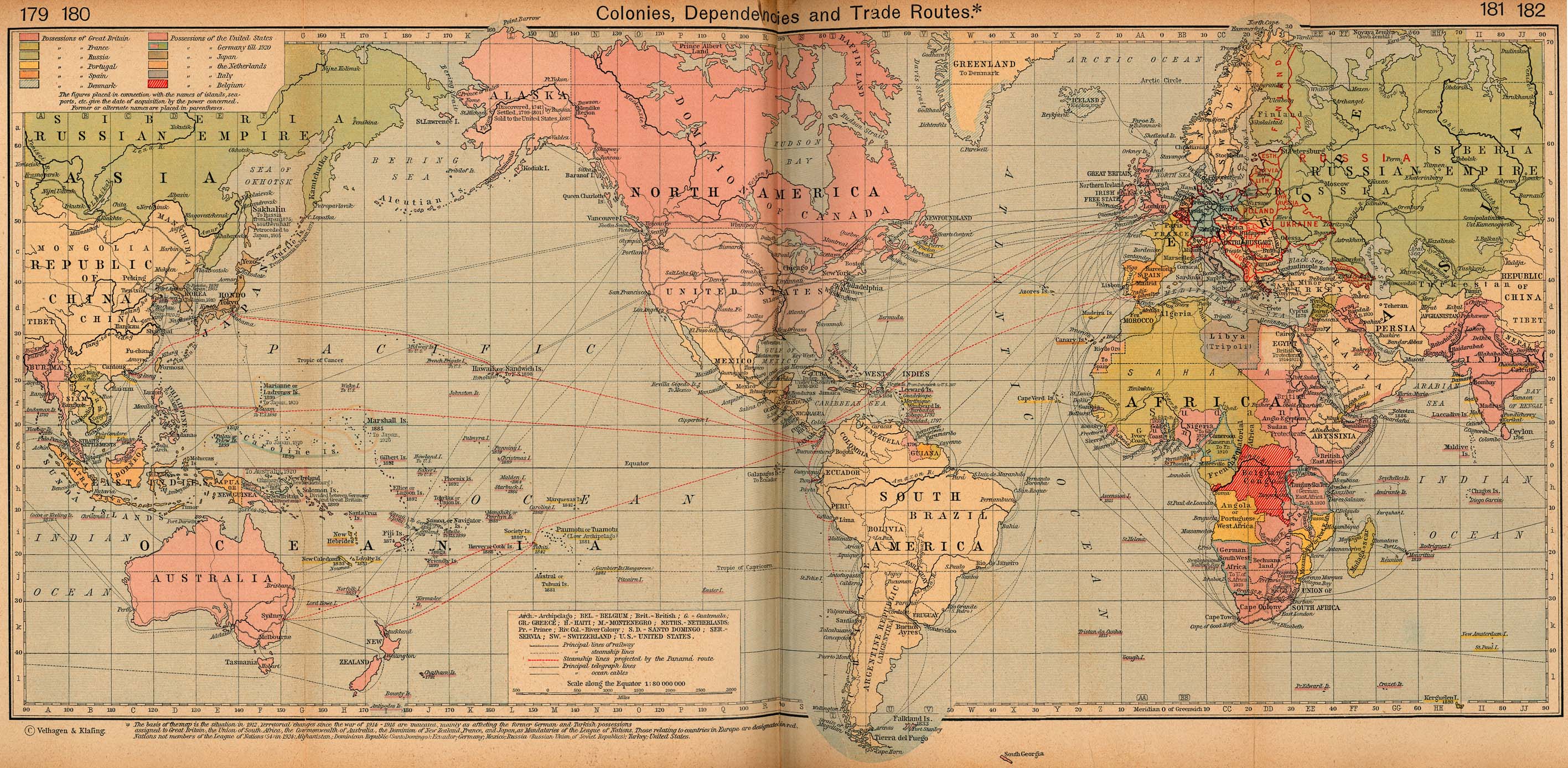
Take, for example, the below map, which lets you slide between a 1912 map of trade routes and Telegeography's map of submarine cables today. The economic interdependence has remained, but the methods and meaning have changed:

The submarine cable map shows economic connections in less-developed countries as well. Cables between South America and Africa, for example, are much more scarce than trans-Atlantic and trans-Pacific routes:

Connections in the South Atlantic are scarce. (Telegeography)

Though cables to developing countries are expanding, they have a lot of work to do before they catch up. And Antarctica is left out completely (scientists down there get their internet from satellites).

The analogy between submarine cables and historic trade routes has a lot of caveats: trade routes were determined by geography as well as economic interests, and economic incentives were a lot different then than they are today. It would also be a mistake to overlook physical goods in favor of the internet (just look at those giant container ships). But both then and now, paths across the ocean require investment, trading partners on both sides, and a willingness to take risks. Sailors took the gamble in the past, and tech companies are taking it now.

Submarine cables get big investments from companies looking to explore their own modern trade routes

Submarine cables in Asia. (TeleGeography)

These cables carry information for the entire internet, including both corporate and consumer interests. That's why Google invested $300 million in a trans-Pacific cable system consortium to move data, Facebook put money into an Asian cable system consortium, and the finance industry invests just as much to shave a few milliseconds off trade times.

Other consortia regularly lay cables to transmit the consumer internet. Each group's control of a submarine cable is an advantage in the information exchange between countries.

Submarine cables are a 150-year-old idea with new potency

The process for laying submarine cables hasn't changed much in 150 years — a ship traverses the ocean, slowly unspooling cable that sinks to the ocean floor. The SS Great Eastern laid the first continually successful trans-Atlantic cable in 1866, which was used to transmit telegraphs. Later cables (starting in 1956) carried telephone signals.

A map of the submarine telegraph in 1858, though the attempt only worked for three weeks. (Wikimedia Commons)

Modern cables are surprisingly thin, considering how long they are and how deep they sink. Each is usually about 3 inches across. They're actually thicker in more shallow areas, where they're often buried to protect against contact with fishing boats, marine beds, or other objects. At the deepest point in the Japan Trench, cables are submerged under water 8,000 meters deep — which means submarine cables can go as deep as Mount Everest is high.

The optical fibers that actually carry the information are bundled within the larger shell of the cable:

A diagram of a submarine cable. (Wikimedia Commons)

The components include:

  1. Polyethylene
  2. Mylar tape
  3. Stranded metal (steel) wires
  4. Aluminum water barrier
  5. Polycarbonate
  6. Copper or aluminum tube
  7. Petroleum jelly (this helps protect the cables from the water)
  8. Optical fibers

These cables move the videos, trades, gifs, and articles that bring the internet around the world in a matter of milliseconds. And that's the type of advantage any trader — digital or analog — could appreciate.

WATCH: 'Meet the enormous boats that carry your stuff'

09 Nov 08:33

How Much Does Passion Matter When Founding vs. Joining Something?

by Ben Casnocha

When you’re starting a company you have to be passionate about the problem you’re solving. That’s a truism of entrepreneurship. You’ve got no customers, no employees, no activity: You better hope that the vision you hold in your heart is one that keeps you excited through all the days (and years?) of little progress.

When you’re joining a company as an employee, by contrast, passion for the problem the company is solving is less important — assuming the company already has some traction, which is a fair assumption given the company has the cash to hire you. Why? Because anything at scale is interesting. You can take the most boring, back office piece of enterprise software and if you tell me, “Millions of people use this every day” or “50 companies are paying millions a year to use this” etc. then I’ll become interested. Heck, if you pitched me on joining a trash pickup business like 1-800 Got Junk and you said they’ve got 200 different locations and are doing tens of millions a year in revenue — I’m potentially interested. Ideally, the business mission also aligns with something you’re personally passionate about, but it’s not necessary.

Bottom Line: When you’re founding a company (or joining a super early stage company), passion for the problem the company is solving is critical. When joining ventures that already have velocity, other factors — like the quality of your co-workers and the culture of work that’s been established — matter more, because anything at scale becomes interesting.

09 Nov 08:22

Startup Playbook | Sam Altman | Y Combinator | 5th November 2015

Y Combinator wrote a handbook for their startups — and then they thought, why not just give it to everybody? Which is very kind of them, since it’s likely to be one of the best business books you’ll ever see. Actionable information in every sentence. “Find ways to get 90% of the value with 10% of the effort. The market doesn’t care how hard you work — it only cares if you do the right things”