buy this print
Or share on:
 facebook
  reddit
That is the new book by Robert D. Kaplan, and the subtitle is The South China Sea and the End of a Stable Pacific. Since this is possibly the most important topic in the world right now, you should read this book. Here is one interesting excerpt of many:
According to Yale professor of management and political science Paul Bracken, China isn’t so much building a conventional navy as an “anti-navy” navy, designed to push U.S. sea and air forces away from the East Asian coastline. Chinese drones putting lasers on U.S. warships, sonar pings from Chinese submarines, the noisy activation of Chinese smart mines, and so on are all designed to signal to American warships that Beijing knows about their movements and the United States risks a crisis if such warships get closer to Chinese waters. Because “relations with China are too important to jeopardize with a military confrontation,” this anti-access strategy has a significant political effect on Washington. “The strategic impact of China’s agility is not so much to tilt the military balance in its direction and away from the United States. Rather,” bracken goes on, “it introduces new risks into the American decision-making calculus.”
Some chapters of this book are deeper and better thought out than others, but still it is definitely worth reading.
“I haven’t talked to Joe in years, but I know that if I were stranded and called him, he’d drop everything and come pick me up.”
I hear that a lot. It’s great to have friends who will bail you out of a tough situation, who’ll always answer your call at 2 AM, who will fly around the world to help you in an emergency. Even if you haven’t spoken to them in a long, long time.
These “2 AM friends,” as I refer to them, tend to be old childhood buddies, old roommates, or family friends who, for whatever reason, you no longer talk to or see often. There’s nevertheless real closeness and unbreakable trust. They play a similar role as family. I have a couple 2 AM friends.
But 2 AM friends, for all the joy and help they provide in times of need, do not nourish or invigorate my day to day life, almost by definition, as I’m not talking to them on a week to week or month to month basis. Sure, there’s some abstract sense of meaning I get from reflecting on my relationship with them, but it’s just that — abstract. And, sadly, that feeling weakens with every passing day.
I’m a big believer in staying in touch with people (via email, phone, in-person visits) to keep up relationships. I’ve always been mildly skeptical of the phrase “we pick up right where we left off.” If months and months of time have passed without any real communication, and if you or the friend are living reasonably dynamic lives, it’s going to take awhile to re-sync emotionally and intellectually. Even if there’s a lot of shared history in the past.
It takes a heck of a lot of time and energy to keep up with friends, of course. Time and money beyond just ‘liking’ social media updates. Joys and frustrations. All to be done in a culture where there are no broadly accepted social norms about how to “do” friendship. In the world of romance, there are a million and a half articles and guideposts for how to date, how long to wait before you call, what you should expect two years into a relationship, and so on. In the friendship maintenance department, there’s basically nothing. As Andrew Sullivan put it, it takes no work to fall in love. It takes real work to rise to a real and lasting friendship.
Some people’s lot in life is so unlucky that they haven’t been able to keep up with anyone — they have no one to list as an emergency contact number on a medical form.
Other people are fortunate enough to have that 2 AM friend to list, but then few other people with whom they share their day to day, week to week, month to month journey. If the emergency contact person isn’t the same as the day to day friend, and frequently they’re not, then this is the scenario I’m interested in: how can we appreciate the unique joys of a friend who’s part of our lives as our lives unfold? How can we work to strengthen those bonds and not fall back on solely the 2 AM friends?
In Empire Falls, there’s this line by Richard Russo which has stuck with me: ”One of the odd things about middle age was the strange decisions a man discovers he’s made by not really making them, like allowing friends to drift away through simple neglect.”
Subscribe to the Browser to receive a feed with direct links to the recommended content
A review of one of the new sleep books says it’s “for sleep strivers,” which is, when you step back from it, one of the most insane phrases ever written.
A great article in the NY Times Magazine.
My boyfriend, a South African, was completely disgusted. “You Americans don’t know how to rest,” he said. “You rest only to work better.”
The post The silliness of the science of sleep appeared first on Chris Blattman.
I have read many of the accounts and I am following this story with interest. As to what happened, I don’t care to hazard a very particular guess. But I wish to make a general point about puzzles. When an event appears extremely puzzling, there are often a few ways out:
1. One or more of the agents in the story has a capacity to behave more irrationally than you might think. Even if you believe people are reasonably rational, by examining a puzzle you are to some extent selecting for a situation with irrational behavior from some of the participants. And sometimes the line between irrational behavior and totally incompetent behavior is a thin one or it is absent altogether.
2. Our own ability to use the argument from exclusion (it cannot be A, B, or C, therefore only D remains) to reach reliable conclusions is extremely dubious and limited.
3. There are more conspiracies than we are usually aware of, and sometimes these conspiracies shape events.
I tend to favor #1 and #2 over #3. The core insight perhaps is that it is easier for coordinated events to fail to happen than to happen. That does not explain what went on, but it does slant me away from some of the more extreme (and worrying) scenarios.
The fate of the plane and its passengers is of course a matter of intrinsic interest. But I also find interesting the question of whether a social scientist, or an economist, should have a systematically different interpretation of what might be going on, if only stochastically. And if we don’t…what good are we?
#LimitsofRatiocination
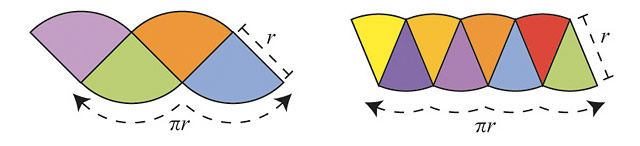
As Pi Day approaches, it time for a refresher course, courtesy of Steven Strogatz, on what pi actually means and how you can visualize calculating it. It's all about rearranging the pieces of a circle in a calculus-ish sort of way:
If you're reading this site, you'll probably like watching Charlie Rose interview Bill Murray for nearly an hour. The whole thing is available on Hulu (US only):
The video is recent too: Feb 9, 2014. A clip is available on YouTube...check out that leather vest!
And from a different interview with Murray, we learn that everyone has been drinking champagne incorrectly. Here's the Murray method:
I learned how to drink champagne a while ago. But the way I like to drink champagne is I like to make what we call a Montana Cooler, where you buy a case of champagne and you take all the bottles out, and you take all the cardboard out, and you put a garbage bag inside of it, then you put all the bottles back in and then you cover it with ice, and then you wrap it up and you close it. And that will keep it all cold for a weekend and you can drink every single bottle. And the way I like to drink it in a big pint glass with ice. I fill it with ice and I pour the champagne in it, because champagne can never be too cold. And the problem people have with champagne is they drink it and they crash with it, because the sugar content is so high and you get really dehydrated. But if you can get the ice in it, you can drink it supremely cold and at the same time you're getting the melting ice, so it's like a hydration level, and you can stay at this great level for a whole weekend. You don't want to crash. You want to keep that buzz, that bling, that smile.
Buzz on, you crazy diamond!
Tags: Bill Murray Charlie Rose interviews video