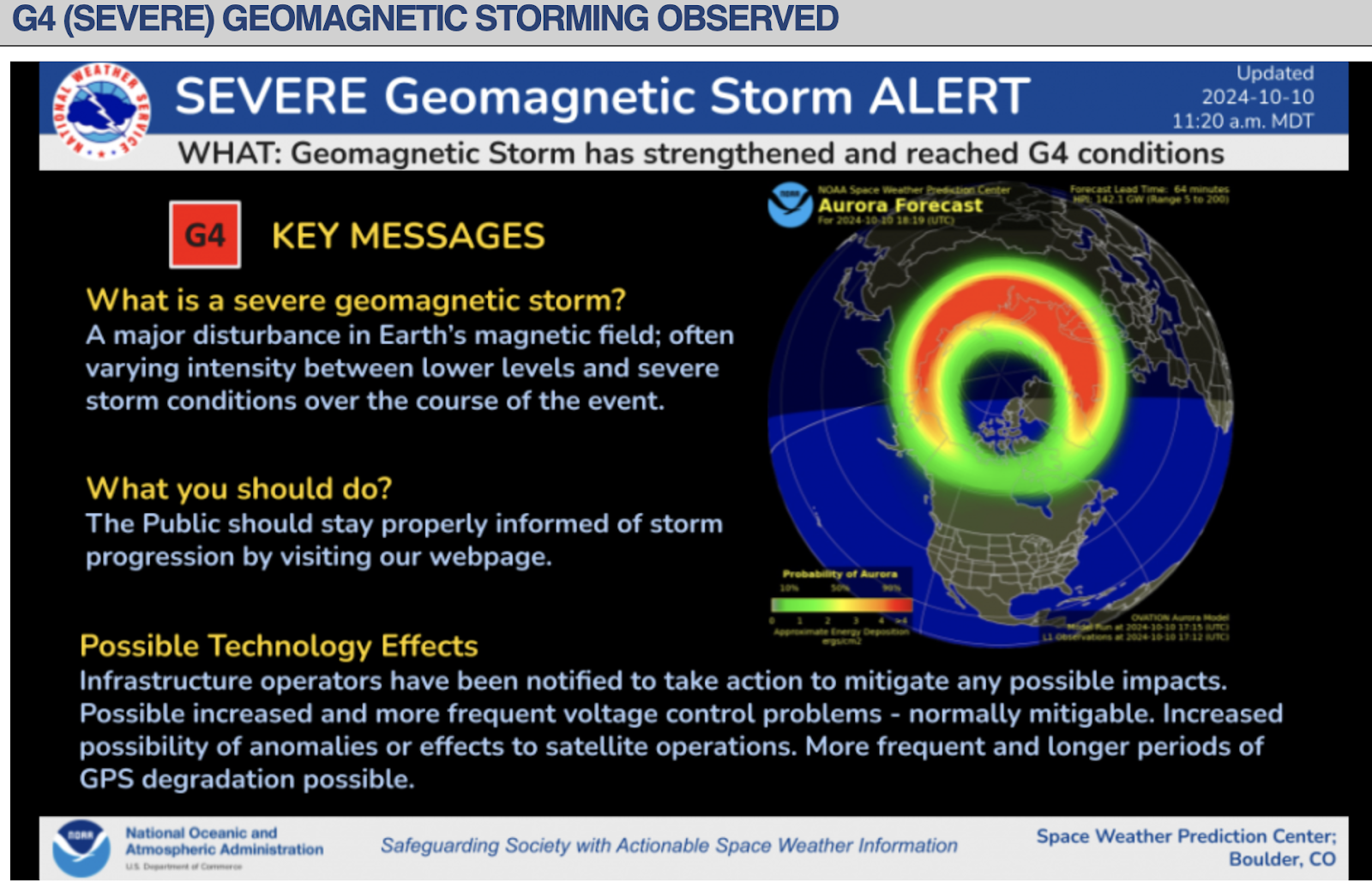
You might go outside after dark tonight and look north--a significant aurora may be visible over Washington.
A severe geomagnetic storm is occurring following a major coronal mass ejection (CME).
The GOES weather satellite orbiting Earth noted a powerful proton flux produced by the solar storm two days ago...so we knew it was coming.
An important measure of the potential for an aurora is the Planetary K index (Kp). My own experience is that we don't see much auroral activity around here until the index gets to 7. At 8, the changes are good. 9 it is certain.
As shown below, we are now at 8.5 (see below)
And the NOAA predictions suggest relatively high values this evening (see below).
The NOAA Space Prediction Center predict a decent aurora over us:
The big issue is clouds. Right now, the skies are fairly clear above us (4 PM)--see below. There is some high cirrus to the south and west--which may be an issue.
The high clouds to the southwest are clearly shown on the latest infrared satellite image (see below).
Because of the clouds, there are no guarantees....but I suspect there is a real chance tonight.
So once it is decently dark (after 9 PM), go to a dark place with a view to the north. In Seattle, I recommend the kite hill at Magnuson Park.....that is where I will be.
Seattle of Seattle Parks Department, please don't close the gate!
In Italy, illegal immigrants gang-raped a 13 year old girl. Was the crime significant because it shed light on the perils posed by illegal immigrants? Of course not: because it was “pounced on” by the dreaded “far right”:
A 13-year-old girl was gang-rapęd by 7 illegals and this is how CNN covers it: pic.twitter.com/hYv4yItgmG
There’s at least a week’s worth of good news in this one Washington Post article about the backlash against the “defund the police” campaign. However, I think the Post overstates the extent to which Democrats are truly moving away from anti-police views and policies.
Let’s start, though, with the good news. It begins in the first three paragraphs:
Mayoral candidates across the country are closing out their campaigns pledging to restore law and order, a major setback for racial justice protesters who only a year ago thought they had permanently reshaped the debate on policing in American cities.
As voters head to the polls Tuesday, local elections are dominated by discussions about safety and law enforcement amid a surge in violent crime. The tone of the debate, even in many liberal urban communities, highlights how major policing reforms have stalled.
From Buffalo to Seattle, Democratic politicians who once championed significant reductions or reallocations of police department budgets are backtracking. In other cities, including Cleveland, liberal candidates are being hammered over their stances on public safety.
The shift, of course, is driven by voter revulsion at the results of anti-police and other soft-on-crime policies:
A Pew Research Center poll published Tuesday shows that 47 percent of Americans want to increase funding for police, compared to 15 percent who want to decrease funding. In June 2020, when the racial justice protests were at their peak, 31 percent of Americans wanted to increase funding, while 25 percent supported a decrease. Three-fourths of Black Americans, who form a decisive voting bloc in many mayoral contests, either support increasing or keeping spending on police the same, Pew found.
The shift in public opinion comes after large U.S. cities experienced a 30 percent jump in killings in 2020, the biggest one-year increase since the federal government began compiling national figures in the 1960s.
(Emphasis added)
We keep hearing about a “racial reckoning.” Maybe the media should start talking about a law and order reckoning.
Here’s some good news from Buffalo, New York:
Community activist India Walton is attempting Tuesday to become the country’s first socialist mayor in decades after she defeated the incumbent mayor, Byron Brown, in the June Democratic primary. Walton’s bid for public office grew out of the racial justice protests that swept the nation following Floyd’s murder, and she had been a fixture at Black Lives Matter demonstrations.
Before her campaign for mayor, Walton embraced calls to shift resources away from police. According to the Buffalo News, Walton used expletive-laden anti-police chants at a rally. Her affiliation with the Black Lives Matter movement has become fodder for Brown, who is mounting a write-in campaign.
On the campaign trail, Walton has largely stopped talking about cutting funding for police and instead stresses the need for accountability for police misconduct and a greater role for mental health professionals in responding to residents in distress.
The socialist has transitioned from insane to merely clueless.
I love this passage:
Jesse Myerson, a spokesman for the Walton campaign, said Walton does not recall using profanity on the campaign trail last year. Myerson added Walton has shifted away from the “slogans of activists” during moments of “searing injustice” and is now focused on becoming an effective mayor.
A poll released Tuesday by WIVB-TV and Emerson College showed Mayor Brown holds a 17-point lead over forgetful Walton.
We’ve discussed how “defund the police” has lost its panache, and then some, in Seattle’s mayoral race. The Post brings us up-to-date:
In Seattle, a city that experienced a 73 percent increase in homicides last year, city council president and mayoral candidate M. Lorena González is also on the defensive over her past support for reducing police funding in that city by as much as 50 percent and diverting that money to social programs.
González’s chief opponent in the race, former council member Bruce Harrell, is hammering González for that stance, arguing homeowners and businesses are clamoring for safer streets in a city that has lost about 300 police officers in the last year.
“Make no mistake about it, I am not defunding the police,” Harrell charged in a debate on Thursday night. “My opponent has made it clearly a purpose-driven part [of her campaign] to defund the police.”
González responded by saying she still wants to “invest in community-based safety and non-law-enforcement systems” but will also “fully support hiring plans” to add more officers to the Seattle Police Department.
Several recent polls suggest Harrell now leads González.
(Emphasis added)
Justin Hansford, executive director of the Thurgood Marshall Civil Rights Center at Howard University, finds it “surprising how quickly Democrats are back to a law-and-order narrative.” Maybe. But it’s more surprising that the death of George Floyd induced temporary insanity in the form of a strong “defund” campaign.
Hanford blames the waning of that campaign on its diffuse leadership structure, most notably the fact that the movement never established a clear leader or political arm. There’s no limit to the cluelessness of many on the left.
At the same time, conservatives shouldn’t be so clueless as to take the rhetoric of suddenly law-and-order conscious Democrats at full face value. There’s some truth — more than a little, I fear — in this observation by one of the Post’s sources:
Mayoral candidates are being compelled to respond to realities on the ground. But the response to those realities is going to be dramatically informed by what happened to George Floyd, and it will not be the response we would have seen in 2018 or 2019.
The problem for Democratic mayors is that the more their response to the reality of mounting violent crime is “informed by what happened to George Floyd,” the more the hands of police officers will be tied and the more difficult it will be even to staff a police force with enough manpower to combat the wave of violent crime.
Going forward, voters are likely to want sincere law-and-order mayors, not just law-and-order poseurs.
China is developing a hypersonic missile designed to evade American nuclear defenses. This summer, it conducted two tests of that missile.
The U.S. knew about the tests, but our military officials were silent on the subject until last week. After the Financial Times reported the Chinese tests, presumably based on a leak, our government finally discussed this development.
Joint Chiefs Chairman Mark Milley called it “very close” to a “Sputnik moment” for the United States. For our younger readers, Sputnik was the artificial satellite launched by the Soviet Union in 1957. The successful launch signaled that the Soviets were ahead of the U.S. in penetrating outer space, and helped trigger the space race.
Milley said the Chinese tests of the hypersonic missile surprised our experts. He added that the tests were a “very significant technological event” and that the event “has our [full] attention.”
Fareed Zakaria argues that the Chinese tests are nothing like Sputnik, that the technology in question is nothing new, and that Milley is feeding cold war paranoia. However, this discussion by the New York Times indicates otherwise:
[T]he advances suggest that China might one day be able to arm a hypersonic vehicle with a nuclear warhead, launch it into a low orbit, and release it from anyplace — including, perhaps, an evasive flight path over Antarctica.
Existing defenses of the continental United States all point west and north over the Pacific, meaning they might fail in defeating an attack from the south. Even if there were antimissile bases pointed south, current antimissile technology is designed to intercept intercontinental ballistic warheads on predictable, parabolic paths in outer space — not hypersonic weapons that can zig and zag through the atmosphere.
“We just don’t know how we can defend against that technology, neither does China, neither does Russia,” said Ambassador Robert A. Wood, who is retiring in a few weeks as the U.S. representative at arms control sessions in Geneva.
The Asia Times discusses how what China is doing with hypersonic technology differs from what others, like the Soviet Union, have done. It also points out that because the Chinese missiles are launched from a spacecraft in orbit, China is violating the Outer Space Treaty of 1967.
If the hyepersonic technology is such a game-changer, you would think the U.S. is also working assiduously to develop it. However, it’s not clear that we are. Wood says that we have “held back” from pursuing its military uses to avoid stoking a new kind of arms race.
On the other hand, Pentagon spokesman John Kirby claims that the United States is competing with China on this technology. He stated that “our own pursuit of hypersonic capabilities is real, it’s tangible, and we are absolutely working towards being able to develop that capability.”
Maybe. But when Gen. Milley calls the Chinese tests a “Sputnik moment” it tells me that China is well ahead of us.
China has no desire to launch missiles at the U.S. Its plans for gaining world dominance don’t include starting a war with America.
But China desires to conquer Taiwan. Developing a missile that can penetrate our defenses would likely deter the U.S. from coming to Taiwan’s defense or at least reduce China’s fears that we will.
The signs of China’s intentions towards Taiwan are unmistakable. The Times points to the Pentagon’s concern that China is flying sorties inside Taiwan’s air identification zone, digging hundreds of new silos for long-range nuclear missiles, building an arsenal of antisatellite weapons, and routinely firing more rockets into space than any other country.
I agree with the Asia Times that “the U.S. will have to come up with an answer to China’s new [technological] threat.”
I hear some conservatives saying that we should have gone into Afghanistan, defeated the forces that attacked us on 9/11, and then left. The obvious problem with this view is that as soon as we left, the forces that attacked us or collaborated in the attack would have returned to power.
Sure, we would have killed and captured some bad guys, but basically we would have been back where we were before 9/11. Who would want that?
Now, the forces responsible for 9/11, including al Qaeda (see below) are returning to power or prominence. But at least they suffered nearly 20 years of lost or diminished power, during which they experienced hardship and, most importantly, were unable to execute attacks against the U.S.
Still, the return of the Taliban to power presents a clear and present danger to the U.S., as this Washington Post article suggests. According to the Post:
[A]s the militants commandeer Afghanistan’s security and intelligence institutions, the Biden administration faces a far steeper challenge in fulfilling the president’s pledge to prevent al-Qaeda, the Islamic State and other terrorist groups that have operated there from regaining strength and threatening the United States.
Current and former officials said that the process for identifying and responding to terrorist plots has been upended as the Pentagon and the CIA — instead of planning for operations alongside an allied government and friendly spy agency in Kabul — are forced to contemplate an environment abruptly off-limits and under the control of a hostile regime.
“The counterterrorism posture went from problematic with the U.S. withdrawal to extraordinarily bad with the Taliban in full control,” said Marc Polymeropoulos, a veteran intelligence officer who served as a CIA base chief in Afghanistan. “Suddenly one wonders if we will go entirely dark. It’s like a bad dream.”
Many conservatives like to ridicule our intelligence services, and to some extent they deserve it. But it’s a fact that al Qaeda has been unable to attack our homeland since 9/11.
Unless you believe al Qaeda lost interest in attacking us, our security and intelligence services must have done something right. Our presence in Afghanistan was one of those things.
As inconvenient as it may be, al Qaeda is still around. The Post reports:
There are worrisome signs it may become more difficult for the United States to prevent a resurgence by al-Qaeda, which a recent United Nations report said maintained a presence in at least 15 Afghan provinces and showed “no indication of breaking ties” with the Taliban despite pledges to do so as part of a 2020 deal struck between the Afghan militants and Trump administration.
(Emphasis added)
A very foolish deal.
Nor is it only al Qaeda we need to worry about:
Foreign intelligence officials said they are detecting signs that the Taliban’s victory has energized global jihadists, a threat that may only grow as the Taliban releases al-Qaeda operatives who were imprisoned by the Afghan government.
An intelligence official from an Arab nation, who like others spoke on the condition of anonymity to describe evolving assessments, said officials had seen an uptick in jihadist communications about developments in Afghanistan. The Taliban takeover, this official said, “is encouraging many jihadists to think about traveling to Afghanistan now instead of Syria or Iraq.”
According to a European intelligence official, the Taliban’s victory has become a rallying cry for jihadist sympathizers there. “The U.S. appears in all of this now as a weak nation,” he said.
An al-Qaeda fighter who goes by the name Abu Khaled said the Taliban’s conquest was momentous for all extremists. “God willing, the success of the Taliban will be also a chance to unify mujahideen movements like al-Qaeda and Daesh,” he said, using another name for the Islamic State.
Of course. It’s easy to forget that the rise of al Qaeda and other such movements was fueled by the successes of the Taliban and other such movements, coupled with the Clinton administration’s fecklessness in dealing with them. And the rise of ISIS was fueled by the Obama-Biden pullout from Iraq.
It’s worth noting that the adverse consequences I discuss here — the resurgence of jihadists encouraged by America’s defeat and the inability to deal with threats emanating from Afghanistan — all flow from Biden’s decision to withdraw from Afghanistan, not from the way he carried it out. It’s also worth noting that we were preventing these consequences with a commitment of only 2,500 to 3,500 U.S. forces and very few American casualties.
Yeah, the “2020—Miss Me Yet?” memes kinda write themselves this week. It was only 72 hours ago that it seemed the chief absurdity of the week—and hence today’s lede theme—was the goofy “amen and awoman” prayer in the House of Representatives. That now seems like five years ago. I’ve always said Trump years seem like dog years.
Stories are still circulating a week after the election that turnout fell sharply from 2012. That’s almost certainly not true. The confusion is the result of news outlets trying to pin down voter turnout figures quickly in a system that doesn’t count millions of votes until weeks after the election.
Approximately 58.1 percent of eligible voters cast ballots in last week’s presidential election, according to the latest estimates from Michael McDonald, associate professor at the University of Florida, who gathers data at the U.S. Elections Project. That’s down only slightly from 2012, when turnout was 58.6 percent, and well above 2000’s rate of 54.2 percent. Turnout may end up being higher than in any presidential election year between 1972 and 2000. (It’s already higher than in any midterm election since 1896, according to McDonald’s numbers, including the paltry 35.9 percent of voters who turned out two years ago.)
If your social media feed is anything like mine, though, you’re still seeing stories claiming only 53 percent or 55 percent of eligible Americans voted, which would represent the lowest turnout in at least 20 years. Those figures were based either on initial vote tallies (which inevitably rise as more ballots are counted) or on McDonald’s earlier estimates, which he is updating as more data becomes available. My own report Friday that turnout was 57 percent was based on estimates at the time, and it’s also out of date.
We won’t have final turnout numbers for weeks or months because some states are still counting ballots; millions remain uncounted. That means estimates based solely on votes counted so far will understate turnout — though already more presidential votes have been counted this year than in 2012 (contrary to reports that fewer voters turned out this year). In the meantime, most news organizations rely on estimates from McDonald.
While McDonald’s topline estimate of turnout has risen by just 1 percentage point since Friday, figures for individual states have changed far more: He now estimates turnout at 53.8 percent in California, which still has millions of ballots to count. That’s up from 45.5 percent on Friday. So here is a new version of the map we ran on turnout on Friday — itself, remember, subject to still more revision.
Sometimes you’re not in the mood to write, but you know that you should. Maybe you’ve set a goal and hope to reach it, or you’re on a deadline. Here are a few strategies that you can use to get started.
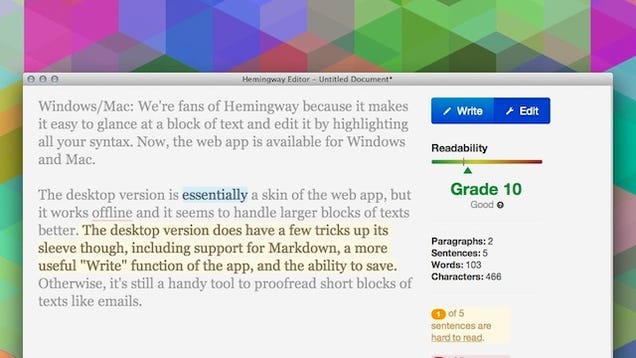
Windows/Mac: We're fans of Hemingway because the syntax highlighting makes it easy to glance at a block of text and edit for specific parts of speech. Now, the webapp is available for Windows and Mac.
The desktop version is essentially a skin of the web app, but it works offline and it seems to handle larger blocks of texts better. The desktop version does have a few tricks up its sleeve though, including support for Markdown, a more useful "Write" function of the app, and the ability to save. Otherwise, it's still a handy tool to proofread short blocks of texts like emails.
It took a little while for the apps to come into their own, but we’re at a place now where the iPad has nearly as good of a selection of apps as the iPhone. Now, it’s harder than ever to find apps that are worthwhile. Let us save you some time with this collection of the best iPad apps.
The Lifehacker Pack is a yearly snapshot of our favorite, must-have applications for each of our favorite platforms. This list focuses specifically on apps that really shine on the iPad, so no half-done, blown up iPhone apps here.
You wouldn’t think it based solely on the name, but our pick for the best email client on iOS is Microsoft Outlook. It includes everything you need in an email client, including a unified inbox, customizable swipe options, powerful search, and a solid filtering system. It blows Apple’s default Mail app out of the water, so if you’re looking for something with more power, Outlook’s the way to go. If you don’t want to deal with Microsoft, Spark is the next logical choice, and a fantastic email app in its own right. It does everything Outlook does, but adds in a smart inbox that’s much better than Outlook’s, and a ton of customization options to make the app your own.
Picking a notes apps used to be easy, but things are a lot more complicated these days and you have tons of solid options. If you like a ton of features, blow for blow, OneNote and Evernote are the most comparable, offering you means to save images, integrate IFTTT, have tons of folders, special recipe filters, and tons of more options. The catch, really, is that OneNote’s free, while Evernote’s best features are locked behind a paywall. These everything buckets aren’t for everyone though. If plain text is more your thing, Simplenote is the app for you. There’s no long list of features here, Simplenote just does text, and it does it very well. If you’re looking for something in-between, Google Keep is well worth a look. It’s powerful, but still pretty simple. Of course, you’ll get a lot more out of Google Keep if you’re already invested in the Google ecosystem. Heck, it’s also worth pointing out that Apple’s default Notes app has made a lot of strides over the years, so if you haven’t checked it out recently, give it a look. It fits somewhere in-between the everything buckets of Evernote and OneNote and Google Keep.
For whatever reason, the iPad is pretty devoid of to-do apps, but thankfully, our favorite on iPhone, Any.Do arrived on iPad in the last year. Any.Do has a simple interface that makes it easy to add tasks and organize them, but you can also add tasks with your voice, share lists with other, sync across multiple devices, and even easily postpone tasks.
Editing images on your iPad isn’t ideal, but sometimes it’s your only option. Pixelmator is a worthy app for doing it because it features just about every tool that the desktop version has. You can quickly jump in and start editing photos, painting, and doing basic graphic design. If you’re editing photos on your iPad, Pixelmator is a must have.
Using your iPad as a second display is a great way to extend your desktop without taking too much space. The best app for doing so is Duet Display. With it, you can connect your iPad to your computer with a cable, then immediately start using your iPad as a second display with almost no lag. It comes with lots of options too, including high resolution displays, 60 frames per second, and touch support.
The iPad is a fantastic (albeit expensive) notepad, and depending on what you’re looking for you have a couple options. As a sketchbook, Paper is a fantastic option that makes even the worst artist look like an artistic genius with it’s brush options, easy to use book, and downloadable color palettes. While you’re at it you might consider grabbing a solid stylus as well.
You have tons of options for calendar apps on the iPad, but our favorite on iPhone is Fantastical 2, and that remains the case for the iPad as well because it’s a perfect mesh of features and usability. Fantastical allows for natural language input, so you can type out “lunch tomorrow with Alan” and Fantastical will automatically create the event. Beyond that, the app features a variety of view modes, a light and dark theme, Reminders integration, and a map view to get a visual look of your day.
Writing on an iPad is great and you have a ton of quality apps to choose from to do it. That said, we like Editorial because it’s incredibly customizable. The crux of Editorial is its automation functions, where you can set it up with text expansion, application triggers, and more. Basically, it’s as powerful as you want it to be, but still works great for just writing. If longform writing is more your thing, Ulysses is our favorite. Ulysses sits somewhere between plain text and Scrivener, making it perfect for organizing and writing that novel you’ve been meaning to write without being overwhelming.
If you’re a Chrome user on your desktop computer, Chrome’s syncing features alone make it a stellar replacement for Safari. Chrome’s packed with some extra great features, including a desktop view, a solid incognito mode, easy to browse tabs, and the speed dial to quickly access your favorite sites. If Chrome isn’t your thing, you have a few other solid options as well. Safari’s pretty solid these days, but if you’re not also using it on a Mac, it’s usefulness diminishes pretty quickly.
The official Facebook app does a fine job of providing you with a solid mobile experience, but it’s especially good looking on the iPad. With big pictures, a nice wide view of everything, and a full set of features, if you’re using Facebook, the iPad app is well worth keeping around.
Skype has long been the kind of video calling, but Google recently introduced Google Hangouts is giving it a run for its money. The reason is simple: pretty much everyone already has a Google account, and that’s all your need to use Google Hangouts. The iPad version looks great on the bigger screen, and the added scree real estate makes video chat a lot better than the iPhone counterpart. With it, you can make video calls instantly, and it doesn’t cost you a dime. That said, Skype is still the kind of VOIP, and it’s widely used enough that most people have it. Both work great for video chats, so pick whichever suits you best.
Dropbox is already a fantastic cloud storage service, but what really sets it above the competition is its mobile app. While it used to be nothing more than a file browser, nowadays you can instantly upload all your pictures, edit files, and easily share anything in your Dropbox through a wide variety of services. The PDF viewer alone is fantastic on the iPad, but overall it’s an incredibly useful app to keep around. Plus, you can always score more space with a little work.
Workflow is an app that allows you to create macros and small apps for iOS. Essentially, it’s Automator for your iPad. You can make it so with a tap of a button you can load up upcoming calendar events, print a page to PDF, find lyrics for the currently playing song, and more.
Launch Center Pro makes doing serious work on your iPad a lot easier by allowing you to create application specific shortcuts. Basically, you’ll fire up Launch Center Pro, hit an action button, and you’ll get whisked away to a specific part of an app so you can quickly send emails, create reminders, and whatever else.
If This Then That is already one of our favorite web apps, and the iPad app is just as powerful. Not only can you create any recipe you want on the go, you can also tap directly into the iPad’s contacts, photos, reminders, and more to automate whatever happens on your iPad.
It’s hard to really differentiate between any of the ereader apps on the iPad because they’re all pretty similar. They all let you read books on your phone, and most of them are tied to an account on the the store they’re part of. So, if you’re using iBooks on another device, then that’s the logical choice. The same goes for the Kindle app. Pick the ebook app that works best for you. That said, if you’re a student, the Kindle app has all kinds of killer features.
Google Reader might be dead, but Reeder is still our favorite RSS reader. With a recent update, Reeder added support for a few third-party RSS readers, including Feedly. Reeder is incredibly clean, and you can quickly save articles for later viewing, sync everything up, or just browse your feeds in its simple interface.
Bookmarking services are great on the desktop, but they really excel on the iPad. Save articles wherever you find them, and you get access on your phone so you can read when you’re bored. Each service has its own set of benefits and downsides, but they’re all terrific and look fantastic on the iPad. So, pick one and run with it.
Listening to podcasts on your iPad is a fantastic way to pass the time, but Apple’s option is less than perfect. We’re big fans of Overcast, because once you set it up it automates pretty much everything for you. It downloads all your podcasts directly in the app, it works over the air or Wi-Fi, or you can set it up so it only streams content. Overcast can also intelligently boost the sound on podcasts and has a “smart speed” option that speeds up your favorite podcasts without making them sound weird. It’s also free, which makes it automatically appealing.
If you want to watch TV shows and movies on your iPad you have plenty of options, and most of them are pretty similar. It really depends on what you’re paying for to watch on your TV, because for the most part the apps for Netflix, Amazon Instant Video, and Hulu are all pretty similar. Having these apps on your iPad makes it a lot easier to get through your massive queue.
Uber and Lyft are straight out of the “creative destruction” model that economist Joseph Schumpeter said was the essence of free markets. Competition can serve as a powerful force to improve the operation of economies. Uber has built a better, tech-savvy mousetrap for transportation services. Uber drivers’ cars are often newer and cleaner than traditional cabs, and customers can easily request upgrades. Drivers are screened, and a passenger can see a picture of the driver and his or her customer-service rating before getting into the car. Low-ranked drivers can be and are removed from the system, an accountability system that’s missing from most cab companies.
Many drivers with an entrepreneurial bent also like Uber because they can decide what hours they will work and use the service to earn a supplementary income if they happen to be unemployed. Armando Rojas, an immigrant from Colombia who now lives in New York City, told me he likes the flexibility of Uber “and the fact you are more your own man.” Having said that, he complains the company has lately added fees, which, combined with new taxes, make it almost as difficult for him to make ends meet as it would be if he were driving a cab.
The latest battleground between Uber and its enemies is in Cambridge, Mass., the home of both MIT and Harvard, powerhouses of scientific research. But the low-tech cab industry is pulling all the strings it can to get local government to kill innovation and unplug Uber.
Elections for the European parliament have been taking place across the EU, and the results are described by many as shocking:
Stunning victories in European Parliament elections by nationalist, Eurosceptic parties from France and Britain left the European Union licking its wounds on Monday and facing a giant policy dilemma.
Across the continent, anti-establishment parties of the far right and hard left more than doubled their representation amid voter apathy, harnessing a mood of anger with Brussels over austerity, mass unemployment and immigration.
While the center-right and center-left will continue to control more than half of the 751 seats in the EU legislature, they will face an unprecedented challenge from noisy insurgents determined to stop business as usual in the 28-nation bloc.
UKIP won 27.5% of the vote and had 24 MEPs elected. Labour, on 25.4%, has narrowly beat the Tories into third place while the Lib Dems lost all but one of their seats and came sixth behind the Greens.
Outside of London, UKIP was getting consistently more than 30% of the vote in England:
UKIP’s web site is here, its manifesto is here. For the most part, its policy positions will be familiar to American conservatives, but the context is Britain’s participation in the EU. Here are some samples:
A gulf has opened between the ruling elite and the public. Because they must all follow Brussels diktats, each of the establishment main parties is now so similar voters have no real choice.
The EU controls Immigration, Business and Employment, Financial Services, Fishing, Farming, Energy and Trade. It seeks now to control Law and Order, Foreign Affairs and Tax. Only outside the EU can we start to solve the problems our country faces. …
* A vote for UKIP is a vote to leave the EU and recover power over our national life.
* Free trade, but not political union, with our European neighbours. We are the EU’s largest export market: they depend on us for jobs – not the other way around. …
* Regain control of our borders and of immigration – only possible by leaving the EU.
* Immigrants must financially support themselves and their dependents for 5 years. This means private health insurance (except emergency medical care), private education and private housing – they should pay into the pot before they take out of it. …
* Develop shale gas to reduce energy bills and free us from dependence on foreign oil and gas – place the tax revenues into a British Sovereign Wealth Fund. …
* Remove the UK from the jurisdiction of the European Court of Human Rights. …
* No to Political Correctness – it stifles free speech.
* The law of the land must apply to us all. We oppose any other system of law.
* Teach children positive messages and pride in their country. We want to unite through better integration.
UKIP is a patriotic party that believes in putting Britain first. Only UKIP will return self-government to the British people.
In France, the National Front, which has been around for quite a while, swept to its first-ever national victory, winning 25% of the vote and besting both the ruling Socialist Party (14%) and the more conservative UMP (21%). “Right wing” parties also did well in Denmark and Austria.
Two closely-related issues drove the insurgency. The first is broadly referred to as Euroskepticism. The bureaucrats in Brussels want to run Europe; they want Europe to be, in effect, a country; and they don’t want to be accountable to voters. Euroskepticism has multiple sources. For example, some people believe that the Euro and continent-wide central banking policy are damaging their economic interests. Others may not be hostile in principle to European union, but don’t want to give up sovereignty to unelected bureaucrats. But most Euroskepticism, at bottom, is the result of persistent nationalism.
For some decades now, Europe’s elites have frowned on nationalism, whether it be French, British, German, Italian, or whatever. The European project has had the long-term goal of molding the continent into a single political entity, in which what were formerly countries would have roles analogous to the American states or Canadian provinces. Intellectuals have justified their hostility toward nationalism by blaming it for the two world wars, which is not entirely unreasonable. But the European impulse arises more, I think, from the desire of Europe’s transnational elites to run a bigger entity–one that stands as an equal with the United States–and to do so without interference from those pesky voters.
The second issue that drives the current revolt is immigration. Logically, if Europe is a single country, then its citizens should be able to move from place to place in search of employment or better health care or welfare benefits. Understandably, many citizens of, say, France and Great Britain have reservations about immigration policies that have not just the effect, but the purpose of obliterating national identity.
The European press persists in describing any political group that has reservations about European integration or, especially, mass immigration as “far right.” To be “far left,” on the other hand, you generally have to use violence to try to install Communist dictatorships. Even peaceful socialists don’t qualify as “far left.” This is a deliberate political choice by Europe’s reporters and editors, but it has unfortunate consequences. With “far right” describing a vast political spectrum that might include most American voters if applied on this side of the Atlantic, ordinary conservatives are forced, to some extent, to make common cause with the handful who can legitimately be seen as extreme. The National Front, for example, has an unsavory past. But where else is a French voter to go, if he wants to be a citizen of France, rather than the European Union?
What is happening in Europe is is largely mirrored in the United States. Here, too, a liberal elite wants to install itself in power on a permanent basis; to stamp out, or at least marginalize, such old-fashioned forces as patriotism and religion; and to operate through administrative dictate so as to avoid any accountability to voters. Democracy is such an inconvenience when you are trying to remake a civilization! Americans should keep a close eye on events in Europe. Our future may well be foretold in the current political upheaval there.
You've probably seen this pattern going around. It's an input that appears as if it has placeholder text in it, but when you click/tap into that input, that text moves out of the way and allows you to type there. It's rather clever, I think. Brad Frost has a really good post on it, detailing the pros and cons and such.
Many of the demos I've seen involve JavaScript. The other day I was checking out at Nest.com, saw their technique for it, and I thought of a way I could pull that off without JavaScript. So here we are.
It's not quite as sexy as the Nest ones, where the text is fading out as the label is sliding up. Certainly possible with some JavaScript, but we're going to stick with pure CSS here. Still might be possible though. I'll leave that challenge up to you.
Some Quick Reminders
There are two reasons you might consider doing this:
It might be able to save space. Because the input and label are combined, it takes up less space. When an input is in focus, you do still need to show both the label and input, but you can get that space by either using some of the space the input was already using, or by growing the area temporarily only for the focused input.
It makes the input one big button. Not that inputs aren't already, and not that labels aren't when they have a proper for attribute, but there is something kinda nice about a big rectangle that tells you what it wants that you click/tap. Might make for a nice experience particularly on mobile.
I'd say, generally, that always-visible labels are probably "better" - but this is a clever idea and done right, may be useful occasionally. There is always a risk of screwing this up and hurting accessibility too, so take care. One downside to this pattern: we can't use placeholder in addition to the label, which can be helpful (e.g. a label of "Phone Number" and a placeholder hint of "(555) 555-5555").
The Trick (1 of 3) - The label is the placeholder
There is a <div> that contains both the <label> and <input> (which you need to do anyway because inputs within forms need to be in block level elements) that has relative positioning. That allows absolute positioning within it, which means we can position the label and input on top of each other. If we do that with the input on top, but with a transparent background, you'll be able to see the label right underneath it while still being able click into it.
form > div {
  position: relative;
}
form > div > label {
  position: absolute;
}
The Trick (2 of 3) - the :focus state and the adjacent sibling combinator
The source order of the <label> and <input> wouldn't matter much here, since semantically they are tied together with the for attribute. But if we put the input first, that means we can leverage its :focus state and an adjacent sibling combinator (+) to affect the label when it is focused. Similar in concept to the checkbox hack.
input:focus + label {
  /* do something with the label */
}
You can do whatever you want with the label. Just find a cool place to move it and style it that is out of the way of typing in the input. My example had two possibilities: one was making it smaller and moving toward the bottom of the input, the other was moving it to the far right side.
Once there is actual text in the input, and the input goes back out of focus, it would be very weird (bad) to see the label and the input text on top of each other. Fortunately in CSS there is a :valid selector that works on inputs when they are in a valid state. That valid state can be "any text at all", assuming the only thing that makes it valid is having any value at all, which can be achieved like:
<input type="text" required>
Then remember the only reason you could see the label at all was because the input has a transparent background. To hide it, we can use an opaque background instead:
form input:valid {
  background: white;
}
The rest of this is just fiddling around with design details until you have it just how you like it.
INDIANAPOLIS -- In what has become an NFL scouting combine tradition, St. Louis Rams coach Jeff Fisher was asked again whether he would be willing to draft an offensive lineman in the first round of May’s draft.
Once again, Fisher said the fact that none of his teams have taken a lineman in the first round in his nearly two decades as a head coach is more a matter of happenstance than design.
“I have no reservation whatsoever,” Fisher said.
Hotel room thermometers normally don't let you adjust the temperature above or below a certain point, which can lead to some pretty warm rooms in the summer time or chilly ones in the winter. If you want more control, here's how to override your hotel thermometer, put it in "VIP" mode, and tweak it where you like it.
Gary Leff, writing for View from the Wing, shared the video above, which shows you how it's done. Most hotel wall units (Gary noted that Hilton and Hyatt specifically tend to use this type of thermostat) that you'll have access to will work this way. The window units on the air conditioner/heaters themselves may be a bit more flexible, but give this a try on your next wall thermometer:
Hold down the “display” button
While holding that button, press “off”
Release off, continue to hold down display, and Press the “up” arrow button
Release all buttons
This trick also disables the motion sensors that many hotels use to only keep the heating and cooling system active at all when a guest is in the room—that means that you won't have to wait for a sweltering room to gradually cool off when you get back from a long day, or wait for an ice cold room to warm up in the winter.
Gary explains that you don't have to just be quirky about the temperature to use this trick—sometimes hotels try and save money by keeping the room thermostats in a certain range, leading to uncomfortable guests, and in his case, he had a room that got a ton of sunlight that warmed it up in the daytime, making it really hot, even with the thermostat turned down as far as it can go. Either way, the power is yours—to be more comfortable when you travel. Hit the link below to read more—his commenters, both at the link below and his much older post have some similar tricks for other hotel chains that may not use these units, too.