14 Jul 18:22
by Takahito Kasahara, Young Jin Jang, Léanne Racicot, Dimitrios Panagopoulos, Steven H. Liang, Marco A. Ciufolini
Abstract
A metathesis reaction occurs when a diaryliodonium triflate is heated with an aryl iodide, resulting in the formation of a new diaryliodonium triflate.

Mixed diaryliodoniumtriflates are obtained through treatment of aryl iodides with diaryliodonium triflates. A possible mechanism for the metathesis reaction is proposed.
14 Jul 07:57
by Jing Peng, Chao Chen, Junjie Chen, Xiang Su, Chanjuan Xi and Hui Chen

Organic Letters
DOI: 10.1021/ol501655g

11 Jul 09:13
by Hongchao Zheng, Laura L. Adduci, Ryan J. Felix, Michel R. Gagné
Abstract
An unprecedented gold-catalyzed diastereoselective cycloisomerization of 1,6-diynes bearing an alkylidene cyclopropane moiety has been developed. This methodology enables rapid access to a variety of 1,2-trimethylenenorbornanes, which are important building blocks in the preparations of abiotic and sesquiterpene core structures.

When gold met alkylidenecyclopropane: Cationic gold catalysts can mediate the highly exothermic (≈60 kcal mol−1) cycloisomerization of 1,6-diynes bearing an alkylidene cyclopropane moiety. This diastereoselective methodology efficiently generates 1,2-trimethylenenorbornanes, an important building block for abiotic targets and sesquiterpene natural products. DCE=1,2-dichloroethane, Tf=trifluoromethanesulfonyl, Tol=Tolyl.
11 Jul 08:58
by Filip Kolundžić, Annamalai Murali, Patricia Pérez-Galán, Jonathan O. Bauer, Carsten Strohmann, Kamal Kumar, Herbert Waldmann
Abstract
A facile synthesis of chiral cyclic alkyl aminocarbene–gold(I) complexes from gold-free 1,7-enyne substrates was developed. The novel cyclization–rearrangement reaction sequence is triggered by the addition of (Me2S)AuCl to different 1,7-enynes and leads to structurally unique carbene–gold(I) complexes in high yields. These novel complexes are catalytically active and inhibit the proliferation of different human cancer cell lines.

Golden opportunities: A cyclization–rearrangement cascade of different 1,7-enynes triggered by the addition of (Me2S)AuCl provides facile access to structurally unique chiral cyclic alkyl aminocarbene–gold(I) complexes in high yields. These novel complexes are catalytically active and display biologic activity against cancer cell lines.
11 Jul 08:56
by Jordi Burés, Paul Dingwall, Alan Armstrong, Donna G. Blackmond
Abstract
An unusual solvent-induced inversion of the sense of enantioselectivity observed in the α-selenylation of aldehydes catalyzed by a diphenylprolinol silyl ether catalyst is correlated to the presence of intermediates formed subsequent to the highly selective C![[BOND]](http://onlinelibrarystatic.wiley.com/undisplayable_characters/00f8ff.gif) Se bond-forming step in the catalytic cycle. This work provides support for a mechanistic concept for enamine catalysis and includes a general role for “downstream intermediates” in selectivity outcomes in organocatalysis.
Se bond-forming step in the catalytic cycle. This work provides support for a mechanistic concept for enamine catalysis and includes a general role for “downstream intermediates” in selectivity outcomes in organocatalysis.

Off the beaten path: Studies of an unusual inversion of the sense of enantioselectivity for the selenylation of aldehydes catalyzed by a diphenylprolinol ether catalyst provides support for a mechanistic concept beyond the simple steric model developed for enamine catalysis in these systems. A general role for downstream intermediates in selectivity outcomes in organocatalysis is discussed. TMS=trimethylsilyl.
20 Jun 10:39
by Laurent Batiste and Peter Chen

Journal of the American Chemical Society
DOI: 10.1021/ja4084495

02 Jun 19:21
by Shiqiang Zhou and Yanxing Jia

Organic Letters
DOI: 10.1021/ol501341b

29 May 18:00
by Jonathan M. French and Steven T. Diver

The Journal of Organic Chemistry
DOI: 10.1021/jo500748e

28 May 18:35
by Zhuo Xin, Søren Kramer, Jacob Overgaard, Troels Skrydstrup
Abstract
A new synthetic route to the privileged 1,2-dihydroisoquinolines is reported. This method, which relies on a gold-catalyzed formal [4+2] cycloaddition between ynamides and imines, provides a new retrosynthetic disconnection of the 1,2-dihydroisoquinoline core by installing the 1,8a CC and 2,3 CN bonds in one step. Both aldimines and ketimines can be used as substrates. In addition, one example of dihydrofuropyridine synthesis is also demonstrated.

Heterocycles: A new synthetic route to the privileged 1,2-dihydroisoquinolines is reported. This method, which relies on a gold-catalyzed formal [4+2] cycloaddition between ynamides and imines, provides a new retrosynthetic disconnection of the 1,2-dihydroisoquinoline core by installing the 1,8a CC and 2,3 CN bonds in one step. Both aldimines and ketimines can be used as substrates. In addition, one example of dihydrofuropyridine synthesis is also demonstrated (see scheme).
28 May 10:06
by Kamalkishore Pati, Igor V. Alabugin
Abstract
Au-catalyzed cycloisomerization of aryl propargyl ethers provides controlled transition from alkyne to carbonyl chemistry followed up by a Petasis–Ferrier rearrangement/aromatization cascade leading to substituted biaryls with functionalized naphthalene cores.

An Au-catalyzed sequence of alkoxy group translocation, Petasis–Ferrier rearrangement, and aromatization transforms aryl propargyl ethers into substituted biaryls with functionalized naphthalene cores.
19 May 11:48
by Tony S. N. Zhao, Yuzhu Yang, Timo Lessing and Kálmán J. Szabó

Journal of the American Chemical Society
DOI: 10.1021/ja502792s

06 May 08:23
by Mark D. Levin, F. Dean Toste
Abstract

Teaching Au new tricks: A novel manifold for reactivity in gold catalysis has been realized, allowing the cross-coupling of arylboronic acids and allylic bromides without a sacrificial oxidant. A bimetallic catalyst is employed, providing allylbenzene products with unique scope and chemoselectivity. A mechanistic proposal is put forward based on stoichiometric experiments, including the isolation of an AuIII allyl complex.
06 May 08:20
by Matthew J. Hesse, Stéphanie Essafi, Charlotte G. Watson, Jeremy N. Harvey, David Hirst, Christine L. Willis, Varinder K. Aggarwal
Abstract
α,α-Disubstituted allylic pinacol boronic esters undergo highly selective allylborations of aldehydes to give tetrasubstituted homoallylic alcohols with exceptional levels of anti-Z-selectivity (>20:1). The scope of the reaction includes both acyclic and cyclic allylic boronic esters which lead to acyclic and exocyclic tetrasubstituted homoallylic alcohols. The use of β-borylated allylic boronic esters gave fully substituted alkenes bearing a boronic ester which underwent further cross-coupling enabling a highly modular and stereoselective approach to the synthesis of diaryl tetrasubstituted alkenes. Computational analysis revealed the origin of the remarkable selectivity observed.

Asymmetric CC coupling: α,α-Disubstituted allylic pinacol boronic esters undergo highly selective allylborations of aldehydes to give tetrasubstituted homoallylic alcohols with exceptional levels of anti-Z-selectivity (see scheme). The scope of the reaction includes both acyclic and cyclic allylic boronic esters. β-Borylated allylic boronic esters gave fully substituted vinyl boronates suitable for further cross-coupling.
06 May 08:19
by Catherine Holden (née Hall), Michael F. Greaney

Arynes are now accessible through the [4+2] Diels–Alder cycloaddition of triynes, a process that captures all atoms of the starting material in the aryne product. The atom economy and reagent-free conditions provide a new dimension to aryne chemistry and should enable exciting developments in the study and application of arynes in synthesis.
05 May 17:03
by Zhunzhun Yu, Ben Ma, Mingjin Chen, Hai-Hong Wu, Lu Liu and Junliang Zhang

Journal of the American Chemical Society
DOI: 10.1021/ja503163k

Nyk, cxl and 3 others like this
02 May 18:48
by Manikandan Thangaraj, Sachin Suresh Bhojgude, Rajesh H. Bisht, Rajesh G. Gonnade and Akkattu T. Biju

The Journal of Organic Chemistry
DOI: 10.1021/jo500819w

02 May 17:15
by Günter Seidel, Alois Fürstner
Abstract
A formal gold-for-chromium transmetalation allowed the gold carbenoid species [Cy3PAuCAr2]NTf2 (11) (Ar=pMeOC6H4-) to be obtained in crystalline form. The structure in the solid state suggests that there is only little back donation of electron density from gold to the carbene center of 11 and hence very modest AuC double-bond character; rather, it is the organic ligand framework that is responsible for stabilizing this species by resonance delocalization of the accumulated positive charge. Because 11 is capable of cyclopropanating p-methoxystyrene even at low temperature, the discussion of its structure is deemed relevant for a better understanding of the mechanisms of π-acid catalysis in general.

Call me “carbenoid”: No signs of significant AuC double-bond character, but many indications for charge density at carbon distinguish the structure of an only modestly “stabilized” gold carbenoid in the solid state. Because this species is capable of cyclopropanating a styrene derivative under mild conditions, its structural features are relevant for mechanistic discussions of π-acid catalysis in general.
25 Apr 15:34
by Juana Du
A two-catalyst combination offers long-sought selectivity in intermolecular coupling of olefins to form four-membered rings. [Also see Perspective by Neier]
Authors: Juana Du, Kazimer L. Skubi, Danielle M. Schultz, Tehshik P. Yoon
23 Apr 08:51
by Xiao Liu, Cong Xu, Mang Wang and Qun Liu

Chemical Reviews
DOI: 10.1021/cr400473a

26 Mar 11:55
by John M. Curto, Joshua S. Dickstein, Simon Berritt and Marisa C. Kozlowski

Organic Letters
DOI: 10.1021/ol500506t

24 Mar 13:28
by Lauren E. Hayward
A model reproduces the temperature dependence of charge-order fluctuations in a cuprate superconductor.
Authors: Lauren E. Hayward, David G. Hawthorn, Roger G. Melko, Subir Sachdev
24 Mar 13:27
by R. Soria
A stellar-mass black hole shocks its surroundings with kinetic energy in excess of its predicted radiative output. [Also see Perspective by King]
Authors: R. Soria, K. S. Long, W. P. Blair, L. Godfrey, K. D. Kuntz, E. Lenc, C. Stockdale, P. F. Winkler
19 Mar 17:02
Chem. Commun., 2014, 50,3941-3943
DOI: 10.1039/C4CC00474D, Communication
Shiqing Li, Fan Yang, Taiyong Lv, Jingbo Lan, Ge Gao, Jingsong You
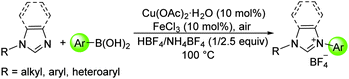
An efficient approach to synthesize unsymmetrical imidazolium salts through the direct quaternization of N-substituted imidazoles using arylboronic acids is developed.
The content of this RSS Feed (c) The Royal Society of Chemistry

19 Mar 13:03
by Weizhen Fang, Marc Presset, Amandine Guérinot, Christophe Bour, Sophie Bezzenine-Lafollée, Vincent Gandon
Abstract
Complexes of type [LAuCl] (L=phosphine, phosphite, NHC and others) are widely employed in homogeneous catalysis, however, they are usually inactive as such and must be used jointly with a halide scavenger. To date, this role has mostly been entrusted to silver salts (AgSbF6, AgPF6, AgBF4, AgOTf, etc.). However, silver salts can be the source of deactivation processes or side reactions, so it is sometimes advisable to use silver-free cationic gold complexes, which can be difficult to synthesize and to handle compared with the more robust chloride. We show in this study that various Lewis acids of the transition and main group metal families are expedient substitutes to silver salts. We have tested CuI, CuII, ZnII, InIII, SiIV, BiIII, and other salts in a variety of typical AuI-catalyzed transformations, and the results have revealed that [LAuCl] can form active species in their presence.

Not just silver: Active gold species have been generated from the corresponding inactive chlorides by using Lewis acids that are not typical in gold chemistry (see figure). Instead of silver salts, complexes of Cu, Zn, In, Si, Bi, and others have been used. This study shows that silver salts, which can cause deactivation processes and side reactions, can be replaced by various activators. Thus, the use of a sensitive cationic gold complex can be avoided.
06 Mar 12:47
by Huai-Long Teng, Lu Yao and Chun-Jiang Wang

Journal of the American Chemical Society
DOI: 10.1021/ja500878c

21 Feb 12:47
by Chen Cheng
A catalyst that adds silyl groups to specific sites on aryl rings could streamline synthesis of pharmaceutical intermediates. [Also see Perspective by Tobisu and Chatani]
Authors: Chen Cheng, John F. Hartwig
18 Feb 17:53
by Charis Gryparis and Manolis Stratakis

Organic Letters
DOI: 10.1021/ol500225x

11 Feb 19:18
by Manuel Hofer, Enrique Gomez-Bengoa and Cristina Nevado

Organometallics
DOI: 10.1021/om400884s

17 Jan 16:19
by Dongmei Lu, Chao Wu, Pengfei Li
Abstract
Boryl radicals have the potential for the development of new molecular entities and for application in new radical reactions. However, the effects of the substituents and coordinating Lewis bases on the reactivity of boryl radicals are not fully understood. By using first-principles methods, we investigated the spin-density distribution and reactivity of a series of boryl radicals with various substituents and Lewis bases. The substituents, along with the Lewis bases, only affect the radical reactivity when an unpaired electron is in the boron pz orbital, that is, for three-coordinate radicals. We found evidence of synergistic effects between the substituents and the Lewis bases that can substantially broaden the tunability of the reactivity of the boryl radicals. Among Lewis bases, pyridine and imidazol-2-ylidene show a similar capacity for stabilization by delocalizing the spin density. Electron-donating substituents, such as nitrogen, more efficiently stabilize boryl radicals than oxygen and carbon atoms. The reactivity of a boryl radical is always boron based, irrespective of the spin density on boron.

Synergistic effects of substituents and Lewis bases on the reactivity of boryl radicals with various topologies are examined (see figure). Two electron-donating substituents in combination with a good σ-donating and π-accepting Lewis base stabilize boryl radicals much more efficiently than if only substituents or Lewis bases are used.
17 Jan 15:49
by Xiao-Song Xue, Chen Yang, Xin Li and Jin-Pei Cheng

The Journal of Organic Chemistry
DOI: 10.1021/jo402605n