06 Mar 07:14
by Alina Meindl, Shane Plunkett, Aoife A. Ryan, Keith J. Flanagan, Susan Callaghan, Mathias O. Senge
Contemporary applications in optics, medicine, solar cells, or material science are increasingly reliant on unsymmetrically substituted porphyrins. Due to their widespread applications and rise in demand we undertook a comparative analysis of synthetic strategies for meso-substituted porphyrins and present the synthesis of five different series of so-called A2BC push-pull porphyrins. The synthetic pathways used were applied to both 5,15-substituted and 5,10-substituted porphyrins, showcasing their flexibility and adaptability for different needs. Our approach combines well-known reactions with a strategic and logical stepwise functionalization allowing researchers to change and modify the electronic properties of these systems at various points of the syntheses. This facilitates the easy optimization of the synthesis of systems of current interest, for example, porphyrins for dye-sensitized solar cells (DSSCs) or for use in nonlinear optics, as well as fast generation of compound libraries.

In view of the applications of A2BC push-pull porphyrins, for example in dye-sensitized solar cells (DSSCs), we analyzed the synthetic strategies for 5,10- and 5,15-substituted porphyrins, combining well-known reactions with a strategic and logical stepwise functionalization, enabling the modification of the electronic properties of these systems at various points of the syntheses.
03 Mar 06:45
![Möbius Aromatic [28]Hexaphyrin Germanium(IV) and Tin(IV) Complexes: Efficient Formation of Triplet Exited States](http://onlinelibrary.wiley.com/store/10.1002/anie.201700063/asset/image_n/anie201700063-toc-0001.png?v=1&s=11eb9bad770da90c811e488b37d32cffbf5ff96e "Möbius Aromatic [28]Hexaphyrin Germanium(IV) and Tin(IV) Complexes: Efficient Formation of Triplet Exited States")
Heavy-atom efffect: [28]Hexaphyrin GeIV and SnIV complexes were synthesized and characterized as distinct 28π Möbius aromatic molecules. The hydroxy group of the GeIV complex was readily exchanged with phenols and thiophenol with retention of configuration. Intersystem crossing to the T1 state is remarkably enhanced in the SnIV complex owing to the heavy-atom effect, and the T1 state thus formed is antiaromatic in line with the Baird rule.
[Communication]
Mondo Izawa, Taeyeon Kim, Shin-ichiro Ishida, Takayuki Tanaka, Tadashi Mori, Dongho Kim, Atsuhiro Osuka
Angew. Chem. Int. Ed., February 28, 2017, DOI: 10.1002/anie.201700063. Read article
01 Mar 06:30
by Yuto Kurata, Shinya Otsuka, Norihito Fukui, Keisuke Nogi, Hideki Yorimitsu and Atsuhiro Osuka

Organic Letters
DOI: 10.1021/acs.orglett.6b03861

26 Feb 08:22
Chem. Sci., 2017, 8,3494-3499
DOI: 10.1039/C7SC00533D, Edge Article

Open Access
Alexandra Roth, Tobias A. Schaub, Ute Meinhardt, Dominik Thiel, Jan Storch, Vladimir Cirkva, Pavel Jakubik, Dirk M. Guldi, Milan Kivala
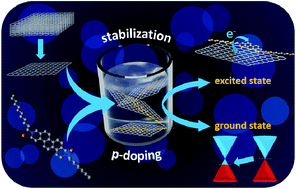
We report on the preparation of a hybrid system consisting of exfoliated graphene and N,N[prime or minute]-didodecyl 3,10-diazapicenium salts by solution based methods. The obtained hybrids were characterized by steady state and time-resolved spectroscopic as well as microscopic techniques to corroborate the p-doped character.
The content of this RSS Feed (c) The Royal Society of Chemistry

26 Feb 08:14
by Shiqian Zhang, Zhiqiang Liu and Qi Fang

Organic Letters
DOI: 10.1021/acs.orglett.7b00276

21 Feb 20:42
by Christopher C. McAtee, Paul S. Riehl and Corinna S. Schindler

Journal of the American Chemical Society
DOI: 10.1021/jacs.7b01114

21 Feb 06:58
by King-Chin Yim, Vonika Ka-Man Au, Keith Man-Chung Wong, Vivian W. W. Yam
Abstract
A series of luminescent bis-cyclometalated gold(III) complexes with different nuclearities and various alkynyl ligands derived from hexaphenylbenzene (HPB) and hexabenzocoronene (HBC) have been synthesized. The energies of the low-energy metal-perturbed intraligand (IL) π–π*(R−C^N^C) absorptions of the HPB–alkynyl gold(III) complexes have been fine-tuned by attaching various substituent groups to the bis-cyclometalating ligands. Similarly, the metal-perturbed 3IL [π![[RIGHTWARDS ARROW]](http://onlinelibrarystatic.wiley.com/undisplayable_characters/002192.gif) π*(R−C^N^C)] emissions of the complexes show energy shifts according to the electronic nature of the bis-cyclometalating ligands. On the contrary, the absorption and emission spectra of the HBC–alkynyl gold(III) complex have been assigned as dominated by the IL transitions of the HBC–alkynyl unit, as supported by transient absorption studies. The supramolecular assembly morphologies of the gold(III) complexes have been studied by TEM and SEM, along with comparisons across different complexes based on the molecular structures, and their assembly processes monitored by concentration-dependent and variable-temperature 1H NMR spectroscopy studies.
π*(R−C^N^C)] emissions of the complexes show energy shifts according to the electronic nature of the bis-cyclometalating ligands. On the contrary, the absorption and emission spectra of the HBC–alkynyl gold(III) complex have been assigned as dominated by the IL transitions of the HBC–alkynyl unit, as supported by transient absorption studies. The supramolecular assembly morphologies of the gold(III) complexes have been studied by TEM and SEM, along with comparisons across different complexes based on the molecular structures, and their assembly processes monitored by concentration-dependent and variable-temperature 1H NMR spectroscopy studies.

Glitters with gold(III): A new class of luminescent bis-cyclometalated gold(III) complexes, containing hexa-peri-hexabenzocoronene or hexaphenylbenzene derivatives in the alkynyl ligands, has been synthesized and characterized (see figure). The complexes undergo supramolecular self-assembly processes driven by noncovalent interactions. Detailed spectroscopic studies were performed.
21 Feb 06:39

[Author Profile]
Angew. Chem. Int. Ed., February 20, 2017, DOI: 10.1002/anie.201700715. Read article
08 Feb 07:34

A comparative set of singly twisted Möbius aromatic (see scheme, left) and doubly twisted Hückel antiaromatic (right) bis(palladium(II)) [36]octaphyrins were synthesized. Their spectroscopic features and quantum-chemical calculations suggest that the aromaticity of these two compounds is reversed in the lowest triplet state (T1).
[Communication]
Yongseok Hong, Juwon Oh, Young Mo Sung, Yasuo Tanaka, Atsuhiro Osuka, Dongho Kim
Angew. Chem. Int. Ed., February 06, 2017, DOI: 10.1002/anie.201611431. Read article
02 Feb 21:04
by Angela B. Grommet and Jonathan R. Nitschke

Journal of the American Chemical Society
DOI: 10.1021/jacs.6b12811

01 Feb 19:31
by Mark S. Little, Stephen G. Yeates, Aula A. Alwattar, Kane W. J. Heard, James Raftery, Alyn C. Edwards, Adam. V. S. Parry, Peter Quayle
The Scholl-type reactions of 4,10-disubstituted chrysene derivatives proceeded by variegated and unexpected oxidation/coupling pathways. These observations serve as a cautionary note when attempting to employ the Scholl reaction in target-oriented materials synthesis.

Scholl coupling reactions proceed by unexpected oxidation/coupling pathways.
16 Jan 08:36
by Yudong Yang, Jingbo Lan and Jingsong You

Chemical Reviews
DOI: 10.1021/acs.chemrev.6b00567

06 Jan 06:46
by Daniel R. Kohn, Levon D. Movsisyan, Amber L. Thompson and Harry L. Anderson

Organic Letters
DOI: 10.1021/acs.orglett.6b03528

25 Sep 21:02
by Dominik Lungerich, Jakob Hitzenberger, Wolfgang Donaubauer, Thomas Drewello, Norbert Jux
Abstract
A feasible two-step synthesis and characterization of a full series of hexaarylbenzene (HAB) substituted porphyrins and tetrabenzoporphyrins is presented. Key steps represent the microwave-assisted porphyrin condensation and the statistical Diels–Alder reaction to the desired HAB-porphyrins. Regarding their applications, they proved to be easily accessible and effective high molecular mass calibrants for (MA)LDI mass spectrometry. The free-base and zinc(II) porphyrin systems, as well as the respective tetrabenzoporphyrins, demonstrate in solid state experiments strong red- and near-infrared-light emission and are potentially interesting for the application in “truly organic” light-emitting devices. Lastly, they represent facile precursors to large polycyclic aromatic hydrocarbon (PAH) substituted porphyrins. We prepared the first tetra-hexa-peri-hexabenzocoronene substituted porphyrin, which represents the largest prepared PAH-porphyrin conjugate to date.

Hexaarylbenzene (HAB)-substituted (tetrabenzo)porphyrins were found to have useful properties for various applications, such as calibrants for (MA)LDI instruments, as strong red- and near- infrared light emitters, and as precursors to large superbenzene-porphyrin light-harvesting architectures.
21 Sep 05:40
by Javier Fernández-Ariza, Rafael M. Krick Calderón, M. Salomé Rodríguez-Morgade, Dirk M. Guldi and Tomás Torres

Journal of the American Chemical Society
DOI: 10.1021/jacs.6b07432

17 Sep 12:19

The path matters! Hexaphenylbenzene-based molecular nodes and polyfluorene wires are the constituents used for the on-surface synthesis of asymmetric node structures with a well-defined geometry, size, and composition (see structure). Measurements of electronic transport through individual molecular nodes when lifted from the surface by an STM tip revealed different transport behavior depending on the π-conjugation pathway.
[Communication]
Christophe Nacci, Andreas Viertel, Stefan Hecht, Leonhard Grill
Angew. Chem. Int. Ed., September 16, 2016, DOI: 10.1002/anie.201605421. Read article
10 Sep 05:29

A phosphole-fused porphyrin dimer as a representative of a new class of phosphorus-containing porphyrins was synthesized. This structure exhibits remarkably broadened absorption as well as unique optoelectronic properties and is a good electron acceptor owing to the unique phosphole-fused structure.
[Communication]
Tomohiro Higashino, Tomoki Yamada, Tsuneaki Sakurai, Shu Seki, Hiroshi Imahori
Angew. Chem. Int. Ed., September 09, 2016, DOI: 10.1002/anie.201607417. Read article
07 Sep 10:10
by Makoto Sako, Yoshiki Takeuchi, Tetsuya Tsujihara, Junpei Kodera, Tomikazu Kawano, Shinobu Takizawa and Hiroaki Sasai

Journal of the American Chemical Society
DOI: 10.1021/jacs.6b07424

02 Sep 06:22

Supramolecular Chemistry. The use of noncovalent interactions between untethered residues to amplify the regio-, stereo-, and atropselective formation of a C60 fullerene bisadduct racemate is described by G. Bottari, D. M. Guldi, T. Torres et al. in their Communication on page 11020 ff.
[Frontispiece]
Giovanni Bottari, Olga Trukhina, Axel Kahnt, Michael Frunzi, Yasujiro Murata, Antonio Rodríguez-Fortea, Josep M. Poblet, Dirk M. Guldi, Tomás Torres
Angew. Chem. Int. Ed., September 01, 2016, DOI: 10.1002/anie.201683761. Read article
26 Aug 07:36
by Halina Zhylitskaya, Joanna Cybińska, Piotr Chmielewski, Tadeusz Lis and Marcin Stępień

Journal of the American Chemical Society
DOI: 10.1021/jacs.6b07826

24 Aug 05:33
by Jean-François Greisch, Konstantin Yu. Amsharov, Jürgen Weippert, Patrick Weis, Artur Böttcher and Manfred M. Kappes

Journal of the American Chemical Society
DOI: 10.1021/jacs.6b06205

17 Aug 10:46
by Tanya K. Ronson, Ben S. Pilgrim and Jonathan R. Nitschke

Journal of the American Chemical Society
DOI: 10.1021/jacs.6b06710

05 May 11:44
by Shingo Kawashima, Kohsuke Aikawa, Koichi Mikami
The catalytic hydrocarboxylation of styrenes derivatives and α,β-unsaturated carbonyl compounds with CO2 (101.3 kPa) in the presence of an air-stable rhodium catalyst was explored. The combination of [RhCl(cod)]2 (cod = cyclooctadiene) as a catalyst and diethylzinc as a hydride source allowed for effective hydrocarboxylation and provided the corresponding α-aryl carboxylic acids in moderate to excellent yields. In this catalytic process with carbon dioxide, intervention of the RhI–H species, which could be generated from the RhI catalyst and diethylzinc, was clarified. Significantly, the catalytic asymmetric hydrocarboxylation of α,β-unsaturated esters with carbon dioxide was also performed by employing a cationic rhodium complex possessing (S)-(–)-4,4′-bi-1,3-benzodioxole-5,5′-diylbis(diphenylphosphine) [(S)-SEGPHOS] as a chiral diphosphine ligand. A plausible model for asymmetric induction was proposed by determination of the absolute configuration of the product.

The Rh-catalyzed hydrocarboxylation of styrene derivatives and α,β-unsaturated carbonyl compounds with CO2 is shown. The use of [RhCl(cod)]2 (cod = cyclooctadiene) as a catalyst and diethylzinc as a hydride source provides the corresponding α-aryl carboxylic acids in moderate to excellent yields. Additionally, this catalyst system can be used in the asymmetric version of this reaction.
No more posts. Check out what's trending.

![Möbius Aromatic [28]Hexaphyrin Germanium(IV) and Tin(IV) Complexes: Efficient Formation of Triplet Exited States](http://onlinelibrary.wiley.com/store/10.1002/anie.201700063/asset/image_m/anie201700063-toc-0001-m.png?v=1&s=f4248afbf6fd211c5be05d76febf577d8b8d5fe8 "Möbius Aromatic [28]Hexaphyrin Germanium(IV) and Tin(IV) Complexes: Efficient Formation of Triplet Exited States")