10 Jun 06:25
Chem. Commun., 2015, 51,11745-11756
DOI: 10.1039/C5CC03577E, Feature Article
Anthony Harriman
Following natures' blueprint, the concept of artificial light-harvesting antennae is discussed in terms of sophisticated molecular arrays displaying a tailored cascade of electronic energy transfer steps.
The content of this RSS Feed (c) The Royal Society of Chemistry

10 Jun 05:16
by Dahuan Liu, Tian-Fu Liu, Ying-Pin Chen, Lanfang Zou, Dawei Feng, Kecheng Wang, Qiang Zhang, Shuai Yuan, Chongli Zhong and Hong-Cai Zhou

Journal of the American Chemical Society
DOI: 10.1021/jacs.5b02999

08 Jun 14:12
by Valentin M. Hertz, Michael Bolte, Hans-Wolfram Lerner, Matthias Wagner
Abstract
Herein we show that replacing the two meso carbon atoms of the polycyclic aromatic hydrocarbon (PAH) bisanthene by boron atoms transforms a near-infrared dye into an efficient blue luminophore. This observation impressively illustrates the impact of boron doping on the frontier orbitals of PAHs. To take full advantage of this tool for the targeted design of organic electronic materials, the underlying structure–property relationships need to be further elucidated. We therefore developed a modular synthesis sequence based on a Peterson olefination, a stilbene-type photocyclization, and an Si–B exchange reaction to substantially broaden the palette of accessible polycyclic aromatic organoboranes and to permit a direct comparison with their PAH congeners.

Desirable deficiency: A modular synthesis approach provides access to extended polycyclic aromatic hydrocarbons containing electron-deficient boron atoms (see picture). The compounds obtained are air- and water-stable, bright blue luminophores and show reversible redox behavior.
08 Jun 14:12
by Bin Wu, Naohiko Yoshikai
Abstract
Even though 2,2′-diiodo- and 2,2′-dibromobiaryls represent accomplished precursors for heterofluorenes and other extended π-conjugated systems, their preparation still remains nontrivial when structural diversity of the biaryl backbone is required. Herein, we report a convenient method for the preparation of various 2,2′-diiodobiaryls from 2-iodobiaryls via cyclic diaryliodonium intermediates. An iodinative ring-opening of the diaryliodonium salts, mediated by a copper/diamine catalyst system, is able to afford the corresponding 2,2′-diiodobiaryls under mild conditions. The versatility of this two-step approach is demonstrated by the preparation of hitherto unexplored tetraiodoteraryls and their conversion into ladder-type π-conjugated systems.

Biaryl iodination: 2-Iodobiaryls can be readily converted to 2,2′-diiodobiaryls through an initial oxidation to form cyclic diaryliodonium salts, followed by a copper/diamine-catalyzed iodinative ring-opening under mild conditions. The versatility of this two-step protocol is demonstrated by the preparation of hitherto unexplored tetraiodoteraryls and their conversion into ladder-type π-conjugated systems.
05 Jun 05:55
by Damian Myśliwiec, Tadeusz Lis, Janusz Gregoliński and Marcin Stępień

The Journal of Organic Chemistry
DOI: 10.1021/acs.joc.5b00745

05 Jun 05:31
by Michael H. Holthausen, Julia M. Bayne, Ian Mallov, Roman Dobrovetsky and Douglas W. Stephan

Journal of the American Chemical Society
DOI: 10.1021/jacs.5b04109

02 Jun 16:37
by Christian Dietl, Henrik Hintz, Bastian Rühle, Jörn Schmedt auf der Günne, Heinz Langhals, Stefan Wuttke
Abstract
A perylene dye was introduced directly as a linker into a metal–organic framework (MOF) during synthesis. Depending on the dye concentration in the MOF synthesis mixture, different fluorescent materials were generated. The successful incorporation of the dye was proven by using 13C and 27Al MAS NMR spectroscopy, by solution NMR spectroscopy after digestion of the MOF sample, and by synthesizing a reference dye without connecting groups, which could coordinate on the metal–oxo cluster inside the MOF. Fluorescence quenching effects of the MOF linker, 2-aminoterephthalate, were observed and overcome by postsynthetic modification with acetic anhydride. We show here for the first time that amino groups, which can be used as anchoring points for covalent attachment of other molecules, are responsible for fluorescence quenching. Thus, a very promising strategy to implement switchable fluorescence into MOFs is shown here.

Switch it on! A very promising strategy to implement fluorescence into MOFs has been discovered. A perylene dye was introduced directly as a linker into a metal–organic framework (MOF) during synthesis. Amino groups, which can be used as anchoring points for covalent attachment of other molecules, are responsible for the fluorescence quenching. However, the fluorescence can be switched-on by postsynthetic modification of these groups (see figure).
02 Jun 16:29
Chem. Soc. Rev., 2015, 44,6597-6615
DOI: 10.1039/C5CS00114E, Review Article
Renana Gershoni-Poranne, Amnon Stanger
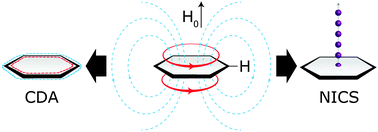
A review summarizing recent advances in magnetic criteria for identification and evaluation of aromaticity.
The content of this RSS Feed (c) The Royal Society of Chemistry

01 Jun 06:35
by Justyna M. Płotka-Wasylka, Calum Morrison, Marek Biziuk and Jacek Namieśnik

Chemical Reviews
DOI: 10.1021/cr4006999

01 Jun 05:21
Dalton Trans., 2015, 44,12688-12699
DOI: 10.1039/C5DT01146A, Paper
Urszula K. Komarnicka, Radoslaw Starosta, Agnieszka Kyziol, Malgorzata Jezowska-Bojczuk
New, water and air stable, CuI/CuNCS complexes with hydroxymethyldiphenylphosphine or phosphine derivatives of sparfloxacin and diimines are presented. Cytotoxic activity of these complexes is strongly dependent on the type of diimine and phosphine.
The content of this RSS Feed (c) The Royal Society of Chemistry

29 May 06:23
by Miao Du, Xi Wang, Min Chen, Cheng-Peng Li, Jia-Yue Tian, Zhuo-Wei Wang, Chun-Sen Liu
Abstract
A promising alternative strategy for designing mesoporous metal–organic frameworks (MOFs) has been proposed, by modifying the symmetry rather than expanding the length of organic linkers. By means of this approach, a unique MOF material based on the target [Zn8(ad)4] (ad=adeninate) clusters and C3-symmetric organic linkers can be obtained, with trigonal microporous (ca., 0.8 nm) and hexagonal mesoporous (ca., 3.0 nm) 1D channels. Moreover, the resulting 446-MOF shows distinct reactivity to transition and lanthanide metal ions. Significantly, the transmetalation of CoII or NiII on the ZnII centers in 446-MOF can enhance the sorption capacities of CO2 and CH4 (16–21 %), whereas the impregnation of EuIII and TbIII in the channels of 446-MOF will result in adjustable light-emitting behaviors.

Star cluster: A ligand symmetry modulation strategy was developed to design a mesoporous metal–organic framework with C3 symmetry ligands and large octazinc(II) clusters, which shows dual reactivity to transition and lanthanide metals, resulting in enhanced functionalization of gas sorption and luminescence for the modified materials (see figure).
gjchen and -1 others like this
29 May 06:22
by Juergen Bartelmess, Michele Baldrighi, Valentina Nardone, Emilio Parisini, David Buck, Luis Echegoyen, Silvia Giordani
Abstract
A series of π-extended distyryl-substituted boron dipyrromethene (BODIPY) derivatives with intense far-red/near-infrared (NIR) fluorescence was synthesized and characterized, with a view to enhance the dye’s performance for fluorescence labeling. An enhanced brightness was achieved by the introduction of two methyl substituents in the meso positions on the phenyl group of the BODIPY molecule; these substituents resulted in increased structural rigidity. Solid-state fluorescence was observed for one of the distyryl-substituted BODIPY derivatives. The introduction of a terminal bromo substituent allows for the subsequent immobilization of the BODIPY fluorophore on the surface of carbon nano-onions (CNOs), which leads to potential imaging agents for biological and biomedical applications. The far-red/NIR-fluorescent CNO nanoparticles were characterized by absorption, fluorescence, and Raman spectroscopies, as well as by thermogravimetric analysis, dynamic light scattering, high-resolution transmission electron microscopy, and confocal microscopy.

Know your onions: A series of bright fluorescent boron dipyrromethene (BODIPY) dyes was synthesized and characterized (see figure); single crystals of one fluorophore reveal solid-state fluorescence. Subsequently, the far-red/near-infrared-fluorescent BODIPY dye was attached to carbon nano-onions, to give a red fluorescent carbon nanomaterial.
29 May 06:22
by Shu-Na Zhao, Xue-Zhi Song, Min Zhu, Xing Meng, Lan-Lan Wu, Jing Feng, Shu-Yan Song, Hong-Jie Zhang
Abstract
A new anionic framework {[Me2NH2]0.125[In0.125(H2L)0.25]⋅xDMF}n (1) with one-dimensional (1D) channels along the c axis of about 13.06×13.06 Å2, was solvothermally synthesized and well characterized. Post-synthetic cation exchange of 1 with Eu3+, Tb3+, Dy3+, Sm3+ afforded lanthanide(III)-loaded materials, Ln3+@1, with different luminescent behavior, indicating that compound 1 could be used as a potential luminescent probe toward different lanthanide(III) ions. Additionally, compound 1 exhibits selective adsorption ability toward cationic dyes. Moreover, the RhB@1 realized the probing of different organic solvent molecules by tuning the energy transfer efficiency between two different emissions, especially for sensing DMF. This work highlights the practical application of luminescent guest@MOFs as sensors, and it paves the way toward other one/multi-color luminescent host–guest systems by rational selection of MOF hosts and guest chromophores with suitable emissive colors and energy levels.

Rainbow runner: A new anionic framework {[Me2NH2]0.125[In0.125(H2L)0.25]⋅x DMF}n (1) with 1D channels was solvothermally synthesized. Post-synthetic cation exchange with Ln3+ and various dyes gave lanthanide(III)/dye-loaded metal–organic framework (MOF) materials Ln3+@1 and Dye@1 (see figure). Compound 1 could be used as a potential luminescent probe toward different lanthanide(III) ions. Moreover, one complex could be used as a probe for different organic solvent molecules, especially DMF molecules.
29 May 06:21
by Cheng-Yi Xiong, Hai-Jun Wang, Wen-Bin Liang, Ya-Li Yuan, Ruo Yuan, Ya-Qin Chai
Abstract
Novel luminescence-functionalized metal–organic frameworks (MOFs) with superior electrogenerated chemiluminescence (ECL) properties were synthesized based on zinc ions as the central ions and tris(4,4′-dicarboxylicacid-2,2′-bipyridyl)ruthenium(II) dichloride ([Ru(dcbpy)3]2+) as the ligands. For potential applications, the synthesized MOFs were used to fabricate a “signal-on” ECL immunosensor for the detection of N-terminal pro-B-type natriuretic peptide (NT-proBNP). As expected, enhanced ECL signals were obtained through a simple fabrication strategy because luminescence-functionalized MOFs not only effectively increased the loading of [Ru(dcbpy)3]2+, but also served as a loading platform in the ECL immunosensor. Furthermore, the proposed ECL immunosensor had a wide linear range from 5 pg mL−1 to 25 ng mL−1 and a relatively low detection limit of 1.67 pg mL−1 (signal/noise=3). The results indicated that luminescence-functionalized MOFs provided a novel amplification strategy in the construction of ECL immunosensors and might have great prospects for application in bioanalysis.

Trap the light fantastic: Luminescence-functionalized metal–organic frameworks (MOFs) were synthesized by using Zn2+ as the central ion and a Ru complex as the ligand. This provided a method to use a metallic complex instead of a small organic molecule as a ligand to prepare MOFs. Moreover, MOFs were applied to the construction of a sensitive electrogenerated chemiluminescence biosensor (see figure).
27 May 21:29
by Jing Cao, Gábor London, Oliver Dumele, Margarete von Wantoch Rekowski, Nils Trapp, Laurent Ruhlmann, Corinne Boudon, Amnon Stanger and François Diederich

Journal of the American Chemical Society
DOI: 10.1021/jacs.5b03074

26 May 17:15
Dalton Trans., 2015, 44,11954-11962
DOI: 10.1039/C5DT01598G, Paper
Partha Pratim Bag, Xu-Sheng Wang, Rong Cao
We have prepared 2 g Ln-MOF on a laboratory scale with high purity using microwave-assisted synthesis by changing the conformation of flexible ligand using Ln, which adopts only the preferred (energetically stable) conformation from green solvents (water and ethanol).
The content of this RSS Feed (c) The Royal Society of Chemistry

26 May 10:10
by Kwang Hun Park, Yu Jin Kim, Gi Back Lee, Tae Kyu An, Chan Eon Park, Soon-Ki Kwon, Yun-Hi Kim
Two novel semiconducting polymers based on benzodithiophene and dithienophosphole oxide (DTP) units are designed and synthesized. A novel electron-deficient DTP moiety is developed. Surprisingly, the introduction of DTP units brings highly polarizable characteristics, which is beneficial for the photocurrent in solar cells. Thus, the donor–acceptor type of conjugated polymers based on this novel acceptor has superior charge transfer properties and highly efficient PL quenching efficiencies. As a result, polymer solar cells (PSCs) with high power conversion efficiencies of 6.10% and 7.08% are obtained from poly(3,5-didodecyl-4-phenylphospholo[3,2-b:4,5-b']dithiophene–4-oxide-alt-4,8-bis(5-decylthiophen-2-yl)benzo[1,2-b:4,5-b']dithiophene) (PDTP–BDTT) and PDTP–4-oxide-alt-4,8-bis(5-decylselenophen-2-yl)benzo[1,2-b:4,5-b']dithiophene) (PDTP–BDTSe), respectively, when the photoactive layer is processed with the 1,8-octanedithiol (ODT) additive. The PDTP–BDTSe copolymer is now the best performing DTP-based material for PSCs. Using the polarizable unit strategy determined in this study for the molecular design of conjugated polymers is expected to greatly advance the development of organic electronic devices.

Two novel copolymers, PDTP–BDTT and PDTP–BDTSe, containing dithienophosphole oxide units bring superior charge transfer properties by highly polarizable characteristics, which is beneficial for good performance in polymer solar cells.
26 May 10:09
Chem. Soc. Rev., 2015, 44,3942-3953
DOI: 10.1039/C5CS00318K, Tutorial Review
Jinyao Liu, Wei Huang, Yan Pang, Deyue Yan
This review covers the recent development of hyperbranched polyphosphates, including synthesis, functionalization and biomedical applications, that may promote the interdiscipline research among dendritic polymers, functional material, and biomedicine.
The content of this RSS Feed (c) The Royal Society of Chemistry

25 May 19:14
Chem. Sci., 2015, 6,4643-4649
DOI: 10.1039/C5SC01330E, Edge Article

Open Access
Tai-Cheng Hou, Ying-Yi Wu, Po-Yi Chiang, Kui-Thong Tan
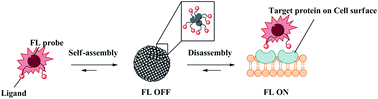
In the presence of target analyte, bright fluorescence in the near-IR region is emitted through the recognition-induced disassembly of the probe aggregate.
The content of this RSS Feed (c) The Royal Society of Chemistry

25 May 19:14
Chem. Soc. Rev., 2015, 44,6578-6596
DOI: 10.1039/C5CS00051C, Review Article
Zebing Zeng, Xueliang Shi, Chunyan Chi, Juan T. Lopez Navarrete, Juan Casado, Jishan Wu
Pro-aromatic and anti-aromatic [small pi]-conjugated molecules are demonstrated to have an irresistible wish to be diradicals in the ground state.
The content of this RSS Feed (c) The Royal Society of Chemistry

25 May 14:21
by Delia Miguel, Sara P. Morcillo, Ana Martín-Lasanta, Noelia Fuentes, Lara Martínez-Fernández, Inés Corral, Maria J. Ruedas-Rama, Diego J. Cárdenas, Luis Álvarez de Cienfuegos, Angel Orte and Juan M. Cuerva

Organic Letters
DOI: 10.1021/acs.orglett.5b01275

25 May 14:10
by Lei Ji, Robert M. Edkins, Andreas Lorbach, Ivo Krummenacher, Charlotte Brückner, Antonius Eichhorn, Holger Braunschweig, Bernd Engels, Paul J. Low and Todd B. Marder

Journal of the American Chemical Society
DOI: 10.1021/jacs.5b03805

21 May 21:10
by Nathalie Busschaert, Claudia Caltagirone, Wim Van Rossom and Philip A. Gale

Chemical Reviews
DOI: 10.1021/acs.chemrev.5b00099

21 May 16:52
by Qingkai Qi, Jingyu Qian, Xiao Tan, Jibo Zhang, Lijuan Wang, Bin Xu, Bo Zou, Wenjing Tian
The molecular crystals of acridonyl-tetraphenylethene (AD-TPE) exhibit an intriguing turn-on and color-tuned luminescence in response to mechanical grinding and hydrostatic compression. On the basis of in-depth experimental and computational studies, it is hypothesized that the origin of the piezochromic behavior from the D-phase to the B-phase is the change of the intramolecular geometrical conformation, especially for the torsion angle between the TPE and AD moiety. The different molecular conformation in the two distinctive solid phases causes the substantial switching of the intramolecular charge transfer (ICT) process, which can be directly correlated with the subsequent fluorescence from locally excited (LE) state and ICT state in both phases. The AD-TPE molecular system presents a very rare example of high-contrast reversible fluorescence tuning driven by a switching of the excited state in the solid state under the mechanical stimuli, and thus provides a novel mechanism of the piezochromic behavior.

Tuning the solid state luminescence of organic materials under mechanical stimuli is an attractive subject for both the fundamental research and practical application in the optical recording and sensing. Herein, a structurally well-defined molecule, acridonyl-tetraphenylethene is reported, whose molecular crystals exhibit an intriguing turn-on and color-tuned luminescence with high contrast in response to the mechanical stimuli such as grinding and hydrostatic pressure.
19 May 16:02
Chem. Commun., 2015, 51,10381-10384
DOI: 10.1039/C5CC03403E, Communication
Pengchong Xue, Jiabao Sun, Peng Chen, Panpan Wang, Boqi Yao, Peng Gong, Zhenqi Zhang, Ran Lu
A metal- and heavy atom-free nonplanar organic molecule with persistent RTP was successfully fabricated and exhibited a multicolour phosphorescence-to-fluorescence switching property in response to mechanical force stimuli.
The content of this RSS Feed (c) The Royal Society of Chemistry

19 May 10:17
by Kazunari Nakajima, Shohei Takata, Ken Sakata, Yoshiaki Nishibayashi
Abstract
A method for the synthesis of phosphabenzenes under iron catalysis is described. Thus, the FeI2-catalyzed [2+2+2] cycloaddition of diynes with phosphaalkynes in m-xylene gave a variety of phosphabenzenes in good to high yields (up to 87 % yield).

Ironing out any difficulties: Unlike complexes of other transition metals, an iron catalyst enabled the synthesis of phosphabenzenes from 1,6-diynes and phosphaalkynes (see scheme). A variety of phosphabenzene derivatives were formed in good to high yield by FeI2-catalyzed [2+2+2] cycloaddition reactions of these substrates in m-xylene.
19 May 10:16
by Yuki Matsunaga, Jye-Shane Yang
Abstract
A new strategy is reported for multicolor fluorescence writing on thin solid films with mechanical forces. This concept is illustrated by the use of a green-fluorescent pentiptycene derivative 1, which forms variably colored fluorescent exciplexes: a change from yellow to red was observed with anilines, and fluorescence quenching (a change to black) occurred in the presence of benzoquinone. Mechanical forces, such as grinding and shearing, induced a crystalline-to-amorphous phase transition in both the pristine and guest-adsorbed solids that led to a change in the fluorescence color (mechanofluorochromism) and a memory of the resulting color. Fluorescence drawings of five or more colors were created on glass or paper and could be readily erased by exposure to air and dichloromethane fumes. The structural and mechanistic aspects of the observations are also discussed.

Memorable art: Multicolor fluorescence writing was possible on thin solid films of a pentiptycene–anthracene conjugated system (see picture). This technique relies on the formation of fluorescent exciplexes with aniline vapors and on force-induced fluorescence color memory. The drawings were erased by blowing air over the surface and by exposure to dichloromethane fumes.
16 May 11:23
by Sonia Remiro-Buenamañana, Alejandro Díaz-Moscoso, David L. Hughes, Manfred Bochmann, Graham J. Tizzard, Simon J. Coles, Andrew N. Cammidge
Abstract
The first syntheses of hybrid structures that lie between subphthalocyanines and subporphyrins are reported. The versatile single-step synthetic method uses a preformed aminoisoindolene to provide the bridging methine unit and its substituent while trialkoxyborates simultaneously act as Lewis acid, template, and provider of the apical substituent. The selection of each component therefore allows for the controlled formation of diverse, differentially functionalized systems. The new hybrids are isolated as robust, pure materials that display intense absorption and emission in the mid-visible region. The new compounds are further characterized in solution and solid state by variable-temperature NMR spectroscopy and X-ray crystallography, respectively.

The first syntheses of subphthalocyanine–subporphyrin hybrid structures are reported. The new hybrids are isolated as robust, pure materials that display intense absorption and emission in the mid-visible region, and are further characterized in solution and solid state by variable-temperature NMR spectroscopy and X-ray crystallography, respectively.
15 May 21:00
by Kamil Skonieczny and Daniel T. Gryko

The Journal of Organic Chemistry
DOI: 10.1021/acs.joc.5b00714

15 May 10:13
Chem. Commun., 2015, 51,9880-9883
DOI: 10.1039/C5CC01697E, Communication
Xiao Yu, Seth M. Cohen
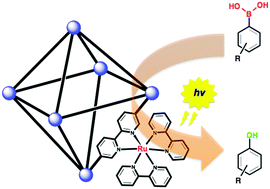
A photocatalytic Ru complex was incorporated into a Zr(IV)-based MOF via postsynthetic methods, to give an efficient and recyclable catalytic material for the aerobic oxidation of arylboronic acids under light irradiation.
The content of this RSS Feed (c) The Royal Society of Chemistry