11 Oct 19:04
Chem. Commun., 2015, 51,17532-17535
DOI: 10.1039/C5CC06927K, Communication
Xiao-Ye Wang, Fang-Dong Zhuang, Jie-Yu Wang, Jian Pei
A thiophene-fused polycyclic azaborine skeleton was successfully employed in conjugated polymers, showing a hole mobility of 0.38 cm2 V-1 s-1 in field-effect transistors.
The content of this RSS Feed (c) The Royal Society of Chemistry

11 Oct 19:03
Chem. Commun., 2015, 51,16629-16632
DOI: 10.1039/C5CC07523H, Communication

Open Access
Julio Fernandez-Cestau, Benoit Bertrand, Maria Blaya, Garth A. Jones, Thomas J. Penfold, Manfred Bochmann
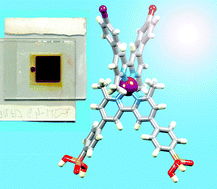
A second nitrogen for modulation: cyclometallated gold(III) complexes based on pyrazine provide a new family of photoluminescent compounds which allow facile modulation of the emission wavelengths without the need for modifying the basic ligand framework.
The content of this RSS Feed (c) The Royal Society of Chemistry

04 Oct 18:09
by Vasily V. Sivchik, Anastasia I. Solomatina, Yi-Ting Chen, Antti J. Karttunen, Sergey P. Tunik, Pi-Tai Chou, Igor O. Koshevoy
Abstract
The cocrystallization of a weakly luminescent platinum complex [Pt(btpy)(PPh3)Cl] (1) (Hbtpy=2-(2benzothienyl)pyridine; emission quantum yield Φem=0.03) with fluorinated bromo- and iodoarenes C6F6-nXn (X=Br, I; n=1, 2) results in the formation of efficient halogen-bonding (XB) interactions Pt![[BOND]](http://onlinelibrarystatic.wiley.com/undisplayable_characters/00f8ff.gif) Cl⋅⋅⋅XR. An up to 22-fold enhancement (Φem=0.65) in the luminescence intensity of the cocrystallized compound is detected, without a substantial change of the emission energy. Based on crystallographic, photophysical, and theoretical investigations, the contribution of the XB donors C6F6-nXn to the amplification of luminescence intensity is attributed to the enhancement of spin–orbit coupling through the heavy-atom effect, and simultaneously to the suppression of the nonradiative relaxation pathways by increasing the rigidity of the chromophore center.
Cl⋅⋅⋅XR. An up to 22-fold enhancement (Φem=0.65) in the luminescence intensity of the cocrystallized compound is detected, without a substantial change of the emission energy. Based on crystallographic, photophysical, and theoretical investigations, the contribution of the XB donors C6F6-nXn to the amplification of luminescence intensity is attributed to the enhancement of spin–orbit coupling through the heavy-atom effect, and simultaneously to the suppression of the nonradiative relaxation pathways by increasing the rigidity of the chromophore center.

Hal-lighted: A weakly luminescent Pt complex readily cocrystallizes with fluorinated bromo- and iodoarenes (halogen-bond donors) to form compounds with significantly increased emission quantum yields (Φem). The effect is attributed to the combination of enhanced spin–orbit coupling and structural rigidity in the cocrystallized compound that suppresses the nonradiative decay rate.
24 Sep 06:01
by Mario Tenne, Stefan Metz, Gerhard Wagenblast, Ingo Münster and Thomas Strassner

Organometallics
DOI: 10.1021/acs.organomet.5b00136

24 Sep 06:01
by Alessandro Donoli, Annalisa Bisello, Roberta Cardena, Marco Crisma, Laura Orian and Saverio Santi

Organometallics
DOI: 10.1021/acs.organomet.5b00191

19 Sep 14:51
by Hiroki Hirai, Kiichi Nakajima, Soichiro Nakatsuka, Kazushi Shiren, Jingping Ni, Shintaro Nomura, Toshiaki Ikuta, Takuji Hatakeyama
Abstract
The development of a one-step borylation of 1,3-diaryloxybenzenes, yielding novel boron-containing polycyclic aromatic compounds, is reported. The resulting boron-containing compounds possess high singlet-triplet excitation energies as a result of localized frontier molecular orbitals induced by boron and oxygen. Using these compounds as a host material, we successfully prepared phosphorescent organic light-emitting diodes exhibiting high efficiency and adequate lifetimes. Moreover, using the present one-step borylation, we succeeded in the synthesis of an efficient, thermally activated delayed fluorescence emitter and boron-fused benzo[6]helicene.

Easy boryl LEDs: A one-step borylation of 1,3-diaryloxybenzenes has been developed. The resulting boron-containing aromatic compounds possess high singlet–triplet excitation energies as a result of localized frontier molecular orbitals induced by boron and oxygen. These compounds are efficient host and emitting materials for organic light-emitting diodes.
19 Sep 14:51
by Koichi Mitsudo, Hidehiko Sato, Arata Yamasaki, Natsuyo Kamimoto, Jun Goto, Hiroki Mandai and Seiji Suga

Organic Letters
DOI: 10.1021/acs.orglett.5b02417

18 Sep 06:44
by Zhong’an Li, Sukrit Mukhopadhyay, Sei-Hum Jang, Jean-Luc Brédas and Alex K.-Y. Jen

Journal of the American Chemical Society
DOI: 10.1021/jacs.5b08072

17 Sep 19:44
by Sarah L. Skraba-Joiner, Erin C. McLaughlin, Aida Ajaz, Rajesh Thamatam and Richard P. Johnson

The Journal of Organic Chemistry
DOI: 10.1021/acs.joc.5b01559

17 Sep 19:41
by Hosoowi Lee, Young-Hwan Jeong, Joo-Ho Kim, Inhye Kim, Eunji Lee and Woo-Dong Jang

Journal of the American Chemical Society
DOI: 10.1021/jacs.5b08092

17 Sep 12:33
Chem. Soc. Rev., 2015, 44,8097-8123
DOI: 10.1039/C5CS00013K, Review Article
Daojin Li, Yang Chen, Zhen Liu
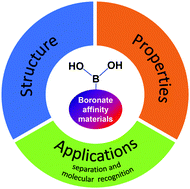
We critically survey recent advances in boronate affinity materials for separation and molecular recognition, which have gained rapid development recently.
The content of this RSS Feed (c) The Royal Society of Chemistry

17 Sep 12:32
by Takaki Sumi, Tomohiro Kaburagi, Masakazu Morimoto, Kanako Une, Hikaru Sotome, Syoji Ito, Hiroshi Miyasaka and Masahiro Irie

Organic Letters
DOI: 10.1021/acs.orglett.5b02361

16 Sep 05:57
by Katsuaki Kawasumi, Tony Wu, Tianyu Zhu, Hyun Sik Chae, Troy Van Voorhis, Marc A. Baldo and Timothy M. Swager

Journal of the American Chemical Society
DOI: 10.1021/jacs.5b07932

16 Sep 05:57
by Takahiro Sawano, Nathan C. Thacker, Zekai Lin, Alexandra R. McIsaac and Wenbin Lin

Journal of the American Chemical Society
DOI: 10.1021/jacs.5b09225

14 Sep 21:56
by Alexander Samokhvalov
Abstract
Adsorption and desorption play major roles in separations, purification of water, waste streams, liquid fuels, catalysis, biomedicine and chromatography. Mesoporous metal–organic frameworks (MOFs) with pore sizes 2–50 nm are particularly suitable for adsorption of organic compounds in solution. Tens of thousands of aromatic and heterocyclic compounds are major components of liquid fuels, feedstock for industrial synthesis, solvents, dyestuffs, agricultural chemicals, medicinal drugs, food additives, and so forth. This Review provides a systematization and analysis of studies on adsorption/desorption on mesoporous MOFs in solution and their underlying chemical mechanisms. The (in)stability of mesoporous MOFs in water is critically discussed. Adsorption capacity and selectivity are covered for organic dyes, medicinal drugs, major components of liquid fuels, and miscellaneous industrial chemicals. Ionic interactions, Brønsted acid–base interactions, hydrogen bonding, coordination bonding, π–π interactions, and non-specific interactions are covered amongst adsorption mechanisms. The effects of post-synthetic modifications of mesoporous MOFs on their stability, adsorption capacity, selectivity, and mechanisms of adsorption and desorption are analyzed. To encourage research in this quickly growing field, we identify “niches” for which no application-oriented and/or mechanistic studies were reported. Perspectives and limitations of a wide use of mesoporous MOFs as industrial sorbents are discussed.

MOFs as sorbents: Aromatic and heterocyclic compounds are abundantly present in liquid fuels, among industrial chemicals, dyes, drugs, and so forth. This Review analyzes their adsorption/desorption on mesoporous MOFs in solution and associated molecular mechanisms. (In)stability of mesoporous MOFs in water is critically discussed. Perspectives and limitations of using mesoporous MOFs as industrial sorbents are assessed.
14 Sep 21:55
by Ashley D. Bromby, Samantha N. Keller, Kevin J. A. Bozek, Vance E. Williams and Todd C. Sutherland

The Journal of Organic Chemistry
DOI: 10.1021/acs.joc.5b01299

14 Sep 11:01
by Yongyang Gong, Gan Chen, Qian Peng, Wang Zhang Yuan, Yujun Xie, Shuhong Li, Yongming Zhang, Ben Zhong Tang

Persistent room temperature phosphorescence (RTP) from pure organic luminogens can be rationally realized based on the crystallization-induced phosphorescence phenomenon and severe crystallization. A perfect crystal with dense molecular packing and effective intermolecular interactions isolates the triplet excitons from quenching sites and significantly blocks the high-energy vibrational dissipation, thus yielding long-lasting RTP.
12 Sep 09:34
by Maxence Urbani, María Medel, Sangeeta Amit Kumar, Mine Ince, Ashok N. Bhaskarwar, David González-Rodríguez, Michael Grätzel, Mohammad Khaja Nazeeruddin, Tomás Torres
Abstract
The detailed synthesis and characterization of four ruthenium(II) complexes [RuLL′(NCS)2] is reported, in which L represents a 2,2′-bipyridine ligand functionalized at the 4,4′ positions with benzo[1,2-b:4,5-b′]dithiophene derivatives (BDT) and L′ is 2,2′-bipyridine-4,4′-dicarboxylic acid unit (dcbpy) (NCS=isothiocyanate). The reaction conditions were adapted and optimized for the preparation of these amphiphilic complexes with a strong lipophilic character. The photovoltaic performances of these complexes were tested in TiO2 dye-sensitized solar cell (DSSC) achieving efficiencies in the range of 3–4.5 % under simulated one sun illumination (AM1.5G).

Ru ready for this: Four (cis)tris-heteroleptic complexes based on benzo[1,2-b:4,5-b′]dithiophene are reported. The conditions of synthesis needed to be adapted because of the strong lipophilic character of these amphiphilic molecules (see figure). In particular, the (arene)RuII half-sandwich complex intermediates involved in the first reaction step were formed quantitatively, which suggests that the partial scrabbling process must occur during the second step (see figure).
11 Sep 17:32
Dalton Trans., 2015, Advance Article
DOI: 10.1039/C5DT03055B, Paper
Annika Klose, Gerald Kehr, Constantin G. Daniliuc, Gerhard Erker
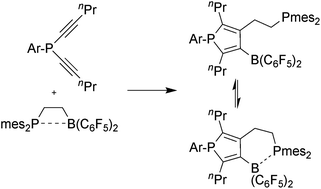
The reaction of arylbis(alkynyl)phosphanes with the frustrated P/B Lewis pair mes2PCH2CH2B(C6F5)2 gives phosphane/borane functionalized phospholes by a sequence of 1,1-carboboration reactions.
To cite this article before page numbers are assigned, use the DOI form of citation above.
The content of this RSS Feed (c) The Royal Society of Chemistry

10 Sep 20:43
Chem. Soc. Rev., 2015, 44,8386-8398
DOI: 10.1039/C5CS00215J, Tutorial Review
Open Access
Catherine E. Housecroft, Edwin C. Constable
The development of bis(diimine)copper(I) complexes as dyes in dye-sensitized solar cells is described. We assess the progress made in terms of light-harvesting and overall photoconversion efficiencies, and highlight areas that remain ripe for development and improvement, and the advantages of copper dyes over conventional ruthenium dyes.
The content of this RSS Feed (c) The Royal Society of Chemistry

08 Sep 06:38
by Tomohito Morosaki, Wei-Wei Wang, Shigeru Nagase, Takayoshi Fujii
Abstract
Iminosulfane(phosphane)carbon(0) derivatives (iSPCs; Ar3P![[RIGHTWARDS ARROW]](http://onlinelibrarystatic.wiley.com/undisplayable_characters/002192.gif) C
C![[LEFTWARDS ARROW]](http://onlinelibrarystatic.wiley.com/undisplayable_characters/002190.gif) SPh2(NMe); Ar=Ph (1), 4-MeOC6H4 (2), 4-(Me2N)C6H4 (3)) have been successfully synthesized and the molecular structure of 3 characterized. Carbone 3 is the first thermally and hydrolytically stable carbone stabilized by phosphorus and sulfur ligands. DFT calculations reveal the electronic structures of 1–3, which have two lone pairs of electrons at the carbon center. First and second proton affinity values are theoretically calculated to be in the range of 286.8–301.1 and 189.6–208.3 kcal mol−1, respectively. Cyclic voltammetry measurements reveal that the HOMO energy levels follow the order of 3>2>1 and the HOMO of 3 is at a higher energy than those of bis(chalcogenane)carbon(0) (BChCs). The reactivities of these lone pairs of electrons are demonstrated by the C-diaurated and C-proton-aurated complexes. These results are the first experimental evidence of phosphorus- and sulfur-stabilized carbones behaving as four-electron donors. In addition, the reaction of hydrochloric salts of the carbones with Ag2O gives the corresponding AgI complexes. The resulting silver(I) carbone complexes can be used as carbone transfer agents. This synthetic protocol can also be used for moisture-sensitive carbone species.
SPh2(NMe); Ar=Ph (1), 4-MeOC6H4 (2), 4-(Me2N)C6H4 (3)) have been successfully synthesized and the molecular structure of 3 characterized. Carbone 3 is the first thermally and hydrolytically stable carbone stabilized by phosphorus and sulfur ligands. DFT calculations reveal the electronic structures of 1–3, which have two lone pairs of electrons at the carbon center. First and second proton affinity values are theoretically calculated to be in the range of 286.8–301.1 and 189.6–208.3 kcal mol−1, respectively. Cyclic voltammetry measurements reveal that the HOMO energy levels follow the order of 3>2>1 and the HOMO of 3 is at a higher energy than those of bis(chalcogenane)carbon(0) (BChCs). The reactivities of these lone pairs of electrons are demonstrated by the C-diaurated and C-proton-aurated complexes. These results are the first experimental evidence of phosphorus- and sulfur-stabilized carbones behaving as four-electron donors. In addition, the reaction of hydrochloric salts of the carbones with Ag2O gives the corresponding AgI complexes. The resulting silver(I) carbone complexes can be used as carbone transfer agents. This synthetic protocol can also be used for moisture-sensitive carbone species.

Getting tough on carbon: The combination of the high electron-donating ability of the triarylphosphane ligand and the strong π-acceptor ability of the iminosulfane ligand confers considerable thermal and hydrolytic stability on iminosulfane(phosphane)carbon(0) (see figure). The four-electron donor ability of these carbon complexes is revealed by the synthesis of aurated complexes.
08 Sep 06:37
by Sujuan Wang, Bo Lv, Qiuye Cui, Xiaoqian Ma, Xinwu Ba, Jinchong Xiao
Abstract
A series of pyrene/phenanthrene-fused furan derivatives (1–8) were synthesized by a simple condensation reaction between pyrene-4,5-diketone/phenanthrenequinone and substituted phenol/naphthol in the presence of trifluoromethanesulfonic acid in 1,2-dichlorobenzene heated at reflux. The formed compounds can emit strong blue light in organic solvents. Additionally, the self-assembly behaviors of two of the compounds (3 and 5) were studied through re-precipitation method and the resulting nanostructures were characterized by UV/Vis, fluorescence spectra, and field-emission scanning electron microscopy (FESEM). The findings showed that the shape and size of compounds 3 and 5 could be tuned by the ratio of THF and hexadecyl trimethyl ammonium bromide (CTAB) solution in water.

Fluorescent furan-embedded heteroarenes: Eight enlarged cyclic pyrene/phenanthrene-fused furan derivatives were synthesized through a one-step reaction. All the resulting compounds emitted blue fluorescence in dichloromethane. The self-assembly behaviors of two of the molecules were investigated (see figure), indicating that the shape, size, and morphology could be tuned by the ratio of THF to a solution of hexadecyl trimethyl ammonium bromide (CTAB).
08 Sep 06:34
Chem. Commun., 2015, 51,15796-15799
DOI: 10.1039/C5CC06149K, Communication
Mikihiro Hayashi, Kazuya Otsubo, Tatsuhisa Kato, Kunihisa Sugimoto, Akihiko Fujiwara, Hiroshi Kitagawa
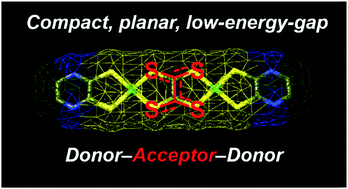
We prepared a compact, planar, low-energy-gap molecule with donor-acceptor-donor (D-A-D) nature for the first time based on a bimetal dithiolene complex.
The content of this RSS Feed (c) The Royal Society of Chemistry

02 Sep 12:29
by Chunbai He, Demin Liu and Wenbin Lin

Chemical Reviews
DOI: 10.1021/acs.chemrev.5b00125

02 Sep 12:22
by Andreas Kretzschmar, Christian Patze, S. Thimon Schwaebel and Uwe H. F. Bunz

The Journal of Organic Chemistry
DOI: 10.1021/acs.joc.5b01496

02 Sep 12:22
by Dennis Reinhard, Frank Rominger and Michael Mastalerz

The Journal of Organic Chemistry
DOI: 10.1021/acs.joc.5b01520

02 Sep 12:20
by Štěpánka Lachmanová, Grégory Dupeyre, Ján Tarábek, Philippe Ochsenbein, Christian Perruchot, Ilaria Ciofini, Magdaléna Hromadová, Lubomír Pospíšil and Philippe P. Lainé

Journal of the American Chemical Society
DOI: 10.1021/jacs.5b05545

02 Sep 05:40
by Jonathan H. Barnard, Paul A. Brown, Kevin L. Shuford, Caleb D. Martin
Abstract

Jamming PB into benzene: 1,2-Phosphaborines were synthesized by the ring expansion reaction of boroles with the cyclic phosphine [PPh]5 under UV irradiation. The products were structurally characterized revealing a planar central ring. The nature of the bonding was analyzed computationally and indicated that the heterocycle had appreciable aromatic character.
02 Sep 05:38
by Marek K. Węcławski, Till T. Meiling, Arkadiusz Leniak, Piotr J. Cywiński and Daniel T. Gryko

Organic Letters
DOI: 10.1021/acs.orglett.5b02042

02 Sep 05:35
by Christian Reus, Monika Stolar, Jeffrey Vanderkley, Johannes Nebauer and Thomas Baumgartner

Journal of the American Chemical Society
DOI: 10.1021/jacs.5b06413