Journal of the American Chemical Society
DOI: 10.1021/ja5101855
Hierarchically organized structures are prevalent in nature, where such features account for the adhesion properties of gecko feet and the brilliant color variation of butterfly wings. Achieving artificial structures with multiscale features is of interest for metamaterials and biomimetic applications. However, the fabrication of such structures relies heavily on lithographic approaches, although self-assembly routes to superstructures are promising. Sequential seed-directed overgrowth is now demonstrated as a route to metal dendrimers, which are hierarchically branched nanocrystals (NCs) with a three-dimensional order analogous to that of molecular dendrimers. This method was applied to a model Au/Pd NC system; in general, the principle of sequential seed-directed overgrowth should enable the synthesis of new hierarchical inorganic structures with high symmetry.

Building connections: Sequential seed-directed overgrowth provides a route to metal dendrimers, which are hierarchically branched nanocrystals analogous to molecular dendrimers. By manipulating the seed shape, the number of branches is readily controlled. By repeating the seed-mediated co-reduction process, iterative chain growth with concentric branching is possible.

Electronic circular dichroism and circularly polarized luminescence acid/base switching activity has been demonstrated in helicene-bipyridine proligand 1 a and in its “rollover” cycloplatinated derivative 2 a. Whereas proligand 1 a displays a strong bathochromic shift (>160 nm) of the nonpolarized and circularly polarized luminescence upon protonation, complex 2 a displays slightly stronger emission. This strikingly different behavior between singlet emission in the organic helicene and triplet emission in the organometallic derivative has been rationalized by using quantum-chemical calculations. The very large bathochromic shift of the emission observed upon protonation of azahelicene-bipyridine 1 a has been attributed to the decrease in aromaticity (promoting a charge-transfer-type transition rather than a π–π* transition) as well as an increase in the HOMO–LUMO character of the transition and stabilization of the LUMO level upon protonation.

Rollover platination: A [6]helicene-bipyridine derivative has been used as a proligand for “rollover” cycloplatination and for the conception of acid/base chiroptical switches. Protonation triggers a change in the nature of the HOMO–LUMO transition, from a π–π* to a charge-transfer transition, and significantly modifies the circularly polarized luminescence and electronic circular dichroism spectra of the organic and organometallic helicenes (see figure).
The fluorescence enhancement effect of covalently fixed fluorescent chromophores has been investigated by means of kinetic analysis of decay rate constants and theoretical calculations. Derivatives of 1-cyano-1,2-diphenylethene dimer have a distorted cyclic structure when both ends are clipped with two naphthalene-1,8-diyl linker units. In contrast to the reference monomer derivative, which exhibits only slight fluorescence in solution (Φf<0.01, τf<0.1 ns), the dimer derivative shows high fluorescence quantum yield (Φf=0.55) and long lifetime (τf=20.6 ns) in dilute solution owing to suppression of the nonradiative decay process (knr=0.022 ns−1). A V-shaped derivative with a covalent linker on one side showed moderate quantum yield and lifetime (Φf=0.12, τf=4.9 ns). According to the wavelength shifts of the absorption/fluorescence bands and theoretical calculations by time-dependent density functional theory (TD-DFT), we propose an H-aggregate-type excimer interaction.

Rigidly linked chromophores: Fixing two chromophores with tight linker units provides a high fluorescence quantum yield (Φf) and a long lifetime. The fluorescence properties are found to depend on the number of naphthalene-1,8-diyl linker units (see graphic). The temperature dependence of the fluorescence of the cyclic dimer has also been investigated and the data showed that a typical H-aggregate-type excimer emission is almost independent of temperature in the range 100–300 K.
A series of phosphorus analogues of aromatic-fused monoimides (phthalimides and naphthalimides) bearing a mesityl group on the P center have been synthesized. In a comparison of their photophysical, electrochemical, and thermal properties with those of the corresponding imides, the impact of P incorporation was revealed. Furthermore, theoretical studies using DFT methods were conducted to understand their properties.

Can P do it? A series of phosphorus analogues of N-mesityl phthalimides and naphthalimides have been synthesized and characterized (see figure). In a comparison of the physicochemical properties of these diketophosphanyl compounds with those of the corresponding reference imides, the effect of P incorporation into the dicarbonyl-fused aromatics on their properties has been revealed.
The push–pull character of a series of donor–bithienyl–acceptor compounds has been tuned by adopting triphenylamine or 1,1,7,7-tetramethyljulolidine as a donor and B(2,6-Me2-4-RC6H2)2 (R=Me, C6F5 or 3,5-(CF3)2C6H3) or B[2,4,6-(CF3)3C6H2]2 as an acceptor. Ir-catalyzed C![[BOND]](http://onlinelibrarystatic.wiley.com/undisplayable_characters/00f8ff.gif) H borylation was utilized in the derivatization of the boryl acceptors and the tetramethyljulolidine donor. The donor and acceptor strengths were evaluated by electrochemical and photophysical measurements. In solution, the compound with the strongest acceptor, B[2,4,6-(CF3)3C6H2]2 ((FMes)2B), has strongly quenched emission, while all other compounds show efficient green to red (ΦF=0.80–1.00) or near-IR (NIR; ΦF=0.27–0.48) emission, depending on solvent. Notably, this study presents the first examples of efficient NIR emission from three-coordinate boron compounds. Efficient solid-state red emission was observed for some derivatives, and interesting aggregation-induced emission of the (FMes)2B-containing compound was studied. Moreover, each compound showed a strong and clearly visible response to fluoride addition, with either a large emission-color change or turn-on fluorescence.
H borylation was utilized in the derivatization of the boryl acceptors and the tetramethyljulolidine donor. The donor and acceptor strengths were evaluated by electrochemical and photophysical measurements. In solution, the compound with the strongest acceptor, B[2,4,6-(CF3)3C6H2]2 ((FMes)2B), has strongly quenched emission, while all other compounds show efficient green to red (ΦF=0.80–1.00) or near-IR (NIR; ΦF=0.27–0.48) emission, depending on solvent. Notably, this study presents the first examples of efficient NIR emission from three-coordinate boron compounds. Efficient solid-state red emission was observed for some derivatives, and interesting aggregation-induced emission of the (FMes)2B-containing compound was studied. Moreover, each compound showed a strong and clearly visible response to fluoride addition, with either a large emission-color change or turn-on fluorescence.

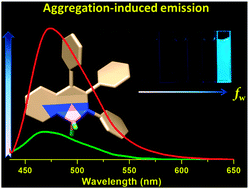
Tune in, turn on: D–π–A organoboron compounds with tunable push–pull character have been prepared by varying the donor and acceptor groups. Efficient green to near-IR emission has been achieved from these compounds in solution. Aggregation-induced emission (AIE) was observed for one compound. Each compound showed a strong and clearly visible response to fluoride addition, with either a large emission-color change or turn-on fluorescence. TICT=twisted intramolecular charge-transfer.
The synthesis of cyclo-1,4-phenylene-2′,5′-thienylenes (CPTs) as the first example of a thiophene-based, radially π-conjugated system is described. X-ray crystal structures, UV-vis absorption and emission spectra, and theoretical studies revealed the unique structural and photophysical properties of CPTs. With all of these unique structural and photophysical properties, the radially π-conjugated CPTs are expected to open a door for the discovery and development of new functional organic materials.

Full circle: Cyclo-1,4-phenylene-2′,5′-thienylenes (CPTs) have been synthesized as the first example of a thiophene-based, radially π-conjugated system. X-ray crystal structures, UV-vis absorption and emission spectra, and theoretical studies revealed the unique structural and photophysical properties of CPTs based on their radial, cyclic π-conjugation.


The synthesis and characterisation of a family of block codendrimers consisting of highly versatile mesogenic and carbazole-containing 2,2-bis(hydroxymethyl)propionic acid (bis-MPA) dendrons are reported. The liquid-crystal behaviour was investigated by means of differential scanning calorimetry, polarised-light optical microscopy and X-ray diffraction. Depending on the chemical structure of the constituent dendrons, the codendrimers show lamellar or columnar mesophases. On the basis of the experimental results, models both at the molecular level and in the mesophase are proposed. The physical properties of the block codendrimers derived from the presence of the carbazole moiety in their structure were investigated: photoluminescence in solution and in the mesophase, electrochemical behaviour and hole transport. Electrodeposition of carbazole dendrons afforded a globular supramolecular conformation in which the mesogenic molecular side plays a key role.

Janus dendrimers: A family of block codendrimers with mesogenic and carbazole-containing 2,2-bis(hydroxymethyl)propionic acid dendrons (see figure) was synthesised. The optical, thermal and structural characteristics of the block codendrimers were determined, and their photoluminescence, electrochemical and hole-transport properties evaluated.
Tetracyclic heterocycles that exhibit high photoluminescence quantum yields were synthesized by anellation reactions of mono-, di-, and trifunctionalized 2,3-dichloroquinoxalines. Thus, treatment of 2,3-dichloroquinoxaline with TMPLi (TMP=2,2,6,6-tetramethylpiperidyl) allows a regioselective lithiation in position 5. Quenching with various electrophiles (iodine, (BrCl2C)2, allylic bromide, acid chloride, aryl iodide) leads to 5-functionalized 2,3-dichloroquinoxalines. Further functionalization in positions 6 and 8 can be achieved by using TMPLi or TMPMgCl⋅LiCl furnishing a range of new di- and tri-functionalized 2,3-dichloroquinoxalines. The chlorine atoms are readily substituted by anellation with 1,2-diphenols or 1,2-dithiophenols leading to a series of new tetracyclic compounds. These materials exhibit strong, tunable optical absorption and emission in the blue and green spectral region. The substituted O-heterocyclic compounds exhibit particularly high photoluminescence quantum yields of up to 90 %, which renders them interesting candidates for fluorescence imaging applications.

Light up: Treatment of 2,3-dichloroquinoxaline with 2,2,6,6-tetramethylpiperidyl (TMP)-bases allows a regioselective functionalization of positions 5, 6 and 8. After these functionalizations, substitution of the chlorine atoms by various anellation reactions leads to a series of novel O- or S-heterocyclic tetracycles that exhibit tunable optical properties with high molecular extinction coefficients and strong photoluminescence in the blue and green spectral regions.