Disclaimer: The author of this Beyond bite is a Cornell graduate student affiliated with the Carl Sagan Institute. Any views and opinions expressed by persons in the event covered and by the author are theirs alone, and not necessarily endorsed by or shared by the Carl Sagan Institute, Astrobites, Cornell University, or the AAS.
Carl Sagan, for the uninitiated, was a science communicator and astronomer perhaps best known for his book and TV series Cosmos, in addition to his novel Contact, which inspired an acclaimed Zemeckis-directed film of the same name. Even after his unfortunate demise in 1996, his work has continued to inspire astrophysicists, astrobiologists, planetary scientists, engineers, artists, and numerous everyday people, this Astrobiter included. (I read Cosmos in high school for a creative writing course and it’s stuck with me ever since!)
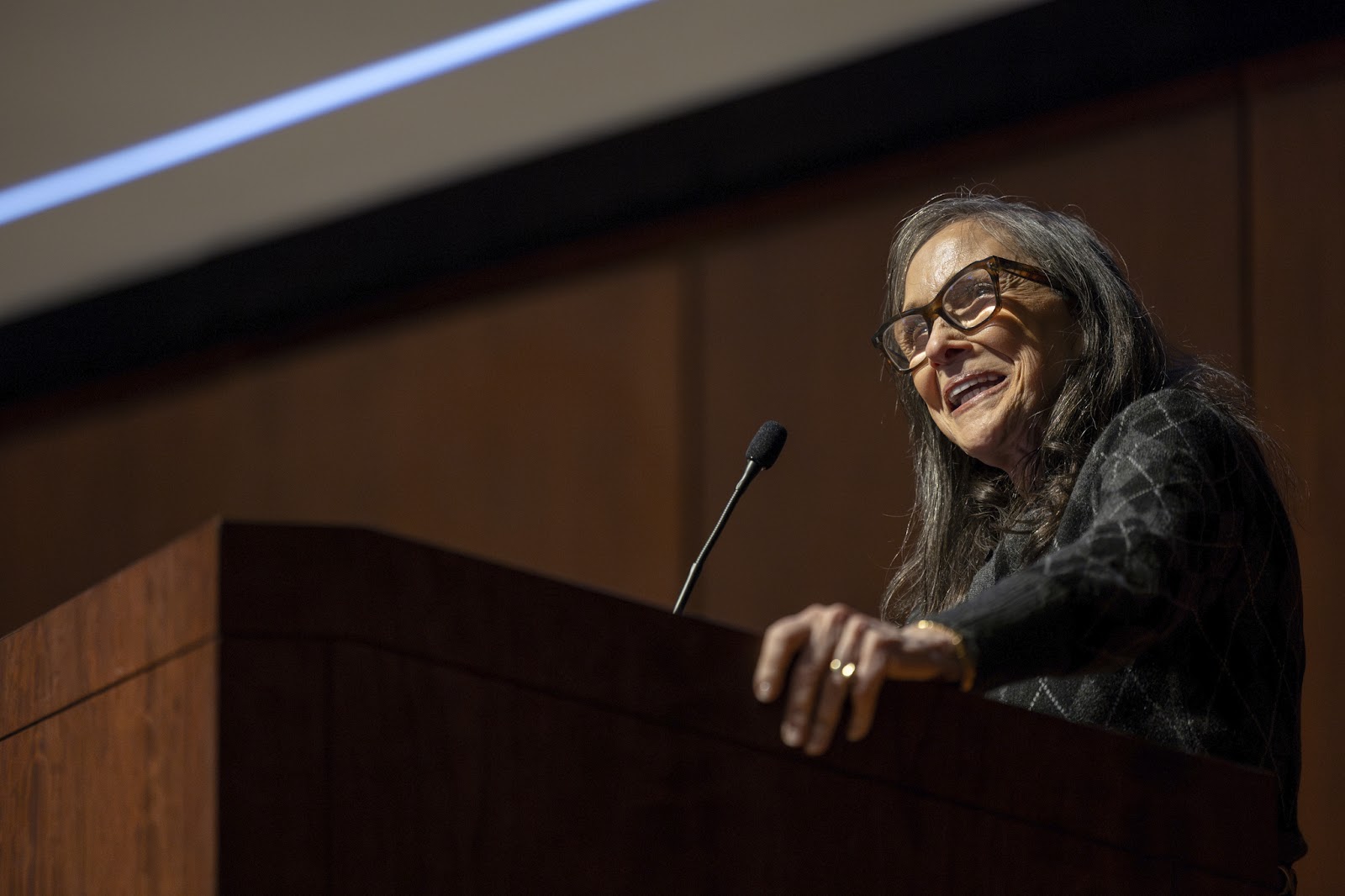
Photo 1: Taken by Simon Wheeler, courtesy of the Carl Sagan Institute. Ann Druyan opening Carl Sagan’s 90th birthday celebration.
The Carl Sagan Institute, cheekily abbreviated CSI, is an interdisciplinary research group with a simple yet profound goal: to find life in the universe, wherever it may be. Coming from a physics and astronomy background, this Astrobiter has found CSI to be the most excitingly interdisciplinary team they’ve ever found themselves in. One can walk down the halls of the third floor of the Space Sciences Building, where the majority of CSI is hosted, and chat with astronomers working on the upcoming Habitable Worlds Observatory mission, climate scientists modeling alien atmospheres, and even biologists probing soil and microbe samples. Carl Sagan promoted this cross-field collaborative spirit that is now integral to CSI, and it was fully on display in the series of public lectures given on his birthday.
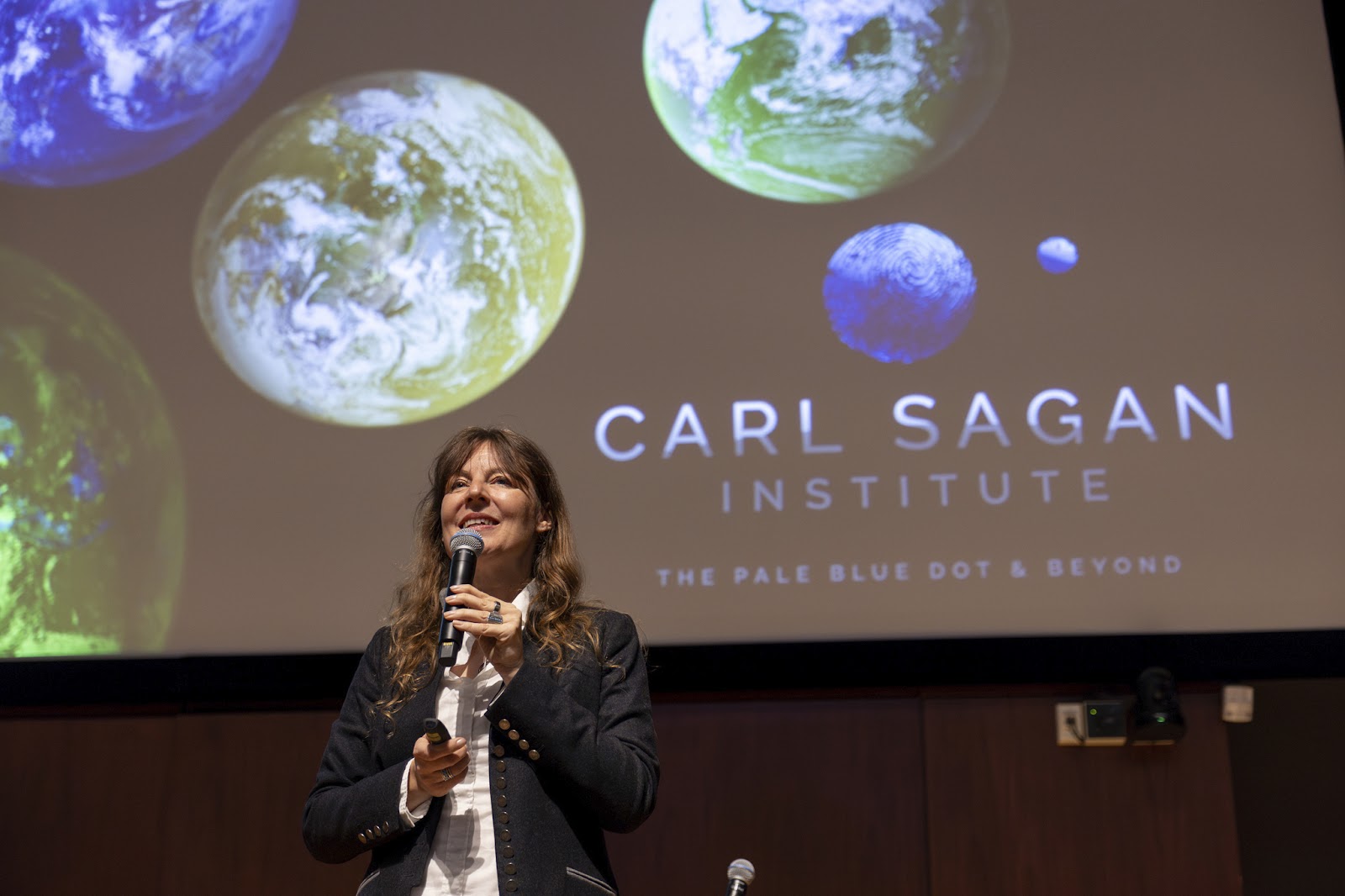
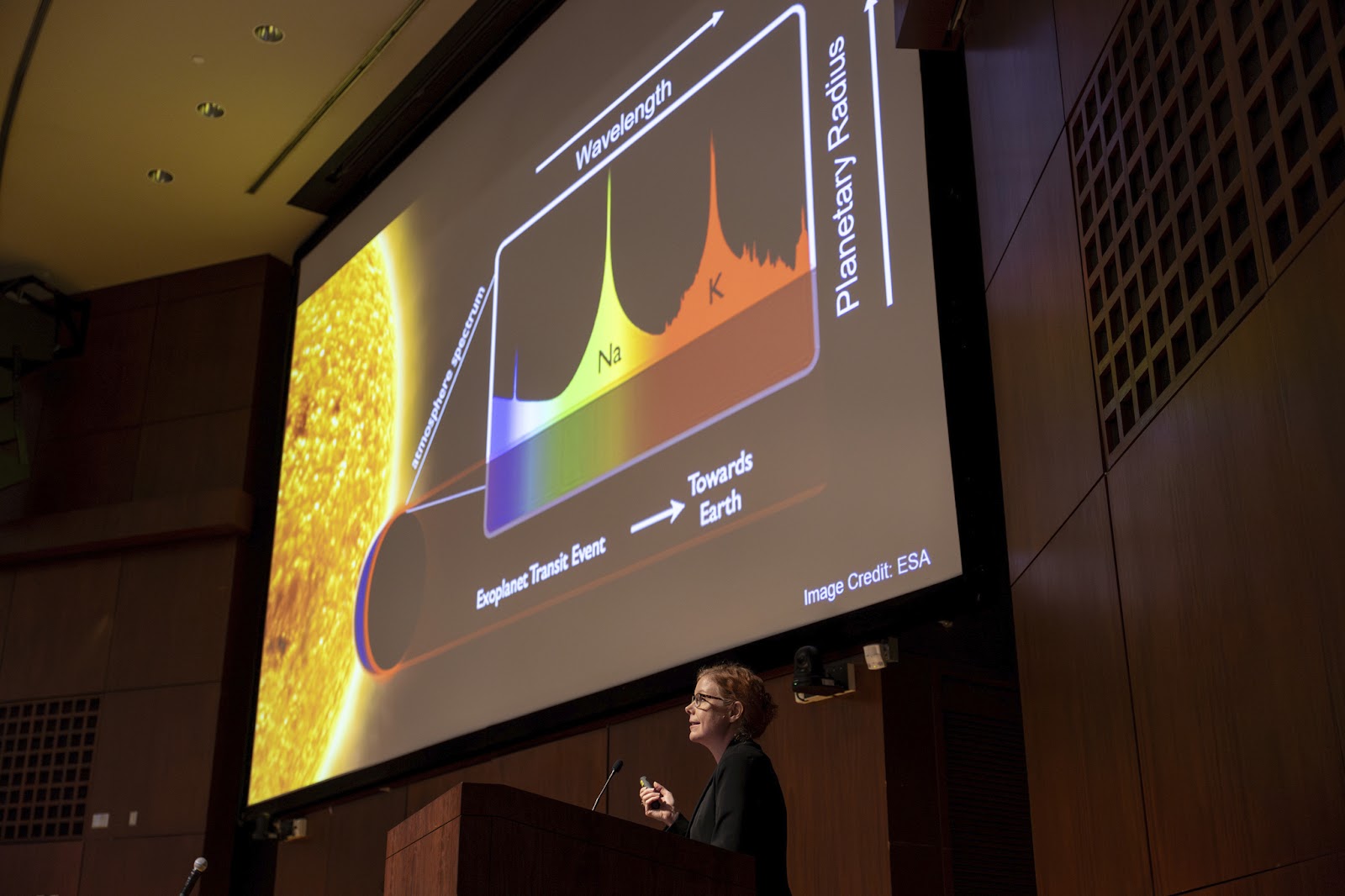
Photo 2: Taken by Simon Wheeler, courtesy of the Carl Sagan Institute. Lisa Kaltenegger, director of the Carl Sagan Institute (CSI), explaining her work and the origins of CSI.Photo 3: Taken by Simon Wheeler, courtesy of the Carl Sagan Institute. Nikole Lewis, exoplanet atmosphere researcher at CSI and Cornell astronomy professor, explaining how exoplanet atmospheres are inferred from transit observations.
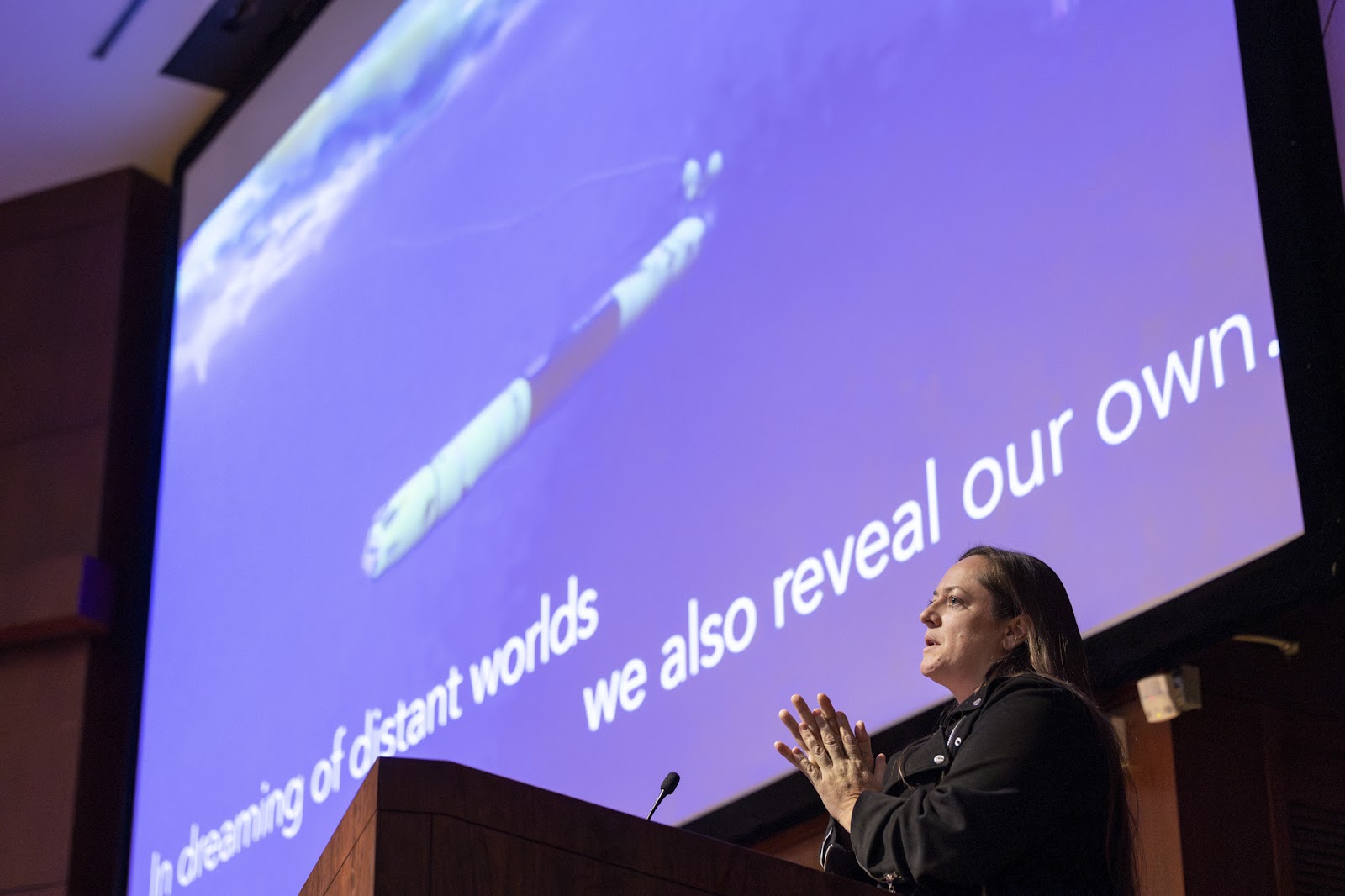
Looking a bit closer to Earth, for some comparative planetology, fellow astronomer and planetary scientistBritney Schmidt connected her work examining ice shelves in Antarctica to Europa’s 30-kilometer-thick ice shell, which may hide a water world. Similarly to what Carl Sagan would have thought, she defined Earth System Science as the study of interconnected cycles and processes supporting life on our planet, and our duty to protect it.
Photo 4: Taken by Simon Wheeler, courtesy of the Carl Sagan Institute. Britney Schmidt presents a slide with the text “In dreaming of distant worlds, we also reveal our own world.” This sums up the goal of comparative planetology: to use our planet as a basis for understanding others.
The next set of speakers gave a more human-oriented perspective on Carl Sagan’s work. Bruce Lewenstein, professor in Communication and Science and Technology Studies, who presented on Carl Sagan’s use of the imagination in scientific research and outreach. Unlike other prominent popular science books at the time, Cosmos centered imagination as a learning tool, which was visualized as the “Ship of the Imagination” in both the original TV show and the 2010s reboot, influencing the style of subsequent science communicators. Carl Sagan used imagination to not just teach, but compel viewers and readers to see a common humanity reflected at them by the stars. Some of these viewers who took Cosmos’ message to heart relayed their own messages afterwards, such as Jill Tarter, first director of the SETI Institute, and inspiration for the protagonist of Contact, and Bill Nye, beloved host of Bill Nye the Science Guy.
The celebration had a musical interlude featuring Charles Ive’s prescient composition, The Unanswered Question, played by Cornell’s student string orchestra, directed by Gabriela S. Gómez Estévez.
During the second half of the celebration, more scientists from a variety of fields shared their Sagan-inspired work. Among them was Mark Sarvary, lecturer in biology and science communication, who shared insights about Cornell’s highly successful science communication minor, which was inspired by Carl Sagan’s vision. It had been noted by several speakers that Sagan’s science communication efforts were not appreciated by the scientific community of his day, despite their obvious benefits. Sagan’s work has since inspired a paradigm change where scientists, just like this Astrobiter and other Astrobiters, increasingly take on science communication as part of their training.
Photo 5: Taken by Simon Wheeler, courtesy of the Carl Sagan Institute. Space cupcakes during break!
The final set of researchers presented developments that Carl Sagan had been unable to dream of, but nonetheless would greatly appreciate as furtherances of space exploration technology and astrobiology. Among these were Josh Umansky-Castro, a PhD student in mechanical and aerospace engineering, who explained light sail and small satellite technology, which is poised to extend the distance and economical constraints of future missions, which have been a significant concern since Sagan’s time. Then there was postdoc researcher Jonas Biren, who spoke about lava worlds. Like Schmidt, Biren uses Earth as a laboratory to understand exoplanet characteristics, namely by extracting lava samples and manipulating their properties.
At the end, Ann Druyan closed out the lecture series by talking about her deep involvement in the creation of the Golden Record, which involved picking sounds from all over the world, even recording her own brain activity for inclusion. She wrapped up with a heartfelt video message from Sasha Sagan, Carl’s daughter, who told the audience how important it was to uphold and cherish his legacy, especially in these troubling times.
It was an amazing experience for everyone involved, and it definitely inspired this Astrobiter to continue on in their research.
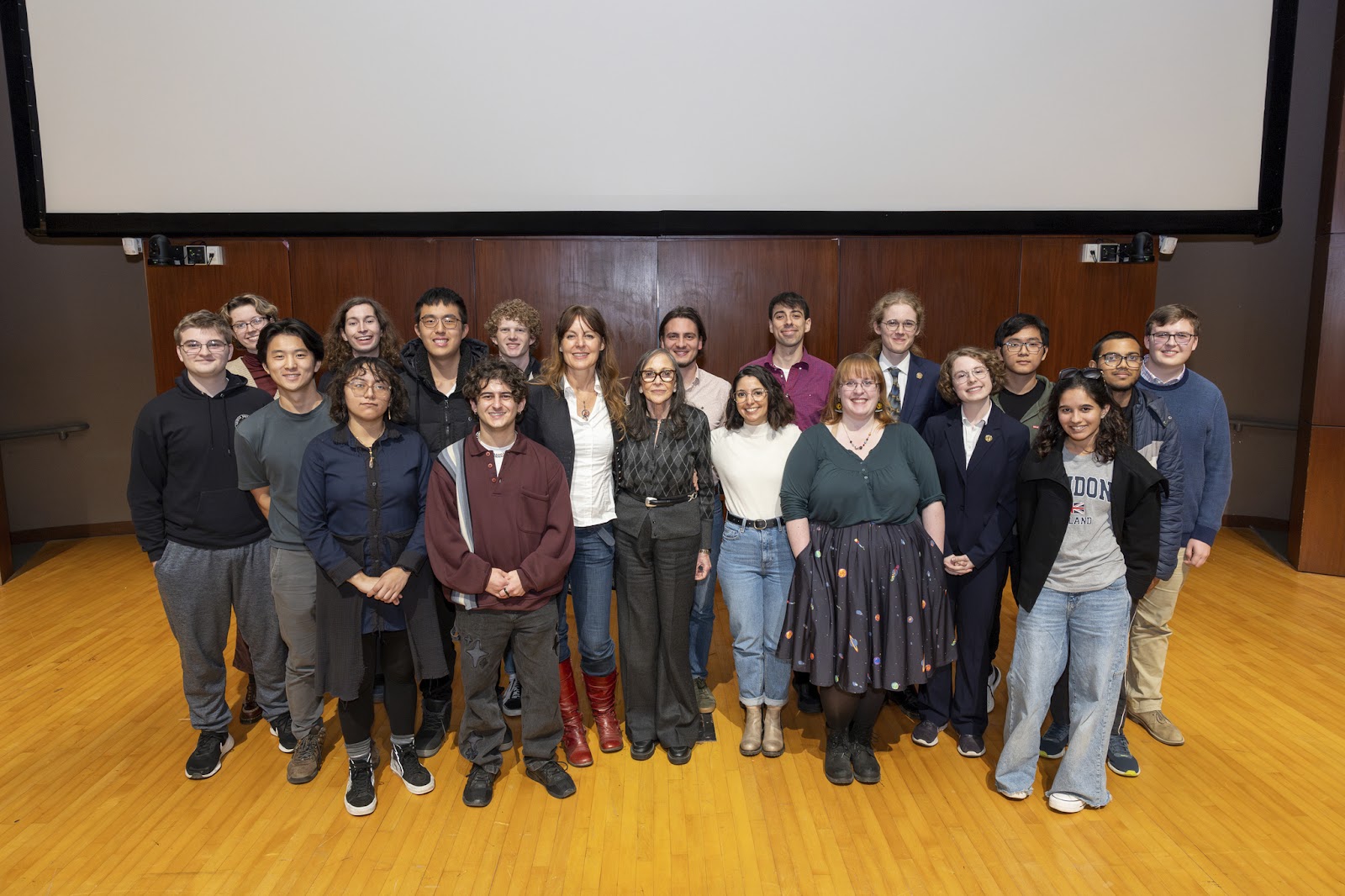
Photo 6: Taken by Simon Wheeler, courtesy of the Carl Sagan Institute. Speakers Ann Druyan, Lisa Kaltenegger, Jonas Biren, Ligia Coelho, and Rebecca Payne, along with the graduate, post-baccalaureate, and undergraduate members of the Carl Sagan Institute research group (including yours truly!), taking a group photo.
Featured image credit: The Carl Sagan Institute Edited by: Maria Vincent
Sandy Munro has been taking apart cars for decades to advise car companies on how to improve factory processes and designs. Sandy is super-impressed with the engineering of the Tesla single front and rear castings and structural battery pack. The design of the cooling for the structural pack is top-notch and super-efficient.
http://arxiv.org/abs/2203.08833
It is widely believed that string theory easily allows for a QCD axion in the cosmologically favoured mass range. The required small decay constant, $f_a\ll M_P$, can be implemented by using a large compactification volume. This points to the Large Volume Scenario (LVS), which in turn makes certain cosmological predictions: First, the axion behaves similarly to a field-theoretic axion in the pre-inflationary scenario, i.e. the initial value can be tuned but one is constrained by isocurvature fluctuations. In addition, the volume naively represents a long-lived modulus, that may lead to an early matter-dominated phase. Finally, the volume modulus’ decay to its own axion tends to produce excessive dark radiation. In this paper we aim to carefully analyze the cosmology by studying models that not only allow for a QCD axion but also include inflation. Quite generally, limits on isocurvature fluctuations restrict us to relatively low-scale inflation, which in the present stringy context points to Kahler or blowup inflation models. Moreover, we find as a novel and at first sight encouraging feature that the lightest (volume) modulus is likely to couple strongly to the Higgs. It hence quickly decays to the Standard Model, thus seemingly resolving the dark radiation problem. This decay is much faster than that of the inflaton such that the latter comes to dominate the Universe. Since the inflaton distributes its energy equally between the QCD axion and the Standard Model, this turns out to be a curse rather than a blessing: Generically, the dark radiation abundance remains too high. We briefly discuss possibilities to circumvent this issue. In particular, the rapid decay of the volume modulus into Higgses demotes dark radiation from a generic LVS problem to an issue resolvable by inflationary model building.
Using a novel crater detection algorithm, which automatically counts the visible impact craters from a high-resolution image, a team of planetary researchers from the United States, Australia, Côte d’Ivoire and France has analyzed the formation of 521 large impact craters on Mars. “Despite previous studies suggesting spikes in the frequency of asteroid collisions, our research [...]
A team of researchers led by Nanyang Technological
University, Singapore (NTU Singapore) has developed “a material that, when coated
on a glass window panel, can effectively self-adapt to heat or cool rooms across
different climate zones in the world, helping to cut energy usage.”
> Video: “Glass that adapts to heating and cooling needs” by NTUsg, YouTube.
http://arxiv.org/abs/2111.08682
We envisage a black hole perturbed by a force-free magnetic field (FFMF) outside and attempt to determine its structure. We suppose the metric that describes this black hole is of the static spherical type, that is Schwarzschild, and the energy-momentum tensor emanating from an FFMF source perturbs this background metric, in this regard one can imagine a magnetic accretion disk around the black hole. By solving the equations for such a configuration, we will show that in addition to modifying the diagonal elements of the background metric, we will also see the non-zeroing of the off-diagonal elements of the general metric, one of the immediate consequences of which will be a static to stationary transition.
[This is a transcript of the video embedded below.]
Some people dream of making babies, some dream of making baby universes. Seriously? Yes, seriously. How is that supposed to work? What does it take to make a new universe? And if we make one, what do we do with it? That’s what we’ll talk about today.
At first sight, it seems impossible to make a new universe, because where would you take
As we learn more about how planetary systems form, it’s becoming accepted that a large number of planets are being ejected from young systems because of their interactions with more massive worlds. I always referred to these as ‘rogue planets’ in previous articles on the subject, but a new paper from Patricio Javier Ávila (University of Concepción, Chile) and colleagues makes it clear that the term Free Floating Planet (FFP) is now widespread. A new acronym for us to master!
There have been searches to try to constrain the number of free floating planets, though the suggested ranges are wide. Microlensing seems the best technique, as it can spot masses we cannot otherwise see through their effect on background starlight. Of these, the estimates come in at around 2 Jupiter-mass planets and 2.5 terrestrial-class rocky worlds per star that have been flung into the darkness. This is a vast number of planets, but we have to be wary of mass uncertainties, as the cut-off between planet and brown dwarf (usually around 13 Jupiter masses) comes into play.
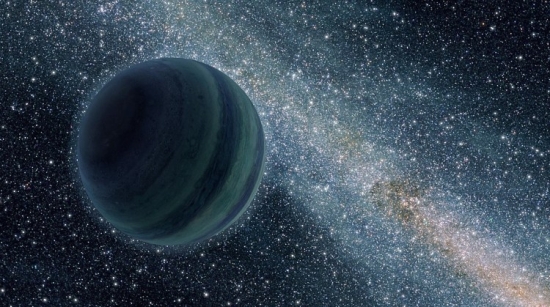
Image: An artist’s conception of a free floating planet. Credit: JPL/Caltech.
Any chance for life on a world like this? It’s hard to see how unless it’s something exotic indeed, but it’s Friday, so let’s play around with the idea. A major paper on rogue worlds is a 1999 discussion in Nature by David Stevenson (Caltech), which assumes a hydrogen-rich atmosphere. I’m just going to pull this out of the abstract before moving on to the Ávila paper:
Pressure-induced far-infrared opacity of H2 may prevent these bodies from eliminating internal radioactive heat except by developing an extensive adiabatic (with no loss or gain of heat) convective atmosphere. This means that, although the effective temperature of the body is around 30 K, its surface temperature can exceed the melting point of water. Such bodies may therefore have water oceans whose surface pressure and temperature are like those found at the base of Earth’s oceans. Such potential homes for life will be difficult to detect.
To say the least. Let’s also note a later paper by Steinn Sigurðsson and John Debes that has shown that among terrestrial class planets ejected from their stars, a good number may retain a lunar-sized moon. Citations for both these papers are below.
But let’s think bigger. Ávila and colleagues go after Jupiter-sized worlds with large, terrestrial-sized moons (far larger than any we see in our Solar System, where Ganymede, larger than Mercury but much smaller than Earth, reigns supreme). They model the chemical composition and evolution of CO2 and water in an attempt to discover the kind of atmosphere that would allow liquid water on the surface. CO2 is found to produce more effective atmospheric opacity (governing atmospheric absorption) than Stevenson’s choice of molecular hydrogen.
From the paper:
…to the best of our knowledge, there are no detailed models of the chemical evolution of the atmosphere of a moon orbiting an FFP. Within this context, we introduce here an atmospheric model to tackle this limitation. We assume that in the absence of radiation from a companion star, the tidal and the radiogenic heating mechanisms represent the main sources of energy to maintain and produce an optimal range of surface temperatures.
The authors simulate the atmosphere of an Earth-sized moon in an eccentric orbit around a gas giant, analyzing its thermal structure and determining the mechanisms that can keep it warm. The assumption is that carbon dioxide accounts for 90% of the moon’s atmosphere. The model relies on radiogenic heating along with tidal factors as the main energy sources while invoking an atmosphere under changing conditions of cosmic ray ionization, chemistry, pressure and temperatures.
In a setting like this, the cosmic-ray ionization rate (CRIR) drives chemistry in the atmosphere. A bit more on this:
Due to the absence of impinging radiation, the time-scale of water production is driven by the efficiency of cosmic rays in penetrating the atmosphere. Higher CRIRs reduce the water formation time-scale when compared to low-CRIR models, implying that they play a key role in the chemical evolution, by enhancing the chemical kinetics. However, due to the attenuation of cosmic rays, in the lower layers of the atmosphere, the water production is also affected by the density structure, that determines the integrated column density through the atmosphere. This causes an altitude-dependent abundance of water as well as of some of the other chemical species, as CO, H2 and O2.
The authors’ model assumes an initial 10% molecular hydrogen and measures changes depending on atmospheric pressure, semi-major axis and eccentricity, the latter generating tidal heating. In the best scenario, we wind up with an amount of water on the surface of the moon that is about 10,000 times smaller than the volume of Earth’s oceans, but 100 times larger than found in Earth’s atmosphere. Thus we have a conceivable way to keep water a liquid on the surface, offering the possibility of prebiotic chemistry:
“Under these conditions, if the orbital parameters are stable to guarantee a constant tidal heating, once water is formed, it remains liquid over the entire system evolution, and therefore providing favourable conditions for the emergence of life.
Keeping that orbit eccentric enough to produce the needed tidal forces is a challenge. The authors’ research indicates that while moons around ejected gas giants may exist up to 0.1 AU from the planet, closer orbits in the range of ≲ 0.01 AU are more probable (Jupiter’s largest moons are within 0.01 AU). Is a single moon in this configuration not going to circularize its orbit, or can earlier orbital resonances survive the ejection? A good science fiction writer should have a go at this scenario to see what’s possible.
The paper is Avila et al., “Presence of water on exomoons orbiting free-floating planets: a case study,” International Journal of Astrobiology published online 08 June 2021 (full text). The Sigurðsson and Debes paper is Debes & Sigurðsson, ”The Survival Rate of Ejected Terrestrial Planets with Moons,” Astrophysical Journal Vol. 668, No. 2 (2 October 2007) L 167 (full text). The Stevenson paper is “Life-sustaining planets in interstellar space?” Nature 400 (6739):32 (1999). Abstract.