Props to Student 22, they did poorly but they came by it honestly
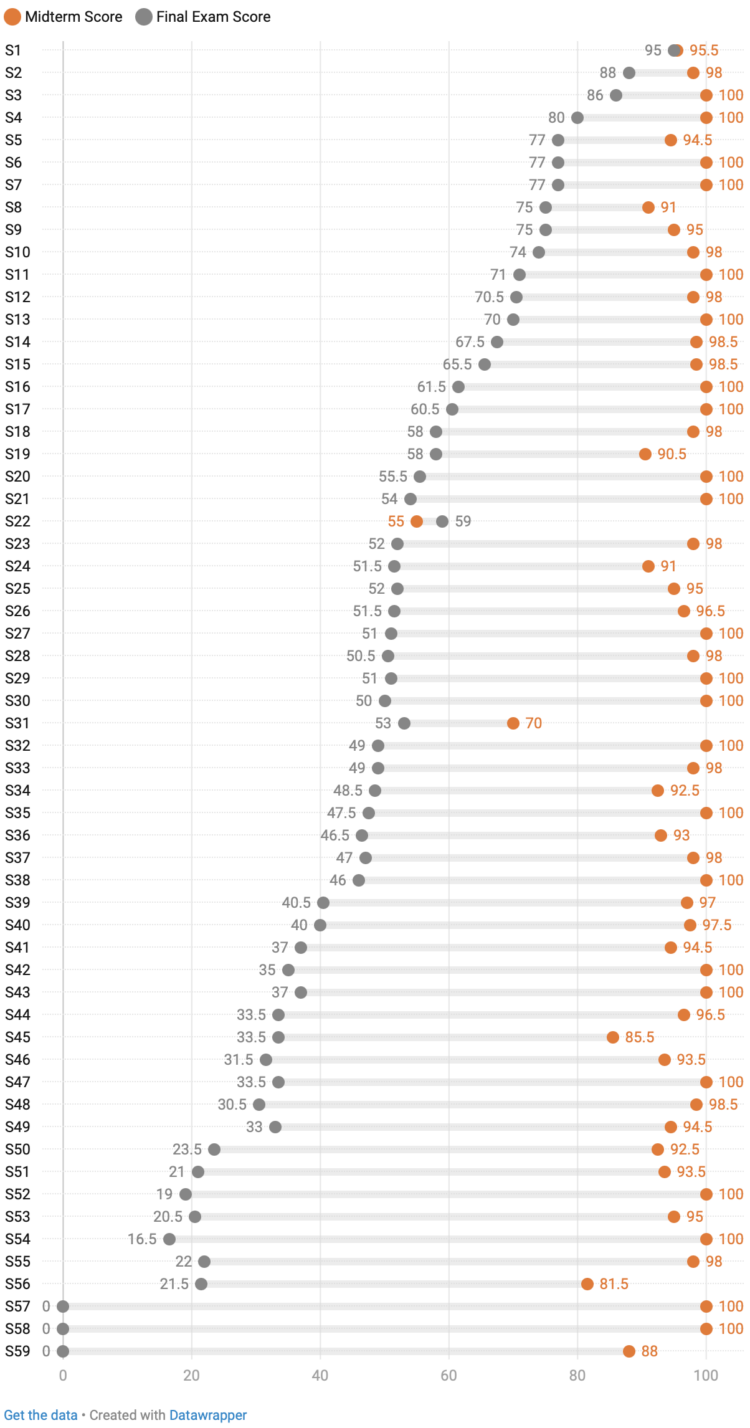
Roberto Serrano, a Brown University economics professor, gave a take-home midterm and it seems most of the students used AI handle the work. Suspicious of cheating, Serrano required the final exam to be taken in-person. For Inside Higher Ed, Emma Whitford charted the discrepancy between high midterm marks against much lower final marks:
Education needs to figure out new ways to grade progress, and students need to figure out how to think deeply for themselves. Unless you’re student number one, in which case you may carry on.
There are more than 11,000 known species of birds on Earth, and while many have perfectly sensible names, others seem as though they were invented during a particularly whimsical brainstorming session.
Recently, bird historian Robert Francis compiled and ranked what he considers the 100 greatest bird names of all time, a monumental exercise in avian nomenclature that celebrates the weird, wonderful, and unexpectedly poetic corners of the bird world.
The resulting list reads less like a scientific catalog and more like a cast of eccentric storybook characters.
Among the contenders are the Chad Firefinch, which somehow sounds like both a tropical bird and a high school quarterback, the perpetually cheerful Happy Wren, and the wonderfully self-explanatory Handsome Fruiteater. Each is a real species, and each seems to have been named by someone having a very good day.
Elsewhere, things take a darker turn with birds like the Vampire Ground-Finch, a species known for occasionally drinking blood, and the ominously named Blood Pheasant, whose title feels more like a heavy metal album than a mountain-dwelling bird.
Some names are simply delightful because of how they sound. Consider the Weebill, Australia’s smallest bird, or the Squacco Heron, a name that seems to perfectly capture the noise a cartoon bird might make after flying into a window.
What makes these names so enjoyable is that they reveal a surprisingly human side of science. The natural world may be categorized with great precision, but somewhere along the way an ornithologist looked at a small finch and decided that Cinderella Waxbill was a better name than something dry and technical. The world is arguably better for that decision.
Birds themselves are endlessly fascinating, but their names can be miniature works of art. Equal parts observation, imagination, and mischief. And after browsing Francis’s list, it’s hard not to wish that more things in life were named with the same level of enthusiasm.
After all, who wouldn’t rather encounter a Vampire Ground-Finch than a Model XJ-47?
You can browse Robert Francis’s full ranking of the 100 greatest bird names on his Bird History Substack, where each entry comes with a bit of context, history, and appreciation for the art of naming things.
This cartoon has six panels, each of which shows a different scene. The first five panels all feature cheerful robots in office environments.
PANEL 1
A shiny golden robot talks to the viewer.
GOLDIE: Good news! Here are just some of the ways AI saves you time and makes your job better!
PANEL 2
A robot – which seems to be a suit and tie with a smartphone sticking up out of the collar – talks to us. He’s carrying a huge stack of papers.
PHONE: Good news! Because your new AI agent is expected to save you so much time, the company is providing you with extra work!
PANEL 3
A tiny robot that looks like a ball with hands is bouncing on a desk.
BOUNCY: Good news! The AI agent makes lots of mistakes, so you get to do proofreading and debugging! Yay!
PANEL 4
A robot with a head shaped like a Telsa Cybertruck talks to us. A bunch of other robots are in the background.
TELSA: Good news! The company has determined you’ll get more work done with more AI agents doing more bad work for you to check and correct!
PANEL 5
A coffee machine with a screen with a happy face on it talks to us.
COFFEE: Good news! More of your colleagues are letting AI do their jobs, so now you get to fix that work, too!
PANEL 6
A human with a shellshocked look is walking on a sidewalk, carrying a cardboard box full of desk stuff in classic I’ve-just-been-fired iconography. A caption is shaped like a memo on paper.
CAPTION: Good news! We’ve determined that bad work done by A.I. is more cost-effective than better work done by humans.
CHICKEN FAT WATCH
“Chicken fat” is obsolete jargon for what we now call “Easter eggs.”
PANEL 1: A poster on the wall says LESSER EVIL INCORPORATED. “If it’s not lethal, it’s a lesser evil.” A rat sits reading a book, Charlotte’s Web.
PANEL 2: A gigantic ant is climbing a skyscraper in the background.
PANEL 3: A picture of an adorable toddler is inscribed “I heart you Mommy! Always remember if u quit ur job I’ll starve.” A “to do” list says: “-Work -Work -Work -Labor -Toil -Lunch -Drudge -Slog -die.” A coffee mug, decorated with Charlie Brown’s zig-zag shirt line, has a mouse wearing glasses peering out of it.
PANEL 4: One of the robots is a toaster. The robot puppy has left poo (a steaming pile of nuts and bolts) on the ground. The cybertruck robot’s head is on fire, and if you peer closely at the passenger window you can see a screaming person trapped inside.
PANEL 5: The coffee cup has a picture of Bender from Futurama on it. There’s an electric outlet with two “faces”; one of the faces is the standard, the other one is smiling and winking at us. A poster says “NOTICE: Cups must be cleaned after death.” A cannister is labeled “82% real Sugar,” with an adorable granny mascot saying “What you don’t now won’t kill you, probably.”
PANEL 6: The box of stuff from the fired employee’s desk includes a coffee mug; the mouse from panel 3 is still in the mug. A jar on the sidewalk says “Background Juice” on the label.
And there’s graffiti! “BG” (for background) is written in a few places. Someone has written a list of jobs: “Priest Poet Lawyer Marine Squire Grocer Vicar.” (Let me know in comments if you know where that list comes from.) A game of “hangman” is in progress: “A_S_ER.” (You see the answer, right?) More things written on the wall: “Filler.” “Who reads this?” “PP + Marcie 4EV.” “E=M.C. Hammer.” “Mary + Charlie + Frank.” Finally, a poster on the wall is partly blocked by the caption, but I can tell you it says “Secret Hidden Text! Because you can’t read this text: At last, I’m free to say it: Basketball is BORING! Bite me, b-ball fans!”
On February 13, 1922, Geneva Jensen of Southborough, Massachusetts, wrote to film star Lillian Gish, “I saw in to-day’s paper that you will be in Boston. […] Is it too presuming of me to ask you to come out […] and to spend the night here? […Mine] is only a small cottage, but I would leave nothing undone to make it comfortable for you. […] Won’t you be my Valentine?”
Bringing to mind contemporary dating practices where pictures are swapped before a tryst, Geneva included a snapshot of herself. A smiling, dark-haired, white schoolgirl in mismatched striped patterns stands in front a copse of bare trees. Behind her legs, a cat trots away impishly.
Geneva Jensen, as she showed herself to actress Lillian Gish. Lillian Gish Papers. The Billy Rose Theater Collection, New York Public Library for the Performing Arts, NYC.
Such passionate response to film actresses was not uncommon among young female audiences in the silent era. Homoeroticism was central to US film culture in the 1910s and 1920s, the decades that saw the development of a star-driven national film industry. That homoeroticism permeated the early Hollywood star system should not come as a surprise: many high-ranking stars of the period, as well as film reporters, producers, editors, screenwriters, and fans, were young women. In a world of women, queer affinities—from same-sex identification and hero-worshipping to sexual attraction—thrived.
However, the historical knowledge that women have been drawing queer pleasures from commercial media for over a century seems constantly forgotten. Recent cultural debates surrounding the viral success of the Canadian streaming show Heated Rivalry(2025) puzzled over the pleasures female audiences derived from seeing two fictional male hockey players embark on a secret sexual relationship. Created for the Canadian streamer Crave by gay show-runner Jacob Tierney and adapted from Rachel Reid’s men-loving-men (MLM) romance novel series Game Changers, Heated Rivalry has received global attention for its explicit sex scenes as for its impassioned female fanbase. In the US alone, dozens of journalists have pondered why women enjoy making and consuming media content exploring male romance and gay desire. Inspired by a plot point in the narrative, Heated Rivalry also popularized “coming to the cottage” as a shorthand for joyous queer intimacy and yearning. Geneva, clearly, was a century ahead of the gay hockey players.
The argument that (presumably straight, white) women gravitate to gay male content is not new, nor particularly exciting. Scholarship on female fan communities that couple male media characters, like Joanna Russ’s seminal article, harks back forty years. The 1960s television show Star Trek—and specifically the coupling of Spock and Captain James Kirk in fans’ writings and art—is usually cited as the origin point of “slashing,” the slang term used to describe the transformative practice of queering male characters for fan entertainment.
In the coverage of Heated Rivalry’s explosive global fandom much attention was again devoted to delineating audience monoliths and drawing correlations between fans’ preferences and their lived sexual experiences or gender identities, resulting in stultified understandings of what fandom primarily affords its participants: fantasy, projection, escapism, joy. Fandom first takes root in the imagination, in audiences’ psychic and affective real estate. It can, and sometimes does bleed into the physical realm, encouraging fans to see themselves in a mediated performance: to copy a celebrity’s look or mannerism, to work out complicated personal feelings through a star’s oeuvre or biography. As Geneva’s letter shows, fandom can motivate a viewer to reach out to others (fans or performer), seeking to bridge the gap between seen and lived, image and body, things remotely witnessed and things proximally shared. As Geneva reasons after requesting Gish to be her Valentine, “I would never have dared to write to anyone like this but […Lillian,] you seem nearer to me than some of my best friends.”
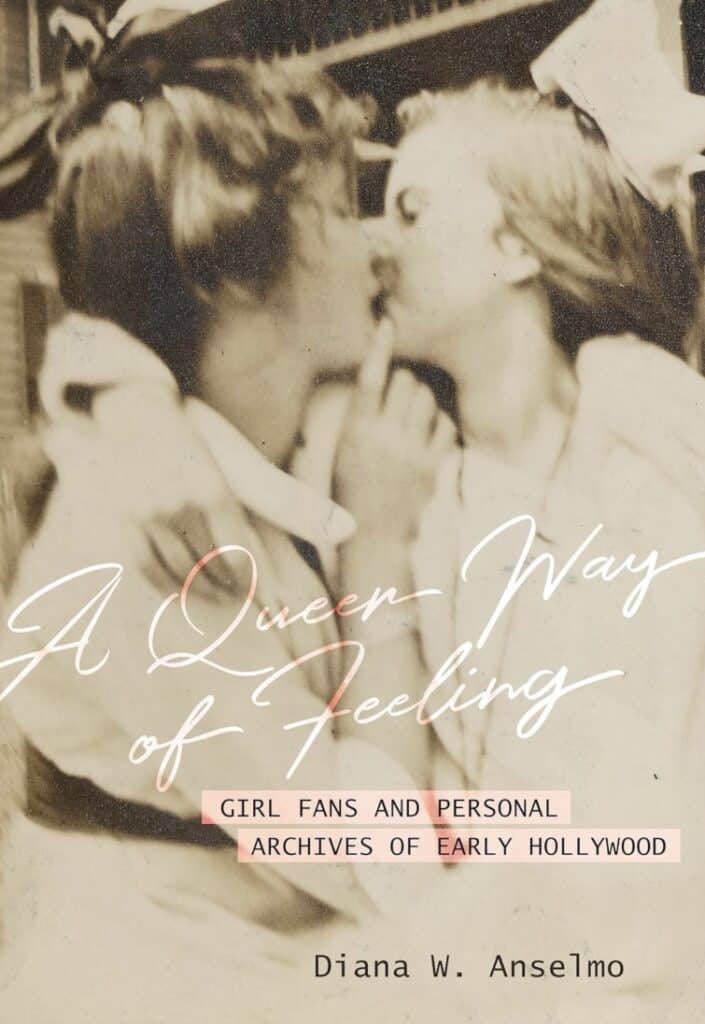
Media fandom has been affording diverse women the exploration of such queer pleasures since the onset of commercial cinema—the germ of today’s immensely lucrative transmedial celebrity/influencer culture. In my book, A Queer Way of Feeling: Girl Fans & Personal Archives of Early Hollywood(University of California Press 2023), I explore the scrapbooks, letters, and diaries ordinary moviegoing girls crafted in the 1910s as a means to negotiate feelings that colored outside normative lines: same-sex attraction, gender nonconformity, a distaste for marriage and motherhood, a preference for male clothing and athleticism.
Cover of Anselmo’s book, A Queer Way of Feeling.
Like Geneva’s, these queer fan attachments persevere in the archival margins of the histories we tell about women, media, and pleasure. Some fan mail and scrapbooks from the early silent era are buried in stars’ personal papers; others appear intermittently in online auctions or in film periodicals of the time, like Motion Picture Magazine and Motography. But make no mistake: the reception ardor found in these old archives mirrors that of enthusiastic female fans currently congregating on Reddit, Tumblr, or TikTok to convey heated reactions to fictional hockey romance.
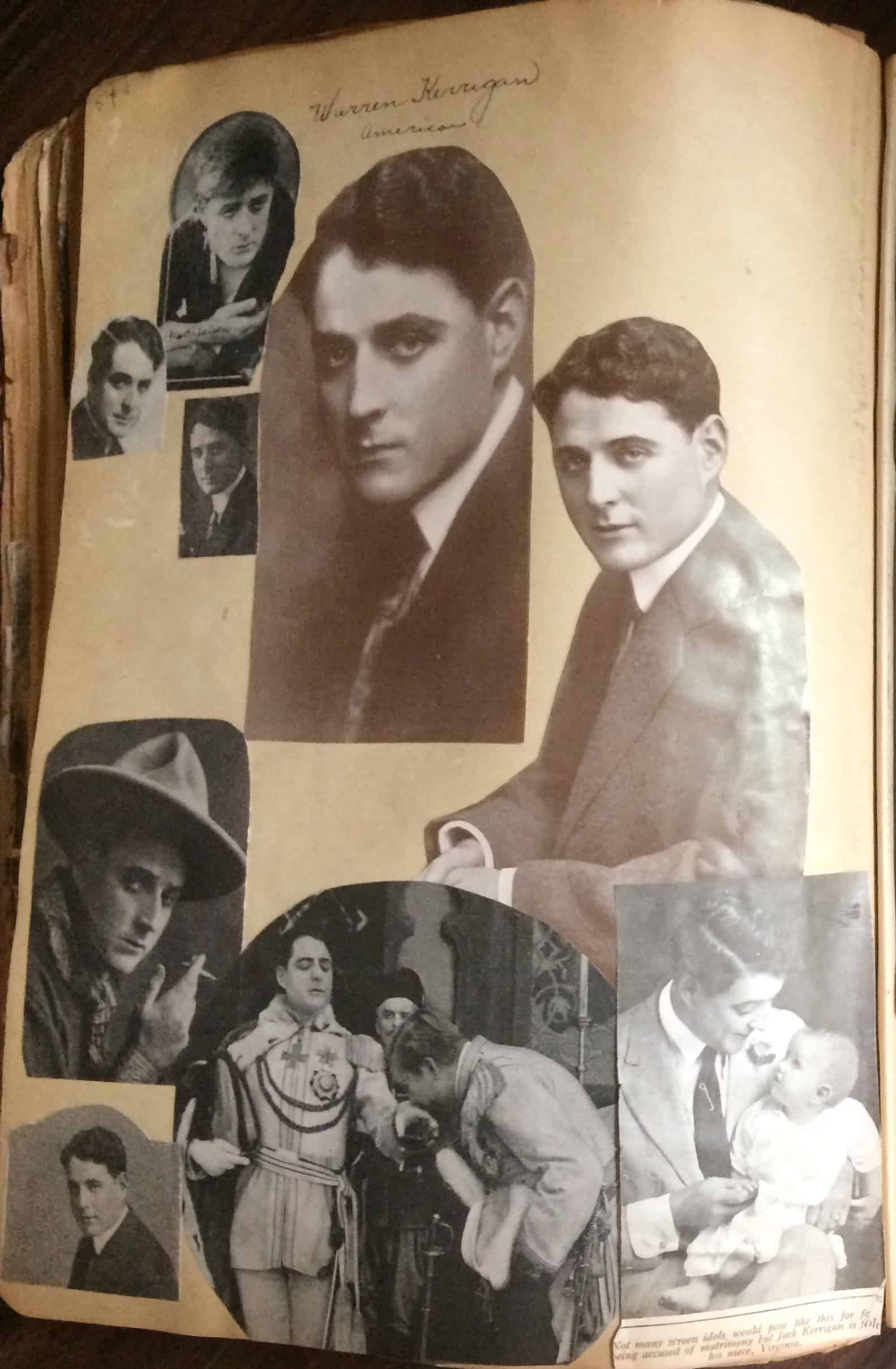
In their silent film scrapbooks, young women queered both male and female stars. Between 1913 and 1915, Eleanor G. Fulton, a well-wheeled Los Angelina, crafted a scrapbook entirely devoted to film idol Jack Warren Kerrigan. Eleanor’s meticulous collages privilege newspaper articles foregrounding Kerrigan’s nontraditional masculinity. Two of Kerrigan’s most salient queer characteristics—a consuming love for his mother and a distaste for female company—are highlighted in her scrapbook. The fan pasted and underlined interviews where the actor declared that “my only interest besides my work is my mother” and where journalists warned that “in spite of his good looks, Warren Kerrigan does not care for girls. He is seldom seen with women; he says he loves the ladies devotedly—and then adds ‘when they leave me alone.’”
Queer rumors attached themselves to Kerrigan as early as 1914, when seventeen-year-old James Carroll Vincent moved in with the star and his mother in their Hollywood Hills estate. Frequently photographed in debonair poses, Kerrigan did not hide his penchant for finery, including fashion, flowers, and high art. Allowances for such flamboyant masculinity eventually fell out of favor in 1917, when the actor spoke against enlisting to fight in World War I. Predating the sexually ambiguous Rudolph Valentino by a decade, Kerrigan would undergo the public trials of challenging dominant notions of red-blooded American masculinity. Fulton’s scrapbook supplies a roadmap to the writing on the wall: early queer whispers, slivers of newspaper pulp quipping that “Jack Kerrigan’s favorite flower is the pansy,” calling him “a great big baby doll,” and announcing that the star was to write a syndicated column “to teach men dress properly,” since he reported having “boys actually mob me to get my handkerchief away for a souvenir.”
Kerrigan’s dissidence from the conventional he-man stereotype charmed both male and female film fans. Fulton clipped verses penned by male fans that gushed with homoeroticism. In 1916, William De Ryee, from Santa Cruz, California, wrote to Motion Picture Magazine to crown Kerrigan “the player of my heart.” He listed the leading man’s physical attributes with rousing approval: “And talk of being handsome—he’s living Belvedere! / With dreamy eyes, whose wistfulness had made him e’en more dear.” The poem concludes with possibly one of the first fandom instances of a deflecting “no homo:” De Ryee hurriedly asserted, “Of course, ‘I love the ladies,’ but commend I must this man; / This peerless Sovereign of the Screen—J. Warren Kerrigan.” The scare quotes around the fan’s disclaimer of virile heterosexuality are perhaps as damning as his swooning over Kerrigan’s “dreamy eyes.”
Like many current female fans, Eleanor seems to have found the queerness suffusing Kerrigan’s star text not a deterrent, but a driving force of her fan attachment, stimulating the moviegoer to follow, document, and eventually meet the actor in person. Eleanor’s collages also spotlight the emotionality of Kerrigan’s acting and the feminized vulnerability of his body, selecting stills where the star languishes in bed, lounges in silk pajamas, touches other men, or is long-haired and skirted as Samson in the 1914 biblical film.
Sensitive Kerrigan. Alice Shefler’s Scrapbook. Author’s Personal Collection.
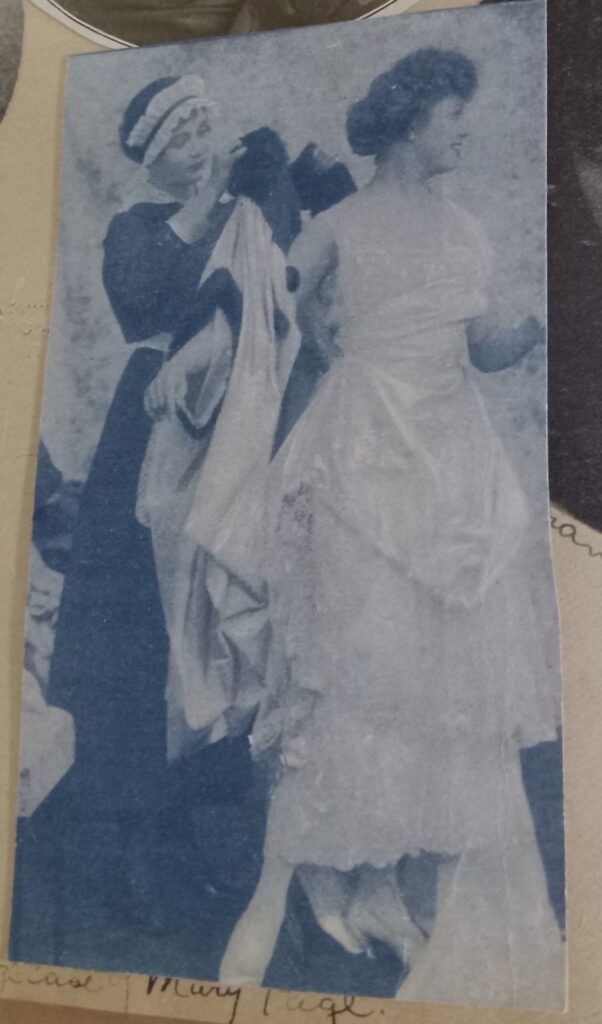
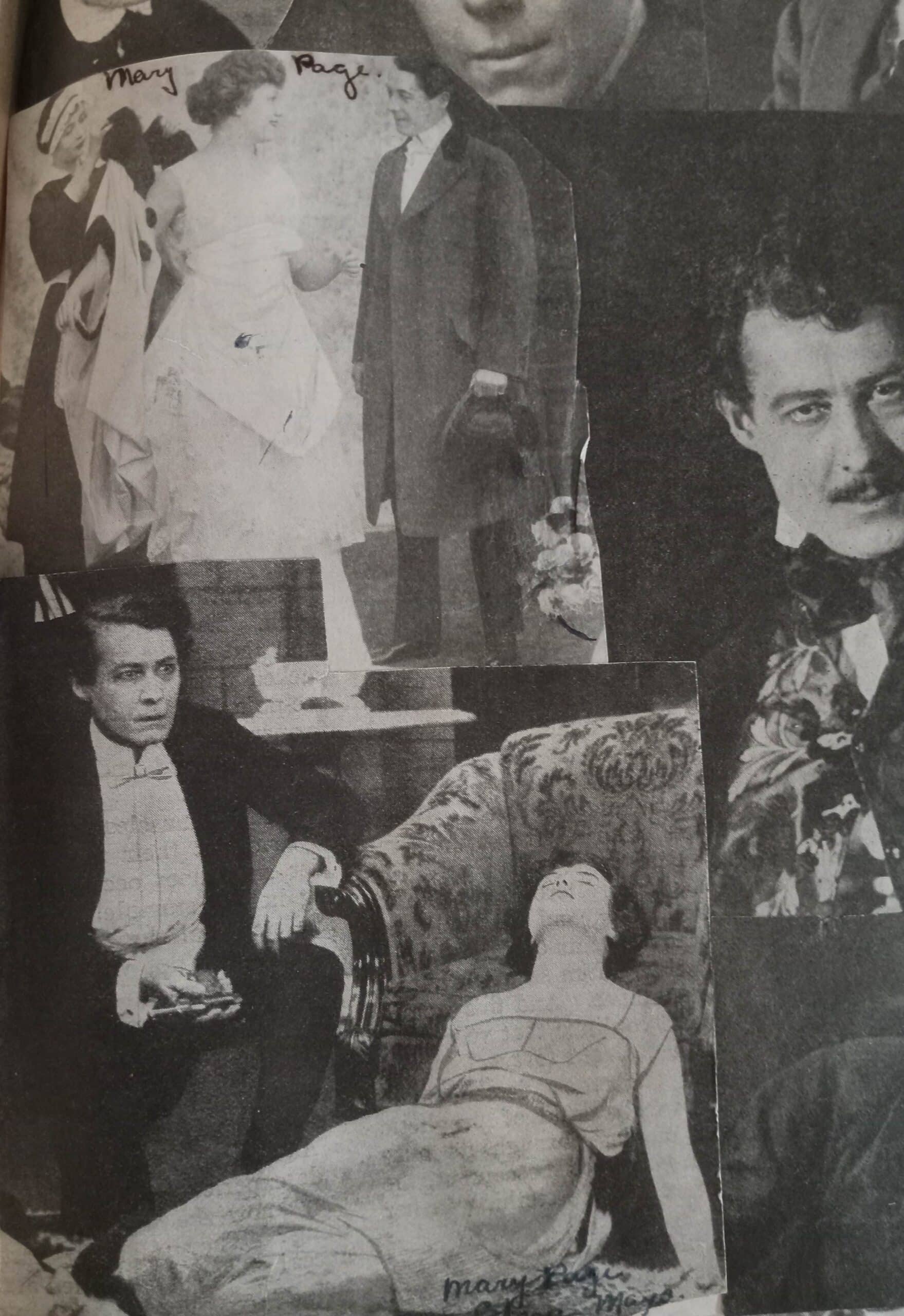
Working-class Alice E. Shefler from Portland, Oregon also used scrapbooking to queer her film reception. From 1915 to 1917, her sixteenth and eighteenth birthdays, Alice produced dozens of collages dedicated to US actors, including a four-image shrine to Edna Mayo, who starred in the popular 1916 serial The Strange Case of Mary Page. One of the images Alice clipped shows a maid helping Mary Page/Mayo with her evening gown. The two women stand close together, their bodies caught in the act of domestic intimacy. Neither of them faces the camera; the maid is transfixed by her lady’s motions, and Mayo looks forward smilingly. The image, as the teenage fan preserved it, simmers with homoerotic innuendo: two young women huddle in a boudoir and avoid the camera’s voyeuristic gaze, while one of them partakes in either dressing or undressing the other—the direction of the act is left unclear.
Alice Shefler’s Scissoring of Edna Mayo.
On a later page, this promotional still returns, only now a man faces Mayo. It becomes clear that the original image included Henry B. Walthall, Mayo’s leading man in The Strange Case of Mary Page. By scissoring him out of her earlier collage, Alice created a moment of sapphic intimacy through fan reception, one that persists to this day (I own her scrapbook as well as Eleanor’s. They both live in my closet).
Without Alice’s scissoring.
Alice, like Eleanor, scoured commercial film ephemera for images of nontraditional masculinity and male homoeroticism. In a collage devoted to Harold Lockwood, another heartthrob of the 1910s, Alice chose to collect movie stills in which the actor interacts with other men. In one image, Lockwood holds intense eye-contact with a young officer, the man’s hand covering Lockwood’s in a tight grip. Their facial expressions thrum with such tension the exchange blurs the lines between homosocial and homoerotic, a threat and a come-on. In another film still, Lockwood appears among working men who cheer as he is patted on the shoulder by an older officer on horseback, a female child secured between his thighs. The image celebrates rugged masculinity while presenting a picture of male bonding centered in an alternative family configuration. Again, without context, this fragmented scene from The Buzzard’s Shadow (1915) presents a community of men physically reassuring each other and nurturing a child without any adult female presence to signal heterosexual romance or reproduction.
Female moviegoers like Alice and Eleanor favored queer possibility over heterosexual content. They sought out implied same-sex attraction in film glances and touches captured in promotional stills. It is significant that Alice foisted so much attention on scrapbooking images of Lockwood with other men when most of the star’s promotional images showed him next to May Allison, his onscreen sweetheart. This deliberate type of reception reveals early stagings of female fandom scavenging for representations of male/male intimacy on the silver screen.
This reading is strengthened by myriad other stills Alice collaged, all depicting “pretty boy leads” being physical with each other, including Kerrigan having his hand kissed in A Son of the Immortals (1916); a sketch of shirtless Thomas Santschi fist-fighting another half-naked man; and Owen Moore, in a small still from Betty of Greystone (1916), entangled with another man on the floor, their limbs so intertwined their two bodies cannot be told apart. This is an unusual still to choose from a long melodrama starring Dorothy Gish, especially because both men’s faces are obscured, foreclosing star identification or optimal handsomeness. With the added context of Alice’s broader scrapbooking proclivities, the emphasis on homoerotic male intimacy—on strapping masculinity turned on itself in a simulacrum of wrestling or lovemaking—likely drove the inclusion of this grainy film still.
Queerness attracts queerness. Perhaps seeing a debonair actor play against the he-man type appealed to female spectators who identified as “different from the norm” because such star texts gave visibility to fans’ divergence from heteronormativity. Perhaps some women moviegoers enjoyed seeing men being physical with one another because masculinity was attractive to them. Perhaps pleasure resided in witnessing male homoeroticism sidestep, no matter how briefly, traditional gender and sexual binaries that tended to cast female characters as narrative trophies or ornaments.
The “why” is less compelling to examine than the “when” and the “how.” The latter especially has changed little since the beginnings of transmedial celebrity culture, of which Hollywood star cinema was a pioneer and Heated Rivalry a distant cousin and direct beneficiary. Literate female audiences have been deriving pleasure from queering mass media for over a century, hunting the screens and promotional content for representations of male homoeroticism, gender nonconformity, and sapphic intimacy. Female audiences wanted film actresses to come to their cottage in 1922 and they delight in seeing fictional hockey players go to their cottage in 2026. In fan reception history, queer joy never needed a “why”—a “how” more than sufficed.
Diana W. Anselmo is a media historian who works on queer film reception in the Progressive Era, affective labor in US media history, and most recently the history of lithium extraction, thermal waters, and public health in Portuguese soil. She is the Writer in Residence for Nursing Clio and a Visiting Scholar at the University of Pennsylvania.
haha I can't afford the town I grew up in and fought so hard to escape
It’s not that millennials will never own homes, it’s just that they may never be able to own them where they want to. Case in point: The town you grew up in and fought so hard to escape is the only place with homes in your price range.
Just heartbreaking.
Although you worked so hard to get good grades in high school, saved money by attending community college for two years before transferring to a state university, and landed a solid job in your dream city, ultimately, after 15 years out of your parents’ house, the only homes in your price range are back in the podunk town where you were raised.
And sure, there are other affordable homes in other equivalent podunk towns, but it’s pretty depressing that your hard work has merely led you back to a place with nothing but a 7-11, two dive bars, and an opioid crisis. If only you’d known that to really make something for yourself, your one option was to go into finance. But would business school even be worth it now? What with AI…? And everything?
Oh, who knows? (Certainly not you.)
There’s a pretty nice-looking place on Zillow up for sale, not too far down the street from your parents. Three bedrooms, a little yard, a laundry machine. Yes, buying it would mean you failed, but something about it remains compelling. Most tragically, you could’ve saved about half the cost if you’d just bought it during the pandemic when your mom first sent you the link.
Damn. If only you’d known to give up by then.
So what will you do? Should you just keep renting in the city where you’re basically watching your money burn? Or should you move back home, buy property, and just get addicted to opioids? Sound off below!
This facsimile of The Royal Psalter of Sainte-Chapelle, an illuminated manuscript originally made in Paris in the early thirteenth century, is filled with a delightful variety of geometric, floral, and zoomorphic line fillers.
Medieval scribes and artists filled the empty space between lines with humor, providing a break from often serious texts and also creating visual balance and symmetry. We suspect that they must have had a lot of fun creating these quirky creatures.
The Fine Arts Library holds a collection of over 300 full-color facsimiles of illuminatedmanuscripts from a wide range of periods and traditions. The collection primarily includes religious texts, but representatives of secular works on poetry and literature, astronomy, travel, sketchbooks, and science and medicine are also included.
The Michelin Guide will soon cover Cleveland, Detroit, Indianapolis, Milwaukee, Minneapolis, and Pittsburgh | Getty Images
The Michelin Guide announced today that it will be releasing a Great Lakes edition, which will cover Cleveland, Detroit, Indianapolis, Milwaukee, Minneapolis, and Pittsburgh — basically, every major city in the region except Chicago, which is covered by a separate Michelin Guide.
It continues the guide’s partnerships with destination marketing organizations, as Eater’s Matthew Kang recently explained. These organizations pay to gain Michelin consideration, on the grounds that Michelin recognition will help drive tourism to cities and diners to restaurants. “Our chefs and restaurateurs have been building a vibrant food scene for years, and this recognition will help attract new visitors, support local hospitality jobs, and strengthen Pittsburgh’s reputation as an exciting culinary destination for taste driven travelers,” Visit Pittsburgh President and CEO Jerad Bachar said in the statement. The guide clarified that these partnerships have no bearing over which restaurants are selected.
In 1926, the Michelin Guide began awarding stars to restaurants in France. In 2005, it expanded into North America, initially awarding stars in New York City, San Francisco, and Chicago. In recent years, the guide has expanded aggressively across the United States, most recently launching guides in the American South, Boston, Philadelphia, and the Southwest. (The South, Boston, Philadelphia received their first selections in late 2025, while the first selections for the Southwest will be announced later this year.)
According to the press release, Michelin inspectors have already begun scouting cities for the inaugural selections, which will be unveiled next year.
David Novros makes intricate, multipart, asymmetrical paintings out of horizontal and inverted L-shaped panels with carefully measured intervals between them. They are not simply shapes placed against the wall, as their openings make the wall integral to our experience. Looking at them, I was reminded of something he told an interviewer in 2008:
Seeing the Alhambra in Granada was an extraordinary experience for me. It was the first time that I understood painting as something other than an object hanging on a wall. I thought that paintings could be in a fixed place, made for that place, made for the light of the place, experienced kinesthetically. It didn’t matter that the “painting” was tiles, it was still painting.
Standing in the large open space of his exhibition at Paula Cooper, it was obvious that Novros’s panel paintings diverge from the shaped paintings of Frank Stella and Kenneth Noland. Instead of being an object against (or sticking out from) the wall, Novros made his work with the wall in mind. They are, as he has called them, “portable murals,” suggesting that the work needs to be portable because the wall on which it is displayed is not permanent.
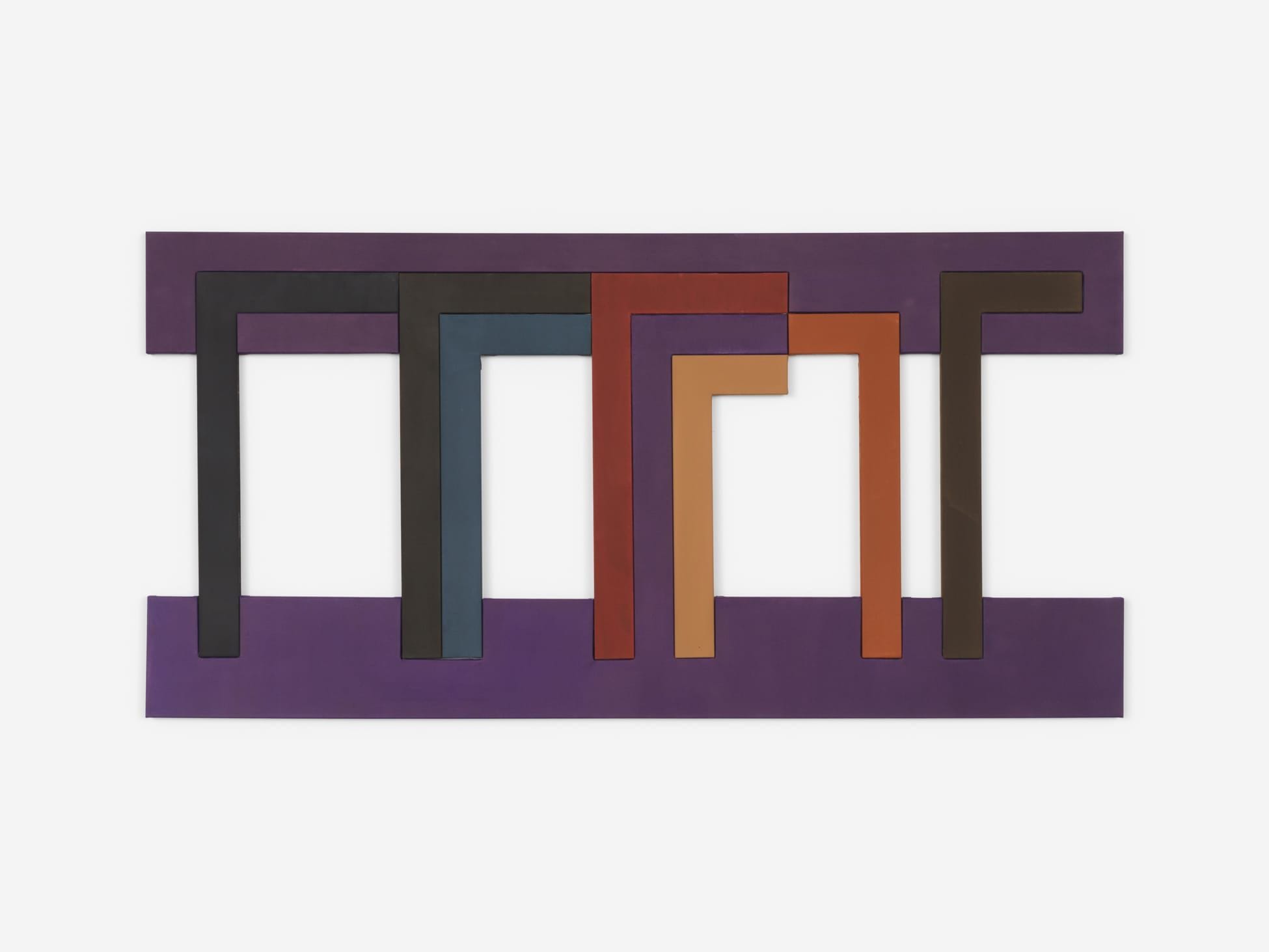
David Novros, “Untitled” (2024), oil and murano on canvas, 10 panels
Novros’s paintings are scrupulously orchestrated arrangements of monochromatic panels of different thicknesses and widths. They are meant to be seen from afar and looked at closely, as the sides of the panels reveal the underpainting, including drips. In some cases, the underpainting casts a soft glow onto the wall. This does not happen with every panel, so viewers are apt to find themselves moving away from and toward the painting, double-checking what they saw. But this is just the beginning of the pleasure of experiencing these works.
“Untitled” (2024) consists of 20 different-sized panels. Together, they form three wide, darkly painted horizontal bars demarcated by four lighter-painted, inverted L-shapes placed at different intervals across the painting, with one L resting its arm on the top bar. There is a dissonant internal rhythm to the vertical bars, whose tan surfaces differ ever so slightly from each other, though without any evident logic. This rhythm is underscored by the three horizontal bars, the bottom structural bar being dark green and the two above it black. With slight spaces between the panels, the entire construction feels handmade and the arrangement slightly imperfect. Nothing is permanent, the work signals to us.
Installation view of David Novros, "Untitled" (2025), oil and murano on canvas, 37 panels
The most intricate painting, “Untitled” (2025), consists of 37 panels. Working with a palette of five colors, whose tones vary in no logical manner, Novros arranged three stacked rows with three rectangular, window-like openings each. Within this open, façade-like structure, Novros engineers continuous change, from the position of the gray, brown, and earth-red verticals, to the subtly changing size of the openings, to how far the panels extend from the wall.
When I was at the exhibition, there was a thin line of shadow spanning the bottom of one row, making me hyper-conscious of the fact that the painting is susceptible to the changing light. This sensitivity to natural light and time passing is something Novros shares with artists like Robert Ryman and Suzan Frecon. Their work exists in time and is not impervious to its passing.
David Novros, "untitled" (2023), watercolor and graphite on paper
In Novros’s case, shadows, tonal changes, underlayers, and an afterglow all call for our attention. There is no ideal viewpoint, and we become conscious that we are seeing ourselves looking at and examining a painting. The interplay of structure, color, placement, surface texture, and openings never becomes repetitive. Looking becomes a series of discoveries.
The paintings are complemented by a group of watercolors. In each one, the color of the vertical and horizontal bands varies. Done on white paper, they all emanate a soft glow. Novros’s sensitivity to his medium and materials is to be found everywhere in this museum-worthy show. These works ask the viewer to slow down, to step away from the world, to discover renewal through attention. The poet Robert Duncan believed the poet’s duty was “to keep/ the ability to respond.” In Novros’s paintings, doing, seeing, and thinking are inseparable.
Installation view of David Novros
David Novroscontinues at Paula Cooper Gallery (534 West 21st Street, Chelsea, Manhattan) through April 25. The exhibition was organized by the gallery.
Björk is throwing a rave in Iceland to mark the total solar eclipse this August.
The one-day festival, Echolalia, will take place at Víðistaðatún sculpture park in Hafnarfjörður on 12 August. During the event, the festival site will experience complete coverage of the sun by the moon for one minute and four seconds.
Björk will DJ at the event, while Arca is also set to play. Other performances will come from Icelandic acts Sideproject and Ronja Jóhannsdóttir.
A press release announcing the festival read: "For years we’ve been having Mánakvöld – dance evenings under a full moon where Björk invites friends to DJ with her. This time we gather under the total solar...
I don’t have a cartoon syndicate and I’m not in newspapers. But I get to do this for a living because lots of readers support my Patreon with mostly small pledges! I also have prints and books for sale.
TRANSCRIPT OF CARTOON
This cartoon has for panels, showing two women talking as they walk through a hilly park. The woman in front has dark hair and is wearing a red t-shirt; the person in the rear has light brown hair and is wearing floral pants. I’ll call them TSHIRT and FLORAL.
PANEL 1
Tshirt is listening as Floral lectures.
FLORAL: Of course teachers should be legally required to “out” trans kids to their parents. Because of parents’ rights.
PANEL 2
FLORAL: It doesn’t matter if it’s outing trans kids, or vaccinations, or what books teachers are allowed to assign. It should always be up to the parents!
PANEL 3
Close-up on Flora, who is pounding a fist into her palm, very intense.
FLORAL: Parents’ rights are sacrosanct! Period!
PANEL 4
Tshirt turns to ask Floral a question; Floral replies cheerily.
TSHIRT: What if parents want their trans kid to have gender affirming care?
FLORAL: Fuck parents’ rights.
CHICKEN FAT WATCH
“Chicken fat” is a long-obscure cartoonists’ term for unimportant but amusing details slipped into the art, which I want to bring back. (“Stop trying to make fetch happen!”)
PANEL 1: A grinning kid is hanging upside-down high in a tree. A notice nailed to the tree shows a sad-looking robot and says “NOTICE: Background gags weren’t made by A.I.” On the ground, Steamboat Willie (the earliest form of Mickey Mouse, now copyright-free) is fleeing from a vicious cat.
PANEL 2: An evil-looking bunny is behind the bush, smoking a cig. High in a tree, a rat has disguised itself as a squirrel by taping a big leaf to its real end, and is trying to pass itself off to a real squirrel. A notice nailed to the tree has a picture of an evilly grinning robot and says “NOTICE: Then again isn’t that what an A.I. would say.”
PANEL 3: On top of a cloud, a cloud-colored person with a mohawk is lying on their back and reading their phone.
PANEL 4: A basset hound is in the hole in the tree. A sign below the hole says “Home Sweet Hole.” The robot from the notices in panels 1 and 2 is hiding behind the tree. Steamboat Willie’s lifeless corpse lies in the grass. A notice nailed to another tree shows a picture of a vague shadow shape, and says “MISSING: Small robot which functions as a visual representation of A.I. in background gags. Extremely hackneyed, but functional.”
T-SHIRT: In panel 1, the t-shirt has a logo of a piece of cake. Panel 2, it’s a peace sign. And in panel 4, it’s a chess piece.
Just in the past week, the following post crossed my mastodon timeline:
I have spent several hours writing feedback on this paper, and now I am looking at the references and … none of them exist.
Next time I am starting with the references 😠
@mark@mastodon.ocert.at
and a friend who’s a journal editor sent me this from bsky:
The linked study cites an article which lists me as an author, but which does not actually exist.
I complained to the journal editors.
Over a year later, the study is still there, no retractions or corrections.
pubmed.ncbi.nlm.nih.gov/39614949/
… much like the first person quoted, I tend to get to references last. As I’ve matured, I had already become aware of the long-standing problem of mis-citation where an author cites a real publication but either misuses or misunderstands it (sometimes it’s obvious which, I try to be generous when it’s not). So I do actually check references. At this point, there are some classics I can recognize. But if I don’t, I will actually do a quick vibe check skim, maybe something deeper when the claim is either really important to what I’m reviewing or I find it surprising.
Inverting the Process
But clearly, the era of LLMs calls for a new approach, checking references first. Even a “grounded” LLM isn’t guaranteed not to spit out a citation that doesn’t exist. After checking for existence, it may be even more important now to check if a work is being cited appropriately. The presence of a widely-cited article in a bibliography might just mean it’s significant in the corpus but not used correctly here.
For my own part, the presence of a single reference whose existence I cannot confirm will be enough for me to stop review.1 I am not going to put in work for same people who could not be bothered to do their own work.
You are already not owed publication for heartfelt work, but you are owed respect and engagement. That’s what the peer review process is for. You are not owed my review time for something you couldn’t bother to put time into.
What Next?
What should the editors do? The Library Loon proposes automatic rejections (and career consequences) and I’d agree that’s the option most in line with “you are owed the degree of work you put into it.” I’d also note that fabricating references, when done intentionally by humans, was already considered research misconduct. I don’t think being too lazy to check the a tool’s work makes it not misconduct, just embarassing too.
The most generous thing I could come up with would be requiring the provision of links to prove that the cited works exist (not access, but at least existence) along with text excerpts of the relevant paragraphs with page numbers so that editors or reviewers can check the work (and do a quick visual comparison with articles/works they can access). But editors and reviewers are already overstretched trying to engage with people who actually did their own work. In a world where we are all already so overstretched, why should they have to put in all this extra time to check someone’s work when that person couldn’t be bothered to check it before submitting?
As peer reviewers, we can’t stop people from trying to fill up journals with slop like so many landfills. But we can treat it the same way we would an author who made up all their citations in 2010: rejection, end of conversation. And in changing how we approach reviews, bibliography-first, we can stop them from wasting (much of) our time.
It’s harder to figure out what to do with correct but inappropriate references, especially if the language has that canned LLM feel. If continuing with the review, one should note the problem, of course. One might also check in with editors. This seems like it’s going to have to remain a judgment call. ↩︎
It's amazing how much Trump has fucked up the book world while trying to fuck up other things
The complete print runs of two eagerly awaited Fantagraphics collections were aboard a ship damaged by an Iranian missile as it was near the Strait of Hormuz
When it comes to health advice, more people trust the American Academy of Pediatrics and the American Medical Association than they do federal health agencies, according to a new poll
You know, what they do to us, they can do to any group of Americans. . . all who read this included.
The Kansas legislature has a Republican supermajority. They passed, over the governor's veto, a law that gender cannot be changed, and thus gender markers on a Kansas license or birth certificate cannot be changed. Anyone who had already gone through the long, expensive, arduous legal process of gender transition on their documents? Those were declared instantaneously invalidated when the law went into effect on February 26th. All trans people in Kansas are required to go get new drivers' licenses on which they are forcibly detransitioned by the state--oh, and you can't even drive to the DMV to get and pay for this license. Anyone caught driving while trans will be fined $1000 and subject to six months in jail for each "offense".
When you think about a driver's license, perhaps driving is the only activity that comes to mind for which you need one. Or perhaps buying a six-pack of beer or going to a club also come to mind. But such a list is missing two huge consequences of this Kansas law. In the US, you need a valid state ID to pick up a range of prescriptions, including pain medications, sleep medications--and testosterone, which so many transmasculine people are prescribed, myself included. So people are suddenly cut off from their gender-affirming medical care. And another major issue: Kansas is one of 38 states that require a valid photo ID both to register to vote, and to cast a vote once registered. Kansas has gone and disfranchised the 1700 trans people it has identified as having legally gender transitioned in Kansas.
The law does more than impact birth certificates and drivers' licenses, as well. It's now a crime in Kansas to use a public bathroom matching your lived gender if that gender doesn't match the binary sex you were assigned at birth. Again, a $1000 fine per violation--only this time, any person who reports a trans person for using a bathroom gets $1000 too.
As immigrants and family members of immigrants and people who are simply brown in the US can tell you, a disturbing percentage of the people around you are delighted to participate in persecuting their neighbors. Perhaps you saw how comedian Ben Palmer set up a fake tipline to report suspected undocumented immigrants, and got a pile of reports, including one by a kindergarten teacher who suspected a child's parents were not citizens and wanted them deported, and a woman outraged that a store employee who correctly helped her find the product she wanted "didn't speak English" seeking her deportation for that "crime." I have friends whose children have been threatened by classmates that they will get them deported if they don't hand over their snack or lose the schoolyard ballgame. And meanwhile, the president is seeking to end birthright citizenship and do the equivalent of detransitioning swaths of American citizens into noncitizens at a stroke.
People tell me this will never happen. People also told me no state would ever invalidate the gender transitions of everyone in it. And then this week Kansas did, and put it into effect overnight.
Perhaps you are neither brown nor trans. But what can happen to us can happen to any group. For your own sake as well as ours, please don't ostrich. Keeping your head down does not keep you safe for long. Stand up! Object. Resist.
Every man — literally every single male-identifying person on God’s green earth — has at some point in their life fantasized about being the host of the marginally recognizable cable program Mystery Science Theater 3000. But fortunately, every man is an idiot, and very few of them actually go on to achieve that goal.
Unfortunately, though, once these MST3K hopefuls reach a certain age, they have to cope with the fact that they will never make their living mocking relentlessly awful movies and, in fact, are already late for their weekend shift at Home Depot.
That’s why this new support group, Mystery Science Failure 40something, helps these men, these dumb, dumb men, finally grapple with the fact that they’re not actually funny, they were just drunk while watching Comedy Central in the 90s.
The program is simple and modeled after the same program that cardiac surgeons use with fentanyl survivors. Men — dumb, unfunny men — come into the support group with a whole lot of hope and unearned confidence, somehow believing that they deserve to spend all day making jokes with some robot friends in a space prison. Then they’re pumped full of morphine, rolled into a room with a bunch of other 43-year-olds, where they’re allowed to babble and babble riffs until it’s all out of their system.
Also, a constant loop of “Mac & Me” is playing in the room. It’s universally bad enough to make sure we get all the attempted humor out of their systems.
After that, the men are free to leave. Back to their suburban homes, and however many kids and ex-wives they have. Completely free of their dumb, unfathomably unachievable dreams. It’s for their own good, and they learn something.
They learn that it takes more to be the host of a tertiarily understood cult TV show like MST3K than just being the weird kid in middle school who got laughs eating centipedes. It takes real ambition, discipline, and not being so old that you no longer have your original kneecaps. And when they leave, they’re ultimately all the better for it. Probably. The group doesn’t actually check back in on them, unlike fentanyl survivors.
There is a porcupine that lives in an exposed tree in my yard. I’m worried about him during this blizzard as I can see he’s getting covered in snow. As stupid as I realize this likely is to ask- is there anything I should do to help him?
I spent a week during the pandemic scanning the journal of Dr. Nancy Caroline, who headed up the project, for a researcher who couldn't come to view it as the library was closed to the public. Super interesting story!
Freedom House Ambulance Service in Pittsburgh, a pioneer in emergency care, was largely forgotten. Now, members of Congress want to honor it.


 ALT
ALT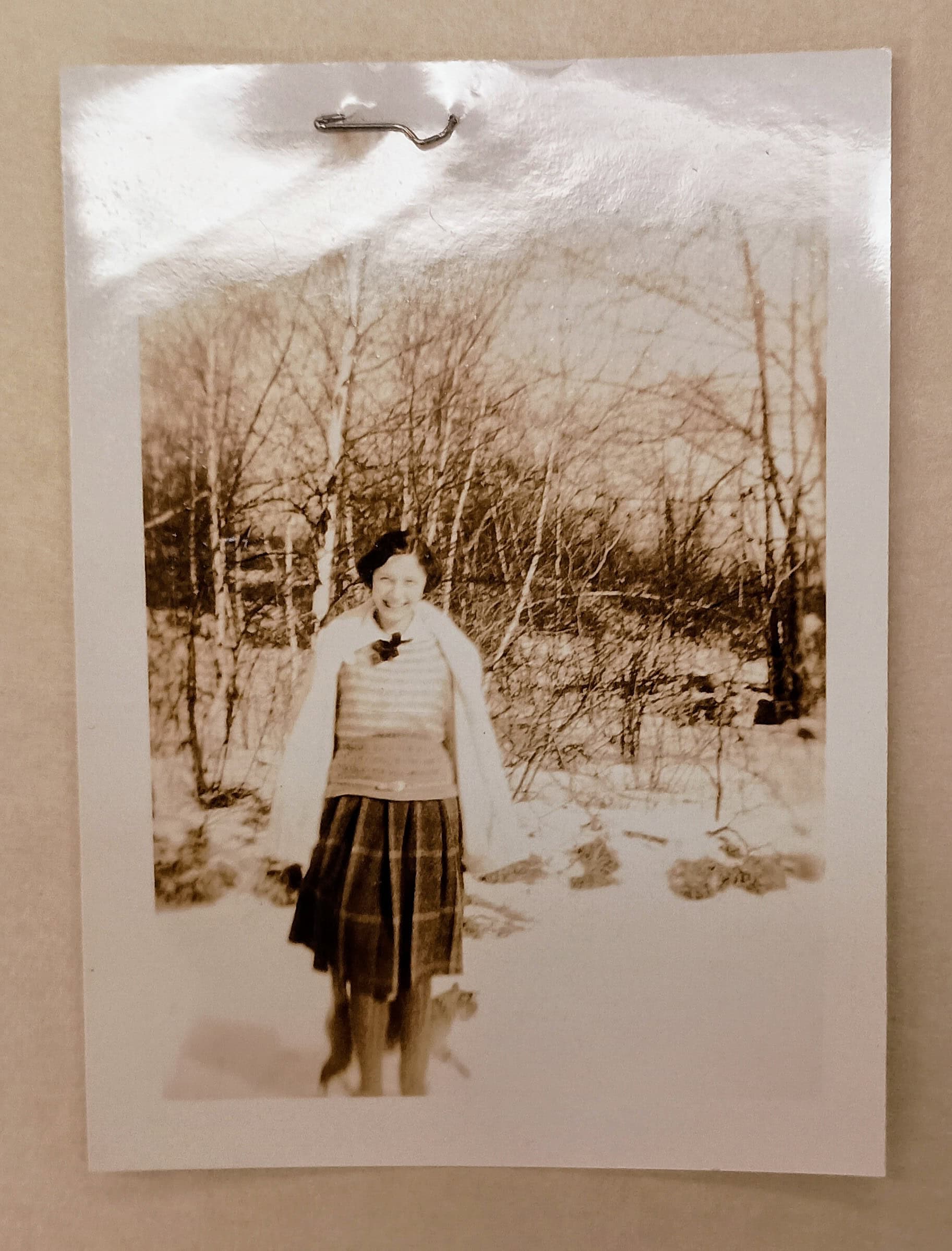
 Diana W. Anselmo is a media historian who works on queer film reception in the Progressive Era, affective labor in US media history, and most recently the history of lithium extraction, thermal waters, and public health in Portuguese soil. She is the

 ALT
ALT ALT
ALT ALT
ALT









![[link]](https://i.redd.it/9h467i92smvg1.jpeg)
![[link]](https://i.redd.it/ko2v64yw7ckg1.png)