Shared posts

16 Apr 03:47

Food Art Video

by Michael Ruhlman
Timmy the Tooth

I bet Alina has plenty of sippin vodka.

The above is, technically, an intro to the Chicago restaurant Alinea, led by restaurateur Nick Kokonas and chef Grant Achatz, whose story I recount in The Reach of a Chef. The question “Are chefs artists?” almost always annoys me. Grant told me he considers himself as such (and not without reason). His mentor Thomas Keller considers himself, the chef, a craftsman. In a long-ago post I reprint from Reach of a Chef my chapter on chef Masa Takayama, making a case I almost argue against: that the chef can, in certain instances, rise to the level of artist. That chefs are artists is a facile assumption that is almost always wrong.

To complicate matters in the funnest of possible ways, in walks Christian Seel, a chef as actual filmmaker, creating this, one of the most dramatic series of food, cooking, dining images I’ve encountered. If the Food Network/Cooking Channel/Bravo/Travel Channel ever gets its collective act together and discovers the balls to broadcast this kind of work, I’ll be there. Kokonas noted that Alinea patron, friend, and consultant Gary Adcock of Studio 37 was a consultant on the above film. Seel, a CIA grad who has cooked in some of the world’s best restaurants, is currently the media director for the Next/Aviary/Alinea group. I’ve asked him to discuss the film and his thinking:

By Christian Seel

I just read a great book by the Academy Award–winning film editor Walter Murch (In the Blink of an Eye). In it, he prioritizes the six most important elements of film editing. At the top of the list is emotional content. With any short, the first thing I personally do is try to identify an emotion and a story that I want to convey, and work from there. It sounds very obvious put like that, but its not always so, given that you start with something abstract and no characters or dialogue.

Music and sound are always critical with any production. As I’m behind the camera, it’s often difficult to simultaneously capture great images and record quality audio—fundamental aspects of a dining room or kitchen. With the Alinea Intro here, I was lucky enough to find a song that had the exact characteristics I was looking for—an experience larger than life, grandiose. When you have the right music, it does a lot to carry the emotional content. A short really starts to come together and have a life of its own. When you edit with the music, it kind of tells you what it wants to be. A good song or music will have kind of a “drive” to it. It carries or drives you along, which in turn carries the video. Good music/songs will also have emotion and obviously rhythm that you can play off.

I was lucky enough to be able to use a RED Epic camera recently. It records at 5K resolution—roughly five times the resolution of HD video. It’s a serious Hollywood camera used to shoot The Hobbit, Oz The Great and Powerful, The Great Gatsby, and dozens of other major productions. You can play footage from that camera on an IMAX screen and it would still look sharp. It’s really cool how far technology has come. From a practical standpoint, I can stabilize and crop footage and still maintain a very high playback resolution.

With this short in particular, I wanted to convey first a sense of excitement and anxiety that comes from sitting down at a highly anticipated restaurant meal. With Alinea specifically, there are so many hundreds of thousands of movements that go into the production of a meal. If you observe, you can see how all these movements have to fall into place in a very precise way, almost like a choreographed show or a symphony. It’s really impressive and amazing in my opinion. When I cut the piece together, I tried to convey that. The cuts in the video are based almost entirely on these individual movements—as if the employees themselves are moving to this internal rhythm. Each action in the restaurant is like a note being played on an instrument. I don’t pretend to take credit for this concept. I wanted to show bold and decisive movement, which is extremely agile and precise at the same time. With Alinea, the food is so carefully conceived and executed that I try to light it and shoot it as simply, honestly, and straightforward as possible, in hopes of doing it justice.

You can respond to Christian on Twitter: @XtianSeel

If you liked this post, check out these other links:

© 2013 Michael Ruhlman. Photo © 2013 Donna Turner Ruhlman. All rights reserved.

DiggShare

15 Apr 19:28

Football violence: Who is to blame?

Timmy the Tooth

Thatcher

Weekend clashes at Wembley and Newcastle are a reminder that the battle against hooliganism never ends, writes David Bond
15 Apr 18:28

Heart-warming: A fat bloke called ‘Brian’ takes part in a Mens 100 meter race, becomes a legend

by Arthur Antunes Coimbra
15 Apr 17:12

Rogues Gallery: H bums and Aussies…The strikers of the late 1970′s early 1980′s

by Les Crang

Author: Les Crang

Today we are looking at 3 Arsenal strikers that summed up Arsenal’s ambition (or lack thereof) during the 70s and 80s.

The oft heard quote from most young (I’m of an age where everything is young) Arsenal fans is “why on Earth did we sign Chamakh and Park? They’re crap, Wenger is crap, and signing players is no longer his forte.” Yup, I’ll agree these guys are awful, but when it comes to bad signings none stand up to Terry Neill and his bargain basement dross.

Although Terry did sign two great English strikers in Alan Sunderland and Malcolm MacDonald for less than £600,000 combined. He’s more infamous among many Arsenal fans of this period for his signings of the H-bums and An Aussie. Stand up Ray Hankin, John Hawley (the H-bums) and John Kosmina (the Australian, obviously). God. I can feel the depression descending upon me just thinking about them.  Between the three them, they played 21 games and scored three goals. Frustrating is putting it to mildly for these wastes of space.

Lets start with John Kosmina.  Oh, the Australian John Kosmina. So many stories about him and so few games he played in (1 league game, 3 European games, no goals). Terry Neill signed him in march 1978.

Terry Neill said of his signing:

Signed from an Adelaide club for £40,000. Several friends in Australia had recommended him and I thought he was worth taking a risk on. He was strong and brave, and since Malcolm Macdonald was having trouble with his knee we used him in the second leg against Red Star. John wore a sheepskin coat everywhere. ‘Is it always this cold?’ he used to say. He didn’t settle in [really?], and soon returned to Australia.

Willie Young was more succint in his appraisal of John Kosmina when he said: “John Kosmina – the only Aussie with a self confidence problem”!

But John’s greatest claim to fame?

Warming up as a sub for Mark Heeley against Red Star Belgrade on 6th Dec 1978 in Belgrade, Heeley came off only for manager Terry Neill to turn around to find John gone. Red Star scored whilst Arsenal were down to 10 men. When he did come back, Kosmina explained to Terry the cold weather meant he needed to pee [that coat was crap then?]. He was later subbed for Paul Vaessen and Arsenal went out on away goals. Thanks John.

Kosmina

Ray Hankin. Or as Jon Spurling termed him and Hawley, the h-bums. I’d heard that other fans called them Laurel and Hardy. A comedy duo that summed up some ‘joke’ signing Terry Neill made.

In his biography Terry wrote:

Sometimes its is worth risking a small sum on a player from a lower division in the hope he might develop into something. If he is determined to make a success of his career he can overcome his problems.

Terry, he’s in a lower division usually because he’s not good enough and not because he has ‘problems’.

I recently interviewed Terry Neill, a lovely fella. I asked him about Ray Hankin. His response?

Oh, Ray Hankin. I think at that stage I couldn’t see the wood for the trees, a bit like the present boss. [Arsene Wenger]

I asked what he meant:

Well, I wasn’t making the best signings for Arsenal, though Hankin was Don’s idea. When you manage a club, you get too close and can’t always see clearly.

In discussing Wenger it seemed to pain Terry to criticise him.

Ray Hankin was a case of a player with no skill or finesse. Starting at Burnley and moving to Leeds United in 1976, playing 83 games and scoring 32 goals in 4 seasons.  He then moved to Vancouver Whitecaps for two seasons. Although Hankin played with some real great players at Vancouver, such as Peter Beardsley, the skills did not rub off on Ray. Also, the North American Soccer League was slowly declining from its heady days in the mid and late 1970’s. No longer were players like Pele going to the USA to play, it was more like Ray and Steve Daley.

Then Terry bought Ray Hankin for Arsenal in 1981 as a replacement for Frank Stapleton. Described, unflatteringly, as:

Two stone over his optimum playing weight, lasted barely two games. Appearing as a substitute against Liverpool, he proceeded to trip over – much to Kenny Dalglish amusement – as he jogged towards the opposition penalty area.

In the same match, he missed a sitter and the fans sang his name. Changing the H for a W.

Spurling says of the signing:

The press pissed themselves laughing so much about this deal that even The Sun’s witty humour wouldn’t allow them to give the obligatory label of the ‘new Stapleton’

The cost of Ray? £400,000 if he proved himself. He didn’t. Good bye and good riddance.

Hawley

Oh, last, but in no means least, John Hawley. Terry Neill had previously managed John at Hull City. Whilst at Hull he scored 22 goals in 114 appearances. As a striker. So less than 1 in 5. He then proceeded to Leeds United and Sunderland with slightly more successful scoring ratio. Anyhow, in 1981 Arsenal signed him for £50,000 from Sunderland. Bargain? Maybe, but, as ‘The Times’ reported:

John Hawley, the Sunderland striker, is poised to sign for Arsenal today. A fee of £50,000 has been agreed and the deal will be completed if the 27-year-old forward passes a medical examination. Arsenal’s manager, Terry Neill, who has been looking for a striker since the sale of Frank Stapleton to Manchester United, has beaten Chelsea, Norwich City and Newcastle in the race to sign Hawley.

Yup, even Chelsea and Newcastle wanted him. What a dearth of talent we had in English strikers back then.

Anyhow, unlike the previous two strikers, Hawley did get into double figures in appearances and did score: 15 appearances and 3 goals. On his second appearance John scored. Against Notts County. In a 2-1 defeat (in which he was subbed). Spurling said of this:

Hawley grabbed a consolation goal was the only ray of light that day. (That sentence will never be repeated again).

One of John Hawley’s other two goals came against Spurs in a 3-1 defeat at highbury, the less said the better. He then scored one final goal on the winning side in a 4-1 win against Southampton. Hawley proceeded to play the next season, but was let go at the end of 1983.

The dearth of goals Arsenal scored in 1981-82 is underlined when the Arsenal websites says (firmly tongue in cheek, I assume)’ ‘Striker John Hawley helped Arsenal finish fifth in the top flight in 1981/82.’

Team-mate, Brian McDermott said of him:

The crowd was on his case right from the start. They paid their money, didn’t like what they saw, and told him so.

As an honourable mention, Hawley left us for Bradford City, and helped them to promotion to Division Two (now The Championship in Sky parlance). He also played in the final game at Valley Parade in 1985 against Lincoln City, in which the Bradford stadium fire occured.  The Times  reported:

John Hawley, the former Arsenal striker, yanked a man over the wall to safety, ignoring the proximity of his own nylon shirt to the fire.

A third rate striker, but respect where respect is due.

Therefore, £100,000 spent on what? Total dross. You can deride the present team all you like, but these three? Exhibit number 1 in why seasons 1981-1983 are regarded as ‘the dark ages’ by Arsenal fans. That’s just some of the forwards we bought though. We couldn’t buy worse, could we? Well, that another article in itself.


12 Apr 19:54

First Look: The Izakaya at Daikaya in Washington D.C.

by Brian Oh
Timmy the Tooth

Huh... grilled avocado.

Slideshow

VIEW SLIDESHOW: First Look: The Izakaya at Daikaya in Washington D.C.

The Empress of Stockholm cocktail and a drink menu which are all pasted inside of a manga called "The Gourmet" [Photograph: Brian Oh]

Hot on the heels of its ramen shop downstairs (check out our first look here), Daikaya has recently opened an izakaya, which draws from the flavors of traditional Japanese bar snacks while adding its own unique flair. Daikaya adheres to the philosophy of the izakaya, a very "freestyle" form of dining. Co-owner Daisuke Utagawa emphasizes the concept of grazing and not having to "know the plan" when you sit down. Izakayas are meant to be very democratic and "everyone should feel like they belong." As such, chef Katsuya Fukushima, who worked under José Andrés for years, has created a menu of down-to-earth yet inventive bar food.

20130406-247337-daikayaizakaya-avocado.jpg

Grilled avocado filled with ponzu, wasabi, and nori salt

Grilled avocado ($6.25), for example, is filled with ponzu, wasabi, and nori salt—scoop out the avocado's innards with a spoon. The pork and brussel sprout skewers ($5.25) are essentially Fukushima's take on okonomiyaki, the popular Japanese street food. Because Okonomiyaki is so labor-intensive, it's not really feasible to make in Daikaya's small kitchen so Fukushima created this dish to preserve its prominent flavors.

20130406-247337-daikayaizakaya-bar.jpg

The 90-seat space incorporates distinctly Japanese design touches such as copious amounts of natural wood, walls lined with Japanese fabric and Japanese manga, and stacks of Japanese beer crates. Utagawa wanted to "evoke the heart of Japan" and the feel of an authentic izakaya, but didn't want it to feel like a transplant. "It's important to understand the heart of diners here.

The bar program includes a large selection of sakes, shochus, Japanese whiskeys, and cocktails crafted by bar director Eddie Kim (formerly of Room 11). The Rickey-san ($12) is a variation on the classic Gin Rickey with yuzu, which gives it a stronger citrusy acidity. There are a variety of mocktails available too that use green tea soda and yuzu. Kim is even working on a rarefied sake bomb using spherified sake (stay tuned).

The crowd so far? A combination of hipsters, Hill staffers, and people just off the plane from Japan. Check out a sample of the Daikaya izakaya's food in the slideshow!

Daikaya Izakaya
705 6th St. NW, Washington, DC 20001 (map)
202-589-1600; daikaya.com

12 Apr 18:22

Proposal to Make Cobblestone Streets Historic Features

by Exit133
Timmy the Tooth

Fuck that. Those streets are basically impassable because of the cobblestones.

Our friends over at Post Defiance last week drew our attention to a proposal to designate some of Tacoma’s remaining brick and stone paved streets as protected historic features. The proposal was approved by Tacoma’s Landmarks Preservation Commission, and went to a public hearing yesterday.

The streets in question, the steeply sloping cobblestone blocks of North 9th, 10th, and 11th streets between North K and North G, were paved between 1905 and 1910 as a part of Tacoma’s early street paving program. The streets represent some (though not all) of the remaining original brick and stone paved...

Keep Reading...

12 Apr 18:21

DIY vs. Buy: How to Make Your Own Orange Soda

by Marcia Simmons
Timmy the Tooth

Trying this!

From Drinks

20131212-247676-diyorangesoda.jpg

[Photograph: Marcia Simmons]

Most orange soda has more in common with orange the color than the fruit, but that doesn't stop me from craving it. The reason I drink soda isn't because I think it's full of vitamins and minerals. I drink it because it tastes good. My idea of the perfect orange soda is the fast-food fountain Orange Crush and Sunkist that I grew up with, even though as an adult I know it's just a bunch of corn syrup and artificial flavoring. Luckily, DIY orange soda delivers the same satisfying combination of sweet and tart you get from the commercial version without the questionable ingredients. And mixed in with the familiar sharpness and prickly joy of orange soda is a new and exciting flavor I wasn't used to tasting in my soda—real oranges.

What's Available to Buy?

My longtime favorites, Sunkist and Crush are also the most ubiquitous. Fanta and Faygo are also pretty easy to find and pretty delicious. If you can find them where you live, seek out Nesbitt's and Capt'n Eli's, too. (All of these fared pretty well in the orange soda taste test, with Faygo coming out on top.) Boylan's is tasty, but it has more of a light tangerine flavor and doesn't quite have the same kick I expect from orange soda.

Why DIY?

As loyal as I was to the corn syrup and chemicals of my childhood orange soda, DIY orange soda won me over with its bright and crisp flavor. It has the fresh taste of actual oranges while still delivering the nostalgic pleasure of a fountain soda. Big-brand soda is pretty cheap, so you'll pay a little more to skip the artificial flavors. But compared to the commercial sodas made with cane sugar and natural ingredients, DIY is a fraction of the cost.

There's a lot of room to have fun with this very basic recipe. If you're not such a stickler for matching the flavor of the well-known brands, you can try using different types of citrus like blood orange or mandarin...maybe even a mixing in some lemon or grapefruit. While you're playing around, maybe add some orange blossoms or other fruits like cranberries or mango.

I stuck with sugar as the sweetener for a more traditional soda flavor, but honey or agave could make for a delightful twist. Citric acid gives the soda that familiar pop and tartness, as well as extending the shelf life. However, you can skip it if you want to taste fruit and sugar and nothing else. For the truly adventurous, you could carbonate with champagne yeast like in this DIY grape soda recipe for a more dry and sophisticated flavor.

Get the Recipe

DIY Orange Soda »

Use It!

The best way to enjoy this homemade treat is by itself over ice. But I also like to spike it with gin, squeeze in a little lemon and top it off with a few dashes of rhubarb bitters. Next on my list is a drinkable Creamsicle—mix your homemade soda with a little ice cream and half-and-half.

About the Author: Marcia Simmons is the co-author of DIY Cocktails: A Simple Guide to Creating Your Own Signature Drinks. She also shares cocktail recipes and tips on the DIY Cocktails blog and on Twitter @DIYCocktails.

Get the Recipe!
12 Apr 17:53

Fan banned for throwing banana at Bale

by ESPN staff
Timmy the Tooth

Headline Hailed for Consonant Construction

An Arsenal fan has been banned from attending matches for three years for throwing a banana at Tottenham Hotspur's Gareth Bale.
12 Apr 17:51

Wapato Hills Park Master Plan

by Exit133
Timmy the Tooth

My house is a few blocks from this park. This will be awesome if they pull it off.

Metro Parks is inviting the community to an open house to revisit and comment on the Wapato Hills Conceptual Master Plan. The plan, developed and approved by Metro Parks Commissioners in 2005, lays out a long-term vision for the design of Wapato Park. The plan provides a long-range guide for future development and improvements to the park, including uses and activities that might occur at the park, and seeks a balance between historical qualities of the park and current and future needs of the community.

Wapato Park was officially established as a public park in the...

Keep Reading...

12 Apr 17:44

Grilling: Thai Chicken Satay

by Joshua Bousel
Timmy the Tooth

NOM NOM NOM

20130304-243181-chicken-satay.jpg

[Photographs: Joshua Bousel]

I'm all over beef skewers. The thinly sliced flank steak sears well and remains tender over a very hot fire. Unfortunately, I can't say the same for chicken, which dries out quickly and ends up becoming flavorless sticks of poultry. Of course, chicken skewers can be delicious when done right, with this chicken satay being a prime example.

The sweet, pungent marinade for these chicken satays includes fish sauce, lemongrass, sugar, lime, and turmeric, which embeds the chicken with flavor even after a relatively short soak of only an hour. On the grill, in order to maintain juiciness, a careful eye must be kept to ensure the chicken is pulled off when just cooked through. Even if you go over just a little, the skewers are still plenty good, thanks to the powerful marinade. A dip in a spicy peanut sauce also added to the success here.

The pairing of the earthy and bright chicken with a creamy, spicy, and sweet sauce produced a chicken skewer that has the ability to change your mind about chicken skewers.

About the author: Joshua Bousel brings you new, tasty condiment each Wednesday and a recipe for weekend grilling every Friday. He also writes about grilling and barbecue on his blog The Meatwave whenever he can be pulled away from his grill.

Get the Recipe!
12 Apr 13:49

The Brunch Dish: Grange Hall Burger Bar Serves the Best Brunch That Isn't Technically Brunch

by Matt Kirouac

From Chicago

20130408-247791-the-brunch-dish-grange-hall-burger-bar-open-faced-breakfast-burger-4.jpg

[Photographs: Chelsea Ross]

As the name makes glaringly obvious, burgers are the main draw at Grange Hall Burger Bar. However, the weekend farmers' breakfast should not be overlooked. The restaurant makes a point of differentiating their breakfast from brunch, stating how farmers' don't partake in brunch. Okay. Well I hope farmers don't come chasing after me with pitchforks, because I'm going to write about Grange Hall anyway and heap praise upon the brunch-but-not-really-brunch menu.

The farmers' breakfast menu jives perfectly with Grange Hall's cottage-like decor, which looks like it was designed by somebody's crafty grandma who had a lot of time and spare cow bells on her hands. The food is just as cottage-y and grandma-esque. This being Grange Hall Burger Bar, you'd be remiss not to order the open-faced breakfast burger ($13.95), a dish combining seemingly every aspect of breakfast in one Titanic plate. Rather than just remove the top bun off one of their burgers, the kitchen serves the grass-fed beef patty on a thick, maple syrup-soaked slice of cinnamon-raisin French toast. The burger is topped with an oozy egg, cheddar, and two kinds of bacon: applewood-smoked and Canadian. Oof. It's a mouthful to say, and an ever bigger mouthful to eat. First of all, I appreciate the boldness of this dish. PSA to restaurants offering "breakfast burgers": just adding an egg on a burger does not make it "breakfast." I would normally shy away from sweet-infused burgers, and at first the idea of essentially a French toast burger sounds a bit like an IHOP commercial, but the dish succeeds with flying colors. The burger is juicy and intensely beefy. When the beef jus, egg yolk, and maple syrup meld together on the plate, it's a surprisingly scrumptious combination, sorta like when Lady Gaga and Beyonce did those videos together and I was surprised how well they worked together.

20130408-247791-the-brunch-dish-grange-hall-burger-bar-quiche-loretta-1.jpg

Another wacky alternative to typical breakfast fare is Grange Hall's outré interpretation of quiche. The quiche Loretta ($9.75) is not your standard egg pie by any stretch of the imagination. Rather, it's a mini egg-filled skillet baked with a slice of bread in the center, taking the place of the crust. Allegedly this is farmer-style quiche, and instead of breaking their hearts by telling them this isn't quiche, I'll instead just savor this unusual creation in all it's yummy weirdness. It's studded with green onions, cheddar, bacon, and corn. The bread in the center takes the whole thing in an inverse toad-in-the-hole direction. Accompanying potatoes are especially great when jazzed up with some housemade hot sauce.

20130408-247791-the-brunch-dish-grange-hall-burger-bar-banana-cream-pie-1.jpg

Is it weird to order dessert after brunch... I mean breakfast? The answer of course is no. Especially at Grange Hall, where seasonal pies are the dessert du jour. The April pie is banana cream ($6 for a slice), with a tangy banana-studded custard and a sturdy, nutty crust (if this were farmer-style pie, I'm assuming there would just be a pile of dough in the center of the pie?). The dollop of housemade whipped cream on top is probably the prettiest dome of whipped cream I have ever seen, and I practically have a Masters in Whipped Cream. If dessert with breakfast seems askew, just think of it as a fruit plate, but naughtier.

Grange Hall may not classify itself as such, but it's worthy of mentioning in the same breath as Chicago's top brunch spots. It's a charmingly rustic escape from the normal brunch queue, complete with some of the most unusual and unusually delicious breakfast dishes. If this is how farmers spend their weekend mornings, I'm prepared to pack up my spare hoes and head to the country.

Grange Hall Burger Bar

844 West Randolph Street, Chicago IL 60607 (map)
312-491-0844
grangehallburgerbar.com

12 Apr 13:07

Sleeping Around: Pop-Up Hotel in a Shipping Container

by Steph
Timmy the Tooth

I wish I was handy enough to turn a shipping container into an office. I would so, totally do that in my back yard, have it double as my Zombie shelter.

[ By Steph in Boutique & Art Hotels & Global. ]

Sleeping Around Hotel 1

Do you want to spend a night on a river bank, a cliff, a meadow or a busy urban street? The ‘Sleeping Around’ pop-up hotel concept can go virtually anywhere you like, setting up quickly in locations where static architecture isn’t possible or practical. Made from four recycled 1950s shipping containers, this traveling hotel opens up possibilities for travelers who want more than just a night of comfort.

Sleeping Around hotel 2

Sleeping Around consists of six shipping containers – four are individual hotel rooms, one serves as a sauna and the sixth is a breakfast and lounge area. Each of the hotel rooms has a floating bed, spacious rain shower, iPod docking station and air conditioning system.

Sleeping Around Hotel 3

The hotel has already spent a few weeks on the banks of the Scheldt in Antwerp, where the containers were procured, and is now on the move. Travelers interested in staying there can track its location on the website, and put in requests for future spots. It can be set up and ready to go within five hours of arriving.

Sleeping Around Hotel 4
This hotel may not be quite as mobile as the super-compact Hotello, which is basically a self-contained hotel room setup in a wheeled trunk, but it opens intriguing possibilities for the future of travel accommodations. If you could choose any location to set up a temporary hotel, where would it be?

Share on Facebook

[ By Steph in Boutique & Art Hotels & Global. ]

[ WebUrbanist | Archives | Galleries | Privacy | TOS ]


12 Apr 12:58

Patti Smith shakes hands with the Pope? Patti Smith shakes hands...

Timmy the Tooth

Those monkey backpacks are child leashes which makes sense, you need your kid on a leash if they're near a catholic priest.


Patti Smith shakes hands with the Pope? Patti Smith shakes hands with the Pope.

Also, supposedly this photo was released by the Vatican press office. I like to think that some random nun or priest figured out who this person is and said, “We have to release this to world to show how hip Pope Francis is!” Either that or they were just as impressed with that monkey backpack as I am.

12 Apr 02:14

Farm Transparency v. Farm Secrecy

by Michael Ruhlman
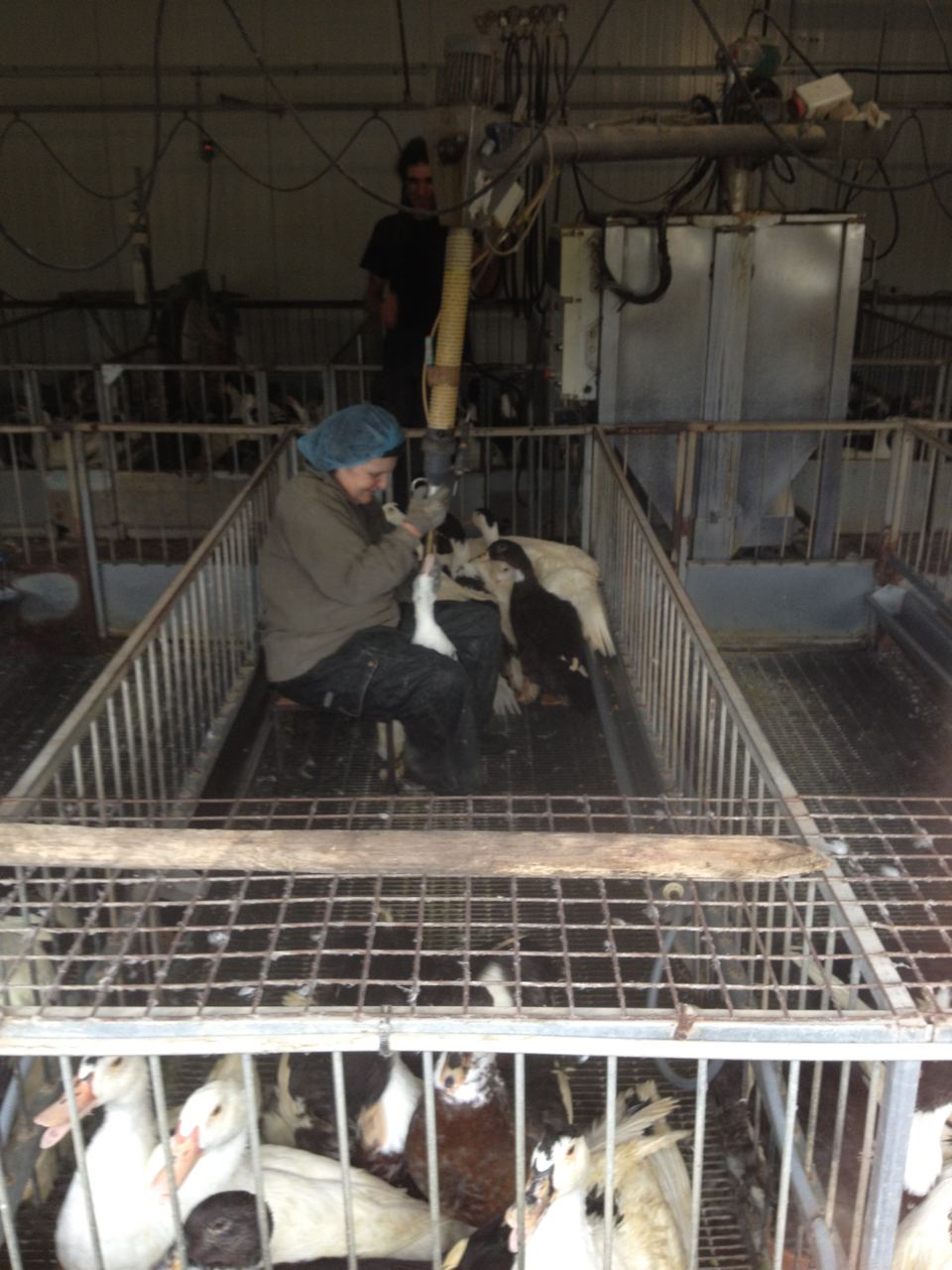
A foie gras farmer feeding her ducks. Photo by Michael Ruhlman.

A foie gras farmer feeding her ducks during the brief period of gavage. The ducks at the bottom of the photo showed no signs of illness or discomfort (they were quite merry, actually, if that’s possible). Photo by Michael Ruhlman.

Last summer, on assignment for Condé Nast Traveler, I visited a farm that raises ducks for foie gras, driven there along harrowing roads in southwestern France by Kate Hill. I’d never seen the practice, vilified in America, of force-feeding ducks and, being in the land of foie gras and confit de canard, I had to see for myself. The farm, Souleilles, run by Yves and Geneviève Boissière, is wide, wide open in the town of Frespech. The husband and wife were warm and welcoming and watched me take an iMovie and iPhone pix of the practice while Yves spoke at length about the process. The ducks are pasture raised most of their lives, then force fed for 14 days, beginning with a little less than half a pound twice a day, increasing to less than a pound (400 grams) at the end. Granted, it’s a lot of food for that size animal, but I saw them in the final days of their mortal coil, and they waddled happily between the old lady’s legs, pointed their beaks skyward of their own accord as the woman popped the tube in and massaged the food down toward their gizzard, a process that took about five seconds. They then waddled away briskly, quacking and flapping, to the other side of the cage. They weren’t crowded, showed no evidence of sickness, had plenty of room, and lived in clean pens, behaving not at all like puking frat boys stumbling all over each other but rather more like Beatrix Potter’s Jemima Puddle-Duck. Again most of their lives are spent in a pasture the size of a football field. A better life than the millions of Perdue chickens enjoy surely.

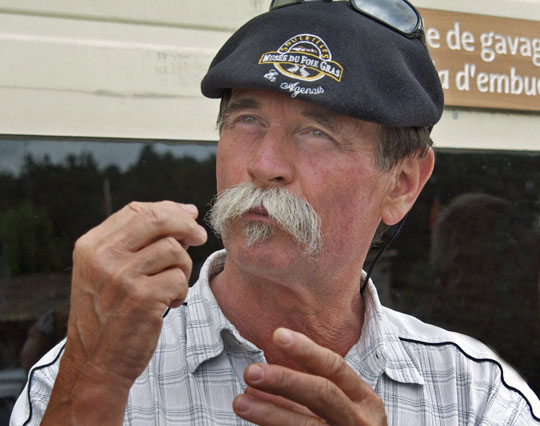
Yves Boissiere

Yves Boissiere, who raises ducks in Frespech, in southwestern France.
Photos by Donna Turner Ruhlman.

All this came to mind because of the news of the current bills lobbied for by Big Ag to make it illegal to try to record harmful farming practices in the United States. Which is hardly the exception in our factory-farming, cheap-meat country. If it were the exception, why would Big Ag be spending big money trying to prevent the harm from being broadcast?

Jedediah Purdy wrote an articulate op-ed two days ago in the NYTimes and the paper’s editorial board seconded it. America doesn’t need more farm secrecy, it needs more farm transparency. If you don’t want someone to be allowed to film inside your building where the food our kids are eating is being slaughtered, you should be shut down until you welcome the videographer.

If you want to eat meat, I believe you should be present—or, better, a participant—in the death of at least one of the animals that you eat. I took part in a chicken slaughter last summer. It was not easy, nor should it be. I cooked the chicken I killed and gutted. I took very good care to cook it perfectly. I witnessed a humane slaughter of a Mangalitsa hog the following fall and a demonstration of how it was debristled, gutted, and broken down. I’ve twice visited a slaughterhouse in Ashland, Ohio, where locally raised cows are dispatched and broken down for their muscle and bone, a federal inspector checking each one (they’re big animals and it’s pretty gruesome). I’ve written about why I believe it is ethical and yes, humane, to eat meat. I think vegetarianism is a healthy and good choice if that’s what you want and what your body wants. I believe that veganism is lunacy, and arguably inhumane (but a superb weight loss plan and, adhered to long enough, perhaps even an effective birth control strategy).

But regardless what I believe, we are a meat-eating country and the Perdues, McDonalds, Smithfields, Monsantos, and Cargills are going to keep it that way, have no fear. What we and, more importantly, our legislators can do is refuse to sell out to the Big Ag lobbies for their election cash and help to make animal husbandry as humane as possible nationwide and without exception. It’s very, very hard given the billions of animals we slaughter yearly for food. But surely the first step is transparency, not secrecy, which these new bills are trying to ensure so that you can have your tasty McRib and boneless Kentucky Fried for pennies. It’s good for big business and helps your senator and representative keep that glinting smile for the camera. But it’s certainly not good for the animals we rely on for our food, which means it’s not good for your family.

Ducks galore

“These ducks are bound for the cassoulet pot tomorrow,” says Yves, “but don’t tell them, they’ll go on strike.”

These are happy, healthy ducks in clean uncrowded conditions. The 400,000 ducks raised for foie gras in this country enjoy the same. I wish this were true of the billions of other animals we kill for food (hello, California?!).

We, worms’ meat ourselves, in Mercutio’s memorable phrase, should do better. Though now that I think about it, perhaps Congress should outlaw worms?

If you liked this post, there’s something wrong with you; this post should piss you off no matter whose side you’re on. Keep reading:

© 2013 Michael Ruhlman. Photo © 2013 Donna Turner Ruhlman. All rights reserved.


DiggShare

10 Apr 11:47

Jurgen Klopp’s brilliant reaction to being told Dortmund’s winner v Malaga was offside

by Ronaldo Assis de Moreira
Timmy the Tooth

Best Gif Evar

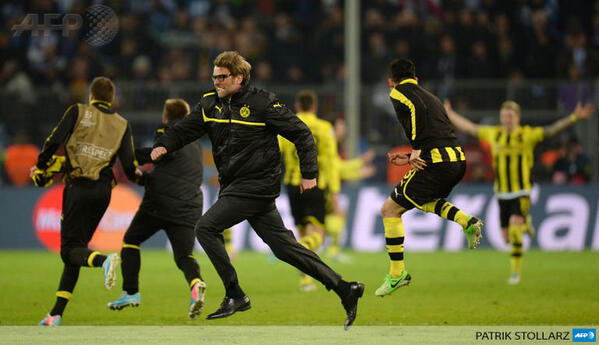
BHcGhDYCMAAnUR3 Jurgen Klopps brilliant reaction to being told Dortmunds winner v Malaga was offsideBorussia Dortmund coach Jurgen Klopp, if he wasn’t already, is becoming the neutrals favourite coach in European football.

With a swashbuckling young team, terrific home support, a club now based  on a sound financial footing, what is not to love about Dortmund and Klopp?

The fact Jurgen Klopp speaks English, along with his early success as a coach, means he is already held in high regard in England and he took part in an excellent post match interview with Sky Sports after the dramatic win over Malaga.

High on a stunning turnaround, Klopp was laughing hard only to be told Felipe Santana’s winner may have been offside.

What ensues is a funny change in character as Klopp says “What?” And then precedes to turn the question on its head, arguing that Malaga’s second goal was also offside.

Klopp: “This is very important information… so its ok!”

Video and GIF of that moment in Jurgen Klopp’s post match interview with Sky Sports is below.

iOCG9jGZAfHo5 Jurgen Klopps brilliant reaction to being told Dortmunds winner v Malaga was offside

09 Apr 19:39

The Pizza Lab: Pesto Pizza

by J. Kenji López-Alt
Timmy the Tooth

Making this this weekend.

From Slice

20130320-pesto-pizza-2.jpg

[Photographs: J. Kenji Lopez-Alt]

Back when I was a wee food labber who spent his summers at band camp,* my favorite day of the summer was when the camp's cook, Glen, would make his pesto. We'd have a camp-wide pesto spaghetti eating contest, in which I may have been the only competitor. This simultaneously made me a winner and a complete loser each time.

*Ok, chamber music camp. But really the same sort of hormonal, nerdy crew.

What can I say? I loved my pesto back then as much as I love it now. Today, we're gonna stick it on pizza. But first, a few words to the wise.

When we talk pesto here, we're talking the genovese variety made with basil, pine nuts, and cheese that we're most familiar with. There are, of course, other varieties of pesto kicking around, but we're not gonna bother with them for now.

The easiest way to make genovese pesto is in the food processor**; just throw in your ingredients (that's basil, pine nuts, parmesan cheese, garlic, and olive oil), buzz it up, and you're good to go. But there are ways to improve it.

**You mortar and pestle purists can balk all you want. Meanwhile, I'll be enjoying my pesto while I wait for you to finish yours.

For one thing, pesto made in this way has a tendency to lose its color, turning from a rich, deep green to a drab olive green, especially if you let it sit in the fridge for a night or two. How do you prevent this from happening? Blanch the basil.

See, puréed basil leaves lose their color as air and natural enzymes interact with pigments in the leaves. Blanching the leaves by dunking them in boiling water for just a few moments (about 15 to 30 seconds) will deactivate those pesky enzymes, helping your pesto to stay deep, bright green, even after days of storage and cooking.

20130320-pesto-pizza-5.jpg

See?

I also like to add some spinach to the mix, to add some more green without overwhelming the other flavors with excess basil.

As for application, you can't just use the exact same pesto you'd use on pasta, throw it on a pizza, and expect it to work. The problem is the oil. In a dish of pasta, the excess olive oil combines with the pasta water to form a sauce. On a pizza, all it does is pool into greasy slicks on the surface of the pizza.

You have two options. If you want to make an all-purpose pesto, you can make it as normal*** and then blot out some of the excess oil before adding the pesto to your pizza. Alternatively, just make it with a bit less oil to begin with. My recipe is made with equal parts (by weight) basil, spinach, parmesan, and pine nuts, with a single garlic clove (also added to the blanching water as the spinach and basil cook, to take away some of its sharpest edges) and 1/3 cup of olive oil.

***in the recipe linked, increase the oil from 1/3 cup to 1/2 cup

A teaspoon of lemon zest adds some brightness and balances the whole thing out.

20130320-pesto-pizza-3.jpg

When it comes to application and other toppings, I like to keep things sparse. Some folks like to spread the pesto around like a tomato sauce. I prefer applying in discrete spots to create some points of interest as you work your way through the pie.

20130320-pesto-pizza-7.jpg

Speaking of cheese, I'm going with a three-part mix. A bottom later of grated parmesan, followed by fresh mozzarella (di bufala if you're wearing your fancy pants), and dollops of ricotta. As the pie bakes, the mozzarella spreads out into a milky blanket, while the dollops of ricotta soften and the pesto spreads, touching and mingling with the ricotta in a way that would be considered inappropriate in some, more restrictive, societies.

20130320-pesto-pizza-8.jpg

If you're feeling extra feisty, you can always add more toppings if you desire. Pesto is a pretty strongly flavored sauce to begin with, and according to The Pizza Snob's Approach to Toppings, every topping must be more flavorful than the one that came before it. Thus for topping a pesto pie, you'd need to go with bold flavors like sun-dried tomatoes, anchovies, capers, and olives.

At least, that's what I'd do. Feel free to do whatever the heck you'd like. It's your pizza; nobody's stopping you.

Get The Recipe!

Pizza with Pesto, Ricotta, and Mozzarella »

About the author: J. Kenji Lopez-Alt is the Chief Creative Officer of Serious Eats where he likes to explore the science of home cooking in his weekly column The Food Lab. You can follow him at @thefoodlab on Twitter, or at The Food Lab on Facebook.

Get the Recipe!
09 Apr 19:34

Deborah Madison's Cauliflower with Saffron, Pepper Flakes, Plenty of Parsley, and Pasta

by Kate Williams
Timmy the Tooth

will try with Aveline. She hates vegetables.

040913-247319-cook-the-book-cauliflower-with-pasta-parsley-saffron.jpg[Photograph: Christopher Hirsheimer and Melissa Hamilton]

Deborah Madison's cauliflower and pasta dish from her new cookbook Vegetable Literacy is a surprise of a recipe. It almost looks like something I'd throw together without thinking, but has a few tweaks that make it stand out from my ordinary dinners. First, Madison uses what may look like a dangerous amount of red pepper flakes; her scant teaspoon looks menacing compared to my usual pinch or two. Also, she throws in parsley, lots of parsley, in three places, some of it is cooked with garlic to mellow, some of it is wilted into the cooked pasta, and the rest is thrown in at the end for a bright finish.

But the real winner here is saffron. The floral taste of saffron always reminds me of bouillabaisse; tasting bites of Madison's cauliflower dish takes my mind to the French stew but for much less time and effort.

Why I picked this recipe: I pair cauliflower with pasta on a regular basis, but never would have thought to add saffron.

What worked: The finished dish had a great balance of earthy cauliflower and floral saffron. Copious amounts of olive oil (use your best here!) don't hurt things either.

What didn't: I thought the use of three pots for a simple pasta dish was a bit silly. Next time, I'll skip par-steaming the cauliflower and just give it more time in the skillet (with a little more water added). I ended up needing to cook it in the skillet longer than written anyway.

Suggested tweaks: You could give this same treatment to broccoli if you wanted, and could certainly use whole wheat pasta for a heartier take. If you're not inclined to spend the money on saffron (but you really should, just this once), a couple of pinches of turmeric will add similar color.

As always with our Cook the Book feature, we have five (5) copies of Vegetable Literacy to give away this week.

About the author: Kate Williams is a freelance writer and personal chef living in Berkeley, CA. She is a contributor to The Oxford American, Berkeleyside NOSH, and blogs at cookingwolves.wordpress.com.

Get the Recipe!
09 Apr 19:21

Behind The Scenes at the Absolut Vodka Distillery in Sweden

by Jessica Leibowitz
Timmy the Tooth

mmm... sippin vodka.

From Drinks

Slideshow

VIEW SLIDESHOW: Behind The Scenes at the Absolut Vodka Distillery in Sweden

[Photographs: Jessica Leibowitz]

Thanks to Absolut, I recently had the opportunity to join a press trip to Sweden to see vodka-making in action. (Don't worry, there were meatballs, too.)

Vodka is one of those magical byproducts of science where a handful of wheat and some yeast transforms into a strong spirit. I traveled to Sweden to find out how it works. (It was kind of a dream come true: I actually have an old binder filled with Absolut ads. One of my favorites was Absolut L.A.)

20130403-00-absolut-wheat-fields.jpg

Near some of the wheat fields for Absolut Elyx in Sweden, which are dormant during the winter.

Rather than purchase raw neutral spirits, which is common practice for many manufacturers, Absolut takes control of the process from beginning to end—from seed to glass—and it's all done locally in Sweden. Did you know the original name was Absolut Rent Brännvin (Swedish for "Absolutely pure vodka")?

The distillery churns out 600,000 liters (or 80,000 to 90,000 cases) of vodka per day. The process is done with continuous distillation, which Absolut founder Ellis Smith (that dude on the medallion) introduced to Sweden back in 1879.

While on the vodka tour-de-Sweden, we also learned about the soon-to-be-released Absolut Elyx, a new high-end vodka that's produced on a much smaller scale. The name comes from "lyx," which is Swedish for luxury. The spirit is already available in a few countries and will be released in the US in May.

Shall we get down to the nitty-gritty, then? Follow our tour to see how Absolut is made (plus, get a peek at some upcoming new products) »

About the author: Jessica Leibowitz is in charge of all things video at Serious Eats. You can follow her on Twitter at @photo_delicious.

09 Apr 18:39

“A sublime chicken” – Is this the worst/funniest football commentary EVER?!

by Ronaldo Assis de Moreira
Timmy the Tooth

Or a "sublime chip in"

In our excitement at bringing you Serge Gnabry’s wonder goal for Arsenal Under-21s at Liverpool at Anfield on Monday night, we missed what may go down as one of the worst pieces of commentary EVER!

After Gnabry’s shot nestled in the far corner, the LFC TV commentators wax lyrical about the young German’s goal with former Liverpool striker John Aldridge then inexplicably describing it is “A sublime chicken.”

The exact moment of the commentary gaffe from Aldridge comes at 0.24 on the video below.

Listen to it and howl with laughter.

It also appears that the main commentator has a good laugh at Aldridge in the process.

After the video are some of the best Tweets on the “sublime chicken.”

Gnabry goal from last night – youtube.com/watch?feature=… – Liverpool commentator says “It’s a sublime chicken.” , Wut?

— arseblog (@arseblog) April 9, 2013


Can’t stop calling things “a sublime chicken” today. #gnabry #aldridge

— danlevy1 (@danlevy1) April 9, 2013


Pretty sure the commentator called Gnabry’s goal a sublime chicken. What does that even mean??

— I Am The Arsenal (@GoonerNelly86) April 8, 2013

09 Apr 14:19

Penis size does matter

by scinews@sciencenews.org (Science News)
Timmy the Tooth

Next study; does wallet size change the attractiveness of males?

Women tend to consider men with lengthier members more visually attractive
09 Apr 03:25

High-Fiber Pretzel Rolls: health with stealth

by PJ Hamel
Timmy the Tooth

Not bad

Does this look like a high-fiber sandwich roll?

Not from the outside, it doesn’t. But how about inside? Is it dark and dense and grainy, like so many whole-grain breads?

Nope.

And that’s because it’s not whole-grain – but it IS high-fiber.

Excuse me?

Although I’ve never been a whole-grain bread aficionado, I’ve found myself liking a darker, denser alternative to white bread more and more lately. Maybe it’s simply that I’m using our white whole wheat flour, which creates a light-colored, pleasant-textured 100% whole wheat bread.

But, much as I enjoy whole wheat bread some of the time, I still find myself turning to the white breads that fueled my childhood: soft dinner rolls, sandwich loaves, pizza crust.

Still, the “eat healthy” drumbeat always resonates softly in my head: less sugar, less fat, fewer calories, more fiber…

Ah, fiber. Think bran cereal. Whole-grain pasta. Lentils. Brown, browner, brownest.

Sometimes getting more fiber into your diet feels like a penance, doesn’t it? Sure, there’s fiber in some fun stuff, too – berries, for instance. A bowl of oatmeal. An apple. But for the most part, fiber is… well, boring.

That’s why I keep Hi-maize Fiber close at hand while baking my favorite non-fiber white breads. Adding 1/3 to 1/2 cup of this special cornstarch-like ingredient to a typical white bread recipe adds significant insoluble fiber to the loaf – without sacrificing a single bit of flavor, texture, or rise.

I call Hi-maize my stealth weapon – I use it to increase the fiber content of all kinds of bread and rolls, plus pizza crust, and no one is ever the wiser.

No sulking pleas of “This isn’t whole wheat, is it?”

Or, “What’s wrong with this bread?”

(You’ve been there, right?)

I fell in love with the following roll recipe while Charlotte, the woman who creates our Baker’s Catalogue recipes, was testing a version recently for our fall catalogues. She kindly shared her recipe with me, and by adding Hi-maize, plus a couple of twists and turns (literally), I turned the dough into pretzel rolls – high-fiber pretzel rolls, each one checking in with 4g of fiber.

Not a huge amount, admittedly; but better than 0g fiber – which is what you get in your typical white bread.

Fiber aside, though, these rolls simply taste fantastic. Think Philly or NYC soft-pretzel vendor: that familiar aroma wafting from the pushcart; the chewy/soft pretzels, deep golden brown flecked with coarse salt. The flavor – salty crust and bland interior complementing each other beautifully.

These rolls have all of those classic pretzel attributes, and more: fiber.

Yes, you can have your white rolls – and fiber, too. Give these a try; you’ll soon find yourself keeping the Hi-maize close by, for whenever the inevitable white bread urge hits.

High-Fiber Pretzel Rolls, here we come!

Combine the following in a mixing bowl, or the bucket of your bread machine (set on the dough cycle):

1 1/2 cups lukewarm water
2 tablespoons butter
1 teaspoon salt
4 cups (17 ounces) King Arthur Unbleached All-Purpose Flour
1/4 cup Baker’s Special Dry Milk or nonfat dry milk
1/2 cup Hi-maize Fiber
2 teaspoons instant yeast

Want to make these rolls without the Hi-maize? Substitute all-purpose flour, increasing the water in the dough to 1 3/4 cups.

Mix and knead — by hand, stand mixer, or bread machine set on the dough cycle — to make a smooth, fairly soft dough. It’ll probably stick to the bottom of the bowl just slightly, if you’re kneading in a stand mixer.

Place the dough in a lightly greased bowl (or 8-cup measure), and let it rise for 60 to 90 minutes, until it’s very puffy.

Gently deflate the dough, and divide it into 8 pieces. Pat each piece into a rough log, cover, and let rest for 10 minutes, to relax the dough’s gluten and make it easier to shape the rolls.

Roll each piece of dough into a 16″ rope.

Shape the ropes into tight pretzels, tucking the two ends through the center and squeezing them together underneath. Press the rolls down gently, to flatten.

Lightly grease a baking sheet, or line it with parchment. Place the rolls on the baking sheet, cover them, and let them rest for 15 minutes.

While the rolls are resting, preheat the oven to 400°F. Prepare a water bath by combining 1 1/2 to 2 quarts water (enough to fill the pan about 1 1/4″ deep), 1 tablespoon salt, and 1/4 cup baking soda in a 10″ to 12″ shallow saucepan or deep skillet. Bring the mixture to a boil.

Drop the rolls, 3 or 4 at a time, into the water bath. Cook for 30 seconds; turn over, and cook for an additional 30 seconds.

IMG_0757

Place the rolls back on the baking sheet.

Sprinkle with coarse sea salt.

Bake the rolls for 20 to 24 minutes, until they’re a deep golden brown.

Remove them from the oven, and cool right on the pan…

…or transfer to a rack.

Go ahead, enjoy one while it’s still warm. If you’re a fan of yellow mustard, slather it on.

Or even better, slice and stuff with salami and provolone, or your favorite deli sandwich filling.

Close your eyes; you just might believe you’re on 7th Avenue, queuing up with a can of Dr. Brown’s Cel-Ray…

Read, bake, and review (please) our recipe for High-Fiber Pretzel Rolls.

Print just the recipe.

08 Apr 22:24

This Week on Serious Eats Chicago

by The Serious Eats Chicago Team
Timmy the Tooth

Do you Chicagoans follow this? You should.

08 Apr 14:50

Wake and Bake: Banana Pecan Coffee Cake

by Carrie Vasios
Timmy the Tooth

Needs more butter?

From Sweets

20130413-wakeandbake-bananapecancoffeecake.JPG

[Photograph: Carrie Vasios]

It happens every time. I leave a coffee cake out in the kitchen, and over the course of a few days I'll notice the crumb slowly start to disappear. At first it's just the pieces that might be construed as "loose". You know, no harm done, they might fall off anyway. Then the indents appear, the small pockmarks where a crumb has been pried away. Finally, I'm left with a bald cake. That, too, will get eaten, but it's never the same without the crumb.

So if we all know that the best part of a coffee cake is the crumb, why not just make a coffee cake with a ton of streusel topping? That's what I finally said to myself, and that's why I made this cake.

The base is a coffee cake made extra moist with full fat Greek yogurt. I fold in ripe diced bananas which, in my mind, make it taste distinctly like breakfast. The topping is mostly dark brown sugar and pecans—creating a crumbly, nutty, sweet topping that crowns every piece of coffee cake. It's a little rich, sure, but only when you serve the first few pieces. Over the next few days that crumb inevitably gets picked away and then, ta da, the standard ratio of cake to crumb returns.

Get the Recipe

Banana Pecan Coffee Cake »

About the author: Carrie Vasios is the editor of Serious Eats: Sweets. She likes to peruse her large collection of cookbooks while eating jam from the jar. You can follow her on Twitter @carrievasios

Get the Recipe!
08 Apr 14:13

WBA 1-2 Arsenal: choose your own adventure

by Tim

I’m drunk, still, from last night. Buffalo Trace bourbon in massive quantities combined with chicken liver pate, a huge steak, and loads of wonderful dishes conspired to see me passed out on my friend’s La-Z-Boy this morning. But I’m here and I’m presenting you with this “choose your own adventure” style post.

If you thought it refreshing to see a team full of seasoned professionals, turn to page 7; if you’d rather see Arsenal play more kids, turn to page 19

(Page 7)

Arsenal now have model professionals at most positions in this team. If you take nothing else from this story, take that fact. I was at Ashburton Grove when Arsenal played Sunderland and the starting midfield trio was Nasri, Denilson, and Song and yesterday, Arsene started Rosicky, Arteta, and Ramsey. It could be argued that it was injury to Wilshere that forced that starting lineup but it can’t be argued that the seasoned professionals did what it takes to win that game.

Rosicky, of course, scored both goals for the Arsenal but he also had a goal-saving clearance and a couple of key fouls that helped break up Albion’s attack. Arteta also put in a shift with his normal metronomic passing and when Arsenal gave up passing put in some crucial fouls of his own. More important, Arteta was seen being, you know, an actual captain at several points in the match: telling people where to be and teaching them the game.

If you look at the starting XI you will see that just one “youth” player started yesterday, Ramsey. This follows on Arsene’s purchasing over the last few years: he’s no longer buying kids, but rather seasoned professionals, and decent ones at that. Mertesacker’s red card, Arteta’s leadership in the clutch, Monreal’s abs, they are all seasoned pros and the difference between those seasoned pros and a team full of kids is obvious.

I’ve said this before but I think this represents a sea-change in Wenger’s transfer policy. Or at least I’d like to hope so, nothing would benefit players like Gibbs, Szczesny, Ramsey, Wilshere, and Ox more than playing along side consummate professionals.

(Page 19)

Good job! You fail to close out the game against West Brom, lose 3-2 and are now just 1 point above Everton in the League table. Worse still, all those kids you played were only using your club as a stepping stone to get to play with a team that has seasoned professionals in every position and they all leave next season. Also, a giant scorpion stings you on your way home from work and you die, the end.

If you think Howard Webb had a shocker, turn to page 18. If you don’t, turn to page 81.

(page 18)

You confront Howard Webb at the end of the match to let him know what you thought of his performance. He turns you in to the FA for “bringing the game into disrepute” and you serve a six match ban, followed by two years of having every call in the Premier League go against you and your team. Welcome to Wenger’s life.

Also, the space aliens in charge of Arsenal are very cross with you indeed. You are reassigned to Rigel 7 and Mark Hughes takes over as Arsenal manager. Because Mark Hughes is a space alien. How do you think he keeps getting work?

(page 81)

Well, it can’t be a shocking performance if it’s the norm, right? Webb is literally the worst official I have ever seen hold the whistle, and I’ve played with some really terrible referees in my life.

Look, Webb is the guy who saw Nigel de Jong Kung-Fu kick Xabi Alonso and gave him a yellow card. He watched Rio Ferdinand Kung-Fu kick Bacary Sagna and didn’t even call a foul. He sent Adebayor off in the League Cup final for a “foul” in the scrum that was committed by Emmanuel Eboue (who was later punished).

The only things that surprise me about Webb is when he gets a call right, like the Mertesacker “backtackle” where the Baggies were trying to get a penalty for a handball that never happened.

Compared to his average game, Webb was brilliant yesterday. It was like reading by a 15 watt light bulb when you’re used to a single tea-candle.

If you think Szczesny needs a start, turn to page 42; if you think Fabianski should persist between the sticks, turn to page 14 

(page 14)

Fabianski continues starting at Arsenal and after two more shocking matches, Stan Kroenke finally “man’s up” and fires you. Because even Stan Kroenke could tell that Fabiasnki is not very good. Also, a giant scorpion stings you. You don’t die right away but instead the poison paralyzes you and you are slowly eaten alive.

(Page 42)

I got a lot of stick for saying this yesterday but Fabianski was terrible: half the time he seemed to stay on his line when he should have come out and the other half the time he seemed to come out when he should have stayed on his line; the penalty was kicked tamely straight at him and he couldn’t stop it; and not only all that but his distribution was shocking.

After Mertesacker was sent off, Fabianski was one of the main reasons why Arsenal couldn’t keep possession because he kept hoofing the ball up field. There was one point where Arsenal won a goal kick, he placed the ball on the ground, and sliced it so far out of bounds it went into the upper deck. That kick left Giroud shaking his head. Giroud. Who had a shocker of his own yesterday.

I’ve been begging Arsene to buy a legitimate professional goalkeeper for two years now and he’s persisted instead with Szczesny. I like Wojciech because he occasionally shines and wins games for Arsenal but he’s just so inconsistent right now. And as inconsistent as Szczesny is, Fabianski is just downright terrifying. Given the fact that Fabianski can’t possibly be the future at Arsenal and the match he had yesterday I’m sorry but I see no reason why Fabianski should continue over Szczesny.

After Mertesacker was sent off, if you would have subbed more offensive players to retain possession, turn to page 72; if you liked the three defensive subs, turn to page 1066.

(page 72)

What are you thinking, dumb dumb?

There was some talk earlier this season that Wenger doesn’t listen to Steve Bould but it seems to me like over the last few weeks he’s been taking a much more conservative approach to football and I have to wonder if that isn’t Bould’s influence. I’ve never seen Arsene Wenger sub three defensive players in a game in order to protect a lead. I’ve never seen Arsenal concede possession to a mediocre team, like West Brom. So, something seems different to me.

And it’s working.

For refusing to play defensive, you lose the game, you lose the treasure, and you’re fired.

(page 1066)

Now that you have Bouldly subbed where no Wenger subbed before you win the game, the treasure (the 7amkickoff 4th place trophy), and you get the princess (because women are possessions)!

Congrats,

The End

Qq

06 Apr 21:22

WBA 1-2 Arsenal: By the Skin of our Teeth Numbers

by 7amkickoff
rosicky

26 Minutes of Panic

B.M.R. = Before Mertesacker Red
A.M.R. = After Mertesacker Red

This chart is for Arsenal:

B.M.R. A.M.R
Passes Attempted 373 46
Passes Completed 310 17
Pass % 83% 37%
Passes in final 1/3 90 2
Passes Forward Att. 197 32
Passes Forward Suc. 151 7
Clearances Attempted 20 21
Successful Clearances 13 6
Clearance % 65% 29%
Headed Clearances 8 10
Successful Headed 4 3
Tackles Attempted 12 3
Tackles Successful 11 2
Fouls 15 1

4.5 - Arsenal successful passes per minute B.M.R.
0.65 - Arsenal successful passes per minute A.M.R.
1.29 – Arsenal successful passes in the West Brom final third per minute B.M.R.
0.08 – Arsenal successful passes in the West Brom final third per minute A.M.R.
3.2 – WBA successful passes per minute B.M.R.
5.1 – WBA successful passes per minute A.M.R.

Individual Weirdness

Giroud really struggled in the game and his struggles were exacerbated by the Mertesacker sending off. He only managed 12/22 total passes on the day and just 1/4 passes in the final 26 minutes. Moreover he led all players with a whopping 5 turnovers.

It didn’t help at all that he had no one to pass to and that Fabianski’s service in the final 26 minutes was very poor: only connecting on 5/13 kicks in pucker time. Prior to that, Fabianski was 19/31 which isn’t particularly poor for a keeper, though not at the rate that Szczesny offers (Szcz is a 70% passer, Lukas averages 51%). Mertesacker is Arsenal’s second most reliable passer (92%) and provides the keeper with an outlet when the forwards are covered. Arsenal failed to adjust to Mertesacker’s red card in that regard, Vermaelen was 0/3 passing and Lukas didn’t attempt a single short pass in the entire second half. The result is an Arsenal passing graphic that looks remarkably like Stoke City were playing for the last 26 minutes:

ArsenalPasses
(HT to @Miko_Gooner and the FourFourTwo app for the graphic above)

It also didn’t help that Giroud took that shot in the last few minutes, that kind of decision making infuriates Arsene Wenger who nearly popped out of his jacket when he saw Giroud’s hopeful poke in the 95th minute.

The midfield attack of Arsenal really sparkled in that first 65 minutes or so. Gervinho started slow with a few turnovers (2) and some rather loose dribbling (1/4) but in the end he was nearly perfect in all his passes, created two shots for teammates, and had an assist. Gervinho also had an important tackle, stripping the ball, and starting the counter which may have fizzled but was still very promising.

Rosicky, of course, was on the end of the Gervinho shot/assist and left the keeper flat-footed with a thumping header. That was his first goal for Arsenal since the loss to Olympiakos in December and his first League goal since the 5-2 win over Spurms. Today’s two goals was also Rosicky’s first brace for Arsenal since his very first season when Arsenal beat Liverpool 3-1 in the FA Cup.

Defensively, Rosicky didn’t have any tackles or interceptions and instead committed 4 fouls, but he did have a goal saving block off the line. I’ll take that! Oh and since I know you’ll ask, Rosicky didn’t have a single successful dribble (0/3), a single successful cross (0/1), was 85% passing, wasn’t particularly forward passing (17/40). But he did carry the ball forward nearly every time and that isn’t measure, YET!

West Brom were distinctly average until they unleashed the Lukaku in the 62′.  Romelu became the focal point of the Albion attack and along with Ridgewell tortured Sagna and Gervinho down the right with their size, pace, and trickery. Lukaku tied all players with 4 shots and probably should have had a goal but just didn’t put enough curl on it. As you can see from the West Brom passing chart below they changed focus in the second half to concentrate on Sagna/Gervinho:

WBA-final3rd0-69 WBAfina3rd70-96

I also want to mention that Romelu Lukaku is just 19 years old.

And finally, those two graphics above illustrate just how much pressure Arsenal sustained in that last 26 minutes of football. Arsenal only managed 2/14 passes in the Albion final third in the same time that Albion worked in 46/53 in our final third. Worse still, one of the two passes Arsenal completed was that hopeful punt to Giroud in the 95th minute.

From all that possession, West Brom managed 7 shots in those last 26 minutes but none of them were on frame all going slightly over, wide, or just shy of the mark. West Brom will probably feel a bit hard done by and wondering what might have been had any of their last 7 shots been on target but I can’t help feeling like “yeah, well, who cares, Arsenal won!”

7am