Shared posts

04 Jun 18:50

Sauce, Affordable Italian Comfort Food on the Lower East Side

by Nick Solares
Timmy the Tooth

Plank me.

From Serious Eats: New York

Exterior

[Photographs: Nick Solares]

Sauce is the sort of eclectic, neighborhood-centric restaurant that I hope we always have on Lower East Side. While it is obviously a for-profit business, I appreciate that owner and Chef Frank Prisinzano seeks to meet community needs rather than simply cashing in on the latest fad. When he opened Frank back in 1998, he was addressing what he saw as a gap in affordable dining. His pizzeria Lil' Frankie's anticipated the Neapolitan pizza craze by several years when it opened in 2002, but perhaps more importantly, Prisinzano also opened East Village Radio in the same space to promote local and music and culture.

Dining Room

Sauce is described as a nose-to-tail red sauce trattoria, which I think is pretty apt. Prisinzano wanted a source of sustainable, responsibly-raised meats for his restaurants and paid the concept more than mere lip service. Rather than simply buying the most popular cuts from a butcher, he takes in whole animals and uses every part.

As a consequence, the menu is heavily geared towards carnivorous eating and very much encourages communal dining. This is not to say that vegetarians and small parties won't find comfort and joy here. But the food, atmosphere, and indeed ethos behind the restaurant are evocative of Sunday dinner in an Italian-American household. Indeed, many of the recipes where handed down from Prisinzano family.

20130602Sauce bread and pepper.jpg

Bread, peppers, carrots and olive oil.

Before you order, a generous plate of bread is served alongside peppers, carrots, and olive oil.

20130601Sauce Kale Salad.jpg

Pecorino Kale black pepper, Tuscan oil, croutons, mustard and lemon mayo.

The kale salad with lemon mayo ($9.95) is a crisp, creamy affair with a tangy punch from the mustard and pecorino. It is one of the most popular menu items, and deservedly so.

20130602Sauce stuffed peppers.jpg

Stuffed peppers with farro sausage and sage.

Roasted red peppers ($9.95) are stuffed with either mushrooms or, as a special, pork sausage. The pepper, cooked until tender, has a pleasing sweetness, which balances the earthiness of the sage.

20130602Sauce garlic bread.jpg

Double garlic bread.

In the double garlic bread ($2.95), whole roasted cloves of garlic come under a crisped Parmesan canopy. The Tuscan bread beneath soaks up the pungent flavors like a sponge.

20130601Sauce Noodles and meatballs.jpg

Cencione pasta.

Tender pillows of ear-sized housemade cencione ($10.95) come doused in vibrant, sweet-tart tomato sauce. Adding grass-fed meatballs ($5) adds a heartiness to the dish, and makes it even more evocative of a Sunday dinner on Mott Street circa 1953.

20130601Sauce Plank Pour.jpg

Soft polenta.

The Plank—soft polenta on wood with grass-fed bolognese—is designed to serve two for a price of $9.95 per person. A foundation of creamy polenta is covered with bolognese, parmesan cheese, and a lashings of olive oil.

20130601Sauce Plank Close Up.jpg

The plank, close up.

20130602Saice Pork Parm.jpg

Pork alla parmigiana.

Another classic in the Italian-American canon is offered using either chicken ($16.95) or pork ($18.95). The parm is served alongside thick ropes of spaghetti with a passato tomato sauce spiked with garlic and basil.

There are desserts at Sauce, such as tiramisu, gelato, seasonal tortes, and the like, but I have never successfully saved room for them. The portions for for the savory dishes are large enough to satisfy.

Sauce

78 Rivington Street, New York, NY 10002 (map)
212-420-7700
saucerestaurant.com

04 Jun 18:23

What if? Plus Sagna and Koz should stay

by Tim
Timmy the Tooth

No one ever comments on my poetry.

What if?

What if Arsenal’s defenders didn’t make so many mistakes?
We would have won the League in 2013!

What if Cesc had never left?
We would have won the League in 2012!

What if the club had spent £100m?
We would have won the League in 2011!

What if Arsenal had beaten Birmingham, Blackburn, Sunderland, Wigan, West Ham, and Burnley?
We would have won the League in 2010!

What if Arsenal had allowed 13 fewer goals?
We would have won the League in 2009!

What if Martin Taylor hadn’t broken Eduardo’s leg?
We would have won the League in 2008!

What if Arsenal never moved away from Highbury?
We would have won the League in perpetuity.

All of the above imagined facts are true. As Opta published today, if Arsenal had not made as many defensive errors as they did last season, the North London team would have won the League.

This “what if” moment is a favorite pastime for all sports fans especially after the season is over when one has time to really digest what went right and especially what went wrong that year. In a ways I guess re-imagining the season allows us all to play armchair coach, armchair general manager, armchair sports psychologist, armchair physical therapist, and armchair sports writer for our favorite team. It allows us to escape the reality of our dreadful existence within the fantasy of a fantasy of a sports team.

In Shakespearean terms we re-imagine the games and the season as Hamlet had the troupe put on the play within the play in order to snare Claudius and Gertrude. Except here the play is already a play and so re-imagining it is the play within the play within the play and who we want to trap depends upon our point of view.

Interestingly, no one counts “offensive errors”. I could think of a number that would have changed a number of games and probably won us the League but the defensive errors are always more glaring, perhaps, and Arsenal’s first half of this season was replete with them.

Thomas Vermaelen led all outfield players with 6 and Bacary Sagna wasn’t far behind with 4 but a little more context is needed here to understand those errors. Sagna was just returning from injury and as a result he made all four of his individual errors between 10 November 2012 (Arsenal 3-3 Fulham) and 13 January 2013 (Arsenal 0-2 Man City). After that match, Sagna remained error-free in the League for the rest of the season.

But Sagna didn’t get much help from his teammates in that period either, making 14 errors all totaled in just 11 matches. In fact, Arsenal were basically all over the shop in the first half of the season making 31 errors in the first 22 matches and just 8 in the last 16. Thus, between January 23rd (Arsenal 5-1 West Ham) and the end of the season, Arsenal would only make 8 defensive errors total: with 2 of those by Szczesny and 1 by Andre Santos.

Sagna and Koz on everyone’s radar

There has been a lot of talk among the bloggers that this year might be the first year in a long time that a prominent Arsenal player isn’t the target for Man City/ManU/Chelsea/Barcelona. Some are joking that’s because we don’t have a prominent player but those jokes aren’t stopping the Sun and the Daily Mail from linking Arsenal players to various and sundry world superpowers!

Podolski was the man yesterday and today, The Sun has decided that Laurent Koscielny is a target for Bayern Munich. Perhaps he is. Maybe Pep Guardiola is interested —  after all Koz had a great finish to the season and has shown himself to be a terrific professional in terms of working on his weaknesses: he came to the league looking frail, he built his upper body, etc.

But I don’t think Arsene is going to let Koz go just yet and to be fair to the player I highly doubt he will be interested in a move yet either. I get the feeling that Wenger respects this young man and that Koz feels he has unfinished business after the loss to Birmingham in the League Cup final. I’m putting this down to “grasping at straws” by the Sun. They must not have filled their quota for Arsenal transfer stories. Though, I would be willing to change my mind if the author, “ANTONY KASTRINAKIS” is willing to give up the name of the “Arsenal Insider” who fed him the quotes.

The other player linked out is Bacary Sagna and I’ve made it abundantly clear that I would like him to stay. He’s gotten over his injury nightmare and while he may have lost a step he’s still one of Arsenal most important passers in midfield and a reliable header of the ball on defense. Not only that but he can slot in at center half when needed and his experience is important in terms of bringing on the youngsters. I hope he signs a new deal and see all this talk about him maybe leaving (in the more reliable L’Equipe) as pressure on the club to give him one last bumper contract.

Qq

04 Jun 18:07

That popping sound

by Jesse

That popping sound

04 Jun 15:55

Let This Be the Year of Maria Bamford

Timmy the Tooth

Love her.

03 Jun 18:50

Should Tipping Be Banned? A New Freakonomics Radio Podcast

by Suzie Lechtenberg
Timmy the Tooth

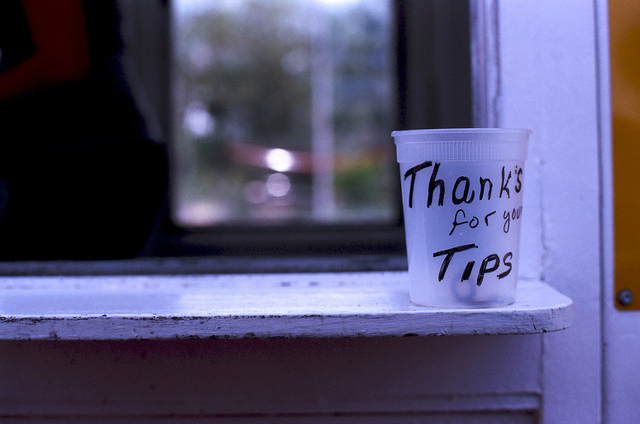
Tipping? That's racist. BOOM, headshot.

(Photo: Aaron Stidwell)

Our latest podcast is called “Should Tipping Be Banned?” (You can download/subscribe at iTunes, get the RSS feed, or listen via the media player above. You can also read the transcript; it includes credits for the music you’ll hear in the episode.) 

As we all know, the practice of tipping can be awkward, random, and confusing. This episode tries to offer some clarity. At its center is Cornell professor Michael Lynn, who has written 51 academic papers on tipping. A few examples: 

Because Lynn has largely built his career around tipping, it came as a bit of a surprise when Stephen Dubner asked him what he would change about the practice: 

LYNN: You know, I think I would outlaw it. 

Why ban tipping? Lynn has found that tipping, as currently practiced in the U.S., is in fact discriminatory. If that’s not enough to make you dislike tipping, consider what Magnus Torfason, from the Harvard Business School, has to say

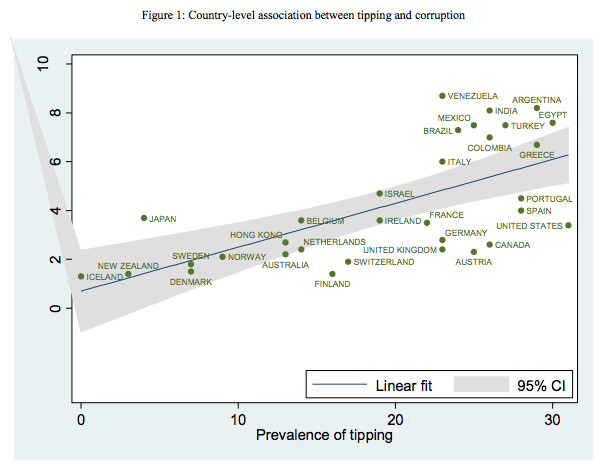
TORFASON: The more tipping you see in a given country, the more corruption you generally see in that country as well. 

You’ll also hear from a New York lawyer named Justin Swartz on the legality of tipping; Jay Porter, the owner of the San Diego restaurant The Linkery, where tipping is forbidden; and from people from all over the country who work for tips — as they dish on their strategies to make more money. (Thanks to radio producers Marc Sanchez, Colin Weatherby, Avishay Artsy and Kaitlin Prest for recording.)

Finally in this episode, you’ll hear how Steve Levitt and Stephen Dubner dole out their dough.

Magnus Torfason's research shows the association between tipping and corruption in 32 countries.

31 May 15:15

Reality Check: Ramen Burger at Lotteria in Japan

by Jay Friedman
Timmy the Tooth

I wonder if I could get a ramen Bloody Mary?

From A Hamburger Today

20130529-lotteria-ramen-burger-sign-small.jpg

[Photographs: Jay Friedman]

We've given you a preview of Lotteria's Ramen Burger, and even shown you how a guy ate one with ten extra portions of ramen. Now it's time for a review.

Lotteria is a fast-food chain in Japan (with other outlets in East Asia) serving up its special Ramen Burger for a limited run, just until mid-June. I was lucky enough to be in Tokyo as the promotion started, hitting up a Shinjuku location that offers only 100 burgers per day (some shops sell only 50). I was excited to try this. Ramen and burgers are two of my favorite foods. Combine them, and what could go possibly wrong?

Just about everything.

20130529-lotteria-ramen-burger.jpg

Actually, the individual components aren't bad. The chashu is moist and tender enough, with a layer of fat and good pork flavor. It's braised in soy sauce, garlic, ginger, and bonito flakes, with a sweet tare sauce added. The ramen "patty," which is boiled and lightly charred, comes from Menya Musashi—a quality ramen chain in Tokyo with its flagship in Shinjuku. Hiding beneath the noodles is Japanese mayonnaise, almost always a welcomed ingredient. The bun itself is simple and soft, exactly what I want for a burger, in contrast to brioche buns, which can both get in the way and fall apart. On the side is a cup of "special soup" with bonito flavoring.

20130529-lotteria-ramen-burger-soup-small.jpg

Put it all together, though, and the sandwich is sad. The carb-on-carb action falls flat, bland in comparison to the more readily available yakisoba sandwich with its fried noodles, pickled red ginger, and yakisoba sauce seeping into the soft bun. The chashu is too small, not making its presence felt in enough bites. And I didn't know what to do with the soup. Dip the sandwich, au jus-style? That's too awkward. Dip some excess noodles, tsukemen-style? That pulls too many noodles from the burger. Turns out, I later learned, that the soup is just for drinking. (Unless you do kaidama, ordering extra patties at 100 yen apiece, which you then dip in the soup.)

I think Lotteria's Napoli Panda Burger (with spaghetti and cheese) might be a better bet. It retains the beef patty, with tomato and cheese adding umami that's missing in the Ramen Burger. And it's half the price of the Ramen Burger, which at 634 yen (634 in Japanese is mu-sa-shi, in honor of the noodle source) is pretty expensive for a fast-food product. For that money, I could almost buy a regular bowl of ramen at Menya Musashi, not far from this particular Lotteria. Gomen nasai (I'm sorry).

About the author: Jay Friedman is a Seattle-based freelance food writer who happens to travel extensively as a sex educator. An avid fan of noodles (some call him "The Mein Man"), he sees sensuality in all foods, and blogs about it at his Gastrolust website. You can follow him on Twitter @jayfriedman.

Love hamburgers? Then you'll Like AHT on Facebook! And go follow us on Twitter while you're at it!

31 May 00:12

Sale Week!

by glenn

Just in case you didn’t already know, its Sale Week at Glennz Tees! All shirts reduced until Midnight Sunday. Visit Store


Follow Glennz Tees Twitter | Facebook | Flickr | Behance | Dribbble | Vimeo

30 May 16:46

The Oddest-Looking Musical Instruments on Earth

by Vincze Miklós
Timmy the Tooth

BEN FRANKLIN

Most musical instruments look a little weird, if you stare at them for long enough. When aliens finally make contact, they'll be confused by our habit of gripping wood and metal structures and throttling sound out of them. But some devices are odder than others. Here are the strangest musical instruments of all.

The Contrabass Balalaika

The Russian folk instrument was developed in the late 17th century. It's available in various sizes (prima, secunda, alto, bass and contrabass balalaika) — but they all have a triangular body, played with fingers or leather plectrums.

(via Wikimedia Commons/Tomislav Medak and Russian Balalaika)

The American Fotoplayer

The instrument combines a piano with organ pipes, drums, bells and various sound effects, using switches, pedals, levers, buttons and pull chords. It can chirp like a bird, or create the sound of thunder, pistol shots or sirens, among others. Some of them have a matching roll cabinet that features music specially composed for romantic, dramatic or chase scenes with "Picturolls."

These were produced between 1912 and 1925. Between 8-12,000 of these were made, but less than 50 survive, and only 12 are known to be in playing condition.

(via Live Auctioneers, Rinaudo's Reproductions and Hearing The Movies)

The Boardwark Hall Auditorium Organ, Atlantic City, New Jersey

The largest musical instrument ever was designed by the state senator Emerson L. Richards and constructed between 1929 and 1932 by the Midmer-Losh Organ Company. It has seven keyboards (called manuals), 1,235 stop tabs controlling 587 flue stops, 265 reed stops, 35 melodic and 46 non-melodic percussions, 164 couplers, 18 tremolos, 120 swell pedal selectors for the 6 swell pedals controlling 15 swell boxes and a stop crescendo pedal.

A ten-minute documentary film about the organ is available here.

(via Ross McNeillie/Flickr 1 - 2)

Stylophone

The analog stylus-operated synthesizer was invented in 1967 by Brian Jarvis and went into production in 1968. Three million were sold, until 1975.

(via Wikimedia Commons/Dhscommtech)

Pikasso Guitar

The multi-necked Pikasso with 42 strings and two sound holes was created for Pat Metheny by Linda Manzer in 1984. It took two years to build.

(via Wikibit)

The Theremin or the ætherphone

The theremin, one of the first electronic musical instruments, was invented by the Russian Lev Sergeyevich Termen (Léon Theremin) in 1928. It's an instrument that you play without making any physical contact at all.

Cimbalom

The concert hammered dulcimer was popularized in Hungary, but can be found in other Central-Eastern European countries and Greece, too. It's very common amongst the Romani people (Gypsies) of the area. The cimbalom has occasionally been used in film scores like The Lord of The Rings: The Two Towers, The Curious Case of Benjamin Button or in the Star Trek III: The Search for Spock.

(via Wikimedia Commons/Xylosmygame)

The glass harmonica (armonica, bowl organ or hydrocrystalophone)

This was invented by Benjamin Franklin in 1762, one year after he saw Richard Pockrichan playing on an instrument composed of glass vessels in London.

(via Wikimedia Commons/Vince Flango and Glogger)

Crwth

The Welsh Crwth (or crowd) was thought to have been played in Wales since the 11th century. Only four of them have survived, but some modern copies have been made.

(via Michael J. King)

The Great Stalacpipe Organ, Luray Caverns, Shenandoah National Park, Virginia

The electrically actuated lithophone (an instrument consisting of a rock or pieces of rock) was designed in 1956 by a Pentagon programmer named Leland W. Sprinkle, but the musical attributes of the stalactites was known since the discovery of the caverns in 1878. Each organ key is wired to a solenoid-actuated rubber mallet that is connected to a stalatite.

That's what I call rock music!

(via Wikimedia Commons/John Callas)

The Ondes Martenot (or the ondium Martenot, or ondes musicales)

The early electronic musical instrument was invented in 1928 by Maurice Martenot. The notes are produced by varying the frequency of oscillation in vacuum tubes. It was produced until 1988.

Frank Zappa, Arthur Honegger and Pierre Boulez employed the Ondes Martenot in their works, and it was frequently used in popular films and TV series like The Outer Limits (1963-1965), Lawrence of Arabia (1962), Ghostbusters (1984) and Amélie (2001), among others.

(via Wikimedia Commons)

Jew's harp (Gewgaw)

It's held against the teeth or lips and plucked with the fingers. The Gewgaw is originally came from Asia, and it's one of the oldest musical instruments in the world.

It could be made of iron and bamboo, among other substances.

(via Wikimedia Commons/Manfred Brückels - 1 - 2)

Piano especially designed for people confined to bedrest (UK, 1935)

(via Muslimhype)

30 May 16:14

Vegetable Biryani from 'River Cottage Veg'

by Kate Williams
Timmy the Tooth

I love a good Biryani

053013-253568-cook-the-book-vegetable-biryani.jpg

[Photograph: Simon Wheeler]

Biryani is a celebratory dish of rice and curry, often featuring meat. Luckily, Hugh Fearnley-Whittingstall's vegetarian version in River Cottage Veg doesn't suffer from its absence. His base is a richly spiced stew of potatoes, peas, and carrots, fragrant with cardamom, ginger, cumin, cinnamon, and coriander. A fluffy layer of saffron basmati rice tops the curry and manages to retain its own character, even after a second round of cooking. The final touches of caramelized onions, toasted almonds, and chopped cilantro add enough vibrancy to the dish that it's easy to forget that it's meatless.

Why I picked this recipe: Frankly, most biryani recipes I've tried haven't worked very well, so I wanted to see if Fearnley-Whittingstall's version was up to snuff.

What worked: This one went off without a major hitch. The rice stayed fluffy, the curry was distinctly fragrant, and the meal came together with relative ease.

What didn't: Next time I'll start caramelizing the onions earlier (perhaps before starting any other elements) to give them a chance to really cook down. These quickly browned onions were okay, but would've been better with more time on the stove.

Suggested tweaks: You could play with the vegetables in the curry if you'd like. Cauliflower would be a nice addition, as would sweet potatoes.

As always with our Cook the Book feature, we have five (5) copies of River Cottage Veg to give away this week.

About the author: Kate Williams is a freelance writer and personal chef living in Berkeley, CA. She is a contributor to The Oxford American, Berkeleyside NOSH, and blogs at cookingwolves.wordpress.com.

Get the Recipe!
29 May 22:14

Stephanie’s Cheese Rant

by Michael Ruhlman
Timmy the Tooth

Conclusion? Tillamook cheese is great.

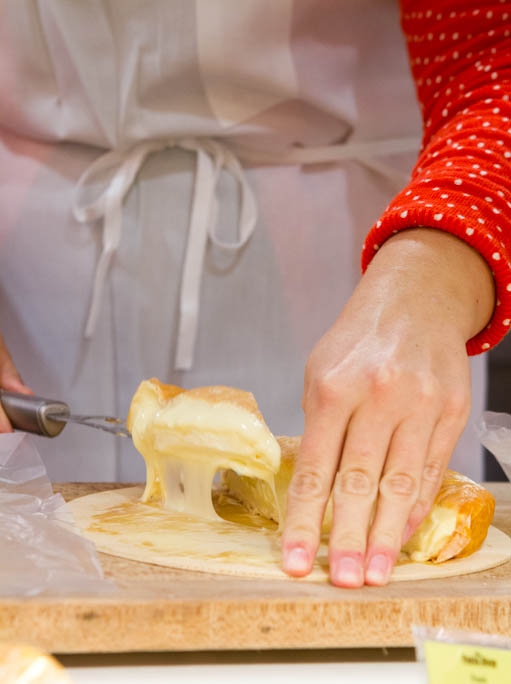
Cheese. Photo by Stephanie

Cheese. Photo by Stephanie.

Stephanie Stiavetti (@sstiavetti) writes The Culinary Life blog. Her first book, Melt: The Art of Macaroni and Cheese, will be published next year by Little, Brown.

by Stephanie Stiavetti

If you’re a regular reader of Michael’s site, then you’re probably one of a class of people that thinks a lot about food. You might make it a point to buy quality ingredients, mostly prepare your meals at home, and generally spend a fair amount of time thinking about what you put in your body. What baffles me, though, is that despite all the grass-fed beef and produce carefully selected at the local farmers’ market, a huge number of the people in this food-conscious demographic still buy crappy, industrially produced cheese. These folks have educated themselves about many other aspects of what they eat, but are seemingly unaware that these cheeses are on par with the same processed foods they spend so much money and energy avoiding.

Then there’s an interesting class of in-betweens, somewhat cheese-savvy individuals who consciously go out of their way to buy specialty cheeses for a cheese plate, but when it comes to the cheese they’re putting on a burger, in a casserole, or on top of their pasta, they still reach for the dairy equivalent of a Pop Tart. Pisses me off. And it’s a big part of why I wrote a whole book dedicated to cooking with “real” cheese (with friend and fellow writer Garrett McCord, out from Little, Brown this fall).

Why is it that the quality and origin of one’s cold cuts warrants so much critical thought, yet not nearly as much attention is paid to the cheese that’s slapped on top of food before calling it dinner? If you notice a difference when you eat fresh, locally sourced meat and vegetables, I guarantee that you’ll find a huge difference between high- and low-quality cheeses.

So listen up! School’s in session. Today I’m going to give you a quick primer on basic cheese vocabulary. These terms will help you to become a better cheese buyer and, consequently, a healthier, more satisfied cheese eater.

Artisan, Specialty, or Mass-Produced Cheeses?

There are many ways to classify cheeses, but some would argue that it’s most important to properly categorize varieties by how they are produced. Cheeses generally fall into one of four production categories: industrially producedspecialtyartisan, and farmstead. How can a novice cheese buyer tell the difference between a mass-produced cheese and a farmstead cheese? Here’s how:

Industrially produced cheeses are made in large factories, often employing huge teams of workers to create the cheese. The milk comes from any number of places, including factory farming operations. The taste and texture of industrially produced cheeses are usually very consistent from one package to the next. They come wrapped in sealed plastic, often pre-sliced or in huge blocks, and are sold prolifically across the country. These are the cheeses you’ll find in the cheese aisle at your local Safeway, Kroger’s, Costco, etc. Think brands like Kraft, Sargento, President, Laughing Cow, and generic grocery store cheeses.

Specialty cheeses are produced with less mechanization than industrially produced varieties, and are usually created in somewhat smaller amounts. Specialty cheese makers pay attention to flavor and texture profiles, keeping a relatively close eye on the cheeses they produce, though these cheeses are not considered “handmade.” You can find specialty cheeses at regular grocery stores, where they’re often a little pricier than their mass-produced counterparts. Specialty cheeses are a good intersection between quality and ready availability—brands such as Kerrygold, Beemster, Parrano, and Cabot Cheese Co-op. for example.

Artisan cheeses are handmade in small batches, often by just one or a small handful of passionate individuals who pay close attention to the tradition of the cheesemaker’s art. Artisan dairies employ as little mechanization as possible, adhering to more traditional methods (while working within the limitations of health and sanitation laws). You can usually find these cheeses at small local cheese shops manned by knowledgeable cheese staff. While artisan cheeses are not usually found in the huge cheese aisle at the supermarket, many big grocery chains are implementing cheese counters with a trained cheese person standing by. Brands to look for: Cowgirl Creamery, Vermont Creamery, Coach Farms, Laura Chenel, and Cypress Grove.

Farmstead cheeses are made using milk from the cheesemaker’s own animals, meaning the cheese is produced on the farm where the animals live. A cheese can be classified as both artisan and farmstead if the cheese is made by hand and the milk comes from the farm where the cheese is made. These are cheeses you’ll find in small local cheese shops, or at the specialty cheese counter of your local grocery store (not in the cheese aisle). Think: Fiscalini, Redwood Hill, and Vermont Farmstead.

When Large Production = Small-Time Quality

While it may appear that some cheeses are created on an industrial scale, in reality they may be the combined intimate efforts of many farmers working together to create very consistent results. Take Gruyère, for example. Because of its protected origin designation, only cheese made in a very specific region of Switzerland can be called Gruyère, but there’s not just one enormous factory creating all the Gruyère that exists in the world. Many smaller dairy farms within the region work together to help produce the cheese, all of them adhering to the same specific requirements for a uniform product. If you’re curious about the original of your specific wedge of Gruyère (or any other protected cheese, such as Emmentaler, Parmigiano Reggiano, etc.), feel free to ask the staff of your local cheese shop who made, aged, and distributed the cheese you’re buying.

Other popular kinds of cheeses, such as brie, are not protected by any sort of designation, and therefore may be made on any scale without any sort of specified quality control. This means that while officially titled Gruyère will be fairly consistent, it is not necessarily the case for brie. Artisan brie can be amazing. Mass-produced brie that you find for $3 at Walmart tastes vaguely of salted pressboard and packing peanuts. Same goes for camembert, cheddar, “Swiss” cheese, and others. (Fun fact: Swiss cheese doesn’t really exist as a type of cheese. It’s the generic name for Emmentaler-like cheese produced outside the designation.)

It’s also worth noting that not all large-production cheese tastes like crap. Some big-name brands manufacture cheese at a dizzying rate while still maintaining high standards of quality. Two such examples are Tillamook and Black Diamond, both of which create very good cheddars and are available in huge grocery store chains. But the point of this post is to show the merits of selecting specialty and artisan cheeses over their factory-generated cousins, and I make it a point to select small-production cheeses because I prioritize independent producers, non-factory-farmed ingredients, and artisan-level quality. Huzzah!

How Do You Find Out?

Learning about the cheese you eat is no different than learning about the meat you’re buying. Do some research. Your best source for cheese information is a staff person at your local cheese counter. A good cheesemonger is well trained in the way of the milk and can answer your questions about the origin, content, and quality of the cheeses they stock. Given the growing popularity of handmade cheese, many large-scale supermarkets are outfitting their locations with well-stocked cheese counters. Even if your regular grocery store doesn’t have a cheese counter, you can probably find at least a few specialty brands in the cheese aisle. If all else fails, look to online cheese vendors such as Murray’s or Artisanal.

What About Price?

Quality cheeses are more expensive than their processed counterparts, as is most of the food you put in your mouth. I’m continuously hearing the complaint that good cheese is too pricey, yet these same people plunk down $10 for a dozen organic, free-range eggs. News flash: you’re digesting it all, and it all needs to be high-quality. Crappy cheese is just as bad for you as any other crappy food.

What About Fat?

Sure, there’s the argument for eating low-fat foods, and a huge number of Americans still buy fat-free cheeses, which are generally not available from anywhere but industrial brands. Cheese is composed primarily of fat. Fat-free cheese isn’t really cheese. But much like the stance Michael has taken on salt—that if you don’t glut yourself on sodium-laden processed food, you don’t have to worry a whole lot about the salt you use to season your homemade dishes—I take a similar position on fat. If you cut out processed high-fat foods, the fat you consume from a moderate amount of real cheese isn’t going to hurt you. In fact, there’s a whole cookbook dedicated to the idea of fat as a healthy, necessary part of your diet.

Learn More

If you’re interested in learning more about cheese and where it comes from, there are a few awesome books on the topic:

DiggShare

28 May 18:10

'In the six' and football's other strange Americanisms

Timmy the Tooth

This is a load of testicles.

British attempts to describe baseball provoke ridicule in the US, while American jargon in "soccer" causes amusement and bafflement among British fans. Why do people care so much?
28 May 17:48

The Economics of Self-Publishing an E-Book: Part 1

by Matthew Amster-Burton
Timmy the Tooth

Interesting...

Earlier this year, I told you about how I ran a successful Kickstarter campaign to fund the editing, design, and book tour for my self-published ebook, Pretty Good Number One: An American Family Eats Tokyo.

I published the book last month, and it spent a few days at number one…in Amazon’s “ebooks about Japan” category.

Still, not bad, and the book is selling steadily. I guess my fourth grade teacher was right: people do want to know what I did on my summer vacation.

If you’ve been thinking about self-publishing an ebook, here’s a guide to the economics. I’m not going to tell you how to write a book—that’s your job, author.

But I want to give an overview of what happens after that, from the moment you write the last word and have a well-deserved beverage to the day you receive your first royalty payment.

This week, let’s look at the expense side: what it costs to produce a high-quality ebook that can compete with the big publishers.

Next week, the fun part: getting paid. We’ll look at how to get your book into the major stores, whether to use a middleman, how to price your book, and how much you’ll make in royalties on each book sale.

For more detail, I highly recommend the book APE: Author, Publisher, Entrepreneur, by Guy Kawasaki and Shawn Welch.

Hire a typo hitman (or woman)

Self-publishing an ebook is cheap compared to mainstream publishing. The major ebook stores charge you nothing to list your book. But that doesn’t mean making an ebook is free.

The two biggest expenses for a typical ebook are copy editing and cover design.

My book is about 250 pages, and I paid a copy editor $1500 to edit it. That’s a midrange price; you don’t need to pay more, and it’s risky to pay much less (I found trustworthy quotes as low as $1200).

The longer the book, the more it costs to copy-edit. Duh.

Fifteen hundred bucks is a lot of money (paid for by my Kickstarter backers, of course—thank you!).

Is copy editing really necessary? Can’t I just rely on friendly volunteers? Let’s look at the facts.

Before I sent my manuscript to the copy editor, I had several friends and family members read it and point out typos, grammatical errors, continuity errors, inconsistent spelling of Japanese words, and so on.

They found dozens of errors. By the time I sent it to the copy editor, I figured the manuscript was in excellent shape.

The copy editor sent it back with over 500 unequivocal errors flagged, including plenty of big, stupid ones. Kawasaki describes a nearly identical experience in his book.

The moral: if your book is a vanity project and you just want to see your name come up in an Amazon search, sure, skip copy editing.

If you want to actually sell books and avoid having readers fling their Kindles aside after slogging through two pages of your error-ridden prose (and leave you a one-star review), hire a professional.

You can find a copy editor through the Editorial Freelancers Association.

Cover me

I also hired a professional cover designer. Readers are more likely to click on a good cover, and there are a lot of bad covers, so it’s not hard to stand out.

The design cost $300 and included several prototype designs to choose from, and back-and-forth edits with the designer. (“Can you make the octopus scarier?” “Sure.”) I hired CL Smith.

Another good place to shop for a book cover is 99Designs, where freelance designers compete for your contract.

Recently, Amazon introduced a tool called Cover Designer which lets you build a cover using free stock photos, backgrounds, and templates.

I’ve tried it, and it’s pretty good—not as good as the results you’ll get from hiring a professional designer, but possibly good enough for your book.

Since it’s free, by all means give it a try. (To try it, sign up for Amazon’s Kindle Direct Publishing program and add a book; you don’t have to have your manuscript ready in order to play with Cover Designer.)

Inside job

Finally, there’s the small matter of the stuff inside the book.

Most of the major ebook stores will let you simply upload a Microsoft Word document, but it’s not a great idea.

Unless your surname is Gates, you’re probably not as consistent with your use of formatting styles as an ebook requires, and, as a result, your ebook will look funny: weird spacing, clunky title page, and so on.

You have several options for making your words look as good as they sound.

Design it yourself. Amazon publishes a free guide, Building Your Book for Kindle, that explains how to format your book well in Word, including building a table of contents (often missing from published books, infuriatingly).

For the most part, the book’s advice applies not just to Amazon, but to other stores such as Barnes and Noble, iBooks, and Kobo.

Use an aggregator such as BookBaby or Smashwords. These services (which I’ll discuss more next week) will format your manuscript for a fee (BookBaby) or a cut of your royalties (Smashwords).

The results range from decent to excellent, depending on how good your formatting is when you deliver the manuscript.

Hire a book designer. For $200 (for a medium-length novel), 52 Novels will produce pristine EPUB and Kindle-format files from your manuscript. Extra-long books and nonfiction books cost more.

The bill

Assuming a 250-page novel, the total cost of producing a pro-quality ebook from your finished manuscript is $1200 to $2000.

Next week we’ll put your book up for sale and figure out how many books you have to sell to make a profit.

Matthew Amster-Burton is a personal finance columnist at Mint.com. His new book, Pretty Good Number One: An American Family Eats Tokyo, is available now. Find him on Twitter @Mint_Mamster.


28 May 13:33

Arteta, my player of the year

Timmy the Tooth

That's me!

Writing for 7amkickoff, Tim Bostelle makes the case for Arsenal's vice-captain to take top honours this season
27 May 19:51

Video: Santi Cazorla – out of this world

by blogger@arseblog.com (Arseblogger)
Timmy the Tooth

Not quite sentimental enough...

santi_smile

Hey, a video of a player that doesn’t have a terrible techno soundtrack!

Made by: Culann Davies – give him a follow on Twitter and YouTube

Song: John Grant – Outer Space (available on iTunes here)

25 May 02:25

Awesome! The new Jurgen Klopp song: Kloppo You Rockstar!

by Ronaldo Assis de Moreira
Timmy the Tooth

GERMANS

 Awesome! The new Jurgen Klopp song: Kloppo You Rockstar!Last night we brought you the 2011 song “I wanna be like Jurgen Klopp.”

And, it appears the love for Borussia Dortmund coach Jurgen Klopp may have hit fever pitch ahead of the Champions League final against Bayern Munich on Saturday night.

German comedian Matze Knop, who was responsible for the song that went viral after Dortmund won their first Bundesliga title, has released another tune, according the former Mainz boss with his current standing in the game.

“Kloppo You Rockstar” starts off with a reference to Klopp’s victory over Jose Mourinho in the Champions League semi-final and goes on to  credit how the Dortmund boss manages his young and exciting side.

Matze Knop has played Klopp on German TV for some time and seems to be an absolute genius at portraying how the Dortmund boss moves on the touchline.

This is quality!

24 May 17:06

Piccadilly: tiles 2

by diamond geezer
Timmy the Tooth

Ahhh... home.

PICCADILLY: the tiles

Doug loves them. He's got a website about the tiles down the Piccadilly line (and down the other lines designed in the Edwardian era). Doug's even written a book, of the lavishly-illustrated £50 type, which could probably be described as definitive. We have three more north London stations to visit.

Skip King's Cross St Pancras, it's been entirely modernised. And you won't spot York Road, that's long closed.

Caledonian Road is a below-ground tiling extravaganza. The ox-blood façade at street level is mighty fine too, but there are plenty of these around London, and downstairs ticks different boxes. The chosen colour here is mauve, in two closely coordinated shades, rippling in zigzags down the wall. Compared to some of the other stations we've visited the effect is quite muted, definitely less polished. There's been no recent wholesale restoration here - indeed close-up investigation reveals a few long-term imperfections. Let's call it character.

If you're looking for the way out, Cally Road offers a choice of signage. The usual modern enamel panels are here, all terribly pristine and normal, but also much more ornate WAY OUT panels tiled beside the exits. The words appear inside a design that could be a ticket window, but is more correctly a free-standing picture frame - the correct term is 'aedicular'. Other exits are marked NO EXIT, similarly framed and glazed. You'll find these aedicular signs at all the other stations I've highlighted, but some of those here are unreconstituted Leslie Green originals.

Head to the far end of the northbound platform to see an original all-red roundel, almost hidden, beyond a staff telephone near the signals. There's another at Covent Garden if you don't want to trek this far out, but again beyond the passenger barrier so best seen from a passing train.

Holloway Road is best seen just after a train has left, with the cylindrical platform empty and brown hoops overhead. That's assuming you like brown. Leslie Green chose two shades of brown as his Holloway Road colours, one richer and darker, the other verging on orange. The lighter hue is used on the platforms to create a bold diagonal design, broken by a broad vertical dark strip. This polychromatic branding continues along the exit passages, even up the steps to the spiral staircase... but not all the way to the top.

A most well preserved station, this, both above and below, and the second in a row with a Grade II listing. It's the attention to detail, the small things, that make the difference. Take the interconnecting passage, for example. Today it's only useful to anyone changing between northbound and southbound trains, which should be nobody, but in its day this was an entrance at the foot of the stairs. Which way to go? The tiling tells you, left To The Trains Hammersmith, right To The Trains Finsbury Park. And all in brown, of course, lovely brown.

Tottenham fans should look away now.

It made perfect sense in 1906 to call Arsenal station Gillespie Road. A fairly minor road, admittedly, but entirely descriptive of the ticket hall's location. It's nowhere near the platforms, though. A long gentle ramp slopes down from the entrance, and down, and down, before reaching a cavity dug out beneath the East Coast mainline. Arsenal football team didn't move in nearby until 1913, and the station name didn't change until 1932. Today the ramp down to the platforms is part barriered-off to provide a protected contraflow system on matchdays, but look behind the metal bars and Leslie Green's striped tiles remain.

Strange colours, though. Purple and green don't really go together, especially when the purple's a wishywashy mauve and the green's dark emerald. You'd expect red and white because those are Arsenal's colours but, like I said, the tiles predated the team's arrival. And the old station name survives on the platforms, with GILLESPIE ROAD written in large flowing capitals at each end. Who cares if that's not what it's called any more, rejoice that it's still here. A century on, the Piccadilly's tiling vision endures.

Finsbury Park rounds off the original line, but has no original tiling. The station's platforms were radically reworked in the 1960s to allow cross-platform interchange between the new Victoria line and the Piccadilly. Instead you can enjoy the sight of six hot air balloons, created in mosaic by artist Annabel Grey, bobbing curvaceously along the length of the platform.

I've now downloaded 28 Piccadilly tiling photos to Flickr. According to Flickr's cavalier new interface almost none of you have looked at them, but the stats lie because you clearly have.
23 May 21:19

Awesome! Jurgen Klopp pop song – ‘I wanna be like Jurgen Klopp’

by dovrawson
Timmy the Tooth

GERMANS

 Awesome! Jurgen Klopp pop song   I wanna be like Jurgen KloppThe two German giants, Bayern Munich and Borussia Dortmund, are set to appear at Wembley on Saturday night for the Champions League Final and it seems every neutral is a Dortmund fan.

101GG has also been sucked in this season by the Dortmund story. The fans, the players, the beautiful football.

But, possibly the greatest thing at Borussia Dortmund is manager Jurgen Klopp.

It’s difficult to put your finger on what it is everyone loves about him, but his eccentric and enthusiastic nature is simply a pleasure to see.

Earlier this week he displayed exactly how much affection he has for his players:

(On Shinji Kagawa) ‘We Cried for 20 minutes, in each others’ arms, when he left

We stumbled across a brilliant song made in 2011 after he helped win Dortmund his first league title.

A mix of German and English, we are sure you’ll love it:

23 May 19:07

Conversations With My 2 Year Old “Actual conversations...

Timmy the Tooth

Interestingly, I had a similar idea with Aveline. We talked about "God bless you" once on video it was interesting.


Conversations With My 2 Year Old

“Actual conversations with my 2 year old daughter, as re-enacted by me and another full grown man.”

18 May 14:47

GOD DAMN – Must watch Video !

by Team
Timmy the Tooth

Stick with it...

New Pic 4GOD DAMN – Must watch Video !

Powerhouse heavy riffing trio GOD DAMN release startling new video for Heavy Money, the title track of new EP out 17th June 2013.

HEAVY MONEY is the brain-splatting new track from Wolverhampton trio GOD DAMN. Following the recent success of previous single I’m a Lazer, You’re a Radar, the band are ready to blow your hair back once again with this hard-hitting audio-visual combo.

Taken from forthcoming EP of the same name and directed by Benjamin Parry, the video is an homage to British Social Realism and depicts how an unsuspecting homeless man fares when a group of deviant and disgusting boys gang up on him and his young companion.

Song and aesthetics complement each other perfectly through the juxtaposition of bold concepts in mundane surroundings and a track that will knock you sideways. The grand intro and epic style of Heavy Money will unite us all!

The Heavy Money EP is out on June 17th 2013 on Gravy Records on limited edition cassette and free download.

Pre-order the EP HERE  http://www.gravyhq.com/GRAVY/GRVY010.html

www.facebook.com/goddamntheband

www.twitter.com/goddamntheband


15 May 13:16

RIP Richard Swanson: American dribbling trom US to Brazil for One World Football Project hit by car

by Paul
Timmy the Tooth

UGH... if you go to his site, the GPS tracker shows exactly where he was killed.

swanson1 RIP Richard Swanson: American dribbling trom US to Brazil for One World Football Project hit by carThis is a truly tragic story.

42 year-old Richard Swanson, an American man who recently embarked on a charity walk for the One World Futbol Project, has been tragically hit by a car on the Oregon highway on day 14 of his trip, and killed.

His plan was to dribble the indestructible football, the One World Football, throughout the trip from Seattle to Brazil (10,000 miles), to raise awareness for the One World Project, who donate the ball to children in developing countries.

His project was tragically cut short, however, and football can only salute him for his noble cause.

RIP mate.

Watch the video of Mr Swanson explain his project on the clip below, before he set out on the trip.

04 May 14:54

Suarez, Bony, Lewandowski; a transfer primer with The Prisoner

by Tim

Where am I?

The Village.

What do you want?

Information.

You won’t get it!

By hook or by crook we will.

What side are you on?

I have no alignment. I am number 2. I am on the side of information. I will be asking the questions, I seek information. What is Robert Lewandowski’s shots on goal percentage in League play?

I won’t tell. 

Wrong answer. We already know: in League play, Robert Lewandowski has taken just 91 shots and put 48 shots on goal for a shots on goal % of 53%. He’s also scored 23 goals on 91 shots for a 3.95 shots per goal ratio in League play. That is among the best in world football.

In all competitions, over the last two seasons, Lewandowski has scored 64 goals on 304 shots, 4.75 shots per goal. He’s also put 145 shots on frame for a 48% clip there and has scored 64 goals on those 145 shots on goal giving him a whopping 44% kill rating and 21% goals ratio.

So, you already have information. What do you want from me? 

Arsenal’s Olivier Giroud has taken 307 shots in that same period and only scored 38 goals. Does that not mean anything to you?

Who is number one?

Number one is Perry Groves. Number two is Perry Groves. Number three is Perry…

WHO IS NUMBER ONE???

In two seasons with Arsenal Gervinho has 91 shots, 34 on goal, and just 11 goals. That’s a shots on goal at 37%, 8.3 shots per goal, 32% kill rate, and a paltry 12% conversion rate of overall shots. Giroud has taken 307 shots but his numbers are basically the same as Gervinho: just 43% of his shots are on target, he requires 8 shots per goal, he only converts 29% of his shots on goal as goals, and overall his conversion rate is a paltry 12%.

What’s it all about?

You have information. For example, what do you know about THEO WALCOTT?

He’s not much better than Giroud or Gervinho: in League play over the last two years he has 20 goals on 149 shots, 64 of which were on goal. That’s 7.45 shots per goal, 43% shots on goal ratio, 31% of his shots on goal are goals, and just 13% of his overall shots are goals.

Precisely. Now, how much is Borussia reportedly asking for Lewandowski?

£25m and he’s supposedly already agreed to £160k/wk salary with Bayern. It’s all just tapping up if you ask me. Which you did.

Does Arsenal need a forward like Lewandowski?

Need? Who needs anything? He couldn’t hurt. But Arsenal have only once gone for big names like Lewandowski. They are more likely to bid on a player like Bony.

Bony?

Wilfried Bony, born in Ivory Coast, teammate of Gervinho, has scored 31 goals for Vitesse in the Dutch Eredivisie. Has 114 shots, 56 shots on goal, 3.7 shots per goal, 49% of his shots are on target, converts at a 27% rate.

The Eredvisie is crap. The defenders are crap. The keepers are crap. Everyone is crap.

True, Luis Suarez came from the Eredivisie and he was the last player to score 29 goals in a season there. His numbers in the Premier League look basically the same as Giroud, Gervinho, and Walcott: he has just 47 goals on 372 shots (7.9 shots per goal or a conversion rate of 13%, and he only gets 41% of his shots on target).

SUAREZ IS OUT

Yes, but he creates those shots!

Only sort of. The whole team works hard to get Suarez the ball and he demands a ton of possession. He is one of the most prolific dribblers in the League but he has one of the worst dribble accuracy percents, he’s 95 of 291 dribbles. That’s an appalling percentage by the way. He is also third in the League in being dispossessed and second in turnovers.

And in case you’re curious, Suarez’ numbers in the Eredivisie weren’t much better: in his best season at Ajax, Suarez scored 35 goals but he took 275 shots. That’s 7.9 shots per goal or a conversion rate of… 13%. 

That is precisely the kind of information we seek. Suarez is the type of forward that my superiors think Arsenal should buy. That’s despite the racism, the biting, the diving, the handballing, and the fact that everyone at Liverpool is working to get that ball hog the ball. So, he wasn’t much more efficient at Ajax?

No. Who are you?

I am number two. You are number 7.

I am not a number! I am a free man!

Qq

02 May 16:35

Champagne and food pairings – some surprisingly fun and casual options

by Joanna
Timmy the Tooth

Huh, sushi and champagne. That's my next date.

potato chips with onion dip

When pairing Champagne and food, the acidity of the wine is key to finding its perfect food partner. There are some classic and extravagant pairings like caviar and oysters, but there are some more unexpected foods that are also a great match. I don’t think that Champagne has to be stuffy and formal at all. It’s always a great time to enjoy bubbles  – and here are some of my favourite pairings, perfect for a casual weekend afternoon or to start your evening with.

Potato Chips – yes, really!

Considering basic wine pairing rules, wines with high acidity pair well with foods with high fat and salt content. Think about a Coca-Cola and potato chips….it’s the same idea, only here, it’s brut Champagne and potato chips. The fat, salt, and crunch of a great potato chip (I like the Cape Cod kettle chip brand) paired with an acidic, bubbly Champagne is heaven. Or if you are a Champagne purist and feel like this is too unconventional, try a Cava or Prosecco. I promise you will be most pleasantly surprised.

Fresh spring rolls with sweet and spicy chili sauce

fresh spring rolls

Here, rather than a marriage of opposites, one can also work with complementary flavors in food and wine pairing. Go with a sweet or semi-sweet Champagne to complement the sweetness of the dipping sauce. Sweetness also makes the chili less aggressive in the mouth. The end result is a fantastic pairing that you will no doubt wish to repeat again and again.

Macaroni & cheese

mac and cheese SliceofChic

Champagne with a good old-fashioned homemade macaroni and cheese is a combination not to be missed. In this combination, one must avoid sharp cheeses like aged cheddar. Instead, think mild, buttery and slightly nutty cheeses like smoked gouda. You could go a bit more gourmet and add pancetta or truffles. But I prefer a classic mac and cheese with a buttery, breadcrumb topping. Honestly, for me, it doesn’t get better than this….my two most favorite things in the world, my mother’s mac and cheese recipe and a bottle of brut Champagne. Again, if a high / low pairing like this makes you uneasy (what a waste of an expensive bottle, you say!), you can go with a more value-oriented choice like a classic French Cremant sparkling wine.

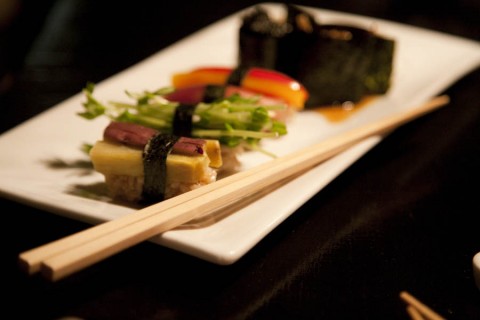
Sushi

Gaya011-480x320

Sushi and Champagne in my mind are the next classic pairing, à la oysters and caviar. The same principles apply here – the acidic qualities of Champagne paired with seafood. It goes one step further here with the subtle flavors of seaweed and vinegary sushi rice being kicked up a notch, thanks to the acid of the Champagne. Furthermore, the yeasty qualities of a true French Champagne works especially well with the savoury and umami qualities of soy sauce. A traditional brut French Champagne, rather than a Cava or Cremant substitute which lacks the yeasty qualities, works best here.

American-style chilli

I guess it's a chilli of some sort in bowl

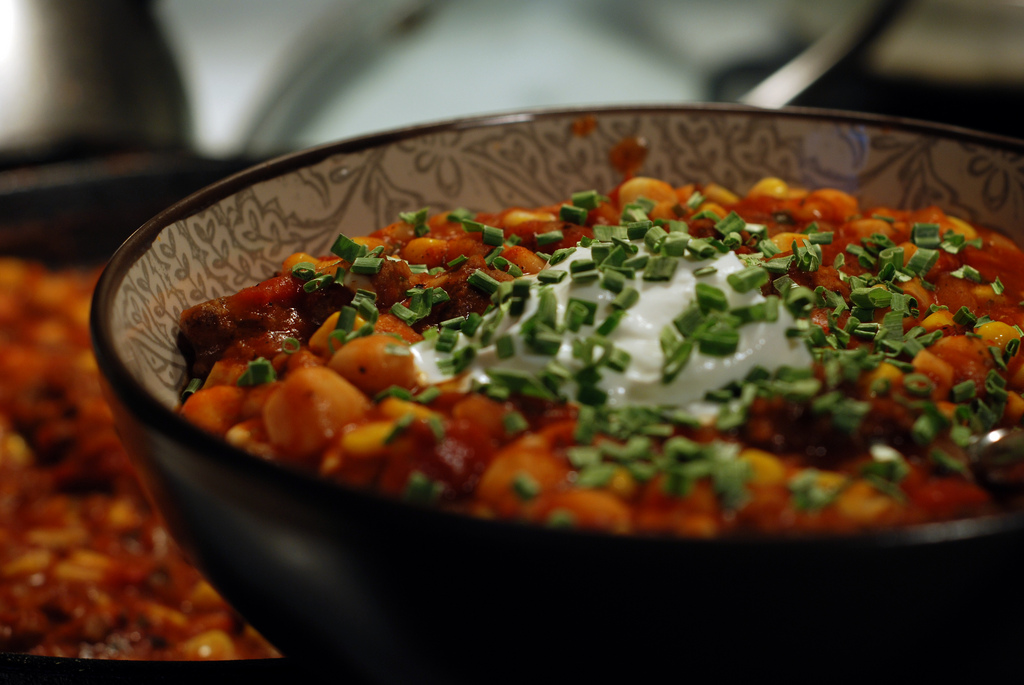
The spice and the punch of an American style meat and bean chilli can be greatly enhanced when paired with Champagne. The kick of the chilli powder, cumin and other spices that are often present pair especially well with bubbles. Champagne defuses the chilli’s spicy nature, and the dish takes on a new life. Also, if you like to top your chilli with cheese, again, using the same principle as the mac and cheese above, use a milder cheese like Colby or Monterey Jack so the acid doesn’t “turn” the cheese to bitter.

So really, I think Champagne shouldn’t just be for special occasions. Bubbles make everyone smile, and for this reason, I like to enjoy and serve them regularly. It’s not all about caviar and oysters with Champagne….try the chips or mac and cheese or spring rolls and integrate Champagne snacks and meals into your everyday life with these untraditional but decidedly delicious pairings. Cheers!

The post Champagne and food pairings – some surprisingly fun and casual options appeared first on Chubby Hubby.

02 May 15:24

US Barista Champion Erin McCarthy On Coffee Brewing Mistakes to Avoid

by Liz Clayton
Timmy the Tooth

I just look at someone like that and I think "fuck you. fuck you and your too tight shirt. fuck you and your bow tie. fuck you and your blue dockers slacks. fuck you and your filtered water. I bet you like sipping vodka."

From Drinks

050113-coffee-brewingmistakes-mccarthy-1_edited-1.jpg

[Erin McCarthy, who brews the best cup of coffee in the United States, preparing to brew. Photo: Liz Clayton]

Just exactly how hard is it to brew a really great cup of coffee? If you've gotten this far into the article, you probably already know: it can be a challenge even to the best of us—particularly if you're brewing a cup before you've, you know. Had any coffee yet.

Counter Culture Coffee's Erin McCarthy recently won the 2013 United States Brewers Cup Championship by brewing the famous Hacienda Esmeralda Geisha coffee from Panama on Kalita Wave brewers at a heated showdown in Boston, Mass. Before he heads to the world championships in Melbourne to brew the (gulp!) best cup of coffee in the world, we asked Erin what he thinks the five most common mistakes people make in their everyday brewing routines.

Mistake #1: Buying bad coffee

Not buying bad quality coffee is the first step to success, says McCarthy, who cautions that freshness—including making sure the coffee is whole bean—is key. This may be elementary to some, but when buying coffee in a grocery store (or even a specialty cafe), always check the bottom of the bag for the roast date. Many grocers have trouble with keeping the right amount of stock on hand, resulting in months-old coffee going stale on the shelves. Don't know which coffee's the best option? McCarthy has a quick tip:

"I would say that the roasters that are sourcing coffee they're really proud of, would have more information on the bag. The farmer, the processing method, etc.—anything specific on the bag beyond what the roaster's general philosophy is." Look for roasters who know and care about the chain of history of their coffee, rather than those who may be buying cheaper, lower-quality beans that could be well beyond their flavor peak.

Mistake #2: Pre-grinding

If there's anything McCarthy stresses, it's not to pre-grind coffee. Beyond how quickly the coffee begins to lose flavor after grinding (which is to say, immediately), McCarthy stresses the sensory experience of coffee brewing as a point of instruction:

"The fragrance of freshly ground coffee sets you up for what you're going to taste in the coffee, and a lot of times you get things out of the fragrance that you may not get from the extraction. That's really cool, it's getting to know another side of the coffee. Ground coffee smells really good! Why would you grind it and have that sensory experience peter out at the grocery store or the cafe where you bought it?"

For those who can't afford an expensive conical burr grinder, McCarthy suggests choosing a little elbow grease instead of a cheap blade grinder: "There are hand grinders that are burr grinders that are affordable that produce a really good grind. I don't think a blade grinder is a gateway to good grinders. It's like a choose your own adventure where you die on the third page."

Mistake #3: Using unfiltered water

Even in cities renowned for above-average tap water, McCarthy strongly recommends purified or filtered water—a filter that fits onto your faucet is just fine, he says—as an important bridge to a great cup of coffee.

"Coffee is really intensely hydroscopic," says McCarthy, "So it LOVES to pick up smells and pick up tastes. So if there's ANYTHING in your water that is maybe a little chloriney, even if you don't taste it in your water when drinking it—you'll taste it in the coffee. The cleaner your water is, the better your coffee will taste."

Mistake #4: Using water that's too cold

"I think that most people are still brewing coffee at too low a temperature," says the Brewer's Cup champ. "Whether they're using Mr. Coffees or hand-brewing, if you're pouring from a kettle that was boiled into a pouring kettle, you're losing 10 degrees. I'll either pour from my kettle that can boil, or I'll put my Takahiro [pouring kettle] back on the heat, and that helps a lot. And what that does, is these aromatics and the more delicate flavors—the fruity, the floral, and definitely the sweetness—come out more with higher temperatures. You're able to extract more out of the coffee with a higher temperature."

When brewing, McCarthy aims to have the water bed—the slurry of wet coffee grounds and water that's still extracting through it—to stay around 200 degrees F. "So that means the water when I pour it has to be 8 to 10 degrees above that," notes McCarthy.

Mistake #5: Giving up

We all horribly muck up a brew of coffee—like anything else in life&mash;now and then. And while sometimes you only have time to put milk in it and move on, the secret to really getting better is to brew another batch. "Here's the thing," McCarthy says. "when I mess it up, if I'm trying to brew the best cup that I can, I'll do it again. And those mistakes get less and less if you're used to it," he pauses.

"If you've had enough sleep."

About the author: Liz Clayton drinks, photographs and writes about coffee and tea all over the world, though she pretends to live in Brooklyn, New York. She is currently compiling photographs of the best coffee in the world to be published by Presspop this spring.

02 May 02:27

Taste Test: We Try Four Frozen Vegan "Cheeze" Pizzas

by Niki Achitoff-Gray
Timmy the Tooth

Vegan cheese lovers pizza is a bit like making a vagina lover's prostate massager.

From Slice

20130501-249935-cheeze-boxes2.jpg

[Photographs: Niki Achitoff-Gray]

If tasting 'regular' frozen pizza requires reduced expectations, then tasting frozen 'cheeze' pizzas might be termed an exercise in complete and utter futility. As Kenji has already argued quite convincingly, vegans and/or the lactose intolerant are probably far better off foregoing the cheese factor altogether when it comes to pizza. And, if this experience has taught us anything, he is unequivocally correct—at least when it comes to the realm of frozen pies. There's just no way around it...great vegan melting cheese simply does not exist. (Yet!)

So, let's cut to the chase. What's the point?

Optimism is definitely part of it. But if we're being honest, it mostly boils down to the curiosity factor. Was it possible there could actually be something to this burgeoning trend?

Neither vegan nor lactose intolerant myself (and a total cheese nerd), I'll readily admit that I'd never really given "dairy-free vegan cheese alternatives" much thought one way or another. In fact, I'd dismissed them so thoroughly that when I recently passed the glowing shrine of frozen, soy substitute-topped pies at my local Whole Foods, I did a completely genuine double-take.

It went a little like this: First, an incredulous Wait, this exists? Then, cowering slightly (and not not convinced that I was surrounded by an army of self-righteous vegan telepaths), a rushed Well, yes, of course this exists. Followed by the haughtier, Gross, this exists, and finally, eyes bulging and mind racing a mile a minute, to an Aha! THIS EXISTS! By which point I realized I was already at the cash register, handing over my credit card and watching the cashier bag my prize of four (four!) cheese-ish pizzas.

Of course, that was the easy part. Then we had to, well, eat them all.

The Contenders

*The Amy's pizza is not strictly vegan, since it contains caseinate, a milk-derived protein, in the soy cheese. They do have vegan versions of the pie, but none were available at the time of our visit. For this reason, we have focused on the "cheeze" factor, rather than the vegan component.

The Criteria

With such limited experience in these matters, we had a hard time even determining our criteria until we'd completed our tasting. At the end of the day, our "winning" pie was less about the how well the cheeze worked—my initial expectation—and far more about how efficiently the other factors could make the cheeze element as inoffensive as possible. Because, shocker, vegan cheese alternatives are, at their very very best, flavorless and minimally applied.

The Cheeze: We were hoping for cheese alternative that would (a) melt relatively well and (b) taste somewhat milky, salty, and, er, cheese-like.

The Crust: Okay. It's frozen pizza. We weren't looking for any miracles, just a crust that would get some nice crispness to the base and at least a little flavor. Add a slightly fluffy, bready texture and airy density and we'd be pretty darn pleased.

The Sauce: A decent sauce under these circumstances should have a good balance of acidity, with enough seasoning to add body to the pie. We were also on the lookout for typical offenses, like cloying sweetness, over-seasoning, or that one-dimensional tomato pasty flavor and texture.

The Results

#1: Amy's Soy Cheeze Pizza

This pie was definitely the best of the bunch, owing entirely to the quality of the crust. It actually had some rise and texture to it, though we thought that the whole thing was in need of some serious seasoning.

It was definitely alarming how different our pie looked from the image on the box—I actually had to pull it out of the oven prematurely to avoid burning it to a crisp, and at no point did the cheese show even the slightest inclination to melt. It was ultimately really crunchy and had almost no flavor at all. So either that box is pure lies, or someone needs to revisit their cooking directions.

#2: American Flatbread Vegan Harvest

We had high hopes for American Flatbread's vegan pie. It uses real tomato sauce and Daiya vegan mozzarella shreds, sprinkled with parsley and herbs. And parts of it were actually pretty decent. As in, there was a sliver of decent crust, okay-tasting sauce, and soft, stringy cheeze with some actual seasoning to it. But they were sandwiching a thick, profoundly unappealing goopy layer that tasted a whole lot like Elmer's Glue. (Don't ask how we all jumped to that reference without hesitation...we're still not sure).

Oh, also, it was our second favorite. Or third least-favorite?

#3: Tofurky Vegan Cheese Pizza

Woah, Nelly! The sauce on this guy was out of control. Laid on way too thick, it was also super sweet and insanely over-seasoned with oregano. Which isn't surprising considering that its only ingredients are tomato paste, water, garlic, canola oil, salt, oregano, and basil. The Daiya cheese melted relatively well on this guy, but still retained its shred shape. Soft little flavorless confetti, if you will. At least the sauce and cheeze detracted from the freezer burny, gummy "crust."

#4: Daiya Cheeze Lover's Pizza

Everybody else was pretty grossed out by this pie. But what the hell—it was my favorite. Probably because it seemed so far outside the realm of pizza. It had an overwhelming fake butter flavor to it, with a super crisp, thin crust. Sort of like a cracker soaked in grease, which is apparently something I'm into. But unless that's you're thing, you should listen to my colleagues and steer clear.

The Verdict

I had hoped we might experience something of a revelation with this taste test, providing vegans and lactose intolerants with some glimmer of a future of frozen pizza possibilities. But, alas, we are forced to conclude that there is, quite simply, no such thing as a good "cheeze" pizza.


About the author: Niki Achitoff-Gray is the editor of Slice and a part-time student at the Institute of Culinary Education. She's pretty big into pizza.

27 Apr 23:02

Must Listen! Ray Hudson’s crazy brilliant commentary for Lionel Messi Golazo v Bilbao

by Ronaldo Assis de Moreira

Ray Hudson regularly goes mental when commentating on Barcelona and particularly Lionel Messi.

On Saturday, the former Newcastle United player really went to town with a goalgasm followed by a legendary description once Messi’s left footer had touched the back of the net.

Sensational stuff!

27 Apr 01:16

Travelling with the toddler to Kyoto, Japan, Part 1

by Aun
Timmy the Tooth

Funny thing, I was just looking at the cost to take Aveline to Japan.

kyoto-kids-monkey-park-1

My wife S and I have been to Kyoto many times. But until this past April, we’d never gone there with a young child in tow (of course, since we only had our first child two years ago, that would kind of make sense). This most recent trip, because we had brought along our son T, was remarkably different from all of our previous trips. Our schedule, because we had to plan everything around his schedule, was different. Where we went and what we did each day, because we wanted to do and see things that would be fun for him, was different. And where we ate, because we wanted to go to places that served food he liked, was different.

We had a good time. More importantly, T had a terrific time and, from what we could tell at least, really enjoyed himself. While Kyoto is a city known for culture, history, handicraft, and food, it is also a great city to visit with kids. There are a lot of outdoor playgrounds and a lot of things you can do with young ones. Below, I have listed the things that we enjoyed the most. This list, of course, is by no means an exhaustive list of child-friendly activities. It is just the few things we experienced and enjoyed the most. I already have a list of things we want to do with T on future trips, like strawberry picking for example, which we just didn’t have time for this time.

Experiences / Attractions

kyoto-kids-nara-derk-park-2 kyoto-kids-nara-deerk-park-3 kyoto-kids-nara-deer-park

Nara Park and feeding the deer.

Of all the things we did with T, the one thing he’s told us he enjoyed the most was feeding the deer in Nara Park. Now, some friends have pointed out that the practice of feeding the deer in Nara is ruining the ecosystem of the area because the “deer senbei” (the crackers that visitors purchase to feed them) aren’t meant to be part of the deer’s natural diet. Intellectually, I can understand this. But, visiting, interacting with and feeding the senbei to the deer there is just sooooooooo much fun. For adults as well as for kids.

Nara was the capital of Japan from 710 to 784. It’s a small city that is easy for tourists to navigate their way around. It is home to some very well-known and often visited temples, shrines and gardens, many of which are in or around Nara Park. Getting to Nara from Kyoto is a cinch. Take the Kintetsu Railway express train from Kyoto Station straight to the Kintetsu Nara Station. It’s a quick 35 minute journey which deposits you right at the western edge of Nara Park. From there, you only have to walk east for a few minutes and you’ll find yourself both in the park and face to face with some rather friendly, slightly over-zealous and very greedy deer.

(We decided to walk past the deer hounding visitors at the edge of the park and walk further into the park, making our way towards Todaiji Temple. The deer are all over the park, so you don’t feel like you have to stop and feed the first ones you come across.)

One packet of deer senbei usually runs 150 Yen. From the moment you buy a packet, deer will start following you, and if you don’t feed them quickly enough for their liking, nudge you and even occasionally nip at you. So, it is advisable not to pass let your children hold onto the senbei or feed the deer unsupervised. When you’re not holding onto the biscuits, the deer will treat you with a mild interest (or really disinterest); they are actually very tame, and very friendly.

kyoto-kids-arashiyama

Arashiyama

I’ve already written heaps about Arashiyama. Not only is it a fun place for adults, but kids love visiting this much beloved tourist area as well. T had a great time looking at all the stuff for sale in the boutiques lining the main road and playing along the banks of the Hozu River.

kyoto-kids-monkey-park-3 kyoto-kids-monkey-park-2

Arashiyama Monkey Park

Also in the area, and the main reason we went there, is a the Arashiyama Monkey Park. The monkey park is home to approximately 130 Japanese macaques, whom many call “snow monkeys”. This sanctuary is located on the top of a hill, accessible via a 20 minute hike. There is a large clearing which affords amazing views of Kyoto and which the monkeys roam around freely within. And a small wooden house, in which visitors can rest and from which one can feed the monkeys.

Feeding should only be done from within the safety of the shelter. You can purchase diced apples or nuts. Because the monkeys do tend to get a little grabby, it is advised to place the food in the palm of your hand, as opposed to holding it with your finger tips. The monkeys cling onto bars that enclose the windows of the shelter and happily accept as much food as you’re willing to buy for them.

Not only is this fun for the whole family, the hike up and down to the park is just beautiful. We went during cherry blossom season, which was simply gorgeous. I would love to return again in the Fall when the leaves are all orange and red.

Getting to the Monkey Park is easy. From Arashiyama station, walk towards the Hozu River. Cross the river and turn right. You’ll see a sign for the Park after a few steps.

kyoto-kids-hirakata-park
hirakata-park-anpanman

Hirakata Park

Hirakata Park is an amusement park outside of Osaka. From Kyoto, if you hop on an express train via the Keihan Railway line from Gion, you can get there in half an hour, which makes it a very convenient place to visit. Since we’ve returned to Singapore, S hasn’t been able to stop talking about how much fun she and T had visiting Hirakata Park, mostly because the number of rides suitable for toddlers was quite remarkable.

T had a grand old time running us back and forth between rides. Once he had established his favourites, mama or papa had to go on them with him over and over again, which honestly, we didn’t mind doing at all. We also liked that the Park was clean and open, affording us a lot of open space in which our crazy little kid could run around and exhaust himself.

My only caution is that the food we ate there–we went to the curry house on property–is quite awful. My advice is to get your hand stamped (for re-entry), leave the Park, have a great, cheap, local meal somewhere near by and then head back into the Park if your kids still want to ride more rides.

There are also fun rides for older kids and parents. Once T fell asleep, I decided it was my turn and checked out some of the Park’s more thrilling roller coasters.

As said, getting there is easy. Hop an express train from the Keihan Railway Gion-Shijo station going south. Ride until Hirakatashi and then transfer to a local train for one stop. Get off at Hirakatakoen station and the Park is a three minute walk away.
kyoto-kids-aquarium

Kyoto Aquarium

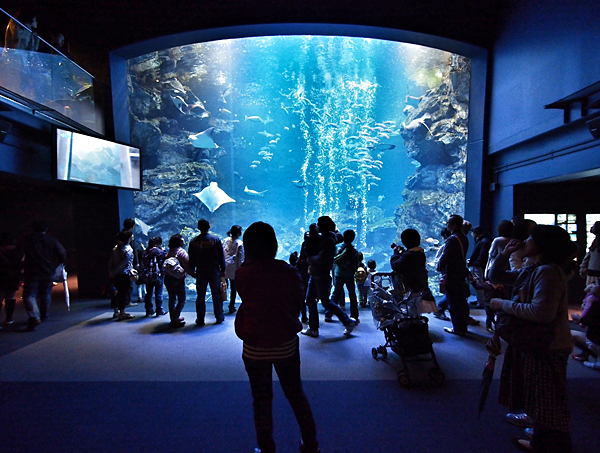
Kyoto’s aquarium, located in Umekoji Park, only opened in March last year. It’s a wonderful, new and shiny attraction that’s fun for kids and adults alike. We visited on a drizzly Sunday morning and the place was packed. Irregardless, we had a great time.

The aquarium’s main pool is thrilling. We and many other families whiled away a good portion of our visit staring up at all the fish and other aquatic life swimming around in this giant tank. T especially loved the sea animal zone and the fur seals that swim directly over and around you; the penguin zone; and the invertebrates area (he’s currently obsessed with jellyfish). We also enjoyed the dolphin show despite the fact that it was entirely in Japanese.

Getting to the aquarium is pretty easy. There are detailed instructions on this page here: http://www.kyoto-aquarium.com/en/access/index.html

kyoto-kids-kiyomizudera-1 kyoto-kids-kiyomizudera-2

Kiyomizudera Temple area

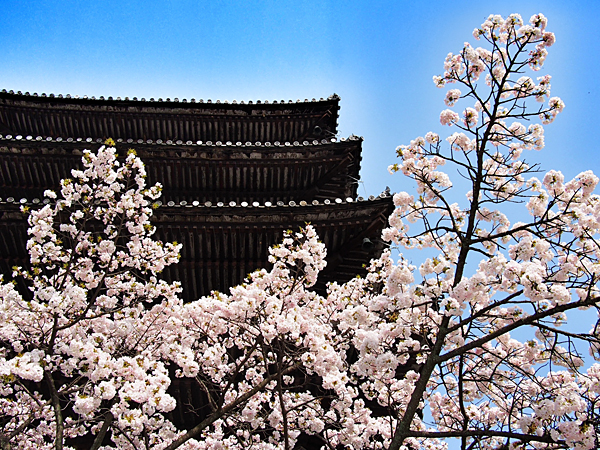
This is one of Kyoto’s cutest little areas. A small hilly tourist enclave, with one of the city’s most beautiful temples as its focal point, S and I have always loved coming here and checking out all the food shops, handicraft shops, cafes, and souvenir shops. Seeing this fun neighbourhood through T’s eyes made the experience all the more enjoyable.

This area is also home to several of the most famous cherry blossom viewing spots in Kyoto, so it was understandably packed when we visited. But the sakura were truly breathtaking and both mama and baby were thrilled by the view. T was even happier when we gave him a taste of some sakura soft serve ice cream I had bought for myself. In fact, he liked it so much he refused to give it back to me, shoving as much as he could into his face and down his little gullet.

I’ll be following this post up tomorrow with some recommendations for eating around Kyoto with really young kids. So please stay tuned.

The post Travelling with the toddler to Kyoto, Japan, Part 1 appeared first on Chubby Hubby.

24 Apr 21:31

Deep Fried Chicago: Bangers & Lace

by Joe Roy
Timmy the Tooth

That hot dog looks seriously fucking good

From Chicago

20130422-249311-deep-fried-chicago-bangers-and-lace-chorizo-deviled-eggs.jpg

[Photograph: Joe Roy]

I've been on notice for quite some time that Bangers & Lace in Wicker Park puts out exceptional sausage. But it wasn't until recently that I took the time to look over the rest of the menu. Turns out their deep frier is also put through its paces—so much so that I had to be extra selective on a recent visit. It's not often that a restaurant deep fries more than this column can handle, but any time my hot oil cup runneth over is a win win for everyone.

To be honest, I expected the Chorizo Deviled Eggs ($5.00)—essentially a deviled scotch egg with some chorizo tossed in for good measure—to be way over the top. I was pleasantly surprised, though, by its subtlety. Save the addition of deep fried crunch from the breading, the dish plays it straight, with the chorizo's presence a mere whisper. A little more salt would perk things up a bit, but paired with a few beers, I doubt you'll notice.

20130422-249311-deep-fried-chicago-bangers-and-lace-po-boy.jpg

The Po' Boy ($11.00) is a rather inspired take on the New Orleans staple. At its core, a po' boy is about spotlighting incredibly fresh and lightly breaded seafood, frills and distractions notably absent. Taking that idea and grinding it into the sausage context, the sandwich features two pucks of roughly chopped and beer battered seafood, with large chunks of sweet shrimp carrying most of the flavor. A buttery top-split bun, borrowed from the East Cost, provides the base, while shredded iceberg, thinly sliced red onion, and a guacamole-like remoulade/aji all do a great job staying the hell out of the way of the seafood main event.

Overabundance of fried items or not, I can't think of any way I could've justifiably avoided the Foie Gras Corn Dog ($13.00). And once I got over the sticker shock of what were essentially two concession stand sucker sized fried orbs, I'm so glad I made the plunge. Although the foie is wrapped with both flavorful garlic sausage and brioche corn breading, its rich flavor dominates in the best way possible. The fig preserves and brown butter caramel were so good I contemplated taking the leftovers home in a doggy bag. One word of advice: be sure to eat this as soon as it gets to the table, as the molten foie center quickly renders the stick handles moot.

20130422-249311-deep-fried-chicago-bangers-and-lace-chili-cheese-dog.jpg

The show stealer by a wide mile, the Chili Cheese Dog ($6.00) tastes even prettier than it looks. Housed in the same bun as the Po' Boy, the uncured hot dog, sausage chili (with actual rounds of cured sausage!), sour cream drizzle, and vibrantly pickled red onions work together to create the best non-traditional chili cheese dog I've ever tasted. Too bad the cheese curds, the dish's only fried component, were as lackluster as they were puny. Nevertheless, they were barely missed, and I'd order this dish again in a second, with or without curds.

With at least four more fried items on the menu to try, it looks like a follow up trip to Bangers & Lace is well in order. I'm looking forward to sampling the rest—especially the Crispy Corn Nuts—if I can tear myself away from the Chili Cheese Dog, that is.

Bangers & Lace

1670 W Division Street Chicago, IL 60622 (map)
773-252-6499
bangersandlacechicago.com

24 Apr 17:30

British Bites: Salmagundi

by Sydney Oland
Timmy the Tooth

Looks delicious.

20130424-248726-salmagundi.JPG

[Photograph: Sydney Oland]

Salmagundi is more of a concept than a recipe. Essentially, it is a large composed salad that incorporates meat, seafood, cooked vegetables, raw vegetables, fruits, and nuts and is arranged in an elaborate way. Think of it as the British answer to Salad Niçoise.

Dating back to the seventeenth century, salmagundi refers to the large assortment of ingredients that give the diner a large range of flavors and textures on one plate. But it's also, in true British form, a way to use leftover roasts and vegetables in a new, striking way. The meal-sized salad is normally served for lunch or as part of a picnic.

While I have included recipes for an assortment of ingredients to serve in your salmagundi, don't feel inhibited. Use what is fresh, or what you have in the fridge, or what you feel like eating at that moment. Just make sure to include a wide variety of ingredients and plate the dish on a large serving platter, for the best first impression when you place your salmagundi on the table.

About the author: Sydney Oland lives in Somerville, Mass. Find more information at sydneyoland.com (or read eatingnosetotail.com)

Get the Recipe!
24 Apr 17:29

Suarez banned for 10 games over bite

Timmy the Tooth

Overbite?

Liverpool striker Luis Suarez is banned for 10 matches by the FA for biting Chelsea defender Branislav Ivanovic.
24 Apr 02:41

Roasted Stuffed Artichokes with Mint Oil from 'The New Persian Kitchen'

by Kate Williams
Timmy the Tooth

I would try this, if I had a girlfriend. :^(

042313-249100-cook-the-book-roasted-stuffed-artichokes.jpg

[Photograph: Sara Remington]

It took me a long time to come around to the prickly artichoke. For the longest time, this vegetable seemed like too much work for too little food—there's peeling, scraping, poking, and snipping involved in most preparations. But in the last few years, I've come to appreciate the slow process as well as the slight grassy sweetness of the heart and the meditative undertaking of eating the flesh off the tiny leaves.

Louisa Shafia's stuffed artichokes recipe in The New Persian Kitchen adds another couple layers of greatness to the humble artichoke. To the center she adds a subtly fragrant and fluffy ricotta, egg, and saffron filling that puffs and browns over a long slow roasting time. Drizzled atop is a brilliant mixture of lemon juice, dried mint, and grape seed oil that permeates the delicate leaves a reduced sauce in the pan perfect for greedy dipping and slurping.

Why I picked this recipe: Artichokes are coming into their prime right now. What better way to eat them than stuffed with a warm, fluffy ricotta mixture and doused with a tangy lemon-mint oil?

What worked: This recipe represents artichokes at their best.

What didn't: My artichokes were on the smaller size, and so I had enough filling to stuff at least three, if not four, of them. They also needed only an hour of roasting time to turn tender.

Suggested tweaks: You could certainly play with the flavors in the ricotta mixture if you'd like; fresh mint would be a lovely counterpoint to the dried herb in the sauce.

As always with our Cook the Book feature, we have five (5) copies of The New Persian Kitchen to give away this week.

About the author: Kate Williams is a freelance writer and personal chef living in Berkeley, CA. She is a contributor to The Oxford American, Berkeleyside NOSH, and blogs at cookingwolves.wordpress.com.

Get the Recipe!