Shared posts

15 May 17:39

5 of the Least Expensive Cars to Own

by Mary Hiers
Timmy the Tooth

Civic SI is pretty sweet!

Just because the sticker price on a car is low, doesn’t mean that car is automatically a good deal.

Remember, that’s simply the price you pay to own the car.

It does not take anything else into account – cost of repairs, average fuel cost, average insurance premiums, and so on and so forth.

When you’re looking for a cheap, economic vehicle, you need to look at the entire picture. Cost alone means little. Cost-to-own means everything.

Recently, Consumer Reports came out with a comprehensive analysis of the most and least expensive cars to own over a five-year period.

Very likely, none of you need nor want an expensive car, so let’s just focus on the cheap.

Here are five cars of varying sizes that, according to Consumer Reports, you can operate for five years for under $35,000.

Toyota Prius C Two ($24,600, Subcompact)


Least expensive cars to own

The smaller a car is, the cheaper it’s bound to be, and the Toyota Prius C Two is no exception.

A subcompact hatchback, the Prius C Two is not the best car for comfort or looks (it can get rather cramped in there, plus the engine is a tad noisy), but if your goal is to have something cheap to get you from here to there, this is perfect.

It’s reliable, gets 43 MPG, and won’t require frequent trips to the mechanic.

Toyota Prius Four ($28,200, Compact)


Least expensive cars to own

For just a few thousand dollars more, you could ride with a Prius Four, which is a much better ride than the C Two – roomier, more comfortable, quieter, and it just might have better MPG as well.

Going to the highway could net you upwards of 55 MPG, and if you get the hybrid model, electricity could boost that number to an absurd 67 MPG.

Toyota Camry Hybrid XLE ($31,800, Midsized Sedan)


Least expensive cars to own

Now we’re getting bigger, and therefore more expensive. However, $31,800 over five years is still not at all a bad deal.

The price tag goes up mainly due to a lower MPG (26-38 MPG) depending on what kind of engine you get, along with slightly less reliability than before.

But we’re still not even close to Jalopyville here, thank goodness.

Subaru XV Crosstrek Premium ($34,200, Small SUV)


Least expensive cars to own

Yes, even an SUV can cost very little to operate, despite all you’ve heard.

For just over $34,000 in a five-year span, you could be driving a Subaru.

It’s not the comfiest ride ever, and you might be sending this one to the repair shop a tad more often than you’d like after the first year, but there’s nothing too major to worry about here.

Besides, for an SUV, getting 26 MPG is a small miracle.

Honda Civic Si Manual ($34,800, Sporty)


Least expensive cars to own

Finally, we have a sporty car that just slips under the $35,000 barrier that separates the bargains from the ripoffs.

The Honda Civic Si Manual is, quite obviously, a manual vehicle, which helps drive down the cost to own automatically.

In addition, this car actually boasts better gas mileage than the last couple of cars on this list, at a cool 29 MPG.

Still, a bigger car means bigger sticker price, and the Civic Si is no exception. But if you’re in the market for a good, economic sporty car, this might be the perfect one for you.

15 May 17:24

Marlon King jailed for 18 months for dangerous driving

Timmy the Tooth

18 months for a car accident which broke a woman's arm. He was eating an ice-cream cone and driving. He does have 15 prior convictions but still. Wow.

Marlon King, the former Barclays Premier League striker, has been sentenced to 18 months in jail and banned from driving...
14 May 21:52

Dyke condemns Scudamore sexist email remarks

by PA Sport
Timmy the Tooth

Naturally...

Premier League news
12 May 16:45

The Food Lab: The Hard Truth About Boiled Eggs

by J. Kenji López-Alt
Timmy the Tooth

The most comprehensive article ever written about how to boil an egg.

It's time for another round of The Food Lab. Got a suggestion for an upcoming topic? Email Kenji here, and he'll do his best to answer your queries in a future post. Become a fan of The Food Lab on Facebook or follow it on Twitter for play-by-plays on future kitchen tests and recipe experiments.

20140430-peeling-eggs-10.jpg

A perfect hard-boiled egg: clear yellow yolk and smooth, tender white, all peeled perfectly. [Photographs: J. Kenji Lopez-Alt]

Back when I was a lowly line cook at a fancy-pants restaurant in Boston, as the new guy*, it was my job to wake my butt up at the crack of dawn to come in early and prep breakfast whenever one of the Beacon Hill politicians wanted to impress their campaign funders with boozy waffles and perfectly soft-boiled eggs topping their asparagus. In those days, I used the brute-force method of getting perfect boiled eggs: I boiled at least three times what I needed, knowing that at least half of them would stick to their shells and turn into egg salad sandwiches for family meal.

*Let's just call it like it is: I was the kitchen bitch.

Since then, I've had a bit of time to reflect and refine my methodology. The secret to peeling hard boiled eggs? Well "secret" might be a bit of an exaggeration. Here's the truth: there is no 100% fool-proof method, and anybody who tells you different is selling something. And I do believe I've tried them all, many, many times over. The number of eggs I've boiled over the last several years in carefully controlled circumstances numbers well into the thousands, but despite that, the best boiled egg I cooked this year is no better than the best boiled egg I cooked twelve years ago in that Beacon Hill kitchen.

That said, a bit of the old scientific method has helped to greatly increase my success rate. Finding the hard truth about boiled eggs was a tough case to, er, crack.* I can now pretty routinely produce perfectly boiled eggs with clean-peeling shells, and you can too!

*sorry, I just can't help myself!

Want the tl;dr version? Here you go. This is all you need to know:

20140430-peeling-eggs-16.jpg

Lower your eggs into already-boiling water, or place them in a steamer insert in a covered pot steaming at full blast on the stovetop. If boiling, lower the heat to the barest simmer. Cook the eggs for 11 minutes for hard or 6 minutes for soft. Serve. Or, if serving cold, shock them in ice water immediately. Let them chill in that water for at least 15 minutes, or better yet, in the fridge overnight. Peel under cool running water.

No baking, no pricking, no tricks, no gimmicks, that's it.

But of course, there's still a lot of eggsplaining to do.

This is not the first time I've explored boiling eggs, but this time I went all-in with dozens and dozens and dozens and dozens of eggs to get to the bottom of what really makes them tick.

Bear with me.

Old vs. Young

The age of an egg does make a difference, but only when the eggs are super fresh: freshly laid eggs are more likely to stick to the shell. In the U.S., eggs can sit for up to 30 days before being packaged, and the sell-by date can be a further 30 days after that, which means that most likely, the eggs you're getting at the supermarket are old enough that no further aging at home should be necessary. Still, it certainly doesn't hurt to look for a package with the closest expiration date.

If you're buying your eggs direct from the farmer or you keep a couple hens out back, then you may want to let your eggs sit around for a couple of weeks before using them for boiling. (And if you want to cook those super-fresh eggs, might I recommend poaching them using our foolproof method? It's almost a shame to do anything else with them!)

Much more important to the end result is the way in which the egg is cooked.

Hot or Cold Start?

More than any other factor, the thing that made the most difference in how cleanly eggs released from their shells was the temperature at which they started: A hot start produces easier-to-peel eggs. And it doesn't matter whether that hot start is in boiling water or in a steam-filled pot or pressure-cooker. They're all strikingly easier to shell than those started in a cold pot.

20140430-peeling-eggs-07.jpg

Starting eggs in cold water greatly increases the chances of shell sticking.

Even with two-week-old eggs, starting cold resulted in eggs that had just over a 50% success rate for clean peeling. Eggs started in boiling water or steam came out well above 90%. I don't have a fully satisfactory answer for this phenomenon, but my thoughts are that it's somewhat like cooking a steak in a skillet. Add the steak to a cold pan and heat it up slowly, and as proteins coagulate, they bond with the metal, becoming nearly inseparable. Heat that steak fast, however, and the proteins bundle into themselves, instead of sticking to the metal. Slow-cooked egg whites bond more strongly with the membrane on the inside of an egg shell.

You might notice that this goes almost exactly against the advice I gave four years ago in my very first Food Lab column. Back then, I did not know what I do now. Back then, I recommended starting eggs in cold water and bringing them up to a simmer with the water, the idea being that they'll cook more evenly with a slow start. This is true: eggs started slow will have more tender, evenly cooked whites.

Why is that? It's because in rapidly boiling water, the exterior of an egg will cook much faster than the center.

Take a look at these eggs, which were cooked in fully boiling water for times ranging from 1 minute to 15 minutes:

09242009-egg-boiling-timing.jpg

As you can see, not one of them is a perfect hard-cooked egg: the eggs go directly from having slightly translucent centers to having rubbery whites.

Here's what happens when an egg white cooks at a raging, full-on boil:

09242009badhardegg.jpg

  • From 30 -140 degrees: As it gets hot, its proteins, which resemble coiled up balls of yarn, slowly start to uncoil.
  • At 140 degrees: Some of these uncoiled proteins—called ovotransferrin—begin to bond with each other, creating a matrix, and turning the egg white milky and jelly-like (like the innermost layers of egg white in the 3-minute egg above).
  • At 155 degrees: The ovotransferrin has formed and opaque solid, though it is still quite soft and moist (see the white of the 5-minute egg).
  • At 180 degrees: The main protein in egg whites—ovalbumen—will cross-link and solidify, giving you a totally firm egg white (see the whites of the 7 and 9 minute eggs). This is very similar to the gunk that seeps out of the surface of overcooked salmon.
  • 180 degrees-plus: The hotter you get the egg, the tighter these proteins bond, and the firmer, drier, and rubbier the egg white becomes (the 11-15 minute eggs). Hydrogen Sulfide, or "rotten-egg" aromas, begin to develop. Ick.

Egg yolks, on the other hand, follow a different set of temperatures:

  • At 145 degrees: They begin to thicken and set up.
  • At 158 degrees: They become totally firm, but are still bright orange and shiny.
  • At 170 degrees: They become pale yellow and start to turn crumbly.
  • 170 degrees-plus: They dry out and turn chalky. The sulfur in the whites rapidly reacts with the iron in the yolks, creating ferrous sulfide, and tinging the yolks.

Thus, for perfect hard-cooked eggs, you want whites that don't cook much beyond 180°F, and yolks that have just hit 170°F throughout. Cooking relatively gently allows for this, but easy peeling requires a full 212°F blast of heat.

So how does one cook easy-peeling eggs that also have relatively tender whites? There are a couple of options. If you're boiling, you can plunge your eggs into boiling water, let them boil for 30 seconds or so just to set the exterior of the whites, then drop the temperature and finish them off at around 180 to 190°F (a very low simmer). You end up with eggs that are easy to peel, with tender whites throughout.

20140430-peeling-eggs-03.jpg

Steaming eggs cooks them more gently than boiling, making them less likely to crack or explode, and less likely to turn rubbery.

With steam, there's no need to lower the heat—steam's relatively lower density means that steamed eggs actually cook a little more gently than boiled eggs. Your whites will be ever-so-slightly tougher than with simmered eggs, but not enough to be off-putting. The gentleness of steam and the ability to load up a steamer insert and lower it gently into a pot also has the advantage of reducing your chances of shells cracking and whites leaking out.

Finally, steaming your eggs has the advantage of being the fastest method around: instead of waiting for a pot of water to come to a boil, all you need to do it boil a half inch of water. Throw your steamer insert in, cover the pot, set your timer, and you've got perfectly cooked eggs.

What About the Pressure Cooker?

Yeah, what about it?

For a while now, I've been reading about cooking eggs in a pressure cooker. Those articles promise you a magic bullet: cook your eggs at low pressure in a standard pressure cooker, and they'll practically jump out of their shells.

But here's the thing: I couldn't find a single source that actually tested that hypothesis in a controlled, scientific environment, and all the anecdotal evidence in the world is not worth the pixels it's written with when confronted with strong scientific evidence.

So I tested the pressure cooker method, multiple times with multiple eggs in each batch, using different pressure cookers, different timings, and different cooling methods. Dozens and dozens of eggs in total. Not only that, but I tested it side-by-side with boiled and steamed eggs, and to get really scientific about it, I went double-blind, with one test administrator (who did not know which eggs had been cooked by which method) handing cooked eggs in random order to a third party who peeled them all (also with no knowledge as to the cooking method for the eggs he was peeling). All of the eggs were rated on ease of peeling (1 = easiest to peel, 10 = most difficult), and were observed for surface damage after peeling.

Guess what? There is absolutely zero correlation between cooking eggs in a pressure cooker and ease of peeling. In fact, depending on how long it took to bring the pressure cooker to pressure, eggs cooked in one actually showed a slight negative correlation!

There's an even more nefarious problem: Even when timed perfectly, the pressure cooker produces slightly rubberier whites than other methods.

Here's the thing: Pressure cookers cook hotter than steaming or boiling—even at low pressure they hit temperatures in excess of 220°F. And the hotter something cooks, the greater the temperature differential between the center and the edges.

Pressure-cook your eggs for six minutes to get perfectly hard-cooked yolks, and the outer layers of your whites end up tough. At least, tougher than equivalently steamed or simmered eggs.

20140430-peeling-eggs-12.jpg

Pressure cooked for five, six, and seven minutes.

The bigger issue is that pressure-cooker eggs have a smaller window of perfection. With a stovetop simmered or steamed egg, the difference in end results between 10 minutes of simmering versus 11 minutes is not that great. With a pressure-cooked egg and its rapid cooking, however, the difference a minute makes is huge. At five minutes, the yolks are still translucent yellow. At six minutes, the yolks are tender and just set. At seven minutes, you've already started to develop the dreaded green tinge.

My advice? Save the pressure cooker for things that it actually improves or makes faster. Eggs ain't one of 'em.

Out of the Pot and Into the Oven

The other method that seems to be getting a fair bit of play recently is cooking eggs in the oven. Now, nobody wants to heat up the oven just to make a couple of eggs for breakfast, but what if you're making deviled eggs or breakfast for a crowd? Heating an oven to cook a few dozen eggs seems like it might be a swell idea.

Alton Brown (a generally trustworthy guy) recommends placing eggs on a moistened towel directly on an oven rack in a cold oven, then setting the oven to 320°F and coming back 30 minutes later.

Even before I tested the method, alarms were going off in my head. Recipes that call for cooking in an oven while its temperature is in flux (either starting cold or turning off in the middle) are never reliable. Ovens on their own are bad enough—most home ovens swing their temperatures by as much as 50°F above and below their set temp (assuming they were calibrated well to begin with). To add the confounding variable of how efficiently your specific oven heats or cools on top of that is asking for trouble.

20140430-peeling-eggs-18.jpg

What may work perfectly in one oven probably won't in another. The method certainly didn't work in mine. One batch heated too quickly and came out with dark spots on the shell and a pale brown color to the white. For a second batch, I lowered the cooking time and managed to get eggs that looked ok when split open, but they were a bitch-and-a-half to peel, which makes sense. Remember: cold start = harder to peel eggs. It doesn't matter if it's in the oven or in a pot of water.

Ovens are inherently unreliable because there is no physics-based indicator or limiter of heat. A pot of simmering or steaming water, on the other hand, is reliably at the same temperature (assuming constant atmospheric pressure), which means that no matter whose kitchen I'm in and no matter how powerful their stovetop burner, so long as I can boil some water, my eggs will cook reliably time after time.

When cooking eggs in large numbers, I'll stick with the steamer and cook my eggs in batches if I have to rather than play Russian roulette with the oven.

A Simple Cure for the Dimple

Does anyone else get bothered by the dimple created by the air space in the fat end of the egg? I sure do. The problem is that the older the egg is, the bigger that air space gets. This means that the eggs that are most suitable for boiling also happen to come out the ugliest,* and nobody wants to be that guy who serves the deformed deviled eggs.

*I'm sure there's some parallel to be drawn here between the kinds of people who are having babies and the kinds of people most suited to raising babies, but that's another subject for another time.

20140430-peeling-eggs-01.jpg

A pin-prick in the fat end can help remove the air bubble... when it works. But we have a better way.

If you're to trust Jacques Pepín (and I usually do!), solving this problem is as simple as pricking the fat end of the egg with a pin. This allows the air inside to be pressed out rapidly as the egg cooks, leaving you with a completely smooth egg. Usually.

But occasionally, you end up with this:

20140430-peeling-eggs-08.jpg

This is what can happen with pricked eggs.

Instead of creating a prettier egg, things can go sour when boiling water enters your egg, creating these strange, deep craters. Wouldn't it be great if there were a more foolproof method of getting rid of those dimples?

As it turns out, there is, and it was one I discovered completely accidentally.

See, I came in early one morning to start boiling eggs before the office filled up with coworkers and distractions. I'd gotten through three dozen test runs, working in six-egg batches and testing various combinations of cooking temperatures, cooking methods, and cooling methods. When I started shelling those eggs, I noticed that despite the eggs all coming from the same origin, some batches of six had perfectly round bottoms, while others had dimples. What was the correlation?

20140430-peeling-eggs-05-text.jpg

Shocking in ice water can help remove the divot in a boiled egg.

Here it is: The eggs that I had immediately shocked in ice water after cooking came out full-figured and smooth, regardless of the initial cooking method, whereas those that I allowed to cool naturally had dimples.

Shocking!

My theory? When you pull the hot egg out from the pot, the yolk and white have yet to firm up completely (you can feel this when you try to peel a hot-from-the-pot egg compared to an egg that has rested or cooled a bit). By shocking it, you very rapidly cause the steam that has built up inside that air pocket to convert to water, instantly dropping to about .5% of its original volume. The still-malleable boiled egg moves in to fill its place.

Let the egg cool slowly, on the other hand, and by the time that steam has cooled sufficiently, the egg is already basically set in its shape. Instead of the egg moving in to fill that space, air is drawn in through the egg shell.

Further testing is needed to prove the theory, but it sounds pretty legit to me, and the practical effects on appearances are undeniable. Shocked eggs also have a slightly higher success rate for peeling.

Time to Peel!

One last factor that improves your chances of a successful peel, and it's a major one: make sure to chill your eggs completely. I mean let them sit in that ice bath for at least 15 minutes, or better yet, let them sit overnight in the fridge. The cooler the egg is, the firmer and tighter its structure will be, and the less likely is it to develop craters when you pry off the shell.

Chilling eggs overnight reduced poorly-peeled-egg count by a further 50% compared to those peeled after a few minutes of shocking (or even worse, straight out of the pot).

Sure, sometimes you want to serve your hard boiled eggs hot. My advice for those times? Serve them in the shell so that if they don't peel well, it's your guests who will feel inadequate. This is a good strategy for instilling a bit of insecurity and fear in them before a brunch-time debate over politics or religion.

20140430-peeling-eggs-04.jpg

Crack your egg all over before starting to peel.

Before I start to peel my eggs, I crack them gently all over their surface, starting at the fat end and gently rotating and tapping all around. I don't use the roll-it-against-the-counter method, as I've accidentally squashed too many eggs with my ham-hands that way.

The many cracks makes it easier to gently peel away the shell under running water.

20140430-peeling-eggs-02.jpg

Peeling under running water is the way to go, and yes, I forgot to shock this one.

When I've got a bunch of eggs to peel, I'll place either a fine mesh strainer or the insert of a salad spinner in the sink under the tap and peel the eggs under the flow, letting the shells drop down into the strainer below for easy cleanup afterwards.

20140430-peeling-eggs-10.jpg

And that's about all there is to it. Start with old eggs, cook them hot (but skip the pressure cooker), chill them rapidly and completely, crack all over, and peel under running water.

Another Food Lab article, another 5,000+ words on a subject that probably only really needs 10, but what are humans if not voraciously curious and insatiably wasteful? At least this time around there was only two egg puns. But it was an egg-ceptional one. D'oh!

P.S. For the record, baking soda still doesn't make any detectable difference.

About the author: J. Kenji Lopez-Alt is the Chief Creative Officer of Serious Eats where he likes to explore the science of home cooking in his weekly column The Food Lab. You can follow him at @thefoodlab on Twitter, or at The Food Lab on Facebook.

Recipes!

09 May 17:34

Opening today: Fed Up! See it!

by Marion
Timmy the Tooth

You probably won't see this.

This ad was in last Sunday’s New York Times.  It appears again today with blurbs added.

Full disclosure: I’m one of the many people interviewed for the film and appear in three 10-second clips.

Fed Up! is a stunningly hard-hitting exposé of the food industry’s role in promoting unhealthy diets and childhood obesity.  It spares nothing in showing the devastating effects of obesity on kids (I found those parts painful to watch).

The film’s main message is that the food industry, in collaboration with government, is responsible for creating a food environment that promotes poor health.

It is especially tough on food company marketing and industry-sponsored research.

It is also—I think, unfortunately—tough on Michelle Obama and her Let’s Move! campaign.

Mrs. Obama is not the problem.  The food industry’s marketing and co-opting practices are the problem.

We can debate whether it was wise or useful for Let’s Move! to partner with the food industry, but the campaign has done much to bring issues of childhood obesity to public attention.

It’s ironic that the accomplishments of Let’s Move!—the White House garden, the Healthy Hunger-Free Act of 2010, the new school food nutrition standards, the new nutrition standards for WIC, and the new food label, for example—are at this very moment under fierce attack by food companies, their trade associations, and their friends in Congress.

With that said, the film is well worth seeing.  Don’t miss it.  Get your friends to see it.  Let the debates begin.

How to see Fed Up!

  • Watch the trailer here.
  • Find out where it’s playing here.
  • Share it on social media here.
  • See Katie Couric’s excellent ABC News interview here.
  • Read the New York Times review here.

As for the debate, please enjoy:

Additions

07 May 18:38

Hungover Bear and Friends: Not All There by Ali Fitzgerald

- -

07 May 17:24

£9,850 fine for banana throw racism

Timmy the Tooth

See... that's how you deal with racism in Spain, a little fine.

Villarreal are fined €12,000 (£9,850) by the Spanish Football Federation after a fan threw a banana at Barcelona's Dani Alves.
05 May 17:35

A Single Guy’s Date Story as Interpreted In the Mind of His Married Friend by Colin Nissan

Timmy the Tooth

100% true.

She was kind of cute. Not totally my type, but not bad.

Brazilian model. Continue.

I met her online, which, I still kind of feel weird about for some reason.

Yeah, I hear you. It must feel weird having the Internet set you up with beautiful, sex-starved women. Sounds really weird. But if you think about it, life’s weird. For example, this morning I watched my wife struggle to take her night guard out of her mouth. So that was weird. And wet. So wet.

We texted back and forth trying to make a plan.

YOU: Here is a picture of my genitals.
HER: Thank you, and here is a picture of my genitals.

Eventually we met at a bar. The only problem was she didn’t drink, so that was kind of a lame.

She was already super buzzed and horny when she got there.

We honestly didn’t have all that much in common. We just couldn’t seem to get into any kind of rhythm conversation-wise.

But you didn’t care because this wasn’t about having things in common; it was about two people fulfilling their basic animal instincts to explore each other’s bodies in a way one could never do with someone he’s been with for eight years, someone who sucks her teeth and mocks his shirts.

Then, get this: she started telling me about her mother who has cancer. Ugh, it was so heavy, man. I mean, I felt bad for her, but such a bummer for a first date.

She handed you a condom under the table.

Eventually we left and just shared a cab. Her place was on the way to mine, so I was just going to drop her off.

The back seat of the cab was dark, her horny face bathed in red from the taillights ahead. You both let out a nervous giggle as a sharp turn of the cab brought your bodies together. “Whoops,” she said. “Whoops,” you replied, wishing you’d used a different word than the one she just used. But it didn’t matter. It was on.

When we pulled up at her place, we kissed goodbye. I’m not even sure why, honestly, I wasn’t even feeling it.

Those beautiful strange lips touched yours, so unfamiliar, so different than a routine pursed peck every morning. This kiss had life. Emotion. And her breath smelled sweet, like boobs.

That’s when things took a really weird turn. She actually started crying, like sobbing uncontrollably. It was so crazy. I was like, um…

She couldn’t bear it any longer. The release of all that horniness poured out of her in the form of tears. It can do that.

So I went upstairs with her just because I honestly didn’t know what to do. I couldn’t leave her like that. Thankfully her roommate came home a few minutes later. He turned out to be a super nice guy and kind of defused the situation. I could tell he’d been through this with her before.

Her FEMALE roommate came home. Also horny. Also hot. Also a Brazilian model who works for the same agency, that’s how they met. SHE walked in and said, “Well what do we have here?” Your date replied, “Don’t worry, there’s plenty of him to go around,” then they winked at each other and started kissing, then kissing you, then each other again. Eight hours of twelve-limbed lovemaking ensued, leaving the three of you an exhausted sweaty heap on the bed as the morning sunlight streamed in. Then they made you pancakes. Delicious, fluffy, blueberry pancakes. GOT IT?

Overall, total nightmare.

No it wasn’t.

Dating isn’t what it’s cracked up to be, man. You’re lucky you don’t have to do this crap.

Yes it is. It is what it’s cracked up to be. Don’t do this.

I can’t remember the last time a date was either normal or just no-strings-attached sex. There’s always something complicated or weird about it.

You shut your mouth, you shut your dirty lying mouth and stick to the story, do you hear me? You stick to the story!

Oh and get this, she’s still texting me, like, every day. I don’t know what to do, it’s kind of freaking me out. I might have a stalker on my hands.

You’re a terrible friend. A terrible, selfish friend. You have vicarious responsibilities. You know you do! And you’re blowing it!

Anyway, I do have another date with a new girl tonight. Could be a fun one, actually. We’ll see.

Well. Now, that’s better. That’s much, much better. I look forward to hearing a detailed report on your evening with this lovely Dominatrix. I think I shall call her “Mistress Bianca.”

05 May 17:08

In Holding Donald Sterling Accountable, ‘There Is More to Do’

by Dave Zirin
Timmy the Tooth

yes, like send someone to Spain to sort out the fans

Nation sports editor Dave Zirin, appearing on Al Jazeera America’s Consider This, discusses Donald Sterling’s ban and what should be done next.

05 May 17:05

Wenger: World Cup will affect transfer business

by arseblog
Timmy the Tooth

Facepalm...

Arsene Wenger

Arsene Wenger says that this summer’s World Cup will have an impact on the transfer business the club will do.

The tournament in Brazil will see most of the world’s top players in action, and that will hamper efforts to reinforce the squad. Quoted in the Mirror, the Arsenal manager said, “From my experience, the World Cup years have always been very quiet until the end of the World Cup, with no players reachable.

“Everybody is focused in the country on their national team and there’s not a lot happening. People are away. I believe this year again you will have to wait until July 15 to start going.

“You are not the only one who decides when the business is done because it’s down to availability of players and the clubs who sell decide that.”

But he did say expects to be active in the market once things get going, and is keen on retaining as many of the current squad as possible.

“It will be busy,” he said, “but the main thing for us will be to keep the stability because we feel we are close. We want to add something that makes us even stronger, but, number wise, it will not be massive.”

05 May 17:03

Knock knock

by Tim
Timmy the Tooth

What I did on Saturday.

After a Saturday morning of watching football and eating bacon, I took my six year old hiking. We were going to a waterfall called “The Cathedral”. A place where a short hike turns around...

[[ This is a content summary only. Visit my website for full links, other content, and more! ]]
05 May 17:03

Plain & Simple Golden Cake

by PJ Hamel
Timmy the Tooth

Perfect timing, Avie wants vanilla cupcakes for her birthday.

Why is it so difficult to make a plain-vanilla yellow cake?

Well, it shouldn’t be any more difficult than it is to make a chocolate cake, or most any other type of cake. After all, the steps are the same: mix ingredients, pour batter into pans, bake.

Chocolate cake always turns out pretty well; after all, it’s CHOCOLATE. But to make a GOOD vanilla cake – moist, tender, high-rising,and flavorful – well, that’s another story.

And I think I know why.

Most of us grew up enjoying cakes made from a mix. Starting in the 1950s and stretching right up to the present day, boxed cake mixes in the supermarket baking aisle have been as ubiquitous as oranges and bananas in the produce section. They’re a given.

Show me a grocery store – any store selling groceries, from Kroger to 7-Eleven® – without at least one box of Duncan Hines or Betty Crocker, and I’ll show you a store that’s missing the boat, demand-wise.

Birthdays. Potlucks. Bake sales. Team parties. Everyone needs to make a cake sometime, right? And for many, making a cake means heading right for the Pillsbury Funfetti®.

For those of us who actually enjoy the process of baking as much as its tasty end product, a boxed cake mix isn’t the answer. But neither is the dry, heavy, low-flavor cake a lot of the recipes out there on the Internet or in cookbooks yields.

The standard for a lot of us is the yellow cake Mom used to make. Which, judging by frequent discussions in the King Arthur Flour test kitchen among us test bakers, was made from a box – and was pretty darned good. Moist. Flavorful. Bright yellow.

So I set out to replicate that experience using a recipe, not a mix. I baked 13 cakes in four days, in hopes of hitting the exact right mix of ingredients that would yield yellow cake mecca: the flavorful cake of our collective memory.

At the end of the day, I don’t think I achieved that perfect childhood cake. But then, neither did Duncan, Betty, or the Doughboy – all of which I tested right alongside my recipe.

Here’s the story.

IMG_5611

To give myself a fighting chance at success, I figured I’d best start with our King Arthur Unbleached Cake Flour Blend.

Most cake flours (and the flours in boxed cake mixes) are bleached. The protein level of cake flour is low; you don’t want a lot of gluten toughening your tender cake. You do, however, need what gluten there is to be strong, in order to “carry” the high levels of sugar and fat in most cakes. Bleaching strengthens gluten.

So how does King Arthur Flour manage to produce a cake flour that works well without bleach? While the protein level of a typical cake flour is 6% to 8%, the protein level of King Arthur’s cake flour is 9.4% – just a bit higher. We’ve found this slightly elevated protein is sufficient to produce a cake that rises nicely, without adversely affecting its tender texture.

IMG_5698

Next, I decided to follow a typical cake recipe direction I usually ignore: have your ingredients at room temperature.

As it turns out, this DOES make a difference. I found that using eggs, butter, and milk straight from the fridge yielded a cake that didn’t rise as high, and wasn’t as fine-grained.

If you’re in a hurry, your microwave can be your best friend. Use it to take the chill off your milk; and to soften your butter. Thankfully, many microwave ovens these days have a “soften” setting, and it works well.

To warm cold eggs quickly, submerge them in hot water for 5 to 10 minutes.

IMG_5587

Next, use pans that are sufficiently deep to hold your cake. I like a 2″-deep cake pan; I never have to worry about the baking cake spilling over its edges.

Notice I’ve greased the pan, then lined it with parchment, then greased the parchment. Why hold your breath when turning your cake out onto a cooling rack, hoping like crazy it’ll pop out of the pan intact? Parchment guarantees a crumble-free cake.

OK, let’s get down to the recipe itself, shall we? While you’ll see me making two layers here, this Plain & Simple Golden Cake recipe actually make a single tall 9″ layer. The “extra” pans of batter you’ll see are tests – trust me, when you bake 13 cakes in 4 days, you don’t bake them one by one.

First, preheat the oven to 350°F. The batter for this cake goes together quickly, and you want to make sure your oven is fully up to temperature.

IMG_5613

Let’s start by whisking together the liquid ingredients:

1/2 cup milk
2 large eggs
2 teaspoons vanilla extract
1/4 teaspoon almond extract, optional

Next, whisk together the following:

1 1/2 cups (6 1/4 ounces) King Arthur Unbleached Cake Flour Blend
1 cup sugar
1 1/2 teaspoons baking powder
1/4 to 1/2 teaspoon salt; your preference
2 tablespoons Cake Enhancer, optional; for improved texture and moistness

“Cake enhancer”? You probably don’t keep it in your pantry, it’s true. But those 13 cakes I baked made me a believer: this product, which we discovered in Europe, yields cake that’s taller, lighter , and more reliably moist than cake made without it.

And at a cost of about 40¢ per cake, I think it’s worth it.

And how about that range in the amount of salt? I tend to like my baked goods a bit saltier, so settled on 1/2 teaspoon salt. But I know others of you prefer to cut back on salt, so feel free to use just 1/4 teaspoon, if you’re in this camp.

IMG_5592

Take 6 tablespoons of your room-temperature butter, and plop it down into the middle of the bowl of dry ingredients. You can cut the butter into pats first, or not; if it’s truly at room temperature, it won’t really matter.

vanilla2

Mix at low speed until the mixture is crumbly. Mix longer than you would for pie crust; you don’t want a lot of big chunks of butter remaining.

Add half the milk/egg mixture to the flour in the bowl. Beat just to combine, then add the remaining milk/egg mixture, beating just to combine.

vanilla3

Add 1 tablespoon freshly squeezed lemon juice,* if desired. Once everything is thoroughly combined, scrape the bottom and sides of the bowl, then beat the batter for 15 seconds at high speed; this will “fluff” it up a bit.

*Hey, I thought this was a vanilla cake – what’s with the almond extract and lemon juice? In trying to replicate the “box mix” we all seemed to love growing up, I found adding these elements, while they don’t contribute any identifiable lemon or almond flavor, do add to its “I don’t know what it is but I know I like it” flavor.

vanilla4

Spoon the batter into the prepared pan, smoothing it to the edges.

Bake the cake on your oven’s middle rack for 35 to 38 minutes, until a toothpick inserted into the center comes out clean, and the center of the top springs back when pressed lightly with your finger.

vanilla5

Here’s my first experiment: that’s a cake made with all-purpose flour on the left, cake flour on the right. The cake-flour cake rose higher, and showed a somewhat finer texture.

And here’s the next experiment:

vanilla1

Could I bake a cake as tasty and moist as the Doughboy’s… without the polysorbate 60, DATEM, and TBHQ?

IMG_5688

The answer is yes. While the boxed mix cake is definitely bright yellow (probably thanks to the Red 40 and Yellow 5 in its ingredient list), its flavor, texture, and moistness aren’t superior to my own homemade-recipe cake.

In fact, I did a blind taste test over Easter, using my extended family as the judging panel. No one chose the boxed cake mix cake as their favorite; and while a couple did prefer the cake made with all-purpose flour, the majority picked the cake made with cake flour.

The remaining tests I did aren’t easily pictured, as they all involve shelf life. I tried baking cake with and without Cake Enhancer; and then compared adding dry instant vanilla pudding mix to adding Cake Enhancer, figuring all the claims of “there’s pudding in the mix” must hold some water.

The pudding-mix cakes, compared to the Cake Enhancer cakes, stayed comparably nice and moist; but they were also heavier and denser, as well.

Score another one for Cake Enhancer.

IMG_5725(1)

At the end of the day, is this the best yellow/vanilla/golden cake you’ll ever bake?

Maybe. Maybe not. Depends on your own particular palate, and the “memory cake” you’re trying to match.

I’d love the cake to have more assertive vanilla flavor. And I tried to accomplish that by brushing it with a vanilla-water “glaze” 5 minutes before taking it out of the oven – an extra step that, surprisingly, made NO difference in taste. So, I’m still thinking about this angle.

But the light texture? The moistness? I think the cake passes muster in those departments. Surprisingly, letting the cake rest overnight (covered with a cake cover) enhances its texture; I found it a tiny bit dry the first day, nicer the second.

Eating this cake plain, you might think it’s a bit less sweet than it might be. I’ve deliberately made it that way, assuming most of you will be topping it with icing, or fruit and whipped cream, or a glaze of some sort – if only a blizzard of confectioners’ sugar.

And what if you want to bake a double-layer birthday cake? Simply double the recipe.

Finally, can you make this cake with all-purpose flour? Of course. It’ll simply be a bit heartier.

So, there you have it – a baker’s dozen experiments, all leading to a couple of simple tips.

Cake flour and Cake Enhancer make a soft and tender, fine-textured, moist cake. And a combination of simple flavors – vanilla, almond, lemon – add depth to the cake’s taste.

Are you ready to test this recipe against your own favorite-memory cake?

Please read, bake, and review our recipe for Plain & Simple Golden Cake.

Or print just the recipe.


05 May 16:59

Arsenal 1-0 West Brom: match report

by 7amkickoff
Timmy the Tooth

Match report.

giroud

Arsenal hosted West Bromwich Albion today at the Emirates stadium and with both teams secure in their places in the table the match felt more like a slumber party than a football match.

It took 16 minutes but Arsenal were the first to wake from their sleep when Cazorla’s corner found Giroud’s head and the ball found Mulumbu’s leg before finding the net. It was a dream start and Arsenal’s 8th goal from a set play this season. Liverpool have 23 goals from set plays and Man City have 19. That’s not counting penalties. Counting penalties Arsenal have 11 goals from set plays, Liverpool 33, and Man City 25. I say that for no other reason but to make you angry and because I am 7amkickoff, this is what I do.

Up 1-0 and slumbering through the game, West Brom nearly woke Arsenal in the 32nd minute when Dorrans the Explorer took a wicked shot from outside the box. The ball dipped right in front of Szczesny and he spilled the ball right to the onrushing Berahino. Berahino’s shot found row z and he was spared blushes when the sideline official brought fourth the flag.

The game stirred for a minute after West Brom forced another turnover in Arsenal’s final third, this time on Özil, and Bearahino had a curling effort go straight to the same fans he just shot into. Maybe he hates those people? Maybe it’s a message? Dreams are often hard to interpret.

Arsenal responded with a quick counter. Koscielny tackled the ball away, Flamini cleaned up the garbage and played forward to Özil who spotted Podolski steaming in to the West Brom box, a neat little pass put the German in and his drag-back found Cazorla at the top of the box for a shot low and in the corner which was well saved.

From there, the game slipped back into a dream. Flamini and Sessegnon had a little talk after Sessegnon tackled his ankle instead of the ball. Flamini was angry but quickly realized a stupid foul would mean he missed the FA Cup final.  So, I think he asked Sessegnon nicely not to tackle his ankles or he will have to blind him.

Both teams peeked at the clock, 33 minutes gone, and decided to slap the snooze button.

The second half started the same as the first. West Brom stirred a bit in their pyjamas, scratched their nether regions and then rolled over.  Arsenal yawned and realized they should probably get up and brush their teeth.

Did I just see Özil sprinting back to cover on defense? His touch has been dreamy all day but covering on defense too?

Arteta gives way to Kallstrom amid great applause from the Arsenal crowd.

We have been informed that Loic Remy is watching in the stands, Mandzukic is rumored to be watching at home on TV, Draxler is listening to the game on the radio, and Diego Costa is going to read about the game in tomorrow’s paper.

Oh man, Özil just did this neat little dribble down the touch line. What was that? And a slide tackle? What is going on? I thought Arsenal were supposed to be asleep. Is it me? I did get up late.

Arsenal bring on Rosicky for Cazorla. More applause.

Özil is easily the man of the match here. He has a nice little shot, tried to be cute and chips it just wide. He plays in a cross for Giroud to head just wide. Podolski finds him with a through ball and he crosses to Olsson who passes to Podolski. Poldi hits the crossbar. Özil is everywhere. Özil is everything.

Nacho off, Vermaelen on. Amalfitano off, Anichebe on. We are informed that Anichebe likes to score against big teams.

Anichebe gives Arsenal a little scare, in the 92nd minute, backing his ample frame into Sagna and then turning to shoot. It took an intervention from Mertesacker to prevent a shot.

The contest comes to a close as Arsenal open one eye, roll over, and decide to have a lap around the kitchen. Searching for a cup of coffee, whilst whistling about “going to Wemberly”.

@7amkickoff

05 May 16:53

Spanish football hit by new racist row as Pape Diop accuses Atlético Madrid fans of racist chants

by Jimmy Pierce
Timmy the Tooth

Spain is fucking racist.

Levante midfielder Pape Diop accuses Atlético Madrid fans of monkey chants
05 May 16:52

Guess Who Cares For Young Adults When They Move Back Home

by Heather Krause
Timmy the Tooth

Uhhh... 30 minutes a month for men and 14 minutes a month for women with no kids. I'm guessing those dudes are bashing the bishop.

When my kids first left home, one of the things I enjoyed most was that I didn’t have to make any more school lunches. But today, in my home just as in millions of others, my 21- and 24-year-old kids are back, and I’m making lunches again. This is a big change from what I had expected my life to look like when my kids became young adults. Like many women of my generation, I invested a lot of time in parenting my children, with the unspoken assumption that they would enjoy the same independence and economic prosperity that I did as an adult. I expected that when they were in their 20s, I would be dining out, dropping off laundry at the dry cleaners and spending quiet weekends with my husband.

A record number of young adult children are living at home with their parents. In the U.S., 21.6 million young adults were living at home in 2012, according to a Pew Research Center analysis of U.S. census data. That’s 36 percent of all 18- to 31-year-olds, representing the highest rate since 1969, the first year that comparable data was available. This recently increasing trend began at the onset of the most recent recession in 2007. So I wondered: Is this affecting how parents are spending their time, the way it has affected me? And are women affected differently than men?

It turns out it’s not just me. According to an analysis of data from the American Time Use Survey,106 which asks a nationally representative sample of people to record how they spend their time every day, parents with 18- to 31-year-old children living at home are spending at least eight hours per week caring for them. That’s causing real shifts in the time they spend relaxing. (Their sex lives are also being affected.) And women are spending significantly more time taking care of these young adult children than men are.

It’s not news that women do more work around the house than men, or that women have less leisure time than men. What’s new is that the period of care is getting longer, even if it’s mitigated by the increased responsibility and independence of these adult children.

Using the survey data, I analyzed how adults between the age of 31 and 64 spend their time.107 In order to compare time use across different types of households, I looked at households with young children (under 18 only), households with young adult children (between 18 and 31) and households without children. I excluded households with children under and over 18 from my analysis because it’s not possible to separate how parents spend their time in relation to their different children. We also can’t determine whether childless households are comprised of parents of children who have left the home, or of people who never had children in the first place. To help resolve this, I compared weekly time use estimated for a typical 46-year-old adult, since that’s the average age of a parent who is equally likely to have a child under 18 or a young adult child.

The differences that women experience in household care, child care, personal care and leisure time are greater across the board compared to the differences men experience.

krause-feature-living-at-home-1

A woman whose children have left home can expect to spend 10.5 hours a week on household and child care. However, when those children don’t leave home, she spends 18 hours a week, on average, on those activities. A man, on the other hand, spends 5.5 hours on home and child care, whether he has adult kids in the house or not. In other words, women with adult children living at home spend, on average, eight more hours a week on house and child care, whereas men are unaffected.

Take laundry, one of the specific sources of time-use differences between men and women with children living at home. Women living with small or young adult children do almost three hours of laundry a week, while women without kids do closer to an hour and a half of laundry a week. Men, on the other hand, do about 30 minutes of laundry a week, regardless of whether they have kids — of any age — at home.

krause-feature-living-at-home-2

I found a similar trend when looking at leisure time. In broad terms, women spend less time in leisure than men. The difference in hours is significant. Men see bigger percentage increases of leisure time at each stage: from a household with kids under 18, to one with kids over 18, to one with no kids. 

If we were to look more closely at leisure time, we can see that both sexes start spending more time watching television and movies108 as their children grow up or move out, but men get a bigger bump. Women experience an increase of about 11 percent for each transition (young children at home to adult children at home to no children at home) while men experience an increase of 20 percent from young children to adult children and an increase of nearly 14 percent from adult children to no children.

krause-feature-living-at-home-3

When it comes to their sex lives, men without children in the home have significantly more sex each month than men with children of any age at home. Interestingly, the same is not true for women. Women with kids under the age of 18 at home have the most sex, followed by women without kids. Women and men with kids over 18 at home have the least amount of sex – about 10 minutes a month.109

Perhaps all this indicates Americans are drifting towards the lifestyles of past generations. The percentage of young adults living at home, which is considered today to be a striking increase, is still low compared to historical data. For most of the U.S.’s history, the multigenerational household was the norm. In 1880 for instance, 68 percent of unmarried young adult women and 59 percent of unmarried young adult men lived at home with their parents.110 By 1950, fewer unmarried women (65 percent) but more unmarried men (66 percent) lived with their parents. Twenty years later, rates for both women and men dropped to 50 percent and 52 percent, respectively. These numbers are not directly comparable with the more recent data, which says that 36 percent of 18- to 31-year-olds live with their parents. This historical data only covers U.S. born, never-married people between the ages of 20 and 29. Even so, these numbers show a general trend: that as the U.S. modernized and grew economically, a growing number of people left their childhood homes to start their own. 

The numbers make it clear to me that I am not the only mom spending time in her mid-40s differently than she had expected. My young adult children are back home, and I’m doing more laundry, grocery shopping, cooking and much less relaxing on the patio with a drink, while my partner is pretty much doing the same thing he did when the kids were out of the house. But I don’t mind making the lunches this time around — arugula salads are way more fun than trying to hide a vegetable stick or two inside a peanut butter roll-up.

05 May 16:48

Liverpool striker Luis Suarez wins Football Writers' Association's Player of the Year award

by Telegraph Sport
Timmy the Tooth

He bit a fellow player last year, hence the photo.

Liverpool striker Luis Suarez has been voted the 2014 Footballer of the Year by the Football Writers' Association


05 May 16:46

Billy Corgan’s Madame ZuZu’s tea shop is now selling loose-leaf...

Timmy the Tooth

Tea sommelier, go fuck yourself.


  1. Billy Corgan’s Madame ZuZu’s tea shop is now selling loose-leaf tea online. While I haven’t had any of the tea from Madame ZuZu’s, I have a feeling if you purchase any of the teas, whether it be the Wild Licorice Elixir or the Moonlight Jasmine Blossom, they all taste like tears. Whiny, cry-baby tears.
  2. I like to think that the person at Crain’s who put these two photos together for this online article knew exactly what they were doing.
31 Mar 14:48

Fans angry as England's World Cup kit sells for £90

by Telegraph Sport
Timmy the Tooth

What's up with Gerrard's arms? Spindly.

Revelation shirt alone will cost £90 draws angry response as Nike introduces third and fourth strip in little more than a year as kit suppliers


26 Mar 23:24

Some musings on non-GMO Cheerios to start the week

by Marion
Timmy the Tooth

Worrying about micronutrients while you're eating garbage like breakfast cereal is hilarious.

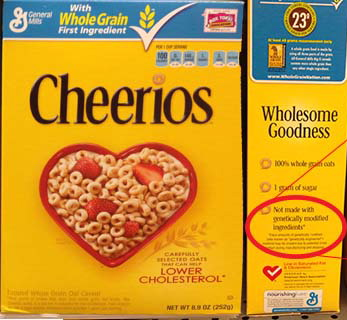
I read about General Mills’s introduction of non-GMO Cheerios back in January, but didn’t get around to looking for them until this weekend.

I was expecting to see something like this (thanks Fooducate):

Instead, the information is tucked into a side panel. 

New PictureNew-non-GMO-Label-Original-CheeriosWMSmThis may explain why General Mills is complaining that the non-GMO is not doing a thing to boost sales of Cheerios.  If anything, sales are “down somewhat.”

And here’s a good one: According to one professor, the non-GMO Grape Nuts and Cheerios are going to be less nutritious than the GMO versions.

Post Foods’ new non-GMO Grape Nuts (click here ) no longer include Vitamin A, vitamin D, vitamin B12 or vitamin B2 (Riboflavin)*, while the new non-GMO Original Cheerios no longer have Riboflavin on the ingredients list (the old version has 25% of the daily value in a 28 g serving while the new version has 2% of the DV).

How come?  It’s hard to find non-GMO vitamins (who knew?).  Vitamins, it seems are often produced from genetically engineered microorganisms, or from microbes growing in fermentation tanks that are fed a nutrient mix that contains ingredients from GM sugar beets or corn.

Should we be worried about nutritional deprivation among Cheerios eaters?

Cheerios are essentially a vitamin pill wrapped in rapidly absorbable starch.

The ingredients: whole grain oats, corn starch, sugar, salt, tripotassium phosphate, wheat starch.

Everything else is added vitamins.

Personally, I prefer my cereals with no added vitamins (they taste bad).  And I doubt they make much difference to health.

Whether non-GMO will have a noticeable effect on sales of Cheerios remains to be seen.

If General Mills doesn’t advertise the change, it can’t expect non-GMO to boost sales.

Curious, no?


25 Mar 21:49

Portland Drinking Guide: The Best Spots for Cocktails Right Now

by Emily McIntyre

From Drinks

Slideshow

VIEW SLIDESHOW: Portland Drinking Guide: The Best Spots for Cocktails Right Now

[Photographs: Emily McIntyre]

Portland, Oregon has become a cradle to beverage innovation in many fields, from cocktails to coffee. It makes sense that there would constantly be new good things to drink here: it's a city full of folks who appreciate well-made and well-sourced food. Portland is home to a dizzying array of local distilleries and people crafting all sorts of delicious products to taste. But while there are plenty of Portland cocktail alchemists poised over fizzing beakers, the overwhelming trend I've noticed lately is a return to the basics of great bartending.

"The core of the industry is hospitality and building a balanced drink," Kyle Linden Webster, owner of Expatriate, said to me recently. "It's not about impressing people, and it's not a secret society." It works for me.

Whether you're looking for a great Manhattan or a tiki drink or something entirely original, my favorite Portland bars deliver. These spots range from elegant to kitschy, but what they all have in common is a quality so easily misplaced in the modern cocktail world: a solid sense of identity and a certain cleanness of execution. If you're wondering where to go for great cocktails in Portland, consider this your guide.

The Rookery at Raven & Rose

20140302rookerysceneu.jpg

The Rookery, the upper portion of the now-renovated historic Ladd Carriage House, is one of my favorite places to drink a cocktail in Portland, for many reasons. The last remaining portion of the Ladd estate—originally built to house the estate's horses, carriages, and employees—the most recent incarnation of this beautiful building has captured the romantic essence of the English countryside while maintaining a Portland perspective on drinks.

High white ceilings girded with wooden beams soar above a worn floor that anchors a mix of Shaker-style details and classic English pub-style bar and leather chairs. The space is at once familiar and refreshing, like a breath of country air. The cocktails here are outstanding, as are the many spirits events and the food menu.

The Rookery at Raven & Rose: 1331 SW Broadway, Portland, OR 97201(map) 503-222-7673; ravenandrosepdx.com

Hale Pele

20140301-hale-pele-action.jpg

I love Portland's overcast weather, but even so, I get weary after weeks of rain and timid sun. Hale Pele is the perfect antidote to the rainy-day blues. From the staff's unashamed island style to the glowing pufferfish lights to the menu full of classic tiki drinks with just enough originality to be inspiring, Hale Pele deserves all its great press and more.

At my last visit, my bartender told me they had 237 bottlings of rums from around the world that week. The bar is home to The Loyal Order of Fire Drinkers, a club of dedicated rum-tasters who mark off a selection of 50 rums week by week as they go on special. Honoring this incredibly versatile spirit, many of the 42 cocktails on the Hale Pele incorporate one or more styles of rum and a wide variety of fresh juices, falernum, and spices. Come during happy hour (5 to 6 p.m. daily) for mind-blowing Puaa Pork Sliders ($5), a selection of delightful tiki drinks and a rotating rum special.

Hale Pele: 2733 NE Broadway Street, Portland, OR 97232(map) 503-662-8454; halepele.com

Teardrop Lounge

20140302teardropscene.jpg

As smooth as the Pearl District neighborhood it anchors, the silver-and-white Teardrop Cocktail Lounge has been a destination for well-made drinks since it opened in 2007. Steel, glass, exposed concrete—these design elements have been overused in the restaurant biz, but the Teardrop steps past first impressions with a hospitality and swagger that reflects the Portland walking past its spacious windows.

The menu has a page for house cocktails, a page for classics, and a page for cocktails created by friends (including some delightful names—"Bankers are Wankers", anyone?) as well as a creative small plates menu. The spirits collection is presented with panache, giving room for drinking experimentation on all fronts, and the fanatical attention to detail that has bartenders crafting every possible ingredient in the seasonal menu by hand means you'll have to come back again and again to truly grasp Teardrop's offerings.

Teardrop Lounge: 1015 NW Everett Street, Portland, OR 97209 (map) 503-445-8109; teardroplounge.com

Pepe le Moko

20140305--Pepe-action-shot.jpg

Remember Corn Nuts? These salty, fried bits of corn are available at every gas station in America, and their Spanish cousin, Quicos, are the first taste to greet you at the long-anticipated, just-opened Jeff Morganthaler concept in downtown Portland, Pepe le Moko. The experience is a little disorienting, but that's part of the fun. From the Long Island Iced Tea ($13) to the Espresso Martini ($11), this menu is one to challenge preconceptions by re-imagining tired cliches in the cocktail world. (Morganthaler once boasted, "I make the best amaretto sour in the world!" Well, he might just be right.)

Votive candles make many-pointed stars on close-set tables, and the spot has an unfinished air that fits the eponymous Paris gangster flick of 1937, the leather couches, long bar, and banded curving ceiling seeming to set the scene for a sophisticated Parisienne to make her entrance, plop her purse on the bar, and down a Long Island Iced Tea while her golden hair slips down her back. (A scene pretty much possible only here, since most self-respecting bars in town refuse to serve the drink.)

The decor leaves something to the imagination, but the master hand of Morganthaler is evident in the drinks. They're delicious. It takes a supreme confidence to serve drinks like this, and smile in the face of most cocktail-aficiandos' confusion. That, and the best amaretto sour in the world.

Pepe le Moko: 407 SW 10th Avenue, Portland, OR, 97205 (map) 503-546-8537; pepelemokopdx.com

Barwares at Smallwares

20140302barwaresscene.jpg

Adjoining NE Portland's excellent Smallwares, Barwares is a slick juxtaposition of East and West—Asian pottery (complete with a Hello Kitty figurine) under a chandelier straight from a vintage store, sake next to Regan's Orange Bitters, succulent planters next to water served in old Jim Beam bottles. The food reflects this mixed heritage (gleefully claiming to be "inauthentic Asian") but the drinks menu is more focused, consisting largely of some really delicious classic or classic-inspired cocktails.

Chef/owner Johanna Ware has a long pedigree with names like Momofuku in it, and in her first proprietary spot she offers a unique and ultimately memorable experience. Come to Smallwares/Barwares to explore an array of tasty dishes and stay for an imaginative cocktail or three.

Barwares at Smallwares: 4605 NE Fremont Street, Portland, OR 97213 (map) (971) 229-0995; smallwarespdx.com/barwares/

Rum Club

20140219-Rum-Club-action-shot.jpg

Stepping into Rum Club, I always feel a sense of warmth unrelated to the temperature. It's a quirky place—with a glowing wooden bar roughly the shape of a horseshoe that seems to embrace the bartender, a patio for those rare evenings when Portland isn't grim and wet, and a hummingbird motif that plays nicely with the tiki-esque figurines you'll find in odd places. A visit to Rum Club is like stepping into your eccentric neighbor's basement—if that neighborh had something of a rum fetish.

Drinks here are bright and balanced, and pack an unexpected punch—the off-menu Em's Rum Daiquiri had me swaying slightly as I left after my last visit. (Said Em's Rum is a house blend called The Blackhearted Blend from head bartender Emily Baker, using rums from Jamaica, Bermuda, and Guyana.) Catch the happy hour from 4 to 6:30 p.m. Mondays through Saturdays and 5 to midnight on Sundays for discounted cocktails and one of the best winter salads I've had at just $6.

Rum Club: 720 SE Sandy Boulevard, Portland OR 97214 (map) (503) 265-8807; rumclubpdx.com

Whey Bar

20140310-Whey Bar Action Shot.jpg

Don't let the fighting cocks on the wall of Whey Bar in NE Portland disturb you—you are, after all, drinking a pickle cocktail in an Argentine-inspired bar. Come to Whey Bar at 4 p.m., before Ox—the almost obscenely-popular restaurant next door—fills up and overflows into the garage-turned bar space, and soak in the details surrounding you along with a creative seasonal cocktail.

Fresh dill on the oyster bar, a concrete floor under no-nonsense tables, a garage door painted a blue-grey so delightful I want to lick it, and lovely lightbulbs dangling overhead—the place is filled with delightful, un-fussy details. Definitely try the French Diplomat ($9) for a tactile experience reminiscent of the inner peel of a grapefruit, mediated by a honey sweetness and a chamomile aroma.

Whey Bar: 2225 NE Martin Luther King Jr Boulevard, Portland, OR 97212 (map) 503-284-3366; oxpdx.com

Expatriate

20140222--Expatriate.jpg

Enter through the curtained, sign-less door of Expatriate in NE Portland, and you are in another world. A world where famed Beast chef Naomi Pomeroy imagines a menu of riveting pan-Asian-inspired bar food, where owner and pedigreed bartender, world traveler, and DJ Kyle Linden Webster bends in total concentration over his spinning records, and where a Chinese moon gate inspires a moment of worship between sips.

The oft-neglected art of mixing a balanced cocktail is central here, and an unashamed focus on hospitality. Sit yourself at the long mahogany bar and soak in the sheer atmosphere of the place. Above your head, on the top shelf of the spirit library, is a round-bellied Blanton's Bourbon bottle that glows like molten gold next to a world globe. Know that wherever you are, at this moment you are an expatriate from your home scene. Your explorations end here, with a perfectly executed cocktail and some really great music.

Expatriate: 5424 NE 30th Avenue, Portland, OR 97211(map); expatriatepdx.com

Multnomah Whiskey Library

20140302multnomahwhiskeyscene.jpg

You may wait several hours in line to enter the sacred precincts of the Multnomah Whiskey Library, but for once in your life, the wait will be worth it. Respect—for you and your patience, for the over 1500 bottlings of spirits that line the walls, for the beverage ritual—will envelop you like a wave. Whoever you are, if you are willing to tender the same respect, your time in this famed refuge will be entirely memorable. Here is one place in Portland that offers that complete package: quality, attention to detail, delightful service, and a curated list of outstanding cocktails. The chance to taste rare whiskeys is a highlight, but the cocktails are also not to be missed.

Superlatives aside, what is the Multnomah Whiskey Library actually like? Oak paneling, classic leather couches, and library ladders guarding long rows of shining bottles. People of all shapes and sizes luxuriating in being part of an exclusive club: those who value this experience. Warm lighting—lamps and chandeliers under stained glass windows, and an attractive, happy staff. Wait in line if you have to. The experience will be more than worth the effort.

Multnomah Whiskey Library: 1124 SW Alder Street, Portland, OR 97205 (map) 503-954-1381; multnomahwhiskeylibrary.com

Clyde Common

20140305--Clyde Commons.jpg

It's inevitable now that Pepe le Moko is open to compare it to Jeff Morgenthaler and the Ace Hotel's other Portland collaboration, Clyde Common. While Pepe le Moko seems designed to create nuggets of privacy clearly delineated by leather and chair rails, Clyde Common puts me in mind of a communal dining space and kitchen I once shared with about 30 complete strangers at a retreat center about 14,000 feet up a New Mexico mountain. Long tables of worn wood seat 8-20, practiced hands fly in an open kitchen, and (during daylight hours) tall windows encourage the exchange of a smile, or a glare, with passersby. In those same windows, as night falls, you can catch a mesmerizing reflection of the deft movements, striped aprons, and flickering flames reflected from the kitchen.

The bar program here is designed to be approachable and fun. The cocktails here are subtle, enjoyable, and pack a boozy wallop deceptively disguised by their balanced composition. Come by yourself during happy hour (3 to 6 p.m. daily) and try the Bourbon Renewal (Maker's Mark, Jacquin's Creme de Cassis, Angostura bitters, and lemon) along several plates of the Common's famous food. Or, bring a passel of friends and enjoy the night falling as you enjoy each other. Either way, you'll find Clyde Common encourages you out of Portland's funky rain-enforced solitude and into some conviviality.

Clyde Common: 1014 Southwest Stark Street, Portland, OR 97205 (map) 503-228-3333; clydecommon.com

Curious about what to order at each of these bars? Head over to the slideshow for our cocktail picks.

About the Author: Equally obsessed with cocktails and coffee, Emily McIntyre is a travel and beverages writer based in Portland, Oregon. Follow her at @mcintyrewrites.

25 Mar 18:15

Epic Wait at Il Buco Alimentari? Where to Eat Instead

by Max Falkowitz
Timmy the Tooth

I''ll have the deep-fried cock and balls.

From Serious Eats: New York

Fried Rabbit ($15)

What to eat when you can't eat this fried rabbit. [Photograph: J. Kenji Lopez-Alt]

When a restaurant tries to be all things to all people, it usually fails. Miraculously, Il Buco Alimentari e Vineria does not. Where else do you find an Italian restaurant that's also a great little market, a full-service bakery, a neat wine bar, and a first-rate sausage store? Oh, and did I mention they make great gelato to-go as well?

But all good things come at a price, and for Il Buco, that means potential for long waits at dinner. Where should when the restaurant is too busy? The neighborhood is full of Italian alternatives.

The Closest Call

Charred Octopus at L'Apicio ($19)

[Photograph: Alice Gao]

Il Buco's ingredient-driven Italian cooking shows evidence of American influences; so too does the menu at L'Apicio, Gabe Thompson's East Village flagship, where polenta comes spread on charcuterie boards and beautifully charred octopus is garnished with nubs of pepperoni. You'll also find Il Buco-like pleasures in the wines, selected by Thompson's partner Joe Campanale, and the desserts, made by pastry chef Katherine Thompson.

More Italian

Octopus ($14)

Octopus at Prima. [Photograph: Maggie Hoffman]

Does L'Apicio have a wait of its own? Here are three more spins on Italian for you. Prima hews modern with a focus on seafood: octopus, oysters, and fish of all kinds. For something more casual, Bianca may do you right—it's the neighborhood Italian restaurant every neighborhood should have, and its cooking rises above its humble surroundings.

Or say to hell with subtlety and hit up Rubirosa, where full-on retro red sauce is embraced with just the right note of irony. The thin-crust pizza, mountains of pasta, and endless vistas of chicken parm don't disappoint.

Lunch Alternatives

Thumbnail image for 20131003-mile-end-breakfast-sandwich.jpg

A sandwich from Mile End. [Photograph: Robyn Lee]

If you're looking to avoid a wait at Il Buco, your best bet is to visit for lunch, where the menu is largely the same but the room is way quieter. But perhaps you can't commit to the cost or time of a full lunch meal, or there's a surprise crowd in the way between you and a table. Mile End Sandwich won't carry the same monster short rib sandwich that Il Buco's known for, but it will treat you right. So can The Smile and its to-go annex, where you can pick up smart salads and well-constructed sandwiches on the run.

Drinks While You Wait

20120221-MadamGeneva-2.jpg

[Photograph: Alice Gao]

If you've decided to wait out your meal with a drink, Il Buco's little wine counter is as good a place to start as any. But it fills up quickly, so be prepared to look elsewhere in the East Village.

Here's two options to start: for cocktails, try Madam Geneva, an East and Southeast Asian-inspired cocktail bar with a focus on gin drinks of all kinds. Or you can save your money for dinner and hit low-key at neighborhood bar The Scratcher, where you'll find a nice happy hour through 8 p.m. and a solid beer-and-a-shot deal for good measure. Remember: just because you're visiting a fancy restaurant doesn't mean your night has to start that way.

Where Else?

What are your favorite standby bars and restaurants in the area? Let us know in the comments.

About the author: Max Falkowitz is the New York editor and ice cream maker in residence at Serious Eats. You can follow him on Twitter at @maxfalkowitz.

14 Mar 13:40

Nicklas Bendtner faces £100,000 fine from Arsenal after alleged drunken threat to taxi driver

by Matt Law
Timmy the Tooth

Pensive Bendtner.

Outcast striker Nicklas Bendtner faces £100,000 fine for alleged incident in which he unbuttoned trousers and rubbed against a taxi


04 Mar 13:44

Dinner Tonight: Japanese Curry Rice With Hanger Steak

by Nick Kindelsperger
Timmy the Tooth

Weird... Just made this the other day

20140226-284894-dinner-tonight-japanese-curry-beef.jpg

[Photograph: Nick Kindelsperger]

No, this is not beef stew. First, it takes forever to make a good beef stew, which is not something I usually have on a weeknight. Second, you can probably notice a slight orange tint, which hints that there are a bunch of spices involved here. This is actually a popular Japanese take on curry. The history is slightly confusing, but it's basically a strange mutation of a basic Indian curry, as translated by the British to the Japanese. If you'd like to make this sucker from scratch, you should definitely check out this recipe. But if you can score some boxed Japanese curry paste, like Gold Curry, you'll be able to get this very filling meal completed in less than 30 minutes.

Than again, since many of the pictures of this dish look like beef stew, I decided to focus on ingredients that one would normally find in that dish. That meant carrots, onions, potatoes, and, of course, beef. Problem is, the meat in beef stew is usually cooked for hours. My only choice was to look for a quick-cooking alternative. I settled on hanger steak, though you could sub in flank or skirt. The meat is sliced thinly, cooked quickly, and then removed. When cooled, it's cut into chunks, and then added back in at the end.

I picked up a few tips while looking into other recipes. The biggest piece of advice is to go for the spicy Japanese curry, which is still only moderately spicy. Besides that, adding a fruit helps lend some sweetness, which explains what the apple is doing in the list. Honestly, it's kind of incredible it all comes to gather so quickly. And though it looks like beef stew, there's so much more going on.

About the author: Nick Kindelsperger is the editor of Serious Eats: Chicago. He loves tacos and spicy food. You can follow him as @nickdk on Twitter.

Every recipe we publish is tested, tasted, and Serious Eats-approved by our staff. Never miss a recipe again by following @SeriousRecipes on Twitter!

Get the Recipe!
02 Mar 23:12

Liverpool admits that Suarez had a release clause and Arsenal activated it

by Tim
There has been further light shed on the the Arsenal summer transfer saga with Luis Suarez as Liverpool’s owner John Henry has admitted that the striker had a £40m release clause, that Arsenal...

[[ This is a content summary only. Visit my website for full links, other content, and more! ]]
02 Mar 06:15

FA looks to increase racism and discrimination bans after Nicolas Anelka gets five-match suspension for quenelle

by Ben Rumsby
Timmy the Tooth

in Europe, they give you a 5 game ban for a racist gesture. In America, you get a 15 yard penalty for saying nigger. Good luck, America.

FA will discuss strengthening its anti-discrimination sanctions again following failure to secure a ban of more than five matches for striker Nicolas Anelka


02 Mar 05:33

Alan Pardew sent off for headbutting David Meyler: in pics

by Telegraph Staff
In pics: Newcastle manager Alan Pardew is sent to the stands after headbutting a Hull City player during his side's 4-1 win


02 Mar 05:26

Mountaintop Tent: Airlifted Alpine Retreat Built at 8,000 Feet

by Urbanist
Timmy the Tooth

Touching tribute

[ By WebUrbanist in Global & Travel & Places. ]

mountaintop distance view structure

Created as a tribute to a mountain guide killed in an tragic avalanche, this tent-shaped shelter of wood and steel was helicoptered in pieces and assembled at an elevation of 2531 meters in Italy.

mountain cabin by cliff

mountaintop architecture design build

Commissioned by the family of the fallen and designed by Giovanni Pesamosca Architetto (images by Flavio Pesamosca), the building was made to honor Luca Vuerich, who perished in an avalanche while climbing a frozen waterfall.

mountaineer retreat construction helicopter

Thanks to the efforts of family, friends, colleagues and mountain rescue volunteers (twelve people in total), the shell was constructed on site in a single day from pre-marked parts deposited by helicopter.

mountain cabin entry side

mountain cabin in context

The triangular structure is shaped to shed snow but built capable of being covered entirely as well, with access on its south side where the sun melts accumulation the fastest.

mountain retreat edge

The wooden truss-reinforced frame is made to withstand high wind loads as well due to its exposed location, and set up on a series of concrete footings.

mountain tent retreat alps

mountain interior construction process

The interior sports nine beds for hikers and mountain climbers, which might look spartan to the outside observer but are strikingly luxurious when you consider their remote location.

mountaineering retreat hiking rest

mountain cabin money shot

Open to anyone who can get there, the building is located in the Julian Alps, on the crest of the Foronon Buinz Mountain along the Ceria-Merlone trail.


Want More? Click for Great Related Content on WebUrbanist:

Mountaintop Museum: Underground Rooms Tunnel into Peak

In a bold yet beautifully contextual move, this embedded mountaintop museum structure is part of a series of buildings set high in the mountains of Tyrol, ... Click Here to Read More »»


Monastic Marvels: 12 Cliffside & Mountaintop Monasteries

Precariously perched on mountain tops and into the sides of sheer cliffs, these dramatic monasteries are difficult to reach, but offer incredible views. Click Here to Read More »»


Bike Tire Tent: Compact Travel Shelter Wraps Inside Wheels

For the cycling nomad, this design uses space you never knew you had, and helps free up room in front-of-handlebar baskets or on above-back-tire racks for ... Click Here to Read More »»


Share on Facebook

[ By WebUrbanist in Global & Travel & Places. ]

[ WebUrbanist | Archives | Galleries | Privacy | TOS ]


02 Mar 05:03

Pardew fined £100,000 by Newcastle

Timmy the Tooth

Coach headbutts opposition player. Seriously.

Newcastle fine boss Alan Pardew £100,000 and give him a formal warning for headbutting Hull midfielder David Meyler.
01 Mar 21:35

Yeast bread, rolls, and pizza

by PJ Hamel
Timmy the Tooth

There you go!

So, why do you want to bake with whole grains?

For some of us, it’s a desire to add fiber to our diet. For others, a lifestyle choice: avoiding heavily processed or refined foods – embracing “whole” foods.

Maybe you simply like the flavor of wheat. Or you’re trying to follow a healthier diet, which according to USDA dietary guidelines, means “Consume at least half of all grains as whole grains. Increase whole-grain intake by replacing refined grains with whole grains.”

photo 3

Or perhaps you bought a bag of whole wheat flour because it was called for in a cookie recipe you wanted to try, and now you don’t know what to do with the rest of the bag…

Whatever the provenance of your desire to bake with whole grains – specifically, whole wheat – you’re probably not satisfied with simply following existing whole-grain recipes. You know, the ones in magazines like Real Simple, and Cooking Light.

It’s fine to try new whole-grain recipes every now and then; but what you’d really like to do is substitute whole wheat in some of your well-loved family favorites, making Anna’s Banana Bread or Gram’s Peanut Butter Blossoms or those Jordan Marsh Blueberry Muffins just a tad healthier.

Is it possible to do this – simply substitute whole wheat flour for the all-purpose (white) flour called for in your recipe-box recipes? Or is there some secret you don’t know – the need to increase liquid, decrease fat, wave your magic wand and spin around three times – in order to successfully convert a white flour recipe to whole wheat?

Thankfully, the process can be simpler than you think.

IMG_3768

This post, the first in a guided series to substituting whole wheat for all-purpose (AP) flour, concentrates on the most challenging type of recipes to convert: yeast bread, rolls (including sweet rolls), and pizza.

But you know what? After lots of experimenting, I found a simple rule for substituting whole wheat with minimal change in the flavor, texture, and rise of your bread.

IMG_3705

Here it is: in yeast recipes calling for all-purpose (white) flour, substitute King Arthur White Whole Wheat Flour for up to half the white flour, by volume. There’s no need to adjust any other ingredients. The result will be a loaf, roll, or pizza crust that rises nicely, has mildly “wheaty” flavor, and is a warm beige in color, rather than creamy white.

Bonus: you’ll be treating yourself to a nourishing blend of the vitamins and minerals found in enriched all-purpose flour; and the fiber and additional vitamins and minerals in whole wheat flour. The two flours complement one another wonderfully well, not just in flavor and performance, but in dietary benefits.

If you like this 50/50 result, try substituting a bit more whole wheat next time. If you don’t – substitute a bit less. But half and half – AP and whole wheat flours – is a good place to start.

Now, what about substituting whole wheat flour for 100% of the all-purpose – can you make a straight 1:1 switch?

IMG_3756

Unless you’re willing to accept a loaf, roll, or crust that doesn’t rise as high, isn’t as light – then not a good idea.

BUT – there IS a way to use that straight 1:1 substitution, and turn white to 100% wheat, by making a few simple adjustments. More about that later.

OK, timeout. So, SO many of you have asked the following question, that I need to address it right now, before we go one step further:

Is white whole wheat really a whole-grain flour? Or is it a blend of white flour and whole wheat, or does it rely on some wacky type of processing to make it white, or…?

White whole wheat flour is 100% whole wheat – “nothing added, nothing taken away,” as we like to say here. It’s ground from white wheat berries rather than red wheat berries; but just as a red tulip and a white tulip are both tulips, red and white wheat are both wheat.

All-purpose flour on the left; white whole wheat in the center; traditional (red) whole wheat on the right.

All-purpose flour on the left; white whole wheat in the center; traditional (red) whole wheat on the right.

And when you grind the entire berry of either wheat – red, or white – the result is 100% whole wheat flour. Period. Take it to the bank.

If you love traditional red whole wheat (King Arthur Whole Wheat Flour, in the dark brown bag), more power to you; use it in good health. It’ll “work” exactly like white whole wheat in your recipe.

IMG_3937

That’s dough made with white whole wheat flour on the left; and the same recipe made with traditional (red) whole wheat flour on the right. Both are 100% whole wheat, but what a difference in color, eh?

But if you’re someone who’s not in love with the assertiveness of whole wheat flour, take my advice: try white whole wheat. Compared to red wheat, white wheat’s mouth feel, flavor, and look are much closer to that of white flour.

Now, let’s explore some of the experiments that brought me to these conclusions. In all cases, I’m comparing the same recipe made using 100% all-purpose flour; 50% all-purpose and 50% white whole wheat; and 100% white whole wheat flour.

First up: a simple yeast batter bread, English Muffin Toasting Bread.

IMG_2928

I’m using this recipe in order to see how whole wheat will act in a yeast bread that doesn’t call for any kneading.

www3englishmuffin

To make this simple bread, I combine all the ingredients in a bowl and, using an electric mixer, beat at high speed for 1 minute. The resulting sticky dough/batter is scooped into a loaf pan.* After a single rise, it’s baked.

*I love using a 9″ x 4″ pain de mie pan for any bread recipe calling for an 8 1/2″ x 4 1/2″ loaf pan. The longer, narrower, deeper pan, with its straight (rather than slightly flared) shape, produces bread without the typical “mushroom” top – no getting stuck in the toaster!

www4emtoasting

The result? The 100% white flour loaf rises just a tad higher than the 50/50 combo, while the 100% whole wheat loaf is a distant third, rise-wise.

I’m a bit surprised at this result. Why would the 100% whole wheat loaf be SO far behind the 50/50 loaf?

Thankfully, as the experiments continue, I figure out the answer.

For my next loaf, I want an old family recipe, a tried-and-true white bread. I know many of you cherish your family recipes; let’s see what happens when we substitute whole wheat flour in an older recipe, one clearly written for white flour.

IMG_3743

How many of you have recipes like this? Written in India ink on a yellowing card, stuffed in a worn cardboard box, this is my grandmother’s recipe for the bread she made week after week, year after year, to feed her family – 7 kids and husband.

Clearly she didn’t need a lot of direction!

But I did. It took me awhile to figure out, but eventually I used this skeleton to write myself a “real” recipe.

www1grandma

Remember: I’m using 100% AP (white) flour; a 50/50 blend; and 100% whole wheat flour. All three rise similarly through their first rise (on the baking sheet). And even the second rise doesn’t produce huge differences…

IMG_3754

…though you can see the AP loaf (left) is clearly taller than either the 50/50 or whole wheat loaves.

Once baked, though…

www6grandma

…the 100% AP loaf stands tallest – by a hair (crumb), over the 50/50 loaf.

The 100% whole wheat loaf wasn’t too bad, though; a bit shorter, a bit denser, and it took longer to bake. Which is a good thing to remember: the denser/shorter the loaf, the longer it’ll take to bake all the way through.

Next, let’s sweeten things up a bit. How will a typical cinnamon roll or sticky bun turn out if I simply substitute whole wheat flour for all-purpose, without making any adjustments in the other ingredients?

Remember, this is all about simplicity; I want to figure out when you can successfully make a straight 1:1 switch with all-purpose and whole wheat; and when you can do so only by tweaking the recipe.

cinnbun

Our Cinna-Buns recipe is the quintessential breakfast sweet roll.

Let’s see what happens using a straight 1:1 switch.

www5cinnbuns1

This rich dough, with its egg, milk, and sugar, is a fairly slow riser.

And the whole wheat dough seems stiff. It isn’t rising quite as well as the AP and 50/50 doughs – which makes sense. Whole wheat, with its coarser grind and bran, takes longer to absorb liquid than AP flour. But once it does, it absorbs more. The same amount of water used in both an all-purpose flour and whole wheat flour bread recipe will yield whole wheat dough that’s stiffer than AP dough.

www1cinnbun

But let’s continue with the rolls, and see what happens.

IMG_3591

Uh-oh. While the AP (left) and 50/50 (bottom right) rolls are rising nicely, the 100% whole wheat rolls are lagging far behind.

IMG_3614

And the resulting 100% whole wheat buns – not up to snuff. Dense and stiff compared to the AP rolls, I need to throw these to the birds.

OK, I’m going to stop for a moment, and consider what I know about yeast dough.

Generally speaking, the stiffer and drier the yeast dough, the less it will rise. The CO2 produced by yeast has an easier time expanding the elastic network of gluten in which it’s trapped when the dough contains more liquid.

Think of swimming upwards through water, vs. digging your way out of hard-packed dirt – get the picture?

What if I increase the amount of liquid in the 100% whole wheat dough, to give it the same soft, elastic consistency as the AP dough?

At the same time, I’ll give the whole wheat dough 20 to 30 minutes to absorb the liquid before kneading; this should make the dough easier to work with, and prevent me from adding too much additional flour.

Let’s try these Cinna-Buns again.

And this time, just to throw another variable into the mix, let’s test traditional (red) whole wheat flour against white whole wheat.

I make the dough again, adding 2 teaspoons additional milk for each cup of whole wheat flour in each of the 100% whole wheat recipes.

I also let the whole wheat doughs rest for 25 minutes before kneading.

I knead the doughs, let them rise, and shape them into buns.

And after 90 minutes rising in the pan…

www2cinnbun2

…success!

That’s AP flour, bottom left; 100% white wheat, center; and traditional (red) wheat, bottom right. All three are rising nicely.

IMG_3804

And after baking, you can’t see a difference in height or texture.

IMG_3978

Only the buns’ color gives them away: that’s traditional whole wheat in front; white whole wheat in the center, and all-purpose flour in back.

OK, now that I know the secret to turning a white flour bread recipe into high-rising 100% whole wheat bread, let’s test it on another old favorite: Amish Dinner Rolls.

IMG_3793

This moist, dense potato roll recipe has been on our site for years, undergoing several changes along the way.

Substituting butter for lard, for instance – which gives you an idea of this recipe’s vintage.

Using what I’ve learned about increasing the amount of liquid, and giving the dough a rest before kneading, will I make high-rising dinner rolls first time out of the gate?

www7amish1

The dough looks good. It feels good, too; all three doughs (all-purpose, 50/50, and 100% white wheat) are soft and supple.

www8amish2

Shape rolls, nestle in pans. Apply elastic shower caps, for rising. (What, you don’t know the Secret Life of Shower Caps – doubling as dough-rising covers?)

Nice rise… nice bake…

IMG_3776

…nice buns!

While the late afternoon light paints a rather deceiving picture, kind of washing out the colors, that’s 100% white wheat, bottom left; all-purpose, top; and 50/50, bottom right.

All three rolls have risen nicely, and have great, light/soft texture.

And, finally – let’s try some pizza dough.

IMG_3908

Since I’m working on the second installment of my “America’s Love Affair with Pizza” series concurrently with this post, I choose the basic pizza dough recipe from Wolfgang Puck’s Pizza, Pasta, and More!

www9pizza

Again: all-purpose on the left, 50/50 in the center, 100% white whole wheat on the right.

Notice how rough the dough is in the first shot (top left); all I’ve done at this point is mix the ingredients together, without kneading. Right after I take the shot, I knead the AP dough; then the 50/50; then, finally, the 100% white wheat, which gives this last dough its requisite 25 minutes’ rest.

They all rise nicely. I divide them in half, to make two 8″ pizzas each.

Puck notes that the dough can be used right away; or refrigerated overnight before shaping and baking. So I try that experiment, too.

The result? I don’t see a textural difference between using the dough immediately, or chilling it. There is, however, one difference in the all-purpose crust: the chilled dough is slightly more flavorful, due to  lactic and organic acids produced overnight by the growing yeast.

I can’t taste that same difference in the whole wheat doughs; I can only assume the flavor of wheat overrides the subtle flavors produced by the yeast.

www10pizza2

Here’s the dough I’m using right away. I shape it, give it a short (30-minute) rise, and brush it with olive oil, per Puck’s instructions…

IMG_3899

…then bake.

Over-bake, actually. I mean to par-bake these, then add the toppings, then finish baking. But I misjudge how fast pizza crust can bake on a pizza stone in a 450°F oven.

Whoops.

IMG_3903

Anyway, here are the results: top to bottom, 100% whole wheat, 50/50, all-purpose.

Continuing to experiment with the amount of liquid necessary to make the highest-rising 100% whole wheat crust, I try adding slightly less additional water to the pizza crust than I do to the Amish roll dough. And there’s a difference: the 100% whole wheat crust (top) isn’t as light as the AP crust (bottom).

I do one final experiment, making the 100% whole wheat crust again, and upping the amount of water. And this time, the resulting crust is just as light as the AP crust.

IMG_3906

Now, back to those original over-baked crusts. Once I turn them all into finished pizzas, they’re not bad. Though why I’m so cheap with the pepperoni, I don’t know – since it’s low-fat turkey pepperoni, I definitely can (and should have) applied it more generously!

IMG_3914

One final shot: AP crust on the bottom, 50/50 on top. As you can see, the 50/50 crust is a warmer color, and rises just slightly less than the AP crust.

And there you have it: it’s perfectly feasible to substitute whole wheat flour for all-purpose flour in your favorite yeast recipes. To summarize:

♥ White whole wheat flour yields a lighter-colored, milder-flavored bread than traditional (red) whole wheat flour.
♥ When whole wheat flour is used up to 50/50 with all-purpose flour, there’s no need to make a change in your favorite white-flour yeast recipe – the result should be quite similar to the original.
♥ When whole wheat flour is substituted 100% for the white flour in a favorite recipe, allow the dough to rest for 20 to 30 minutes before kneading.
♥ When whole wheat flour is substituted 100% for the white flour, adjust the dough consistency by adding 2 teaspoons additional liquid per cup of whole wheat flour used, to start. After giving the dough a rest, start to knead; if it begins to feel overly dry and stiff, add more liquid, enough to make a smooth, supple dough. Note: In high hydration recipes, those making a very soft, sticky dough (e.g., ciabatta), start by following the recipe as written, without using additional water. Add more water only if necessary to produce the dough consistency described in the recipe.

Oh, and another thing: when baking with whole wheat flour, I often substitute orange juice for part of the liquid called for in the recipe. Why? While it doesn’t lend any flavor of its own, orange juice (used in small amounts) seems to temper the sometimes assertive flavor of whole wheat.

In addition, yeast loves an acidic environment, which orange juice helps create. A good rule of thumb is 1/4 cup OJ substituted for 1/4 cup of the water or milk in a recipe using 3 cups of whole wheat flour.

Finally, one last bit of advice: be sensible. Substituting whole wheat for 100% of the white flour in your favorite brioche, or challah, or croissant recipe, even if you add liquid, isn’t going to create a light and tender, highest-rising, buttery, delicious brioche, or challah, or croissant. It’ll be whole wheat – with all of whole wheat’s inherent characteristics: darker color, stronger flavor, a less-smooth mouth feel.

When baking with whole wheat, it’s best to understand the limits of any particular recipe, and manage your expectations. That said – I was never a particular fan of whole wheat, but after a week’s worth of baking with it, I’ve gained new appreciation for its versatility, its ability to slip fairly seamlessly into white flour recipes – and even its flavor!

What’s been your experience baking with whole wheat flour? Share your thoughts in comments, below.

Did you enjoy this baker’s guide? Check out our guide to substituting whole wheat flour in your favorite cookie, brownie, and bar recipes.


01 Mar 16:32

Steak 'n Shake Introduces a Pepperoni Pizza Steakburger

by Erin Jackson

From A Hamburger Today

284421-steak-n-shake-pepperoni-pizza-burger.jpg

[Photograph: Steak 'n Shake]

We've reported on a few different burger and pizza mash-ups on AHT, including the pepperoni and bacon Pizzaburger from Boston Pizza, Pizza Hut's experiments with cheeseburger pizza crust in the Middle East, and UK, Pizza Little Party's Megaburger pizza (to name a few), but none look quite as promising as Steak 'n Shake's new Pepperoni Pizza Steakburger ($5.49 with fries).

It's made with two smashed and seasoned beef patties topped with pepperoni, mozzarella and provolone cheese, and pizza sauce on a pretzel bun seasoned with garlic. Here's hoping the pepperoni slices are crisped up on the grill (they look a little limp in the photo) and the pretzel bun isn't too dense. If nothing else, it's got to be better than the new Double Cheeseburger pizza from Papa John's, topped with a Thousand Island-esque sauce ground beef, Roma tomatoes, and dill pickles.

What do you think about Steak 'n Shake's new burger/pizza hybrid?

About the author: Erin Jackson is a food writer and photographer who is obsessed with discovering the best eats in San Diego. You can find all of her discoveries on her San Diego food blog EJeats.com. On Twitter, she's @ErinJax

Love hamburgers? Then you'll Like AHT on Facebook! And go follow us on Twitter while you're at it!