Shared posts

17 Jan 01:49

Congress agrees: the law can't be copyrighted

by Cory Doctorow

Rogue archivist Carl Malamud writes, "On Tuesday, the House Judiciary Committee held a 3-hour hearing on revisions to the U.S. Copyright Act. I was surprised and gratified by the number of Members of Congress who stood up and forcefully endorsed the principle that the law belongs to the people. It was a bipartisan show of force and gave me real hope."

The OpenGov Foundation put together a number of key quotes from the hearing or you can watch the whole hearing on C-SPAN. There is also a nice YouTube Playlist that has most of the segments relating to the "edicts of government" topic.

In addition to the question of the right of citizens to read the law and speak the law, the hearing featured a spirited discussion of the question of the broadcast right (featuring EFF Pioneer Award winner Jamie Love) and the topic of file sharing, which featured the eminent expert David Nimmer (author of the treatise "Nimmer on Copyright") and Professor Lunney of Tulane University.

In my testimony, I asked the Committee to consider an Edicts of Government Amendment, which would codify long-standing Copyright Office Policy that says the laws by which we live may not be subject to copyright restrictions, be they court opinions, regulations, statutes, or the public safety laws on which our modern society depends.

US Reps: Congress Must Address Copyright-Restricted Laws, Legal Codes & Standards (Thanks, Carl!)


16 Jan 19:30

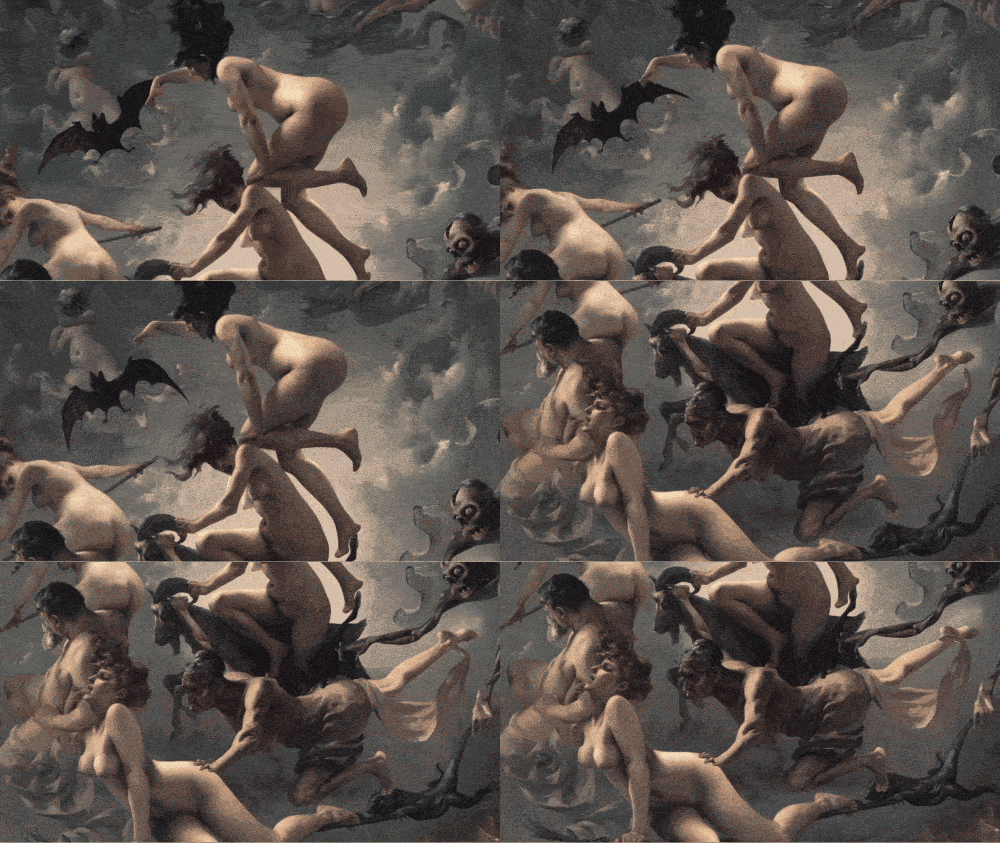
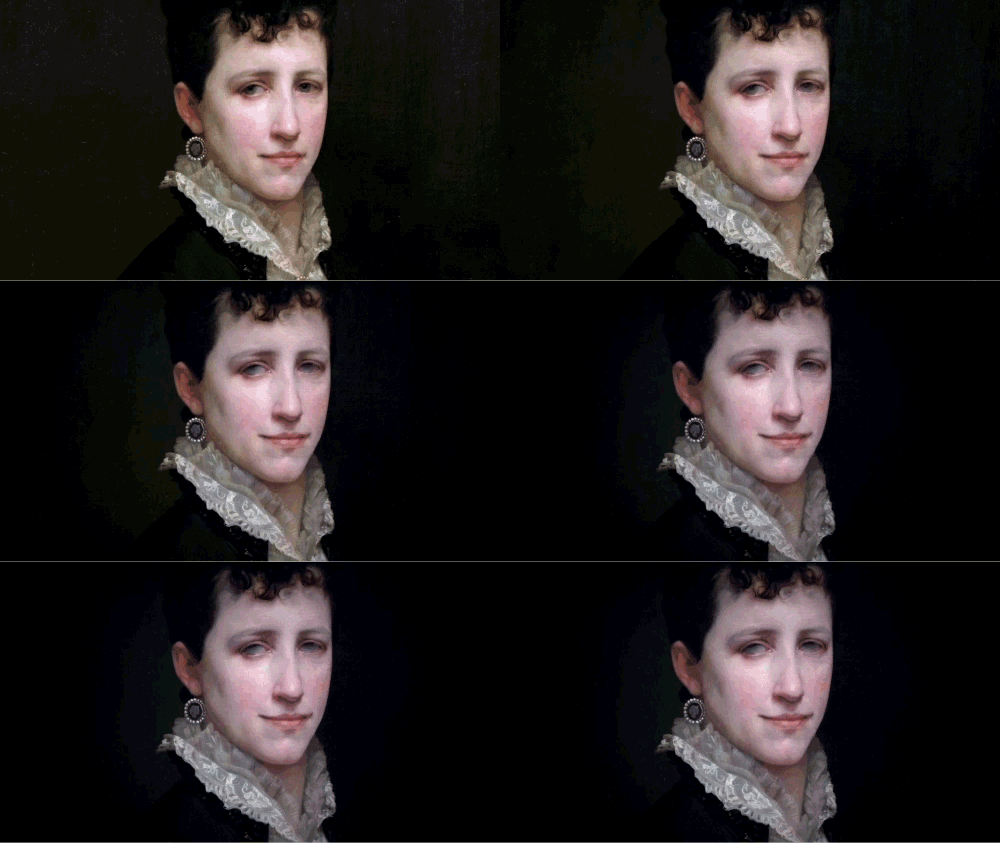
Incredible digital animation brings master paintings to life

by Rob Beschizza

From hazy Pre-Raphaelite beauty to shadowy baroque allegory, this short film weaves hundreds of years of art history into an amazing and unsettling narrative of human beauty. Directed and animated by Rino Stefano Tagliafierro (previously at BB), it is "a path of sighs through the emotions of life, a tribute to the art and her disarming beauty."

Tagliafierro also has an awesome tumblr full of GIFs.


16 Jan 19:27

Robocop Remix

by Miss Cellania

(vimeo link)

The movie Robocop envisioned "a future in which the justice system was run by corporations and Detroit was nearing collapse," and that image was science fiction… then.

The remake of Robocop will hit theaters next month, so before that happens, let's take a short look at the 1987 version that's so familiar to us. Eclectic Method remixed the movie into a series of sounds and images that works just right. I'd buy that for a dollar! -via Laughing Squid

16 Jan 19:09

Openstreetmap: why we need a free/open alternative to proprietary maps

by Cory Doctorow


In the Guardian, Serge Wroclawski makes the case for Openstreetmap, a free/open map tool maintained by a volunteer community. Wroclawski argues that allowing companies to own maps allows them to own places: to determine which features of our neighbourhoods are worthy of inclusion, to determine which parts of our cities should and shouldn't be considered in route planning, and to monitor our decisions about where we travel and what we do when we get there. It's a dangerous proposition, and Openstreetmap is a viable, and often superior, alternative (see, for example, the map above of the neighbourhood around my office):

The second concern is about location. Who defines where a neighbourhood is, or whether or not you should go? This issue was brought up by the American Civil Liberties Union (ACLU) when a map provider was providing routing (driving/biking/walking instructions) and used what it determined to be "safe" or "dangerous" neighbourhoods as part of its algorithm. This raises the question of who determines what makes a neighbourhood "safe" or not – or whether safe is merely a codeword for something more sinister.

Right now, Flickr collects neighbourhood information based on photographs which it exposes through an API. It uses this information to suggest tags for your photograph. But it would be possible to use neighbourhood boundaries in a more subtle way in order to affect anything from traffic patterns to real estate prices, because when a map provider becomes large enough, it becomes the source of "truth".

Lastly, these map providers have an incentive to collect information about you in ways that you may not agree with. Both Google and Apple collect your location information when you use their services. They can use this information to improve their map accuracy, but Google has already announced that is going to use this information to track the correlation between searches and where you go. With more than 500 million Android phones in use, this is an enormous amount of information collected on the individual level about people's habits, whether they're taking a casual stroll, commuting to work, going to their doctor, or maybe attending a protest.

Why the world needs OpenStreetMap [Serge Wroclawski/Guardian]

(via /.)


16 Jan 19:08

Copyright's insane penalties

by Cory Doctorow

Here's another important Copyright Week post from the Electronic Frontier Foundation: Mitch Stoltz looks at the brutal penalties for copyright violations: "What if a single parking ticket carried a fine of up to a year's salary? What if there were no way to know consistently how much the fine would be before you got it? And what if any one of hundreds of private citizens could decide to write you a ticket?"

Something very close to this scenario is a reality in copyright law. Copyright holders who sue for infringement can ask for "statutory damages" and, if they win, let a jury decide how big of a penalty the defendant will have to pay—anywhere from $200 to $150,000 per copyrighted work. That's a big problem for Internet users, and everyone else who wants to use creative works in lawful but non-traditional ways. Authors of remix video and fan fiction, bloggers, coders, entrepreneurs and others who create, inform, and empower on the fuzzy edges of copyright law must gamble every day. They risk unpredictable, potentially devastating penalties if a court disagrees with their well-intentioned efforts.

People from across the spectrum of opinion on copyright—including many who generally support more restrictive copyright law—agree that copyright damages are broken and need fixing. In today’s House Judiciary Committee hearing on the scope of copyright, Professors David Nimmer and Glynn Lunney agreed on almost nothing—but both agreed that copyright’s penalty regime makes no sense today.

Different from almost all other areas of the law, plaintiffs in copyright cases don’t have to present any evidence that they were harmed. And aside from setting some broad ranges of amounts for "willful" and "innocent" infringement, the only guidance that the Copyright Act gives to juries in picking an amount is to say that it should be "just."

Copyright Week is a worldwide effort to fix copyright: here are the six principles you can sign onto.

To Safeguard the Public Domain (and the Public Interest), Fix Copyright’s Crazy Penalties


16 Jan 19:07

Nun faces 30 years in prison for exposing security lapses in nuclear weapons program

by Cory Doctorow


Mike from Mother Jones sez, "Josh Harkinson writes about the upcoming sentencing of Megan Rice, an elderly nun and Plowshares activist who broke into the Y-12 enriched uranium facility with two fellow aging activists. The incident, which exposed glaring security flaws and was deeply embarrassing to the feds, could get the trio a maximum 30 years in federal prison. Harkinson writes:"

"The security breach," as the Department of Energy's Inspector General later described it, exposed "troubling displays of ineptitude" at what is supposed to be "one of the most secure facilities in the United States." At a February hearing of the House Energy and Commerce Committee, multiple members of Congress thanked Rice for exposing the site's gaping vulnerabilities. But that didn't deter federal prosecutors from throwing the book at Rice and her accomplices...

Even if the judge gives Sister Rice a more lenient sentence, as seems likely, she could still end up spending the rest of her life behind bars. "It's of absolutely no consequence to her," says her friend Ralph Hutchinson, coordinator for the Oak Ridge Environmental Peace Alliance. "As a nun she believes strongly that she is called to be a servant of God wherever she is."

Nun Faces up to 30 Years for Breaking Into Weapons Complex, Embarrassing the Feds [Josh Harkinson/Mother Jones]


16 Jan 19:02

Copyright week: using and losing the public domain

by Cory Doctorow


As Copyright Week continues, here's a pair of posts focusing on the importance of the public domain. First off, a guest editorial from Wikimedia's lawyers on the role of the public domain in the creation and maintenance of Wikipedia, one of the most amazing and important phenomena of the Internet age:

We must defend a vibrant public domain if we want collaborative projects like Wikipedia to continue to thrive. When material is removed from the public domain, it damages projects like Wikipedia and impacts Wikipedia readers and reusers at large. We are disappointed in the decision in Golan v. Holder, which removed content in the public domain by upholding the the Uruguay Round Agreements Act of 19941. Given the impact of the URAA on Wikipedia, the Wikimedia Foundation joined EFF in an amicus brief challenging the URAA a few years ago. When copyright is restored in a work, the public domain suffers. The immediate result is that Wikipedia is not as rich, because removing material from the public domain means that work previously available on Wikipedia may need to be removed.

Next, Techdirt's Mike Masnick reminds us that the public domain has been stolen from the public wholesale, through a series of economically and morally indefensible extensions of copyright that put that which rightly belongs to all of us into private hands:


However, the damage that our missing public domain does to culture, society, learning and knowledge is quite incredible. Two years ago, we had mentioned some research done by Professor Paul Heald, in which he noticed an incredible thing about new books available from Amazon, showing that plenty of recent new books were available, but they fade quickly... until you hit 1922 (the basic limit, before which nearly all works are in the public domain). And then there's a sudden jump in the works available.

See that big gap? All of that is lost culture thanks to our restrictive copyright laws, and the 1976 Act's ability to effectively kill off the public domain in the US. It should be seen as highly problematic that there are more books from the 1880s available for sale on Amazon than books from the 1980s.

Click here to sign on to copyright week's principles.


15 Jan 23:55

Leaked: environmental chapter of the secret Trans-Pacific Partnership treaty

by Cory Doctorow

Most of our coverage of the Trans-Pacific Partnership has focused on its Internet-regulating provisions. But the treaty -- which has been negotiated in unprecedented secrecy, with heavy-handed shoves from the US Trade Representative -- also has disturbing implications for the environment. Today, Wikileaks published a leaked consolidated draft of TPP's environment chapter, which sets out the ways in which corporations will be able to prevent countries from passing environmental laws that interfere with profit making.

Today, 15 January 2014, WikiLeaks released the secret draft text for the entire TPP (Trans-Pacific Partnership) Environment Chapter and the corresponding Chairs' Report. The TPP transnational legal regime would cover 12 countries initially and encompass 40 per cent of global GDP and one-third of world trade. The Environment Chapter has long been sought by journalists and environmental groups. The released text dates from the Chief Negotiators' summit in Salt Lake City, Utah, on 19-24 November 2013.

The Environment Chapter covers what the Parties propose to be their positions on: environmental issues, including climate change, biodiversity and fishing stocks; and trade and investment in 'environmental' goods and services. It also outlines how to resolve enviromental disputes arising out of the treaty's subsequent implementation. The draft Consolidated Text was prepared by the Chairs of the Environment Working Group, at the request of TPP Ministers at the Brunei round of the negotiations.

Secret Trans-Pacific Partnership Agreement (TPP) - Environment Consolidated Text


15 Jan 21:01

FCC Net Neutrality rules are dead, but they sucked anyway: time for some better ones

by Cory Doctorow

Yesterday, the DC Circuit Court of Appeals invalidated the FCC's Open Internet Rules. These were the closest thing to a set of Net Neutrality rules America had: rules that were supposed to ensure that ISPs fetched you the data you asked for without prejudice, rather than giving preference to the companies that had bribed them for faster access to you.

But these rules sucked

As David Isenberg points out, the Open Internet Rules were drafted to be as inoffensive to great and powerful companies as possible. They were toothless, nearly pointless rules that turned their backs on "500 years of common law and a deep corpus of case law."

In 2009 and 2010 — as FCC Chairman Genachowski deked and ducked and tried not to offend anybody powerful — it was clear to all, especially to the biggest telcos and cablecos, that if the FCC were to classify Internet access as a Title 2 telecommunications service, this would (a) solve the big problems that the phrase “Network Neutrality” was invented to describe, would (b) provide strong legal grounds against challenges, and would (c) be consistent with 500 years of common law and a deep corpus of case law. Nope, we could not have that. It was better to have a weak compromise, full of exceptions, that was bound to be overturned in court. Here’s my own bitter prognostication from December 2010.

Now that the DC Appeals Court has struck down the FCC’s 2010 order [court decision here], now is the time to demand that the FCC do what it should have done in the first place. It should classify Internet access as a Title 2 Telecommunications Service. The precedents for doing this are strong. The bigcos will be unanimous in their hatred for it; we should welcome their hatred.

The Internet should be for everybody. It should not be narrowly monetized, productized and marketed to benefit the already-rich and the already-powerful. Reclassification of Internet access to be a Title 2 Telecommunications Service could do this.

On Freedom to Tinker, Annemarie Bridy has more, including how the FCC's "past regulatory choices continue to haunt it" -- the ball is now in the FCC's court:

Following the court’s decision, which certainly comes as no surprise to lawyers at the FCC, the ball is back in the FCC’s court to do what it proposed to do back in 2010 but has so far not had the political will to do: separate, for regulatory purposes, the connectivity component of broadband, which consists of functions that enable the transmission of data, from the information component, which consists of services such as e-mail, access to online newsgroups, and the ability to create a personal Web page. By reclassifying the connectivity component as a telecommunications service, the FCC would be operating squarely within the bounds of its statutory authority to impose anti-blocking and non-discrimination obligations on broadband providers. The FCC has the authority to modify its previous classification, as long as it gives a good reason for doing so, which it can do, if only it has the will. This is an opportunity for the FCC’s new Chairman, Tom Wheeler, to make good on President Obama’s past promises to support net neutrality.

On Consumerist, Kate Cox explains the history of this mess with admirable clarity:

The problem goes back to the 1990s, when home broadband connections first began to appear and politicians and government agencies had to figure out what to do with them. The result was the Telecommunications Act of 1996 [PDF].

Under section 706 of that Act, the court found, the FCC does indeed have the authority to “enact measures encouraging the deployment of broadband infrastructure.” So yes, the FCC can regulate broadband, in a general sense. After that, it gets tricky.

The Telecommunications Act has two different categories of services in it. One category covers telecommunications carriers–the company that runs the wires to your house–and the other covers information-service providers. Way back when, these would have been different entities: one company ran the phone lines on your street, which you then used to dial in to a different company, like AOL or Prodigy.

Telecom companies were prohibited, as common carriers, from restricting what traffic they carried. In other words, your local phone company couldn’t say, “You aren’t allowed to dial AOL from your home phone; you have to use our service instead.” The same rules were found to apply to DSL connections as to basic land-lines.

(Image: Net Neutrality News Tag Cloud, a Creative Commons Attribution Share-Alike (2.0) image from seanweigoldferguson's photostream)


15 Jan 19:15

Booth babes are bad for business

by Cory Doctorow

Spencer Chen did an A/B test on the efficacy of "booth babes" at a big trade-show, staffing a booth in one part of the floor with scantily clad models, and another with older women recruited for their people skills, dressed in professional attire.

The results were clear for Chen: the "grandmas" generated far more sales-leads and conversions than the "babes." What's more, the kind of attendees the "babes" attracted were less valuable to Chen's companies: rather than roping in executives with purchase-decision power, they brought in young "IT nubs" who just wanted to get their pictures taken with models in sexy outfits.

Importantly, Chen's point isn't just that booth-babes turn off women at trade shows, but that they also turn off men, and he says he has the data to prove it.

The results? They were great. The booth that was staffed with the booth babes generated a third of the foot traffic (as measured by conversations or demos with our reps) and less than half the leads (as measured by a badge swipe or a completed contact form) while the other team had a consistently packed booth that ultimately generated over 550 leads, over triple from the previous year.

Everyone on the team was genuinely surprised by the results but duly convinced. It was like showing some hardened sales reps a new golf swing. I was able to replicate this a few more times throughout the year with even better results since we had a chance to further optimize our new “staffing plan.”

Booth Babes Don’t Work [Spencer Chen/Tech Crunch]

(Image: booth babe atari, a Creative Commons Attribution Share-Alike (2.0) image from bdu's photostream)


15 Jan 19:14

The Net Neutrality ruling in a nutshell

by Rob Beschizza
A précis from the New York Times on what the courts' apparent rejection of FCC network neutrality rules meant, and what happens next.


15 Jan 19:13

Dirty secrets of America's most notorious patent troll

by Cory Doctorow


MPHJ are the notorious patent trolls who claim that any business that scans documents and then emails them owes them $1,000 per employee. Their corporate structure is shrouded in mystery, hidden behind a nigh-impenetrable screen of shell companies, but thanks to a lawsuit the company has launched against the Federal Trade Commission, we're getting access to some details about their extortion racket. The Electronic Frontier Foundation's Julie Samuels rounds up the most interesting tidbits including the fact that MPHJ believes that every business in America with more 100 employees owes them $1,000 per employee, no matter what industry the company is in.

MPHJ brought suit against the FTC because it claims that it has a First Amendment right to send threatening letters to small businesses.

* MPHJ has sent letters to approximately 16,465 small businesses nationwide.

* MPHJ sent more than 9,000 letters claiming that "most businesses, upon being informed that they are infringing someone's patent rights, are interested in operating lawfully and taking a license promptly" and that "[m]any companies have responded to this licensing program in such a manner." The letters also claimed that the price for a license—either $1,000 or $1,200 per employee—was reached through the responses of "many companies." However, when the first 7,366 of those letters were sent, MPHJ hadn't sold a single license though its "licensing program."

* Of the 16,465 letters that MPHJ sent, it only received 17 (yes, 17!) licenses. Yet the price of these 17 licenses was thousands of small businesses going through the stress and expense of facing a threat of patent litigation.

* MPHJ began sending letters in September 2012. It did not file an infringement suit until November 18, 2013—after it had been sued by the states of Nebraska and Vermont.

In other words, this is run-of-the-mill extortion, or an attempt to get a quick buck out of small businesses. And not just some small businesses—essentially every small business. MPHJ believes that as long as a business has at least 20 employees and works in certain fields, such as the vaguely defined "professional services," it "very likely" infringes. And if a business has at least 100 employees, no matter what kind of industry it's in? Then, according to MPHJ, it, too, "very likely" infringes. You read that right. Every. Business. In. America.

MPHJ Exposed: The Real Dirt on the Notorious Scanner Troll


15 Jan 19:13

Firestarter music video, without the music

by Rob Beschizza
*coughs* *smacks lips*. [Video Link]


15 Jan 19:12

Kabe-don Is How Tough Guys Show Their Love

by Zeon Santos

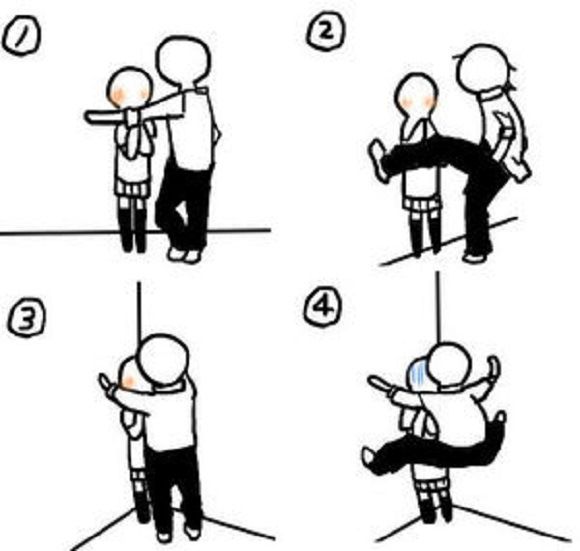
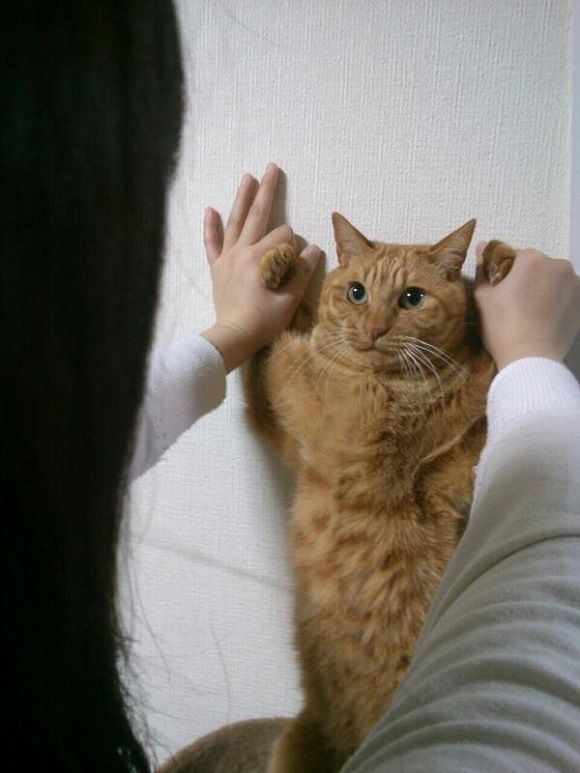
You may not be familiar with the term Kabe-don, but chances are you’ve seen the pose in movies, TV shows, comic books and animation. It’s the way tough guys show their love, by pinning the object of their affection up against the wall using arms or legs or both, and kabe-don poses are an internet sensation in Japan.

People love to stage pictures of themselves posing kabe-don style with a pet or loved one, or else they create wacked out illustrated versions of the pose which would be impossible to do in real life.

They also love adding a bit of wordplay to the pose phenomenon, changing words like gyudon (a type of beef bowl) into a bull posing kabe-don style over his intended "victim". And don’t forget Neko-don, kitty style kabe-don pics which are all the rage because, you know, the internet.

Via RocketNews24

15 Jan 19:10

HEADWATER: NSA program for sabotaging Huawei routers over the Internet

by Cory Doctorow


Bruce Schneier leads a discussion of HEADWATER, the NSA's tool for compromising Huawei routers over the Internet and turning them into snoops. It's one of the entries from the notorious TAO catalog:

HEADWATER

(TS//SI//REL) HEADWATER is a Persistent Backdoor (PDB) software implant for selected Huawei routers. The implant will enable covert functions to be remotely executed within the router via an Internet connection.

(TS//SI//REL) HEADWATER PBD implant will be transferred remotely over the Internet to the selected target router by Remote Operations Center (ROC) personnel. After the transfer process is complete, the PBD will be installed in the router's boot ROM via an upgrade command. The PBD will then be activated after a system reboot. Once activated, the ROC operators will be able to use DNT's HAMMERMILL Insertion Tool (HIT) to control the PBD as it captures and examines all IP packets passing through the host router.

(TS//SI//REL) HEADWATER is the cover term for the PBD for Huawei Technologies routers. PBD has been adopted for use in the joint NSA/CIA effort to exploit Huawei network equipment. (The cover name for this joint project is TURBOPANDA.)

STATUS: (U//FOUO) On the shelf ready for deployment.

HEADWATER: NSA Exploit of the Day


15 Jan 19:04

LEGO Albums

by Miss Cellania

Harry Heaton digitally creates images that are famous album covers as if they were made of LEGO bricks for his Tumblr blog LEGO Albums. The effect is a low-res pixilation that you'll recognize if you have ever owned the album (squinting helps). He takes requests and submissions, too, if you want to make your own LEGO album cover! But look through the archive first, because there's a lot of album covers there, from many musical eras. -via Flavorwire

15 Jan 19:02

UK consultation on orphan works

by Cory Doctorow

The UK's Intellectual Property Office has opened a consultation into orphan works -- works that are still in copyright but whose copyright holder can't be ascertained or located. The US Supreme Court case Eldred v Ashcroft heard that 98 percent of the works in copyright are orphans, and this problem will only get worse as the duration of copyright keeps on getting extended.

Parliament enacted the Enterprise and Regulatory Reform Act 2013, which set out a plan for letting people buy and use orphan works with an escrow fund for absentee rightsholders. Now, the IPO is seeking opinions on how that system should run.

The Government's orphan works scheme aims to address the issue of reproducing works when rights holders cannot be found. The UK wide scheme provided under the Enterprise and Regulatory Reform Act 2013 External Link, allows for the commercial and non-commercial use of any type of orphan work, by any applicant, once they have undertaken a diligent search for missing rights holders and paid a licence fee.

Alongside the UK scheme, the Government is implementing the complementary EU orphan works Directive External Link. This will allow publicly accessible archives to digitise certain works and to display them on their websites for access across the EU.

This technical consultation is seeking views on the legal effectiveness, structure and effect of the draft secondary legislation only. The overall policy is outside the scope of this consultation.

This consultation is particularly relevant to rights holders, their representatives and to anyone wishing to reproduce copyright works where the copyright owner cannot be found. However, it is not limited to these groups and responses from all interested parties are welcome.

Copyright works: seeking the lost (Thanks, Gary!)


15 Jan 02:21

Capitalism, casinos and free choice

by Cory Doctorow


Tim "Undercover Economist" Harford's column "Casinos’ worrying knack for consumer manipulation," takes a skeptical look at business and markets -- specifically their reputation for offering a fair trade between buyers and sellers. Inspired by Natasha Dow Schüll's book Addiction by Design: Machine Gambling in Las Vegas, a 2012 book on the calculated means by which gamblers are inveigled to part with more money than they consciously intend to, Harford asks a fundamental question about capitalism: are markets built on fair exchanges, or on trickery?

Consider, first, confusion by design: Las Vegas casinos are mazes, carefully crafted to draw players to the slot machines and to keep them there. Casino designers warn against the “yellow brick road” effect of having a clear route through the casino. (One side effect: it takes paramedics a long time to find gamblers in cardiac arrest; as Ms Schüll also documents, it can be tough to get the slot-machine players to assist, or even to make room for, the medical team.)

Most mazes in our economy are metaphorical: the confusion of multi-part tariffs for mobile phones, cable television or electricity. My phone company regularly contacts me to assure me that I am on the cheapest possible plan given my patterns of usage. No doubt this claim can be justified on some narrow technicality but it seems calculated to deceive. Every time I have put it to the test it has proved false.

I recently cancelled a contract with a different provider after some gizmo broke. The company first told me the whole thing was my problem, then at the last moment offered me hundreds of pounds to stay. When your phone company starts using the playbook of an emotionally abusive spouse, this is not a market in good working order.

Casinos’ worrying knack for consumer manipulation (Thanks, Tim!)

(Image: Slot Machine, a Creative Commons Attribution Share-Alike (2.0) image from kubina's photostream)


15 Jan 02:20

Whistleblower Edward Snowden joins Freedom of the Press Foundation board

by Xeni Jardin

The Freedom of the Press Foundation, an organization of which I am a proud board member, today announced that Edward Snowden has joined its board of directors. The announcement is here. Charlie Savage at the New York Times writes about it here. The Huffington Post's item is here. Here's CNN, and here's Politico, and here's the Washington Post. Above, a video of Daniel Ellsberg speaking on Jake Tapper's CNN show about the Snowden news, and the intergenerational fight for government transparency and against corruption in America.

Also this week, a new Qunnipiac poll: Americans now consider Snowden to be more of a whistleblower than traitor by a huge margin: 57-34%.

The full announcement is below:

Freedom of the Press Foundation (FPF) is proud to announce NSA whistleblower Edward Snowden will join its board of directors.

“I am proud and honored to welcome Edward Snowden to Freedom of the Press Foundation’s board of directors. He is the quintessential American whistleblower, and a personal hero of mine,” said FPF’s co-founder Daniel Ellsberg. “Leaks are the lifeblood of the republic and, for the first time, the American public has been given the chance to debate democratically the NSA’s mass surveillance programs. Accountability journalism can’t be done without the courageous acts exemplified by Snowden, and we need more like him.”

Freedom of the Press Foundation was founded in 2012 in part to build a movement to support and strengthen the First Amendment and defend those who are on the front lines holding power to account. Its founding board members include Daniel Ellsberg, Glenn Greenwald, Laura Poitras, John Cusack, Xeni Jardin, and John Perry Barlow. The NSA revelations Mr. Snowden brought to light represent one of our generation's greatest threats to press freedom. Mr. Snowden is joining the board to be part of solution, to help protect today's journalists and inspire tomorrow’s watchdogs.

FPF co-founder Glenn Greenwald said: "We began this organization to protect and support those who are being punished for bringing transparency to the world's most powerful factions or otherwise dissent from government policy. Edward Snowden is a perfect example of our group's purpose, as he's being persecuted for his heroic whistleblowing, and it is very fitting that he can now work alongside us in defense of press freedom, accountability, and the public’s right-to-know."

Mr. Snowden said: "It is tremendously humbling to be called to serve the cause of our free press, and it is the honor of a lifetime to do so alongside extraordinary Americans like Daniel Ellsberg on FPF’s Board of Directors. The unconstitutional gathering of the communications records of everyone in America threatens our most basic rights, and the public should have a say in whether or not that continues. Thanks to the work of our free press, today we do, and if the NSA won't answer to Congress, they'll have to answer to the newspapers, and ultimately, the people."

Snowden brings a deep knowledge about how journalists and sources can communicate securely in the age of mass surveillance. Protecting digital communications is turning into the press freedom battle of the 21st Century.

"Journalism isn't possible unless reporters and their sources can safely communicate," said Mr. Snowden, "and where laws can't protect that, technology can. This is a hard problem, but not an unsolvable one, and I look forward to using my experience to help find a solution.”

Freedom of the Press Foundation is currently raising money and awareness for a variety of open-source encryption tools, along with helping media organizations install SecureDrop, a whistleblower submission system.

Ellsberg added: “The secrecy system in this country is broken. No one is punished for using secrecy to conceal dangerous policies, lies, or crimes, yet concerned employees who wish to inform the American public about what the government is doing under their name are treated as spies. Our ‘accountability’ mechanisms are a one-sided secret court, which acts as a rubber stamp, and a Congressional ‘oversight’ committee, which has turned into the NSA’s public relations firm. Edward Snowden had no choice but to go to the press with information. Far from a crime, Snowden’s disclosures are a true constitutional moment, where the press has held the government to account using the First Amendment, when the other branches refused.”

Freedom of the Press Foundation was founded in 2012 to support and defend aggressive, public-interest journalism dedicated to transparency and accountability. It has raised over $500,000 for such news organizations as WikiLeaks, MuckRock, National Security Archive, Bureau of Investigative Journalism, and Center for Public Integrity.

Snowden will officially join the board of directors in February 2014.


14 Jan 20:27

Copyright Week: the law shouldn't be copyrighted

by Cory Doctorow


The Electronic Frontier Foundation continues to publish its excellent series of Copyright Week posts (here's yesterday's installment). Today, Corynne McSherry describes the fight over copyrighted laws. Not copyright laws -- laws about copyright -- but, rather, laws that are copyrighted, and that can't be read without paying hefty fees.

This odd situation crops up often in the realm of public safety standards (the last kind of law you'd want to hide away from the public, really): lawmakers commission private standards bodies to write these standards, then write a law that reads, "In order to comply with the law, you must follow standard such-and-such." So now you've got this weird situation where the law is a secret, it is proprietary, it cannot be published, and you can't see it or know what it says unless you're willing to pay the standards body.

But that's just the beginning:

Fortunately, open access crusaders like Public.Resource.Org (whose founder, Carl Malamud, is testifying before Congress today about this issue), and the Center for Information Technology Policy, have worked hard to correct the situation, by publishing legal and government documents and giving citizens the tools to do so themselves. A private company, Google, has also done its part by including court opinions in the Google Scholar database. Until recently, these folks haven’t had to deal with copyright infringement lawsuits as they worked to free the law.

No longer. A group of standards-development organizations (SDOs) have banded together to sue Public.Resource.Org, accusing the site of infringing copyright by reproducing and publishing a host of safety codes that those organizations drafted and then lobbied heavily to have incorporated into law.

The SDOs argue that they hold a copyright on those laws because the standards began their existence in te private sector, and were only later "incorporated by reference" into the law. That claim conflicts with the public interest, common sense, and the rule of law.

The fundamental right to access and share the law does not disappear just because the law in question is a technical standard. And a good thing, too, because these standards are now a significant part of the laws that shape our lives. Once incorporated, they become mandatory requirements, just like any other law.

Copyright Week has six principles: transparency, a robust public domain, open access, "you bought it, you own it," fair use and balance. Sign onto them at EFF's site.

The Law Belongs In the Public Domain


14 Jan 20:27

Lots of science demonstration videos for home and school

by Maggie Koerth-Baker
A website dedicated to high-quality, accurate, free science videos on the Internet? Yes, please.


14 Jan 20:20

Patent mess goes to the Supreme Court

by Cory Doctorow

Two more high-profile patent cases are headed to the US Supreme Court, which has already agreed to hear a patent case this year. The patent system is in chaos, with ever-more-trivial patents being granted, and ever-broader theories of patent infringement being created by the Federal Circuit, the court that oversees the patent system.

A Supreme Court ruling that restored some sanity to patents would be very welcome indeed -- but if they went the other way, it would be dreadful. The only solution at that point would be for Congress -- whose campaigns depend on revenue from patent abusers -- to pass a new law (don't hold your breath).

When the case was appealed to the US Court of Appeals for the Federal Circuit, though, a sharply divided "en banc" panel made a surprising and broad ruling. In a 6-5 ruling, the top patent court found that Akamai didn't have to show that Limelight's customer actually infringed the patent directly; it merely had to show that Limelight "induced" its customer to infringe. Limelight would have to stand trial, again.

That led to Limelight appealing to the Supreme Court. It also raised alarm bells among other patent defendants. The issue of "joint infringement" comes up frequently in tech and Internet cases, where a user or customer performs some steps of the patent. (The recent TQP v. Newegg trial is an example; Newegg was accused of executing some steps of the patent, while its customers performed other steps.)

"The Federal Circuit has created a new basis for patent-infringement liability that conflicts with this Court’s precedents and the Patent Act," wrote Limelight lawyers in their petition.

"Imposing on a business the additional obligation to speculate correctly about potential future uses by a third-party buyer or user is unreasonable and unfair," wrote lawyers representing HTC and two other high-tech companies in an amicus brief supporting Limelight.

Supreme Court looks to rein in top patent court with two new cases [Joe Mullin/Ars Technica]


14 Jan 20:16

Requirements for DRM in HTML5 are a secret

by Cory Doctorow


The work at the World Wide Web Consortium (W3C) on adding DRM to HTML5 is one of the most disturbing developments in the recent history of technology. The W3C's mailing lists have been full of controversy about this ever since the decision was announced.

Most recently, a thread in the restricted media list asked about the requirements for DRM from the studios -- who have pushed for DRM, largely through their partner Netflix -- and discoverd that these requirements are secret.

It's hard to overstate how weird this is.

Standardization is the process by which all the parties in a technical subject agree on how things should be done. It starts with a gathering of requirements -- literally, "What is the standard required to do?" Without these requirements, it's hard to see how standardization can take place. If you don't know what you're standardizing for, how can you standardize at all?

DRM, by its nature, has secret requirements. That's why attempts to standardize it always end up with unworkable garbage, like the DVB's CPCM. DRM relies on me installing software on your computer that stops you from running other software. For example, you install a browser that plays video in such a way that another program on your computer can't grab the video as the browser shows it on the screen.

This is silly. It's your computer. Whatever steps the browser takes to obscure how it is playing the video back can be unpicked by you, at your leisure, so you can make a tool that gets around it.

Standards are, by their nature, public: they say, "This is what you are expected to do." But if you make DRM's workings public ("here's how we hide the keys from you"), you provide a roadmap for defeating it. Standardized DRM is an oxymoron, like a secret law.

The ensuing Hacker News thread is well worth a read on this.

Re: Watermarking [Re: Campaign for position of chair and mandate to close this community group]

(Image: Shh--Daily Image 2011--April 2, a Creative Commons Attribution (2.0) image from tinfoilraccoon's photostream)


14 Jan 20:16

Zach King's Magic Vines

by Miss Cellania

(YouTube link)

A 6-second vine video is the perfect place to show off some complicated special effects without the magic getting lost in exposition. When you put a lot of those great 6-second videos together, it's a non-stop barrage of delight that doesn't have to hang together or make sense. That's fine with me!  

Film student Zach King (previously at Neatorama) has been having a lot of fun making short clips at Vine to blow your mind with one "magic" effect in each. FarlyTeem compiled about 75 or so of them to make it easy for you to enjoy. -via Daily Picks and Flicks

14 Jan 20:14

Catlateral Damage

by Miss Cellania

You're a cat. You break stuff. Simple as that.

That's the concept behind the game Catlateral Damage. You are the cat, and your goal is to jump around the room and knock stuff to the floor, whether it's delicate electronic equipment, houseplants, or precious trophies. If you find yourself enjoying this to the point where you don't want to stop, then you may have some insight into how your cat thinks.

I did not do well, as it took some time to orient my movements and more time to stop laughing at my awkward performance and that crazy cat paw. I also think I may be handicapped by not having a left or right mouse button. You can play online, or download the game. -via Time Newsfeed

13 Jan 21:03

Copyright week: take copyright back!

by Cory Doctorow


This week is Copyright Week, and every day this week, the Electronic Frontier Foundation and its allies in the fight for a fair, balanced copyright will be posting new article explaining how to fix copyright. The week is organized around six principles: transparency, a robust public domain, open access, "you bought it, you own it," fair use and balance. They're asking for you to sign onto the principles and support the campaign. Here's the kick-off post:

It's no longer the case that copyright is only a concern if you run the kind of company that has its own theme parks. Instead, copyright policy can have an effect on any user posting to her favorite sites, sharing videos she's captured or photos she's taken. It can affect your basic freedom to tinker, make, and repair your stuff. And it gives content owners, and governments, a powerful censorship tool, with far too little oversight.

Copyright is supposed to embody a balanced incentive system, encourage authors and inventors to create new things by helping them receive some compensation for that investment. At the same time, copyright law puts limits on authors, such as fair use and limited terms of protection, to help make sure that IP rights don’t unfairly inhibit new creativity. When the system works, it can be an engine for creativity, innovation and consumer protection. When it doesn’t, IP rights have the opposite effect, giving IP owners a veto on innovation and free speech.

Copyright Week: Taking Copyright Back


13 Jan 18:22

2600's HOPE X conference accepts Bitcoin signups

by Cory Doctorow
Emmanuel Goldstein from 2600 magazine writes, "The HOPE X conference (July 18-20, New York City) is now accepting Bitcoin for preregistration. It's believed this is the first time in North America that any conference (other than a couple of Bitcoin conferences) has accepted the digital currency. Quite a few people have been requesting this for a while - and a hacker conference is exactly the kind of place where such experiments should be tried out. In addition to allowing people to preregister with a minimum of identifying information, it also presents attendees and non-attendees alike with a way of making new projects at the conference possible by donating additional bitcoins if desired. It will be most interesting to see if this method of payment is embraced by HOPE X attendees."


13 Jan 17:54

What GTA Would Look Like As A Kids Game

by Zeon Santos


(Video Link)

The Grand Theft Auto video game franchise has changed the way people see Mature rated video games, and pushed that M rating to the max with brutally honest depictions of street crime, prostitution, and gang violence. The games are too graphic for children, but what if they made a version geared specifically towards kids?

Nacho Punch made an animated short that attempts to show what the E for Everybody GTA would look like called GTA for Kids, and it's still way too hardcore for kids! I guess when you name a video game series after a major felony you're not looking to cash in on the kiddie market.

Via Uproxx

13 Jan 03:49

Carl Malamud's testimony on copyrighting the law

by Cory Doctorow

Rogue archivist Carl Malamud sez, "On Tuesday, January 14, 2014 at 10AM, the House Judiciary Committee will be holding hearings on the Scope of Copyright Protection. I will be testifying on the subject of Edicts of Government, including copyright assertions over state laws and federally-mandated public safety codes. My prepared statement is available and I would like to express my appreciation to the Committee for giving me the opportunity to testify."

Edicts of government are the rules of general applicability by which we choose to govern ourselves as a society. When John Adams said we are “an empire of laws, and not of men,”[1] he meant that our democracy is based on public laws that we all know, not on the arbitrary actions taken in star chambers or smoke-filled back rooms.

That ignorance of the law is no excuse is a principle firmly rooted in the law, a principle that can only be true if our laws are public.[2] All modern democracies are based on the doctrine of the rule of law, a doctrine firmly embedded in our common law, enshrined in international treaties, and one of the underpinnings of the constitutions of the United States and other nations.[3]

Legal scholars rarely agree on a single point, but on the idea that the law must be promulgated to be effective, they are unanimous. Professor Tamahana, for example, in his standard text on the subject stated, “Citizens are subject only to the law, not to the arbitrary will or judgment of another who wields coercive government power. This entails that the laws be declared publicly in clear terms in advance.”[4] That is why, going back to ancient times, societies that replaced the rule of tyrants with the rule of law prominently displayed the laws in public places for all to see, a point made so well by Senator Robert C. Byrd in his classic lectures on Roman history delivered on the floor of the U.S. Senate.[5]

An Edicts of Government Amendment


12 Jan 23:13

DRM-free comics of excellence from Image Comics

by Cory Doctorow

The rise of Marvel's Comixology has meant that DRM -- Digital Rights Management -- has become the norm for comics, meaning that your collection is forever locked to Comixology's platform, and it is illegal for anyone except Comixology (and not the artists and writers who created the comics!) to unlock them so that they can be viewed on non-Comixology players.

It's as though Comixology had come up with a scheme to get us to buy our comics in a form that could only be put into special longboxes that they alone can sell -- longboxes that can only be stacked on the shelves they choose, and comics that can only be read under the lightbulbs they authorize, in the chair they approve. Every penny you spend on Comixology increases the cost of your switching away from it -- and increases the extent to which a single company (now owned by Disney) controls and sets the rules for making, publishing, retailing and reading comics.

Some comics creators are pushing back. Image Comics, publishers of The Walking Dead, announced its DRM-free comics store in July (Image is also noteworthy for its creator-friendly contracts, which are among the best in the industry). Last week, Image put on a one-day comics expo in San Francisco where it featured the new DRM-free titles coming to its store, and Wired rounded up seven amazing-looking stories that you'll be able to buy without selling your soul.

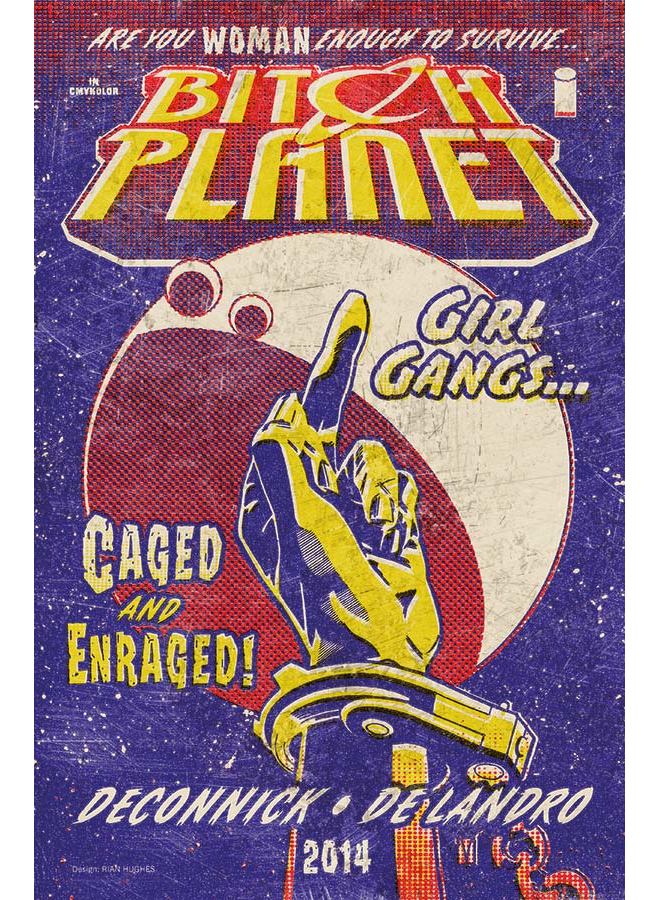
Image's creator-friendly policies have attracted some pretty amazing talent, like Grant Morrison, Jamie McKelvie, Michael Chabon, and many others. But the one I'm most intrigued by is Bitch Planet, from Kelly Sue Deconnick:

A feminist, sci-fi take on women-in-prison sexploitation by Captain Marvel and Pretty Deadly writer Kelly Sue Deconnick? Yes, please. Illustrated by Valentine De Landro, the series follows five convicts on an all-female penal planet trying to make their escape by way of gladiatorial combat. It's worth noting that, at least in premise, Bitch Planet bears a striking resemblance to the "Prison Ship Antares" arc of Alex de Campi's Grindhouse, likewise a prison sexploitation homage set in space. I tend to think this is a genre mash-up that makes intuitive sense and is thus more zeitgeist than swipe, but I'm still crossing my fingers for the crossover de Campi proposed when she mentioned the similarity on Facebook). —Rachel Edidin

The 7 Best DRM-Free Comics Announced at Image Expo [Wired]

(via Kadrey)