Shared posts

12 Jan 17:05

8 Bit Cinema Presents- Pulp Fiction

by Zeon Santos

(Video Link)

If someone hopped into a time machine, a VHS copy of Quentin Tarantino’s beloved flick in hand, to show Pulp Fiction to a studio full of game designers circa 1987, they may have made a game that looks much like CineFix's 8-Bit Cinema version of Pulp Fiction.

It's got all the blood, drama and bad dance moves found in the original movie, but now it looks a lot more like Double Dragon than a Tarantino flick. Scenes like the club dance off and everything Bruce seem like they would have been fun to play on an old school NES. The part where you clean blood and brain bits out of the back of a car via button mashing? Not so much...

Via Animal NY

12 Jan 00:24

Canadian spy agency admits to illegally spying on Canadians

by Cory Doctorow

The Communication Security Establishment of Canada -- a secretive spy agency that's already been caught lying to a judge and illegally spying on diplomats at the Toronto G20 -- has admitted that it illegally spied on Canadians as well.

CSE also admits it's allowed to help CSIS, the Mounties and Canada Border Services Agency "in a variety of circumstances — including intercept operations against a Canadian or individuals in Canada."

National security blogger Bill Robinson says that means CSE can use information gleaned from Canadians.

"If it falls into the government's collection priorities, they certainly will use it," he said Friday.

CSE admits it 'incidentally' spied on Canadians [Daniel Proussalidis/Observer.ca]

(via Reddit)


11 Jan 20:55

Crowdsourced, realtime date advice: networked hivemind Cyrano

by Cory Doctorow

Artist/programmer Lauren McCarthy has undertaken an interesting experiment in networked romance called Social Turkers. McCarthy sets up dates with men using OK Cupid, and uses her phone to stream a live video feed of the outings to Amazon's Mechanical Turk crowdsourcing platform. The turkers observe the interaction and text realtime suggestions on what McCarthy should do in order to have an optimal date.

She's documented each date, and published the log of the turkers' commentary.

During a series of dates with new people I meet through the Internet, I will discretely stream the interaction to the web using an Iphone app. Turk workers will be paid to watch the stream, interpret what is happening, and offer feedback as to what I should do or say next. This feedback will be communicated to me via text message.

Through this series of interaction experiments, I will refine the rules of the system — the type of feedback and rating the turkers provide, and the amount and frequency of their influence. I will also keep public logs of the responses of the turkers and my own reflections on what transpires during each interaction.

Coming soon: easy to use app for anyone to start crowdsourcing their own relationships! Stay tuned.

Social Turkers: Crowdsourced Dating (via JWZ)


11 Jan 20:52

Baybrook Remodelers sue (and sue and sue) people who give them negative reviews

by Cory Doctorow


Since 2010, Kristen A. has maintained a website where she documents the legal hassles she's undergone with Baybrook Remodelers, Ken Carney's Connecticut company, who has sued her for posting a negative online review of the work they did for her. Baybrook has filed more than 40 lawsuits against its online critics. In Kristin A's case, Baybrook has filed for 15 continuances, dragging the case out so that it was never heard -- it's only scheduled for a hearing now because Kristin A's lawyer insisted. It's not the only case that's been dragged out by Baybrook's lawyers.

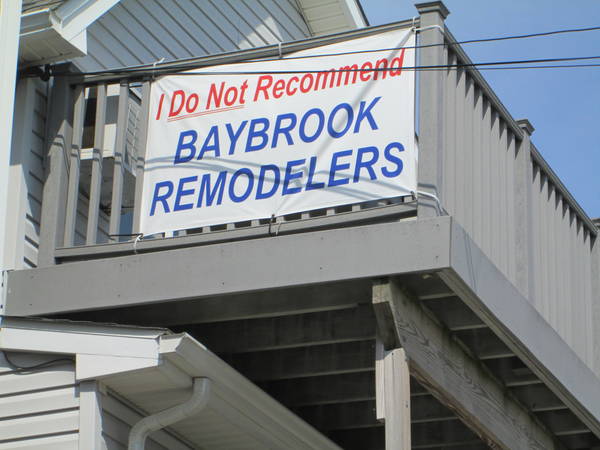
Kristen A's mother actually moved houses because of legal harrassment from Carney and Baybrook -- after she hung up a sign saying "I do not recommend Baybrook Remodellers" and another showing how many lawsuits the company had filed, Baybrook had the city of Milford pull her zoning approval and make her life hell (nice one, Milford, CT).

The Connecticut Department of Consumer Protection's complaints file for Baybrook is 40 pages long.

Here's a look at the docket, which is filled with little else other than the plaintiff's extension requests. As Kristen notes, a trial is forthcoming, with jury selection beginning in March. This is what Baybrook's been avoiding. Obviously, it hoped its threats would be enough to quell the criticism. That has backfired and now the company is in the awkward position of having to explain itself to a jury. This isn't the only case Baybrook is dragging its heels on. Another Tort case filed by Baybrook Remodelers in 2010 is still ongoing, with numerous extensions having been filed here as well. A motion for summary judgement has been filed by the defendant who is obviously hoping to finally have this seemingly endless suit tossed.

Kristen's site contains even more details of Baybrook's shady behavior. She noticed that shortly after she posted her negative review detailing the 40+ lawsuits the company was involved in (Dec. 6, 2010), a flood of Baybrook's "admirers" took to these same sites to post glowing reviews of the company. Most of the reviews were posted Dec. 15-17, which either means the company was posting its own reviews or had just wrapped up a ton of contracts for deliriously happy customers. Some reviews even copy-pasted wording from positive reviews written years earlier. Other identically-worded reviews surfaced under different names in January of 2011. One was even posted on Baybrook's website using yet another name.

But the most damning indicator of the company's negative reputation is the 40 pages of complaints filed with the Connecticut Department of Consumer Protection. The complaints detail a variety of issues with Baybrook Remodelers, including its tendency to do shoddy work and leave cleanup and damage repairs to the client. Other complaints point out how reluctant the company is to engage with dissatisfied customers ("owner won't answer his phone").

Remodeler Sues Woman Over Negative Reviews, Helps Force Another Critic Out Of Her Own Home [Tim Cushing/Techdirt]


11 Jan 20:50

An Adventure

by Jesse
While walking along the pier, I was strangely overcome with a desire to peer around the water. I soon spotted five or six people dressed as police. I watched as they combed the surroundings for evidence, called back to home base, showed me their badges, and told me to "back away from the surroundings." After a while of this, it dawned on me that these people weren't just dressed up as police. At least three of them were police!

I decided that I would heed their advice of "stepping the fuck back" after none of them would give me an autograph (talk about stuck up!!!). I then overheard one saying, "looks like we got a floater." Ew, gross, I thought. That's terrible. Who would do such a thing? However, it soon became clear that they were actually just talking about a body. What a relief!

I started to get hungry and asked if anyone had a sandwich. "We've got bigger fish to fry," they told me. That sounded pretty good so I decided to stick around but as it turns out, "fish" is just code for "dead body" and "fry" is just code for I don't know what.
11 Jan 20:49

Remembering Aaron Swartz

by Cory Doctorow

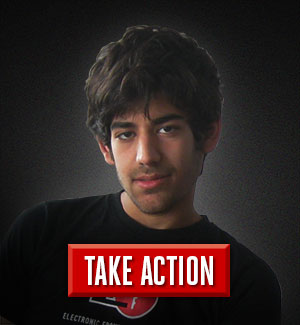
It's been a year since Aaron Swartz killed himself. The Electronic Frontier Foundation's Parker Higgins has posted a memorial to him that I found quite moving. I miss Aaron a lot.

I've been feeling pretty hopeless about the future lately, and I think a lot of it has been driven by the impending anniversary of Aaron's death. The last couple years were hard ones.

Aaron had a gift for identifying the problems that mattered, mapping a theory of change, and then taking it on, step by step. That approach allowed him to undertake challenges that many people, most people, would dismiss as impossible. That may be the greatest legacy of the central role he played in the historic SOPA blackout protests: he dreamed a way that an individual could make a small difference, and enough acting together were unstoppable.

It takes a tremendous human spirit to look at the failures of the institutions around us—from the breakdown of governmental checks and balances to its war on whistleblowers to the tremendous corporate influence on crafting anti-user policies—and not despair. Aaron taught us that we must not. He's inspired people to take up big challenges not out of reckless optimism, but because he believed that if we can see the change we want in the world, we are powerful enough to make it happen. From Lawrence Lessig marching across New Hampshire to address corruption in politics, to public interest groups banding together for a day of action against NSA spying, that legacy lives on.

We gave Aaron a Pioneer Award last year and continue to fight in his honor. Join us by demanding a fix to the CFAA and joining our month of action against censorship and surveillance and toward open access.  Because in the end, the way to celebrate Aaron’s life is to come together and continue his work.

Remembering Aaron


11 Jan 20:46

City of London Police told they can't just take away domains because Hollywood doesn't like them

by Cory Doctorow


The City of London is a curiosity; it's the financial district within London proper, and it has its own local government, which is elected by the banks and other corporations within the district. This (literally) corporate-run government then operates its own police force, separate from the Metropolitan Police, with sweeping powers.

The City of London Police recently gave themselves the power to seize domains that they believed were implicated in copyright violation, and started sending officious letters to domain registrars demanding that the domains be shut down. This was a purely extrajudicial, ad-hoc procedure -- in other words, the City of London Police were just making it up. The letters they sent had no force in law, cited no evidence from a court, and were unenforceable.

Nevertheless, a surprising number of registrars caved in to them, confiscating their customers' domains and blocking any attempt to transfer the domains to more responsible registrars. One of the worst offenders was the terrible Public Domain Registry, which blocked its customers from transferring domains to EasyDNS.

EasyDNS took Public Domain Registry to Verisign and then to the National Arbitration Forum, and, after a long process, prevailed. The arbitrator ruled that City of London Police don't have the power to take away domains just because some of their friends don't like them -- without due process and a court order, the City of London Police are just a bunch of random jerks barking orders that no one has to obey.

Bravo to EasyDNS for refusing to cave in, and for going to the wall for domain owners -- even those who aren't doing business with it.

The Registrar of Record argued that a basis for withholding the transfer of the domain names was their involvement in fraudulent activity. The Response stated that the three domain names “were involved in criminal distribution of copyrighted material directly or indirectly and are liable to prosecution under UK law which serves as evidence of fraud” under the Transfer Policy. First, the Registrar of Record’s assertion is not correct as the London Police Request does not state that it has evidence of fraud. The Registrar of Record apparently contacted the London Police, as the Registrar states that the London Police have “agreed to answer any and all questions that might arise with regards to these domain names.”

Second, the reference to “evidence of fraud” in the Transfer Policy does not refer to fraudulent conduct by the holder of the domain name, but evidence of fraud with respect to the transfer of that domain name

City Of London Police Cannot Seize Domains Just Because Hollywood Says The Websites Are Infringers [Mike Masnick/Techdirt]

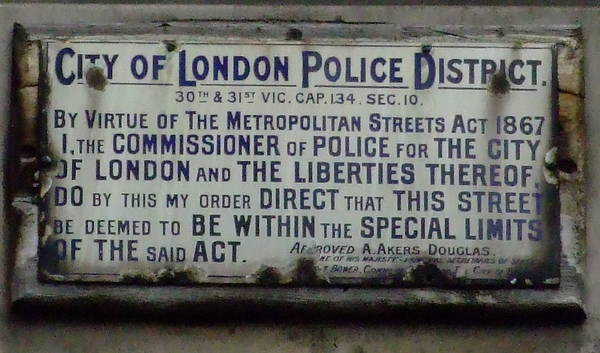
(Image: City of London Police District, a Creative Commons Attribution (2.0) image from 10260831@N02's photostream)


10 Jan 18:59

HOWTO prevent people from sending to your Gmail account via Google Plus

by Cory Doctorow
Google continues to try and cram its users into Google Plus, its also-ran social network. The latest move allows people who don't have your Gmail address to send email to your Gmail account by using your Google Plus ID. I have a Gmail account that's associated with my Android devices and the last thing I want is for people to start sending email there. Thankfully, there's a way to opt out (though it would have been much better if it was opt-in). Tl;dr: Gmail -> Settings -> Email via Google+ -> Off. (via Cnet)


10 Jan 18:52

Star Trek Trailer: Derp Edition

by Miss Cellania

(YouTube link)

Slackstory continues the meme of reconstructing movie trailers using bloopers and outtakes with J.J. Abrams' 2009 movie Star Trek. Clumsy Kirk, illogical Spock, and a Starfleet crew with more dancing skills than flight skills is what you get. -via Daily of the Day   

Previously: The same treatment for The Avengers and Star Wars.

10 Jan 18:48

Seven Minutes Of Sterling Archer One Liners

by Zeon Santos

(Video Link)

He’s the animated spy with sophisticated style, a drinking problem and enough one liners to fill a little black book, he’s Sterling Archer and his appropriately titled animated series Archer has been blowing away audiences for four seasons with their raunchy adult humor and twisted view of the world of spydom.

With Archer coming back in 2014 for its fifth season, fans are craving a taste of what Codename: Duchess has in store for them this time around, so to tide you over Uproxx has put together a supercut of Archer’s greatest moments in witty repartee with Seven Minutes of Sterling Archer’s Best One Liners. (NSFW due to language)

Via Kotaku

10 Jan 04:19

Bill O'Reilly gets the facts wrong about high school marijuana use

by Mark Frauenfelder

In the above clip, O'Reilly is seen arguing with Columbia University neuroscientist Carl Hart (author of High Price: A Neuroscientist's Journey of Self-Discovery That Challenges Everything You Know About Drugs and Society) about the percentage of high school seniors who said they smoked marijuana recently. O'Reilly defends the number supplied to him by his research team, saying Hart should "take it up with the National Institutes of Health," to which Hart replies, "I am a council member on the National Institutes of Health. Your number is wrong... it's a fact." O'Reilly stares down at his papers and shuffles them, and says, "I doubt it's a fact because we don't get this wrong."

At the end of the segment O'Reilly says, in passing, that Hart's number is correct, but doesn't says anything about how this destroys his argument that today's teens are smoking more pot than teens in earlier years.

The Perfect Storm - Is America Going To Pot? - O'Reilly Talking Point


10 Jan 04:15

Filtered: free/open IMAP filter

by Cory Doctorow

Jeff writes, "Filtered is a new free/open source IMAP mail filtering application which provides automated routing of email based on per sender settings. You can train Filtered via its web UI or by dragging and dropping email to folders in your email account. Filtered can also learn from the contents of your existing folders."

Filtered's advanced module also brings new kinds of features to mail:

* Quiet hours. Shut down your inbox during specific hours like weekday evenings and weekends while allowing specific senders emails e.g. family to come through

* Privacy folder. Drag emails to your secure folder and Filter will encrypt them to its server, then delete them from your NSA-browsable gmail account.

* Whitelisting. Automatically send challenge emails to unknown senders to require them to verify their identity before the message appears in your inbox. Unverified senders are held in a review folder.

* Smartphone alerts. Filtered can send notifications to your phone when messages from specific senders or with specific keywords arrive.

* Manage anonymous email accounts. Filtered makes it easier to route inbound mail from catch-all email addresses. This is useful for registering with companies using anonymous addresses to minimize data mining.

The coolest thing about Filtered is that it's a platform for reading, analyzing, routing and managing your email -- possibilities abound. Filtered is essentially a programmable playground for "hacking" your own email. Filtered is written in PHP, in the Yii Framework. An installation guide is provided for typical GNU/Linux configurations. There is also a community support forum and a feature request board.

Filtered – Open Source IMAP Mail Filtering Software for PHP (Thanks, Jeff!)


09 Jan 20:07

Top blogger scammed many

by Rob Beschizza
Choire Sicha reports on Mediaite managing editor Jon Nicosia, who turns out to be a con artist, Zachary Hildreth, with form. The "confession". The fallout. On the internet, no-one know you're a dog. But if they never see you because of "black ops", well, you'd think some suspicion would kick in... [The Awl, Mediaite, Gawker]


09 Jan 16:48

2013's Most Profitable Movies Passed the Bechdel Test

bechdel test,infographic,movies

Submitted by: (via vocativ)

09 Jan 16:47

Scribd’s New Ebook Subscription Service: Partnering with Publishers, Profiting from Piracy

by Victoria Strauss
 Posted by Michael Capobianco for Writer Beware

I was contemplating what to write for my first Writer Beware blog post, when a subject popped up out of the blue, packed with all kinds of fascinating questions.

Some of you may remember when SFWA tangled with the online “digital library” Scribd back in 2007. Scribd was loaded with unauthorized uploads of copyrighted material, but SFWA screwed up big time by sending a sort-of DMCA notice (it wasn’t really) to get works by many sf writers removed from the site. It was an embarrassment for SFWA, and over time made it less and less likely that the organization would do anything directly about illegal uploads, even though a plan had been developed to do so for members who had specifically authorized SFWA to act as their agent.

Since everything to do with online piracy left a decidedly bad taste in my mouth, I decided I would not go looking for illegally uploaded copies of my or other authors’ works, and I didn’t check to see if Scribd was following through on the promises it made at the time to provide real-time checking of works uploaded to the service.

Jump forward six years to now. The subject of Scribd came up on a SFWA forum as part of a controversy that I needn’t go into here, and I decided that it was finally time to check it out.

Six years has made a big difference. Scribd has set out to become a full-fledged bookstore to compete with Amazon and Barnes and Noble, and takes it one step farther with the addition of an all-you-can-eat subscription service that allows access to an unlimited number of ebooks for $8.99 a month. They are now partnering with HarperCollins and various other publishers, such as Smashwords, E-Reads, and Rosetta Books, with the promise of more to come. They cover a lot of ground; not only do they sell ebooks and subscriptions, they offer what look like unauthorized “previews” of many other books, with links to authorized retailers.

But finally, beneath all the new things, the old Scribd--offering not-necessarily-legal user uploads of copyrighted works--is still there. Only now Scribd has monetized them, since you can only see a “preview” of the material for free, and must be a paid subscriber to access the whole unauthorized upload.


How did this happen without creating much of a ripple in the author community?

Well, first of all, it happened recently. The subscription service started on October 1. Details of what the deal looks like appeared for the first time in a Smashwords email and blog post just as I was writing this blog post.

A number of questions about such a service immediately spring to mind, and the Smashwords post answers some of them--assuming that the deal is consistent across the various publishers. When authors sign up for the deal directly, we can see how their royalties will be computed, but there’s another level of complexity when there’s a publisher acting as intermediary.

How much will HarperCollins authors see from the subscription program? HarperCollins CEO Brian Murray told Publisher’s Lunch, “We have negotiated very hard, to the point where if the whole business went this way, we and our authors would be very pleased …[this is] the exact opposite of the music industry’s subscriptions models. The revenues that go to our authors is up, somewhat significantly.” So can we assume authors will be getting 25% of the take, as they do from ebooks? Or slightly more? Will the payments be broken out on royalty statements so authors can see how much money they are making from Scribd subscriptions? Most importantly, do publishers have the contractual right to sell authors’ books this way at all?

Is there, indeed, even a difference, except that (counting the first 10% free preview) reading 30% of a book is considered a sale, reading 29% is considered 1/10 of a sale, and reading 15% is no sale?
Extensive book previews have become the norm, and they’re apparently authorized by publishers based on vague wording in the authors’ contracts about promotional excerpts. But here we have 29% of the book available for reading with no compensation due the author, unless there are nine more browsers who read enough of the book to count as a browse but not enough to count as a full sale.

Complicated enough for you? Let’s break it down a little further. Since it doesn't matter if you read the first 10% or not, that isn't even part of the equation. If I’m understanding the Smashwords/Scribd deal correctly, it specifies:

First 10% - Free. Doesn’t count toward total.
10% - 15% read - No payment.
15% - 30% read - Browse credit. 10 browses equals 1 sale.
30% - 100% read - Full sale.

While for novels, this may not seem onerous, for non-fiction and short fiction anthologies it can become easily become problematical.

Just for the moment, let’s assume it is an okay deal for many authors. It’s tremendously better than the deal offered to musicians by music subscription services like Pandora and Spotify. Even so, this paradigm switch should be scrutinized with great care. It’s another instance of rich corporations expanding what can be done with authors’ works without consulting them, defining terms in such a way that no one really understands how it affects authors’ copyrights, and doing so based on language in contracts that never anticipated an e-book subscription service. Authors need to sit up and take notice, and protest if they think their rights are being abrogated. If it’s not a great deal--which, let’s face it, is likely, given the insistence of the major publishers on paying at most a 25% net royalty rate on e-books--all the more reason for concern.

Which brings us to Scribd’s unauthorized uploads of copyrighted material. If you’d told me a couple of weeks ago that my first Writer Beware blog post would be about ebook piracy, I would have laughed. But it really looks as though Scribd has gone even farther into a very questionable area of monetizing the pirated books in its library, in two ways.

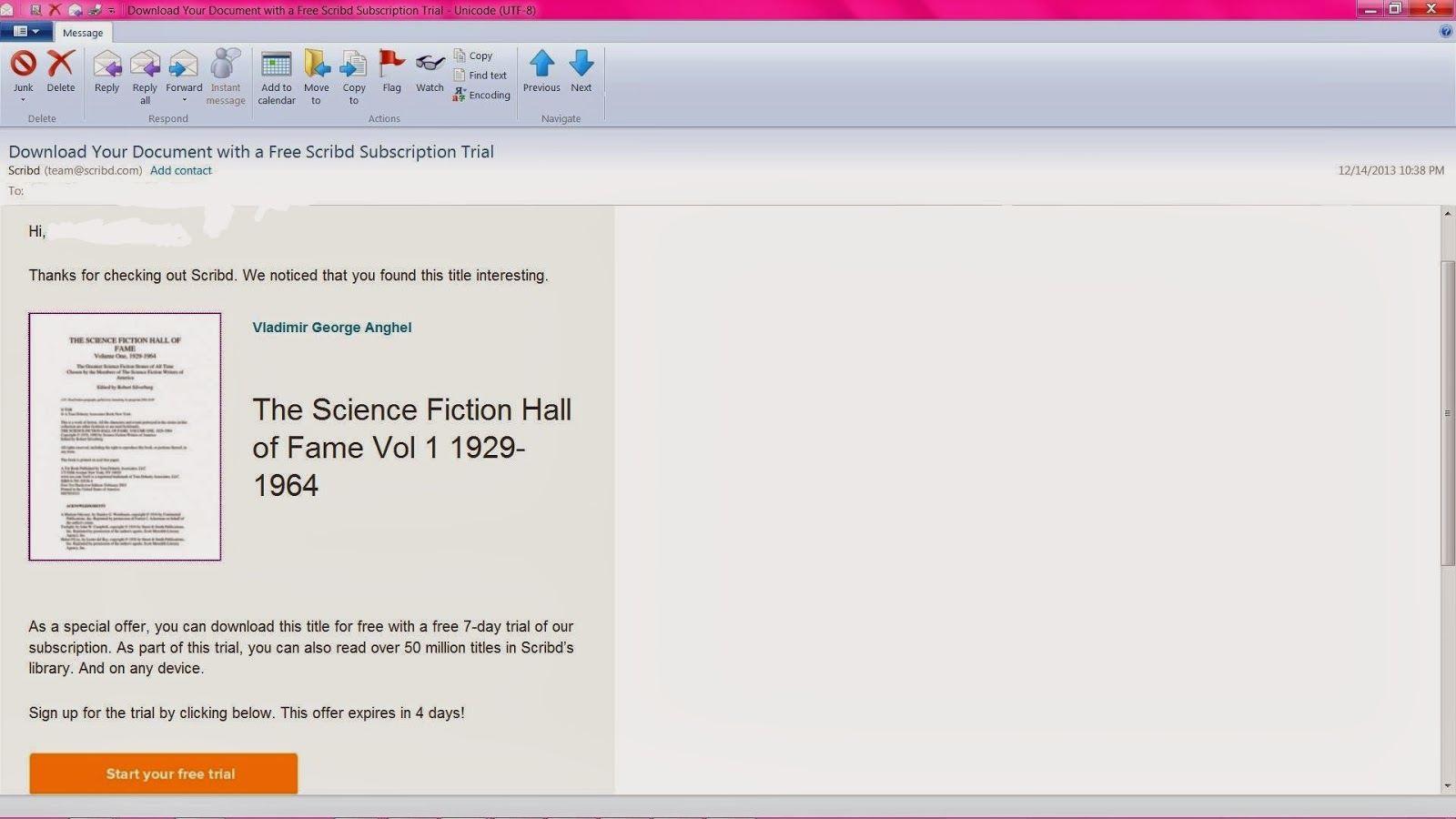
Firstly, they apparently only allow full access to pirated works to paid subscribers. Here's a screenshot of the email I received after checking the Scribd site for unauthorized uploads of SFWA-related copyrighted material:


As you can see, this unauthorized copy of the Science Fiction Hall of Fame, Vol. 1, was illegally uploaded by Vladimir George Anghell, and Scribd is using it as bait for a 7-day free trial of their subscription service, that will, of course, transition automatically to a paid subscription if I do not cancel.

Think about it. All across the Scribd website, there are illegally uploaded, copyrighted files that you can only read in their entirety if you start paying Scribd, which doesn’t pay authors anything for those uploads. Almost as bad are the advertisements displayed next to pirated works.

Six years ago, Scribd initiated a system to monitor uploads and compare them to a database of copyrighted works, with the promise to delete anything that matched. It may be working, it may not, but there’s still an enormous amount of pirated work available there, and you have to ask yourself, do you want to support a site like Scribd by having your work sold there? If Scribd has to pay out royalties for an authorized version of a book, but the equivalent unauthorized upload acts as subscription bait and they need never pay out anything for access to it, where is their motivation to clean the site of the unauthorized versions?

Other companies are working on the book subscription model, Oyster Books being the most prominent, without the taint of unauthorized uploads. The deal Oyster Books offers to authors actually looks a little better, with pay-out occurring at 10% read rather than 20%.

It’s too early to tell if the subscription model will catch on and become a significant source of revenue for authors...but it just might. Future author contracts should treat these types of sales separately from straight ebook sales, and authors should be able to negotiate subscription terms independently from ebook sales. Contract language shouldn’t be re-purposed when technological changes affect the publishing world. Instead, new terms should be negotiated.

As for Scribd, is this the next step in the evolution of ebook publishing, in which a corporation simultaneously profits from pirated works and makes deals with traditional publishers? However subscription services work out, don’t count the Scribd model out, because it’s building on its large base of copyright scofflaws to create the most ruthless and author-unfriendly of them all.

EDITED 1/10/13 TO ADD: Via Publishers Weekly, Scribd's Andrew Weinstein has responded to this blog post, acknowledging the presence of pirated content on Scribd and outlining the steps the company says it's taking to combat the problem.

#SFWApro
09 Jan 16:46

"Plagiarized" copy of Chris Foss painting sells for $5.7m

by Rob Beschizza

On the left, Chris Foss's "Nemo's Castle", cover for Isaac Asimov's Stars Like Dust. On the right, Glenn Brown's "Ornamental Despair", sold at auction for $5.7m. What's up? Charlie Jane Anders explains at iO9, and quotes the artist himself:

The Foss paintings never look like my versions of them. Mine are always played around with. The colors are altered, the cities were redrawn and I was always inventing things to increase their intensity right from the start. ... I never want to lose that notion of appropriation—people say to me, sooner or later you'll stop copying other artists and you'll make work of your own, but it's never been my point to try to do that, because I never thought you ever could. The work is always going to be based on something, and I wanted to make the relationship with art history as obvious as possible.

The argument is that increasing the size and saturation of someone else's work, with some literary and artistic recontextualization, generates a transformative new work—even if the new context amounts to an explicit repetition of the themes already implicit in the original.

There's evidence of at least one lawsuit over Brown's work in the past, but it hasn't reached the courtroom and it's not clear how it settled. For all we know, Foss got a cut.

If you're ever frustrated when someone looks at modern art and dismisses it out of hand, or assumes that the artist and the business are a conspiracy of pretentious idiots and fraudsters, just remember that people like Brown are why.


09 Jan 03:05

Franz Kafka- The Video Game

by Zeon Santos

(Video Link)

Now you can truly say “this video game is Kafka-esque” without sounding like a vapid hipster, because The Franz Kafka Video game is on its way to your Castle. You will feel the Metamorphosis as you attempt to survive The Trial of playing this game, deep in Contemplation about Amerika and The Judgment of your friends if you’re unable to beat the game.

This brainy game was developed by A Hunger Artist by the name of Denis Galanin, a Russian game developer whose previous game release was based on Hamlet and who would probably write A Letter To His Father if he ever stood Before The Law, accused of making a mindless game.

Via Geeks Of Doom

08 Jan 19:35

OccupyMLA: the true tale

by Cory Doctorow

Mark Marino writes, "At the 2013 MLA Convention in Boston, I revealed that I and my writing partner Rob Wittig created the fictional protest movement OccupyMLA. What started out as a single Twitter account evolved into an elaborate fiction about a hapless trio of adjuncts, trying to fight for their place in the academy. Often fighting just as much against one another, the members of Occupy MLA struggled to reach the very bottom rungs of the academic ladder in a professional ecology that has stratified the administration, the tenured, and the adjuncts, with a chasm between each domain."

The story of Occupy MLA is story that MLA must wrestle with, the plight of adjuncts, the future of "the profession." Notice this year's theme for the conference in Chicago: Vulnerable Times. The piece is an example of improvised narrative, Wittig and Marino call netprovs, a form which combines real-time performance with emerging online venues. The full transcripts are available at the website.

OccupyMLA (Thanks, Mark!)


08 Jan 19:19

A TED talk about what's wrong with TED talks: "Middlebrow megachurch infotainment"

by Rob Beschizza

Benjamin Bratton, Associate Professor of Visual Arts at the University of California, San Diego, explains what's wrong with TED—at a TEDx event in San Diego. "My talk is about TED: what it is, and why it doesn't work." [via Gawker]


08 Jan 04:18

Scan-to-email patent trolls sue Coca-Cola and other large companies

by Cory Doctorow


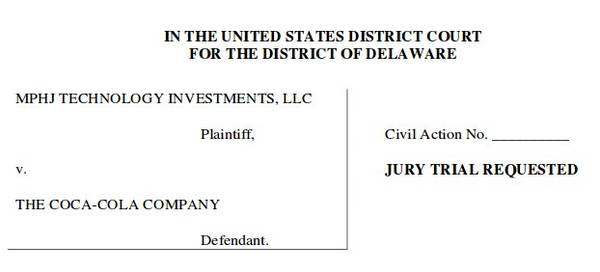
MPHJ is America's most notorious patent troll. The company -- whose owners are shrouded in mystery through a network of shell companies -- claims a patent on scanning documents and then emailing them, and they threaten business-owners with massive lawsuits unless they pay $1,000 per-employee "license fees."

Mostly, the troll has gone after small-fry, companies too small to defend themselves, and has stopped short of actually going to court. But now they've gone big-league, announcing suits against Coca-Cola, Dillards, Unum Group and Huhtakami.

It's not clear whether they've built their litigation warchest through the small-fry, but it seems unlikely. The lawsuit discloses that the troll extracted payments from Canon and Sharp in exchange for not suing their customers, and I suspect this is where the money for the suits came from.

The legal filings in the cases are very long, and detail the companies' internal networks as evidence of patent violation. The troll relies on the fact that all three companies use Xerox and Lexmark products and since these two companies haven't paid ransom for their customers, it can be assumed that anyone using their devices violates the patents.

The complaints describe the IT infrastructure of each company, apparently based on publicly available information. In the case of Coca-Cola for instance, MPHJ says the company transmits "electronic images, graphics and/or documents via a communications network from a network addressable scanner, digital copier, or other multifunction peripheral," which allegedly infringes MPHJ's patents. Coca-Cola uses a "standardized infrastructure of Lexmark C772 color and T644 monochrome laser printers, as well as Lexmark X642e and X646dte MFPs, all connected to the company’s network and integrated with the company’s FileNet system," write MPHJ's lawyers, from the Farney Daniels law firm.

The four lawsuits are a major escalation in the battle over the MPHJ patents. They're remarkably long; the suit against Unum group is 47 pages, and the one against Huhtakami is 66 pages. In part, such detail about the nature of infringement suggests that MPHJ is responding to claims that its demands in the past have been too vague.

Notorious “scan-to-email” patents go big, sue Coca-Cola and Dillard’s [Joe Mullin/Ars Technica]


08 Jan 00:54

Help wanted: Creative Commons is hiring a new CEO

by Cory Doctorow

Creative Commons is hiring a new CEO [PDF], who'll run the organization which currently has a $3M budget and a staff of 20. They're looking for someone who can lead, fundraise, and grow the organization.

Creative Commons is at an inflection point in its history. In the coming years, CC will pursue strategies that expand use of its licenses and promote a robust knowledge-sharing ecosystem. The organization recognizes that many paths lay open for pursuing these objectives, and the search for a new chief executive offers an opportunity to explore new ideas for services, products, advocacy, policies and programs. The new leader will oversee continued stewardship of CC’s licenses and also seek new opportunities to expand knowledge-sharing through the internet.

Creative Commons San Francisco Bay Area, CA CHIEF EXECUTIVE OFFICER


08 Jan 00:52

FemSkin

by Rob Beschizza
spriteleigh

Well I don't know what this is.

“This is my new FemSkin. they call it the HD model. It's brighter than my other FemSkin. Brighter color. I added the hair to make the vagina look a little more realistic. At least realistic to me. The bare vagina looked a little too bare. I used some of the clippings from my hair. You have to roll it down to about the waist before you can pull it on. You have to put in a lot of powder so you don't stick to it.”

— from Secrets of the Living Dolls, a documentary aired last night on Britain's Channel 4 about FemSkin body suits. [via Gawker]


07 Jan 18:48

Creepypasta, the new keystroke in horror

by Rob Beschizza
Clipboard-sized, unsettling, endlessly mutating pseudolore with dark and scary themes. Creepypasta is going mainstream. [Aoen Magazine]


07 Jan 02:39

Edited tweet used in ad

by Rob Beschizza

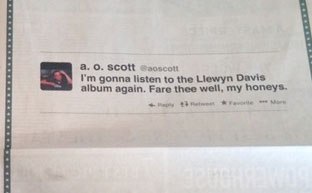
Inside Llewyn Davis is a movie. Its producers ran a full-page ad (price: $70k!) in the NYT which featured little more than the above tweet, from critic Tony "A.O." Scott.

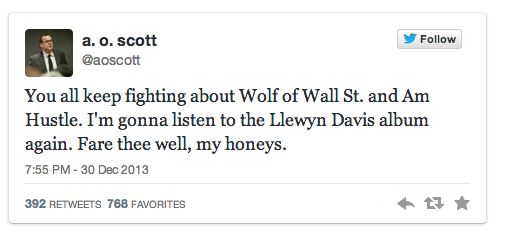
Many found it eye-rollingly precious, but there was a worse problem: despite being carefully formatted to look exactly like an actual on-the-web tweet, it turned out to have been edited to remove some words inconvenient to the advertising message being crafted from it. The original posting follows.

The controversy has built to the point where it warrants a response from the Times' Public Editor, Mary Sullivan. There are so many hypermodern issues to wallow in here! The juciest: Sullivan reports that Tony Scott was asked permission by the producer, Scott Rudin, to edit and run the tweet, but had explicitly refused permission. Here's the response he'd sent.

Well this is a new one. I’d prefer though that my tweets not be used in advertisements. That seems like a slippery slope and contrary to the ad hoc and informal nature of the medium.

And changing the tweet is basically manufacturing a quote, something I avoid.

So I’m afraid the answer is no.

You know immediately what sort of person Rudin is from the fact that he asked for permission to run the quote, was told an unequivocal "no", but did it anyway. Why bother asking permission? Perhaps, just for a moment, it felt like a connection to a human being.


07 Jan 00:09

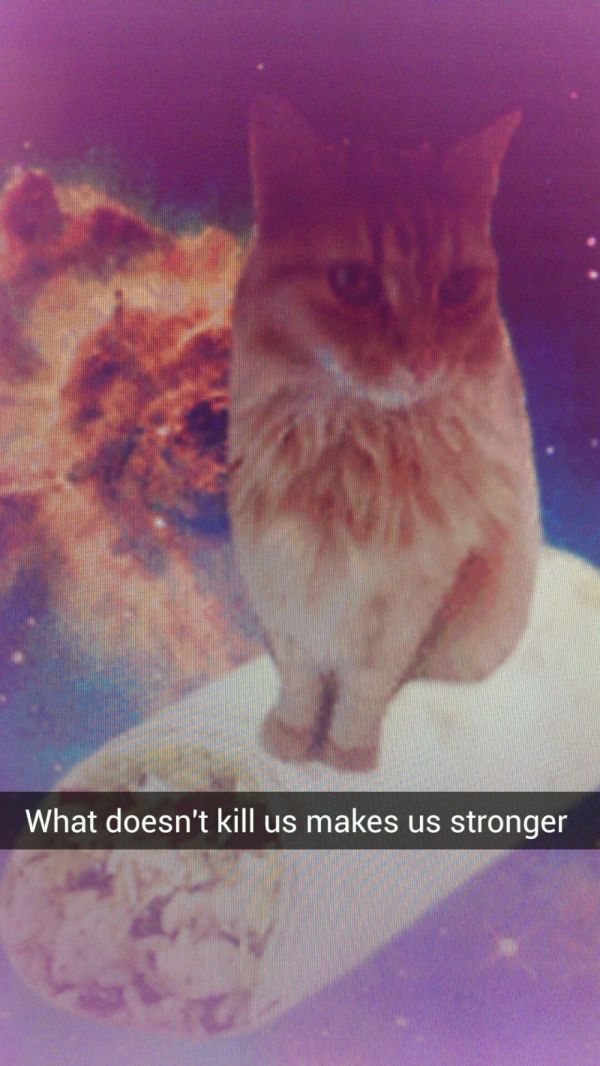
Cats in Space with Inspirational Quotes

by John Farrier

According to pseudoscience, today is Blue Monday: the most depressing day of the year. That's because many people are returning to work after a long Christmas vacation. Do you need an emotional pick up? Certainly sugar-filled foods would help, but let's find another way.

Cartoonist Kelly Angel, whose work we've previously featured, made these Snapchat images and sent them to her roommate. You can find more here. Remember to be the cat that you want to see in the world.

06 Jan 19:58

2014 corporate deathwatch

by Rob Beschizza
Sean Gallagher identifies the following as companies unlikely to reach 2015 in one piece: Radioshack, BlackBerry, HTC, Zynga and AMD. I feel obliged to add that no-one ever lost much betting against whatever entity is currently called "Atari".


06 Jan 19:57

Portrait of a failing state: Canadian government's worst moments of 2013

by Cory Doctorow


Dave writes, "You were kind enough to post my round-up of Canadian politics' dumbest moments last year. Well, this year it seems things have gotten even crazier as we head towards Banana Republic status. Senators taking the country for a financial ride. A government spending millions on self-serving advertising campaigns. We even have some good old fashioned book-burnings!"

Read below for just the War on Science bit. But get a tissue first, as it's enough to make you cry.

It's getting so bad that scientists are actually starting to march in protest.  Prompting our "Science Minister" to send out fundraising letters to combat "radical ideologue" scientist.

Not all science is bad though.  When you can re-purpose a Federal Research Organization (The NRC) to do science on behalf of industry, that's good science!  When you can just sort of make some shit up about polar bears to forward your climate change denying ideals, that's good science!  When you can use "science" to determine when life begins, that's good science!

Unfortunately, most science in Canada is bad science, and needs to be scrapped.  Research into the effect of lead bullets and shot?  Scrap it!  Fisheries libraries with irreplaceable documents (many fisheries libraries...and apparently not just libraries but budgets and jobs at the DFO as well...and perhaps proof that it's been done to "cull materials" rather than "save money")?  Scrap them!  Protection for endangered freshwater fish?  Scrap it!  A program that has greatly reduced heroin overdoses on the Downtown East Side?  Better try to scrap that!  Doctors trying to reduce heroin dependency using prescription heroin?  Scrap it!  The UN Drought Convention?  Scrap it!

And this is how crazy it has gotten.  Can you believe that Statscan is actually putting disclaimers on it's data due to scrapping of the mandatory long form census?  Our Environment Minister has doubts about climate change!  Gee, can't imagine why they are so afraid of admitting that climate change is real?

(Image: Stephen Harper, Flickr)


06 Jan 18:29

Symmetry: A Palindromic Film

by Miss Cellania

(vimeo link)

The short film Symmetry is a graduation project by the group Parachutes, written, directed, and edited by Yann Pineill. The second half of the movie is a complete reversal of the first half, both in time and flipped as a mirror image, that actually continues the story. It works because the cuts are short and there is no dialogue. Even the shot of the clock makes sense.  

If you enjoyed that, you might want to check out more palindromic short films, such as
Michel Gondry's music video for "Sugar Water" (1996), HANNAH by Samuel Kiehoon Lee (2005), and Palindromo by Philippe Barcinski (2001) which is only played one direction -backwards. -via Metafilter

06 Jan 18:26

"Mom Song" is the Creepiest Old Spice Ad Ever

by Miss Cellania

(YouTube link)

The latest ad from Old Spice plays upon the scent as a sign of maturity: the new product Old Spice Re-Fresh Body Spray making Mama's boy smell, act, and be treated like a man. This doesn't sit well with some mothers, apparently, as they stalk their sons and sing their laments. The entire ad is a creepfest, but funny, too.

Don't worry, Mom, your little boy may smell like a man, and he may attract women who aren't you, but as long as he's living in your basement, he's still your little boy. -via Viral Viral Videos

06 Jan 18:24

URGENT: Input needed on EU copyright consultation

by Cory Doctorow

Ásta Helgadóttir, reserve MP for the Icelandic Pirate Party, writes, "The European copyright reform is here -- and we have the chance to influence policy reform in this area for the first time in at least 15 years, and there is no way to say when this chance will come around again. The European Commission has opened up for consultation on their proposal for legislation (which then will be sent to the European Parliament) and you, as an individual, alien or organization can give your honest opinion about whatever copyright has done, good or bad, for and to you in the past decades.

The European Commission does not want too many replies at all. The EC has given an extremely short consultation period: only 60 days for 80 questions. It has not provided any translations of this document, and in addition the language used is very technical. Not all Europeans are able to read English, and one thing is for sure: The upcoming copyright reform is going to affect them. The timing, Christmas and holiday period, when people are sure to be busy with other matters, is also strategic. The Commission has rejected pleas on extending the consultation period and providing translations at least in French, German and Polish.

I believe this consultation is important for the future of culture and knowledge in Europe. We cannot make peer-to-peer filesharing illegal -- that is how we, in modern times, share culture, information and knowledge. To make people liable for the content of webpages they link to is just absurd. The objective of copyright should not be to make normal usage and sharing of culture criminal -- but that is a likely outcome of the European copyright reform, unless we make ourselves heard.

Go to www.copywrongs.eu and answer the questions which are important to you. You do not have to answer all the questions, only the ones that matter to you.

The original consultation can be found here, and there's a simplified version here.

The deadline is 5 February 2014. Until then, we should provide the European Commission with as many responses as possible!

Amelia Andersdotter, MEP for the Swedish Pirate Party, and I, Ásta Helgadóttir, reserve MP for the Icelandic Pirate Party, had a workshop on the Copyright Consultation at the 30C3 in Hamburg. We didn't have a clear idea of what the results should be, just that we wanted to motivate as many as possible to answer the consultation. One of the outcomes of that workshop was www.copywrongs.eu, something way beyond what Amelia and I had ever dreamt of. The great people from the Pirate Party Austria, Wikimedia in Germany and Open Knowledge Foundation Germany, all really deserve lots of praise for such hard work.

Help reform copyright! (Thanks, Ásta!)