Shared posts

07 Feb 19:18

Use the Creative Commons to nurture photojournalists

by Jonathan Worth

I’m a photographer, and I teach a photography class called Phonar. I'm from the  generation that made photographs on film, for transfer to paper, whereas the students I teach make pictures out of pixels for screens. These screens come with speakers, which means we have to learn about sound, which is okay. Throw into the mix, though, the fact that screens want to play movies, not stills, and things get more hectic.

Surely that means I should be teaching movie-making, right? As all this is no longer something restricted to a few highly-trained pros, we also have to work out just what it is that we photographers do that's different to what every cellphone owner does.

In 2009, when my undergrad class started, I just didn’t know. So I opened it out online, for free, and open-sourced the problem.

The latest iteration just finished up. Every version has had stuff to take away, about photography or teaching or learning online versus learning onsite. But this time it was something bigger.

This time, the most interesting piece of work didn’t come from someone in the room. (Sure, there was awesome work from my paying students, who kick all kinds of ass). Instead, something came in after the classes finished, and it blew me away. It was from a young woman called Priyanka Ghetia, who hoped one day to attend university. She’d been doing the Web versions of Phonar quietly, on her own, either drawing on her schoolteacher for help or teaching herself. She’d used her phone to make sound recordings; her old camera; and even a torch when light was short.

What she’d made just stopped me in my tracks.

Now, that’s very cool. It turns out that by running my classes in this open model, I’m more likely to get awesome students apply to study with me, after becoming part our ‘storytelling’ conversation. It means people who might not otherwise have got involved, for whatever reason—money, geography, culture, age—can join. The dialogue can bloom.
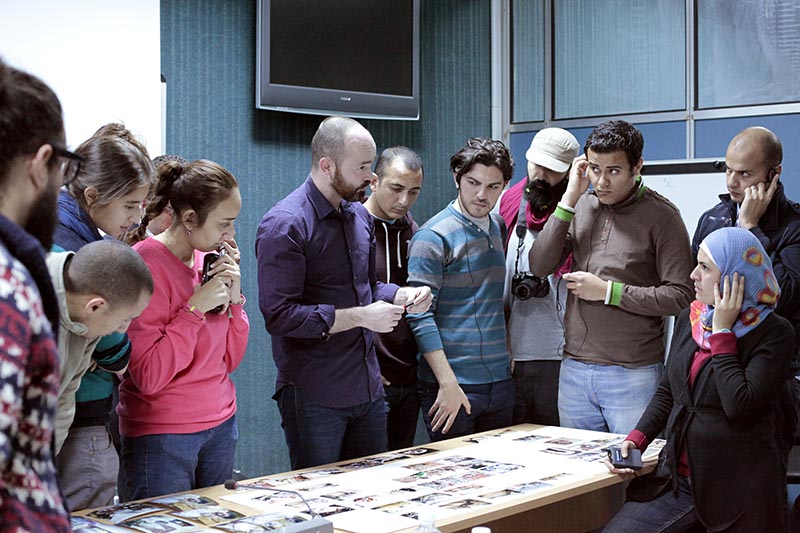

Photographer Cedric Gerbahaye talking to academy students.[CC-BY-NC-ND_4.0]

Its already bloomed to the point where we’ve had up to 35,000 join over one ten-week iteration of the course: a big "chat"! But what about moving beyond a university classroom of 25?  What about applying the same open and connected approach to say, the most prestigious Photojournalism Award in the World? And what if the starting point wasn’t 25 photographers, but instead was their 10 million-strong community?

That’s what I asked Maarten Koets, Deputy Director of World Press Photo. He took a moment to think about it, then decided that you can change the world with that sort of thing. #Boom

Six months (and a massive amount of behind-the-scenes work) later, anyone can “attend” the World Press Photo Academy.
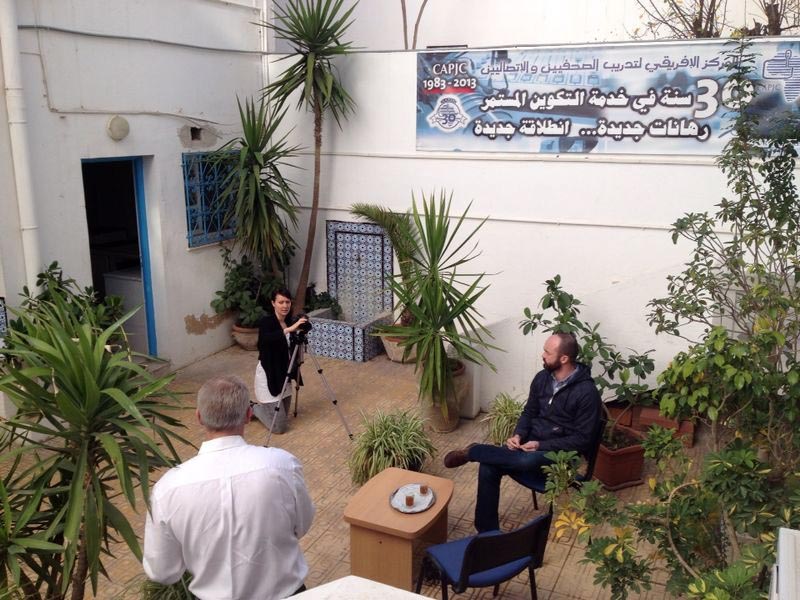

Rebecca Simons of World Press Photo recording interviews with Belgian Photographer Cedric Gerbehaye for the online participants.[CC-BY-NC-ND_4.0]

You can’t rock up to the onsite classes taking place in north Africa (those places have gone to photojournalists from the region, who won a competition to attend), but you can take the same workshops, listen to the same interviews, and submit work to the same briefs. You just need to bring your own chairs to the Facebook page.

Here's the kicker. If you’re a teacher, you can pick up Creative Commons Licensed teaching materials (which are naturally authored by the most acclaimed figures in the multi-media industry) and relay them to your own classes, wherever they may be.
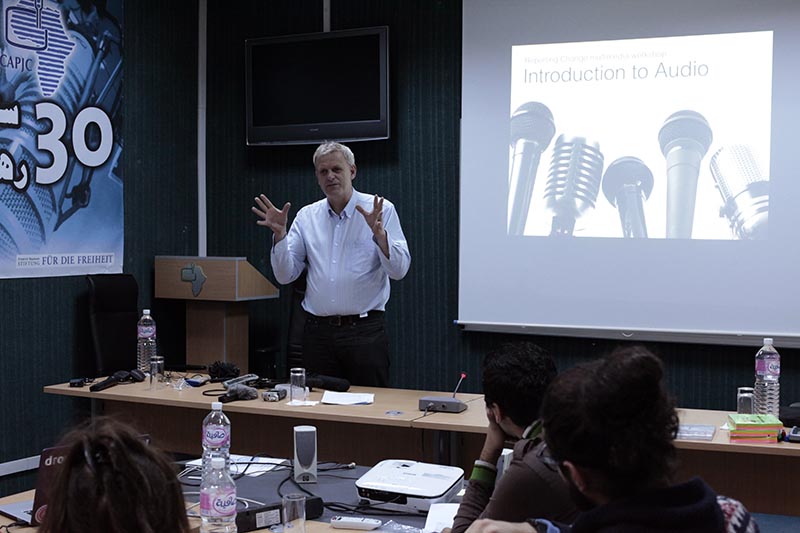

D.J. Clarke leading multimedia workshop "Introduction to Audio"[CC-BY-NC-ND_4.0]

This means that a teacher in Nairobi, the Netherlands or Newport Beach can plant her class right in the middle of what was, until now, one of the most exclusive networks of industry experts, and enable her students and become a part of their conversations.

Also, importantly, this is a storytelling class with images and sound. So we're not only teaching people to speak clearly, but putting them in a situation where they stand a better chance of being heard. That’s something that traditional learning institutions don't really do.
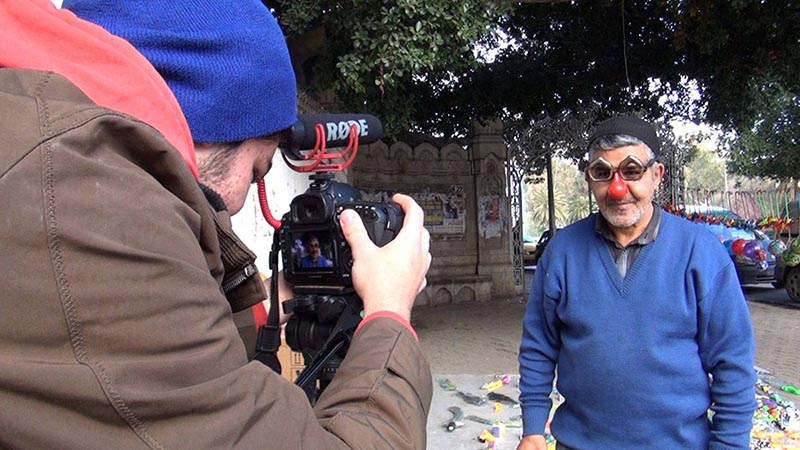

Academy students in mentored live shoot.[CC-BY-NC-ND_4.0]

I wouldn’t be in the least bit surprised if the most interesting, successful and winning work submitted to this first open and connected World Press Photo Academy came from someone who won a place in the onsite class, or even a professional tagging along for the ride. But watch out for something awesome, made by someone using something like a mobile phone and a torch.
How to join.


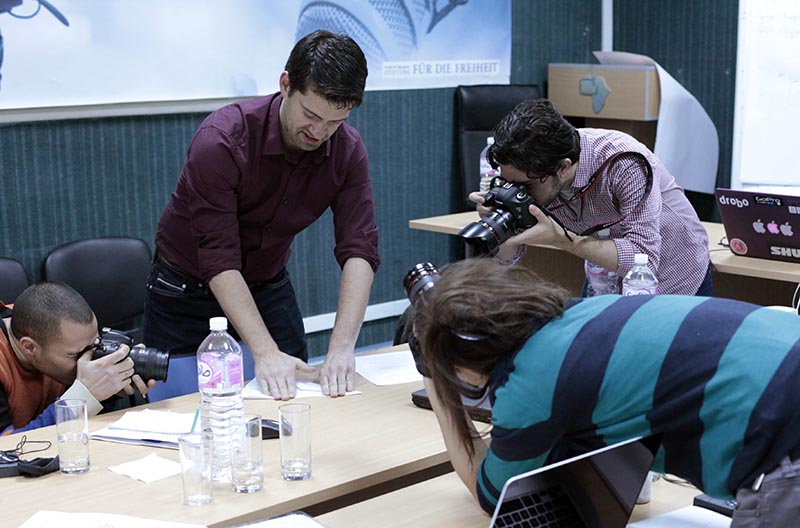
Multimedia journalist Matt Ford working with students.[CC-BY-NC-ND_4.0]
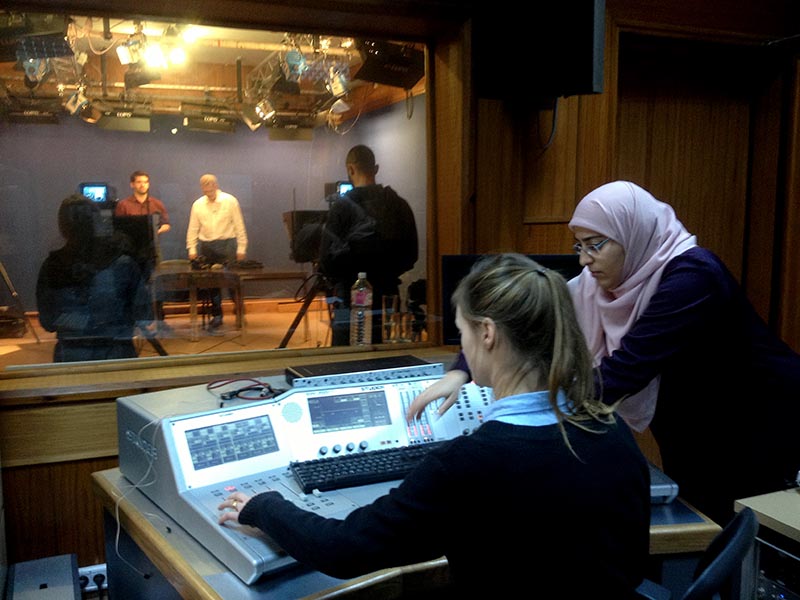

Producing lessons and demos for the internet class[CC-BY-NC-ND_4.0]
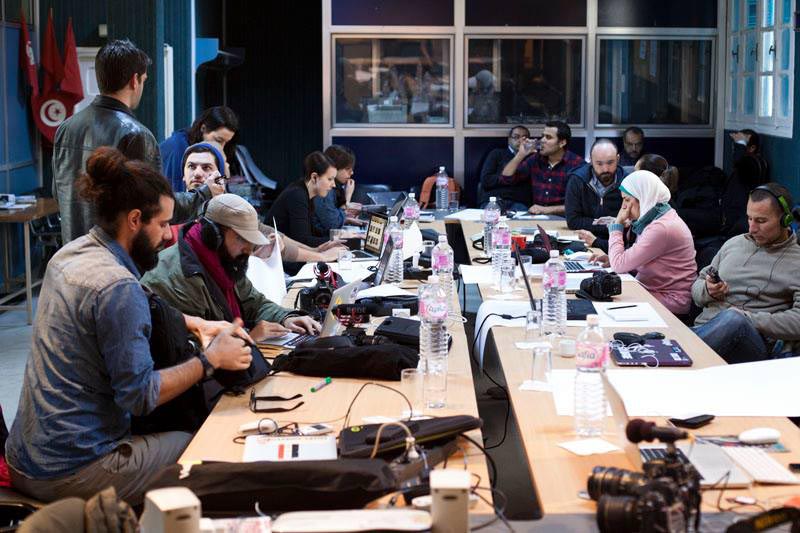

Live workshopping. [CC-BY-NC-ND_4.0]

Jonathan Worth is an English editorial portrait photographer who never won a World Press Award. He did write the world’s first Open and Connected Undergraduate Photography courses though (picbod and phonar) and that made him a National Teaching Fellow and a Fellow of the Royal Society of Arts and Commerce, so he’s not bitter.


07 Feb 18:32

TEACH: Science

by Miss Cellania

(YouTube link)

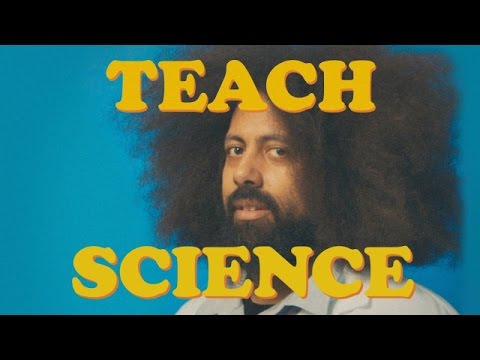
TEACH is a new web series starring Reggie Watts as a high school teacher who makes a difference in his students’ lives. Think of a classroom sitcom like Welcome Back Kotter or Head of the Class. Then enjoy the fact that this series is nothing like those. The first episode in the series concerns science class. -via Boing Boing

07 Feb 18:31

ICONS: Putting Rodin, Forrest Gump, Mad Men, The Creation of Adam, Reservoir Dogs and Daft Punk in One Fluid Shot

by Alex Santoso

What do Rodin's The Thinker, Forrest Gump, Mad Men, The Creation of Adam, Reservoir Dogs and Daft Punk have in common? This wonderful clip:

In their advertisement titled "Icons," British newspaper The Sunday Times stitched together six iconic scenes from art and modern culture into one fluid sequence.

From the website:

The Sunday Times 'ICONS' - This is all about those iconic cultural images that we pin to our walls and stick in our minds. We all have our favourites. Heisenberg, Kraftwerk, and Banksy’s kissing coppers all featured in early scripts, but we wanted to take a snapshot of what’s making the headlines in 2014. Daft Punk winning big at the Grammy's, The final series of Mad Men, and Tarantino are all over the media right now. These people and their work have left an indelible mark and we’ll probably still be talking about them in ten, twenty maybe even a hundred years years time. The TV spot is a respectful nod to it all.

Icons is directed by ad agency Grey.

The Making Of video is equally fantastic:

06 Feb 23:41

Toxic Avenger's brilliant rant about the importance of Net Neutrality

by Cory Doctorow

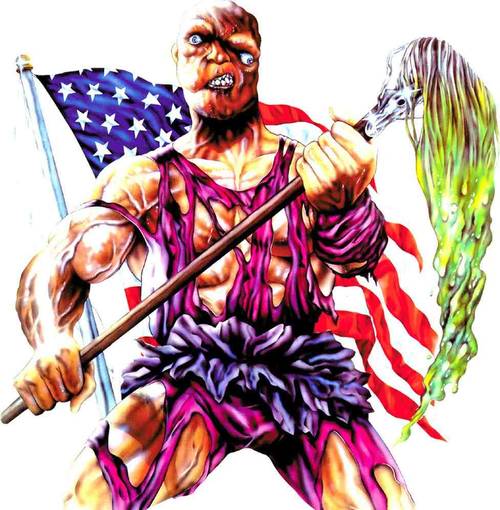
Lloyd Kaufman, cofounder of Troma Entertainment (the people who brought us such films as the Toxic Avenger) has a brilliant, profane, and stirring editorial in support of Net Neutrality on Techdirt. Kaufman explains how an open Internet is the only competitve hedge against the communications giants that own "cinemas, newspapers, T.V. stations, radio and even Broadway 'legitimate' theaters." Thanks to the failure of the FCC to give Net Neutrality their full protection, and the court ruling that gutted the FCC's weak protections, Net Neutrality is in real trouble. Kaufman's editorial a great arguments for its preservation.

The giant devil worshiping international media conglomerates want to create a super highway with expensive prohibitive tolls with faster and better internet for themselves. This will make it impossible for independent artists or innovators because they simply can’t compete. The result will be similar to US television, where the biggest companies own the networks and cable systems etc. and air constant iterations and reruns of their own content. It will become harder to get anything independent into the consciousness of the public. The Internet will become an NBC-ABC-CBS kind of world unless we the people take action.

In 2010, the Federal Communications Commission (FCC) created the Open Internet Order which set anti-blocking and anti-discrimination Network Neutrality rules. While the FCC claimed the rules would protect Open Internet, many of us Net Neutrality advocates felt the proposed rules had many loopholes and were made with the purpose of winning support from the telco lobbyists. Of course, we were right. The FCC stated that the rules would make it illegal for ISPs such as Verizon to block services or charge content providers like Netflix for faster Internet highways to their customers. Now, just a few weeks ago-the rules were invalidated by the US Court of Appeals for the District of Columbia because the FCC chose years ago to classify broadband providers in a manner that exempts them from treatment as common carriers and therefore has no right to regulate them.

Innovation And Our Better Future Depend On Preserving Net Neutrality [Lloyd Kaufman/Techdirt]


06 Feb 20:34

Turks bid farewell to the Internet in the face of brutal censorship/surveillance law

by Cory Doctorow

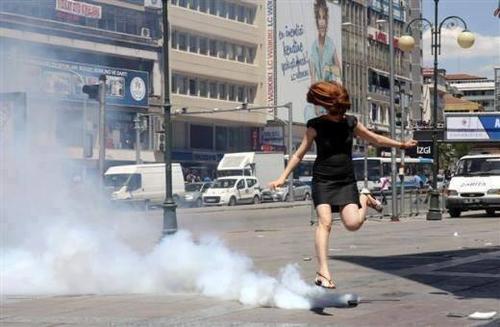
Turkey's brutal new Internet law grants the Turkish Telecommunications Directorate the power to arbitrarily censor Web-pages to the individual URL level, much like the Great Firewall of China -- meaning that specific articles that are critical of the state can be censored while leaving the remainder of the site intact. It criminalizes "harmful" Internet messages and hosting "harmful" content, and requires long-term data-retention by ISPs, meaning the state and police will be able to access records of your entire online activity. It will also mandate the use of deep packet inspection to detect and disrupt technologies for evading censorship and maintaining privacy.

The law was passed in a process rife with corruption, secrecy and other undemocratic irregularities. Turkey's #OccupyGezi uprising galvanized a diverse opposition that took to the streets against corruption and repression, spread using the Internet. It documented police brutality that shocked the world and uploaded the videos to Youtube. As the forces of reaction and oppression in Turkey move to consolidate their power, it's clear that this law is intended to prevent any further use of networks to organize and publicize opposition movements.

On Medium, Ahmet A. Sabancı has posted a poignant farewell to the Internet from Istanbul:

We, as people from Turkey, had a great time with you. You teach us so many things that we couldn’t learn from anywhere else. We had lots of great memories with you. You were always there whenever we needed you. But we have to say goodbye.

Turkish parliament passed the bill which is going to kill you. Maybe it’ll not kill you directly but you’ll be crippled and we can’t do everything we want together. There’s a little chance for you -presidential veto- but like I said, it’s a little chance.

I know you’re not ready for this but I have to tell you what will happen after tonight. I know hearing this will hurt you but you have to get ready for these. Because these seems inevitable.

Dear Internet,


06 Feb 19:48

Corporate mascots as anime characters

by Cory Doctorow


Bruce Yan has created some gorgeous anime-inflected remixes of traditional American logos, including the Girl Guides and Starbucks. Astro Boy/Atom Boy was really born to be Bob's Big Boy mascot.


Corporate Brands Are Cuter With Hayao Miyazaki And Disney-Style Logos (via The Mary Sue)


06 Feb 19:42

Sony to exit PC business

by Rob Beschizza
It's selling off the VAIO unit, responsible for desktop and laptop computers, and plans to spin off its TV division into a separate company this summer. Sony will be holding onto its smartphones and PlayStations, obviously. [Engadget]


06 Feb 19:39

Middle class brands collapse, 1% brands thrive

by Cory Doctorow
Evidence of the widening wealth gap: Across America, brands that serve middle class customers are shutting down, while businesses that serve the rich are thriving. Good bye $16.50 dinners at Olive Garden, hello $71 checks at Capital Grille. (via Mitch Wagner)


06 Feb 19:38

In which Pat Robertson sides with Bill Nye

by Maggie Koerth-Baker
Yesterday, I mentioned the importance of remembering that creationist Ken Ham's theology doesn't actually represent official-everybody-believes-this Christian theology. Or even, necessarily, mainstream Christian theology. And here's more evidence of that: Pat Robertson does not believe the Earth is only 6,000 years old and would like Ken Ham to stop making his side look dumb. Pat Robertson.


06 Feb 19:28

EFF's HTTPS Everywhere + Firefox = most secure mobile browser

by Cory Doctorow

Peter from the Electronic Frontier Foundation writes, "Over at EFF, we just released a version of our HTTPS Everywhere extension for Firefox for Android. HTTPS Everywhere upgrades your insecure web requests to HTTPS on many thousands of sites, and this means that Firefox on Android with HTTPS Everywhere is now by far the most secure browser against dragnet surveillance attacks like those performed by the NSA, GCHQ, and other intelligence agencies."

I installed it today.

Android users should install the Firefox app and then add HTTPS Everywhere to it. Iphone and Ipad users will unfortunately have to switch to Android to get this level of security because Apple has locked Mozilla Firefox out of their platforms.

Making the Mobile Web Safer with HTTPS Everywhere (Thanks, Peter!)


06 Feb 19:28

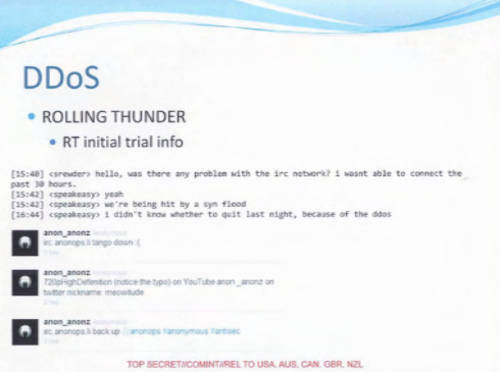
How UK spies committed illegal DoS attacks against Anonymous

by Cory Doctorow

A new Snowden leak, reported by NBC, documents the UK spy agency GCHQ's attacks on Anonymous, which included Denial-of-Service attacks, which are strictly forbidden under UK law. As the Slashdot story notes, "Regular citizens would face 10 years in prison and enormous fines for committing a DoS / DDoS attack. The same applies if they encouraged or assisted in one. But if you work in the government, it seems like you're an exception to the rule."

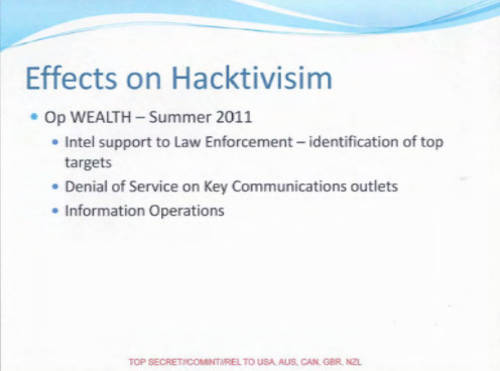
NBC has published a minimally redacted version [PDF] of the GCHQ slide-deck detailing the agency's illegal hacking attacks on alleged Anonymous participants.

The presentation gives detailed examples of “humint” (human intelligence) collection from hacktivists known by the on-line names G-Zero, Topiary and pOke, as well as a fourth whose name NBC News has redacted to protect the hacker's identity. The hacktivists were contacted by GCHQ agents posing as fellow hackers in internet chat rooms. The presentation includes transcripts of instant message conversations between the agents and the hackers in 2011.

“Anyone here have access to a website with at least 10,000+ unique traffic per day?” asks one hacktivist in a transcript taken from a conversation that began in an Operation Payback chat room. An agent responds and claims to have access to a porn website with 27,000 users per day. “Love it,” answers the hacktivist. The hackers ask for access to sites with traffic so they can identify users of the site, secretly take over their computers with malware and then use those computers to mount a DDOS attack against a government or commercial website.

A GCHQ agent then has a second conversation with a hacker known as GZero who claims to “work with” the first hacktivist. GZero sends the agent a series of lines of code that are meant to harvest visitors to the agent’s site and make their computers part of a “botnet” operation that will attack other computers.

The “outcome,” says the presentation, was “charges, arrest, conviction.” GZero is revealed to be a British hacker in his early 20s named Edward Pearson, who was prosecuted and sentenced to 26 months in prison for stealing 8 million identities and information from 200,000 PayPal accounts between Jan. 1, 2010 and Aug. 30, 2011. He and his girlfriend were convicted of using stolen credit card identities to purchase take-out food and hotel stays.

War on Anonymous: British Spies Attacked Hackers, Snowden Docs Show [Mark Schone, Richard Esposito, Matthew Cole and Glenn Greenwald/NBC]

(via /.)


06 Feb 19:25

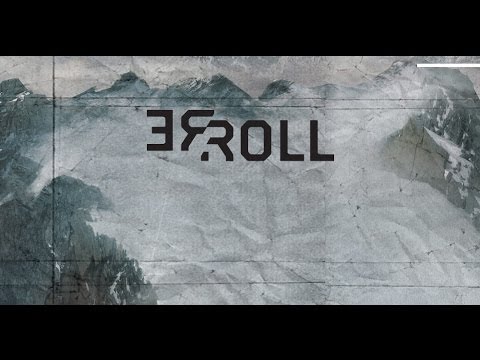
ReRoll Is Mapping The World For An Epic Scale MMO

by Zeon Santos

(Video Link)

Massively multiplayer online games seem huge when you're playing, but in real world scale those MMO continents are pretty small, and as more gamers log on the worlds will need to grow to accomodate the new generation of players ready to explore a virtual world and level up.

A new game is embracing this growth in a global way, by scanning the entire world with autonomous drones to help generate a full scale world in which gamers will play. ReROLL is one ambitious globe spanning game, with tons of possibilities and a map which will take years to explore and quests that will take you across the planet, but the game will begin outside the U.S. because drone regulations haven't been established yet.

If people thought MMO addiction was bad with Warcraft and Everquest wait until this mega scale game comes out!

Via Destructoid

06 Feb 00:17

The Best MMA Fighter to Still be in Elementary School

Submitted by: Unknown

05 Feb 21:26

Move your domain, support EFF

by Cory Doctorow

Spocko sez, "The Electronic Frontier Frontier saved my bacon back in 2007 and they might save yours in the future, this is a simple, easy way to support them in addition to becoming a member. In 2011 and 2013 Namecheap raised $64K and $44K for EFF with 'Move Your Domain Day.'"

For every your .com, .net, .org, .info and .biz domains transferred to Namecheap or hosting plan purchased on February 5, Namecheap will donate $0.50 to EFF. The donation amount goes up to $1.00 per domain/hosting plan if they exceed 10,000. And if they exceed 20,000 domains transferred or hosting plans purchased, Namecheap will donate $1.50 for each transaction.

Domain name transfer coupon code is NCMYDD and costs $3.98. Hosting plans up to 75% off (Shared, Business or Reseller) with coupon code HOSTWITHNC.

MoveYourDomain Day 2014 (Thanks, Spocko!)


05 Feb 21:25

Make It So

by Miss Cellania

(YouTube link)

The song “Let It Go” from the movie Frozen has become a big hit and is nominated for an Oscar. Time for the parodies! The most obvious is “Make It So” with a Star Trek theme. I’m just glad someone with talent did it. This performance is by Debs & Errol. From the YouTube page:

Debs: Holy heck was this ever hard to sing!

But it was worth it! -via Geeks Are Sexy

05 Feb 21:24

Why DRM is the root of all evil

by Cory Doctorow

In my latest Guardian column, What happens with digital rights management in the real world?, I explain why the most important fact about DRM is how it relates to security and disclosure, and not how it relates to fair use and copyright. Most importantly, I propose a shortcut through DRM reform, through a carefully designed legal test-case.

The DMCA is a long and complex instrument, but what I'm talking about here is section 1201: the notorious "anti-circumvention" provisions. They make it illegal to circumvent an "effective means of access control" that restricts a copyrighted work. The companies that make DRM and the courts have interpreted this very broadly, enjoining people from publishing information about vulnerabilities in DRM, from publishing the secret keys hidden in the DRM, from publishing instructions for getting around the DRM – basically, anything that could conceivably give aid and comfort to someone who wanted to do something that the manufacturer or the copyright holder forbade.

Significantly, in 2000, a US appeals court found (in Universal City Studios, Inc v Reimerdes) that breaking DRM was illegal, even if you were trying to do something that would otherwise be legal. In other words, if your ebook has a restriction that stops you reading it on Wednesdays, you can't break that restriction, even if it would be otherwise legal to read the book on Wednesdays.

In the USA, the First Amendment of the Constitution gives broad protection to free expression, and prohibits government from making laws that abridge Americans' free speech rights. Here, the Reimerdes case set another bad precedent: it moved computer code from the realm of protected expression into a kind of grey-zone where it may or may not be protected.

In 1997's Bernstein v United States, another US appeals court found that code was protected expression. Bernstein was a turning point in the history of computers and the law: it concerned itself with a UC Berkeley mathematician named Daniel Bernstein who challenged the American prohibition on producing cryptographic tools that could scramble messages with such efficiency that the police could not unscramble them. The US National Security Agency (NSA) called such programs "munitions" and severely restricted their use and publication. Bernstein published his encryption programs on the internet, and successfully defended his right to do so by citing the First Amendment. When the appellate court agreed, the NSA's ability to control civilian use of strong cryptography was destroyed. Ever since, our computers have had the power to keep secrets that none may extract except with our permission – that's why the NSA and GCHQ's secret anti-security initiatives, Bullrun and Edgehill, targetted vulnerabilities in operating systems, programs, and hardware. They couldn't defeat the maths (they also tried to subvert the maths, getting the US National Institute for Standards in Technology to adopt a weak algorithm for producing random numbers).

What happens with digital rights management in the real world?


05 Feb 21:15

Rob Ford's re-election campaign

by Cory Doctorow

Kelly Manchester put together this brilliant video, suggesting designs for some of Rob "Laughable Bumblefuck" Ford's re-election posters for the next Toronto mayoral race. All are real quotes from the real mayor, who is a really, really bad person.

Video imagines nightmare Rob Ford re-election posters (Thanks, Mom!)


05 Feb 21:14

New Zealand's spies admit to illegally deleting key evidence in Kim Dotcom case

by Cory Doctorow

GCSB, New Zealand's secret police force has admitted to illegally deleting key evidence related to the raid on Kim Dotcom over his Megaupload service. The spies agree that the evidence was illegally deleted, but claim it was an honest mistake, because the data "aged off" their retention system.

Dotcom last night tweeted the claim, saying: "The GCSB spy agency seems to have deleted evidence relevant to my case against the GCSB for illegally spying on NZ residents.''

He quoted Crown lawyers as saying "some communications have automatically aged off. We propose to include ... those communications which are still recoverable''.

Dotcom claimed lawyers acting for the GCSB told him the material had "aged off'' the system, suggesting it had automatically deleted.

He also posted a video of Prime Minister John Key, who is in charge of the agency, saying: "This is a spy agency. We don't delete things. We archive them.''

GCSB deleted key evidence - Dotcom [David Fisher/NZ Herald]

(via Techdirt)


05 Feb 01:28

Deadmau5 Has a Nyan Cat Ferrari, Because of COURSE he Does

Deadmau5 Music cars Nyan Cat

Submitted by: (via Neatorama)

Tagged: Deadmau5 , Music , cars , Nyan Cat
05 Feb 01:27

Cats in Film

by Miss Cellania

(YouTube link)

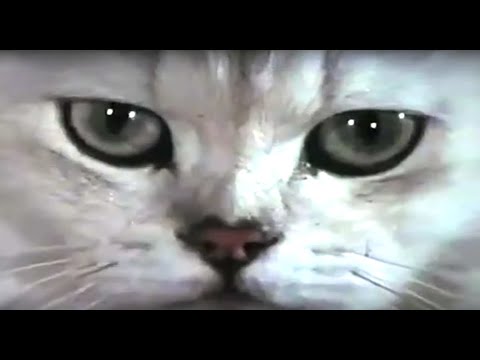
Klara Tavakoli Goesche compiled scenes of cats in Hollywood films from The Incredible Shrinking Man to Inside Llewyn Davis. You will probably recognize at least some of them, but if you are racking your brain on a particular cat, there’s a list with time stamps at the YouTube page. They’re all accompanied by Al Stewart’s “The Year of the Cat.”  -Thanks, Klara!

04 Feb 19:56

Adobe ebook DRM changeover means

by Cory Doctorow
A lot of people are about to lose their ebooks. (Thanks, Florian!)


04 Feb 18:26

Bruce Sterling on making the Internet safe for freedom and art

by Cory Doctorow

Bruce Sterling's keynote at the Transmediale conference in Berlin is one of his best-ever outings (and I say that as a person who dropped out of university and totally upended his life after reading a transcript of one of Bruce's speeches). Sterling addresses the bankruptcy of tech giants, who have morphed themselves into intrusive presences that carry water for the surveillance industry, and lays out a credible case for a future where they are forgotten footnotes in our history.

In particular, I was impressed by this speech because it corrected some serious errors from Sterling's essay "The Ecuadorian Library," which, as Danny O'Brien pointed out completely misattributed a kind of optimistic naivete to technology activists past and present.

In this speech, Sterling revisits the origins and ongoing reality of the project to remake technology as a force for freedom, and corrects the record. As Sterling says, John Perry Barlow didn't write the Declaration of Independence of Cyberspace because he thought the cops couldn't or wouldn't try to take over the Internet: he wrote it because the cops were trying to take it over, and he was "shouting through a megaphone" at them.

There's a species of bottom-feeding contrarian that has sprung up in this century to decry the Internet as a system of oppression. Most of these men are people with some passing connection to the entertainment industry, which has spent the past 20 years demanding systems of Internet censorship and surveillance to help with copyright enforcement. These critics -- who get a lot of press from the news-media, who love mud-slinging as much as they fear disruptive technology -- have somehow hit upon groups like the Electronic Frontier Foundation and the Free Software Foundation as villains in their narratives. Nevermind the fact that the cause of Internet freedom (which includes a fair deal in copyright, because the Internet is a machine for copying) has always been central to these groups' missions, and that they've championed Internet freedom because they were frightened of how the net could be used to surveil and control us, not because they were blind to that possibility.

This talk demolishes that streak of revisionism, and furthermore advances an agenda for a technologically adept arts-practice. It is a marvel of rhetoric and a tonic for those of us who are heartily sick of the trolls.

Bruce Sterling / transmediale 2014 afterglow Opening Ceremony (via Futurismic)


04 Feb 18:25

North Korea's official OS goes Mac

by Rob Beschizza

It having been noted that North Korea's young premier is an Apple man, what surprise is it that the country's official operating system has lost its Windows-style skin in favor of an OS X-style makeover?


04 Feb 18:16

Win $1000 for your NSA Surveillance cartoon

by Cory Doctorow

From Global Voices Online: "The Web We Want invites cartoonists, creatives and artists to join The Day We Fight Back on February 11, 2014 by creating an original cartoon about online surveillance and the right to privacy. The cartoons should help increase awareness about the NSA and demand accountability for mass digital surveillance in a way that makes people want to click and share."

The deadline is Feb 8. Entries have to be Creative Commons Attribution/Share-Alike licensed. First prize: $1000. Second prize: $500. Third prize: $250.

These are badly needed! The world's bloggers cry out for NSA images to use with their Snowden posts other than the traditional "Still of Snowden from that Reuters video;" "Photo of the giant NSA data-center in Utah" and "EFF screaming eagle NSA logo."

Submit Cartoons on NSA Surveillance and Win $1000 (Thanks, Hugh!)

(Image: Commander Keith Alexander on the bridge” Cartoon shared by DonkeyHotey (CC BY-SA 2.0))


04 Feb 18:14

Neatolinks: Mean Fish Are Worse Than Mean Girls

by Jill Harness
04 Feb 18:13

Goat Simulator

by Miss Cellania

(YouTube link)

Goat Simulator is not a real game. The footage from CoffeeStainStudios is just some developers playing around with animation. It’s so ridiculous that I wouldn’t be surprised if the demand follows. Goats are pretty tough, but you don’t want young players thinking they can survive being run over a car this way. Still, watching the goat “climb” a tower had me giggling uncontrollably. -via Uproxx

04 Feb 18:12

Podcast: What does David Cameron's Great Firewall look like?

by Cory Doctorow

Here's a reading of a recent Guardian column, What does David Cameron's Great Firewall look like? which debunks the UK government's stupid arguments for its national anti-porn firewall:

David Cameron's attempt to create a Made-in-Britain version of Iran's "Halal Internet" is the worst of both worlds for parents like me. Kids are prevented from seeing things that they need to access – sites about sexual health, for example – and I still have to monitor my daughter all the time when she uses the net (or teach her how to cope with seeing things no kid should see) because the filter won't stop her from accessing the bad stuff.

And for parents who don't understand that filters are bunkum, the situation is much worse. It's one thing to know that there are risks to your kid from the internet. But parents who rely on the filter are living in bubble of false security. There's nothing more deadly than a false sense of security: If you know your car is having brake problems, you can compensate by driving with extra care, increasing your following distance, and so on. If you falsely believe your brakes to be in good running order, you're liable to find out the hard way that they aren't (if you survive, you can thank Bruce Schneier for that apt and useful analogy).

Mastering by John Taylor Williams: wryneckstudio@gmail.com

John Taylor Williams is a audiovisual and multimedia producer based in Washington, DC and the co-host of the Living Proof Brew Cast. Hear him wax poetic over a pint or two of beer by visiting livingproofbrewcast.com. In his free time he makes "Beer Jewelry" and "Odd Musical Furniture." He often "meditates while reading cookbooks."

MP3


04 Feb 05:39

Name A New Chip

by Miss Cellania

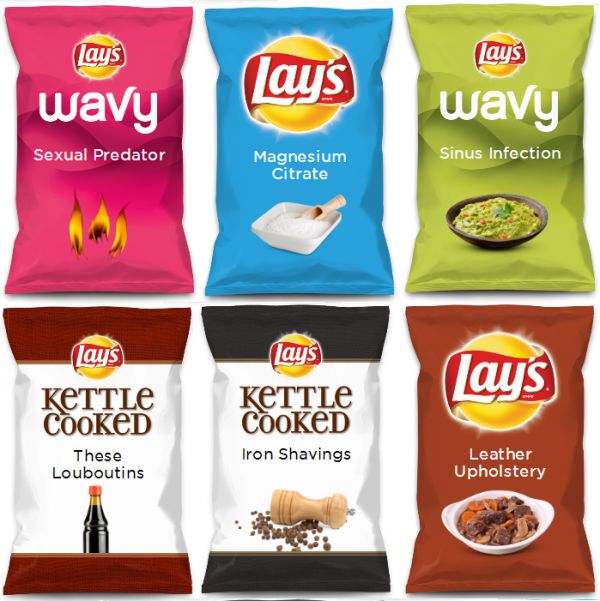
Lay’s is holding a contest called Do Us a Flavor, in which anyone can submit an idea for a new chip flavor. There’s a million dollar grand prize! Well, you know how internet users love to have fun with this kind of thing, so there are some amazing flavors already submitted via the Twitter hashtag #DoUsAFlavor, as well as at the Lay's site. Among the serious submissions like Spaghetti and Meatballs, Poutine, and Fried Chicken, there’s also the lovely Orange Juice and Toothpaste, Student Debt, and Frozen Shampoo. See a selection of the best awful flavors at The Daily Dot. -via mental_floss

04 Feb 02:43

The Big Lebowski Re-Imagined As A CGI Kung Fu Flick

by Zeon Santos

(Video Link)

The Dude abides whether he’s kicking back with a White Russian, or kicking butt in a school for kung fu, and the characters created by the Coen Brothers for their classic film The Big Lebowski seem to fit right in wherever, and whenever, you find them.

In this case some students from the Animation Workshop in Viborg, Denmark have envisioned a scenario where The Dude, Walter and Donny kick it really old school, in ancient Asian style, and have their mellows harshed by a certain ball toting baddie named Jesus and his pack of ninja assassins.

It’s only a mini-trailer at this point, but the students are hoping to turn it into a longer film in the near future, so at this point you can either watch it or say "Screw it, let’s go bowling!"

Via GeekTyrant

04 Feb 00:50

Single Topic Blog of the Day: Matching Monsters Adds Illustrated Creatures to Photos to Match the People in Them

pics,list,photoshop,matching monster,single topic blog

There's a monster out there for everyone, sometimes you just need help seeing it. If you'd like to put yourself up for a monster match, head over to Matching Monsters' submission page.

Submitted by: Unknown