08 Nov 12:30
Chem. Commun., 2016, Advance Article
DOI: 10.1039/C6CC07377H, Feature Article
James E. M. Lewis, Marzia Galli, Stephen M. Goldup
We discuss the properties and potential future applications in catalysis, sensing and materials of ligands based on mechanically interlocked molecules.
To cite this article before page numbers are assigned, use the DOI form of citation above.
The content of this RSS Feed (c) The Royal Society of Chemistry

02 Nov 12:51

One ring to rule them all … and in the darkness bind them: A photoresponsive tetracationic macrocycle features a facile three-step synthesis and makes possible the noncovalent binding of a set of guest molecules, including N-oxide and carboxylate derivatives. The guest molecules can be actively released by UV light irradiation in a remote fashion.
[Communication]
Seán T. J. Ryan, Jesús del Barrio, Reynier Suardíaz, Daniel F. Ryan, Edina Rosta, Oren A. Scherman
Angew. Chem. Int. Ed., October 28, 2016, DOI: 10.1002/anie.201607693. Read article
29 Mar 08:22
by Han-Kyu Choi, Won-Hwa Park, Chan-Gyu Park, Hyun-Hang Shin, Kang Sup Lee and Zee Hwan Kim

Journal of the American Chemical Society
DOI: 10.1021/jacs.6b01865

22 Mar 09:06

The [HAN].− radical anion (see scheme, left) is synthesized as a stable potassium salt and transferred intact to CoII. The resulting complex anion [{(HAN){Co(N′′)2}3]− is a rare radical-bridged trimetallic complex, with very strong antiferromagnetic exchange between the CoII ions and the non-innocent ligand.
[Communication]
Jani O. Moilanen, Nicholas F. Chilton, Benjamin M. Day, Thomas Pugh, Richard A. Layfield
Angew. Chem. Int. Ed., March 21, 2016, DOI: 10.1002/anie.201600694. Read article
21 Mar 08:30
by Colin W. Anson, Soumya Ghosh, Sharon Hammes-Schiffer and Shannon S. Stahl

Journal of the American Chemical Society
DOI: 10.1021/jacs.6b00254

26 Jan 12:41
by Bruno Schuler

Nature Chemistry.
doi:10.1038/nchem.2438
Authors: Bruno Schuler, Shadi Fatayer, Fabian Mohn, Nikolaj Moll, Niko Pavliček, Gerhard Meyer, Diego Peña & Leo Gross
The Bergman cyclization is a fascinating rearrangement reaction with implications beyond organic chemistry. It has now been shown that a reversible Bergman cyclization reaction in a single molecule sitting on an ultrathin NaCl film can be triggered and directly imaged using atomic force microscopy. The interconverted diradical and diyne products are shown to have distinct chemical and physical properties.
11 Dec 15:33
Chem. Commun., 2015, Accepted Manuscript
DOI: 10.1039/C5CC08740F, Communication
Li-Min Zheng, Haiquan Tian, Song-Song Bao
A heptanuclear and a dimer of heptanuclear dysprosium clusters (Dy7 and Dy14) have been successfully synthesized by ingenious coalescence of the single and double pyrazinyl hydrazone as well as phosphonate...
The content of this RSS Feed (c) The Royal Society of Chemistry

07 Dec 08:41
by Christian Hanneken
Nature Nanotechnology 10, 1039 (2015).
doi:10.1038/nnano.2015.218
Authors: Christian Hanneken, Fabian Otte, André Kubetzka, Bertrand Dupé, Niklas Romming, Kirsten von Bergmann, Roland Wiesendanger & Stefan Heinze
Magnetic skyrmions are localized non-collinear spin textures with a high potential for future spintronic applications. Skyrmion phases have been discovered in a number of materials and a focus of current research is to prepare, detect and manipulate individual skyrmions for implementation in devices. The local experimental characterization of skyrmions has been performed by, for example, Lorentz microscopy or atomic-scale tunnel magnetoresistance measurements using spin-polarized scanning tunnelling microscopy. Here we report a drastic change of the differential tunnel conductance for magnetic skyrmions that arises from their non-collinearity: mixing between the spin channels locally alters the electronic structure, which makes a skyrmion electronically distinct from its ferromagnetic environment. We propose this tunnelling non-collinear magnetoresistance as a reliable all-electrical detection scheme for skyrmions with an easy implementation into device architectures.

07 Dec 08:40
by Theodore L. Monchesky
Nature Nanotechnology 10, 1008 (2015).
doi:10.1038/nnano.2015.226
Author: Theodore L. Monchesky
An electrical read-out mechanism for magnetic skyrmions that does not require spin-polarized currents could facilitate the use of these small magnetic states in memory devices.

27 Nov 10:44

DNA base pairing is used to produce hydrogen-bonded macrocycles whose supramolecular structure can be transferred from solution to a solid substrate. A hierarchical assembly process ultimately leads to two-dimensional nanostructured porous networks that are able to host size-complementary guests.
[Communication]
Nerea Bilbao, Iris Destoop, Steven De Feyter, David González-Rodríguez
Angew. Chem. Int. Ed., November 24, 2015, DOI: 10.1002/anie.201509233. Read article
23 Nov 10:18
by Burton H. Simpson and Joaquín Rodríguez-López

Journal of the American Chemical Society
DOI: 10.1021/jacs.5b10256

06 Nov 09:21
by Youngdong Yoo, Zachary P. Degregorio and James E. Johns

Journal of the American Chemical Society
DOI: 10.1021/jacs.5b06643

23 Oct 12:10
Chem. Commun., 2015, Advance Article
DOI: 10.1039/C5CC08038J, Communication
Danyu Xia, Peifa Wei, Bingbing Shi, Feihe Huang
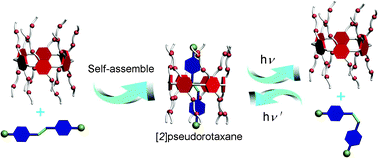
A pillar[6]arene-based [2]pseudorotaxane was obtained in solution and studied in the solid state, and its photo-responsive self-assembly behavior in solution was investigated.
To cite this article before page numbers are assigned, use the DOI form of citation above.
The content of this RSS Feed (c) The Royal Society of Chemistry

23 Oct 09:59
Chem. Commun., 2015, 51,17297-17300
DOI: 10.1039/C5CC07204B, Communication
Carlos-Andres Palma, Artur Ciesielski, Murat Anil Oner, Gael Schaeffer, Jean-Marie Lehn, Johannes V. Barth, Paolo Samori
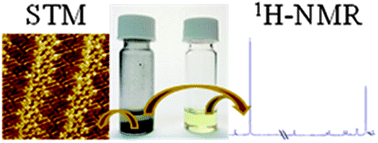
Soft networks are self-assembled at the solid/liquid interface and characterized by local disorder arising from multivalent flexible intermolecular interactions.
The content of this RSS Feed (c) The Royal Society of Chemistry

19 Oct 14:48
by Junling Sun, Yilei Wu, Yuping Wang, Zhichang Liu, Chuyang Cheng, Karel J. Hartlieb, Michael R. Wasielewski and J. Fraser Stoddart

Journal of the American Chemical Society
DOI: 10.1021/jacs.5b09274

19 Oct 14:45
by Cyrille Costentin, Hachem Dridi and Jean-Michel Savéant

Journal of the American Chemical Society
DOI: 10.1021/jacs.5b06834

02 Oct 15:41
Chem. Commun., 2015, 51,16338-16341
DOI: 10.1039/C5CC06970J, Communication
Jan Plas, Deepali Waghray, Jinne Adisoejoso, Oleksandr Ivasenko, Wim Dehaen, Steven De Feyter
The potential of surface confined self-assembly to influence the chemical equilibrium of Schiff base formation and bias the yield and distribution of reaction products is explored.
The content of this RSS Feed (c) The Royal Society of Chemistry

22 Sep 09:28
by Shigui Chen, Makoto Yamasaki, Shane Polen, Judith Gallucci, Christopher M. Hadad and Jovica D. Badjić

Journal of the American Chemical Society
DOI: 10.1021/jacs.5b06041

22 Sep 08:58
by Chaoliang Tan and Hua Zhang

Journal of the American Chemical Society
DOI: 10.1021/jacs.5b03590

10 Aug 12:13
by Bruno Schuler, Gerhard Meyer, Diego Peña, Oliver C. Mullins and Leo Gross

Journal of the American Chemical Society
DOI: 10.1021/jacs.5b04056

10 Aug 12:11
by Zheng Meng, Ying Han, Li-Na Wang, Jun-Feng Xiang, Sheng-Gui He and Chuan-Feng Chen

Journal of the American Chemical Society
DOI: 10.1021/jacs.5b05758

hailul and -1 others like this
10 Aug 12:08
Chem. Commun., 2015, 51,14473-14476
DOI: 10.1039/C5CC04940G, Communication

Open Access
Tuan Anh Pham, Fei Song, Mariza N. Alberti, Manh-Thuong Nguyen, Nils Trapp, Carlo Thilgen, Francois Diederich, Meike Stohr
Upon annealing, H-bonded nanoribbons are transformed into 1D coordination polymers on Au(111) governed by an unusual threefold coordination bonding motif.
The content of this RSS Feed (c) The Royal Society of Chemistry

17 Jul 07:54
by Simon J. Altenburg, Marie Lattelais, Bin Wang, Marie-Laure Bocquet and Richard Berndt

Journal of the American Chemical Society
DOI: 10.1021/jacs.5b05558

15 Jun 07:53
by Daniel Skomski, Christopher D. Tempas, Brian J. Cook, Alexander V. Polezhaev, Kevin A. Smith, Kenneth G. Caulton and Steven L. Tait

Journal of the American Chemical Society
DOI: 10.1021/jacs.5b03706

08 Jun 07:18
by Florian Albrecht, Niko Pavliček, Coral Herranz-Lancho, Mario Ruben and Jascha Repp

Journal of the American Chemical Society
DOI: 10.1021/jacs.5b03114

04 Jun 11:10
by Raja Mitra, Klaus-Richard Pörschke

With scorpionate ligands finding their way into organonickel chemistry, the state of the art of present-day nickel(IV) chemistry is highlighted. Will rapid C-X coupling reactions emerge as a domain of higher-oxidation-state nickel chemistry?
[Highlight]
Raja Mitra, Klaus-Richard Pörschke
Angew. Chem. Int. Ed., June 1, 2015, DOI: 10.1002/anie.201504065. Read article.
18 May 08:15
by Qing-Na Zheng, Xuan-He Liu, Ting Chen, Hui-Juan Yan, Timothy Cook, Dong Wang, Peter J. Stang and Li-Jun Wan

Journal of the American Chemical Society
DOI: 10.1021/jacs.5b02206

24 Apr 07:57
Huihui Kong, Likun Wang, Qiang Sun, Chi Zhang, Dr. Qinggang Tan and Prof. Dr. Wei Xu
 Lateral STM manipulations enable the controllable scission of a complicated metal–organic cluster consisting of nickel atoms and uracil molecules (see Scheme, left) into its elementary structural motifs (right). Furthermore, the elementary units can be seamlessly stitched back together into the original cluster. STM=scanning tunneling microscopy.
Read more now
21 Apr 09:56
by Xiongyi Huang, Tova M. Bergsten and John T. Groves

Journal of the American Chemical Society
DOI: 10.1021/jacs.5b01983

14 Apr 07:47
by Sophie F. Liu, Alexander R. Petty, Graham T. Sazama, Timothy M. Swager

Dead meat: Chemiresistive detectors for amines were created from single-walled carbon nanotubes by noncovalent modification with Co meso-arylporphyrins. The devices demonstrated sub-ppm sensitivity and high selectivity toward amines. The use of the detectors to monitor meat spoilage was also demonstrated. −ΔG/G0=change in conductance upon exposure to meat.
[Communication]
Sophie F. Liu, Alexander R. Petty, Graham T. Sazama, Timothy M. Swager
Angew. Chem. Int. Ed., April 13, 2015, DOI: 10.1002/anie.201501434. Read article.