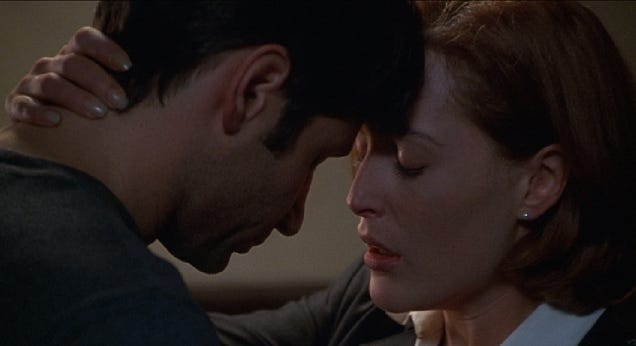
Love is dead. Or at least abducted by aliens. According to Entertainment Weekly, the returning show is going to turn the clock back on Mulder and Scully’s relationship. I’m more upset about this than I am some real-life break-ups.

Love is dead. Or at least abducted by aliens. According to Entertainment Weekly, the returning show is going to turn the clock back on Mulder and Scully’s relationship. I’m more upset about this than I am some real-life break-ups.
ThePrettiestOneI can sympathize here. This was pretty much how I reacted to meeting my mom's twin. It was made weirder by the fact that my aunt had had reconstructed surgery at one point, so she looked subtly different, but the same.
Also, there was the fact that they had the same voice, but different accents.
ThePrettiestOneIt's incredibly disturbing to me that this man is the most reasonable and least crazy candidate that the GOP is fielding this year.


Jeb Bush defunded Planned Parenthood and now Florida is one of the worst states for women’s health
In 2001, Gov. Jeb Bush cut $302,843 for family planning services for poor women through Planned Parenthood in Florida. Now, 25% of women in Florida are uninsured. More than 20% of women in Florida report being in fair or poor health. 20% of Floridian women have no access to a personal doctor or health care provider. And the stats get only more depressing from there.
Look at him. He’s so fucking proud of himself.
 A scene from “The Stanford Prison Experiment,” a new movie inspired by the famous but widely misunderstood study.
Credit PHOTOGRAPH COURTESY SPENCER SHWETZ/SUNDANCE INSTITUTE
A scene from “The Stanford Prison Experiment,” a new movie inspired by the famous but widely misunderstood study.
Credit PHOTOGRAPH COURTESY SPENCER SHWETZ/SUNDANCE INSTITUTE
On the morning of August 17, 1971, nine young men in the Palo Alto area received visits from local police officers. While their neighbors looked on, the men were arrested for violating Penal Codes 211 and 459 (armed robbery and burglary), searched, handcuffed, and led into the rear of a waiting police car. The cars took them to a Palo Alto police station, where the men were booked, fingerprinted, moved to a holding cell, and blindfolded. Finally, they were transported to the Stanford County Prison—also known as the Stanford University psychology department.
They were willing participants in the Stanford Prison Experiment, one of the most controversial studies in the history of social psychology. (It’s the subject of a new film of the same name—a drama, not a documentary—starring Billy Crudup, of “Almost Famous,” as the lead investigator, Philip Zimbardo.) The study subjects, middle-class college students, had answered a questionnaire about their family backgrounds, physical- and mental-health histories, and social behavior, and had been deemed “normal”; a coin flip divided them into prisoners and guards. According to the lore that’s grown up around the experiment, the guards, with little to no instruction, began humiliating and psychologically abusing the prisoners within twenty-four hours of the study’s start. The prisoners, in turn, became submissive and depersonalized, taking the abuse and saying little in protest. The behavior of all involved was so extreme that the experiment, which was meant to last two weeks, was terminated after six days.
Less than a decade earlier, the Milgram obedience study had shown that ordinary people, if encouraged by an authority figure, were willing to shock their fellow-citizens with what they believed to be painful and potentially lethal levels of electricity. To many, the Stanford experiment underscored those findings, revealing the ease with which regular people, if given too much power, could transform into ruthless oppressors. Today, more than forty-five years later, many look to the study to make sense of events like the behavior of the guards at Abu Ghraib and America’s epidemic of police brutality. The Stanford Prison Experiment is cited as evidence of the atavistic impulses that lurk within us all; it’s said to show that, with a little nudge, we could all become tyrants.
And yet the lessons of the Stanford Prison Experiment aren’t so clear-cut. From the beginning, the study has been haunted by ambiguity. Even as it suggests that ordinary people harbor ugly potentialities, it also testifies to the way our circumstances shape our behavior. Was the study about our individual fallibility, or about broken institutions? Were its findings about prisons, specifically, or about life in general? What did the Stanford Prison Experiment really show?
The appeal of the experiment has a lot to do with its apparently simple setup: prisoners, guards, a fake jail, and some ground rules. But, in reality, the Stanford County Prison was a heavily manipulated environment, and the guards and prisoners acted in ways that were largely predetermined by how their roles were presented. To understand the meaning of the experiment, you have to understand that it wasn’t a blank slate; from the start, its goal was to evoke the experience of working and living in a brutal jail.
From the first, the guards’ priorities were set by Zimbardo. In a presentation to his Stanford colleagues shortly after the study’s conclusion, he described the procedures surrounding each prisoner’s arrival: each man was stripped and searched, “deloused,” and then given a uniform—a numbered gown, which Zimbardo called a “dress,” with a heavy bolted chain near the ankle, loose-fitting rubber sandals, and a cap made from a woman’s nylon stocking. “Real male prisoners don’t wear dresses,” Zimbardo explained, “but real male prisoners, we have learned, do feel humiliated, do feel emasculated, and we thought we could produce the same effects very quickly by putting men in a dress without any underclothes.” The stocking caps were in lieu of shaving the prisoner’s heads. (The guards wore khaki uniforms and were given whistles, nightsticks, and mirrored sunglasses inspired by a prison guard in the movie “Cool Hand Luke.”)
Often, the guards operated without explicit, moment-to-moment instructions. But that didn’t mean that they were fully autonomous: Zimbardo himself took part in the experiment, playing the role of the prison superintendent. (The prison’s “warden” was also a researcher.) /Occasionally, disputes between prisoner and guards got out of hand, violating an explicit injunction against physical force that both prisoners and guards had read prior to enrolling in the study. When the “superintendent” and “warden” overlooked these incidents, the message to the guards was clear: all is well; keep going as you are. The participants knew that an audience was watching, and so a lack of feedback could be read as tacit approval. And the sense of being watched may also have encouraged them to perform. Dave Eshelman, one of the guards, recalled that he “consciously created” his guard persona. “I was in all kinds of drama productions in high school and college. It was something I was very familiar with: to take on another personality before you step out on the stage,” Eshelman said. In fact, he continued, “I was kind of running my own experiment in there, by saying, ‘How far can I push these things and how much abuse will these people take before they say, ‘Knock it off?’ ”
Other, more subtle factors also shaped the experiment. It’s often said that the study participants were ordinary guys—and they were, indeed, determined to be “normal” and healthy by a battery of tests. But they were also a self-selected group who responded to a newspaper advertisement seeking volunteers for “a psychological study of prison life.” In a 2007 study, the psychologists Thomas Carnahan and Sam McFarland asked whether that wording itself may have stacked the odds. They recreated the original ad, and then ran a separate ad omitting the phrase “prison life.” They found that the people who responded to the two ads scored differently on a set of psychological tests. Those who thought that they would be participating in a prison study had significantly higher levels of aggressiveness, authoritarianism, Machiavellianism, narcissism, and social dominance, and they scored lower on measures of empathy and altruism.
Moreover, even within that self-selected sample, behavioral patterns were far from homogeneous. Much of the study’s cachet depends on the idea that the students responded en masse, giving up their individual identities to become submissive “prisoners” and tyrannical “guards.” But, in fact, the participants responded to the prison environment in all sorts of ways. While some guard shifts were especially cruel, others remained humane. Many of the supposedly passive prisoners rebelled. Richard Yacco, a prisoner, remembered “resisting what one guard was telling me to do and being willing to go into solitary confinement. As prisoners, we developed solidarity—we realized that we could join together and do passive resistance and cause some problems.”
What emerges from these details isn’t a perfectly lucid photograph but an ambiguous watercolor. While it’s true that some guards and prisoners behaved in alarming ways, it’s also the case that their environment was designed to encourage—and, in some cases, to require—those behaviors. Zimbardo himself has always been forthcoming about the details and the nature of his prison experiment: he thoroughly explained the setup in his original study and, in an early write-up, in which the experiment was described in broad strokes only, he pointed out that only “about a third of the guards became tyrannical in their arbitrary use of power.” (That’s about four people in total.) So how did the myth of the Stanford Prison Experiment—“Lord of the Flies” in the psych lab—come to diverge so profoundly from the reality?
In part, Zimbardo’s earliest statements about the experiment are to blame. In October, 1971, soon after the study’s completion—and before a single methodologically and analytically rigorous result had been published—Zimbardo was asked to testify before Congress about prison reform. His dramatic testimony, even as it clearly explained how the experiment worked, also allowed listeners to overlook how coercive the environment really was. He described the study as “an attempt to understand just what it means psychologically to be a prisoner or a prison guard.” But he also emphasized that the students in the study had been “the cream of the crop of this generation,” and said that the guards were given no specific instructions, and left free to make “up their own rules for maintaining law, order, and respect.” In explaining the results, he said that the “majority” of participants found themselves “no longer able to clearly differentiate between role-playing and self,” and that, in the six days the study took to unfold, “the experience of imprisonment undid, although temporarily, a lifetime of learning; human values were suspended, self-concepts were challenged, and the ugliest, most base, pathological side of human nature surfaced.” In describing another, related study and its implications for prison life, he said that “the mere act of assigning labels to people, calling some people prisoners and others guards, is sufficient to elicit pathological behavior.”
Zimbardo released video to NBC, which ran a feature on November 26, 1971. An article ran in the Times Magazine in April of 1973. In various ways, these accounts reiterated the claim that relatively small changes in circumstances could turn the best and brightest into monsters or depersonalized serfs. By the time Zimbardo published a formal paper about the study, in a 1973 issue of the International Journal of Criminology and Penology, a streamlined and unequivocal version of events had become entrenched in the national consciousness—so much so that a 1975 methodological critique fell largely on deaf ears.
Forty years later, Zimbardo still doesn’t shy away from popular attention. He served as a consultant on the new film, which follows his original study in detail, relying on direct transcripts from the experimental recordings and taking few dramatic liberties. In many ways, the film is critical of the study: Crudup plays Zimbardo as an overzealous researcher overstepping his bounds, trying to create a very specific outcome among the students he observes. The filmmakers even underscore the flimsiness of the experimental design, inserting characters who point out that Zimbardo is not a disinterested observer. They highlight a real-life conversation in which another psychologist asks Zimbardo whether he has an “independent variable.” In describing the study to his Stanford colleagues shortly after it ended, Zimbardo recalled that conversation: “To my surprise, I got really angry at him,” he said. “The security of my men and the stability of my prison was at stake, and I have to contend with this bleeding-heart, liberal, academic, effete dingdong whose only concern was for a ridiculous thing like an independent variable. The next thing he’d be asking me about was rehabilitation programs, the dummy! It wasn’t until sometime later that I realized how far into the experiment I was at that point.”
In a broad sense, the film reaffirms the opinion of John Mark, one of the guards, who, looking back, has said that Zimbardo’s interpretation of events was too shaped by his expectations to be meaningful: “He wanted to be able to say that college students, people from middle-class backgrounds … will turn on each other just because they’re given a role and given power. Based on my experience, and what I saw and what I felt, I think that was a real stretch.”
If the Stanford Prison Experiment had simulated a less brutal environment, would the prisoners and guards have acted differently? In December, 2001, two psychologists, Stephen Reicher and Alexander Haslam, tried to find out. They worked with the documentaries unit of the BBC to partially recreate Zimbardo’s setup over the course of an eight-day experiment. Their guards also had uniforms, and were given latitude to dole out rewards and punishments; their prisoners were placed in three-person cells that followed the layout of the Stanford County Jail almost exactly. The main difference was that, in this prison, the preset expectations were gone. The guards were asked to come up with rules prior to the prisoners’ arrival, and were told only to make the prison run smoothly. (The BBC Prison Study, as it came to be called, differed from the Stanford experiment in a few other ways, including prisoner dress; for a while, moreover, the prisoners were told that they could become guards through good behavior, although, on the third day, that offer was revoked, and the roles were made permanent.)
Within the first few days of the BBC study, it became clear that the guards weren’t cohering as a group. “Several guards were wary of assuming and exerting their authority,” the researchers wrote. The prisoners, on the other hand, developed a collective identity. In a change from the Stanford study, the psychologists asked each participant to complete a daily survey that measured the degree to which he felt solidarity with his group; it showed that, as the guards grew further apart, the prisoners were growing closer together. On the fourth day, three cellmates decided to test their luck. At lunchtime, one threw his plate down and demanded better food, another asked to smoke, and the third asked for medical attention for a blister on his foot. The guards became disorganized; one even offered the smoker a cigarette. Reicher and Haslam reported that, after the prisoners returned to their cells, they “literally danced with joy.” (“That was fucking sweet,” one prisoner remarked.) Soon, more prisoners began to challenge the guards. They acted out during roll call, complained about the food, and talked back. At the end of the sixth day, the three insubordinate cellmates broke out and occupied the guards’ quarters. “At this point,” the researchers wrote, “the guards’ regime was seen by all to be unworkable and at an end.”
Taken together, these two studies don’t suggest that we all have an innate capacity for tyranny or victimhood. Instead, they suggest that our behavior largely conforms to our preconceived expectations. All else being equal, we act as we think we’re expected to act—especially if that expectation comes from above. Suggest, as the Stanford setup did, that we should behave in stereotypical tough-guard fashion, and we strive to fit that role. Tell us, as the BBC experimenters did, that we shouldn’t give up hope of social mobility, and we act accordingly.
This understanding might seem to diminish the power of the Stanford Prison Experiment. But, in fact, it sharpens and clarifies the study’s meaning. Last weekend brought the tragic news of Kalief Browder’s suicide. At sixteen, Browder was arrested, in the Bronx, for allegedly stealing a backpack; after the arrest, he was imprisoned at Rikers for three years without trial. (Ultimately, the case against him was dismissed.) While at Rikers, Browder was the object of violence from both prisoners and guards, some of which was captured on video. It’s possible to think that prisons are the way they are because human nature tends toward the pathological. But the Stanford Prison Experiment suggests that extreme behavior flows from extreme institutions. Prisons aren’t blank slates. Guards do indeed self-select into their jobs, as Zimbardo’s students self-selected into a study of prison life. Like Zimbardo’s men, they are bombarded with expectations from the first and shaped by preëxisting norms and patterns of behavior. The lesson of Stanford isn’t that any random human being is capable of descending into sadism and tyranny. It’s that certain institutions and environments demand those behaviors—and, perhaps, can change them.
Sign up for the daily newsletter.Sign up for the daily newsletter: the best of The New Yorker every day.
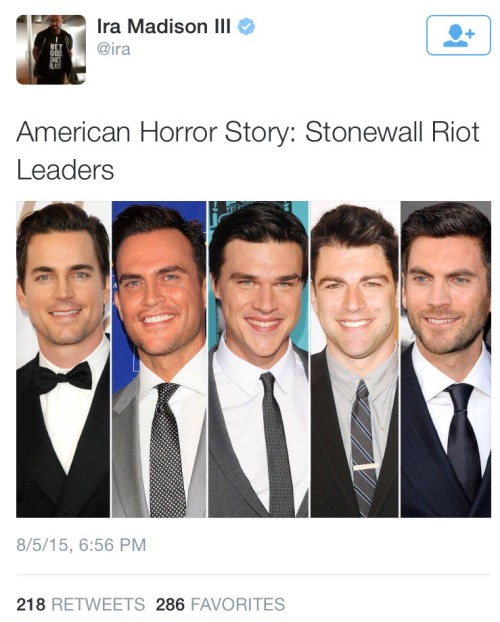
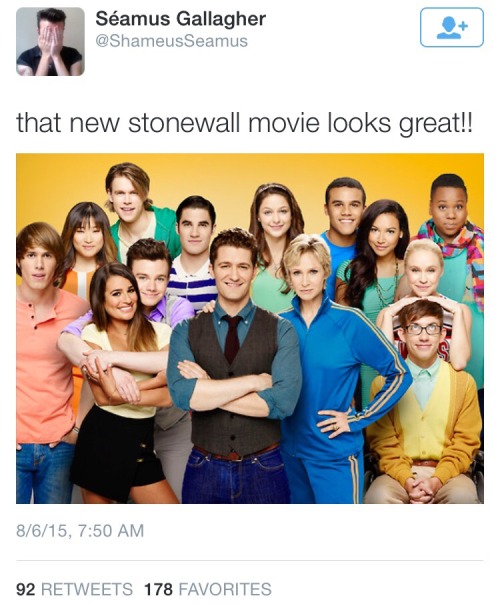
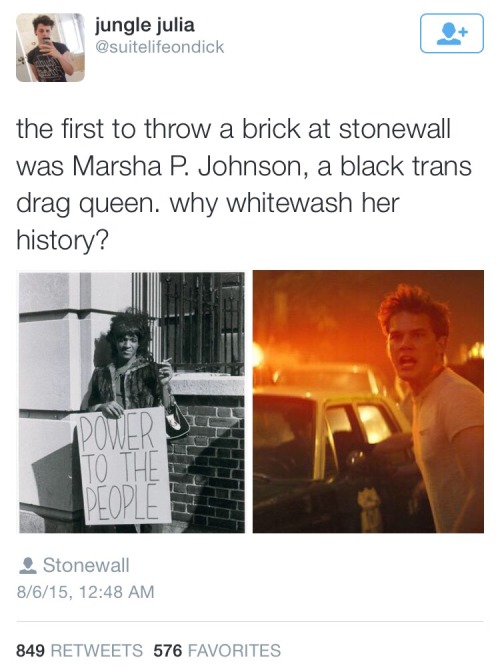
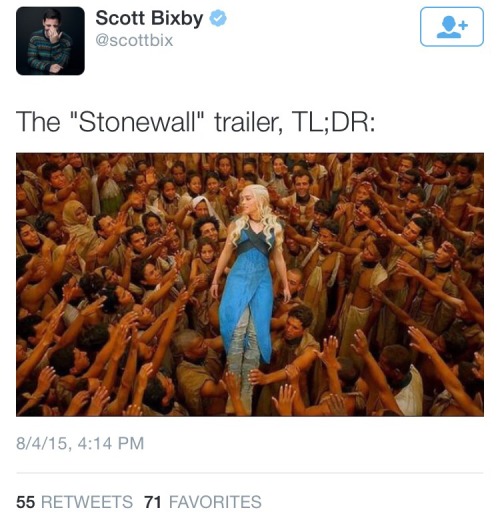
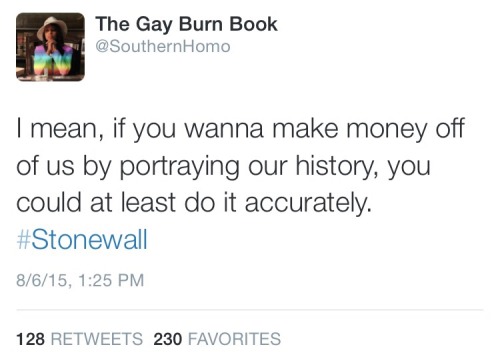
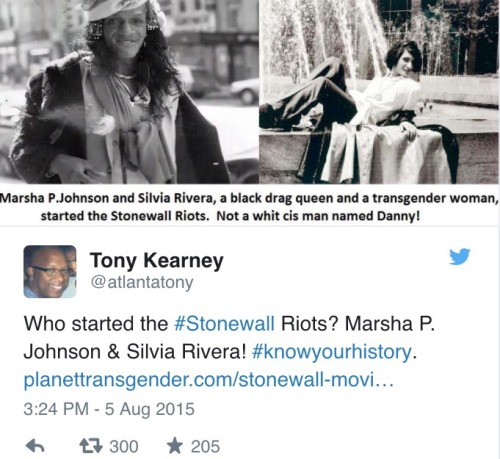

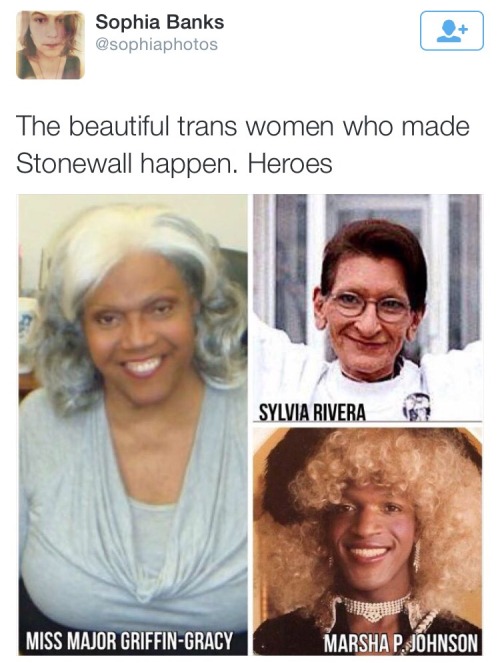
Gay Twitter is going in on the new #Stonewall movie and I’m loving it
YAAAAAAAAAAASSSSS
millennial goals and dreams are so minimal
“i want to drive a car that doesn’t break down all the time”
“i want to one day consider buying a place instead of renting”
“i’d like to not be in so much debt”
we are the least entitled generation but we get the most shit
The truth in this tho
The other day, I started thinking about all the things I would do if I had a ton of money. They were almost all about paying off debt, buying a house, fixing my car, and getting more education for a better job. The most frivolous thing was getting a dog.
People say that we act entitled - apparently it’s entitled to want to live debt-free and feel financially secure.
ThePrettiestOneSo, the people rigging the slate rigged the wait the why the room spinning is in the rigging wait
So, this popped up in the “KotakuInAction” subreddit, i.e., “the place where GamerGaters who don’t realize GamerGate is sooooo 2014 hang out”:

Naturally, I had some thoughts.
Look at these complete assholes. https://t.co/idbxZnMlbG
— John Scalzi (@scalzi) August 7, 2015
I DO NOT KNOW OF THIS CARY DOCTARAMOW OF WHICH YOU SPEAK https://t.co/O6sHX4Sg6V
— John Scalzi (@scalzi) August 7, 2015
Think like a "KotakuInAction" commenter: 1. Wrap your breathe-hole in saran wrap 2. Wait five minutes 3. Hit yourself with a hammer 4. Go!
— John Scalzi (@scalzi) August 7, 2015
OH MY GOD PEOPLE SCALZI AND DOCTOROW BLURB EACH OTHER'S BOOKS THE RABBIT HOLE IS DEEPER THAN WE EVER KNEW pic.twitter.com/9tfILDKXQ8
— John Scalzi (@scalzi) August 7, 2015
Oh my God. Guys. Guys. You gotta see this. This is AMAZING. I mean, this is just THE BEST THING EVAR. pic.twitter.com/uzINLs4Q6I
— John Scalzi (@scalzi) August 7, 2015
WHY WON'T SCALZI AND DOCTOROW DISCLOSE THEY'RE FRIENDS LIKE IN THIS COLLAGE USING PICTURES FROM SCALZI'S SITE WHERE HE NOTES THEY'RE FRIENDS
— John Scalzi (@scalzi) August 7, 2015
ZOMG YOU GUYS I FOUND THIS VIDEO OF SCALZI AND DOCTOROW TOGETHER FROM SEVEN YEARS AGO FOLLOW THE CLUES PEOPLE https://t.co/XK5BZsYKRp
— John Scalzi (@scalzi) August 7, 2015
GUYS. GUYS. LOOK AT THIS. SCALZI ONCE CO-DEDICATED A BOOK TO DOCTOROW. HOW COULD THIS HAVE BEEN HIDDEN FOR SO LONG pic.twitter.com/SzJrh0yacK
— John Scalzi (@scalzi) August 7, 2015
I WILL NOT REST UNTIL SCALZI AND DOCTOROW ANSWER FOR THEIR CRIME OF BEING FRIENDS IN A COMPLETELY PUBLIC AND OBVIOUS WAY FOR OVER A DECADE
— John Scalzi (@scalzi) August 7, 2015
Seriously, though. How these people get through life without poking their eyes out with spoons is entirely beyond me.


ThePrettiestOneme too.

TW for rape, sexual abuse
“Cho kicked off the conversation without much explanation as to what inspired her to act today. But within an hour of her first post, hundreds of fellow survivors and fans had already flooded Twitter with their own stories of abuse and statements of solidarity.
“I want people to know they are not alone,” Cho told NBC News. “Rape, molestation, sexual violence is more common than anyone admits. If all survivors - I say survivors, not victims - if all survivors came forward we could actually see the problem clearly and find a solution and hopefully heal.”
This isn’t the first time Cho has used social media to share her personal struggles and encourage others to do the same. In November 2014, she created the hashtag “#tellyourstory,” urging her followers to do just that.
In a February 2015 interview with NBC News, Cho opened up in more detail about her own history of abuse.
“I was a victim of childhood sexual abuse and also a rape victim. These all happened before I was an adult,” Cho said. ”They were traumatic experiences that I needed to work through. And as a result, unfortunately, I did become sexualized very early, but not by choice. I wouldn’t say that my experiences were great until I at least became an adult.”
“This is my life’s work,” Cho said. “I want to heal the world.”
Read the full piece here

“Let’s hear it for the reproductive freedom advocates on the ground, on the Hill, and online who stood up to anti-abortion extremists and WON!
Stay in the loop at istandwithpp.org
As seen on the Planned Parenthood Action Facebook page
THANKS TO EVERYONE WHO SIGNED AND SHARED!


janellemonae: “Happy Birthday President@BarackObama! You have changed the game. You are bold and compassionate. You have opened up so many doors, changed oppressive rules, fought for women’s rights, fought for gay and lesbian rights, saved this economy, changed the lives of so many around the world, & my list could go on… You have managed to run a country full of lovers & haters like none other.
The world will feel the sadness when you leave office. I know I will. No one like THIS President. #BarackObama”
As seen on Janelle Monae’s Instagram page
More Janelle Monae posts on Profeminst
More President Obama posts
Two of my favorite people together in one pic! Happy B-Day President Obama!!

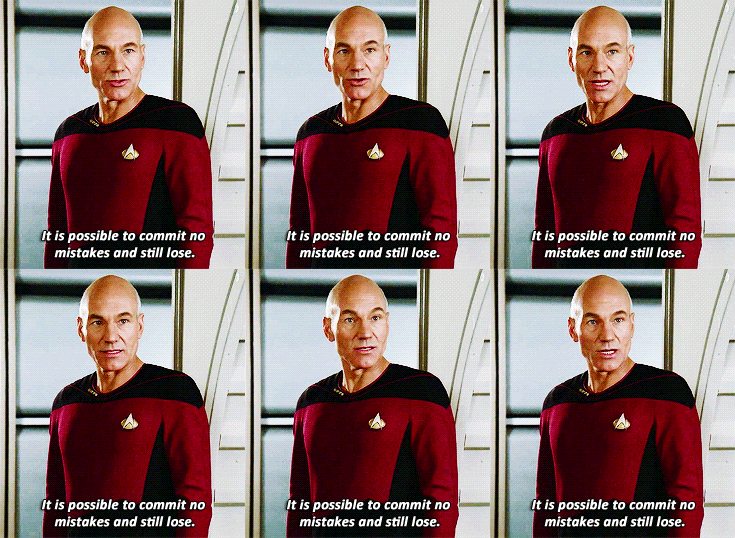

I reblog this every time I see it, because it’s one of life’s hardest lessons.
My two favs in one post!!!
 Ever had a debate on whether to call someone a "disabled person" or a "person with disabilities"? It's not a problem that there's a debate – but lots of abled people are speaking over disabled people. Here are some common things they say, and the simple solution to help.
When you have a stressful job like a doctor or a pilot, you’re faced with executing complex tasks everyday with very high rates of success. How do such professionals even get started when the task at hand can be so overwhelming? One tool that helps them manage their work is the humble checklist.

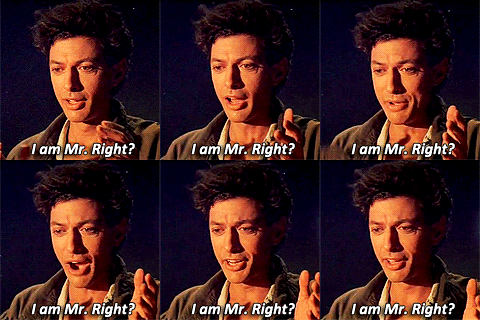
ThePrettiestOneOK, someone please clarify for me:
Is Jeff Goldblum actually considered sexy, or is this whole thing just one long, overly complex prank on someone's part?

Here you go, history in the making. The cutest picture that ever was, or ever will be.
i-still-love-the-way-you-hurt-me:
I got catcalled while I was walking the other day and I couldn’t think of anything clever to say so I just made the most hideous shrieking noise I possibly could.
I heard the guys in the car go “the fuck?”
Guy: “Ay yo baby, nice tits!”
Girl:
ThePrettiestOneIt knows what it did.
IT KNOWS WHAT IT DID.

Now that shows like Sense8 have helped massively expand the presence of transgender people in science fiction and fantasy, one of the most venerable TV shows is following suit. Trans actor Bethany Black is appearing in Mark Gatiss’ upcoming “scary” episode.

I sent the six queries I had planned to send that day. Within 24 hours George had five responses—three manuscript requests and two warm rejections praising his exciting project. For contrast, under my own name, the same letter and pages sent 50 times had netted me a total of two manuscript requests. The responses gave me a little frisson of delight at being called “Mr.” and then I got mad. Three manuscript requests on a Saturday, not even during business hours! The judgments about my work that had seemed as solid as the walls of my house had turned out to be meaningless. My novel wasn’t the problem, it was me—Catherine.
I wanted to know more of how the Georges of the world live, so I sent more. Total data: George sent out 50 queries, and had his manuscript requested 17 times. He is eight and a half times better than me at writing the same book. Fully a third of the agents who saw his query wanted to see more, where my numbers never did shift from one in 25.


Jon Stewart responds to Mike Huckabee’s position on gay marriage. Click here to watch.
And don’t miss Jon’s final Daily Show, tonight at 11/10c.
Of the next six adults you meet, chances are one of them has never sent an e-mail. He's never done a Google search, never been Rickrolled. He thinks "doge" refers to a historical Italian government official. (Wow; very anachronism.)
He will probably never read this story.
It might seem inconceivable that in 2015 there could still be Americans who don't use the Internet — but they exist. Far from being irrelevant to modern society, they're increasingly the target of millions, if not billions, of dollars of taxpayer and private funding for Internet access. And that makes them a really important slice of the population.
[Here's Obama's plan to give teachers and libraries $1 billion a year in extra funding]
Who are these people?
Mostly they're poorer, older and undereducated, according to the Pew Research Center's latest figures. Fifteen percent of U.S. adults, or about 37 million people, by the Census Bureau's latest count, don't use the Web. But break it down by race and class, and suddenly the numbers look very bleak: A fifth of black Americans are disconnected. Same goes for the 25 percent of Americans who make less than $30,000 a year and a quarter of all adults who live in rural areas. And among those who've never finished high school, a third never use the Web.
As the rest of us use the Internet to do homework, find jobs, make friends, get the news, earn a living, learn new skills, buy groceries, organize politically and do a seemingly endless range of other activities, encouraging the disconnected to hop online has become a national priority. New programs are being launched all the time in Washington to expand Internet access, sometimes by federal agencies that would appear to have nothing to do with the Internet.
[Why the Agriculture Department is giving out tens of millions of dollars for Internet access]
The Federal Communications Commission recently opened a proceeding that would subsidize Internet plans for poor people. It has expanded its broadband funding for schools and libraries by $1 billion a year. The Department of Housing and Urban development is working with Google, Sprint and other Internet providers to put discount broadband services in public housing projects.
All these projects are aimed at accelerating a trend that's held consistently since the turn of the millennium. In 2000, nearly half of Americans didn't use the Web, according to Pew. Now that the figure stands at 15 percent, it's clear we've come a long way.
[The government found a smart way to connect the poor to the Internet: Put it in public housing]
But these remaining holdouts are likely to be the hardest to reach, because you can't just throw money at them. Of non-Internet users surveyed in 2013, just 19 percent cited the cost of Internet or owning a computer as an obstacle to adoption. Many more, 34 percent, said they didn't find the Internet relevant to them (though with seemingly 99.9 percent of the Web devoted to cat GIFs, perhaps they have a point). Thirty-two percent said the Web was too difficult to use, according to Pew.
Federal studies have shown that although 10 million disconnected Americans might be willing to get online at the right price, that still leaves some 27 million people for whom price is practically irrelevant to their decision to stay offline.
[How cheap does the Internet have to be to get everyone online?]
"If you build it, they will come," goes the adage. But for these folks, simply building out the Internet isn't enough; convincing them that the Web could help them grow is crucial to getting them online. And it's not merely a matter of waiting for old fuddy-duddies who don't "get it" to die off: As the data show, older people have been among the quickest to adopt the Internet among the disconnected population.
By contrast, there are real structural challenges (poverty and inequality) that are keeping younger, less socially mobile populations from becoming America's next great inventors or scientists or civil servants. And those people matter, too.
ThePrettiestOne100% accurate

When they said it might sing, this wasn’t exactly what I had in mind.I think my dinner is possessed.
THAT IS NOT A “HUMMING NOISE”
Nothing rouses my appetite like the wails of the damned.
Hero.
BLESSINGS UPON NICHELLE NICHOLS
God I’m literally crying
The wind brushed her cheek, doing what it could to heal her grievous wounds. The will-o-wisp whispered, “I am still here, I am always here for you.” The witch crawled, painfully, into a crouch, picked up her wand, spat the mud and muck from her mouth, and snarled –
The knights and mages, for all their bravery and armaments, collectively took a step back. They were trespassers, an invading force, tools of a corrupt king, and the cold knowledge of their doom fell like heavy rain.
Ah yes, the inner thoughts of the tumblr community… reblog it reblog it reblog it reblog it reblog it reblog it reblog it reblog it reblog it reblog it reblog it reblog it reblog it reblog it reblog it reblog it reblog it reblog it reblog it reblog it reblog it Tumblr Gets Deep: Next … Continued
The post Tumblr Gets Deep (21 Pics) appeared first on Pleated-Jeans.com.
okay, i have been trying to say this in a way that makes sense for ages, so here goes:
a lot of hatred of dresses, pink, stereotypically “feminine” stuff is based on internalized misogyny. and that’s definitely something we all need to look at within ourselves and address and work on.
but: a lot of hatred of dresses, pink, stereotypically “feminine” stuff is based on the fact that femininity is compulsory for people who are assigned female at birth.
like, this is a fact. this isn’t something i’m making up. femininity is compulsory. i have to wear dresses and makeup to be taken seriously when i go to job interviews, when i go to social occasions, when i present myself in any formal setting. when i don’t do that, people notice. they’re rude to me.
when i shop in the men’s section, store employees and customers glare at me! my relatives press feminine clothes on me during the holiday season because they think i should dress in a more feminine way! when i go to get my hair cut and ask for it to be cut in a certain style, the woman cutting my hair literally ignores that explicit instruction because it’s “too butch”. femininity is compulsory! i am not allowed to present my gender the way i would like to present my gender!
it’s not the fault of femininity that it’s being forced on me. and the patriarchy does devalue femininity. and the current rhetoric of “you can wear pink and skirts and still be a feminist and still be queer and it’s other people’s fault for not taking you seriously, not yours for dressing that way” is great.
but i’ve heard people say to me, “you can wear lipstick and dresses and still be a feminist” about a thousand times, and i have never, ever, ever heard someone say to me, “you can refuse to wear lipstick and dresses and you are no less of a woman than someone who does wear them.” i had to figure that out all on my own.
i’m allowed to be angry at the cis women who force me to present myself in a way that i don’t want to present myself. i am allowed to do that.
I will scream the bolded from the rooftops for you if you want. <3