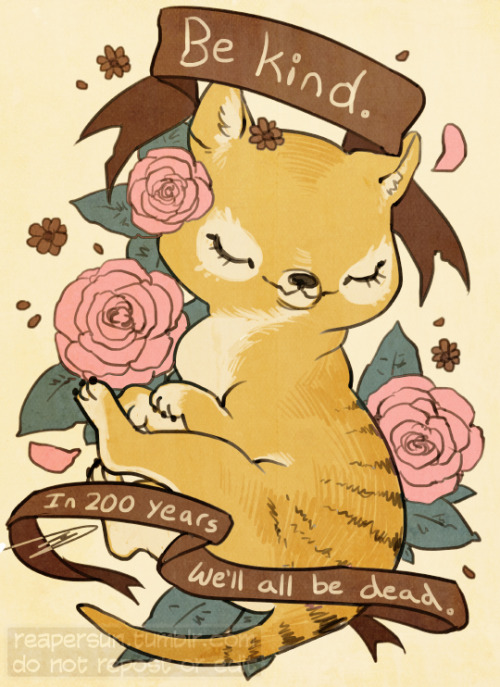
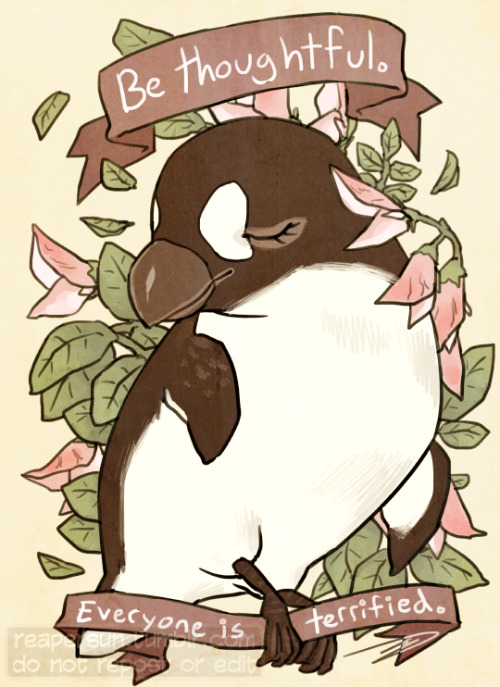
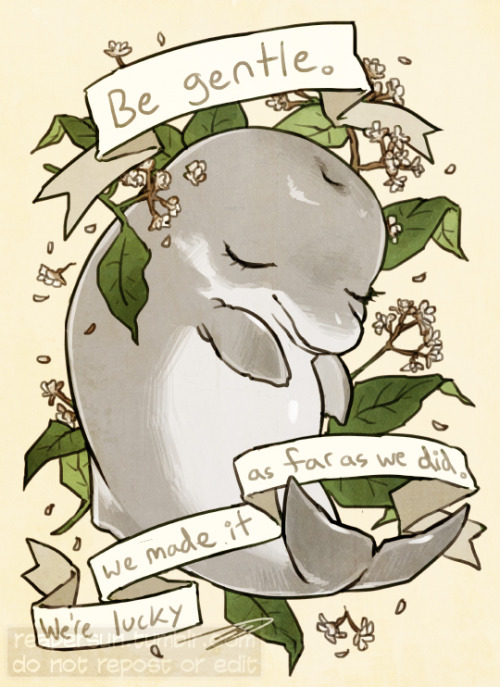
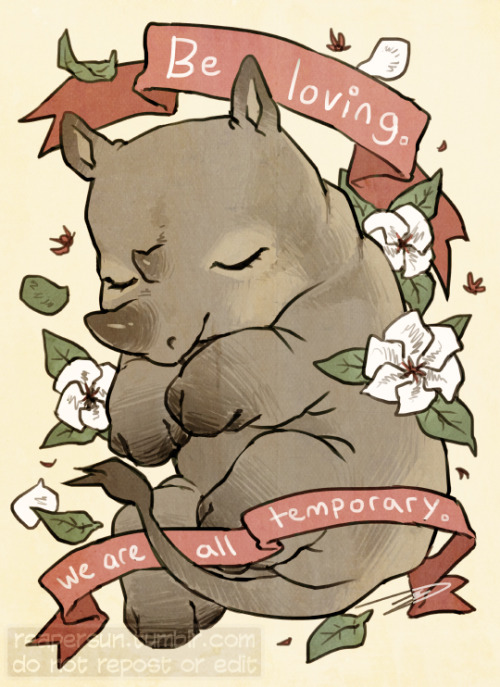
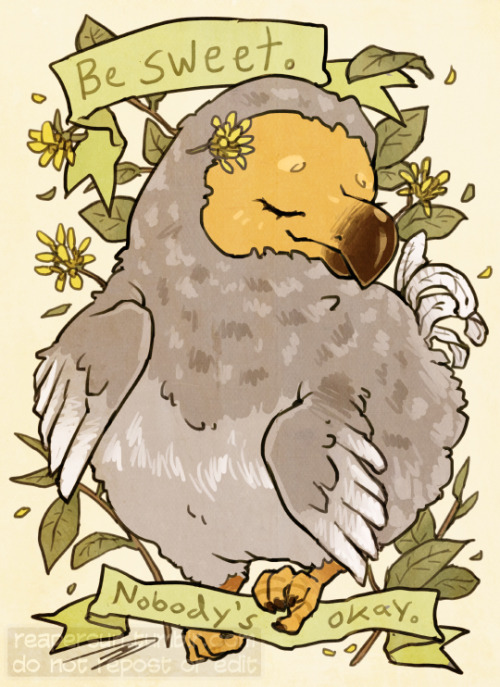
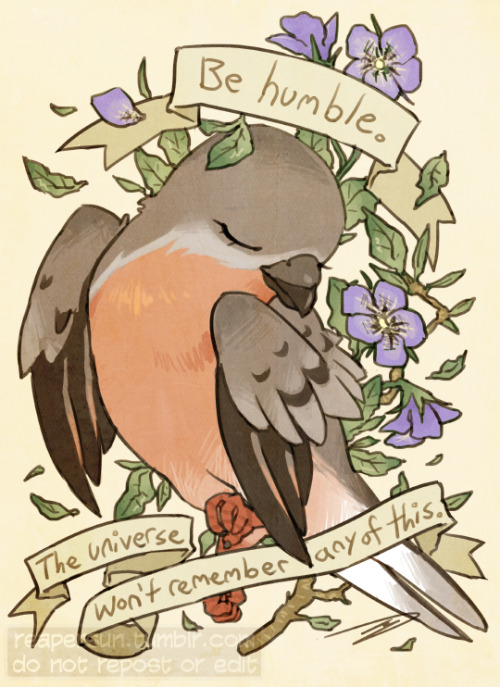
i specifically chose animals that are (or believed to be) extinct due to human influence: thylacine, great auk, baiji, west african black rhino, golden toad, dodo, passenger pigeon, and quagga. there are many other species i could have included. the plants are also based on extinct species, but i found much less information about extinct plants, unfortunately.
the text doesn’t necessarily relate to each animal or their extinction. it’s all basically the same idea: let’s all be nice to each other, because today, the universe is vast and incomprehensible, we are all suffering, we are all going to die, and we’re all in this together. for today.
i’m busy for a couple weeks with conventions, but after that i’m considering a companion series with ancient extinct animals, so feel free to send me your favorites :)
My son and I both had rough days yesterday, and right before bedtime,
my wife and I were talking to him about good days and bad days, limits,
and why at a certain point we all start to feel overwhelmed and fall
apart. I considered bringing up spoon theory, but thought it would be a bit too abstract for him. So instead, I started talking about about Captain America’s shield.
Because
in general, every day has good stuff and bad stuff. And just like Cap,
we all have a shield we can use to deflect some of the bad stuff and
keep it from getting to us. But sometimes there’s too much stuff to
block it all, and Cap gets hurt. We all have bad days like that
sometimes, where there’s just too much.
What makes life trickier
is that your shield can change size. If you’re hungry or overtired, your
shield might shrink down to the size of a saucer, which makes it harder
to deflect anything. On the other hand, if you’ve had a good night’s
sleep, gotten some good exercise, and had fun with your friends, you
could end up with a super-shield that’s as big as you are. (Or even a
full suit of Iron Man armor. We went off on a tangent at this point,
wondering why Tony doesn’t go to Wakanda and make an Iron Man suit out
of vibranium.)
As a metaphor, Cap’s shield worked well. We talked
about why something might not bother you one day, but the same thing
might really get to you on another, depending on how big your shield is
that day, and how much else you’ve been trying to deflect. It also
seemed to be a good way of talking about self-care, and ways to
strengthen your shield so it wouldn’t shrink or crack.
Don’t know if it will be helpful to anyone else, but it was a good conversation with my son, so I figured I’d put it out there.
today i went to this nice botanical garden in alabama and they had this whole section dedicated to daylilies… they haven’t bloomed yet but there were rows and rows of different individual hybrid plants and each one was given its own name on a little plaque
(this is only a tiny portion, there were HUNDREDS)
as soon as i saw some of the names i knew i had to find THE SQUAD (or…the 3 star wars squads lol), so here they are:
So, the bf and I were discussing Prince and Hamilton in the car on the way to work this morning, as you will, and my brain crossed a wire and the line "Why are you writing like you're running out of time" made me start crying again.
If you fucked up today, that’s okay. You’re still smart, and good, and people still love you.
If you’re in a dark place today, that’s okay. Even if you feel like you can’t get out of bed, and all you can do is breathe, that’s okay. You breathe, take the time you need, and we’ll be here when you’re ready.
Every day is a battle. On some, you demolish whatever’s ahead of you. On others, you just have to hang on for dear life. Either way, you’re a warrior. Don’t forget it.
This criticism of how Hamilton places its title character in context might be legitimate if Hamilton weren’t, well, what it is. In essence, Hamilton is a postmodern metatextual piece of fanfic, functioning in precisely the way that most fanfics do: It reclaims the canon for the fan.
In this case, Hamilton’s canon is history, and the fan, Miranda, is doing a lot more than simply adapting it. Like the best fanfic writers, he’s not just selectively retelling history — he’s transforming it.
Hamilton historians are viewing Hamilton as part of the “Founders Chic” movement — but the musical doesn’t really fit into that trend
Alexander Hamilton has long been a divisive figure in the annals of historical study, but in recent years he’s become a focal point of a historical trend many academics and history enthusiasts refer to as “Founders Chic.” Founders Chic first appeared as a term in a July 2001 issue of Newsweek and quickly caught on to describe the sudden millennial trend of lauding the forefathers.
A year later, in a now-offline essay for Common-Place, Jeffrey Pasley observed that “Founders” really meant “Federalist,” as most of the acclaim was centered on David McCullough’s dazzling biography of John Adams, with plenty going to fellow Federalist Hamilton on the side.
Numerous other biographies of the Founding Fathers soon followed, as did a 2008 biopic based on McCullough’s Adams biography. Soon after that, Miranda famously conceived the idea for the musical while reading Ron Chernow’s 2004 biography, Alexander Hamilton, which focuses on Hamilton’s early life as a bastard orphan on the tiny Caribbean island of Nevis, and emphasizes the way his formative years shaped his relationship to the US.
Analyzing the Founders Chic trend in 2003, the Atlantic wrote critically of it: “In revering the Founders we undervalue ourselves and sabotage our own efforts to make improvements — necessary improvements — in the republican experiment they began. Our love for the Founders leads us to abandon, and even to betray, the very principles they fought for.”
But although Hamilton stems from one of the trend’s byproducts, its function as a text is to do exactly what the Atlantic calls for and critique the history the founders began. The real-life Hamilton’s experience, passion, and ambition resonated deeply with Miranda, who is deeply concerned with the American immigrant experience. Miranda immediately recognized a fellow hip-hop artist in Hamilton, in that the founder had all the earmarks of a Tupac or a Biggie Smalls: innate intellect, brashness, unrelenting ambition, and a grand tendency to start drama. (A much-admired piece of recent Hamilton fan art notes he will “fight anyone, including himself.”)
[…]
Like countless fanfic writers before him, Miranda clearly loves his canon, but he expresses that love by tearing the canon to pieces. Like countless fanfic writers before him, he remains as close to the letter of authenticity as possible while also completely deconstructing the worldview he’s been given. Miranda uses his text to not only have fun with and celebrate US history but to critique everything about that history — something his perspective as an American immigrant writing about another American immigrant puts him in a unique position to do.
Miranda’s fanfic interrogates the mythos of the American dream, tearing down the idea that “America” emerged from a single cultural identity that belongs only to white European immigrants and their descendants. This is something Hamilton’s fan base seems to grasp innately. “Do you understand what it’s like to live in a nation where you are made marginal and inconsequential in the historical narrative that you are taught from your first day of school?” writes Tumblr user thequintessentialqueer in a brilliant explication of Hamilton’s function as a text: “Whose rebellion is valued? Who is allowed to be heroic through defiance? … Violence is only acceptable in the hands of white people; revolution is only okay when the people leading the charge are white … Hamilton is not really about the founding fathers. It’s not really about the American Revolution. The revolution, and Hamilton’s life are the narrative subject, but its purpose is not to romanticize real American history: rather, it is to reclaim the narrative of America for people of colour … If you’re watching/listening to Hamilton and then going out and romanticizing the real founding fathers/American revolutionaries, you’re missing the entire point.”
Again and again, Miranda emphasizes that this version of US history is being told by those other immigrants — the ones who, as the show notes, “get the job done,” and the ones who had no choice about whether to immigrate at all.
And just as he emphasizes that “you have no control … who tells your story,” he reminds us that he’s telling the story of American history now — and he’s telling it his way.
[…]
If we rush to defend Hamilton in this instance, we can be forgiven: History is littered with examples of women and writers of color having their work subjected to a higher standard of inquiry and criticism than the work of their white male counterparts. And that is precisely why Hamilton exists as a text: to elevate and celebrate the dismissed and devalued.
As fanfic, Hamilton interrogates the text of American history from the “wrong” perspective to reclaim that narrative for those who were left out of it
Ultimately, critiquing Hamilton for historical accuracy regarding Alexander Hamilton’s actual place in history is a fundamental misunderstanding of what Hamilton is doing as a modern metatext and as fanfic. The entire point of Hamilton is that the real Alexander Hamilton was a man for the 1 percent, not the 99 percent. The act of presenting Hamilton as a man for the people allows Miranda — and by extension, the audience — to feel as though they are actively shaping the future by making the past all about themselves.
The fundamental objective of fanfic, especially when it is written by women, queer and genderqueer people, and people of color, is to insert yourself, aggressively and brazenly, into stories that are not about and were never intended to be about or represent you.
In this way, Miranda’s aggressive over-identification and use of a Federalist Founding Father to represent modern hip-hop and immigrant culture is precisely as subversive, and for many of the same reasons, as the woman-authored fic I read last week about a white male TV character who gets pregnant and gives birth to were-kittens.
Hamilton unites the story of American independence with black, Latino, and Asian actors who were excluded from it, and in doing so allows these excluded citizens to put themselves back into the narrative. Hamilton is not just a story of history — it is the story of the ongoing struggle to make sure that people of color, immigrants, women, and other marginalized citizens are included in the sequel.
Fans of Hamilton don’t flock to the musical because of the way it transforms the Founding Fathers.
They flock to Hamilton because of everything the Founding Fathers never were.
At age 23, Oprah was fired from her first reporting job.
At age 24, Stephen King was working as a janitor and living in a trailer.
At age 27, Vincent Van Gogh failed as a missionary and decided to go to art school.
At age 28, J.K. Rowling was a suicidal single parent living on welfare.
At age 28, Wayne Coyne ( from The Flaming Lips) was a fry cook.
At age 30, Harrison Ford was a carpenter.
At age 30, Martha Stewart was a stockbroker.
At age 37, Ang Lee was a stay-at-home-dad working odd jobs.
Julia Child released her first cookbook at age 39, and got her own cooking show at age 51.
Vera Wang failed to make the Olympic figure skating team, didn’t get the Editor-in-Chief position at Vogue, and designed her first dress at age 40.
Stan Lee didn’t release his first big comic book until he was 40.
Alan Rickman gave up his graphic design career and landed his first movie role at age 42.
Samuel L. Jackson didn’t get his first major movie role until he was 46.
Morgan Freeman landed his first major movie role at age 52.
Kathryn Bigelow won the Academy Award for Best Director when she made The Hurt Locker at age 57.
Grandma Moses didn’t begin her painting career until age 76.
Louise Bourgeois didn’t become a famous artist until she was 78.
Whatever your dream is, it is not too late to achieve it. You aren’t a failure because you haven’t found fame and fortune by the age of 21. Hell, it’s okay if you don’t even know what your dream is yet. Even if you’re flipping burgers, waiting tables or answering phones today, you never know where you’ll end up tomorrow.