Shared posts

12 Jan 02:49

Origins of the world map

by Nathan Yau

Mapping the entire planet is not exactly a straightforward thing to do, especially during a time when there weren’t any flying objects to take photographs from above. Jeremy Shuback rewinds all the way back to this time and asks how the first world map came to be.

Tags: history, Jeremy Shuback

19 Mar 11:51

What The Sports Shutdown Means For Leagues … And Fans

by A FiveThirtyEight Chat

sara.ziegler (Sara Ziegler, sports editor): The coronavirus pandemic has affected every slice of life in the past week for most Americans. The sports world has played an interesting role in all of this, serving as a harbinger in some ways: The suspension of the NBA season after the positive test of Rudy Gobert of the Utah Jazz emphasized the seriousness of the virus for many people.

We can’t know how the next several months will play out, but we wanted to talk through what the suspension has meant for our leagues — and ourselves, as fans.

What do you each see as the most significant effects of the suspensions?

neil (Neil Paine, senior sportswriter): In the immediate, it might be just how each league crowns a champion in 2020, or if they do at all.

The NBA and NHL might have to get creative about how to stage the playoffs, if they can even come back in time to do it. And of course, the men’s and women’s NCAA Tournaments will have no champions.

chris.herring (Chris Herring, senior sportswriter): Exactly. There was initially hope that a shorter hiatus, to allow for quarantines, might be sufficient. A few days later, NBA Commissioner Adam Silver said it would be at least a 30-day hiatus. And now the CDC’s recommendation is that all events be held to 50 people or fewer for the next eight weeks. That would be a logistical challenge for the NBA, which has 30 players and coaches alone for each team, not to mention the referees, statisticians, announcing crew (assuming the game is televised), etc.

We’re looking at months, at least, if this is even under control by then.

travis.sawchik (Travis Sawchik, sportswriter): The number of MLB games that will be played remains highly uncertain. I think the best-case scenario is a mid-June return with another ramp-up period for pitchers, which would result in something like a 100-game season. But it’s possible there are far fewer (if any) games played. Assuming MLB games return at some point this late spring or summer with fans able to be in attendance, it will be interesting to see if consumers of the sport rush back to stadiums or are hesitant to return.

joshua.hermsmeyer (Josh Hermsmeyer, NFL analyst): Of the major sports, the NFL was the least affected. The biggest news was that the NFL draft, which is set to be held April 23-25 in Las Vegas, has been closed to fans. According to the NFL, it will still be televised, and frankly I’m interested to see if it might actually be a more interesting product to watch on TV. The other league event that will likely be impacted are the early May rookie minicamps, when teams get to spend some hands-on time with their new draft picks.

neil: All of this plays into one of the biggest long-term effects as well: the economic impact. Billions upon billions will be lost by not being able to play these games.

chris.herring: It’s still nuts to think about how much the nation has shifted in less than a week.

sara.ziegler: It really is!

neil: It remains surreal.

travis.sawchik: I assume most MLB owners can weather this in the short term, but you wonder what impact it will have on business operations. If the MLBPA thought recent offseasons were tough in terms of free agency and arbitration, what about next winter? And you have to feel for minor league players who are not paid until the season starts. Many are in a very, very tough position.

Then there are the local economies that are affected by the lack of baseball, which is such a volume business, particularly hourly workers at local restaurants and bars and those within the actual stadiums

chris.herring: Even once it became clear that this was a more serious thing, the NCAA folks were brainstorming how to scale down the tournaments, perhaps to 16 teams instead of 68. Then the positive test for Gobert went public, and every hope for that, or anything really, was shattered. A billion-dollar event, just gone.

sara.ziegler: I feel for those kids the most, for sure — and all the college gymnasts and baseball players and wrestlers, etc.

joshua.hermsmeyer: I actually view Gobert as something of an anti-hero now. Without his antics, we may have delayed our collective response even longer.

neil: Totally agree, Josh.

Rudy Gobert was kind of a stand-in for us all.

sara.ziegler: #WeAreRudy

neil: His shift from not taking it seriously enough to realizing just how bad it is really mirrored the nation’s reaction, I think.

chris.herring: And as we type, now the Brooklyn Nets announce that four of their players have tested positive for the virus, including Kevin Durant. That alone more than doubles the number of NBA cases — Gobert, Donovan Mitchell and Detroit’s Christian Wood tested positive before — that we knew about previously.

neil: It is a little sad that we as a country have to take direction from our sports leagues, but that’s another matter…

sara.ziegler: 🔥

How do we expect this to change contracts for players in different leagues? I was wondering if there would be more short-term deals in the NBA, given that the salary cap is likely to be lower.

chris.herring: It was already set to be a strange NBA free agency in 2020 anyway, partly because there won’t really be any superstars on the market. We have seen teams mostly agree to short-term deals before — that was the case in 2018, as clubs were trying to save their money for last year’s star-studded class — but it’s probably a bit too soon to know what will happen a few months from now.

What is clear is that the salary-cap projections are going to take a hit. They were already scaled down because of the fallout from Rockets general manager Daryl Morey’s tweet that impacted the league’s relationship with the Chinese market. (Silver said it may have resulted in a $400 million hit.) There’s no telling how much money will be lost, depending on how many games are cut from the calendar to try to finish the season. And again, that’s if the season gets completed in the first place.

Games might end up being played with no fans in arenas, which would allow for high TV ratings. But the teams themselves would still lose considerable money from concessions and obviously ticket money.

travis.sawchik: While rosters and deals are mostly locked in for 2020, I suspect we’ll see the mid-tier type of free agency and arbitration-eligible player in MLB further squeezed and MLB will continue to trend younger, which it has been doing for more than a decade. The collective bargaining agreement is up after next season, so this could make those negotiations even more contentious. I wonder if this will increase the chance of a work stoppage beyond this year.

sara.ziegler: Ah, that’s interesting — I hadn’t thought of that, Travis.

joshua.hermsmeyer: I think COVID-19 affected NFL contracts in that there was a sense of urgency by the league and NFLPA to not move back the start of the league year despite the crisis. The final vote was very close — 1,019 to 959 — and I think they were concerned that with more time for players to reconsider, it might not have passed.

neil: Yeah, the players were pretty opposed to the 17-game schedule addendum.

sara.ziegler: I’m still surprised that passed, tbh.

Josh, do you have a sense that any of the deals agreed to now will be affected at all? Or is it more business as usual for the NFL?

joshua.hermsmeyer: I think it looks like business as usual for most of these contracts.Ryan Tannehill got a very competitive contract at about 15 percent of this year’s cap, on average, per year. That doesn’t strike me as a contract much impacted by the crisis.

neil: The NFL really does think it can sit back and not be affected much by this, doesn’t it?

joshua.hermsmeyer: I think it’s a bad look personally, but yes.

sara.ziegler: So let’s turn away from the leagues themselves and talk about what this means for fans.

Sports so often bring us together, and we could use that now more than ever. It’s a strange feeling to be without it.

neil: It feels so selfish to think of sports at a time like this, but it’s also leaving a huge emotional void for the country.

chris.herring: Yep. And assuming we get them back in the late summer/early fall, it will be strange, because pretty much everything will be in season by then. So it will be a jammed schedule.

It kind of epitomizes why right now is so strange: We went from having our normal lives to being sheltered in place. And when sports come back, we’ll go from not having them at all to having them in abundance.

neil: Sara, think of all the times we complained that there were “too many sports!” for which we needed to plan coverage. What we wouldn’t give now for just one or two leagues to be active.

sara.ziegler: Haha — I’m kicking myself.

joshua.hermsmeyer: For me it’s just very strange and slightly unsightly to be reading and commenting on million-dollar contracts when people’s jobs are — right now — being wiped out and businesses shuttered. It’s still an escape for some, but the money part rips me right back into the here and now.

sara.ziegler: 100 percent.

travis.sawchik: It was surreal to see all the spring training camps close in Florida and know that MLB stadiums (and NBA and NHL arenas) are going to be empty for weeks if not months. I’m curious if fans rush back to view games in person when they can, or if this keeps folks away in large numbers. I wonder if the behavior will change.

MLB already has an attendance issue, with five straight years of decline. Plus, disposal income could be down for many.

neil: The upside is that there will be a lot of fan excitement when sports do finally return. That will probably have to manifest itself from afar, with games at empty venues at first, and it might be blunted by fear about crowds when they are allowed to exist. But I think there will be an outpouring of interest when the leagues resume, as much because it will mean some degree of normalcy has returned to life.

sara.ziegler: That will be a beautiful day, whenever it comes.

travis.sawchik: Indeed! For MLB, this could very well be the shortest season in terms of games played since 1981, a strike-shortened year.

neil: That was a wild season.

travis.sawchik: A shortened season split into two seasons!

From a fan perspective, I wonder if such a truncated schedule could increase interest if the volume of games are down — each one becomes slightly more meaningful. It perhaps also helps give some underdog-type teams slightly better odds in a smaller sample of games. Many have called for a shorter MLB schedule, but of course no one wanted it to be caused by a deadly pandemic.

neil: Similarly, the NHL has talked about a 24-team playoff if they come back with any time to do it!

(I kinda doubt that will be possible though.)

sara.ziegler: So many interesting options!

travis.sawchik: The 1981 season did give MLB expanded playoffs, which, curiously, they didn’t turn back to again until 1995.

sara.ziegler: I’m reminded again that sports are a great diversion from real life … but they’re not real life. I love the Minnesota Vikings, but whether they win a Super Bowl doesn’t have any bearing on, say, finding a cure for cancer. (Which is good, since they’re obviously never winning a Super Bowl.)

joshua.hermsmeyer: lol

I’m looking forward to Stefon Diggs reenacting the Marshawn Lynch Dave and Buster’s video after a month in Buffalo.

sara.ziegler: Hahahahaha

travis.sawchik:

neil: It’s been nice to see that reaction across most of the major sports. NBA players like Giannis Antetokounmpo and Zion Williamson stepping up — really makes me appreciate those guys and the good they do in their communities.

travis.sawchik: That’s great to see. I saw Kevin Love donated $100,000 to arena workers in Cleveland as well.

neil: And for us fans, until real games come back, I created a playlist of old classic games to watch on YouTube:

joshua.hermsmeyer: Nice!

neil: Put that thing on shuffle and get a dose of SPORTS. The other great thing is, for many older games, I’ve now forgotten who won. So it’s like it’s new again.


https://abcnews.go.com/video/69693159


18 Aug 00:11

How Big Is A Fart? Somewhere Between A Bottle Of Nail Polish And A Can Of Soda

by Maggie Koerth-Baker

The questions kids ask about science aren’t always easy to answer. Sometimes, their little brains can lead to big places adults forget to explore. With that in mind, we’ve started a series called Science Question From A Toddler, which will use the curiosity of kids ages 5 and younger as a jumping-off point to investigate the scientific wonders that adults don’t even think to ask about. The answers are for adults, but they wouldn’t be possible without the wonder only a child can bring. I want the kids in your life to be a part of it! Send me their science questions. They may serve as the inspiration for a column. And now, our question …


Q: How much space does a fart take in your body? — Inbal R., age 5

Placed under the microscope, even the dullest grain of sand develops a personality. So it goes with farts. (Or “flatulence,” as they say in the scientific literature.) Farts may seem largely interchangeable, but each one is special. Even just your own farts are a circus sideshow of intestinal gas: big ones, little ones, stinky ones, oddly fresh ones. There is not enough scientific evidence to say that no two farts are alike — but you can rest assured that they are a riot of diversity.

As a result, it’s impossible to say exactly how much space a generic fart takes up in the body. I can, however, tell you about the range of specific farts, as captured in scientific experiments. For instance, a 1997 study of 16 Americans found a volume-per-fart range of 17 milliliters to 375 milliliters. Imagine a bottle of nail polish — that’s a rough analogy for the volume of the daintiest of poots. Now imagine a can of soda. That’s the volume of a really big stinker. Your body is a wonderland.

But there are another couple of questions floating around this data. First, obviously, “How does one collect a fart?” And I’ll get to that in a bit. But second, and perhaps more important, is this: “Why study the gas volume of farts?” That’s a really interesting question if for no other reason than the fact that Dr. Michael Levitt, a researcher at Minneapolis Veterans Affairs and the grande sieur of fart research, doesn’t think there’s much value to the data. “It’s just physiological fact,” he told me. It’s interesting to know the volume of a fart, but it doesn’t have a lot of deeper meaning.

So people just measured the volume of farts and continue to measure the volume of farts — Levitt was quantifying intestinal gas and writing about its chemical makeup back in 1968 — for, if you’ll pardon me, shits and giggles? Not exactly. It turns out that the value of knowing the volume of a fart, and the larger volume of gas in the intestine, lies not in what those measurements tell us — but in what they don’t tell us. Specifically, the volume of gas in your intestine tells us next to nothing about medical issues such as bloating and distention. The latter don’t appear to be caused by the former.

It’s true. A 2009 study compared the volume of gas in the gut and bowels before and after an episode of serious bloating. In that study, researchers took CT scans of patients’ abdomens. Intestinal gas shows up in these scans because its molecular density is different from those of the bones and organs and muscle and empty abdominal cavity around it. Because they know the density of the gas, researchers can pick out the spots where it is. Each spot shows up in the scans as an obese teal blob, floating between the ribs and the pubic arch. Because they know the area each pixel of the CT image represents, the scientists can calculate the volume of gas contained in the blobs.

Like the length of Anne Rice novels over time, the people in this study got bigger but not more substantive. Their bodies really did get wider about the tum when they felt bloated, but there wasn’t a big shift in the amount of gas in their guts — and definitely not enough to account for the increase in girth. Nor was the amount of gas in their guts, either before or after bloating, all that different from the amount in the guts of the blissfully bloat-free.

It’s weird. But it’s a finding that’s been replicated over and over. Other than in a small minority of people with really rare bowel disorders, gas doesn’t cause bloating, and farting won’t relieve it, Levitt told me. Fernando Azpiroz, chief of the department of digestive diseases at Spain’s Autonomous University Hospital Vall d’Hebron, another scientist who has spent years researching intestinal gas, agreed.

Now there is a caveat here. To quote a different 2009 paper, “Beans, beans, the musical fruit, The more you eat, the more you toot.” Certain foods, beans included, produce more easily fermentable residues as they break down in the stomach and intestines. More fermentation means more gas, so the “flatulogenic foods” really will increase the volume of gas in your gut and in your farts. In 2012, for instance, researchers took healthy volunteers and those who suffered from chronic gastrointestinal problems, fed them either a neutral or fart-inducing breakfast, and then put a catheter up each of their anuses to collect farts and transfer the gas to a machine that measured the volume of those farts in real time. The volunteers were hooked up this way for six hours after each meal, like if Tom Six of “Human Centipede” had abandoned directing horror films for life as a dairy farmer. (I told you we’d get to this eventually.)

The result: Beans for breakfast really do mean more farts and a higher volume of gas farted — from a mean of about 260 milliliters in six hours on the neutral breakfast to upward of 660 milliliters post-beans. (Bad news for fart-shy Brits?) But there wasn’t much difference in the volume of farts produced by the healthy people and those produced by the folks prone to bloating, even though the latter reported more discomfort.

So what gives? The going theory is that people who experience a lot of problems with bloating and farting — like those who have irritable bowel syndrome — are actually suffering from a nerve disorder that causes hypersensitivity to pain, said Bruno Chumpitazi, director of the neurogastroenterology center at Texas Children’s Hospital. There’s an overlap between people who have IBS and those with other kinds of pain disorders such as fibromyalgia and chronic pelvic pain, he said. And he told me tests using an inflatable balloon inserted into the colon have shown that it takes less inflation to make people with IBS feel symptoms such as pain, bloating and discomfort.

But the bloating is real, right? It can be measured. So there must be more going on than just a broken-down relay between brain and butt. Azpiroz has a theory about that — one that grew out of looking at all those CT scans of distended abdomens. There is a visible difference between the bloated and the nonbloated, but it’s not gas. Instead, it’s the position of the diaphragm, a sheet of muscle stretched under the lungs that aids in breathing. When patients feel bloated, their diaphragms have dropped down, pushing their stomachs out. Azpiroz said he suspects that it’s a learned behavior — a physical re-adjustment in response to the discomfort caused by hypersensitivity of the abdominal nerves. It’s something that, he says, can be fixed. Basically, instead of Gas-X, people with chronic bloating need to relearn how to hold their diaphragms high. Biofeedback, a system that uses electronic monitors to show patients what their bodies are doing and teach them how to consciously control it, can help.

And nobody would have known any of this if scientists hadn’t decided to find out how much space a fart took up in the body.


VIDEO: What your poop says about you

ESPN Video Player
07 Sep 18:59

Pa de pagès

by lacuinadesempre.cat

Pa de pagès, nanos.
Què seríem els catalans sense el pa de pagès?.
Aquesta recepta no la trobareu al llibre Corpus del Patrimoni Culinari Català, però sí en aquest blog.
La recepta i les fotografies son cortesia de l'Oscar Peral, un apassionat del pa que recentment ha fet diversos cursos sobre la seva elaboració.El pa que fa, afortunadament, el tasto sovint (és el meu cunyat, de fet) i, tot i haver estat elaborat a casa seguint les instruccions d'en Xavier Barriga (de la Turris), el resultat és, senzillament, extraordinari.
Però tot s'ha de dir: us caldrà una mica d'empenyorament i dedicació per fer-lo.
Però val la pena, creieu-me.
Parlarem del polish, i us diré que és un pre-ferment o tipus de massa mare.
Més endavant prepararem un article on parlarem dels diferents tipus de llevats i masses mare que podem emprar en l'elaboració del pa (polish, biga, massa mare, etc...).
Per tant, primer veurem com preparar el polish, que serà un dels ingredients de la recepta del pa de pagès.
Veurem, també, com construir una càmera de fermentació casolana. No és imprescindible, ni molt menys, però ajuda molt, sobretot a l'hivern. Per fabricar aquesta càmera només us caldrà:
- una caixa de plàstic grossa amb tapa, que us pot costar 10€.
- un cable calefactor de 75W (el que s'utilitza pels terraris va bé)  i que us pot costar uns 40€. 
- un termòstat digital amb control de temperatura, que mesurarà la temperatura dins de la caixa i encendrà o apagarà el cable calefactor quan calgui. Això us pot costar uns 55€ aproximadament. 
Ho podeu fer amb artefactes més senzills i econòmics també, tot és qüestió d'imaginació. 
Per cert, es recomanable posar un got amb aigua dins de la càmera de fermentació per evitar que les masses es ressequin en excés.  
I poc més. 
Doncs això, a fer pa de pagès!
Així que si voleu gaudir d'un bon àpat català, ja només haureu d'anar a collir els tomàquets de l'hort i fregar-los bé sobre una llesca ben torrada o, per exemple, mullar un trosset de crosta cruixent dins un morter d'allioli fet a mà... ummmmmmmm!
Ah!, i el porró, que no falti, eh?.

INGREDIENTS I ELABORACIÓ DEL POLISH
320 g de farina blanca panificable
360 g aigua mineral a temperatura ambient
7,5 g de llevat fresc premsat


NOTA:
Aquesta recepta està extreta del llibre "El aprendiz de Panadero" d'en Peter Reinhart
Com a variant, només us direm que hem afegit l'equivalència del llevat premsat, ja que el llibre ens proposa d'utilitzar llevat sec. 

INICI ELABORACIÓ POLISH 
Dos dies abans de coure el pa preparem el polish.
Dijous a les 20:00h
És important fer servir farina de forner o panificable, ja que té un percentatge de gluten diferent que la farina fluixa que habitualment comprem al supermercat i això, precisament, determina el grau d'absorció d'humitat.
És important pesar correctament les quantitats.
L'aigua també, i que estigui a temperatura ambient. Millor si és aigua mineral embotellada que de l'aixeta.
L'aboquem dins el bol.
Anem a pel llevat premsat.
L'esmicolem i l'incorporem a la barreja.
Ho integrem bé amb l'ajuda d'una cullera fins que ens quedi una barreja semi-líquida i enganxosa.
Ho taparem amb film transparent o amb una gorra de dutxa, si voleu.
 
En aquest cas, com que hem construït una càmera de fermentació casolana, ho deixarem uns 30 minuts dins.
En qualsevol cas, també ho podeu deixar a temperatura ambient aquest mateix temps però en un lloc càlid de la casa i sense corrents d'aire. És interessant proporcionar a la massa una temperatura d'entre 24 i 28 graus centígrads. Notareu que comença a fer bombolles.
Un cop passat aquest temps, i havent provocat l'inici de la fermentació, la podrem reservar dins la nevera on seguirà fermentant lentament, ja que la volem utilitzar a l'endemà. Si es vol utilitzar el mateix dia, la massa hauria d'estar entre 3 i 4 hores a la temperatura abans esmentada.
A l'endemà, el primer que farem serà extreure el polish de la nevera i deixar-lo una estona a temperatura ambient, per poder treballar-lo.

INGREDIENTS I ELABORACIÓ DEL PA DE PAGÈS (PA BLANC AMB POLISH)
680 g de farina blanca panificable
300 g d'aigua mineral freda de la nevera
18 g de sal
680 g de polish 


NOTA:
Aquesta recepta s'ha extret del llibre" Pa fet a casa" d'en Xavier Barriga.
Amb aquestes quantitats, us sortiran dos pans ben macos. En podeu fer un sol de gros, però haureu de vigilar la mida, ja que en un forn domèstic el volum de pa que podem coure és limitat.
Recordeu que el dia abans haurem preparat el polish
L'endemà, prepararem la massa del pa de pagès que courem a l'endemà següent.

Divendres, 20:00 hores
Tenim el polish a punt. El reservem.
Pesem la resta d'ingredients pel pa.
Com veureu, utilitzarem una amassadora kitchenaid però no per amassar, només per barrejar. Més endavant veurem com la gràcia de fer pa, precisament, rau en executar el procés de pastat a mà.
Hi incorporem el polish.
I que es barregi bé, senzillament. Amb 5 minuts ho tindrem.
Ara, aboquem aquesta massa enganxosa sobre una fusta o taulell. Els que no esteu acostumats a tractar amb masses d'aquest tipus us pot semblar que té un excés d'humitat, però no és així, la textura és correcte.
Un cop barrejat, deixeu reposar la massa uns 10 minuts, i després d'això ja podrem començar el pastat.
La tècnica que hem utilitzat pel pastat és la d'en Dan Lepard, que consisteix a aixecar la massa i colpejar-la amb força contra la taula, estirant-la cap a tu mateix i doblegant-la després sobre sí mateixa.
Podeu veure aquest procés amb més detall dins la recepta Pa de xapata.
Després d'això es deixa descansar uns 10 minuts, degut al nervi que adquireix, i es torna a repetir el mateix procés. Es cansat, certament, però l'esforç tindrà la seva recompensa.
La massa se us enganxarà força a les mans, però és correcte.
Podeu ajudar-vos d'una espàtula com aquesta.
Seguiu treballant la massa i...
gaudint de la seva textura, de fer pa, al cap i a la fi.
Finalment, recolliu bé la massa i funyiu-la fent una bola.
Perfecte.
Ara, un cop acabat el procés de pastat, posarem la massa dins un bol amb farina i, tapat amb un drap humit, deixarem fer la primera fermentació dins la nevera durant tota la nit.
 
Dissabte, 08:30h
Enfarineu bé el taulell per evitar que la massa s'enganxi excessivament.
Traiem la massa de la nevera i la deixem agafar temperatura dins la càmera de fermentació (24 º) durant una hora aproximadament.
La tallarem en dos parts ja que, com hem comentat, farem dos pans.
Seguidament,  fem una bola funyint la massa de dalt cap abaix, fent sortir tot l'aire de la massa.
Us ha de quedar una bola ben ferma.

Preparem l'entorn de llevat fent ús d'un drap o una tela de lli i abundant farina.
Col·loquem les dues boles dins la càmera amb la part més maca cap amunt, i les deixem fermentar.
Per aquesta segona fermentació, hem tingut la massa de dues a tres hores més.
Mentrestant, posarem el forn a escalfar a uns 250 graus centígrads, el màxim que us permetrà un forn domèstic. En general, és interessant utilitzar un pedra de forn. Nosaltres hem utilitzat una pedra de forn que servirà per absorbir l'excés d'humitat i afavorir la creació d'una bona crosta. Per tant, necessitarem tenir la pedra dins el forn força estona, i així fer que agafi temperatura.
Col·loquem el pa sobre una pala de fusta amb força farina, interessant tenir-ne una, per cert.
A l'hora d'introduir el pa al forn, li donarem la volta amb molt de compte. D'aquesta manera no caldrà grenyar el pa, es grenyarà sol amb aquesta part més lletja al cap de munt. 
Farem servir la pala per introduir el pa al forn i, amb un cop de canell, col·locar-lo sobre la pedra. A més, hi posarem una safata a la part inferior del forn amb una mica d'aigua (un got). Això generarà el vapor necessari per a una òptima cocció.  Just abans de posar el pa, abaixarem el forn a 170 graus centígrads. El courem amb escalfor a la part superior i inferior i sense ventilació.
Fornejar durant uns 90 minuts procurant no obrir el forn, ja que perdríem tot el vapor. 
De nou, feu servir la pala de fusta per retirar el pa del forn. 
Deixeu refredar el pa de tal manera que corri l'aire per sota i no faci humitat.
I aquí teniu el resultat, ja podeu gaudir-lo!
La molla ha de quedar esponjosa.
La crosta ben dura.
I quina oloreta de pa més bona! i es que fer-te tu mateix el pa et fa sentir bé, orgullós de la feina feta.
Espero que us hagi agradat aquest tutorial d'avui.
Bon profit!
11 Dec 13:18

SureChEMBL - Chemical Structure Information in Patents

by John Overington

Today we have announced that we are taking over the running of the SureChem system from Digital Science. We have renamed this SureChEMBL to reflect the history and provenance of the technology and engineering, but also to align it with it's new home and future, we like the name, and hope you do. We are delighted that this has happened - Nicko and the team at Digital Science have been great, and the more we have dug in to how it works, the more we have appreciated the design and vision that they had.

If there is one consistent piece of feedback we get about ChEMBL it is in encouraging us to add patent data to what we do. So now we have, but because the data from patents is different in detail from that reported in the published literature, we will keep the databases separate, but closely integrated.

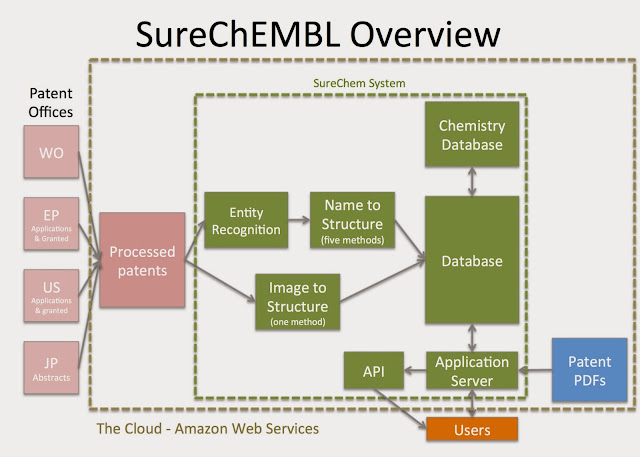
For those of you that are already SureChem users you will be familiar with the functionality and how it works; but for those that weren't SureChEMBL takes feeds of full text patents, identifies chemical objects from either the in-line text or from images and adds 2-D chemical structures. This is then loaded into a database and is searchable by chemical structure, so you can do substructure, similarity searching and so forth - all the good things you'd expect from a chemical database. This chemical search functionality is unavailable from the public, published patent documents, and is really essential for anyone seriously using the patent literature. Oh, and the system does this live, so as patents are published, they are processed and added to the system - the delay between publication and structures being available in SureChEMBL is about a day when converted from text, and a few days when converted from image sources.


SureChEMBL is hosted on the cloud - it's quite a complicated AWS solution, and it will take a few months for us to assume complete control of all the various parts, and, importantly keep things running smoothly behind the scenes, so the continuous access to fresh patent data is maintained.

SureChEMBL uses a number of third part software products in its operation, and arranging the licenses and permissions has been complex, and is still ongoing. The 3rd party software and data feeds used in SureChEMBL include:

Name to structure: ChemAxon, ACD/Labs, Perkin Elmer, OpenEye, OPSIN, NextMove
Chemical cartridge: ChemAxon
Image to structure: Key Module
Patent data: FairView (IFI Claims) – processed patents, TwinDolphin – patent PDFs

These guys have all been a pleasure to work with so far, and SureChEMBL is a great showcase of their respective technologies and data:

We will host the system at the primary urls http://www.ebi.ac.uk/surechembl and also at http://www.surechembl.org - at the moment , these redirect to www.surechem.org, but as we switch things over they will point to servers provisioned by our team, so please start using these new urls for future access, although the original urls will continue to work into the future.

One of the more complicated things to transfer is the user accounts system - we can't simply transfer them over - and so have a plan to mail batches of users once a new sign-on system is in place in order to invite them to sign up to the new user account system. If you are not currently a registered user, please sign up with the current system, and we'll invite you to transfer over to our sign-on system once things are ready.

The EMBL-EBI has a broad range of life-science chemistry resources, and we integrate across chemistry related content using a chemical structure integration system call UniChem. In overview the EMBL-EBI chemistry resources include the following.


The future? - well the future is exciting, and we have lots of ideas to actively develop the SureChEMBL system. To be clear though, doing this will rely on us getting funding, and we're working hard on this. Some of the ideas we have for SureChEMBL include:
  • Put SureChEMBL chemical content into UniChem
  • Add sequence searching
  • Add disease term, animal model, etc. indexing
  • Development of community KNIME nodes
  • Add links to/from Europe PMC
  • Ligand Ensemble-based mapping of ChEMBL literature to patents
  • Refactor interface for EMBL look and feel
  • Extend image extraction retrospectively from 2006 using spot priced compute from AWS
  • Provide weekly/monthly feed of patent structures to PubChem
  • Add chemical structure tagging & search to full text content of Europe PMC
But one of the first things we plan to do is index genes and targets (in collaboration with local SME SciBite) and provide an RDF form of the data and REST web services as part of the IMI OpenPHACTS project.

In the new year, we will run a webinar on SureChEMBL (which we will announce here), but in the mean-time we're very happy to take questions on the SureChEMBL support email address surechembl-help (at) ebi.ac.uk.

jpo
10 Nov 23:33

Space science: Zero-gravity hero

by John Gilbey
Xavier.fradera

Cool movie...

Space science: Zero-gravity hero

Nature 502, 7473 (2013). doi:10.1038/502623a

Author: John Gilbey

John Gilbey is gripped by the memoir of Chris Hadfield, a former International Space Station commander.