Shared posts

29 Jan 20:14

Diet rapidly and reproducibly alters the human gut microbiome

by Lawrence A. David
TimB

For Yohan! "Here we show that the short-term consumption of diets composed entirely of animal or plant products alters microbial community structure and overwhelms inter-individual differences in microbial gene expression." Magical.

Diet rapidly and reproducibly alters the human gut microbiome

Nature 505, 7484 (2014). doi:10.1038/nature12820

Authors: Lawrence A. David, Corinne F. Maurice, Rachel N. Carmody, David B. Gootenberg, Julie E. Button, Benjamin E. Wolfe, Alisha V. Ling, A. Sloan Devlin, Yug Varma, Michael A. Fischbach, Sudha B. Biddinger, Rachel J. Dutton & Peter J. Turnbaugh

Long-term dietary intake influences the structure and activity of the trillions of microorganisms residing in the human gut, but it remains unclear how rapidly and reproducibly the human gut microbiome responds to short-term macronutrient change. Here we show that the short-term consumption of diets composed entirely of animal or plant products alters microbial community structure and overwhelms inter-individual differences in microbial gene expression. The animal-based diet increased the abundance of bile-tolerant microorganisms (Alistipes, Bilophila and Bacteroides) and decreased the levels of Firmicutes that metabolize dietary plant polysaccharides (Roseburia, Eubacterium rectale and Ruminococcus bromii). Microbial activity mirrored differences between herbivorous and carnivorous mammals, reflecting trade-offs between carbohydrate and protein fermentation. Foodborne microbes from both diets transiently colonized the gut, including bacteria, fungi and even viruses. Finally, increases in the abundance and activity of Bilophila wadsworthia on the animal-based diet support a link between dietary fat, bile acids and the outgrowth of microorganisms capable of triggering inflammatory bowel disease. In concert, these results demonstrate that the gut microbiome can rapidly respond to altered diet, potentially facilitating the diversity of human dietary lifestyles.

29 Jan 05:22

Revisiting the role of persistent neural activity during working memory

TimB

Haven't read the article, just noting that the first author is "Kartik K. Sreenivasan". Nice try, Karthik, you're not fooling anyone :D

Kartik K. Sreenivasan, Clayton E. Curtis, Mark D’Esposito.
• Recent work suggests that the standard neural model of WM is in need of revision.
• Multivariate analyses find that sensory cortex stores WM information.
• lPFC....
28 Jan 21:48

Thomas L. Neff’s Idea Turned Russian Warheads Into American Electricity

by By WILLIAM J. BROAD
TimB

I had never heard of this, really interesting...

In all, over two decades, the program known as Megatons to Megawatts turned 20,000 Russian warheads into electricity that has illuminated one in 10 American light bulbs.
    
18 Jan 04:48

Needed: Three Obama Speeches for the People

by editor
TimB

Preach it, Ralph!

"...the people need the views and vision of their President... on the resources and preconditions necessary for the government to wage peace as a continual policy of statecraft and not just sporadic initiatives between waging war or engaging in other violent conflicts... We have military academies but no peace academies. Vast sums are allocated for research and teaching about war and military tactics, but very little for peace studies at our schools and universities..."

Dear President Obama: All the daily decisions and crises you have to confront must not preclude occasional addresses to the country that rise to the level of statesmanship, transcending the hurly-burly of politics and executive branch administration. There are three … Continue reading →

The post Needed: Three Obama Speeches for the People appeared first on The Nader Page.

17 Jan 19:44

01/15/14 PHD comic: 'Running Behind'

TimB

An eternal truth

Piled Higher & Deeper by Jorge Cham
www.phdcomics.com
Click on the title below to read the comic
title: "Running Behind" - originally published 1/15/2014

For the latest news in PHD Comics, CLICK HERE!

12 Dec 17:12

Unraveling Animals by Jaume Montserrat

by Johnny Strategy

Unraveling Animals by Jaume Montserrat illustration animals

Unraveling Animals by Jaume Montserrat illustration animals

Unraveling Animals by Jaume Montserrat illustration animals

Unraveling Animals by Jaume Montserrat illustration animals

Unraveling Animals by Jaume Montserrat illustration animals

Unraveling Animals by Jaume Montserrat illustration animals

Unraveling Animals by Jaume Montserrat illustration animals

Unraveling Animals by Jaume Montserrat illustration animals

I tend to have weird dreams too when sleeping on a plane, but nothing comes close to those of Jaume Montserrat. While on a flight home the Barcelona based illustrator dreamt he was on a Noah’s Ark-like island and “there was only one animal from each specimen. All of them were empty, asexual and immortal. They didn’t need to hunt, nor were they scared of being hunted – so there was a perfect symbiosis.” And thus came the inspiration for his series “Emptyland,” a surreal representation of unraveling animals often depicted as being intertwined with each other. At first glance the drawings are a little creepy, but upon closer observation there’s actually something very peaceful about them. (via ghost in the machine and iGNANT)

04 Dec 16:39

A neolithic skier - updated

by Minnesotastan
TimB

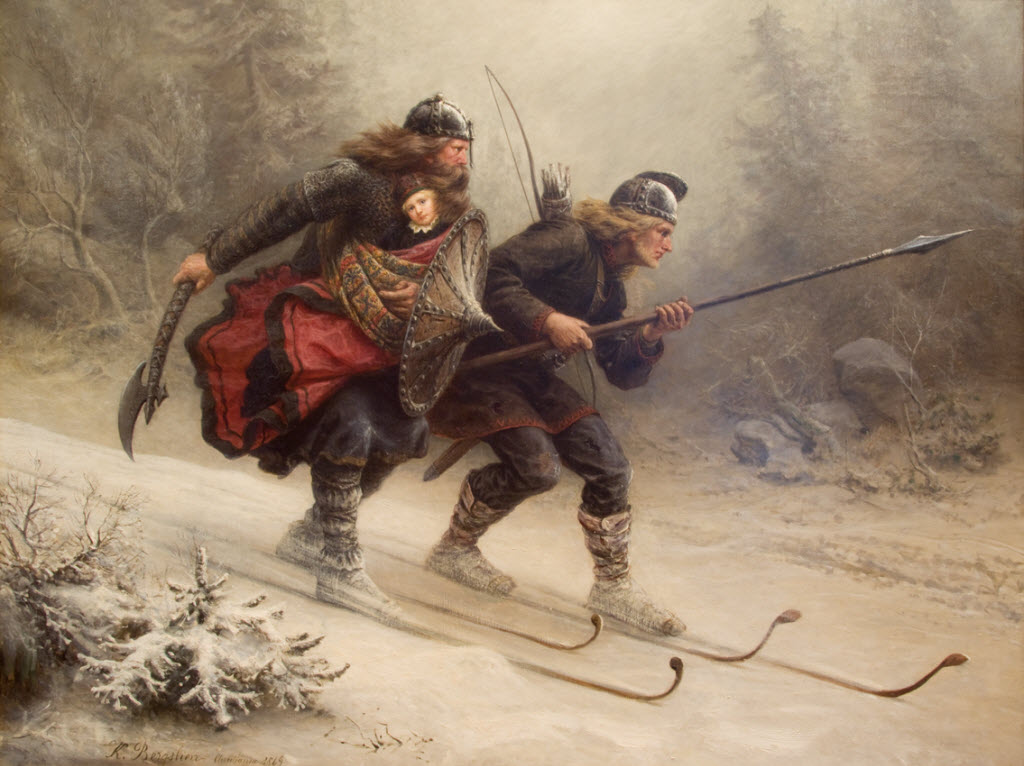
Shared mainly for the painting, which could just as easily been made ironically this year: "Birkebeinerne takes Håkon Håkonsson as a child to Trondheim by Knud Bergslien". AMAZING


Many years ago I visited the famous Holmenkollen ski jump in Norway.  Recently, while reading about the Nordic ski championships held there in 1966, I saw the embedded photo of a set of stamps issued in Norway to commemorate the event.

My eye was caught by the stamp at the upper left.  The 55 and the 60 show modern jumpers and X-country skiers, and the 90 shows a stylized Holmenkollen.  The 40 looked to me like a cave drawing (or other geoglyph).

So I started to research the antiquity of skiing.  Medium aevum (via Uncertain Times) had this to say -
The primitive ski dated back to 1010, and is thought to be Greenland’s oldest ski brought by Norsemen circa 980 A.D...

The oldest account involves the famous story from 1206 A.D. of the Birkebeiners during a civil war in medieval Norway. Considered the underdog, the Birkebeiners were at war against a rival faction known as the baglers. Following the death of the Birkebeiner chief, the baglers feared a rival in his young son Håkon Håkonsson. To protect him, two of the most skillful Birkebeiner skiers, with toddler in tow, skied through treacherous conditions over the mountains from around Lillehammer to safety in Østerdalen valley.
- accompanied by this way cool painting:


- entitled Birkebeinerne takes Haakon Haakonson as a child to Trondheim by Knud Bergslien, apparently from the Nordnorsk Kunstmuseum (northern Norway art museum).

But more relevant to the image on the Norwegian stamp I found the following:
The oldest and most accurately documented evidence of skiing origins is found in modern day Norway and Sweden. The earliest primitive carvings circa 5000 B.C. depict a skier with one pole, located in Rødøy in the Nordland region of Norway.
That's what's on the stamp, according to a Facit catalogue.  Now to try to wrap my mind around the idea of someone skiing in 5000 BC (predynastic Egypt, maize introduced to Mexico, wheel invented in Mesopotamia, beer brewing invented...), and then noting the accomplishment by carving it on a stone.

You learn something every day.

Addendum:
I posted the above back in January of 2012.  This week I encountered an interesting article and video at National Geographic on the origins of skiing:
The hunting party slowly glides into the Altay Mountains in search of elk. It is dead calm, minus 38°F. Just as their ancestors have for millennia, the five men traverse deep, feathery snow buoyed on handmade skis hewed from spruce, with strips of horsehide attached to the bottoms. In lieu of poles each man carries a single wooden staff. Since boyhood, they have learned to master their deceptively crude equipment with exquisite efficiency and grace—the grain of the horsehair providing traction to move uphill and a slick surface for rapid descents, the staff aiding balance...

The hunters come from seminomadic Tuvan-speaking clans who inhabited pockets of the Altay. Technically, they are Chinese citizens, but their log cabins stand within 20 miles of the converging borders of Russia, Kazakhstan, and Mongolia, and the roots of their language lie to the north in Siberia, where the majority of Tuvans now live. Anthropologists say their lineage includes Turkic and Samoyed tribes who at various periods over the past several thousand years moved through these mountains...

Serik describes a hunt when Tursen skied down on a bounding deer, leaped on its back, grabbed its antlers, and wrestled it down into the snow, the animal kicking and biting. It is a scene that has been repeated for thousands of years in these mountains. Within the Altay, a handful of petroglyphs have been discovered depicting archaic skiing scenes, including one of a human figure on skis chasing an ibex. Since petroglyphs are notoriously hard to date, it remains a controversial clue in the debate over where skiing was born. Chinese archaeologists contend it was carved 5,000 years ago. Others say it is probably only 3,000 years old. The oldest written record that alludes to skiing, a Chinese text, also points to the Altay but dates to the Western Han dynasty, which began in 206 B.C.

Norwegian archaeologists also have found ski petroglyphs, and in Russia, what appears to be a ski tip, carbon-dated to 8,000 years ago, was excavated from a peat bog. Each nation stakes its own claim to the first skiers. What is widely accepted, however, is that whoever first strapped on a pair of skis likely did so to hunt animals.
I'm fascinated by the fact that the grain of horsehair allows traction for skiing uphill, and by the observation above that "the earliest primitive carvings circa 5000 B.C. depict a skier with one pole" - as does this video (via The Dish):

03 Dec 16:15

South African Resort Offers High-End Tourists Chance To Live In Make Believe Shanty Town

by jonathanturley
TimB

whut. why. WHYYEEEEEEE

240px-Soweto_townshipI saw this on Reddit and found it truly breathtaking. A high-priced resort has created a make believe Shanty town so that the upper class can experience the feeling of utter poverty. It is reminiscent of the failed effort of Disney to create an an attraction where people could “feel like slaves” by picking cotton under the eye of white bosses. After a long and intense fight, Disney abandoned the plan. The Shanty Town vacation is available at Emoya Private Game Reserve, Luxury Hotel, Conference Centre and Spa. For the record, the picture at the left is a real Shanty Town.

The resort proclaims the fun of living in a Shanty Town with such luxury elements as wi-fi and heated floors:

Millions of people are living in informal settlements across South Africa. These settlements consist of thousands of houses also referred to as Shacks, Shantys or Makhukhus. A Shanty usually consists of old corrugated iron sheets or any other waterproof material which is constructed in such a way to form a small “house” or shelter where they make a normal living. A paraffin lamp, candles, a battery operated radio, an outside toilet (also referred to as a long drop) and a drum where they make fire for cooking is normally part of this lifestyle.

Now you can experience staying in a Shanty within the safe environment of a private game reserve. This is the only Shanty Town in the world equipped with under-floor heating and wireless internet access!

The Shanty Town is ideal for team building, braais, fancy theme parties and an experience of a lifetime. Accommodates up to 52 guests. Our Shantys are completely safe and child friendly.

It is not clear if the experience will include the fact that one in nine people in South Africa are infected with HIV or that roughly 30% is unemployed or that more than three million children (nearly 4%) are orphans. It should also reflect an average annual salary for black South Africans that is $7,500 — probably a bit less than needed for heated floors.


01 Dec 19:05

Limm Digital Art

by César Couto
TimB

ODE art! I can dig it.

Here is the amazing work of German collective Deskriptiv which was summarized like this “trailing points from sample positions inside a volumetric vector field.”

Limm Digital Art15 550x374 Limm Digital Art
Limm Digital Art14 550x369 Limm Digital Art
Limm Digital Art13 550x494 Limm Digital Art
Limm Digital Art12 550x499 Limm Digital Art
Limm Digital Art11 550x490 Limm Digital Art
Limm Digital Art10 550x550 Limm Digital Art
Limm Digital Art3 550x550 Limm Digital Art

20 Nov 01:51

Polish Concert Pianist Builds a ‘Viola Organista’ Based on a 500-Year-Old Leonardo Da Vinci Sketch

by Christopher Jobson

Polish Concert Pianist Builds a Viola Organista Based on a 500 Year Old Leonardo Da Vinci Sketch Leonardo Da Vinci instruments history
Viola Organista built by Slawomir Zubrzycki

Polish Concert Pianist Builds a Viola Organista Based on a 500 Year Old Leonardo Da Vinci Sketch Leonardo Da Vinci instruments history
Codex Atlanticus by Leonardo Da Vinci, (page 93r)

Buried in the pages of Leonardo Da Vinci’s famous 15th century notebooks, amongst the sketches of flying machines, parachutes, diving suits, and armored tanks, was a curious idea for a musical instrument that merged the harpsichord and cello. The Italian Renaissance polymath referred to it as the viola organista. The general idea for the instrument was to correlate keyboard fingerwork with the sustained sound of a stringed instrument, but among the dozens of ideas pursued by the gifted artist and inventor, this was one he never explored further. Nearly 100 years would pass before an organist in Nuremberg would build the first functional bowed keyboard instrument, and many others would try throughout history to realize Da Vinci’s vision with various levels of success.

Now, after an estimated 5,000 hours of work over three years and nearly $10,000 invested in the project, Polish concert pianist Slawomir Zubrzycki has unveiled his own version of the viola organista. Not only is the new instrument gorgeous, it’s fully functional and Zubrzycki demonstrated it in public for the first time at the 5th International Royal Krakow Piano Festival a few weeks ago. Above is a video of that performance where you can hear how beautiful the strange instrument sounds. Via the Hindustan Times:

The flat bed of its interior is lined with golden spruce. Sixty-one gleaming steel strings run across it, similar to the inside of a baby grand. Each one is connected to the keyboard complete with smaller black keys for sharp and flat notes. But unlike a piano, it has no hammered dulcimers.Instead, there are four spinning wheels wrapped in horse tail hair, like violin bows. To turn them, Zubrzycki pumps a peddle below the keyboard connected to a crankshaft.

As he tinkles the keys, they press the strings down onto the wheels emitting rich, sonorous tones reminiscent of a cello, an organ and even an accordion. The effect is a sound that da Vinci dreamt of, but never heard; there are no historical records suggesting he or anyone else of his time built the instrument he designed.

Here’s an additional interview with Zubrzycki, where you can see the instrument up close (click the “CC” icon for English captions):

You can learn more about Zubrzycki and the history of the viola organista over at the History Blog.

27 Jul 16:17

Secret Information Is More Trusted

by schneier

This is an interesting, if slightly disturbing, result:

In one experiment, we had subjects read two government policy papers from 1995, one from the State Department and the other from the National Security Council, concerning United States intervention to stop the sale of fighter jets between foreign countries.

The documents, both of which were real papers released through the Freedom of Information Act, argued different sides of the issue. Depending on random assignment, one was described as having been previously classified, the other as being always public. Most people in the study thought that whichever document had been "classified" contained more accurate and well-reasoned information than the public document.

In another experiment, people read a real government memo from 1978 written by members of the National Security Council about the sale of fighter jets to Taiwan; we then explained that the council used the information to make decisions. Again, depending on random assignment, some people were told that the document had been secret and for exclusive use by the council, and that it had been recently declassified under the Freedom of Information Act. Others were told that the document had always been public.

As we expected, people who thought the information was secret deemed it more useful, important and accurate than did those who thought it was public. And people judged the National Security Council's actions based on the information as more prudent and wise when they believed the document had been secret.

[...]

Our study helps explain the public's support for government intelligence gathering. A recent poll by the Pew Research Center for the People and the Press reported that a majority of Americans thought it was acceptable for the N.S.A. to track Americans' phone activity to investigate terrorism. Some frustrated commentators have concluded that Americans have much less respect for their own privacy than they should.

But our research suggests another conclusion: the secret nature of the program itself may lead the public to assume that the information it gathers is valuable, without even examining what that information is or how it might be used.

Original paper abstract; the full paper is behind a paywall.

19 Mar 22:33

Front Page News: Grad School or Meth?

by salmonseason@somethingawful.com (Ian "Salmon Season" Golding)
TimB

Framed around liberal arts PhD's, but it still seems applicable

Two popular paths for the recent college graduate, but which one is right for you?
14 Mar 14:34

Dawn of consciousness

by thuudung
TimB

Testing! Now that gReader is officially retiring :( I'm back here for more.

Julian Jaynes, Princeton psychologist, took a dim view of his field – “bad poetry disguised as science.” He had his own theory of how mankind learned to think… more»