Somewhere in Virginia on the outskirts of private farmland sits the completely bizarre sight of nearly 40 giant U.S. president busts crumbling amongst the weeds. The mammoth heads—each estimated to weigh in excess of 7,000 pounds—were originally commissioned from a Houston artist as the centerpiece for Presidents Park, a ten-acre open-air museum with presidential sculptures and informational plaques located in Williamsburg, Virginia. First opened in 2004, the museum closed just 6 years later due to lack of attendance and most of the heads were eventually moved to a private farm where they sit today.
Photographer Patrick Joust recently made a trek to the presidential graveyard and shot these amazing photos of the eroding statues. The pieces are already faded and peeling from the elements and display a number of structural scars from repeated moves. The post-apocalyptic scene is reminiscent of the final moments of Planet of the Apes, or a modern take on the giant mysterious heads sprawled across Easter Island. A few of the presidential busts have been a bit more lucky: Abraham Lincoln’s bust now rests in front of the the Lincoln RV Park in Williston, North Dakota, and Theodore Roosevelt’s bust sits outside the Roosevelt Inn in Watford.
The morning of May 4, 2011, Jameelah El-Shabazz watched out the window of her Bronx apartment as a team of police officers fanned across the rooftop of Banana Kelly High School. The 43-year-old mother of five said she didn’t think much of the scene — drug raids were common in her neighborhood.
As she did most mornings, El-Shabazz said she went to her bedroom to feed her newborn son and to worship before a shrine of candles and carvings arranged atop her wardrobe. Her most treasured object was a wooden tray her father had brought her from Nigeria. A deity of the Ifa religion, which she practices as a high priestess, was carved on its surface and covered in a residue of finely crushed eggshells. El-Shabazz used the substance, known in her faith as efun powder, to cleanse the shrine. She took fresh clumps of the powder from a cup and began to break it up in her hands.
That’s when the narcotics officers kicked in the door.
Her baby shrieked as the gun-wielding officers tore apart rooms looking for PCP, which an anonymous informant had claimed was being sold from the apartment. They ordered everyone to lie on the ground, then turned to her eldest son, Akin Shakoor, who along with another son was having frequent run-ins with police. El-Shabazz said the officers told Shakoor if he didn’t give up the drugs, “they would take all of my children away from me and make sure that I was put out of my apartment.”
An altar in Jameelah El-Shabazz’s apartment in the Bronx. El-Shabazz had to repeatedly fight to keep her apartment after police mistook crushed eggshells for cocaine. (Edwin Torres for ProPublica)
As evidence, police seized 45 paper cups of the eggshell powder, the sacred wooden tray, and a small amount of marijuana. They arrested El-Shabazz, her teenaged sister Najah El-Shabazz, and Shakoor, then 21, and took them outside past the handcuffed residents of four other apartments that were raided that morning.
Najah was released, court filings say, but Jameelah El-Shabazz and Shakoor sat in cells on Rikers Island for the next week awaiting the results of police lab tests. Finally, the results confirmed what she had told the officers all along: the wooden tray and the 45 paper cups of powder were drug-free. Jameelah El-Shabazz and Shakoor were released from Rikers and fully exonerated.
But El-Shabazz’s battle with New York’s legal system was only beginning. That September, another of her sons called to say the police were back, this time with a lawyer and a court order to seal the Bronx apartment. Her entire family had to leave — immediately.
El-Shabazz was facing a nuisance abatement action, a little-known type of lawsuit that gives the city the power to shut down places it claims are being used for illegal purposes. The case against her was based on the same drug allegations that had been dismissed in May. Incredibly, the filing, signed by a New York Police Department attorney, stated: “recovered during the execution of the search warrant were forty-five (45) paper cups of cocaine.”
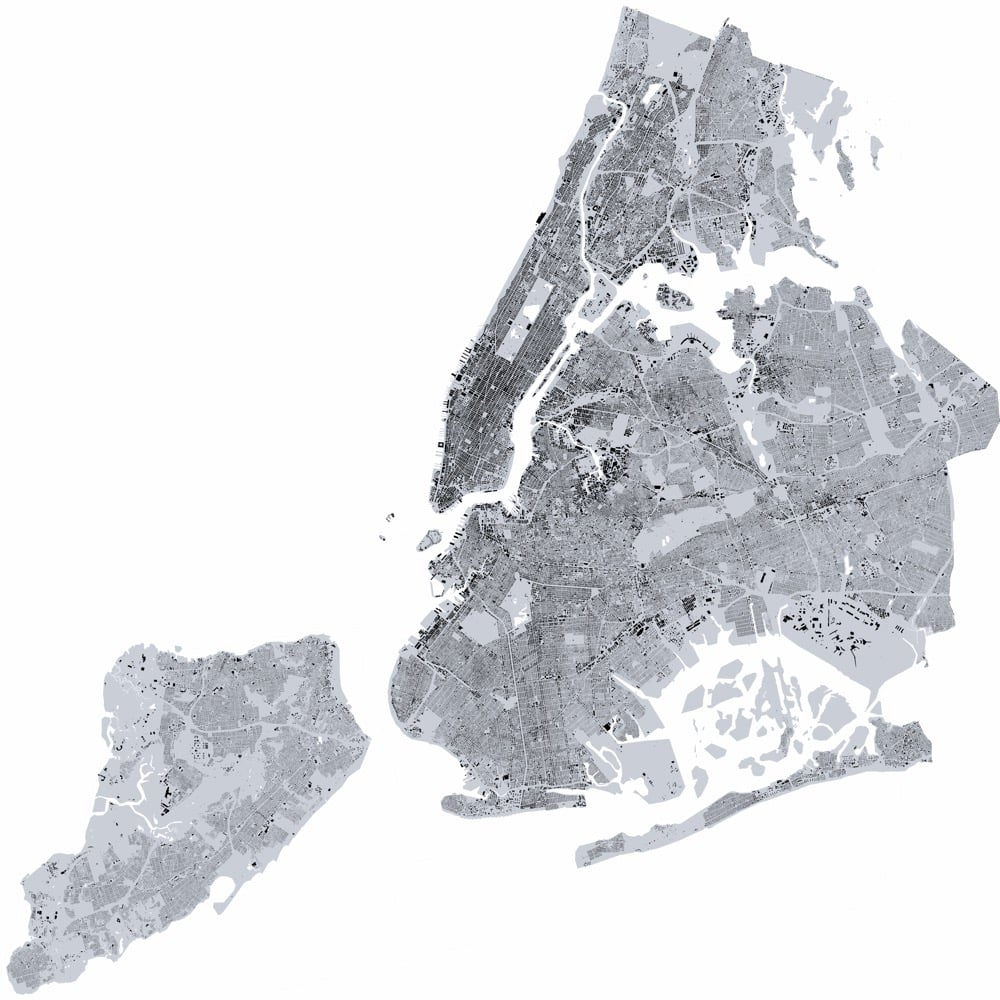
The nuisance abatement law was created in the 1970’s to combat the sex industry in Times Square. Since then, its use has been vastly expanded, commonly targeting apartments and mom-and-pop bodegas even as the city’s crime rate has reached historic lows. The NYPD files upward of 1,000 such cases a year, nearly half of them against residences.
Barred From Home
Read about the 297 people who gave up their leases or were barred from homes as a result of nuisance abatement actions.
The process has remarkably few protections for people facing the loss of their homes.
Three-quarters of the cases begin with secret court orders that lock residents out until the case is resolved. The police need a judge’s signoff, but residents aren’t notified and thus have no chance to tell their side of the story until they’ve already been locked out for days. And because these are civil actions, residents also have no right to an attorney.
Perhaps most fundamentally, residents can be permanently barred from their homes without being convicted or even charged with a crime.
A man was prohibited from living in his family home and separated from his young daughter over gambling allegations that were dismissed in criminal court. A diabetic man said he was forced to sleep on subways and stoops for a month after being served with a nuisance abatement action over low-level drug charges that also never led to a conviction. Meanwhile, his elderly mother was left with no one to care for her.
In partnership with ProPublica, the Daily News reviewed 516 residential nuisance abatement actions filed in the Supreme Courts from Jan. 1, 2013 through June 30, 2014. Our analysis also reviewed the outcomes of the underlying criminal cases against hundreds of people who were banned from homes as a result of these actions.
173 of the people who gave up their leases or were banned from homes were not convicted of a crime, including 44 people who appear to have faced no criminal prosecution whatsoever.
Overall, tenants and homeowners lost or had already left homes in three-quarters of the 337 cases for which the Daily News and ProPublica were able to determine the outcome. The other cases were either withdrawn without explanation, were missing settlements, or are still active.
In at least 74 cases, residents agreed to warrantless searches of their homes, sometimes in perpetuity, as one of the conditions of being allowed back in. Others agreed to automatically forfeit their leases if they were merely accused of wrongdoing in the future.
The toll of nuisance abatement actions falls almost exclusively on minorities, our analysis showed. Over 18 months, nine of 10 homes subjected to such actions were in minority communities. We identified the race of 215 of the 297 people who were barred from homes in nuisance abatement battles. Only five are white.
Runa Rajagopal of the Bronx Defenders, who leads a division that represents people in the civil courts, called the practice a “collective punishment” on the entire family of those accused of a crime, “used by the NYPD to exert power and control largely over communities of color.”
The NYPD declined to answer any questions about specific cases.
Officials emphasized that because these are civil cases, they’re handled separately from criminal cases and thus have lower standards of proof.
“The law does not require criminal conviction, does not require [a] particular disposition of a criminal case, does not even require an arrest of anyone,” said Lawrence Byrne, the NYPD’s Deputy Commissioner of Legal Matters in an interview with the Daily News last year.
Assistant Commissioner Robert Messner, who heads the NYPD’s Civil Enforcement Unit, concurred, saying, “You have to remember, it’s an action about a place. It’s not about people.”
The department’s chief spokesman, Stephen Davis, said in a statement that the suits are intended to prevent crimes from reoccurring at ‘repeat offender’ locations. “Each nuisance abatement order and settlement is signed-off by a judge.” Davis added.
Though a nuisance abatement threatened to force El-Shabazz out of her home, she doesn’t appear to have been the intended target. Two of El-Shabazz’s sons were already known to police when her apartment was raided in 2011.
Akin Shakoor had been arrested at the building at least twice before, in 2009, for misdemeanor possession of drugs. He pleaded both cases down to non-criminal violations. Her other son, Jehadh Shakoor, was arrested in the neighborhood with marijuana in 2008, and with PCP in 2009, and convicted of misdemeanor possession charges. (El-Shabazz said the officers also often harassed a third son, who was an honor student in high school and is now in college.)
The narcotics officer behind nuisance abatement cases against El-Shabazz and others, Detective Peter Valentin, has his own history. The Daily News earlier identified him as the most-sued officer on the NYPD’s 35,000-member force. Valentin was put on desk duty in 2014 for allegedly fabricating buys from confidential informants.
The NYPD has embraced nuisance abatement actions as part of its controversial “Broken Windows” strategy of aggressively pursuing low-level offenders to prevent more serious ones.
Judges Frequently Approve Lockouts
The Daily News and ProPublica found that, overall, judges approved the NYPD's request to temporarily lock out businesses and residents in 70 percent of cases.
Borough
Judge
Approved TCO
Bronx
Kenneth L. Thompson Jr.
100%
Sharon A.M. Aarons
100%
Mark Friedlander
100%
Wilma Guzman
100%
Norma Ruiz
100%
Julia I. Rodriguez
96%
Alison Y. Tuitt
94%
Howard H. Sherman
88%
Edgar G. Walker
12%
Lucindo Suarez
4%
Brooklyn
Johnny Lee Baynes
100%
Carl J. Landicino
76%
Sylvia G. Ash
8%
Dawn Jimenez-Salta
5%
Manhattan
Milton A. Tingling
100%
Joan M. Kenney
70%
Carol E. Huff
41%
Cynthia S. Kern
6%
Michael D. Stallman
4%
Queens
Orin R. Kitzes
100%
Source: Daily News/ ProPublica analysis of nuisance abatement cases filed Jan. 1, 2013 — June 30, 2014.
This decades-old approach — which has introduced large numbers of black and Hispanic New Yorkers to the criminal justice system through stop-and-frisks, summonses and misdemeanor arrests — has touched off waves of protests in recent years.
Though little heard of, nuisance abatement actions have long been a key component of the strategy. William Bratton, fresh into his first tenure as the city’s top law enforcement official, hailed such actions in a 1995 white paper on quality-of-life policing as “probably the most powerful civil tool available to the police,” allowing officers to “sweep down on a location and close it without warning.”
Since Bratton wrote those words, the number of nuisance abatement actions filed each year has quintupled.
Bratton was hired back as police commissioner in 2014. While he has significantly reformed other aspects of quality-of-life policing, the department does not appear to have adjusted its policies when it comes to nuisance abatement actions.
Sidney Baumgarten, the former city official who commissioned the drafting of the nuisance abatement law in the 1970s, said it is now being abused. He is alarmed by the sheer volume of cases, especially those aimed at households in which no one has been convicted of a crime.
“I think it’s wrong. I think it’s unconstitutional. I think it’s over-reaching,” he said. “They’re giving up their constitutional rights. And why? Because they’re afraid they’re going to be evicted from their home, with their children. There’s a certain amount of compulsion, and threat and coercion, by the very nature of the process they’re using.”
In most other cities, officials can’t initiate a nuisance abatement action unless they’ve given landlords the opportunity to solve problems first. Authorities can only restrict access to a home after a court process that involves all parties.
But in New York, the NYPD begins nearly every nuisance abatement action by making an emergency appeal to a civil court judge without the landlord or tenant present, alleging the dangers a residence poses. Affidavits detailing three instances of a particular crime, such as drug dealing or gambling, in a one-year period are enough for a judge to authorize an action.
The allegations can be based entirely on the work of confidential informants or undercover officers and need not have led to arrests. The Daily News and ProPublica identified 17 nuisance abatement actions against residences and 64 against businesses in which no arrests were documented.
When they file a case, the police always ask the judge for permission to lock out the occupants of the residence until the case is resolved. These requests for what’s known as “temporary closing orders” state that the location is being used in an “ongoing illegal manner,” and that the “public health, safety and welfare require immediate abatement of the public nuisance.”
The Ever-Expanding Nuisance Abatement Law
1977: New York City enacts the nuisance abatement law as a tool to combat sex-related businesses in Times Square.
1978-1983: The mayor’s office uses the law to close down more than 100 businesses.
1982: The law is amended to allow the city to target one- and two-family homes.
1983: Critics felt the law was being too narrowly focused, so its preamble is rewritten to make it clear it could be used against a wide range of illegal establishments, not merely sex-related ones. City documents show it was understood the law required convictions– not merely arrests or accusations— to bring cases.
1984-1988: Despite broadening the law, the city uses it against non-sex-related businesses only 13 times.
1989: A judge rules a conviction is not necessary to count toward the required number of “violations” needed to bring a action.
1991: NYPD creates a unit in one Bronx precinct that can file its own nuisance abatement cases and other civil actions. It’s meant to help high-crime neighborhoods. The effort expands to nine more precincts over the next three years.
1993: Law is amended to decrease the number of violations needed for cases over certain offenses, such as drugs and gambling, from five to three.
1994: The NYPD gets the authority to file its own nuisance abatement cases throughout the entire city. That year, during his first tenure as police commissioner, Bill Bratton doubles the size of the unit dedicated to civil cases. They file 214 nuisance abatement actions.
1995: Bratton calls nuisance abatement “the most powerful civil tool available” in Broken Windows policing.
2006: The law is again expanded to include illegal social clubs, counterfeit goods operations and unlicensed security guards.
2007: The law is expanded once more to add places that make, sell or store fake IDs.
2008-2013: The number of nuisance abatement cases filed by the NYPD grows from 900 in 2008 to 1,082 in 2013. The top alleged offense becomes Alcohol Beverage Control violations, followed by drug and marijuana violations. Prostitution accounts for only 28 cases, despite the fact that sex-related businesses were the original target of the law.
2015: The most recent expansion: Selling synthetic marijuana, or K2, is added to the list of offenses.
Sources: New York Police Department, Municipal Archives; “Security: Policing Your Homeland, Your State, Your City,” by Howard Safir with Ellis Whitman; “NYPD Battles Crime: Innovative Strategies in Policing,” by Eli B. Silverman
However, the NYPD’s court filings routinely do not describe the alleged “ongoing” illegal activity that would justify immediately throwing people out of their homes. Instead, the Daily News and ProPublica analysis found, police filings describe purported offenses that occurred, on average, at least five months earlier for businesses and six months earlier for residences.
Judge Fern Fisher, the deputy chief administrative judge for the city’s courts, expressed concern. “If it’s six months old, then it’s not all that much of an emergency that you can’t wait three or four days for the (other) party to come in and tell their side of the story,” she said.
Prompted by the Daily News and ProPublica’s findings, Fisher issued an advisory notice to judges on Feb. 1 that recommended limiting the granting of temporary closing orders of homes before the tenant or homeowner has come to court. The notice also cautioned against granting such orders when the evidence of alleged illegal activity is old, or based on “statements with multiple layers of hearsay” and the word of confidential informants.
The Daily News and ProPublica found temporary closing orders were granted in 75 percent of the residential cases examined. Some judges granted the requests nearly every time. Queens Judge Orin Kitzes signed them in 235 out of 236 cases that came before him. Others, such as Manhattan Judge Michael Stallman, routinely crossed out that portion of applications. Stallman said he does this because the NYPD’s attorneys never have any evidence of ongoing illegal activity or information about the outcomes of the underlying criminal cases.
“I can’t remember the last time that I’ve ever had information about the disposition of a criminal case,” he said. “I’ve repeatedly indicated that it’s difficult for me to evaluate a civil case where I don’t even know whether the criminal case is pending.”
NYPD’s Messner said his lawyers “talk to” the precinct officers to confirm the location still poses a problem, but don’t include this information in court filings for the sake of efficiency.
“The judges don’t want to read tomes,” he said. “We could do 100 cases a year instead of 800 cases a year, with, you know, tremendous levels of detail. But we wouldn’t end up with a better product. We’d just end up helping a lot less people.”
The NYPD’s Byrne said when officers serve temporary closing orders, they can use their discretion to determine if certain family members can stay.
By law, people affected by temporary closing orders have a right to a court appearance within three business days. But they could wait as long as five days if their court date would otherwise fall on a weekend. At the courthouse, the NYPD’s attorney usually offers to settle the case without going to trial — often by requiring tenants to bar specific people from their homes or to give up their leases. Then the closing order is lifted.
But if tenants decide to fight the case, they may not be allowed to go home until the case is resolved. Though cases rarely go to trial, settlement negotiations can take weeks.
Luis Rivera, 58, was shut out of his apartment in the Bronx for nearly a month in 2013 while he fought his case. It alleged the requisite three violations: Five months earlier, police said a confidential informant had bought heroin at the apartment on two occasions. Shortly thereafter, during a raid on the apartment, police said they found seven small paper envelopes of white powder, a marijuana cigarette and two gravity knives. They arrested Rivera, along with two other men who were staying with him.
Rivera was described by people who knew him as having significant mental and physical impairments. One woman, who asked not to be named, said she let Rivera sleep on a chair in her studio apartment after the nuisance abatement action left him homeless. She said the officers should have known he was too sick for the streets.
“He was not doing good at all,” she said. “He had cancer; he was on the transplant list. You could tell he was very sick. There were times when he didn’t remember what was what. He would shit on himself and everything.”
In court filings, Rivera said he did not understand what was happening when the police arrested him a second time as they served him with the nuisance abatement action. When he was released, he simply went home, then was arrested a third time for violating a temporary closing order.
“My understanding was that I could go back to my apartment because I was given my keys. I was handed some papers but I am not able to read or understand them on my own,” he said in an affidavit filed through his attorney, Rajagopal. “I am still very confused as to how or why the police were able to evict me from my home without a hearing or trial.”
The criminal charges against Rivera and the other two men were eventually dismissed, and Rivera was allowed back in his apartment after signing a settlement with strict terms limiting who could visit.
He died last September.
Maritza Rivera holds a photograph of her brother, Luis Rivera, who was shut out of his apartment for nearly a month while he was gravely ill. She says Luis Rivera died in September of cancer of the esophagus and cirrhosis of the liver. (Edwin Torres for ProPublica)
The nuisance abatement law arose from New York’s downward spiral during the 1970s. At the time, Sidney Baumgarten, a top aide to Mayor Abe Beame, was leading a campaign to rid Times Square of streetwalkers, pimps and peep shows. Conventional law enforcement tactics had been as effective as a game of whack-a-mole. Arrest a petty lawbreaker; watch another one pop up.
Baumgarten, who gamely sported a big white button that read “Vice President in Charge of Vice,” searched for more creative solutions. Using the city’s zoning and public health laws, he unleashed code inspectors on seedy establishments. After enough violations and arrests, he would file suit in civil court to shut down the businesses for a year.
But the process was cumbersome. The city prevailed only after giving notice to tenants and winning protracted court battles. With advanced warning, proprietors of brothels had enough time to move to new locations. Even the fleabag Belmore Hotel, where a teen prostitute was strangled to death with her gold chain necklace in 1975, continued business as usual for a year until the city won its case.
Baumgarten commissioned the drafting of the nuisance abatement law in the summer of 1976 to address these shortcomings. The law defined 12 categories of violations — including prostitution, illegal gambling and drug sales — that could trigger enforcement actions. Most notably, the city could surprise businesses with temporary closing orders secured in secret court hearings. During the closure, police could go room-to-room inventorying people and paraphernalia.
After the law was enacted in 1977, the city put it to swift use. Within five years, the mayor’s office shuttered 100 sex businesses in Midtown, reducing the number by nearly half, according to city archives. But some officials felt the law was being used too narrowly, focusing on only one problem in one area at a time when many neighborhoods were engulfed in crime.
In 1991, during Raymond Kelly’s first tenure as police commissioner, the city allowed the NYPD to initiate nuisance abatement actions with its own lawyers. The move was part of the police department’s Civil Enforcement Initiative pilot project, led by Messner, which focused on a few precincts outside the city center. The initiative was widely credited with bringing down crime and was soon expanded citywide.
In the early 1980s, documents show city officials believed they needed criminal convictions – not merely accusations or arrests — before initiating nuisance abatement actions. But by the time the NYPD started bringing its own cases, the courts had interpreted the statute’s wording to mean that wasn’t necessary.
The NYPD has since dramatically expanded the law’s reach, wielding it against drug dealers, underground gambling dens, illegal chop shops, fencing operations, after-hours clubs, counterfeit handbag hawkers, and bodegas selling alcohol and cigarettes to minors. Last year, the City Council passed legislation that added selling K2, a highly addictive form of synthetic marijuana, to the list of offenses that could lead to nuisance abatement actions.
The number of nuisance abatement cases filed by the NYPD grew from 214 in 1994 to 1,082 in 2013. The department would not disclose the number of cases it filed in 2014 and 2015, but incomplete data obtained via a Freedom of Information request indicates the unit’s caseload has remained steady.
Messner said he was pleased that his staff’s caseload increased even as the department was cut from 65 to 55 people. “I’m an astronomically good manager,” he said. “This is an efficient way to address crime and provide police services.”
Over the 18-month period examined by the Daily News and ProPublica, 44 percent of the cases took aim at residences.
Messner said this reflects a shift in the drug trade since the early 1990s. “In those days, you know, all the drugs were being sold out of storefronts,” he said. “When they moved into apartments, it caused a problem.” Messner said dealers now use their children, parents and grandparents as “human shields.”
Asia Short leaves her friend’s apartment in Bedford-Stuyvesant, Brooklyn. Asia lost her Queens apartment as the result of a nuisance abatement action. (Edwin Torres for ProPublica)
The nuisance abatement law was created to clean up rough neighborhoods and, indeed, some who have lived in buildings with addicts nodded out in stairwells, fights in the hallways, and crews of lookouts stationed by the door, said it has been a blessing.
Marychel Mendez, a young woman who lives in a seven-unit apartment building in Corona, Queens, recalled the stream of unsavory people her neighbor, a 34-year-old woman named Asia Short, allowed into her home.
“It was so scary because sometimes there were people sitting there,” Mendez recalled, gesturing toward a short set of steps that led to their shared landing. “Or sometimes there were drugs right on the floor.”
Mendez said Short’s three children didn’t always make it to school and would cry when a noxious smell, which she described as “like Clorox,” filled the hallway. So Mendez said her mother complained to the landlord and the police. Her mother even let detectives use her peephole to photograph the people who passed through Short’s apartment.
Not long after a raid of Short’s home in 2012 in which the police found five plastic twists of crack, more than 100 pills, Ziploc bags used to package drugs, and bullet cartridges, Short and the crying children were gone. There were no more drugs scattered in the hallway. No more addicts on the steps. Mendez and her family felt safe.
But Short and her family didn’t disappear into thin air. When the police put her out with a bag of clothes and toiletries that night, she said she had to leave her cat behind because she didn’t have a pet carrier, or any idea of where she was going. At the courthouse, she said the NYPD’s attorney, who was standing out in the hallway with her landlord, told her the only way she would be able to get back in her apartment was if she agreed to move out.
“They was like, ‘We’re not going to let you in for the cat. We’re not going to let you in for clothes. We’re going to let you in when you sign this agreement.” So she signed.
The criminal charges against Short were ultimately dismissed. A friend who was arrested at the house with her, Jonathan Donaldson, took responsibility for the drugs and was sentenced to a year and a half in prison. Meanwhile, during the four months between when the nuisance abatement case was filed and when it was settled, Short said her cat died of starvation.
Today, she never seems to stay at any one place for too long. Sometimes she sleeps on a relative’s couch, sometimes on the subway or at a homeless shelter. The chaos of her life makes it difficult to hold down a job.
“Right now, I still have nowhere to stay,” Short said, sitting on the stoop of a tattered brownstone in Bedford-Stuyvesant last August. At her feet sat a crinkled black plastic bag she was using as a purse.
“You hang out until 4 a.m., ride the train until noon, find a house to shower at, and then on to the next place,” she said wearily.
For her, the apartment provided a better life she just couldn’t hang onto. “I was in the shelter for four and a half years, then I get that apartment,” she said. Her time on the streets made her generous with friends who needed a place to sleep or shower. “Jonathan didn’t even live with me,” she added before trailing off.
Short said her three kids are living at a homeless shelter in the Bronx with their father.
The Daily News and ProPublica spoke to five other people who said they spent time living on the streets or in homeless shelters after being subjected to nuisance abatement actions, and many more who were left scrambling to find friends or relatives to take them in.
Juan Vadi, a 53-year-old recovering addict, pleaded guilty to misdemeanor drug possession and was fined $500 after police turned up a Ziploc bag of crack, two pipes and a plate with crack residue, and a marijuana grinder during a search of his parents’ Jamaica, Queens apartment.
Eight months later, police issued a nuisance abatement action detailing the arrest and claiming Vadi was using the apartment to sell crack. He insisted he would never sell drugs from the family home, where multiple generations share four bedrooms, and said he believes an acquaintance who always seemed to get arrested but never did any time fabricated allegations about buying drugs there. Nonetheless, in order to protect his family members from losing their home, Vadi agreed never to sleep there again for the rest of his life.
Now he sleeps in a waist-high cubicle with three other men at a shelter on the Bowery in Manhattan. He said he can’t afford an apartment on his disability payments alone until he can get rental assistance, which could take years. Every day, he said he takes the subway an hour and a half to Queens to spend time with his family and help care for his sick parents.
“If you do a real bad act — major drugs, guns — I can see them doing this. But for a misdemeanor fine? That’s all it was,” he said.
Juan Vadi, 54, is the primary caretaker for his mother and father. After he pled guilty to a misdemeanor for having a small amount of crack, Vadi agreed to never stay at his parents’ home again. (Edwin Torres for ProPublica)
Few landlords would comment on the record about nuisance abatement actions, but some acknowledged they were grateful for the help with removing nightmare tenants in a city that otherwise makes it extremely difficult to do so.
Wavecrest Management owns a building in the Longwood neighborhood of the Bronx where three people were excluded after police said they were using an apartment to sell marijuana. “It helps us keep the building safe for everybody,” said Susan Camerata, a property manager with Wavecrest, “We were grateful to get this information because we were stymied, we had no other way to enact change.”
NYPD’s Messner said compassion for those who have been made homeless by a nuisance abatement action is misplaced.
“I’m protecting the kid who wants to go to school and shouldn’t have to walk past the drug dealer’s door every time. I’m protecting that kid’s grandmother,” he said. “I’m not as concerned about the drug dealer. If the guy ends up in a homeless shelter, yes, I’m sorry he ended up in a homeless shelter. But if that’s what it takes so that a whole generation of kids can grow up and whose parents can’t afford to send them to fancy schools, if that’s what it takes, I’m okay with it.”
Because nuisance abatement actions are civil proceedings, defendants have no right to an attorney. The tenants and homeowners interviewed by the Daily News and ProPublica were elderly, ailing, poor or unable to speak English and, thus, ill-equipped to navigate the legal maze on their own.
The vast majority of residential tenants and homeowners represent themselves, often ineffectively, the Daily News and ProPublica found. Just 22 percent of those without lawyers reached settlements with police that allowed them to keep their apartments without barring anyone, versus 43 percent of tenants with lawyers.
The settlements often impose provisions that critics say erode tenants’ constitutional rights. The Daily News and ProPublica identified 74 cases in which tenants or homeowners agreed to allow warrantless searches in order to get back into their homes. They routinely waive their right to sue, and promise to vacate the home immediately and surrender their lease without going before a judge if accused of wrongdoing in the future.
Sometimes judges are not even present in the courtroom to ensure tenants are fully informed of their rights and understand what they are signing when such deals are struck. The Daily News and ProPublica interviewed several people who said they were left to fend for themselves against the NYPD’s attorney in a hallway while a judge was nowhere to be seen.
Carmen Otero, a grandmother from Puerto Rico who faced a nuisance abatement action in 2013 after police found 10 strips of suboxone in her apartment, claims she wasn’t provided a Spanish-speaking interpreter when she showed up at Bronx Supreme Court and was led into a room by the NYPD’s attorney.
“They didn’t talk Spanish. They were just pressuring me to sign,” said the 75-year-old woman, whose fuchsia pink nightgown exposed a scar from open-heart surgery. “I didn’t want to sign, but I did because they were insisting … I thought if I didn’t sign it I would go to prison.”
Carmen Otero. Below, her son Miguel Gomez helps Carmen get up to use the bathroom. Otero, who says she wasn’t provided with a Spanish interpreter, agreed to allow the NYPD to make unannounced inspections of her apartment. (Edwin Torres for ProPublica)
Otero signed a settlement that says the NYPD can make unannounced inspections for a year, and if anyone besides her and her son are found in the apartment during the first six months, she will immediately surrender her lease. The Bronx Supreme Court was unable to verify whether Otero was provided an interpreter. But at least one other settlement involving a Spanish-speaking tenant included an “affidavit of translation.” Otero’s did not.
The Daily News witnessed such scenarios playing out in Judge Kitzes’ courtroom in Queens during court dates for four nuisance abatement cases.
At one hearing, Lillie Capers, a 90-year-old woman so frail she could barely speak above a whisper, arrived at court to discuss whether she could remain in the Jamaica, Queens home her family has owned since the 1960’s. An undercover officer had bought heroin and cocaine from her adult son, Rodney Capers, several times, and when police searched the house, they found a crack rock, two pipes and a straw with crack residue, and other drug paraphernalia.
Rodney Capers was already living in a treatment facility after pleading guilty to felony drug possession by the time the police filed the nuisance abatement action against Lillie Capers. Kitzes never entered the room on the day of her hearing. Instead, the NYPD attorney invited her and her daughter-in-law into the hallway to discuss a settlement, which they agreed to sign.
When Lillie Capers and her daughter-in-law returned to the courtroom, the Daily News asked if they had a copy of the stipulation — the technical term for the settlement. They didn’t know what that was. When the Daily News asked if they understood the agreement meant that if Rodney were found living at Lillie Capers’ home any time within the next year, the police could immediately move to close it down for a year, they said no. When asked if they understood the agreement meant the family could not sue the city, they said no.
Then the judge’s law secretary, Cassandra Johnson, called them to a long wooden table in front of the judge’s bench, along with the NYPD attorney. Capers was concerned because her son, 46 years old and with a lengthy rap sheet, didn’t have a job or a place to stay. Johnson explained that the rules were strict on that. “The effectiveness is from the date you’re signing, for a full year,” she said. Capers said she might not be able to stand up to her son if he resisted. “In order for him to help himself, you have to stay strong,” her daughter-in-law urged. “You can’t afford to lose your house for Rodney.”
Capers nodded feebly and signed. Then the judge’s clerk, John Sullivan, carried the papers behind a door, where Kitzes’ chambers are located. Sullivan emerged 10 minutes later and gave them a copy.
Lillie Capers, 89, and her daughter-in-law Donna Capers, leave Queens Supreme Court after Lillie Capers’ first hearing in a nuisance abatement case in May 2015. (Anthony DelMundo/New York Daily News)
Sullivan was asked if someone always went over the agreements between tenants and the NYPD before they were signed, like Johnson had done. “Not always. If they can work it out amongst themselves, why would the court need to get involved?” he said. Kitzes, who retired in December, declined an interview request.
At her home months later, Capers told the Daily News barring her son was for the best. Since he’s been in the treatment program, he has a job and looks healthy, she said.
Some of those facing nuisance abatement actions told the Daily News and ProPublica they thought the NYPD attorney was actually there to give them advice, unaware they weren’t entitled to free counsel and that the attorney actually represented the other side.
“The attorneys that the court appointed to me ended up saying the risk that I’m taking if I fight is too big of a risk,” said David Diaz, a custodian at a synagogue who faced losing his apartment in the Bronx after cops found a small amount of cocaine, along with a scale, straw, razor blades and plate with cocaine residue, in bedrooms where two relatives, aged 19 and 23 at the time, slept.
Diaz said the attorney led him into the hallway, where Diaz tried to argue the only people who should be excluded from his apartment were the two guys who had the drugs in their room. The rest were just sleeping over from a family BBQ the night before. But he ended up having to ban his two brothers and another woman, who were also arrested that day but had their charges dismissed.
“He [the lawyer] said I could try to fight it but I’m risking losing the whole apartment, and he said, ‘With your daughter and everything, that’s a big risk,’” Diaz recalled. “And I was like, ‘You know what, you’re right.’ So I just agreed to it.”
When the Daily News informed Diaz that civil courts don’t appoint attorneys for defendants, he said, “I don’t know if he was representing me or if he was representing the city, but it was a lawyer that I was talking to.”
Judge Fisher, the deputy chief administrative judge, advised judges in her Feb. 1 notice that they should speak to all parties in open court, and ensure that defendants who do not have attorneys fully understand any agreement they are signing.
Miguel Gomez, Otero’s son, said it was unfair that his mother had to face off against the NYPD without an interpreter.
“They took advantage of her, that’s what I see,” Gomez fumed. “They took all her rights away right there. It’s like candy from a baby. What’s a baby going to do? She can’t defend herself.”
Jameelah El-Shabazz didn’t lose her apartment in the Longwood section of the Bronx as a result of the nuisance abatement action filed against her in September 2011.
Two days after she was shut out of her home, she reached a settlement with the NYPD. She agreed to bar her oldest son, Akin Shakoor, for life — even though the district attorney had dropped the criminal charges against them four months earlier, and court filings say they received city payouts totaling $37,500 stemming from the raid.
During settlement negotiations in the nuisance abatement case, the NYPD’s attorney said he could still use evidence against Shakoor that a confidential informant had bought drugs from the home, El-Shabazz’s attorney said. To challenge that, the family would have had to demand a hearing before a judge — and to wait to get back into the apartment.
“If you did that they probably couldn’t produce the witnesses or anything like that,” said Jonathan Levy, her attorney. “But in the meantime you’re locked out of your house … and that’s just incredible leverage.”
Even after agreeing to bar her son, El-Shabazz had to fight a separate eviction case in Housing Court initiated by the Bronx District Attorney’s Office, and an administrative hearing over her Section 8 benefits, both prompted by the same dismissed drug allegations. (The Daily News identified multiple instances where tenants had to defend their homes against multiple government-initiated cases.)
Jameelah El-Shabazz in her living room, where cops ordered everyone to the floor as they searched for evidence of drugs. They found two joints, and white powder that turned out to be crushed eggshells. (Edwin Torres for ProPublica)
El-Shabazz remains defiant about the nuisance abatement case, insisting she would never banish her son from her home even though it’s clearly written in the agreement she signed. “Never am I going to tell my son that I’m still raising that he can’t come to my house,” she said. “Who does that? I’m not doing that.”
Levy said it’s possible the experience was so traumatic she didn’t fully grasp what happened.
“Getting locked out of your home without warning is as traumatic as losing a job, witnessing a shooting, being robbed, any number of things that violate your sense of personal integrity and safety,” Levy said. “In general, I think it’s one of the most pernicious things about using this law against residential properties as opposed to commercial.”’
Correction, Feb. 12, 2016: A chart in this story, showing judges' approvals of temporary closing orders, was incorrectly labeled. The chart shows the percent of times judges approved such requests for both businesses and residences, not just for residents. Further, the judges’ combined rate of approval is 70 percent and not 75 percent.
If you have information about nuisance abatement actions in New York City or elsewhere, please email sryley@nydailynews.com.
Additional reporting and research by Barry Paddock of the New York Daily News; and Edwin Torres, Christine Lee, Pia Dangelmayer and Andrea Hilbert, special to ProPublica. Production by Hannah Birch, Rob Weychert, and David Sleight.
Sarah Ryley is the data projects editor and an investigative reporter at the New York Daily News. Her recent work has focused on the criminal justice system and racial disparities in Broken Windows policing. She is also an adjunct professor of journalism at the New School.
Sign up to get ProPublica’s investigations delivered to your inbox.
Architect and watercolorist Tytus Brzozowski imagines a dreamlike world where giant structures rest on towering stilts and trains seem to emerge from tunnels in the side of residential buildings. Unusual motifs like dice and teapots dot the landscape (or float through the air), and yet everything seems in its place, a credibility attributed to elements lifted directly from the architecture seen on the streets of Warsaw, Poland. Brzozowski refers to his watercolor paintings as “the city of his dreams,” and just as dreams seem to defy space and time, his paintings bring together elements of the present and past. You can see more of his work on Facebook and many of his pieces are available as prints through Lumarte. (via Colossal Submissions)
Japanese art director Tatsuya Tanaka (previously) continues to entertain us with his ongoing miniature photo project, now stretching into its fifth year. Tanaka uses office supplies, food, and other found objects that he utilizes as set pieces or backdrops for miniature inhabitants. You would think his desire to continue the project would diminish after surpassing 1,000 photos or that his imagination would be completely tapped, but that’s clearly not the case. You can see new images from the Miniature Calendar project every single day on Instagram and Facebook.
Three days before the Iowa caucuses, Sen. Elizabeth Warren has released what might have been her closing argument had she been a candidate in the presidential race.
It’s a thorough indictment of a rigged system in Washington that allows corporate criminals to go free while those without the same power and influence get severely punished.
Of the 20 cases, which span Wall Street, the auto industry, pharmaceuticals, natural resources, and more, only one resulted in any convictions to executives, and that was for a misdemeanor — in the Upper Big Branch mine case, where 29 Americans died.
The focus on how laws are enforced rather than the intricacies of the law itself carries on a theme Warren has stressed throughout primary season — that personnel is policy, that who you will put in power in those key regulatory positions matters as much as your 10-point plan.
The Hillary Clinton and Bernie Sanders camps — and their allies in the press — have been arguing increasingly harshly over who has the most perfect or most attainable policies. But the real issue, as Warren sees it, comes in installing the personnel to carry out the laws on the books that protect public safety and the economy.
Both Clinton and Sanders have called for stiffer penalties and more aggressive Justice Department enforcement on financial crimes. The Warren report suggests how far we have to go, and how intensely she will be watching developments as they unfold.
The report is the first in a promised annual series from Sen. Warren, where she will highlight the most egregious cases of unprosecuted corporate crime from the previous year.
In virtually all the cases she cites — from Standard & Poor’s delivering inflated credit ratings to defraud investors during the financial crisis, to Novartis giving kickbacks to pharmacists to steer customers to their products, to an explosion at a Bayer CropScience pesticide plant that killed two employees — the Department of Justice declined to prosecute individual executives or the corporations themselves, resorting to settlements with minuscule fines that barely disrupt the corporations’ business models.
The report also gives new meaning to the term “1 percent.”
JPMorgan’s settlement for giving conflicted advice to its clients over wealth management products was less than 1 percent of annual operating profits.
GM paid under 1 percent of company revenue to settle claims on the faulty ignition switch that killed multiple vehicle passengers.
For-profit college EDMC ripped off students with false promises of well-paying jobs, and paid below 1 percent of its student loan revenue over the period of violations.
Warren further documents how in some settlements, the headline dollar figure looks tough until you read the fine print. A settlement with Graco Children’s Products for selling defective car seats yielded $10 million, but $7 million of it went toward developing safety programs, which any responsible manufacturer would do in its normal course of business. The BP civil settlement over the Deepwater Horizon for $20.8 billion sounds massive until you learn that $5 billion could be deducted as an ordinary business expense for tax purposes.
Warren singles out the Securities and Exchange Commission as “particularly feeble,” letting corporate offenders off the hook with weak civil settlements, and then routinely granting the wrongdoers waivers from automatic penalties triggered by the violations. Sen. Warren has been at odds with the SEC and its chair, Mary Jo White, whose tenure has been “extremely disappointing,” in her view.
Some of the enforcement gaps stem from under-resourced federal agencies dealing with bad laws, Warren says. She points out that the Occupational Health and Safety Administration could only fine DuPont $372,000 for an incident at a factory in LaPorte, Texas, where four workers died from methyl mercaptan inhalation. The National Highway Traffic Safety Administration’s maximum possible fine for Honda for concealing the harm from its violently exploding Takata airbags was $70 million, again around 1 percent of the company’s total profits.
This could get worse, Warren warns, if Republicans succeed in inserting a provision into a bipartisan criminal justice reform bill that would raise the bar for federal prosecutors to indict corporate criminals. The Koch Brothers have pushed for the provision. “If adopted,” Warren writes, “this amendment would severely weaken the already anemic enforcement of federal white-collar criminal laws.”
But Warren insists that the bigger problem is a failure to “use the tools Congress has already provided to impose meaningful accountability on corporate offenders.” She even argues that bank regulators had the tools they needed to stop the 2008 financial crisis, but chose not to.
Despite multiple promises by President Obama’s Department of Justice to stiffen enforcement of corporate misconduct, including a 2015 memo creating new guidelines for prosecutions of individuals, almost all major instances lead to toothless settlements, she writes. “Accountability has been shockingly weak.”
Warren also published an op-ed in the New York Times on Friday discussing her report. “Enforcement isn’t about big government or small government,” she writes there. “It’s about whether government works and who it works for.”
By day, Virgina-based glass artist Kiva Ford (previously) fabricates one-of-a-kind glass instruments designed for special applications in scientific laboratories. By night, he retires to his home art studio where he utilizes his vast skillset to create curious glass vessels, miniatures, goblets, and other unusual creations working entirely by hand. Ford says his artistic practice is heavily inspired by his interests in mythology, history, and science.
Ford’s artistic observations of the natural world have begun to merge directly with his scientific glassblowing abilities in a number of new hybrid pieces. In Metamorphosis and Metamorphosis II, we see the sequence of a caterpillar morphing into a butterfly and an egg turning into a frog, all seamlessly encapsulated by handmade glass instruments, evoking the mystery of a ship in a bottle.
You can follow more of Ford’s work on Instagram and he sells hundreds of glass objects—mostly miniatures—through his Etsy shop. (via Hi-Fructose)
In the United States it's not actually difficult to find significant funding with which to research new and innovative -- not to say bizarre and absurd -- pursuits, as long as they form part of an overall project of mass murder.
The United States has hundreds of programs at universities, think tanks, and research institutes that claim to devote their attention to “security” and “defense” studies. Yet in almost all of these programs that receive many millions of dollars in Federal funding, the vast majority of research, advocacy and instruction have nothing to do with climate change, the most serious threat to security of our age.
Hence the need for this petition to the U.S. Congress: End federal funding for security and defense programs at universities and think tanks that do not take climate change as their primary subject for research and for instruction. All universities, think tanks and research institutes that claim to be concerned with “security” or “defense” research must devote at least 70% of their resources to work on the mitigation of, and adaptation to, climate change, or lose their eligibility for Federal funding.
This excellent proposal originated with Emanuel Yi Pastreich, Director of The Asia Institute. Other signers, including myself: David Swanson, Director, World Beyond War; John Kiriakou, Associate fellow, Institute for Policy Studies; John Feffer, Director, Foreign Policy in Focus; Norman Solomon, Cofounder, RootsAction.org; Coleen Rowley, Retired FBI agent and former Minneapolis Division legal counsel.
Why do we think this is important? Why do we plan to deliver the petition to the Senate Committee on Armed Services and the House Armed Services Committee? Here's why:
In an act of profound intellectual irresponsibility, so-called scholars of "security studies" spend their hours imagining fantastic military scenarios, rather than responding to the incontrovertible threat of climate change which scientists have unanimously identified as a reality.
We cannot waste any more of our tax dollars on security and defense studies that fail to address the primary threat to the well-being of the United States, and of the world.
The time has come to put an end to this insanity. We demand that all programs of defense and security studies in the United States identify in their statement of purpose climate change as the primary security threat to the United States and that they dedicate at least 70% of their budgets to research, teaching and advocacy to the critical topics of mitigation of (primarily) and adaptation to (secondarily) climate change.
Any program that fails to focus on climate change in this manner should lose its status for Federal funding.
Mitigation of, and adaptation to, climate change should be the primary concerns for all in security and defense field studies. Obviously other security issues deserve study, but granted the fact that the cost of climate change will run in the trillions of dollars over the next decade, and even more beyond then, we do not have the funds to support programs that are not dedicated to addressing this immediate threat.
The D.C. Office of Disciplinary Counsel — the legal body responsible for overseeing the D.C. Bar’s professional rules — has filed ethics charges against Thomas Tamm, the former Justice Department lawyer who contacted the New York Times about President Bush’s warrantless wiretapping program in 2004.
The office’s charging papers, which were released Tuesday and first reported by the National Law Journal, cite two counts of professional misconduct. In addition to charging him with referring his client’s secrets to a newspaper, they also allege that Tamm “failed to refer information in his possession that persons within the Department of Justice were violating their legal obligations.”
According to a 2008 interview with Newsweek, Tamm did ask his supervisors about “the program” (as it was referred to by the administration). He was told that it was “probably illegal,” and that he should drop the subject. He even reached out to the staff of the Senate Judiciary Committee, who refused to discuss the program with him on the basis of its secrecy.
The D.C. Office of Disciplinary Counsel declined to comment.
In 2001, Tamm joined the Department of Justice’s Office of Intelligence Policy and Review, the agency responsible for filing individualized warrant requests before the Foreign Intelligence Surveillance Court. He soon discovered that one category of cases was treated differently: under “the program,” only the attorney general could sign the warrant applications, and only one FISA Court judge was allowed to review them. Tamm inferred that the evidence gathered to prepare the warrants must have been obtained illegally. In the spring of 2004, he walked to a nearby payphone to call New York Times journalist Eric Lichtblau. The Times would go on to win a 2006 Pulitzer Prize for its reporting on the NSA’s warrantless wiretapping program.
In 2007, 18 armed FBI agents raided Tamm’s house, interrogated his wife, and pressured him to plead guilty to felony charges. He left the Justice Department and had to borrow money to pay his legal fees.
In 2009, Tamm won the Ridenhour Prize for Truth-Telling, and was celebrated by civil libertarians and transparency advocates for having “imperiled his own future liberty to preserve the liberties of all of us who live in this nation.”
In 2011, the Department of Justice announced that it would not prosecute Tamm for the disclosures.
The D.C. Office of Disciplinary Counsel, formerly known as the Office of Bar Counsel, opened Tamm’s case in 2009, but did not file charges until December. That delay is exceptional, even for an office that has a huge backlog. Tamm will have to argue his case before a hearing committee, and punishment could range from a professional censure to disbarment. According to his attorneys, Tamm could face another four to six years of protracted legal battles.
Top photo: The phone booth at Judiciary Square Metro station used by whistleblower Thomas Tamm.
Jimmy Fallon's impersonation of Bob Dylan is always spot-on—but this example tops them all! Taking Drake's "Hotline Bling" and giving it the Dylan treatment is more than just hilarious (which it certainly is), it's also now my favorite Bob Dylan song ever. (Also note the clever parody of Dylan's live performance of "Tangled Up in Blue.") A+++, Jimmy!
The United States has spent nearly half a billion dollars and five years developing Afghanistan’s oil, gas and minerals industries — and has little to show for it, a government watchdog reported today.
The project’s failings are the result of poorly planned programs, inadequate infrastructure and a challenging partnership with the Afghan government, the Special Inspector General for Afghanistan Reconstruction wrote in its newest damning assessment of U.S. efforts in the war-torn country. The finding comes after some 200 SIGAR reports have detailed inefficient, unsuccessful or downright wasteful reconstruction projects. A recent ProPublica analysis of the reports found that there has been at least $17 billion in questionable spending.
We Blew $17 Billion in Afghanistan. How Would You Have Spent It?
Here’s just what the Special Inspector General for Afghanistan Reconstruction found. See for yourself how that money could have been used at home. Explore the app.
The United States Agency for International Development and a Pentagon task force were in charge of developing a so-called “extractive” industry in Afghanistan — basically a system for getting precious resources out of the ground and to the commercial market. SIGAR called out both USAID and the Defense Department last year for their failures to coordinate and to ascertain the ability of Afghans to sustain the project, which unsurprisingly is not promising. In fact, when international aid stopped supporting the Afghan office responsible for oversight of the petroleum and natural gas industries, two-thirds of the staff were fired.
Exploiting these resources, which are estimated to be worth as much as $1 trillion, is pivotal to Afghanistan’s economic future. SIGAR noted that the Afghan government has shown progress under USAID’s tutelage in regulating and developing the commercial export of the resources. But the report said the project was still hampered by corruption, structural problems and a lack of infrastructure for the mining industry, such as reliable roads. Many of the mines operate illegally, with some profit going to the insurgency, SIGAR said.
When it came to individual extractive projects, there was little progress made, the IG found.
The controversial Pentagon task force in charge of much of the effort, the Task Force for Business Stability Operations, spent $215 million on 11 extractive programs, but “after operating in Afghanistan for 5 years, TFBSO left with nearly all of its extractive projects incomplete,” SIGAR found. Three of the programs technically met objectives, but one of those is of questionable value at best. The task force built a gas station for an outrageously inflated cost and in the end it didn’t have any customers. So while the objective to create the station was achieved, SIGAR doubted it was a worthwhile venture.
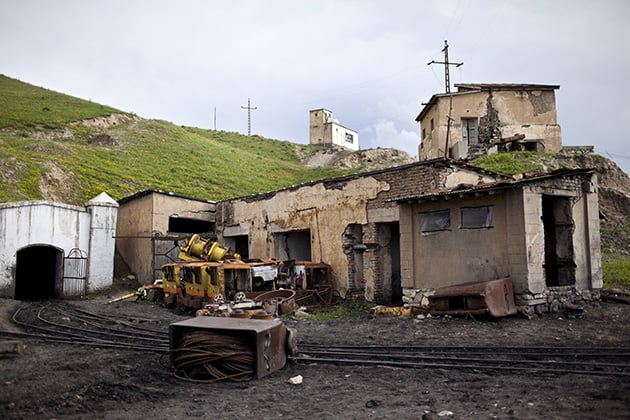
The Karkar Valley coal mines in Puli Khumri, Afghanistan. (Benjamin Lowy/Getty)
The task force, made up of mostly civilian business experts and designed to develop the Afghan economy, has come under fire from SIGAR and Congress for demanding unusual and expensive accommodations in the country, allegedly punishing a whistleblower, and lacking overall accountability. The Senate is holding a hearing on the task force next week.
In today’s report, SIGAR highlighted that the task force spent $46.5 million to try to convince companies to agree to develop the resources, but not one ended up signing a contract. About $122 million worth of task force programs had mixed results, SIGAR said.
The Defense Department declined SIGAR’s request to comment on its findings. In its response, USAID said it has helped Afghanistan “enact investor-friendly extractive legislation, improve the ability to market, negotiate and regulate contracts, and generate geological data to identify areas of interest to attract investors.” Any conclusions and criticisms, USAID told SIGAR, “need to be substantially tempered by the reality that mining is a long-term endeavor.”
In case you missed it, it's Star Wars season. Every copy of the original trilogy in the city is sold out, practically every 3-D IMAX showing of Episode VII is accounted for, every cereal box and piece of merchandise now unabashedly adorns a BB-8 on its packaging. However, not all is accounted for. A largely unseen piece of cinema mastery exists that defies the vast world of Star Wars culture. If you are running out of media from a galaxy far, far away, I challenge you to consider seeing Turkish Star Wars, a film made in 1982.
For what it's worth, the movie title literally translates to The Man Who Saved the World. The term “Turkish Star Wars” is applied as a way to communicate just what is going to happen on screen before you put yourself through it. Not to suggest that you'll suffer, here; as a matter of fact, you'll have a hell of a time…
How many currencies does the world need? Actually, let’s make this more concrete. The euro was a colossal bet on the proposition that Europe, at any rate, needs only one. You will have noticed that the experiment is going badly. And why is that? There are two main theories, both widely voiced ove...
We are able to de-anonymize executable binaries of 20 programmers with 96% correct classification accuracy. In the de-anonymization process, the machine learning classifier trains on 8 executable binaries for each programmer to generate numeric representations of their coding styles. Such a high accuracy with this small amount of training data has not been reached in previous attempts. After scaling up the approach by increasing the dataset size, we de-anonymize 600 programmers with 52% accuracy. There has been no previous attempt to de-anonymize such a large binary dataset. The abovementioned executable binaries are compiled without any compiler optimizations, which are options to make binaries smaller and faster while transforming the source code more than plain compilation. As a result, compiler optimizations further normalize authorial style. For the first time in programmer de-anonymization, we show that we can still identify programmers of optimized executable binaries. While we can de-anonymize 100 programmers from unoptimized executable binaries with 78% accuracy, we can de-anonymize them from optimized executable binaries with 64% accuracy. We also show that stripping and removing symbol information from the executable binaries reduces the accuracy to 66%, which is a surprisingly small drop. This suggests that coding style survives complicated transformations.
A presidential election that promises to be the stupidest in our nation's history has just reached new points of stupidness: Samuel L. Jackson and Donald Trump are having a fight about golf cheating. This is a real thing that is happening, not a fever dream from an episode of Curb Your Enthusiasm.
Don't worry—there's nothing of particular urgency going on with the candidates today, so you don't have to feel any guilt about indulging in this dumb news. You're not missing any headlines about Ted Cruz admitting that he's the cause of cancer, or Bernie Sanders unveiling a new iPhone.
The only other headline of note today is that Jeb Bush says he's more attractive than Chris Christie, which I guess is true in a Dean Stockwell-versus-Ernest Borgnine sort of way. So go ahead, allow this idiotic golf story to be your one dose of political news today—it's not like the other candidates are doing anything more serious.
As far as anyone can tell, the golf-cheating feud started, like so many conflicts do, in the pages of United Airlines' in-flight magazine, Hemispheres. In an interview with Alex Pappademas, Samuel L. Jackson revealed that he's golfed with Donald Trump several years ago at one of Trump's clubs. And then Trump, without telling Jackson, either signed him up as a dues-owing member of the club, or there was some clerical error that resulted in a bill being sent to Jackson.
On one hand, this is kind of an asshole move. On the other, I love that Trump might be employing a bait-and-switch with celebrities like one of those "10 cassettes for a penny" clubs.
Jackson also says that he's a better golfer than Trump, because "I don't cheat."
I don’t know @SamuelLJackson, to best of my knowledge haven't played golf w/him & think he does too many TV commercials—boring. Not a fan. — Donald J. Trump (@realDonaldTrump) January 5, 2016
And then Anthony Anderson, star of the show Black-ish, tweeted this fond memory:
C'mon @realDonaldTrump you played Golf with @SamuelLJackson and me as well. we also had lunch together! shrimp and hot dogs. sound familiar? — Anthony Anderson (@anthonyanderson) January 5, 2016
This is yet another fantastic detail: shrimp and hot dogs? What? Because these are rich people we're talking about, you know that the shimp and hot dogs were served with pretentious garnish on complicated fancy plates, and I am so desperately curious about how Trump's kitchen dresses up this bizarre pairing.
Anyway, Trump followed that up with this:
I don’t cheat at golf but @SamuelLJackson cheats—with his game he has no choice—and stop doing commercials! — Donald J. Trump (@realDonaldTrump) January 6, 2016
And then added:
Man shot inside Paris police station. Just announced that terror threat is at highest level. Germany is a total mess-big crime. GET SMART! — Donald J. Trump (@realDonaldTrump) January 7, 2016
This is a great idea. Let's all watch a clip from the 1995 reboot of the Don Adams sitcom Get Smart, starring Andy Dick and a generous laugh track.
You are now all caught up on the 2016 presidential campaign.
By any measure, Ben's 2015 project has been a complete success, accomplishing everything it was designed to do: Ben raised millions of dollars, sold a ton of books, upped his speaking fee, and turned the heads of every cable news casting director in the country.
"Ben Carson loses two top aides as his campaign flounders," reports the LA Times, still operating under the assumption that Ben's running a campaign for president rather than a get-richer-quick scheme.
Departing the Carson enterprise this week are campaign manager Barry Bennett and communications director Doug Watts. Why are they leaving? Who knows. We're close to the Iowa primaries, which is probably about as far as Carson intends to go — he'll lose there, then in New Hampshire, then mmmmmmmmmaybe he'll stick around long enough to win some approval from a few voters in South Carolina, and then it's time to pivot back to public speaking, endorsements, and auditioning for Fox News.
At that point, who needs campaign managers and political communications? Doug and Barry's departure makes perfect sense. (Also they apparently hated one of Carson's friends, so there might've been a little drama there.)
It's been a wildly profitable year for Carson. His "presidential campaign" just announced that they've raised $23 million over the last three months (on top of $32 million earlier in the year), and most of that money's going right back into raising even MORE money. Carson's speaking fees brought in $4.3 million over the last two years. Since May, he's done seven paid events, for which he was paid somewhere between a quarter and a half million dollars. In September, one speech at an anti-abortion gathering brought him $15,000 to $50,000. And he's sold 52,000 copies of his book, probably mostly to reporters trying to unravel all his tall tales.
His polls numbers are shitty, but his money-numbers — which are what really matters — have the other candidates beat.
But for now he can probably just relax, kick back, and enjoy the last few hours of what was probably the most profitable year of his life. Pretending to run for President is one of the best-paying jobs in the country.
All heavy new releases in here, get somewhere private. Void Of Sleep, Intronaut, Krieg, Grave Pleasures, Swallow The Sun, the Celtic Frost tribute, tons more.
This interesting article by medieval historian Amanda Power traces our culture's relationship with the concept of mass surveillance from the medieval characterization of the Christian god and how piety was policed by the church:
What is all this but a fundamental trust in the experience of being watched? One must wonder about the subtle, unspoken fear of the consequences of refusing to participate in systems of surveillance, or even to critique them seriously. This would be to risk isolation. Those who have exposed the extent of surveillance are fugitives and exiles from our paradise. They have played the role of the cursed serpent of Eden: the purveyor of illicit knowledge who broke the harmony between watcher and watched. The rest of us contemplate the prospect of dissent with careful unease, feeling that our individual and collective security depends on compliance.
[...]
Eight centuries ago, in November 1215, Pope Innocent III presided over a Great Council of the Church in Rome known as the Fourth Lateran Council. It was attended by high-ranking members of the ecclesiastical hierarchy and the monastic world, together with representatives of emperors, kings, and other secular leaders from throughout Christendom. Their decisions were promulgated through seventy-one constitutions. They began with a statement of what all Christians were required to believe, including specifics on the nature of Godby this time: "eternal and immeasurable, almighty, unchangeable, incomprehensible and ineffable" -- and the view that salvation could be found only through the Roman Catholic Church. Anyone who disagreed, according to the third constitution, was to be handed over to secular lords for punishment, stripped of their property, and cast out of society until they proved their orthodoxy, or else be executed if they did not. Anyone in authority would be punished if they did not seek out and expel such people from their lands; their subjects would be released from obedience and their territories handed over to true Catholics. There was nothing empty about this threat: the council occurred in the middle of the bitter Albigensian Crusade, during which heresy -- likened to a cancer in the body of Christendom -- was purportedly being cut out of Languedoc by the swords of the pious.
The Fourth Lateran Council was talking about crimes of thought, of dissent over matters of belief, matters not susceptible of proof. But whether individuals were heretics could not, in theory, be established without investigating the contents of their minds. To this end, the council decreed that bishops' representatives should inquire in every parish at least once a year to discover "if anyone knows of heretics there or of any persons who hold secret conventicles or who differ in their life and habits from the normal way of living of the faithful." These representatives were to follow these external indications of nonconformity into the recesses of the mind and establish their meaning in each case. Over the decades the role of the inquisitor was developed into an art and a science, and elaborate handbooks were produced. But in 1215 it was stated merely that individuals should be punished if "unable to clear themselves of the charge."
[...]
What is all this but a fundamental trust in the experience of being watched? Our trust is so strong that it seems to have found its own protective rationality, deeply rooted in Western consciousness. It's an addict's rationality, by which we're unable to refrain from making public a stream of intimate details of our lives and those of children too young to consent. One must wonder about the subtle, unspoken fear of the consequences of refusing to participate in systems of surveillance, or even to critique them seriously. This would be to risk isolation. It would be a trifle paranoid to reveal less -- a little eccentric, not quite rational.
Just until Christmas, holiday print subscriptions are only $19. Support our work and get one for yourself or as a gift today!
Two stories about Joseph Campbell, the influential American comparative mythologist, and outer space. The first story, relayed by an acquaintance of his in a letter to the New York Review of Books: on the occasion of the first moon landings in 1969, Campbell mentioned to a student, apropos of nothing, that the Moon would “be a good place to put the Jews.” The second story is Star Wars.
Campbell is chiefly famous as the originator of the “Monomyth,” as laid out in his book The Hero With A Thousand Faces. A kind of cod-structuralist, he thought that all human myth across all recorded culture had the same basic structure. Campbell argued that what all worthwhile cultures have in common is an admiration for the Great Hero, and the story of his Journey.
The Hero’s Journey is this: our protagonist starts out in an ordinary, humdrum world; he (and it’s usually a he) leaves to seek adventure, falls into a vast and strange world in which he discovers surprising new abilities, faces his father, defeats evil, fulfills his great destiny, and returns home a changed man. It’s not just that the original Star Wars films display some of this structure: George Lucas was an avid reader of Campbell’s, actively gambling on his theory, reasoning that if that narrative were as universal as he claimed, a film that cleaved tightly to its progression could only be a box office juggernaut.
This might be why everything in Star Wars is expressed in such general terms. The story of the hero and the great evil can admit no particularities; the Galactic Empire doesn’t have anything as crude as an actual name; the Rebel Alliance isn’t burdened by anything so weighty as an explicit ideology. All we are allowed to know is that one side is good and the other is villainous — we’re told, in those scrolling-text intros. (The principle of identity is strong with this one throughout — note, for instance, that every planet in the Galaxy only seems to have one immediate location; you pilot your ship to Yoda’s world and he’s immediately there to meet you.)
Star Wars tries to skim below the surface of actual politics, so that Ronald Reagan could see its Evil Empire as an image of the Soviet Union, while snarky liberals are allowed to point out the irony of vast and jealous entertainment corporations telling stories about an armed revolution against all monoliths, and then blanketing the world with tie-in tat.
But all this assumes that Campbell’s story really is universal and absolute, something that precedes culture and ideology. Which it isn’t: it’s the product of an antisemite’s ecumenicalism, the kind of syncretic cultural milkshake that Umberto Eco describes as the first condition of fascism.
Look at the Rebel Alliance in Star Wars, really look at them, and try to see anything like a radically democratic revolution against tyranny. What is the class composition of these rebels? Of the ones we know, there’s one member of a hereditary royal family, one petty criminal, one former ruler of a privately owned city, and one adopted child of rural landowners (and, possibly, slaveholders) who is also the scion to an ancient religious order of aristocratic knights.
At the start of A New Hope, we hear that the Alliance has growing support within the Imperial Senate, and Imperial Senates aren’t usually very fond of proper revolutionaries. Consider the Alliance’s tactics. Every time we meet the rebels, they have built themselves a base on some deserted planet, where they’re stockpiling heavy arms.
As any good student of Mao knows, a revolutionary movement can only succeed if it wins the trust of the people; holding territory is a game played by the State, not those trying to overthrow it. We never see the rebels being sheltered from Stormtroopers by grateful peasants (while they do ally with the Ewoks, it’s with a fully colonial sense of entitlement); we never see Alliance propaganda being passed around in secret by the oppressed; we never see any indication that this armed faction has any kind of popular mandate whatsoever. It’s not just infantile bourgeois ultraleftism — Blanquism in space.
At the end of The Empire Strikes Back, we see for the first time a full Rebel Alliance fleet; vast blobby spaceships to rival the Empire’s. Aren’t warships expensive? Who’s funding these people? Consider that when we see that fleet, it’s positioned outside the Galaxy. There’s a name for groups like the Rebel Alliance. Not freedom fighters, but Contras, right-wing death squads.
The instinctive political response is perhaps too simple: neither the Galactic Empire nor the Rebel Alliance, but interplanetary socialism! This isn’t entirely illegitimate, and there are far worse places to start than a rejection of the terms of the conflict, but this line can only get us so far. Neither should we take the oppositional position that if the rebels are bad, then the Sith must therefore be good. There’s something else happening.
Campbell was wrong, but the gamble paid off anyway: Star Wars was an enormous success — the franchise is now in its third clutch; this week’s The Force Awakens looks set to break every box-office record, all over again. Some of this can only be put down to the fact that pop culture is intrinsically fascist, and nerd culture especially so. But there’s also a sense in which Star Wars really does work as a modern myth, with all of myth’s explanatory powers — not because of the fabulistic simplicity of its categories, but precisely because the world it shows is lopsided, hollow, and broken.
For instance: what, exactly, is the Galactic Empire? It’s strange: something that’s fully omnipresent, but also nowhere to be found. The Empire rules the entire galaxy, but all we see are border zones: corrupt, bandit-strewn scrubworlds; autonomous mining colonies; planets inhabited only by storms and monsters; bucolic pre-agricultural fantasies. There are warships and soldiers, thousands even, but that only proves the existence of a border, not anything on the other side. The Empire is all hollow inside, it’s nothing more than its own border. If you have shipyards, why build your weapons platform off the forest moon of Endor?
In A New Hope the heroes blast through a panel inside the clean, sleek, fascist-modernist Death Star, escape through the hole, and find themselves in a primordial horror of a waste-disposal system: the room’s full of back sludge, up to your knees, and a horribly befanged Something is making its monstrous sines beneath . . .
The essential horror of the Galactic Empire is the horror of something with form but no real being; a walking corpse, complete with worms.
But never mind the Empire — what about the Force? “It surrounds and penetrates us,” says Obi-Wan. “It binds the Galaxy together.” Something like Spinoza’s God, or the Dao, with its binary division into opposing principles of dark and light. Except that while the Dark Side of the Force is mentioned so often that many viewers of Star Wars tend to assume the existence of a corresponding Light Side, at no point in any of the movies is it ever actually mentioned.
Obi-Wan declares that he has “felt a great disturbance in the Force.” The Galactic Emperor uses this exact phrase one film later. Anakin Skywalker is the one who is prophesied to “bring balance to the Force.” Is the Force then out of balance? It can’t be anything like the Dao, the hidden harmony in which all things are suspended; it’s far more like the apeiron of Anaximander, as read by Heidegger and Derrida.
Anaximander, the first Greek philosopher to write his thoughts down, handed posterity only a single fragment:
Whence things have their origin,
Thence also their destruction happens,
According to necessity;
For they give to each other dike [justice, jointure] and recompense for their adikia [injustice, disjointure]
In conformity with the ordinance of Time.
The apeiron, or the infinite, is this whence and this thence: in other words, the Force. Heidegger believed that Anaximander, living a long time ago in an ontology far far away, had arrived at something that subsequent philosophy, with its mess of concepts, worked to obscure: things are always still partly absent, their fragmentary being is a modification of the wholeness of Being as such.
In Heidegger’s reading, for things to recompense for their injustice can only mean their destruction in the apeiron, the annihilation of all particularities in the indifference of the infinite. In Spectres of Marx, Derrida argues instead that justice can only be a “relation to the other” that must require “an irreducible excess of a disjointure.” Throughout the book, he returns to a phrase of Hamlet’s, one that “seems to offer a predestined hospitality.” “The time is out of joint,” says Hamlet — and this is not a bad thing.
Darth Vader was supposed to be the Chosen One, who would bring balance to the Force; instead he became a murderous tyrant. This is in no way a contradiction: the Force is its dark side, the despotic ordinance that annihilates all things in sameness. Bringing balance to the Force doesn’t mean universal peace, it means firing up the Death Star.
The Jedi and the Sith or the Empire and the Alliance are not really opposing forces; they’re all on the side of jointure. If only a Sith deals in absolutes, then the Star Wars films are a Sith. The Force is something like Adorno’s grotesque characterization of the Hegelian world-spirit: it “drips with suffering and fallibility”; to “hear its murmur” prompts the “shudder at something which is overpowering and at the same time devoid of qualities.” There was never an Empire; there was never a rebellion; there was only the Force, and it’s evil.
All this is perfectly demonstrated in the sadly underappreciated Star Wars prequels. Here we’re shown the real truth of the situation in the original trilogy. The Jedi — a rich, powerful, aristocratic military order, unaccountable to any democratic oversight and pompously decked out in peasant robes — are shown marching into battle alongside the armies of proto-Stormtroopers as they wage a war of extermination against some poorly defined separatists, whose view that the Republic is essentially evil turns out to be absolutely correct. The Yodas and Obi-Wans and Skywalkers of the world are politically aligned with a nihilistic and omnicidal power from beyond the galaxy: they always were.
Nerds hated the prequel trilogy; their great worry about the new Star Wars film is that it would be another Phantom Menace. Which misses the point: it was always going to be another Phantom Menace, from the moment of its conception. Never mind what George Lucas says. A prequel only gains its meaning from the fact that it’s viewed after and in relation to the original.
The Phantom Menace already describes what takes place immediately after the events of The Return of the Jedi. There’s no Death Star, but the evil remains, and the designated good guys are in the thick of it.
I’ve not yet seen The Force Awakens, but a few conclusions are already easy to make. Firstly, the title has a decidedly Heideggerian bent: truth, as he puts it in The Fundamental Concepts of Metaphysics, means “letting what is sleeping become wakeful.” Mass awakening, as opposed to mass consciousness, is a notion with unavoidable fascist overtones. Based on the experience of the later James Bond films, and Abrams’ previous efforts with Star Trek, it’s very likely to be a dull soup of knowing, pseudo-pomo references to the original trilogy, to keep the fans happy; where the prequels tried to extend the story, the sequels will probably only recapitulate it.
A new surrogate for the Empire, a new stand-in for the Alliance, to reinforce the pure homogeneity that is the Star Wars vision of justice, to conceal with phoney wars and fake empires the fact that our only hope is not to awaken the Force, but to smash it utterly.
I don't see what the problem is in the first place, I guess? PrezBro probably hears about atrocities all over the world every day. I mean, maybe that was a poor turn of phrase, but... "A president should not need to watch cable to understand how to respond to massacres of this kind.", I'm not feeling it. Thoughts?
There is a bizarre story out of the New York Times where the newspaper printed an astonishing statement by President Obama that was immediately picked up by journalists and then removed by the newspapers under a claim that it was trimmed for space. The newspaper said that President Obama defended his criticized laid-back response to the Paris and San Bernardino massacred to not watching enough cable television. It was the most newsworthy part of the fairly generic article and yet it quickly disappeared as social media lit up with criticism of the President.
The President was responding to criticism that he seemed passive or disconnected in his early response to the massacres. Reporting on a private meeting with columnists, Obama was reportedly as recognizing the failure and added “In his meeting with the columnists, Mr. Obama indicated that he did not see enough cable television to fully appreciate the anxiety after the attacks in Paris and San Bernardino, and made clear that he plans to step up his public arguments.” That rationalization was immediately picked up by media, including a leading CNN reporter, as astonishing.
It then disappeared without a trace.
At first, I thought that the New York Times might have simply gotten it wrong or it was decided that the President was just joking in such a bizarre comment. However, the New York Times is not denying the statement was made or suggesting that it was a joke. Instead, D.C. bureau chief Elisabeth Bumiller wrote “There’s nothing unusual here. That paragraph, near the bottom of the story, was trimmed for space in the print paper by a copy editor in New York late last night. But it was in our story on the web all day and read by many thousands of readers. Web stories without length constraints are routinely edited for print.” That last part is certainly true, but that is well known. What does not track is cutting a graph that, while embarrassing to the White House, was the only real news in the piece. That is reflected in the fact that social media lit up immediately from journalists who cited only that part of the story.
Reporters flashed the information on social media while some like Ron Fournier of the National Journal columnist called it “breathtaking.”Likewise, the Wall Street Journal’s James Taranto compared the lack of response by some as a telling contrast to such a statement being made by a less favored politician like George W. Bush. CNN’s Brian Stelter declared it the “Quote of the Day” and immediately put it on his Twitter feed.
In fairness to the New York Times, it has hit Obama pretty hard on some stories. However, this removal of such a newsworthy element of the story is itself quite disturbing. A president should not need to watch cable to understand how to respond to massacres of this kind.
"I have no idea how Sacha Baron Cohen’s Ali G character sneaked through my gate to ask Noam outrageous things like, "How many words does you know?" and "What is some of them?" I do remember that Noam came to me afterward looking dazed. "No more men in gold suits," he said, sighing."
<3 <3 <3
Being Noam Chomsky's assistant means greeting students, political prisoners, politicians, musicians, overwhelmed fans, Cirque du Soleil clowns, lost souls
"Ultimately, we need to reproduce the things that make the brain work; but to spot those, we need to understand how it works or at least have a theory the simulation can test. Alas, we don’t. Simulations might have been slow about delivering, but they actually represent impatience: the view that instead of waiting until we understand the brain, we should get on and build something now."
The philosopher John Searle has been dining out for years on a good line about simulation. People think, he says, that if they simulate the mind on a computer it’ll be conscious; but you know what? When they run a computer simulation of a rain storm, nobody gets wet.
That hasn’t stopped people t...
TODAY BOTH HOUSES OF CONGRESS approved a $1.1 trillion spending bill intended to keep government services funded through September 2016. Tucked into this omnibus legislation are provisions that could undermine, on the basis of personal heritage, the ability of many American citizens to travel visa-free to countries in Europe and east Asia.
For more than 25 years, the Visa Waiver Program has allowed people from a select list of countries, currently 38 nations long, to travel to the U.S. without a visa. Those countries, in turn, must reciprocate, allowing Americans the same privilege on their own soil. Today, Congress voted to change the deal: People coming from countries covered under the Visa Waiver Program, including people who are citizens of those countries, will now need to get a visa if they are determined to be nationals of Iran, Iraq, Sudan, and Syria, or if they have visited those countries since 2011.
This is worse than it sounds, because at least two of those countries, Iran and Syria, deem people to be nationals, regardless of where they were born or live, if their fathers are citizens. So it’s possible that someone who is a citizen of one of the countries on the visa-free travel list — the United Kingdom, say — and who lives there and grew up there and has never visited another country, could end up denied entry to the U.S. because of a parent born in Iran or Syria.
It gets even worse still, because there is a strong likelihood that countries party to the newly altered Visa Waiver Program, including European Union member states, will institute reciprocal restrictions on Americans, meaning that many Iranian-Americans, Syrian-Americans, and others in the U.S. would see their ability to travel the world seriously degraded based on ancestry or dual citizenship. Potentially facing similar reciprocal restrictions are any aid workers, journalists, or other Americans who simply visited at some point since 2011 the countries targeted in the new legislation.
An open letter published by the European Union’s ambassador to the United States has already said that passage of the bill “could trigger legally mandated reciprocal measures” against American citizens, in this case, specifically those whose national origin is from Iran, Sudan, Syria, or Iraq, effectively placing them into a lower category of citizenship when attempting to travel abroad.
The new restrictions have alarmed civil rights groups in the United States, including the American Civil Liberties Union, which in a letter to the House of Representatives earlier this month called the changes arbitrary, discriminatory, and “un-American,” since they would punish individuals solely based on their nationality or ethnic origin. Despite this harsh criticism, at least some of the provisions were approved by the House of Representatives in a 407-19 vote on December 8, paving the way for today’s vote.
Jamal Abdi, a spokesperson for the National Iranian American Council, believes the legislation will eventually prompt other countries to deny Iranian-Americans the same rights of free travel enjoyed by other Americans.
“Targeting people who are dual nationals is particularly discriminatory and unjust, since dual nationality is not something you choose,” Abdi said. “Under this legislation, if you’re a European of Iranian origin or your father is an Iranian citizen, you wouldn’t be able to travel without a visa to the United States. As we’ve already heard from the EU, this would trigger reciprocal measures that would result in the passports of Iranian-Americans being treated as inferior, essentially putting them in a category of second-class citizenship.”
The bill approved by the House earlier this month, HR-158, which is related to the legislation approved today, was initially written for the narrow and reasonable purpose of blocking or restricting from U.S. entry individuals who traveled to Islamic State-controlled territory in Syria or Iraq. But provisions later added by Republican lawmakers made the legislation more draconian, including by imposing restrictions involving entire countries — official “state sponsors of terrorism” like Iran and Sudan. (In those two countries, at least, the Islamic State is nonexistent.)
Some parts of the newly passed legislation could even violate the recently negotiated deal between the U.S. and Iran to curb Iranian nuclear activity.
For example, under the new rules, a European or Japanese business owner who traveled to Iran to take advantage of recently lifted economic sanctions would thereafter find themselves denied visa-free entry to the United States — a restriction that would inevitably act as a deterrent to doing business in Iran. But the provisions of the U.S.-Iran nuclear deal prohibit policies that undermine “the normalization of trade and economic relations with Iran.”
Thirty-three Democratic members of Congress signed an open letter published last week criticizing some of the new Visa Waiver Program restrictions. The letter said the restrictions “would result in discrimination against people simply because they are dual citizens based on ancestry” and asserted that national origin should not be a factor when determining visa requirements. People entering the United States, the letter said, should be evaluated on an individual level, not based on “where their parents are from.”
In the end, those objections were not enough to stop the new rules. Abdi said that politicians have stoked fears of immigration and helped increase public support for harsh laws that target en masse individuals from Muslim-majority countries.
“This bill is a direct response to the rhetoric of GOP leaders like Donald Trump and others who have called for restricting people coming to the United States based on national origin,” Abdi said. “There has been a lot of outcry about his outrageous comments and proposals from the public and in the media, but now as a consequence of the environment he’s helped create, we’re actually seeing Congress take steps to turn such xenophobic ideas into law.”
i put “All I Want for Christmas is You” through a MIDI converter, and then back through an mp3 converter
the result is this garbage
I’m driving myself up the wall because I swear I can hear the vocal line but I don’t know how that could be if it was truly converted to MIDI. Unless you can replicate speech sounds entirely with modulated MIDI notes, in which case I’m actually impressed with this tire fire of an MP3.
A fun read, but I dunno about her alignment with the crusty professors who grumble about trigger warnings and such.
Has anyone read her books? Any suggestions?
Camille Paglia is dismayed by the return of Victorian notions of female fragility. "If today’s young women want to be passive wards of the state, then that is their self-stultifying choice"