Shared posts

17 Aug 15:47

Men I Trust – Lauren

by Sarah
Men I Trust - Lauren

Men I Trust – Lauren

We’ve been fans of Men I Trust for some time now, so imagine our excitement when a new video popped up in our inbox!

Founded in 2014, Men I Trust are an electronic pop four-piece from Québec, comprised of Dragos Chiriac (keys and mastering), Jessy Caron (guitar, bass & keys), Odile Marmet-Rochefort (vocals), and Emmanuelle Proulx (vocals).

Men I Trust have the cool vibes of the late 90’s, blended with beautiful piano melodies, low fuzzy bass and powerful, yet fragile vocals from the two girls.

The video for ‘Lauren’ was shot by the band at the Hautes-Gorges National Park near their home in Québec.

Head over to their Soundcloud page for a free download of the track.

Sounds like: Tame Impala, Wet, MUNA, Lucius

Website | SoundcloudTwitterFacebookYouTubeInstagram

19 Jul 05:13

When Law Is Not Justice

by By BRAD EVANS and GAYATRI CHAKRAVORTY SPIVAK
Rule of law may be good for business, but in many parts of the world it’s not enough to ensure basic rights.
17 Jul 04:22

Aerial Shots That Demonstrate The Stark Divide Between Rich and Poor

by Kate Sierzputowski
JohnnyMiller_04

Papwa Sewgolum Golf Course © Johnny Miller / Millefoto

During apartheid, barriers were both constructed and modified to segregate urban spaces—roads, rivers, and large stretches of open land separating rich neighborhoods from the poor. Twenty-two years later these barriers still exist, large homes with lush lawns just a few yards away from tightly-packed communities organized with dirt roads rather than tree-lined streets. Photographer Johnny Miller wanted to capture the dramatic divide from a new perspective, and decided to shoot many areas in South Africa from several hundred feet in the air for a series titled “Unequal Scenes.”

By utilizing aerial photographs, the separation is all the more apparent, suburban sprawl nestled up against tight and overcrowded streets. Due to the camera’s position so high in the air, the details of each area becomes obscured. It is difficult to pinpoint an exact location for the photographs, allowing the viewer to relate the imagery to communities in their own part of the world that may also carry distinct inequalities.

“My desire with this project is to portray the most Unequal Scenes in South Africa as objectively as possible,” Miller explains in a statement about the project. “By providing a new perspective on an old problem, I hope to provoke a dialogue which can begin to address the issues of inequality and disenfranchisement in a constructive and peaceful way.”

Miller has an upcoming exhibition of his photographs in early August in Johannesburg that will be announced soon. You can see more of his aerial photographs that document inequality on his Facebook, Twitter, and Youtube. (This Isn’t Happiness)

JohnnyMiller_01

Bloubosrand Kya Sands © Johnny Miller / Millefoto

JohnnyMiller_02

Manenberg Phola Park © Johnny Miller / Millefoto

JohnnyMiller_03

Masiphumelele Lake Michelle © Johnny Miller / Millefoto

JohnnyMiller_05

Strand Nomzamo © Johnny Miller / Millefoto

JohnnyMiller_06

Strand Nomzamo © Johnny Miller / Millefoto

JohnnyMiller_07

Vukuzenzele Sweet Home © Johnny Miller / Millefoto

JohnnyMiller_08

Vusimuzi Mooifontein Cemetery © Johnny Miller / Millefoto

16 Jul 20:37

Illustrator Simon Stålenhag’s Visions of a Technologically Dystopian Future

by Christopher Jobson

simon-1

Swedish illustrator Simon Stålenhag (previously) depicts a uncomfortable collision of present and future where people much like us seem to confront a brave new technological reality. In his digital paintings children throw spears at terrifying drones, and people wander aimlessly in their yards while fully engrossed inside virtual reality helmets strapped to their heads, and sometimes there’s even a giant alien caterpillar. Each bleak snapshot is seemingly unconnected to the last but suggests a provocative story—for some reason I’m reminded of my favorite children’s picture book, Chris van Allsburg’s The Mysteries of Harris Burdick. Stålenhag collected many of his own illustrations into a book titled Tales from the Loop, and many of his best images are available as prints. You can also find him on Tumblr.

simon-2

simon-3

simon-4

simon-5

simon-6

simon-7

simon-8

simon-9

simon-10

simon-11

16 Jul 20:36

Stenciled Cats by C215 Prowl the Streets

by Christopher Jobson

cat-1

As he travels the world with spray cans in hand, Parisian street artist C215 (previously) depicts what he describes as “things and people that society aims at keeping hidden.” Homeless people, street kids, smokers, and refugees are all muses for his unique brand of intricate stencil work that reduce his subject’s faces into sinewy outlines. One of his favorite things to depict are the faces of friendly felines that peer out from walls or on the sides of trash bins, oddly perfect and regal despite their rugged urban surroundings. Collected here are some of our favorite cats from the last two years or so, but you can see more up-to-date works on both Flickr and Facebook.

cat-2

cat-3

cat-4

cat-5

cat-6

cat-7

cat-8

cat-10

16 Jul 18:36

Ecological Representations

by Andrew Wilson
TimB

My guilty pleasure. I know, somewhere deep inside, that this is all a waste of time. And yet, I have to read the pre-print anyway...

Funny story. One day, I got a text from Sabrina that said "Holy crap. I think ecological information is a representation." "Uh oh", I thought - "Twitter is gonna be maaaaad". Then we thought, "we should probably write this idea down, see if we can break it". So we wrote, and the funnier thing was....it all just got stronger. The result is a paper we call "Ecological Representations", which we have just uploaded as a preprint to BioRxiv.

In it, we
  1. argue that Gibsonian, ecological information meets the criteria to be a representation, then
  2. predict that this information leads to neural activity that preserves its structure and that also meets the criteria to be a representation, and
  3. we argue that these two ecological representations (informational and neural representations) can address the three core reasons cognitive science wants representations (getting intentionality/aboutness from a physical system, solving poverty of stimulus and enabling higher order cognition) while 
  4. avoiding the two big problems with mental representations trying to address those motivations (symbol grounding and system-detectable error). 
  5. We then spend a bunch of time getting serious about higher order cognition grounded in information (see, I told you we were working on it!)
We submitted this to a good cognitive science journal and got the reviews back last week. We were rejected after hitting a wall of confusion from two reviewers who got distracted by side issues and one who just didn't quite get it. No-one gave us much in the way of specific actionable things that need fixing, nor did anyone actually say our analysis of information as a representation was wrong. We remain unimpressed with the quality of the reviews (although the editor has been very clear and generous with his time in replying to us querying the rejection). 

That said, we are taking one hint from the process before submitting elsewhere, and that is we are clearly having trouble articulating the argument, in part I think because comes out of left field and we're tripping a lot of different knee-jerk reactions. We think the story makes sense but then we're us, so what we need is some fresh eyes. This is where you lovely people come in.

I have made some minor structural revisions to the version that got reviewed to address some of the issues that came up and I have uploaded it as a pre-print to BioRxiv.org. Now, we want your help.
One quick thing to flag up; just this week, there's been a special issue on embodiment and symbols and meaning and things at Psychonomic Bulletin and Review. There's a bunch of this material that will likely be relevant to building the case that this paper is useful; we have not had a chance to get into it yet, but we will!
  1. The problems from the reviews boiled down to "we need more background on the ecological stuff" and "this is all a bit old fashioned mental representation talk, we've moved on'. Our initial reply is "sure, no problem" and "you may have moved on, but this really is the core of the matter and the problems remain unsolved, so there's that". Our questions: what remains unclear from the ecological psychology background in the paper and what is this mythical recent literature on the nature of mental representation that solves or defines away these issues?
  2. Does our argument work? Are we just making things up or is information really doing the representational work we think it is? 
  3. Do the implications we lay out follow? 
  4. Just how much do you disagree with our (very early days) framework for using this analysis to get information supporting higher order cognition? More importantly, what do you think is wrong?
One thing to get out of the way here; we know that the word 'representation' has been checked out of the library by many different people. We've tried to aim for the most basic definition of representation that gets at what all these versions are trying to deal with, and landed on the idea that if nothing else, a representation must stand-in for something else in a way that gives you intentional, functional behaviour of all kinds. We still think mental representations don't exist, but the need for things standing in for other things to support behaviour seem to real; this is just an ecologically grounded version of solving that problem.

So, please: spread the preprint around, read it, comment it, dissect the hell out of it. Post comments here, blog it yourself, find us on Twitter, or email us your thoughts. We appreciate all the interactions we have via the blog and Twitter and we really want to know what we can do to make this paper good. It's a fairly important part of a bigger project, and it's important that we get this right. For all their flaws, the reviews told us we aren't telling this story clearly yet, and so it's on us to find out why not.

References
Golonka, S., & Wilson, A. D. (2016) Ecological Representations. Preprint uploaded to BioRxiv.org. doi:10.1101/058925
01 Jul 20:06

Muslim Cleric In Ghana Proclaims That Gay Couples Cause Earthquakes

by jonathanturley
TimB

Is that supposed to be a compliment? *rimshot*

Kinemetrics_seismographMuslim cleric Mallam Abass Mahmud in Ghana has explained the real cause of earthquakes. Never mind those pesky seismologists and tectonic plates. The real cause it appears are gays and specifically gay sex. It is not clear if the level of gay relations corresponds to the Richter scale in the intensity of earthquakes.

Mallam Abass Mahmud explained that homosexuality “disgusts Allah” and “Allah gets annoyed when males engage in sexual encounter and such disgusting encounter causes earthquake.” He noted that Allah destroyed the ancient cities of Sodom and Gomorrah “as the result of homesexuality.”

Not to leave the impression that his view were purely scientific, Mahmud added a menacing conclusion: “Should we allow such a shame to continue in our communities against holy teachings? Certainly no, and we are very happy to chase away such idiots from our Zongo communities.”

The level of intolerance and violence against gays are well known in Ghana and most of Africa. This will of course add new religious legitimation for such violence.


Filed under: International, Religion, Society
01 Jul 17:13

Clouds, Rivers, and Mountains Converge in Breathtaking Landscapes of Guilin, China

by Christopher Jobson

kyon04

Perched high atop the city of Guilin, China, photographer Kyon.J had an extraoridnary view of the Li River as it winds through an unusually steep mountainscape. Early in the morning the area is often filled with fog or haze trapped in the mountains, certainly a dream scenario for any landscape photographer. You can see more of Kyon.J’s work on her 500px page where she also shares equally impressive photos of her native Japan.

kyon02

kyon03

kyon01

kyon05

kyon06

kyon07

20 Jun 00:50

"Wide" vs. "long"

by Minnesotastan
Marine scientists this week reported finding an immense sea sponge in a marine preserve near Hawaii.  They described it this way:
“It’s probably on the order of centuries to millennia old,” lead researcher Daniel Wagner told the Guardian. The sponge, the largest on record, is “about 12ft wide and 7ft long” he said, “so about the size of a minivan”.
I'll defer to the copyeditors who read this blog, but my assumption would be that the greater dimension would be referred to as the length and the shorter one as the width.  Unless a sponge has a front and a back...
22 May 17:18

Top Democrats Ally With Oil and Gas Industry to Fight Colorado Anti-Fracking Ballot Measures

by Alleen Brown
TimB

Microcosmic

Oil and gas companies are spending heavily to crush three Colorado ballot initiatives that would limit fracking. And some of the state’s most powerful Democrats are helping them.

The stakes are particularly high for several Colorado communities that have voted to limit or ban oil and gas development locally. Those limits were nullified in two cities by state Supreme Court decisions earlier this month. So the ballot initiatives may be their last best chance to slow development whose speed has surprised even cities that initially supported oil and gas projects.

“We feel it is a last ditch effort,” said Tricia Olson, director of Coloradans Resisting Extreme Energy Development, or CREED, which is pushing to get two of the measures on the ballot.

One measure would allow cities to pass rules to limit or even ban oil and gas development locally; the other would disallow companies from building oil and gas facilities closer than 2,500 feet from “occupied structures.” A third, supported by a separate group called Coloradans for Community Rights, would empower communities to make all kinds of decisions, including whether to frack. The groups are currently in the process of gathering the 98,000 signatures required to get on the ballot.

Campaign finance filings released this month indicate just how much oil and gas companies are willing to pony up to drill freely.

An industry-backed committee created just to defeat fracking ballot measures in Colorado, called Protecting Colorado’s Environment, Economy, and Energy Independence, collected more than $6.3 million in the first five months of this year.

Most of the pro-fracking group’s money came from two $2.5 million donations, one each from Anadarko Petroleum and Noble Energy. Smaller contributions came from a dozen or so other oil and gas companies and industry groups.

Karen Crummy, who is a spokesperson for the group, said the measures would wreck the economy and strip farmers and ranchers of mineral rights that help them get by in tough times.

By comparison, on the anti-fracking side, CREED’s issues committee raised only $56,000. The total for Coloradans for Community Rights barely surpassed $5,700. The biggest anti-fracking donor, to CREED, was Tricia Olson, a retiree.

The fight for community control took off four years ago in a town named Longmont, when the industry spent more than $500,000 attempting to stop local voters from enacting a citywide ban. But the pro-ballot campaigners, who raised less than $30,000, won.

There was similar voter approval in 2013 in Lafayette, Fort Collins, Broomfield, and the city of Boulder. (Boulder County commissioners had passed a moratorium on fracking in early 2012.)

Ever since, the industry has dedicated itself to defeating the rules in court, an effort that climaxed on May 2, with a pair of Supreme Court decisions against Longmont and Fort Collins.

Both Bernie Sanders and Hillary Clinton claim they support locally enacted fracking limits. Sanders wants to ban the technique altogether, while Clinton says she would not support fracking “when any locality or any state is against it.”

But top Democrats in Colorado have warmed to the frackers.

Consider the case of Ted Trimpa, a registered lobbyist for Noble Energy and Encana oil and gas, who sits on the advisory committee of Coloradans for Responsible Energy Development, another front group for Anadarko and Noble that is fighting the proposals.

If anyone knows the power of Colorado cash to swing local politics, it’s Trimpa. He was an architect of Colorado Democrats’ surprise take-back of state politics from Republicans in 2004. The scheme involved aiming the cash of four wealthy donors, known as the “Gang of Four,” at key races, and later evolved into an infrastructure for coordinated Democrat donations through a network of non-profits.

The “Colorado miracle” became a model for Democrats nationwide. Trimpa has since served as a board member of some of the national Democratic Party’s most important funding and policy appendages, including Democracy Alliance and ProgressNow, as well as the American Bridge 21st Century Foundation, which supports the Clinton campaign through a Super PAC of the same name.

He’s joined on the Coloradans for Responsible Energy Development advisory committee by Democratic superdelegate and former Gov. Roy Romer. And Trimpa’s old pal Tim Gill, one of the Gang of Four, is now chairman of another group, Colorado Concern, that has put money down to halt the initiatives.

Watch the video from the anti-fracking group Protect Colorado:

In 2014, two fracking ballot measures very similar to the ones being pushed now were bankrolled by America’s fifth-richest member of Congress (and another of the Democratic Gang of Four), Rep. Jared Polis.

But the measures were apparently too threatening to the political ambitions of too many Democrats. Democratic Gov. John Hickenlooper was facing re-election, as was Sen. Mark Udall — and Polis himself happened to be running to become chair of the Democratic Party’s Congressional Campaign Committee.

So at the last minute, Polis made a deal with Hickenlooper and oil and gas representatives to kill the measures before they made it to the ballot, despite the fact that the campaign had already collected 200,000 supporter signatures, more than enough to qualify for a vote. In exchange, oil and gas companies threw out a pair of pro-fracking measures, and Hickenlooper agreed to create a panel to recommend policies to hand more control and protection to communities where fracking was taking place. Democratic Sen. Michael Bennet, who is up for re-election this year, had also pushed for the compromise.

Hickenlooper was re-elected — attracting nearly three times more oil and gas cash than his Republican opponent. Polis lost his bid for DCCC chair, and Udall lost, too. As for the promised panel, although Hickenlooper appointed six representatives from the oil and gas companies, he included not a single grassroots organizer that had been pushing for more local control. The panel’s recommendations failed to give significant new decision-making powers to communities.

Hickenlooper recently spoke at a luncheon alongside American Petroleum Institute head Jack Gerard, stating that this year’s ballot initiative to increase distances between homes and gas wells could invite lawsuits costing billions. “I don’t think it’s a good idea at all,” he said.

The anti-fracking campaign says it won’t get fooled again. “CREED is very sensitive to the fact that our Democrats had a large hand in the initiatives being pulled last time, because they had so much control,” said Lauren Petrie, a senior organizer for Food and Water Watch, a nonprofit backing the Colorado campaign. This time around, she said, they’re “making sure that this is remaining a grassroots-led effort.”

Sign up for The Intercept Newsletter here.

The post Top Democrats Ally With Oil and Gas Industry to Fight Colorado Anti-Fracking Ballot Measures appeared first on The Intercept.

10 May 19:24

less advanced primate

Today on Married To The Sea: less advanced primate


The Worst Things For Sale is Drew's blog. It updates every day. Subscribe to the Worst Things For Sale RSS!
07 May 00:57

FBI Told Cops to Recreate Evidence From Secret Cell-Phone Trackers

by Jenna McLaughlin

A recently disclosed document shows the FBI telling a local police department that the bureau’s covert cell-phone tracking equipment is so secret that any evidence acquired through its use needs to be recreated in some other way before being introduced at trial.

“Information obtained through the use of the equipment is FOR LEAD PURPOSES ONLY,” FBI special agent James E. Finch wrote to Chief Bill Citty of the Oklahoma City Police Department.

The official notice, dated September 2014, said such information “may not be used as primary evidence in any affidavits, hearings or trials. This equipment provides general location information about a cellular device, and your agency understands it is required to use additional and independent investigative means and methods, such as historical cellular analysis, that would be admissible at trial to corroborate information concerning the location of the target obtained through the use of this equipment.”

The document, obtained by nonprofit investigative journalism outlet Oklahoma Watch, pertains to the use of cell site simulators, or Stingrays — surveillance technology that mimics a cellphone tower to trick cellphones into transmitting location data and other information, sometimes even the contents of calls.

Journalists and activists have uncovered at least 20 similar nondisclosure agreements between FBI and local police about Stingrays in the past few years — but the FBI’s advice about retroactively recreating evidence appears to be new.

Privacy advocates have long warned of “parallel construction,” in which investigators cover up information obtained without a warrant by finding other ways to attribute it — never allowing the source of the original lead to be scrutinized or subject to judicial oversight.

“This is the first time I have seen language this explicit in an FBI non-disclosure agreement,” Nate Wessler, a staff attorney with the American Civil Liberties Union’s Speech, Privacy, and Technology Project, wrote in an email to The Intercept. “The typical NDAs order local police to hide information from courts and defense attorneys, which is bad enough, but this goes the outrageous extra step of ordering police to actually engage in evidence laundering,” 

“Instead of just hiding the surveillance, the FBI is mandating manufacture of a whole new chain of evidence to throw defense attorneys and judges off the scent. As a result, defendants are denied their right to challenge potentially unconstitutional surveillance and courts are deprived of an opportunity to curb law enforcement abuses,” Wessler continued.

One concrete example of law enforcement engaging in parallel construction was the Drug Enforcement Agency’s “Hemisphere” program, in which agents were given access to troves of AT&T’s historical cell phone records and instructed to subpoena those same records to create a separate legitimate evidence trail.

Read the rest of the notice here:

Related:

Sign up for The Intercept Newsletter here.

The post FBI Told Cops to Recreate Evidence From Secret Cell-Phone Trackers appeared first on The Intercept.

06 May 17:26

White House Report on Big Data Discrimination

by schneier

The White House has released a report on big-data discrimination. From the blog post:

Using case studies on credit lending, employment, higher education, and criminal justice, the report we are releasing today illustrates how big data techniques can be used to detect bias and prevent discrimination. It also demonstrates the risks involved, particularly how technologies can deliberately or inadvertently perpetuate, exacerbate, or mask discrimination.

The purpose of the report is not to offer remedies to the issues it raises, but rather to identify these issues and prompt conversation, research­ -- and action­ -- among technologists, academics, policy makers, and citizens, alike.

The report includes a number of recommendations for advancing work in this nascent field of data and ethics. These include investing in research, broadening and diversifying technical leadership, cross-training, and expanded literacy on data discrimination, bolstering accountability, and creating standards for use within both the government and the private sector. It also calls on computer and data science programs and professionals to promote fairness and opportunity as part of an overall commitment to the responsible and ethical use of data.

06 May 02:40

Principles underlying sensory map topography in primary visual cortex

by Jens Kremkow
TimB

Two V1 papers in Nature this week; see also http://www.nature.com/nature/journal/v533/n7601/full/nature17941.html

Haven't read this carefully, but it one seems interesting because it admits a really simple model. If ocular dominance runs one way, and LGN on/off runs perpendicular, then if V1 RF sizes work out right, you automatically get odd/even/mono/stereo for free, just based on where it sits over that grid.

Principles underlying sensory map topography in primary visual cortex

Nature 533, 7601 (2016). doi:10.1038/nature17936

Authors: Jens Kremkow, Jianzhong Jin, Yushi Wang & Jose M. Alonso

The primary visual cortex contains a detailed map of the visual scene, which is represented according to multiple stimulus dimensions including spatial location, ocular dominance and stimulus orientation. The maps for spatial location and ocular dominance arise from the spatial arrangement of thalamic afferent axons

06 May 01:57

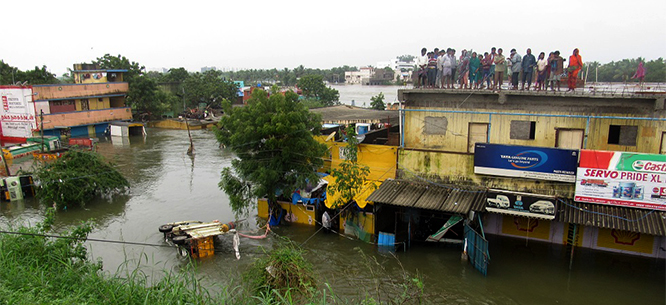
Unnatural Disaster: After the Chennai Floods

by Anjali Vaidya

Last December’s floods in Chennai illustrated the devastating consequences of a development model that puts profits before people. But they also hinted at what a democratic response to climate disaster might look like.

04 May 21:03

The Morning News: Trump to Be the Nominee, Bar Complaint Filed Against Lawyer after Threatening Email to City Council

by Heidi Groover
by Heidi Groover

Dump Trump, obviously.
Dump Trump, obviously. mikeledray/Shutterstock

Republican Voters Abandon Whatever Small Amount of Shame They May Have Still Had About Being Racists and Nominate Donald Trump for President: As you've heard by now, Trump won Indiana last night and Ted Cruz dropped out. (Now, it sounds like John Kasich will drop out this morning too.) Nothing is guaranteed until the convention, but that means Trump will almost definitely be the Republican nominee. Brace for an ugly six months. On the Democratic side, Bernie Sanders pulled off a surprise win in Indiana. Hillary Clinton is still likely to get the nomination, but he's vowing to stay in until the end.

For the Third Time in Three Weeks, Seattle Police Save a Life with Naloxone: That's the overdose-reversal drug some cops are now carrying. Around 12:30 am Tuesday, two officers on bike patrol downtown saw a man lying on his back and foaming at the mouth. He was sweating profusely and had stopped breathing. Nearby, they saw an orange hypodermic needle cap. With a dose of Naloxone, he began breathing within minutes and was taken to Harborview. More of this, please.

Drone Footage from Inside Bertha's Tunnel: Do you think the Washington State Department of Transportation, which released this video, is hoping that if we watch it for long enough we'll forget how wholly fucked the tunnel project is?

An email to the women of the Seattle City Council and signed by Jason M. Feldman told them to do the honorable thing and end yourselves after they voted against a street vacation for a new NBA arena.
An email to the women of the Seattle City Council and signed by "Jason M. Feldman" told them to "do the honorable thing and end yourselves" after they voted against a street vacation for a new NBA arena. City of Seattle

Bar Complaint Filed After Misogynist Email to City Council Members: Ben Livingston, a cannabis activist and former Stranger contributor, says he has filed a bar complaint against Lynwood Lawyer Jason M. Feldman. After Monday's arena vote, the women on the Seattle City Council received a gross and threatening email signed with that name. As Erica C. Barnett reports, the email read in part: "As women, I understand that you spend a lot of your time trying to please others (mostly on your knees) but I can only hope that you each find ways to quickly and painfully end yourselves. Each of you should rot in hell for what you took from me yesterday" and "I TRULY pray for nothing but horrible things for each of you moving forward" and "Please Please Please do the honorable thing and end yourselves." And that email was far from the only one.

Sheriff's Deputies Kill Man with Rifle in Burien: The sheriff's office says the man pointed the gun at them.

Rainier Beach International Baccalaureate Program Saved: Because of funding challenges, some feared the acclaimed program would get cut. Now, the nonprofit the Alliance has pledged some funding and Seattle Public Schools will cover the rest, the Seattle Times reports.

Why are these things still allowed on the street?
Why are these things still allowed on the street? Kelly O

State Increases Penalty Against Ride the Ducks: State regulators approved a settlement agreement charging Ride the Ducks of Seattle $308,000 for last year's crash, up from the $222,000 penalty approved in March.

"Lured by Seattle’s Tech Boom, but Being Left Behind:" The New York Times talks to some of the families living in the building Amazon recently agreed to loan to Mary's Place to open a shelter.

Seattle's Left Lost One of Its Greatest Lawyers: Cleveland Stockmeyer helped write initiatives that brought city council districts and public campaign financing to Seattle. Progressives across the city are mourning his death.

You Can Keep Giving BIG Today: After the donation site for Give BIG, an annual fundraising campaign for nonprofits all over the city, went down, the Seattle Foundation is extending Give BIG through midnight tonight.

Subscribe to the Slog newsletter here. All the best posts, delivered to your inbox every afternoon.

[ Comment on this story ]

[ Subscribe to the comments on this story ]

04 May 04:04

Watch What Is Possibly the Funniest Parody of Synth Composers Ever

by Dave Segal
by Dave Segal

Giorgio Moroder plays a major-key role in Adult Swims hilarious parody.
Giorgio Moroder plays a major-key role in Adult Swim's hilarious parody.

Adult Swim has created a spot-on parody of the pomposity of synthesizer/composers Xangelix (Vangelis), Morgio Zoroger (Giorgio Moroder), and Carla Wendos (Walter/Wendy Carlos). The premise of Live at the Necropolis: Lords of Synth centers on long-lost footage from a 1986 contest to determine who can create the greatest sonic tribute to Halley's Comet. As commentator Edgar Tangram (nice Tangerine Dream allusion) explains: "Whoever scores the celestial dance of the comet most evocatively will be named the Lord of the Synth. The losers will be banned from music for a period of 100 years." Other details of the clip ring all too true: the insufferable self-regard each of the contestants possesses; the clunky mid-'80s headphones; the ludicrous eyewear; the stoic nerdiness of the announcers; the "pulsating ball of pure energy" that is in attendance. Things take on a goofily apocalyptic tone near the end, but rest assured, the healing power of synthesizers is reaffirmed and everyone lives geekily ever after. Dunno about you, but "Don't look now, but Carla Wendos has executed an absolutely killer tritone which has given Xangelix a rather untimely boner" will always have a special place in my memory bank.

[ Comment on this story ]

[ Subscribe to the comments on this story ]

04 May 03:40

Spending Three Weeks Alone in a Basement with Goya's Monsters

by Jen Graves
TimB

Oh yes, so pumped. Come visit Seattle in the summer and see some creepy Goya paintings with me!

by Jen Graves

They carried her off!

"Oh—" Barbara Robertson caught her breath, tightening with dread.

The normally cheerful, petite redhead was pulling a framed print out of a cardboard box full of framed prints, and was about to get her first glimpse of the one she'd randomly selected.

Every print she pulls out is a fresh fright, like a wild animal she’s uncaging without knowing its species until it bites. Lurking in these boxes is some of the most nightmarish art in history.

"Do we have to look at this one?" Robertson said, letting out a grim laugh, since laughing is all you can do unless you mean to weep or claw at your eyes.

This one is better than the one of the woman selling her daughter, she added. Or the one of the rapists hauling off their victim, her face contorted in a scream and their faces nothing but hooded black voids.

This one is a dead, buxom, young woman laid out flat on an old man's lap.

Like all of them, it’s beautifully drawn and shaded. Like all of them, its subject matter means that it’s dreadfully beautiful, a dazzling light hitting a terrible crime.

Robertson puts it back, choosing another of Francisco de Goya’s Los caprichos—there are 80 of them in all—and hoping it isn’t worse.

"Ah," she sighed in relief when she saw it. "This one is merely wicked."

It's Robertson's job to re-frame all 80 prints so they can go on display this summer.

She spends seven hours a day alone with them in Seattle Art Museum’s basement. She’s taking one for the team. In the galleries this summer, these prints will be behind transparent sheets of Plexiglas: domesticated. Here, exposed, they lunge. They menace. They control the environment. Yet they’re just scraps of paper.

"I thought, 'This is going to be great!'" she told me when I visited her last week in the place that’s become like a tomb if she doesn’t turn on her radio.

Barbara Robertson is the woman trusted to use an X-acto knife in close proximity to Goya prints, seen here in a photo-allowed room next to one of the conservation studios at Seattle Art Museum, where she spends her days with the nightmarish scenes of Los caprichos.
Barbara Robertson is the woman trusted to use an X-acto knife in close proximity to Goya prints, seen here in a photo-allowed room next to one of the conservation studios at Seattle Art Museum, where she spends her days with the nightmarish scenes of Los caprichos. JG

In 1799, when Goya made Los caprichos, Spain was living under the Inquisition and corrupt royals. Ignorance, superstition, and venality were widespread. Goya, who’d gone deaf a few years prior, was enraged. The title, “caprices,” is furious sarcasm. The term usually refers to a piece of art or music that’s at least a little lighthearted.

After a few days alone with Los caprichos, Robertson began to notice an unsettling difference in herself. In 20 years of handling every kind of art for SAM, she’d never felt anything like this.

Her sunny disposition gave way to foul moods. She couldn’t explain how she felt at night. The whole world just seemed…worse.

"Here, take this one," she said, pushing across the table the print she was working on when I arrived.

In the piece, I saw two lovely girls at the base of a tall tree, wearing peaceful smiles and gazing modestly downward. They appeared to be roasting something on a spit, maybe cooking dinner. But no. Where is the fire? There is no fire. Instead, the girls hold a rod, and the rod is shoved up the ass of a plucked bird. Bird? Wait—it is a bird with a man’s head. The man-bird is vomiting. Or dripping blood out of his/its open mouth.

That swell vignette is only part of this virulent little fantasia. When you see this print at SAM this summer, look for the lecherous man-birds up in the tree; the black spots of syphilis on the girls’ faces; the crone with a maiden’s eyes.

“That is a pretty typical example,” Robertson explained. “It’s called All Will Fail. All will fail. All will fail!”

The problem with Los caprichos is that they are so goddamn good. You fall into them as into love.

“The more you look at them, they get worse,” moaned Robertson.

A woman smitten.

“First, I see how beautifully drawn this is,” she leaned in, speaking to no one in particular, in a daze.

“He could draw anything, in any position. Anything….”

Goya does this to people. Casts spells. He’s brilliant in every way: aesthetically, politically, poetically. While writing a biography of the artist, the Australian critic Robert Hughes was visited by a nightmare in which Goya trapped Hughes in a prisonlike airport, running the critic over and over through the security scanners but with a metal contraption on his leg so that he could never leave.

“I had hoped to ‘capture’ Goya in writing,” Hughes admitted, “and he instead had imprisoned me.”

Love and Death. The saddest and least hateful of them all.

In the museum basement, Robertson is technically in charge.

She uses an X-acto knife to slice through the paper backing on each frame. She turns it over and lifts away the armature and layer of transparency protecting the print. She pulls open the cream mounting. Naked now, the Goya faces up at her. Sometimes she grabs a nearby magnifying glass.

If you look closely, the monsters and terrors disappear for a moment. The shapes and shades rise up like music.

Even the tiniest lines are clear and sharp. Because of that, Robertson believes this set was printed early, before the plates wore down. (The whole set is lent to SAM by one private collector.)

To make each image, Goya cut his drawing into a plate. That became the basic etching. Then he printed using aquatint to achieve areas of infinite shading, from the bleakest whites to deep-sea grays and silky blacks.

Goya was the king’s painter. But these pieces he made for himself, and for a middle-class audience that could afford to buy a small book of prints. He sold only a handful before he decided he was too frightened of the Church. He hid the prints with the king, of all people.

“Look at this one,” Robertson said, sliding over another example. It shows an attractive young woman shielding her eyes while she reaches upward. She’s trying to yank the gold teeth out of the mouth of a hanged man.

“You don’t want to look at it, but there’s this beautiful composition of grays and whites and blacks,” Robertson gestured, pointing it out to the woman’s right. “They’re all going to get to you. They’re scary. They’re threatening. They draw you back in.”

She is so right. It happens in every piece.

Plate 12 of Los caprichos is titled Out Hunting for Teeth. You know, as one does.
Plate 12 of Los caprichos is titled Out Hunting for Teeth. You know, as one does. Courtesy of Seattle Art Museum
30 Apr 23:25

[Report] Slow waves, sharp waves, ripples, and REM in sleeping dragons

by Mark Shein-Idelson
Sleep has been described in animals ranging from worms to humans. Yet the electrophysiological characteristics of brain sleep, such as slow-wave (SW) and rapid eye movement (REM) activities, are thought to be restricted to mammals and birds. Recording from the brain of a lizard, the Australian dragon Pogona vitticeps, we identified SW and REM sleep patterns, thus pushing back the probable evolution of these dynamics at least to the emergence of amniotes. The SW and REM sleep patterns that we observed in lizards oscillated continuously for 6 to 10 hours with a period of ~80 seconds. The networks controlling SW-REM antagonism in amniotes may thus originate from a common, ancient oscillator circuit. Lizard SW dynamics closely resemble those observed in rodent hippocampal CA1, yet they originate from a brain area, the dorsal ventricular ridge, that has no obvious hodological similarity with the mammalian hippocampus. Authors: Mark Shein-Idelson, Janie M. Ondracek, Hua-Peng Liaw, Sam Reiter, Gilles Laurent
29 Apr 21:00

Mitsubishi admits rigging going back more than 25 years

Japanese automaker last week admitted manipulating emissions data in more than 600,000 vehicles.
26 Apr 04:25

This is not a long-legged fox

by Minnesotastan

It's a "maned wolf."  But it's not a wolf.

It is the unique entity in the genus Chrysocyon.  "There are no known extant or extinct species that come close" (because it's the only one that survived the mass extinctions of the Pleistocene).

Explained at Biomedical Ephemera, or: A Frog For Your Boils.

Addendum:  The evolutionary advantage of those long legs can be seen in this video of it in its natural environment (hat tip to Brazilian reader Binho).
23 Apr 16:33

New Architectural Watercolors by Maja Wronska

by Christopher Jobson

maja-1

We’ve long enjoyed the work of painter and architect Maja Wronska (previously) who depicts unique vantages of architectural sites through detailed watercolors. Not only does Wrońska capture these buildings in their entirety, but also focuses on the specific details of their construction and environment such as chandeliers that hang within an ancient church, or the pigeons found circling its exterior. These elements are all produced with an eye for how to capture the character of a space rather than just its aesthetic, imbuing her paintings with the rich history found within each location.

Many of her pieces are available as prints and other objects on Society6. You can see more of Wronska’s works and pieces in progress on her Instagram.

maja-10

maja-2

maja-6

maja-3

maja-4

maja-7

maja-8

maja-5

maja-9

23 Apr 15:44

Donald Trump Is Reportedly Coming to Washington on May 7

by Ansel Herz
TimB

"Irate Dorito chip Donald Trump" hahahahahaha

by Ansel Herz

#ShutTrumpDown: They did it in Chicago. Can we do it in Washington?
Irate Dorito chip Donald Trump is expected in Washington state two weeks from tomorrow. Joseph Sohm / Shutterstock.com

#ShutTrumpDown: They did it in Chicago. Can we do it in Washington?


[ Comment on this story ]

[ Subscribe to the comments on this story ]

23 Apr 15:41

Judge Grants Torture Victims Their First Chance to Pursue Justice

by Jenna McLaughlin

A CIVIL SUIT against the architects of the CIA’s torture program, psychologists James Mitchell and Bruce Jessen, will be allowed to proceed, a federal judge in Spokane, Washington, decided on Friday.

District Judge Justin Quackenbush denied the pair’s motion to dismiss a lawsuit launched against them on behalf of three victims, one dead, of the brutal tactics they designed.

“This is amazing, this is unprecedented,” Steven Watt, a senior staff attorney for the American Civil Liberties Union representing the plaintiffs, told The Intercept after the hearing. “This is the first step towards accountability.”

What’s so unprecedented is that this is the first time opponents of the program will have the chance to seek discovery evidence in the case unimpeded by the government. In every other past torture accountability lawsuit, the government has invoked its special state-secrets privileges to purportedly protect national security.

But since the extraordinarily detailed and revealing executive summary of the Senate’s torture report was published in 2014, after years of investigation, the government now says almost everything is declassified already.

The three plaintiffs are Suleiman Abdullah Salim, Mohamed Ahmed Ben Soud, and the estate of Gul Rahman, who died at a CIA black site known as the “Salt Pit.” Each was kidnapped and subjected to extreme physical and psychological torture and experimentation, though none was ever charged with a crime.

The two living plaintiffs were not at the hearing, but Watt said he was thrilled to text his client Abdullah Salim, now living in Tanzania, the good news. “When I first met with him, I told him the likelihood we’d get as far as we have so far was highly unlikely. To tell him that we won today — you know, it’s historic.”

Mitchell and Jessen’s proposed framework for “enhanced interrogation” involved trying to drive detainees to a state of “learned helplessness” through unbearable suffering, to the point they would be willing to totally comply. The theories behind the tactics were drawn from the psychologists’ experiments on dogs decades prior.

The defendants were not present at the hearing either, but their lawyers argued that Mitchell and Jessen were not directly involved in, and therefore are not responsible for, the victims’ capture and treatment. “They did not make decisions about Plaintiffs’ capture, treatment, confinement conditions, and interrogations; and they did not perform, supervise or control Plaintiffs’ interrogations,” defense attorney Christopher Tompkins argued in a brief filed in the case.

Dror Ladin, the ACLU attorney who argued in court at Friday’s hearing, argued that Mitchell and Jessen directly composed and supervised the program, and were paid to do so for years — and therefore should not escape responsibility, according to Guardian reporter Maria L La Ganga, who blogged the hearing live.

Top image: Screen grab from Committee Study of the Central Intelligence Agency’s Detention and Interrogation Program.

The post Judge Grants Torture Victims Their First Chance to Pursue Justice appeared first on The Intercept.

22 Apr 16:25

Deep Online Convex Optimization with Gated Games

by Igor
TimB

The paper seems interesting, but I'm mainly sharing for the jargon. Will I have logarithmic regret based on how much I read?

A sentence from the intro: "Gated players generalize the sleepy experts introduced by Blum in [42], see also [43]."

David sent me the following a while back:


Dear Igor,


I’ve enjoyed following your blog for a long time, and think the following preprint may be of interest: “Deep Online Convex Optimization with Gated Games,” http://arxiv.org/abs/1604.01952. It analyzes the convergence of gradient-based methods on rectifier neural networks, which are neither smooth nor convex, using ideas from game-theory.


Abstract:
Methods from convex optimization are widely used as building blocks for deep learning algorithms. However, the reasons for their empirical success are unclear, since modern convolutional networks (convnets), incorporating rectifier units and max-pooling, are neither smooth nor convex. Standard guarantees therefore do not apply. This paper provides the first convergence rates for gradient descent on rectifier convnets. The proof utilizes the particular structure of rectifier networks which consists in binary active/inactive gates applied on top of an underlying linear network. The approach generalizes to max-pooling, dropout and maxout. In other words, to precisely the neural networks that perform best empirically. The key step is to introduce gated games, an extension of convex games with similar convergence properties that capture the gating function of rectifiers. The main result is that rectifier convnets converge to a critical point at a rate controlled by the gated-regret of the units in the network. Corollaries of the main result include: (i) a game-theoretic description of the representations learned by a neural network; (ii) a logarithmic-regret algorithm for training neural nets; and (iii) a formal setting for analyzing conditional computation in neural nets that can be applied to recently developed models of attention.

cheers,
David 
 
 
Thanks David !


Image Credit: NASA/JPL-Caltech/Space Science Institute  
W00097359.jpg was taken on April 14, 2016 and received on Earth April 14, 2016. The camera was pointing toward SATURN, and the image was taken using the MT2 and CL2 filters. This image has not been validated or calibrated.
 
Join the CompressiveSensing subreddit or the Google+ Community or the Facebook page and post there !
Liked this entry ? subscribe to Nuit Blanche's feed, there's more where that came from. You can also subscribe to Nuit Blanche by Email, explore the Big Picture in Compressive Sensing or the Matrix Factorization Jungle and join the conversations on compressive sensing, advanced matrix factorization and calibration issues on Linkedin.
21 Apr 16:13

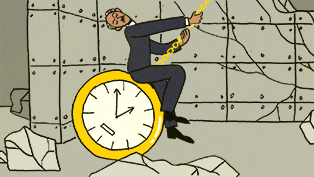
This Philosopher Helped Ensure There Was No Nobel for Relativity - Issue 35: Boundaries

by Jimena Canales

On April 6, 1922, Einstein met a man he would never forget. He was one of the most celebrated philosophers of the century, widely known for espousing a theory of time that explained what clocks did not: memories, premonitions, expectations, and anticipations. Thanks to him, we now know that to act on the future one needs to start by changing the past. Why does one thing not always lead to the next? The meeting had been planned as a cordial and scholarly event. It was anything but that. The physicist and the philosopher clashed, each defending opposing, even irreconcilable, ways of understanding time. At the Société française de philosophie—one of the most venerable institutions in France—they confronted each other under the eyes of a select group of intellectuals. The “dialogue between the greatest philosopher and the greatest physicist of the 20th century” was dutifully written down.1 It was a script fit for the theater. The meeting, and the words they uttered, would be discussed for the rest of the century.

The philosopher’s name was Henri Bergson. In the early decades of the century, his fame, prestige, and influence surpassed that of the physicist—who, in contrast, is so well known today.…
Read More…

21 Apr 02:07

Turley to Testify On The “Administrative State” In Senate Hearing

by jonathanturley

senate_large_sealJonathan-Turley-e1416865770538I will be testifying this morning at 10 am before the Senate Committee on Homeland Security and Governmental Affairs in SD-342, Dirksen Senate Office Building . The hearing, entitled “The Administrative State: An Examination of Federal Rulemaking” will look at the role of agencies in rulemaking in the federal system.

As I state in my testimony below, I have long written about the rise of a “fourth branch” in our system and, while academics have good-faith disagreements over the implications of this trend, I believe that this rise of an Administrative State is neither benign nor inevitable. By dismissing the rising power of federal agencies as irreversible and inevitable, many academics portray the changes in our constitutional system as a fait accompli—a reality as fixed as the weather in our system. Conversely, critics are often portrayed as quixotic figures tilting at the windmills of federal agencies. There is a false association with the natural growth of the size of government and the emergence of an Administrative State. Clearly, the government has necessarily grown with the increasing size of our population and governmental function. That does not mean, however, that federal agencies must inevitably possess the type of insulated, independent power that they wield today. No one is seriously questioning the need for federal agencies and no one should deny the myriad of important and beneficial actions that agencies take in supporting our security, public health, economy, and environment. Citing the need for federal agencies therefore is hardly an answer to the criticism of the Administrative State—no more than recognizing the need for banks is an answer to a criticism of banking abuses. The fundamental issue raised in hearings like this is how to maintain a large system of federal agencies and offices, without altering the foundation of our constitutional system—particularly our system of separation of powers.

I am honored to appear with the following witnesses:

Witnesses
Jonathan Turley
Professor of Public Interest Law
George Washington University

Randolph J. May
President
The Free State Foundation

The Honorable Bradford P. Campbell
Counsel, Drinker Biddle & Reath, LLP and Former Assistant Secretary for Employee Benefits at the U.S. Department of Labor

William Kovacs
Senior Vice President for the Environment, Technology & Regulatory Affairs
U.S. Chamber of Commerce

Robert Weissman
President
Public Citizen

Here is my testimony.


Filed under: Academics, Congress, Constitutional Law, Courts, Politics, Society
21 Apr 02:00

Security Risks of Shortened URLs

by schneier

Shortened URLs, produced by services like bit.ly and goo.gl, can be brute-forced. And searching random shortened URLs yields all sorts of secret documents. Plus, many of them can be edited, and can be infected with malware.

Academic paper. Blog post with lots of detail.

20 Apr 22:44

March becomes warmest month ever recorded

US National Oceanic and Atmospheric Administration says temperature in the month was 1.22C above 20th century average.
18 Apr 02:17

David Swanson - War is a Lie - Seattle April 15, 2016

by davidswanson
TimB

Saving for later; I was feeling too lazy on Friday to go, happy to see it got recorded...