Thorben Petersen
Shared posts
[ASAP] Study of the Bulk Charge Carrier Dynamics in Anatase and Rutile TiO2 Single Crystals by Femtosecond Time-Resolved Spectroscopy
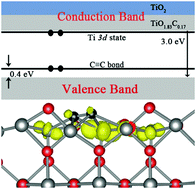
Mediating both valence and conduction bands of TiO2 by anionic dopants for visible- and infrared-light photocatalysis
DOI: 10.1039/C8CP00895G, Paper
By the formation of a C2 dimer in the carbon homo-doped TiO2 surface, opposite shifts of both valence and conduction bands are observed, which contribute to the narrowing of the band gap.
The content of this RSS Feed (c) The Royal Society of Chemistry
TiO2 photocatalysis for C-C bond formation
DOI: 10.1039/C7CY01458A, Minireview
Synergistic utilization of TiO2-photo-generated holes and electrons is a potential protocol for catalytic C-C bond formation reactions.
The content of this RSS Feed (c) The Royal Society of Chemistry
On the prediction of core level binding energies in molecules, surfaces and solids
DOI: 10.1039/C7CP08503F, Perspective
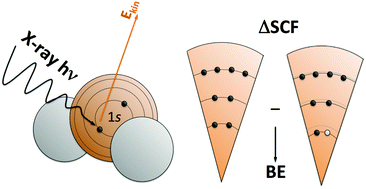
Core level binding energies, measured by X-ray photoelectron spectroscopy providing unique information regarding the chemical environment of atoms in a system, can be estimated by a diversity of state-of-the-art accurate methods here detailed.
The content of this RSS Feed (c) The Royal Society of Chemistry
[ASAP] Predicting the Band Gaps of Inorganic Solids by Machine Learning
[ASAP] Application of Clustering Algorithms to Partitioning Configuration Space in Fitting Reactive Potential Energy Surfaces
Goodbye to S2- in aqueous solution
DOI: 10.1039/C8CC00187A, Communication
S2-(aq) is a widespread but deleterious artefact which needs to be eliminated by the chemical community.
The content of this RSS Feed (c) The Royal Society of Chemistry
Oxidation of Sulfur Dioxide over V2O5/TiO2 Catalyst with Low Vanadium Loading: A Theoretical Study
Microwave-Assisted Greener Synthesis of Defect-Rich Tungsten Oxide Nanowires with Enhanced Photocatalytic and Photoelectrochemical Performance
Pair Natural Orbital Restricted Open-Shell Configuration Interaction (PNO-ROCIS) Approach for Calculating X-ray Absorption Spectra of Large Chemical Systems
Oxygen vacancy regulation on tungsten oxides with specific exposed facets for enhanced visible-light-driven photocatalytic oxidation
DOI: 10.1039/C7NR08590G, Paper
The density of oxygen vacancy on WO3 with specific exposed facets can be regulated through different cooling methods.
The content of this RSS Feed (c) The Royal Society of Chemistry
Adsorption of CO2 and Facile Carbonate Formation on BaZrO3 Surfaces
Roadmap for a Smart Factory: A Modular, Intelligent Concept for the Production of Specialty Chemicals
Abstract
Digitalization and increasing the flexibility of production concepts offer the possibility to react to market challenges in the field of specialty chemicals. Shorter product lifetimes, increasing product individualization, and the resulting market volatility impose new requirements on plant operators. Novel concepts such as modular production plants and developments in digitalization (Industry 4.0) are able to assist the implementation of smart factories in specialty chemicals. These essential concepts will be presented in this Minireview.
Products on demand: Modular, intelligent production concepts provide suitable solutions for the challenges that plant operators are facing in dynamic markets that have increasing product individualization. Concepts such as batch-to-conti and the integration of fast configurable modules have already proven their potential. Thus, the way towards a smart factory has already been paved.
WO3 Photoanodes with Controllable Bulk and Surface Oxygen Vacancies for Photoelectrochemical Water Oxidation
DOI: 10.1039/C7TA10056F, Communication
Introduction of oxygen vacancies for semiconductor photoanodes is an effective method to accelerate charge carriers transfer and improve the photoelectrochemical performance. However, excessive surface oxygen vacancies are always created in...
The content of this RSS Feed (c) The Royal Society of Chemistry
Pleading for a Dual Molecular-Orbital/Valence-Bond Culture
The history of the two main theories of chemical bonding, Valence Bond and Molecular Orbital theories, with their respective localized and delocalized visions of the electron pairs, is briefly recalled with an emphasis on their equivalence at comparable computational levels. The delocalized/localized alternative also exists in the very framework of MO theory, since localized MOs can be obtained through unitary transformations which leave Slater determinants invariant. In particular, the use of hybrid orbitals in chemical interpretations is thus perfectly justified. It is argued that a dual knowledge of both theories and their interconnections is of great help to get a complete understanding of the nature of bonding in molecules. Other means of switching from the delocalized to localized representations are also shown to be quite insightful in, e.g., hydrogen-bonding around water molecules, or conformational analysis of propene and many other unsaturated acyclic systems. It is shown that playing with such equivalent readings of the same wave function of dicarbon provides a very clear bonding picture for this enigmatic molecule, whereas the original untransformed wave function is ambiguous. The localized orbital representations of water, ethylene and dicarbon are shown to basically provide the same picture as the analysis of electron density maps as provided by the Maximum Probability Domains method and by the Dynamic Voronoi Metropolis Sampling method. Some current misconceptions are falsified, like the supposed existence of some unique "real" set of orbitals for a molecule, or the belief that the localized lone pair orbitals of water, the famous "rabbit-ear" hybrid orbitals, are in conflict with photoelectron spectroscopy.
Facile formation of mesoporous structured mixed-phase (anatase/rutile) TiO2 with enhanced visible light photocatalytic activity
DOI: 10.1039/C7CC05750D, Communication
A new mesoporous anatase/rutile TiO2 nanocomposite was synthesized at a lower calcination temperature, and exhibited a higher visible light photocatalytic activity.
The content of this RSS Feed (c) The Royal Society of Chemistry
Advances on Tungsten Oxide Based Photochromic Materials: Strategies to Improve Photochromic Properties
DOI: 10.1039/C7TC04189F, Review Article
Photochromic materials have been extensively studied because they are quite attractive and promising for many applications. Tungsten oxide (WO3), a typical photochromic material, has attracted considerable attentions. So far, many...
The content of this RSS Feed (c) The Royal Society of Chemistry
Promotional effect of Rh nanoparticles on WO3/TiO2 titanate nanotube photocatalysts for boosted hydrogen production
Source:Journal of Photochemistry and Photobiology A: Chemistry, Volume 353
Author(s): R. Camposeco, S. Castillo, V. Rodriguez-González, M. Hinojosa-Reyes, María I. Medina-Álvares, Isidro Mejía-Centeno
In this work, we explore the hydrogen production via the water splitting process on Rh-WO3 photocatalysts supported on nanotubes of TiO2. H2 production tests were performed in a 2-propanol-water solution. The support (titanate nanotubes, NT) was obtained, first, by the sol-gel method followed by the hydrothermal method. The surface of the titanate nanotubes was decorated with nanoparticles of rhodium and tungsten by applying microwave irradiation. The photocatalysts were characterized by XRD, HR-TEM, UV-vis, SBET, H2-TPR and XPS. For the photocatalytic tests, we employed two photocatalysts with 0.3 and 0.5wt.% of Rh on WO3/TiO2 (3wt.% of WO3) under UV-A light radiation at 365nm and visible light at 450nm. We found that 56μmolh−1 of hydrogen were produced by photolysis. The support (NT) produced 59μmolh−1 of hydrogen. The addition of 3wt.% of WO3 to the nanotubes increased slightly the H2 production (66μmolh−1). However, a promotional effect was observed when rhodium was added to the 3WO3/NT photocatalysts. In fact, the highest hydrogen production was obtained on the 0.5Rh-3WO3/NT photocatalyst (234μmolh−1), even after seven cycles of 8h. We suggest that Rh acts as co-catalyst of the WO3 during the water splitting process. A diagram for the density of states, based on the UV–vis and XPS results, is proposed.
Graphical abstract

Computational Chemistry: The Fate of Current Methods and Future Challenges
“Where do we go from here?” is the underlying question regarding the future (perhaps foreseeable) developments in computational chemistry. Although this young discipline has already permeated practically all of chemistry, it is likely to become even more powerful with the rapid development of computational hard- and software.
Enhanced electrochemical water oxidation: the impact of nanoclusters and nanocavities
DOI: 10.1039/C7CP06852B, Paper
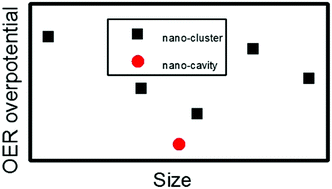
Hematite surfaces with a nanocavity are more active for OER than surfaces with nanoclusters.
The content of this RSS Feed (c) The Royal Society of Chemistry
Dissociative chemisorption of methane on Ni(111) using a chemically accurate fifteen dimensional potential energy surface
DOI: 10.1039/C7CP05993K, Paper
A new chemically accurate potential energy surface for the dissociative chemisorption of methane on the rigid Ni(111) surface.
The content of this RSS Feed (c) The Royal Society of Chemistry