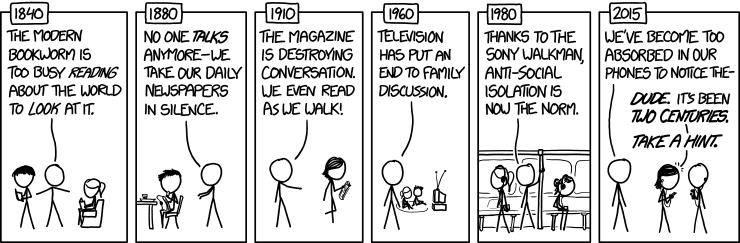
Explaining the TCP 3-way handshake to the younger generation


Explaining the TCP 3-way handshake to the younger generation


The gray lot under the I-93 overpass in downtown Boston didn’t have much to draw in pedestrians or foodies. It was empty, like so many other urban spaces orphaned by America’s lust for highways.
Now it has a farm. Not a tilled field—there’s not a ton of sunlight down there, and the exhaust fumes wouldn’t be great for human consumption. Instead, a refrigerated shipping container called a Leafy Green Machine sits in the newly redeveloped lot, churning out fresh produce even during cold New England winters.
That container is the brainchild of Freight Farms. Cofounder Brad McNamara had been consulting on rooftop greenhouse construction for several years, driven both by a love for good produce and for activating underutilized city spaces. But those projects can take a couple years, with the permitting and design, and the specific needs of each site make them hard to replicate. As a result, commercial-scale urban greenhouses require significant capital—a New York Times article on rooftop greenhouses reports they can cost between $1.2 million and $2 million, all told. That’s why McNamara and company started looking for a different approach. They soon found one, in the shipping container.
“There was this available envelope that had been perfectly engineered to withstand extreme temperatures and hold an internal climate, and also had an infrastructure ready to transport them,” McNamara says.
Refrigerated shipping containers made it possible to transport fresh and frozen produce throughout the world. Freight Farms outfits these containers with a vertical hydroponic grow system and LED lights, all of which are digitized to give the farmer detailed data on water flow, temperature, and lighting. They sell for about $80,000 each. McNamara says they’ve sold 50 this year, with customers in 16 states and a few Canadian provinces.
“We just harvested 50 pounds of baby kale in December and we had our first frost back in October.”The slim profile makes it easy to slip a farm into a city’s in-between spaces: the strips of field wedged between buildings, parking lots that never fill up, undeveloped side lots. Despite its small footprint, a 320-square-foot container can match the yield of a two acre plot of land, the company says, thanks to the highly efficient vertical hydroponics.
A majority of the customers come with no farming experience, McNamara says. They’re retired schoolteachers, former accountants, young people who want to run their own businesses—people who are passionate about growing food but don’t want to leave the city to do it. The company offers them an intensive “Farm Camp” training, and then sells the seeds, nutrients, and tools needed to get things up and running. “Their success is our success,” McNamara says. “Freight Farms goes nowhere if we sell something and people don’t succeed.”
But they also get customers in massive food services companies like Sodexo and Aramark, who want to supply their campus food contracts with fresh and locally grown fruits and vegetables. Other buyers are wholesale distributers, the companies that carry produce the last mile to local grocery stores and restaurants.

Jon Olinto got involved with Freight Farms as a way of supplying fresh greens to b.good, the Boston-based fast-healthy restaurant chain he cofounded. He’d dabbled in urban growing—like cultivating tomatoes in baby pools on the roof of one restaurant—but wanted to expand the supply by installing a freight farm.
It wasn’t so easy at first. The b.good team got turned down by landlord after landlord who didn’t want a farm on their property, but eventually made an arrangement with a property management company and the Massachusetts Department of Transportation to install one under the I-93 overpass. They partnered with Scott DeLuca, an ex-finance professional who wanted to start farming, and promised to buy DeLuca’s produce for the b.good restaurants. The first seeds went in at the end of September and have now matured. In the process, the space around the farm has evolved, too.
“Two years ago it really was wasteland—you would never even walk underneath it,” Olinto says. “This dead space has been converted to actually grow fresh veggies. It’s going to be 365 days a year. We just harvested 50 pounds of baby kale in December and we had our first frost back in October.”
That ability to serve foods he otherwise couldn’t, grown less than a mile away from the restaurant, leads Olinto to believe this concept could really take off.
”There’s always anxiousness around starting something new, but I think the market is really underserved,” he says. “I’m not the only restaurant owner who would love to source fresh produce all year from just around the corner.”
Freight Farms is ramping up production with a goal of shipping internationally next year. Closer to home, they’re also looking for partners to get the farms into food deserts, so food can be grown and sold in the community. If these plans succeed, cities a few years from now could be better fed and closer to the source of the food they eat, which would be quite a reversal for the box that kickstarted international food shipping.


Graphic artist Yang Liu has a sharp eye for cultural comparison, honed by personal experience. In 1990, at the age of 13, she moved from Beijing, to Berlin. After exactly 13 years there, she started an illustrated project to document her dual experiences in China and Germany.
Originally created as 47 simple blue and red posters, Yang Liu’s nonjudgmental series playfully captures the difference between cultures: from workplace hierarchy to restaurant etiquette. It has since been shown at the Ministry of Foreign Affairs in Germany, and was published in 2007 by art book authority Taschen with the title East Meets West.

“This project reflects very much my personal way of seeing things,” Liu told Quartz. She said that moving as a child gave her the habit of comparing situations and interactions. “Many situations are better to understood if they can be seen in relation.”
Juxtaposition appears to be a defining trait of Liu’s work: She has also published a similar series called Man meets Woman, also with Taschen. Here are few revelatory comparisons from East Meets West:


Research also demonstrates brain's plasticity and ability to adapt to new language environments
You may believe that you have forgotten the Chinese you spoke as a child, but your brain hasn’t. Moreover, that “forgotten” first language may well influence what goes on in your brain when you speak English or French today.
In a paper published today in Nature Communications, researchers from McGill University and the Montreal Neurological Institute describe their discovery that even brief, early exposure to a language influences how the brain processes sounds from a second language later in life. Even when the first language learned is no longer spoken.
It is an important finding because this research tells scientists both about how the brain becomes wired for language, but also about how that hardwiring can change and adapt over time in response to new language environments. The research has implications for our understanding of how brain plasticity functions, and may also be important information about creating educational practices geared to different types of learners.
The researchers asked three groups of children (aged 10 - 17) with very different linguistic backgrounds to perform a task that involved identifying French pseudo-words (such as vapagne and chansette). One group was born and raised in unilingual French-speaking families. The second group were adopted from China into a French-speaking family before age three, stopped speaking Chinese, and from that point on heard and used only French. The third group were fluently bilingual in Chinese and French. As the children responded to the words they heard, the researchers used functional magnetic resonance imaging (fMRI) to look at which parts of their brains were being activated.
Although all groups performed the tasks equally well, the areas of the brain that were activated differed between the groups. In monolingual French children with no exposure to Chinese, areas of the brain, notably the left inferior frontal gyrus and anterior insula, expected to be involved in processing of language-associated sounds were activated. However, among both the children who were bilingual (Chinese/French) and those who had been exposed to Chinese as young infants and had then stopped speaking it, additional areas of the brain, particularly the right middle frontal gyrus, left medial frontal cortex, and bilateral superior temporal gyrus were activated.
 The researchers found that the Chinese children who had been adopted into unilingual French families and no longer spoke Chinese, and so were functionally unilingual at the time of testing, still had brains that processed language in a way that is similar to bilingual children.
“During the first year of life, as a first step in language development, infants' brains are highly tuned to collect and store information about the sounds that are relevant and important to the language they hear around them,” said Lara Pierce, a doctoral student at McGill and the first author on the article. “What we discovered when we tested the children who had been adopted into French-language families and no longer spoke Chinese, was that, like children who were bilingual, the areas of the brain known to be involved in working memory and general attention were activated when they were asked to perform tests involving language. These results suggest that children exposed to Chinese as infants process French in a different manner to monolingual French children.”
The researchers believe that their findings speak to the unique and lasting influence of early language experience on later brain organization, as well as to the brain's ability to adapt to new language environments in order to gain proficiency in a new language.
“The adopted children we tested have an interesting background because they were exposed to one language from birth, but completely discontinued that language at a young age when they were adopted into families who speak a different language,” says Pierce. “This is very interesting from a language development perspective because it allows us to look at the influence of just that very early period of language development on later language processing, separately from the effects of ongoing exposure to one or more languages.”
The researchers are interested in knowing whether similar areas of the brain would be activated if the languages that had been “lost” and “gained” through adoption were closer together than Chinese and French, such as French and Spanish for example.
To read the full article “Past Experience Shapes Ongoing Neural Patterns for Language” by Lara Pierce et al in Nature Communications: http://www.nature.com/ncomms/2015/151201/ncomms10073/full/ncomms10073.html

Here’s an alarming but little-known figure—stray cats and pet cats allowed outdoors kill 3.6 million birds every day on average in the United States, for a total of at least 1.3 billion birds per year. That’s most likely a sizable chunk out of the U.S. land-bird population, which the Smithsonian Migratory Bird Center estimates is around 10-20 billion. While habitat loss and climate change pose long-term dangers to birds in this country, recent research shows that outdoor cats currently kill more of them than any other threat caused by humans.
It’s not just a problem in the U.S. A 2011 study found that domestic cats have directly contributed to extinctions of 22 bird species on islands around the world, and threatened dozens more. Researchers in the United Kingdom estimated that 55 million birds fall prey to domestic cats there each year; in Australia, threats to endangered species led government officials to announce plans for euthanizing 2 million feral cats.
Cat predation of wildlife, in other words, is a worldwide issue. But here’s something else that stretches across borders: People love cats. In the U.S., there are about 84 million pet cats, and around 46 million of them are allowed to roam outside. An estimated 30-80 million more live as strays. That’s a lot of cats, and many spend their days doing what they’ve done since the first cats were domesticated more than 9,000 years ago: hunting small animals. Humans originally used domesticated cats as efficient predators, protecting stores of food from vermin. But there’s little need for working cats anymore; these days, most people just think of them as gentle companions and Internet memes. But their instincts haven’t caught up to our evolving needs—cats are still highly effective stealth hunters. And our having them around in such numbers means trouble for birds.Some cat owners aren’t aware of the problem; some are, but feel that the companionship they receive from their pet outweighs their small contribution to a broader issue. But some cat lovers are also bird lovers. Two of them, a birdwatcher named Nancy Brennan and a bird biologist named Susan Willson, have developed what they believe is a solution.
Brennan, 57, spent much of her career in conservation and environmental planning. She grew up in rural New England, where cats lived indoors and outdoors; she and her husband, who live in the Vermont woodlands near Green Mountain National Forest, took the same approach with their cat George. But hunting opportunities near their home are abundant, and for months after they moved in Brennan became increasingly frustrated as George dragged bird after bird into the house.
Many cats spend their days doing what cats have done since they were first domesticated: hunting small animals.The breaking point, Brennan recalls, happened on the first spring-like day of 2008, when she heard “a ruckus” coming from just outside the house. It was George, struggling to pull a ruffed grouse, a gamebird the size of a small chicken, through the cat door. That morning, she vowed to either find a way to stop George’s hunting habits or bring him to the Humane Society.
Brennan already knew George couldn’t become an indoor cat, but her past attempts to keep him away from birds had failed. She had tried tying extra bells on his collar, but it seemed the cat moved too stealthily for the bells to have any sort of warning effect on his prey.Then she recalled something she’d read about birds—they have excellent color vision. Birds have four color pigments in their eyes, compared to three in primates and just two in other mammals. While this adaptation helps birds find food and choose brightly colored mates, Brennan realized she might be able to put it to another use. She took up her sewing tools and gathered some multi-patterned fabric, piecing together something that resembled a ruffled Elizabethan collar with a bright color scheme. She fastened it as a cover over George’s usual collar and let him outside.
Sure enough, George returned home later that day without any birds—and none the next few days, either. As spring and summer passed without a single bird, she began to believe that she might be on to something that could work for other cat owners, too. She began tinkering with the prototype and created a website to sell the collar, which she named Birdbesafe. Over the next few years, she used customer feedback to zero in on which colors and patterns worked best.
The collars began to sell steadily, but they still remained scientifically unproven until 2013, when Willson, who studies tropical birds at St. Lawrence University stumbled upon the Birdbesafe website while looking for a way to rein in the hunting habits of her cat Gorilla. Soon after she brought him home, Gorilla began presenting Willson with dead birds, generally about two each week—a behavioral remnant, she believes, of his time as a stray, when he survived by catching and eating birds. “I’m a bird biologist. That was not a good thing, that was horrifying,” she said. Intrigued by the anecdotal evidence on the Birdbesafe site, she ordered a collar cover. Gorilla was beaten at last—he still caught voles, but he stopped bringing home birds altogether.
Intrigued by the collar’s success, Willson contacted Brennan and explained her idea for an experiment. She enlisted a group of cat owners near her home in Canton, New York, all of whom were dealing with bird-hunting pets of their own. She divided the cats into two groups, one that wore collars and one that didn’t; every two weeks, the Birdbesafe group and the control group switched places. Over the course of that fall, the cats brought home 3.4 times fewer birds while wearing Birdbesafe collars. The following spring, the collar covers made an even bigger difference—the cats killed 19 times as many birds while in the control group than while wearing Birdsbesafe.
“It was spectacular,” Willson said. She speculates that the difference was larger in the spring because birds are distracted from watching for predators at that time of the year, when high levels of hormones like testosterone cause them to focus on breeding behavior. The collar cover gave birds extra warning during the season when they’re least watchful.

Willson’s study was published earlier this year in the journal Global Ecology and Conservation. A few weeks after it came out, Australian researchers published a similar study in the journal Applied Animal Behaviour. This second paper found that Birdbesafe wasn’t just effective for birds—compared to control animals, cats wearing the collar killed 47 percent fewer animals with good color vision, a group that also includes reptiles.
For now, Birdsbesafe is available in scattered pet stores and bird-supply shops in 16 U.S. states and four other countries. Brennan says that since the scientific papers came out, sales have been greater than in all past years combined.But some animal experts remain skeptical that the collar can be a large-scale solution to the problem of cat predation. “There’s some value to it,” said John Carroll, a biologist at the University of Nebraska who has studied the issue, “but it doesn’t get to the root of the problem” of the environmental damage caused by free-range cats. This goes beyond simply killing things—by competing with native predators for food, carrying diseases to other species, causing stress in birds and other prey animals, and mating with native wildcats, domestic cats can cause wide-ranging harm in fragile ecosystems. The Australian researchers that tested Birdsbesafe also concluded that while it helped save birds, it was not appropriate for protecting endangered mammals, which rely on smell and don’t pick out bright colors.
Brennan said she doesn’t see her collars as a pass for pet owners to let their animals live largely outdoors. Instead, she sees Birdsbesafe as an answer for people with cats that are unmanageable indoors. “This is another solution so we can keep chipping away at that problem,” she said.
Willson believes that Birdsbesafe collars could be used in feral-cat colonies as well. Feral cats kill more birds than owned cats do, she said, and their numbers are huge. Currently, Willson is preparing to test Birdsbesafe in France and at a handful of other sites around the world. New Zealand biologists just announced plans to test the collar covers as well.
In the meantime, on a much smaller scale, the collar has managed to solve at least one problem: Brennan’s cat “started sleeping in” instead of stalking wildlife.
“Some of them just retire,” Brennan said. “He had never missed a dawn hunting until he had been wearing my contraption for about a year. He was just like, ‘Oh, forget it.’”
This post originally appeared on The Atlantic.

Let’s admit it. Few of us like to think, much less talk about our colons. But you might be surprised at the importance of what gets into your colon and what goes on inside it. This little-loved part of our bodies is actually less an onboard garbage can and more like the unlikeliest medicine chest.
There is abundant medical evidence that diet greatly influences health, and new science is showing us why this is so. It is also showing us that advocates of trendy paleo and vegan diets are missing the big picture of how our omnivorous digestive system works.
Your colon is the home for much of your microbiome—the community of microbial life that lives on and in you. In a nutshell, for better and worse, what you eat feeds your microbiome. And what they make from what you eat can help keep you healthy or foster chronic disease.
To gain an appreciation of the human colon and the role of microbes in the digestive tract as a whole, it helps to follow the metabolic fate of a meal. But, first, a word about terms. We’ll refer to the digestive tract as the stomach, small intestine, and colon. While the colon is indeed called the “large intestine,” this is a misnomer of sorts. It is no more a large version of the small intestine than a snake is a large earthworm.
The stomach might better be called a dissolver, the small intestine an absorber, and the colon a transformer. These distinct functions help explain why microbial communities of the stomach, small intestine, and colon are as different from one another as a river and a forest. Just as physical conditions like temperature, moisture, and sun strongly influence the plant and animal communities that one sees on a hike from a mountain peak to the valley below, the same holds true along the length of the digestive tract.
How is it that the bulk of what humanity now eats could undermine our health?
Imagine you are at a Fourth of July barbecue. You saunter over to the grill to take a look at the fare. The pork ribs look great so you spear a few and add a heap of homemade sauerkraut on the side. You grab a handful of corn chips and a few pieces of celery. The vegetable skewers look good too, so you add one to the pile on your plate. And what would the Fourth of July be without macaroni salad and pie?
You lift a rib to your mouth and start gnawing. A forkful of sauerkraut mingles well with the meat and you crunch your way through another mouthful. The macaroni squishes between your teeth, but the celery takes some chewing. It all slips down the hatch and lands in the acid vat of your stomach where gastric acids start dissolving the bits of food. On the pH scale, where 7 is neutral and lower values are more acidic, the stomach is impressive. Its acidity ranges from 1 to 3. Lemon juice and white vinegar are about a 2.
After the stomach acids work over your meal, the resultant slurry drops into the top of the small intestine. Right away bile from the liver shoots in and starts working over the fats, breaking them down. Pancreatic juices also squirt into the small intestine to join the digestive party. Your Fourth of July feast is now on its way to full deconstruction into the basic types of molecules—simple and complex carbohydrates (sugars), fats, and proteins. In general, there is an inverse relationship between the size and complexity of these molecules and their fate in the digestive tract. Smaller molecules, primarily the simple sugars that compose the refined carbohydrates in the macaroni, pie crust, and chips are absorbed relatively quickly. Larger or more complex molecules take longer to break down and are absorbed in the lower reaches of the small intestine.
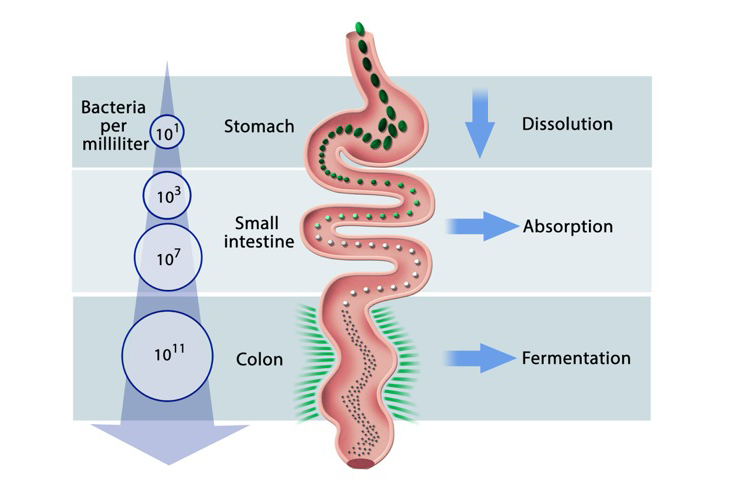
The sausage-like loops of the small intestine provide an entirely different type of habitat for your microbiota than the stomach. Acidity drops off rapidly and, in combination with all the nutrients, the abundance of bacteria shoots up to 10,000 times more than that in the stomach. But conditions still aren’t ideal for bacteria in the small intestine. It’s too much like a flooding river. And understandably so, considering that about seven quarts of bodily fluids, consisting of saliva, gastric and pancreatic juices, bile, and intestinal mucus flow through it every day. And that’s not including the two additional quarts of whatever other liquids you consume. The rushing swirl of fluids entrains food molecules and bacteria and carries them rapidly downstream. The constant motion means that nothing stays put for long, so bacteria can’t really settle in and contribute much to digestion.
By the middle to lower reaches of your small intestine, the fats, proteins, and some of the carbohydrates in the Fourth of July slurry are sufficiently broken down for absorption and pass into the bloodstream through the intestinal wall. Notice we said some of the carbohydrates. A good amount of them aren’t broken down at all. These complex carbohydrates, what your doctor calls fiber, have a completely different fate than simple carbohydrates.
They drop, undigested, into the slough-like environment of the colon. With a neutral pH of about 7, the colon is a paradise for bacteria compared to the acid vat of the stomach or the churning rapids of the small intestine, where the pH is slightly lower.
Deep within the safety of our inner sanctum, communities of microbial alchemists use our colon as a transformative cauldron in which to ferment the fiber-rich complex carbohydrates we can’t digest. But it takes the right microbes. For example, Bacteroides thetaiotaomicron makes over 260 enzymes that break apart complex carbohydrates. In contrast, the human genome codes for a paltry number. We can only make about 20 enzymes to break down complex carbohydrates.
Grain Wreck
Our built-in cauldron and the fiber fermenters that run it are akin to personal pharmacists. They can churn out a great many medicinal compounds, and all of them are vital to the health and normal functioning of our colon cells. But we will only reap the benefits of butyrate and other alchemical products from our microbiome if we send lots of fiber down the hatch.
In thinking about such connections, the seeds of the world’s major cereal crops (grains) are a good place to start, as they account for the lion’s share of what the world eats. Lucky for us, grains offer a nearly perfect nutritional package. Whether wheat, barley, or rice, all have the basics—proteins, fats, and carbohydrates, along with health-boosting vitamins, minerals, and phytochemicals. But how is it that the bulk of what humanity now eats could undermine our health?
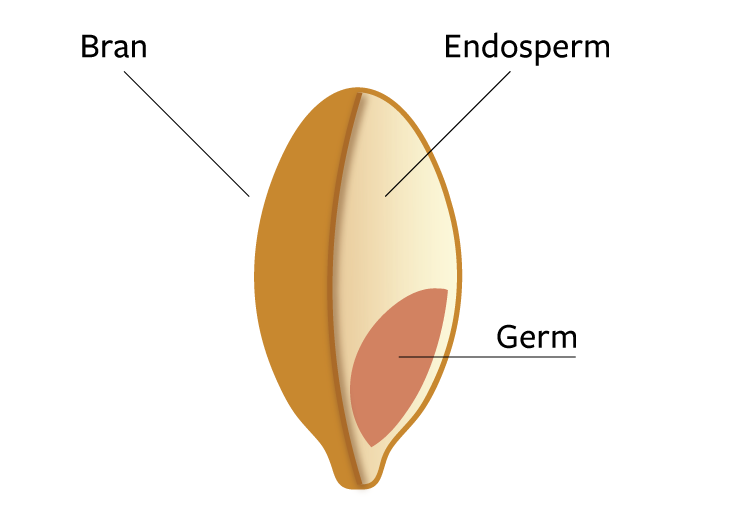
It has to do with the structure of a plant seed and what we do to them after they are harvested. Consider a grain of wheat. The outer seed coat (the “bran”) and the inner embryo (the “germ”) are small in terms of the overall seed weight. The bran composes about 14 percent of the total weight, while the germ adds another 3 percent. Despite their low weight, these two parts of a seed are packed full of nutrients. And the bran in particular is rich in complex carbohydrates, although a chemist calls them polysaccharides—very long chains of sugar molecules.
Many diet gurus shun our inner omnivore. We are constantly urged to eat a narrow (and ever-changing!) slice of omnivory.
The remaining 83 percent of a seed by weight is the endosperm. It contains most of the simple carbohydrates and nearly all the proteins found in a seed. In effect, the endosperm is like the placenta of a plant. Had the seed fallen to the ground and germinated, the simple carbohydrate-rich endosperm would have provided for the seed until it grew roots and leaves and could feed itself. While a sprouting plant clearly needs this type of supercharged energy supply, it’s not so good for us in large amounts.
When someone says a grain is “refined,” it means that the bran and the germ are stripped out when the seed is milled. Only the endosperm remains. Grind up the endosperm of wheat grains and you have white flour, which to your small intestine is an easily absorbable sugar.
All cereal grains are amenable to refining. It’s the basis for all those eye-popping choices of boxed and bagged items in grocery stores around the globe, especially in the Western world. Refine corn, add some fats back, toss with salt, and you get the perfect tortilla chip. Do the same with wheat and you can make a fine cracker or bread.
Part of the reason grains are refined is because the fats go rancid—things made from refined flours last longer. Also, bakers don’t like bran in flour because it interferes with the elasticity of dough and inhibits rising. Removing these pesky parts of a grain solves those problems. But it causes a whole host of new ones for our bodies. When a seed goes through milling and processing, its perfect nutritional package falls apart.
Looking back at carbohydrate consumption over the last century reveals some interesting trends. Americans ate about the same amount of total carbohydrates in 1997 as we did in 1909—just not the same kinds. Over this time period, the proportion of carbohydrates from whole grains dropped from more than half of what we consumed to about a third. What replaced whole grains was food products made from different kinds of refined grains. In other words, for the first time in human history we now eat mostly the simple sugar part of a grain (the endosperm) and far less of the complex carbohydrate part of a grain (the bran and the germ).
The small intestine and colon handle a whole grain very differently than they do a refined grain. When complex carbohydrates remain bound together with other molecules in whole grains, it takes longer for enzymes to find the carbohydrates and start breaking them down. It’s like trying to open a cardboard box triple-wrapped in duct tape versus a box with an easy-open pull tab. Also, the sugar molecules from whole grains have to jockey for space with the protein and fat molecules to make contact with the absorptive cells in the small intestine, further slowing the sugar-absorption process. Plain and simple, when whole grains remain intact, your body absorbs the sugar component at a markedly slower rate. And the indigestible part of whole grains (and many other plant foods) pass into the colon where the fiber fermenters feast on it, producing copious amounts of butyrate.
In contrast, refined grains release a veritable fire hose of glucose, which our small intestine dutifully absorbs and passes on to the bloodstream. This sends insulin charging out of the pancreas to shuttle glucose from the blood into cells. But using cells as a place to endlessly stockpile sugar can eventually lead to other problems. And so, our wonderfully efficient bodies attempt to solve this problem—by converting excess sugar into fat and moving the overage into depot-like fat cells. When we need this energy, like in the middle of the night long before breakfast, it’s there for our use. But an abundance of refined carbohydrates converted into fats overshoots the needs of the average American. It’s a recipe that fuels inflammation and the onset of Type 2 diabetes, obesity, and other maladies.
The amount of meat in the Western diet can also pose problems. When consumed in relatively large quantities, animal protein is not completely broken down by the time it reaches the lower end of the small intestine. Eat too much meat and your overwhelmed small intestine delivers partially digested animal protein to the colon. When bacteria in the colon encounter intact or partially digested protein, a different kind of alchemy gets underway—protein putrefaction.
The problem with putrefaction stems from some of the elements of which animal proteins are made—a fair bit of nitrogen and small amounts of sulfur. Ammonia, nitrosamines, and hydrogen sulfide probably don’t mean much to the average person. But they are among the nitrogen and sulfur-containing compounds that bacterial putrefiers create. These compounds pack a toxic punch to cells lining the colon. They interfere with the uptake of butyrate, which deprives colonic cells of the energy they need to keep the colon functioning in top shape. The spaces between cells begin widening and the contents of the colon itself begin seeping out into surrounding tissue and leaky gut syndrome sets in. Undernourished cells start falling down on the job and cellular waste products begin to accumulate inside cells, which gums up other cellular operations. In addition, goblet cells, whose main purpose is to make and secrete the mucus that coats and protects the colon lining, slow down on mucus production. This makes the colon lining more vulnerable to pathogens and physical damage. This is not a trivial point. The colon is a busy place and the cells lining it constantly regenerate throughout a person’s life. If cells aren’t regularly replaced, the effects are somewhat like a house that goes unmaintained. Lots of little problems add up to bigger problems, and eventually the house starts to fall apart.
Other problematic byproducts are made in the colon. Eating lots of fat stimulates the liver to produce bile and deliver it to the small intestine. We need bile. It acts like a detergent and breaks fats into smaller molecules so they can be absorbed. Almost all of the bile used in the small intestine gets transported back to the liver after fats are sufficiently broken down. The key word here is almost. About 5 percent of bile secretions keep moving down the digestive tract and land in the colon. So, people who eat lots of fat secrete more bile to break down the fats, which means more bile ends up in the colon.
But guess who gets ahold of this bile and transforms it? Our colonic microbiota. They convert bile into decidedly vile compounds called secondary bile acids. And like putrefaction byproducts, secondary bile acids are toxic to cells lining the colon.
The Omnivore Within
As adherents of the paleo diet like to remind us, humans have long eaten meat. They stress that meat is a fabulous source of many nutrients, especially if the animals being eaten were raised without antibiotics and allowed to follow their normal way of eating. Vegetarians and vegans also admonish us, pointing out that people who eat a plant-based diet generally have lower rates of cardiovascular disease and Type 2 diabetes. They also point out that plants possess what animals don’t—an astounding arsenal of cancer-fighting phytochemicals.
In other words, both of these countervailing dietary perspectives—paleo and plant-based—contain more than a germ of truth. So consider another perspective. Combining elements of each diet makes a lot of sense given what our colonic microbiota do with the meat, fats, and plants we eat.
Here’s how it might play out. Imagine the putrefaction byproducts from undigested meat and secondary bile acids soaking the cells lining the colon. DNA mutations occur and a few abnormal colon cells start regenerating and gain the upper hand, ignoring instructions from immune cells to self-destruct. But follow this scene with a tsunami of butyrate, and the colonic cells perk up. Renegade cells succumb to immune cells. Prodigious amounts of undigested complex carbohydrates from plant foods enter the colon, dislodge and mop up secondary bile acids, thereby reducing contact between these carcinogens and the colon lining. Normal cell growth and functions resume, maintaining the health of the cauldron and thereby the body at large.
This scenario is ingenious from both a health and an ecological perspective. The fiber fermenters have solutions for problems the protein putrefiers create. Plus, everyone in the cauldron gets fed—with either complex carbohydrates, or the castoffs of undigested proteins and leftover bile acids. So long as the byproducts of the fiber fermenters prevail, the colon serves as a medicine chest rather than a toxic dump.
Here’s another way to think of your colon: The gut of each and every one of us is akin to a garden.
We are the most omnivorous creatures on the planet, with a vast array of domesticated crops and animals and wild foods at our fingertips. There is hardly anything people don’t eat—from the blubber of whales, the intestinal lining of pigs, caterpillars, rotten fish, raw fish, and seaweed, to the more mundane items like meat, dairy, bread, fruits, nuts, and vegetables. Yet many diets and diet gurus shun our inner omnivore. Instead, we are constantly urged to eat a narrow (and ever-changing!) slice of omnivory. Ideas for what we should eat have swung like a pendulum—more toward meat, or more toward vegetables, away from fats, then toward certain kinds of fats, toward whole grains, now away from all grains.
No wonder so many of us are either sick or tired, or both. Perhaps it’s worth focusing on what to feed our personal alchemists so that we realize the benefits. The mechanics are pretty simple. Pick a modest-sized plate and make meals using vegetables, legumes, leafy greens, beans, fruits, and unmilled whole grains as the main ingredients. Add some meat if you want and dollops of healthy fats on the side or sprinkled through the plant foods. Desserts and sweets are special, so save them for the special times.
We realize a diet like this doesn’t lend itself to being packaged and sold. It emphasizes how to think about food in the context of one’s microbiome, rather than prescribing a narrow choice of foods, counting calories, or advocating “dieting” as a daily activity. This advice is far from sexy and certainly not earth-shattering.
Understandably, special dietary considerations apply to people with gut dysfunctions or who are diabetic or allergic to specific foods. But for most of us the key to healthy eating may be as simple as balance and diversity—and sidelining refined carbohydrates. In other words, provide plenty of mulch for your fiber fermenters so that they can churn out far more of their nutritional gold than what your protein putrefiers and bile acid modifiers conjure up. Keeping the fiber-lovers on top means filling the cauldron every day with fermentative fodder so that it bubbles with things that are good for you.
If you haven’t grown any fonder of your colon and its capabilities by this point, try another way to think about it. The gut of each and every one of us is akin to a garden. And as many gardeners know, the plants that make a garden are only as vibrant and resilient to pests and pathogens as the soil in which they are rooted. The real key to a vibrant and healthy garden—both inside and outside our bodies—comes from cultivating legions of beneficial bacteria. The not-so-secret ingredient for doing so? Mulch. That’s right, plant matter for the tiny alchemists in our colonic cauldron to feast upon just as they do in garden soil. When they fill up on such fodder, we harvest a well-stocked medicine chest.
David R. Montgomery is Dean’s professor of geomorphology at the University of Washington and a MacArthur Fellow. Anne Biklé is a biologist and gardener.
Excerpted from The Hidden Half of Nature: The Microbial Roots of Life and Health by David R. Montgomery and Anne Biklé. Copyright © 2016 by David R. Montgomery and Anne Biklé. With permission of the publisher, W.W. Norton & Company, Inc. All rights reserved. This selection may not be reproduced, stored in a retrieval system, or transmitted in any form by any means without the prior written permission of the publisher.
Lead photo by H. Armstrong Roberts/ClassicStock/Getty Images
This is a web site (under construction) for young students - and anyone else - who are (like me) thrilled by the challenges posed by real science, and who are - like me - determined to use their brains to discover new things about the physical world that we are living in. In short, it is for all those who decided to study theoretical physics, in their own time.
It so often happens that I receive mail - well-intended but totally useless - by amateur physicists who believe to have solved the world. They believe this, only because they understand totally nothing about the real way problems are solved in Modern Physics. If you really want to contribute to our theoretical understanding of physical laws - and it is an exciting experience if you succeed! - there are many things you need to know. First of all, be serious about it. All necessary science courses are taught at Universities, so, naturally, the first thing you should do is have yourself admitted at a University and absorb everything you can. But what if you are still young, at School, and before being admitted at a University, you have to endure the childish anecdotes that they call science there? What if you are older, and you are not at all looking forward to join those noisy crowds of young students?
It should be possible, these days, to collect all knowledge you need from the internet. Problem then is, there is so much junk on the internet. Is it possible to weed out those very rare pages that may really be of use? I know exactly what should be taught to the beginning student. The names and topics of the absolutely necessary lecture courses are easy to list, and this is what I have done below. It is my intention to search on the web where the really useful papers and books are, preferably downloadable as well. This way, the costs of becoming a theoretical physicist should not exceed much the price of a computer with internet connection, a printer, and lots of paper and pens. Unfortunately, I still have to recommend to buy text books as well, but it is harder to advise you here; perhaps in a future site. Let’s first limit ourselves to the absolute minimum. The subjects listed below must be studied. Any omission will be punished: failure. Do get me right: you don’t have to believe anything you read on faith - check it. Try alternative approaches, as many as you can. You will discover, time and again, that really what those guys did indeed was the smartest thing possible. Amazing. the best of the texts come with exercises. Do them. find out that you can understand everything. Try to reach the stage that you discover the numerous misprints, tiny mistakes as well as more important errors, and imagine how you would write those texts in a smarter way.
I can tell you of my own experiences. I had the extreme luck of having excellent teachers around me. That helps one from running astray. It helped me all the way to earn a Nobel Prize. But I didn’t have internet. I am going to try to be your teacher. It is a formidable task. I am asking students, colleagues, teachers to help me improve this site. It is presently set up only for those who wish to become theoretical physicists, not just ordinary ones, but the very best, those who are fully determined to earn their own Nobel Prize. If you are more modest than that, well, finish those lousy schools first and follow the regular routes provided by educators and specialized -gogues who are so damn carefully chewing all those tiny portions before feeding them to you. This is a site for ambitious people. I am sure that anyone can do this, if one is gifted with a certain amount of intelligence, interest and determination. Now, here begins the serious stuff. Don’t complain that it looks like being a lot. You won’t get your Nobel Prize for free, and remember, all of this together takes our students at least 5 years of intense study (at least one reader was surprised at this statement, saying that (s)he would never master this in 5 years; indeed, I am addressing people who plan to spend most of their time to this study). More than rudimentary intelligence is assumed to be present, because ordinary students can master this material only when assisted by patient teachers. It is necessary to do exercises. Some of the texts come with exercises. Do them, or better, invent your own exercises. Try to outsmart the authors, but please refrain from mailing to me your alternative theories until you have studied the entire lot; if you do this well you will discover that many of these authors were not so stupid after all.
Theoretical Physics is like a sky scraper. It has solid foundations in elementary mathematics and notions of classical (pre-20th century) physics. Don’t think that pre-20th century physics is “irrelevant” since now we have so much more. In those days, the solid foundations were laid of the knowledge that we enjoy now. Don’t try to construct your sky scraper without first reconstructing these foundations yourself. The first few floors of our skyscraper consist of advanced mathematical formalisms that turn the Classical Physics theories into beauties of their own. They are needed if you want to go higher than that. So, next come many of the other subjects listed below. Finally, if you are mad enough that you want to solve those tremendously perplexing problems of reconciling gravitational physics with the quantum world, you end up studying general relativity, superstring theory, M-theory, Calabi-Yau compactification and so on. That’s presently the top of the sky scraper. There are other peaks such as Bose-Einstein condensation, fractional Hall effect, and more. Also good for Nobel Prizes, as the past years have shown. A warning is called for: even if you are extremely smart, you are still likely to get stuck somewhere. Surf the net yourself. Find more. Tell me about what you found. If this site has been of any help to someone while preparing for a University study, if this has motivated someone, helped someone along the way, and smoothened his or her path towards science, then I call this site successful. Please let me know. Here is the list.
Note that this site NOT meant to be very pedagogical. I avoid texts with lots of colorful but distracting pictures from authors who try hard to be funny. Also, the subjects included are somewhat focused towards my own interests.
LIST OF SUBJECTS, IN LOGICAL ORDER ARE ON THE SIDE. (Not everything has to be done in this order, but this approximately indicates the logical coherence of the various subjects. Some notes are at a higher level than others).

The sign put up by the facilities manager of North Berkeley Properties at 2115 Shattuck Ave. in downtown Berkeley to warn people about a liquid repellent coating on the wall. Photo: Ethan Cheng
An employee at a downtown Berkeley business was getting tired of people using an alleyway on Shattuck Avenue as a toilet and decided to do something about it.
Ethan Cheng, the facilities manager at North Berkeley Properties, said the recessed space between Arinell Pizza at 2119 Shattuck and Bank of America at 2129 has had problems with graffiti and public urination for as long as he can remember, even though it is checked and cleaned up regularly by the downtown Berkeley ambassadors.
“I never could figure out how to fix the issue until I read an article in the San Francisco Chronicle about how the San Francisco Public Works Department was trying to combat a similar issue on its public walls,” Cheng told Berkeleyside.(...)
Read the rest of Berkeley business tries novel way to stop public urination (291 words)
By Tracey Taylor. |
Permalink |
27 comments |
Post tags: Downtown Berkeley, North Berkeley Properties, Pee-repellent paint, Liquid repellent coating, Berkeley businesses
Check informit.com/knuth throughout 2014 to purchase Vol 3-4A eBooks as they become available. If you want email notifications, send an email to taocp@awl.com.
1. Jon Bentley, researcher: What a treat! The last time I had an opportunity like this was at the end of your data structures class at Stanford in June, 1974. On the final day, you opened the floor so that we could ask any question on any topic, barring only politics and religion. I still vividly remember one question that was asked on that day: "Among all the programs you've written, of which one are you most proud?"
Your answer (as I approximately recall it, four decades later) described a compiler that you wrote for a minicomputer with 1024 available bytes of memory. Your first draft was 1029 bytes long, but you eventually had it up and running and debugged at 1023 bytes. You said that you were particularly proud of cramming so much functionality into so little memory.
My query today is a slight variant on that venerable question. Of all the programs that you've written, what are some of which you are most proud, and why?
Don Knuth: I'd like to ask you the same! But that's something like asking parents to name their favorite children.
Of course I'm proud of  and
and  , because they seem to have helped to change the world, and because they led to many friendships. Furthermore they've made these eBooks possible: I'm enormously happy that the work I did more than 30 years ago has miraculously survived many changes of technology, and that the 3,000 pages of TAOCP now look so great on a little tablet—even after zooming.
While I was preparing for Volume 4 of TAOCP in the 90s, I wrote several dozen short routines using what you and I know as "literate programming." Those little essays have been packaged into The Stanford GraphBase (1994), and I still enjoy using and modifying them. My favorite is the implementation of Tarjan's beautiful algorithm for strong components, which appears on pages 512–519 of that book.
I have to admit some pride also in the implementation of IEEE floating-point arithmetic that appears in my book MMIXware (1999), as well as that book's metasimulator for MMIX, in which I explain many principles of advanced pipelined computers from the ground up.
Literate programming continues to be one of the greatest joys of my life. In fact, I find myself writing roughly two programs per week, on average, both large and small, as I draft new material for the next volumes of TAOCP.
2. Dave Walden, Users Group: Might you publish the original 3,000-page version of TAOCP (before the decision to change it into seven volumes), as a historical artifact of your view of the state of the art of algorithms and their analysis circa 1965? I think lots of people would like to see this.
Don Knuth: Scholars can look at the handwritten pages that led to Volumes 1–3 by going to the Stanford Archives, and all of the remaining pages will be deposited there eventually. I see little value in making those drafts more generally available—although some of the material about baseball that I decided not to use is pretty cool. Archives from the real pioneers of computer science, who wrote in the 40s and 50s, should be published first.
I do try to retain the youthful style of the original, in the pages that I write today, except where my first draft was embarrassingly naïve or corny. I've also learned when to say "that" instead of "which," thanks in part to Guy Steele's tutelage.
3. Charles Leiserson, MIT: TAOCP shows a great love for computer science, and in particular, for algorithms and discrete mathematics. But love is not always easy. When writing this series, when did you find yourself reaching deepest into your emotional reservoir to overcome a difficult challenge to your vision?
Don Knuth: Again, Charles, I'd like to ask you exactly the same question!
For me, I guess, the hardest thing has always been to figure out what to cut. And I obviously haven't been very successful at that, in spite of much rewriting.
The most difficult technical challenge was to write the metasimulator for MMIX. I needed to do that behind the scenes, in order to shape what actually appears in the books, and it was surely the toughest programming task that I've ever faced. Without the methodology of literate programming, I don't think I could have finished that job successfully.
Many of the "starred" mathematical sections also stretched me pretty far. Overall, however, after working on TAOCP for more than fifty years, I can't think of any aspect of the activity where the effort of writing wasn't amply repaid by what I learned while doing it.
4. Dennis Shasha, NYU: How does a beautiful algorithm compare to a beautiful theorem? In other words, what would be your criteria of beauty for each?
Don Knuth: Beauty has many aspects, of course, and is in the eye of the beholder. Some theorems and algorithms are beautiful to me because they have many different applications; some because they do powerful things with severely limited resources; some because they involve aesthetically pleasing patterns; some because they have a poetic purity of concept.
For example, I mentioned Tarjan's algorithm for strong components. The data structures that he devised for this problem fit together in an amazingly beautiful way, so that the quantities you need to look at while exploring a directed graph are always magically at your fingertips. And his algorithm also does topological sorting as a byproduct.
It's even possible sometimes to prove a beautiful theorem by exhibiting a beautiful algorithm. Look, for instance, at Theorem 5.1.4D and/or Corollary 7H in TAOCP.
5. Mark Taub, Pearson: Does the emergence of "apps" (small, single-function, networked programs) as the dominant programming paradigm today impact your plans in any way for future material in TAOCP?
Don Knuth: People who write apps use the ideas and paradigms that are already present in the first volumes. And apps make use of ever-growing program libraries, which are intimately related to TAOCP. Users of those libraries ought to know something about what goes on inside.
Future volumes will probably be even more "app-likable," because I've been collecting tons of fascinating games and puzzles that illustrate programming techniques in especially instructive and appealing ways.
6. Radia Perlman, Intel: (1) What is not in the books that you wish you'd included? (2) If you'd been born 200 years ago, what kind of career might you imagine you'd have had?
Don Knuth: (1) Essentially everything that I want to include is either already in the existing volumes or planned for the future ones. Volume 4B will begin with a few dozen pages that introduce certain newfangled mathematical techniques, which I didn't know about when I wrote the corresponding parts of Volume 1. (Those pages are now viewable from my website in beta-test form, under the name "mathematical preliminaries redux.") I plan to issue similar gap-filling "fascicles" when future volumes need to refer to recently invented material that ultimately belongs in Volume 3, say.
(2) Hey, what a fascinating question—I don't think anybody else has ever asked me that before!
If I'd been born in 1814, the truth is that I would almost certainly have had a very limited education, coupled with hardly any access to knowledge. My own male ancestors from that era were all employed as laborers, on farms that they didn't own, in what is now called northern Germany.
But I suppose you have a different question in mind. What if I had been one of the few people with a chance to get an advanced education, and who also had some flexibility to choose a career?
All my life I've wanted to be a teacher. In fact, when I was in first grade, I wanted to teach first grade; in second grade, I wanted to teach second; and so on. I ended up as a college teacher. Thus I suppose that I'd have been a teacher, if possible.
To continue this speculation, I have to explain about being a geek. Fred Gruenberger told me long ago that about 2% of all college students, in his experience, really resonated with computers in the way that he and I did. That number stuck in my mind, and over the years I was repeatedly able to confirm his empirical observations. For instance, I learned in 1977 that the University of Illinois had 11,000 grad students, of whom 220 were CS majors!
Thus I came to believe that a small percentage of the world's population has somehow acquired a peculiar way of thinking, which I happen to share, and that such people happened to discover each other's existence after computer science had acquired its name.
For simplicity, let me say that people like me are "geeks," and that geeks comprise about 2% of the world's population. I know of no explanation for the rapid rise of academic computer science departments—which went from zero to one at virtually every college and university between 1965 and 1975—except that they provided a long-needed home where geeks could work together. Similarly, I know of no good explanation for the failure of many unsuccessful software projects that I've witnessed over the years, except for the hypothesis that they were not entrusted to geeks.
So who were the geeks of the early 19th century? Beginning a little earlier than 1814, I'd maybe like to start with Abel (1802); but he's been pretty much claimed by the mathematicians. Jacobi (1804), Hamilton (1805), Kirkman (1806), De Morgan (1806), Liouville (1809), Kummer (1810), and China's Li Shanlan (1811) are next; I'm listing "mathematicians" whose writings speak rather directly to the geek in me. Then we get precisely to your time period, with Catalan (1814) and Sylvester (1814), Boole (1815), Weierstraß (1815), and Borchardt (1817). I would have enjoyed the company of all these people, and with luck I might have done similar things.
By the way, the first person in history whom I'd classify as "100% geek" was Alan Turing. Many of his predecessors had strong symptoms of our disease, but he was totally infected.
7. Tony Gaddis, author: Do you remember a specific moment when you discovered the joy of programming, and decided to make it your life's work?
Don Knuth: During the summer of 1957, between my freshman and sophomore years at Case Tech in Cleveland, I was allowed to spend all night with an IBM 650, and I was totally hooked.
But there was no question of viewing that as a "life's work," because I knew of nobody with such a career. Indeed, as mentioned above, my life's work was to be a teacher. I did write a compiler manual in 1958, which by chance was actually used as the textbook for one of my classes in 1959(!). Still, programming was for me primarily a hobby at first, after which it became a way to support myself while in grad school.
I saw no connection between computer programming and my intended career as a math professor until I met Bob Floyd late in 1962. I didn't foresee that computer science would ever be an academic discipline until I met George Forsythe in 1964.
8. Robert Sedgewick, Princeton: Don, I remember some years ago that you took the position that you weren't trying to reach everyone with your books—knowing that they would be particularly beneficial to people with a certain interest and aptitude who enjoy programming and exploring its relationship to mathematics. But lately I've been wondering about your current thoughts on this issue. It took a long time for society to realize the benefits of teaching everyone to read; now the question before us is whether everyone should learn to program. What do you think?
Don Knuth: I suppose all college professors think that their subject ought to be taught to everybody in the world. In this regard I can't help quoting from a wonderful paper that John Hammersley wrote in 1968:
Just for the fun of getting his reactions, I asked an eminent scholar of English Literature what educational benefits might lie in the study of goliardic verse, Erse curses, and runic erotica. 'A working background of goliardic verse would be more than helpful to anyone hoping to have some modest facility in his own mother tongue', he declared; and with that he warmed to his subject and to the poverties of unlettered science, so that it was some minutes before I could steer him back to the Erse curses, about which he seemed a good deal less enthusiastic. 'Really', he said, 'that sort of thing isn't my subject at all. Of course, I applaud breadth of vocabulary; and you never know when some seemingly useless piece of knowledge may not turn out to be of cardinal practical importance. I could certainly envisage a situation in which they might come in very handy indeed'. 'And runic erotica?' 'Not extant'. (Was it only my fancy that heard a note of faint regret in his reply?) Certainly the higher flights of scholarship can add savour; but does the man-in-the-street have the time and the pertinacity and the intellectual digestion for them?
Programming, of course, is not just an ordinary subject. It is intrinsically empowering, and applicable to many different kinds of knowledge. And I also know that you've been having enormous successes, at Princeton and online, teaching advanced concepts of programming to students from every discipline.
But your question asks about everybody. I still think many years will have to go by before I would recommend that my own highly intelligent wife, son, and daughter should learn to program, much less that everybody else I know should do so.
Nick Trefethen told me a few years back that he had just visited his son's high school in Oxford, which is one of the best anywhere, and learned that not a single student knew how to program! Britain is now beginning to change that, indeed at a more rapid pace than in America. Yet such a revolution almost surely needs to take place over a generation or more. Where are the teachers going to come from?
My own experience is with the subset of college students who are sufficiently interested in programming that they expect it to become an integral part of their life. TAOCP is essentially for specialists. I've primarily been writing it for geeks, not for a general audience, because somebody has to write books that aren't for dummies. (By a "dummy" I mean a smart non-geek. That's a much larger market, and very important; but it's not my target audience, and general education is not my forte.)
On the other hand, believe it or not, I try to explain everything in my books by imagining a non-specialist reader. My goal is to be jargon-free whenever possible; I especially try to avoid terms from higher mathematics that tend to frighten the programmer-on-the-street. Whenever possible I try to translate results from the theoretical literature into a language that high-school students could understand.
I know that my books still aren't terribly easy to fathom, even for geeks. But I could have made them much, much harder.
9. Barbara Steele: What was the conversion process, and what tools did you use, to convert your print books to eBooks?
Don Knuth: I knew that these volumes would not work especially well as eBooks unless they were converted by experts. Fortunately I received some prize money in 2011, which could be used to pay for professional help. Therefore I was able to achieve the kind of quality that I envisioned, without delaying my work on future volumes, by letting the staff at Mathematical Sciences Publishers in Berkeley (MSP) handle all of the difficult stuff.
My principal goal was to make the books easily searchable—and that's a much more challenging problem than it seems, if you want to do it right. Secondarily, I wanted to let readers easily click on the number of any exercise or equation or illustration or table or algorithm, etc., and to jump to that exercise; also to jump readily between an exercise and its answer.
The people at MSP wrote special software that converts my source text into suitable input to other software that creates pdf files. I don't know the details, except that they use "change files" analogous to those used in WEB and CWEB. I've checked the results pretty carefully, and I couldn't be more pleased. Moreover, they've designed things so that it won't be hard for me to make changes next year, as readers discover bugs in the present editions.
(My style of writing tends to maximize the number of opportunities to make mistakes, hence I would be fooling myself if I thought that the books were now perfect. Therefore it has always been important to keep future errata in mind. The production staff at Addison-Wesley has been consistently wonderful in the way they allow me to correct about fifty pages every year in each volume.)
10. Silvio Levy, MSP: Could you comment on the differences between the print, pdf, ePUB, etc., editions of TAOCP? What would you say is gained or lost with each?
Don Knuth: The printed versions weigh a lot more, but they don't need battery power or a tether to electricity. They are always there; I don't have to turn them on, and I can have them all open at once.
I can scribble in the margins (and elsewhere) of the print versions, and I can highlight text in different colors. Ten years from now I expect analogous features will be commonly available for eBooks.
I'm used to flipping pages and finding my way around a regular book, much more so than in an eBook; but my grandchildren might have the opposite reaction.
The great advantage of an eBook is the reader's ability to search exhaustively. What fun it is to look for all occurrences of a random word like 'game', or for a random word fragment like 'gam' or 'ame', and find lots of cool material that I don't recall having written. The search feature on these books works even better than I had a right to hope for.
The index in a printed book has the advantage of being more focused. But that index also appears in the eBook, and in the eBook you can even click in the index to get to the cited pages.
Today's eBook readers are often inconvenient for setting bookmarks and going back to where you were a couple of minutes ago, especially after you click on an Internet link and then want to go back to reading. But that software will surely improve, and so will today's electronic devices.
In the future I look forward to curated eBooks that have additional notes by experts—and possibly even graffiti in the style of Concrete Mathematics—somewhat analogous to the "director's comments" and other extras found on the DVDs for films. One could select different subsets of these comments when reading.
11. Peter Gordon, Addison-Wesley (retired): If the full range of today's eBook features and functionalities had been available when TAOCP was first published, would you have written those volumes very differently?
Don Knuth: Well, I don't think I would have gotten very far at all. I would have had to think about doing everything in color, and with interactive figures, tables, equations, and exercises. A single person cannot use the "full range" of features that eBooks potentially have.
But by limiting myself to what can be presented well in black-and-white type, on printed pages of a fixed size, I was fortunately able to complete 3,000 pages over a period of 50 years.
12. Udi Manber, Google: The early volumes of TAOCP established computer programming as computer science. They introduced the necessary rigor. This was at the time when computers were used mostly for numerical applications. Today, most applications are related to people—social interaction, search, entertainment, and so on. Rigor is rarely used in the development of these applications. Speed is not always the most important factor, and "correctness" is rarely even defined. Do you have any advice on how to develop a new computer science that can introduce rigor to these new applications?
Don Knuth: The numerical computations that were somewhat central when computer science was born are by no means gone; they continue to grow, year by year. Of course, they now represent a much smaller piece of the pie, but I don't believe in concentrating too much on the big pieces.
My work on introduced me to applications where "correctness" cannot be defined. How do I know, for example, that my program for the letter A produces a correct image? I never will; and I've learned to live with that uncertainty. On the other hand, when I implemented the routines that interpret specifications and draw the associated bitmaps, there was plenty of room for rigor. The algorithms that go into font rendering are among the most interesting I've ever seen.
As a user of products from Google and Adobe and other corporations, I know that a tremendous amount of rigor goes into the manipulation of map data, transportation data, pixel data, linguistic data, metadata, and so on. Furthermore, much of that processing is done with distributed and decentralized algorithms that require more rigor than anybody ever thought of in the 60s.
So I can't say that rigor has disappeared from the computer science scene. I do wish, however, that Google's and Adobe's and Apple's programmers would learn rigorously how to keep their systems from crashing my home computers, when I'm not using Linux.
In general I agree with you that there's no decrease in the need for rigor, rather an increase in the number of kinds of rigor that are important. The fact that correctness can't be defined on the "bottom line" should not lull people into thinking that there aren't intermediate levels within every nontrivial system where correctness is crucial. Robustness and quality are compromised by every weak link.
On the other hand, I certainly don't think that everything should be mathematized, nor that everything that involves computers is properly a subdiscipline of computer science. Many parts of important software systems do not require the special talents of geeks; quite the contrary. Ideally, many disciplines collaborate, because a wide variety of orthogonal skill sets is a principal reason why life is such a joy. Vive la différence.
Indeed, I myself follow the path of rigor only partway: Rarely do I ever give a formal proof that any of my programs are correct, once I've constructed an informal proof that convinces me. I have no real interest, for example, in defining exactly what it would mean for to be correct, or for verifying formally that my implementation of that 550-page program is free of bugs. I know that anomalous results are possible when users try to specify pages that are a mile wide, or constants that involve a trillion zeros, etc. I've taken care to avoid catastrophic crashes, but I don't check every addition operation for possible overflow.
There's even a fundamental gap in the foundations of my main mathematical specialty, the analysis of algorithms. Consider, for example, a computer program that sorts a list of numbers into order. Thanks to the work of Floyd, Hoare, and others, we have formal definitions of semantics, and tools by which we can verify that sorting is indeed always achieved. My job is to go beyond correctness, to an analysis of such things as the program's running time: I write down a recurrence, say, which is supposed to represent the average number of comparisons made by that program on random input data. I'm 100% sure that my recurrence correctly describes the program's performance, and all of my colleagues agree with me that the recurrence is "obviously" valid. Yet I have no formal tools by which I can prove that my recurrence is right. I don't really understand my reasoning processes at all! My student Lyle Ramshaw began to create suitable foundations in his thesis (1979), but the problem seems inherently difficult. Nevertheless, I don't lose any sleep over this situation.
13. Al Aho, Columbia: We all know that the Turing Machine is a universal model for sequential computation.
But let's consider reactive distributed systems that maintain an ongoing interaction with their environment—systems like the Internet, cloud computing, or even the human brain. Is there a universal model of computation for these kinds of systems?
Don Knuth: I'm not strong on logic, so TAOCP treads lightly on this sort of thing. The TAOCP model of computation, discussed on pages 4–8 of Volume 1, considers "reactive processes," a.k.a. "computational methods," which correspond to single processors. I've long planned to discuss recursive coroutines and other cooperative processes in Chapter 8, after I finish Chapter 7. The beautiful model of context-free parsing via semiautonomous agents, in Floyd's great survey paper of 1964, has strongly influenced my thinking in this regard.
I'd like to see extensions of the set-theoretic model of computation at the beginning of Volume 1 to the things you mention. They might well shed light on the subject.
But fully distributed processes are well beyond the scope of my books and my own ability to comprehend them. For a long time I've thought that an understanding of the way ant colonies are able to perform incredibly organized tasks might well be the key to an understanding of human cognition. Yet the ants that invade my house continually baffle me.
14. Guy Steele, Oracle Labs: Don, you and I are both interested in program analysis: What can one know about an algorithm without actually executing it? Type theory and Hoare logic are two formalisms for that sort of reasoning, and you have made great contributions to using mathematical tools to analyze the execution time of algorithms. What do you think are interesting currently open problems in program analysis?
Don Knuth: Guy, I'm sure you aren't really against the idea of program execution. You and I both like to know things about programs and to execute them. Often the execution contradicts our supposed knowledge.
The quest for better ways to verify programs is one of the famous grand challenges of computer science. And as I said to Udi, I'm particularly rooting for better techniques that will avoid crashes.
Just now I'm writing the part of Volume 4B that discusses algorithms for satisfiability, a problem of great industrial importance. Almost nothing is known about why the heuristics in modern solvers work as well as they do, or why they fail when they do. Most of the techniques that have turned out to be important were originally introduced for the wrong reasons!
If I had my druthers, I wish people like you would put a lot of effort into a problem of which I've only recently become aware: The programmers of today's multithreaded machines need new kinds of tools that will make linked data structures much more cache-friendly. One can in many cases start up auxiliary parallel threads whose sole purpose is to anticipate the memory accesses that the main computational threads will soon be needing, and to preload such data into the cache. However, the task of setting this up is much too daunting, at present, for an ordinary programmer like me.
15. Robert Tarjan, Princeton: What do you see as the most promising directions for future work in algorithm design and analysis? What interesting and important open problems do you see?
Don Knuth: My current draft about satisfiability already mentions 25 research problems, most of which are not yet well known to the theory community. Hence many of them might well be answered before Volume 4B is ready. Open problems pop up everywhere and often. But your question is, of course, really intended to be much more general.
In general I'm looking for more focus on algorithms that work fast with respect to problems whose size, n, is feasible. Most of today's literature is devoted to algorithms that are asymptotically great, but they are helpful only when n exceeds the size of the universe.
In one sense such literature makes my life easier, because I don't have to discuss those methods in TAOCP. I'm emphatically not against pure research, which significantly sharpens our abilities to deal with practical problems and which is interesting in its own right. So I sometimes play asymptotic games. But I sure wouldn't mind seeing a lot more algorithms that I could also use.
For instance, I've been reading about algorithms that decide whether or not a given graph G belongs to a certain class. Is G, say, chordal? You and others discovered some great algorithms for the chordality and minimum fillin problems, early on, and an enormous number of extremely ingenious procedures have subsequently been developed for characterizing the graphs of other classes. But I've been surprised to discover that very few of these newer algorithms have actually been implemented. They exist only on paper, and often with details only sketched.
Two years ago I needed an algorithm to decide whether G is a so-called comparability graph, and was disappointed by what had been published. I believe that all of the supposedly "most efficient" algorithms for that problem are too complicated to be trustworthy, even if I had a year to implement one of them.
Thus I think the present state of research in algorithm design misunderstands the true nature of efficiency. The literature exhibits a dangerous trend in contemporary views of what deserves to be published.
Another issue, when we come down to earth, is the efficiency of algorithms on real computers. As part of the Stanford GraphBase project I implemented four algorithms to compute minimum spanning trees of graphs, one of which was the very pretty method that you developed with Cheriton and Karp. Although I was expecting your method to be the winner, because it examines much of the data only half as often as the others, it actually came out two to three times worse than Kruskal's venerable method. Part of the reason was poor cache interaction, but the main cause was a large constant factor hidden by O notation.
16. Frank Ruskey, University of Victoria: Could you comment on the importance of working on unimportant problems? My sense is that computer science research, funding, and academic hiring is becoming more and more focused on short-term problems that have at their heart an economic motivation. Do you agree with this assessment, is it a bad trend, and do you see a way to mitigate it?
Similarly, could you comment on the demise of the individual researcher? So many papers that I see published these days have multiple authors. Five-author papers are routine. But when I dig into the details it seems that often only one or two have contributed the fresh ideas; the others are there because they are supervisors, or financial contributors, or whatever. I'm pretty sure that Euler didn't publish any papers with five co-authors. What is the reason for this trend, how does it interfere with trying to establish a history of ideas, and what can be done to reverse it?
Don Knuth: I was afraid somebody was going to ask a question related to economics. I've never understood anything about that subject. I don't know why people spend money to buy things. I'm willing to believe that some economists have enough wisdom to keep the world running some of the time, but their reasons are beyond me.
I just write books. I try to tell stories that seem to be important, at least for geeks. I've never bothered to think about marketing, or about what might sell, except when my publishers ask me to answer questions as I'm doing now!
Three years ago I published Selected Papers on Fun and Games, a 750-page book that is entirely devoted to unimportant problems. In many ways the fact that I was able to live during a time in the history of the world when such a book could be written has given me even more satisfaction than I get when seeing the currently healthy state of TAOCP.
I've reached an age where I can fairly be described as a "grumpy old man," and perhaps that is why I strongly share your concern for the alarming trends that you bring up. I'm profoundly upset when people rate the quality of my work by measuring the extent to which it affects Wall Street.
Everybody seems to understand that astronomers do astronomy because astronomy is interesting. Why don't they understand that I do computer science because computer science is interesting? And that I'd do it regardless of whether or not it made money for anybody? The reason is probably that not everybody is a geek.
Regarding joint authorship, you are surely right about Euler in the 18th century. In fact I can't think of any two-author papers in mathematics, until Hardy and Littlewood began working together at the beginning of the 20th century.
In my own case, two of my earliest papers were joint because the other authors did the theory and I wrote computer programs to validate it. Two other papers were related to the ALGOL language, and done together with ACM committees. In a number of others, written while I was at Caltech, I did the theory and my student co-authors wrote computer programs to validate it. There was one paper with Mike Garey, Ron Graham, and David Johnson, in which they did the theory and my role was to explain what they did. You and I wrote a joint paper in 2004, related to recursive coroutines, in which we shared equally.
The phenomenon of hyperauthorship still hasn't infected computer science as much as it has hit physics and biology, where I've read that Thomson-Reuters indexed more than 200 papers having 1,000 authors or more, in a single recent year! When I cite a paper in TAOCP, I like to mention all of the authors, and to give their full names in the index. That policy will become impossible if CS publication practices follow in the footsteps of those fields.
Collaborative work is exhilarating, and it's wonderful when new results are obtained that wouldn't have been discovered by individuals working alone. But as you say, authors should be authors, not hangers-on.
You mention the history of ideas. To me the method of discovery tends to be more important than the identification of the discoverers. Still, credit should be given where credit is due; conversely, credit shouldn't be given where credit isn't due.
I suppose the multiple-author anomalies are largely due to poor policies related to financial rewards. Unenlightened administrators seem to base salaries and promotions on publication counts.
What can we do? As I say, I'm incompetent to deal with economics. I've gone through life refusing to go along with a crowd, and bucking trends with which I disagree. I've often declined to have my name added to a paper. But I suppose I've had a sheltered existence; young people may be forced to bow to peer pressure.
17. Andrew Binstock, Dr. Dobb's: At the ACM Turing Centennial in 2012, you stated that you were becoming convinced that P = N P. Would you be kind enough to explain your current thinking on this question, how you came to it, and whether this growing conviction came as a surprise to you?
Don Knuth: As you say, I've come to believe that P = N P, namely that there does exist an integer M and an algorithm  that will solve every n-bit problem belonging to the class N P in nM elementary steps.
Some of my reasoning is admittedly naïve: It's hard to believe that P ≠ N P and that so many brilliant people have failed to discover why. On the other hand if you imagine a number M that's finite but incredibly large—like say the number 10  3 discussed in my paper on "coping with finiteness"—then there's a humongous number of possible algorithms that do nM bitwise or addition or shift operations on n given bits, and it's really hard to believe that all of those algorithms fail.
My main point, however, is that I don't believe that the equality P = N P will turn out to be helpful even if it is proved, because such a proof will almost surely be nonconstructive. Although I think M probably exists, I also think human beings will never know such a value. I even suspect that nobody will even know an upper bound on M.
Mathematics is full of examples where something is proved to exist, yet the proof tells us nothing about how to find it. Knowledge of the mere existence of an algorithm is completely different from the knowledge of an actual algorithm.
For example, RSA cryptography relies on the fact that one party knows the factors of a number, but the other party knows only that factors exist. Another example is that the game of N × N Hex has a winning strategy for the first player, for all N. John Nash found a beautiful and extremely simple proof of this theorem in 1952. But Wikipedia tells me that such a strategy is still unknown when N = 9, despite many attempts. I can't believe anyone will ever know it when N is 100.
More to the point, Robertson and Seymour have proved a famous theorem in graph theory: Any class  of graphs that is closed under taking minors has a finite number of minor-minimal graphs. (A minor of a graph is any graph obtainable by deleting vertices, deleting edges, or shrinking edges to a point. A minor-minimal graph H for is a graph whose smaller minors all belong to although H itself doesn't.) Therefore there exists a polynomial-time algorithm to decide whether or not a given graph belongs to : The algorithm checks that G doesn't contain any of 's minor-minimal graphs as a minor.
But we don't know what that algorithm is, except for a few special classes , because the set of minor-minimal graphs is often unknown. The algorithm exists, but it's not known to be discoverable in finite time.
This consequence of Robertson and Seymour's theorem definitely surprised me, when I learned about it while reading a paper by Lovász. And it tipped the balance, in my mind, toward the hypothesis that P = N P.
The moral is that people should distinguish between known (or knowable) polynomial-time algorithms and arbitrary polynomial-time algorithms. People might never be able to implement a polynomial-time-worst-case algorithm for satisfiability, even though P happens to equal N P.
18. Jeffrey O. Shallit, University of Waterloo: Decision methods, automated theorem-proving, and proof assistants have been successful in a number of different areas: the Wilf-Zeilberger method for combinatorial identities and the Robbins conjecture, to name two. What do you think theorem discovery and proof will look like in 100 years? Rather like today, or much more automated?
Don Knuth: Besides economics, I was also afraid that somebody would ask me about the future, because I'm a notoriously bad prophet. I'll take a shot at your question anyway.
Assuming 100 years of sustainable civilization, I'm fairly sure that a large percentage of theorems (maybe even 38.1966%) will be discovered with computer aid, and that a nontrivial percentage (maybe 0.7297%) will have computer-verified proofs that cannot be understood by mortals.
In my Ph.D. thesis (1963), I looked at computer-generated examples of small finite projective planes, and used that data to construct infinitely many planes of a kind never before known. Ten years later, I discovered the so-called Knuth-Morris-Pratt algorithm by studying the way one of Steve Cook's automata was able to recognize concatenated palindromes in linear time. Such investigations are fun.
A few months ago, however, I tried unsuccessfully to do a similar thing. I had a 5,000-step mechanically discovered proof that the edges of a smallish flower snark graph cannot be 3-colored, and I wanted to psych out how the machine had come up with it. Although I gave up after a couple of days, I do think it would be possible to devise new tools for the study of computer proofs in order to identify the "aha moments" therein.
In February of this year I noticed that the calculation of an Erdős-discrepancy constant—made famous by Tim Gowers' Polymath project, in which many mathematicians collaborated via the Internet—makes an instructive benchmark for satisfiability-testing algorithms. My first attempt to compute it needed 49 hours of computer time. Two weeks later I'd cut that down to less than 2 hours, but there still were 20 million steps in the proof. I see no way at present for human beings to understand more than the first few thousand of those steps.
19. Scott Aaronson, MIT: Would you recommend to other scientists to abandon the use of email, as you have done?
Don Knuth: My own situation is unusual, because I do my best work when I'm not interrupted. I eat, sleep, and write content, more-or-less as a recluse who spends considerable time reading archives and other people's code. As I say on my home page, most people need to keep on top of things, but my role is to get to the bottom of things.
So I don't recommend a no-email policy to people who thrive on communication. And I actually take advantage of others in this respect (either shamelessly or shamefully, I'm not sure which), by pestering them with random questions, even though I don't want anybody to pester me—except about the one topic that I happen to be zooming in on at any particular time.
I do welcome email that reports bugs in TAOCP, because I always try to correct them as soon as possible.
Other unsolicited messages go to the bit bucket in the sky, otherwise known as /dev/null.
20. J. H. Quick, blogger: Why is this multi-interview called "twenty questions," when only 19 questions were asked?
Don Knuth: I'm stumped. No, wait—Radia asked two.
Incidentally, the eVolumes of TAOCP contain some 4,500 questions, and almost as many answers.


Blogger Laura McLively explores some of the more exotic and unique produce at Berkeley Bowl in her blog, My Berkeley Bowl. Photo: Mike Byrne
Laura McLively first visited Berkeley Bowl as an undergraduate at Cal. The Sonoma County native took the bus there to pick up an item for a class assignment, and, like many who encounter the Berkeley institution of a grocery store for the first time, she went a bit nuts. She bought way more than she could carry home on the bus.
Soon, she borrowed a huge rolling suitcase from her mother to take on her frequent shopping trips to the store.
After a year of living in Spain with her husband, she returned to the East Bay. When she came back to Berkeley Bowl, it was like she was seeing it with new eyes. “I noticed this vacancy that had been left by not doing this kind of explorative cooking that I had been doing in Spain,” she said.
In the organic section, she saw a black Spanish radish, and wondered what she could use it for. The fact that it was Spanish was not lost on her. “It wasn’t a coincidence,” she said. “It sparked a need in me. I needed to know what [it was].”
Her desire to learn about every exotic item in the produce section of the Berkeley Bowl has become a passion project — McLively blogs about her these culinary experiments on her blog, My Berkeley Bowl, where she “explores new realms in cooking with ingredients most people don’t use.”(...)
Read the rest of Blogger inspired by unique, exotic at Berkeley Bowl (1,271 words)
By Alix Wall. |
Permalink |
3 comments |
Post tags: Berkeley blogger, Berkeley Bowl, Berkeley dining, Laura McLively

We have implemented the FRBNY DSGE model in a free and open-source language called Julia. The code is posted here on GitHub, a public repository hosting service. This effort is the result of a collaboration between New York Fed staff and folks from the QuantEcon project, whose aim is to coordinate development of high performance open-source code for quantitative economic modeling.
You may wonder why we wrote our code, which was originally in MATLAB and made available here, in Julia. MATLAB is a widely used, mature programming language that has served our purposes very well for many years. However, Julia has two main advantages from our perspective. First, as free software, Julia is more accessible to users from academic institutions or organizations without the resources for purchasing a license. Now anyone, from Kathmandu to Timbuktu, can run our code at no cost. Second, as the models that we use for forecasting and policy analysis grow more complicated, we need a language that can perform computations at a high speed. Julia boasts performance as fast as that of languages like C or Fortran, and is still simple to learn. (Read this post, written by the creators of the language, to understand why Julia fits the bill.) We want to address hard questions with our models—from understanding financial markets developments to modeling households’ heterogeneity—and we can do so only if we are close to the frontier of programming.
We tested our code and found that the model estimation is about ten times faster with Julia than before, a very large improvement. Our ports (computer lingo for “translations”) of certain algorithms, such as Chris Sims’s gensys (which computes the model solution), also ran about six times faster in Julia than the MATLAB versions we had previously used. (These results should not be interpreted as a broad assessment of the speed of Julia relative to MATLAB, as they apply only to the code we have written.) This document written by the New York Fed and QuantEcon collaborators, who did the real work on the port, documents the speed improvements and offers an overview of the hurdles encountered in the translation of a large codebase from one language to another. We hope it will be of use to other central banks and researchers embarking on similar projects.
We posted our code on GitHub because it is a natural home for open-source projects like ours. Anyone can easily download the code and—most importantly from our point of view—offer suggestions on how to improve it by posting enhanced versions and extensions of our routines. This release also provides an opportunity for the research community to experiment with an open-source, large-scale dynamic stochastic general equilibrium (DSGE) model that is actively used in a research and policy setting. The point of collaborative programming goes beyond the joy of sharing; it is a form of “model validation.” We constantly test the accuracy of our code (and the process of translation into Julia led to yet another line-by-line examination), but we also believe that the best way of making sure that the code is accurate is by letting the rest of the world be our reviewers. If there are inaccuracies or inefficiencies, somebody will find them. If there is a way to make the code faster, somebody will suggest it.
Finally, we want to thank our friends from QuantEcon, Zac Cranko, Spencer Lyon, and Pablo Winant, who worked elbow to elbow on the code with our staff, as well as John Stachurski, who made the collaboration possible. We are not done with this project: what we posted was just the DSGE model estimation part of the code, and a lot more is yet to come. Check out our code, and stay tuned!
Disclaimer
The views expressed in this post are those of the authors and do not necessarily reflect the position of the Federal Reserve Bank of New York or the Federal Reserve System. Any errors or omissions are the responsibility of the authors.
This post reflects the experience of the authors with Julia and MATLAB and does not represent an endorsement by the Federal Reserve Bank of New York or the Federal Reserve System of any particular product or service.
Marco Del Negro is an assistant vice president in the Federal Reserve Bank of New York’s Research and Statistics Group.
Marc Giannoni is an assistant vice president in the Bank’s Research and Statistics Group.
Pearl Li is a undergraduate at the Wharton School of the University of Pennsylvania, and was a summer intern in the Group during the summer of 2015.
Erica Moszkowski is a research analyst in the Group.
Micah Smith is a senior research analyst in the Group.
20 years ago this past weekend:
click for ginormous comic
Source: Bill Watterson
Tiffani Ashley Bell : Last summer in 2014, I was a Code for America fellow, working on software with the City of Atlanta. With government stuff, when you’re working on projects at that level, there is often a lot of downtime as you wait for things to go through.
Before I get up in the morning, I usually scroll through Twitter on my phone. One morning in July of last year I read an article in the Atlantic about how there were 100,000 people in Detroit who were about to have their water shut off for owing money to the water company. The article said that something like 50 percent of the Detroit Water and Sewerage Department’s customers were behind on their bills. If you were $150 behind for at least 2 months, you were eligible for shut off.
This story really bothered me. It just really bothered me. This was a city-run water company having this issue. I thought it was shady that this was the city’s solution. How is turning off a household’s access to clean water helping people who are already hurting, who are already behind on their bills?
I ended up not even going into the office that day. I just stayed in the house, in my pajamas, reading more and more about what was going on, taking phone calls, trying to figure out how this was happening and how to help. I talked a lot about the situation on Twitter, posting my thoughts and findings, and reading other people’s reactions and ideas. Kristy Tillman, who became my co-founder, said, “I would pay someone else’s bill if I could pay it directly to the water company.”

Meanwhile, I had been clicking all around on the water company’s website, and I found a 400-page PDF document that was a list of account numbers of people who owed money that the water company supposedly couldn’t deliver bills to by mail. We took one of the account numbers and plugged it into the utility company’s website, and it showed a lot of information: How much was owed, consumption history, payment history. And there was a payment button.
So we put together a quick site on Heroku that night. In the beginning it was really just an ugly site with a link to a Google Form that basically said, ‘If you need help, sign up here.’ We wanted to connect with the people behind that big list of accounts, with the hopes of eventually being a platform for telling their stories. Then we just started Tweeting that out.
Yes. My cofounder Kristy and I hadn't even met in person yet at that point! But we had been Twitter contacts for a long time.
I’m just now getting to the point that I’ve met most of the people I've talked to on Twitter in person -- whether at a conference, or travel, or just through work in San Francisco. But there are all these people I’ve talked to and shared thoughts with for years.
It was a Thursday that we launched the site, and the response from the press and from donors was just immediate and incredible. We actually ended up then spending the whole weekend trying to find a person in Detroit to help! At the beginning, we had a bunch more people signed up to pledge than we had signed up to receive the money.
Originally we just did social media promotion, but we quickly saw that was not useful for the folks who needed the help. So we printed out postcards and mailed them to different places in Detroit. The Postal Service has a widget on its website that lets you pick a mail route and see how many houses are on it and how much it would cost to send a postcard to that route. We just picked the most prevalent zip code that we found in that big PDF of accounts.
It took off from there by word of mouth. We helped a few people, and they’d tell a bunch of people. I think if you have something that really works and is honest, word of mouth is the best marketing you can get.
Soon after we launched, my work at the fellowship in Atlanta also picked up, and before I knew it I was juggling 2 full time jobs!
I just thought, “I have to figure out a way to keep this going, because people keep applying for help with their bills.” For me it was clearly just an obvious thing that needs to exist, so I knew I needed to do my best to keep it going.
So we applied to YC to take part as a non-profit. It worked out: The Code for America fellowship ended the same weekend we got accepted to Y Combinator.
Being a Code for America fellow, I was able to basically get access to whoever I wanted in the government in Atlanta. You quickly see that even if the government is not perfect, the people in City Hall are not terrible people. They come to work for the most part because they want to help people. So based on what I knew from Atlanta, I knew that it couldn’t be that there were just terrible people running the water company in Detroit.
It turns out this whole water crisis thing goes back a while. In the City of Detroit, generally, the water company is the one thing that still brings in money every month -- there are a lot of people who still pay consistently. But the city has taken out billions in bonds, so they owe Wall Street a lot of money. They see the water company as the only place to try and get that money back.
Once you’re behind on your bill for two months and the water has been turned off, there’s a $30 reconnection fee to turn it back on. If you were already behind on your bill though, there’s a chance you can’t afford that. So there are people who will come around with a crowbar and a pickup truck to turn it back on illegally. But if the water company finds out you did that, they charge a $250 fine. You can see how these things just add up.
I remember at first we’d have some people calling this a “Band-Aid solution.” Now, I understand where that comes from. And in a way, I agree with them! Our intention has never been to just pay people’s bills indefinitely. That’s not sustainable, and it doesn’t encourage utility companies to look at their pricing and policies.
But I never saw this as a Band-Aid solution. It was just the most simple and elegant thing to do at that time.
Water is an essential thing that we all need. I don’t have this fantasy that everything should just be free. I understand that utilities cost money to run. But I think the policies could be better. I think there is a better way to work with people. If someone can’t afford a $150 bill, shutting off their water isn’t going to change that, and it is very likely to make the problem worse. If you are a week before Thanksgiving and your family does not have running water, if you are looking for a job and going on an interview but you can’t take a shower, you don’t need to hear that changing that would be a Band-Aid.
Our approach was to do what needs to be done to get people’s water turned back on, while also looking further into what causes people to need this help in the first place. We’re stopping the bleeding while also helping treat the underlying wound.
A lot of how this has evolved has been in the lean startup model. Our core issue is about water affordability and access. Right now, that’s manifested with this large group of people who can’t pay their water bills. So we started with the smallest possible thing we could do to begin to chip away at the problem: Paying those bills to get the water turned back on.
I went to college in D.C., and though I majored in computer science, I’m also a closet policy wonk. When I saw this problem, I knew we couldn’t change the laws overnight. There were already people protesting the situation, so we weren’t going to go that route. We did the quickest thing we could do to alleviate the problem.
Now we’re maturing as an organization, and the second phase of building our platform will be working toward addressing root causes. In our data and collecting these stories, we’ve seen that there are a few common threads behind people who are getting their water shut off: People who have lost a job, people with a medical issue that’s sent a financial shock through the family, people who have paid money to someone like a landlord who is not using it to pay the water bill, senior citizens who have not applied for all of the programs they are eligible for.
We’re also adding internal improvements like tracking funds, adding administrative layers, improving customer service, shortening response times to people. But we couldn’t have gotten here at all if we hadn’t started the way that we did.
Exactly. This is just one city. We’ve also launched the program in Baltimore, and we’re starting to work with other cities too -- we’re hoping to launch Philadelphia in the spring, for instance.
With each new city, we’re learning about different policies, different criteria for shutoff and fines. There is a lot of policy design that we’re implementing through software.
In the beginning, not so much actually. Like I said, at the start, we had a lopsided situation where we had a lot more donors than people we could connect to help. We were frantically trying to reach out to the city to tell them, “We have a ton of money here, if you can just help us connect with the people to give it to, you’ll be doing a great thing.”
I made some calls, and eventually got through to the Mayor’s Chief of Staff. She essentially just blew me off. She was pretty condescending, honestly. So we just went through YC, and kept doing it on our own.
We’d been able to scrape all this data from the water company’s website, but there is a ton of other data that we often needed too. If I had a question about a certain account and whether it had been shut off yet or not, I’d have to sit on the customer support line for 30 or 40 minutes, like everyone else. One time when I went in person to the utility company in Detroit to pay bills, and when I finally got to the front of the line, “I run this non-profit, and I have about 50 accounts that I’d like to get information for,” and the woman at the desk just said, “You just paid the one bill. That’s a new request, so you’ll have to go to the back of the line for that.”
I got to a point this past summer after a year where I started to get really fed up with the things we had to do to help people. I was like, “Hell, we're sending all this money to you probably would have never gotten anyway. There's got to be something you can do to help facilitate.”
Finally, through Jen Pahlka at Code for America, I was put in touch with the CIO for the City of Detroit. I told her the situation, and she put me directly in touch with the COO of the water company. I was able to explain to them who we are and what we’re doing. We've been working directly with them for 3 weeks ago, and it’s been a totally different experience. So we’re getting there, but it’s taken a while.
The ideal situation would be for us to have our own portal with the information we need, in every city that we’re in. We’re working toward that now.
Well, that’s not quite true. I will quit on some things in a second! [laughs] But not stuff that I care about. I turned 30 this past summer, and I’ve realized that even more as I get older. For things I care about, I really can't let them go.
I was in Detroit over the past year, and I visited this lady's house, one of the people we had helped with the bills. She had five kids she was raising on her own -- two of them were her own, and three she had adopted from her best friend who had died, which had put a strain on her finances. Her water had been shut off, and she had periods also of having no electricity. I was standing there talking to her about how much the project had helped her, and I heard one of the kids flushing the toilet in the background. That sound is something you and I might take for granted, but for that family, it was an important thing. All this work we’re doing has a tangible, real impact.
So no, I don’t think of myself as having a special amount of tenacity. The folks this product is for that aren't the usual affluent 20-somethings living in San Francisco. We cater to someone who is totally different. These are regular, hard-working folks who are going through tough situations: Grandmas, aunts, uncles.
I think about all the other jobs or things I could have been doing as an engineer, and I can’t imagine anything else that I’d want to do more.
If you're setting up a service where people can register their own usernames to be used as a hostname (username.example.com), email address (username@example.com), or URL path (example.com/username) within your domain, there are some common names you should avoid letting the general public register.
Many Internet protocols make the assumption that a domain is manually managed by its owners, and in particular assume that a name like admin must have been registered or approved by the actual owners. Automatic registration breaks this assumption, and has been the source of some attacks. Microsoft Live has fallen victim to this multiple times: in 2008, a researcher signed up for sslcertificates@live.com and used it to get a login.live.com certificate, and as late as this March, the same problem happened to live.fi, the Finnish version of the service, when an IT professional tried registering the email account hostmaster@live.fi as his personal Live account, and then found he could receive a certificate for that domain.
This is a list of all the names I know that should be restricted from registration in automated systems. If you know of others, please let me know and I'll update this page.
tl;dr: Regardless of how you're currently using usernames, restrict them to lowercase letters, digits, and hyphens, starting with a letter and not ending with a hyphen (that is, /^[a-z]([a-z0-9-]*[a-z0-9])?$/ as an extended regex). Ban all the names in this file (last updated 2015-11-21). Get yourself listed as a public suffix: see below for directions and implications.
Most of these problems involve a computer on the domain doing an unqualified lookup: when a computer named a.example.com looks for b, it will usually find b.example.com. If you're running a simple hosting service, or similar, you may not need to block all of these, but these names are extremely unlikely to be used by legitimate users anyway. So you may as well block all of them to allow expanding in the future.
localhost, localdomain, and broadcasthost: these are usually present in /etc/hosts, and applications or scripts might hard-code an assumption about them having their usual value (especially for localhost).www: Browsers will often prepend this if the domain itself does not resolve as a hostname.wpad: Web Proxy Auto-Discovery in several browsers; someone who owns this (unqualified) name can act as a proxy for all web traffic.isatap: IPv6 tunnel autodiscovery, primarily on Windows. Similarly to WPAD, someone who owns this (unqualified) name can act as a proxy for all IPv6-capable traffic. Windows Server has a built-in blacklist of domain names that defaults to WPAD and ISATAP.autoconfig: Thunderbird's spec for autoconfiguration. Thunderbird will query the website at autoconfig.example.com for settings when attempting to set up example.com email. Good way to harvest passwords.imap, pop, pop3, smtp, mail, for email clients that make guesses about what your email servers are. (This includes Thunderbird but also many others.)Note that valid hostnames are restricted in syntax: they must only contain letters, digits, or hyphens, and cannot start or end with a hyphen. DNS is case-insensitive, so make sure there are no case collisions. An older standard prevents hostnames from starting with a digit, which is a straightforward way to prevent all-numeric usernames (which can cause problems with tools that accept either names or UIDs). Dots separate portions of a domain name and cause various problems (wildcard certificates only apply to one level, a.b.example.com can read and write cookies for b.example.com, etc.), so they're usually more trouble than they're worth. DNS records are much more liberal, but names that don't follow these rules will generally not resolve as hostnames: you can look them up with dig/host/etc., but you can't use them in applications. Checking hostname syntax also prevents you from worrying about names like _tcp or _udp, which are used in SRV records.
Most parts of the web platform consider two pages with different origins, that is, scheme (http / https), hostname, and port number, to be unrelated websites that cannot interact with each other by default. However, there are a few exceptions, most notably cookies. Web pages at www.example.com and login.example.com are allowed to set cookies with a scope of example.com, despite not sharing the same hostname / origin. The simple rule of allowing parent domains created the problem of supercookies: example.com could set a cookie scoped to .com, which would then be sent to all sites ending in .com. There are two big problems with this: the first is privacy (being tracked across websites), and the second is session-fixation attacks, where an attacker can overwrite your session cookie with their own, and have your actions (including logging in or sending private data) happen within the attacker's session.
The immediate fix was to ban top-level domains, but this still allowed setting cookies for publicly-registrable suffixes like .co.uk that weren't at the top level. So browser vendors created the public suffix list to track which suffixes are open for public registration. The public suffix list now inclueds not only "ICANN" entries, such as .com and .co.uk, but also "private" entries, such as .herokuapp.com and .github.io, since the same problems exist with allowing users to set cookies for all Heroku or GitHub Pages users.
So, if you are letting users register hostnames in your domain, you should get it listed as a public suffix, which requires just sending a pull request or an email. It takes some time for the update to reach browsers (the list is compiled into browsers, so it's only updated by a browser version update), so you should try to do this as far in advance as possible before launching.
Note that by making example.com a public suffix, nobody, not even code on example.com itself, can set a cookie for example.com. If you have a website of your own that needs cookies (analytics, registration, etc.), you'll need to run it at e.g. www.example.com, and make example.com just a redirect. Alternatively, you can use a completely separate domain for your own site vs. your users' sites, as with the Heroku and GitHub examples: their own websites are heroku.com and github.com.
The CA/Browser Forum Baseline Requirements, section 3.2.2.4 item 4, requires that if a CA is going to validate a domain by coming up with an administrative email address on its own, it may only use admin, administrator, webmaster, hostmaster, or postmaster. Reserve all of those names, regardless of whether they go somewhere useful.
All CAs are supposed to be compliant with that these days, but for safety's sake, also reserve root, info, ssladmin, ssladministrator, sslwebmaster, sysadmin, is, it, and mis (see this 2009 comment on Mozilla's bug tracker).
RFC 2142 defines the names info, marketing, sales, support, abuse, noc, security, postmaster, hostmaster, usenet, news, webmaster, www, uucp, and ftp. You won't need most of these to actually reach a useful mailbox, though you should reserve all of them.
You may want to reserve mailer-daemon, nobody (a default UNIX user account), noreply, no-reply, etc. for automated processes that send email.
Again, as these names are unlikely to be used by legitimate users, it's usually worth blocking them now and keeping your options open, even if you're not currently offering email service. You may add an email service in the future (Amazon launched Send to Kindle by email over a decade after introducing user accounts). As always, you can manually register these names to trusted or internal users.
For many websites with user-provided content, like Twitter, Facebook, or GitHub, user-chosen usernames become part of the URL at top level (https://twitter.com/geofft, https://github.com/geofft). If you're building a website like this, the easiest approach is to restrict these usernames as if they were hostnames. This has two advantages: the first is that it's easy to launch a hostname-based system later (e.g. GitHub Pages now supports geofft.github.io) if you know that all your usernames are valid hostnames.
The second is that there are several URL paths you need to reserve at top level, and all of them happen to contain dots and are therefore invalid hostnames. If you do permit dots, you need to block the following names:
robots.txt, for the Robots Exclusion Protocol, used to tell well-behaved crawlers how to well-behave.favicon.ico, for the shortcut icon displayed in the tab bar and other places.crossdomain.xml, which allows the Flash plugin to make cross-origin requests. Java and Silverlight also look for and trust crossdomain.xml.clientaccesspolicy.xml, a Silverlight-specific version of crossdomain.xml..well-known, specified in RFC 5785 as a place for these sorts of things so they don't keep cluttering the root level. Thunderbird autoconfiguration looks in here, as do ACME, the automatic certificate enrollment spec from Let's Encrypt; BrowserID / Mozilla Persona; and RFC 7711, a new standard for providing certificates for third-party non-HTTP services. So there are a number of security issues with an unauthorized user being able to create files under /.well-known/.(These are URLs, not filenames. You should of course also disallow users from creating files named e.g. .htaccess if your web server respects those.)
All of these are invalid hostnames, so simply requiring usernames to be valid hostnames avoids having to check for these specific cases. If you're only allowing users to choose some portion of the URL, and inserting other text (e.g., example.com/user/geofft, example.edu/~geofft), then you don't have to worry about this, but again it may still be useful to keep your options open for other URL, hostname, or email schemes in the future.
Do not allow users to publish custom HTML, especially not custom scripts, at these sorts of URLs. https://example.com/user1, https://example.com/user2, and https://example.com/login all share the same origin, so by the same-origin policy, these web pages can freely interact with each other and mess with each other's content. A few JavaScript interfaces, including service workers, make it very easy to attack another site on the same origin. If you want users to be able to publish custom HTML and JS, use separate hostnames within a public suffix. https://user1.example.com and https://user2.example.com are separate origins, and if you have made example.com a public suffix as mentioned earlier, you can safely let them publish custom scripts, since the sites are no more able to interact with each other than two separate .com websites could.
This post was inspired by a GitHub issue for Sandstorm's sandcats.io dynamic DNS service; thanks to Asheesh Laroia for pointing me at that thread and reviewing a draft of this article.
26 November 2015
Gretchen Reynolds on the science of fitness.
Sturdy legs could mean healthy brains, according to a new study of British twins.
As I frequently have written in this column, exercise may cause robust improvements in brain health and slow age-related declines in memory and thinking. Study after study has shown correlations between physical activity, muscular health and mental acuity, even among people who are quite old.
But these studies have limitations and one of them is that some people may be luckier than others. They may have been born to have a more robust brain than someone else. Their genes and early home environment might have influenced their brain health as much as or more than their exercise habits. Their genes and early home environment also might have influenced those exercise habits, as well as how their bodies and brains responded to exercise.
In other words, genes and environment can seriously confound experimental results.
That problem makes twins so valuable for scientific purposes. (Full disclosure, I am a twin, although not an identical one.) Twins typically share the same early home environment and many of the same genes, and if they are identical, all their genes are the same.
So if one twin’s body, brain and thinking abilities begin to differ substantially over the years from their twin’s, the cause is less likely to be solely genetic or the early environment, and more likely to be attributable to lifestyle, including exercise habits.
It was that possibility that recently prompted Claire Steves, a senior lecturer in twin research at King’s College London, to consider twins and their thighs.
Muscular power, especially in the legs — which are the largest muscles in the body — is widely accepted as a marker of healthy aging. Older people with relatively powerful leg muscles get around better than those with weak legs. They also tend to have sharper minds, studies show.
But whether people’s lifestyles, and in particular their exercise habits, had provided them with good legs and minds, or whether they had won the genetic lottery, remained unclear.
So for the new study, which was published this month in Gerontology, Dr. Steves and her colleagues turned to the TwinUK registry, which includes health and fitness data for thousands of British twins.
The scientists pulled records for 162 healthy, middle-aged, female twin pairs, some of whom were identical and some not.
The scientists looked for twins who, 10 years previously, had completed extensive computerized examinations of their memory and thinking abilities, as well as assessments of their metabolic health and leg-muscle power, which measure muscles’ force and speed.
The scientists focused on the twins’ muscles rather than their exercise habits largely because the power measures were objective, unlike people’s notoriously unreliable recollections of how much they have worked out. (There was a correlation, though, between more self-reported exercise and sturdier legs.)
The scientists then asked the twins to visit a laboratory and repeat the cognitive tests.
Twenty of the identical twin pairs also completed brain-imaging scans.
Then the researchers compared leg power 10 years earlier with changes in brain function over the same time period.
They found that of the 324 twins, those who had had the sturdiest legs a decade ago showed the least fall-off in thinking skills, even when the scientists controlled for such factors as fatty diets, high blood pressure and shaky blood-sugar control.
The differences in thinking skills were particularly striking within twin pairs. If one twin had been more powerful than the other 10 years before, she tended to be a much better thinker now.
In fact, on average, a muscularly powerful twin now performed about 18 percent better on memory and other cognitive tests than her weaker sister.
Similarly, in the brain imaging of the identical twins, if one genetically identical twin had had sturdier legs than the other at the start of the study, she now displayed significantly more brain volume and fewer “empty spaces in the brain” than her weaker sister, Dr. Steves said.
Over all, among both the identical and fraternal twins, fitter legs were strongly linked, 10 years later, to fitter brains.
Of course, this study involved only a single snapshot of the brain health of middle-aged female twins. The scientists did not directly study the effects of exercise on the women’s brains, or look at changes in muscular health over the 10 years and whether that affected how well the twins could think.
The study also was not designed to uncover how muscle power builds brainpower, Dr. Steves pointed out, although she said she suspects that working muscles release biochemicals that travel to the brain and affect cellular health there. And the sturdier the muscles, the more of these chemicals they create.
More experiments obviously are needed, however, to understand these mechanisms.
For now, she said, the results imply that whatever your genetic make-up, building muscles can strengthen your mind, and should your legs currently be spindly, you might want to consider walking, running, standing or dancing more often.
“I was quite surprised by the strength of the findings,” Dr. Steves said, “because to be honest, I am someone who has always in the past prioritized work of the mind over work of the body. This study brings home to me that the brain needs exercise to keep fit.”
Related:
For more fitness, food and wellness news, follow us on Facebook and Twitter, or sign up for our newsletter.

The Fourier Transform is one of deepest insights ever made. Unfortunately, the meaning is buried within dense equations:
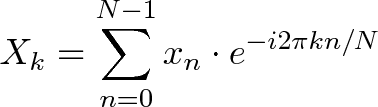
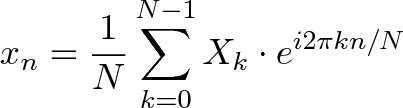
Yikes. Rather than jumping into the symbols, let's experience the key idea firsthand. Here's a plain-English metaphor:
Here's the "math English" version of the above:
Time for the equations? No! Let's get our hands dirty and experience how any pattern can be built with cycles, with live simulations.
If all goes well, we'll have an aha! moment and intuitively realize why the Fourier Transform is possible. We'll save the detailed math analysis for the follow-up.
This isn't a force-march through the equations, it's the casual stroll I wish I had. Onward!
A math transformation is a change of perspective. We change our notion of quantity from "single items" (lines in the sand, tally system) to "groups of 10" (decimal) depending on what we're counting. Scoring a game? Tally it up. Multiplying? Decimals, please.
The Fourier Transform changes our perspective from consumer to producer, turning What did I see? into How was it made?
In other words: given a smoothie, let's find the recipe.
Why? Well, recipes are great descriptions of drinks. You wouldn't share a drop-by-drop analysis, you'd say "I had an orange/banana smoothie". A recipe is more easily categorized, compared, and modified than the object itself.
So... given a smoothie, how do we find the recipe?
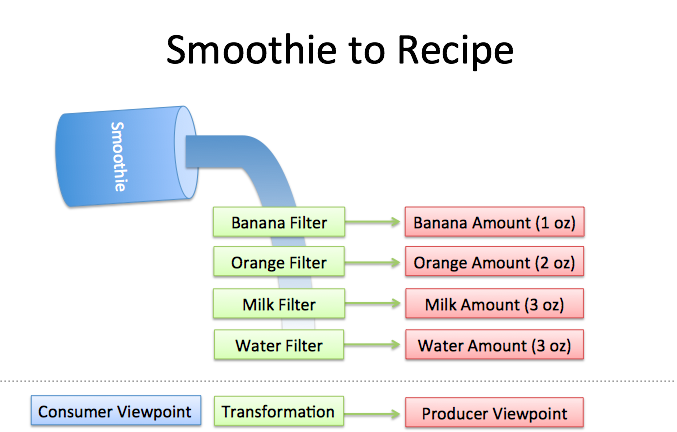
Well, imagine you had a few filters lying around:
We can reverse-engineer the recipe by filtering each ingredient. The catch?
Filters must be independent. The banana filter needs to capture bananas, and nothing else. Adding more oranges should never affect the banana reading.
Filters must be complete. We won't get the real recipe if we leave out a filter ("There were mangoes too!"). Our collection of filters must catch every last ingredient.
Ingredients must be combine-able. Smoothies can be separated and re-combined without issue (A cookie? Not so much. Who wants crumbs?). The ingredients, when separated and combined in any order, must make the same result.
The Fourier Transform takes a specific viewpoint: What if any signal could be filtered into a bunch of circular paths?
Whoa. This concept is mind-blowing, and poor Joseph Fourier had his idea rejected at first. (Really Joe, even a staircase pattern can be made from circles?)
And despite decades of debate in the math community, we expect students to internalize the idea without issue. Ugh. Let's walk through the intuition.
The Fourier Transform finds the recipe for a signal, like our smoothie process:
Stop. Here's where most tutorials excitedly throw engineering applications at your face. Don't get scared; think of the examples as "Wow, we're finally seeing the source code (DNA) behind previously confusing ideas".
If earthquake vibrations can be separated into "ingredients" (vibrations of different speeds & strengths), buildings can be designed to avoid interacting with the strongest ones.
If sound waves can be separated into ingredients (bass and treble frequencies), we can boost the parts we care about, and hide the ones we don't. The crackle of random noise can be removed. Maybe similar "sound recipes" can be compared (music recognition services compare recipes, not the raw audio clips).
If computer data can be represented with oscillating patterns, perhaps the least-important ones can be ignored. This "lossy compression" can drastically shrink file sizes (and why JPEG and MP3 files are much smaller than raw .bmp or .wav files).
If a radio wave is our signal, we can use filters to listen to a particular channel. In the smoothie world, imagine each person paid attention to a different ingredient: Adam looks for apples, Bob looks for bananas, and Charlie gets cauliflower (sorry bud).
The Fourier Transform is useful in engineering, sure, but it's a metaphor about finding the root causes behind an observed effect.
One of my giant confusions was separating the definitions of "sinusoid" and "circle".
Labeling a circular path as a "complex sinusoid" is like describing a word as a "multi-letter". You zoomed into the wrong level of detail. Words are about concepts, not the letters they can be split into!
The Fourier Transform is about circular paths (not 1-d sinusoids) and Euler's formula is a clever way to generate one:
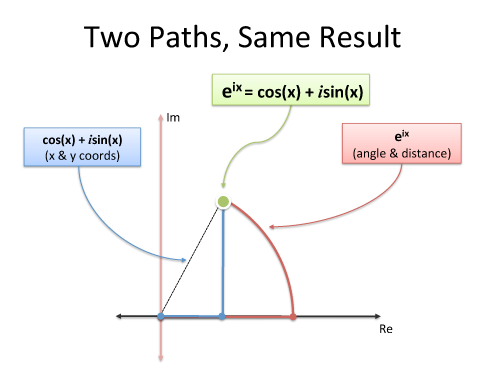
Must we use imaginary exponents to move in a circle? Nope. But it's convenient and compact. And sure, we can describe our path as coordinated motion in two dimensions (real and imaginary), but don't forget the big picture: we're just moving in a circle.
Let's say we're chatting on the phone and, like usual, I want us to draw the same circle simultaneously. (You promised!) What should I say?
I could say "2-inch radius, start at 45 degrees, 1 circle per second, go!". After half a second, we should each be pointing to: starting point + amount traveled = 45 + 180 = 225 degrees (on a 2-inch circle).
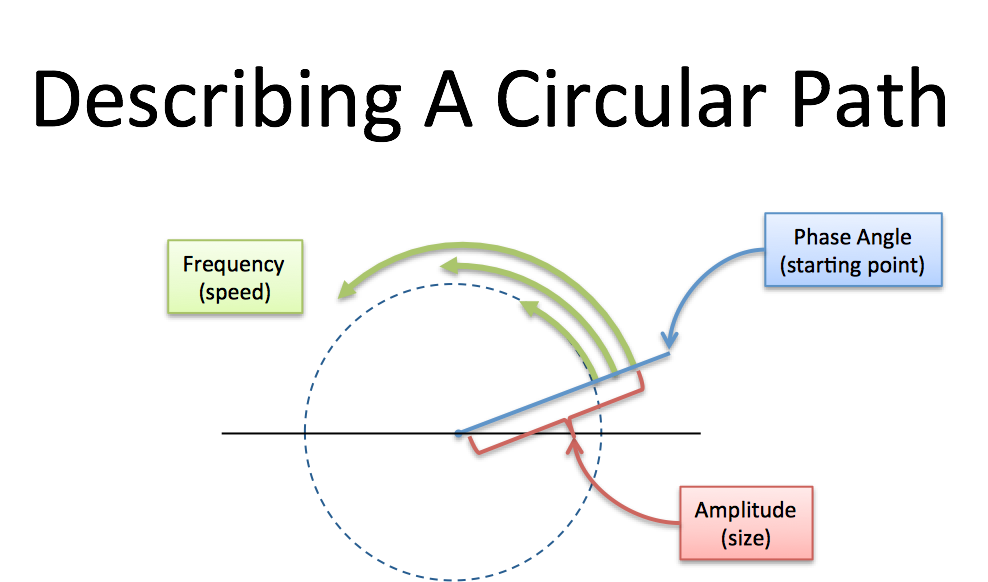
Every circular path needs a size, speed, and starting angle (amplitude/frequency/phase). We can even combine paths: imagine tiny motorcars, driving in circles at different speeds.
The combined position of all the cycles is our signal, just like the combined flavor of all the ingredients is our smoothie.
Here's a simulation of a basic circular path:
(Based on this animation, here's the source code. Modern browser required. Click the graph to pause/unpause.)
The magnitude of each cycle is listed in order, starting at 0Hz. Cycles [0 1] means
Now the tricky part:
[1 -1] shows the amplitude at these equally-spaced intervals.With me? [0 1] is a pure 1Hz cycle.
Now let's add a 2Hz cycle to the mix. [0 1 1] means "Nothing at 0Hz, 1Hz of strength 1, 2Hz of strength 1":
Whoa. The little motorcars are getting wild: the green lines are the 1Hz and 2Hz cycles, and the blue line is the combined result. Try toggling the green checkbox to see the final result clearly. The combined "flavor" is a sway that starts at the max and dips low for the rest of the interval.
The yellow dots are when we actually measure the signal. With 3 cycles defined (0Hz, 1Hz, 2Hz), each dot is 1/3 of the way through the signal. In this case, cycles [0 1 1] generate the time values [2 -1 -1], which starts at the max (2) and dips low (-1).
Oh! We can't forget phase, the starting angle! Use magnitude:angle to set the phase. So [0 1:45] is a 1Hz cycle that starts at 45 degrees:
This is a shifted version of [0 1]. On the time side we get [.7 -.7] instead of [1 -1], because our cycle isn't exactly lined up with our measuring intervals, which are still at the halfway point (this could be desired!).
The Fourier Transform finds the set of cycle speeds, strengths and phases to match any time signal.
Our signal becomes an abstract notion that we consider as "observations in the time domain" or "ingredients in the frequency domain".
Enough talk: try it out! In the simulator, type any time or cycle pattern you'd like to see. If it's time points, you'll get a collection of cycles (that combine into a "wave") that matches your desired points.
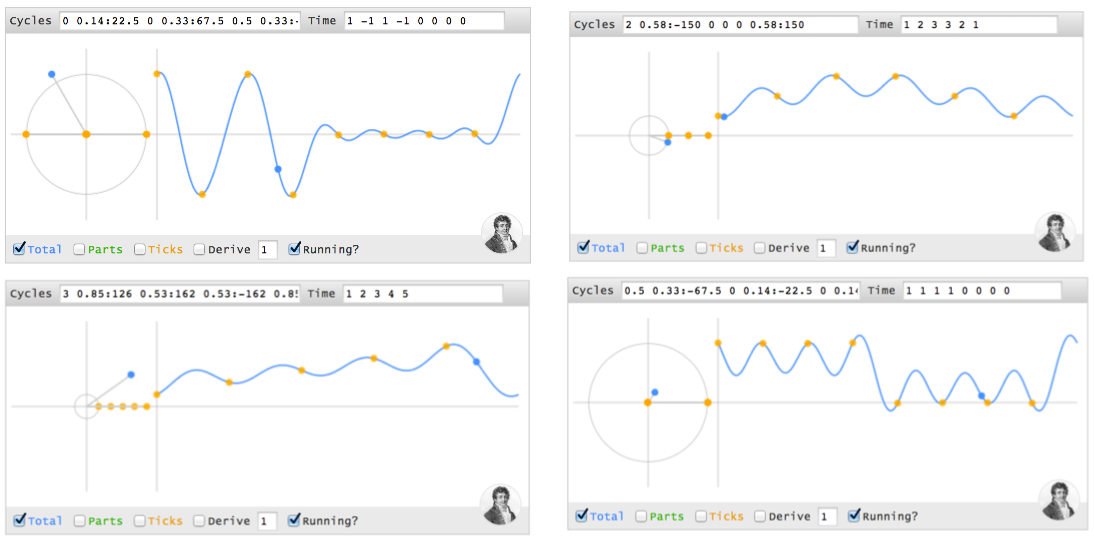
But… doesn't the combined wave have strange values between the yellow time intervals? Sure. But who's to say whether a signal travels in straight lines, or curves, or zips into other dimensions when we aren't measuring it? It behaves exactly as we need at the equally-spaced moments we asked for.
Can we make a spike in time, like (4 0 0 0), using cycles? I'll use parentheses () for a sequence of time points, and brackets [] for a sequence of cycles.
Although the spike seems boring to us time-dwellers (one data point, that's it?), think about the complexity in the cycle world. Our cycle ingredients must start aligned (at the max value, 4) and then "explode outwards", each cycle with partners that cancel it in the future. Every remaining point is zero, which is a tricky balance with multiple cycles running around (we can't just "turn them off").
Let's walk through each time point:
At time 0, the first instant, every cycle ingredient is at its max. Ignoring the other time points, (4 ? ? ?) can be made from 4 cycles (0Hz 1Hz 2Hz 3Hz), each with a magnitude of 1 and phase of 0 (i.e., 1 + 1 + 1 + 1 = 4).
At every future point (t = 1, 2, 3), the sum of all cycles must cancel.
Here's the trick: when two cycles are on opposites sides of the circle (North & South, East & West, etc.) their combined position is zero (3 cycles can cancel if they're spread evenly at 0, 120, and 240 degrees).
Imagine a constellation of points moving around the circle. Here's the position of each cycle at every instant:
Time 0 1 2 3
------------
0Hz: 0 0 0 0
1Hz: 0 1 2 3
2Hz: 0 2 0 2
3Hz: 0 3 2 1
Notice how the the 3Hz cycle starts at 0, gets to position 3, then position "6" (with only 4 positions, 6 modulo 4 = 2), then position "9" (9 modulo 4 = 1).
When our cycle is 4 units long, cycle speeds a half-cycle apart (2 units) will either be lined up (difference of 0, 4, 8…) or on opposite sides (difference of 2, 6, 10…).
OK. Let's drill into each time point:
The trick is having individual speeds cancel (0Hz vs 2Hz, 1Hz vs 3Hz), or having the lined-up pairs cancel (0Hz + 2Hz vs 1Hz + 3Hz).
When every cycle has equal power and 0 phase, we start aligned and cancel afterwards. (I don't have a nice proof yet -- any takers? -- but you can see it yourself. Try [1 1], [1 1 1], [1 1 1 1] and notice the signals we generate: (2 0), (3 0 0), (4 0 0 0)).
In my head, I consider these signals "time spikes": they have a burst of activity for a single instant, and are zero otherwise (the fancy name is a delta function.)
Here's how I visualize the initial alignment, followed by a net cancellation:
Not everything happens at t=0. Can we change our spike to (0 4 0 0)?
It seems the cycle ingredients should be similar to (4 0 0 0), but the cycles must align at t=1 (one second in the future). Here's where phase comes in.
Imagine a race with 4 runners. Normal races have everyone lined up at the starting line, the (4 0 0 0) time pattern. Boring.
What if we want everyone to finish at the same time? Easy. Just move people forward or backwards by the appropriate distance. Maybe granny can start 2 feet in front of the finish line, Usain Bolt can start 100m back, and they can cross the tape holding hands.
Phase shifts, the starting angle, are delays in the cycle universe. Here's how we adjust the starting position to delay every cycle 1 second:
If time points (4 0 0 0) are made from cycles [1 1 1 1], then time points (0 4 0 0) are made from [1 1:-90 1:180 1:90]. (Note: I'm using "1Hz", but I mean "1 cycle over the entire time period").
Whoa -- we're working out the cycles in our head!
The interference visualization is similar, except the alignment is at t=1.
Test your intuition: Can you make (0 0 4 0), i.e. a 2-second delay? 0Hz has no phase. 1Hz has 180 degrees, 2Hz has 360 (aka 0), and 3Hz has 540 (aka 180), so it's [1 1:180 1 1:180].
The big insight: our signal is just a bunch of time spikes! If we merge the recipes for each time spike, we should get the recipe for the full signal.
The Fourier Transform builds the recipe frequency-by-frequency:
We can then loop through every frequency to get the full transform.
Here's the conversion from "math English" to full math:
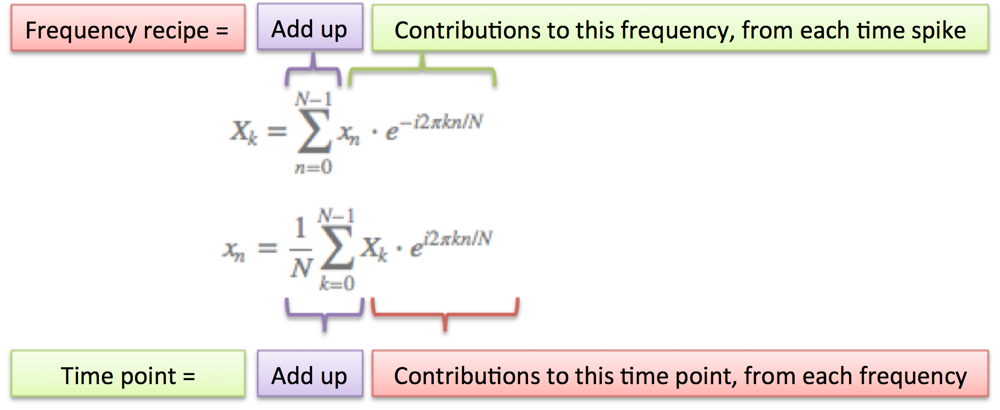
A few notes:
This was my most challenging article yet. The Fourier Transform has several flavors (discrete/continuous/finite/infinite), covers deep math (Dirac delta functions), and it's easy to get lost in details. I was constantly bumping into the edge of my knowledge.
But there's always simple analogies out there -- I refuse to think otherwise. Whether it's a smoothie or Usain Bolt & Granny crossing the finish line, take a simple understanding and refine it. The analogy is flawed, and that's ok: it's a raft to use, and leave behind once we cross the river.
I realized how feeble my own understanding was when I couldn't work out the transform of (1 0 0 0) in my head. For me, it was like saying I knew addition but, gee whiz, I'm not sure what "1 + 1 + 1 + 1" would be. Why not? Shouldn't we have an intuition for the simplest of operations?
That discomfort led me around the web to build my intuition. In addition to the references in the article, I'd like to thank:
Today's goal was to experience the Fourier Transform. We'll save the advanced analysis for next time.
Happy math.
Stuart Riffle has a great interpretation of the Fourier Transform:
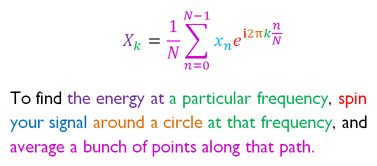
Imagine spinning your signal in a centrifuge and checking for a bias. I have a correction: we must spin backwards (the exponent in the equation above needs a negative sign). You already know why: we need a phase delay so spikes appear in the future.
Lucas Vieira, author of excellent Wikipedia animations, was inspired to make this interactive animation:
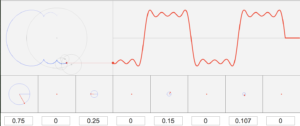
(Detailed list of control options)
The Fourier Transform is about cycles added to cycles added to cycles. Try making a "time spike" by setting a strength of 1 for every component (press Enter after inputting each number). Fun fact: with enough terms, you can draw any shape, even Homer Simpson.
All the code and examples are open source (MIT licensed, do what you like).

When I got married four years ago, many people said to me, "Finally you can escape the nuisance of living with roommates and enjoy some peace, quiet, and privacy with your wife!"
I don't blame them for assuming Alyson and I would live alone. This is the pattern in America today, as David Roberts laid out in a recent Vox piece: "When we marry and start a family, we are pushed, by custom, policy, and expectation, to move into our own houses." Roommates are for college kids and single people on a budget; married people live by themselves.
But we didn't want to take that path. As single people, both of us enjoyed living with others, and while it wasn't always easy it led to many enduring friendships. So we decided to move into the basement of a group house after we got married. It worked out splendidly. We ate meals with our housemates on a regular basis, hosted parties together, and shared the chores. The only real downside was a lack of sunlight in our subterranean dwelling. We deemed the social experiment a success.
Once we saved up enough money to buy a house of our own in Washington, DC's Petworth neighborhood, we deliberately chose a place in which we would always have room for housemates, even if we had kids in the future. As soon as we closed on our house, our first purchase was a long dining room table that could accommodate our group dinners.
For us, living in a group house was not a phase to grow out of but a lifestyle choice that valued people over privacy. Sure, we lose certain freedoms — we can't walk around the kitchen naked, for instance — but what we get in return is many lighthearted conversations, laughter, and an opportunity to get to know people on a deep level. As Roberts wrote in his essay, "The key ingredient for the formation of friendships is repeated spontaneous contact." In a city where we have to plan coffee dates with people two weeks in advance, a group house can readily foster spontaneity.
In addition, I think these living arrangements enhance rather than detract from our marriage. Living with others, we don't put pressure on each other to be our only conversation partner. Without that burden, we are free to enjoy each other's company rather than depending on it to satisfy all of our social needs.
When I was growing up, I never would have guessed that as a married man, I'd be living with housemates. Raised in Chicago and Memphis, I was accustomed to people living with their nuclear families and, when they grew up, moving out and moving on.
Then I spent the summer after my junior year of high school living with a host family in Madrid, where everything was different. Many young adults still lived with their parents (and seemed to enjoy it), single people lived with friends in shared apartments, and all of them ate meals together at home. It blew my mind, and I returned to the United States as a different person. I realized that people were the greatest treasure in the world. I became more outgoing, more adventurous, and more willing to put myself in unusual situations.
After leaving my parents' home to start college, my first experience of shared housing in America came in the form of residential housing on the campus of Rice University in Houston. While it was not bad, sharing a bedroom wasn't ideal — my roommate's motorcycle alarm would go off early every Tuesday and Thursday morning for his 8 am class — "Vroom, vroom, vroom, hit the road! Vroom, vroom..."
Moving into a three-bedroom house off-campus for my last two years of college was a breath of fresh air. Having a room to myself was delightful, of course, but it was surprising how much I also came to love our kitchen and dining room. Once my mom bought me the cookbook Help! My Apartment Has a Kitchen, I was off to the races.
Being off campus was a great escape from the gossip-infested dorms, but instead of isolating me from people, I found that our house greatly enhanced my social life. In my experience, cute girls rarely turned down an opportunity for a home-cooked meal, and my roommates and I loved exploring the city of Houston. Best of all was joining the Urban Animals, a rollerblading group that skated on weeknights from bar to bar all over the city (this was the 1990s after all). My roommates and I were half the age of all the other Animals, but we were fully embraced by this motley crew of doctors, dentists, and potheads.
Cruising through the perfectly smooth concrete cityscape after all the suburbanites had gone to bed, I became a part of a cohesive community of nonconformists, and it made me realize that being a happy, fulfilled adult did not require me to adhere to what my peers considered "normal."
Moving to Innsbruck, Austria, after graduation gave me another opportunity to see how housing works in other countries. Upon arriving, I searched the university classified ads for rooms and found that a popular alternative to campus housing was a Wohngemeinschaft (German for "living community"). I moved into an apartment with three Austrians and a young French woman.
By sitting with them and their friends at the dinner table every night, I quickly became enmeshed in the social life of a lively European town. It was particularly helpful in learning Austrian alpine dialect, Tirolerisch, and I learned an essential rule: Never pronounce Austrian words like a German.
Upon returning to the United States for graduate school in California, I discovered that Berkeley was full of "group houses" that felt similar to the Wohngemeinschaften of German-speaking Europe. I settled into a North Berkeley bungalow with three other PhD students, including an economist, a political scientist, and a bioengineer. We shared our meals, our chores, and our magazines — the economist got the Economist, the bioengineer got Science, and I got Sports Illustrated.
Just like in Houston and Innsbruck, cooking for housemates and friends was a central feature of our group house identity. In each city, of course, one had to make adjustments to the local culture, and in Berkeley it meant buying a new cookbook, Recipes for a Small Planet: The Art and Science of High Protein Vegetarian Cookery.
Though shared housing was becoming the norm for me, one conversation made me realize that it was a truly special lifestyle. After three semesters of living with me, my bioengineering housemate got married and moved a few blocks away. His wife later confided to me, "Tom, thanks for training my husband." We both laughed, but after further reflection, I realized that it was true. By creating a regular cooking rotation, developing a chore schedule, and having plenty of opportunities for conflict resolution, my housemates and I unconsciously trained one another to be better partners for our future spouses. It was many years before I got married myself, but this conversation stuck with me.
After moving to Washington, DC, to start my professional career, I found plenty of people who lived in shared housing, but with one major difference — hardly anyone in DC cooked! My first three years I lived in a large row house in a neighborhood called Mount Pleasant with six other people, and five of us shared one refrigerator and a narrow galley kitchen. Though we had more people in our house than burners on our stove, we rarely bumped into each other in the kitchen. Though I still cooked meals regularly and invited friends and housemates to join me, rarely did anyone reciprocate. Instead, most socializing took place outside our home at happy hours, restaurants, and bars. It was still fun, but it had a more frenetic feel to it. Conversations were animated but less sustained as we divided our attention between finding seats, placing our orders, and splitting the bill.
Comparing this situation to what I had experienced in Houston, Berlin, Innsbruck, and Berkeley, I observed a wide spectrum of shared housing arrangements. It's one thing to split the rent and another thing to enjoy life together. Sharing utility bills is different from sharing meals. Am I cooking at home just to stay within my food budget or to deepen my relationships? Is my primary motivation for living with housemates just to save money or to foster community? Would I be willing to sacrifice some individual privacy in exchange for developing a shared social identity? People answer these questions quite differently, and it doesn't take much time of living with others in order to learn what they value most.
/cdn0.vox-cdn.com/uploads/chorus_asset/file/4273319/1G9A0397-2.0.jpg)
The author serving dinner for his roommates (Thomas Burnett)
Of all my group living experiences, buying a house and inviting people to live in it with us has been the most ambitious. The configuration of the house we bought was ideal for group living. There were three upstairs bedrooms with two full bathrooms, so Alyson and I had one to ourselves, and two upstairs housemates could share the other bathroom. The first floor had a large kitchen, living room, and guest bathroom, which made it ideal for hosting dinner parties. The finished basement had a bedroom, a sizable living area, and a full bathroom, so it could easily accommodate another couple. Now that we had our dream house just a block away from the Metro, we invited four people to move in with us — two singles and a couple.
How did it turn out? We approached the situation with high-minded ideals, but we quickly discovered the challenges of day-to-day reality. During our first year there wasn't a kitchen in the basement, so all six of us used the first-floor kitchen. Though the space was large enough to accommodate us, the sheer volume of cooking overwhelmed our cleaning schedule.
Almost every night before going to bed, I cleaned all the crumbs off the counters and wiped off the stove, regardless of whether I was the one who'd cooked. Alyson emptied the dishwasher and cleaned the floors far more than anyone else, and after a few months, we were both exhausted — it felt like we were running a bed and breakfast. To compound the difficulties, one housemate wanted to sublet her room each time she traveled for work, and I felt like our house was becoming a hostel rather than a home.
The first year was a humbling, exhausting experience. Though we were perfectly accustomed to being a married couple living with other housemates, we were still first-time homeowners and first-time landlords.
We learned that there is a power dynamic between landlords and tenants that can't be ignored even if you are friends. When there were disputes, we couldn't settle them with a purely democratic process because we had unequal investments in the house and different short-term/long-term perspectives.
As homeowners, we were also more protective of our house in general. With six of us, there was more wear and tear, more accidents, and more frustrating moments. If something broke, I had to fix it or replace it. The housemates' rent more than offset monetary costs, but I also invested a lot of time that I could not get back.
Some problems were relatively easy to fix. To accommodate everyone's bicycles, I built a large bike rack on the wall and installed rubber flooring near the back door. To decrease the volume of kitchen traffic and crumb proliferation, we installed a kitchen in the basement so that only four people used the main kitchen, not six. And to resolve the carousel of people living with us, we stipulated in future leases that subletting was not permitted.
Nevertheless, some challenges will always remain. We have experimented with several different chore schedules in order to spread responsibilities equitably. We've had some housemate turnover, partly due to the transience of DC residents and partly due to incompatible personalities. Over the past three years, Alyson and I have devised a highly specific Craigslist housing post in order to fully convey our group house identity so that no one is caught by surprise when they move in. Here's an excerpt from our post:
Alyson and I are intellectually curious, environmentally conscious, bicycle-riding professionals. We enjoy cooking with our housemates, sitting on the front porch, participating in our neighborhood church, and exploring DC's many cultural activities, especially theater performances. We are looking for a housemate with the following characteristics:
1. Enthusiastic about eating meals together regularly and hosting brunches for our neighbors
2. Environmentally conscious and committed to energy and water conservation
3. Eager to keep the kitchen clean and tidy
Though there are some ongoing frustrations, the joys of group house living certainly outweigh the sorrows. With our current housemates, we have dinner together once a week and rotate the cooking duties. Regardless of who prepares the food or what's on the menu, it's one of the highlights of my week. Eating home-cooked meals with friends has a powerful effect that I've never experienced in any other context.
It is no surprise to me that religious communities have traditionally lived together and eaten their meals together. Judeo-Christian scripture describes the inception of the kingdom of God as a huge feast or wedding banquet. Jewish and Muslim communities practice regular cycles of fasting and feasting together. Many Christians commemorate the legacy of Jesus by sharing wine and bread every week.
Whether or not one is spiritually inclined, everyone can enjoy the magic of communal meals in group houses, which extend across every culture and era of history. Living together in a community can be rewarding, but it may not satisfy everyone — in my experience, it requires us to dispense with an unhealthy obsession with privacy, personal space, and hyper-individualism.
There are other ways, too, of fostering and maintaining adult friendships even if you're not ready to move into a group house. David Roberts's article described how people are moving to walkable communities, which foster regular contact with neighbors, and other people, particularly in Germany, are building multi-unit housing that includes shared space for kids to play and adults to hang out together.
While I applaud these new developments and hope they become more common, I also think there are plenty of low-tech solutions that don't require changing existing infrastructure. One friend of mine recruited other couples to move into her rent-controlled apartment building, and another friend has encouraged four different families to buy homes within one block of her. Another family was feeling socially isolated as new parents, so they started a weekly front porch cocktail party at their house. On Friday nights after their infant went to sleep, their friends would come over to sip drinks and enjoy grown-up conversations.
In a fragmented society with little social intimacy after people leave college, shared housing is a viable alternative that shapes us in positive ways that we might not expect. Group houses challenge my wife and me to engage in conflict resolution rather than avoidance. They encourage us to be respectful and considerate of each other rather than belittle and marginalize. Though we aren't always best friends with the people we live with, it provides us with the spontaneous social contact that we need to thrive. In light of this, it's worth rethinking whether shared housing is just a stepping stone or a personally fulfilling destination.
Thomas Burnett works in communications at the National Academy of Sciences. He has degrees in history of science and philosophy from University of California Berkeley and Rice University.
First Person is Vox's home for compelling, provocative narrative essays. Do you have a story to share? Read our submission guidelines, and pitch us at firstperson@vox.com.
There’s a troubling tendency for public officials in charge of U.S. transit systems not to actually step foot on the buses and trains they oversee. The result is a totally unsurprising failure to anticipate basic problems: if you’re used to parking right beside your destination, for instance, you can’t appreciate the importance of a good sidewalk network leading to a transit stop or station. Your understanding of the challenges facing daily riders is theoretical at best.
Jesse Bailey at the blog Walkable West Palm Beach points us to an especially egregious instance of this windshield perspective in action. The Florida Bicycle and Pedestrian Partnership Council, convened under the auspices of the state’s Department of Transportation, is supposed to help people get around on bike or on foot. And yet a recent meeting agenda explains—at great length, and at the very start of a 115-page document—where council members can park.
There’s a parking map for the Tallahassee destination:
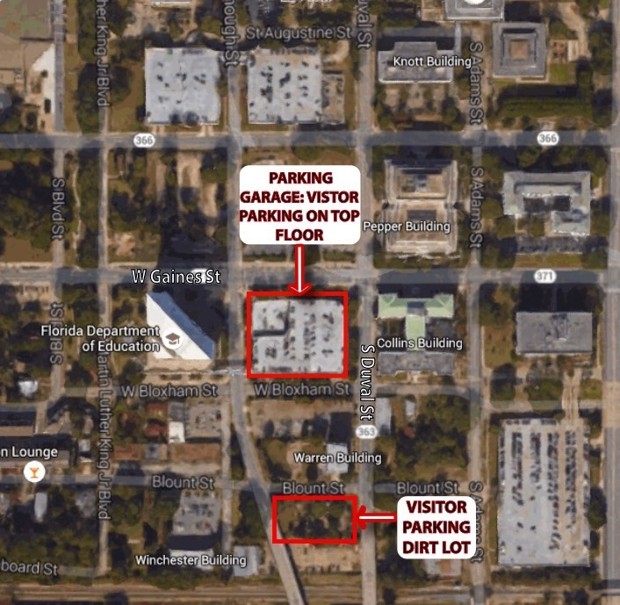
And detailed written directions beneath the parking map that include tips on how to park (facing forward!) and all-cap advice on HOW NOT TO GET TOWED:
BE SURE NOT TO PARK IN THE FSU WARREN LOT WHICH IS LOCATED ACROSS THE STREET FROM THE VISITOR DIRT LOT. THAT LOT IS MARKED WITH A RED AND YELLOW FSU SIGN AND YOU WILL EITHER GET TOWED OR GET A TICKET IF YOU PARK THERE.
And a free parking pass you can print out and tape “in your back window so
that it is visible when standing behind the vehicle”:
And—wait for it—a very friendly reminder that it’s preferable not to, you know, run over people:
The speed limit in the garage is 5 mph. Please drive carefully as there are many pedestrians making their way through the garage.
Bailey’s final take is spot on (original emphasis):
Our governmental leadership, transportation agencies, and advocates all need to be cognizant of how the conversation is framed: Are we merely paying lip service to the community of people who bike and walk for transportation? How are our governing bodies to understand the needs of those walking and biking if the only time they consider their needs, they arrive via automobile and don’t consider people arriving using the very modes they are meeting to discuss? And if non-motorized users are overlooked by meeting organizers for a meeting about non-motorized users, imagine what happens for meetings in which this isn’t the topic of discussion.
The council members who drive to these meetings will no doubt do so because it’s very difficult for them to walk or bike or ride transit. That’s not to knock them; if it were easy and convenient to get places without a car in Florida cities, the state wouldn’t need policy committees on alternative transportation. And who knows—maybe the parking instructions have been included ironically, and every meeting commences by turning the garage passes into confetti.
But there’s a reason some cities have started to require that transit officials actually ride transit: the farther you’re removed from a problem, the less urgency you feel to resolve it.

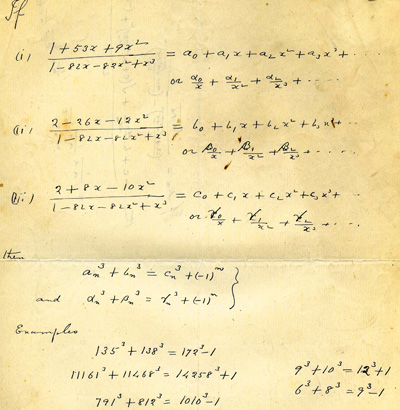
Ramanujan's manuscript. The representations of 1729 as the sum of two cubes appear in the bottom right corner. The equation expressing the near counter examples to Fermat's last theorem appears further up: α3 + β3 = γ3 + (-1)n. Image courtesy Trinity College library. Click here to see a larger image.
A box of manuscripts and three notebooks. That's all that's left of the work of Srinivasa Ramanujan, an Indian mathematician who lived his remarkable but short life around the beginning of the twentieth century. Yet, that small stash of mathematical legacy still yields surprises. Two mathematicians of Emory University, Ken Ono and Sarah Trebat-Leder, have recently made a fascinating discovery within its yellowed pages. It shows that Ramanujan was further ahead of his time than anyone had expected, and provides a beautiful link between several milestones in the history of mathematics. And it all goes back to the innocuous-looking number 1729.
Ramanujan's story is as inspiring as it is tragic. Born in 1887 in a small village around 400 km from Madras (now Chennai), Ramanujan developed a passion for mathematics at a young age, but had to pursue it mostly alone and in poverty. Until, in 1913, he decided to write a letter to the famous Cambridge number theorist G.H. Hardy. Accustomed to this early form of spam, Hardy might have been forgiven for dispatching the highly unorthodox letter straight to the bin. But he didn't. Recognising the author's genius, Hardy invited Ramanujan to Cambridge, where he arrived in 1914. Over the following years, Ramanujan more than repaid Hardy's faith in his talent, but suffered ill health due, in part, to the grizzly English climate and food. Ramanujan returned to India in 1919, still feeble, and died the following year, aged only 32. Hardy later described his collaboration with Ramanujan as "the one romantic incident in my life".
The romanticism rubbed off on the number 1729, which plays a central role in the Hardy-Ramanujan story. "I remember once going to see [Ramanujan] when he was ill at Putney," Hardy wrote later. "I had ridden in taxi cab number 1729 and remarked that the number seemed to me rather a dull one, and that I hoped it was not an unfavourable omen. 'No', he replied, 'it is a very interesting number; it is the smallest number expressible as the sum of two cubes in two different ways.'" What Ramanujan meant is that
The anecdote gained the number 1729 fame in mathematical circles, but until recently people believed its curious property was just another random fact Ramanujan carried about in his brain — much like a train spotter remembers train arrival times. What Ono and Trebat-Leder's discovery shows, however, is that it was just the tip of an ice berg. In reality Ramanujan had been busy developing a theory that was several decades ahead of its time and yields results that are interesting to mathematicians even today. He just didn't live long enough to publish it.
The discovery came when Ono and fellow mathematician Andrew Granville were leafing through Ramanujan's manuscripts, kept at the Wren Library at Trinity College, Cambridge. "We were sitting right next to the librarian's desk, flipping page by page through the Ramanujan box," recalls Ono. "We came across this one page which had on it the two representations of 1729 [as the sum of cubes]. We started laughing immediately."
Srinivasa Ramanujan (1887 - 1920).
or
or
and so on.
In 1637 the French mathematician Pierre
de Fermat confidently asserted that the answer is no. If  is a whole number greater than
  then there are no positive whole number triples
 and
and  such that
Fermat scribbled in the margin of a page in a book that he had "discovered a truly marvellous proof of this, which this margin is too narrow to contain". Naturally, this assertion was like catnip to mathematicians, who subsequently drove themselves crazy, for over 350 years, trying to find this "truly marvellous proof".
What the equation in Ramanujan’s manuscript illustrates is that Ramanujan had found a whole family (in fact an infinite family) of positive whole number triples 
 and
and  that very nearly, but not quite, satisfy Fermat’s famous equation for
  They are off only by plus or minus one, that is, either
or
Since any positive whole number triple satisfying the equation would render Fermat’s assertion (that there are no such triples) false, Ramanujan had pinned down an infinite family of near-misses of what would be counter-examples to Fermat’s last theorem.
"None of us had any idea that Ramanujan was thinking about anything [remotely] related to Fermat's last theorem," says Ono. "But here on a page, staring us in the face, were infinitely many near counter-examples to it, two of which happen to be related to 1729. We were floored." Even today, nearly 400 years after Fermat's claim and 20 years after its resolution, only a handful of mathematicians even know about the family Ramanujan had come up with. "I'm a Ramanujan scholar and I wasn't aware of it," says Ono. "Basically, nobody knew."
But this isn't all. When Ono and his graduate student Sarah Trebat-Leder decided to investigate further, looking at other pages in Ramanujan's work, they found he had developed a sophisticated mathematical theory that went beyond anything people had suspected. "Sarah and I spent time thinking more deeply about what Ramanujan had really done, and it turns out that he anticipated [an area of] mathematic 30 or 40 years before anyone knew this field would exist. That's what we are excited about."
It turns out that from looking at equations of the form
it’s not too large a mathematical step to considering equations of the form
where  ,
,  and
and  are constants. If you plot the points
  that satisfy such an equation (for given values of and ) in a coordinate system, you get a shape called an elliptic curve (the precise definition is slightly more
involved, see here). Elliptic
curves played an important role in the eventual proof of Fermat's last theorem,
which was delivered in the 1990s by the mathematician Andrew
Wiles.
that satisfy such an equation (for given values of and ) in a coordinate system, you get a shape called an elliptic curve (the precise definition is slightly more
involved, see here). Elliptic
curves played an important role in the eventual proof of Fermat's last theorem,
which was delivered in the 1990s by the mathematician Andrew
Wiles.
Ono and Trebat-Leder found that Ramanujan had also delved into the theory of elliptic curves. He did not anticipate the path taken by Wiles, but instead discovered an object that is more complicated than elliptic curves. When objects of this kind were rediscovered around forty years later they were adorned with the name of K3 surfaces — in honour of the mathematicians Ernst Kummer, Erich Kähler and Kunihiko Kodaira, and the mountain K2, which is as difficult to climb as K3 surfaces are difficult to handle mathematically.
That Ramanujan should have discovered and understood an exceedingly complicated K3 surface is in itself remarkable. But his work on the surface also provided an unexpected gift to Ono and Trebat-Leder, which links back to elliptic curves. Like all equations, any elliptic curve equation
naturally cries out for solutions: pairs of numbers  that satisfy the equation. In the spirit of Fermat, you might look for whole number solutions, but number theorists usually give themselves a little more leeway. They look for solutions that are rational numbers, that is, numbers that can be written as fractions.
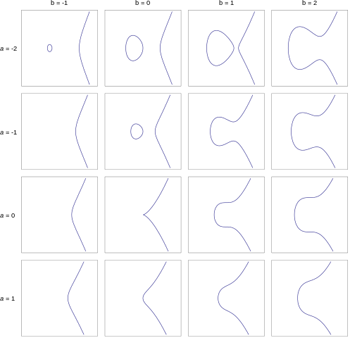
The elliptic curves corresponding to whole number values of a between -2 and 1 and whole number values of values of b between -1 and 2. Only the curve for a = b = 0 doesn't qualify as an elliptic curve because it has a sharp corner.
Last year, in 2014, the mathematician Manjul Bhargava won the Fields Medal, one of the highest honours in mathematics, for major progress in this context. Bhargava showed that most elliptic curves fall into one of two particularly simple classes. Either there are only finitely many rational number solutions; or there are infinitely many, but there is a recipe that produces all of them from just a single rational number solution. (You can read our interview with Bhargava and our article exploring some of his work.)
If you sift through all elliptic curves in a systematic way, for example by ordering them according to the size of the constants  and
and  that appear in their formulas, then you are most likely only ever going to come across these "simple" elliptic curves. The probability of finding a more complicated one, which requires two or three solutions to generate them all, is zero. Searching for such elliptic curves systematically is like searching a haystack for a needle in a way that guarantees the needle will always slip through the net. To get at those more complicated elliptic curves, you need another method.
And this is exactly what Ramanujan came up with. His work on the K3 surface he discovered provided Ono and Trebat-Leder with a method to produce, not just one, but infinitely many elliptic curves requiring two or three solutions to generate all other solutions. It's not the first method that has been found, but it required no effort. "We tied the world record on the problem [of finding such elliptic curves], but we didn't have to do any heavy lifting," says Ono. "We did next to nothing, expect recognise what Ramanujan did."
There is another interesting twist to this story. While Ramanujan was working in the abstract realms of number theory, physicists studying real-world phenomena began developing the theory of quantum mechanics. Although a triumph in its own right, it soon became clear that the resulting quantum physics clashed with existing physical theories in an unredeemable way. The rift still hasn't been healed and presents the biggest problem of twenty-first century physics (see here to find out more). One attempt at rescuing the situation was the development, started in the 1960s, of string theory, a prime candidate for a "theory of everything" uniting the disparate strands of modern physics.
G.H. Hardy (1877 - 1947).
A curious prediction of string theory is that the world we live in consists of more than the three spatial dimensions we can see. The extra dimensions, the ones we can't see, are rolled up tightly in tiny little spaces too small for us to perceive. The theory dictates that those tiny little spaces have a particular geometric structure. There's a class of geometric objects, called Calabi-Yau manifolds, which fits the bill (see this article to find out more). And one of the simplest classes of Calabi-Yau manifolds comes from, wait for it, K3 surfaces, which Ramanujan was the first to discover.
Ramanujan could never have dreamt of this development, of course. "He was a whiz with formulas and I think [his aim was] to construct those near counter-examples to Fermat's last theorem." says Ono. "So he developed a theory to find these near misses, without recognising that the machine he was building, those formulas that he was writing down, would be useful for anyone, ever, in the future."
Ono doesn't rule out that Ramanujan's manuscripts contain further hidden treasures. "I've known about 1729 for thirty years. It's a lovely, romantic number. Ramanujan was a genius and we are still learning about the extent to which his creativity led him to his formulas. His work amounts to one box, kept at Trinity College, and three notebooks, kept at the University of Madras. That's not a lot. It's crazy that we are still figuring out what he had in mind. When is it going to end?"
You can read more about the work of Ramanujan in A disappearing number. For experts, Ono and Trebat-Leder's paper is available here.
Ken Ono is Asa Griggs Candler Professor of Mathematics and Computer Science at Emory University.
Sarah Trebat-Leder is a PhD student at Emory, where she is a Woodruff Fellow and NSF Graduate Fellow.
Marianne Freiberger is Editor of Plus. She interviewed Ono and Trebat-Leder in October 2015.
by Geoff Chester, LIEPĀJA
Novuss is the national game of Latvia; Koroona is the national game of Estonia. But what are these games and where did they come from? Geoff Chester explains…
By 1927, the Republics of Latvia and Estonia had 9 years of independence behind them. During these years, the governments of these two countries had reoriented their trade towards Western Europe, exporting agricultural and timber products, principally to the United Kingdom, and importing modern technology, primarily from Germany. Estonian and Latvian vessels plied the briny Baltic and the frigid North Sea, responding to the British demand for bacon, butter and wood. One idea they brought back that year from the British Isles was the Indian game of carrom, which became the basis of the national game of the two northernmost Baltic States.

Novuss (in Latvia) or Koroona (in Estonia) is a two or four-player game, played on a wooden table, most commonly made of birch. The game is sometimes known as ‘sea billiards’, in acknowledgement of not its maritime origins, but also the object of the game: namely, to sink eight wooden discs into the four pockets in each corner of the table using a cue and a big wooden disc. It initially served the role of entertaining sailors on their voyages, as the flat wooden discs stay firmly in place on the table during stormy weather on the high seas, but it was quickly adopted by the residents of four major Baltic ports: Liepāja, Ventspils, Rīga and Tallinn. The game caught on, and by the outbreak of World War 2 was played in tournaments and competitions throughout the region. The rules of the game were first standardised in 1932 (as was the size of table, which was initially smaller in Estonia than in Latvia).
I have been living in Latvia for the last 6 years, initially in the capital, Riga, and now in the city of Liepāja, on the west coast of the country. I only found out about Novuss by chance, at a nursing home in Līgatne (which happened to have an emergency bunker for the elite of the Latvian SSR underneath it). I was intrigued by this game, and asked my friend what this game was. Matter-of-factly, she told me the name of the game. My mind drew a blank. It was only that evening, when I researched the game that I found out that not only was it from Latvia, but that it also hailed from Liepāja, the city where my grandmother was born. The roots of this game in England (the country of my birth) also made me feel an affinity with Novuss.

This game is often found dotted around the countryside, in old summer houses and cultural centres. Sadly it is not a foregone conclusion that you will encounter this game on the streets of Tallinn or Riga (unless you know where to look), although this was not always the case. During Soviet times, every courtyard would have impromptu Novuss/Koroona tournaments in the summer months. Companies would have their own teams and newspapers would have news on tournaments/leagues throughout the USSR. But, as for a great many things which were popular in Soviet times, the 1990s were a rude awakening, a time when the old and familiar were swept away for the new and exotic. Sadly, darts and snooker became more commonplace than Novuss/Koroona, even in its home ports.
It remains to be seen what the future holds for this game. Some argue that its best days are behind it, that progress dictates that new is always better. I am inclined to disagree. Novuss today, as in the past, still provides a role as a social lubricant, a non-verbal means of interpersonal connection, a necessity in what is generally acknowledged to be one of the most reserved and reticent parts of the world. Crucially, one of the biggest challenges for the Latvian state, that of emigration, could prove to be a blessing for a game popular amongst its citizens. Just as Latvians leaving their homeland in the 1940s introduced this game to North America and Australia, the new Latvian diaspora could now popularise this game in Western Europe at large.

The mere existence of such a game serves as a reminder not only of the ties between the Eastern Baltic littoral and Western Europe, but also of the spirit of another epoch. The 1920s were an unparalleled decade of progress, peace and prosperity in Europe, a period that Latvia and Estonia were able to take advantage of, and contribute to. This game still stands as a mute reminder of that age.
Geoff Chester is the owner of Novus Novuss, a company seeking to modernise and popularise Novuss/Koroona in the urban environment. If you feel the urge to try Novuss/Koroona, you can check out the rules at novusnovuss.eu and contact us for advice on where to find this game in Latvia.


While in his teenage years, a poor village boy in the south Indian state of Andhra Pradesh wanted to join the postal service. With no money for higher education, a job with the government agency could have made his life secure.
But a relative supported him financially and sent him to medical school. That changed the life of Araveeti Ramayogaiah, who became a pediatrician, but decades later, his day-to-day practice became inseparable from the postal service.
For almost 25 years, Ramayogaiah wrote and sent postcards to India’s poor, especially women, telling them about ways to prevent—rather than cure—diseases. The good doctor died in Hyderabad in September this year at the age of 65.
The inexpensive postcard was Ramayogaiah’s solution to private hospitals, which are typically inaccessible and unaffordable for many of India’s poor.
In all, he wrote around 36,000 postcards to patients, acquaintances and strangers—explaining basic habits like boiling water and washing hands, and how to prevent commonplace ailments like diarrhea.
“Eighty percent of diseases in India are waterborne and airborne, and can be easily prevented,” Ramayogaiah told Rahul M, a freelance journalist, earlier this year. “All that one needs to do is have clean surroundings and drink boiled water.”
Ramayogaiah emphasised on “preventive aspects rather than curative,” said Rama Devi, who works at Jana Vignana Vedika, an organisation working for the popularisation of science, in Andhra Pradesh, and is a doctor at Gandhi Medical College and Hospital in Hyderabad.

“He often joked that if doctors in India were to go on a strike for 10 to 15 days, the mortality rate during that period would decrease because doctors wouldn’t be writing prescriptions,” she told Quartz. “He would say doctors are creating iatrogenic (caused by treatment) diseases. First they give medicines, that causes side-effects, so more medicines…and that’s a vicious cycle.”
In a column for The Hindu newspaper in 2011, Ramayogaiah wrote:
We, doctors, know for sure from our long years of gruelling studies that most of the symptoms are self-limiting, most others are trivial and very few are serious. In the name of evidence-based medicine and defensive medicine, we order a battery of investigations even for trivial symptoms… Unnecessary tests are a loathsome burden on patients and, at times, result in false positive results leading to unscientific treatment.
“Health is to do with water, nutrition, environment and good sanitation,” Devi said. “Doctors come into picture when a disease takes place. So why do people say that doctors give health, he would say.”
From 1990 till 1998, Ramayogaiah worked in the paediatric ward of Chittoor’s Government Headquarters Hospital, from where he wrote his first postcard.
At the hospital, he was also connected to the Breastfeeding Promotion Network of India, an initiative to encourage women to breastfeed infants. Roughly 2,500 women used to deliver babies every month, and typically, they would return to their homes in the nearby villages after the delivery.

“He started thinking how do we know whether the child was getting vaccinated properly, and according to the date,” A. Naga Sujana, Ramayogaiah’s daughter, told Quartz.
Eventually, he decided to collect the addresses of these new mothers from the hospital’s gynaecology department and write to them directly.
“So in a postcard, he would list all the vaccinations, the dates when they were due, and at what age of the child,” Sujana recalled. “He would then sign it with a ‘wishing you good health’ and post it.”
The doctor also ensured the postcards were sent from the hospital he worked at. “That way when women receive these postcards they would take them seriously as they look official,” Ramayogaiah said in an interview earlier this year.
His idea worked. Women would often return to the hospital for the vaccinations and profusely thank him.
“These were mostly uneducated women. So the postmaster who would be delivering the letter would read them aloud for them,” Sujana said. “At that time, he sent some 1,500 postcards.”
During his next posting, in Guntur, Andhra Pradesh, he sent out another 2,500 postcards on polio vaccination. “He had fallen very sick, and he could not participate in the Pulse Polio campaign, so he wrote postcards and sent them to villages,” his daughter recalled. Pulse Polio is an immunisation programme by the Indian government to eliminate polio. In 1995, the campaign was scaled to cover all of India’s population.
Ramayogaiah was born in Mundlapadu, a tiny village in Andhra Pradesh’s Prakasam district, in 1950. He studied medicine at Kurnool Medical College, before graduating in 1968 and then reading for a diploma in child health.
At 27, Ramayogaiah became a government doctor, eventually spending many years at major primary health centres and several posts in the state government.

In 2005, during the twilight years of his practice, he moved to Hyderabad, where he held various posts, including the state malaria officer and medical consultant at the Indian Institute of Health and Family Welfare. He was also the state coordinator for the Breastfeeding Promotion Network of India, and additional director of health, Andhra Pradesh.
“He had no possessions like a house or a car,” Devi said. “He was way too simple.”
Ramayogaiah retired in 2008, but his postcard campaign didn’t. He actually took writing postcards full time.
Soon after, he started a non-profit body, called the Organisation for Promotion of Social Dimensions of Health, and used his pension to collect addresses, write postcards and dispatch them.
Ramayogaiah also launched a blackboard campaign, in which he created 170 health boards containing health tips and information about diseases in easy-to-understand pointers.
These health boards were then sent to schools, colleges and village panchayats.
“Volunteers or school headmasters were supposed to write the health tips on the blackboard in their own handwriting. That would make children curious, and they would read them and learn. That would stay for, say, two or three days. After which, he would send another set of health tips,” Sujana explained.
A couple of months ago, Ramayogaiah was found to be suffering from a deadly brain tumour. He was admitted in a private hospital in Hyderabad, but he wouldn’t take any of it.
“When I went inside the ICU (intensive care unit), he told me, ‘We fought all our lives against these corporate hospitals, so this is not right. It’s not necessary, so let me go’,” Devi recalled.
After much deliberation, he was brought to his daughter’s home from the hospital. “I have lived my 65 years happily, I am satisfied with that,” he said during Rahul M’s visit to his daughter’s home in Hyderabad.

Ramayogaiah passed away on Sept. 06. Now, the volunteers will be using the health boards to write letters and post them on his behalf.
“Nothing will change. Only his signature will be missing,” his daughter said.
We welcome your comments at ideas.india@qz.com.


The Narendra Modi government might throw India’s beleaguered aviation sector a much-needed life jacket.
On Oct. 30, the country’s civil aviation ministry proposed a slew of measures that could lower the cost of flying within Asia’s third largest economy and boost regional connectivity. These proposals are part of the draft National Civil Aviation Policy 2015 (pdf), and will only be finalised once the ministry receives comments from the public and other stakeholders on the proposed amendments.
India wants to become one of the top three countries globally in terms of domestic and international passenger traffic, the draft policy outlined. It is currently the 10th largest aviation market in the world, and saw passenger traffic growth of 20% in the first half of 2015.
But airlines in India have been plagued by heavy losses in recent years, mainly due to high input costs, overcapacity and stiff competition. Huge debt is also a problem. In fact, state-owned Air India has about Rs40,000 crore of debt, Bloomberg reported.
The draft has proposed new rules for existing airlines wanting to fly to global destinations.
It proposes to abolish or amend the current 5/20 rule, which stipulates that an airline should have been operational for at least five years with a fleet of 20 aircrafts, to be allowed to fly globally.
While new entrants into the sector have been seeking a change to the proposed 5/20 rule, others including Air India have vehemently opposed the idea.
“In the current context, the 5/20 rule has no standing. If the government wants to catapult Indian aviation onto the world platform, the 5/20 rule must go away in totality. But if it has to get replaced with another guideline then that has to be pro-growth, pro-business and pro-people,” Phee Teik Yeoh, CEO of Vistara, told the Mint newspaper last month.
Meanwhile, some changes to the foreign direct investment (FDI) caps have been proposed. “If the government decides to go in for open skies for countries lying within 5,000 km radius,” FDI in airlines would increase from the current 49% to above 50%.
The ministry has proposed an all-inclusive airfare of a maximum Rs2,500 per passenger—indexed to inflation—for one-hour flights on certain regional routes in the country. It will also revive unused and under-utilised airports. India has a number of “ghost airports,” some of which have been deserted for years.
“The government has proposed to take flying to the masses by making it affordable. For example, if every Indian in middle-class income bracket takes just one flight per annum, it would result in a sale of 300 million tickets, a big jump from the 70 million domestic tickets sold in 2014-15,” the draft said.
Moreover, the government has proposed to set up a regional connectivity fund to help airlines increase their access to remote areas. The government would provide subsidies to airlines to bring down the cost of travel on certain routes. This fund will be created by charging a 2% extra levy on tickets to domestic and international sectors with high traffic volumes.
“Overall, this is a good first step,” Ajay Singh, the chairman and managing director of SpiceJet, told Reuters. “Most of the growth in India is happening in tier 2 and tier 3 towns.”


I often think about a piece I read in 2015 in the Atlantic, by Julie Beck, called "How Friendships Change in Adulthood." I suspect it will ring true for Vox readers of, uh, a certain age. Like my age, for instance. Old, is what I'm saying.
I do think, however, that Beck left out an interesting piece of the puzzle. Our ability to form and maintain friendships is shaped in crucial ways by the physical spaces in which we live. "Land use," as it's rather aridly known, shapes behavior and sociality. And in America we have settled on patterns of land use that might as well have been designed to prevent spontaneous encounters, the kind out of which rich social ties are built.
It's a familiar tale that Beck tells: Early in life, friendships are central to our development and sense of self. This is true right up through to those early post-collegiate years, when everyone is starting out in their professional lives.
And then people get married. They have kids. Their parents get older and need more care. They settle into careers. All those obligations — spouses, kids, family, work — are things we have to do. Friendships are things we choose to do. And that means, when time constricts and things get busy, friendships often get bumped.
So as we get older, time with friends tapers off. "[In a study we did,] we asked people to tell us the story of the last person they became friends with, how they transitioned from acquaintance to friend," researcher Emily Langan told Beck. "It was interesting that people kind of struggled":
In a set of interviews he did in 1994 with middle-aged Americans about their friendships, [researcher William] Rawlins [of Ohio University] wrote that, "an almost tangible irony permeated these adults' discussions of close or ‘real’ friendship." They defined friendship as "being there" for each other, but reported that they rarely had time to spend with their most valued friends, whether because of circumstances, or through the age-old problem of good intentions and bad follow-through: "Friends who lived within striking distance of each other found that… scheduling opportunities to spend or share some time together was essential," Rawlins writes. "Several mentioned, however, that these occasions often were talked about more than they were accomplished."
This is a sad story. People almost universally report that friendships are important to their happiness and well-being. They don't want to lose touch with friends and stop making new ones. They lament it constantly. (I can testify to all of this firsthand.)
But as the habits of family and work settle in, friendships become an effort, and as every tired working parent knows, optional effort tends to get triaged.
Does it have to be this way?
/cdn.vox-cdn.com/uploads/chorus_asset/file/4203481/dinner-party.jpg) (Shutterstock)
(Shutterstock)
There's a temptation to say that this is inevitable, just the way things are. People grow up, they don't hang out with friends as much anymore. It's kind of sad, but that's just how it is.
But it is not inevitable. In fact it's quite new! For the vast majority of Homo sapiens' history, we lived in small, nomadic bands. The tribe, not the nuclear family, was the primary unit. We lived among others of various ages, to which we were tied by generations of kinship and alliance, throughout our lives. Those are the circumstances in which our biological and neural equipment evolved.
It's only been comparatively recently (about 10,000 years ago) that we developed agriculture and started living in semi-permanent communities, more recently still that were thrown into cities, crammed up against people we barely know, and more recently still that we bounced out of cities and into suburbs.
So everything about how we live now is "unnatural," at least in terms of the scope of human history. Unnatural doesn't necessarily mean bad — our long lifespans are unnatural too — but it should remind us that the particular socially constructed living patterns common today have shallow roots.
There's nothing fated or inevitable about each of us living in our own separate nuclear-family castles, with our own little faux-estate lawns, getting in a car to go anywhere, never seeing friends unless we make an effort to schedule it.
Why should it require explicit scheduling to see a friend who lives "within striking distance"? Why shouldn't proximity do some of the work? The answer, for many Americans, is that anything beyond a few blocks away might as well be miles; it all requires a car. We do not encounter one another in cars. We grind along together anonymously, often in misery.
Why do we form such strong friendships in high school and college and form comparatively fewer as the years go on?
I read a study many years ago that I have thought about many times since, though hours of effort have failed to track it down. The gist was that the key ingredient for the formation of friendships is repeated spontaneous contact. That's why we make friends in school — because we are forced into regular contact with the same people. It is the natural soil out of which friendship grows.
This study isn't it, but it's similar, to wit:
The researchers believed that physical space was the key to friendship formation; that "friendships are likely to develop on the basis of brief and passive contacts made going to and from home or walking about the neighborhood." In their view, it wasn’t so much that people with similar attitudes became friends, but rather that people who passed each other during the day tended to become friends and later adopted similar attitudes.
And this also reinforces the point:
As external conditions change, it becomes tougher to meet the three conditions that sociologists since the 1950s have considered crucial to making close friends: proximity; repeated, unplanned interactions; and a setting that encourages people to let their guard down and confide in each other, said Rebecca G. Adams, a professor of sociology and gerontology at the University of North Carolina at Greensboro. This is why so many people meet their lifelong friends in college, she added.
This kind of spontaneous social mixing doesn't disappear in post-collegiate life. We bond with co-workers, especially in those scrappy early jobs, and the people who share our rented homes and apartments.
But when we marry and start a family, we are pushed, by custom, policy, and expectation, to move into our own houses. And when we have kids, we find ourselves tied to those houses. Many if not most neighborhoods these days are not safe for unsupervised kid frolicking. In lower-income areas there are no sidewalks; in higher-income areas there are wide streets abutted by large garages. In both cases, the neighborhoods are made for cars, not kids. So kids stay inside playing Xbox, and families don't leave except to drive somewhere.
Thus, seeing friends, even friends within "striking distance," requires planning. "We should really get together!" We say it, but we know it means calls and emails, finding an evening free of work, possibly babysitters. We know it would be fun. But it's very easy just to settle in for a little TV.
Those of you who are married with kids: When was the last time you ran into a friend or "dropped by" a friend's house without planning it? When was the last time you had a unplanned encounter with anyone other than a clerk or a barista, someone serving you?
Where would it happen? The mall? Walmart? There are so few noncommercial public spaces where we mix and mingle freely with people on a regular basis.
/cdn.vox-cdn.com/uploads/chorus_asset/file/4203505/nyc-highline.jpg) (Shutterstock)
(Shutterstock)
Say you're a family with children and you don't regularly attend church (as is increasingly common). There are basically two ways to have regular, spontaneous encounters with people. Both are rare in America.
One is living in a real place, a walkable area with lots of shared public spaces, around which one can move relatively safely and effectively without a car. It seems like a simple thing, but such places are rare even in the cities where they exist. (I live in North Seattle, undoubtedly coded as urban for census purposes, but my walkshed is pretty lame. Meanwhile, a few miles south of me they're building million-dollar single-family homes square in the middle of a perfect walkshed, right across from the zoo.)
A robust walkshed is an area in which a community of people regularly mingles doing errands, walking their dogs, playing in the parks, going to school and work, etc. Ideally, cities would be composed of clusters of such walksheds, connected by reliable public transit.
But we don't live in such a world. Walkable communities are very difficult to find in the US, and because there is such paucity of supply relative to demand, they are expensive, accessible only to the high-income. Places where they exist tend to have absurd zoning restrictions that prevent growing them. (Our own Matt Yglesias has much to say on these issues.)
The second, even more rare, is some form of co-housing. There are many kinds of co-housing, too many to get into in this post, but my favorite, a common model in Germany, is baugruppen, or building groups. I wrote an enthusiastic post about baugruppen here:
The basic idea is that a group of people comes together to work directly with architects and designers, bypassing developers, to build a shared dwelling that they own collectively (a co-op, basically). Taking developers out of the picture saves money — 25 to 30 percent in Berlin, where baugruppen are common — and opens up space for much more ambitious, innovative, and sustainable architecture. It also fosters cooperation and community among members of the collective.
In practice, baugruppen are basically like condos, but with much more robust shared spaces and collective ownership rather than developer ownership. (If you want to know much more about them, passivhaus designer Mike Eliason has a seven-part series I highly recommend. He summarizes it as "private owners collaboratively building affordable multifamily projects.")
The idea behind baugruppen, and co-housing generally, is that it's nice to live in an extended community, to have people to rely on beyond family. It's nice to have bustling shared spaces where you can run into people you know without planning it beforehand. It's nice to have nearby friends for your kids, places where they can play safely, and other adults who can share kid-tending duties.
/cdn.vox-cdn.com/uploads/chorus_asset/file/4203665/baugruppen1.jpg) (Architect: Zanderroth Architekten; Photo: Simon Menges)
(Architect: Zanderroth Architekten; Photo: Simon Menges)
Both these alternatives — walkable communities and co-housing — sound exotic to American ears. Thanks to shifting baselines, most Americans only know single-family dwellings and auto-dependent land use. They cannot even articulate what they are missing and often misidentify the solution as more or different private consumption.
But I do not think we should just accept that when we marry and start families, we atomize, and our friendships, like our taste in music, freeze where they were when we were young and single. We shouldn't just accept a way of living that makes interactions with neighbors and friends a burden that requires special planning.
We should recognize that by shrinking our network of strong social ties to our immediate families, we lose something important to our health and social identities, with the predictable result that we are ridden with anxiety and loneliness. We are meant to have tribes, to be among people who know us and care about us.
To some extent, economic and employment trends have made us rootless. We move around much more and remain in jobs for less time (or work in the "gig economy"). We don't stay in one place the way our parents and grandparents did. Those trends, which have brought good along with bad, are likely irreversible.
But we can do something about the places where we live. We can make them more conducive to community and spontaneous social mixing. We know how to do it — it's just a matter of agreeing that we need it and changing policy accordingly.
/cdn0.vox-cdn.com/uploads/chorus_asset/file/4272039/exurb.0.0.jpg)
/cdn0.vox-cdn.com/uploads/chorus_asset/file/4272055/Branches_eneiges.0.0.0.jpg)