Shared posts

27 Oct 22:02

Cutting Back Sugar Improves Obese Children's Health in Just 10 Days

by Anahad O'Connor
Photo
Credit Tom Starkweather/Bloomberg News.

Obese children who cut back on their sugar intake see improvements in their blood pressure, cholesterol readings and other markers of health after just 10 days, a rigorous new study found.

The new research may help shed light on a question scientists have long debated: Is sugar itself harming health, or is the weight gain that comes from consuming sugary drinks and foods mainly what contributes to illness over the long term?

In the new study, which was financed by the National Institutes of Health and published Tuesday in the journal Obesity, scientists designed a clinical experiment to attempt to answer this question. They removed foods with added sugar from a group of children’s diets and replaced them with other types of carbohydrates so that the subjects’ weight and overall calorie intake remained roughly the same.

After 10 days, the children showed dramatic improvements, despite losing little or no weight. The findings add to the argument that all calories are not created equal, and they suggest that those from sugar are especially likely to contribute to Type 2 diabetes and other metabolic diseases, which are on the rise in children, said the study’s lead author, Dr. Robert Lustig, a pediatric endocrinologist at the Benioff Children’s Hospital of the University of California, San Francisco.

“This paper says we can turn a child’s metabolic health around in 10 days without changing calories and without changing weight – just by taking the added sugars out of their diet,” he said. “From a clinical standpoint, from a health care standpoint, that’s very important.”

Added sugars — the extra sweeteners food companies put in their products, not the sugar that occurs naturally in foods like fruit – are a topic of growing debate. In February, the federal government’s Dietary Guidelines Advisory Committee recommended that Americans limit their intake of added sugars to no more than 10 percent of daily calories.

In 2014, the Food and Drug Administration proposed that food companies include a line on their nutrition labels listing the amount of added sugars in their products. After the dietary guidelines committee issued its report earlier this year, the agency expanded on its 2014 proposal, saying that companies should also list a “daily percent value” for added sugars on their labels in line with the 10 percent recommendation.

The proposed changes have been strongly opposed by the food industry as unscientific. The Sugar Association, a trade group, said the F.D.A. was “making assertions that lack adequate scientific evidence,” and the Grocery Manufacturers Association criticized the standards the agency used to establish the daily value as being “inadequate.”

The newly released study is timely in part because it lowered sugar intake among children to roughly 10 percent of daily calories, the amount recommended by the dietary guidelines committee.

For their study, the scientists recruited 43 children between the ages of 9 and 18 who were considered at particularly high risk of diabetes and related disorders. All the subjects were black or Hispanic and obese, and had at least one or more symptoms of metabolic syndrome, a cluster of risk factors that includes hypertension, high blood sugar, abnormal cholesterol and excess body fat around the waist.

On average, the subjects had been getting about 27 percent of their daily calories from sugar. By comparison, the average American takes in about 15 percent, though children typically consume much more than this in part because they have the highest intake of sugar-sweetened beverages.

The study authors paired the subjects with dietitians. They then replaced the sugary foods in their diets with other foods purchased from local grocery stores. The goal was not to eliminate carbohydrates, but to reduce sugary foods and replace them with starchy foods without lowering body weight or calorie intake.

“Wherever there was food with added sugar in their diets, we took it out and we replaced it with a no-added-sugar version,” Dr. Lustig said.

So instead of yogurt sweetened with sugar, the children ate bagels. Instead of pastries, they were given baked potato chips. Instead of chicken teriyaki – which typically contains a lot of sugar – they ate turkey hot dogs or burgers for lunch. The remaining sugar in their diet came mostly from fresh fruit.

Because the scientists were working on a tight N.I.H. budget, they could only carry out the costly intervention for nine days. But in that short space of time, they saw marked changes.

On average, the subjects’ LDL cholesterol, the kind implicated in heart disease, fell by 10 points. Their diastolic blood pressure fell five points. Their triglycerides, a type of fat that travels in the blood and contributes to heart disease, dropped 33 points. And their fasting blood sugar and insulin levels – indicators of their diabetes risk – likewise markedly improved.

One expert who was not involved in the new research, Dr. Frank Hu of the Harvard T.H. Chan School of Public Health, said that the study “strengthens the existing evidence on the relationship between added sugar intake and metabolic disease.”

“This kind of study is very difficult to do,” he said. “But it provides a proof of concept that in a high risk population, reducing consumption of added sugar can have multiple metabolic benefits.”

Dr. Sonia Caprio, a pediatric endocrinologist and professor of pediatrics at Yale Medical School, said that although the study was small, “it addressed the issue in an original way and tried to isolate the effect of sugar on metabolic syndrome and insulin resistance.”

“This is an important area of research that might solve some of the metabolic issues that we are facing in children, particularly in adolescents,” she said. “This study needs to be taken seriously, and we need to expand on it.”

Related:

For more fitness, food and wellness news, “like” our Facebook page.

For more fitness, food and wellness news, follow us on Facebook and Twitter, or sign up for our newsletter.

26 Oct 22:14

What You're Really Asking When You Ask 'Where Are You From?'

by Tanvi Misra
Image Stacie DaPonte/Flickr
Stacie DaPonte/Flickr

At a convention in New Hampshire last week, Harvard student Joseph Choe stood up to ask Donald Trump something about foreign policy. But before Choe could finish, the Republican presidential candidate interrupted him with a question of his own: “Are you from South Korea?"

"I'm not. I was born in Texas, raised in Colorado,” Choe replied. The audience  cheered, while Trump shrugged.

Trump’s inquiry was a ruder variant of “where are you from?”—a seemingly innocuous question that we all have encountered under different circumstances. It’s okay in situations where everyone is venturing answers: say, as a part of introductions in a classroom. But the question can be problematic when it singles people out on the basis of their appearance.  

Most of the time, I get it when people detect my accent. In those cases, I’m happy to explain where it’s from. But often, I’m asked where I’m from even before I’ve said a word—often as a conversation-opener at a bar, on the street, or in an Uber. It irks me that in these situations, the question comes loaded with presumptions. Judging by the flood of responses I got when I asked people their reactions to the question on social media, I’m not the only one who finds the question daunting.

But on the other hand, I have to admit that I’ve also often asked people where they’re from, and it’s led to some really great conversations. The point is, just as with any other fragment of language, context matters. Below, I’ve unpacked some of the reasons people may be uncomfortable when asked where they’re from.

For minorities, the question carries historical baggage

For immigrants and people of color, including myself, the “where are you from?”question contains subtext. It often disguises curiosity about the ethnic background of the person being asked. People can see through that. Here’s what people said when I posed the question on social media:

@Tanvim @katchow I find it's usually asked when inquiring about my race, and not my place of birth.

— Cara (@CaraLynn_94) October 21, 2015

@Tanvim @katchow "you mean where are my parents from?"

— Karen Shea (@karenzshea) October 21, 2015

@Tanvim @katchow It depends. If what they're really asking "So how come you're brown?" that's one thing.

— ZOMBIE Singh (@maanvisings) October 21, 2015

@Tanvim @katchow But if they pick up on my easy-going California vibe and wanna bond over how much better it is over there, I'm cool with it

— ZOMBIE Singh (@maanvisings) October 21, 2015

@Tanvim better than "what are you," but always a time-waster. I say "Maryland," they say "no, I mean..."

— Svati Kirsten Narula (@svatikirsten) October 21, 2015

When directed towards minorities, the veiled question assumes foreignness. (Trump’s phrasing is a good example.) Given that the original inhabitants of the country weren’t white, the very first “settlers” of America were Hispanic, and that Chinese were among the first immigrants to the country, the idea that somehow these ethnicities are different from the mainstream, or not as American, is grating to many.

For Asian Americans in particular, these assumptions of foreignness have been especially damaging. This group, which includes several ethnicities, has been “othered” through racist immigration and naturalization policies that lasted until 1965 and cost people their homes, jobs, and freedom. In her new book, The Making of Asian America, Erica Lee recounts much of this problematic history. Here’s Karan Mahajan quoting Lee’s book in the The New Yorker:

In the eyes of some, Asians in America are, Lee writes, “perpetual foreigners at worst, or probationary Americans at best.”

This is why many Asian Americans bristle at a line of questioning that continues that tradition of “othering.”  Here are some responses I got from people of color and immigrants who felt this way:

@Tanvim @katchow "Where are you from" to a Brown person has an Orientalist twist. Like I'm not home, don't belong here, out of place.

— Never Worn (@Neverworn2) October 21, 2015

@Tanvim 2) I tire of having to "prove" that I am from in group (i.e. My hometown, my college, America) so that Q is unwanted from my POV

— Luis André Vertiz (@lvertiz) October 21, 2015

@Tanvim 1) unwanted in the sense that the "asker" is from the in group and I am perceived as from the "out group"

— Luis André Vertiz (@lvertiz) October 21, 2015

For “third culture kids,” the question is complicated

“Third culture kids” is a term coined by sociologist Ruth Uneem in the 1950s to refer to kids who’ve grown up in a culture different than their parents’. Writer Pico Iyer—who is of Indian descent, but has lived in America, Tokyo, and the U.K.—is a great example. In a TED talk from 2013, he described the confusion he faces when asked where he’s from:

They're expecting me to say India, and they're absolutely right insofar as 100 percent of my blood and ancestry does come from India. Except, I've never lived one day of my life there. I can't speak even one word of its more than 22,000 dialects. So I don't think I've really earned the right to call myself an Indian. And if "Where do you come from?" means "Where were you born and raised and educated?" then I'm entirely of that funny little country known as England, except I left England as soon as I completed my undergraduate education, and all the time I was growing up, I was the only kid in all my classes who didn't begin to look like the classic English heroes represented in our textbooks. And if "Where do you come from?" means "Where do you pay your taxes? Where do you see your doctor and your dentist?" then I'm very much of the United States, and I have been for 48 years now, since I was a really small child. Except, for many of those years, I've had to carry around this funny little pink card with green lines running through my face identifying me as a permanent alien. I do actually feel more alien the longer I live there.

The exact number of international transplants (military brats, missionary kids, and children of diplomats or international businesspeople, for instance) are hard to pin down, but Iyer puts it upwards of 220 million, similar to the 2013 U.N. estimate.

“If you took the whole population of Canada and the whole population of Australia and then the whole population of Australia again and the whole population of Canada again and doubled that number, you would still have fewer people than belong to this great floating tribe,” he says in the talk.

For many members of this group, the answer to the question “where are you from?” doesn’t fit within the limited scope of small talk. Here were some responses I got from some of them:

For women, the question can come off as a creepy pick-up line

An informal poll among girlfriends confirmed that women often get asked this question at loud, crowded bars and on streets. In these cases, it’s not likely that the askers have a genuine interest in the woman’s geographical origin. For women of color, in particular, the question recalls a history of men projecting cultural stereotypes onto them. It’s along the same lines of calling someone “exotic”: it might signal interest, but it’s actually not a compliment.

Well, how do you know where someone is from?

Cutting the question out of our conversation arsenal doesn’t make sense, but for me, it’s definitely not a great icebreaker. If the conversation is naturally veering toward a discussion of origins and there’s genuine interest, I don’t mind being asked where I’m from. I would prefer, however, being asked more specific questions—where did you grow up? Were you born there? Do your parents still live there? Where did you live before you moved here? These queries are more transparent to me, and permit me to give more concise, nuanced answers.

Instead of beating around the bush, I, like several of the people I spoke with, would rather answer honest, conscientiously framed questions that lead to productive conversations about race and identity. Of course, that conversation requires a level of comfort. (Like, I wouldn’t just initiate it with my Starbucks barista.) But if the motivation behind the “where are you from?” question is to sniff out my ethnicity, or confirm presumptions about my cultural identity, it’s probably best not to ask. Or you might get a reply like this one:


26 Oct 18:29

Sketch Guy: Learning to Deal With the Impostor Syndrome

by CARL RICHARDS
The syndrome is described as a feeling of “phoniness in people who believe that they are not intelligent, capable or creative despite evidence of high achievement.”


23 Oct 21:33

Flatpack Passive House is made in Detroit

by Lloyd Alter
Phoenix Haus brings European prefab technology to the midwest
23 Oct 18:29

Dechoker medical device could end deaths by choking

by Melissa Chipman

by Melissa Chipman

Louisville is quickly becoming a hotbed for medical technology innovation.

Dechoker, an anti-choking device, was invented by Alan Carver, a sea captain. When he was going to get his 200-ton license renewed, he had to take a first-aid class, wherein they taught things like CPR and the Heimlich maneuver. When Carver asked his instructor what the next step would be if the Heimlich failed and he was 100 miles out to sea, the instructor told him frankly that the victim would die.

Carver decided that was unacceptable.

He researched the subject thoroughly and found that there was absolutely no other solution to choking besides the Heimlich maneuver. So he spent the past five years developing new technology to solve this problem.

The Dechoker is a device that essentially sucks an obstruction out of your throat. Christopher Kellogg, president of the company, said it’s so easy to use, a child could save the life of an adult, and a person living alone could save his own life by using it on himself.

There are a lot of people for whom the Heimlich maneuver is either impossible or dangerous. Often times, the Heimlich results in additional injury, like broken ribs to the choking victim. Size disparity can often impede the ability of a person to perform the life-saving tactic on another. People who are obese or pregnant are very hard to help as well.

Many people are also at higher risk of choking, including people with swallowing disorders, people with Cerebral Palsy and seniors with dementia.

There are 160,000 choking deaths worldwide annually.

“We want to eradicate choking deaths,” said Kellogg.

Choking victims typically have seven minutes until brain death. The Dechoker takes seconds to use. There is a mask that seals over the victim’s nose and mouth. A tube inside the mask depresses the tongue and goes a little way down the throat (not as far as the trachea, Kellogg said). The plunger pulls up like a syringe taking blood, and, hopefully, whatever is choking the victim pops out with the air pressure.

If the item is not dislodged, you can repeatedly pump the plunger. Air does not get forced down the victim’s throat; it escapes through a valve. Likewise, if it has sucked up any fluids, those also are discharged through a different valve.

Upon submitting the Dechoker to the Red Cross, Kellogg said they had to invent a category for their application because there wasn’t one for anti-choking devices. There is nothing like Dechoker on the market.

Dechoker won FDA approval around six months ago.

“Anyone can create a medical device,” said Kellogg, “that’s what the FDA is for.”

Carver met with a lot of doctors, engineers and FDA consultants before submitting the device for approval.

The Dechoker is priced at $149.96. Compare that to $2,000 defibrillators designed to save heart attack victims; those devices are now ubiquitous at malls and airports and other public spaces. Kellogg sees the initial markets being the aging care market, emergency responders, restaurants, cruise ships, childcare and schools — especially special education departments (Kellogg himself was a special education educator).

But the company is setting aside 1,000 units to give away for free, and there is an application on their website. If you or someone you love has a swallowing disorder or is otherwise medically at risk of choking, you can apply, and they may send you one for free. You can read some of the requests for donations at the link.

“Giving back to the community is a priority,” said Kellogg.

The company currently employs seven people, not including those who work at the North Carolina manufacturing plant that makes the devices and fills orders.

Dechoker has seen worldwide interest with calls coming in from as far away as Egypt and Japan, even though it has only been on the market four months.

But expect the Dechoker to stick around. The company headquarters is located in nearby Goshen, Ky., precisely because of the support the medtech community has here.

“Louisville has welcomed us with open arms,” said Kellogg. “Kentucky is a great place to do business.” Kellogg also said he got a lot of support from city agencies.

Dechoker comes in two sizes: child and adult.

If you’ve ever lived alone and saw the “Miranda choking” scene from “Sex in the City,” you’re probably thinking $149.96 is looking pretty good.

22 Oct 21:23

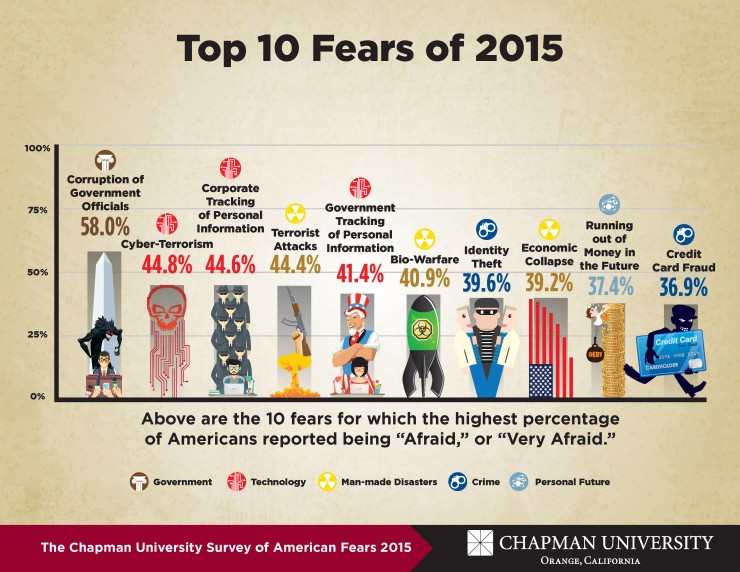
America’s Top Fears 2015

by Barry Ritholtz

Click for the full breakdown.


Source: Chapman University

20 Oct 05:09

One Of These Things Is Not Like The Others

by Barry Ritholtz


Source: Media Matters

20 Oct 03:21

The Lack of Historic Knowledge Is Frustrating

Every time I’m explaining the intricacies of new technologies to networking engineers, I try to use analogies with older well-known technologies, trying to make it simpler to grasp the architectural constraints of the shiny new stuff.

Unfortunately, most engineers younger than ~35 years have no idea what I’m talking about – all they know are Ethernet, IP and MPLS.

Just to give you an example – here’s a slide from my SDN workshop. Anyone familiar with the technologies I listed on the slide immediately grasps the limitations of various SDN approaches.

How many people still remember those technologies? They are dead for a good reason, but unless we know what the reason is, we keep reinventing them after a decade or two.

Want a few more examples? I was trying to explain the principles of SAN and differences between FC and FCoE to a networking engineer a while ago. I started with B2B credits in FC and told him Fibre Channel uses exactly the same approach as hop-by-hop windows we had in X.25, with the same results… resulting in confused blank stare. Further down the conversation I said FCoE uses lossless Ethernet, which uses PAUSE frames, which are exactly the same thing as Ctrl-S and Ctrl-Q on an async link. Same result.

In short, the lack of historical knowledge I see in younger engineers is depressing, and it’s obvious when looking at many SDN ideas or even products that “Those who fail to learn from history are doomed to repeat it”, but I simply don’t know how to fix it – it’s so hard to motivate young people to learn about seemingly irrelevant stuff. Any ideas are highly appreciated.

However, there is something you can do – always ask why do we do things the way we do them and understanding the fundamental principles instead of focusing on the intricacies of the configuration commands. Study old technologies and try to grasp why we no longer use them, because RFC 1925 section 2.11 remains as relevant as ever.

16 Oct 21:26

Why renting a house in India is a better idea than buying one

by Ritesh Kumar Singh
India-real estate-Narendra Modi

In a recent media interaction, finance minister Arun Jaitley urged the Reserve Bank of India (RBI) to cut the interest rates. A lower rate would help fuel growth in India’s realty sector, which is suffering from a severe demand slowdown.

And he’s not wrong. There are 750,000 unsold apartments in seven cities alone, including those in Mumbai, the National Capital Region (NCR) and Bengaluru. RBI governor Raghuram Rajan obliged the finance minister with a 50 basis points (bps) rate cut.

Will that be enough to revive India’s housing demand? Will it save the realty sector from crashing? Why is India’s housing sector staring at an imminent crash?

A majority of demand for homes in India is in the affordable segment. However, most developers are coming out with high priced premium and luxury apartments that most buyers can’t afford. Over 69% of the unsold homes in Mumbai are priced above Rs1 crore or more. The result is huge unsold inventories.

The inventory pile-up is so huge that it would take at least five years in the NCR and three years in Mumbai to sell them off, according to a report by Knight Frank India, a property consultancy. Rajan is right when he says the salaried class can’t afford to buy flats in India’s top cities. Obviously, builders will face shortage of buyers. If homes prices continue to remain flat for long, investors will start losing interest. 

Secondly, India’s home market is driven by investors rather than end users. Thus, if homes prices continue to remain flat for long, investors will start losing interest, as they are in the market for a good return on the money invested.

Return comes in two ways—capital gains from the appreciation in the home prices or rental income. At present, apartment prices are either stagnant or witnessing a mild correction in most parts of India, and more so in the NCR.

When it comes to rental income, a typical two-bedroom, 1,000 square feet apartment in the Mumbai suburbs of Andheri East or Malad with a quoted price of anything between Rs1.5 crore and Rs2.5 crore will generate an annual rental income of anything between Rs3 lakh and Rs6 lakh. That is 2% to 2.4% of the capital value of the apartment.

Expenses on account of property taxes, society maintenance charges and the normal wear and tear of the apartment devour around 20% to 30% of the rental income depending upon the age and location of apartment building. Then, you also have to consider capital gains taxes in case you decide to sell.

Critics will say that I’m not accounting for the role of black money. That’s true.

However, even people with black money who’ve invested in the property market do look for positive returns. If rent is insignificant compared to the property price, and capital appreciation is not happening—which is the reality whether builders accept it or not—investors will soon lose interest. Investors have already started to desert some realty markets like Noida.  

Investors have already started to desert some realty markets like Noida. As a result, prices are lower by almost 30% from the peak of December 2012. (The best way to verify price correction is check prices in the resale market.)

Can the RBI rate cut of 50 bps revive sentiment in the housing sector and bring back buyers as EMIs (equated monthly instalments) would now be lower?

I don’t think so.

It’s important to realise that buyers have to pay both the principal (apartment price) and interest. A 50 bps rate cut on a Rs50 lakh loan with an interest rate of 10% for 20 years means that the EMI will drop from Rs48,251 to Rs46,607.

Will you buy something that cost you Rs50 lakh just because your EMI is now down by Rs1,644 a month? Most people will not, especially when you can rent that Rs50 lakh apartment for just Rs10,000 or Rs12,000 a month.

It doesn’t make sense to buy a two-bedroom apartment for Rs2 crore and enslave yourself for life in a bad job or with a bad boss. Why buy when you can rent it out for just Rs50,000 a month at the most. I stay in a house that is priced at Rs1.5 crore, but I pay only Rs32,000 a month as rent when home loan interest rate is 10%. Why can’t you?

Even if you want to buy your dream home, what’s the hurry? Prices are not moving up so it makes sense to wait till then, stay in a rented accommodation of your choice, at least till the housing regulator becomes a reality. There are so many unoccupied apartments to choose from irrespective of what your local brokers say about availability. There are so many unoccupied apartments to choose from irrespective of what your local brokers say about availability. 

My advice: please don’t go for under-construction apartments, even if you think that the payment plan offered by builders is too good to refuse. For instance, pay 20% now and the balance 80% on possession. Well, 20% of Rs2 crore is Rs40 lakh. And at 10% per year, your interest outgo would be Rs4 lakh annually, which is more than sufficient to rent a decent 2 BHK apartment.

Plus your money remains safe that you can use to buy a ready to move in apartment when prices are reasonable.

If you still want to fall into the 20:80 trap, here’s the fact: builders are delaying handing over the possession by two to six years. If that’s the case, you may have to pay both the rent and EMIs.

Besides, what’s the guarantee that your under-construction project will ever be completed, given the over-leveraged conditions of real estate companies, the nexus between builders, babus and politicians, and no housing regulator to police the errant builders.

Can you fight a builder who doesn’t intend to keep his words? You can’t. But why should you when you have the option of staying in a rented accommodation?

A version of this post first appeared on LinkedIn. We welcome your comments at ideas.india@qz.com.

15 Oct 22:52

The Trouble With Monopolies

by Barry Ritholtz


Source: Business Insider


I missed the Democratic debate Tuesday evening, occupied as I was with listening to classic rock from the 1970s. What would have interested me in that debate was the discussion of the proper role of regulation in modern capitalism.

The U.S. doesn’t seem to engage in the topic like one might expect in a mature, developed economy. There is little intelligent discussion about the costs of too much regulation on the one hand, and the excesses of capitalism on the other. That is a shame, because both sides of those issues create real economic frictions with substantial societal costs.

Consider the slowdown in productivity in the U.S. in the past few years (see total labor productivity, via Federal Reserve Bank of St. Louis). Wharton School professor Jeremy Siegel has wondered if regulation isn’t a major reason behind the decline. I suspect that’s one of many factors, although much of it might be accounted for by measurement flaws. (You can hear Siegel discuss this in our Masters in Business radio podcast this coming weekend).

I will defer the issue of saving capitalism from itself to some future column. But a related issue I would like to address is how poor a job the U.S. does in regulating industries to which it grants monopoly or oligopoly status. Consider the following chart

Continues at Monopolies Don’t Give Us Nice Things


15 Oct 22:52

You Can and Should Be Eating Banana Peels

by Claire Lower on Skillet, shared by Whitson Gordon to Lifehacker

You Can and Should Be Eating Banana Peels

I’ve always assumed that the banana peel’s only purpose was to provide cheap, slapstick laughs at the cost of some poor klutz, but it turns out that you can (and should!) eat the slippery bastards.

Not only are banana peels edible, but they’re pretty good for you, and contain fiber, vitamins C and B-6, potassium, and magnesium. (The only people who should avoid them are those with latex allergies, as the peels contain some of the proteins that cause the reaction.) They can be blended into smoothies (along with the rest of the banana), fermented into vinegar, or cooked into tasty recipes like banana peel thoran or banana skins with blacked eyed peas. The riper the banana, the easier they will be to chew, but even the tougher ones can be softened with ten minutes of boiling (or frying, or baking).

People around the world are eating banana peels because they know something that Westerners do not | Business Insider

Photo by torbakhopper.

13 Oct 05:04

Why a Boston Suburb Combined Its High School and Senior Center

by Amy Crawford
Image Richard Mandelkorn
The main entrance to Swampscott High School, which opened in 2007 (Richard Mandelkorn)

“You’ll have to excuse us, because we’re about to serve lunch, and it’s total chaos,” says Marilyn Hurwitz, striding through the busy lobby of the Swampscott Senior Center toward a multipurpose room where some three dozen elderly women and a handful of men sit waiting for their salmon fillets, spinach salads, and split-pea soup.

The ladies—who, in the gracious style of their generation, wear skirts and stockings, accessorized with lipstick and tasteful jewelry—sit chatting, their walkers and canes parked nearby. But should lunch be late, Hurwitz assures me, they are capable of creating a ruckus.

“You should see the poker games,” she says.


Series

City Makers: Global Shifts


A tendency toward unruly cafeteria behavior is one thing the senior citizens in Swampscott, a seaside Boston suburb, have in common with the town’s youth, but it’s not the only thing. In fact, the airy 7,500-square-foot facility that hosts their knitting circles, card games, and exercise classes shares space with the local high school.

“It’s just a positive neighborly relationship,” says principal Ed Rozmiarek. “This building is called Swampscott High School, but it’s a community space, and it was designed that way.”

The town didn’t originally set out to combine its senior center with its high school, says the building’s architect, Philip Poinelli, a principal at Symmes Maini & McKee Associates in Cambridge. But during the early phases of planning, as his team met with officials, they realized that the needs of the town’s elderly overlapped quite neatly with those of its teenagers. At the time, the senior center was using a small Victorian house that fell far short of accessibility standards.

The senior center had a strong dance program, Poinelli recalls learning. “We said, ‘Well, we have a dance room in the high school.’ In the winter, they took seniors in a bus to a local shopping center to walk—I said, ‘Well, we have this huge field house, you could use that.’ There was so much overlap, and it just seemed to make sense.”

“There was so much overlap, and it just seemed to make sense.”

The building that Poinelli and his team ultimately designed is something that the architect, who specializes in schools, would like to see more often. It’s all too common for departments to compete against one another for funding, rather than joining forces, he says.

“It’s surprising. A high school is probably the greatest capital expenditure that a community will make,” he notes. “So why shouldn’t it serve everyone, from child care to senior citizens?”

In Swampscott, town officials and the project’s architects focused primarily on efficient use of resources. Why build two pottery studios when older artists can share a kiln with teens? There was no official intergenerational programming. But students and seniors have formed serendipitous relationships since the building opened in 2007.

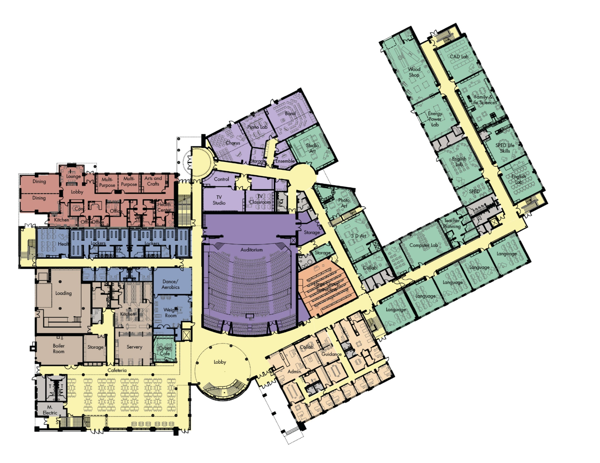
The first-floor plan of the complex, with the senior center shown in red (SMMA)
Seniors using the high-school dance room (SMMA)

Members of a knitting circle taught several students to knit, for example, and high-school sports teams give presentations to the senior men’s group, sharing their strategy for the upcoming season. Kids in need of community-service hours help serve lunch at the senior center, and veterans have been asked to talk to students about their service. The senior center gets 25 free tickets to every high-school performing arts event, and last year, the seniors’ dance team performed at the high-school talent show.

“That was fun,” says Rozmiarek, adding, “Every now and then I think it would be nice to have a more formal partnership. It’s kind of an untapped resource.”

That’s a frustration that both sides feel. Hurwitz, herself a retired high school principal who now works part-time directing the town’s Council on Aging, says her staff would also like to have more formal and frequent interaction. Still, the center’s clients, who numbered more than 1,000 last year (up from a few dozen at the old center), appreciate a location that puts them at the heart of the action.

Eddie Cohen, 89, comes to the center four days a week. Sharing lunch with friends is the main draw, but he also relishes the chance to sit out front in the morning and afternoon, chatting with students as they come and go to classes.

“It’s fun to tease them,” he says. “It keeps your mind active.”

Alice Campbell says having the high school next door gives her and her friends a sense that they are part of the greater community—unlike a stand-alone senior center, which might feel isolated or carry a certain stigma.

“We like to see young people,” she says. “It’s just a lovely feeling, having them nearby. I think it’s something anyone who’s building a senior center should consider.”

Campbell, who is 86 and has been known to arrive at the center on the back of her nephew’s motorcycle, makes her apologies before bustling away. “I have to go play bingo,” she says.


07 Oct 03:48

Sofa bun

by bunniew
06 Oct 05:18

One of few places on Earth where an international boundary can be seen at night

An astronaut aboard the International Space Station took this nighttime panorama while looking north across Pakistan’s Indus River valley. The port city of Karachi is the bright cluster of lights facing the Arabian Sea, which appears completely black. City lights and the dark color of dense agriculture closely track with the great curves of the Indus valley. For scale, the distance from Karachi to the foothills of the Himalaya Mountains is 1,160 kilometers (720 miles).

This photograph shows one of the few places on Earth where an international boundary can be seen at night. The winding border between Pakistan and India is lit by security lights that have a distinct orange tone. Another night image (click here) shows the border zone looking southeast from the Himalaya. A daylight view shows the vegetated bends of the Indus Valley winding through the otherwise desert country.

More than two millennia ago, Alexander the Great entered the Indus plains in 327 BCE from the northwest. He then spent many months leading his army and navy down the length of the Indus valley shown in this view. From near Karachi, he then began the desert march back to Mesopotamia (modern Iraq). By contrast, it takes the space station just three minutes to travel this distance.

Astronaut photograph ISS045-E-27869 was acquired on September 23, 2015, with a Nikon D4 digital camera using a 28 millimeter lens, and is provided by the ISS Crew Earth Observations Facility and the Earth Science and Remote Sensing Unit, Johnson Space Center. The image was taken by a member of the Expedition 45 crew. The image has been cropped and enhanced to improve contrast, and lens artifacts have been removed. The International Space Station Program supports the laboratory as part of the ISS National Lab to help astronauts take pictures of Earth that will be of the greatest value to scientists and the public, and to make those images freely available on the Internet. Additional images taken by astronauts and cosmonauts can be viewed at the NASA/JSC Gateway to Astronaut Photography of Earth. Caption by M. Justin Wilkinson, Texas State University, Jacobs Contract at NASA-JSC.

Instrument(s): 
ISS - Digital Camera
06 Oct 05:15

China Rolls Out the 'World's First Driverless Bus'

by John Metcalfe

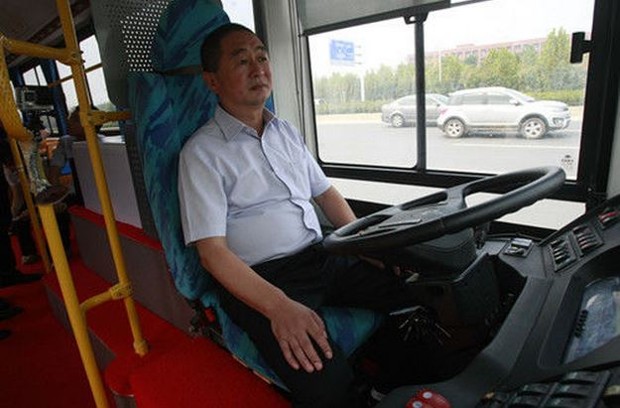
Notice anything odd about this bus tooling along a highway in China’s Henan Province?

Yutong

Look again. The dude behind the wheel is stretching his arms up like he’s dunking on someone—perhaps the execs at Google and Apple, as this thing is the “world’s first driverless bus,” according to manufacturer Yutong.

While tech companies in America have focused on personal automated cars, China has gone big with what could be the beginning of mass, unmanned bus transit. The spacious vehicle, unveiled at the end of August after three years of development, recently managed a 20-mile trip through the crowded city of Zhengzhou without crashing into other motorists or bursting into flames. That same driver stayed behind the wheel, true, but maybe as technology progresses he’ll be replaced with a Johnny-Cab robot.

Yutong

The bus maneuvers with the help of cameras, laser radars, and a master controller that tells it to go faster and stop at signals. Yutong says in a press release it masterfully handled the road during one of its test drives:

With a distance of 32.6 km, the intercity road from Zhengzhou to Kaifeng has 26 traffic lights in total. Despite this and busy traffic, Yutong driverless bus successfully completed a series of highly complex driving acts, such as automatic lane change, overtake, and responding traffic lights. Without any human assistance, the bus arrived at its destination with its highest speed reaching 68 km/h (42 mph). According to some experts, the much improved active safety standard is the biggest advantage of unmanned vehicles as they are very likely to eliminate all kinds of traffic accidents.

The manufacturer also says the bus has an efficient driving style—one “that can only be attained by years of experience of an attentive and careful driver”—that will reduce energy waste and thus make the ride environmentally friendly. The company plans to put it through more tests, including running it on race lanes, before proceeding with real-world applications.

A reporting crew with RT took a spin on the bus last week. Have a look at the view from the front seat:


01 Oct 05:04

Cell phone lobby win means 'more people will die'

by Allan Holmes

Joan Lantz was having trouble breathing. At 9:28 p.m. on Feb. 7, 2012, the 71-year-old picked up her cellphone and dialed 911 from her small apartment in Rock Hill, South Carolina.

“I can’t breathe,” Lantz said in a labored voice to the 911 dispatcher.

“What’s the address?” the dispatcher asked.

There’s a pause. Lantz says again, “I can’t breathe.”

“Hold on one second. I’m trying to find out where you are, OK?” the dispatcher said reassuringly.

It would take more than 13 minutes for dispatchers to determine the location where Lantz was calling from. And even then, it was just an approximate area: somewhere in the sprawling Patriot’s Crossing Apartments complex in northeast Rock Hill.

Another 44 minutes would pass before police officers, who went from apartment to apartment trying to find Lantz, kicked down the door of unit 101. There, they found Lantz lying on her couch, dead from respiratory failure. She was still clutching her cellphone.

Lantz’s death might have been prevented. Addresses pop up quickly on a dispatcher’s screen when a call comes from a landline. But dispatchers can’t always locate callers when the calls come from cellphones — especially when made from indoors.

More than 10,000 people, who would otherwise be saved, die every year when calling 911 from a cellphone because emergency dispatchers can’t get a quick and accurate location on them, the Federal Communications Commission calculated, when it proposed new 911 location rules last year for wireless phones.

The problem isn’t the dispatchers, police officers or firefighters who respond to the emergency calls. The failure is that the technologies used by wireless carriers — like industry giants AT&T Inc. and Verizon Communications Inc. — fail repeatedly to locate indoor callers.

The real tragedy, say emergency workers and cellular engineers, is that this doesn’t have to be: Technical solutions exist that can locate people calling on cellphones within seconds. But tough rules proposed by the FCC in February 2014 aimed at requiring more accurate indoor locations of callers to 911 were weakened through a nearly year-long lobbying campaign by wireless carriers.

Wireless carriers said the new rules relied too heavily on expensive proprietary technology that was untested and that accuracy claims were overhyped. They argued that commercially available technology already widely deployed, such as Wi-Fi and Bluetooth devices found in almost every business and most homes, promised to provide better location accuracy because it would give a specific street address with an apartment, floor and room number.

But more than a dozen associations representing firefighters, police, emergency medical technicians, the elderly, the deaf and technology companies said the commercial technology wasn’t developed for the demands of a 911 system and would fail during major disasters when electricity was lost. The industry’s proposal, many of the groups said, allowed the carriers to shift the cost and responsibility of locating 911 callers from the carriers to the public, making it impossible for the FCC to enforce.

But more important, many of the groups said the carriers ignored them when developing their alternate rules, relying instead on associations the carriers had lavished with hundreds of thousands of dollars of support.

“[This] … is a perfect example of how big money and big corporations can make it appear there’s been a democratic and open process, but in fact they’ve corrupted the science and bought off the very organizations that are supposed to be a watchdog in protecting the public,” said a former senior FCC official who asked to not be identified in order to speak more candidly. “And in this case, the result means more people will die.”

An ‘effing boondoggle’

In February 2014, Tom Wheeler, just three months into his new job as FCC chairman, proposed explicit rules requiring carriers to deliver accurate indoor locations for people calling 911 from their cellphones. The issue had been a big concern for Wheeler going back to the 1990s, when he was head of CTIA-The Wireless Association, which typically fights for looser regulations. But Wheeler had cast the tie-breaking vote on the association’s board to support wireless location rules.

Wheeler told a workshop the FCC convened on the issue in November 2013 that he had been convinced wireless location rules were needed after a meeting he had during his CTIA days with then-FCC Chairman Reed Hundt. The chairman had played a tape for Wheeler of a 911 wireless call from a frantic woman in Texas whose car was stuck on a railroad track. She couldn’t give the dispatcher her location, and while she was unharmed, Wheeler listened to the sound of her car being demolished by an oncoming train.

Wheeler’s proposal would have required carriers to use new technologies to meet the required accuracy. Some were already available while others had been tested but not included in handsets and would have added tens of millions of dollars a year to carriers’ costs to provide. The technology would allow emergency workers to locate people calling from indoors and from deep within cities where tall buildings can block GPS signals.

The rules also included requirements to identify for the first time what floor a person was calling from and to report to dispatchers and the FCC that they were locating the vast majority of indoor callers. The accuracy for pinpointing a caller was reduced from the previous requirement of up to 300 meters to 50 meters.

But the agency didn’t pass those rules. Instead, this past January, the commission approved a watered-down version of Wheeler’s proposed regulations. Deadlines for when carriers have to meet accuracy standards for locating wireless callers were extended and requirements specifically designating indoor-location accuracy were removed. Cheaper, untested technologies that won’t require wireless carriers to spend more money were included instead.

The final rules were a significant step forward in eventually improving locating wireless 911 callers, said an FCC official who was involved in working on the regulations and asked not to be identified so to speak candidly about the rulemaking process. But many supporters of the stricter proposal inside the FCC still weren’t satisfied with the outcome, the source admitted.

The process “was the biggest effing boondoggle ever,” said a participant in the rule-making process. The person asked for anonymity, fearing a backlash from carriers. “It represents everything that is wrong with Washington.”

Large and well-financed telecommunications companies spent millions on lobbying the FCC and relied on cozy relationships cultivated over years with the two associations representing emergency dispatchers, Association of Public-Safety Communications Officials-International (APCO) and the National Emergency Number Association (NENA), the key groups needed to support any new location rules.

In the end, they managed to convince the government to sacrifice safety to protect their bottom lines, say many public safety advocates. But wireless companies say their approach is better because it relies on commercially available, ubiquitous location technology that many popular applications use to locate callers.

Nearly two dozen individuals including lobbyists, wireless technology executives, cellular engineers, 911 operators and industry consultants declined the Center’s requests for interviews or asked to speak anonymously for this story. They said their jobs or businesses relied heavily on the carriers — in particular AT&T and Verizon, which combined account for two-thirds of all cellphone customers nationwide.

AT&T declined to comment for this article, referring questions to CTIA, which includes as members AT&T and other carriers as well as suppliers. CTIA offered a 935-word statement, which did not address a dozen questions the Center sent on specific points that appear throughout this article.

“The FCC’s rules require wireless carriers to meet quantifiable benchmarks on aggressive timelines,” Scott Bergmann, vice president of regulatory affairs at CTIA, wrote in the emailed statement. The FCC’s approach “will help save lives.”

Verizon and T-Mobile US Inc. also declined requests for interviews to answer specific questions about how the rules were negotiated. For other responses, the Center relied on excerpts from comments the companies filed with the FCC.

Officials from APCO, which has received considerable support from carriers, didn’t respond to multiple requests for an interview. In a blog posted in January, APCO said it was “proud” to have collaborated with the wireless carriers to develop an alternate set of rules that it believed would provide a better solution by delivering a specific address to 911 dispatchers.

GPS not the best

For years, the FCC has required wireless carriers to provide GPS location technology in their handsets, with accuracies up to 300 meters of a 911 caller. But dispatchers don’t always get a location when a call comes in. A 2012 study of 911 calls in five California cities showed an accurate location was being delivered between 20 percent and 49 percent of the time. Carriers disputed the findings, saying dispatchers weren’t following proper computer procedures to obtain callers’ locations.

Most recent cellphones are equipped with global positioning system hardware, which can locate callers from satellites. But while GPS works well when locating a caller standing in an open field, when the call comes from inside homes, apartments, stores, hotels, college dorms, or in downtowns where tall buildings block the signals, it performs poorly.

With an estimated 58 percent of all wireless calls coming from indoors, the FCC realized a large portion of emergency calls were likely not to deliver a location at all.

Data crunched by the FCC showed 10,120 lives would be saved each year, with an economic benefit of $92 billion annually, if police, firefighters and ambulances could reach a caller just one minute faster.

Tests performed in 2012 by an FCC-sponsored group and later by independent consultants had shown new wireless location technologies frequently provided better indoor accuracy than GPS-based technologies. The FCC now had “confidence that further advances in technology should enable us to locate callers indoors with the same degree of accuracy as outdoors,” Wheeler said in February 2014 before the agency’s commissioners approved opening the rules for public comment. The agency’s two Republican commissioners also voted in favor of releasing the proposed rules but objected to what they considered tight timelines.

At the heart of the proposed rules were two requirements:

  • Within two years, wireless carriers would have to provide the location of a 911 call from indoors to within 50 meters 67 percent of the time. Within five years, carriers would have to deliver that level of accuracy for 80 percent of all indoor calls.
  • Within three years, carriers would be required to provide the vertical location, such as a floor in a building, of a wireless caller to within three meters 67 percent of the time and 80 percent of the time within five years.

The rules were considered aggressive but attainable by police, firefighters, medical responders, many technologists and cellular engineers.

The carriers disagreed. AT&T filed comments with the FCC in May 2014, calling the rules’ accuracy requirements “not yet technically or commercially feasible” and the “proposed timeframes … wholly unrealistic.” Verizon also said the deadlines were not attainable and that more time was needed to test if “a particular location solution will meet any new accuracy standards the Commission adopts.” T-Mobile said the FCC’s reliance on new location technologies for its proposed rules had “proven economically infeasible to deploy and maintain in comparison to other, better performing technology alternatives,” and suggested Wi-Fi technology as an alternative. Sprint Corp. made the same arguments.

Getting their way

Eleven months later, the FCC passed very different rules, regulations that were based largely on a plan called the Roadmap, which was written by the four big wireless carriers — AT&T, Verizon, Sprint and T-Mobile — in conjunction with APCO and its smaller sister, NENA, which together represent about 30 percent of the nearly 100,000 emergency dispatchers nationwide.

The rules no longer required the carriers to show they were delivering locations for indoor calls. All 911 calls, coming from outdoors and indoors, would be measured together. The percentages of calls that would have to deliver an accurate location were reduced, from 67 percent in the first two years to 40 percent. The deadline for 80 percent of calls delivering an accurate indoor location was extended from five years to six.

Removed from the rules was a requirement to deliver a location for callers in multi-story buildings. In its place is a requirement that within three years carriers come up with an independently verified way to measure vertical location and deploy by 2023 the technology to just the top 50 wireless markets nationwide. The FCC had proposed requiring carriers to provide vertical locations nationwide within three years for 67 percent of indoor calls.

The carriers also got their way in pushing for a so-called Nationwide Emergency Address Database, which would provide a dispatchable address that includes street address, apartment number, suite, floor and other location information for just 25 percent of the population. The database, which is required to be built by 2021, would be populated with the addresses of Wi-Fi and Bluetooth devices operated by companies, retail establishments and individual homeowners that smartphones access and can be used to broadcast their locations.

The carriers, CTIA, technology companies and APCO and NENA touted the new rules as a collaboration between industry and the dispatcher associations, a partnership, they frequently said, that the FCC had called for in its proposed rules, asking for “industry and public safety stakeholders to propose consensus-based, voluntary commitments.”

“The FCC’s invitation was based on a long and successful history of collaborations between wireless carriers and the public safety community to improve 9-1-1, which was repeatedly spearheaded by APCO and NENA,” including the rules passed in 2013 for texting 911, which “has already enabled life-saving communications,” CTIA’s Bergmann said in an email.

But in the end, the carriers asked only the dispatcher associations to negotiate, other groups argued. Left out were a range of associations, including police, sheriffs, firefighters, emergency medical responders, the elderly, the deaf, abused women, utility regulators and others who strongly supported the initial rules, members from these groups said.

The two groups the carriers did negotiate with — APCO and NENA — have received large financial donations from the carriers.

AARP, whose members are among the most likely demographic to call 911, described the negotiations as a “closed, opaque process” and said the “agreement would have been very different … if it had been an open and transparent process.”

The wireless companies “have far too much influence in Washington, and when you add to that APCO and NENA, it is very hard” to overcome, Kevin O’Connor, head of governmental affairs for the International Association of Fire Fighters, which supported Wheeler’s original rules, said in an interview. “The people going into fires risking their lives should be included in any negotiations and should carry a lot of weight. But unfortunately, in this case, that didn’t happen.”

In January, the FCC commissioners, three Democrats and two Republicans, voted 5-0 to approve the altered rules, but the unanimity belied the commissioners’ division. Democratic Commissioner Mignon Clyburn voted to “concur” with the rules, a position that means she didn’t agree with the changes but wasn’t going to try to stop them. “I would have preferred the rules that we originally proposed would be the ones we vote on today,” she flatly said before the vote. Clyburn didn’t respond to a request for an interview.

Commissioner Jessica Rosenworcel, also a Democrat, opposed Wheeler’s proposed rules. A frequent speaker and attendee at APCO events, Rosenworcel was the key player helping guide the creation of less stringent rules, sources inside the FCC said. Rosenworcel said the new requirements took “a lot of work and wrangling” and thanked APCO and NENA for their “insights and assistance.” Rosenworcel did not respond to a request for an interview.

Wheeler realized he didn’t have the votes to pass his original proposal without Rosenworcel, who would have likely joined the two Republican commissioners in voting against Wheeler’s rules, FCC sources said.

The two Republican commissioners preferred the altered rules. Ajit Pai said he appreciated the rule changes and that he “would like to thank Commissioner Rosenworcel in particular for helping steer the item down a better path,” a rare show of bipartisan camaraderie on the commission.

Wireless funds flow to safety groups

A few weeks after the FCC released the proposed tougher rules wireless carriers began meeting with APCO and NENA. The groups had worked together months before to form rules for texting 911, and the carriers needed the groups’ support to help roll back what they viewed as Wheeler’s heavy-handed regulations.

“You don’t have to be an Einstein to figure out what their reaction was,” Brian Fontes, NENA’s CEO, said of the carriers in an interview at his office. “They had to be apoplectic over the proposals that the commission was presenting.”

The carriers and the associations, aligning with their state chapters and groups supported by the wireless carriers, collectively spent millions of dollars to file dozens of comments in support of their alternate rules and convinced other large groups and corporations to do the same. The four carriers, CTIA, APCO and NENA — with support from large technology companies such as Cisco Systems Inc., Motorola Mobility LLC and other smaller groups — filed nearly twice as many comments and met with FCC staff more than a dozen times more than location technology companies and their supporters did during the 12 months the commission wrote the rules, according to FCC records. The record they built overwhelmed the smaller and less financed groups. And it was a record the FCC is required by law to consider.

The wireless carriers are among the best in Washington when it comes to building a strong case for their views on wireless policies because they can call on a network of organizations to file comments that support the carriers’ positions, the FCC official said. As a legal matter, the FCC has to consider all the submissions or risk future lawsuits, the official said.

TruePosition Inc., a location technology company that supported the stricter rules, formed a lobbying group called FindMe911. The group published a list of comments from dispatchers nationwide complaining about the poor location technology and created other promotional campaigns. But the effort failed against the wireless carriers’ combined spending, said one of the leaders of the campaign.

In reaching out to the public-safety stakeholders, the carriers kept the field to APCO and NENA, two associations they had long ago cultivated close relationships with by being among the top sponsors of the associations’ annual conferences. The carriers also have been among the primary sponsors of the groups’ awards banquets, workshops and seminars held on specific 911 policies.

The financial ties run deep.

APCO offers companies corporate partnerships, which includes benefits based on the amount of money a company gives such as access to APCO board members and executive staff. AT&T is a “platinum corporate partner,” the top partnership level. It requires giving the association $100,000 or more, according to APCO’s website. Verizon is a silver partner, a level bestowed to companies that donate between $40,000 and $70,000, and T-Mobile is a bronze partner, which requires a gift between $10,000 and $40,000. Sprint is not a corporate partner.

Motorola also gave $100,000 or more, and TeleCommunication Systems Inc., which develops wireless-location-based services, and Intrado Inc., which provides emergency communications systems to telecom companies, both donated between $70,000 and $100,000. TeleCommunication Systems and Intrado rely heavily on business from the largest wireless carriers, according to sources knowledgeable about the contracts who asked for anonymity for fear of retribution from the carriers.

MotorolaTeleCommunication Systems and Intrado submitted comments in December with the FCC supporting the wireless carriers’ rules. Together these six companies represent 40 percent of APCO’s corporate partners. None of APCO’s 15 corporate partners includes a company or group that supported the stricter 911 location rules.

APCO collected about $3.4 million from its conferences in 2013, which includes sponsorships from wireless carriers and the emergency wireless infrastructure companies that work closely with the telecoms, according to its financial statement filed with the Internal Revenue Service. That was 34 percent of its total revenue of $9.9 million and is typically the largest single source of income for the association.

APCO’s sister association, NENA, also holds conferences and seminars that are sponsored by the wireless companies and infrastructure companies that depend on their business. But NENA CEO Fontes denied sponsorships and other giving influence the association’s policy positions.

“I think it’s a very big problem that APCO has these sponsorships; it’s a very big problem,” said Hundt, FCC chairman during President Bill Clinton’s administration. The carriers’ sponsorships of APCO and NENA conferences and events “just create a serious conflict of interest. It’s unavoidable.”

Fontes, saying he wanted to be transparent, provided the Center for Public Integrity a printed copy of a spreadsheet showing AT&T, Sprint, T-Mobile, Verizon and CTIA gave NENA a total of almost $595,000 from 2011 to 2014. The amount is about 4 percent of NENA’s total revenues during that time.

“Some perceive that we capitulated because these carriers give a vast amount of money to NENA. Well, it’s not so,” said Fontes, who previously was head of policy at CTIA. The amount they give “is not going to make or break this organization.”

CTIA, to which AT&T referred the Center to answer questions about financial ties with APCO, did not address an emailed question about whether wireless companies used sponsorships and other donations to influence dispatcher associations. The association wrote that the FCC encouraged industry and other stakeholders to work together.

Motorola declined to comment. Intrado said in a one-sentence statement about its support of APCO and NENA that it “is a long-standing supporter” of the groups and “continues to partner with them to further our common goals.” TeleCommunication Systems did not reply to emails requesting comment. APCO Executive Director Derek Poarch and recently elected APCO President Brent Lee didn’t return emails requesting an interview.

Influencing rules

Money also buys access to conference panels and the chance to give presentations at forums where the first kernels of rules may be formulated, with the ideas eventually making their way to the FCC for consideration. Close relationships between association leaders and corporate executives are formed over drinks at the bar and parties at corporate offices.

In March, APCO held its Emerging Technology Forum in Dallas, where AT&T’s corporate headquarters are located. The forum, which the association periodically holds, was sponsored by TeleCommunication Systems, Intrado and T-Mobile, among other companies. Speakers included David Simpson, head of the FCC’s Public Safety and Homeland Security Bureau, which was in charge of writing the wireless 911 location rules.

Most of one afternoon session included “education” on location technology and accuracy given by Verizon, Intrado, TeleCommunication Systems and Qualcomm Inc., which develops wireless communications equipment. All four companies urged the FCC to adopt the carriers’ wireless 911 location rules. Not one company or group who supported the tougher proposed rules was part of the program.

APCO also held an evening reception at AT&T’s headquarters, where the company provided attendees, APCO executives and policymakers “opportunities to meet and greet with AT&T executives,” according to the forum’s program. AT&T also advertised that “technologists from AT&T’s Foundry in Plano will be offering demos of the latest innovations in communications.”

James Thurber, a professor at American University who has studied lobbying for more than 30 years, said the practices are routine and almost universally accepted, but he says it no less undermines the public interest.

“This is one of the lobbying tools to influence public policy,” Thurber said. “The sponsors help set the parameters of the policymakers and drive the policy in the direction they like. … These companies aren’t putting $100,000 out there unless they see some return they will get. This isn’t philanthropy.”

APCO is especially amenable to wireless carriers’ demands, typically aligning itself with the companies’ positions on 911 issues, particularly with AT&T, according to executives and technologists with 911 groups, location-technology companies and former FCC staffers.

Thera Bradshaw, who sat on the APCO board and served as its president for a year, said she never felt pressure to give in to demands from wireless carriers, but when it came to including carriers’ executives on panels and presenting their points of views at “conferences and events, I’ve seen that happen.”

APCO officials didn’t respond to emails requesting comment.

Sore point

One of the elements in the wireless carriers’ proposal that made it into the FCC’s final rules and irritates critics was the reliance on Wi-Fi and Bluetooth technology, which smartphones connect to for Internet access and provide location information for popular applications. Each router and device has an identifier that can be tied to the physical address where the devices are located, presumably a floor and room number in a multi-story building.

The carriers argued the ubiquitous presence of the routers and devices — in almost every business, school, and most homes — could be used to locate 911 callers indoors. Smartphones constantly look for Wi-Fi routers, which typically have a range of about 50 to 150 feet, depending on obstructions such as walls and appliances. If a person calls 911, the smartphone may determine which Wi-Fi router is closest by its signal strength, even without being connected to the Wi-Fi, and relay the router’s address to the emergency dispatch center, technologists said. If the physical address of the router is known, a smartphone could deliver the location of the router. Emergency responders would be given not only a street address, but a floor, suite or room number, a location that everyone wants, carriers argued to the FCC.

But the physical address of the Wi-Fi and Bluetooth devices would need to be stored in a national database that dispatchers could access. The carriers offered in its Roadmap to build a National Emergency Address Database to store the addresses, which would be provided to dispatchers during a 911 call. The agency agreed and required carriers to create the database by 2021.

Critics of the solution say the technology has its flaws.

Wi-Fi can fail during tornadoes, hurricanes and earthquakes when power blackouts occur, while calls to 911 increase.

Also, critics argue that carriers support the Wi-Fi solution simply because it allows them to avoid the expense of the location technologies that attach to cell towers or on top of buildings, such as TruePosition’s and NextNav’s technologies. NextNav’s product can locate callers on a specific floor and room in a building by sending a beacon out from a transmitter that uses a barometric pressure sensor in smartphones to determine how high a caller is from ground level. The technology would cost about $25 million a year for each carrier, company officials said. In comments to the FCC, wireless carriers said the technologies were too costly, and “commercially-available solutions” such as Wi-Fi could “help … carriers manage costs,” according to a CTIA filing.

For AT&T, $25 million represents 0.4 percent of its 2014 net income, and for Verizon, about 0.3 percent.

The carriers’ support of Wi-Fi as a location technology is relatively new. In afiling with the FCC four years ago, T-Mobile said using Wi-Fi to locate callers “has considerable shortcomings,” including reliability, limited accuracy and that only callers who owned smartphones would have the ability to access the routers. T-Mobile urged the FCC not to consider Wi-Fi as a solution for locating 911 callers.

In response to recent inquiries, T-Mobile referred the Center to a comment it filed in December, just weeks before the FCC voted on the new rules, in which the carrier wrote that recent advancements, “including the widespread use of WiFi positioning technologies in the commercial sector,” have “led carriers and others to reconsider this technology.”

Most important, critics said, a Wi-Fi solution would leave a large portion of low-income households and the elderly with no way of being located when calling 911. About 30 percent of all U.S. households do not have a broadband Internet connection in their home, meaning they have no Wi-Fi router  is needed to connect wirelessly to the Internet, according to the Pew Research Center. Most of the households without an Internet connection are low-income and the elderly. Only 52 percent of households that earn less than $30,000 a year have a connection, and only 47 percent of people older than 65 do. Poor communities as a whole also will have fewer Wi-Fi hotspots, leaving large areas in these neighborhoods with no access, critics said.

In addition, most of the poor and elderly don’t have smartphones, which are needed to read nearby Wi-Fi routers and their addresses. About 50 percent of households earning $30,000 and less don’t have a smartphone, and 73 percent of Americans older than 65 years old don’t own one, according to a 2015 Pew Research Center survey.

Won’t save as many lives

In the end, it will be the 911 dispatchers who determine how well the new rules work. And many aren’t convinced they will, given how the rules were written.

Stephen Souder, the director of the Department of Public Safety Communications for Fairfax County, Virginia, and a widely respected expert in the field, said the politics that led to the latest rules were “frustrating.”

But Souder isn’t naïve to how Washington works. He’s seen it before — many times. The FCC has been working on wireless location rules for 911 since 1994, when Souder was part of the agency’s first effort to write requirements for locating wireless callers. Those regulations, and efforts to write others in later years, were rolled back as well. As a result, some people still can’t be found when they call 911, he said, “and in fact it’s gotten worse.”

Now Souder, sitting in his office that overlooks the massive control room where dispatchers take 911 calls, seems resigned to the fact that the latest rules will likely fall short, too, and another six years or more will be lost to improving the system to the point that all callers can be located.

And people will continue to die.

“I’d like to say that these rules will save lives. I don’t know,” Souder said. “But I can absolutely say that [they] won’t save as many lives as [they] would have if [there were] tighter timelines and accuracy requirements that the first rules had.”

This story was co-published with the Daily Beast, and a version of this story was also published with TIME.

01 Oct 03:24

Microsoft Leads Movement to Offset Emissions with Internal Carbon Tax

Photo
Tamara DiCaprio, senior director of environmental sustainability at Microsoft, with solar panels in French Polynesia.

When Microsoft business unit managers calculate their profits or losses each quarter, they consider more than just sales and expenses. They also factor in the price of carbon.

Even more radically, the business units are charged an internal tax by Microsoft based on their energy usage. The money goes into a common fund that invests in environmental sustainability projects.

The company’s program is at the forefront of a fast-growing effort called carbon pricing. This year, 437 companies are calculating an internal price on carbon, up sharply from 150 last year, according to a new report by CDP, a nonprofit group that monitors carbon disclosures for companies.

Motivated by a mixture of moral conviction, hard-nosed economic forecasting and expectation of tougher regulations down the road, companies are scrambling to understand just how much energy they use. Like Microsoft, some, including Disney and Shell, are voluntarily charging themselves, and using that money to build solar panels and wind farms.

Senate Democrats recently introduced a bill proposing tough emissions regulations, and world leaders, including President Obama and Pope Francis, have called for action to combat climate change.

“Businesses do what’s in the interest of business,” said Paula DiPerna, a special adviser to CDP who worked on the report. “If this many companies are pricing carbon internally, they know that climate change is a business risk.”

Microsoft has gone further than most. In just three years, the company has reduced its emissions by the equivalent of 7.5 million metric tons of carbon dioxide and saved more than $10 million through reduced energy consumption. This year, Microsoft expects to charge its business units about $20 million for their emissions.

By taking money directly away from the bottom line, the program has grabbed the attention of the entire company, said Tamara DiCaprio, senior director of environmental sustainability at Microsoft and the architect of its carbon fee program.

“When we started talking about carbon emissions not in metric tons, but in terms of dollar amount, the business people could understand it,” Ms. DiCaprio said. “We’re all speaking the same language now: What is the cost to my group?”

Here’s how it works: Ms. DiCaprio and her team learn the amount of energy that each business unit will consume in a quarter, whether from office space, data centers or business air travel. Those kilowatt-hours and gallons of fuel are then converted into metric tons of carbon.

Ms. DiCaprio’s team then makes plans for offsetting the emissions, through clean energy production, efforts to make buildings more efficient and commitments to long-term sustainable power infrastructure.

Finally, the cost of those investments is calculated — $20 million this year — and Ms. DiCaprio and her team then tell each business unit how much it owes, depending on how much energy it used. The money is collected and put into a fund that pays for a range of sustainability projects.

“It’s money that moves,” she said. “That’s really critical.”

At its big office in Bogotá, Colombia, Microsoft installed more efficient lighting with money from the fund. In Santiago, Chile, the sales office got new building-management software to improve heating, ventilation and air-conditioning. And at company headquarters in Redmond, Wash., Microsoft used big data and a blanket of new building sensors to optimize energy usage across 125 buildings, leading to big cost and carbon savings.

The carbon fee is already changing behavior at Microsoft. Because business units are charged on the basis of their energy usage, they have a real incentive to reduce their energy consumption. Over all, Microsoft is using more power from renewable sources.

Other companies voluntarily monitoring their carbon usage include Exxon Mobil and General Motors. An additional 583 big companies told CDP they planned to start carbon pricing within two years.

Not all of these companies are imposing internal taxes and investing in clean energy. Some are simply using carbon pricing as an academic exercise to anticipate future costs if more regulators impose actual taxes on carbon. So far only a few jurisdictions — including Ireland, Chile and the Canadian province of British Columbia — have done that. Others, including California, have instituted cap-and-trade systems aimed at limiting carbon emissions.

Although internal carbon taxing takes money from the bottom line, and thus from shareholders, some big investors support the efforts.

Anne Simpson, director of corporate governance at the California Public Employees’ Retirement System, or Calpers, which manages more than $300 billion, supports carbon pricing efforts, believing that they will help companies prepare for regulatory costs.

“Climate change is going to affect both risks and opportunities for our fund,” she said. “Carbon pricing is needed to make the market more efficient in capturing this particular risk.”

Ms. DiCaprio of Microsoft is especially qualified to grasp the financial risks and climate hazards of failing to reduce carbon emissions. An environmental science major at the University of California, Santa Barbara, Ms. DiCaprio became a commodities trader at Merrill Lynch in the 1990s. “I learned how markets work,” she said.

After a few years on Wall Street, Ms. DiCaprio moved to Seattle to take a job doing tech support at Microsoft. Over the years, her roles expanded to include sales, marketing and partnerships.

Then in 2010, after attending an environmental science reunion in Santa Barbara, Ms. DiCaprio returned to Microsoft energized by the prospect of helping the tech giant confront climate change. She began working with its sustainability team.

At the time, Microsoft had committed to reducing its emissions by 30 percent. But as the company moved toward providing cloud software services — which require energy-intensive data centers — Ms. DiCaprio and her colleagues resolved to be more ambitious.

“Because we’re doing more bad, we’ve got to do more good,” Ms. DiCaprio says.

In 2012, Microsoft said it would become 100 percent carbon-neutral. That year, Ms. DiCaprio — working with Ms. DiPerna at CDP and drawing on her markets experience on Wall Street — devised and introduced the carbon fee program.

Microsoft’s efforts remain modest in the grand scheme of things. But ahead of the United Nations Climate Change Conference in Paris this December, more companies are asking governments to act on climate change. This summer, six big European oil and gas companies called for governments to impose a tax on carbon emissions. And carbon pricing is, in effect, an effort by companies to regulate themselves when nations and states won’t.

“Companies are almost craving regulatory certainty,” Ms. DiPerna said. “They understand it’s in their business interest to address these risks. But governments have lost their oomph when it comes to climate change.”

Real carbon taxes — and not just voluntary efforts — may not become commonplace anytime soon. Yet more big companies and their investors appear likely to decide that internal carbon pricing makes sense ethically and economically.

“This year the level of investor engagement on this topic has turned a corner,” said Ms. Simpson of Calpers. “You now have trillions of dollars asking for this, rather than millions. And as with everything, money talks.”

Correction: September 26, 2015

An earlier version of this article misidentified the representative of the California Public Employees’ Retirement System who is quoted twice. She is Anne Simpson, director of corporate governance at Calpers, not Anne Stausboll, the chief executive.

01 Oct 03:19

Always bet on text (2014)

I figured I should just post this somewhere so I can make future reference to how I feel about the matter, anytime someone asks me about such-and-such video, 3D, game or "dynamic" multimedia system. Don't get me wrong, I like me some illustrations, photos, movies and music.

But text wins by a mile. Text is everything. My thoughts on this are quite absolute: text is the most powerful, useful, effective communication technology ever, period.


Text is the most flexible communication technology. Pictures may be worth a thousand words, when there's a picture to match what you're trying to say. But let's hit the random button on wikipedia and pick a sentence, see if you can draw a picture to convey it, mm? Here:
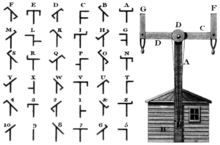
"Human rights are moral principles or norms that describe certain standards of human behaviour, and are regularly protected as legal rights in national and international law."

Not a chance. Text can convey ideas with a precisely controlled level of ambiguity and precision, implied context and elaborated content, unmatched by anything else. It is not a coincidence that all of literature and poetry, history and philosophy, mathematics, logic, programming and engineering rely on textual encodings for their ideas.


Text is the most efficient communication technology. By orders of magnitude. This blog post is likely to take perhaps 5000 bytes of storage, and could compress down to maybe 2000; by comparison the following 20-pixel-square image of the silhouette of a tweeting bird takes 4000 bytes: . At every step of communication technology, textual encoding comes first, everything else after. Because it's vastly cheaper on a symbol-by-symbol basis. You have a working optical telegraph network running in 1790 in France. You the better part of a century of electrical telegraphy, trans-oceanic cables and everything, before anyone bothers with trying to carry voice. You have decades of teleprinter and text-only computer networking, mail and news, chat and publishing, editing and diagnostics, before bandwidth gets cheap enough for images, voice and video. You have pagers, SMS, WAP, USSD and blackberries before iPhones. You have Teletext and BBSs, netnews and gopher before the web. And today many of the best, and certainly the most efficient parts of the web remain text-centric. I can download all of wikipedia and carry it around on the average smartphone.



Text is the most socially useful communication technology. It works well in 1:1, 1:N, and M:N modes. It can be indexed and searched efficiently, even by hand. It can be translated. It can be produced and consumed at variable speeds. It is asynchronous. It can be compared, diffed, clustered, corrected, summarized and filtered algorithmically. It permits multiparty editing. It permits branching conversations, lurking, annotation, quoting, reviewing, summarizing, structured responses, exegesis, even fan fic. The breadth, scale and depth of ways people use text is unmatched by anything. There is no equivalent in any other communication technology for the social, communicative, cognitive and reflective complexity of a library full of books or an internet full of postings. Nothing else comes close.

So this is my stance on text: always pick text first. As my old boss might have said: always bet on text. If you can use text for something, use it. It will very seldom let you down.
30 Sep 06:09

Why Are Little Kids in Japan So Independent?

by Selena Hoy
Image Toru Hanai / Reuters
A schoolgirl walks through a Tokyo subway station. (Toru Hanai / Reuters)

It’s a common sight on Japanese mass transit: children troop through train cars, singly or in small groups, looking for seats.

They wear knee socks, polished patent leather shoes, and plaid jumpers, with wide-brimmed hats fastened under the chin and train passes pinned to their backpacks. The kids are as young as six or seven, on their way to and from school, and there is nary a guardian in sight.

Parents in Japan regularly send their kids out into the world at a very young age. A popular television show called Hajimete no Otsukai, or My First Errand, features children as young as two or three being sent out to do a task for their family. As they tentatively make their way to the greengrocer or bakery, their progress is secretly filmed by a camera crew. The show has been running for more than 25 years.

In this English-subtitled segment from My First Errand, a brother and sister head out to buy groceries for the first time, not without a few tears.

Kaito, a 12-year-old in Tokyo, has been riding the train by himself between the homes of his parents, who share his custody, since he was nine. “At first I was a little worried,” he admits, “whether I could ride the train alone. But only a little worried.”


Series

City Makers: Global Shifts


Now, he says, it’s easy. His parents were apprehensive at first, too, but they went ahead because they felt he was old enough, and lots of other kids were doing it safely.

“Honestly, what I remember thinking at the time is, the trains are safe and on time and easy to navigate, and he’s a smart kid,” Kaito’s stepmother says. (His parents asked not to publish his last name and their names for the sake of privacy.)

“I took the trains on my own when I was younger than him in Tokyo,” his stepmother recalls. “We didn’t have cell phones back in my day, but I still managed to go from point A to point B on the train. If he gets lost, he can call us.”

What accounts for this unusual degree of independence? Not self-sufficiency, in fact, but “group reliance,” according to Dwayne Dixon, a cultural anthropologist who wrote his doctoral dissertation on Japanese youth. “[Japanese] kids learn early on that, ideally, any member of the community can be called on to serve or help others,” he says.

This assumption is reinforced at school, where children take turns cleaning and serving lunch instead of relying on staff to perform such duties. This “distributes labor across various shoulders and rotates expectations, while also teaching everyone what it takes to clean a toilet, for instance,” Dixon says.

Taking responsibility for shared spaces means that children have pride of ownership and understand in a concrete way the consequences of making a mess, since they’ll have to clean it up themselves. This ethic extends to public space more broadly (one reason Japanese streets are generally so clean). A child out in public knows he can rely on the group to help in an emergency.

A young girl riding the Tokyo subway alone (tokyoform / Flickr)

Japan has a very low crime rate, which is surely a key reason parents feel confident about sending their kids out alone. But small-scaled urban spaces and a culture of walking and transit use also foster safety and, perhaps just as important, the perception of safety.

“Public space is scaled so much better—old, human-sized spaces that also control flow and speed,” Dixon notes. In Japanese cities, people are accustomed to walking everywhere, and public transportation trumps car culture; in Tokyo, half of all trips are made on rail or bus, and a quarter on foot. Drivers are used to sharing the road and yielding to pedestrians and cyclists.

Kaito’s stepmother says she wouldn’t let a 9-year-old ride the subway alone in London or New York—just in Tokyo.

Kaito’s stepmother says she wouldn’t let a 9-year-old ride the subway alone in London or New York—just in Tokyo. That’s not to say the Tokyo subway is risk-free. The persistent problem of women and girls being groped, for example, led to the introduction of women-only cars on select lines starting in 2000. Still, many city children continue to take the train to school and run errands in their neighborhood without close supervision.

By giving them this freedom, parents are placing significant trust not only in their kids, but in the whole community. “Plenty of kids across the world are self-sufficient,” Dixon observes. “But the thing that I suspect Westerners are intrigued by [in Japan] is the sense of trust and cooperation that occurs, often unspoken or unsolicited.”


25 Sep 21:58

People Who Need to Pee Are Better at Lying

by schneier

No, really.

Abstract: The Inhibitory-Spillover-Effect (ISE) on a deception task was investigated. The ISE occurs when performance in one self-control task facilitates performance in another (simultaneously conducted) self-control task. Deceiving requires increased access to inhibitory control. We hypothesized that inducing liars to control urination urgency (physical inhibition) would facilitate control during deceptive interviews (cognitive inhibition). Participants drank small (low-control) or large (high-control) amounts of water. Next, they lied or told the truth to an interviewer. Third-party observers assessed the presence of behavioral cues and made true/lie judgments. In the high-control, but not the low-control condition, liars displayed significantly fewer behavioral cues to deception, more behavioral cues signaling truth, and provided longer and more complex accounts than truth-tellers. Accuracy detecting liars in the high-control condition was significantly impaired; observers revealed bias toward perceiving liars as truth-tellers. The ISE can operate in complex behaviors. Acts of deception can be facilitated by covert manipulations of self-control.

News article.

25 Sep 21:48

Retiring: The Sharing Economy Attracts Older Adults

by AMY ZIPKIN
More older Americans are turning to gigs through services like TaskRabbit to supplement retirement savings and investments.


21 Sep 19:57

A living reminder of India and Africa’s 4,000 years of shared history: The mighty Baobab tree

by Haripriya Rangan and Karen L. Bell
India-Baobab-trees-Africa

In the French novella The Little Prince, the titular prince comes from a very small asteroid planet called B612 where soil is full of baobab seeds. He tells the author that if left to grow, the baobabs would become so numerous and huge that they could make the little planet explode.

On Earth, though, baobabs are quite the opposite. Anyone living in Africa where baobabs grow to enormous sizes would be able to tell you about the numerous benefits the trees provide for humans and animals.

They would probably describe the marvellous generosity of its trunk and its hospitality to many creatures, and extol the hardy and light fruit pod with its deliciously powdery pulp and nutritious seeds that remain fresh and edible over long periods of time.

But there is a mystery to baobabs, as they are also found in India. How did they get there? Our new research is starting to shed light on the answer.

Where baobabs are found

African baobabs (Adansonia digitata) are one of nine species of the genus Adansonia. The recently identified A. kilima, which occurs in the highlands of eastern and southern Africa, is very close to A. digitata and is sometimes considered within this broad species.

Outside mainland Africa, there are six baobab species belonging to Madagascar, and one species in the Kimberley region of northwest Australia (known as the boab). The African baobab, though, is most widely distributed both in its home continent and in the neo-tropics where enslaved Africans were brought to work.

Baobabs are found in different parts of the Indian subcontinent, and many of them are so voluminous that they could easily be several thousand years old. No one knows how they arrived in these places. A few studies on baobabs in India have speculated that the fruit pods may have floated across from Africa on ocean currents and washed up on the shores, or that they may have been brought over by Arab traders.

Baobab-tree-Indian-Ocean
Baobab distribution in South Asia(Rangan and Bell 2015)

How did they get to India?

In a recently published study, we investigated how African baobabs were introduced to the Indian subcontinent by combining genetic analysis of baobab trees from Africa, India, the Mascarenes and Malaysia with historical information about different periods of Indian Ocean trade.

We looked at the genetic material to identify the population source regions in Africa and see how these were represented in the baobabs in India, the Mascarenes and Malaysia. We then compared the regional relationships revealed by the genetic analysis with historical accounts of trade and interactions between Africa and these places to infer the pathways of dispersal.

The genetic analysis produced very interesting results. First of all, it showed that the Indian baobabs were the same species as the African species Adansonia digitata, and that there was less genetic diversity in the Indian baobab populations compared to the African populations. This confirmed our hunch that the baobabs had not been in the Indian subcontinent long enough for the populations to diversify, and that their dispersal by ocean currents was less likely than introduction by humans.

However, it also showed some of the Indian baobabs had private alleles that were not present in the African populations. This implied that they could have been from other African baobab populations and brought by humans to the subcontinent much earlier than assumed.

Our second discovery was that there were multiple introductions of baobabs to the Indian subcontinent, and that these were not from just one, but several biogeographic regions of Africa.

Although many of the Indian baobabs showed close relationship with populations from coastal areas of Kenya and Tanzania, there were some that showed closer relationships with baobabs from coastal and inland Mozambique, and also, surprisingly, from West Africa.

The third revelation was that baobabs populations in particular places in inland Mozambique and coastal Tanzania belonged to different genetic clusters which meant that they had been brought to these places from elsewhere.

Baobab-India-Indian-Ocean
Map showing the regional genetic clusters of African baobabs and their proportions in individual samples(Bell, Rangan et al. 2015)

Tracing connections and pathways

When we combined these findings with archaeological and historical accounts of Indian Ocean trade, we identified four major periods during which Africans from different regions of that continent would have travelled to the Indian subcontinent and beyond to Southeast Asia.

The earliest interactions go back more than 4,000 years ago, when African cereal and legume crops arrived in India from Sudan, Ethiopia and the Horn of Africa.

The subsequent expansion of the Indian Ocean trade between Africa and India occurred through Swahili-Arab networks. The arrival of the Portuguese and the establishment of their colonial bases in Mozambique and western and southern India contributed to new flows of Africans between these places.

And finally, we found that during the 18th and 19th centuries, the English and Dutch colonial authorities recruited soldiers from West Africa for regiments in southern India and Southeast Asia.

Baobab-India-Ocean
Inferred pathways of introduction from Africa to the Indian subcontinent and Southeast Asia(Bell, Rangan et al. 2015)

In addition to this combined genetic-historical analysis, we found that the cultural practices and beliefs associated with baobabs in particular places in India showed striking similarity with those from specific regions of eastern and southern Africa.

This led us to the marvellous realisation that the geographical distribution of baobabs in the Indian subcontinent are living reminders of the long history of African diaspora across the Indian Ocean.

We hope that when The Little Prince comes back for a visit from asteroid B612, we’ll be there to assure him that baobabs are the most wonderful trees on Earth and, if you sit by their side and listen carefully, they’ll tell you stories of people who have been forgotten in history books.The Conversation

Image by Gavinevans on Wikimedia Commons, licensed under CC 3.0.

This article was originally published on The Conversation. Read the original article. We welcome your comments at ideas.india@qz.com.

18 Sep 21:51

Why MF Husain painted Hindu figures (but not Muslim ones) in the nude

by Girish Shahane
100 years now.

Very often, an image is torn from its original context and falsely placed in a new one.

MF Husain, India’s most important painter, was the most prominent victim of such malicious re-contexting in India. His birth centenary was celebrated on Sept. 17, although the precise date of his birth is uncertain.

In 1995, Husain was a charismatic 80-year-old given to flamboyant gestures, who walked the city’s roads barefoot, whose paintings fetched astronomical prices, who was courted by socialites and honoured by governments. Within the art community, there were whispers about his proximity to the rich negatively impacting his work, but even his critics acknowledged the central role he had played in developing a modernist style inflected by Indian attributes without being in the least parochial.

In the late 1960s, Ram Manohar Lohia had asked Husain why modern art did not enjoy a wide viewership, and the artist responded with his most innovative and quixotic project: a series of paintings based on episodes from the Ramayana, for which he toured through villages on bullock carts. Soon after, he created a parallel suite of works on the Mahabharata and shipped these to Brazil, where he was slated to exhibit alongside Pablo Picasso as a special invitee to the Sao Paulo Biennale.

Deep knowledge

Husain was familiar with Hindu mythology from his childhood, having been born in the pilgrimage town of Pandharpur and watched Ram Leela performances frequently while growing up in Indore. However, he bolstered his knowledge through recitations by pandits and extensive reading before embarking on his interpretation of the epics.

Before the 1990s, nobody suggested he was insulting the faith. Quite the contrary, he seemed the embodiment of India’s syncretic culture. His art, always celebratory in contrast with the despair, violence, and gloominess of much modernism, has always seemed to me to be imbued with the festive spirit of Hinduism. And yet, in his 81st year, Husain was targeted by right-wing Hindu groups for supposedly insulting their faith, a charge that was to hound him till the end of his life, leading ultimately to his leaving the country he cherished.

The first complaint against Husain related to a sketch he had made in the 1970s as part of a series on Indian goddesses. That this minor work should have been re-invoked in the mid-1990s, and publicised widely as an affront to Hinduism, demonstrates the dangerous power of false re-contexting.

Despite its slightness, Husain’s Saraswati is a good illustration of the way modern artists reinvent traditional icons: Its very simplicity makes it a fine exemplar. The figure is sketched in elegant, precise lines, less voluptuous than the conventional Indian representations.

Respectful work

The image’s most compelling feature is the flowing water near the top denoted by three wavy lines, which breaks the goddess’s arm at the wrist because of refraction, so the hand holding a lotus above the surface appears disconnected. Through this elementary device, Husain highlights the evolution of the divinity from her earliest form as the great river of the Rig Veda, to her eventual status as the goddess of music and knowledge. This sketch is, to my knowledge, the earliest image to conjoin these two aspects of Saraswati, and as such is a perfectly respectful and well-considered addition to an iconographic history rather than an attempt at insulting a faith.

For those who ask why Husain painted Hindu figures naked and not Muslim ones, the answer is simple: he aimed to work with traditions and reconfigure them, and there are no traditions of nude Islamic paintings the way there are of Hindu icons. For what it is worth, I support the right of an artist or cartoonist to depict in the nude revered figures from Islam’s history, but the intent of such an artist or cartoonist would be to shock, and while shock is a legitimate satirical and artistic mode, it was never Husain’s chosen one. He wanted, rather, to exalt India’s villages and cities, its many faiths and customs, its aspirations to modernity, its diversity and inclusiveness. That he of all people became a target of sectarian hatred is a poignant reminder of our failure to live up to the best of our traditions and merge them with a modern understanding of individual rights.

There is, however, one good thing that emerged from the harassment of our foremost artist: a judgement by Justice Sanjay Kishan Kaul in the Delhi high court that is worth reading in full for its carefully argued defence of the freedom of artistic expression.

This post first appeared on Scroll.in. We welcome your comments at ideas.india@qz.com.

16 Sep 23:01

This Graphic Explains 20 Cognitive Biases That Affect Your Decision-Making

by Patrick Allan

We all make bad decisions sometimes, but have you ever wondered what mental obstacles can lead you astray? This infographic goes over 20 of the most common cognitive biases that can mess with your head when it’s decision time.

Some of the cognitive biases on this graphic from Samantha Lee and Shana Lebowitz at Business Insider may sound pretty familiar. You’ve probably heard of the “placebo effect” and “confirmation bias” altering your perspective, but you may not have heard of other biases like “salience” or the “availability heuristic.” It’s not always easy, but identifying the causes of bad choices might help you prevent them in the future. With the information here you’ll at least have a better chance avoiding the “blind-spot bias,” which is the failing to recognize your own cognitive biases in the first place. You can read more at the link below.

http://lifehacker.com/why-its-so-har...

20 Cognitive Biases That Screw Up Your Decisions | Business Insider

This Graphic Explains 20 Cognitive Biases That Affect Your Decision-Making

15 Sep 18:18

Teleport Tells You Key Info About a City Before You Relocate

by Kristin Wong

Teleport Tells You Key Info About a City Before You Relocate

Before moving to a new city, you’ll want to do a fair amount of research to know what you’re getting into. Teleport lets you browse basic details of over 100 different cities, summing up the most pertinent info for potential new residents.

The site is geared toward startups, but it offers a lot of applicable info for just about anyone scoping out a new city. You simply click on the city, and you’ll get a number of details, a few of which include:

  • The average cost of housing, including median rent
  • Affordability of healthcare
  • Taxation information
  • How much everyday items like coffee and groceries cost

The site urges you to sign up via email, but you don’t need to sign up just to browse the cities. If you do sign up for their web app, it will recommend and rank cities based on your preferences. It will also give you a little more detail on each city.

Of course, if you’re just looking to scope out a place, this certainly isn’t the only resource you should use, but it does give you a basic idea of a city’s economy and cost of living, so you can start your research in the right direction. Check it out at the link below.

Teleport

14 Sep 21:43

World Giving Index 2014

by Barry Ritholtz


Source: @Amazing_Maps h/t @kavango

13 Sep 19:07

Gaps in Alumni Earnings Stand Out in Release of College Data

Colleges give prospective students very little information about how much money they can expect to earn in the job market. In part that’s because colleges may not want people to know, and in part it’s because such information is difficult and expensive to gather. Colleges are good at tracking down rich alumni to hit up for donations, but people who make little or no money are harder and less lucrative to find.

On Saturday, the federal government solved that problem by releasing a huge set of new data detailing the earnings of people who attended nearly every college and university in America. Although it abandonded efforts to rate the quality of colleges, the federal government matched data from the federal student financial aid system to federal tax returns. The Department of Education was thus able to calculate how much money people who enrolled in individual colleges in 2001 and 2002 were earning 10 years later.

On the surface, the trends aren’t surprising — students who enroll in wealthy, elite colleges earn more than those who do not. But the deeper that you delve into the data, the more clear it becomes how perilous the higher education market can be for students making expensive, important choices that don’t always pay off.

Photo
There is a gender gap in earnings for the alumni at every top university, although the size of the difference varies greatly. Credit Matt Rourke/Associated Press

The national universities producing the top earners are no surprise: Harvard, M.I.T., Stanford and others that routinely top the annual U.S. News & World Report college rankings. The most troubling numbers show up far beneath the upper echelons of higher education. Elite institutions prop up the overall average earnings of college graduates nationwide. Although earnings of college graduates continue to outpace those of non-collegians by a significant margin, at some institutions, the earnings of students 10 years after enrollment are bleak.

The Department of Education calculated the percentage of students at each college who earned more than $25,000 per year, which is about what high school graduates earn. At hundreds of colleges, less than half of students met this threshold 10 years after enrolling. The list includes a raft of barber academies, cosmetology schools and for-profit colleges that often leave students with few job prospects and mountains of debt.

But some more well-known institutions weren’t far behind. At Bennington College in Vermont, over 48 percent of former students were earning less than $25,000 per year. A quarter were earning less than $10,600 per year. At Bard College in Annandale-on-Hudson, the median annual earnings were only $35,700. Results at the University of New Mexico were almost exactly the same.

The data reveals how much money students are borrowing in exchange for earnings after graduation. While U.C.L.A. and Penn State are both prestigious public research universities, recent U.C.L.A. grads leave with about 30 percent less debt, even as their predecessors are earning about 30 percent more money than counterparts at Penn State. Harvard students borrow barely a quarter of what Brandeis students take on, and earn nearly twice as much.

The return is unequal in other ways. There is an earnings gender gap at every top university. The size of the difference varies a great deal. At Duke, for example, women earned $93,100 per year on average, compared with $123,000 for men, a difference of $29,900. At Princeton, men earned more and women earned less, for a difference of $47,700. Women who enrolled at Cornell earned more than women who enrolled at Yale.

Defining higher education in purely economic terms risks exacerbating what some have described as the corporatization of the modern university. People get a lot more out of college than earnings potential. They learn to be better citizens and better human beings. The world needs dancers and poets along with the future investment bankers and tech entrepreneurs streaming out of elite schools.

The problem is that the dancers and poets are paying the same, ever-rising tuition, even though the necessary cost of running a good poetry program is probably not much more than it was in earlier times when college tuition was much less expensive than it is today. And you can’t pay your student loans back with citizenship — only dollars will do.

Colleges can ameliorate this problem by providing need-based financial aid to low-income students, reducing their debt burden and likelihood of loan default. The new data indicates that some colleges are more successful with this strategy than others.

At the University of Cincinnati, a third of low-income students (from households earning less than $30,000 per year) had failed to pay back any of their student loans five years after graduation. At the University of Alabama, the number was roughly a quarter; at Wayne State University in Detroit, over 40 percent. At the for-profit University of Phoenix, nearly two-thirds of poor students are in these dire straits.

It will take time for the raft of new federal earnings data to seep into the complex reputational ecosystem that continues to govern the higher education market. But this new bottom line will eventually become a permanent aspect of how colleges of all kinds are understood.

04 Sep 21:31

A long and painful goodbye to my dying grandparents

by Anand Katakam
Grandparents

In July, I made my annual pilgrimage to Kottayam in the southern Indian state of Kerala to see my ageing grandparents.

They have aged dramatically since I had seen them last. It wasn’t just creaking bones, white hair and ill-fitted dentures. Their will to live had nearly depleted in the time I had been away.

They live in a town where everyone still waves at each other, but my grandparents don’t ask for help. They are strong-willed people, with a reluctance to rely on other people.

To me, they have become the image of an old couple living alone and still trying to come to terms with the loss of their way of life. Being told to swallow pills, to stop driving their cars, by people who they feel have no business telling them anything.

Their lonely lives are also a departure from a traditional joint Indian family where children and grandchildren take care of their elders till their final days. My mother and her four sisters have a scheduled rotation of visits, but it’s not quite the same as actually being there all the time.

I’m one of their nine grandchildren, and our lives don’t revolve around summers in their huge garden anymore. We’ve all moved to different parts of the world, more distant than ever before. Phone calls don’t quite suffice.

Their loneliness is jarring.

Unlike a lot of their contemporaries—65% of India’s elderly to be precise—they still have economic independence, and parts of their old lifestyle have been preserved.

I decided to document how my grandparents live and how their mundane lives have become a daily struggle. It has become a series of Instagram posts that evolved into a healing process for my cousins and me.

It has become the beginning of a long goodbye.

I recently visited my grandparents, and decided to document their lives, especially the side that as grandchildren we often ignore. A lot of these portraits were painful and difficult to capture, but it has become my own way of dealing with their mortality. This picture is in their TV/living room. Our summer evenings usually ended up here. Today was no different.(Anand Katakam)
Days can be mundane and often governed by routine. My grandfather switches on the TV every day at 6.30 pm to watch the evening news. He pays little attention to anything.(Anand Katakam)
My grandmother loves to cook and most of her day is spent in the kitchen and the pantry. She picks up the phone to gossip. As far as I can remember, she would always be standing and multitasking. Today, that picture looks very different.(Anand Katakam)
This walking stick has been left in the corner of my grandparents’ bedroom for the past two years. It’s barely been used. Time hasn’t been kind to their knees and they might need to pull the walking stick out of its corner.(Anand Katakam)
My grandmother has a hard time breathing and uses an inhaler spacer to ingest her medication. She only has to do it once a day, but the process is tiring and she needs to rest for at least half an hour after she finishes. She’s ready now, but this phone call can’t wait.(Anand Katakam)
Evening drink. He has a small peg of whiskey nearly everyday. This is a Malayalee habit.(Anand Katakam)
Days begin and end here. They’ve shared this bed since 1957.(Anand Katakam)
She needs to lie down every once in a while. Any kind of exertion takes a toll on her lungs. She’s in a lot of pain and I can see her willing her body to fight through it, but her strength is diminishing. A day after I took this, the doctor recommended that she should start using an oxygen cylinder to supplement her breathing. For her, it’s becoming a continuous series of losses. I debated for a long time whether to publish this one, but I felt it was integral to understanding old age.(Anand Katakam)
An analog life in a digital world. Every email they receive is printed out and delivered to them. They can’t quite grasp the power of the internet and they probably never will.(Anand Katakam)
Back in the TV room, my grandmother has an electric heating pack to soothe her back pain. Although she’s feeling better, she doesn’t really want to get up.(Anand Katakam)
Mornings with my grandfather. He has glaucoma and has to use eye drops to control the intraocular pressure.(Anand Katakam)
A meal at my grandparent’s house used to be the most fulfilling meal of the year. They’ve become very basic and it doesn’t taste quite the same. My grandmother is clearing out the chicken bones from our meal.(Anand Katakam)
Finishing his bath. It’s by far one of the toughest things for him to do. He sits on a chair and bathes himself. Then he grabs his munde (sarong) and slowly gets dressed.(Anand Katakam)
The daily closet. My grandfather’s jubba (collarless shirt) and munde (sarong) on the right and my grandmother’s saris.(Anand Katakam)
They put on brave faces everyday and maintain a sense of normalcy, but even the ravages of time can’t hide their sadness. This is the beginning of the long goodbye.(Anand Katakam)

We welcome your comments at ideas.india@qz.com.

31 Aug 05:42

A window into ancient economics

Photo
Credit Illustration by Andrew Rae

One morning, just before dawn, an old man named Assur-idi loaded up two black donkeys. Their burden was 147 pounds of tin, along with 30 textiles, known as kutanum, that were of such rare value that a single garment cost as much as a slave. Assur-idi had spent his life’s savings on the items, because he knew that if he could convey them over the Taurus Mountains to Kanesh, 600 miles away, he could sell them for twice what he paid.

At the city gate, Assur-idi ran into a younger acquaintance, Sharrum-Adad, who said he was heading on the same journey. He offered to take the older man’s donkeys with him and ship the profits back. The two struck a hurried agreement and wrote it up, though they forgot to record some details. Later, Sharrum-­Adad claimed he never knew how many textiles he had been given. Assur-idi spent the subsequent weeks sending increasingly panicked letters to his sons in Kanesh, demanding they track down Sharrum-Adad and claim his profits.

These letters survive as part of a stunning, nearly miraculous window into ancient economics. In general, we know few details about economic life before roughly 1000 A.D. But during one 30-year period — between 1890 and 1860 B.C. — for one community in the town of Kanesh, we know a great deal. Through a series of incredibly unlikely events, archaeologists have uncovered the comprehensive written archive of a few hundred traders who left their hometown Assur, in what is now Iraq, to set up importing businesses in Kanesh, which sat roughly at the center of present-day Turkey and functioned as the hub of a massive global trading system that stretched from Central Asia to Europe. Kanesh’s traders sent letters back and forth with their business partners, carefully written on clay tablets and stored at home in special vaults. Tens of thousands of these records remain. One economist recently told me that he would love to have as much candid information about businesses today as we have about the dealings — and in particular, about the trading practices — of this 4,000-year-old community.

Continue reading the main story

Trade is central to every key economic issue we face. Whether the subject is inequality, financial instability or the future of work, it all comes down to a discussion of trade: trade of manufactured goods with China, trade of bonds with Europe, trade over the Internet or enabled by mobile apps. For decades, economists have sought to understand how trade works. Can we shape trade to achieve different outcomes, like a resurgence of manufacturing or a lessening of inequality? Or does trade operate according to fairly fixed rules, making it resistant to conscious planning?

Economists, creating models of trade, have faced a challenge, because their data have derived exclusively from the modern world. Are their models universal or merely reflections of our time? It’s a crucial question, because many in our country would like to change our trading system to protect American jobs and to improve working conditions here and abroad. The archives of Kanesh have proved to be the greatest single source of information about trade from an entirely premodern milieu.

In a beautifully detailed new book — ‘‘Ancient Kanesh,’’ written by a scholar of the archive, Mogens Trolle Larsen, to be published by Cambridge University Press later this year — we meet dozens of the traders of Kanesh and their relatives back home in Assur. Larsen has been able to construct family trees, detailing how siblings and cousins, parents and spouses, traded with one another and often worked against one another. We meet struggling businessmen, like Assur-idi, and brilliant entrepreneurs, like Shalim-Assur, who built a wealthy dynasty that lasted generations. In 2003, while covering the war in Iraq, I traveled to many ancient archaeological sites; the huge burial mounds, the carvings celebrating kings as relatives to the gods, all gave the impression of a despotic land in which a tiny handful of aristocrats and priests enjoyed dictatorial control. But the Kanesh documents show that at least some citizens had enormous power over their own livelihoods, achieving wealth and power through their own entrepreneurial endeavors.

The details of daily life are amazing, but another scholar, Gojko Barjamovic, of Harvard, realized that the archive also offered insight into something potentially more compelling. Many of the texts enumerate specific business details: the price of goods purchased and sold, the interest rate on debt, the costs of transporting goods and the various taxes in the many city-states that the donkey caravans passed on the long journey from Assur to Kanesh. Like most people who have studied Kanesh, Barjamovic is an Assyriologist, an expert in ancient languages and culture. Earlier this year, he joined some economists, as well as some other Assyriologists and archaeologists, on a team that analyzed Kanesh’s financial statistics. The picture that emerged of economic life is staggeringly advanced. The traders of Kanesh used financial tools that were remarkably similar to checks, bonds and joint-stock companies. They had something like venture-capital firms that created diversified portfolios of risky trades. And they even had structured financial products: People would buy outstanding debt, sell it to others and use it as collateral to finance new businesses. The 30 years for which we have records appear to have been a time of remarkable financial innovation.

It’s impossible not to see parallels with our own recent past. Over the 30 years covered by the archive, we see an economy built on trade in actual goods — silver, tin, textiles — transform into an economy built on financial speculation, fueling a bubble that then pops. After the financial collapse, there is a period of incessant lawsuits, as a central government in Assur desperately tries to come up with new regulations and ways of holding wrongdoers accountable (though there never seems to be agreement on who the wrongdoers are, exactly). The entire trading system enters a deep recession lasting more than a decade. The traders eventually adopt simpler, more stringent rules, and trade grows again.

Photo
Credit Illustration by Andrew Rae

In 1962 A.D., as our modern era of globalization was just beginning, the economist Jan Tinbergen — who would later share the first Nobel in economic science — noted something curious: Trade within and between countries followed a mathematical formula. He called it the Gravity Model, sort of an E=mc2 for global business. It comes with an imposing formula: Fij = G(Mi x Mj)/Dij. Which, simplified, means that trade between two markets will equal the size of the two markets multiplied together and then divided by their distance. (The model gets its name from its mathematical similarity to the equation in physics that describes gravitational pull.)

Since Tinbergen first published his finding, others have tested it on thousands of trade routes around the modern world, as well as on trade records going back a couple of centuries. In extreme cases (for example, trade between warring countries or during periods of sanction), the formula can fail to predict the volume of trade, but over all the model works extremely well. It’s a striking finding, suggesting that, for all the debate about trade agreements and currency rates, import duties and World Trade Organization disputes, trade tends to follow its own rules.

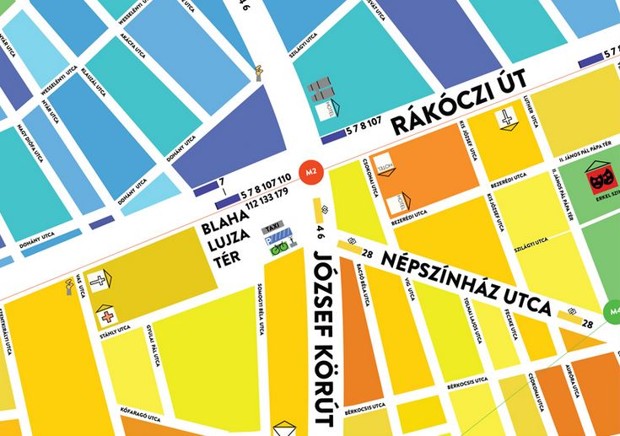
Economists were drawn to the Kanesh archive because it offered an unprecedented chance to see how well the Gravity Model applied in an economy entirely unlike our own. This was trade conducted via donkey, through a land of independent city-states whose legal and cultural systems were totally dissimilar to any we know. But still, the model held up: Ali Hortacsu, a University of Chicago economist on the Kanesh team, says that the trade figures between Assur and Kanesh matched the formula almost perfectly. ‘‘It was a very nice surprise,’’ he told me.

The Gravity Model may seem like bad news for people who want the economy to be fairer. I have spoken to countless activists and concerned friends who see global trade as a choice, something a specific set of politicians and businesses decided to impose on the rest of us, through all those confusing acronymic trade deals: GATT, Nafta and (probably, soon) the T.P.P. To me, though, the model suggests that these deals have less impact than either their boosters or their detractors imagine. There is a natural tendency for different regions to trade at fairly predictable volumes. However much politicians might want to change those outcomes, they have only crude tools at their disposal: They can stop trade through blockades, slow it through tariffs or try to jump-start it with trade agreements. What they can’t do, at least not reliably, is shape it with precision to achieve their preferred outcomes.

But despite trade’s intractability, we still have a lot of room to address the impact of trade on our economy. Trade with China and other nations may be all but inevitable, but growing wealth inequality and disproportionate pain (blue-collar workers losing their jobs, investors reaping a fortune) are not. There is much we can do within our borders to address the unequal impact of global trade. We can educate children for more competitive careers, train displaced workers for new industries or even directly compensate those who fail to benefit from global trade.

That, in fact, is what the people of Assur did, 4,000 years ago, as Barjamovic pointed out to me. Trade brought enormous wealth to a dozen or so families. But rather than hold all of it for themselves, the wealthy were made to redistribute a high percentage of their earnings through taxes and religious foundations that used the money for the public good. This way, the wealth created by trading with Kanesh made nearly everybody — at least every free citizen — better off.

26 Aug 18:07

Squeeze Your Way Across Town With the 'Egg Map'

by John Metcalfe
Image Dénes Sátor
Dénes Sátor

For the urban explorer with stress issues comes the Egg Map, a squishy ball you squeeze the heck out of to reveal roads, districts, and destinations.

The blobby oddity is a concept from Dénes Sátor, who appears to have designed only one model for his native Budapest. Still, if you ever find yourself lost in that charming city, the Egg Map is the clear way to go. It doesn’t require irksome folding like a paper map, and because its inert, rubberized body cannot connect to the Internet, hunting for wi-fi is a non-issue. Simply crush the ball to enlarge different parts of town, and plot a route while people stare at you for fondling what could be a freaky alien artifact.

Sátor plugs the orb’s assets on his Behance page (minor spelling issues corrected):

Haven’t we all lost our nerves at least once before by folding an oversized map during a sightseeing tour or when we went on a trek?…

Well, if you haven’t mastered your orientation skills and you fear that your precious smartphone will end up with a crack on its display on the ground, egg map’s the perfect gadget for you. It fits in your hand or your pocket and has manual zooming—just by squeezing it, you’ll get more details about the place than bumbling with a printed version of your information source.

Drop it, step on it, throw it against the wall—it’s simply indestructible thanks to its incredible flexibility. As it’s filled with 100% oxygen, you don’t have to worry about it making your bag heavier, either. To make it better, it’s made of water-proof material so you can use it even in unfriendly weather conditions like rain, wind, mud, or snow.

Backing the theory this thing is meant for tightly wound people, Sátor adds on Designboom it also can be “thrown at a wall or angry locals.” Just make sure you have another map, lest you wind up pursued down a dead-end alley by a furious man wanting to “return” the Egg down your throat.